Cryptocurrency analysis beyond price charts: market structure, regulatory developments, institutional adoption, tokenomics, and the technology reshaping digital finance and assets.
276 Arrested in Crypto Scam Crackdown: Billions Still at Risk | NeuralWired
Crypto SecurityMay 1, 2026 · 10 min read
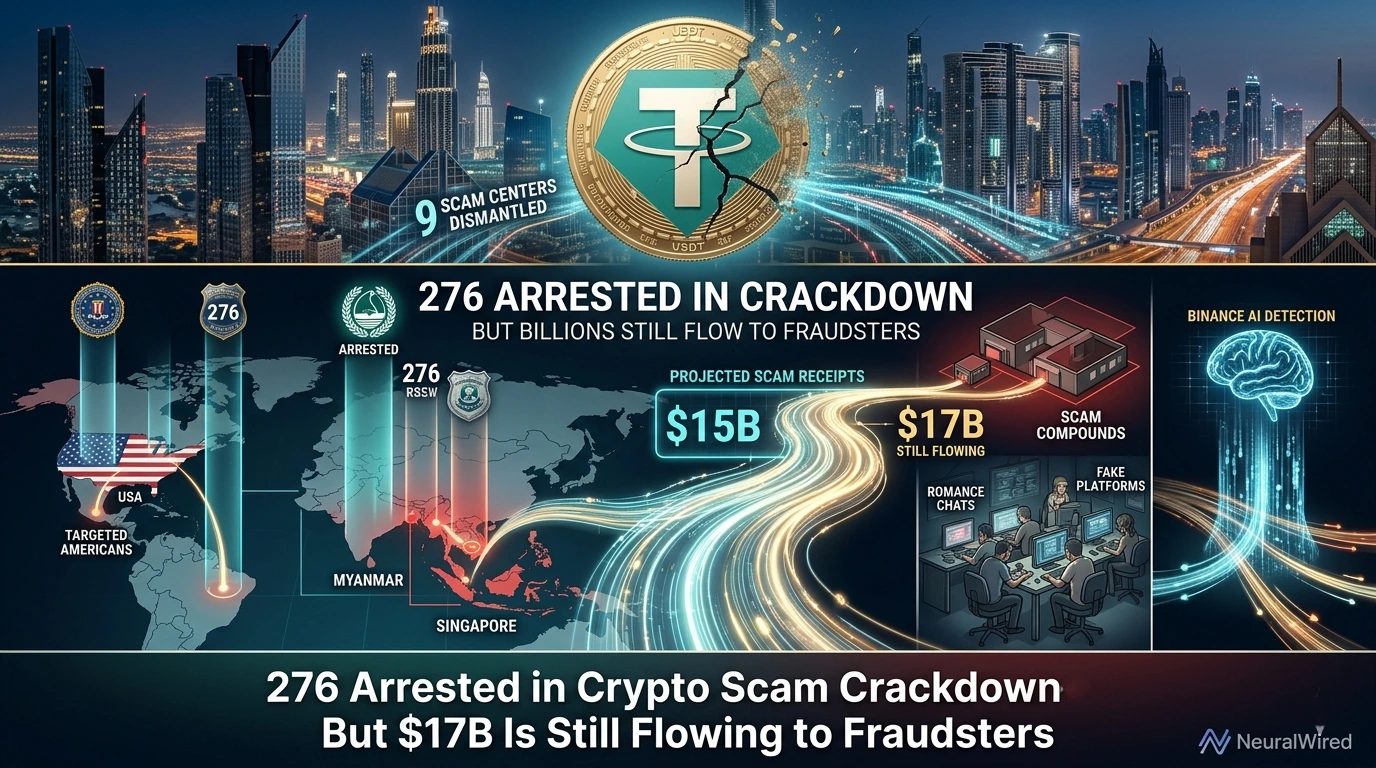
276 Arrested in Crypto Scam Crackdown — But $17B Is Still Flowing to Fraudsters
A sweeping international takedown dismantled nine pig-butchering scam centers and put 276 suspects in custody. Here’s what actually happened, why billions in losses continue, and the concrete steps that can protect you.
On April 28, 2026, law enforcement agencies across four countries announced one of the most coordinated crypto fraud busts ever attempted. Dubai Police, the FBI, the U.S. Department of Justice, and Chinese authorities jointly dismantled nine scam centers that had been running industrial-scale investment fraud operations targeting Americans. At least 276 suspects were arrested and federal charges were unsealed in San Diego against four named defendants from three distinct criminal syndicates.
This was a genuine enforcement win. But it landed against a backdrop that makes the win feel both significant and insufficient. The FBI’s 2025 Internet Crime Report recorded over $20.9 billion in cybercrime losses for the year, a 26% jump from 2024. Investment fraud alone drove $8.6 billion of that figure. And crypto-related complaints accounted for $11.4 billion.
Nine centers closed. Billions still flowing. The math demands a harder look at what’s actually working and what isn’t.
The Dubai-Led Operation: What Actually Happened
The operation, led by Dubai Police and executed with U.S. federal coordination, targeted three distinct criminal organizations running pig-butchering and fake crypto investment schemes from physical compounds across the Middle East and Southeast Asia. The charges unsealed by the Southern District of California named four defendants by name.
Thet Min Nyi, 27, a Burmese national, is alleged to have served as a manager and recruiter for Ko Thet Company. Wiliang Awang, 23, an Indonesian national, faces wire fraud conspiracy charges connected to the Sanduo Group. Andreas Chandra, 29, is charged with operating across both the Sanduo Group and Giant Company. Lisa Mariam, 29, another Indonesian national, is charged with wire fraud conspiracy tied to Giant Company. Two additional co-conspirators remain at large.
“These scammers thought they were safe half a world away. But their world has changed. Global crime now faces global justice.”
Adam Gordon, U.S. Attorney, Southern District of California — Town Hall, April 28, 2026
The DOJ framed this as part of a broader strategic posture. Assistant Attorney General A. Tysen Duva was direct about the intent: fraud networks operating abroad should expect to face American courts.
“Scam center organizers and fraudsters who defraud Americans and others will face justice in American courts and in courts around the world. In contemporary society, fraud is borderless, and law enforcement activity to combat it and eliminate it is as well.”
A. Tysen Duva, Assistant Attorney General, U.S. DOJ — Town Hall, April 28, 2026
Operation timeline: The FBI San Diego field office opened its Homeland Security Task Force investigation in April 2025. The U.S. Scam Center Strike Force was formally established in November 2025, the same month the DOJ seized $15 billion tied to the Prince Group, a criminal organization that had stolen billions through crypto investment fraud. The April 2026 arrests are the most visible public result of that 12-month effort.
How Pig-Butchering Actually Works
The term is deliberately jarring. In Chinese, the original phrase describes fattening a pig before slaughter. Victims are groomed over weeks or months before being financially wiped out. Understanding the mechanics is the first line of defense.
A stranger reaches out via text, dating app, or social media. Often framed as a “wrong number” mistake. Conversation is friendly, low-pressure, and consistent.
🤝
Phase 2: Grooming
Daily contact over weeks or months. Fabricated backstory, photos, and stories build trust. Emotional or romantic attachment develops before any financial topic is raised.
📈
Phase 3: The Pitch
The contact introduces a crypto investment opportunity. Victims are guided to a fake platform, shown fabricated profits, and encouraged to deposit more. Early “withdrawals” sometimes work to build confidence.
🔪
Phase 4: The Slaughter
When victims try to withdraw real money, they’re told to pay “taxes” or “fees.” The platform disappears, or access is blocked. Funds are already laundered across multiple wallets.
The DFPI’s guide notes that scammers will often ask victims to convert cash into crypto at an ATM or exchange, then transfer it to what appears to be a legitimate investment platform. That platform is controlled entirely by the fraud network.
Red flag checklist: Unsolicited contact from a stranger who quickly pivots to investment talk. A crypto platform you can’t verify through independent research. Any request to pay “fees” or “taxes” before you can withdraw profits. Pressure to act quickly or keep the investment secret from family members.
The human trafficking connection
One aspect that rarely gets enough attention: a significant share of the people running these scam operations are themselves victims. Workers are trafficked into compounds in Cambodia, Myanmar, and Laos, many lured by fake job advertisements, then forced to run fraud scripts under threat of violence. Chainalysis documented an 85% surge in crypto transactions linked to suspected human trafficking between 2024 and 2025. The compounds are frequently protected by local armed groups with sanctions designations from OFAC.
The Scale of the Problem in 2025 Numbers
The numbers from the FBI and Chainalysis tell a story that individual arrests can’t fully address. They also show where the real losses are concentrated, which matters for understanding where protection efforts should focus.
Metric
Figure
Source
Why It Matters
Total cybercrime losses (2025)
$20.9 billion (+26% YoY)
FBI IC3
Record year; pace accelerating beyond enforcement capacity
Investment fraud losses
$8.6 billion
FBI IC3
Single largest loss category; 49% of all scam incidents
Crypto-nexus complaint losses
$11.4 billion
FBI IC3
Crypto is the primary fraud payment rail
AI-enabled fraud losses
$893 million (22,000+ complaints)
FBI IC3
AI is scaling scam operations; deepfakes and voice cloning in active use
Crypto scam receipts (on-chain)
$17 billion (projected final)
Chainalysis
Up from $12B in 2024; impersonation and AI-enabled tactics surging
Total illicit crypto flows
$154 billion (+162% YoY)
Chainalysis
Sanctions exposure up 694%; institutional risk exposure growing
Crypto ATM losses (2025)
$333 million+
FBI
Nearly doubled from H1 pace; retail access a growing liability
DPRK-linked crypto theft
$2 billion+
Chainalysis
Nation-state actors dominating theft volume via DeFi exploits
“In 2025, cryptocurrency scams received at least $14 billion on-chain… Based on historical trends, we project that the 2025 figure could exceed $17 billion as we identify more illicit wallet addresses.”
Chainalysis Report Team — Chainalysis Crypto Scams 2026, January 12, 2026
The AI dimension deserves particular attention. The FBI’s IC3 team flagged that AI-enabled scams now represent a distinct and fast-growing threat category, with losses of $893 million from over 22,000 reported incidents in 2025 alone. Vectra AI’s security research suggests AI-driven scams surged 1,210% in 2025, far outpacing the 195% growth in traditional fraud methods, with projected losses potentially reaching $40 billion by 2027 if current trends hold.
How to Protect Yourself: A Practical Framework
The most effective protection combines skepticism at the point of contact, verification before any financial action, and an understanding of what legitimate crypto investment looks like versus what fraud looks like. None of this requires technical expertise.
Before you invest
Verify any investment platform independently using FINRA BrokerCheck, the SEC’s Investment Adviser Public Disclosure database, or the CFTC’s registration lookup. If the platform doesn’t appear in any regulatory database, treat it as fraudulent until proven otherwise.
Search the platform name alongside “scam,” “complaint,” or “review” on independent forums. Pig-butchering platforms rarely have any verifiable history before they appeared in your conversation.
Ask the contact to video call with you. AI deepfakes have improved dramatically, but sustained, unscripted video calls still expose inconsistencies that static photos can’t reveal. A refusal is a signal.
Talk to someone you trust in person before sending any funds. Scam compounds train their operators to isolate victims from family and friends specifically because outside input disrupts the operation.
At the transaction stage
Never send crypto to a wallet address given to you by someone you haven’t met in person and verified independently. Blockchain transactions are irreversible. There’s no dispute mechanism.
Be especially cautious with crypto ATMs. The FBI has flagged $333 million in crypto ATM losses for 2025. Legitimate investments don’t require you to use a convenience-store ATM.
If a platform asks you to pay fees, taxes, or insurance before releasing profits, stop. That’s a secondary extraction technique. Legitimate platforms don’t hold your money hostage behind fee payments.
Use an exchange with strong compliance standards. Platforms with real KYC processes and active fraud monitoring create meaningful friction for scam operations.
Report to the FTC at ReportFraud.ftc.gov. The FTC shares data with law enforcement agencies that have asset-freezing authority.
Contact your bank or exchange and provide the receiving wallet address. Exchanges cooperate with law enforcement and can sometimes freeze associated accounts.
Preserve all communication records: screenshots, chat logs, email threads. These are critical for both criminal complaints and any civil recovery attempt.
What the Industry Is Actually Doing
The enforcement story gets most of the headlines, but some of the most measurable progress on fraud reduction is happening at the exchange and analytics layer. The results from Binance and Chainalysis are worth examining in detail, because they show what scaled technical intervention looks like.
Binance deployed over 100 AI models across its compliance infrastructure in 2025, protecting 5.4 million users and blocking $6.69 billion in fraudulent activity in FY2025 alone. A simulation-based approach to phishing reduced their user phishing rate from 3.2% to 0.4%, an eightfold improvement. That’s not a minor optimization. That’s a structural shift in how fraud is intercepted before it reaches victims.
On the analytics side, Chainalysis demonstrated in April 2026 what proactive blockchain monitoring can accomplish at the victim level. Working with the Singapore Police Force over a month-long operation, they identified over 90 scam victims and prevented $2.86 million in losses using real-time on-chain analytics. The point isn’t the specific dollar figure. It’s the proof of concept: tracking where funds move before they’re fully laundered can interrupt the extraction process.
What “on-chain tracing” means practically: When a victim sends funds to a scam wallet, that transaction is recorded permanently on the blockchain. Analytics firms like Chainalysis and TRM Labs can map where those funds move next, often identifying consolidation wallets shared across multiple victims. When exchanges receive withdrawal requests from flagged wallets, they can freeze the transaction. The window is narrow, but it exists.
Why Enforcement Alone Falls Short
The Dubai operation arrested 276 people and shut down nine centers. That matters. But the structural conditions that make pig-butchering profitable remain almost entirely intact.
Stablecoins, particularly USDT, remain the primary fund-transfer mechanism. Tether has frozen $4.4 billion in addresses linked to fraud since it began cooperating with law enforcement, but new wallets are created constantly. The pseudonymous nature of crypto wallets combined with cross-border laundering routes through multiple intermediate wallets means that tracing funds to a recoverable asset takes time that operational fraud networks don’t give investigators.
The compounds themselves are the deeper problem. The armed groups that protect scam operations in Myanmar and Cambodia operate in jurisdictions where international arrest warrants carry limited practical weight. The Dubai operation worked partly because UAE law enforcement had both the authority and the political will to act. That combination doesn’t exist uniformly across Southeast Asia.
“Investment fraud remains the costliest scam, followed by business email compromise and tech support scams. AI-enabled scams are rapidly evolving, with IC3 receiving more than 22,000 complaints last year referencing AI, and adjusted losses exceed $893 million.”
FBI Cyber Division, IC3 Team — FBI 2025 IC3 Annual Report, April 5, 2026
AI is also changing the economics of fraud operations. Synthetic identity creation, voice cloning for phone-based verification bypass, and deepfake video for trust-building are all in active use. The Vectra AI research team documented a 1,210% surge in AI-enabled scams in 2025. Automation means fewer human operators are needed per victim, which means the per-arrest impact of law enforcement action is declining even as arrest numbers rise.
The recovery reality: The FBI’s IC3 has a Recovery Asset Team that works to freeze fraudulently transferred funds. But the window for recovery closes quickly once funds are converted to crypto and moved across wallets. Filing a complaint within 24 hours of discovering fraud is significantly more likely to result in recovery than filing a week later. Most victims discover the fraud only when they try to withdraw funds, which is often after multiple transfer stages have already occurred.
Frequently Asked Questions
What is a pig-butchering crypto scam?
A pig-butchering scam is a long-term investment fraud where criminals build a trust relationship with a victim over weeks or months, then lure them onto a fake crypto investment platform. Once the victim has deposited significant funds, the platform disappears and the money is laundered. The name comes from a Chinese term for fattening a pig before slaughter.
How much money did the 276 arrests crypto scam crackdown recover?
The April 2026 operation focused on arrests and dismantling physical scam centers rather than direct fund recovery. Related DOJ enforcement efforts did include a separate $15 billion seizure from the Prince Group in November 2025. Individual victim recovery depends on how quickly complaints are filed with the FBI’s IC3 after discovering fraud.
How can I tell if a crypto investment platform is legitimate?
Check for registration with the SEC, CFTC, or FINRA. Legitimate investment platforms are registered with financial regulators and have verifiable histories. Search the platform name alongside “complaint” or “scam” independently. If someone introduced you to the platform through an unsolicited relationship, that alone is a serious warning sign.
Can stolen crypto funds be recovered after a scam?
Recovery is possible but time-sensitive. The FBI’s Recovery Asset Team can freeze funds if a complaint is filed quickly, ideally within 24 to 72 hours of the transfer. On-chain analytics firms can trace funds across wallets, and exchanges with strong compliance programs can freeze accounts associated with flagged addresses. Full recovery is uncommon but partial recovery does occur.
What role does AI play in modern crypto scams?
AI is used to generate synthetic profiles, clone voices for phone verification bypass, create deepfake videos for trust-building, and automate the initial contact and grooming phases of scam operations. The FBI’s 2025 IC3 report logged over 22,000 AI-referenced fraud complaints with $893 million in losses, and AI-enabled scam incidents grew 1,210% in 2025.
Where should I report a crypto investment scam?
File immediately with the FBI’s Internet Crime Complaint Center at ic3.gov, and with the FTC at ReportFraud.ftc.gov. Also contact your bank or crypto exchange and provide the destination wallet address. Preserve all communication records. Report to your state financial regulator as well, since states like California actively track pig-butchering complaints through the DFPI.
Are crypto ATMs safe to use for legitimate transactions?
Crypto ATMs are legal and some people use them legitimately. But the FBI documented over $333 million in crypto ATM-related fraud losses in 2025, and scammers specifically direct victims to use them because transactions are fast and irreversible. If anyone online instructs you to use a crypto ATM to invest or send funds, treat that as a scam attempt.
Why do pig-butchering scams originate from Southeast Asia?
Criminal syndicates established large-scale scam compounds in Cambodia, Myanmar, and Laos where they operate with relative impunity, often under the protection of local armed groups. Many workers in these compounds are themselves trafficking victims, lured by fake job ads. Chainalysis documented an 85% increase in crypto transactions linked to suspected human trafficking between 2024 and 2025.
What Comes Next
The 276 arrests represent the largest coordinated takedown of pig-butchering networks targeting Americans. The DOJ’s Scam Center Strike Force, stood up in November 2025, is now showing its first major public results. That structural commitment to cross-border enforcement is new and meaningful.
But $17 billion in on-chain scam receipts in a single year doesn’t shrink through arrests alone. The most durable protection against pig-butchering fraud is personal: skepticism at first contact, verification before any financial action, and knowing the specific red flags that distinguish grooming from genuine connection. The four-phase scam structure is consistent enough across operations that recognizing Phase 2 before reaching Phase 3 remains the most effective individual defense available.
On the industry side, exchange-level AI detection and proactive blockchain analytics are showing measurable results. Binance’s 96% reduction in illicit fund exposure and Chainalysis’s real-time victim identification work show that technical infrastructure can interrupt fraud before it completes. The gap between what’s technically possible and what’s widely deployed is still large, but it’s narrowing.
The enforcement story will continue to develop. The two fugitive co-conspirators from the San Diego charges remain at large. The compounds in Myanmar and Cambodia operate under conditions that make arrest unlikely without sustained diplomatic pressure. And AI automation is lowering the cost of running scam operations faster than enforcement is raising it.
Watch For
01DOJ Scam Center Strike Force indictments through Q3 2026. The November 2025 Prince Group seizure and April 2026 arrests signal an active pipeline. More charges targeting mid-tier syndicate operators are likely within months.
02Tether and stablecoin issuer compliance expansion. With $4.4 billion already frozen by Tether in cooperation with law enforcement, regulatory pressure on stablecoin issuers to act faster on fraud-linked addresses is building. Policy changes here would have direct operational impact on scam laundering routes.
03AI deepfake detection requirements for crypto exchanges. The FBI’s AI-fraud data from 2025 is already prompting early-stage regulatory discussions about mandatory deepfake detection at the onboarding layer. How exchanges respond to those requirements will shape fraud exposure for retail investors through 2027.
04Crypto ATM legislative action at the state level. Following $333 million in 2025 ATM fraud losses, several U.S. states are actively considering daily transaction limits or enhanced verification requirements for crypto ATM operators. California and Minnesota are the jurisdictions to watch first.
Stay ahead of the curve.
More on crypto security, fraud, and digital finance at NeuralWired.
Bitcoin’s $80K Wall: Why 4 Rejections, $3B in ETF Inflows, and 818K BTC in Corporate Vaults Still Haven’t Broken It | NeuralWired
MarketsMay 1, 2026 · 10 min read
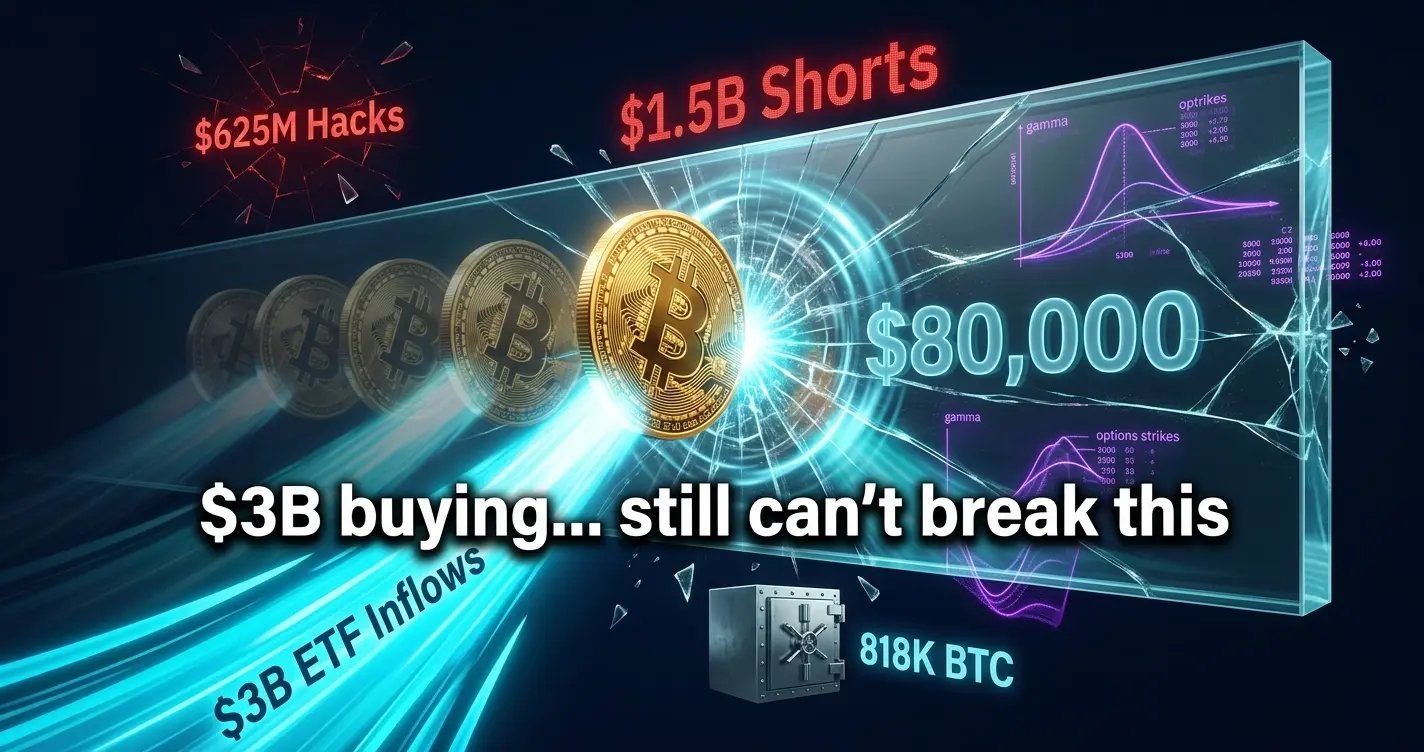
Bitcoin’s $80K Wall: Why 4 Rejections, $3B in ETF Inflows, and 818K BTC in Corporate Vaults Still Haven’t Broken It
Bitcoin has bounced off $80,000 four times since February. Institutions keep buying, exchange reserves sit at a six-year low, and prediction markets priced a May 1 close above $79,000 at just 22 cents. Something structural is holding the line.
Bitcoin traded between $78,000 and $78,700 on May 1, 2026, inching toward a resistance level that has now repelled four separate breakout attempts since February. The number is round, the psychology is obvious, and the mechanics are anything but simple. Beneath a deceptively flat price chart sits a coiled structure of options exposure, institutional order flow, and on-chain supply compression that makes $80,000 one of the most technically significant price points in this market cycle.
The week ending April 25 saw Bitcoin spot ETFs absorb a net $3.06 billion in fresh capital, the second-largest weekly inflow ever recorded, according to SoSoValue data. BlackRock’s IBIT alone pulled in $1.45 billion across those five trading days, pushing its lifetime net inflows past $41.2 billion. That buying wave didn’t push Bitcoin through $80,000. It got within $523 of the level and then reversed.
That reversal tells you more about what’s really happening than the inflow number does. This is a market where institutional demand is real, supply on exchanges has fallen to a six-year low of 2.3 million BTC, and yet a single price level keeps acting like a ceiling. Here’s why, and what it would actually take to change that.
The $80K Wall: Options, Gamma, and 7,200 BTC in Open Interest
The $80,000 level isn’t just psychologically significant. It carries real mechanical weight in the options market. According to analysis from crypto exchange Bittime, there are approximately 7,200 BTC worth of open interest clustered at or near the $80,000 strike, and the current gamma exposure at that level is positive, meaning options dealers are net short gamma and must sell into rising prices to stay hedged.
“BTC’s resistance level is at $80,000 [and] exceeding this level will trigger extreme volatility.”
On-chain analyst Murphy, cited by Bittime Research, April 27, 2026
What that means in practice: every time Bitcoin approaches $80,000, dealers sell to rebalance their books. The selling isn’t driven by conviction that the price is too high. It’s mechanical. Once price clears that level and moves into the zone above $81,000, however, the gamma flips negative. At that point dealers need to buy into rising prices, which can accelerate a move toward $82,000 and beyond with surprising speed. Bittime’s data puts the negative gamma zone at roughly 4,644 BTC of exposure above $81,000.
What is gamma exposure? Options dealers who sell calls must buy the underlying asset as prices rise to hedge their position. When gamma is positive (near a resistance strike), this hedging pressure works against the breakout. When gamma turns negative above that strike, the hedging pressure reverses and can amplify upward moves dramatically.
The April 24 intra-day high of $79,477 illustrated this exactly. Bitcoin came within half a percentage point of $80,000, touched that options resistance zone, and was sold back within hours. The rejection wasn’t a coincidence. It was the market’s options structure executing exactly as designed.
“Bitcoin must break $80,000 to exit consolidation and confirm a durable bullish regime.”
Bitfinex Research Desk, Bitcoin.com News, April 26, 2026
Bitfinex analysts have been consistent on this point since late April. Break the level with a weekly close above it, and the consolidation that began after Bitcoin’s February peak near $126,000 is structurally over. Fail again, and the range compresses further until something external forces a resolution. There’s also an estimated $1.5 billion in short positions that would be force-liquidated if Bitcoin clears $81,000, adding further fuel to any genuine breakout.
ETF Flows: A Record Week Followed by Three Days of Outflows
The $3.06 billion weekly inflow was genuinely exceptional. To put it in context, Bloomberg ETF analyst Eric Balchunas captured the trajectory well when the products first launched:
“If they can take in $22 billion when it’s raining, imagine when the sun is shining.”
Eric Balchunas, Senior ETF Analyst, Bloomberg, CryptoBriefing, January 5, 2026
That early-2026 optimism played out in April’s inflow numbers. But what the weekly headline obscured was a sharp reversal in the days that followed. After the record week ended April 25, flows turned negative almost immediately.
Date
ETF Flow
Notable
Apr 21-25 (week)
+$3.06B net inflows
Second-highest week on record; IBIT +$1.45B
Apr 27
-$263M outflows
Largest single-day outflow of the post-peak period
Apr 28
-$89.68M outflows
Fidelity FBTC shed 1,959 BTC in one session
Apr 29
-$112M (IBIT alone)
BlackRock’s flagship product posted its own net outflow day
Three consecutive days of outflows after a record inflow week is the kind of data point that gets lost in the narrative. It doesn’t invalidate the structural bull case. But it does confirm that institutional appetite, while real, is not an unlimited conveyor belt of buying pressure. When Bitcoin failed to reward the surge of April 21-25 capital with a breakout, some of that money came back out.
Flow reversal risk: For a sustained move above $80,000, analysts say ETF outflows need to flip back to consistent net positive territory. Three consecutive days of net selling after the second-biggest weekly inflow on record suggests momentum may need a fresh catalyst to reignite.
The early-2026 picture does offer longer-term reassurance. Bitcoin ETFs pulled in $1.2 billion across their first two trading days of 2026. If that pace had been sustained over a full year, total annual inflows would have annualized toward $150 billion. It didn’t sustain at that pace, obviously. But it established a demand floor that keeps showing up during any meaningful dip.
818,334 BTC: Corporate Accumulation as a Structural Floor
Strategy, the software company turned Bitcoin holding vehicle led by Michael Saylor, now holds 818,334 BTC. That’s approximately 4.2% of the total Bitcoin supply that will ever exist, sitting in a single corporate treasury. And the buying hasn’t stopped.
On April 20, Strategy added 34,164 BTC at an average price of $74,395, spending $2.54 billion in a single transaction. One week later, another 3,273 BTC for $255 million. The consistency of this accumulation, even at prices most retail buyers would consider elevated, does two things to the market. It removes coins from circulation. And it sets a psychological floor well below current trading prices.
🏛️
Strategy Holdings
818,334 BTC (~4.2% of total supply). Latest purchases averaged $74,395 per coin across two April transactions totaling $2.8B.
📉
Exchange Reserves
2.3 million BTC on exchanges, the lowest level in six years. Less available supply means larger price swings when demand spikes.
💰
Stablecoin Dry Powder
$317 billion in stablecoins, representing 11.73% of total crypto market cap. Potential buying power sitting on the sidelines.
📊
BTC Dominance
57.89% of the $2.65T total crypto market cap. Institutional preference keeps flowing toward BTC over altcoins.
The structural argument is straightforward: with exchange reserves at a six-year low and a single entity holding 4.2% of supply, the available float that could meet institutional demand is genuinely constrained. That’s the supply side of the equation. The demand side, as represented by ETF inflows, has shown it can generate $3 billion in a single week. When those two forces converge with a macro catalyst, the options market’s gamma structure above $80,000 turns from headwind to tailwind almost instantly.
“The $85,000 to $88,000 zone is not a fantasy number, and it sits right at the confluence of the 200-day simple moving average and the upper boundary of the resistance band.”
Michael van de Poppe, Independent Market Analyst, Phemex Research, April 29, 2026
April’s $625M Hack Storm: The Bearish Signal Nobody’s Talking About
The Drift Protocol exploit on April 1 drained $285 million from the Solana-based derivatives platform in one of the largest single DeFi hacks on record.
The KelpDAO attack on April 18, targeting a cross-chain bridge via LayerZero, extracted $293 million, briefly setting a new single-incident record before month-end tallies put it second behind Drift on impact.
The remaining 26-28 incidents collectively accounted for roughly $47 million, a figure that would dominate headlines in a quieter month but barely registered against April’s two landmark exploits.
Context: DeFiLlama’s confirmation of April 2026 as the most-hacked month by incident count doesn’t mean the DeFi ecosystem is collapsing. But $625 million in 30 days creates measurable headwinds for sentiment, particularly among institutional allocators who must justify exposure to their risk committees. This is a suppressive force on the upside that price charts alone don’t capture.
The timing matters. April’s hack wave coincided almost exactly with the peak ETF inflow week and the $79,477 rejection. Some portion of the selling pressure that knocked Bitcoin back from its high likely reflected DeFi participants moving funds off-chain or rotating to safer assets after major protocol failures. It’s impossible to isolate that effect precisely, but it’s also not credible to ignore it entirely.
The broader context is also troubling. The FBI reported $240 million lost to crypto ATM scams in just the first half of 2025, with total ATM-related fraud losses exceeding $333 million nationally. Tennessee has already passed legislation banning crypto ATMs entirely, effective July 2026, citing the FBI-linked fraud data. That’s a retail access restriction at a moment when institutional channels are expanding rapidly, which creates an asymmetric market structure that skews heavily toward sophisticated players.
Macro and Policy Backdrop: Risk-On, but Fragile
Bitcoin’s correlation with traditional risk assets has been consistent throughout this cycle. When equity futures rise, Bitcoin tends to follow. When the Federal Reserve tilts hawkish, crypto sells off. The current macro environment offers a cautiously supportive backdrop, but “cautious” is doing a lot of work in that sentence.
“Market conditions appear to be realigning with the broader status quo, particularly around Fed expectations. After a brief wobble driven by a hawkish tilt that unsettled risk assets, the market is once again leaning toward accommodation.”
Joel Kruger, Strategist, LMAX Group, Finance Magnates
Kruger’s observation describes the macro mechanism that keeps reasserting itself: whenever the Fed signals even a modest lean toward easier conditions, risk assets including Bitcoin catch a bid. The current setup mirrors that pattern. Bitcoin has recovered 30% from its cycle low of $60,000, and the global crypto market cap sits at $2.65 trillion to $2.7 trillion as of May 1, up more than 2% in 24 hours. That’s not explosive. But it’s directional.
Ethereum traded at $2,280 on May 1, up roughly 1.06% on the day, with an intra-day range of $2,260 to $2,300. Ethereum’s relative underperformance against Bitcoin, whose dominance now stands at 57.89%, reflects a consistent theme of this cycle: institutional capital flows into BTC first, altcoins second. Until Bitcoin establishes a clear new range above $80,000, that capital hierarchy is unlikely to shift.
Market snapshot, May 1, 2026: Bitcoin ~$78,000-$78,700 (+2-3% 24h). Ethereum $2,280 (+1.06%). Global crypto market cap $2.65T-$2.7T. BTC dominance 57.89%. BTC market cap $1.56T. Stablecoin market cap $317B (11.73% of total). Sources: CoinGecko.
The prediction markets offered their own probability assessment on May 1. Robinhood’s Bitcoin price event contracts priced a 5pm EDT close at or above $78,000 at 71 cents, above $78,500 at 43 cents, and above $79,000 at just 22 cents. Sophisticated traders put the probability of challenging the $80,000 resistance zone by end of day at roughly one in five.
3 Scenarios for May: Breakout, Grind, or Reversal
Analyst CF Benchmarks’ Gabe Selby framed the decision point plainly in late April: “$80K could be reached within days, though failure to break $88K may trigger renewed consolidation.” That’s the May range in a single sentence. What determines which scenario plays out?
Scenario
Trigger
Price Target
Key Risk
Breakout
Weekly close above $80K + ETF outflows reverse; $1.5B short squeeze ignites above $81K
$82K-$88K (van de Poppe’s 200-DMA confluence zone)
Gamma flip to negative above $81K creates vol spike; macro shock could kill momentum mid-run
Grind
ETF flows remain mixed; no macro catalyst; range-bound $74K-$80K continues
$76K-$80K through May
Prolonged compression increases the probability of a violent resolution in either direction
Strategy’s average cost basis near $74K provides a structural defense; below that gets ugly
Phemex’s market analysts laid out three specific conditions they say must all be met for a sustained push toward $88,000: ETF inflows need to return to net positive and stay there for at least a week; the macro environment needs to hold its current risk-on posture without a Fed shock; and on-chain data needs to confirm that long-term holders aren’t distributing into strength. Two of those three conditions were borderline as of May 1. The third, on-chain holder behavior, remains constructive.
The short-squeeze element adds a non-linear dimension to any breakout. An estimated $1.5 billion in short positions sit above current prices, clustered most densely between $80,000 and $82,000. A clean break above $80,000 that forces even a portion of those positions to close at a loss doesn’t just add buying pressure. It removes selling pressure simultaneously, which is why breakouts from ranges like this can happen faster than even optimistic forecasts anticipate. The options-driven negative gamma above $81,000 amplifies that further.
Frequently Asked Questions
Why does Bitcoin keep failing to break $80,000?
The $80,000 level carries significant options market resistance, with roughly 7,200 BTC in open interest at that strike. Options dealers must sell into rallies approaching $80,000 to stay hedged, creating mechanical selling pressure that doesn’t reflect fundamental bearishness. Once price clears that level, the dynamic reverses.
How much did Bitcoin ETFs bring in during April 2026?
The week of April 21-25 saw Bitcoin spot ETFs record $3.06 billion in net inflows, the second-highest weekly total ever. However, three consecutive days of net outflows followed: $263 million on April 27, $89.68 million on April 28, and $112 million from BlackRock’s IBIT alone on April 29.
How much Bitcoin does Strategy (formerly MicroStrategy) hold?
As of late April 2026, Strategy holds 818,334 BTC, representing approximately 4.2% of Bitcoin’s total eventual supply. The company added 34,164 BTC at an average of $74,395 on April 20 and 3,273 BTC one week later, spending roughly $2.8 billion across two purchases.
What happened with crypto hacks in April 2026?
April 2026 became the most-hacked month in crypto history by incident count. DeFiLlama confirmed 28 to 30 separate exploits totaling more than $625 million stolen. The Drift Protocol exploit ($285 million) and KelpDAO exploit ($293 million) accounted for 93% of losses.
What is a short squeeze and why does it matter at $80K?
A short squeeze occurs when rising prices force traders who bet against an asset to buy it back to limit losses. Approximately $1.5 billion in short positions are estimated above current Bitcoin prices. If Bitcoin clears $81,000, forced short-covering adds significant upward momentum on top of normal buying pressure.
What price targets are analysts citing for Bitcoin in May 2026?
Independent analyst Michael van de Poppe cites $85,000-$88,000 as a realistic target if Bitcoin breaks $80,000, based on the 200-day moving average and resistance band confluence. CF Benchmarks analyst Gabe Selby noted $80,000 could be reached within days but cautioned that failure to clear $88,000 risks renewed consolidation.
Is Bitcoin’s dominance rising or falling in 2026?
Bitcoin dominance sits at 57.89% of total crypto market cap as of May 1, 2026, with a market cap of $1.56 trillion out of a total $2.65-$2.7 trillion global crypto market. Institutional preference for BTC over altcoins continues to support its dominant share of flows.
What is the Tennessee crypto ATM ban and what does it signal?
Tennessee passed legislation banning crypto ATMs, effective July 2026, citing FBI data linking machines to fraud. The FBI reported $240 million in ATM-related scam losses in the first half of 2025 alone, with total losses exceeding $333 million nationally. Tennessee’s move is an early signal of a broader retail-channel restriction trend as institutional access expands.
What Comes Next
The honest read on Bitcoin’s position at the start of May 2026 is that the bulls have done almost everything right and still can’t close above $80,000. Institutional flows hit a near-record. Corporate treasury buying continued at scale. Exchange supply compressed to multi-year lows. The macro backdrop shifted toward risk-on. And Bitcoin topped out at $79,477 before reversing.
That’s not a failure of the bull case. It’s the bull case colliding with a specific, well-defined structural obstacle. Options market mechanics, not fundamental disagreement about Bitcoin’s value, are the primary force keeping price below $80,000. That’s both reassuring and frustrating: reassuring because the resistance is finite and mechanical rather than sentiment-based, frustrating because it can persist indefinitely until a catalyst with enough force to overwhelm the gamma wall shows up.
The April hack data adds a layer of complexity that most price-focused analysis ignores. Losing $625 million across 30 incidents doesn’t just affect the protocols and users directly hit. It shapes the risk conversation inside institutional treasury and compliance teams evaluating crypto allocations. If April’s security picture carries into May, it limits the marginal institutional buying that could provide the catalyst the price needs.
One other data point is worth keeping in mind: $317 billion in stablecoins sits on the sidelines, representing 11.73% of total crypto market cap. That’s buying power looking for a reason to deploy. If Bitcoin provides that reason, in the form of a clean weekly close above $80,000 with ETF outflows reversing, the chase toward van de Poppe’s $85,000-$88,000 target zone could compress into a matter of days rather than weeks.
Watch For
01Weekly ETF flow data (released each Monday): a return to consistent net positive after three straight outflow days is the clearest leading indicator of renewed institutional conviction heading into mid-May.
02Options expiry dates in May: large monthly expirations reset gamma exposure at key strikes. A post-expiry gamma reset could make $80,000 meaningfully easier to clear as dealer hedging pressure temporarily lifts.
03Federal Reserve communication: any signal of rate flexibility or easing bias is the macro catalyst most likely to trigger the institutional buying wave that overwhelms $80,000’s options resistance in a single session.
04May DeFi security data: if April’s 30-incident hack pace continues into May, it will keep a measurable drag on sentiment at precisely the moment price needs clean momentum to break a three-month ceiling.
Stay ahead of the curve.
More Bitcoin market analysis and crypto intelligence at NeuralWired.
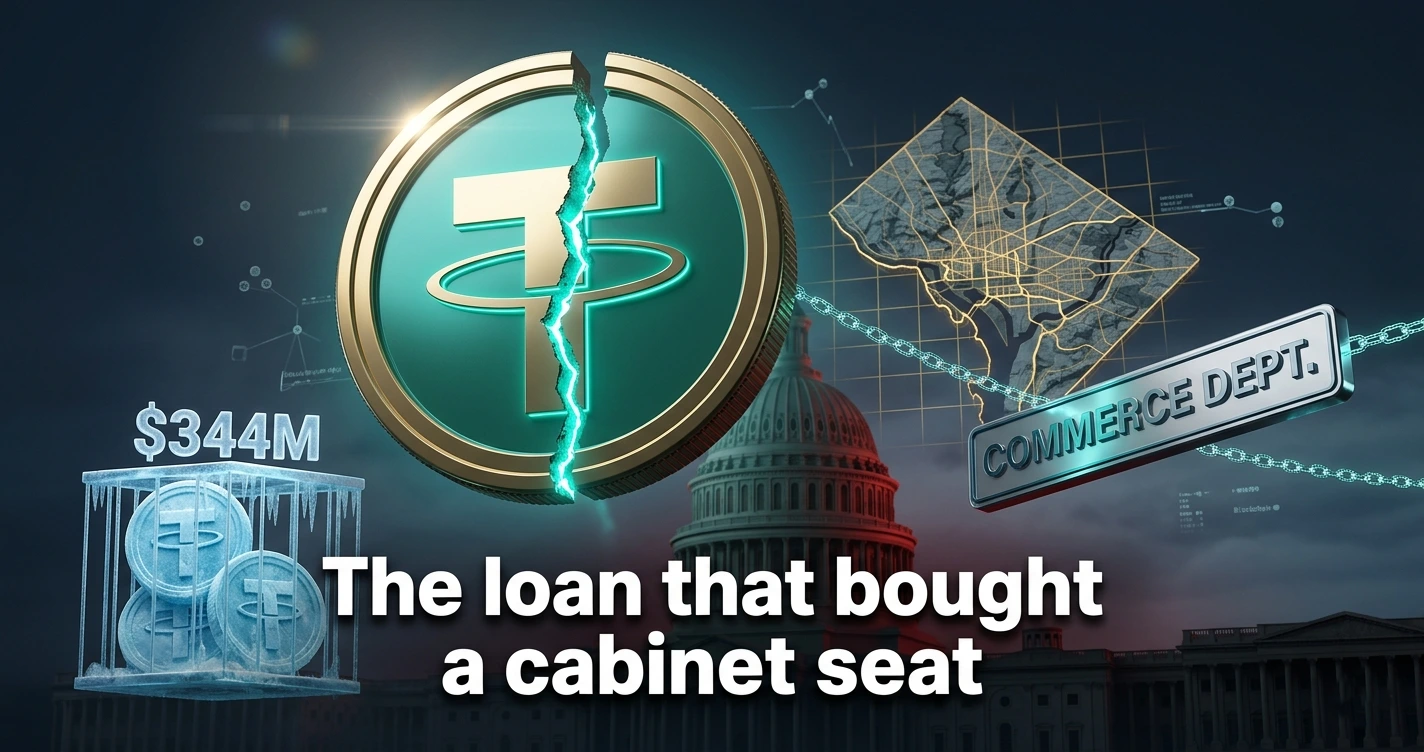
Senators Warren and Wyden Launch 4th Probe Into Tether’s $191B Empire and Its Ties to Commerce Secretary Lutnick
A reported loan from the world’s largest stablecoin issuer to a trust benefiting Howard Lutnick’s children has triggered a fresh congressional investigation — arriving the same week Tether froze $344 million linked to Iran.
Two of Washington’s most aggressive crypto skeptics aren’t done with Tether. On April 29 and 30, 2026, Senators Elizabeth Warren and Ron Wyden sent letters to Commerce Secretary Howard Lutnick and Tether CEO Paolo Ardoino demanding details about a reported loan that allegedly helped Lutnick satisfy his federal divestiture requirements. The letters mark what watchdog journalists are calling the fourth congressional inquiry into the Lutnick-Tether relationship — and they arrive at a politically charged moment.
Just days before the letters landed, the U.S. Treasury Department announced that Tether had frozen $344 million in USDT tied to addresses the government says are connected to the Central Bank of Iran. Treasury Secretary Scott Bessent publicly praised the move. That the same company faces both bipartisan acclaim on sanctions enforcement and a Democratic-led ethics investigation underscores how complicated Tether’s Washington story has become.
Tether now issues more than $191 billion in USDT, representing a 58% share of the entire stablecoin market. It isn’t a niche cryptocurrency project. It’s a financial infrastructure company whose decisions affect markets, sanctions enforcement, and — if the senators’ concerns prove well-founded — the policy agenda of a sitting cabinet official.
The Fourth Probe: What Warren and Wyden Are Asking
The letters Warren and Wyden sent aren’t fishing expeditions. They’re precise. The senators want to know whether Tether provided a loan to a trust set up for Lutnick’s four children, whether that loan facilitated his court-mandated divestiture from Cantor Fitzgerald, and whether Lutnick has maintained any communication with Tether or its executives since his Senate confirmation. They also want documents.
“It is critical that you make decisions because they are in the best interest of the American public, not in the financial interest of your family or Tether.”
Senator Elizabeth Warren, Ranking Member, Senate Banking Committee — Letter to Secretary Howard Lutnick, April 30, 2026
Warren didn’t stop there. She spelled out the conflict of interest in plain terms: if reports of the loan are accurate, she wrote, they “would raise serious questions about the relationship between Secretary Lutnick and Tether, and the influence of Tether on Mr. Lutnick’s policy decisions.” It’s the kind of framing that tends to follow officials into confirmation hearings — or impeachment proceedings.
Wyden, who chairs the Senate Finance Committee, co-signed the letters. This was their third joint action against Lutnick in under a year. In August 2025, the two senators had already demanded that Cantor Fitzgerald disclose tariff-refund agreements it allegedly held. The pattern of escalation is deliberate.
Timeline of investigations: Aug 2025 — Warren and Wyden demand Cantor tariff-refund disclosures. Jan 29, 2025 — Lutnick testifies before the Senate Commerce Committee on Tether involvement. April 29-30, 2026 — Fourth probe launched via letters to Lutnick and Ardoino.
The Commerce Department responded with a familiar line: Lutnick has complied with all applicable ethics rules. That may be legally accurate. It doesn’t answer the underlying question about whether a loan from Tether to a family trust — even an indirect one structured through a blind trust — creates an ongoing financial relationship that shapes policy.
The Loan at the Center of It All
The core allegation traces back to a Bloomberg report from October 2025. According to that reporting, when Lutnick was required to divest his multibillion-dollar stake in Cantor Fitzgerald upon his nomination as Commerce Secretary, a loan from Tether helped facilitate the transaction. The stake was transferred into a trust for Lutnick’s children. Tether, Bloomberg reported, provided the financing that made the structure work.
Neither the loan amount nor its terms have been publicly disclosed. Warren’s letter notes the amount “likely reached millions” based on the scale of the Cantor Fitzgerald valuation. Tether has neither confirmed nor denied the loan’s existence in public statements. Ardoino did not respond to press inquiries before this article’s publication.
“If reports of this loan are accurate, it would raise serious questions about the relationship between Secretary Lutnick and Tether, and the influence of Tether on Mr. Lutnick’s policy decisions.”
Senator Elizabeth Warren — Letter to Commerce Secretary Howard Lutnick, April 29, 2026
The timing matters. Lutnick now sits on the President’s Working Group on Digital Assets. Tether’s U.S.-focused stablecoin product, USAT, launched while Lutnick was already in office. Ardoino attended the White House signing of the GENIUS Act, the stablecoin regulatory framework that Tether had publicly advocated for. Whether any of those outcomes were influenced by the reported financial relationship is exactly what Warren and Wyden want documents to resolve.
Unconfirmed: The loan amount, terms, collateral, and interest rate have not been publicly disclosed. The loan itself has not been independently verified beyond Bloomberg’s original reporting. Tether and the Commerce Department have not confirmed or denied its existence.
How the Divestiture Structure Works
Federal ethics rules require cabinet nominees to divest assets that could create conflicts of interest. Lutnick’s Cantor Fitzgerald stake ran into the billions. A direct sale would have triggered significant tax consequences. Transferring the stake to a trust for his children while securing outside financing — if that’s what happened — is a structure that ethics experts say can technically comply with divestiture requirements while preserving family wealth. It can also preserve relationships, which is precisely the senators’ concern.
$344 Million Frozen: Tether’s Iran Enforcement Action
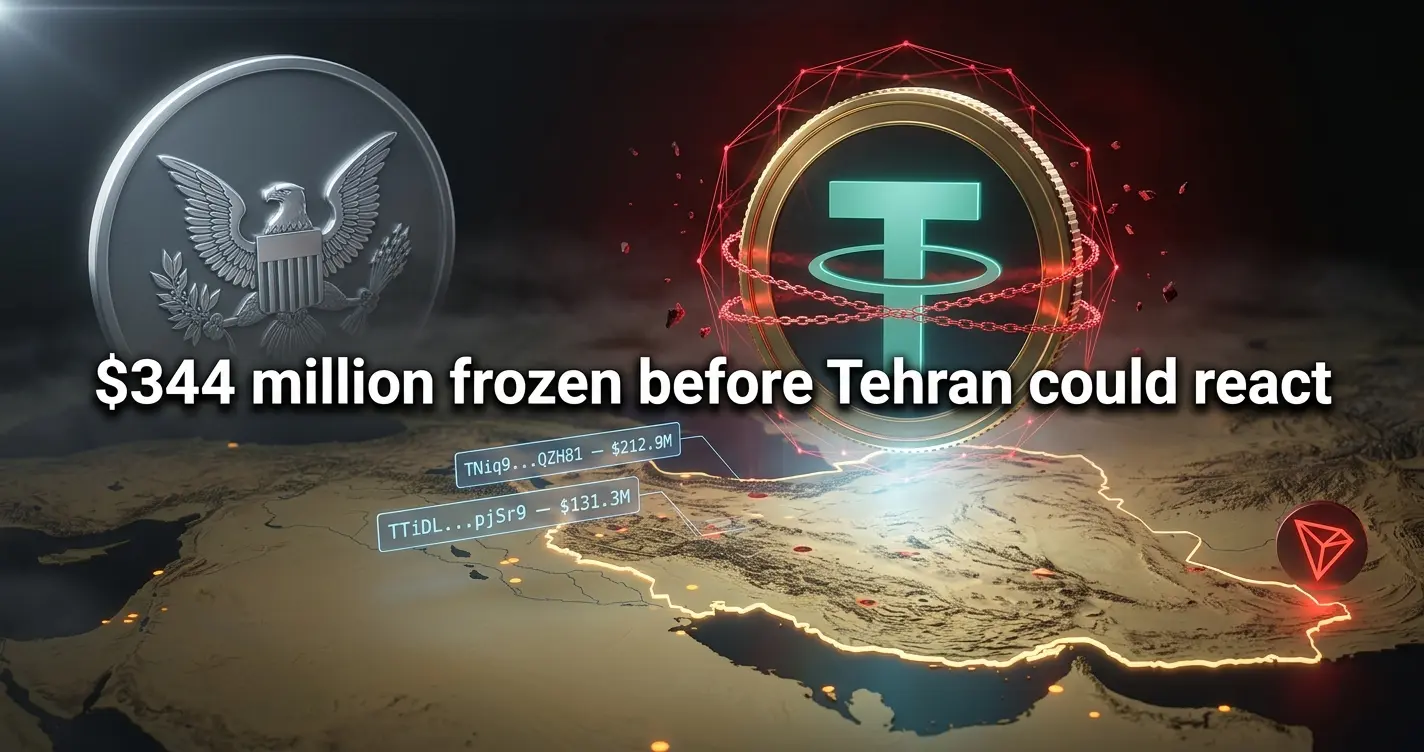
April 23, 2026 was a busy day for Tether’s compliance team. The company, working alongside U.S. authorities, froze two Tron blockchain addresses holding a combined $344 million in USDT. The Treasury Department said the funds were connected to the Central Bank of Iran and were being used to evade U.S. sanctions.
“We will follow the money that Tehran is desperately attempting to move outside of the country and target all financial lifelines tied to the regime.”
Scott Bessent, U.S. Treasury Secretary — Treasury Department press statement, April 23, 2026
The mechanics of the freeze are worth understanding. Tether’s USDT smart contracts include a blacklist function that allows the company to freeze specific wallet addresses at the protocol level. Once frozen, funds can’t be moved. The two addresses in this case held $213 million and $131 million respectively, both on the TRON network, which carries roughly 42% of all circulating USDT, or about $78 billion.
Three days later, on April 26, OFAC updated its Central Bank of Iran designation to reflect the blockchain activity Tether’s freeze had surfaced. The U.S. government confirmed it had detected, through blockchain analytics, “material connections to the Iranian regime, including verified transactions with Iranian exchanges and a series of transfers routed through intermediary addresses interacting with wallets associated with the Central Bank of Iran.”
🔒
Total Frozen
$344 million in USDT frozen across two Tron addresses linked to Iran sanctions evasion.
🇮🇷
Iran Nexus
OFAC confirmed verified transactions with Iranian exchanges and Central Bank of Iran-linked wallets.
🌐
Enforcement Reach
Tether works with 340-plus law enforcement agencies across 65 countries on financial crime cases.
⛓️
Tron Network
TRON carries 42% of all USDT supply, with $20-30 billion in daily transfer volume.
The enforcement action is Tether’s largest single freeze on record. It’s also politically useful for the company. Demonstrating active cooperation with Treasury on sanctions enforcement while simultaneously facing a Senate ethics probe over Lutnick allows Tether to argue that it’s a compliant, government-aligned operator — not a rogue stablecoin issuer.
Tether’s Reserve Picture in 2026
Critics have spent years questioning whether Tether actually holds the assets backing its USDT supply. The company’s position has shifted considerably since its commercial-paper era. Today, Tether’s published reserve breakdown shows more than $122 billion in U.S. Treasury Bills, roughly 83% of its total reserve base.
Reserve Component
Amount / Share
Notes
U.S. Treasury Bills
$122B+ (83.11%)
Largest single asset class; short-duration government paper
Cash and Cash Equivalents
76.31% of liquid assets
Includes overnight repos and money market instruments
Corporate Bonds
0%
Eliminated entirely after 2022 pivot away from commercial paper
Gold and Bitcoin
Small percentage
Held as supplementary collateral alongside surplus equity
Surplus Equity
Billions (undisclosed)
Retained earnings above 1:1 backing ratio
The pivot away from commercial paper began in 2022, when Tether held roughly $8.4 billion in corporate debt instruments that drew sustained criticism from analysts and regulators. That’s all gone now. The shift to Treasury Bills is significant: short-duration U.S. government paper is the most liquid, most transparent asset class available. If Tether needed to redeem USDT quickly, T-bills are easy to sell.
That said, Tether still publishes attestations rather than full audits. The distinction matters. An attestation confirms that a snapshot of assets matched liabilities at a specific moment. A proper audit examines internal controls, the validity of asset ownership documentation, and whether the accounting reflects economic reality. The company has been promising a full audit for years. None has materialized.
Attestation vs. Audit: Tether publishes quarterly reserve attestations from accounting firms. These are not equivalent to a full financial audit. Former SEC enforcement officials have noted that attestations cannot independently verify asset ownership chains or detect potential undisclosed liabilities.
Despite that gap, USDT’s market position keeps growing. As of May 1, 2026, circulating supply sat at approximately $191.1 billion. The stablecoin’s peg held at $0.99971, essentially unchanged despite the headlines. Bitcoin, trading near $75,600 to $76,000 on the same day, showed muted momentum, its price partly weighted by broader market uncertainty around the investigation’s coverage.
Who Has What at Stake
This story isn’t just about one company and one senator. Multiple institutions are navigating overlapping interests, and the outcome of the probe could reshape U.S. stablecoin regulation.
Investigation produces nothing; political capital spent
U.S. Treasury / OFAC
Sanctions enforcement effectiveness
Tether continues freezing illicit funds as enforcement partner
Conflict of interest narrative undermines Treasury credibility
Crypto Traders and Exchanges
USDT liquidity and peg stability
Probe resolves without affecting market confidence
Peg stress or exchange delistings trigger market disruption
Tether’s position in the stablecoin market isn’t secure by default. Circle’s USDC has gained ground in compliant institutional markets, and TRM Labs data from March 2026 shows USDC holds about 64% of the combined adjusted transaction volume in regulated settings. If U.S. stablecoin legislation passed with provisions that made Tether’s offshore structure noncompliant, the company’s American market access could narrow quickly.
Coinbase CEO Brian Armstrong hinted in early 2026 that exchanges might be required to delist Tether under certain regulatory scenarios. Tether’s response has been to accelerate its compliance portfolio, the Iran freeze, the MOS mining OS open-sourcing, the USAT U.S. stablecoin, to build a track record of cooperation before any binding rules take effect.
Meanwhile, the Bitcoin mining vertical is expanding. Tether Investments has proposed merging Strike, the Bitcoin payments company led by Jack Mallers, with Twenty One Capital and bitcoin miner Elektron Energy. Elektron controls around 50 exahashes per second of mining capacity, roughly 5% of the entire Bitcoin network hashrate. Mallers publicly supported the proposal on April 28, 2026. If completed, Tether would have interests spanning stablecoin issuance, U.S. payments infrastructure, and industrial-scale Bitcoin mining.
“Successful treasury companies need amazing operational businesses.”
Paolo Ardoino, CEO, Tether — CoinMarketCap Academy interview, December 2025
Frequently Asked Questions
What is the Tether loan to Lutnick’s family trust?
Bloomberg reported in October 2025 that Tether provided a loan to a trust set up for Commerce Secretary Howard Lutnick’s four children, which allegedly helped him satisfy his federal divestiture requirement from Cantor Fitzgerald. Neither the loan amount nor its terms have been officially confirmed. Senators Warren and Wyden are demanding documentation.
Why did Tether freeze $344 million in USDT?
On April 23, 2026, Tether froze two Tron blockchain addresses holding $344 million in USDT at the request of U.S. authorities. Treasury and OFAC said the funds were connected to the Central Bank of Iran and were being used to evade U.S. sanctions. OFAC updated its Iran designation on April 26 to reflect the findings.
How big is Tether’s USDT in 2026?
As of May 1, 2026, Tether had approximately $191.1 billion in USDT in circulation, representing about 58% of the total stablecoin market. The overall stablecoin market stands at roughly $316 billion across all issuers.
Is Tether’s USDT fully backed by real assets?
Tether publishes quarterly reserve attestations showing more than $122 billion in U.S. Treasury Bills and additional liquid assets. However, these are attestations, not full financial audits. Critics note that attestations can’t independently verify ownership chains or rule out undisclosed liabilities. No independent audit has been completed.
What is the GENIUS Act and how does it affect Tether?
The GENIUS Act is U.S. stablecoin legislation that Tether has publicly supported. CEO Paolo Ardoino attended the White House signing ceremony. The bill would create a legal framework for stablecoin issuers, potentially legitimizing Tether’s U.S. operations while setting compliance standards it would need to meet.
Can Tether freeze USDT in any wallet?
Yes. Tether’s USDT smart contracts include a blacklist function that allows the company to freeze specific addresses at the protocol level. This capability has been used in law enforcement cooperation cases. Tether says it works with more than 340 agencies across 65 countries. Critics argue this power makes USDT not truly decentralized.
What is Howard Lutnick’s role in crypto policy?
As Commerce Secretary, Howard Lutnick sits on the President’s Working Group on Digital Assets. Before his nomination, he ran Cantor Fitzgerald, which had financial ties to Tether including reported U.S. Treasury custody arrangements. His divestiture structure is now under investigation by the Senate.
What is Twenty One Capital and why does it matter?
Twenty One Capital is a Tether-backed Bitcoin holding company. Tether Investments has proposed merging it with Strike, the Bitcoin payments company, and Elektron Energy, a Bitcoin miner controlling roughly 5% of network hashrate. If completed, it would give Tether interests across stablecoin issuance, U.S. payments, and industrial mining.
What Comes Next
The fourth probe into Tether’s Washington ties is, at its core, about two questions that have never been cleanly answered: Does a financial relationship between a stablecoin issuer and a cabinet official constitute a conflict of interest under federal ethics law? And if it does, who, exactly, enforces that?
Warren and Wyden have the oversight authority to demand documents. They can’t compel criminal charges. Whether the Justice Department or the Office of Government Ethics pursues the matter further depends on what those documents actually show. Lutnick’s team says he complied with all required disclosures. The senators say the disclosures they’ve seen don’t answer their specific questions about the reported loan.
Tether, for its part, isn’t standing still. It’s building compliance infrastructure, cooperating on sanctions enforcement, expanding into Bitcoin mining, and pushing for regulatory frameworks it helped draft. The company’s strategy seems to be making itself too useful, and too deeply embedded in U.S. financial infrastructure, to target aggressively. Whether that strategy holds up against a sustained Senate investigation is a different matter. The documents Warren and Wyden are demanding have deadlines attached. The answers, when they come, will determine whether this is a fourth probe or the beginning of something much larger.
Watch For
01Document response deadlines from Lutnick and Ardoino, the senators set specific timelines in their April 29-30 letters. Non-compliance or redacted responses will escalate pressure significantly.
02GENIUS Act progress in Congress, if the bill moves to a floor vote, expect Warren and Wyden to use the Lutnick-Tether probe as a centerpiece argument for stricter conflict-of-interest provisions in stablecoin law.
03Tether’s proposed merger of Strike, Twenty One Capital, and Elektron Energy, regulatory review of a deal combining Bitcoin payments, mining, and stablecoin interests could draw antitrust and securities scrutiny on top of the existing Senate inquiry.
04USDT peg stability, despite holding firm at $0.99971 on May 1, 2026, any major exchange signaling a review of Tether’s listing status could trigger a stress test of its reserve redemption capacity.
Stay ahead of the curve.
More crypto policy, stablecoin analysis, and blockchain regulation coverage at NeuralWired.
$344M Iran-Linked Crypto Frozen: How Tether Became a Sanctions Weapon | NeuralWired
Crypto & PolicyApril 25, 202612 min read
$344M Frozen: How Tether Just Became America’s Sharpest Sanctions Weapon
The U.S. Treasury froze $344 million in USDT tied to Iran’s central bank and the IRGC. The method was precise, fast, and unprecedented. Stablecoin issuers are now doing what traditional banks can’t.
NW
NeuralWired Staff
Crypto & Policy Desk
On the afternoon of April 23, 2026, Tether announced it had frozen $344.2 million in USDT across two Tron blockchain addresses, acting in coordination with the U.S. Treasury’s Office of Foreign Assets Control (OFAC). Hours later, Treasury Secretary Scott Bessent confirmed the action on X, framing it as part of “Operation Economic Fury,” a campaign targeting Iran’s financial infrastructure. By the following morning, blockchain analytics firms had mapped the wallets down to individual transaction flows. The entire operation, from designation to freeze, took less than a day.
That speed is the story. In traditional finance, asset freezes mean calls to correspondent banks, legal filings across multiple jurisdictions, and weeks of back-and-forth. With centralized stablecoins, a single function call in a smart contract locks $344 million before anyone on the other side can move a dollar. This is a structural advantage traditional sanctions enforcement has never had.
The action also raises a more uncomfortable question: when a private company based in the British Virgin Islands holds the technical authority to freeze hundreds of millions of dollars on behalf of the U.S. government, what exactly has changed about how financial power works?
$344M
Total USDT frozen in one action
$370M
Total inflows across ~1,000 transactions since 2021
$7.78B
Iran’s 2025 crypto ecosystem value
$4.4B+
Tether’s total all-time frozen assets
Operation Economic Fury: What Actually Happened
The two wallets at the center of this action had been quietly accumulating funds since March 2021. TRM Labs, which provided the blockchain intelligence supporting the designation, traced roughly $370 million in total inflows across approximately 1,000 transactions over that four-year span. The wallets then went largely dormant by 2023, with minimal outbound transfers. One wallet moved less than $16 million out; the other saw over $228 million in inflows with almost no corresponding exits. These weren’t spending wallets. They were vaults.
OFAC tied both addresses to the Central Bank of Iran (CBI) and, through transaction graph analysis, to the Islamic Revolutionary Guard Corps (IRGC). A U.S. official speaking to CNN confirmed the connections, describing “substantial ties to the Iranian regime, including verified transactions through intermediary addresses interacting with CBI-associated wallets.” Blockchain analytics firm PeckShield independently confirmed the wallet breakdown: $212.9 million in the first address (Tron address TNiq9…QZH81) and $131.3 million in the second (TTiDL…pjSr9).
January 2026 had already signaled the escalation was coming. That month, OFAC sanctioned two Iranian cryptocurrency exchanges, Zedcex and Zedxion, marking the first time the U.S. had formally designated Iranian digital asset platforms for IRGC ties. The April action moved from exchange-level designation to sovereign wallet-level targeting. The progression is deliberate.
“Treasury’s OFAC is sanctioning multiple wallets tied to Iran, resulting in the freeze of $344 million in cryptocurrency. We will follow the money that Tehran is desperately attempting to move outside of the country.”
Scott Bessent, U.S. Treasury Secretary
How the Freeze Actually Worked
The technical mechanics here deserve close attention, because they explain both the power and the limits of this approach. USDT on the Tron blockchain isn’t a bearer asset in the way Bitcoin is. It’s a token governed by a smart contract that Tether controls. That contract includes a blacklist() function. When Tether adds an address to that list, the function blocks any outbound transfers from it. The funds don’t disappear. They sit in the wallet, visible to anyone, completely immovable.
The sequence for this action ran roughly as follows: OFAC identified the suspicious wallets through blockchain intelligence, shared the designations with Tether, and Tether executed the blacklist update. From announcement to freeze, this happened within hours. Compare that to the 2022 Tornado Cash sanctions, which took months of legal preparation and still faced court challenges because they targeted a protocol rather than specific addresses.
This isn’t a capability unique to USDT on Tron. Circle’s USDC includes similar administrative controls. But Tether is the dominant stablecoin by circulation at roughly $189 billion, and its willingness to act swiftly has established it as the preferred enforcement partner. The company has now frozen over $4.4 billion in total across 65 countries, working with more than 340 law enforcement agencies on over 2,300 cases.
Tether Enforcement Track Record
Action
Amount
Year
Mechanism
Iran IRGC/CBI wallet freeze
$344.2M
Apr 2026
OFAC Designation
Pig butchering fraud (Iran-linked)
$225M
2025
DOJ / FBI
Pig butchering fraud (Iran-linked)
$61M
2024
DOJ / FBI
Total all-time frozen assets
$4.4B+
2014-2026
Multiple agencies
U.S.-linked frozen assets
$2.1B+
2014-2026
1,200+ U.S. cases
The Scale of Iran’s Crypto Ecosystem
To understand why this freeze matters strategically, you need the full picture of how much Iran relies on crypto. Chainalysis estimated Iran’s 2025 crypto ecosystem at $7.78 billion. TRM Labs, in its broader analysis, puts total Iranian crypto transaction volume in the $8 to $10 billion range for the year when combining retail and state-linked activity. That’s not marginal. It’s a significant portion of how a heavily sanctioned economy moves money.
The IRGC’s role in that ecosystem is dominant and growing. Chainalysis found that IRGC-associated addresses received over $3 billion in 2025, representing roughly half of Iran’s Q4 crypto activity. The IRGC isn’t just tolerating crypto, it’s running a significant portion of Iran’s parallel financial infrastructure through it. Oil revenues, arms transactions, proxy financing: blockchain analytics firms have traced multiple categories of flows through IRGC-linked addresses.
The $344 million freeze represents roughly 4.4% of Iran’s annual crypto volume. Not a knockout blow. But it’s the first time the U.S. has directly targeted what appear to be CBI-associated sovereign wallets, a qualitatively different kind of pressure than going after private exchanges. And the signal to other custodians and issuers globally is unmistakable.
Tether as Sanctions Enforcer: The Structural Shift
But there’s a structural tension here that privacy advocates have been flagging for years. A private company, not a court, not a regulator directly, holds the technical power to freeze funds at the request of a government agency. Tether’s cooperation is voluntary. It acts on what it describes as “credible information” from authorities. There’s no public due process, no appeals mechanism, no notice to wallet holders before the freeze executes. The speed that makes this enforcement tool so effective is the same quality that makes it alarming as a matter of financial rights.
Tom Robinson, co-founder of blockchain analytics firm Elliptic, had predicted exactly this trajectory in his January 2026 policy outlook: “In 2026, policymakers and regulators will focus on preventing cryptoasset-related sanctions evasion with renewed urgency.” The April action validated that forecast three months in.
“The asset freeze is significant, but given the extent of sanctions against Iran, I don’t believe it will substantially hinder Iran’s efforts to continue operating amid the current state of conflict.”
Dr. Alex Tanne, Fellow, Atlantic Council
Limitations and Likely Workarounds
Dr. Alex Tanne of the Atlantic Council offered the most grounded assessment of the action’s actual strategic impact. The freeze is significant, he told CNN, but Iran has endured sanctions for decades and has established mechanisms to adapt. His recommendation for more effective pressure: focus on third-party actors, specifically China, UAE, and Turkey, that facilitate Iran’s access to global markets.
The technical workarounds available to Iran are well-documented. Sanctions evasion through crypto has never relied exclusively on USDT. Bitcoin and Ethereum can’t be frozen by any central party. Monero and other privacy coins offer transactional opacity that blockchain analytics firms can’t easily pierce. Non-U.S. stablecoin issuers, particularly those operating out of jurisdictions outside American reach, have no obligation to comply with OFAC. And the February 2026 analysis from Cambridge’s Centre for Alternative Finance noted that crypto mixers are actively resurging post-2022 sanctions pressure, now operating through compliant-adjacent privacy protocols.
What the dormant wallet strategy also reveals is that Iran understood this vulnerability. Parking funds in USDT rather than moving them suggests either a belief that USDT offered sufficient security (now disproven) or a deliberate long-term storage play that assumed no U.S. action was imminent. Either way, the strategic calculation will shift. Future Iranian state-linked crypto activity will almost certainly avoid centralized stablecoins for large reserve storage.
Key limitations of the freeze mechanism
Works only for centralized stablecoins like USDT and USDC; Bitcoin and Ethereum have no equivalent freeze mechanism.
Requires voluntary cooperation from the issuer; non-U.S. stablecoin providers face no legal obligation to comply with OFAC.
Adversaries can shift to privacy coins like Monero, which offer transactional opacity that current analytics tools struggle to trace.
Self-custody wallets using non-custodial bridges and cross-chain mixers can circumvent address-level blacklisting.
The freeze captures value already stored but can’t stop future flows that avoid designated infrastructure.
What This Means Going Forward
The $344 million freeze is not primarily a story about Iran losing $344 million. Iran’s crypto infrastructure will adapt, as it always has. The larger story is about what the U.S. government has demonstrated it can do with a willing stablecoin issuer and a functional blockchain analytics apparatus: it can freeze sovereign-scale assets, in hours, with precision targeting that leaves no collateral damage to the surrounding network.
That capability has implications well beyond Iran. Any nation-state, sanctioned entity, or large criminal organization currently holding significant USDT balances is now watching this case and reassessing. The assumption that crypto provided geographic and jurisdictional distance from U.S. enforcement has taken a material hit. The public ledger, which crypto advocates once celebrated as a tool for financial transparency and individual freedom, is now also the most detailed transaction record any sanctions enforcement body has ever had access to.
Blockchain traceability as a sanctions multiplier was always the theoretical upside from an enforcement perspective. April 2026 is when that theory became demonstrated practice at scale. The September 2025 Treasury action targeting crypto-linked oil sale networks, combined with the January 2026 exchange designations and now the April wallet freeze, shows a clear escalation cadence. The U.S. is building out an enforcement playbook, and Tether is currently the most important tool in it.
Frequently Asked Questions
What is Operation Economic Fury?
+
Operation Economic Fury is a U.S. Treasury campaign announced by Secretary Scott Bessent in April 2026. It targets Iran’s financial infrastructure through coordinated crypto sanctions, aiming to cut off funding channels linked to the IRGC, Iran’s Central Bank, and affiliated entities operating through digital assets.
How did Tether freeze $344 million in cryptocurrency?
+
Tether’s USDT smart contract on the Tron blockchain includes a blacklist function that can block outbound transfers from specific addresses. Once OFAC shared the designated wallet addresses, Tether added them to this blacklist, preventing any movement of funds. The process takes minutes to execute and doesn’t require court approval.
Can Bitcoin or Ethereum be frozen in the same way?
+
No. Bitcoin and Ethereum are decentralized protocols with no central issuer holding administrative control. Unlike USDT, no single entity can modify their smart contracts to block transfers. This is a fundamental architectural difference between decentralized cryptocurrencies and centralized stablecoins like USDT or USDC.
How much cryptocurrency does Iran use annually?
+
Chainalysis estimated Iran’s 2025 crypto ecosystem at $7.78 billion in on-chain activity. TRM Labs places the broader figure, including state-linked flows, in the $8 to $10 billion range. The IRGC alone accounted for over $3 billion in crypto receipts in 2025, roughly half of Iran’s Q4 2025 digital asset activity.
Will this freeze significantly impact Iran’s financial operations?
+
Experts are divided. Dr. Alex Tanne of the Atlantic Council argues the freeze won’t substantially hinder Iran, given decades of sanctions adaptation. The $344 million represents roughly 4.4% of Iran’s annual crypto volume. The symbolic and deterrent effect may outweigh the immediate financial disruption.
What happens to the frozen funds now?
+
The funds remain in the blacklisted wallets, visible on-chain but completely immovable. They can’t be transferred, swapped, or spent. Whether they are eventually seized, forfeited, or remain frozen indefinitely depends on subsequent legal proceedings between the U.S. government and Tether under existing sanctions law.
What are the broader implications for stablecoin regulation?
+
The action reinforces that centralized stablecoin issuers function as de facto financial intermediaries subject to U.S. sanctions law. As Congress moves toward a federal stablecoin framework in 2026, compliance capabilities, specifically the ability to freeze addresses on government request, will likely become a formal regulatory requirement rather than a voluntary practice.
Could Iran simply switch to privacy coins or other stablecoins to avoid future freezes?
+
Yes. Privacy coins like Monero, non-U.S. stablecoin issuers, and decentralized exchange protocols present significant challenges for U.S. sanctions enforcement. The Cambridge Centre for Alternative Finance noted a resurgence in crypto mixer activity following 2022 sanctions actions, suggesting sanctioned entities are already shifting toward more opaque tools.
Conclusion
What happened on April 23, 2026 was a precision strike, not a financial war. $344 million frozen in hours, traced through a public ledger to a sovereign actor, with surgical accuracy that no correspondent bank network could replicate. The action proved something important: the public blockchain, the same infrastructure marketed as a tool for individual financial freedom, is also the most transparent transaction record a government enforcement body has ever worked with.
The implications extend in two directions. For U.S. sanctions policy, the Tether cooperation model has just been validated at sovereign-reserve scale. Expect more designations, more freezes, and growing pressure on other stablecoin issuers to build equivalent compliance infrastructure. For adversaries of U.S. financial power, whether state-level or criminal, the message is clear: centralized stablecoins are no longer a safe distance from enforcement reach. The migration to decentralized alternatives, privacy protocols, and non-U.S. financial infrastructure will accelerate.
Watch For
Secondary sanctions pressure on Chinese and UAE financial actors that facilitate Iranian crypto flows, as Dr. Tanne suggested this is the higher-impact enforcement lever.
A formal stablecoin compliance framework from Congress that codifies OFAC cooperation requirements for all U.S.-licensed issuers, likely referencing this action as precedent.
Increased adoption of Monero and non-USDT stablecoins by IRGC-linked wallets as the state-linked component of Iran’s crypto ecosystem migrates away from freezable infrastructure.
NeuralWired covers the intersection of technology, policy, and financial infrastructure. For more analysis on crypto regulation and blockchain-based enforcement, follow our dedicated coverage.
More Crypto & Policy Coverage →