Cryptocurrency analysis beyond price charts: market structure, regulatory developments, institutional adoption, tokenomics, and the technology reshaping digital finance and assets.
How to Buy Cryptocurrency Safely in 2026: The Complete Beginner Guide
Crypto & Finance
How to Buy Cryptocurrency Safely in 2026: The Complete Beginner Guide
By NeuralWired Research Desk | June 6, 2026 | Updated with FBI IC3 2025 Report, GENIUS Act, and Live Market Data
Americans lost $11.4 billion to crypto fraud in 2025 alone. If you’re one of the 560 million people globally who wants to buy cryptocurrency safely in 2026, the single most important decision you’ll make isn’t which coin to pick. It’s which platform to trust and how to not become a statistic.
Bitcoin is down 32% and Ethereum is down 45% year-to-date. The GENIUS Act just created the first federal stablecoin framework in U.S. history. Scams are now AI-powered and indistinguishable from legitimate platforms. This is a moment that rewards careful buyers and destroys careless ones.
This guide tells you exactly what to do and, just as critically, what to avoid.
Why Safety Matters More in 2026 Than Ever Before
Let’s start with the number that should reframe everything: the FBI’s Internet Crime Complaint Center recorded $11.366 billion in U.S. crypto fraud losses in 2025. That is a 22% jump from the year before. It covers 181,565 complaints. The average victim lost $62,604.
$11.4BU.S. crypto fraud losses, 2025
$7.2BInvestment scam losses alone
560MGlobal crypto owners in 2026
30%U.S. adults who own crypto
These aren’t edge cases involving naive grandparents. Adults over 60 accounted for $4.4 billion of those losses, yes. But crypto investment scams hit every age group, with 18,589 individual victims each losing more than $100,000.
At the same time, 30% of U.S. adults now hold some form of cryptocurrency, up from 27% in 2024. Family offices report a 21-point jump in crypto adoption between 2024 and 2026. Roughly 74% are now exploring or invested in the asset class. This is no longer a fringe experiment. It is mainstream finance, with mainstream fraud risks.
The good news: the risks are knowable and mostly avoidable. The bad news: the default behavior of a first-time buyer leaves them exposed to almost all of them.
How to Choose a Safe Crypto Exchange
Your exchange choice is the most consequential safety decision you will make. Here is how to evaluate one correctly.
The Non-Negotiable Checklist
Regulated and licensed in your jurisdiction. In the U.S.: Coinbase, Kraken, and Gemini are registered with FinCEN and hold relevant state money transmission licenses. In the EU: look for MiCA authorization, mandatory by July 1, 2026. In the UK: FCA registration is the baseline.
Full KYC compliance. Any exchange that lets you buy meaningful amounts without ID verification is either unregulated or actively facilitating fraud. Both are problems.
Proof of reserves publication. Post-FTX, this is standard practice for trustworthy exchanges. Kraken, OKX, and Crypto.com publish reserves regularly. Coinbase goes further with audited financial statements as a public company.
Cold storage ratio. Coinbase holds 98% of assets in cold storage. This is the industry benchmark. Ask this question about any exchange you consider.
Insurance coverage details. Coinbase, Crypto.com, and Gemini carry insurance on a portion of crypto assets, plus FDIC coverage on fiat (dollar) balances up to $250,000. Kraken explicitly carries no crypto insurance. Knowing this before a problem is worth infinitely more than learning it after.
Critical Distinction
FDIC insurance protects your dollar balance if the bank holding those funds fails. It does not protect your Bitcoin, Ethereum, or any other crypto holding under any circumstances anywhere. Every exchange that claims “FDIC insured” is referring to cash balances only.
Exchange Comparison: U.S. Beginners in 2026
Exchange
Regulated (US)
Cold Storage
Proof of Reserves
Crypto Insurance
Best For
Coinbase
Yes (Public Co.)
98%
Audited Financials
Partial
First-time buyers, US
Kraken
Yes
Not disclosed
Regular
None
Experienced traders
Gemini
Yes (NYDFS)
Not disclosed
SOC 2 Audited
Partial
Security-focused US users
Bitstamp
Yes (EU/UK)
Not disclosed
Regular
Partial
EU / UK buyers
Crypto.com
Varies by region
Not disclosed
Regular
Partial
Mobile-first users
A note on fees: bank transfers (ACH in the U.S., SEPA in Europe) are consistently the cheapest funding method. Credit card purchases typically carry 2 to 5% fees on top of the spread, and some card issuers classify crypto purchases as cash advances, which triggers immediate interest charges with no grace period.
Step-by-Step: How to Buy Cryptocurrency Safely
This is the actual sequence. Do not skip steps. Every shortcut in this list corresponds to a documented failure mode.
1
Choose your exchange and verify the URL manually
Navigate to the exchange’s official website directly. Do not click links in emails, social media posts, or search ads. AI-generated fake exchange sites now clone legitimate platforms pixel-for-pixel. Bookmark the correct URL immediately after your first verified visit.
2
Complete KYC verification with real documents
You will need a government-issued photo ID (passport, national ID, or driver’s license), proof of address from the last three months (utility bill or bank statement), and a biometric selfie or live video. Automated systems now verify most accounts in 5 to 50 seconds. If an exchange skips this step, leave.
3
Enable two-factor authentication with an authenticator app
Download Google Authenticator or Authy. Never use SMS-based 2FA for a crypto exchange. SIM-swapping attacks specifically target crypto accounts because SMS verification can be hijacked through your mobile carrier without your knowledge or consent.
4
Fund your account via bank transfer
Link your bank account and initiate an ACH (U.S.) or SEPA (EU) transfer. Allow 1 to 3 business days for settlement. This is the cheapest and most traceable funding method. Avoid wire transfers for small amounts due to fixed fees.
5
Start with Bitcoin or Ethereum
Both have the deepest liquidity, the longest track records, and regulated ETF equivalents for comparison. Bitcoin holds 57.3% of total crypto market dominance as of Q1 2026. Avoid memecoins, presales, and anything promoted aggressively on social media until you fully understand what you hold.
6
Consider dollar-cost averaging rather than a lump sum
Dollar-cost averaging (DCA) means buying a fixed dollar amount at regular intervals regardless of price. Given that Bitcoin is down 32% and Ethereum down 45% YTD in 2026, a lump sum entry exposes you to continuing downside. Most major exchanges including Coinbase and Bitget support automated recurring purchases.
7
Move holdings above $1,000 to a hardware wallet
See the storage section below. This single step eliminates exchange insolvency risk, the most catastrophic failure mode for buy-and-hold investors.
Where to Store Your Crypto After Buying
The phrase “not your keys, not your coins” has been true since 2009. The FTX collapse of 2022 transformed it from a mantra into a documented, court-verified lesson: $8 billion in customer funds disappeared from an exchange that appeared, until its final week, entirely legitimate.
Hot Wallets vs Cold Wallets
Your exchange account is a hot wallet. It is connected to the internet. It is convenient. It is also the target of every organized hacking operation in the industry. Crypto hackers stole $3.4 billion in 2025, a 55% rise from the prior year, according to Cointelegraph data.
A hardware wallet (cold wallet) is a physical device that stores your private keys offline. It signs transactions locally and never exposes your private key to the internet. The two market leaders are Ledger (Ledger Nano X for most users) and Trezor (Trezor Model T). Both retail between $70 and $200.
The Seed Phrase Rule
When you set up a hardware wallet, you receive a 12 or 24-word seed phrase. Write it on paper or metal. Store it in a physical location you control. Never photograph it. Never type it into any website or app. Never share it with any person for any reason. The seed phrase is your crypto. Whoever has it owns everything in that wallet.
For amounts below $500, keeping funds on a regulated exchange like Coinbase is a reasonable convenience-vs-risk trade-off. Above $1,000, hardware wallet storage is the correct default. Above $10,000, consider multiple hardware wallets in separate locations.
For risk-averse buyers who want regulated crypto exposure without self-custody responsibility, the U.S. spot Bitcoin ETF landscape is now a genuine option. BlackRock’s IBIT pulled in $25.1 billion in net inflows in 2025 alone. A Bitcoin ETF in a Fidelity or Schwab account offers institutional custody, regulatory oversight, and no seed phrase to manage. See our Bitcoin ETF Explained guide for a full comparison with direct purchase.
The Scam Landscape in 2026: What’s New and Dangerous
Crypto investment scams cost Americans $7.228 billion in 2025 alone, a 25% increase from 2024, alongside a 48% jump in complaints. These are not opportunistic phishing emails anymore. They are sophisticated, long-duration operations run by organized criminal networks.
“These are highly organized, global operations that are getting more sophisticated, including with AI. So I’d expect volumes to keep growing, even if the rate fluctuates year to year as the lawful ecosystem grows in parallel.”
Alex Redbord, Head of Global Affairs, TRM Labs — Decrypt / Yahoo Finance, April 7, 2026
The Three Threats That Did Not Exist at Scale Before 2025
AI-generated fake exchange apps. Clones of Coinbase, Kraken, and Binance now appear in third-party app stores and occasionally the official stores before removal. They look identical to the real app. They are not. Always download from the exchange’s official website link. Verify the developer name in the app store before installing.
Pig butchering on messaging platforms. A stranger contacts you on WhatsApp, LinkedIn, or a dating app. Over days or weeks, they build rapport and introduce you to a “profitable” crypto investment platform. The platform shows real-looking gains. You deposit more. Eventually, the platform disappears. AI now automates the initial relationship-building stage, dramatically scaling the operation. The $7.2 billion figure for investment scam losses is overwhelmingly driven by this category.
Voice-cloned impersonation. AI-driven fraud reached $893 million in adjusted losses in 2025, with voice cloning used in schemes where callers impersonate exchange support staff, government officials, or even people you know. Legitimate crypto exchanges will never call you unsolicited and ask for your seed phrase, 2FA codes, or screen access.
Absolute Red Flags — Stop Immediately If You See Any of These
Any platform promising guaranteed crypto returns. Any “exchange” that requires paying a fee to withdraw your own funds. Any contact (email, social media, WhatsApp) directing you to an investment platform. Any request for your seed phrase or 2FA code from anyone claiming to be support. Any celebrity or influencer endorsement of a specific crypto investment opportunity.
What the GENIUS Act and MiCA Mean for You
2026 is genuinely different from 2022 in terms of regulatory infrastructure. That context matters, but it requires precision to avoid overstating what protection you actually have.
The GENIUS Act (U.S.)
President Trump signed the GENIUS Act into law after the House passed it 308-122 and the Senate passed it 68-30. It is the first federal law to create a comprehensive regulatory framework for payment stablecoins, digital tokens pegged to monetary value and intended for payments.
Key provisions: federal law now defines who may issue a stablecoin, how it must be backed, and which regulator oversees it. Compliant stablecoins are explicitly classified as neither securities nor commodities. Reserve asset requirements, redemption rights, and custody standards are now federal law rather than guidance.
The effective date is January 18, 2027, or 120 days after implementing regulations, whichever comes first. Federal agencies must issue those regulations by July 18, 2026. That deadline is weeks away.
“Most of the regulators are doing a 180 from where they were under the prior administration. ‘Regulation by enforcement’ is likely to disappear, and the SEC now actively works with crypto companies.”
Chris Rhine, Head of Liquid Active Strategies, Galaxy Asset Management — State Street Global Advisors, 2025
What this means for you practically: verified stablecoins such as USDC now have enforceable reserve requirements behind them for the first time in U.S. law. Using stablecoins as a holding vehicle between trades carries meaningfully less counterparty risk than it did in 2022.
What it does not cover: pig butchering operations, fake exchange apps, AI voice cloning scams, or any fraud vector operated outside the U.S. financial system. Our Read The narrative that “regulatory clarity equals lower risk for retail buyers” runs 12 to 24 months ahead of actual enforcement infrastructure. Most consumer protections from the GENIUS Act do not take practical effect until early 2027.
MiCA (European Union)
The EU’s Markets in Crypto-Assets Regulation requires all Crypto-Asset Service Providers to hold MiCA authorization by July 1, 2026, with no extension mechanism. The EU Transfer of Funds Regulation, which took effect December 30, 2024, already applies the Travel Rule to all crypto transfers between providers regardless of transaction amount.
If you are based in the EU: MiCA authorization is your baseline filter. Any exchange operating in the EU without it after July 1 is breaking the law. Some smaller unregistered platforms will cease EU operations around that date, which may freeze user funds temporarily during the transition. Check your exchange’s MiCA status now.
For AI and technology context around the broader U.S. regulatory shift, see our guide to AI Regulation USA 2026, which covers parallel legislative developments across technology sectors.
2026 Market Context: Entry Timing and Risk
Bitcoin is at approximately $61,000 as of June 2026, down from its 2025 cycle high. Ethereum has taken a heavier drawdown at roughly 45% year-to-date. Total crypto market cap closed Q1 2026 at $2.4 trillion, down $622 billion in three months.
“Bitcoin has shown great resilience in 2026, even after a 40% crash. The rise of institutional adoption shows that Bitcoin has matured to the point where its price is no longer dictated by retail and speculators, but rather by a well-established institutionalized market.”
Marcel Thiess, CEO, Thiess Invest — GoBankingRates, April 10, 2026
Historical patterns suggest that post-halving years like 2026 tend to be consolidation phases before the next expansion cycle. U.S. Spot Bitcoin ETFs hold 5.2% of the total circulating Bitcoin supply as of February 2026, providing structural institutional demand that did not exist in previous cycles.
The contrarian position deserves space. Veteran commodity trader Peter Brandt projected in January 2026 that Bitcoin could still drop to the $60,000 range, a call that has been largely validated by actual price action. The market is not yet showing structural recovery signals. A first-time buyer entering with a lump sum near current prices is taking on real downside risk.
Dollar-cost averaging is not just a strategy preference in this environment. It is the mechanism by which you average your entry price across a period of continued potential volatility. It is risk management.
The DCA Framework for 2026 Entry
Divide your intended investment into 12 equal parts. Buy once per month regardless of price movement. This eliminates the single worst outcome for a new crypto buyer: a large lump-sum purchase that immediately drops 30% and psychologically forces an exit at a loss.
Frequently Asked Questions
What is the safest way to buy cryptocurrency in 2026?
Use a regulated, KYC-compliant centralized exchange such as Coinbase, Kraken, or Gemini. Enable app-based two-factor authentication immediately. Fund your account via bank transfer rather than credit card. Transfer any holdings above $1,000 to a hardware wallet such as a Ledger or Trezor after purchase. Never share your seed phrase with anyone under any circumstances.
Can you lose all your money buying crypto?
Yes. Crypto carries no capital guarantee of any kind. Bitcoin fell over 32% year-to-date in 2026 alone. Beyond price drops, exchange hacks, fraud, and irreversible wallet errors cause billions in permanent losses every year. The FBI reported $11.4 billion in U.S. crypto fraud losses in 2025. Treat any crypto investment as money you could lose entirely before entering the market.
What is the best crypto for beginners in 2026?
Bitcoin (BTC) and Ethereum (ETH) are the standard recommendation for first-time buyers. Both have decade-long track records, deep liquidity, and regulated U.S. spot ETF equivalents for comparison. Bitcoin holds 57.3% of total market dominance as of Q1 2026. Avoid memecoins, presale tokens, and any coin promoted primarily through social media influencers.
Do you need ID to buy crypto?
Yes. All regulated exchanges require KYC identity verification before purchase: a government-issued photo ID, proof of address dated within the last three months, and a biometric selfie or live video. As of 2025, 92% of centralized exchanges globally are fully KYC compliant. Automated systems complete verification in as little as five seconds for most users.
Is it safe to buy crypto with a credit card?
It is possible on major exchanges, but it carries unnecessary costs and risks. Fees run 2 to 5% above the transaction. Some card issuers classify crypto purchases as cash advances, which triggers immediate interest with no grace period. Several banks block crypto card purchases outright. Bank transfer (ACH or SEPA) is cheaper, safer, and the standard approach for serious buyers.
What happens if a crypto exchange goes bust?
Users may lose some or all of their crypto holdings. Crypto assets are not FDIC-insured under any circumstances. The FTX collapse in 2022 left users waiting years for partial recovery through bankruptcy proceedings. In 2026, Coinbase and Gemini carry partial crypto insurance, but coverage limits apply. Moving holdings to a personal hardware wallet eliminates exchange insolvency risk entirely.
How do I protect my crypto from hackers?
Five steps: use a hardware wallet (Ledger or Trezor) for long-term storage. Enable app-based 2FA, never SMS. Store your seed phrase offline on paper or metal, never in cloud storage or a photograph. Verify exchange URLs manually every single time. Never connect your wallet to unverified DeFi sites or sign transactions you don’t fully understand.
What is dollar-cost averaging in crypto?
Dollar-cost averaging means buying a fixed dollar amount of cryptocurrency at regular intervals, regardless of the current price. For example, $100 every two weeks. This distributes your entry price across multiple market conditions, preventing a single bad-timed purchase from defining your portfolio performance. Most major exchanges including Coinbase and Bitget support automated recurring purchases.
What You Now Know That Most Beginners Don’t
The mainstream “2026 is the best year to buy crypto” narrative skips three things. The GENIUS Act regulates stablecoins. It does not stop pig butchering operations or AI-generated fake exchange apps. The crash is real and may continue, which makes dollar-cost averaging strategy rather than preference. “Regulated exchange” and “insured investment” are entirely different concepts, and conflating them has cost a lot of people a lot of money.
In the next 12 to 18 months: GENIUS Act enforcement infrastructure will go live in early 2027, meaningfully raising the baseline safety floor for stablecoin users. MiCA implementation will consolidate the EU exchange landscape, removing some platforms and strengthening survivors. AI-augmented scam volumes will continue rising. And Bitcoin’s post-halving cycle, if historical patterns hold, will move from consolidation into its next expansion phase.
Three things to act on now: verify your exchange’s regulatory status in your jurisdiction before depositing a single dollar. Buy your hardware wallet before you need it, not after. Set up a recurring DCA schedule and let time, not timing, do the work.
Stay Ahead of Crypto’s Next Move
The Neural Loop is our weekly briefing covering crypto regulation, market structure, and security intelligence. No noise. No price speculation. Just what actually matters.
Subscribe to The Neural Loop
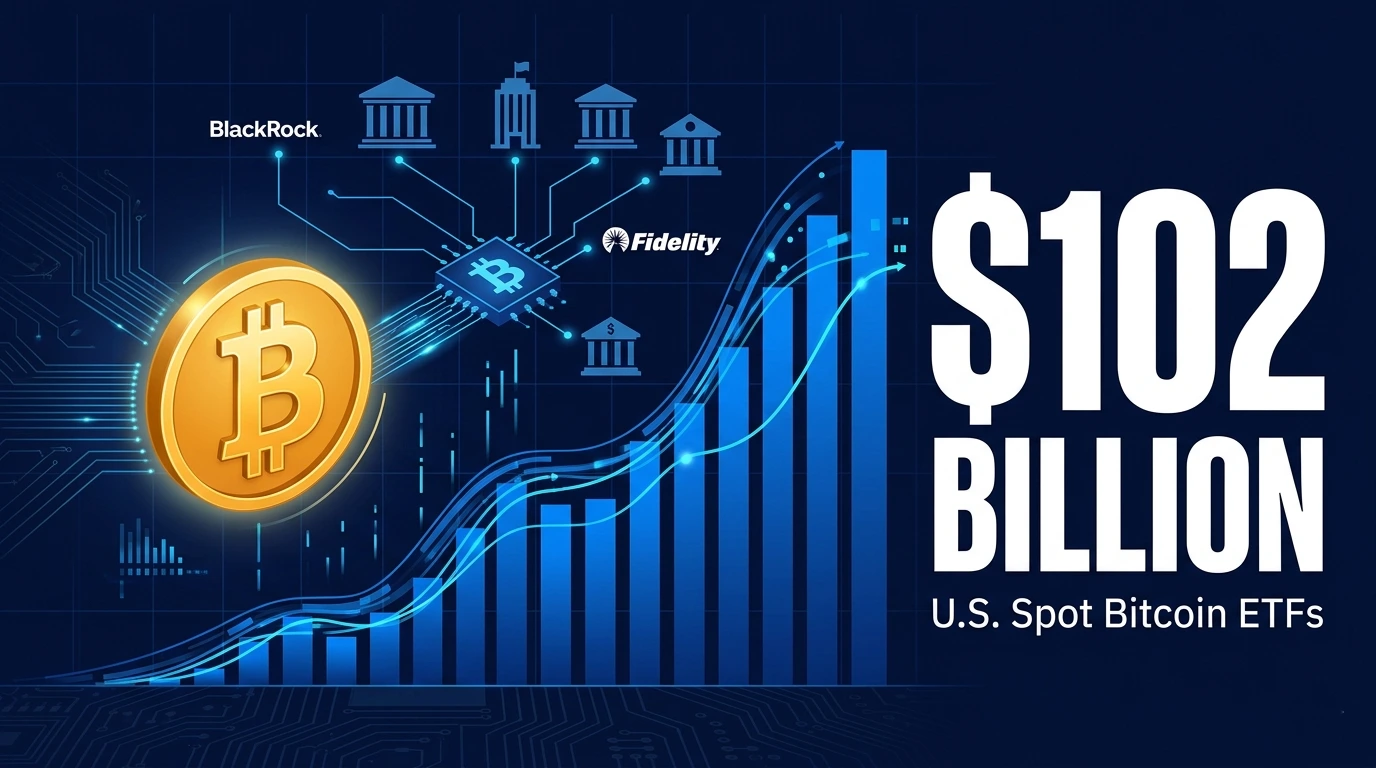
Bitcoin ETF Explained: What It Is, How It Works, and Why $102 Billion Is Betting on It
Finance & Crypto
Bitcoin ETF Explained: What It Is, How It Works, and Why $102 Billion Is Betting on It
By NeuralWired Research DeskJune 6, 202612 min read
A Bitcoin ETF is the simplest way to own Bitcoin exposure without ever touching a crypto wallet. In under 30 months since the SEC approved spot Bitcoin ETFs in January 2024, the category has crossed $102 billion in assets under management and rewritten what institutional participation in crypto actually looks like.
Here’s what’s remarkable about that number. Bitcoin fell 44% from its October 2025 all-time high of roughly $126,198. Institutions kept buying anyway. Net inflows through 2025 reached $47.2 billion, only 3% below the record-setting $48.7 billion absorbed in the launch year. That isn’t panic-buying or momentum chasing. That is a structural shift in how the world’s largest pools of capital think about Bitcoin.
This article explains exactly what a Bitcoin ETF is, how the mechanics work under the hood, which funds lead the market in 2026, what the risks are that most coverage skips, and who these products actually make sense for. Whether you’re a retail investor considering your first allocation or a financial advisor building a client model, the answers are here.
What Is a Bitcoin ETF?
Definition
A Bitcoin ETF (Exchange-Traded Fund) is a regulated financial product that tracks the price of Bitcoin and trades on a traditional stock exchange, just like shares of Apple or Microsoft. Investors gain exposure to Bitcoin’s price movements through a standard brokerage account, with no need to manage crypto wallets, private keys, or custody.
Think of it this way: buying Bitcoin directly is like purchasing physical gold bars. You own it outright, but you need somewhere to store it safely and someone to verify it’s real. A Bitcoin ETF is the equivalent of buying shares in a gold vault. The vault holds the asset. You hold a regulated, tradeable claim on it. The price moves with the underlying. You never touch the gold.
Two distinct types of Bitcoin ETF exist in the U.S. market, and the difference between them is not subtle.
Spot Bitcoin ETF
A spot Bitcoin ETF holds actual Bitcoin as its underlying asset. The share price mirrors the live BTC market price in real time. This is the product the SEC approved on January 10, 2024, after more than a decade of rejections. BlackRock’s IBIT and Fidelity’s FBTC are the dominant examples.
Bitcoin Futures ETF
A Bitcoin futures ETF doesn’t hold any Bitcoin. It holds futures contracts: agreements to buy or sell BTC at a specified future price. ProShares launched the first U.S. Bitcoin futures ETF (BITO) in October 2021. Because futures contracts expire and must be “rolled” into new ones regularly, futures ETFs can diverge from Bitcoin’s actual spot price over time, especially in trending markets. For serious long-term investors, futures ETFs are the inferior product.
How a Spot Bitcoin ETF Actually Works
The internal plumbing of a Bitcoin ETF is more interesting than most explanations give it credit for. Understanding it helps you understand both the product’s strengths and its hidden risks.
The Creation and Redemption Mechanism
Spot Bitcoin ETFs maintain accurate price tracking through a system operated by Authorized Participants (APs). These are large financial institutions: JPMorgan, Jane Street, Virtu Financial. Their role is to keep the ETF’s share price in line with Bitcoin’s spot price through continuous arbitrage.
Creation: When demand for ETF shares rises, an AP delivers Bitcoin to the fund’s custodian. The ETF issues new shares to the AP, who sells them on the exchange. New supply pushes the share price back in line with NAV.
Redemption: When supply of ETF shares exceeds demand, an AP buys ETF shares on the open market and returns them to the fund. The fund returns Bitcoin to the AP in exchange. Reduced share supply pushes price back up.
Arbitrage in practice: If IBIT shares trade at a 0.5% premium to Bitcoin’s spot price, APs can buy BTC, deliver it to BlackRock, receive new IBIT shares, and sell them at the inflated price for a risk-free profit. That profit-seeking activity closes the gap almost instantly. This is why spot ETFs track BTC price so tightly, unlike the old Grayscale GBTC trust, which once traded at a 49% discount to NAV.
Key Update: Mid-2025
The SEC originally required all ETF-to-AP transactions to occur in cash only. In mid-2025, the SEC approved in-kind creation and redemption, meaning APs now deliver actual Bitcoin directly. This reduced friction, lowered transaction costs, and tightened price tracking accuracy further.
Custody: Where the Bitcoin Actually Lives
Most U.S. spot Bitcoin ETFs use Coinbase Custody as their primary custodian. The Bitcoin is held in cold storage at the institutional level, segregated from Coinbase’s operational funds. BlackRock’s IBIT is a notable exception: it uses Coinbase Custody but has a multi-layered custodial agreement that gives it additional protections compared to smaller issuers. This custodian concentration is one of the sector’s underappreciated structural risks. More on that in the risks section.
Spot vs. Futures: The Difference That Matters
Feature
Spot Bitcoin ETF
Bitcoin Futures ETF
Underlying asset
Actual Bitcoin
BTC futures contracts
Price tracking
Tight (real-time BTC price)
Can diverge (roll costs)
U.S. approval date
January 10, 2024
October 19, 2021
Best example
BlackRock IBIT
ProShares BITO
Long-term suitability
Higher (lower tracking error)
Lower (compounding roll costs)
IRA eligible
Yes (brokerage dependent)
Yes (brokerage dependent)
For almost every use case, a spot Bitcoin ETF is the better product. Futures ETFs made sense in 2021 and 2022 when spot products weren’t available. At this point, the main reason to hold a futures ETF over a spot ETF is specific options strategy availability, not underlying exposure quality.
Every Major U.S. Bitcoin ETF in 2026
The SEC simultaneously approved 11 spot Bitcoin ETFs on January 10, 2024. Two years later, the market has consolidated heavily around the top three by AUM, with a growing fee war creating real separation at the bottom of the table.
Ticker
ETF Name
Issuer
Expense Ratio
AUM (approx. 2026)
MSBT
Morgan Stanley Bitcoin ETF
Morgan Stanley
0.14%
New entrant (Apr 2026)
BTC
Grayscale Bitcoin Mini Trust
Grayscale
0.15%
Smaller tier
BITB
Bitwise Bitcoin ETF
Bitwise
0.20%
Mid-tier
ARKB
ARK 21Shares Bitcoin ETF
ARK/21Shares
0.21%
Mid-tier
IBIT
iShares Bitcoin Trust
BlackRock
0.25%
~$62 billion
FBTC
Fidelity Wise Origin Bitcoin Fund
Fidelity
0.25%
~$17-18 billion
HODL
VanEck Bitcoin Trust
VanEck
0.20%
Smaller tier
BTCW
WisdomTree Bitcoin Fund
WisdomTree
0.25%
Smaller tier
BTCO
Invesco Galaxy Bitcoin ETF
Invesco Galaxy
0.25%
Smaller tier
EZBC
Franklin Bitcoin ETF
Franklin Templeton
0.19%
Smaller tier
BRRR
Valkyrie Bitcoin Fund
Valkyrie
0.25%
Smaller tier
GBTC
Grayscale Bitcoin Trust (Legacy)
Grayscale
1.50%
Declining
Fee Math: Why Expense Ratio Is Not a Rounding Error
GBTC at 1.50% versus BITB at 0.20% over a 10-year holding period represents roughly a 13% difference in retained Bitcoin exposure. The legacy Grayscale product was designed before competition existed. Investors still holding GBTC for sentimental reasons are quietly donating Bitcoin to Grayscale’s operating budget every year.
Morgan Stanley’s April 2026 MSBT launch at 0.14% is a signal, not just a product. When one of the largest wealth managers on Earth enters a market and immediately sets a new fee floor, the era of charging investors 0.25% or more for Bitcoin custody is probably ending.
The Numbers Behind the $102 Billion Story
$102BTotal U.S. spot Bitcoin ETF AUM as of late May 2026
6.77%Share of all existing Bitcoin held by U.S. ETFs
$48.7BNet inflows in 2024, the launch year, the most in ETF history
These numbers deserve context, because “Bitcoin ETF is popular” doesn’t convey the scale of what happened. Gold ETFs, which launched in 2004, took five full years to cross $50 billion in AUM. Bitcoin ETFs crossed $100 billion in under 30 months from a standing start. No financial product has accumulated institutional capital this fast.
The $47.2 billion in net inflows through 2025 is the number that should get more attention. Bitcoin posted a roughly negative 9.6% return in 2025 by some measures. The funds kept attracting capital anyway. Bloomberg Intelligence ETF analyst Eric Balchunas flagged IBIT specifically as one of the year’s top six ETFs by inflows despite its negative performance, which he described as genuinely unusual behavior.
“Boomers putting on a HODL clinic. If you can do $25 billion in a bad year imagine the flow potential in a good year.”
Eric Balchunas, Senior ETF Analyst, Bloomberg Intelligence (December 20, 2025)
The Q1 2026 pace was even more aggressive: $18.7 billion in net ETP inflows in a single quarter, pushing total AUM past $155 billion at peak before Bitcoin’s price drawdown compressed valuations. Goldman Sachs filed for its own Bitcoin ETF on April 13, 2026, triggering $411.5 million in single-day inflows across the category on the announcement.
BlackRock’s IBIT now holds approximately $62 billion in Bitcoin, representing roughly 60% of the entire U.S. spot Bitcoin ETF market. That number matters beyond market structure: it means one fund, managed by one company, controls 60% of the regulated Bitcoin investment ecosystem in the world’s largest economy. That concentration has no parallel in commodity ETF markets.
Who Should (and Shouldn’t) Use a Bitcoin ETF
Retail Investors
If you have a Fidelity, Charles Schwab, or Robinhood account, you can buy Bitcoin exposure today, the same way you buy shares of any other company. No crypto exchange registration, no seed phrases, no custody decisions. The ETF handles all of that.
The tax advantage is real. Bitcoin ETF trades generate standard 1099 forms. Direct BTC ownership requires tracking the cost basis of every individual transaction, which gets complicated fast if you’ve been buying regularly. For Roth IRA holders specifically, a Bitcoin ETF lets you own Bitcoin exposure inside a tax-free account, something you can’t do with direct BTC custody at most providers.
Financial Advisors and Wealth Managers
Bitcoin ETFs have moved from fringe to mainstream in the advisory toolkit. Morgan Stanley, which launched MSBT in April 2026, built the product specifically because its own client base was asking for it through existing advisory accounts. The 1% to 5% Bitcoin portfolio allocation is becoming standard in diversified models, not because advisors became crypto believers overnight, but because the ETF structure now fits within existing compliance frameworks.
Options are now available on IBIT, GBTC, FBTC, ARKB, and others. That opens covered call strategies, protective puts, and collar structures that were previously unavailable to Bitcoin investors. For income-oriented advisors, that matters.
Institutional Investors
Wisconsin’s State Investment Board and Michigan’s Retirement System both took documented Bitcoin ETF positions in 2025. They couldn’t hold direct crypto under fiduciary requirements. The ETF structure gave them a regulated, audited, SEC-cleared path to Bitcoin exposure that their compliance teams could approve. That precedent is quietly significant for how pension funds evaluate similar decisions going forward.
Who Should Skip It
If you believe in Bitcoin’s original premise, self-custody, censorship resistance, on-chain utility, ETF shares are the wrong product. You can’t use IBIT shares in DeFi. You can’t send them to another wallet. If a fund is suspended or a custodian encounters problems, you have a legal claim on assets, not Bitcoin in your hand. For conviction-level Bitcoin holders, direct ownership remains the philosophically consistent choice.
The Risks Most Coverage Won’t Tell You
The $102 billion headline tends to crowd out the inconvenient details. Here are the structural risks that deserve more attention than they get.
Custodian Concentration
Most U.S. Bitcoin ETFs use Coinbase Custody as their primary custodian. An operational failure, regulatory seizure, or severe hack at Coinbase wouldn’t destroy the Bitcoin (it’s on-chain), but it could trigger fund suspensions and redemption halts across the majority of the market simultaneously. That single-point-of-failure risk is structurally unlike anything in equity or commodity ETF markets.
The “Institutional Floor” Hasn’t Been Tested
The narrative that ETF-driven institutional buyers create a durable price floor for Bitcoin got a stress test in May 2026, when a six-day outflow streak nearly erased all of 2026’s net inflows, with roughly $1.55 billion exiting in a single week. When macro conditions deteriorated, institutions exited as readily as any other risk-off response. The “different type of buyer” thesis remains unproven through a full bear market cycle.
The Digital Gold Narrative Has a Problem
NYU professor Nouriel Roubini’s February 2026 Project Syndicate op-ed pointed out something the ETF inflow data can’t answer: Bitcoin fell roughly 6% in 2025 while gold surged more than 60%. During every geopolitical stress event of the past 18 months, Bitcoin has sold off alongside risk assets, not alongside gold. The “inflation hedge” and “digital gold” narratives are still marketing claims, not empirically validated behaviors.
“Every time gold has spiked in response to trade or geopolitical ructions over the past year, Bitcoin has fallen sharply.”
Nouriel Roubini, Professor Emeritus, NYU Stern School of Business (February 2026)
Regulatory Risk Isn’t Priced In
The current regulatory environment approved these products. Future administrations or SEC leadership can tighten requirements, impose proof-of-reserve mandates, or restrict institutional participation. Congress is actively debating the Digital Asset Market Clarity Act, and its passage is not guaranteed. International divergence, particularly between U.S. rules and the EU’s MiCA framework, creates additional compliance complexity for globally diversified institutional holders.
Expense Ratio Drag Compounds Invisibly
A 0.25% annual fee sounds negligible. Over 10 years, compounded, it reduces your Bitcoin exposure by several percentage points relative to direct ownership with no custody fees. GBTC holders at 1.50% are experiencing roughly 6 times the Bitcoin exposure erosion of a Grayscale Mini Trust holder at 0.15%. These numbers don’t appear in performance charts because they’re deducted automatically from the fund’s Bitcoin holdings, not charged to your account visibly.
Our Read
Our Read The risks above aren’t arguments against Bitcoin ETFs as a category. They’re arguments for understanding what you’re actually buying. The product solves real access and custody problems. It introduces different risks in return. Knowing both sides is what separates an informed allocation from a momentum trade.
What the Experts Are Saying
The most interesting voice in this market isn’t the most bullish. It’s JPMorgan CEO Jamie Dimon, whose bank is a named Authorized Participant in BlackRock’s IBIT while Dimon himself remains vocally skeptical of Bitcoin’s intrinsic value.
“Our clients are adults. They disagree. That’s what makes markets. So, if they want to have access to buy yourself Bitcoin, we can’t custody it, but we can give them legitimate, as clean as possible, access.”
Jamie Dimon, CEO, JPMorgan Chase (July 2025)
Dimon’s position is its own form of validation. The world’s most powerful banker isn’t buying Bitcoin’s value thesis. But he’s facilitating access because his clients are adults making their own decisions, and because refusing to participate would simply send that business elsewhere. That’s the quiet pragmatism driving most of the institutional adoption story.
From inside the ETF industry, Grayscale’s SVP of ETF Capital Markets Krista Lynch offered the most grounded 2026 outlook available, acknowledging the rocky start to the year while maintaining long-term conviction based on infrastructure tailwinds.
“It’s a really exciting time with all these tailwinds, and I think it is totally within the realm of possibility to have about $15 billion in inflows this year to Bitcoin ETFs alone.”
Krista Lynch, SVP ETF Capital Markets, Grayscale Investments (May 2026)
Her $15 billion 2026 inflow projection is explicitly conditional on macro stabilization and wealth management platforms unlocking ETF access for advised accounts. Neither condition is guaranteed.
Frequently Asked Questions About Bitcoin ETFs
What is a Bitcoin ETF?
A Bitcoin ETF is an exchange-traded fund that tracks Bitcoin’s price and trades on a traditional stock exchange. Investors gain Bitcoin price exposure through a standard brokerage account without managing crypto wallets or private keys. Spot Bitcoin ETFs, approved by the SEC on January 10, 2024, hold actual Bitcoin as their underlying asset.
How does a Bitcoin ETF work?
A spot Bitcoin ETF holds real Bitcoin through a regulated custodian. When you buy shares, Authorized Participants (APs) like major banks create new shares by delivering Bitcoin to the fund. This creation and redemption mechanism keeps the ETF’s share price aligned with Bitcoin’s spot price through continuous arbitrage, allowing retail investors to track BTC without owning it directly.
Is a Bitcoin ETF safe?
Bitcoin ETFs are regulated by the SEC and held by institutional custodians, offering more protection than unregulated crypto exchanges. However, they carry Bitcoin’s inherent price volatility (BTC fell 44% from its October 2025 high), custodian counterparty risk, and fund expense ratio drag. They are safer from a custody standpoint but not from a price standpoint.
What is the difference between a Bitcoin ETF and buying Bitcoin directly?
A Bitcoin ETF provides regulated brokerage access, simple tax reporting, and eligibility for tax-advantaged accounts (IRA/401k), but charges an annual fee (0.14% to 1.50%) and gives no direct BTC ownership. Buying Bitcoin directly means full self-custody, zero ongoing fees, and on-chain utility, but requires managing private keys and handling more complex tax reporting.
Which Bitcoin ETF has the lowest fees?
As of 2026, Morgan Stanley’s MSBT charges 0.14%, the lowest of any spot Bitcoin ETF. Grayscale Bitcoin Mini Trust (BTC) charges 0.15%. BlackRock’s IBIT and Fidelity’s FBTC both charge 0.25%. Grayscale’s legacy GBTC charges the highest at 1.50%. For long-term holders, fee differences compound significantly over years of holding.
How much money is in Bitcoin ETFs?
As of late May 2026, total assets under management across all U.S. spot Bitcoin ETFs reached approximately $102 billion, with BlackRock’s IBIT holding roughly $62 billion. This represents about 6.77% of all Bitcoin in existence. Total AUM peaked near $155 billion in early 2026 before Bitcoin’s price drawdown reduced valuations.
Can you buy a Bitcoin ETF in a Roth IRA?
Yes. Spot Bitcoin ETFs like IBIT and FBTC can be held in Roth IRAs, Traditional IRAs, and 401(k) accounts wherever the brokerage platform allows ETF trading. This is one of the key advantages over direct Bitcoin ownership, which is ineligible for most tax-advantaged retirement accounts.
What happened when Bitcoin ETFs were approved?
On January 10, 2024, the SEC simultaneously approved 11 spot Bitcoin ETFs, ending over a decade of rejections. On the first trading day, combined volume across all 11 funds exceeded $4.6 billion. In its launch year, the Bitcoin ETF category absorbed $48.7 billion in net inflows, the largest first-year inflow total in ETF history.
What is the difference between a spot and futures Bitcoin ETF?
A spot Bitcoin ETF holds actual Bitcoin, so its price directly tracks BTC’s live market price. A futures Bitcoin ETF holds contracts that bet on Bitcoin’s future price, meaning it may diverge from spot price over time due to roll costs when contracts expire. The U.S. approved spot ETFs in January 2024; futures ETFs like ProShares BITO launched in October 2021.
Are Bitcoin ETFs available outside the U.S.?
Yes. Canada launched the world’s first Bitcoin ETF in February 2021 (Purpose Bitcoin ETF, ticker BTCC). Europe has Bitcoin ETPs available on several exchanges. Australia launched its first Bitcoin ETF in 2022. Hong Kong approved spot Bitcoin ETFs in April 2024. The U.S. represents the largest market by far given its institutional investment infrastructure.
What Comes Next
The Bitcoin ETF category crossed $100 billion in AUM faster than any financial product in history. It did it during a year when Bitcoin itself posted negative returns. It absorbed $47 billion in 2025 inflows through a 44% drawdown. By any metric of institutional adoption, the product has worked exactly as designed.
What that means for Bitcoin’s price is a separate question, and anyone who claims certainty about the answer is selling something. What it means for how investors access Bitcoin is clearer: the era of requiring crypto-native infrastructure for Bitcoin exposure is over. The question now is whether that mainstream access drives the kind of long-term institutional accumulation that changes Bitcoin’s market structure permanently, or whether it simply made speculation more convenient.
Three things worth watching in the next 6 to 18 months:
Fee war resolution: Morgan Stanley’s 0.14% MSBT and Goldman Sachs’s pending filing will force a price response from IBIT and FBTC. Watch whether BlackRock cuts its 0.25% fee, which would be the clearest signal that scale advantages no longer justify the premium.
Wealth management platform unlocks: A significant share of potential retail inflows remains blocked by wealth management platforms that haven’t yet enabled Bitcoin ETF access for advised accounts. When those platforms open access, it will likely be the single largest catalyst for new net inflows since launch day.
The Digital Asset Market Clarity Act: Congressional passage would formalize the regulatory framework under which Bitcoin ETFs operate and potentially unlock sovereign wealth fund participation. Failure to pass would leave current approvals dependent on SEC discretion under future administrations.
The $102 billion sitting in Bitcoin ETFs right now is either the early innings of a structural shift in global capital allocation, or the high-water mark of a cycle. The honest answer is that neither camp has enough evidence yet to be confident. What’s not in dispute is that the product worked, that institutional capital bought it through a drawdown, and that the fee floor is still falling.
Stay Ahead of What’s Moving Markets
The Neural Loop delivers NeuralWired’s weekly briefing on AI, enterprise tech, and the financial infrastructure being rebuilt around it. No noise, no fluff.
Subscribe to The Neural Loop
What Is DeFi? How Decentralized Finance Actually Works in 2026
Blockchain & Web3 · Deep Analysis
What Is DeFi? How Decentralized Finance Actually Works in 2026
No banks. No brokers. $100 billion locked in code. Here’s what’s real, what’s hype, and what you need to know.
NeuralWired Research Desk · May 25, 2026 · 14-min read
$100B+DeFi TVL, March 2026
68%Ethereum’s TVL share
$3.1BLost to hacks, H1 2025
68.2%Projected CAGR to 2033
In August 2018, a handful of Ethereum developers coined a term in a Telegram chat. Eight years later, that term, DeFi, short for decentralized finance, describes a financial system processing trillions of dollars a year, with no banks, no brokers, and no customer service line to call when things go wrong.
Decentralized exchanges processed more than $3 trillion in trading volume in 2024 alone, with Uniswap leading the market. The total value locked across DeFi protocols crossed $100 billion again in March 2026 after a rough start to the year. And the U.S. government, after years of regulatory hostility, has now signed the GENIUS Act into law, the first federal framework for stablecoins, the monetary backbone of the whole ecosystem.
So what exactly is DeFi? How does it mechanically work? And, the question serious people are now asking, is it actually safe to use? This guide answers all three, without the marketing gloss.