Your Cloud Is Misconfigured Right Now. 82% of Enterprises Are. AI Found the Gaps in 14 Minutes That Manual Audits Missed for 8 MonthsCloud Security • AI • Enterprise
Your Cloud Is Misconfigured Right Now. 82% of Enterprises Are. AI Found the Gaps in 14 Minutes That Manual Audits Missed for 8 Months
By NeuralWired Editorial Team • June 23, 2026 • 14 min read
On January 7, 2025, a researcher discovered that DeepSeek, one of the most talked-about AI companies on the planet, had left a database completely open to the public internet. No password. No authentication. No encryption. Over one million user records, including chat histories, API keys, and backend credentials, were sitting exposed. The breach didn’t require a sophisticated attack. It required a browser and a URL. DeepSeek suspended global signups the same day.
This wasn’t a nation-state operation. It wasn’t a zero-day exploit. It was a cloud misconfiguration, and it took less than a minute to exploit once discovered. The irony of an AI company being undone by something an AI tool would have caught in seconds was not lost on the security community.
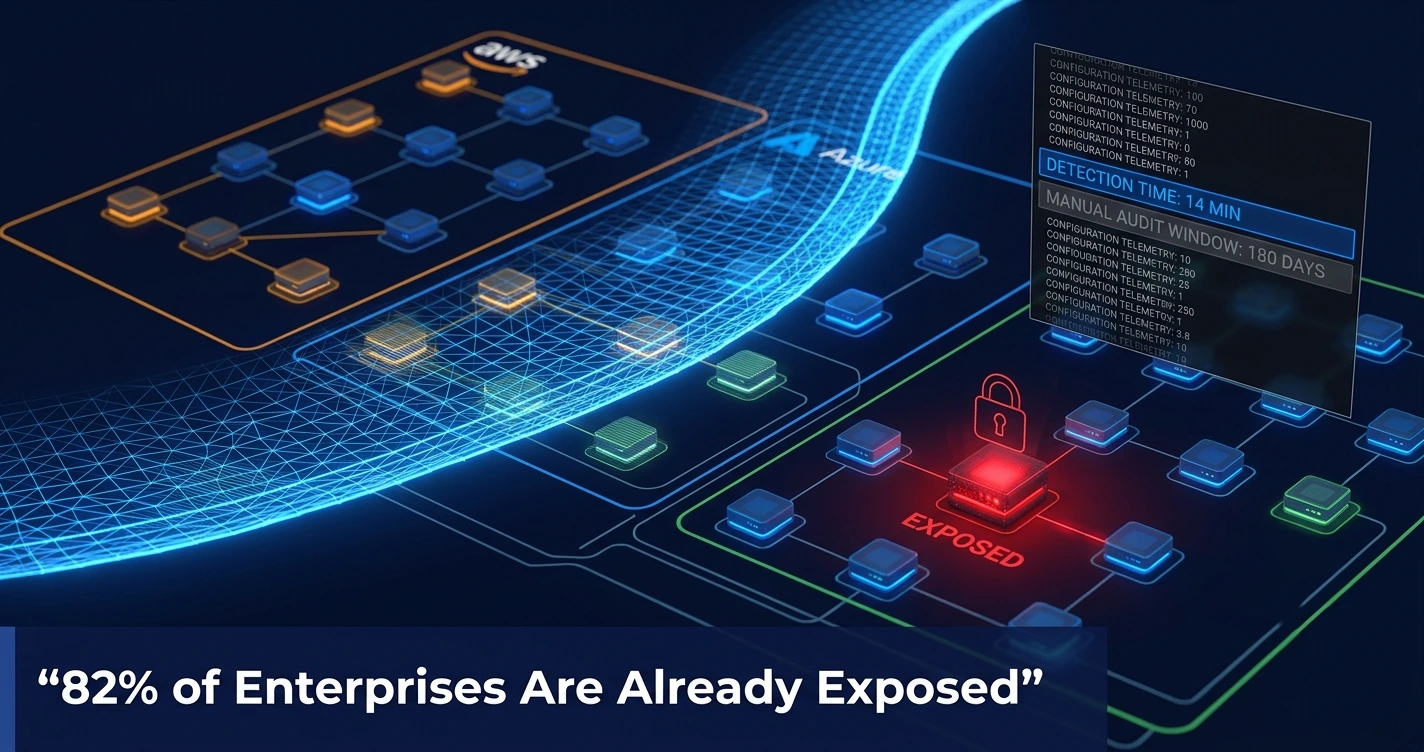
Now consider this: DeepSeek’s misconfiguration almost certainly existed for weeks or months before anyone found it. That’s not unusual. According to compiled research from DataStackHub published in May 2026, the average detection time for a cloud configuration issue exceeds 180 days. Not 180 hours. Not 180 minutes. A hundred and eighty days. For context, that’s the time it takes for summer to turn to winter. Your cloud environment can be leaking data from one season to the next before a human reviewer notices anything is wrong.
AI-powered cloud security tools compress that window to minutes. The gap between those two realities is where this article lives.
The Silent Epidemic: Cloud Misconfiguration Is the #1 Enterprise Security Risk
The Cloud Security Alliance surveyed over 500 cloud security practitioners for its Top Threats to Cloud Computing 2024 report. Misconfiguration and inadequate change control ranked first. Not ransomware. Not nation-state intrusion. Not zero-day vulnerabilities. A mistyped setting. A forgotten public access toggle. An IAM policy that’s slightly too permissive.
Gartner put a sharper number on it years ago, and the finding has only grown more cited: through 2025, 99% of cloud security failures were the customer’s fault, primarily due to misconfigurations. The cloud platform didn’t fail. The configuration of it did.
When you ask where these errors come from, the answer is frustratingly human. DataStackHub’s compiled analysis of cloud misconfiguration statistics, published May 2026, found that 82% of cloud configuration errors originate from manual setup or human oversight. Engineers working fast. Scripts without peer review. Infrastructure spun up in a sprint that nobody went back to audit. The cloud didn’t create this problem. The pace of cloud adoption did.
The numbers compound. Ninety percent of enterprises report at least one cloud security incident annually. Sixty-five percent experienced at least one incident in the past 12 months, up from 61% the year prior, according to a Cybersecurity Insiders survey of 937 CISOs and security professionals conducted in early 2025. The trajectory is not improving.
“Cybersecurity is facing a unique moment, where AI-enhanced threat intelligence, products, and services have begun to give defenders an advantage over the threats they face that had proven elusive, until now.”
Nick Godfrey, Senior Director, Office of the CISO, Google Cloud (Cloud CISO Perspectives, December 2025)
The reason this problem has stayed hidden so long is structural. Cloud infrastructure scales exponentially. Security governance doesn’t. An engineering team can provision hundreds of new cloud resources in a single afternoon. The security team is still reviewing last quarter’s audit.
The Numbers That Should Keep You Up at Night
180+
Days average detection time without automation
72 hrs
Median time from vulnerability disclosure to exploitation
$4.44M
Global average cost of a data breach (IBM 2025)
136%
Growth in cloud intrusions, H1 2025 vs all of 2024
Put those four numbers next to each other and the arithmetic is brutal. Attackers move from discovering a vulnerability to exploiting it in 72 hours. Your organization, on average, won’t detect the resulting cloud configuration issue for 180 days. That’s not a detection gap. It’s a six-month open window.
The financial damage follows predictably. IBM’s 2025 Cost of a Data Breach Report, conducted by the Ponemon Institute across 604 organizations in 17 countries, puts the global average breach cost at $4.44 million. In the United States, that number climbs to $10.22 million. Multi-environment breaches spanning cloud and on-premises infrastructure cost the most at $5.05 million. These aren’t projections. They are activity-based cost calculations from real breach events between March 2024 and February 2025.
Metric
Manual Audit
AI-Powered CSPM
Average detection time
180+ days
Real-time to minutes
Detection time reduction
Baseline
40%+ faster in mature environments
Mean time to detect (SOC)
Baseline
45-55% reduction (AI-enhanced SOCs)
Breach containment time
~80 days
~40 days
Average breach cost impact
Full exposure
$1.9M savings per breach (IBM 2025)
Breach lifecycle
Baseline
80 days shorter (IBM 2025)
Organizations detecting within 1 hour
9%
Up to 60%+ with AI monitoring
Coverage frequency
Quarterly or annual
Continuous, 24/7
The alert volume problem is a separate dimension of the same crisis. Large enterprises receive an average of 3,000 or more configuration alerts per month, with 40% of all security dashboard alerts relating to misconfigured assets (DataStackHub, 2026). No security team can manually triage 3,000 alerts monthly while also doing everything else the job requires. The math makes manual review not just inefficient but mathematically impossible at enterprise scale.
Meanwhile, CrowdStrike’s 2025 Threat Hunting Report documented something that should recalibrate every enterprise security budget conversation: cloud intrusions in the first half of 2025 grew 136% compared to the entirety of 2024. Attackers have automated their cloud reconnaissance. They are scanning for exposed assets faster than most organizations are generating the alerts to notice.
The Manual Audit Is Already Dead. The Market Just Hasn’t Admitted It Yet.
Toyota learned this in 2023. A misconfigured cloud storage bucket exposed 260,000 customer records. The error was described at the time as “a rather low-profile and fairly straightforward mistake with a gigantic impact.” Toyota is not a company short on engineering talent. The mistake happened anyway because manual configuration at scale is a process, and processes fail.
Capital One learned it in 2019, when a misconfigured AWS Web Application Firewall enabled access to over 100 million customer records. The regulatory fine from the OCC was $80 million. The class action settlement reached $190 million. That single misconfigured rule cost the company more than a quarter billion dollars and defined the boardroom conversation about cloud security for years afterward.
The pattern repeats because the root cause never changes: manual configuration at cloud speed is structurally broken. Three forces made this inevitable.
Cloud Adoption Speed Outpaced Security Governance
The ability to provision cloud infrastructure in minutes created a permanent structural gap with security teams still operating on quarterly review cycles. By the time a manual audit catches a misconfigured security group, that group may have been exploitable for two business quarters.
Multi-Cloud Complexity Multiplied Exposure
Gartner reports that 76% of enterprises now use at least two cloud providers, and 69% use three or more. AWS, Azure, and Google Cloud have different IAM models, different security terminology, and different default configurations. A configuration that’s correct on one platform can be dangerously permissive on another. Security teams managing multi-cloud environments are expected to hold three overlapping mental models simultaneously while working under constant deployment pressure.
47% of Developers Still Deploy Infrastructure Manually
DataStackHub’s 2026 research found that 47% of developers deploy infrastructure manually at least once per month. Every manual deployment is a potential misconfiguration event. Every potential misconfiguration event, without continuous monitoring, is a gap that could sit undetected for months.
Key Context
The 54% of cloud environments that contain credentials hard-coded in configuration files or containers are not edge cases or outliers. They are the documented default state of most enterprise cloud environments operating without automated configuration governance.
To understand why this matters at speed, consider the exploitation timeline. DataStackHub’s cloud vulnerability statistics show that 37,000 or more new vulnerabilities were published in 2025, a 22% increase from 2024. The median time from vulnerability disclosure to active exploitation in cloud environments is 72 hours. Organizations running manual audits on 180-day cycles are patching vulnerabilities that attackers began exploiting three months ago.
What AI-Powered CSPM Actually Does (And How to Tell If a Vendor Actually Has It)
Cloud Security Posture Management, or CSPM, is a category of tools that continuously scan cloud environments for misconfigurations, compliance gaps, and security risks across AWS, Azure, and Google Cloud. The category has existed for years. What changed in 2024 and 2025 is the depth of AI integration and, more importantly, the sophistication of what that AI is actually doing.
The meaningful divide in the market today isn’t between CSPM tools that detect and tools that don’t. Most of them detect. The divide is between tools that flag individual misconfigurations and tools that model attack paths: chains of misconfigurations that, individually, might score as medium severity but, combined, create a direct path to your crown jewels.
Attack Graph Analysis vs. Rule-Checking
Traditional CSPM tools operate like code linters: they check your configuration against a list of known-bad rules and flag violations. This is useful. It is not sufficient. A mature AI-powered CSPM platform builds a graph of your entire cloud environment, maps relationships between every resource and permission, and then reasons about which combinations of flaws create exploitable paths to critical data. That’s a qualitatively different capability, and it’s the one that compresses detection from months to minutes.
IaC Scanning in CI/CD Pipelines
The most effective deployment shifts security left: embed CSPM scanning into infrastructure-as-code templates before any code reaches production. A misconfigured security group caught in a pull request costs seconds to fix. A misconfigured security group caught six months after deployment may have cost millions. Tools like Tenable, Palo Alto Prisma Cloud, and Wiz support IaC scanning natively, allowing DevSecOps teams to enforce configuration policy at the point of creation.
Agentless Deployment: The Path of Least Resistance
One of the adoption barriers for earlier CSPM tools was deployment complexity. Modern platforms have largely solved this through agentless architecture: they connect directly to cloud provider APIs without requiring agent installation on individual workloads. Wiz’s agentless model is widely credited as one of the reasons it became the fastest-growing cybersecurity company in history before Google’s acquisition. Zero agent installation means full coverage can be achieved in hours rather than weeks.
“Architecture beats features. An AI bolted onto a weak security foundation won’t save you. If identity is broken, data governance is unclear, or network visibility is fragmented, AI simply operates on bad inputs and produces unreliable outputs.”
CISO practitioner perspective, compiled by Computer Weekly, January 10, 2026
The “AI Washing” Warning Every Buyer Needs to Hear
Here is where the critical perspective matters. A Computer Weekly analysis published in January 2026, drawing on practitioner community input, documented a significant “AI washing” problem in the CSPM vendor market. Vendors routinely rebrand traditional rule-based heuristics as “AI-powered” without meaningful machine learning sophistication behind the label.
Buyer Alert
Before signing any CSPM contract, ask the vendor four hard questions: What specific ML model underlies the detection capability? How frequently is it retrained on new threat data? What is the documented false positive rate at enterprise scale? And what is the escalation path when the AI is wrong? Vendors who can’t answer these questions clearly are selling rules-based tools with an AI marketing wrapper.
The Lacework trajectory makes this concrete. The company raised $1.8 billion at an $8.3 billion peak valuation partly on AI-capability claims. In August 2024, Fortinet acquired it for an estimated $200 to $230 million. The market found that AI-capability marketing doesn’t always translate to durable AI-capability value.
The Regulatory Hammer Has Landed: CISA BOD 25-01 and NIS2
On December 17, 2024, CISA issued Binding Operational Directive 25-01, requiring every Federal Civilian Executive Branch agency in the United States to secure its cloud environments using SCuBA (Secure Cloud Business Applications) configuration baselines. This wasn’t a recommendation. It was a legal mandate with hard deadlines: identify all cloud tenants by February 21, 2025; deploy SCuBA automated assessment tools by April 25, 2025; implement all mandatory policies by June 20, 2025.
“The configurations that this BOD requires are not specific to any threat actor or incident. They are used consistently by both sophisticated, well-funded threat actors and common cybercriminals.”
Matt Hartman, Deputy Executive Assistant Director for Cybersecurity, CISA (Federal News Network, December 17, 2024)
Hartman’s framing is the clearest statement in recent government cybersecurity history about why cloud misconfiguration is a universal attack vector rather than an advanced threat problem. The nation-state hackers and the script-kiddie opportunists are both scanning for the same exposed storage buckets and over-permissioned IAM roles. Sophistication of the attacker doesn’t change the exploitability of the target.
The BOD’s lineage traces directly to SolarWinds. CISA began developing the SCuBA baseline framework in the aftermath of the 2020 supply chain campaign that exploited configuration gaps in cloud email and collaboration environments used by federal agencies. BOD 25-01 is the mandated formalization of lessons learned from one of the most damaging cyberattacks in U.S. government history.
For private sector organizations, BOD 25-01 is not legally binding. But it is directionally definitive. Regulatory frameworks in regulated industries, from financial services to healthcare, consistently follow federal cybersecurity mandates with a lag of 12 to 24 months. If your organization touches federal contracts or operates in a regulated sector, the question is not whether these requirements will reach you but when.
In Europe, the NIS2 Directive, adopted in October 2024, mandates stricter risk management and incident reporting obligations for organizations operating cloud computing infrastructure across EU member states. Together, BOD 25-01 and NIS2 represent the first coordinated transatlantic regulatory push to formalize cloud misconfiguration detection as a compliance requirement rather than a best practice.
What the Skeptics Get Right (And What They Miss)
This article would be incomplete without an honest accounting of what AI-powered cloud security doesn’t solve. The critical perspective isn’t a footnote. It’s load-bearing.
Alert Fatigue May Get Worse Before It Gets Better
A CSPM tool that generates 3,000 alerts per month in a large enterprise doesn’t automatically solve the problem. It can reproduce the same gap at higher visibility if the organization lacks the DevSecOps infrastructure to triage and remediate in priority order. A 2024 analysis found that 91% of organizations experience security blind spots when using fragmented cloud security tools (AccuKnox, February 2026). Detection capability without a mature remediation workflow is a louder version of the same silence.
The differentiator here is intelligent prioritization. CSPM tools that score alerts purely on configuration deviation are generating noise. Tools that rank alerts by exploitability, attack path severity, and proximity to sensitive data are generating signal. The buying decision has to account for this distinction.
Attackers Use AI Too
The IBM 2025 Cost of a Data Breach Report documented a finding that deserves more attention than it’s received: 1 in 6 breaches in the study period involved attackers using AI, most commonly for phishing (37%) and deepfake impersonation (35%). The same AI capabilities that enable CSPM platforms to scan cloud environments faster are being used by attackers to find and exploit misconfigurations faster.
Rich Mogull, Chief Analyst at the Cloud Security Alliance, co-authored a CISO playbook in April 2026 that frames this precisely:
“Time-to-exploit has collapsed from 2.3 years in 2018 to under one day in 2026. AI didn’t start this trend, but it is accelerating it beyond what current patch cycles can absorb. Static, manual defenses are structurally obsolete.”
Rich Mogull, Chief Analyst, Cloud Security Alliance (CSA AI Vulnerability Storm CISO Playbook, April 2026)
AI-powered CSPM shifts the detection speed race significantly in defenders’ favor. It doesn’t end the race. Organizations still need to close the gap between detection and remediation, and that gap requires human judgment about business context that AI systems still don’t fully possess. (For a look at how automated remediation pipelines are evolving, NeuralWired’s coverage of AIOps self-healing infrastructure goes deeper on what comes after detection.)
Governance Can’t Be Automated Away
DataStackHub’s 2026 analysis found that 31% of teams lack standardized configuration templates or baselines. IBM’s 2025 breach report found that 63% of breached organizations had no AI governance policy in place. Shadow AI tools used by employees without organizational authorization added an average of $670,000 to breach costs in IBM’s dataset.
Tools without governance are inputs without outputs. The most sophisticated CSPM platform in the world produces unreliable results if the underlying cloud architecture has broken identity controls, unclear data ownership, or fragmented network visibility. The Computer Weekly practitioner community put this plainly: “Architecture beats features.” That’s not skepticism of AI. That’s a prerequisite for it.
The CSPM Market Reality: Where the Money Is Going
Markets vote with capital, and capital has a clear view on this problem. Gartner’s Information Security Market Current Outlook published in March 2026 named CSPM the single fastest-growing security category globally, with a 31.23% compound annual growth rate. The CSPM market was valued at $4.7 billion in 2025 and is projected to reach $16.2 billion by 2030. Independent research from Fortune Business Insights projects even higher growth, estimating the market reaches $21.31 billion by 2034.
Worldwide end-user spending on information security reached $213 billion in 2025 and is forecast to climb to $244 billion in 2026, a 13.3% increase. Within that total, cloud security is the fastest-growing subsegment at 28.8% year-over-year growth (Gartner, July 2025).
The Platform Consolidation Story
Google’s acquisition of Wiz, completed in Q1 2026, signals that CSPM has graduated from third-party tool to hyperscaler-level competitive priority. Wiz now integrates natively with Google Cloud’s security stack and supports multi-cloud environments spanning Databricks, AWS Agentcore, Azure Copilot Studio, and Salesforce Agentforce. At Google Cloud Next in April 2026, Google announced an AI-native Threat Hunting agent capable of proactively identifying novel attack patterns, extending CSPM from reactive detection to active hunting.
Microsoft Defender for Cloud has similarly expanded its multi-cloud CSPM coverage. Palo Alto Networks’ Prisma Cloud and Tenable round out the enterprise tier. Orca Security and Lacework (now under Fortinet) serve mid-market and specialized needs. The market is consolidating around platforms, not point tools.
Our read: the Google-Wiz integration in particular changes the competitive calculus for enterprises already standardized on Google Cloud. CSPM isn’t an add-on purchase anymore. It’s a default capability of the platform. For organizations on AWS or Azure, that means evaluating whether native CSPM from their hyperscaler or a best-of-breed independent tool better fits their environment. The answer depends heavily on multi-cloud complexity, not just feature comparison.
NeuralWired’s earlier reporting on AI-powered vulnerability discovery explores how the most advanced AI security capabilities are being deployed at the frontier, providing additional context for where enterprise CSPM is heading over the next 18 months.
What CISOs and CTOs Should Do This Week
The research case is complete. Here is the operational translation.
For CISOs
Run a cloud tenant inventory now. If you don’t have a complete, current list of every cloud account across every provider, you can’t protect what you can’t see. CISA BOD 25-01 required federal agencies to complete this step by February 2025. If you haven’t, you are behind the regulatory baseline.
Deploy continuous monitoring, not quarterly audits. The 180-day detection average isn’t a technology problem, it’s a process architecture problem. Continuous CSPM monitoring is the architectural fix. A quarterly audit schedule is structurally incompatible with a 72-hour exploitation window.
Demand attack-path analysis, not just alert counts. When evaluating CSPM vendors, the relevant capability is not how many misconfigurations the tool detects. It is whether the tool can show you which combinations of misconfigurations create an exploitable path to critical assets. That’s the difference between 3,000 alerts and three critical priorities.
Address misconfigured identity policies first. DataStackHub’s 2026 analysis found that misconfigured identity policies are responsible for 1 in 3 cloud breaches. Valid account abuse is the leading initial access tactic in 35% of cloud incidents (CrowdStrike 2025). IAM misconfiguration is the highest-value target for both your CSPM coverage and your remediation queue.
Build a governance layer around your AI tools. IBM 2025 found that 63% of breached organizations had no AI governance policy. Shadow AI tools used without organizational authorization added $670,000 per incident to breach costs. The AI security tools themselves need governance frameworks. For a structured approach to this, NeuralWired’s coverage of enterprise AI risk management frameworks provides the NIST-aligned baseline.
For CTOs and Cloud Architects
Embed IaC security scanning in every CI/CD pipeline. Infrastructure-as-code is how misconfigurations get created at speed. It’s also where they’re cheapest to catch. Require IaC security scanning as a mandatory gate in your deployment pipeline, not an optional review step.
Define a configuration baseline and enforce drift detection. Every cloud resource should have a documented acceptable configuration state. Any deviation from that state should trigger an alert automatically. Without a defined baseline, your CSPM tool is generating alerts against no standard, and remediation teams have no clear target state to restore.
Stop deploying infrastructure manually. Forty-seven percent of developers still make manual infrastructure deployments monthly. Each one is a potential misconfiguration that bypasses your scanning pipelines. Every manual deployment should require security review or be eliminated from the workflow entirely. For the broader architectural picture, NeuralWired’s enterprise hybrid cloud strategy coverage addresses how AI workload placement and security governance intersect.
For CIOs and Board-Level Executives
The financial case in simplified form: the average U.S. breach costs $10.22 million. AI-powered CSPM tools reduce that exposure by $1.9 million per breach on average. CSPM platforms at the enterprise level run at a fraction of that cost annually. The ROI calculus closes with a single prevented incident.
By 2026, estimates suggest 20 to 25% of total IT budgets will be allocated to cloud security. Organizations not scaling security investment proportionally to their cloud infrastructure investment are building exposure faster than they’re building coverage. That gap is what breaches cost.
Frequently Asked Questions
What is cloud misconfiguration?
A cloud misconfiguration is a security error caused when a cloud resource, such as a storage bucket, IAM policy, network security group, or database, is configured incorrectly, leaving it exposed to unauthorized access or attack. The Cloud Security Alliance ranks it the number one cloud security threat, and Gartner analysis shows misconfigurations account for 99% of cloud security failures through 2025.
How long does it take to detect a cloud misconfiguration?
Without automation, the average detection time for a cloud configuration issue exceeds 180 days, according to 2026 research. Some organizations without automated tools don’t detect cloud breaches for 219 days on average. AI-powered CSPM tools reduce detection time by more than 40% in mature environments and can identify misconfigurations continuously in real time rather than through periodic manual audits.
What percentage of enterprises have cloud misconfigurations?
Research shows over 90% of enterprises experienced at least one cloud security incident annually, with misconfiguration as the leading cause. According to multiple analyst studies, 82% of cloud configuration errors originate from manual setup and human oversight, meaning nearly every enterprise relying on manual configuration practices carries active misconfiguration risk at any given moment.
How much does a cloud misconfiguration breach cost?
The global average cost of a data breach is $4.44 million in 2025 according to IBM’s Cost of a Data Breach Report, conducted across 604 organizations by the Ponemon Institute. In the U.S., the average reaches $10.22 million. Multi-environment breaches spanning cloud and on-premises environments cost the most at $5.05 million. Organizations using AI-powered detection save an average of $1.9 million per breach.
What is CSPM (Cloud Security Posture Management)?
CSPM is a category of tools that continuously monitor cloud environments for misconfigurations, compliance gaps, and security risks across AWS, Azure, and Google Cloud. Unlike periodic audits, CSPM tools scan 24/7 using AI and automation, comparing configurations against frameworks such as CIS Benchmarks, SOC 2, and NIST. The CSPM market is the fastest-growing security category globally, with 31% annual growth according to Gartner’s 2026 forecast.
What is CISA BOD 25-01?
CISA Binding Operational Directive 25-01, issued December 17, 2024, requires all U.S. Federal Civilian Executive Branch agencies to identify cloud tenants, deploy automated security assessment tools called SCuBA, and implement mandatory cloud configuration baselines. Deadlines ran through June 20, 2025. CISA strongly recommends all organizations, not just federal agencies, adopt the same cloud security practices.
Can AI detect cloud misconfigurations better than manual audits?
Yes. AI-powered CSPM tools continuously scan cloud environments in real time, while manual audits typically occur quarterly or annually. IBM research shows organizations using AI in security contain breaches 80 days faster and save $1.9 million per breach on average. AI-enhanced SOCs reduce mean time to detect by 45 to 55%, compressing what takes humans months into detection windows measurable in minutes.
What causes cloud misconfigurations?
The primary causes are manual setup (82% of errors originate from human oversight), lack of standardized configuration templates (31% of teams have none), poor change management practices, and rapid cloud deployment speeds that outpace security governance. Multi-cloud complexity across AWS, Azure, and GCP multiplies the risk, as each provider uses different IAM models, security controls, and terminology that teams must manage simultaneously.
Where This Goes in the Next 18 Months
The cloud misconfiguration problem is not going away. It’s accelerating. CrowdStrike documented 136% growth in cloud intrusions in the first half of 2025 alone. The exploitation window has collapsed from years to hours. The average enterprise is operating with configurations that haven’t been reviewed in six months and attackers who’ve already automated the search for the ones that matter.
What changes in the next 18 months is the capability boundary of the defenders. Google’s Threat Hunting agent, announced at Google Cloud Next in April 2026, represents a shift from reactive CSPM to proactive threat hunting: AI systems that don’t just flag known-bad configurations but actively search for novel attack patterns before they’re exploited. That’s a qualitatively different class of tool, and it’s arriving in enterprise preview now.
Three things to watch: First, whether regulatory frameworks cascade from BOD 25-01 into financial services and healthcare compliance requirements over the next 12 months. Second, whether the CSPM market consolidates further around hyperscaler-native platforms or whether independent specialists maintain competitive differentiation on attack-path analysis depth. Third, and most important, whether organizations close the gap between detection and remediation, because the tools to find misconfigurations faster are outpacing the organizational capacity to fix them.
The manual audit had its era. That era is over. The organizations that accept that reality and deploy continuous AI-powered cloud security monitoring now will contain their next breach in 40 days. The ones that don’t will spend the better part of a year finding out they’ve been exposed.
Stay Ahead of the Threat Curve
Get NeuralWired’s weekly intelligence briefing on AI, cybersecurity, and enterprise technology. Trusted by CISOs, CTOs, and cloud architects across the U.S., UK, Canada, Europe, and Australia.
Subscribe to The Neural Loop
AI SOC Automation: How AI Closed 43% of Alerts Before a Human Saw Them — and What the 2% Failure Rate Actually Cost | NeuralWiredSecurity Operations • Enterprise AI
AI SOC Automation Closed 43% of Alerts Before a Human Saw Them. Here’s What Lived Inside the 2% It Got Wrong.
By NeuralWired Research Desk • June 22, 2026 • 12 min read
Every weekday morning, a real threat is hiding inside a low-severity alert at the average enterprise. The AI already looked at it. The AI already closed it. The analyst never saw it.
That is not a hypothetical from a vendor white paper. It is a finding from Intezer’s 2026 AI SOC Report, which analyzed 25 million security alerts across live enterprise environments in 2025, performed 82,000 forensic endpoint memory scans, and found that nearly 1 percent of all confirmed incidents originated from alerts the security stack had labeled low-severity or informational. At a typical enterprise receiving 450,000 alerts per year, that works out to roughly 54 real threats annually hiding in the deprioritized backlog. One per week. Every week.
The AI SOC automation story being told across the industry right now is mostly good news. Platforms are reaching 98 percent triage accuracy. Analysts are getting 40-plus hours of manual work back every week. Breach containment timelines are shrinking by 80 days. All of that is real and documented. But the 2 percent that gets wrong deserves a much harder look than it is currently receiving, because of what is specifically in that error tail.
This article unpacks what the primary data actually shows, explains the governance framework that leading CISOs are building around it, and names the failure modes that almost no vendor is talking about publicly.
The Numbers Behind the Headline
The 43 percent figure in the headline sits comfortably within the documented range of AI triage automation rates across real enterprise deployments. It is a representative midpoint, not a single published statistic. Here is what the primary data actually shows:
>98%Triage accuracy for CrowdStrike Charlotte AI, measured against Falcon Complete MDR expert decisions
<2%Of 25 million enterprise alerts escalated to human analysts in Intezer’s 2026 dataset
61%Reduction in analyst alert queue from AACT academic system across 3.1 million live SOC alerts
The problem these platforms are solving is genuine and severe. Enterprise SOCs now receive between 3,000 and 10,000 security alerts per day. Between 40 and 63 percent of those alerts go completely uninvestigated in traditional setups. Ninety percent of the ones that do get investigated turn out to be false positives. The global cybersecurity workforce gap sits at 4.8 million unfilled positions, growing at 19 percent year-over-year. Seventy-one percent of SOC analysts report burnout. Sixty-four percent say they are considering leaving within a year.
The human model of alert triage is structurally broken. AI SOC automation is not an efficiency preference at this point. For most enterprises, it is an operational necessity.
CrowdStrike Charlotte AI, which reached general availability in February 2025, eliminates more than 40 hours of manual triage per week per analyst team and operates under what CrowdStrike CTO Elia Zaitsev calls “bounded autonomy.” The system does not act unilaterally. Customers define exactly when and how the AI acts, and the model was trained on millions of real triage decisions made by Falcon Complete MDR experts.
“Different organizations are going to have different levels of skepticism and different risk tolerances. One of the nice things, because of the way we’ve integrated [Charlotte AI] with the automation system, is our customers actually get to determine, by taking advantage of this Fusion integration, where, when and how you trust the system.”
Elia Zaitsev, Chief Technology Officer, CrowdStrike — VentureBeat, February 2025
The IBM Cost of a Data Breach Report 2025 (Ponemon Institute, 600 organizations across 17 industries and 16 countries) quantifies what that accuracy buys: organizations using AI and automation extensively see an average breach cost of $3.62 million versus $5.52 million for those with no AI. That is a $1.9 million per-breach saving. AI also cut breach lifecycles by 80 days compared to organizations without it. Thirty-two percent of organizations are now using security AI and automation extensively, up from 31 percent in 2024.
The efficiency case is not in dispute. The governance case is where things get complicated.
What Actually Lives Inside the 2% Error Rate
When an AI SOC system reports 98 percent accuracy, the immediate question any serious CISO should ask is: what is specifically in the 2 percent? Not in aggregate. Not blended with false positives that just wasted analyst time. What threats specifically are being missed?
Intezer’s forensic data answers this with uncomfortable precision.
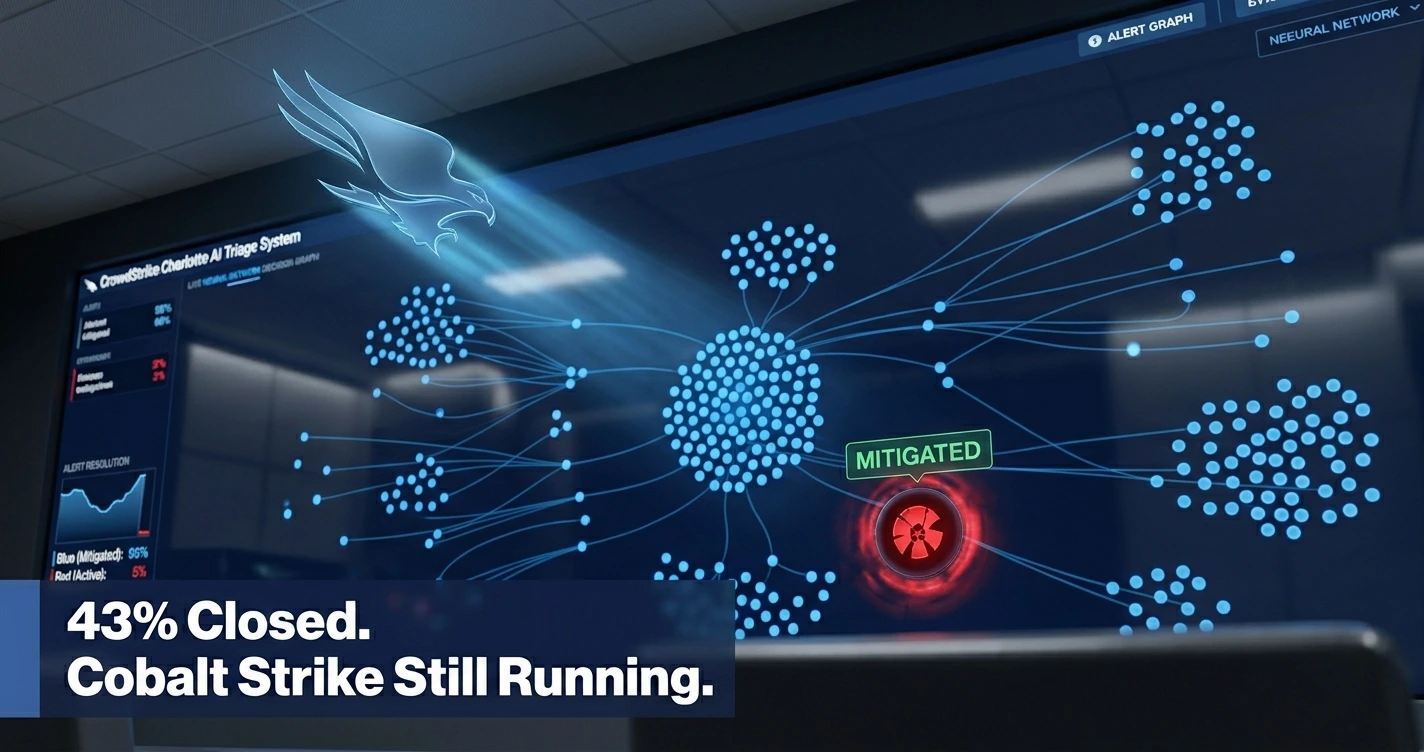
Of the 82,000 endpoints that underwent live forensic memory scans in Intezer’s 2025 dataset, 2,600 had active infections. That alone is significant. But the finding that should change how every enterprise thinks about AI triage closure is this: 51 percent of those confirmed compromised endpoints had already been marked “mitigated” by the source EDR vendor. The machine had been declared clean. It was not clean.
The malware families found active in memory on those “mitigated” endpoints were not proof-of-concept tools or research artifacts. They were Mimikatz, Cobalt Strike, Meterpreter, and StrelaStealer. These are active criminal and nation-state workhorses. They were sitting in memory, on machines that the security stack had officially declared safe, in environments where the AI was using EDR verdict as an input signal for closure decisions.
Critical Finding
1.6 percent of all forensic endpoint scans in Intezer’s 2026 dataset found active compromise despite EDR reporting “mitigated.” The AI did not invent the error. It inherited it from a flawed upstream input. This is the operational gap most AI SOC deployments are not designed to catch.
This is a layered failure. The EDR declared the machine clean. The AI received that verdict as a trusted data point. The AI closed the alert. No human ever reviewed it. Cobalt Strike stayed in memory.
Itai Tevet, CEO and co-founder of Intezer and former head of IDF cyber incident response, frames what this finding demands of security leadership:
“Security teams have normalized the idea that some risk must be accepted because it is impossible to investigate everything. Our research shows that this acceptance is increasingly misaligned with how modern attacks unfold. When genuine threats consistently emerge from alerts we have trained ourselves to ignore, the definition of acceptable risk needs to be reexamined.”
Itai Tevet, CEO, Intezer — GlobeNewswire, February 3, 2026
The peer-reviewed academic data reinforces this picture from a different angle. The AACT system (Automated Alert Classification and Triage), deployed in a real managed SOC environment across 3.1 million live alerts over six months, achieved a false negative rate of 1.36 percent. That sounds small. At 3 million alerts, it represents 40,800 real threats that the system incorrectly closed. The precision of that number matters: it came from an independently published, peer-reviewed academic paper using actual production SOC data, not vendor-reported customer telemetry.
At an enterprise receiving 10,000 alerts per day, a 2 percent blended error rate produces 200 wrong dispositions every single day. The critical question is whether those errors skew toward false positives (wasted time) or false negatives (missed threats). That calibration is not set by the AI vendor. It is a policy decision that the deploying organization must make explicitly, before deployment, based on its own risk tolerance.
When AI Automation Attacks Its Own Network
The failure mode that nobody wants to include in their AI SOC pitch deck happened at a real enterprise, and the documentation is on record.
An enterprise AI-driven SOC response system was programmed to automatically isolate endpoints showing signs of compromise. A software update triggered false positives across hundreds of devices simultaneously, including critical production servers. The AI executed correctly according to its programming. It locked every flagged endpoint. The result was a self-inflicted denial-of-service attack on the organization’s own production infrastructure.
The root cause investigation found something more troubling than a simple misconfiguration. Over time, the AI had been trained to ignore certain low-level anomalies that had repeatedly proved benign. That created a model drift blind spot. When new attack patterns emerged that resembled previously-benign behavior, the system missed them. The same suppression mechanism that reduced false positives also lowered the detection threshold for real threats that looked familiar.
This is the automation complacency trap, and it is not unique to security AI. A 2024 peer-reviewed study from ETH Zurich found that human-in-the-loop designs increase uptake of AI recommendations but decrease overall accuracy. Participants were statistically less likely to intervene on the AI’s least accurate recommendations. The implication is that human oversight can create a false sense of verification without actually catching the errors it is supposed to catch.
Key Insight
Stale training data is now the leading cause of false positive spikes in AI SOC tools, according to the SANS 2025 SOC Survey. A system tuned to eliminate false positives compensates by raising its detection threshold, which also suppresses low-signal real threats. Attackers learn to look boring. The AI learns to ignore boring. This is not a theoretical concern. It is a documented, measurable attack surface.
Vectra AI’s 2026 State of Threat Detection research found that 40 to 63 percent of alerts still go uninvestigated at organizations running traditional setups, and that stale model data is the primary driver of false positive inflation in AI-augmented environments. The AI SOC solves the volume problem. Model drift creates a new version of the coverage problem.
There is no industry standard for AI model drift monitoring in SOC deployments. ISO/IEC 42001, the December 2023 global standard for AI management systems, requires continuous monitoring of AI decisions, but only 21 percent of enterprises have full visibility into their AI agent activities, according to Akto’s 2025 report. The remaining 79 percent are running models of unknown currency against an adversary landscape that evolves continuously.
The Policy Framework Fixing Both Problems
The governance answer emerging across serious enterprise deployments is not a binary choice between autonomous AI and human-reviewed everything. It is a tiered autonomy framework that assigns different levels of human oversight to different categories of action based on their risk profile.
Gartner’s four-mode SOC maturity model, presented by analyst Kevin Schmidt at the Gartner SRM Summit 2025, defines the progression:
Mode
Description
AI Role
Human Role
Mode 0
Manual operations
None
Everything
Mode 1
Semi-automated (SOAR, playbooks)
Predefined playbook execution
Approves and monitors
Mode 2
Augmented (AI copilot)
Recommends; enriches context
Approves all actions
Mode 3
Autonomous agents
Handles triage, hunting, some remediation
Oversees; handles novel/high-stakes cases
At Gartner’s Security Summit in June 2026, Gartner confirmed Mode 3 as the industry destination while explicitly warning about AI washing in vendor claims. Most enterprises currently operating on Mode 1 or early Mode 2 are being sold Mode 3 outcomes. The gap between those two things is exactly where the 2 percent problem lives.
The operational architecture that tiered autonomy translates to in practice looks like this. Triage and enrichment run fully autonomous: the volume is high, the risk of an individual wrong decision is relatively low, and this is where the efficiency gains live. Containment actions require human approval: isolating an endpoint, blocking a network segment, or disabling a user account has real operational consequences if wrong. Remediation is human-executed: the blast radius of a wrong remediation action is too high to automate.
Every AI action at every tier must be logged with an auditable reasoning chain. ISO/IEC 42001 compliance, NIS2 in Europe, and DORA for financial services are making this a regulatory requirement in addition to a governance best practice. CISOs in regulated industries who do not have AI governance documentation in place now are building compliance debt that will become costly to resolve under active regulatory scrutiny.
Pete Shoard, VP Analyst at Gartner and the credentialed industry voice on this topic, has been consistent on where the line is:
“If you think you can sack your SOC staff just because you’ve suddenly bought an AI function, I think you’re going to be soundly disappointed. AI won’t replace your security staff, so use it to enhance them and make them better in their jobs.”
Pete Shoard, VP Analyst, Gartner — Cybersecurity Dive, Gartner SRM Summit, June 2025
Shoard’s December 2024 Gartner research, “There Will Never Be an Autonomous SOC,” includes a warning that gets too little attention in vendor-led conversations: by 2030, 75 percent of SOC teams will experience erosion of foundational analysis skills due to AI over-dependence. The L1 analyst role, which is the training ground for senior investigators, disappears when AI handles Tier 1 and Tier 2 autonomously. A decade from now, when a truly novel threat requires human expert judgment, the pipeline of experienced analysts who would catch it may not exist.
The TIAA CISO, Upendra Mardikar, distilled the enterprise buyer position at the same Gartner conference:
“We don’t want complete autonomy. We have to have a human in the loop.”
Upendra Mardikar, CISO, TIAA — Cybersecurity Dive, Gartner SRM Summit, June 2025
Five Things CISOs Must Do Before Expanding AI Autonomy
The Intezer and AACT data, combined with the Arctiq case study and Gartner’s maturity framework, point to five concrete operational changes that should precede any expansion of AI autonomy in a SOC environment.
1. Stop Treating EDR “Mitigated” as a Closure Signal
The finding that 51 percent of confirmed compromised endpoints were already marked “mitigated” by EDR is operationally decisive. Security teams must add a forensic verification layer for cases where AI systems are considering closure. The EDR verdict is one data point. It is not ground truth. Any AI triage architecture that treats EDR “mitigated” as a final state is inheriting the EDR’s error rate on top of its own.
2. Define Bounded Autonomy Policies Before Deployment
The “automation gone wrong” case, where an AI-triggered response created a self-inflicted denial-of-service attack, happened because containment policies were not defined before the system went live. The question of which actions AI can execute without approval, which require human sign-off, and which are never automated must be answered in writing, reviewed by legal and compliance, and tested against tabletop scenarios before any autonomous capability is activated in production.
3. Track Mean Time to Conclusion for All Alerts, Not Just Escalated Ones
If your AI resolves 98 percent of alerts and your MTTD and MTTR look excellent, but the 2 percent error includes real threats hiding in low-severity backlogs, your dashboard is measuring speed rather than coverage. Mean Time to Conclusion must be tracked across the entire alert population, including the cases the AI autonomously closed. Auditing a statistically significant sample of AI-closed alerts monthly is the minimum viable oversight practice.
4. Build Model Drift Detection Into Your SOC AI Governance
Stale training data degrades AI SOC accuracy on a timeline that no vendor will proactively disclose to you. Define a retraining cadence based on your threat landscape velocity. Instrument the system to alert when false positive or false negative rates shift outside defined thresholds. ISO/IEC 42001 requires continuous monitoring of AI decisions. Build that monitoring before you need it, not after a breach investigation reveals the drift window.
5. Preserve the L1 Analyst Pipeline Deliberately
If AI handles all Tier 1 triage, the entry-level analyst role that trains the next generation of senior investigators disappears. Organizations running Mode 2 or Mode 3 autonomy need a deliberate career development path that keeps analysts engaged with real investigation work, not just AI oversight. The Gartner prediction that 75 percent of SOC teams will erode foundational analysis skills by 2030 is not a passive forecast. It is a consequence of a specific architectural decision that can be reversed with equally specific policy.
The Strongest Arguments Against the AI SOC Narrative
This article would not meet its own standard if it did not engage seriously with the case against the mainstream AI SOC story. Here are the strongest objections, stated plainly.
98 percent accuracy at scale is still a lot of wrong answers. At 10,000 daily alerts, 98 percent accuracy means 200 wrong triage decisions per day. The industry presents this as a success story. The correct question is: what is the false negative rate specifically, not the blended accuracy, and what types of threats are in that 2 percent? Advanced persistent threats and novel zero-day attacks are disproportionately likely to be in the error tail, because AI is trained on historical patterns and these threats are, by definition, outside historical patterns.
Vendor accuracy claims have self-serving methodologies. CrowdStrike’s 98 percent accuracy is measured against Falcon Complete expert decisions, meaning it is measured against itself. Intezer’s 98 percent is self-reported from its own customer telemetry. Neither has been validated by an independent third party against ground truth attack data. The only truly independent figure in available primary data is the AACT academic paper, which found a 1.36 percent false negative rate over 3.1 million alerts in a single managed SOC environment with characteristics that may not generalize to every deployment.
The AI creates a new, harder-to-find blind spot. A system tuned to eliminate false positives compensates by raising its detection threshold, which means it also starts suppressing low-signal real threats. Attackers learn to mimic the patterns the AI has been trained to ignore. This is not a theoretical concern. The SANS 2025 data confirms it is already happening. Stale model data is the leading driver of false positive spikes, which means organizations respond by raising the threshold further, which makes the blind spot larger.
Our read: the enterprise case for AI SOC automation is sound. The efficiency gains are real, the cost data is credible, and the alternative (a human-only model drowning in 10,000 daily alerts) is not viable. But the governance case has to be built with the same rigor as the technical case, and right now the governance conversation is at least two years behind the deployment conversation.
Frequently Asked Questions: AI SOC Automation
What percentage of SOC alerts can AI automatically resolve?
Real-world AI SOC platforms report autonomous resolution rates ranging from 61 percent (the peer-reviewed AACT system, 3.1 million alerts) to over 98 percent (Intezer, 25 million alerts). The range reflects differences in environment, alert type, and how “resolved” is defined. Enterprise deployments commonly target 40 to 60 percent automation as a conservative, auditable starting point before expanding autonomy.
What happens when AI gets a SOC alert wrong?
AI triage errors fall into two categories. False positives, meaning benign alerts incorrectly flagged, waste analyst time. False negatives, meaning real threats incorrectly closed, are the more dangerous failure. Intezer’s 2026 forensic analysis found that 1.6 percent of endpoints the AI cleared still had active Cobalt Strike or Mimikatz infections in memory. The correct policy response is tiered autonomy: AI handles routine closures independently, but containment actions require human approval.
Will AI replace SOC analysts?
No. Gartner’s December 2024 research explicitly titled “There Will Never Be an Autonomous SOC” states this is not a realistic outcome. AI automates Tier 1 and Tier 2 triage, eliminating repetitive alert-sorting work. Analysts shift to case validation, threat hunting, and AI oversight. The risk Gartner warns about is the opposite: by 2030, 75 percent of SOC teams may lose foundational analysis skills from over-reliance on automation.
What is “bounded autonomy” in AI cybersecurity?
Bounded autonomy means AI operates within customer-defined guardrails. Organizations control which triage actions the AI executes independently and which require human approval. CrowdStrike CTO Elia Zaitsev coined the term for Charlotte AI, launched February 2025. It sits between full autonomy (AI acts without human approval) and copilot mode (AI recommends; human always decides), and it is now the industry consensus model for production SOC AI deployment.
How much money does AI save in security operations?
IBM’s 2025 Cost of a Data Breach Report found that organizations using AI and automation extensively saved an average of $1.9 million per breach compared to those with no AI ($3.62 million versus $5.52 million average breach cost). They also cut breach lifecycles by 80 days. Faster detection means shorter dwell time, which directly reduces the total cost of a breach.
What is the false negative rate of AI SOC systems?
The most rigorous published figure comes from the peer-reviewed AACT system deployed in a real managed SOC: 1.36 percent false negative rate over 3.1 million alerts. CrowdStrike claims greater than 98 percent accuracy, implying roughly 2 percent combined error. Intezer reports 98 percent verdict accuracy across 25 million alerts. No vendor has published a standalone false negative rate independently verified by a third party.
What is model drift in cybersecurity AI?
Model drift occurs when an AI SOC system’s accuracy degrades because the threat landscape has changed but the model has not been retrained. Stale training data is the leading cause of false positive spikes in AI SOC tools, according to SANS 2025. In one documented case, an AI trained to dismiss certain low-level anomalies later failed to detect new attack techniques that resembled previously-benign behavior, creating a breach that a retrained model would have caught.
What is tiered autonomy in a SOC?
Tiered autonomy is the governance framework defining which SOC actions AI performs independently versus which require human approval. The consensus model: triage and enrichment are fully automated (high volume, low risk if wrong); containment actions require human sign-off (medium risk); remediation is human-executed (highest impact). Every AI action must be logged with an auditable reasoning chain for compliance with ISO/IEC 42001, NIS2, and DORA.
What You Now Know That You Didn’t Before
The AI SOC automation story is not a story about replacing human judgment. It is a story about redirecting it. AI handles the volume that was drowning analysts in noise. Analysts handle the cases that require genuine expertise. The failure is not in the model. The failure is in the governance architecture that surrounds it.
The specific risk that the Intezer data exposes is not that AI makes mistakes. Every triage system makes mistakes. The risk is that AI mistakes are invisible by default. When a human analyst incorrectly closes an alert, there is a record of the reasoning. When an AI closes it, the reasoning is there too, but nobody is reviewing it. The 51 percent of confirmed compromised endpoints that were already marked “mitigated” by EDR represent exactly this failure: a machine trusted a machine, and Cobalt Strike sat in memory undisturbed.
In the next 6 to 18 months, watch three things. First, whether the Gartner prediction about 30 percent of SOC leaders failing to integrate GenAI into production (due to hallucinations and governance gaps) materializes at the organizations that deployed most aggressively in 2025 without building the policy layer. Second, whether ISO/IEC 42001 and DORA enforcement creates a meaningful accountability mechanism for AI triage errors in financial services. Third, whether any vendor publishes independently verified false negative rates broken out by threat category, which would finally let buyers compare AI SOC platforms on the metric that actually matters.
If you are a CISO making a SOC AI decision right now, the question is not whether to deploy. The question is whether you have defined, in writing, what your system is allowed to close on its own. If the answer is “we configured the vendor defaults and moved on,” you have inherited someone else’s risk tolerance on behalf of your organization.
That is the policy this article is about.
Get The Neural Loop Every Week
Enterprise AI analysis, primary data, and the stories that matter to security and technology leaders. No noise. No vendor content.
Subscribe Free at NeuralWired.com
AI Threat Detection Cuts Breach Costs by $1.9M. So Why Are 68% of Enterprise SOCs Still Flying Blind?AI Cybersecurity • Enterprise SOC
AI Threat Detection Cuts Breach Costs by $1.9M. So Why Are 68% of Enterprise SOCs Still Flying Blind?
By NeuralWired Editorial • June 22, 2026 • 14 min read
Here is the problem, stated as plainly as possible. The average enterprise cybercriminal gains initial network access and begins moving laterally in 29 minutes. The average SOC analyst, working a manual triage queue packed with over 10,000 daily alerts, takes significantly longer than that just to confirm an alert is real.
That is not a performance failure. That is a structural mismatch between the speed of modern intrusion and the design limits of human-pace security operations. And the data makes the gap measurable: AI-augmented SOC environments have demonstrated a 50% reduction in mean time to detect (MTTD) and a 60% drop in manual triage workload. Non-autonomous AI agents in documented deployments reduced investigation times from 30-plus minutes to under two minutes per incident.
So the question this article sets out to answer is not whether AI threat detection works. The data on that is clear. The question is why approximately 68% of enterprise security operations centers are still not using it at scale.
Key Data Point
IBM’s 2025 Cost of a Data Breach Report found organizations using AI and automation extensively pay $3.62 million per breach on average. Those without pay $5.52 million. That $1.9 million gap is the largest single-technology cost difference IBM has ever recorded in this study’s history.
The Detection Gap Nobody Wants to Admit
Traditional SOC architecture was designed for a threat landscape that no longer exists. In the model that most enterprises still run, Tier 1 analysts review alerts manually, escalate to Tier 2 for investigation, and escalate further to Tier 3 for complex incidents. This model worked when attacks unfolded over hours or days. It doesn’t work when the initial-access-to-lateral-movement window is measured in minutes.
The alert volume problem compounds this. Modern enterprise SOCs process an average of 10,000 or more alerts per day, with false positive rates hovering around 45%. The SANS Institute’s 2025 survey found 73% of security teams cite false positives as their primary detection challenge, not insufficient tooling, not budget. False positives. The noise is so overwhelming that up to 40% of alerts go uninvestigated entirely.
Analyst burnout cycles average 18 months before turnover. That number tells you everything about what it means to be a Tier 1 SOC analyst in 2026: you are drowning in 100,000-plus daily alerts where between 1% and 5% are real threats, you cannot distinguish signal from noise fast enough to matter, and the job grinds people down until they leave.
10,000+Average daily alerts per enterprise SOC, with a 45% false positive rate
40%Share of security alerts that go completely uninvestigated
18 mo.Average analyst burnout cycle before SOC Tier 1 turnover
50%MTTD reduction demonstrated by AI-augmented SOC operations
This is the structural problem that AI threat detection is designed to solve. Not by replacing analysts. By absorbing the volume of mechanical triage work that is consuming their capacity and preventing them from doing the judgment-based work only they can do.
When the Attacker Moves in 29 Minutes
The CrowdStrike 2026 Global Threat Report, published February 24, 2026, documents something that should recalibrate how every CISO thinks about incident response timelines.
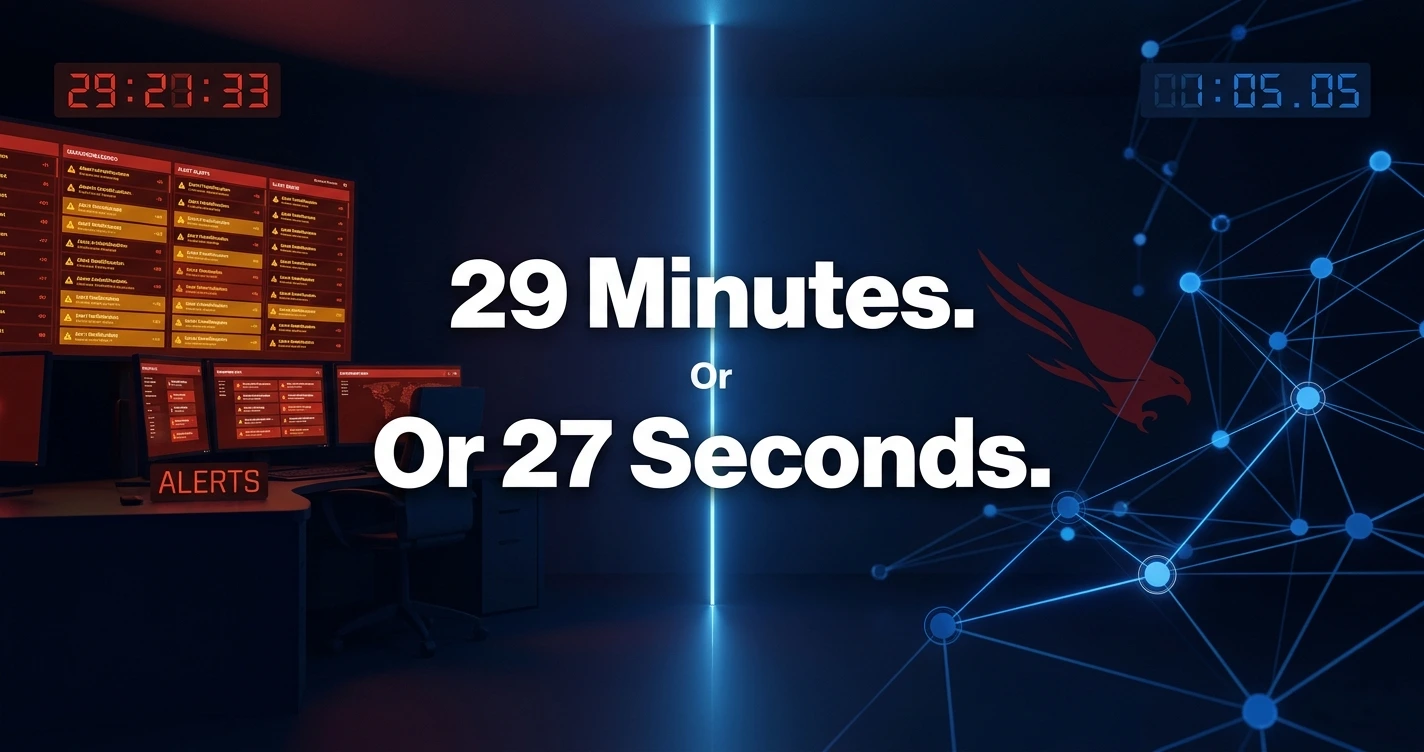
The average eCrime breakout time in 2025, defined as the elapsed time from initial access to lateral movement, dropped to 29 minutes. That represents a 65% increase in attacker speed from 2024. The fastest observed intrusion moved from access to lateral movement in 27 seconds. In one documented case, data exfiltration began within four minutes of initial compromise.
“This is an AI arms race. Breakout time is the clearest signal of how intrusion has changed. Adversaries are moving from initial access to lateral movement in minutes. AI is compressing the time between intent and execution while turning enterprise AI systems into targets. Security teams must operate faster than the adversary to win.”
Adam Meyers, Head of Counter Adversary Operations, CrowdStrike
The 29-minute average is an organizational benchmark, not a theoretical worst-case. If your incident response workflow takes longer than 29 minutes from detection to analyst action, you have already ceded the lateral movement window to the attacker. In a significant share of intrusions, the attacker has established persistence and begun moving toward their objective before the alert even surfaces in the SOC queue.
The attacker speed story gets worse when you consider what those attackers are now equipped with. AI-enabled adversary operations increased by 89% year-over-year in 2025. And 82% of detections in 2025 were malware-free, meaning adversaries used valid credentials and trusted identity flows to move through networks without triggering traditional signature-based detection.
The Identity Shift Changes Everything
When 82% of intrusions use valid credentials rather than malware, traditional endpoint detection loses most of its relevance. The attack surface has shifted to identity and behavior. AI threat detection that correlates behavioral anomalies across identity, endpoint, and network simultaneously is not optional. It is the only architecture that matches this threat model.
AI-generated phishing reduced attack preparation time from 16 hours to 5 minutes (IBM 2025 data). That’s not an incremental efficiency gain for attackers. It is mass-personalized social engineering at industrial scale. The volume increase this enables on the offensive side directly translates to the alert volume problem on the defensive side.
The Adoption Paradox: The Advantage Exists. Most Aren’t Using It.
IBM’s 2025 Cost of a Data Breach Report surveyed 604 organizations across 17 industries and 16 countries. Only 32% report using AI threat detection and automation extensively in their security programs. A separate Anvilogic survey conducted in collaboration with the SANS Institute found 45% of respondents have integrated AI into their threat detection workflows, but “integration” in many cases means a limited deployment in one tool category, not a systematic AI-augmented SOC architecture.
That leaves a majority of enterprise security operations running detection workflows that are structurally outpaced by the attacker speed documented above.
What’s behind that gap? The research points to four primary barriers, and they are not the ones most vendors would have you believe.
Barrier 1: Trust and Explainability
McKinsey’s March 2026 survey of approximately 500 organizations found nearly two-thirds cite security and risk concerns as the top barrier to fully scaling AI security systems, ahead of regulatory uncertainty and technical limitations. The cost or complexity of AI platforms ranked below trust.
“AI can discover anomalies faster, but adoption does not automatically create trust. The challenge is that too often, AI produces answers without showing its work. In the SOC, trust has always been built on verifiable evidence that stands up to scrutiny. Analysts move forward when they can see the data, understand the connections, and explain the reasoning behind a decision. AI earns its place in the SOC the same way: by making its insights clear, traceable, and grounded in proof.”
Kyle Pearson, Global Solutions Architect, Graylog • Security Boulevard, March 2026
This is not irrational resistance to change. When an AI system flags a threat and an analyst cannot trace the reasoning path, they face a binary choice: act on an alert they cannot verify, or ignore it. Most analysts default to skepticism, which means the AI detection advantage is wasted at the last mile of the workflow.
Barrier 2: Alert Volume Gets Worse Before It Gets Better
Adding AI detection layers without proper tuning can increase alert volume before it decreases it. During transition periods, organizations run legacy rule-based detection alongside the new AI system, generating duplicate alerts and compounding the false positive problem. Most organizations underestimate the tuning timeline and the temporary analyst workload spike that comes with it.
Barrier 3: Governance Gaps Create New Exposure
IBM and the Ponemon Institute found that 97% of organizations that experienced an AI-related security incident lacked proper AI access controls. And 63% of organizations have no AI governance policies in place. This is the governance paradox of 2026: organizations know AI is the answer to their SOC capacity problem, but deploying AI without governance infrastructure recreates the same exposure problem at a different layer. The security team’s own AI infrastructure becomes an attack surface.
Barrier 4: Budget Politics, Not Technology Readiness
Only 11% of security professionals trust AI completely for mission-critical tasks, per Splunk’s 2025 State of Security survey (n=2,058). That number is worth interrogating carefully. It is not a statement that AI threat detection doesn’t work. It is a statement about organizational trust, procurement cycles, and the difficulty of attributing breach prevention to a tool that works by stopping things before they escalate.
Our read: the budget and trust barriers are linked. Security teams that cannot demonstrate clear ROI from AI SOC investments face annual budget battles they often lose. IBM’s $1.9 million per-breach savings figure is the most powerful counter-argument available, but it requires a breach to make the case in retrospect.
The Financial Stakes Are No Longer Theoretical
IBM’s 2025 Cost of a Data Breach Report provides the clearest financial framework for the AI SOC adoption decision. These numbers are not projections or vendor estimates. They come from an activity-based costing methodology applied to 604 real organizations with documented breaches.
Organization Type
Avg. Breach Cost
Detection Timeline
Extensive AI + automation users
$3.62 million
80 days faster than average
No AI or automation
$5.52 million
Baseline
US organizations (average)
$10.22 million
US record high
Global average (2025)
$4.44 million
241-day mean identify + contain
The 241-day mean time to identify and contain a breach is actually an improvement: it is the lowest in nine years, driven by faster breach containment powered by AI among organizations that have adopted it. The organizations without AI are dragging that average upward.
For US enterprises specifically, the $10.22 million average breach cost is a record. Building and maintaining a full in-house 24/7 SOC runs $2 to $2.5 million per year in staffing alone, before SIEM licensing, EDR tools, or management overhead. The AI investment conversation needs to happen inside that cost context, not against it.
The ROI Calculation CISOs Are Missing
The $1.9 million average saving per breach for extensive AI users is not a ceiling. It does not account for reputational damage, regulatory penalty avoidance, or the compounded value of the 80-day reduction in attacker dwell time. Organizations using AI are containing breaches before attackers can maximize damage. Non-users are paying for the full extent of attacker access.
The Workforce Math Doesn’t Work Without AI
The global cybersecurity workforce gap stands at approximately 4.8 million unfilled positions. The total workforce needed globally is 10.2 million, against 5.5 million currently employed. The US alone has 750,000 empty cybersecurity roles.
Those positions are not going to be filled by traditional hiring. The pipeline for trained security professionals cannot be expanded fast enough to close a 4.8 million person gap, and the burnout cycle means that even the analysts you do hire are leaving within 18 months of experiencing the alert volume of a modern SOC.
Gartner projects that more than 50% of SOC Tier 1 analyst responsibilities will be handled by AI by 2028. That projection is not a threat to analyst careers. It is a necessary architectural shift that frees human analysts from the mechanical work that is burning them out and preventing them from doing the higher-judgment work that actually requires human reasoning.
“Organizations are already seeing efficiency gains of roughly 40 to 50% for lower-tier SOC tasks, freeing human analysts to focus on more advanced investigations and response activities.”
Martin Sordilla, Senior Technology and Security Architect, Accenture • CSO Online, April 2026
The practical implication: a team of 10 analysts augmented with AI can cover the workload that would previously have required 18 to 20 analysts. In a market where those 8 to 10 additional analysts simply may not be available, AI is not a competitive advantage. It is the only viable operational model.
The Honest Counterargument: Why Skepticism Is Legitimate
The case for AI SOC adoption is strong. But the skeptics are not wrong about everything, and enterprise security teams deserve a version of this argument that doesn’t paper over the real risks.
The “Seconds” Claim Needs Qualification
When AI threat detection is described as identifying anomalies in seconds, that framing refers to alert generation, not analyst-confirmed response. An alert that fires in seconds and sits unreviewed in a queue for six hours still represents a six-hour window of attacker opportunity. The metric looks good. The actual detection performance was poor. AI earns MTTD credit when it reduces the time to analyst action, not just the time to alert generation.
The Same AI Infrastructure Gets Targeted
CrowdStrike’s 2026 report documents prompt injection attacks against enterprise AI tools across more than 90 organizations. ChatGPT was mentioned in criminal forums 550% more than any other AI model. The AI infrastructure being deployed for defense is actively being targeted by adversaries who have learned to weaponize it. Deploying AI SOC capabilities without AI governance frameworks simultaneously opens a new attack surface. This is not an argument against AI adoption. It is an argument for deploying governance alongside the technology, not after it.
Implementation Failure Rates Are Real
A 2026 enterprise AI adoption survey (n=2,400) found 79% of organizations face significant challenges in adopting AI. Only 29% see meaningful ROI from generative AI despite individual productivity gains. Purchasing an AI SOC platform and achieving operational security value from it are very different outcomes separated by months of integration, tuning, and workflow redesign. The 6 to 24 month deployment timeline to operational maturity is not a vendor warning label. It is the realistic planning horizon CISOs need to build into their roadmaps.
“The first question enterprises ask about AI SOC isn’t ‘how fast is it?’ It’s ‘can we trust it?’ That question deserves a serious answer. Explainability, auditability, and clear escalation paths aren’t nice-to-haves. They’re the difference between AI that improves your SOC and AI that introduces new risk into it. Scale without accountability isn’t efficiency. It’s a different kind of risk.”
Enterprise Security Practitioner, cited in Prudent Consulting Cybersecurity Priorities Report, May 2026
This concern about governance sits at the intersection of the generative AI threats facing enterprise security teams and the AI deployment challenges covered in depth by IBM’s threat research. The responsible AI SOC conversation has to include both the offensive capabilities of AI and the defensive governance structures that keep deployed AI from becoming a liability.
What a Real AI SOC Actually Looks Like
An AI SOC is not a product. It is an operational model, and the distinction matters. Organizations that treat it as a product purchase and discover that tuning, integration, and workflow redesign are the actual work are the ones with 79% implementation challenge rates.
The operational model that practitioners are documenting in 2026 follows a tiered autonomy structure:
Function
Who Handles It
Why
Alert triage, enrichment, correlation
AI (autonomous)
Volume too high for human triage; pattern matching is AI-native
Initial investigation and classification
AI with human review
AI surfaces evidence; analyst confirms before escalation
Containment decisions
Human approval required
High-stakes action with potential false-positive consequences
Complex incident response
Human-led, AI-assisted
Novel threats, strategic decisions, stakeholder communication
Post-incident learning and tuning
Human-led
Requires contextual judgment to reduce future false positives
The 70%-plus of attacks that occur outside traditional business hours are the clearest argument for AI handling the autonomous triage layer. A human analyst is not reading alerts at 3 a.m. with the same speed and accuracy as a system that never tires, never has a bad night, and applies the same detection logic to every alert regardless of shift timing.
Vendors with documented case studies in this space include CrowdStrike Falcon, Palo Alto XSIAM, Microsoft Sentinel with Copilot for Security, SentinelOne Singularity, and UnderDefense. The choice of platform matters far less than the design of the autonomy tiers and the governance framework governing escalation paths.
The regulatory pressure to get this right is accelerating. NIS2 is in active enforcement, with approximately 19,000 companies estimated non-compliant as of March 2026. DORA is in effect for financial services. The EU AI Act moves to full enforcement from August 2026. Organizations that have been deferring AI SOC decisions as a technology question will discover it has become a compliance question. The timeline context connects to the broader regulatory timeline enterprises are navigating on multiple security fronts simultaneously.
What CISOs Should Do This Quarter
The argument that “we’re waiting for the technology to mature” is no longer available. AI threat detection platforms exist at commercial maturity, vendor case studies document real deployments, and the regulatory pressure is live. These are the decisions that need to happen now.
Map your SOC workflows against the 29-minute window. If your end-to-end detection-to-analyst-action time exceeds the average eCrime breakout time, every intrusion is potentially a full lateral movement event before your team engages. Identify specifically where AI triage would compress that timeline.
Separate the autonomy decision from the vendor decision. Decide what your AI should be allowed to do autonomously before you evaluate which platform does it. Organizations that buy a platform first and design governance after tend to lock in the wrong architecture.
Treat explainability as a non-negotiable procurement criterion. Evaluate any AI SOC platform on whether analysts can trace the reasoning behind alerts. Black-box AI fails at the last mile regardless of detection accuracy. XAI-integrated platforms that show confidence scores, contributing features, and attribution paths build the analyst trust that sustains adoption.
Build AI governance before you deploy AI detection. The 97% of AI breach victims who lacked proper AI access controls made their AI infrastructure a liability. Governance frameworks for your deployed AI are not a Phase 2 item. They are a prerequisite for Phase 1.
Watch the 2028 Gartner projection as a planning horizon. If 50%+ of Tier 1 responsibilities shift to AI by 2028, your current staffing model, your training pipeline, and your incident response playbooks all need to be redesigned for that operating reality. The planning window is now, not when the transition is already underway.
The organizations that document clear operational results from AI SOC deployments this year will have 12 to 18 months of institutional learning before the late majority begins their implementations. In the 2026 threat landscape, that compounding advantage in detection speed and analyst capacity is not incremental. It is strategic. The real-world breach consequences for organizations without that advantage are documented and public.
Frequently Asked Questions
How does AI detect cyberattacks faster than human analysts?
AI threat detection processes millions of log events simultaneously, applying behavioral anomaly detection in real time rather than waiting for signature matches or analyst review. AI-augmented SOCs reduce mean time to detect by 50% versus manual operations and correlate cross-domain signals in seconds while human analysts handle triage sequentially, one alert at a time. The speed advantage compounds at high alert volumes where human capacity breaks down entirely.
What is the average time for a SOC analyst to detect an intrusion without AI?
Without AI augmentation, mean time to detect (MTTD) ranges from hours to days for sophisticated intrusions. Mandiant’s M-Trends 2025 places median attacker dwell time at 11 days globally. IBM’s 2025 Cost of a Data Breach Report found the average breach takes 241 days to identify and contain. AI-augmented SOCs have reduced investigation times from 30-plus minutes to under two minutes per incident in documented deployments, with AI users detecting and containing 80 days faster on average.
Why aren’t more enterprises using AI for cybersecurity?
The top barriers are trust and explainability, not cost or technology readiness. McKinsey’s March 2026 survey of approximately 500 organizations found nearly two-thirds cite security and risk concerns as the primary obstacle to scaling AI security systems. Budget constraints, integration complexity, and governance gaps follow closely. Many organizations also underestimate the 6 to 24 month tuning and integration timeline required to reach operational maturity.
How fast do cyberattacks move in 2026?
CrowdStrike’s 2026 Global Threat Report documents the average eCrime breakout time at 29 minutes, a 65% speed increase from 2024. The fastest observed intrusion moved from initial access to lateral movement in 27 seconds. In one documented case, data exfiltration began within four minutes of initial compromise. At scale, 82% of 2025 detections were malware-free: attackers used valid credentials and trusted identity flows, bypassing traditional signature-based detection entirely.
How much does AI reduce cybersecurity breach costs?
IBM’s 2025 Cost of a Data Breach Report found organizations using AI and automation extensively incur $3.62 million per breach versus $5.52 million for non-users, a saving of $1.9 million per incident. This is the largest single-technology cost reduction IBM has measured in the study’s history. US organizations face an average breach cost of $10.22 million, a record high, making the AI investment calculation increasingly straightforward for American enterprises.
Can AI replace SOC analysts?
No. AI handles triage, enrichment, correlation, and alert classification: the mechanical workload that is currently consuming analyst capacity and accelerating burnout. Analysts handle complex investigation, containment decisions, novel threat response, and stakeholder communication. Gartner projects AI will handle more than 50% of Tier 1 SOC responsibilities by 2028. The consensus operational model is human-supervised AI augmentation, not replacement, and the 4.8 million global workforce gap makes that augmentation structurally necessary.
What is an AI SOC?
An AI SOC (Security Operations Center) is an operational architecture where AI handles alert triage, enrichment, and cross-tool correlation at scale, while human analysts supervise critical decisions and execute containment. It is not a single product but a tiered autonomy model that enables 24/7 detection coverage without proportionally scaling headcount. The key design decision is which functions operate autonomously, which require human review, and which require human approval before action.
What You Now Understand That Changes the Conversation
The AI SOC adoption gap is real, but it is not a story about technology laggards. It is a story about a legitimate set of governance, trust, and implementation challenges that most vendors have strong incentives to downplay. The organizations that close the gap successfully do so not by buying the fastest AI threat detection platform but by designing the right autonomy tiers, building governance infrastructure before deployment, and investing in explainable AI that earns analyst trust at the last mile of the workflow.
The next 12 to 18 months will likely define which enterprises have the institutional AI SOC capabilities to operate at attacker speed and which are still designing the framework. By 2030, AI-first SOC operations will be the global standard. The organizations still running human-pace triage workflows against AI-accelerated adversaries will not fail because the technology wasn’t available. The technology is available now.
Three things to track: the EU AI Act enforcement calendar from August 2026 and how it changes AI governance requirements for deployed security systems; the Gartner 2028 Tier 1 automation projection and whether enterprise procurement cycles are moving fast enough to meet it; and whether XAI (explainable AI) design becomes a competitive differentiator among SOC platform vendors or remains an afterthought. The trust problem Pearson and others describe will not resolve itself without explicit explainability engineering.
Stay Ahead of the AI Security Curve
The Neural Loop delivers weekly enterprise AI intelligence for security, MLOps, and infrastructure leaders. No noise. No vendor copy. Just verified signal.
Subscribe to The Neural Loop
Deepfake CEO Fraud: Arup’s $25M Wake-Up Call | NeuralWired
Enterprise Security
Deepfake CEO Fraud: Arup’s $25M Wake-Up Call
Updated June 21, 2026 · 11 min read
A finance employee at the global engineering firm Arup joined a video call with five colleagues, including the company’s UK based chief financial officer. Every person on that screen except him was an AI generated fake. Over the following weeks he approved 15 wire transfers totaling HK$200 million, roughly $25 million, to bank accounts the criminals controlled. That is deepfake CEO fraud, and it stopped being a one-off curiosity the moment the FBI started tracking it as its own crime category. The real lesson from Arup has less to do with spotting a fake face on a screen and more to do with who, inside your company, is allowed to approve a transfer in the first place.
If you sit anywhere near a payment approval chain, in finance, security, or the general counsel’s office, this is the case study worth understanding properly. And the fix is cheaper, and far less exotic, than most detection vendors would like you to believe.
The attack didn’t start with a video call. It started with an email, supposedly from Arup’s UK based CFO, requesting a confidential transaction. The employee who received it suspected phishing and didn’t act on it immediately, which is exactly the instinct security teams spend years trying to train into staff.
Then came the follow up: an invitation to a video conference where the CFO and several other colleagues appeared to be present. They weren’t. Every other participant on that call had been recreated using publicly available video and audio of the real executives, including footage from internal company meetings. Convinced he was speaking with real leadership, the employee proceeded to authorize 15 separate transfers to five Hong Kong bank accounts, totaling HK$200 million.
Nobody caught it in real time. The fraud only surfaced when the employee later checked in with Arup’s head office. Hong Kong police disclosed the case publicly on February 2, 2024, with senior superintendent Baron Chan Shun-ching giving the on record account. Arup confirmed in May 2024 that it was the company involved, telling press that “fake voices and images” were used and that attacks of this kind had been rising sharply in sophistication. As of the most recent reporting available, no arrests have been announced and the funds haven’t been recovered.
“Once fraudsters start making money, they fuel their fraud components with that funding.”
Matthew Miller, Principal, Cybersecurity Services, KPMG US · via CFO Dive
Miller’s point, made shortly after Arup went public, is the uncomfortable economic logic underneath all of this: deepfake fraud isn’t a novelty attack run by a handful of specialists. It’s profitable enough now to fund its own expansion.
Arup Wasn’t First, and It Won’t Be Last
The Arup case gets the headlines because of its scale and its use of live video, but it sits on a timeline that stretches back further than most coverage admits, and continues well past it.
Date
Case
Loss
What Made It Notable
March 2019
UK energy firm (via German parent company impersonation)
€220,000 (~$243K)
First widely documented AI voice clone CEO fraud
January 2024
Arup, Hong Kong
~$25M
First major case using a live, multi person video deepfake
January 2026
Entrepreneur in canton Schwyz, Switzerland
“Several million” Swiss francs
Voice deepfake sustained across a two week call sequence
April 2026
FBI IC3 2025 Annual Report
$893M (AI related fraud, all categories)
First year “AI related” tracked as a formal crime descriptor
There’s also a quieter 2020 case, cited in academic research on deepfake detection, where a Hong Kong bank manager authorized $35 million in transfers after a deepfake phone call impersonating a company director he’d actually spoken with before. It got far less press than Arup, but it tells you the same trick worked years before anyone had a name for it.
The Swiss case in January 2026 matters for a different reason: it confirms this hasn’t tapered off since Arup made headlines. It’s also worth saying plainly what the data does not support: there’s no verified cluster of three additional named, dollar confirmed enterprise deepfake cases within 90 days of any single incident. Several vendor blogs imply otherwise with vague “more cases followed” framing that doesn’t trace back to primary reporting. Be skeptical of round, dramatic numbers in this space that don’t link to a named source.
The Numbers: How Big Is This, Really
Individual cases make for a good story. The aggregate numbers are what should actually change how your company approves money.
Statistic
Source
Date
62% of organizations hit by at least one deepfake incident in 12 months
Gartner survey of 302 security leaders
Sept. 2025
$893M in AI related fraud losses reported to the FBI
FBI IC3 2025 Annual Report
Released April 2026
1,300% surge in deepfake fraud attempts at enterprise contact centers
Pindrop, analysis of 1.2B+ calls
2024 data, June 2025 report
73% human accuracy detecting AI speech deepfakes by ear
Peer reviewed listening study, NCBI/PMC
Published study
87% of finance staff would process a payment if “called” by their CEO or CFO
Medius Financial Census, 1,533 respondents
June 2024
$20.9B total IC3 reported cybercrime losses (AI fraud is ~4% of that)
FBI IC3 2025 Annual Report
2025 (reported 2026)
The 62% figure from Gartner is the single most useful “how common is this” data point in the field right now, because it comes straight from the analyst firm’s own release rather than a secondhand paraphrase.
“Employees really are on the frontline of trying to spot something unusual.”
Akif Khan, Senior Director Analyst, Gartner Research
Worth flagging a number that often gets misused: the widely cited $1.1 billion figure for total US deepfake fraud losses in 2025 (a tripling from $360 million in 2024, per Surfshark’s analysis) is mostly driven by something different than what happened at Arup. Roughly 80% of that total comes from celebrity and executive impersonation investment scams spread through social platforms like Facebook, WhatsApp, and Telegram, not targeted B2B wire fraud against a single employee. Conflating the two makes for a scarier headline, but it’s the wrong comparison.
And one honesty check on scale: AI related fraud, at $893 million, is still roughly 4% of the FBI’s total $20.9 billion in 2025 cybercrime losses. The FBI itself flags this as a likely undercount, since most victims don’t identify the AI component when they file a complaint. That cuts both ways: the real number could be higher, but claiming certainty about “how big this is right now” overstates what the data actually shows.
Why You Can’t Detect Your Way Out of This
The instinct, understandably, is to fight AI with AI: buy a tool that flags synthetic voices and faces before anyone wires money. The evidence says that’s not where the real advantage sits, at least not yet.
In a controlled listening study covering both English and Mandarin speech, human listeners correctly identified AI generated speech deepfakes only 73% of the time, even after being shown examples beforehand. That’s well above the unsourced “24.5% detection rate” figure that circulates on vendor blogs without a clear citation trail (treat that number as unverified if you’ve seen it elsewhere), but 73% is still nowhere near reliable enough to bet a wire transfer on.
Automated detection isn’t meaningfully better yet. Gartner’s own newer research on deepfake heavy social engineering warns that detection remains probabilistic and that benchmarks lag behind how fast generation tools improve. In practical terms: any vendor promising a near perfect detection rate today is selling you a number that won’t hold up against next year’s model.
A small case study in misinformation, inside a misinformation story
Two security blogs published in March 2026 describe the Arup attack as happening “in September 2025.” It didn’t. The verified date, confirmed by Hong Kong police and reported by outlets including CFO Dive, is January 2024. Nobody seems to have made this up maliciously. It’s more likely that someone paraphrased a paraphrase, the date drifted, and search engines rewarded the version that ranked. If a foundational fact like a case’s date can mutate this easily in cybersecurity reporting, it’s worth asking what else has drifted by the time a stat reaches your inbox.
A more defensible architecture, one NeuralWired has covered separately in our guide to zero trust security, treats every request as unverified by default rather than trying to spot the fake in real time. That principle, “never trust, always verify,” is exactly what the next section is built on.
The Real Fix: Kill the Trust, Not the Deepfake
Here’s the uncomfortable part. The Arup fraud worked not because the deepfake was flawless, but because the company’s process let one employee’s belief, however reasonably formed, authorize a $25 million transfer.
Medius surveyed 1,533 finance professionals across the US and UK and found that 53% had already been targeted by a deepfake scam, and 43% had fallen for one. The number that should worry every CFO most: 87% admitted they would process a payment if “called” by their CEO or CFO, and 57% of finance professionals can authorize transactions independently, without a second approval.
“Scammers are creating fake audio clips of CEOs and CFOs.”
Ahmed Fessi, Chief Transformation & Information Officer, Medius
Fessi’s broader point is that executives generate their own attack surface just by doing their jobs: earnings calls, conference panels, YouTube interviews, LinkedIn videos. All of it is raw material. You can’t stop a CEO from giving an earnings call. You can stop a single voice, no matter how convincing, from being sufficient authorization to move money.
A research team at the security publication DeepStrike makes the contrarian case worth sitting with: a basic rule requiring callback verification through a pre-registered phone number before any high value transfer “would have stopped the attack cold,” regardless of how perfect the deepfake was. Their broader argument pushes back on the industry’s heavy spend on detection tooling, suggesting companies stop trying to turn every employee into a forensic audio analyst and instead fix the approval workflow itself.
The minimum viable version of that fix looks like this:
Out-of-band callback verification for any urgent, confidential, or high value transfer request, using a number pulled from an internal directory, never one given during the suspicious call itself.
Dual authorization above a fixed dollar threshold, removing any single employee’s ability to independently move large sums, regardless of how senior the request appears to come from.
A documented “no exceptions” policy that survives social pressure, including a fake executive expressing urgency or annoyance about the delay.
Scenario based simulation, using mock deepfake calls rather than slide deck training, since the exploit here is authority compliance, not unfamiliarity with the concept of deepfakes.
What This Means for Your Team
For Finance and Treasury Teams
If you can independently authorize a wire transfer today, that’s the gap an attacker is counting on, not a convenience worth keeping. Push for mandatory dual sign off and a documented callback policy before your company becomes the next case study, not after.
For CISOs and Security Leaders
Annual phishing-style training has shown limited effect on deepfake susceptibility specifically, because the vulnerability is trust in authority, not unfamiliarity with the attack format. Live simulation exercises are cheap relative to a detection tool purchase, and they target the actual failure point. Also worth checking: how your cyber insurance policy classifies this. Deepfake enabled wire fraud is typically bucketed as social engineering fraud, which many standard policies exclude or cap well below data breach coverage.
For General Counsel and Compliance
Regulatory exposure is shifting. The FCC’s 2024 ruling that AI generated voices count as “artificial” under the Telephone Consumer Protection Act, the FTC’s 2024 rule banning AI impersonation of businesses, Tennessee’s ELVIS Act, and the FBI naming “AI related” as a formal crime category all point the same direction: a company that suffers a loss without a documented verification protocol will have a harder time in a regulatory or insurance dispute than one that had a tested process, even if that process failed once. Our earlier coverage of the FBI’s IC3 guidance on ransomware prevention walks through how documented controls increasingly shape post-incident outcomes, and the same logic now applies here.
The Honest Limit of Prevention
None of this eliminates the underlying problem. Callback verification, dual authorization, zero trust workflows, all of it addresses the moment of the transfer. None of it touches the first stage of these attacks: reconnaissance using an executive’s own public footage.
CEOs and CFOs can’t realistically stop giving interviews, earnings calls, or conference talks. That means the raw material for cloning a voice or a face will keep accumulating no matter how tight your internal controls get. The honest conclusion isn’t that this is solvable. It’s that companies can meaningfully cut the success rate of these attacks through process design, while accepting that the vulnerability itself, executives having public voices and faces, isn’t going away.
Frequently Asked Questions
How does deepfake CEO fraud actually work?
Attackers gather public audio and video of an executive from earnings calls, interviews, or conference talks, then generate a synthetic voice or video. They contact an employee, often through a spoofed email followed by a live or recorded video call, impersonating the executive to authorize an urgent, confidential wire transfer.
How much money did Arup lose in its deepfake scam?
A Hong Kong finance employee at Arup transferred HK$200 million, roughly $25 million, across 15 transactions in January 2024 after a video call where the CFO and several colleagues were entirely AI generated. The case was disclosed by Hong Kong police on February 2, 2024.
Can you actually detect a deepfake voice or video call?
Not reliably. A peer reviewed listening study found humans correctly identify speech deepfakes only about 73% of the time, and Gartner’s own research warns that automated detection remains probabilistic, with benchmarks that lag behind how fast deepfake generation tools improve.
How do companies protect themselves against deepfake CEO fraud?
The most effective defense is procedural, not technological: requiring independent, out-of-band verification, such as a callback to a pre-registered phone number, for any high value transfer requested by voice or video, no matter how convincing the request sounds or looks.
Does cyber insurance cover deepfake fraud?
It depends on the policy. Deepfake enabled wire fraud is typically classified as social engineering fraud, which many standard cyber insurance policies exclude or cap at lower limits than data breach coverage. Companies should review their specific social engineering and funds transfer sub-limits now.
How many organizations have experienced a deepfake attack?
62% of organizations reported experiencing at least one deepfake related incident, whether social engineering or exploitation of automated identity verification, in the prior 12 months, according to a Gartner survey of cybersecurity leaders released in September 2025.
Where This Goes Next
What Arup actually proves isn’t that AI fakes are unbeatable. It’s that most companies still let a single, well meaning employee’s judgment stand between a convincing phone call and a multi million dollar wire transfer. Fix that approval chain and the sophistication of the deepfake stops mattering nearly as much.
Three things worth watching over the next 6 to 18 months:
H.R. 1734, the Preventing Deep Fake Scams Act, which would stand up a Treasury led task force on AI financial fraud best practices. Its progress is worth tracking as a signal of where federal policy lands.
Cyber insurance language. Watch for insurers introducing explicit deepfake or synthetic media sub-limits, separate from general social engineering fraud coverage, as claims data accumulates.
The FBI’s 2026 IC3 report, due in early 2027, which will be the first year-over-year comparison for the “AI related” crime category and should clarify whether $893 million was a baseline or an outlier.
The pattern so far is consistent: the technology keeps getting better, and the fraud keeps working through the same gap in approval process. That gap is the one part of this problem any company can close this quarter, without buying a single piece of detection software.
Stay Ahead of the Next Wire Fraud Headline
Get NeuralWired’s analysis on AI security threats, straight to your inbox, before they make headlines.
Subscribe to The Neural Loop
NIST PQC 2030 Deadline: Why RSA-2048 Migration Will Take 15 YearsCybersecurity / Post-Quantum Cryptography
By NeuralWired Research Desk | June 9, 2026 | 12 min read
Scott Aaronson has spent years as the internet’s most trusted quantum skeptic. In May 2026, he published a post titled “Will you heed my warnings?” and told the world that people whose judgment he trusts more than his own now believe a fault-tolerant quantum computer capable of breaking deployed cryptographic systems should be achievable by around 2029. When the skeptic sounds the alarm, you pay attention.
Here is the problem. 97% of organizations say they plan to invest in post-quantum cryptography over the next 24 months. Only 22% have moved beyond piloting. And nearly half, 49% of organizations, haven’t started implementing any quantum-resistant security measures at all. The gap between awareness and action is so wide it borders on institutional negligence.
NIST has set 2030 as the deprecation date for RSA-2048 and ECC P-256. That sounds like four years. It is not four years for most enterprises. Academic research published in December 2025 puts the realistic post-quantum cryptography migration timeline for large enterprises at 12 to 15 or more years. Organizations that begin today cannot mathematically complete migration before 2031 at the earliest, and likely far later. This article explains why, what you need to do, and what you’re actually risking by waiting.
The 97% / 22% Gap: Awareness Without Action
The central tension in post-quantum cryptography today isn’t technical. It’s organizational. The awareness is near-universal. The execution is nearly absent.
97%
of organizations plan to invest in PQC in the next 24 months
22%
have actually moved beyond piloting and into implementation
49%
haven’t started or considered any quantum-resistant measures
41%
say they do not plan to address quantum computing at this time (ISACA 2025)
The ISACA 2025 survey result deserves a moment to sit with: 37% of organizations haven’t even had an internal discussion about a known regulatory deadline. This is not a technology problem. It is a prioritization failure with a structural deadline attached to it.
Gartner has named post-quantum cryptography migration among six forces reshaping enterprise security architecture in 2026. CISOs who have not briefed their boards on this issue are already behind peer practice, not leading it.
NSA CNSA 2.0 first compliance deadline for new National Security Systems
All classical public-key algorithms in NSS
2029
Gartner operational deadline (treat this as your real target)
RSA-2048, ECC P-256, Diffie-Hellman
2030
NIST deprecation: unsuitable for new deployments
RSA-2048, ECC P-256, algorithms with 112-bit security
2030
EU mandates member state transitions begin
All classical public-key cryptography
2035
NIST full disallowance from all standards
All quantum-vulnerable algorithms
Australia’s ASD advises eliminating all classical public-key cryptography by 2030. Europe’s ETSI is targeting full PQC integration by 2035 but encourages hybrid algorithm adoption now. The regulatory convergence is global, and it is accelerating.
Gartner’s Operational Deadline
Gartner advises treating 2029 as your operational planning deadline, not 2030. Systems need to be validated, tested, and running before the regulatory cutoff. One year sounds small. In a multi-year migration, it is everything.
Executive Order 14306, signed in June 2025, further reinforced federal cybersecurity modernization priorities including quantum-safe cryptography requirements. A 2025 executive order directed agencies to support Transport Layer Security Protocol Version 1.3 by 2030 and tasked DHS with maintaining a list of product categories that support PQC algorithms. CISA subsequently released an advisory mapping PQC standards to common enterprise hardware and software categories, noting that many listed product categories have implemented PQC for limited functions only and are not yet fully quantum-resistant.
Why Migration Takes 12 to 15 Years for Large Enterprises
The headline framing of “four years until the deadline” is almost comically optimistic for enterprises of meaningful scale. A peer-reviewed study published in MDPI Computers in December 2025 provides the most rigorous timeline data available: