Category: Cybersecurity

Cybersecurity analysis for CISOs and security teams: threat intelligence, zero-trust architecture, AI-powered attacks, compliance frameworks, and enterprise defense strategies.

  • Generative AI in Cybersecurity: IBM’s 2026 Threat Reality

    Generative AI in Cybersecurity: IBM’s 2026 Threat Reality

    Generative AI in Cybersecurity 2026: The Weapon Defending and Attacking You at the Same Time
    NeuralWired  |  AI & Technology Intelligence for Security Leaders
    Cybersecurity Intelligence  /  Deep Analysis

    Generative AI in Cybersecurity: The Weapon Defending and Attacking You at the Same Time

    Generative AI has fractured cybersecurity into two simultaneous realities. It is the most powerful defensive tool deployed at enterprise scale, and the cheapest offensive weapon ever handed to criminals. Here is the honest picture, with numbers.

    By NeuralWired Research Desk  •  Published: May 31, 2026  •  Last Updated: May 31, 2026  •  14 min read

    $12.87B GenAI Cybersecurity Market 2025
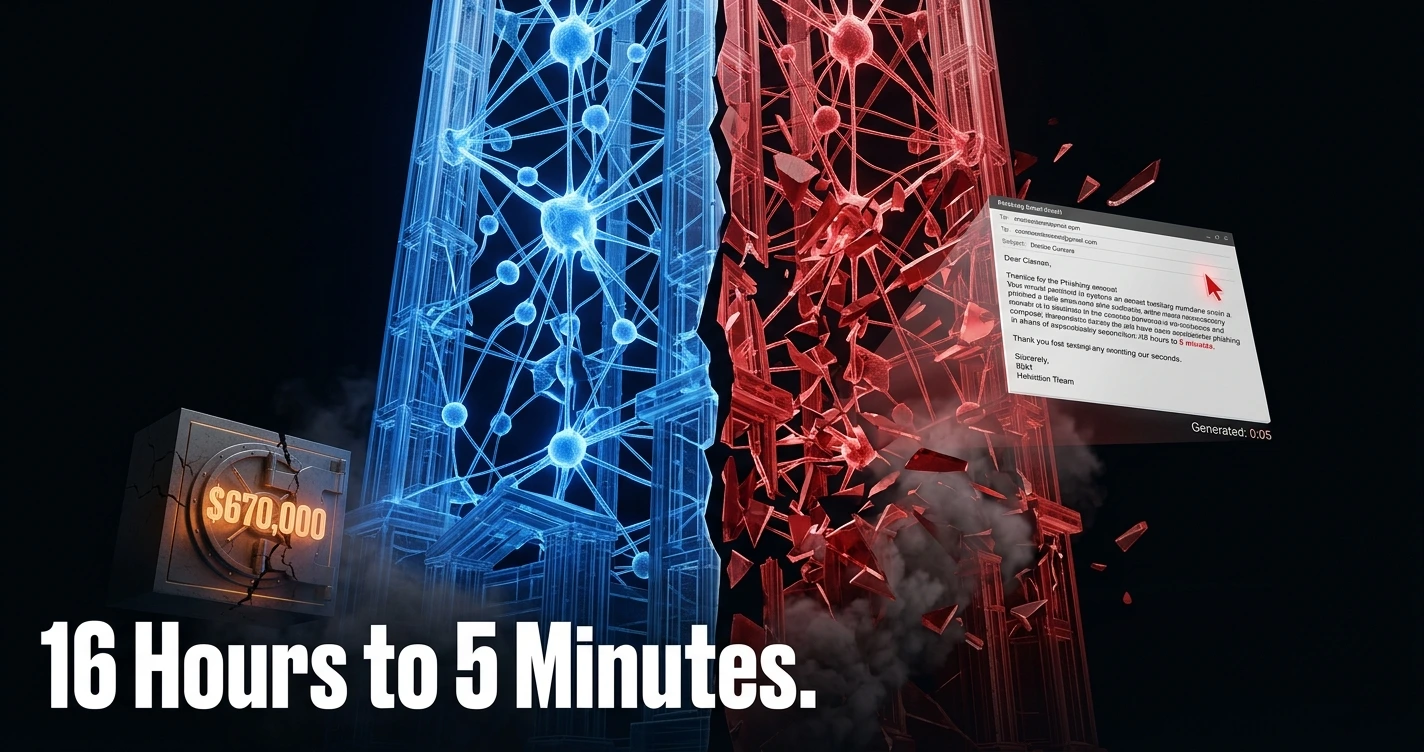
    5 min To craft an AI phishing email (was 16 hrs)
    80 days Shorter breach lifecycle with AI defense
    94% Of security leaders say AI is #1 change driver

    The Core Paradox of 2026

    A financial services firm in Frankfurt tightened its breach lifecycle by 80 days last year. Its AI-powered security operations center caught a credential-stuffing campaign at 2 a.m. with no human analyst in the loop. The same quarter, one of its treasury executives received a video call from what appeared to be the CFO, instructing a wire transfer. The voice was real. The face was real. Neither was human.

    This is the defining tension of generative AI in cybersecurity right now. The same technology compressing your incident response timeline is compressing an attacker’s phishing production pipeline. The World Economic Forum Global Cybersecurity Outlook 2026, drawing on 804 respondents across 92 countries including 316 CISOs, found that 94% of security leaders identify AI as the most significant driver of change in their field. The same report found that 87% flagged AI vulnerabilities as the fastest-growing cyber risk throughout 2025.

    Both numbers refer to the same technology. That is not a contradiction. That is the story.

    Our Read
    This signals something the vendor community is reluctant to say plainly: investing in AI for defense does not reduce your exposure to AI as an attack vector. It changes the nature of the fight. Organizations that grasp this distinction will build genuinely resilient security postures. Those chasing “AI-powered security” as a procurement category will be left exposed in ways their tools cannot detect.


    How Generative AI Is Used in Cybersecurity

    Generative AI in cybersecurity refers to the application of large language models and generative systems to automate threat detection, accelerate incident response, generate synthetic attack scenarios for red teaming, analyze vulnerabilities, and craft adaptive security policies. It powers security operations centers (SOCs) by triaging alerts, reducing analyst workload, and identifying anomalous behavior in real time. (Sources: IBM, Fortinet, WEF GCO 2026)

    On Defense: What the Numbers Actually Show

    The IBM Cost of a Data Breach Report 2025, now in its 20th year and covering 600 organizations across 17 industries and 16 countries, produced the most credible measurement of AI’s defensive ROI to date. Organizations using AI extensively in their security operations cut their breach lifecycle by 80 days and saved nearly $1.9 million on average per breach, compared to organizations that did not.

    The global average breach cost fell 9% to $4.44 million in 2025, the first decline in five years. That is the headline. The subtext is more important: the U.S. average breach cost rose to a record $10.22 million, up from $9.36 million in 2024. The organizations pulling the average down are those investing in AI-augmented detection and response. The ones pulling it up are those that are not.

    Specific Use Cases That Are Working Now

    Across platforms from IBM Security QRadar to CrowdStrike and Palo Alto Networks (named by MarketsandMarkets as the dominant players in this market), the applications generating real operational value in 2026 include the following.

    Use Case What It Does Maturity Level
    AI-assisted alert triage Filters noise, prioritizes high-fidelity incidents, reduces analyst fatigue Production-ready now
    GenAI phishing detection Identifies AI-crafted emails via behavioral and linguistic pattern analysis Production-ready now
    Synthetic red teaming Generates adversarial attack scenarios at scale for penetration testing Production-ready now
    Vulnerability auto-remediation Identifies and patches insecure code in development pipelines Scaling fast (Gartner: 40% of dev teams by end of 2026)
    Autonomous SOC response Full end-to-end incident containment without human input Aspirational. 3 to 5 years from reliable deployment.
    Gartner projects that by the end of 2026, 40% of development teams will routinely use AI-based auto-remediation for insecure code. That figure was under 5% in 2023. The acceleration is real. So is the risk it carries.


    AI Cybersecurity Threats 2026: How Attackers Are Using It

    One statistic from IBM’s 2025 breach report has become the most visceral data point in enterprise security conversations this year. Generative AI has reduced the time required to craft a convincing phishing email from 16 hours to 5 minutes. That is not an incremental efficiency gain. It is a structural change to the economics of social engineering at scale.

    According to IBM’s findings, 1 in 6 breaches in 2025 involved attackers using AI. Phishing was the primary method at 37% of AI-assisted attacks, followed by deepfake impersonation at 35%. These are the first statistics of their kind at scale, and they represent a floor, not a ceiling.

    “Defenders will likely see threat actors use agentic AI in an automated fashion as part of intrusion activities, continue AI-driven phishing campaigns, and continued development of advanced AI-enabled malware. They’ll use agentic AI to implement hacking agents that support their campaigns through autonomous work.”

    Alex Cox, TIME Director and AI Working Group Lead, LastPass (TechNewsWorld, January 2026)

    The Speed Problem Is Now Structural

    FortiGuard Labs’ 2025 cyberthreat data shows that newly discovered vulnerabilities are now being weaponized in an average of 4.76 days, a 43% increase in speed compared to prior periods. The window between a CVE being published and an attacker having a working exploit is now smaller than most organizations’ patch cycles by a significant margin.

    This is where generative AI’s role in offense is most concrete and most dangerous. It is not creating fundamentally new classes of malware (the Picus 2025 Red Report found no notable uptick in AI-driven malware innovation in 2024). It is compressing the timeline of every phase of an attack, from reconnaissance to exploitation to lateral movement.

    Critical Risk Flag
    Deepfake executive impersonation is now technically feasible at enterprise scale according to Palo Alto Networks’ 2026 cybersecurity predictions. Real-time AI video and voice replicas of your C-suite require organizations to retire any multi-factor authentication method tied to voice or video verification immediately. This is not a 2027 concern.


    Shadow AI: The $670,000 Threat Nobody Is Governing

    Shadow AI refers to the unauthorized use of AI tools such as ChatGPT, Claude, or Gemini by employees without IT approval or oversight. It creates security risk because sensitive data may be uploaded to external platforms without data loss prevention controls in place. IBM’s 2025 breach data found that shadow AI adds an average of $670,000 to breach costs per incident, placing it among the top three costliest breach factors, displacing skills shortages from that position for the first time.

    13% of organizations in IBM’s study experienced AI-specific breaches. Of those, 97% lacked basic security controls for their AI systems at the time of breach. Role-based access governance, data classification, and output monitoring were absent in nearly every case.

    Shadow AI is no longer an HR policy issue. It is a board-level financial governance issue. If that framing hasn’t reached your leadership team yet, the IBM numbers are the vehicle.

    You can read more about AI system integrity risks and the specific failure modes of autonomous AI systems in NeuralWired’s analysis of AI agent document corruption, which details exactly how unsanctioned agentic systems corrupt enterprise data flows in ways that are difficult to detect and expensive to remediate.

    What the WEF Data Shows
    64% of organizations are now assessing the security of AI tools before deployment, up from 37% in 2025 according to the WEF Global Cybersecurity Outlook 2026. Governance is accelerating. But 36% of organizations are still deploying AI tools with no formal security assessment. In a market where shadow AI already costs an average of $670,000 per breach, that gap represents enormous, quantifiable financial risk.


    Agentic AI and the Next Escalation

    Agentic AI in cybersecurity refers to AI systems that autonomously execute multi-step tasks including scanning for vulnerabilities, crafting exploits, or orchestrating attack campaigns without constant human direction. In 2026, both defenders and attackers are integrating agentic AI: defenders for autonomous SOC response and threat hunters, threat actors for fully automated intrusion operations. (Sources: OWASP, WEF 2026, Darktrace)

    Darktrace’s State of AI Cybersecurity 2026 report, drawing on more than 1,500 security leaders, captures the shift in a single sentence: 2025 was the year enterprise AI went mainstream; 2026 is when it became a full-scale attack surface.

    The deployment of Anthropic’s Project Glasswing, a restricted frontier model with autonomous zero-day research capability deployed with a small set of trusted infrastructure organizations before any public release, represents a strategic threshold. AI can now autonomously discover zero-day vulnerabilities. The question for every CTO in critical infrastructure is: when adversaries gain access to comparable models, what is your baseline threat assumption?

    A concrete illustration of the speed at which AI-powered vulnerability discovery operates: as detailed in NeuralWired’s coverage of CVE-2026-31431, AI found a 9-year-old Linux kernel vulnerability in under one hour. Nine years of human security review missed it. That is not a niche benchmark. That is a preview of what autonomous AI exploit research means at scale for every organization running Linux infrastructure.

    “I expect the sophistication and intensity of cyber threats will continue to increase, as they have year over year. The ever-expanding tech landscape and rise of Adversarial AI means cybersecurity is not just about protecting business value anymore. It’s now a fundamental driver.”

    Adnan Amjad, US Cyber Leader and Partner, Deloitte & Touche LLP

    The Case Against the Hype

    If you’ve sat through a vendor briefing in the past 12 months, you’ve heard the “AI versus AI cyberwar” framing. It is compelling. It also contains a significant amount of motivated reasoning.

    Cybercriminals Are Not Adopting AI as Fast as the Headlines Suggest

    Sophos X-Ops research published in January 2025, based on direct investigation of multiple underground criminal forums, found that criminals are still largely skeptical of generative AI. Most criminal AI use is limited to bulk email generation and data analysis. Novel attack classes powered by AI remain rare. The Picus 2025 Red Report, cited by Ivanti, found no notable uptick in AI-driven malware techniques in 2024, stating directly that “AI enhances productivity but doesn’t yet redefine malware.”

    The practical implication: vendors are financially incentivized to overstate offensive AI capability to justify defensive AI spending. At least half of the AI-versus-AI cyberwar narrative in circulation right now is marketing material dressed as threat intelligence.

    AI Security Tools Create Blind Spots the Industry Isn’t Discussing

    VikingCloud’s October 2025 analysis details a specific and underreported risk. Adversarial machine learning can be used to attack AI security tools themselves through crafted inputs designed to deceive AI classifiers, allowing malware to pass through undetected. Data poisoning attacks can corrupt the training datasets those AI tools depend on, creating systemic blind spots that are invisible to the defenders relying on the system.

    AI hallucinations in security contexts add another dimension. Based on Artificial Analysis’s AA-Omniscience benchmark covering 40 AI models, all but four were more likely to provide a confident, incorrect answer than a correct one on difficult questions. In a SIEM or incident response workflow, a confidently wrong AI verdict doesn’t just delay response. It actively misdirects it. The Hacker News covered this emerging risk in May 2026, noting it is almost entirely absent from vendor marketing materials.

    “As with many other things in life, the mantra should be ‘trust but verify’ regarding generative AI tools. We have not actually taught the machines to think; we have simply provided them the context to speed up the processing of large quantities of data. The potential of these tools to accelerate security workloads is amazing, but it still requires the context and comprehension of their human overseers for this benefit to be realized.”

    Chester Wisniewski, Director and Global Field CTO, Sophos

    Nearly Half of AI-Generated Code Is Already Shipping Vulnerabilities

    This may be the most underappreciated structural risk in enterprise security today. According to Krishna Vishnubhotla, VP of Product Strategy at Zimperium, writing in TechInformed in December 2025: “Nearly half of AI-generated code contains security flaws. We will see more vulnerabilities pushed into production, not fewer.”

    If your engineering teams are using GitHub Copilot, Cursor, or any AI coding assistant at scale (and they are), the velocity gains from those tools may be offset or exceeded by downstream remediation costs from the vulnerabilities they ship. This is detailed further in NeuralWired’s analysis of why AI agents fail in production, which covers the specific failure modes that create enterprise security exposure.

    “Many people have a huge incentive to keep building the infrastructure, but the vibe has changed. Loans will get more expensive, stock prices are coming down, and profits (except for Nvidia) are few and far between.”

    Gary Marcus, NYU Professor Emeritus and AI Critic, co-founder of Robust.AI (Dark Reading, December 2025)
    Marcus is making a broader economic argument: the AI cybersecurity vendor landscape is being propped up by a capital environment that may not persist. Arkose Labs’ 2025 AI Maturity in Cybersecurity Report found that only about half of enterprises had realized measurable benefits from AI security investments despite widespread adoption. The governance gap widens faster than deployment in too many organizations.


    What Security Engineers Must Do Now

    The attack surface now includes the AI stack itself. Every LLM, API integration, plug-in connection, and training pipeline your organization runs is a software layer that must be audited, tested, and governed like any other. If you’re building or maintaining security infrastructure, here is what requires action before the next quarter closes.

    Priority Action: Shadow AI Audit
    Conduct a full inventory of every AI tool accessing company data across all departments. Engineering, HR, finance, and legal are the highest-risk vectors. Do not assume IT-approved tools are the only ones in use. They are not, and IBM’s 2025 data puts the average cost of getting this wrong at $670,000 per breach.

    Beyond shadow AI, there are four actions that move the needle on genuine risk reduction right now.

    First, evaluate AI-native EDR and SIEM tools with behavioral analysis rather than rule-based detection. Pattern-matching rules built for human-speed attacks are structurally insufficient for AI-generated phishing arriving at machine speed. Behavioral analytics and AI-versus-AI detection architectures are the operative requirement, not a future consideration.

    Second, implement the OWASP LLM Top 10 framework for every internal AI tool and every customer-facing AI product. The OWASP GenAI Security Project is the de facto technical standard for GenAI application security risks and is referenced by enterprise security teams globally. If your AI products are not being assessed against this framework, they are not being adequately assessed.

    Third, treat all AI-generated code as high-risk code. Enforce static analysis and adversarial testing pipelines before any AI-generated code reaches production. The Zimperium data on nearly half of AI-generated code containing security flaws is not a prediction. It is a current operational reality for every engineering team using a code copilot.

    Fourth, establish role-based access governance for every AI component in your security stack. IBM’s 2025 data shows 97% of AI-specific breaches lacked basic access controls. This is the single most actionable gap with the clearest remediation path.


    What CTOs Must Understand Now

    The generative AI cybersecurity market sits between $8.65 billion and $12.87 billion in 2025, depending on the methodology used, according to MarketsandMarkets and ResearchAndMarkets respectively. The broader AI in cybersecurity market, which includes all AI categories, reached $34.09 billion in 2025 according to Fortune Business Insights, with North America holding 34.90% of that market. Growth rates across credible forecasters are consistently pegged between 22% and 29% annually through 2031.

    The vendor landscape is consolidating fast. CrowdStrike, Palo Alto Networks, and Fortinet hold the largest product footprints. Decision windows for multi-year platform contracts are narrowing as consolidation removes competitive alternatives. If you are still in evaluation mode on your AI security platform strategy, that window is not staying open.

    The Post-Quantum Threat Has a Shorter Timeline Than You Were Told

    The “harvest now, decrypt later” threat model, where adversaries collect encrypted data today to decrypt when quantum computing matures, is operating on a compressed timeline. AI-accelerated cryptanalysis research is advancing faster than public quantum computing milestones suggest. NIST finalized its first post-quantum cryptography standards in 2024. Organizations have limited runway for cryptographic inventory and migration planning. Begin that inventory now.

    Timeline Realism for AI Security Claims

    The autonomous SOC is 3 to 5 years from reliable deployment at scale. AI-generated malware redefining attack classes is not in evidence yet. Post-quantum cryptography urgency is a realistic and genuine concern. Calibrate your board communications and investment timelines accordingly.

    The G7 Cyber Expert Group issued a formal joint statement in 2025 acknowledging that GenAI, agentic AI, and advanced AI systems present emerging and evolving cybersecurity risks requiring proactive cross-jurisdictional response. That regulatory signal, combined with the EU AI Act’s risk classification requirements now forcing formal security assessments of AI systems in regulated industries, means the compliance architecture around AI security is hardening fast. Organizations that treat AI governance as optional are building technical debt with regulatory interest attached.

    How We Got Here: The Four-Year Arc

    • Pre-2022 AI in cybersecurity meant machine learning for anomaly detection. Pattern matching, SIEM correlation, endpoint behavior analysis. Useful. Narrow. Human-speed attacks, human-speed defense.
    • 2022 to 2023 ChatGPT launches. Natural language AI reaches non-technical threat actors overnight. Phishing, social engineering, and script generation become democratized. The attack surface calculus changes permanently.
    • 2024 First major wave of GenAI-native security products hit enterprise procurement. CrowdStrike, Palo Alto Networks, and Microsoft release AI copilots. OWASP LLM Top 10 is formalized. NIST finalizes first post-quantum cryptography standards. Gartner places AI-powered security operations at the Peak of Inflated Expectations.
    • 2025 IBM documents AI as both defensive asset and attack vector at scale for the first time. Shadow AI becomes a top-3 breach cost factor. G7 issues formal AI cybersecurity statement. Exploit weaponization drops to 4.76 days average.
    • 2026 Agentic AI creates autonomous attack campaigns. Project Glasswing marks the first institutional AI capable of autonomous zero-day research. EU AI Act forces formal security assessments. Cyber-enabled fraud overtakes ransomware as the top CEO concern.

    Key Takeaways

    • Organizations using AI extensively in security operations cut breach lifecycles by 80 days and save an average of $1.9 million per breach (IBM 2025).
    • 1 in 6 breaches in 2025 involved attackers using AI. Phishing leads at 37%, deepfake impersonation at 35%.
    • Shadow AI adds $670,000 to average breach costs. 97% of AI-specific breaches lacked basic access controls.
    • Exploits are being weaponized in 4.76 days on average, a 43% increase in speed. AI-speed defense is not optional.
    • Nearly half of AI-generated code contains security flaws (Zimperium). Engineering velocity gains may be offset by downstream remediation costs.
    • The autonomous SOC is 3 to 5 years from reliable deployment. Human oversight is the operative model in 2026.
    • Post-quantum cryptography migration timelines are being compressed by AI-accelerated cryptanalysis. Begin inventory now.

    FAQ: Generative AI in Cybersecurity

    How is generative AI used in cybersecurity?

    Generative AI is used in cybersecurity to automate threat detection, accelerate incident response, generate synthetic attack scenarios for red teaming, analyze vulnerabilities, and craft adaptive security policies. It also powers security operations centers (SOCs) by triaging alerts, reducing analyst workload, and identifying anomalous behavior in real time. (Sources: IBM, Fortinet, WEF GCO 2026)

    What are the cybersecurity risks of generative AI?

    Generative AI introduces several cybersecurity risks: it enables attackers to generate convincing phishing emails in minutes rather than hours, create deepfake impersonations, and automate malware. For defenders, risks include shadow AI data exposure, AI model poisoning, adversarial inputs bypassing detection, AI hallucinations causing false security verdicts, and governance gaps in unsanctioned AI tool use. (Sources: IBM 2025, WEF 2026, Sophos)

    Can generative AI replace human cybersecurity analysts?

    No. Generative AI augments but does not replace human cybersecurity analysts in 2026. While AI effectively handles Tier 1 alert triage and enrichment, complex incident response, threat hunting, and strategic decisions still require human judgment. IBM’s 2025 data shows AI-human collaboration reduces breach lifecycles by 80 days. Autonomous SOC response at scale remains 3 to 5 years from reliable deployment.

    How are hackers using generative AI to attack organizations?

    Hackers use generative AI primarily to craft convincing phishing emails at scale, a process that once took 16 hours and now takes 5 minutes. They also use AI for deepfake voice and video impersonations of executives, to debug and customize malware, and to automate victim profiling for more targeted social engineering campaigns. (Sources: IBM 2025, Sophos X-Ops)

    What is shadow AI in cybersecurity?

    Shadow AI refers to the unauthorized use of AI tools such as ChatGPT, Claude, or Gemini by employees without IT approval or oversight. It creates security risk because sensitive data may be uploaded to external platforms without data loss prevention controls. IBM’s 2025 report found shadow AI adds an average of $670,000 to breach costs, making it a top-three costliest breach factor.

    What is the market size of generative AI in cybersecurity?

    The generative AI cybersecurity market was valued at approximately $8.65 billion to $12.87 billion in 2025 depending on methodology, with projections ranging from $35 billion to $45 billion by 2030 to 2031. The broader AI in cybersecurity market reached $34.09 billion in 2025. Growth rates are consistently estimated between 22% and 29% CAGR. (Sources: MarketsandMarkets, ResearchAndMarkets, Fortune Business Insights)

    What is agentic AI in cybersecurity?

    Agentic AI in cybersecurity refers to AI systems that autonomously execute multi-step tasks such as scanning for vulnerabilities, crafting exploits, or orchestrating attack campaigns without constant human direction. In 2026, both defenders and attackers are integrating agentic AI: defenders for autonomous SOC response, and threat actors for fully automated intrusion operations. (Sources: OWASP, WEF 2026, Darktrace)


    Where This Leads in the Next 12 to 18 Months

    What you now understand that most of your peers do not yet: generative AI in cybersecurity is not a product category to buy your way into. It is a structural shift in the economics and speed of both attack and defense simultaneously. The organizations winning this transition are not the ones deploying the most AI tools. They are the ones governing the AI they already have.

    Three things to watch in the next 12 to 18 months. First, agentic AI moving from experimental deployment to production-scale SOC integration at the largest financial and critical infrastructure organizations. When it works, it will compress defender response times dramatically. When it fails under novel adversarial conditions (which adversarial ML is specifically engineered to trigger), organizations that have reduced their human analyst capacity will face an unguarded gap. Second, the post-quantum migration timeline shortening faster than the public discourse reflects, driven by AI-accelerated cryptanalysis. Third, regulatory requirements under the EU AI Act and successor G7 frameworks creating mandatory security assessment requirements for AI systems in regulated industries, transforming what is currently a governance best practice into a legal obligation.

    The mantra for 2026 is the one Chester Wisniewski offered at the start of the year: trust but verify. Not just for your AI tools. For the threat intelligence you’re using to justify buying them.

    Get weekly intelligence on AI and cybersecurity delivered to your inbox. No noise. No vendor marketing. Just the analysis that matters.

    Subscribe to The Neural Loop

  • How to Prevent Ransomware Attacks in 2026: FBI IC3 Guide

    How to Prevent Ransomware Attacks in 2026: FBI IC3 Guide

    How to Prevent Ransomware Attacks in 2026: The Complete IT Manager’s Guide | NeuralWired
    Cybersecurity  ·  May 31, 2026

    How to Prevent Ransomware Attacks in 2026: The Complete IT Manager’s Guide

    $57B Annual Global Ransomware Damage
    44% Of All Breaches Involve Ransomware
    51s AI-Shortened Breakout Time
    Your security stack was designed for a threat that no longer exists. The ransomware of 2026 doesn’t wait for a phishing click, doesn’t spend weeks inside your network, and doesn’t care that you have antivirus. It exploits an unpatched VPN, moves to your domain controller, and starts encrypting — all before your SOC finishes its morning standup.

    The FBI’s IC3 2025 Annual Report, released in April 2026, confirmed what security teams already knew in their gut: ransomware reports hit 3,611 last year, total U.S. cybercrime losses crossed $20.877 billion for the first time, and every single one of the 16 U.S. critical infrastructure sectors reported a ransomware attack. Every one. This isn’t a niche threat hitting careless companies. It’s a $57 billion industry running on subscription models, AI tools, and a workforce that rivals mid-sized tech firms.

    This guide covers what actually works to prevent ransomware attacks in 2026 — not the marketing checklist, the real one. It’s written for IT managers and CISOs who are responsible for keeping operations running, not for people who want to feel like they’ve done something.


    What Is Ransomware and Why Is 2026 Different?

    Ransomware is malicious software that encrypts your files or systems and demands payment — typically in cryptocurrency — to restore access. You already know that. What’s changed is everything else: who’s deploying it, how fast it moves, what they do before they encrypt, and what leverage they hold after.

    The Verizon 2025 Data Breach Investigations Report found ransomware present in 44% of all data breaches — a 37% increase from the year prior. For small and midsize businesses, that number climbs to 88% of all breaches. Not “some breaches.” Almost all of them.

    The Rise of AI-Powered Ransomware

    The existential shift is AI. Not hypothetical AI — deployed, operational AI that ransomware groups are using right now to compress attack timelines that defenders had assumed would stay wide enough to detect and respond.

    “By mid-2026, at least one major global enterprise will fall to a breach caused or significantly advanced by a fully autonomous agentic AI system. These systems use reinforcement learning and multi-agent coordination to autonomously plan, adapt, and execute an entire attack lifecycle: from reconnaissance and payload generation to lateral movement and exfiltration. They continuously adjust their approach based on real-time feedback.”

    — Michael Freeman, Head of Threat Intelligence, Armis | SecurityWeek, February 2026
    The practical consequence: AI has shortened ransomware breakout times to 51 seconds in modeled deployments, while CrowdStrike’s 2025 Global Threat Report found 79% of initial access attacks are now completely malware-free. They’re using stolen credentials and legitimate remote management tools that your security stack was built to trust.

    ⚠ Critical Shift — Read This First
    Attackers are exploiting new vulnerabilities an average of 7 days before a patch is released. The Verizon 2025 DBIR documented that for critical edge device vulnerabilities, the median time between publication and mass exploitation was zero days. Your patch-and-scan cycle cannot protect against threats that arrive before the patch exists.

    Ransomware-as-a-Service Has Industrialized

    After Operation Cronos took down LockBit’s infrastructure in February 2024 and ALPHV/BlackCat collapsed following the Change Healthcare attack, many observers expected the ransomware ecosystem to shrink. It didn’t. The gang count increased 40% despite sustained law enforcement pressure — because Ransomware-as-a-Service is a business model, not a group. Current top platforms vying for dominance include Qilin, DragonForce, and LockBit 5.0, with 63 new ransomware variants identified in 2025 alone — more than five per month.

    Double extortion is now the default, not a premium option. Attackers exfiltrate your data first, then encrypt. Over 7,500 organizations appeared on dark web leak sites in the most recent period analyzed — a 58% jump from 2024. Your backups don’t protect against the public release of stolen data. That’s a separate problem requiring a separate solution.


    How Ransomware Attacks Work in 2026 (Step-by-Step)

    Understanding the attack chain is prerequisite to building a real prevention strategy. Most defenses fail because they target the wrong stage.

    Stage What Happens 2026 Reality Your Defense Window
    1. Initial Access Attacker gets into your environment Usually an unpatched VPN/firewall, not a phishing email Patch edge devices; phishing-resistant MFA
    2. Persistence Establishes foothold, survives reboots Uses legitimate tools (PSExec, AnyDesk) — no malware Behavioral EDR; privileged access management
    3. Discovery Maps your network, finds high-value targets Automated and AI-assisted; completes in hours Network segmentation; deception tech
    4. Lateral Movement Pivots to domain controllers, backup servers Median time to ransomware: 5 days total from entry Zero Trust; least-privilege access
    5. Exfiltration Steals data before encrypting Now standard — creates double extortion leverage DLP monitoring; egress filtering
    6. Encryption Deploys ransomware payload Targets backup servers first; disables VSS snapshots Immutable/air-gapped backups; auto-containment EDR
    The median dwell time — the gap between initial intrusion and ransomware deployment — has collapsed from 70+ days in 2022 to approximately 5 days now. That’s your detection window. Five days, assuming your monitoring catches the initial compromise. If your security operations are running alert reviews on a weekly cycle, you’ve already lost.

    “Phishing is a pervasive initial access mechanism and the reported complaints don’t show how phished credentials and session cookies then fuel account takeover, BEC, session hijacking, and ransomware. The complaint count is only the tip of the spear.”

    — Trevor Hilligoss, Chief Intelligence Officer, SpyCloud | SpyCloud FBI IC3 Analysis, April 2026
    What this means practically: even if your phishing training is excellent, attackers who bought stolen session cookies from a dark web marketplace bypass your MFA entirely. They’re authenticated before they try anything that would trigger an alert. Identity hygiene — not just endpoint security — is now the primary front.


    How to Prevent Ransomware Attacks: 10 Proven Controls

    The most effective ransomware prevention in 2026 requires layered controls across identity, network, endpoint, data, and process. No single tool stops modern ransomware. CISA’s #StopRansomware Guide — the joint framework from CISA, NSA, FBI, and MS-ISAC — remains the definitive baseline. What follows maps directly to it, updated for the 2026 threat landscape.

    1

    Patch Edge Devices First — VPNs, Firewalls, Gateways

    This is the most important shift in ransomware prevention strategy for 2026. Vulnerability exploitation has overtaken phishing as the leading initial access vector, driven almost entirely by internet-exposed edge devices. Your VPN, firewall, and remote gateway are the new front door — and attackers are through it before vendors ship a patch.

    Prioritize CVEs affecting edge devices above all other patching. Subscribe to vendor security advisories and emergency patch notifications. If a critical VPN vulnerability drops on a Friday afternoon, your policy needs to authorize emergency patching that night — not the next change window.

    Immediate Action
    Audit every internet-exposed device right now: VPNs, remote desktop gateways, SSL inspection appliances, load balancers. Run your current firmware versions against the CISA Known Exploited Vulnerabilities catalog. Anything on that list gets patched this week.

    2

    Deploy Phishing-Resistant MFA — Not SMS, Not Authenticator Apps

    If your organization’s MFA strategy is still SMS one-time passwords or standard authenticator apps, you are operating with a false sense of security. Both are regularly bypassed through real-time phishing proxies, SIM-swapping, and session token theft. The attacker doesn’t need your password or your code — they intercept the authenticated session.

    Phishing-resistant MFA means FIDO2/WebAuthn: hardware security keys (YubiKey, Google Titan) or device-bound passkeys. These cannot be intercepted by a phishing proxy because the cryptographic challenge is bound to the specific domain the user is authenticating to. A fake site can’t complete the challenge. Enforce this for all privileged accounts within 30 days. Extend to all users within 90.

    3

    Implement Zero Trust Architecture

    Zero Trust isn’t a product you buy — it’s an architecture decision that requires organizational commitment. This distinction matters because dozens of vendors are selling “Zero Trust” labels on tools that implement none of it. Purchasing a ZTNA product without implementing the full Zero Trust security model per NIST SP 800-207 is security theater.

    Real Zero Trust means: no implicit trust based on network location, least-privilege access enforced for every identity and device, continuous verification rather than one-time login, and micro-segmentation that limits blast radius when — not if — something gets through.

    “Your EDR vendor’s ‘AI-powered’ detection is usually just better marketing. What actually works is real-time behavioral baselines combined with ML anomaly detection, dynamic allowlisting tied to asset criticality, and automated containment — stop first, ask questions later.”

    — Dr. Erdal Ozkaya, Global CISO | erdalozkaya.com, May 30, 2026
    Our read: Ozkaya’s framing is the most practically useful perspective on security tools in circulation right now. The ROI question isn’t “does this tool have AI?” — it’s “does this tool contain threats automatically before a human reviews an alert?”

    4

    Maintain Immutable, Air-Gapped Backups

    “We have backups” is the most dangerous four-word sentence in ransomware response planning. The relevant questions are: Are they immutable? Are they offline? Have you tested a full restore in the past 90 days? Do they exist on a system that ransomware could reach through your network?

    The 2026 ransomware backup strategy requires three layers: the 3-2-1 baseline (three copies, two media types, one offsite), object lock enabled on cloud storage so backups can’t be deleted or encrypted even by a compromised admin account, and air-gapped offline copies that are physically disconnected from your network. Then test the restore. Not annually — quarterly. Untested backups fail at the exact moment you need them.

    And remember: backups don’t stop double extortion. If data was exfiltrated before encryption, your backup strategy is irrelevant to the extortion threat. You still need a separate data exfiltration prevention layer.

    5

    Use Behavioral EDR — Not Signature-Based Antivirus

    Traditional antivirus looks for known malware signatures. Modern ransomware attacks are 79% malware-free — using legitimate tools like PSExec, Cobalt Strike, and AnyDesk that have no malicious signatures. Signature-based detection is not merely insufficient; it’s actively misleading because it creates confidence that isn’t warranted.

    Behavioral EDR (Endpoint Detection and Response) watches what processes do, not what they are. It catches an admin tool that starts encrypting hundreds of files per second, a process that modifies the boot sector, or a script that deletes VSS snapshots. Critically: configure auto-containment. A tool that detects and alerts on ransomware but waits for human review before isolating an endpoint has already failed — 51 seconds isn’t enough time for anyone to read an alert and act.

    The FBI IC3 identified 63 new ransomware variants in 2025 — more than five per month. Signature tools cannot keep pace. Behavioral tools don’t care about variant names.

    6

    Segment Your Network (Micro-Segmentation)

    Ransomware’s power comes from lateral movement: a compromised endpoint reaching your domain controller, your backup servers, your OT systems. Micro-segmentation breaks that chain. It limits what each segment of your network can talk to, so a compromised workstation in finance can’t reach manufacturing systems or backup infrastructure.

    Priority segmentation targets in 2026: isolate backup infrastructure completely from production networks, segment OT/ICS environments from IT networks, and create a hardened administrative tier that requires jump server access. These three alone contain the blast radius of most ransomware incidents to one segment rather than the entire organization.

    7

    Control Third-Party and MSP Access

    Why hack one company when you can hack the company that manages a thousand others? MSPs are a strategic priority for ransomware groups in 2026 precisely because of this multiplication effect. The Ingram Micro attack in July 2025 — where the SafePay group disrupted operations for nearly a week and paralyzed supply chains for thousands of VARs and MSPs — confirmed that distributor-tier targeting is now operational, not theoretical.

    If your organization uses an MSP, that MSP’s security posture is your security posture. Audit their controls. Require written evidence of their MFA implementation, patch management, and incident response plan. Implement just-in-time access grants rather than persistent remote access credentials. The software supply chain attack vector extends beyond MSPs to any vendor with code or access touching your environment — require Software Bills of Materials (SBOMs) from all critical vendors.

    29% of all breaches now involve third-party compromise. That number will rise.

    8

    Run Quarterly Ransomware Tabletop Exercises

    A tabletop exercise is a structured walkthrough of your ransomware incident response — who does what, who authorizes what, who talks to regulators, who approves a ransom decision. Most organizations run these annually, which means their response plan has been sitting untested for up to 12 months when an incident hits. Quarterly is the 2026 standard.

    Include legal counsel, communications, and executive leadership — not just IT. The MGM Resorts attack in September 2023, which caused $100M+ in damages, wasn’t primarily a technical failure; it was a social engineering of the IT help desk that bypassed all technical controls. Your tabletop needs to include scenarios that attack your people and processes, not just your systems.

    9

    Develop and Test Your Incident Response Plan

    An incident response plan that lives in a SharePoint folder is not an incident response plan. It’s a document. The difference between a plan and a capability is rehearsal. Your IR plan needs to cover: immediate isolation procedures (who has authority to pull systems offline without approval chain delay?), communication templates for regulators, customers, and press, evidence preservation protocols for law enforcement, and ransom decision authorization — written down before the incident, not improvised during it.

    Report all ransomware incidents to the FBI at IC3.gov and CISA. Beyond civic obligation, early reporting activates federal resources including threat intelligence sharing that may shorten your recovery.

    10

    Monitor for Data Exfiltration — Not Just Encryption

    Encryption detection is stage six of a six-stage attack. By the time your EDR is flagging encryption activity, the attacker has already been in your network for days, has already stolen the files that will fund their extortion, and has already targeted your backup systems. Encryption monitoring matters — but it’s the last line, not the primary one.

    Add a dedicated exfiltration detection layer: monitor for large, unusual outbound data transfers, use DLP tools that inspect egress traffic for sensitive data patterns, and set anomaly alerts on cloud storage access volumes. The Canvas LMS breach in May 2026, where ShinyHunters exfiltrated 275 million student records, illustrates the scale of damage that becomes irreversible once exfiltration completes — regardless of what your backup strategy looks like.


    What Industries Are Most at Risk from Ransomware in 2026?

    Every sector faces ransomware. That’s not hyperbole — the FBI IC3 2025 Annual Report confirmed ransomware incidents across all 16 U.S. critical infrastructure sectors last year. But targeting is not random. Ransomware groups optimize for maximum leverage, which means sectors where downtime creates existential pressure to pay.

    Sector Why They’re Targeted Key Risk Factor
    Healthcare Patient safety creates payment urgency; high-value PHI Legacy OT systems; life-critical uptime requirements
    Manufacturing OT/ICS downtime costs $100K+/hour in many facilities IT/OT convergence creates new attack surface
    Financial Services Regulatory pressure to restore quickly; high-value data Complex third-party ecosystems; supply chain exposure
    Government Political pressure; citizen data; often under-resourced Budget constraints; legacy infrastructure
    IT / MSPs One-to-many: compromise MSP, hit all their clients Privileged access to client environments
    SMBs (All Sectors) 88% of SMB breaches involve ransomware; fewer defenses Limited security staffing; MFA gaps; unmanaged endpoints
    The Change Healthcare attack in February 2024 remains the definitive case study in healthcare ransomware impact: ALPHV/BlackCat disrupted U.S. healthcare billing for weeks across thousands of providers, with UnitedHealth reporting ~$872 million in remediation costs. A single enterprise compromise cascaded through an entire supply chain. If you’re in any of these sectors and your ransomware prevention checklist is still anchored to phishing training and endpoint antivirus, you’re operating with the wrong threat model.


    Should You Pay the Ransom?

    The official position of the FBI and CISA is clear: don’t pay. The practical reality is more complicated, which is why the answer is never the CISO’s alone to make.

    The arguments against paying are well-established: payment funds further attacks, doesn’t guarantee data recovery or deletion (ransomware groups routinely lie about destroying exfiltrated data), and may violate OFAC sanctions if the group is on the U.S. Treasury’s designated entities list. Paying a sanctioned group — even unknowingly — creates legal exposure for the organization and executives involved.

    The argument for considering payment is equally real: some organizations facing existential operational collapse, particularly in healthcare, have no viable alternative when recovery from backups would take months. Jason Baker, Managing Security Consultant at GuidePoint Security, notes ransomware may be becoming less successful due to increased pressure against payments and improved defenses — but that this trend requires sustained commitment to prevention investment to hold.

    If You’re Facing a Ransomware Demand Right Now
    Step 1: Engage legal counsel immediately — before any payment decision or communication with attackers.

    Step 2: Report to FBI IC3 at ic3.gov and CISA. This is not optional — it activates federal support.

    Step 3: Check whether the ransomware group appears on OFAC sanctions lists before any payment consideration.

    Step 4: Engage a ransomware negotiation firm — do not communicate directly with attackers without expertise.

    What we won’t tell you is that paying is always wrong or always necessary. What we will tell you is that the decision made under pressure, without preparation, without legal counsel, and without having checked OFAC compliance is the one most likely to make your situation worse. The time to think through the ransom decision framework is now, not when you’re six hours into an incident with systems down.


    What to Do After a Ransomware Attack

    Speed and sequencing matter. The first 24 hours after ransomware detection determine whether your recovery takes days or months.

    1. Isolate immediately. Pull affected systems from the network. Disable VPN access. Don’t shut down systems — preserve volatile memory (RAM) for forensic analysis. Killing power destroys evidence.
    2. Activate your IR plan. Notify your incident response team, legal counsel, and executive leadership in that order. Every organization should have this call chain documented and rehearsed before an incident.
    3. Report to authorities. File with FBI IC3 at ic3.gov and notify CISA. If you’re in a regulated industry, check your sector-specific reporting obligations — HIPAA requires breach notification within 60 days; SEC rules may require faster disclosure for public companies.
    4. Preserve evidence. Do not wipe and reinstall before forensic imaging. Law enforcement and your cyber insurance carrier will both need evidence. Early destruction of logs or system images can compromise both investigations.
    5. Identify the scope. What systems are encrypted? What data was exfiltrated? When did initial access occur? (Remember: the encryption event is not when the attack started — it’s when it ended.)
    6. Begin recovery from clean backups. Restore from backups that predate the initial compromise, not just the encryption event. If attackers had been in your network for 5 days, a backup from day 3 may be compromised.
    7. Don’t pay without legal and OFAC review. If payment is under consideration, run sanctions screening first. Always.
    Mean recovery cost per ransomware incident in 2025: $1.53 million according to Sophos research. That number does not include ransom payments — it’s the operational, forensic, legal, and remediation cost of getting back to normal. Organizations with tested incident response plans and clean offline backups recover in days. Those without face months of downtime and costs that exceed that figure significantly.


    Ransomware Prevention Checklist — Print and Post This

    Save this. Run through it with your team this quarter. If any item is unchecked, prioritize it before the next change window.

    Identity and Access

    • Phishing-resistant MFA (FIDO2/passkeys) enforced on all privileged accounts
    • MFA enforced on all remote access points (VPN, RDP, cloud consoles)
    • Privileged Access Management (PAM) solution in place; admin accounts not used for daily work
    • Session token and credential theft monitoring active
    • Third-party and MSP access reviewed; just-in-time access enforced

    Network and Perimeter

    • All internet-exposed edge devices (VPN, firewall, gateway) audited against CISA KEV catalog
    • Emergency patching policy in place — edge device critical CVEs patched within 24 hours
    • Network segmentation implemented; backup infrastructure isolated from production
    • OT/ICS networks segmented from IT networks
    • Egress filtering and anomaly detection on outbound data volumes

    Endpoint and Detection

    • Behavioral EDR deployed across all endpoints — auto-containment configured
    • Signature-based antivirus replaced or augmented with behavioral detection
    • Remote monitoring and management tool inventory audited; unauthorized RMM tools removed
    • PowerShell execution policy restricted; script block logging enabled

    Data and Backup

    • Immutable, air-gapped offline backups implemented (3-2-1 minimum)
    • Cloud backup storage has object lock enabled
    • Full restore test completed in the past 90 days
    • DLP monitoring in place for sensitive data exfiltration
    • VSS shadow copies protected; ransomware groups target these first

    Process and Readiness

    • Incident Response plan documented; tested in the past 90 days via tabletop
    • OFAC sanctions list screening process established for potential ransom scenarios
    • Legal counsel identified and briefed on ransomware response protocols
    • FBI IC3 and CISA reporting procedures documented and known to IR team
    • Cyber insurance policy reviewed; coverage terms and exclusions understood
    • Supply chain/vendor security questionnaire updated; SBOMs requested from critical vendors

    Frequently Asked Questions About Ransomware Prevention

    What is the most effective way to prevent ransomware?
    The most effective ransomware prevention combines immutable offline backups, phishing-resistant MFA (FIDO2 hardware keys or passkeys), Zero Trust architecture with least-privilege access, patched edge devices (VPNs and firewalls), and behavioral EDR with auto-containment. No single control is sufficient — CISA’s #StopRansomware Guide recommends all five as a baseline, and each addresses a different attack stage.

    Can ransomware be stopped once it starts encrypting?
    Once ransomware begins encrypting files, stopping it requires immediate network isolation of affected systems. Behavioral EDR tools configured for auto-containment can interrupt encryption within seconds of detection. However, if data exfiltration already occurred — now standard in double extortion attacks — containment stops encryption but doesn’t undo the theft. The extortion threat remains even with perfect backups.

    What are the three main entry points for ransomware in 2026?
    In 2026, the three primary ransomware entry points are: (1) unpatched edge device vulnerabilities — VPNs, firewalls, and remote gateways now surpass phishing as the leading initial access vector; (2) stolen or phished credentials used against systems without phishing-resistant MFA; and (3) supply chain and third-party access compromise, now responsible for 29% of all breaches. Sources: Verizon DBIR 2025; CrowdStrike 2025 Global Threat Report.

    Should you pay the ransom?
    The FBI and CISA both recommend against paying ransomware. Payment funds further attacks, doesn’t guarantee data recovery or deletion, and may violate OFAC sanctions if the group is designated. Any payment decision must involve legal counsel and a sanctions screening check before any funds move. Report every ransomware incident to ic3.gov immediately — this activates federal support regardless of payment decision.

    Does MFA prevent ransomware attacks?
    MFA significantly reduces risk but doesn’t eliminate it. Standard SMS-based OTP and authenticator apps are increasingly bypassed through real-time phishing proxies, session hijacking, and SIM-swapping. Phishing-resistant MFA — FIDO2 hardware security keys or passkeys — is the 2026 recommended standard. These are cryptographically bound to the authentic domain and cannot be intercepted by a phishing proxy. Enforce this for all privileged accounts immediately.

    What backup strategy best prevents ransomware?
    The 3-2-1 backup rule — three copies, two media types, one offsite — is the foundation, but 2026 best practice adds: immutable air-gapped offline backups that ransomware cannot reach, object lock enabled on cloud storage, and tested restores conducted quarterly. Untested backups consistently fail under incident pressure. Note: backups don’t prevent double extortion — data already exfiltrated remains a leverage point regardless of your backup posture.

    How long does recovery from a ransomware attack take?
    Recovery time varies dramatically based on preparation. Organizations with tested, offline backups and a rehearsed incident response plan typically restore within days to weeks. Those without can face months of downtime. Sophos 2025 research puts mean recovery cost at $1.53 million — separate from any ransom payment. The median ransom demand alone is $1.32 million. The ROI on prevention investment is unambiguous.

    What industries are most targeted by ransomware in 2026?
    The most targeted sectors in 2025–2026 are healthcare, manufacturing, financial services, government, and IT/technology — including MSPs. All 16 U.S. critical infrastructure sectors reported ransomware incidents in 2025, per the FBI IC3 2025 Annual Report. Healthcare and manufacturing face the highest operational impact due to life-critical or production-critical uptime requirements, which maximize attacker leverage.


    What You Now Know
    Ransomware prevention in 2026 is not an endpoint security problem. It’s an identity problem, a network architecture problem, a third-party risk problem, and increasingly an AI problem that moves faster than human response cycles allow. The threat landscape that shaped your current security stack — phishing as the primary vector, weeks of dwell time for detection, malware as the payload — has been replaced by something structurally different.

    In the next 6–18 months, watch for three developments that will reshape the prevention calculus: autonomous AI attack agents moving from modeled capability to confirmed operational deployment; regulators tightening mandatory ransomware disclosure windows (the SEC’s current rules are a floor, not a ceiling); and ransomware groups increasing pressure on the insurance ecosystem, making policies harder to claim and forcing security requirements upward.

    Three things to act on this week: audit your internet-exposed edge devices against the CISA Known Exploited Vulnerabilities catalog, schedule a ransomware tabletop exercise for this quarter, and check whether your backup restore procedure has been tested in the past 90 days. If any of those three are outstanding, they represent more risk than anything else on your to-do list.

  • What Is Zero Trust Security? The NIST Guide (2026)

    What Is Zero Trust Security? The NIST Guide (2026)

    Zero Trust Security: Why “Never Trust, Always Verify” Is Winning the Cybersecurity War
    Cybersecurity

    Zero Trust Security: Why “Never Trust, Always Verify” Is Winning the Cybersecurity War

    $40B+ Global ZT market size in 2025
    30% Organizations that have actually implemented ZT
    $1.76M Average breach cost saved with mature ZT (IBM 2024)
    In 2020, hackers slipped into SolarWinds’ build pipeline and pushed poisoned software updates to 18,000 organizations, including the U.S. Treasury, Homeland Security, and the Pentagon. They moved through networks undetected for months. The perimeter had held. The castle walls were intact. The attackers were already inside, trusted by every system they touched.

    That’s the problem zero trust security was designed to solve. And after two decades of being dismissed as too complex, too expensive, or too theoretical, it has become the dominant cybersecurity framework for enterprises, governments, and anyone who can’t afford to assume the person inside the network is actually who they say they are.

    The zero trust security market hit $40.01 billion in 2025. It’s projected to reach $182.59 billion by 2035. Every major federal agency in the United States is under a legal mandate to adopt it. Yet only 30% of organizations have actually done it. That gap, between the promise and the practice, is the real story.


    What Zero Trust Security Actually Means

    Zero trust is not a product. It’s not software you buy. It’s a philosophy, and that distinction matters enormously, because hundreds of vendors are selling “zero trust solutions” while the framework’s own creator is calling them out on it.

    “Zero Trust is first and foremost a strategy. It’s something that you do, not something you buy.” — John Kindervag, Chief Evangelist, Illumio; Creator of the Zero Trust model; speaking at RSAC 2025. Source
    Kindervag created zero trust around 2009–2010 while a VP and Principal Analyst at Forrester Research. His foundational paper proposed a framework in which companies abandon the assumption that any device or user, inside or outside the corporate network, can be trusted by default. The phrase he coined: never trust, always verify.

    The authoritative technical definition comes from NIST (Special Publication 800-207, published August 2020): zero trust “provides a collection of concepts and ideas designed to minimize uncertainty in enforcing accurate, least privilege per-request access decisions in information systems and services in the face of a network viewed as compromised.”

    In plain English: assume the network is already breached. Verify every user, every device, every access request, every time. Grant only the minimum access required for that specific task. And continuously monitor, because a device that was clean at 9 a.m. might be compromised by 11 a.m.

    The Core Shift
    Traditional security asks: Are you inside the network? If yes, you’re trusted. Zero trust asks: Who are you, what device are you on, what do you need, and does this request make sense right now?, every single time.


    How It Works: The Five Pillars

    CISA’s Zero Trust Maturity Model organizes the architecture across five pillars. If you’re building or assessing a zero trust program, this is your map.

    Pillar What It Covers Why It Matters
    Identity Multi-factor authentication, privileged access, identity governance The highest-ROI starting point. Most breaches begin with compromised credentials.
    Devices Endpoint detection, device health validation, mobile device management A user with valid credentials on a compromised device is still a threat.
    Networks Micro-segmentation, encrypted traffic inspection, DNS security Limits lateral movement — what attackers do after they’re in.
    Applications & Workloads App-layer access control, secure APIs, cloud workload protection The average enterprise uses 130 SaaS apps. Each is a potential attack vector.
    Data Data classification, DLP, encryption at rest and in transit Ultimately, data is what attackers want. This pillar protects the final target.
    Each pillar progresses through maturity stages, Traditional, Initial, Advanced, and Optimal. Cross-cutting capabilities including visibility, analytics, automation, and orchestration apply across all five. The point isn’t to buy a tool for each pillar. It’s to map your existing security investments to this framework and identify what’s genuinely missing.

    The VPN vs. ZTNA Distinction

    The most misunderstood comparison in enterprise security: a VPN and Zero Trust Network Access (ZTNA) are not the same thing. A VPN grants broad network access once a user authenticates, you’re in, and you can reach most of what’s on the network. ZTNA grants access only to specific resources, verified continuously for every session. It’s the difference between handing someone a master key and escorting them directly to the one room they need. Gartner predicted that by 2025, 60% of companies would replace VPNs with ZTNA solutions, and that transition is still very much underway.


    Why Zero Trust Is Winning Now

    Three forces converged to make zero trust urgent rather than optional.

    The Perimeter Collapsed

    The traditional “castle and moat” security model assumed that everything inside the corporate network could be trusted. That assumption died slowly, then all at once. SolarWinds (2020), Colonial Pipeline (2021), and the MOVEit breach (2023) each involved extensive lateral movement that perimeter defenses couldn’t detect. The attackers weren’t breaking through the walls, they were walking through the gate with stolen credentials.

    Remote Work Killed the Network Edge

    When 2020 sent millions of employees home overnight, it didn’t just complicate security, it obliterated the physical boundary the perimeter model depended on. Workers logging in from home networks, personal devices, coffee shops, and foreign countries made the “inside vs. outside” distinction meaningless. Zero trust, which had been growing steadily, became unavoidable.

    The U.S. Government Made It Mandatory

    In May 2021, President Biden’s Executive Order 14028 formally required federal civilian agencies to develop plans for Zero Trust Architecture. The OMB memorandum M-22-09 (January 2022) went further, requiring all federal agencies to meet specific ZT objectives by the end of FY 2024. When the U.S. government mandates a cybersecurity framework across every civilian agency, the private sector follows, not because it has to, but because the vendor ecosystem, talent pool, and enterprise procurement processes all orient toward it.

    A CISA progress report published January 2025 assessed federal agency implementation through FY 2024. It was candid about failures and outlined next steps, which is itself a signal that the mandate has teeth, even if delivery is uneven.


    The Implementation Gap: 72% Planning, 30% Doing

    Here’s the single most important number in zero trust right now: according to Forrester, 72% of security decision-makers at large organizations plan to pursue zero trust or are already doing so. According to CyberRisk Alliance’s 2024 survey, only 30% of organizations have actually implemented zero trust practices.

    That’s a 42-point execution gap. And it has a name: the implementation problem.

    “Anything that helps me get visibility and reduces risk is a win, but Zero Trust has to start with a mindset and a strategy aligned to business outcomes.” — Jared Nussbaum, CISO, Ares Management; speaking at RSAC 2025. Source
    What’s stopping organizations? The data from a StrongDM survey of 600 U.S.-based cybersecurity workers is blunt: 48% cite cost and resource constraints as their primary barrier. Another 22% report internal resistance. The obstacles aren’t technical, they’re organizational and financial.

    Gartner’s estimate cuts even deeper: by the end of 2026, only 10% of large enterprises will have a mature and measurable zero trust program, up from less than 1% in 2023. Even among organizations that have started, most are mid-journey. Approximately 52% of organizations have completed full ZTNA deployment; 38% remain in partial implementation phases.

    The ROI Case CISOs Should Be Making to Their Boards
    The IBM Cost of a Data Breach Report 2024 found that the average breach costs $4.88 million, a record high, up 10% from 2023. Organizations with mature zero trust deployments save an average of $1.76 million per breach compared to those without. A mid-market zero trust program can pay for itself from a single avoided breach.

    For CISOs navigating this, the practical guidance is consistent: don’t buy new platforms before mapping existing investments. If you have MFA, EDR, and IAM tools already deployed, map them to the five pillars first. Identity is almost always where the highest-ROI work begins, because it’s where most breaches start.


    The Hard Truth: What Zero Trust Can’t Do

    No serious coverage of zero trust is complete without this part. Three categories of criticism deserve attention from anyone making real decisions about it.

    The Vendor Exploitation Problem

    The 2023 Okta breach is the cautionary tale. A threat actor accessed a stolen credential from the identity and access management firm, a company whose entire value proposition is verifying identity, and used it to access customer systems across Okta’s client base. As Jason Steer, CISO of Recorded Future, noted in the aftermath:

    “A lot of organizations are now all in on companies like Okta, who offer zero trust, and that means threat actors understand that as well.” — Jason Steer, CISO, Recorded Future. Infosecurity Magazine, March 2026
    Steer’s point is precise: zero trust can consolidate organizational risk into single-vendor dependencies. The identity pillar, when it relies on one provider, becomes a single point of failure with a much larger blast radius than the perimeter it replaced.

    Kindervag himself has addressed the product misconception directly: “Any business or vendor that claims to have a zero trust product is either lying or doesn’t understand the concept at all.”

    MFA Is Not Impenetrable

    Identity is zero trust’s highest-ROI pillar and its most exploited weakness simultaneously. Attackers have developed reliable techniques to circumvent MFA: man-in-the-middle attacks that intercept one-time codes, SIM swapping to take over a user’s phone number, and push notification fatigue attacks that bombard users with authentication requests until they approve one out of frustration. Zero trust doesn’t prevent these. It raises the cost of exploitation, it doesn’t eliminate it.

    The Academic Challenge: Is True Zero Trust Even Achievable?

    This one is uncomfortable, and it mostly hasn’t penetrated vendor marketing materials or government mandates. Professor Virgil D. Gligor of Carnegie Mellon University, a 2019 inductee into the National Cyber Security Hall of Fame and recipient of NIST’s National Information Systems Security Award, published a formal technical challenge to zero trust’s theoretical foundations.

    His argument: enterprise networks rely on “black box” devices whose security properties cannot be proven unconditionally. Because of this, the name “zero trust” is technically incoherent. What practitioners are building is trust minimization, which is valuable, but different. As Gligor concluded in his CMU CyLab Technical Report (22-002): “Zero trust is impossible in any enterprise network and has meaning only as an unreachable limit of trust establishment.”

    What This Means Practically
    Gligor’s argument isn’t that zero trust programs are worthless, it’s that teams which believe they have achieved complete trust elimination may operate with false confidence that itself becomes a vulnerability. The goal should be trust minimization, not trust elimination. If your security culture assumes zero trust means zero risk, that’s the threat.

    The Friction-Shadow IT Paradox

    Ironically, aggressive zero trust implementation can recreate the exact vulnerabilities it’s designed to prevent. When continuous verification creates too much friction, too many authentication prompts, too many blocked workflows, users find workarounds. Shadow IT proliferates. Unmonitored channels open. Organizations attempting comprehensive overnight transitions typically face implementation failures and user resistance that undermine the program entirely. Incremental deployment by pillar, starting with identity, consistently outperforms big-bang rollouts.


    What’s Changing in 2025–2026

    Two developments define the frontier of zero trust right now.

    AI Integration

    The integration of AI and machine learning within zero trust architectures is producing real capability improvements, particularly in behavioral analytics and anomaly detection. The canonical early example: in August 2025, Cloudflare launched new capabilities within its Cloudflare One platform designed to help organizations monitor AI usage and protect against Shadow AI, which it describes as the unsanctioned use of generative AI tools that bypass corporate security controls. Our read: this signals that zero trust is evolving to treat AI models themselves as entities that require access verification, not just the humans using them.

    Post-Quantum Cryptography

    In March 2025, Cloudflare announced end-to-end support for post-quantum cryptography within its ZTNA solution, enabling quantum-safe connectivity from web browsers to corporate applications without requiring organizations to individually upgrade each system. This matters because the encryption underpinning zero trust’s secure communications, the channel through which continuous verification happens, needs to be quantum-resistant before quantum computing makes current encryption breakable. The organizations that don’t start this transition now will face a retroactive security crisis when the threat matures.

    NIST released the final version of SP 1800-35 (Implementing a Zero Trust Architecture) in June 2025, documenting end-to-end implementations built with 24 commercial vendors in a government lab environment. It’s the most comprehensive practical build guide available for organizations starting from scratch.


    Frequently Asked Questions

    What is zero trust security in simple terms?

    Zero trust security is a cybersecurity approach that eliminates automatic trust for any user, device, or network connection, including those already inside a corporate network. Instead of trusting based on location, every access request is verified continuously. The core principle: “never trust, always verify.” NIST defined the framework in SP 800-207 in 2020.

    What are the five pillars of zero trust?

    The CISA Zero Trust Maturity Model defines five pillars: Identity, Devices, Networks, Applications & Workloads, and Data. Each pillar progresses through maturity stages, Traditional, Initial, Advanced, and Optimal. Cross-cutting capabilities including visibility, analytics, automation, and orchestration apply across all five pillars.

    Is zero trust the same as a VPN?

    No. A VPN grants broad network access once a user authenticates. ZTNA (Zero Trust Network Access) grants access only to specific resources, verified continuously for every session. It’s the direct VPN replacement technology. Gartner predicted that by 2025, 60% of companies would replace VPNs with ZTNA solutions, a transition still underway for most organizations.

    Who created zero trust security?

    Zero trust was created by John Kindervag while a VP and Principal Analyst at Forrester Research around 2009–2010. He published the foundational paper introducing the model and the phrase “never trust, always verify.” Kindervag is now Chief Evangelist at cybersecurity company Illumio and served as a primary author of the NSTAC report to the President on zero trust.

    Does zero trust prevent ransomware?

    Zero trust significantly reduces ransomware risk by limiting lateral movement, the ability of attackers to spread through a network after initial compromise. Micro-segmentation, a core zero trust control, contains breaches to smaller network zones. However, zero trust doesn’t prevent the initial point of entry, and identity controls remain vulnerable to MFA bypass techniques.

    How much does it cost to implement zero trust?

    Costs vary widely by organization size, existing infrastructure, and vendor choices. The financial case rests on IBM’s 2024 data: the average breach costs $4.88 million, while organizations with mature zero trust programs save an average of $1.76 million per breach. Most practitioners recommend starting with existing MFA and IAM tools mapped to the five pillars before purchasing new platforms.


    What You Now Know That Most Organizations Don’t Act On

    Zero trust security isn’t a product, a perimeter replacement, or a checkbox. It’s a strategic reorientation, from “trust by location” to “verify always, grant least privilege, monitor continuously.” The concept is 15 years old. The mandate, the market, and the threat landscape have finally caught up.

    The implementation gap, 72% intent, 30% execution, is the central story of cybersecurity in 2025. The organizations closing that gap are not the ones that bought a “zero trust platform.” They’re the ones that mapped identity as pillar one, built maturity incrementally, and didn’t mistake a vendor’s marketing claim for a security guarantee.

    Watch three things over the next 12–18 months:

    • AI as a zero trust entity: As enterprises adopt generative AI tools, the frameworks for verifying AI model access, not just human access, will become a new frontier of zero trust architecture.
    • Post-quantum cryptography adoption: Organizations that don’t begin transitioning the cryptographic layer of their zero trust implementations will face a retroactive security crisis when quantum computing matures.
    • Regulatory enforcement sharpens: GDPR, NIS2, and U.S. federal compliance requirements are tightening. A breach without a documented zero trust program is increasingly being treated as negligence by regulators and cyber liability insurers alike.
    If you’re building this, start with identity. Resist the “zero trust in a box” pitch. And read Gligor’s paper, not because he’s right that zero trust is theoretically impossible, but because the organizations that understand its limits are the ones that won’t be surprised when it doesn’t live up to its name.

  • Canvas LMS Breach: ShinyHunters Steals 275M Student Recordsi

    Canvas LMS Breach: ShinyHunters Steals 275M Student Recordsi

    ShinyHunters Breaches Canvas: 275M Student Records Stolen | NeuralWired

    ShinyHunters Breaches Instructure’s Canvas: 275 Million Student Records Stolen in Education’s Worst Data Catastrophe

    Instructure confirmed a criminal cyberattack on Canvas LMS after ShinyHunters claimed responsibility for exfiltrating 3.65 TB of data from nearly 9,000 schools worldwide. The breach exposed names, email addresses, student IDs, and billions of private messages, triggering urgent questions about how a single SaaS platform can become the master key to the personal data of an entire generation of learners.

    On April 30, 2026, engineers at Instructure, the company behind the Canvas learning management system, noticed something wrong with their API keys. What followed over the next week was a slow-motion confirmation of a catastrophe: a criminal threat actor had breached the platform used by more than 7,000 universities, K-12 districts, and education ministries across the globe. ShinyHunters, the extortion group behind high-profile hits on Ticketmaster and Snowflake customers, took credit. The alleged haul of 275 million records makes this one of the single largest education-sector data thefts ever recorded.

    Instructure’s Canvas holds roughly 41% of the North American higher-education market. That concentration is exactly what makes it so attractive to attackers, and so dangerous when it fails. One breach, one exfiltration window, one unplugged credential, and the academic records, private messages, and institutional identities of an entire generation of students can land on a criminal leak site.


    What Happened: A Supply-Chain Attack on Global Education

    Canvas is not a single school’s system. It’s a multi-tenant cloud platform hosted on AWS that aggregates data across thousands of individually isolated institutional accounts, centralizing them for analytics, integrations, and API-driven services. That architecture is its commercial strength. It’s also its security liability.

    Instructure detected the first signs of unauthorized access on April 30, escalating through a formal incident declaration by May 2. By May 3, ShinyHunters had posted claims on monitored leak sites, alleging exfiltration of 3.65 terabytes spanning approximately 275 million user records across close to 9,000 institutions. The data allegedly includes names, institutional email addresses, student ID numbers, and messages exchanged between users over the platform. No passwords, dates of birth, government identifiers, or financial information appear to have been involved, according to Instructure’s own investigation at the time of publication.

    Context: ShinyHunters previously targeted Instructure in a separate breach in September 2025, reportedly via a third-party Salesforce integration. Two confirmed attacks in eight months. The May 2026 incident is the larger of the two by any available measure.

    The scale is difficult to contextualize. At 275 million records, the alleged dataset is larger than the entire population of Brazil. The 3.65 terabytes of raw data represents not just identifying fields but conversation logs, the actual content of messages between students and instructors, which adds a dimension of personal exposure that no simple identity-fraud warning can address.

    Instructure’s Incident Timeline

    April 30, 2026 — 17:06 MDT
    Instructure engineers detect anomalous API key activity. Internal investigation begins immediately.
    May 2, 2026 — 12:46 MDT
    Instructure formally declares a confirmed “cybersecurity incident perpetrated by a criminal threat actor.” Credentials revoked, keys rotated, vulnerabilities patched.
    May 3, 2026
    ShinyHunters claims responsibility on monitored leak sites, alleging 275 million records and 3.65 TB of stolen data across approximately 9,000 schools globally.
    May 6, 2026 — 15:13 MDT
    Instructure CISO Steve Proud issues formal public statement. Incident declared resolved with no ongoing malicious activity confirmed.
    The containment window from detection to resolution spanned roughly six days. Whether the threat actor had access for days or weeks before the April 30 detection remains an open forensic question Instructure has not yet answered publicly.

    Who Are ShinyHunters, and Why Does It Matter?

    ShinyHunters has operated since 2019, building a reputation as one of the most prolific data-theft and extortion groups active today. Their model is straightforward: breach a high-value target, exfiltrate as much data as possible, then demand payment under threat of public release. Past victims include Ticketmaster, AT&T, and numerous Snowflake enterprise customers. In 2025, the group was reported to have merged operations with elements of Lapsus$, expanding its technical reach considerably.

    “ShinyHunters… Threat Classification: Data Theft, Extortion, Database Monetization… Amount of Available Information: High.”

    Jon DiMaggio, Threat Actor Analyst, Analyst1 — Analyst1 Threat Actor Profile, February 2026
    The education sector is a particularly appealing target. Schools hold rich personal data on minors and young adults, including contact information, internal communications, and institutional identifiers that don’t change the way passwords do. Phishing campaigns built on this kind of dataset can be devastatingly precise: a message appearing to come from a student’s actual professor, referencing a real assignment, is far more convincing than a generic credential-harvesting attempt.

    The group operates on a “pay or leak” extortion model, but Instructure’s public statements made no reference to any ransom demand or payment deadline. As of publication, no deadline confirmation from primary sources has been independently verified.

    Why Canvas Is Such a High-Value Target: The Multi-Tenancy Problem

    Canvas’s architecture concentrates risk in ways that a federated, institution-by-institution deployment model would not. The platform runs as a SaaS product on AWS multi-region infrastructure, including regions such as us-east-1 and eu-west-1, using API keys, OAuth, and SSO for integrations. Each institution’s data is logically isolated in separate tenant partitions, but the administrative and analytics layers, including products like Canvas Data 2, aggregate across tenants for reporting and integration purposes. That aggregation layer is where the exposure multiplies enormously.

    Instructure’s response involved revoking credentials, rotating API keys, and patching unspecified vulnerabilities. The company did not publicly name the precise attack vector, so whether the breach entered through credential compromise, API misconfiguration, or a third-party integration remains officially unconfirmed. What is clear is that the platform’s privileged access layer, once breached, could reach data across thousands of institutions in a single exfiltration operation.

    Technical note: Canvas stores user messages without end-to-end encryption in order to support search and moderation functionality. Any actor with sufficient API privileges can read message content in plain text, not just metadata. That’s a deliberate architectural trade-off, and one that massively amplifies the harm when access is compromised.

    Security researchers have noted for years that edtech platforms lag behind enterprise software in zero-trust adoption. API keys are often long-lived, minimally scoped, and infrequently audited. In a world where multi-tenant SaaS platforms handle hundreds of millions of records, those gaps compound quickly into catastrophic exposure windows.

    How the Instructure Breach Compares to Other Major Incidents

    Incident Date Records Affected Data Type Sector Group Responsible
    Instructure Canvas (May 2026) Apr–May 2026 ~275 million Names, emails, IDs, messages Education ShinyHunters
    National Public Data Aug 2024 ~2.9 billion SSNs, addresses, names Data broker USDoD
    Ticketmaster / Live Nation May 2024 ~560 million Payment, contact, ticket info Entertainment ShinyHunters
    Instructure Canvas (Sep 2025) Sep 2025 Undisclosed Undisclosed (Salesforce integration) Education ShinyHunters (reported)
    PowerSchool Dec 2024 ~60 million Student and teacher records Education (K-12) Unknown
    The Canvas breach lands as the largest confirmed education-sector data exposure on record by volume of affected individuals. Its significance lies not just in scale but in the content dimension: unlike records-only breaches, the inclusion of private messages creates social-engineering ammunition that is qualitatively more dangerous than a name-and-email dataset alone.

    Instructure’s Response: What CISO Steve Proud Said

    Instructure’s formal public statement on May 6 came from CISO Steve Proud via the company’s incident status page. The statement was measured and carefully scoped, confirming the incident while stopping short of independently verifying ShinyHunters’ stated data volumes.

    “While we continue actively investigating, thus far, indications are that the information involved consists of certain identifying information of users at affected institutions, such as names, email addresses, and student ID numbers, as well as messages among users. At this time, we have found no evidence that passwords, dates of birth, government identifiers, or financial information were involved.”

    Steve Proud, Chief Information Security Officer, Instructure — Instructure Status Page, May 6, 2026
    The statement notably avoids confirming the number of affected institutions or individuals, describing the exposed data as “certain identifying information” rather than quantifying scope. Instructure also did not publicly confirm or deny the 9,000-institution figure ShinyHunters cited. The gap between the vendor’s scoped language and the attacker’s sweeping claims is itself a forensic question worth watching as the investigation develops.

    Affected institutions are legally responsible for notifying impacted students and staff under frameworks like FERPA in the United States and GDPR in Europe. The burden of individual notification and regulatory compliance falls on the schools, not on Instructure directly, a structural asymmetry that critics argue under-incentivizes platform vendors to invest aggressively in breach prevention.

    What Students, Teachers, and IT Teams Should Do Right Now

    🔑
    Rotate credentials

    Change passwords for any account sharing credentials with your Canvas login. Enable multi-factor authentication on every account you can access.

    📧
    Watch for phishing

    Expect highly targeted emails appearing to come from real professors or classmates. Verify any unusual request via phone or in-person before acting on it.

    🔍
    Monitor Have I Been Pwned

    Check haveibeenpwned.com for your institutional email. The dataset is not yet listed as of publication, but listings can appear weeks after a breach.

    🛡
    IT: Audit all API keys

    Revoke all long-lived Canvas API tokens. Re-issue with minimum required scopes. Audit every third-party integration connected to your institution’s Canvas instance.

    Universities operating under FERPA have independent notification obligations once they become aware of a breach affecting student educational records. Institutions should not wait for Instructure’s official notification before beginning their own incident response. Legal counsel familiar with FERPA breach obligations should be involved from day one.

    Instructure Has a Posture Problem, Not a Luck Problem

    Two ShinyHunters attacks in eight months is not a coincidence. The first breach, in September 2025, reportedly entered through a Salesforce integration, a third-party surface. The second, in April 2026, used API keys as the initial detection signal. Different vectors, same outcome. That pattern points not to an unlucky run of sophisticated attacks but to systemic gaps in how Instructure manages its external attack surface over time.

    One anonymous security analyst writing for GBlock put it plainly: two breaches in eight months “is not a streak of bad luck. It is a posture problem.” That’s a harder verdict than Instructure’s measured containment language suggests, and it’s the kind of institutional accountability question that procurement officers at universities will be asking directly in the months ahead.

    The repeat-target dynamic also raises questions about the security diligence frameworks universities apply when selecting and renewing LMS contracts. Canvas dominates with roughly 41% of the North American higher-ed market. When a platform is that entrenched, switching costs are enormous and competitive pressure to improve security posture weakens. That structural dynamic is as much a systemic risk as any individual vulnerability.

    What the industry needs, and what this incident may accelerate, is a shift toward zero-trust architecture in edtech procurement standards: short-lived tokens, minimal API scopes, mandatory MFA at the integration layer, and third-party audits with real teeth. Whether Instructure’s customer base has the leverage to demand those changes is the real question this breach puts on the table.

    What to Watch
    01 Instructure’s full disclosure. Will the company confirm or refute ShinyHunters’ 275 million figure? The gap between “certain identifying information” and 275 million records needs closing publicly.
    02 FERPA enforcement action. The U.S. Department of Education has jurisdiction here. Whether regulators treat this as a systemic vendor failure, rather than individual school failures, sets an important precedent.
    03 Phishing campaigns. Message data in attacker hands means tailored social-engineering campaigns targeting students and faculty are likely in the weeks ahead. Watch for credential harvesting at institutional scale.
    04 Instructure contract renewals. Several major university systems will be up for LMS contract reviews in 2026-2027. This breach enters those conversations directly.

    People Also Ask

    Was my school affected by the Instructure Canvas breach?
    ShinyHunters claims the breach affected approximately 9,000 institutions globally. Not every Canvas customer is necessarily affected, and Instructure has not released a list of impacted schools. Check your school’s IT communications and monitor Instructure’s official status page for institution-specific guidance as it becomes available.

    What data was stolen in the ShinyHunters Canvas hack?
    According to Instructure’s official statement, the breach exposed names, institutional email addresses, student ID numbers, and messages between users. The company says there is no evidence that passwords, dates of birth, government identifiers, or financial information were involved. ShinyHunters claims 3.65 TB of total data exfiltration, a figure Instructure has neither confirmed nor denied.

    How do I check if my student information was exposed?
    Monitor Have I Been Pwned using your institutional email address. As of publication, the dataset has not yet appeared there, but that can change weeks after a breach. Regardless, change your Canvas-linked password, enable MFA on your account, and stay alert for targeted phishing emails referencing real course details or instructor names.

    Has ShinyHunters issued a ransom deadline for Instructure?
    No confirmed ransom demand or deadline has been verified from primary sources as of publication. Instructure’s CISO statement declared the incident resolved with no ongoing activity. ShinyHunters operates a “pay or leak” model, but there is no public confirmation that a demand was made, met, or refused in this case.

    What should universities do right now about Canvas LMS security?
    Immediately revoke all long-lived Canvas API tokens and re-issue with minimum required scopes. Enforce MFA across all administrative and integration accounts. Audit all third-party app integrations connected to your Canvas instance. Notify legal counsel of potential FERPA obligations. Brief faculty on the elevated phishing risk from message-content exposure, particularly for communications referencing specific students or assignments.

    Stay ahead of edtech security threats NeuralWired covers data breaches, AI policy, and the infrastructure risks shaping digital learning. Join 120,000+ readers.
    Get the Briefing

  • Cross-Chain Bridge Security: The $292M DVN Flaw

    Cross-Chain Bridge Security: The $292M DVN Flaw

    DeFi’s $292M Bridge Crisis: Why Cross-Chain Security Keeps Failing | NeuralWired

    DeFi’s $292M Bridge Crisis: How One Validator Flaw Drained a Protocol in 46 Minutes

    The Kelp DAO exploit wasn’t a smart contract bug. It was an attack on the invisible plumbing beneath DeFi, and the fix requires the industry to rethink bridge security from the ground up.

    At 17:35 UTC on April 18, 2026, 116,500 rsETH tokens left Kelp DAO’s bridge contract on Ethereum and landed in an attacker’s wallet. That transfer, worth roughly $292 million at the time, represented about 18 percent of rsETH’s entire circulating supply. The bridge held reserves backing the token across more than 20 blockchains. With the reserve gone, hundreds of millions in rsETH on Arbitrum, Base, Linea, and a dozen other L2s were suddenly backed by nothing.

    Within hours, the attacker deposited the stolen tokens into Aave as collateral and borrowed over $190 million in real ETH against assets that were effectively counterfeit. Aave froze rsETH markets across its V3 and V4 deployments within the same afternoon. SparkLend and Fluid followed. Total DeFi TVL fell by over $13 billion in the 48 hours after the drain, as users raced to withdraw from protocols they no longer trusted.

    The most troubling part? The vulnerability had been flagged publicly in an Aave governance forum post fifteen months earlier. The attack didn’t exploit a novel zero-day. It exploited a known configuration flaw that nobody fixed. Here’s exactly how it happened, and what the industry can actually do about it.


    Anatomy of the Attack: Not a Contract Bug

    To understand what went wrong, you first need to understand what cross-chain bridges actually do. When rsETH moves from Unichain to Ethereum, some piece of software on Ethereum has to verify that the corresponding tokens were locked or burned on Unichain. That verification is the entire security model. Get it wrong, and you can mint tokens on the destination chain that don’t correspond to anything real on the source chain.

    Kelp DAO’s rsETH bridge used LayerZero’s OFT (Omnichain Fungible Token) standard across more than 20 networks. LayerZero’s architecture uses Decentralized Verifier Networks, or DVNs, to attest that a cross-chain message is valid before the destination chain acts on it. The critical variable is how many DVNs must agree before a message is accepted. Kelp’s rsETH bridge was configured with a 1-of-1 setup: one DVN, one required signature, no second check.

    The 1/1 problem in plain terms: A 1-of-1 DVN configuration means that if the single verifier can be convinced something happened on the source chain, the destination chain will act on it, regardless of whether that thing actually occurred. There is no independent party to catch the error.

    The attackers knew this. According to LayerZero’s incident statement, they gained access to the list of RPC nodes the LayerZero Labs DVN used to read source-chain state. RPC nodes are the servers that let off-chain software query blockchain data. The attackers then swapped the binary software on two of those nodes with malicious versions. The malicious nodes told the DVN a specific fraudulent transaction had occurred, while simultaneously returning accurate data to every other system that queried them, including LayerZero’s own monitoring infrastructure. That selective lying was the heart of the attack.

    Compromising two nodes alone wasn’t enough. The DVN also used external RPC nodes for redundancy. So the attackers launched a DDoS attack against those external nodes, forcing the DVN to fail over onto the poisoned ones. Once failover triggered, the DVN confirmed a cross-chain burn event that never happened. The Ethereum contract released 116,500 rsETH. The malicious node software then self-destructed, wiping binaries and logs. The entire operation unfolded between 10:20 and 11:40 AM Pacific Time.

    “This was not a smart contract hack. There was no reentrancy bug, no missing access check, no price oracle sleight-of-hand. The KelpDAO incident is something arguably more dangerous: an attack on the off-chain verification layer on which many cross-chain protocols depend.”

    Chainalysis Investigation Team, Chainalysis, Inc. — Inside the KelpDAO Bridge Exploit
    Kelp’s emergency pause multisig activated 46 minutes after the drain, at 18:21 UTC. Two follow-up attempts by the attacker at 18:26 and 18:28 UTC, each trying to pull an additional 40,000 rsETH worth roughly $100 million, both reverted because of the freeze. Without that pause mechanism, total losses could have approached $490 million. The attacker was later linked by LayerZero and Chainalysis to North Korea’s Lazarus Group, specifically the TraderTraitor subunit responsible for a string of DeFi attacks throughout 2025 and 2026.

    Why This Attack Is More Dangerous Than a Smart Contract Bug

    Smart contract vulnerabilities are findable. Auditors scan for reentrancy, missing access controls, integer overflows, and the other known failure modes. The industry has spent years building audit checklists, formal verification tools, and bug bounty programs oriented around on-chain code. This attack bypassed all of that. The smart contracts worked exactly as written. Every transaction on-chain looked completely valid.

    What the attack targeted was the off-chain infrastructure layer: the RPC nodes that verifiers depend on to read chain state. That layer sits outside the scope of typical smart contract audits. No Solidity audit would catch a configuration that leaves a bridge with a single off-chain verifier, because the configuration isn’t in the contract code. It’s a deployment parameter chosen by the protocol team.

    The configuration audit gap: The fault in the Kelp exploit was not in any line of smart contract code. It was in the deployment configuration, which sits outside the usual scope of a Solidity audit. Configuration reviews are a newer and less common discipline in DeFi security, and this incident is likely to accelerate demand for them considerably.

    The blame dispute that followed the attack illustrated just how structural the problem is. LayerZero’s post-mortem said Kelp chose 1-of-1 despite recommendations to use multi-DVN redundancy. Kelp fired back that the 1/1 configuration appears in LayerZero’s own V2 OApp Quickstart, where the sample configuration file wires every pathway with one required DVN and no optional DVNs, and that no specific recommendation to change the rsETH DVN configuration was ever communicated through the direct channel between the two teams, open since July 2024. Security researchers backed Kelp’s reading: Yearn Finance developer Artem K pointed out that LayerZero’s public deployment code uses single-source verification defaults across Ethereum, BSC, Polygon, Arbitrum, and Optimism. Kelp wasn’t an outlier. According to sources cited by CoinDesk, roughly 40% of protocols on LayerZero run the same 1/1 configuration. A Dune Analytics review of approximately 2,665 active LayerZero OApp contracts found 47% using 1/1 setups.

    LayerZero’s response to the exploit was swift: the company announced it would stop signing messages for any application running a 1-of-1 configuration, forcing a protocol-wide migration. That’s a meaningful response. But it also implicitly confirms that the default behavior of a $166 billion-volume cross-chain messaging protocol had, until April 2026, been compatible with the exact configuration that enabled this attack.

    The Scale of DeFi’s Bridge Problem

    The Kelp DAO exploit didn’t arrive in isolation. It was the largest single incident in a sustained wave. Drift Protocol, a Solana-based perpetuals exchange, lost approximately $285 million on April 1 in an attack also attributed to Lazarus Group. April 2026 ended with total DeFi losses estimated at around $647 million across 28 to 30 documented incidents, making it one of the most damaging months in DeFi history.

    Incident Date Loss Attack Type Attribution
    Kelp DAO (rsETH bridge) April 18, 2026 ~$292M Off-chain RPC poisoning + DDoS Lazarus Group (DPRK)
    Drift Protocol April 1, 2026 ~$285M Social engineering North Korea-affiliated actors
    Remaining April exploits April 2026 ~$70M Various Multiple
    The pattern across years is damning. Bridges and cross-chain infrastructure have accounted for some of the largest individual DeFi losses since 2022, from the $625 million Ronin Bridge hack (5 of 9 validator keys compromised via spear phishing) through the Wormhole and Nomad exploits, and now to Kelp DAO. The specific attack vectors shift, but the underlying dynamic stays the same: cross-chain verification requires trusting off-chain actors or infrastructure, and when that trust is misplaced, the consequences are catastrophic and instantaneous.

    The contagion from Kelp extended well beyond the $292 million direct loss. Bad debt on Aave from rsETH collateral reached into the hundreds of millions. Aave, SparkLend, and Fluid all froze rsETH markets. The broader DeFi ecosystem saw TVL decline sharply as users withdrew from lending protocols they associated with rsETH exposure. The event exposed how tightly coupled DeFi lending markets have become with cross-chain assets, and how a single bridge failure can transmit losses through the entire stack.

    The Path Forward: What Actually Fixes This

    There’s no single solution that eliminates cross-chain bridge risk. The problem is architectural: you’re asking one blockchain to verify the state of another, without a shared execution environment. But there are concrete steps that meaningfully reduce the attack surface, and the good news is that several of them are available today.

    Multi-DVN consensus: the immediate fix

    The most direct lesson from Kelp is that 1/1 verifier configurations should be treated as insecure by default. LayerZero’s V2 architecture supports X-of-Y-of-N configurations, where multiple independent DVNs must agree before a message is accepted. Under a 2/3 or 3/5 configuration, compromising one DVN’s RPC infrastructure isn’t enough. A second independent verifier would read from different nodes, see the discrepancy, and reject the forged message. The Kelp exploit would have failed.

    LayerZero’s DVN ecosystem now includes major independent operators including Google Cloud, Chainlink, and Polyhedra Network, each running separate infrastructure. A multi-DVN configuration requiring consensus across two or more of these independent operators is available today and doesn’t require waiting for research to mature. The cost is slightly higher latency and fees. For a bridge holding hundreds of millions in user funds, that tradeoff isn’t a close call.

    ZK-light clients: the cryptographic long game

    The deeper fix is to eliminate the need to trust verifiers entirely. Berkeley’s zkBridge research demonstrates that zero-knowledge proofs can be used to verify cross-chain state without any external trust assumptions. Rather than asking a validator to attest that something happened on Chain A, a ZK-light client generates a cryptographic proof that a specific state transition occurred on Chain A, verifiable on Chain B using only mathematics.

    “With succinct proofs, zkBridge not only guarantees strong security without external assumptions, but also significantly reduces on-chain verification cost. We propose novel succinct proof protocols that are orders-of-magnitude faster than existing solutions for workload in zkBridge.”

    UC Berkeley RDI Center Research Team — zkBridge: Trustless Cross-chain Bridges Made Practical
    The catch is that ZK proving remains computationally expensive, and building ZK-light clients for chains with complex consensus mechanisms (like EVM chains with large validator sets) is still an active research problem. Polyhedra Network’s zkBridge DVN, which uses zkSNARKs to verify cross-chain state, is already available as a LayerZero DVN option and has processed over 20 million cross-chain transactions. It’s not the default configuration for most protocols. It should be.

    Cross-chain invariant monitoring

    One reason the Kelp exploit succeeded for 46 minutes is that traditional monitoring tools only read from a single chain. They saw valid on-chain transactions and raised no alerts. What would have caught the attack much faster is cross-chain invariant monitoring: continuously comparing the total supply of a token on the destination chain against the total locked on the source chain. If those numbers diverge by more than a rounding error, something is wrong.

    This type of monitoring doesn’t require waiting for ZK proofs to mature. It requires reading state from two chains, comparing numbers, and triggering an alert when they don’t match. Chainalysis noted in its post-mortem that spotting this class of exploit requires exactly this approach: continuously verifying that tokens released on a destination chain mathematically match tokens burned on the source chain. Protocols moving significant value across chains should treat this as non-optional infrastructure, not an optional add-on.

    Canonical bridges for high-value assets

    For the very highest-value transfers, canonical bridges (the bridges built directly into L2 rollup protocols, secured by Ethereum L1 consensus itself) offer a security guarantee that no third-party bridge can match. Arbitrum Bridge, Optimism Gateway, and Base Bridge inherit Ethereum’s validator set with no additional trust assumptions. The tradeoff is a seven-day withdrawal window on optimistic rollups and limited flexibility. For large institutional transfers or reserve-backing of major assets, that tradeoff is worth making.

    🔒
    Multi-DVN Consensus

    Require 2+ independent verifiers to approve every cross-chain message. Available today on LayerZero V2. Eliminates single-point-of-failure. Highest immediate impact.

    🧮
    ZK-Light Clients

    Cryptographic proofs verify source-chain state without trusting any validator. Polyhedra’s zkBridge DVN is live. Strongest security model; proving cost declining rapidly.

    📊
    Cross-Chain Monitoring

    Continuously compare token supply across source and destination chains. Catches invariant violations before they become catastrophic losses. No new infrastructure required.

    🛡
    Canonical Bridges

    For maximum-value transfers, use L1-secured canonical bridges. Seven-day withdrawal window is the cost. Ethereum validator security is the benefit.

    What Builders Must Do Now

    The Kelp incident makes clear that a smart contract audit is not a security audit for a cross-chain protocol. If your protocol bridges assets, you need a different and more expansive review process. Here’s what that looks like in practice.

    • Audit your DVN configuration, not just your contracts. Review what configuration your bridge deployment is actually using, not what your documentation says it should use. If you’re on a 1/1 setup, treat that as a critical vulnerability and migrate before you’re targeted.
    • Require at least two independent DVNs from different operators. Google Cloud, Chainlink, and Polyhedra are all live LayerZero DVN operators with independent infrastructure. A 2-of-3 requiring any two of them is materially more secure than a 1/1 setup at minimal additional cost.
    • Add Polyhedra’s zkBridge as an optional DVN. Even as an optional rather than required verifier, a ZK-proof-based DVN adds a mathematically grounded check that targeted RPC poisoning can’t defeat.
    • Deploy cross-chain supply monitoring on day one. Any bridge that issues tokens on destination chains should maintain a real-time comparison of locked supply on the source chain against circulating supply on all destination chains. Automate alerts and automatic pausing on significant divergence.
    • Test your emergency pause mechanism under realistic conditions. Kelp’s pause multisig worked. It fired 46 minutes in and prevented an additional $200 million in losses. Not every protocol that has a pause mechanism has verified it actually works under the conditions where it would be needed.
    • Harden your RPC infrastructure independently of your bridge vendor’s recommendations. Use multiple RPC providers from different geographic regions and organizational structures. Implement RPC consistency checking that alerts when different providers return materially different state for the same query.
    The documentation default problem: LayerZero’s own V2 OApp Quickstart, at the time of the Kelp exploit, showed a sample configuration with one required DVN and no optional DVNs. Default configurations in developer tooling become de facto standards. Infrastructure providers have a responsibility to make the secure configuration the default, not an advanced option that teams have to discover separately.

    Frequently Asked Questions

    What is a DVN (Decentralized Verifier Network) in LayerZero?
    A DVN is an independent off-chain network that reads source-chain state and attests that a cross-chain message is valid before the destination chain accepts it. LayerZero’s architecture lets each protocol choose which DVNs must confirm a message and how many must agree. A 1/1 configuration requires only one DVN’s attestation; a 2/3 configuration requires two of three to agree before any action is taken.

    How did the Kelp DAO exploit actually work?
    Attackers compromised the RPC nodes that LayerZero’s single DVN used to read source-chain state, installing malicious software that reported a fake token burn event to the DVN while returning accurate data to all other systems. They simultaneously DDoS’d the backup external RPC nodes, forcing the DVN to rely on the poisoned infrastructure. The DVN validated the fake message, and Kelp’s Ethereum contract released 116,500 rsETH to the attacker. The exploit took roughly 80 minutes from start to finish.

    Would a standard smart contract audit have caught this vulnerability?
    No. The Kelp DAO smart contract code was correct and performed as designed. The vulnerability was in the deployment configuration, specifically the decision to use a 1-of-1 DVN setup, which sits outside the scope of a typical Solidity audit. This is a significant gap in how DeFi security reviews are currently structured, and it’s driving demand for dedicated bridge configuration audits.

    What is zkBridge and how does it improve cross-chain security?
    zkBridge uses zero-knowledge proofs to verify that a specific state transition occurred on a source chain, without relying on any external validator to attest to it. The proof can be checked on the destination chain using only cryptographic math. This eliminates the need to trust any off-chain infrastructure, making the class of attack that hit Kelp DAO impossible. UC Berkeley’s RDI Center published the foundational research; Polyhedra Network has deployed a production implementation.

    Is LayerZero itself compromised after this attack?
    No. LayerZero’s incident post-mortem confirmed zero contagion to other applications on the protocol. Every application using multi-DVN configurations was unaffected. The attack targeted one specific application’s single-verifier deployment, not a flaw in LayerZero’s protocol code. LayerZero has since announced it will stop signing messages for any application using a 1/1 DVN configuration.

    What is the safest type of cross-chain bridge for large asset transfers?
    For the highest-value transfers, canonical bridges secured by Ethereum L1 consensus (Arbitrum Bridge, Optimism Gateway, Base Bridge) offer the strongest security guarantees, since they inherit Ethereum’s full validator set with no additional trust assumptions. The tradeoff is a seven-day withdrawal window on optimistic rollups. Third-party bridges using multi-DVN configurations with ZK-proof verifiers are the next-best option when speed and flexibility are required.

    Who was behind the Kelp DAO attack?
    LayerZero and Chainalysis attributed the attack with preliminary confidence to North Korea’s Lazarus Group, specifically the TraderTraitor subunit. The same group was linked to the Drift Protocol exploit earlier in April 2026 and a series of DeFi attacks going back several years. Lazarus Group has developed expertise in both technical infrastructure attacks and social engineering of crypto teams.

    The Bridge Problem Isn’t Going Away

    Multi-chain DeFi isn’t a temporary phase. Users and capital will continue to move across chains, and bridges will remain the critical infrastructure that makes that movement possible. The question isn’t whether to use cross-chain bridges. It’s whether the industry will build them with the security rigor their role demands.

    The Kelp DAO exploit exposed two overlapping failures. The first is technical: a 1/1 verifier configuration is not an appropriate security model for a bridge holding hundreds of millions in user funds, and that configuration was both a common default and underaudited across the industry. The second is systemic: DeFi’s lending markets have grown deeply entangled with cross-chain assets, meaning a bridge failure no longer stays in the bridge. It transmits instantly to lending protocols, stablecoin markets, and the broader TVL of the entire ecosystem.

    The good news is that the technical tools to build materially more secure bridges exist today. Multi-DVN configurations, ZK-proof-based verifiers, and real-time cross-chain invariant monitoring aren’t research concepts. They’re deployable options that the Kelp incident will likely force into mainstream adoption far faster than any industry working group ever could. Fifteen months of ignored governance forum warnings accomplished nothing. A $292 million loss is already reshaping how protocols configure their bridges. That’s not how security lessons should have to be learned. But at least they’re being learned.

    Watch For
    01 LayerZero’s forced migration off 1/1 DVN configurations: the protocol announced it will stop signing messages for single-verifier apps, driving a wave of bridge reconfigurations across dozens of protocols through mid-2026.
    02 DeFi United’s rsETH recovery plan: a coalition of protocols has proposed using Aave to systematically unwind bad debt tied to the exploit and restore rsETH’s backing. The outcome will shape how DeFi handles post-exploit socialized losses going forward.
    03 ZK-proof DVN adoption rates: Polyhedra’s zkBridge DVN is live on LayerZero. Watch whether major protocols add it as a required or optional verifier in the months following this incident, signaling an industry shift toward cryptographic rather than validator-based bridge security.
    04 Aave’s LRT collateral policy: this is the second 2026 incident where liquid restaking token collateral on Aave produced nine-figure bad debt from a non-Aave failure. A policy overhaul on how Aave handles cross-chain or bridge-dependent assets is increasingly likely.
    Stay ahead of DeFi security. More analysis on blockchain infrastructure and protocol security at NeuralWired.
    Explore DeFi Coverage
  • PyTorch Lightning Malware on PyPI: Urgent Fix Guide 2026

    PyTorch Lightning Malware on PyPI: Urgent Fix Guide 2026

    PyTorch Lightning Hit by Supply Chain Attack — Malicious PyPI Versions Steal Credentials | NeuralWired

    PyTorch Lightning Hijacked: 16M Monthly Downloads Exposed to Credential-Stealing Malware

    Two versions of the popular AI framework package were quietly poisoned on PyPI, executing a credential harvester the moment any developer imported them. Here’s what got stolen, how it worked, and what you need to do right now.

    At some point on the morning of April 30, 2026, someone published two versions of the lightning package on PyPI that should never have gone live. Versions 2.6.2 and 2.6.3 of PyTorch Lightning, a high-level wrapper used by machine learning engineers around the world to train scalable models, carried hidden malware that kicked off the moment a developer ran import lightning. No extra steps. No warnings. Just a background thread quietly draining credentials.

    By the time PyPI quarantined the package, the malicious releases had been available for hours. With over 302,000 downloads recorded in a single day and more than 16 million across the past month, the exposure window was not trivial. Any developer who updated Lightning that morning and then ran a training script could have handed over their GitHub tokens, AWS access keys, and more without realizing it.

    This wasn’t an opportunistic smash-and-grab. The attack was carefully engineered, obfuscated behind multiple layers, and tied to a broader supply chain campaign that had already hit SAP-related npm packages the day before. The AI and machine learning community, which has built considerable institutional trust in the PyTorch ecosystem, now has a reason to reconsider how it handles package hygiene.


    What Happened on April 30

    The malicious packages were pushed to PyPI under the lightning project namespace, almost certainly using a compromised PyPI token belonging to the Lightning-AI maintainer account. That’s the most probable entry point, though the full forensic picture hasn’t been publicly confirmed by Lightning-AI at time of writing.

    What followed was a rapid sequence of moves that suggested the attacker had a plan well beyond the initial payload. Within hours, a GitHub account identified as pl-ghost pushed and then quickly deleted six short-lived branches across Lightning-AI repositories, including litAI, utilities, and torchmetrics. The branch names were either random 10-character strings or fake Dependabot labels, both designed to blend into the background noise of an active open source project. Fortunately, branch protections and automated workflows on the Lightning-AI repos blocked any of those branches from merging.

    Safe version: PyTorch Lightning 2.6.1, released January 30, 2026, is the last confirmed clean release. If you’re running 2.6.2 or 2.6.3, treat your environment as compromised until you’ve completed a full credential rotation.

    Community members noticed quickly. A GitHub issue, numbered #21689 on the Lightning-AI repo, described the hidden execution chain in detail. It was closed without explanation. When Socket Research opened a follow-up issue, it was shut down within one minute by the pl-ghost account, which posted a “SILENCE DEVELOPER” meme before closing it. That behavior strongly suggests the project’s GitHub account had already been taken over at that point.

    “The issue was closed within one minute by the pl-ghost account, which then posted a ‘SILENCE DEVELOPER’ meme… strongly indicating that the project’s GitHub account appears to be compromised.”

    Socket Research Team, Socket.dev — Socket Research Blog, April 30, 2026
    The Lightning-AI maintainers eventually acknowledged the situation with a short statement confirming an active investigation, and a subsequent advisory described the affected versions as containing “functionality consistent with a credential harvesting mechanism.” That’s a careful way of saying the packages were designed to steal developer secrets.

    Inside the Malware: A Multi-Stage Credential Harvester

    The technical sophistication here is worth understanding, because this wasn’t a simple script that grabbed a few environment variables. Socket Research’s full payload teardown reveals a multi-stage attack chain that starts on import and fans out aggressively.

    Stage One: The Launcher

    The malware hides inside a directory called _runtime/ within the package. A file named start.py triggers silently when the library is imported. Its first job is downloading the Bun JavaScript runtime directly from GitHub. This is an unusual dependency for a Python machine learning library, which is exactly why it works as a hiding mechanism.

    Stage Two: The 11 MB Payload

    Once Bun is installed, the launcher executes router_runtime.js, an 11-megabyte obfuscated JavaScript file running in a daemon thread. The obfuscation uses string-array rotation combined with AES decryption, consistent with the javascript-obfuscator toolchain. The size and complexity of this file signal that substantial development time went into making it hard to analyze.

    🔑
    703 process.env References

    The payload systematically scans environment variables for any tokens, secrets, or credentials present in the developer’s shell.

    🔐
    463+ Auth Token References

    Targeted scanning for authentication tokens, API keys, and bearer credentials across multiple platforms and services.

    📦
    336 Repository References

    Once credentials are harvested, the payload attempts to poison up to 50 branches per stolen token across reachable repositories.

    🪛
    npm Worm Component

    Local npm .tgz files get infected via postinstall hooks, enabling the malware to spread laterally through package dependencies.

    Stage Three: Credential Validation and Exfiltration

    The payload doesn’t blindly dump everything it finds. It validates harvested credentials against live APIs before exfiltrating them, confirming that GitHub tokens, npm tokens, and cloud provider keys (AWS, Azure, GCP) are actually active before sending them out. This validation step is a meaningful refinement over simpler stealers; it signals a mature operation focused on quality over volume of data.

    Stage Four: Repository Poisoning

    With a valid GitHub token, the malware attempts to inject .claude/router_runtime.js and malicious workflow files into up to 50 branches per token. Commits are impersonated using the email claude@users.noreply.github.com, a deliberate choice to blend in with automated commits from legitimate Claude AI tooling. The npm worm component handles local spread, bumping package versions and inserting postinstall hooks into any .tgz files it can reach.

    Important dependency: The entire attack chain requires the Bun runtime to be downloadable from GitHub. In environments with strict egress controls or GitHub access restrictions, the payload may not fully execute. That said, any affected version should still be treated as compromised regardless of network configuration.

    Detection in 18 Minutes, and the Response That Followed

    One of the few things that went right here was speed. Socket’s AI-powered scanner flagged both 2.6.2 and 2.6.3 as potentially malicious just 18 minutes after they were published to PyPI. That’s an impressively short detection window for a supply chain attack, where traditional signature-based tools often lag by hours or days.

    “Socket’s AI scanner flagged both versions 2.6.2 and 2.6.3 as potentially malicious eighteen minutes after publication.”

    Socket Research Team, Socket.dev — Socket Research Blog, April 30, 2026
    PyPI’s own response was also fairly rapid, moving to quarantine the lightning project once the situation was confirmed. Quarantine on PyPI means the affected versions can no longer be installed, though anyone who already pulled them down retains the packages in their local cache.

    The maintainer response was more complicated. The GitHub suppression behavior, whether it represents a fully compromised account or something more ambiguous, created a trust problem that a brief advisory statement can’t fully repair. When community members raising legitimate security concerns get silenced by memes within 60 seconds, it damages the project’s credibility in ways that outlast the technical incident itself.

    Understanding the Scale of the Risk

    PyTorch Lightning isn’t a niche tool. It’s infrastructure for how a meaningful slice of the global AI research and engineering community trains models at scale. The download numbers make that concrete.

    Metric Figure Why It Matters
    Daily Downloads (lightning) 302,431 Reflects how many installs could occur within a single attack window
    Weekly Downloads 3,429,724 Shows how quickly compromised versions propagate through CI/CD pipelines
    Monthly Downloads 16,201,959 Long-tail exposure risk for teams with infrequent dependency updates
    GitHub Stars (pytorch-lightning) 31,100+ Indicator of broad developer adoption and community reliance
    Companies using PyTorch 17,196+ Enterprise-scale attack surface across industries
    AI research papers using PyTorch ~85% Academic ML pipelines potentially feeding compromised credentials into research infrastructure
    The PyTorch ecosystem is effectively the default substrate for AI research. When something this deeply embedded gets compromised, the blast radius isn’t just individual developers. It extends to corporate training clusters, academic compute environments, and any CI/CD pipeline that automatically pulls the latest compatible version. That last category is particularly dangerous, since many ML projects pin a major version but not a specific patch, meaning an automated update could trigger the malware silently.

    It’s also worth noting, as Socket Research flags, that PyPI download statistics include CI mirrors and caching infrastructure. The “real” number of human-initiated installs is lower than 16 million, but that caveat doesn’t meaningfully reduce the risk surface for organizations running automated pipelines.

    Connecting the Dots: Mini Shai-Hulud and TeamPCP

    This attack didn’t emerge in isolation. The Hacker News assessed the Lightning incident as an extension of the Mini Shai-Hulud campaign, which struck SAP-related npm packages on April 29, just one day earlier. The shared patterns are hard to dismiss: similar obfuscation techniques, the same focus on credential harvesting to enable repository poisoning, and an operational tempo that suggests a coordinated actor moving across ecosystems quickly.

    “The campaign is assessed to be an extension of the Mini Shai-Hulud supply chain incident that targeted SAP-related npm packages on Wednesday.”

    Ravie Lakshmanan, Editor, The Hacker News — The Hacker News, April 30, 2026
    A group calling itself TeamPCP has claimed responsibility via a Tor-accessible site, posting a PGP-signed message that references both LAPSUS$ and a group called CipherForce. Those claims should be treated skeptically. Attribution in supply chain attacks is genuinely difficult, and extortion groups have strong incentives to name-drop well-known threat actors to inflate their perceived credibility. Socket Research itself notes that the Lightning payload lacks specific IOCs tied to Mini Shai-Hulud, suggesting it may be a distinct actor mimicking the same playbook rather than the same crew.

    What’s not disputed is the sophistication of the operational security. The use of fake Dependabot branch names, commits impersonating Claude AI tooling, and rapid deletion of evidence branches all point to an attacker who has studied how modern DevOps environments look and knows how to hide in plain sight within them.

    IOC note: The specific IOC “SHA1HULUD,” associated with the Mini Shai-Hulud npm campaign, was not found in the Lightning payload. Researchers at Aikido Security and OX Security have documented overlapping infrastructure patterns, but the exact actor relationship remains unconfirmed.

    What You Should Do Right Now

    If there’s any chance your environment pulled Lightning 2.6.2 or 2.6.3, the response isn’t optional. Here’s the practical order of operations.

    • Immediately uninstall both affected versions: pip uninstall lightning. Then reinstall the last clean release: pip install lightning==2.6.1.
    • Rotate every secret in your environment. GitHub personal access tokens, fine-grained tokens, npm tokens, and cloud provider credentials (AWS, Azure, GCP) should all be treated as compromised. Don’t audit first and rotate later; rotate now and audit afterward.
    • Review your GitHub repository’s branch history for any unexpected branches created around April 30, particularly any with random alphanumeric names or fake Dependabot labels.
    • Audit your GitHub Actions workflow files for any unauthorized modifications. The malware attempts to insert malicious workflows; check .github/workflows/ carefully across all branches.
    • Check your local npm cache and any .tgz packages in your project directories. The worm component targets these specifically via postinstall hooks.
    • If your CI/CD pipeline automatically installs the latest compatible lightning version, add a version pin to 2.6.1 immediately and lock it until Lightning-AI publishes a verified clean release with an explicit security advisory.
    • Scan your environment with Socket’s security tooling or equivalent software composition analysis (SCA) tools. Look for any .claude/router_runtime.js files that shouldn’t be there.
    For teams: If anyone on your team ran a training job or imported Lightning on April 30 before the quarantine, assume shared secrets are at risk. Service accounts with broad repository access should be rotated first. Check your GitHub security log for any unusual OAuth activity or API calls originating from unfamiliar IP addresses.

    Frequently Asked Questions

    Are PyTorch Lightning versions 2.6.2 and 2.6.3 safe to use?
    No. Both versions contain credential-stealing malware that executes automatically when you import the library. PyPI has quarantined these releases, so they can no longer be installed fresh. If you already have either version, uninstall immediately and downgrade to 2.6.1, the last verified clean release.

    What credentials were targeted in the PyTorch Lightning supply chain attack?
    The payload targeted GitHub tokens, npm tokens, and cloud provider credentials including AWS, Azure, and GCP access keys. It also scanned environment variables broadly, referencing over 700 process.env lookups. Credentials were validated against live APIs before exfiltration, so only active secrets were sent out.

    How do I remove the compromised PyTorch Lightning package?
    Run pip uninstall lightning, then pip install lightning==2.6.1 to restore the last clean version. After uninstalling, rotate all secrets in your environment, audit your GitHub repository for unexpected branches or workflow changes, and scan local npm files for signs of the worm component.

    Does this affect pytorch-lightning as well as the lightning package?
    The confirmed malicious versions were published under the lightning PyPI namespace. The pytorch-lightning package name was previously used but the project migrated to lightning. If your requirements file references lightning at version 2.6.2 or 2.6.3, you’re affected. Check both package names in your environment to be safe.

    What is the Mini Shai-Hulud campaign?
    Mini Shai-Hulud is the name researchers applied to a supply chain attack that compromised SAP-related npm packages on April 29, 2026. The Lightning PyPI incident shares similar obfuscation techniques and credential-harvesting patterns, leading researchers to assess them as potentially related. A group called TeamPCP has claimed responsibility for both, though attribution remains unconfirmed.

    How quickly was the PyTorch Lightning malware detected?
    Socket’s AI-powered scanner flagged versions 2.6.2 and 2.6.3 as potentially malicious within 18 minutes of publication. This rapid detection is faster than traditional signature-based approaches, though the packages were still available for several hours before PyPI completed quarantine.

    Was the Lightning-AI GitHub account compromised?
    Evidence strongly suggests it was. The pl-ghost account closed a legitimate community security report within one minute while posting a dismissive meme, then pushed and deleted six suspicious branches across multiple Lightning-AI repositories. Socket Research concluded this behavior is consistent with a compromised maintainer account, not normal project management.

    What should ML engineering teams do to prevent similar attacks?
    Pin exact package versions in production environments rather than floating on minor versions. Integrate software composition analysis tools like Socket into your CI/CD pipeline to catch malicious packages before they deploy. Regularly audit your dependency tree, enable two-factor authentication on all package registry accounts, and implement least-privilege policies for tokens used in automated pipelines.

    What This Means Going Forward

    The PyTorch Lightning compromise is a useful case study in how supply chain attacks actually work in practice: not through spectacular zero-days, but through a compromised token, a sophisticated payload, and a brief window before the community noticed. The 18-minute detection by Socket is genuinely impressive. The hours-long exposure window before full quarantine is not.

    For ML engineers specifically, this incident highlights a risk profile that the security community has been raising for years. Training infrastructure typically runs with broad cloud permissions and direct access to sensitive model weights, datasets, and API keys. A credential harvester that lands inside a framework as foundational as PyTorch Lightning doesn’t just steal tokens; it can open doors into production model serving environments, data pipelines, and cloud billing accounts. The attack surface for a compromised ML developer is meaningfully wider than for a compromised web developer.

    OSS trust is a fragile thing. The speed of the technical response, from Socket’s detection to PyPI’s quarantine, shows the system can work. But the GitHub suppression behavior, whatever its precise explanation, is the kind of thing that makes developers question whether the open source projects they depend on are actually being watched by anyone paying attention. That’s a confidence problem the Lightning-AI team will need to address directly, not just through code patches, but through transparency about how the account was compromised and what access controls have changed since.

    The broader lesson isn’t novel, but it’s clearly not yet internalized everywhere: every package in your dependency tree is a potential attack surface. The more foundational the package, the more attractive the target. In an ecosystem where 85% of AI research runs on PyTorch, “foundational” doesn’t get more foundational than this.

    Watch For
    01 Lightning-AI’s official post-incident report — particularly whether they confirm full compromise of the PyPI token and GitHub account, and what token-rotation and account-audit steps have been implemented.
    02 TeamPCP’s next move. If the attribution holds, a group claiming LAPSUS$ ties that successfully hit both npm and PyPI in 48 hours is likely to attempt more OSS ecosystem targets. Watch for unusual activity in popular ML framework namespaces on PyPI and conda-forge.
    03 PyPI’s policy response. The incident is a test case for whether package registries will accelerate adoption of mandatory publisher attestations, two-factor requirements for high-download packages, and faster automated quarantine tooling.
    04 Secondary infections from the npm worm component. Any developer who ran affected Lightning versions alongside active npm projects may have locally infected .tgz files that could propagate the payload if shared or published, even after removing the original package.
    Stay ahead of AI security threats. More on supply chain attacks, model security, and the tools protecting the ML ecosystem at NeuralWired.
    Explore Cybersecurity
  • Copy Fail Linux Vulnerability Explained: Root Access in 2026

    Copy Fail Linux Vulnerability Explained: Root Access in 2026

    Copy Fail (CVE-2026-31431): The 9-Year Linux Kernel Flaw That Gives Any User Root Access | NeuralWired

    Copy Fail: The 9-Year Linux Kernel Flaw That Hands Any Local User Root Access

    CVE-2026-31431 lets any unprivileged user on virtually every major Linux distribution gain full root access using 732 bytes of Python. An AI found it in roughly one hour. Nobody spotted it for nine years.

    Three separate kernel changes, written years apart by engineers who had no reason to connect them, quietly assembled a trap inside the Linux cryptographic subsystem. The last piece clicked into place in August 2017. Nobody noticed. Servers got deployed. Containers launched. Cloud providers scaled. And somewhere in the intersection of an IPsec helper module, a zero-copy file transfer mechanism, and a performance shortcut, a fully working privilege escalation waited.

    On April 29, 2026, offensive security firm Xint.io published the full technical details of CVE-2026-31431, now publicly named Copy Fail. The flaw carries a CVSS 7.8 severity score, which sounds manageable until you read what it actually does: it gives any local user, no matter how restricted, a reliable path to full root on nearly every Linux system shipped since 2017. No race condition. No per-distro adjustments. No compiled payload. Just Python, and patience.

    The discovery itself is almost as striking as the vulnerability. Theori’s Xint Code Research Team, using an AI-assisted analysis pipeline, surfaced Copy Fail as its highest-severity finding roughly an hour after pointing the system at the Linux kernel’s crypto/ subsystem. The same scan, the team noted, found additional high-severity bugs still working through coordinated disclosure.


    A Bug Built in Three Acts

    Copy Fail isn’t a single coding mistake. It’s the result of three individually reasonable kernel changes, each made years apart, that only become dangerous in combination.

    Act One: 2011 – The authencesn Module

    The authencesn module arrived in 2011 to handle IPsec ESP Extended Sequence Numbers, defined in RFC 4303. From the start, it used the caller’s destination scatterlist as scratch space to rearrange ESN bytes during decryption. This was entirely harmless: only the kernel’s internal xfrm layer ever called it, and the kernel controlled both ends of the operation.

    Act Two: 2015 – The AF_ALG AEAD Socket

    In 2015, the AF_ALG interface gained AEAD support, including a splice() path that could deliver pages directly from the page cache into the cryptographic subsystem. authencesn was converted to the new AEAD interface. Still not exploitable: AF_ALG used out-of-place operations, keeping input and output buffers separate.

    Act Three: August 2017 – The In-Place Optimization

    A performance optimization in algif_aead.c changed how decryption handled memory. For efficiency, the new code copied AAD and ciphertext into an output buffer, but chained the authentication tag pages by reference using sg_chain() and then set req->src = req->dst, creating an in-place operation. Page cache pages delivered via splice() were now sitting inside the writable destination scatterlist. The trap was set.

    The core insight: Nobody connected the 2017 in-place optimization to authencesn‘s scratch writes or to splice()‘s page cache delivery mechanism. Each change was reasonable in isolation. The vulnerability lives entirely at their intersection, across a six-year window and three separate subsystems.

    How the Exploit Actually Works

    The attack chain is deceptively clean. An unprivileged user opens an AF_ALG socket bound to authencesn(hmac(sha256),cbc(aes)) and uses the standard splice() system call to transfer pages from a readable target file into the socket. No special permissions. No kernel modules. Nothing that triggers standard audit rules.

    Inside the kernel, the 2017 in-place optimization causes those file pages to end up in the writable destination scatterlist. When authencesn‘s decrypt routine runs, it writes four bytes at an offset past the AEAD tag, directly into what it believes is its own output buffer. Those bytes land in the kernel’s cached copy of the target file.

    “An unprivileged local user can write four controlled bytes into the page cache of any readable file on a Linux system, and use that to gain root.”

    Xint Code Research Team, Theori — xint.io
    The write fails HMAC verification and recvmsg() returns an error. The caller sees a failed decryption. But the four-byte write into the page cache persists. Repeat the process across targeted offsets of a setuid binary, and the kernel’s cached version of that binary contains attacker-controlled code. Call execve() on it, and the kernel loads from the page cache rather than disk.

    Stealth note: The corrupted page is never marked dirty for writeback, so the file on disk remains unchanged. Disk-based integrity checks and standard checksums won’t catch the modification. The in-memory version, which is what actually executes, is corrupted system-wide.

    The result is a four-property combination that the Xint team describes as nearly unique in their experience:

    📦
    Portable

    Confirmed working on Ubuntu 24.04, Amazon Linux 2023, RHEL 10.1, and SUSE 16 with no per-distro modifications.

    🔬
    Tiny

    The full working proof-of-concept is 732 bytes of standard-library Python. No compiled payload, no external dependencies.

    👻
    Stealthy

    Disk-based integrity checks see nothing. The modification exists only in the page cache, invisible to on-disk forensic tools.

    🐳
    Cross-Container

    Container isolation doesn’t stop it. Part two of Theori’s research series covers a full Kubernetes container escape using the same primitive.

    “This vulnerability is unique because it has four properties that almost never appear together: it’s portable, tiny, stealthy, and cross-container. It allows any user account, no matter how low-level, to increase their privilege to full admin access.”

    Xint.io Spokesperson, Theori — xint.io

    The Scale of Exposure

    Linux isn’t just popular on servers. It is, for practical purposes, the substrate on which the cloud runs. The numbers make the exposure concrete.

    Platform Linux Share Implication
    Google Cloud VMs 91.6% Highest Linux density of any major cloud provider
    AWS EC2 Instances 83.5% Amazon Linux 2023 directly confirmed vulnerable
    Microsoft Azure VMs 61.8% Majority of Azure workloads run affected kernels
    Public Cloud Overall ~90% CNCF estimate across combined AWS/Azure/GCP infrastructure
    Production Kubernetes 96.4% Container escape risk affects nearly all K8s deployments
    The affected kernel range compounds the problem. Theori confirmed the exploit works across kernel versions 6.12, 6.17, and 6.18. The vulnerable commit dates to August 2017, meaning any system running a kernel from that point forward and exposing AF_ALG sockets to unprivileged users is potentially affected. That’s essentially every major distribution shipped in the past nine years.

    Shared hosting environments face the most acute risk. A single compromised tenant account can traverse to root, from which the entire host is accessible. Multi-tenant SaaS platforms, university computing clusters, and developer PaaS environments all sit in this category.

    “732 bytes of Python. Root on every major Linux distribution shipped since 2017. No race conditions. No per-distro offsets. No version checks. 100% success rate.”

    Brian Pak, Xint Code Research Team, Theori — xint.io

    AI Found It in One Hour

    The vulnerability’s discovery story is, in many ways, just as significant as the vulnerability itself. Taeyang Lee, a researcher at Theori, formed an initial hypothesis: the combination of AF_ALG sockets and splice() creates a path where unprivileged userspace can feed page cache pages directly into the crypto subsystem, and that scatterlist page provenance might be an underexplored source of vulnerabilities.

    Rather than manually auditing the kernel’s crypto subsystem, the Xint Code Research Team fed that one-line hypothesis into an AI-assisted scanning pipeline pointed at crypto/. About an hour later, Copy Fail came back as the highest-severity finding. The same scan surfaced additional high-severity bugs that are still working through coordinated disclosure.

    “About an hour later, Copy Fail came back as the highest-severity finding. The same scan surfaced additional high-severity bugs, still in coordinated disclosure.”

    Xint Code Research Team, Theori — xint.io
    The implications for the security research field are hard to overstate. Traditional manual kernel audits are expensive, slow, and require deep specialist knowledge. This approach condensed what might have been weeks of expert review into a single hour of autonomous scanning. The economics of vulnerability discovery are shifting, and not symmetrically: defenders don’t automatically get faster just because attackers do.

    David Brumley, Chief AI and Science Officer at Bugcrowd, drew a direct line between Copy Fail and earlier high-profile kernel primitives in a post on Bugcrowd’s research blog:

    “Copy Fail is the same class of primitive, in a different subsystem. The 2017 in-place optimization in algif_aead allows a page-cache page to end up in the kernel’s writable destination scatterlist for an AEAD operation submitted over an AF_ALG socket. An unprivileged process can then drive splice() into that socket and complete a small, targeted write into the page cache of a file it doesn’t own.”

    David Brumley, Chief AI and Science Officer, Bugcrowd — bugcrowd.com
    Logic bugs like Copy Fail are particularly hard for humans to spot. Memory corruption flaws produce signals: crashes, sanitizer output, fuzzer hits. A logic bug that writes to the right memory location, through the right interfaces, in a sequence that spans three subsystems and six years of kernel history, produces nothing. It just works.

    Patching: Fast Upstream, Slow Everywhere Else

    The upstream kernel response was fast. Theori reported the flaw to the Linux kernel security team on March 23, 2026. An initial acknowledgment came the next day. Patches were proposed and reviewed by March 25. The fix landed in the mainline kernel on April 1, 2026, via commit a664bf3d603d, which reverts the 2017 in-place optimization. Upstream patch time: under 10 days from report to commit.

    The problem is what happens after that. Enterprise deployments average 60 to 90 days to roll out Linux patches after vendor releases, according to Qualys TruRisk data. Roughly 15 to 25 percent of systems running older LTS kernel branches wait more than 100 days. The gap between “patch exists” and “patch deployed” is where attacks happen.

    Stage Typical Timeline Status for CVE-2026-31431
    Upstream kernel patch 24-48 hours (critical) Committed April 1, 2026
    Distro security advisory Days to weeks Debian and SUSE advisories published
    Enterprise deployment 60-90 days average Majority of systems still unpatched
    LTS branch backport Varies widely 15-25% may wait 100+ days
    For immediate mitigation before patching is possible, administrators can restrict AF_ALG socket access using seccomp profiles or AppArmor/SELinux policies. The Debian security tracker and SUSE CVE advisory both carry current package status for their respective distributions.

    Action required: Check your kernel version against your distribution’s patched release. On systems where live patching isn’t available, restrict AF_ALG socket creation for unprivileged users as an interim control. Container workloads should be treated as high priority given the forthcoming Kubernetes container escape research.

    Disclosure Timeline

    Copy Fail followed a thorough coordinated disclosure process, giving vendors and distributors time to prepare patches before full public release.

    Date Event
    August 2017 Vulnerability introduced via in-place optimization commit in algif_aead.c
    March 23, 2026 Theori reports flaw to Linux kernel security team
    March 24, 2026 Kernel security team acknowledgment received
    March 25, 2026 Patches proposed and reviewed
    April 1, 2026 Fix committed to mainline kernel (commit a664bf3d603d)
    April 22, 2026 CVE-2026-31431 officially assigned
    April 28, 2026 Bugcrowd blog post published by David Brumley
    April 29, 2026 Full public disclosure via xint.io; The Hacker News coverage published
    April 30, 2026 Heise.de German-language coverage; broader security community response
    Theori has also confirmed that this is part one of a two-part research series. Part two will detail a Kubernetes container escape built on the same underlying primitive. Container security teams should treat this as an active, evolving situation rather than a closed incident.

    Frequently Asked Questions

    What is CVE-2026-31431 (Copy Fail)?
    CVE-2026-31431, called Copy Fail, is a local privilege escalation flaw in the Linux kernel’s algif_aead cryptographic interface. It allows any unprivileged local user to write four controlled bytes into the kernel page cache, enabling root access on any major Linux distribution shipped since August 2017.

    Which Linux distributions are affected by Copy Fail?
    Confirmed affected distributions include Ubuntu 24.04, Amazon Linux 2023, RHEL 10.1, and SUSE 16. Any Linux distribution running a kernel from August 2017 onward with the authencesn and algif_aead modules is likely affected. Debian and SUSE have published security advisories with current patch status.

    How do I know if my system is patched?
    Check your running kernel version against your distribution’s patched release. The upstream fix landed on April 1, 2026, in mainline commit a664bf3d603d. Check the Debian security tracker or your distro’s equivalent CVE advisory page for the specific patched package version.

    Does Copy Fail affect cloud virtual machines?
    Yes. Cloud VMs running unpatched Linux kernels are vulnerable to any user who can execute code on the instance. This includes multi-tenant environments. Cloud providers run Linux on over 60% to 91% of VMs depending on the platform, making this a high-priority patch for cloud workloads.

    Does Copy Fail work inside containers?
    Yes. Container isolation does not prevent exploitation because the flaw exists in the host kernel’s page cache, which is shared across containers. Theori has confirmed a full Kubernetes container escape using the same primitive; full details are expected in a forthcoming Part 2 research post.

    Why did this go undetected for nine years?
    The vulnerability exists only at the intersection of three kernel changes made in 2011, 2015, and 2017 across separate subsystems. Logic bugs don’t produce crashes or fuzzer signals. Each individual change was reasonable in isolation, making the combined effect essentially invisible to standard review and testing processes.

    What’s the interim mitigation if I can’t patch immediately?
    Restrict AF_ALG socket creation for unprivileged users via seccomp filter policies, AppArmor profiles, or SELinux policy rules. This blocks the attack path without requiring a kernel update. Verify your container runtime and Kubernetes policies also restrict this system call for workloads running as non-root users.

    How significant is the AI-assisted discovery angle?
    Theori’s AI pipeline found Copy Fail in roughly one hour from a one-line research hypothesis. The same scan identified additional high-severity bugs still in coordinated disclosure. This suggests AI tools can compress vulnerability discovery timelines from weeks to hours, changing the economics of both offensive and defensive security research significantly.

    What Comes Next

    Copy Fail is a clean illustration of how complexity creates risk in long-lived software. The Linux kernel is audited more thoroughly than virtually any codebase on earth, yet a logic bug spanning three subsystems and six years of history slipped through every review. The flaw wasn’t in any single commit. It was in the space between them.

    The AI discovery angle changes the calculus going forward. If a one-line hypothesis fed into an autonomous scanner can surface a CVSS 7.8 kernel flaw in an hour, the assumption that lightly funded attackers lack the research capacity to find such bugs needs revisiting. The same tools available to Theori’s researchers are available to anyone willing to build or buy similar infrastructure. Coordinated disclosure and rapid upstream patching matter more than ever, because the window between bug introduction and discovery is likely to shrink.

    For enterprise security teams, the immediate priority is simple: patch, or restrict AF_ALG access today. The 60-to-90-day average remediation window is a liability Copy Fail was designed to exploit. And with Part 2 of Theori’s research series, covering the Kubernetes container escape, still to come, the organizations most at risk may not have fully mapped their exposure yet.

    Watch For
    01 Theori’s Part 2 Kubernetes container escape research, expected soon after the April 29 initial disclosure, which will detail how Copy Fail’s page cache primitive translates into a full container breakout on production clusters.
    02 Additional high-severity kernel bugs found by the same Xint Code AI scan, currently in coordinated disclosure. Expect further CVE assignments and patching cycles in the weeks following Copy Fail’s public release.
    03 Enterprise patch deployment rates for CVE-2026-31431 across major cloud providers. Given the 60-to-90-day average lag and the simplicity of the exploit, any confirmed in-the-wild exploitation reports in May or June 2026 would mark a significant escalation.
    04 Broader adoption of AI-assisted vulnerability scanning by both security teams and threat actors. Copy Fail’s one-hour discovery time is a benchmark that will likely pressure security organizations to rethink how they audit critical infrastructure code.
    Stay ahead of the curve. More on Linux security, AI-assisted research, and enterprise threat intelligence at NeuralWired.
    Explore Security