Tech policy analysis: AI regulation, data privacy laws, antitrust enforcement, digital governance, and legislative updates affecting technology companies and professionals globally.
After months of Senate stalemates and banking-lobby pressure, a compromise on stablecoin yield rewards has unlocked what could become the most sweeping U.S. crypto legislation ever passed.
For nearly a year, one sentence in a Senate bill held the entire U.S. crypto regulatory framework hostage. On May 1, 2026, that sentence finally got rewritten. Coinbase announced a deal had been reached on the stablecoin yield provision inside the CLARITY Act, the Digital Asset Market Clarity Act that passed the House back in July 2025 but had been grinding through Senate opposition ever since. The compromise, brokered by Senators Thom Tillis (R-N.C.) and Angela Alsobrooks (D-Md.) with White House involvement, clears the path for the most consequential digital asset legislation the United States has ever attempted.
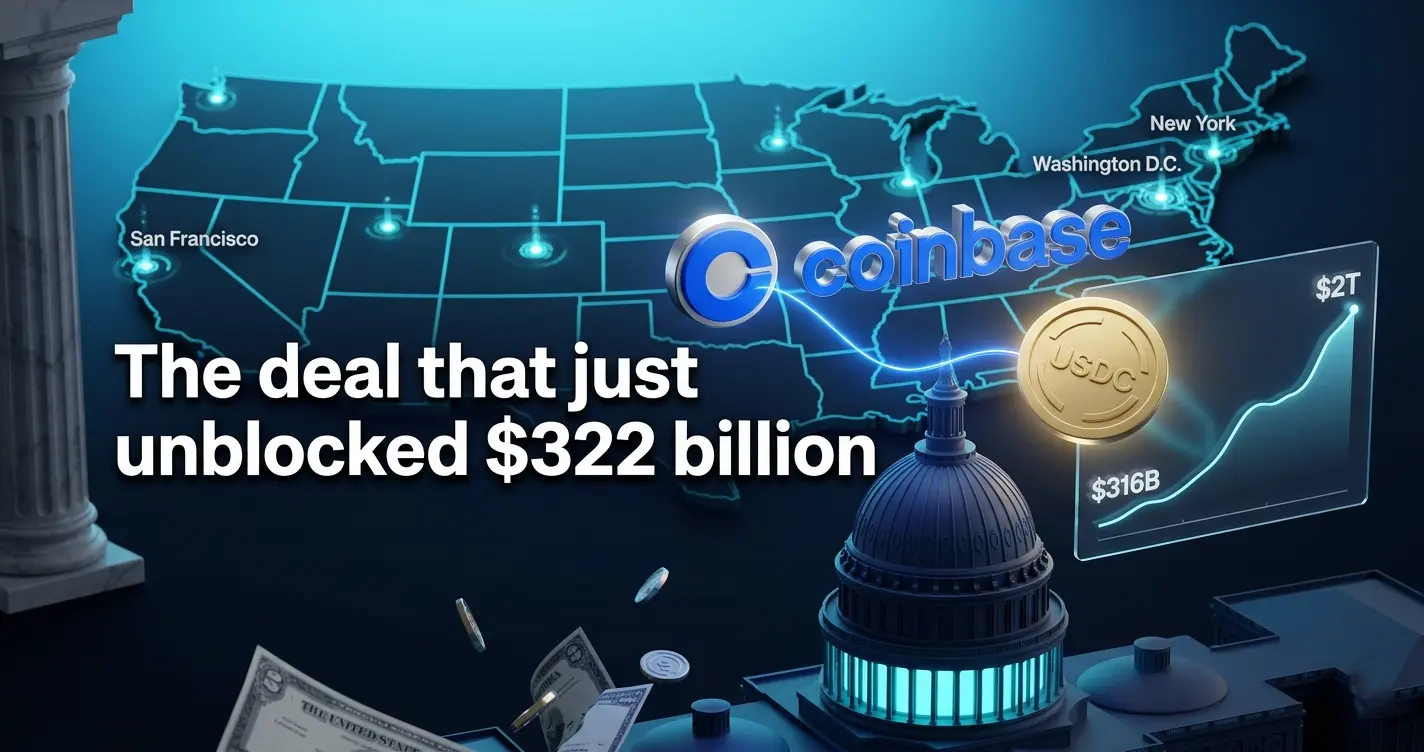
The stablecoin market now sits at $322 billion in total capitalization as of May 2026. That’s the number that explains why Coinbase spent $1.07 million lobbying in Q1 2026 alone, why the American Bankers Association fought the White House’s own economists, and why Senate Banking Committee Chairman Tim Scott spent months trying to hold together a fragile Republican coalition. The fight over who gets to profit from idle stablecoin reserves isn’t just a technical policy dispute. It’s a battle over who controls the next generation of financial infrastructure.
Here’s what the deal actually says, who wins, who’s still uneasy, and what happens now.
The Deal That Broke the Logjam
The compromise text, first disclosed by Punchbowl News, has three components. First, a broad prohibition on rewards that are “economically or functionally equivalent to interest on bank deposits.” Second, a directive to regulators to create a new stablecoin disclosure regime. Third, a list of permissible reward activities that stablecoin issuers can offer without tripping the prohibition.
That third piece is the one Coinbase needed. The exchange had described earlier draft language as “overly limiting” and, in March, informed Senate offices it “cannot support latest compromise” after rejecting a prior proposal. The new framework draws a distinction between passive interest payments and activity-based rewards, a line the crypto industry pushed hard to establish.
What the compromise covers: The finalized text bans yield paid solely for holding a stablecoin, treating it like a deposit interest product. It permits rewards tied to specific user activity or services, and it requires stablecoin issuers to disclose reserve compositions and yield mechanics to regulators under a new framework.
The White House’s involvement signals administration buy-in that wasn’t guaranteed. In April, the Council of Economic Advisers published a report arguing that allowing stablecoin yield “would have almost no effect on bank lending,” a finding that directly contradicted the banking lobby’s core objection. Getting the White House to co-author the political cover helped Tillis and Alsobrooks close the gap.
“Could be in a good final position by next week.”
Sen. Thom Tillis (R-N.C.), Senate Banking Committee, announcing progress on March 18, 2026 — Bloomberg
That optimism took six more weeks to materialize. But it did.
$322 Billion at Stake
The numbers behind this fight explain why it took so long to resolve. Tether’s USDT alone holds roughly $184 billion in market cap, representing about 58% of the entire stablecoin ecosystem. Circle’s USDC sits at $78 to $79 billion, with its reserves structured so that 80% sits in the Circle Reserve Fund, a BlackRock-managed government money market vehicle. The interest income those reserves generate is Circle’s primary revenue stream. In 2024, that came to $1.68 billion.
That’s the economics the yield provision was threatening. When stablecoin issuers hold short-term Treasuries and money market funds, they earn yield on reserves that users don’t see. The crypto industry’s argument was simple: let us share some of that yield with users. Banks heard something different: let them compete directly with deposit accounts.
💵
Stablecoin Market Cap
$322 billion total as of May 2026, up from $316B in March. Tether holds 58% of that market.
📈
2028 Forecast
Bank analysts project stablecoin market cap could reach $2 trillion by 2028, a roughly 6x expansion from today.
🏛️
Treasury Impact
Growth to $2T could drive an additional $1 trillion in U.S. Treasury bill purchases as stablecoin issuers hold reserves.
🔒
Coinbase Lobbying Spend
$1.07 million in Q1 2026 alone, making the yield provision one of the most aggressively lobbied items in the bill.
The transaction volume at stake makes those reserve figures look modest. In January 2026 alone, stablecoin networks moved over $10 trillion in a single month. This isn’t a niche asset class. It’s infrastructure, and the rules around who profits from it matter enormously.
Banks vs. Crypto: The Yield Battle
The banking industry’s opposition was not purely self-interested theater. It rested on a coherent, if contested, economic argument. Citi’s head of Future of Finance research put the fear plainly.
“Stablecoin yields could trigger massive outflows from traditional banks, potentially draining $6.6 trillion from the banking system.”
Ronit Ghose, Future of Finance Head, Citigroup — Bloomberg, August 2025
PwC’s banking advisory practice echoed the concern in operational terms.
“Banks may face higher funding costs by relying more on wholesale markets or raising deposit rates, which could make credit more expensive for households and businesses.”
Sean Viergutz, Banking and Capital Markets Advisory Leader, PwC — PwC Analysis, August 2025
The banks drew parallels to the 1981 to 1982 money market fund surge, when $32 billion in net withdrawals moved from bank deposits into higher-yielding alternatives in roughly 18 months. The Kansas City Federal Reserve estimated that allowing stablecoin yield could drain $1.5 trillion in lending capacity from the system.
The White House pushed back hard on those projections. Its April 8 CEA report concluded that banning stablecoin yield would boost traditional lending by only 0.02%, or about $2.1 billion, and that most of that benefit would flow to large banks rather than the community lenders the banking lobby was positioning as the primary victims.
Banking lobby response: The American Bankers Association dismissed the White House study on April 12, arguing economists had asked “the wrong question.” The Bank Policy Institute and Bank Policy Forum also rejected its framing. Neither group has endorsed the final compromise as of publication.
Circle’s CEO called the bank-run fears “exaggerated.” The compromise, to a degree, splits that difference. It caps passive yield while creating regulatory space for activity-based rewards, a structure that doesn’t entirely satisfy either side but gives each something to work with.
Legislative Timeline
The CLARITY Act has been moving, stalling, and lurching since the House passed it in July 2025. It established a three-category framework: securities fall under SEC jurisdiction, digital commodities under the CFTC, and stablecoins under shared oversight. The Senate inherited it with no consensus on the yield question, which became the bill’s main fault line almost immediately.
Date
Event
Key Players
Status
July 2025
CLARITY Act passes the House
House of Representatives
Confirmed
Jan. 11, 2026
Coinbase escalates pressure on yield restrictions
Coinbase Global Inc.
Confirmed
Jan. 2026
Senate Banking Committee postpones markup
Senate Banking Committee
Confirmed
Mar. 18, 2026
Tillis signals deal is close
Sen. Tillis, Sen. Moreno
Confirmed
Mar. 24-25, 2026
Coinbase rejects earlier compromise proposal
Coinbase, Senate offices
Confirmed
Apr. 8, 2026
White House CEA publishes stablecoin yield report
White House CEA
Confirmed
Apr. 14, 2026
Chairman Scott identifies three remaining issues
Sen. Tim Scott
Confirmed
May 1, 2026
Deal finalized; Coinbase confirms compromise
Coinbase, Tillis, Alsobrooks
Confirmed
May 2, 2026
Scott eyes May markup for CLARITY Act
Sen. Tim Scott
Reported
Before July 4 recess
Target window for Senate floor vote
Senate Majority Leader John Thune
Reported, unconfirmed
Senate Banking Committee Chairman Tim Scott is now eyeing a May markup for the full bill. That’s contingent on securing all 13 Republican votes on the 24-member committee, a hurdle Scott identified as one of three remaining issues as recently as mid-April alongside DeFi provisions and yield language. The yield issue is now resolved. DeFi and committee unity aren’t confirmed.
“Three issues remain: stablecoin yield language, DeFi provisions, and securing all Republican votes on the committee.”
Sen. Tim Scott (R-SC), Senate Banking Committee Chairman — Yahoo Finance, April 14, 2026
Market Signals and Forecasts
Prediction markets as of May 2 show roughly a 55% probability that the CLARITY Act text gets released on schedule, according to data from Binance Square. That’s a thin majority, and it reflects genuine uncertainty about whether the remaining committee issues get resolved in time for Majority Leader John Thune to find floor space before the July 4 recess.
The stablecoin market itself has been shifting in ways that complicate the bill’s assumptions. Tokenized treasury products grew faster than stablecoins in Q1 2026 for the first time, with $2.12 billion in tokenized treasury market cap added versus $1.19 billion in new stablecoin supply. That trend, eight consecutive quarters of tokenized treasury expansion, suggests institutional investors are already finding yield-bearing alternatives to plain stablecoins without waiting for Congress.
DeFi yields in context: Protocols like Aave, Maple, Curve, and Pendle currently offer 4 to 14% APY on stablecoin-adjacent products. That range illustrates the gap between what regulated stablecoins could offer under the new framework and what users can already access through decentralized channels, a gap the CLARITY Act’s DeFi provisions still need to address.
For Coinbase specifically, the deal matters beyond its lobbying costs. The exchange’s core stablecoin business depends on being able to offer competitive products as USDC’s issuer, Circle, prepares for its anticipated IPO. Circle’s $1.68 billion in 2024 revenue came almost entirely from reserve interest income. The new disclosure regime built into the compromise will require Circle to be more transparent about that structure, adding compliance costs but also potentially legitimizing the business model for institutional investors evaluating the IPO.
Tether’s USDT holds 58-59% of the stablecoin market, making its compliance posture under any final rules a systemic question, not just a Tether one.
The $7.7 trillion U.S. money market fund industry, cited by Circle’s CEO as the real yield competitor for deposits, gives context to why banks fear stablecoin yield more than they admit publicly.
Galaxy Research’s April 29 CLARITY Act update flagged the DeFi provisions as the most technically complex remaining obstacle, one that the yield deal doesn’t resolve.
Senate floor scheduling under Thune remains the wild card; even a successful markup doesn’t guarantee a pre-recess vote.
Frequently Asked Questions
What is the CLARITY Act?
The Digital Asset Market Clarity Act is U.S. legislation that creates a three-category regulatory framework for digital assets. It assigns SEC oversight to securities, CFTC oversight to digital commodities, and shared oversight to stablecoins. It passed the House in July 2025 and is now working through the Senate.
What does the stablecoin yield compromise actually do?
It bans rewards on stablecoins that are “economically or functionally equivalent to interest on bank deposits,” while allowing activity-based rewards and creating a new regulator-led disclosure framework. Passive yield for simply holding a stablecoin is prohibited; rewards tied to user activity or services can be permitted.
Why did the banking industry oppose stablecoin yield?
Banks feared that competitive yields on stablecoins would pull deposits away from traditional accounts, raising their funding costs and shrinking their lending capacity. Citi estimated a worst-case scenario of $6.6 trillion in deposit outflows if stablecoin yields were allowed without restriction.
What did the White House CEA report find?
The April 8 report argued that banning stablecoin yield would only boost traditional lending by about 0.02%, or $2.1 billion, and that the banking lobby overstated the risks. It concluded that allowing yield would have “almost no effect on bank lending,” directly challenging the ABA’s core argument.
How large is the current stablecoin market?
The total stablecoin market cap reached $322 billion as of May 2026. Tether’s USDT dominates with approximately $184 billion (58% market share), followed by Circle’s USDC at $78 to $79 billion. Forecasts project growth to $2 trillion by 2028.
What are the remaining obstacles to the CLARITY Act passing?
As of early May 2026, the main hurdles are resolving DeFi provisions, securing unified Republican support on the Senate Banking Committee, and finding Senate floor time before the July 4 recess. The stablecoin yield issue is now resolved, but committee markup timing remains unconfirmed.
What happens if the CLARITY Act doesn’t pass before the July 4 recess?
The bill would not die, but momentum would stall significantly. Congress would return in September with a compressed legislative calendar ahead of budget deadlines. Prediction markets currently give the bill roughly a 55% chance of advancing on its current timeline.
How does this affect Circle’s upcoming IPO?
The compromise includes a new disclosure regime that requires stablecoin issuers to be more transparent about reserve compositions and yield mechanics. For Circle, whose 2024 revenue of $1.68 billion came almost entirely from reserve interest, this adds compliance requirements but also legitimizes its business model for public market investors.
What Comes Next
The stablecoin yield deal is significant precisely because it was the most intractable piece of the CLARITY Act puzzle. Coinbase, banks, the White House, and two bipartisan Senate negotiators all had to move to reach it. That kind of convergence doesn’t happen often on financial regulation, and it signals that the political coalition for the bill is real, if still fragile.
What it doesn’t do is guarantee passage. Tim Scott still needs his full committee behind him, the DeFi provisions remain genuinely complex, and Senate floor time is a finite resource in a pre-recess sprint. The July 4 deadline is a target, not a commitment. But for the first time since the bill left the House, the path is clearer than the obstacles.
For the $322 billion stablecoin market, the implications extend beyond legislation. The deal’s framework, banning passive yield while permitting activity-based rewards, will shape product design across every major issuer regardless of when or whether the full bill passes. Exchanges, DeFi protocols, and custodians are already building to the probable regulatory contours. The compliance industry is already hiring. The lobbying spend was a preview of the infrastructure cost that comes next.
American crypto policy has spent a decade in legal limbo. This deal doesn’t end that story. But it does suggest the next chapter gets written sooner than most people expected.
Watch For
01Senate Banking Committee markup date in May 2026 — Tim Scott has signaled intent but no confirmed date. Full Republican committee unity is the bottleneck, and any defection pushes the timeline past July 4.
02DeFi provisions resolution — Galaxy Research flagged this as the most technically complex remaining obstacle. Watch for a separate negotiation track or a compromise amendment that mirrors the yield deal’s structure.
03Circle IPO and the new disclosure regime — Circle’s public offering will be the first major test of how capital markets value a business model now subject to the CLARITY Act’s transparency requirements. Timing likely contingent on bill progress.
04Tokenized treasury market vs. stablecoins — The eight-quarter growth streak in tokenized Treasuries outpacing stablecoin supply growth signals institutional appetite for yield that the compromise framework won’t fully satisfy. Watch whether product innovation accelerates outside the stablecoin category.
Stay ahead of crypto policy.
More on digital assets, regulation, and market structure at NeuralWired.
Pentagon Inks AI Deals with 7 Tech Giants for Classified Networks, Sidelines Anthropic | NeuralWired
Defense AIMay 2, 2026 · 12 min read
Pentagon Inks AI Deals with 7 Tech Giants for Classified Networks, Sidelines Anthropic
The U.S. Department of Defense has formalized classified-network AI agreements with OpenAI, Google, Nvidia, Microsoft, Amazon, SpaceX’s xAI, and Reflection AI, openly excluding the one company that refused to strip its safety guardrails.
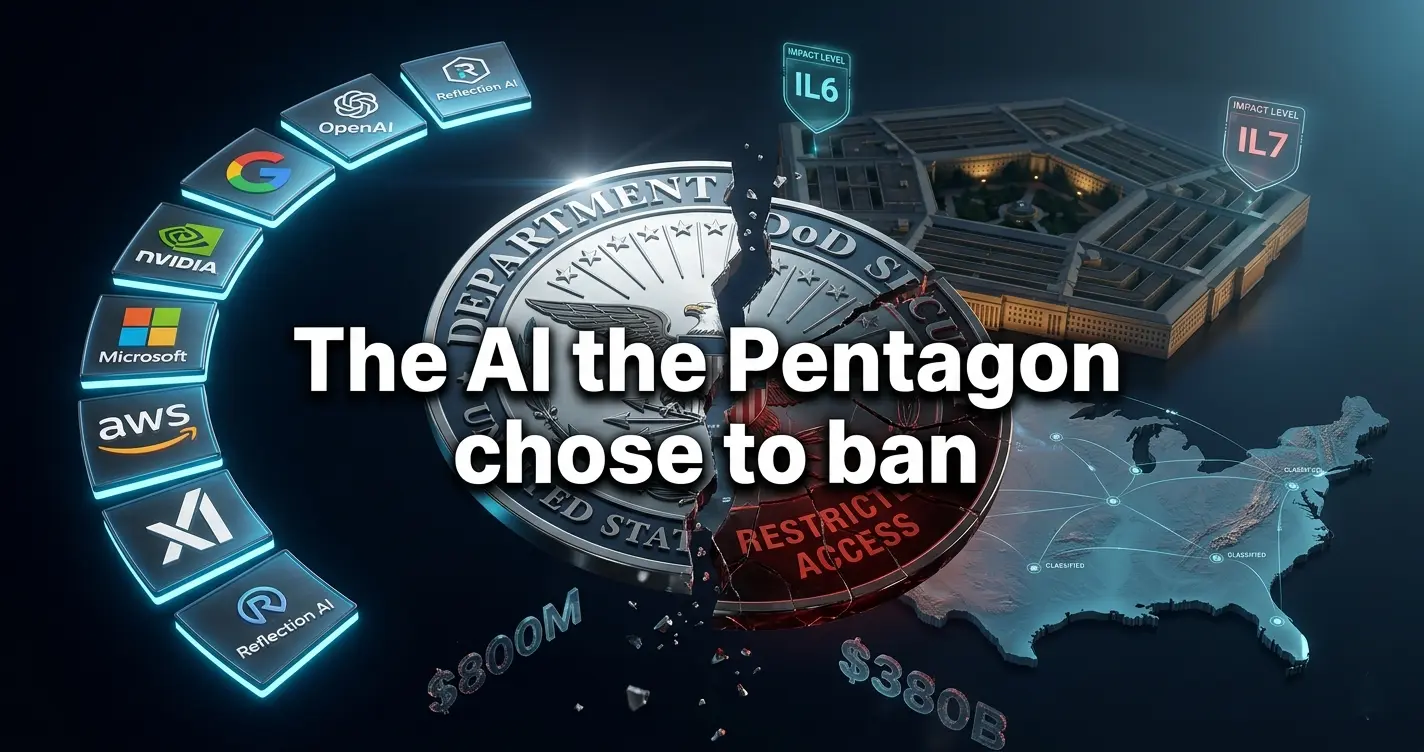
On May 1, 2026, the U.S. Department of Defense announced it had secured AI agreements with seven leading technology companies, granting their models access to Impact Level 6 and 7 classified networks covering everything from intelligence analysis to weapons targeting. One name was conspicuously absent: Anthropic, maker of the Claude models that, until recently, held the only frontier AI authorization on those same networks.
The exclusion didn’t come quietly. It followed a two-month standoff over what the Pentagon demanded and what Anthropic refused to accept: the removal of contractual safeguards against using AI for autonomous kill decisions and mass domestic surveillance of American citizens. When negotiations collapsed in February, the DoD took the extraordinary step of designating Anthropic a “supply-chain risk”, a label typically reserved for foreign adversaries like Huawei.
The announcement marks a decisive turn in how the U.S. military intends to field AI in warfighting operations. Seven companies have now agreed, in writing, to provide access for what DoD contracts describe as “any lawful governmental purpose.” The question of what that phrase actually permits, and who decides, sits at the center of a federal lawsuit, a temporary court injunction, and a growing split inside the AI industry itself.
The Seven Companies and What They’re Providing
The agreements cover AI deployments on the Pentagon’s most sensitive networks. Impact Level 6 handles secret-classified data, operational planning, intelligence feeds, logistics modeling. Impact Level 7 reaches into top-secret territory: mission-critical command and control, weapons targeting, and battlefield data fusion. The companies now authorized at those levels are:
🤖
OpenAI
GPT series models, including agentic capabilities for autonomous task execution across classified pipelines.
🔷
Google
Gemini models, building on a prior $200M baseline contract signed April 28. Google signed a separate classified deal first among the seven.
⚡
xAI (SpaceX)
Grok models, providing Elon Musk’s frontier AI into the DoD’s core decision-support stack.
🟩
Nvidia
AI infrastructure and chips, the hardware backbone underpinning inference at classified classification levels.
☁️
Microsoft + AWS
Azure AI and Copilot alongside Amazon Web Services cloud AI services, both already entrenched DoD cloud providers.
🚀
Reflection AI
A frontier-model startup earning its first major government contract, a signal that DoD is deliberately seeding competition beyond established players.
Together, these companies represent a combined agentic AI contract valued at roughly $800 million across four of the parties, with each major provider receiving approximately $200 million in agentic AI contract awards. The GenAI.mil platform, the Pentagon’s internal AI access system, already had 1.3 million DoD personnel generating tens of millions of prompts and deploying hundreds of thousands of AI agents within its first five months of operation.
GenAI.mil by the numbers (first 5 months): 1.3 million DoD personnel onboarded, tens of millions of prompts processed, hundreds of thousands of autonomous agents deployed. The platform now expands to Impact Level 6 and 7 networks with all seven vendors above.
How Anthropic Got Blacklisted — and Why It Matters
Until early 2026, Anthropic held a uniquely privileged position. Claude was the only frontier large language model formally authorized to operate on classified DoD networks, integrated into Palantir’s Maven Smart System, the AI platform that supported Pentagon operations in Iran. That changed when Secretary of Defense Pete Hegseth issued a January 9 memorandum requiring all DoD AI contracts to include “any lawful use” language within 180 days.
“The Pentagon would not employ AI models that won’t allow you to fight wars.”
Pete Hegseth, Secretary of Defense, February 2026
Anthropic’s position, as stated by CEO Dario Amodei during negotiations, was that the AI model should be used in accordance with what it can “reliably and responsibly do.” The company insisted on maintaining two specific contractual safeguards: a prohibition on using Claude for autonomous weapons systems without human-in-the-loop oversight, and a ban on mass domestic surveillance of U.S. citizens. The Pentagon rejected both conditions.
Negotiations collapsed in February. On March 5, the DoD formally designated Anthropic a “supply-chain risk”, an unprecedented move against a domestic AI company. The label carries practical teeth: it bars military agencies and their contractors from using Anthropic’s products. The designation normally applies to foreign-linked technology suppliers like telecommunications hardware from companies with ties to China’s government.
Precedent alert: A “supply-chain risk” designation against a U.S. AI company is without modern precedent. The legal authority used derives from the same statutes applied to Huawei and ZTE. Anthropic’s legal team argues this represents an unconstitutional use of national security emergency powers against a domestic firm for refusing to weaken its ethical policies.
The other six companies took a different approach. OpenAI reportedly proposed a separate technical safety stack while contractually deferring all usage decisions to existing U.S. law. Google agreed to the “any lawful governmental purpose” framing despite internal objections. As DeepMind research scientist Alex Turner noted in late April, that framing gives Google no practical veto over how the Pentagon deploys its models.
“Google can’t veto usage, the reliance on aspirational language without any legal constraints is the core problem here.”
Alex Turner, Research Scientist, DeepMind, April 29, 2026
Inside the Classified Networks: What These AI Systems Actually Do
Impact Level 6 and 7 aren’t abstract categories. They define the security architecture, vetting requirements, and permissible use cases for everything running on those networks. Below is what the DoD’s own technical framework requires at each tier.
Classification Level
Security Standard
Primary Use Cases
AI Applications
Impact Level 6 (Secret)
FedRAMP High + DoD IL6 authorization
Intelligence analysis, operational planning, ISR data fusion
Data synthesis, situational awareness, logistics optimization
The DoD’s stated objectives for these integrations are “streamlining data synthesis, elevating situational understanding, and augmenting warfighter decision-making.” In practice, that means AI models processing classified intelligence feeds in near-real time, generating targeting recommendations, and managing logistics chains that span multiple theaters simultaneously. Hundreds of thousands of AI agents are already operating autonomously within the broader GenAI.mil infrastructure.
“The Pentagon wants to go beyond last year’s limits on autonomous weapons and expand AI from intelligence and reconnaissance to kinetic uses, such as selecting and engaging targets with drones.”
Vanessa Vos, Researcher, Bundeswehr University Munich, March 4, 2026
All vendors must meet FedRAMP High certification and comply with a zero-trust architecture mandate that runs through September 2027. They also operate under DoD Directive 3000.09, the autonomous weapons policy, which the Secretary of Defense can adjust without congressional approval. That last point is critical: the policy guardrails governing how these AI systems engage with targeting decisions sit entirely within the executive branch’s discretion.
The Staff Reluctance Problem
There’s a wrinkle the Pentagon’s announcement didn’t address. Multiple reports indicate that DoD staff who routinely used Claude for classified work are reluctant to switch. Claude’s capabilities in complex reasoning and nuanced synthesis earned it a strong internal following. Replacing it with models that staff consider inferior, at least for certain analytical tasks, creates uneven capability across units. That’s not a hypothetical concern; it’s an operational risk the DoD is absorbing as the price of its policy choice.
The Financial Stakes: $380 Billion in the Balance
For Anthropic, this isn’t just a policy dispute. It’s an existential financial threat. The company’s pre-blacklist market valuation stood at approximately $380 billion, according to analysis published April 30. The direct contract loss is quantifiable: the DoD deal under negotiation was worth up to $200 million, part of an $800 million agentic AI contract shared across four providers. The indirect damage is harder to measure but potentially far larger.
Stakeholder
Financial Exposure
Direction
Anthropic
$200M direct contract loss; billions in 2026 enterprise revenue at risk; $380B valuation under pressure
Negative
OpenAI
~$200M agentic AI contract; expanded defense pipeline access
Positive
Google
$200M+ (expanded from prior baseline contract); classified network access for Gemini
Positive
Nvidia
Infrastructure revenue across all seven vendor deployments; chip demand tied to IL6/7 inference
Strongly Positive
Palantir
$10B+ Army data contracts; $795M+ Maven Smart System support — now runs on rival models
Mixed
Reflection AI
First major government contract; instant defense-sector credibility
Strongly Positive
Anduril
$20B Lattice AI C2 Enterprise contract (Army); aligned with DoD’s kinetic AI direction
Positive
Anthropic’s legal filings describe the revenue impact as running into “multiple billions” during 2026 alone, according to analysis by Pearl Cohen published March 25. An IPO that had been in preparation becomes significantly more complicated when the company is formally designated a risk to national security supply chains. Enterprise customers in adjacent government and contractor markets face their own compliance questions about continuing to use Claude.
The Lawsuit That Temporarily Stopped the Clock
Anthropic didn’t accept the blacklist quietly. On March 9, the company filed two simultaneous federal lawsuits: one in the Northern District of California and a second in the D.C. Circuit Court of Appeals. The legal theory combined First Amendment arguments, that the government can’t penalize a company for the speech embedded in its AI policies, with administrative law claims that the DoD exceeded its statutory authority.
On March 26, a federal judge granted a temporary stay of the “supply-chain risk” designation, pausing its enforcement while the litigation proceeds. That stay doesn’t reinstate Anthropic’s contracts. It doesn’t undo the May 1 announcement. It means the legal classification remains contested while the deals move forward with the other seven vendors.
The case raises questions with no clean precedent. Can the government compel an AI company to remove ethical constraints as a condition of federal contracting? Does a “supply-chain risk” designation require evidence of actual security risk, or can it rest on policy disagreement? And if companies can be blacklisted for maintaining safety guardrails, what incentive structure does that create across the industry?
“Statements outside formal AI contracts do not alter legal liability if ethical or legal concerns arise later.”
Tuncer, Legal Expert, Anadolu Agency, March 1, 2026
Congress has started paying attention. Axios reported that several lawmakers are exploring legislation to establish minimum guardrails for military AI deployments, a direct response to the Anthropic dispute. Any such legislation would face the same executive-branch resistance that produced the original standoff.
Safety vs. Speed: A Race the Industry Can’t Ignore
Step back from the specific contracts and what emerges is a structural incentive problem. The Pentagon has now demonstrated that companies maintaining strong internal safety policies on autonomous weapons and surveillance can be shut out of the defense market entirely. Companies that defer those decisions to existing law, and accept that the executive branch will define what that law permits, get access to some of the largest government contracts available.
“Race to the bottom where the most compliant firms win”, on Pentagon blacklisting dynamics.
Geoffrey Gertz, Independent Defense AI Analyst, February 16, 2026
The AI industry’s internal debate over this isn’t theoretical. Some researchers argue that companies without government contracts lose the ability to shape how AI is deployed in high-stakes settings. Others contend that accepting “any lawful use” language, where “lawful” is defined unilaterally by the government using the AI, represents a fundamental abdication of responsibility.
“US military’s reliance on fluid domestic definitions due to lack of international law creates legal loopholes for mass surveillance and autonomous weapons use.”
Firdevs Bulut Kartal, Author, Anadolu Agency, March 2, 2026
The international dimension compounds the problem. The International Committee of the Red Cross and several allied governments have pushed for binding treaties governing autonomous weapons. The U.S. now has seven major AI vendors operating on classified military networks under contracts that explicitly reject company-level ethical constraints, and no international legal framework that would fill the gap.
DoD Directive 3000.09 governs autonomous weapons policy and can be modified by the Secretary of Defense without congressional approval
None of the seven vendor agreements include third-party audit rights or external oversight mechanisms
The “any lawful use” framing places the entire interpretive burden on the executive branch
No allied nation has adopted an equivalent “AI-first warfighting force” doctrine at this speed or scale
Zero-trust architecture (mandatory by September 2027) addresses cybersecurity, not policy compliance
For the vendors themselves, the tension isn’t abstract. Both Google and OpenAI faced significant internal employee pushback over prior military AI work. Both have now signed contracts that their own researchers publicly criticize. The question isn’t whether that tension exists, it’s whether it produces any meaningful constraint on deployment decisions.
Frequently Asked Questions
Why was Anthropic excluded from Pentagon AI deals?
Anthropic refused to remove two contractual safeguards, one prohibiting autonomous weapons use without human oversight, and one banning mass domestic surveillance, that the Pentagon required all vendors to drop. When negotiations failed in February 2026, the DoD designated Anthropic a “supply-chain risk,” barring military use of its models.
What does “Impact Level 6 and 7” mean for military AI?
Impact Level 6 covers secret-classified networks used for intelligence analysis and operational planning. Impact Level 7 is top-secret, covering weapons targeting and mission-critical command and control. Both require FedRAMP High certification and continuous security monitoring.
What is the “any lawful use” clause in DoD AI contracts?
It’s a contract provision, mandated by Secretary Hegseth’s January 2026 memo, requiring AI vendors to permit any use the government considers lawful. Critics argue it gives vendors no ability to restrict how their models are deployed for autonomous weapons or surveillance, with the government as the sole arbiter of what’s permitted.
Has Anthropic’s lawsuit succeeded in blocking the blacklist?
A federal judge issued a temporary stay of the “supply-chain risk” designation on March 26, 2026, pausing enforcement while litigation proceeds. However, the stay didn’t restore Anthropic’s contracts, and the Pentagon’s May 1 deals with seven other companies moved forward regardless.
Which companies signed Pentagon classified AI deals in May 2026?
Seven companies: OpenAI, Google, Nvidia, Microsoft, Amazon Web Services, xAI (SpaceX’s AI division, providing Grok), and Reflection AI, a frontier-model startup receiving its first major government contract. Anthropic was explicitly excluded.
How large is the Pentagon’s AI investment across these deals?
The agentic AI contracts for four of the seven companies total approximately $800 million, with each receiving around $200 million. Broader defense AI context includes a $20 billion Anduril Lattice contract, $10 billion-plus Palantir Army contracts, and a $9 billion Joint Warfighting Cloud Capability ceiling.
What is GenAI.mil and how widely is it used?
GenAI.mil is the Pentagon’s official AI access platform for DoD personnel. Within its first five months it onboarded 1.3 million military personnel, processed tens of millions of prompts, and deployed hundreds of thousands of autonomous AI agents across various operational tasks.
What are the cybersecurity requirements for these AI deployments?
All vendors must meet FedRAMP High certification and Impact Level 6 or 7 authorization. The DoD has also mandated zero-trust architecture across its AI deployments, with a compliance deadline of September 2027. Zero trust governs network access controls but doesn’t address policy compliance or autonomous weapons constraints.
What Comes Next in Military AI
The Pentagon’s May 1 announcement is less a conclusion than a line drawn in the sand. Seven companies now hold classified-network access under contracts that prioritize deployment speed over independent safety oversight. One company is fighting that framework in federal court while watching its valuation erode. And the broader AI industry is absorbing the lesson: in the defense market, safety constraints are a liability, not a selling point.
The short-term winners are obvious. OpenAI, Google, and Nvidia gain enormous revenue and strategic positioning. Reflection AI graduates from startup to defense contractor overnight. The long-term picture is murkier. If autonomous AI targeting systems fail in the field, or if domestic surveillance applications produce a political crisis, the companies that signed “any lawful use” agreements will find those contracts suddenly very visible. The absence of contractual accountability doesn’t eliminate operational accountability. It just shifts when it arrives.
For the broader AI safety community, the Anthropic case establishes a troubling precedent: a domestic AI company can be designated a national security risk not for building dangerous technology, but for refusing to make its technology less safe. Whether Congress, the courts, or allied governments move to address that precedent will define the regulatory environment for military AI for the decade ahead.
Watch For
01Anthropic v. DoD federal ruling in the Northern District of California, a decision on the First Amendment and administrative law claims could set binding precedent for all AI vendors facing government safety-policy disputes. Expected within 6-12 months.
02Congressional AI guardrails legislation, Axios reported lawmakers are drafting minimum safety requirements for military AI contracts. Any bill faces executive resistance, but a markup hearing would signal how seriously Congress is engaging with the “any lawful use” framework.
03DoD Directive 3000.09 revision, Secretary Hegseth has authority to update autonomous weapons policy without Congress. Any change expanding AI autonomy in kinetic targeting will directly affect what the seven new vendor agreements permit and how models like GPT, Gemini, and Grok are deployed in combat scenarios.
04Anthropic’s valuation trajectory and IPO timeline, the $380 billion figure was pre-blacklist. How institutional investors price the combination of litigation risk, lost defense revenue, and enterprise customer uncertainty will serve as a real-time market verdict on whether safety-first AI is commercially viable.
Stay ahead of the curve.
More on defense AI, military tech policy, and classified network security at NeuralWired.
OpenAI Acquires Hiro: The Compliance Play Reshaping Finance AI — NeuralWired
NeuralWiredIntelligence for Technical Professionals
Agentic AI & M&A
OpenAI’s Hiro Acquisition: The Compliance Play Rewriting the Finance AI Stack
The official narrative is talent and datasets. The real story is a 12–18 month shortcut into regulated verticals, and what it means for every CTO currently evaluating agentic infrastructure.
NeuralWired Analysis DeskApril 14, 2026~1,900 words · 9 min read
OpenAI announced the all-cash acquisition of Hiro on April 13, 2026, describing it as a move to “accelerate safe, specialized AI agents for high-impact domains like finance.” What that framing omits is more consequential than what it includes: Hiro’s primary value is not its 15-person engineering team or even its 10 TB of anonymized transaction data. It is a production-tested, compliance-adjacent agent stack that OpenAI could not assemble internally in time to defend against Microsoft’s Copilot Finance.
For CTOs in fintech, banking, or any SOX/PCI-DSS-regulated environment, this deal signals a fundamental shift in the build-vs-buy calculus for agentic infrastructure. For ML engineers, it introduces a new reference architecture for tool-calling in regulated contexts — one OpenAI will almost certainly productize as a vertical API tier. For founders building general-purpose agents, the competitive window is narrowing faster than last quarter’s funding rounds suggest.
This analysis draws on PitchBook filings, Hiro’s archived technical whitepaper, public benchmark data, and expert commentary to examine what the deal actually buys OpenAI, where the architecture is genuinely strong, and where the compliance story is still largely aspirational.
~$180M
Implied deal value (15× ARR multiple, per CB Insights)
92%
Hiro task accuracy on standard budgeting benchmarks
$2.8B
Finance AI agent market in 2026 (IDC, 45% CAGR to 2030)
70%
Enterprises citing compliance as primary agent adoption barrier (O’Reilly)
What actually happened, and what was omitted
The deal closed March 20, 2026, more than three weeks before the public announcement. Talks began in January, shortly after Hiro’s $12M Series A, and accelerated materially after two catalysts converged in early April: OpenAI’s o3 model posted a 78.2% score on SWE-bench (April 12), exposing the gap between general coding performance and domain-specific tool-calling in regulated workflows, and Microsoft Copilot Finance crossed one million active users, a direct threat to OpenAI’s enterprise revenue base.
OpenAI’s public blog post emphasizes “datasets for secure workflows” and “specialized engineering talent.” The archived Hiro terms of service and pre-deal pilot disclosures paint a more granular picture: 50+ fintech pilots generating $4M ARR, a 30% churn rate driven by hallucination failures in multi-step regulatory reasoning, and a core architecture built on proprietary fine-tunes of o1-preview. That last point is conspicuously absent from official communications and creates a technical integration question OpenAI has yet to address publicly, Hiro’s production performance assumed a specific model generation that o3 supersedes.
OpenAI’s Q1 2026 earnings call (April 10) reported finance-related API calls up 150% year-over-year, confirming organic demand that Hiro’s stack is now positioned to capture at premium pricing, modeled internally at approximately $50 per user per month for the vertical tier, versus the current $20 API subscription ceiling.
The technical reality: Hiro + o3 architecture
Hiro’s engineering contribution is not a proprietary model. It is an orchestration layer. The architecture chains o3’s planning capabilities to a set of domain-specific tool-calling pipelines, Plaid API integrations, tax database connectors, reconciliation workflows, wrapped in a PII-aware sandbox with structured audit log output. Think of it as LangGraph with financial domain expertise baked in, compliance checkpoints enforced at the workflow level, and a retrieval-augmented generation (RAG) layer trained on Hiro’s 10 TB transaction dataset, independently audited by Deloitte.
“Multi-agent finance needs o3-level reasoning; Hiro provides the scaffolding.”
— Prof. Lisa Wong, Stanford CS, co-author of the April 2026 agent orchestration preprint
Under standard benchmark conditions, the combined stack achieves 92% task completion with sub-2-second latency and 99.9% uptime in pilot environments. The RAG layer reduces hallucinations by approximately 70% relative to a base o3 deployment, per Anthropic’s January 2026 finance agent safety evaluation — a credible external reference point given Anthropic’s methodology is peer-reviewed. Industry average hallucination rates in finance contexts sit around 25%; the Hiro-informed approach brings this toward 12–15%.
The limits are just as important. Accuracy drops to 65% on edge cases, crypto tax treatment, multi-entity consolidations, novel regulatory interpretations — without human oversight at the review stage. The architecture currently caps at approximately 10,000 daily queries in production configurations before throughput degrades. Former Hiro engineer Alex Rivera, posting on Blind post-acquisition, noted: “Our stack scales to 50K queries per day; OpenAI will push to millions fast”, implying the GPU infrastructure buildout required for enterprise scale is non-trivial and not yet completed.
“We’re testing OpenAI APIs now, Hiro could obsolete our in-house stack if APIs drop Q4.”
— Mike Chen, ML Engineer at Stripe, Hacker News thread, April 13, 2026
For engineers evaluating the stack today: the meaningful technical contribution is the compliance-aware tool-calling scaffolding, not the model itself. The immediate experiment worth running is o3 tool-calling with domain-specific RAG against your own regulated workflows, that will tell you more about integration feasibility than any benchmark.
Strategic and competitive implications
The acquisition compresses OpenAI’s path into regulated verticals by an estimated 12–18 months. Building Hiro’s compliance-grade dataset and pilot track record internally would have required that timeline minimum, and Microsoft’s Copilot Finance momentum made waiting untenable. According to McKinsey’s April 13 CTO pulse survey (n=500), 85% of technology executives are actively reevaluating AI vendor strategy post-o3, with vertical domain expertise ranking as the top selection criterion. OpenAI just acquired the strongest credential in its target vertical.
The competitive response map is becoming clear. Microsoft will accelerate Copilot verticals, watch the May Ignite announcements closely. Google DeepMind’s 20 enterprise finance pilots (per Google Cloud Next 2026) remain narrowly focused on healthcare and lag significantly in tool-calling depth. The most immediate casualties are general-purpose agent startups: Adept faces a direct positioning problem, and any startup competing on finance workflow automation without a compliance moat now faces a significantly better-funded, better-credentialed incumbent.
$10B+
Projected vertical AI M&A wave, Elena Vasquez, a16z: “Expect healthcare, legal next” (Substack, April 14)
The business model implication is as significant as the competitive one. OpenAI shifts from generalized subscription revenue toward vertical licensing, a fundamentally stickier, higher-margin model. The IDC’s Q1 2026 forecast puts the finance AI agent market at $2.8B with 45% compound annual growth to 2030, driven primarily by regulated verticals. OpenAI now holds a credible claim to 20–35% of that market.
Reality check: compliance timeline and failure scenarios
The phrase “safe, specialized AI” in OpenAI’s announcement carries more aspirational weight than evidentiary support. Hiro’s pilot track record is real — 50 deployments, Deloitte audit, production-level latency, but it does not constitute SOX compliance, PCI-DSS certification, or SEC readiness at scale. Those require separate, enterprise-specific audit processes estimated at 6–12 weeks minimum per deployment.
Key Risk Factors
Hiro’s datasets contain anonymized but sensitive transaction data, GDPR and CCPA scrutiny is probable, potentially delaying GA release 6+ months
Hallucination rate of 15% on edge cases remains unacceptable for autonomous financial advice under current SEC interpretations
Hiro’s fine-tunes were built on o1-preview; integration with o3 requires architectural rework, not a configuration change
No public beta date confirmed; “Q3 2026 integration” in the announcement refers to internal engineering timelines, not developer access
IBM Watson Health precedent: a high-profile regulated-vertical AI acquisition that underdelivered substantially on launch timeline and accuracy claims
“Hiro’s datasets are a privacy minefield, expect SEC scrutiny delaying rollout six months.”
— David Kim, CISO at Robinhood, FinTech Daily podcast, April 14, 2026
The open-source counter-response is already forming. Jordan Lee, founder of AgentX, posted on X: “Vertical lock-in kills innovation; we’ll open-source counters.” Given the HN community’s 450+ comment thread leaning heavily skeptical on compliance claims, expect credible open-source finance agent frameworks to emerge by Q3, which will pressure OpenAI’s pricing assumptions in the SMB segment even if enterprises adopt the vertical tier.
“Finance agents like Hiro hallucinate 20% on regulatory edge cases; o3 helps, but without auditable traces, enterprises won’t touch it.”
— Dr. Raj Patel, AI Safety Researcher, UC Berkeley, Twitter, April 14, 2026
Realistic developer access timeline: beta APIs by Q4 2026 at the earliest, general availability in 2027 pending regulatory audits. The Q3 2026 date in OpenAI’s announcement refers to internal integration milestones, not public release.
What professionals should do now
Engineers & ML Practitioners
Prototype o3 tool-calling with domain RAG against your regulated workflows this sprint — establish your baseline before Hiro APIs ship
Audit current agent architectures against Hiro’s published 92% benchmark methodology
Join OpenAI’s enterprise API waitlist now; beta access will be capacity-constrained
Watch the open-source finance agent space, credible forks likely by Q3
CTOs & Tech Leaders
Reassess build-vs-buy for finance agent infrastructure, the ROI case for buying just improved by 12–18 months of development shortcut
Reallocate 15–20% of in-house agent R&D budget toward evaluation and integration planning
Demand auditable trace output as a non-negotiable vendor requirement before any regulated deployment
Ask your legal team now: what does autonomous financial advice liability look like under your current regulatory regime?
Founders & Investors
General-purpose agent startups competing in finance face an existential repositioning moment, vertical depth or defensible niche, decide now
Healthcare and legal are the obvious next vertical M&A targets; the a16z thesis ($10B wave) warrants serious evaluation
Short-term opportunity: compliance tooling and audit infrastructure that sits on top of OpenAI’s vertical APIs, not competing with them
“Hiro’s tool-calling layer is gold for o3, cuts our dev time by 40%, but compliance audits will drag integration.”
— Sarah Lin, CTO at Finch, ex-Plaid, LinkedIn, April 14, 2026
Frequently asked questions
How does Hiro actually integrate with o3?
Hiro’s orchestration layer routes o3’s planning output to domain-specific finance tools, Plaid APIs, tax databases, reconciliation pipelines, through a PII-aware sandbox with structured audit log output. The RAG layer, trained on Hiro’s 10 TB transaction dataset, provides regulatory context retrieval at inference time. OpenAI has not published API endpoint specifications; expect a preview at a developer event before Q4 2026. Engineers can simulate the architecture today using o3’s existing tool-calling capabilities with custom retrieval layers.
When will developers actually get access?
Beta access is realistically Q4 2026 at earliest; general availability most likely 2027, following compliance audits. The “Q3 2026 integration” language in OpenAI’s announcement refers to internal engineering milestones, not public release. Historical precedent from OpenAI’s enterprise API rollout (GPT-4 Turbo took approximately 6 months from announcement to GA) supports this estimate.
What will this cost enterprises?
Per-query costs are estimated at $0.05–$0.20 based on current o3 API pricing analogues. The vertical tier is modeled internally at approximately $50 per user per month, 2.5× the current enterprise API tier ceiling. Enterprises should model costs against both the query volume of their workflows and the development cost of building equivalent compliance-grade orchestration in-house, which Sarah Lin’s comment suggests is roughly 40% of current engineering cycles for teams with production agents.
OpenAI or Microsoft for regulated finance deployments?
OpenAI now holds a clear reasoning and tool-calling advantage in pure financial task performance; Microsoft leads on enterprise integration depth (Active Directory, Azure compliance tooling, existing M365 contracts). For new deployments starting from scratch, the evaluation hinges on whether your compliance team can accept a newer vendor’s audit trail or requires the established Microsoft enterprise agreement structure. Expect Microsoft to counter aggressively at May Ignite.
Is Hiro SOX/PCI-DSS compliant out of the box?
No. Hiro has SOC 2 Type II certification from its pilot program, audited by Deloitte. SOX and PCI-DSS compliance require deployment-specific audits and controls that OpenAI cannot provide generically. David Kim’s (Robinhood CISO) warning about SEC scrutiny on Hiro’s datasets applies independently of any customer deployment. Any regulated enterprise should plan 6–12 weeks of compliance review before production deployment, regardless of OpenAI’s timeline commitments.
Should we build or buy for finance agent infrastructure now?
For regulated enterprises in banking and fintech, the buy case just strengthened significantly. McKinsey’s April 2026 data shows that custom builds deliver 40% slower ROI than vendor solutions in compliance-heavy domains. The exception: organizations with proprietary financial data that represents genuine competitive advantage in the model, or teams requiring custom agent behavior that a vertical API tier cannot support. For everyone else, redirect R&D budget toward evaluation and integration planning now.
How does this affect open-source agent frameworks?
Short-term pressure on general-purpose frameworks competing in finance (LangGraph, Autogen finance wrappers). Medium-term: credible open-source finance agent forks are probable by Q3 2026, per the HN community response and AgentX’s stated intent. The open-source counter will likely target the SMB segment OpenAI’s pricing leaves underserved, and will apply meaningful downward pressure on the vertical tier’s price ceiling over 18–24 months.
What is Hiro’s implied valuation and what does it signal?
At approximately $180M (15× ARR multiple, per CB Insights), the deal is priced at a dataset and compliance infrastructure premium, not a revenue multiple. $4M ARR at standard SaaS multiples would imply $40–60M; OpenAI paid 3–4× that premium for the audit trail, pilot track record, and the 12–18 months it would take to replicate it. a16z’s Elena Vasquez calling a $10B M&A wave in verticals is directionally credible: expect similar dataset-plus-compliance premiums in healthcare AI acquisitions within 12 months.
What this really means
The Hiro acquisition is not an acqui-hire and it is not primarily about a dataset. It is OpenAI purchasing a proven compliance pathway into the highest-value, highest-barrier enterprise AI market at a moment when its main competitor is already in the building. The $180M price is an options premium on 12–18 months of regulatory legitimacy that OpenAI could not manufacture faster on its own.
Over the next 30–90 days, watch for: Microsoft’s response at May Ignite; any SEC or GDPR inquiry into Hiro’s transaction datasets; and the first credible open-source finance agent fork. The 12-month outlook depends heavily on whether OpenAI can solve the o1-to-o3 architecture migration without degrading Hiro’s production benchmarks, that is the most underreported technical risk in this deal.
For technical professionals, the practical takeaway is this: the build-vs-buy inflection point for regulated agentic infrastructure just moved. If you are evaluating that decision in the next two quarters, start your compliance review process now, not after the APIs ship. The teams that win in this cycle will be the ones that understand the regulatory requirements before the vendor does.
Daily frontier intelligence for technical professionals. No summaries. Just signal.
Subscribe Free →
Disclosure: This analysis is based on publicly available sources, archived documentation, and third-party research as of April 14, 2026. NeuralWired has no financial relationship with OpenAI, Microsoft, or any company referenced herein. Valuation estimates are derived from third-party databases and should not be construed as financial advice. Some URLs referenced in this article (particularly for archived Hiro documentation and internal earnings pages) may require enterprise access or may have changed post-acquisition. Readers should verify primary sources independently. Pricing estimates are modeled projections, not confirmed figures from OpenAI.
The gap between “having a policy” and operational compliance is wider than most boards realize. Here is the cross-jurisdictional roadmap, 5-level maturity model, and board playbook your organization needs before the clock runs out.
NW
NeuralWired Research Desk
Published March 18, 2026 · Updated March 18, 2026
14 min read12 data points10+ sources
40-50%of large enterprises claim AI governance programs exist
15-20%actually meet EU AI Act documentation standards today
35M EURmaximum fine for prohibited-practice violations
30%lower compliance overhead for super-compliance firms
Aug 2026EU AI Act high-risk obligations enforcement start
Somewhere between 40% and 50% of large enterprises tell auditors they have a formal AI governance program. Only 15% to 20% can actually back that claim up when regulators ask for documentation, monitoring logs, and impact assessments. That gap, between policy on paper and operational compliance, is about to become the most expensive mistake in enterprise technology.
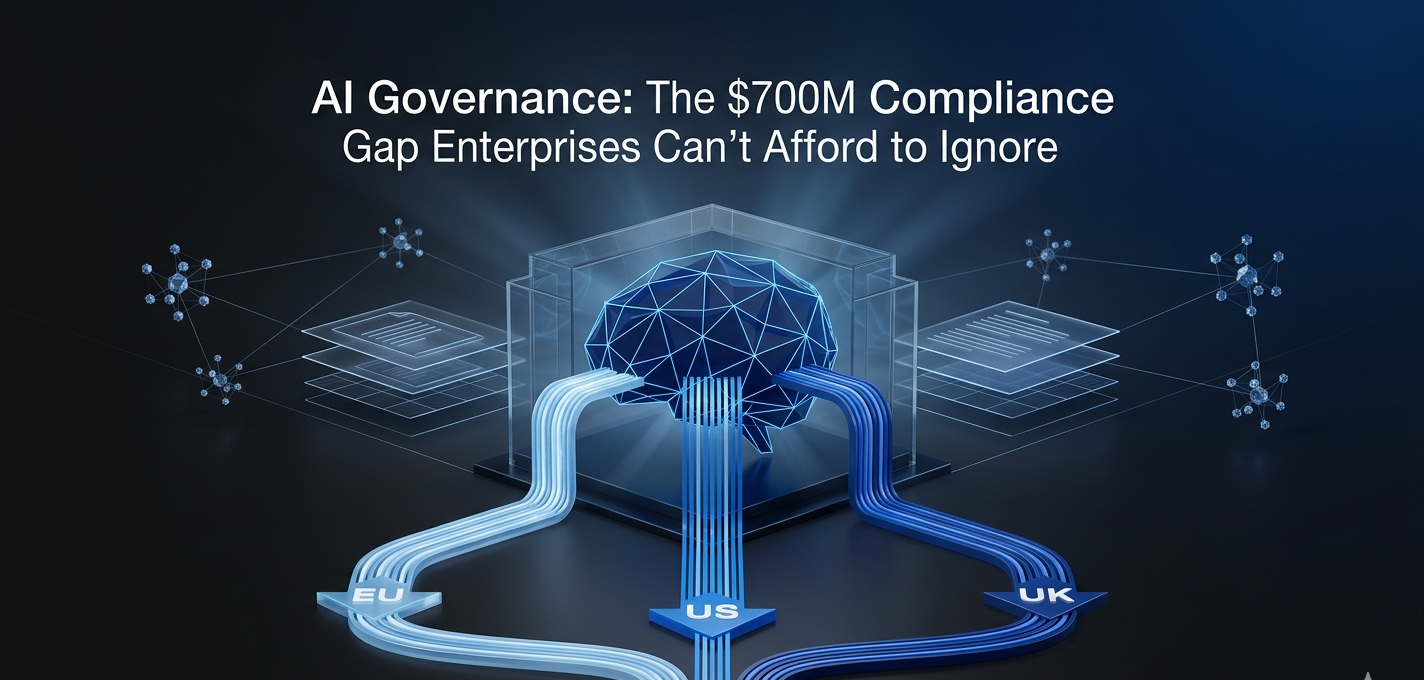
The EU AI Act’s high-risk obligations become fully enforceable in August 2026. Fines can reach 35 million euros or 7% of global annual turnover, whichever is larger. For a $10 billion revenue company, that is a $700 million exposure sitting quietly in your AI deployment backlog.
Meanwhile, U.S. federal and state governments issued over 120 AI-related laws, executive orders, and guidance documents in 2024 and 2025. More than 30 state-level AI laws are enacted or under review by early 2026. For global enterprises, this is not a single compliance problem. It is a regulatory patchwork that demands a unified governance architecture.
This analysis gives you the cross-jurisdictional roadmap that competitors’ articles skip. You will get a five-level AI governance maturity model, a board-oversight structure with concrete roles and reporting cadence, a cross-mapping of EU AI Act, NIST AI RMF, and UK AI Safety Institute requirements, and the implementation checklist that compliance officers and engineers can act on today.
Section 01
The Regulatory Landscape: Three Regimes, One Enterprise Problem
AI governance regulation and enterprise compliance don’t live in one jurisdiction. The challenge for multinational enterprises in 2026 is that three distinct regulatory philosophies are converging simultaneously, each with its own enforcement timeline, documentation standard, and penalty structure.
🇪🇺
European Union
EU AI Act
Risk-based framework. High-risk AI systems require conformity assessments, technical documentation, human oversight, and ongoing monitoring. Full enforcement: August 2026.
🇺🇸
United States
NIST AI RMF + State Laws
Fragmented patchwork. Federal guidance is voluntary. States like Colorado require annual impact assessments for high-impact AI. 30+ state laws active or pending by 2026.
🇬🇧
United Kingdom
AI Safety Institute Framework
Principle-based with sector-specific overlays. Emphasis on safety testing for frontier models and transparency mandates. Increasingly convergent with EU standards post-Brexit.
The EU AI Act is the most structurally demanding. It categorizes AI systems by risk level: unacceptable (banned outright), high-risk (stringent compliance), limited-risk (transparency obligations), and minimal-risk (essentially unregulated). Around 15% to 20% of regulated AI deployments in banking and healthcare are expected to land in the high-risk category, triggering the most burdensome documentation and monitoring requirements.
Why This Matters for Global Operations
The EU AI Act applies to any AI system that affects EU residents, regardless of where the developer is headquartered. A fintech firm based in Singapore that operates credit-scoring models for French customers is fully subject to EU AI Act high-risk obligations. Territorial reach is one of the most consistently underestimated compliance risks in 2026.
The U.S. picture is deliberately different. The National Institute of Standards and Technology AI Risk Management Framework (NIST AI RMF) offers a voluntary governance structure built around four core functions: Govern, Map, Measure, and Manage. It doesn’t carry direct legal penalties, but it’s rapidly becoming the de facto standard that regulators, auditors, and enterprise procurement teams use to evaluate AI maturity. More than 25% of major U.S. enterprises are already running annual AI risk assessment cycles, driven largely by state-level mandates.
“We’re past the point where an AI policy document satisfies anyone. Regulators and boards want to see model inventories, impact assessments, and audit trails.”
The Compliance Gap That’s Costing Enterprises Millions
The numbers are blunt. Roughly 40% to 50% of large enterprises report having formal AI governance programs. Only 15% to 20% actually meet EU AI Act documentation and monitoring standards when independently assessed.
That gap has a name: documentation debt. And regulators are already finding it. Around 40% of AI system audits flag documentation gaps, even when the underlying models perform technically well. A system can have excellent accuracy, low bias metrics, and solid security controls, and still fail a compliance audit because its risk classification, training data lineage, or human-override protocols aren’t properly recorded.
Compliance Risk Alert
Documentation gaps are treated as violations under the EU AI Act, not administrative oversights. The distinction matters because violations trigger financial penalties, while oversights typically trigger remediation timelines. In roughly 40% of audited AI deployments, technically sound systems still fail on documentation alone.
The cost of fixing this after the fact is significant. Building a minimum-viable AI governance program, including model inventory, impact-assessment tooling, and basic documentation infrastructure, runs $150,000 to $500,000 for mid- to large-sized enterprises. Do that reactively under regulatory pressure and costs compound. Do it proactively and the ROI case is straightforward: $500,000 in governance infrastructure against a potential $700 million fine is not a hard calculation.
There is a less obvious cost too. Board visibility into AI incidents is rising sharply. Around 30% to 40% of global tech firms now report AI governance incidents, including biased outputs and model-drift-related harm, to internal boards or compliance committees. That is up from under 10% in 2022. When something goes wrong and there’s no audit trail, no incident response protocol, and no documented risk classification, the liability isn’t just financial. It’s reputational.
Section 03
The 5-Level AI Governance Maturity Model
Most compliance frameworks tell you what you need. Fewer tell you where you are and what closing the gap actually looks like. Here is a five-level maturity model designed for enterprise AI governance programs, benchmarked against EU AI Act, NIST AI RMF, and UK AI Safety Institute requirements.
Level
Name
What It Looks Like
Regulatory Status
Next Milestone
Level 1
Ad Hoc
No formal AI inventory. Governance handled case-by-case. No impact assessments.
Non-compliant. High penalty exposure.
Build model inventory. Assign AI risk owner.
Level 2
Documented
Written AI policy exists. Risk classifications attempted. No systematic monitoring.
Design to strictest global standard. Governance embedded in product development lifecycle.
20 to 30% lower compliance overhead across jurisdictions.
Publish public AI principles. Establish governance as competitive differentiator.
Level 5 “super-compliance” isn’t theoretical. Companies designing to the strictest available rules, typically the EU AI Act or Colorado-style state frameworks, report 20% to 30% lower compliance-operations overhead across multiple jurisdictions. When your baseline is the most demanding standard, you don’t need to rebuild governance architecture every time a new state or country enacts legislation.
Most enterprises assessed in 2025 are operating at Level 1 or Level 2. Getting from Level 2 to Level 3 is where the real work happens, and where most programs stall because they underestimate the operational lift of systematic model monitoring and documentation.
Section 04
Board-Level AI Governance: Roles, Reporting, and Escalation
AI governance can’t live exclusively in engineering. The regulatory frameworks making headlines in 2026 expect board-level accountability, and auditors are starting to ask questions about who owns AI risk at the C-suite level.
The AI Steering Committee Structure
An effective AI steering committee isn’t another bureaucratic layer. It’s the decision-making body that connects engineering risk to business risk, and business risk to regulatory exposure. Minimum composition for most enterprises:
1Chief AI Officer or CISO (chair) owns the AI risk register and escalation protocols. Responsible for quarterly board briefings on AI risk posture.
2Chief Legal Officer or General Counsel maps AI deployments to current and emerging regulatory requirements. Owns the cross-jurisdictional compliance calendar.
3Chief Data Officer manages model inventory, data lineage documentation, and training data governance. Critical for audit readiness.
4Head of Product or CTO representative ensures governance requirements are embedded in the product development lifecycle, not bolted on post-deployment.
5Independent AI ethics advisor provides external perspective on bias, fairness, and societal impact. Increasingly expected by regulators in high-risk sectors.
Reporting Cadence and Escalation Triggers
Governance without a reporting cadence is a policy document, not a program. The standard for enterprises operating high-risk AI systems in 2026:
MMonthly: Engineering team reviews model performance metrics, drift indicators, and new deployment risk classifications.
QQuarterly: AI steering committee reviews the AI risk register, outstanding impact assessments, and regulatory calendar updates.
AAnnually: Full board briefing on AI risk posture. Annual impact assessments for all high-impact systems. Colorado-style state frameworks mandate these.
!Immediate escalation triggers: AI system causes demonstrable harm; regulator inquiry received; material model drift detected; third-party audit finding issued.
The Speed Payoff of Getting This Right
Enterprises that treat AI governance as a core operating model rather than a compliance checkbox report 20% to 35% faster speed-to-market on AI-driven products. Clear guardrails reduce rework, shorten approval cycles, and eliminate the late-stage legal reviews that stall product launches. Governance is an accelerant when it’s built correctly.
Section 05
The Cross-Jurisdictional AI Governance Roadmap
Most enterprise AI governance guides focus on one jurisdiction. That is the wrong unit of analysis for any company operating across borders. Here is a cross-mapping of EU AI Act, NIST AI RMF, and UK AI Safety Institute requirements into a single enterprise implementation sequence.
Phase 1: Inventory and Classification (Weeks 1 to 8)
✓Build a complete AI model inventory: system name, use case, data inputs, affected populations, deployment jurisdiction, and current risk classification.
✓Classify each system against EU AI Act risk tiers. Flag all systems that process decisions about individuals in hiring, credit, healthcare, law enforcement, or critical infrastructure.
✓Map U.S. state-law exposure: identify which systems affect residents of Colorado, California, or other states with active AI legislation.
✓Assign owners to every AI system in the inventory. No ownership means no accountability in an audit.
Phase 2: Documentation and Impact Assessment (Weeks 8 to 20)
✓Run conformity assessments for all EU-exposed high-risk AI systems. Document training data sources, validation methodology, bias testing results, and human oversight protocols.
✓Implement the NIST AI RMF Map and Measure functions: identify AI risks at the system level and implement quantitative and qualitative risk metrics.
✓Complete impact assessments for all high-impact systems. Colorado-style frameworks require annual reassessment cycles, so build the workflow now.
✓Establish data lineage documentation: training sets, preprocessing decisions, and version control for model artifacts.
Phase 3: Monitoring and Incident Response (Weeks 20 to 36)
✓Deploy model monitoring tooling: track performance drift, bias indicators, and output distribution shifts in production. Enterprises with these tools answer regulator requests 50% faster than those without.
✓Build an incident response protocol: define what constitutes a reportable AI incident, who gets notified, and what the remediation timeline is.
✓Establish human-in-the-loop controls for all EU-classified high-risk AI systems. Document override procedures and decision log retention policies.
✓Activate the board reporting cadence and AI steering committee rhythm as outlined in Section 04.
Phase 4: Certification and Continuous Improvement (Month 9 Onward)
✓Pursue third-party conformity assessment for EU AI Act high-risk systems where required. Self-declaration is permitted for some categories; third-party certification is required for critical infrastructure, law enforcement, and biometric systems.
✓Publish an AI transparency report. Increasingly expected by institutional investors, enterprise customers, and regulators.
✓Embed governance checkpoints into the product development lifecycle so new AI deployments enter the governance program at inception, not post-launch.
✓Track the regulatory calendar quarterly. With 30+ state laws active or pending in the U.S. alone, the compliance landscape will keep shifting through 2027 and beyond.
Frequently Asked Questions
What is AI governance in an enterprise?
Enterprise AI governance is the set of policies, processes, roles, and technical controls that manage how an organization develops, deploys, monitors, and retires AI systems. It covers risk classification, documentation standards, human oversight requirements, incident response, and board-level accountability.
In 2026, it is no longer optional. Regulators in the EU, UK, and increasingly U.S. states treat AI governance as a compliance function equivalent to financial controls or data privacy programs.
What are the key requirements of the EU AI Act for companies?
For high-risk AI systems, the EU AI Act requires a technical documentation file, risk management system, data governance controls, transparency and user information requirements, human oversight mechanisms, accuracy and robustness testing, conformity assessment, and registration in the EU database.
The high-risk category includes AI systems used in hiring, credit scoring, healthcare diagnostics, critical infrastructure management, biometric identification, and law enforcement. Full enforcement starts August 2026.
What are the penalties for non-compliance with the EU AI Act?
Penalties scale with the severity of the violation. Violations of prohibited-practice rules carry fines up to 35 million euros or 7% of global annual turnover, whichever is higher. Non-compliance with high-risk system obligations carries fines up to 15 million euros or 3% of turnover. Providing incorrect information to authorities can trigger fines up to 7.5 million euros or 1% of turnover.
For context: a company with $10 billion in annual revenue faces up to $700 million in exposure for prohibited-practice violations alone.
How does the NIST AI RMF apply to enterprises?
The NIST AI Risk Management Framework is voluntary at the federal level but is increasingly referenced by U.S. state regulators, federal procurement requirements, and enterprise customers. It is structured around four functions: Govern (establish AI risk policies and accountability), Map (identify AI risks in context), Measure (quantify and assess risks), and Manage (respond to and monitor risks).
Enterprises that implement NIST AI RMF typically find it maps well to EU AI Act requirements, making it a practical starting point for cross-jurisdictional compliance programs.
What is the difference between AI ethics and AI governance?
AI ethics is the philosophical and values-based dimension: fairness, transparency, human dignity, and avoiding harm. AI governance is the operational dimension: the systems, processes, roles, and documentation that translate ethical commitments into auditable, enforceable controls.
In 2026, regulators care about both but can only enforce governance. You can have a beautifully worded AI ethics statement and still fail a compliance audit for lack of a model inventory or impact assessment.
How do state AI laws like Colorado’s affect enterprise AI programs?
Colorado-style AI laws require deployers of high-impact AI systems to conduct annual impact assessments, disclose when AI is used in consequential decisions such as hiring, lending, or housing, provide individuals the ability to appeal AI-driven decisions, and manage risks of algorithmic discrimination.
With 30+ state laws active or pending by early 2026, multi-state enterprises need a governance architecture flexible enough to accommodate new requirements without rebuilding from scratch each time. The NIST AI RMF provides that flexible base layer.
Who should be responsible for AI governance in the boardroom?
Best practice in 2026 points to the Chief AI Officer (or equivalent) as the primary owner of the AI risk register and board reporting. The General Counsel owns regulatory mapping. The CDO owns documentation and model inventory. The full board receives AI risk briefings at least annually.
The critical structural requirement is that AI governance can’t live entirely in engineering. When something goes wrong and there’s no C-suite accountability, regulatory and reputational exposure is significantly higher.
How do you implement AI governance across global operations?
The most efficient approach is “harmonize upward”: design your governance program to the most demanding standard (typically the EU AI Act), then verify that lower-bar jurisdictions are satisfied. This is the mechanism behind the 20% to 30% reduction in compliance overhead reported by super-compliance firms.
Operationally, this requires a cross-jurisdictional regulatory calendar, a model inventory that tracks where each system is deployed, and a flexible impact-assessment workflow that can incorporate new jurisdictional requirements without redesigning the entire program.
The Pattern Is Clear. The Window Is Closing.
Across every governance framework, audit report, and regulatory timeline examined in this analysis, the pattern repeats: the gap between policy on paper and operational compliance is the defining AI governance risk in 2026. Enterprises that addressed it proactively are operating at Maturity Level 3 or 4. Those that haven’t are staring at August 2026 enforcement with documentation debt, no model inventory, and no board-level accountability structure.
The financial math is straightforward. Building a minimum-viable AI governance program costs $150,000 to $500,000. The alternative is exposure up to 7% of global revenue for EU AI Act prohibited-practice violations. The real leverage isn’t avoiding the fine. It’s the 20% to 35% faster product velocity that enterprises with mature governance programs consistently report. Governance built correctly is an accelerant, not a constraint.
Watch three developments through 2027: consolidation among AI governance platform vendors as enterprise demand scales; regulatory convergence between EU AI Act, UK AI Safety Institute standards, and U.S. state frameworks creating de facto global standards; and a growing premium in enterprise procurement for AI transparency reports and third-party conformity certifications. Organizations that build governance infrastructure now will answer those procurement questions with documentation, not promises.