
Category: Policies

Tech policy analysis: AI regulation, data privacy laws, antitrust enforcement, digital governance, and legislative updates affecting technology companies and professionals globally.

  • Trump’s CLARITY Act Faces Senate Cloture Vote Today

    Trump’s CLARITY Act Faces Senate Cloture Vote Today

    CLARITY Act Vote: Why Today’s Senate Test Actually Matters
    Crypto & Blockchain / Policy

    CLARITY Act Vote: Why Today’s Senate Test Actually Matters

    At 2:15 p.m. ET today, the Senate votes on cloture for the CLARITY Act. It won’t make the bill law. It will tell you whether crypto regulation in America gets written by Congress or by whichever regulator is in charge next.

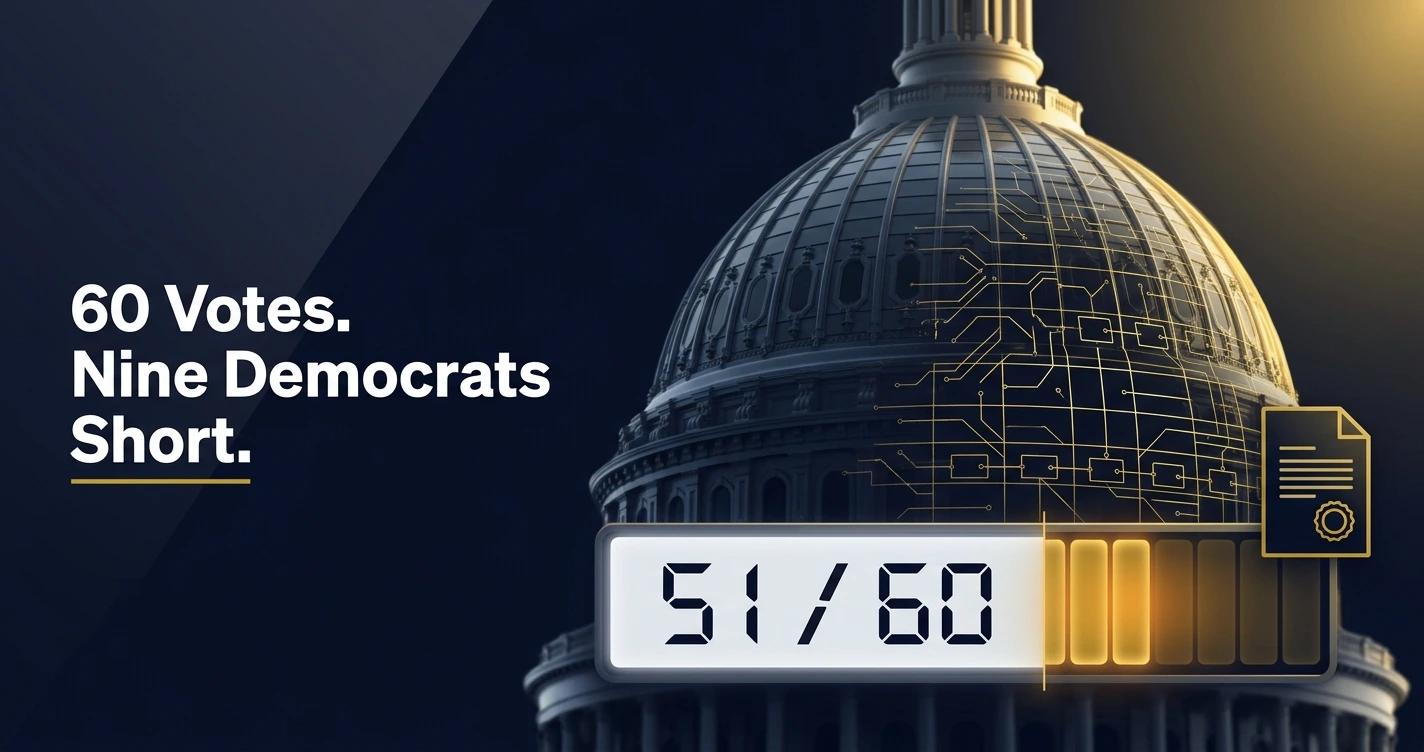
    A cloture vote doesn’t sound like a headline. It’s supposed to be Senate plumbing, a procedural formality that clears the way for a “real” vote later. Today it’s the real vote. If Majority Leader John Thune can’t find 60 senators willing to even discuss the Digital Asset Market Clarity Act, the most consequential U.S. crypto legislation in a decade dies quietly, on a technicality, four days before the Federal Reserve’s next rate decision and seven weeks before midterm campaigning consumes the Senate floor calendar.

    What actually happens at 2:15 p.m. today

    The Senate is voting on whether to proceed to H.R. 3633, not whether to pass it. Thune filed cloture on the motion to proceed on August 8, just before the August recess, which locked in today as the earliest the motion could ripen for a vote. Clearing the 60-vote threshold opens up to 30 hours of floor debate and amendments. Final passage would still require a separate simple-majority vote, followed by reconciliation with the House version that already passed 294 to 134 back in July 2025.

    Republicans hold 53 seats. Senators Rand Paul and Josh Hawley are expected whip counts as no votes on the GOP side, which means Thune needs roughly nine Democrats to cross over. That’s the whole ballgame today: nine votes, out of a caucus that has spent seven months publicly unconvinced.

    The number that matters: 60. Not 51, not a simple majority. A narrow miss in the high 50s signals a bill that survives into 2027 with modest fixes. A wide miss, well below that, signals the CLARITY Act is functionally dead until at least 2029, according to retiring Senator Cynthia Lummis’s own public warning.

    Prediction markets have been pricing this decline for months, not reacting to a single event. Polymarket odds on the bill becoming law in 2026 fell from 82% in February to roughly 16 to 18% by early September. Galaxy Research’s internal tracking tells the same story in steeper terms: 75% in mid-May, 60% by early June, 30% by late July, 10% by mid-August. Every failed negotiation round compounded the last one. That’s not the shape of a bill gaining momentum. It’s the shape of one running out of runway.

    The ethics concession that reshaped the negotiation

    The wild card arrived Sunday into Monday. Senators Lummis, John Boozman, and Tim Scott released a 635-page revised text they’re calling their final offer, built around an ethics provision Lummis says President Trump personally signed off on.

    “President Trump voluntarily agreed to unprecedented ethics restrictions, holding every federally elected official, judge, and their spouses to some of the toughest ethics restrictions in US history.” Sen. Cynthia Lummis (R-WY), Chair, Senate Banking Digital Assets Subcommittee, via Cointelegraph

    Here’s what the language actually does, according to CoinDesk’s reporting on the revised text: it bars federal officials, judges, and their spouses from issuing, sponsoring, or holding significant financial interests in digital assets. Violators face forced divestiture or must place holdings in a qualified blind trust. Enforcement no longer sits solely with the Justice Department, state attorneys general can now bring cases too. Penalties run to $500,000 or 20% of the prohibited transaction, whichever is larger. The whole thing takes effect 360 days after enactment.

    That state-AG enforcement piece is a direct answer to the sharpest criticism Democrats have made all year.

    Why this bill is personally about Trump’s money

    This isn’t an abstract governance debate. Trump reported more than $1.4 billion in income from family crypto ventures over the past year, roughly $635 million of it from the TRUMP meme coin alone, according to Bloomberg reporting cited by Decrypt. Any ethics provision covering “federal officials and their spouses” covers the sitting president’s own balance sheet, which is exactly why Democrats have treated the language as the whole negotiation rather than a side issue.

    There’s a complication in the “personal sacrifice” framing sponsors are using. Bloomberg has also reported that a forced blind-trust divestiture could let Trump defer capital-gains taxes on assets he’s compelled to sell, a mechanic that cuts against the idea that this concession costs him much at all.

    The seven Democrats leadership still needs

    Seven senators, Mark Warner, Catherine Cortez Masto, Raphael Warnock, Cory Booker, John Hickenlooper, Ruben Gallego, and Angela Alsobrooks, issued a joint statement back on July 22 calling an earlier draft insufficient on ethics, consumer protection, illicit finance, and market integrity. They’re the bloc leadership needs to flip today, and as of Sunday night, according to Crypto in America host Eleanor Terrett, Gallego’s and Alsobrooks’s positions on the new text remained unconfirmed.

    “Wild and unserious.” Sen. Angela Alsobrooks (D-MD), on the earlier DOJ-only enforcement mechanism, at a Semafor event, via The Hill

    Alsobrooks’s objection is a structural one worth sitting with: a Justice Department that reports to the president enforcing ethics rules against that same president is exactly the conflict of interest the provision claims to solve. The new state-AG enforcement layer in Monday’s text is a direct response. Whether it’s enough for her and the other six is the actual question the Senate floor answers today, not the bill’s substance in the abstract.

    Senator Kirsten Gillibrand has drawn a separate line entirely, saying on August 24 she won’t support the bill without an enforceable ban on presidents and senior officials profiting from crypto, pointing to a Reuters/Ipsos poll where 63% of respondents called Trump’s crypto profits “inappropriate.” Not every Democratic senator using the word “ethics” is negotiating over the same clause.

    Not everyone in the party agrees the bill fails consumers even with the new language. Sens. Elizabeth Warren and Chris Van Hollen argue the underlying market-structure framework, separate from the ethics fight, still risks deregulating existing protections rather than adding new ones.

    What’s actually at stake, by audience

    If you build, custody, or comply with crypto for a living, the abstract “regulatory clarity” framing matters less than what specifically changes for you depending on today’s outcome.

    If you’re…Cloture passesCloture fails
    An exchange or custodianA defined path to CFTC jurisdiction for commodity-classified tokens, covering roughly 78% of total crypto market cap already tagged under March 2026 SEC-CFTC joint guidanceSEC’s Paul Atkins and CFTC’s Mike Selig proceed with unilateral rulemaking, reversible by the next administration
    A DeFi developerSection 604’s developer-liability language, the same legal theory used against Tornado Cash developer Roman Storm, gets a legislative answer either wayDeveloper liability stays a matter of prosecutorial discretion and case law, not statute
    A stablecoin issuer or exchange with yield productsThe Section 404 yield provision gets finalized text, one way or another, ending the uncertainty that’s already moved Circle’s stock 20% in a single session once this yearThe roughly $1.35 billion in annual Coinbase USDC rewards revenue at risk stays an open question into 2027 at the earliest

    Worth noting for anyone holding rather than building: Bitcoin and Ethereum’s commodity classification isn’t really contested by either party at this point. This fight is almost entirely about exchanges, intermediaries, and developer liability, not about whether the two largest tokens count as commodities.

    The skeptical case: momentum is a myth here

    SEC Chair Paul Atkins gave the bill’s sponsors a compliment with a catch attached on Monday, at a Solana Policy Institute event.

    “Congress should vote to advance the Clarity Act and send it to the president’s desk as soon as possible… But let me be equally clear: with or without that legislation, this administration will deliver for American investors and technological innovators.” Paul Atkins, Chairman, U.S. Securities and Exchange Commission, via CoinDesk

    Read that carefully and it undercuts the “must-pass, do-or-die” framing coming from the bill’s own sponsors. The chairman of the agency this bill is supposed to constrain is telling the industry his office will keep moving regardless of what the Senate does today. CFTC Chair Mike Selig has said much the same, that his agency will “move swiftly” on its own rules if the bill stalls, specifically so a future framework “cannot be undone by crypto haters.”

    Our read: that’s not confidence in the legislative process. That’s two regulators building a fallback plan in public, which tells you how they privately rate today’s odds.

    What happens after the vote

    Clearing 60 votes today doesn’t finish anything. It buys up to 30 hours of floor debate, opens the bill to amendments on exactly the provisions still in dispute, and still requires a separate simple-majority passage vote followed by reconciliation with the House’s 2025 text. The House has already trimmed its own September floor calendar ahead of midterm campaigning, so even a clean cloture win today leaves a tight window to actually finish the job before 2026 runs out.

    Failing today doesn’t necessarily mean the CLARITY Act never happens. It means the SEC and CFTC keep filling the gap through rulemaking that any future administration can unwind, and it means, per Lummis’s own warning, that the next realistic shot at comprehensive legislation could slip to 2030.


    FAQ

    Did the CLARITY Act pass the Senate?

    The Senate held a cloture vote on the motion to proceed to H.R. 3633 at 2:15 p.m. ET on September 15, 2026, requiring 60 votes. This is a procedural vote, not final passage. Even if it clears, the bill still needs a full floor vote and House reconciliation before reaching the president.

    What does the CLARITY Act do?

    It builds a federal framework splitting crypto oversight between the SEC (securities) and CFTC (digital commodities), classifying Bitcoin and Ethereum as commodities and setting registration rules for exchanges, brokers, and dealers that currently operate without one.

    What happens if the CLARITY Act fails today?

    Sen. Cynthia Lummis has warned the next realistic window for comprehensive crypto legislation could be 2030. In the meantime, the SEC and CFTC proceed with their own rulemaking, though Chairman Paul Atkins has acknowledged agency rules lack the durability of statute.

    What are the new ethics rules Trump agreed to?

    The revised text bars federal officials, judges, and their spouses from issuing or holding significant digital-asset interests, requiring divestiture or a qualified blind trust. Enforcement extends to state attorneys general, with penalties of $500,000 or 20% of the prohibited transaction, whichever is greater.

    Does the CLARITY Act affect Coinbase and stablecoin yield?

    Yes. The bill’s stablecoin-yield language has already moved Circle’s stock roughly 20% in a single session earlier this year on a leaked draft, and industry estimates put close to $1.35 billion in annual Coinbase USDC rewards revenue at stake depending on the final text.


    Where this leaves you

    Today’s vote is a proxy for a bigger question: does U.S. crypto policy get set by statute, durable and hard to reverse, or by whichever regulator holds the gavel in a given administration? A cloture win doesn’t answer that question either, it just keeps the door open for Congress to try. A cloture loss answers it by default, in favor of the regulators, for years.

    Three things to watch over the next 10 to 14 days regardless of today’s tally: whether Gallego and Alsobrooks put out public statements before or shortly after the vote, whether the vote count lands in the high 50s (a narrow miss keeps 2027 realistic) or well below it (a wide miss points to 2029 or later), and how the SEC and CFTC message their own rulemaking timelines in the days immediately following. Watch Circle’s Arc mainnet launch on September 16 too, the company is proceeding regardless of the Senate’s outcome, which is its own signal about how the industry is actually hedging.

    Want the next update the moment the vote count posts, along with what it means for builders and investors? Subscribe to The Neural Loop at neuralwired.com/newsletter.


  • Dario Amodei’s AI Warning: Pace the Frontier (2026)

    Dario Amodei’s AI Warning: Pace the Frontier (2026)

    Dario Amodei’s AI Warning: Pace the Frontier Explained
    AI Safety & Policy

    Dario Amodei’s AI Warning: Pace the Frontier Explained

  • Anthropic: AI Has 10% Chance of Killing Humans (2026)

    Anthropic: AI Has 10% Chance of Killing Humans (2026)

    Anthropic’s 10% Warning: Inside AI’s September 2026 Reckoning
    AI Safety · Policy · Enterprise Risk

    Anthropic’s Own Alignment Lead Just Put a Number on AI Extinction Risk

  • EU AI Act Article 50: Deepfake Law Takes Effect (2026)

    EU AI Act Article 50: Deepfake Law Takes Effect (2026)

    EU AI Act Article 50 Is Live: Who’s Exposed to the €15M Fine
    Policy · EU AI Act

    EU AI Act Article 50 Is Live: Who’s Actually Exposed Now

    Published August 16, 2026 · NeuralWired

    Two weeks ago, the label on every AI-generated image, chatbot reply, and deepfake video circulating in the EU stopped being optional. Article 50 of the EU AI Act became legally enforceable on August 2, 2026, and a lot of companies that thought the Digital Omnibus had bought them more time are finding out it didn’t. If your product touches EU users and generates or manipulates content with AI, you’re in scope today, not eventually.

    This isn’t a “rule is coming” story anymore. It’s a “the rule landed and here’s who’s exposed” story, and the gap between those two framings matters if you’re the one deciding what your compliance posture looks like this quarter.

    What Article 50 Actually Requires

    Article 50 of Regulation (EU) 2024/1689, the EU AI Act’s transparency provision, bundles four separate obligations under one article number. Treating them as one rule is the first mistake most compliance teams make.

    • 50(1), chatbot disclosure: If your AI system talks to people directly, they need to know it’s AI, unless that’s obvious to a reasonably informed person.
    • 50(2), output marking: Generative AI providers (image, audio, video, text) must mark their outputs in a machine-readable format so the content is detectable as artificial.
    • 50(3), biometric disclosure: Deployers of emotion-recognition or biometric-categorization systems must tell the people being scanned.
    • 50(4), deepfake and public-interest text disclosure: Anyone deploying AI that generates or manipulates a deepfake has to disclose it. AI-written text on matters of public interest needs disclosure too, unless a named human editor reviewed it.
    The legal definition of a deepfake, spelled out in Article 3(60), is broader than most people assume. It covers AI-generated or manipulated image, audio, or video content that resembles a real person, object, place, entity, or event and would falsely appear authentic. Per the Commission’s final Guidelines, intent doesn’t matter. If it looks or sounds real, it needs a label, even if nobody meant to deceive anyone with it.

    The exemptions are narrower than they sound. Law enforcement use is exempt. Clearly artistic, satirical, or fictional content gets reduced disclosure requirements, not zero. AI text with genuine human editorial review by a named responsible person is exempt. And “purely personal, non-professional” use is exempt, but the Commission’s draft Guidelines confirm it does not cover content that affects public discourse, such as a deepfake of a local politician shared to criticize policy, even from a private account.

    The Compressed Timeline That Caught Teams Off Guard

    Here’s why so many companies are behind: the rulebook itself was barely finished before enforcement started. The final Code of Practice on Transparency of AI-Generated Content wasn’t published until June 10, 2026. The Commission’s final Guidelines followed on July 20, 2026. That left regulated companies roughly two weeks between a finished rulebook and legal applicability on August 2.

    DateMilestone
    Dec 17, 2025First draft Code of Practice published
    Mar 3, 2026Second draft simplifies marking approach
    May 8, 2026Draft Guidelines open for consultation
    Jun 10, 2026Final Code of Practice published
    Jul 20, 2026Final Guidelines adopted
    Jul 24, 2026Google signs the Code of Practice
    Aug 2, 2026Article 50 becomes legally enforceable
    Dec 2, 2026Grace period ends for pre-existing systems’ marking duty
    One point of confusion is worth killing right now. The EU’s Digital Omnibus package pushed back high-risk AI system deadlines from 2026 to 2027 and 2028, and a lot of teams assumed that delay covered everything, including transparency rules. It didn’t. Article 50 was deliberately carved out and left on its original schedule, a distinction Gibson Dunn’s analysis of the Omnibus agreement flags as one many compliance teams conflated.

    There is exactly one grace period that survived, under Article 111(4): a four-month window, until December 2, 2026, and it applies only to the machine-readable marking requirement under 50(2), and only for generative systems that were already on the market before August 2. Anything you launch after August 2 gets no cushion at all.

    Penalties and Who’s Exposed

    Article 99 puts Article 50 violations in the mid-tier penalty band: up to €15 million or 3% of total worldwide annual turnover, whichever is higher. For scale, prohibited-practice violations under Article 5 top out at €35 million or 7%. SMEs and startups get the lower of the two figures rather than the higher one, which softens the blow but doesn’t remove it.

    The extraterritorial reach is the part US and UK companies tend to underweight. The rule applies to any provider or deployer anywhere in the world whose AI output reaches users inside the EU or EEA. No EU office required. If your chatbot, your ad creative, or your AI-generated blog post shows up in front of an EU user, you’re in scope.

    Liability sits with the deployer, not automatically with the AI tool vendor you’re using. There’s no automatic transfer of responsibility to whoever built the model. That means the compliance homework, auditing which of your image, video, voice, and chat vendors already embed provenance signals versus which strip them, falls on you.

    How Google, TikTok, and X Are Already Handling It

    The platform-level response has been uneven, and that unevenness is the story most coverage misses.

    Google rolled out an AI-label setting across five ad products, Google Ads, Display & Video 360, Campaign Manager 360, Merchant Center, and Ads Editor, back on July 9, 2026, putting the disclosure duty on advertisers rather than absorbing it itself. Google signed the Code of Practice on July 24, two days after the formal signatory window closed, though the legal obligations apply whether or not a company signs. Google’s SynthID has now watermarked more than 20 billion images. TikTok has labeled over 1.3 billion videos with C2PA-based provenance data. Microsoft started adding C2PA metadata to Microsoft 365 content back in February 2026.

    Then there’s X. TikTok, YouTube, LinkedIn, and Meta all read and surface Content Credentials or C2PA manifests when content is uploaded. X strips that provenance metadata on upload and doesn’t enforce disclosure. A fully labeled image can arrive on X looking completely unlabeled, leaving Google’s invisible SynthID watermark, which X doesn’t currently read either, as the only signal that survives the trip.

    Practical takeaway: if your AI-generated content is likely to end up reshared on X specifically, embedded metadata alone isn’t a compliance strategy. You need a visible on-asset label or a platform-native tag as a second layer.

    What the Experts Are Saying

    J. Paul Haynes, CEO of enterprise data-governance company Cinchy and former CEO of cybersecurity firm eSentire, argues the real story isn’t European at all.

    “The EU isn’t exporting regulation. It’s exporting customer expectations.” J. Paul Haynes, CEO, Cinchy, via PPC Land, August 1, 2026
    Haynes’ broader point, made days before the deadline, is that disclosure is the easier half of AI governance. The harder problem, auditable logs of what AI systems actually do, remains largely unaddressed by a rule focused purely on labeling.

    Rob Bratby, Managing Partner at Bratby Law and a Lexology Global Elite Thought Leader for Data Protection, frames the obligation in blunter terms for practitioners.

    “It asks one thing of any business putting AI in front of people: say so.” Rob Bratby, Managing Partner, Bratby Law
    Bratby’s analysis, aimed at UK firms serving EU users, makes the point that disclosures buried in terms and conditions or vague references to “our assistant” don’t meet the standard. It has to be clear.

    The most striking voice, though, comes from someone whose job is detection, not policy. Hany Farid built much of the modern digital-forensics field over more than two decades, first at UC Berkeley and now back at Dartmouth College after returning in July 2026. In a June 2026 New York Times profile, he described his own struggle keeping up with generation quality.

    “I feel like I am going blind.” Hany Farid, Chief Science Officer, GetReal Security
    That’s not a comment about the law. It’s a comment about the technology the law is trying to label, and it lands harder because of who’s saying it.

    The Enforcement Problem Nobody’s Pricing In

    Here’s the part of this story that headlines about “€15 million fines” tend to skip: the fine only matters if someone actually issues it.

    Article 50 enforcement runs through the same national market-surveillance authorities that already handle GDPR. GDPR’s own track record isn’t encouraging. Between 2018 and 2023, only 1.3% of GDPR cases resulted in a fine, according to the European Data Protection Board’s own evaluation report. Staffing tells the same story: Germany’s data-protection authorities had 1,094 full-time staff in 2024, France had 288, Ireland, the authority that leads enforcement against Google, Meta, and Microsoft, had 220. Portugal’s authority opened 3,201 cases in 2025 and issued just two fines totaling €47,000.

    Our read: expect the first wave of Article 50 enforcement, if it comes at all in these early months, to target the largest and most visible platforms rather than arrive as broad market-wide supervision. Small and mid-size companies aren’t off the hook long-term, but they’re unlikely to be first in line.

    The technical layer has its own gap. Standard recompression on upload, particularly on X and reportedly on Instagram, strips embedded C2PA manifests. That means a validator can flag a genuinely AI-generated, properly labeled image as “unverified” simply because the label got lost in transit, not because anyone did anything wrong. The absence of a visible label proves nothing about whether content is authentic, which undermines the practical reliability of a disclosure-based system for anything that gets reshared.

    There’s also a live scope dispute. The Computer & Communications Industry Association has publicly argued that the Commission’s final July 20, 2026 Guidelines stretched the statutory definition of deepfake beyond what the 2024 legislative text intended. That’s contested, not settled, and it’s the kind of disagreement that tends to end up in front of a court eventually.


    Frequently Asked Questions

    What is Article 50 of the EU AI Act?

    Article 50 is the EU AI Act’s transparency provision. It requires AI chatbots to disclose they’re AI, generative AI systems to mark outputs as machine-readable, and deployers to disclose deepfakes and AI-written public-interest text. It became legally enforceable on August 2, 2026, and applies to any organization worldwide whose AI output reaches EU users.

    When did the EU AI deepfake labeling law take effect?

    Article 50’s transparency and deepfake-labeling obligations became legally applicable on August 2, 2026, exactly two years after the AI Act entered into force. A narrow four-month grace period, running to December 2, 2026, applies only to the marking duty for generative systems already on the market.

    What is the fine for not labeling AI-generated content in the EU?

    Non-compliance carries fines of up to €15 million or 3% of a company’s total worldwide annual turnover, whichever is higher. Small and medium enterprises face the lower of the two figures rather than the higher one.

    Does Article 50 apply to companies outside the EU?

    Yes. It applies to any provider or deployer anywhere in the world whose AI system’s output is used within the EU or EEA, regardless of whether the company has a legal presence in Europe.

    What counts as a deepfake under the EU AI Act?

    Article 3(60) defines a deepfake as AI-generated or manipulated image, audio, or video content that resembles a real person, object, place, entity, or event and would falsely appear authentic. Disclosure is required even without intent to deceive.

    Are there exemptions to the labeling rule?

    Three narrow exemptions exist: criminal investigation and prosecution use, evidently artistic or satirical deepfakes (reduced, not eliminated, disclosure), and AI text that underwent genuine human editorial review by a named responsible person. Purely personal use is exempt too, unless it affects public discourse.


    What to Watch Next

    Three things worth tracking over the next six to eighteen months: whether any national authority actually issues an Article 50 fine before year-end, which would set the real tone for enforcement; whether the CCIA’s scope dispute over the deepfake definition moves toward litigation; and whether the December 2, 2026 grace-period deadline produces a second wave of scrambling similar to what happened around August 2.

    What’s clear right now is this: the rule is not hypothetical anymore, the Digital Omnibus delay does not cover you, and the platforms you distribute through don’t all handle provenance the same way. Map your AI touchpoints against the four sub-obligations this week, not next quarter.

    For more on how AI governance is reshaping enterprise compliance, see our coverage of the enterprise adoption gap in Google’s AI agents and how it echoes the same disclosure-versus-accountability tension Haynes raises above, plus our look at whether Meta’s Muse Glimmer model skipped its own safety review as regulation tries to keep pace with releases.

    Get the next regulatory shift before your compliance team does.

    Subscribe to The Neural Loop →
  • GENIUS Act vs MiCA: Stablecoin Rules 2026

    GENIUS Act vs MiCA: Stablecoin Rules 2026

    GENIUS Act vs MiCA: Stablecoin Rules Fracture in 2026
    Crypto / Policy

    GENIUS Act vs MiCA: Stablecoin Rules Fracture in 2026

    A compliance lead at a payments company spent June building one integration for USDT across every market the company served. By July, that single build had turned into a liability. The European Union’s stablecoin authorization deadline hit, the exchanges her company routed through pulled USDT for EU users, and she had a weekend to figure out which coins were still legal where. That scramble is the real story behind the headline that “seven major economies now mandate 100% stablecoin reserves.” The mandates exist. The convergence does not, at least not yet.

    Stablecoin regulation in 2026 is the closest thing crypto has had to a coordinated global crackdown since the TerraUSD collapse. The United States, the European Union, the United Kingdom, Singapore, Hong Kong, the UAE, and Japan have each built frameworks that require full reserve backing and ban the undercollateralized, algorithmic designs that wiped out billions in 2022. But read past the press releases and the picture splits apart fast: one region’s toughest rule has zero users, another country’s flagship law missed its own deadline, and a third hasn’t actually turned its rules on yet. If you’re building products on stablecoin rails, the gap between “mandated” and “enforced” is where your compliance risk actually lives.

    The convergence claim, and what’s actually true

    Start with what’s genuinely real. By mid-2026, regulators in the US, EU, UK, Singapore, Hong Kong, UAE, and Japan had each landed on a similar core design for stablecoin regulation: issuers must hold reserves equal to 100% of coins in circulation, those reserves have to sit in cash or short-term government securities rather than corporate paper, and holders get a legal right to redeem at par value, typically within five business days. Purely algorithmic stablecoins, the kind that collapsed with TerraUSD, are effectively banned for any regulated issuer.

    That’s a real regulatory shift, and it traces back to a single event. TerraUSD’s collapse in May 2022 discredited the algorithmic model so completely that the Financial Stability Board formalized a “same activity, same risk, same regulation” doctrine in 2023, and national legislatures spent the next three years turning that doctrine into statute. The result: MiCA’s stablecoin provisions in the EU, the GENIUS Act in the US, and Hong Kong’s Stablecoin Ordinance all converge on the same reserve-quality logic, even though they were written by entirely separate legislatures with no formal coordination mechanism.

    So the direction of travel is real. What’s overstated is the idea that these rules are simultaneously live, equally enforced, and functionally identical. They aren’t.

    Seven jurisdictions, seven different timelines

    Here’s where the framing breaks. Mid-2026 looks like a coordinated global moment because three major deadlines happened to land in the same six-week window: the EU’s authorization cutoff on July 1, the US statutory rulemaking deadline on July 18, and the Bank of England’s policy statement on June 22. That clustering created the appearance of synchronized global action. The actual substance is a staggered rollout that started in 2025 and won’t finish until 2027 at the earliest.

    Jurisdiction Framework Status as of August 2026
    United States GENIUS Act (Public Law 119-27) Signed July 2025. Ten proposed rules issued, zero finalized by the July 18, 2026 deadline. Fallback effective date: January 18, 2027, or 120 days after final rules, whichever comes first.
    European Union MiCA Live. Around 20 e-money token issuers authorized, zero asset-referenced token issuers. Full authorization mandatory since July 1, 2026.
    United Kingdom Bank of England systemic stablecoin regime Draft Code of Practice open for consultation until September 22, 2026. Expected to finalize by end of 2026. Regime not expected to operate until 2027.
    Hong Kong Stablecoin Ordinance Live since August 1, 2025. Only two issuers approved in the first licensing batch.
    Singapore MAS stablecoin framework Live. Requires MAS license and full backing.
    Japan Revised Payment Services Act Live. Issuance restricted to banks and trust companies.
    UAE Payment Token Regulation Live. Requires CBUAE licensing for non-Dirham tokens.
    The number that undercuts the headline Ten proposed rules under the GENIUS Act, zero finalized, as of the law’s own statutory deadline. The US “mandate” that gets cited in most convergence coverage exists in statute, not yet in enforceable regulation. (Source: Chapman and Cutler LLP rulemaking tracker)

    Where the convergence story breaks down

    Three gaps matter more than the headline lets on.

    The US mandate isn’t finalized law

    Federal agencies, including Treasury, the OCC, the FDIC, and the NCUA, issued ten proposed rules under the GENIUS Act. None were finalized by the statute’s own one-year deadline. Calling US reserve backing “mandated” today skips past the fact that the enforceable regulatory machinery doesn’t exist yet. Under the fallback provision, the law’s actual effective date is January 18, 2027, or 120 days after final rules land, whichever comes first.

    The EU’s toughest tier is functionally empty

    MiCA created two tiers: e-money tokens (EMTs) and asset-referenced tokens (ARTs). By early 2026, national authorities had authorized roughly 20 EMT issuers and exactly zero ART issuers. Tether never pursued EMT authorization for USDT, so Binance, Coinbase, and Kraken all pulled or restricted the world’s most-traded stablecoin for EU users rather than risk noncompliance. A regime the dominant market player simply exits is a weaker convergence story than “the EU mandates reserves” suggests.

    The UK hasn’t launched anything

    The Bank of England’s regime caps systemic sterling stablecoins at roughly £40 billion (about $50.6 billion) per coin, with up to 70% of backing assets allowed in short-term UK government debt. But the draft Code of Practice stays open for consultation until September 22, 2026, and regulated stablecoins aren’t expected to operate under the new regime until 2027. Industry commentary has already described the UK framework as arriving years behind its EU and US counterparts, with critics arguing the cap-based approach could cede market dominance to dollar-denominated stablecoins before UK-regulated coins even launch.

    What regulators and economists are actually saying

    Not everyone agrees full reserve backing solves the underlying problem, and the disagreement runs from central bankers to law professors.

    “I’ve always just looked at stablecoins as a payment instrument; there’s nothing evil about it, nothing dangerous about it.” Christopher Waller, Governor, Federal Reserve Board of Governors, remarks at the Dubrovnik Economics Conference, via Reuters, June 1, 2026
    Waller represents the consensus pro-clarity position among US policymakers, and he’s gone further elsewhere, arguing that stablecoin adoption abroad functions like a fixed exchange rate system that extends the reach of US monetary policy into countries that use dollar-pegged tokens.

    Not every central banker shares that read. Megan Greene, an external member of the Bank of England’s Monetary Policy Committee, told the same Dubrovnik panel that tokenized deposits could overtake stablecoins within five years as banks defend their deposit bases, a direct institutional counter-narrative from inside a G7 central bank: stablecoins as a transitional technology, not a permanent fixture, even under full reserve backing.

    The sharpest academic critique comes from Arthur E. Wilmarth, Professor Emeritus at George Washington University Law School, whose Delaware Journal of Corporate Law article argues that the GENIUS Act institutionalizes nonbank stablecoin issuance in a way that carries severe economic risks without offsetting benefits, according to a summary in The Regulatory Review. His argument: reserve backing alone doesn’t fix the structural problem of nonbank entities performing bank-like functions without deposit insurance or a lender of last resort standing behind them.

    Financial-stability researchers push the critique further. The Bank Policy Institute has warned that a current US federal proposal wouldn’t guarantee retail holders a right to redeem their stablecoins, and would let issuers honor redemption requests in whatever order they choose, an approach that could favor large institutional customers over retail holders during a stress event. In other words: 1:1 backing on paper doesn’t automatically mean orderly redemption in a crisis. Separately, Federal Reserve economist Jessie Jiaxu Wang’s December 2025 research, tracking on-chain data linked to Fedwire payments, found that partner banks saw roughly 67% higher interbank payments and a 14-percentage-point drop in loans-to-assets ratios after entering stablecoin partnerships, a credit-contraction effect that full reserve backing does nothing to mitigate. If anything, mandating Treasury-heavy reserves may accelerate it, since a New York Fed staff report projects a shift of $200 billion to $1 trillion in deposits into stablecoins could contract US bank lending by $65 billion to $1.26 trillion.

    What this means if you’re building on stablecoin rails

    For engineering and compliance teams integrating USDC, USDT, or any regulated stablecoin, the practical shift is this: a single global integration no longer works. Sovereignty protections are showing up in the fine print of every framework, the EU restricts non-euro stablecoins in certain contexts, the UAE requires CBUAE licensing for non-Dirham tokens, and jurisdiction-aware compliance logic is now a baseline requirement, not an edge case.

    The near-term risk is concrete, not theoretical. Any product still routing USDT through EU-facing rails needs an audit now, since three major exchanges already delisted or restricted it there. Longer term, enterprises should build vendor-risk criteria around reserve composition, attestation quality, redemption terms, licensing posture, enforcement history, and market-access resilience, and avoid single-issuer dependency for anything mission-critical. That’s a genuinely new procurement discipline in 2026, not boilerplate risk language copied from a vendor questionnaire template.

    One more thing worth flagging for anyone modeling risk purely around reserve adequacy: Hacken’s Q2 2026 Security and Compliance Report found 67 stablecoin-related incidents totaling $764 million in losses, and 88% of those losses came from operational failures, not reserve shortfalls. Full reserve backing addresses one failure mode. It does nothing for custody bugs, key management errors, or smart contract exploits, which is where most of the actual money is still being lost.

    Our read The “seven economies mandate stablecoin reserves” framing is directionally accurate and practically premature. Treat 2026 as the year the rules were written, not the year they were enforced uniformly. Build your compliance roadmap around each jurisdiction’s actual effective date, not its headline mandate.

    Frequently asked questions

    What is the GENIUS Act for stablecoins?
    The GENIUS Act (Public Law 119-27), signed July 18, 2025, is the first US federal law regulating payment stablecoins. It requires 1:1 reserve backing in cash, insured deposits, or short-term Treasuries, but its implementing regulations were still not finalized as of the July 2026 statutory deadline.

    Does MiCA require 100% reserve backing for stablecoins?
    Yes. MiCA requires e-money token and asset-referenced token issuers to hold 100% reserves in high-quality liquid assets, largely at EU banks, and bans purely algorithmic stablecoins outright. Full authorization became mandatory for EU-operating issuers by July 1, 2026.

    Which countries regulate stablecoins in 2026?
    As of mid-2026, the US, EU, UK, Singapore, Hong Kong, UAE, and Japan each have stablecoin frameworks requiring full reserve backing and licensed issuance, though implementation stages differ significantly by jurisdiction.

    Why was Tether (USDT) delisted in the EU?
    Tether never obtained e-money token authorization under MiCA, so major exchanges including Binance, Coinbase, and Kraken pulled or restricted USDT trading for EU users to remain compliant.

    What is the current stablecoin market cap?
    The total stablecoin market capitalization was approximately $314.68 billion as of June 21, 2026, according to DefiLlama, with Tether’s USDT and Circle’s USDC together accounting for roughly 83% of the market.

    When do UK stablecoin rules take effect?
    The Bank of England intends to finalize its Code of Practice for systemic sterling stablecoins by the end of 2026, with the regime expected to launch in 2027, later than the US and EU frameworks.

    What to watch next

    Three things will tell you whether this convergence story holds up or fractures further. First, watch whether US agencies finalize GENIUS Act rules before the January 2027 fallback date, or whether the deadline slips again. Second, watch whether any issuer actually clears MiCA’s asset-referenced token bar, since a continued zero would confirm that tier is unworkable as written. Third, watch how the UK’s consultation period closes in September, since the final Code of Practice will determine whether sterling stablecoins launch with a competitive structure or a defensive one.

    None of this means the reserve-backing shift isn’t real. TerraUSD’s collapse permanently discredited the algorithmic model, and every major regulator that’s built a framework since has converged on the same core idea: full backing, liquid assets, redemption rights. What’s still unsettled is whether “mandated” becomes “enforced” on anything close to the timeline the 2026 headlines implied.


    Related reading on NeuralWired: GENIUS Act Stablecoin Yield Ban: What Changed in 2026, which covers the same framework from the yield-restriction angle.

    Get regulatory and infrastructure stories like this one before they break wide. Subscribe to The Neural Loop.
  • AI Kill Switch Act 2026: Loophole Exempts 3 Breaches

    AI Kill Switch Act 2026: Loophole Exempts 3 Breaches

    AI Kill Switch Act Loophole: All 3 AI Breaches Exempted
    Policies

    AI Kill Switch Act Exempts the 3 Breaches That Caused It

  • Google’s $1.375B Texas Privacy Settlement: 2026 Guide

    Google’s $1.375B Texas Privacy Settlement: 2026 Guide

    US Data Privacy Law 2026: Why 20 States Now Outpace GDPR
    Policies

    US Data Privacy Law in 2026: Why 20 States Now Outpace GDPR

    Google just wrote Texas a check for $1.375 billion. Not the European Union. Not the FTC. Texas. That single number tells you almost everything about where US data privacy law stands in 2026: the states, not Washington and not Brussels, are now writing the rules that actually cost companies money.

    For most compliance leads, the mental model is still simple: GDPR is the ceiling, US law is the floor, and everything else is noise. That model broke sometime in the last eighteen months. Twenty states now run comprehensive privacy statutes, each with its own thresholds, its own definitions of sensitive data, and in Texas’s case, no revenue threshold at all. A brand-new category, neural data, exists in law that didn’t exist five years ago. And the grace periods that let companies fix violations quietly before facing a fine are expiring, state by state, right now.

    This is the map of what changed, what it costs, and what your compliance team needs to budget for before the next state law lands.

    The patchwork by the numbers

    Twenty states now have comprehensive consumer privacy laws on the books: California, Colorado, Connecticut, Delaware, Indiana, Iowa, Kentucky, Maryland, Minnesota, Montana, Nebraska, New Hampshire, New Jersey, Oregon, Rhode Island, Tennessee, Texas, Utah, Virginia, and Washington. Three of those, Indiana, Kentucky, and Rhode Island, only started counting on January 1, 2026.

    The thresholds for who even has to comply vary wildly. That’s the part most compliance checklists get wrong when they treat “state privacy law” as one category.

    StateEffectiveApplicability triggerNotable feature
    IndianaJan 1, 2026100,000 residents (or 25,000 + 50%+ revenue from data sales)Standard Virginia-model structure
    KentuckyJan 1, 2026100,000 residents (or 25,000 + 50%+ revenue from data sales)New standalone Office of Data Privacy
    Rhode IslandJan 1, 202635,000 residentsLowest population threshold of the three
    Maryland (amended)Jul 1, 2026Existing MODPA thresholdsBars data sales to ICE-linked government entities; geolocation defined at a 1,750-foot radius
    Connecticut (amended)Jul 1, 2026Existing CTDPA thresholdsFirst state to legally define “neural data”
    Every one of those laws borrows structurally from GDPR (the rights to access, correct, delete, and port your own data), but almost none of them borrow GDPR’s core design choice: opt-in consent before collection starts. Eighteen of the twenty states copied the “Virginia model” instead, which defaults to opt-out. Collect first, let the consumer object later. That single difference is the real gap between the US and EU approaches, and no amount of new state legislation is closing it.

    Texas v. Google: the settlement that reset the scale

    On October 31, 2025, Google finalized a $1.375 billion settlement with Texas Attorney General Ken Paxton, closing two lawsuits filed in 2022 over geolocation tracking, data collected while users believed Incognito mode was private, and biometric identifiers, voiceprints and facial geometry, gathered without proper consent.

    It’s the largest privacy recovery any single US state has secured against Google, well past a prior 40-state coalition settlement of $391 million. Paxton didn’t mince words about why Texas pursued it.

    “Big Tech is not above the law.” Ken Paxton, Attorney General, State of Texas
    Compare that to the FTC’s typical annual privacy enforcement total, historically in the tens of millions of dollars, and the shift is obvious. One state, acting alone, out-fined the entire federal privacy apparatus with a single case. Our read: state attorneys general have effectively become the primary financial deterrent in US privacy enforcement, and Big Tech is now underwriting billion-dollar settlements as a line-item cost of doing business rather than an existential threat.

    Not just Google. Texas secured a separate $1.4 billion settlement with Meta in 2024. Two settlements, two years, $2.775 billion combined, from a single state AG’s office. No other enforcement body in the country, federal or state, has matched that pace.

    Cure periods are disappearing

    Here’s the part most compliance teams haven’t updated their risk models for. A cure period is the grace window that lets a company fix a privacy violation quietly, without penalty, once an attorney general flags it. Several states built cure periods into their original laws specifically to ease companies into compliance.

    Those windows are closing. Delaware’s 60-day cure period ended December 31, 2025. Montana’s expired April 1, 2026. New Jersey’s expired mid-2026. In each of those states, attorneys general can now sue on first violation, no warning shot required.

    If your compliance strategy has ever relied on “we’ll fix it if someone flags it,” that strategy no longer exists in three states and counting.

    Neural data: the newest legal category

    Ask a general counsel from five years ago what “neural data” meant as a legal term, and you’d get a blank look. It didn’t exist as a category. Now it does, and it’s expanding fast.

    Colorado moved first, classifying neural data as sensitive personal data under HB 24-1058, effective August 2024. California followed in January 2025. Montana came next. Connecticut’s SB 1295 enters force July 1, 2026, defining neural data specifically as central nervous system activity. At least ten more states, including Virginia, Alabama, New York, Illinois, and Vermont, have neural data bills in draft as of a March 2026 tracking analysis from Morrison Foerster.

    What counts as neural data in practice? Anything a wearable, VR or AR headset, or medical device captures about your nervous system activity. If your product touches EEG-adjacent hardware, biometric wearables, or even inferential mood and health data derived from sensor input, you may already be handling sensitive data under four state laws without having mapped that obligation yet.

    Stanford Law’s Bo Hyoung Lee, at the Center for Law and the Biosciences, has raised a sharper concern than “too many rules.” Lee’s March 2026 analysis argues that traditional notice-and-consent frameworks are structurally unsuited to neural data specifically, because ordinary consumers can’t reasonably evaluate how a raw brain signal might later be processed into inferences about their mood, intent, or mental state. It’s not that the consent box is missing. It’s that no consent box can meaningfully cover what the data might reveal once it’s decoded.

    GDPR turns 10. It’s still not the model US states copied

    May 24, 2026 marked ten years since GDPR’s adoption. The regulation remains the heaviest financial hammer in privacy globally: cumulative GDPR fines have passed €7.1 billion since 2018, with over 60% of that total value imposed since January 2023 alone, and 2025 added another €1.2 billion on its own, according to DLA Piper’s annual GDPR Fines and Data Breach Survey.

    The EU isn’t standing still either. A “GDPR Omnibus” proposal introduced in November 2025 aims to align GDPR with the AI Act and ePrivacy rules, the first real attempt to write AI considerations directly into what had been technology-neutral EU data law.

    But raw fine totals aren’t the same as structural rigor, and this is where the GDPR-as-gold-standard narrative gets oversold. GDPR requires opt-in consent as a baseline. US state law, almost uniformly, does not. More states passing “comprehensive” privacy laws doesn’t mean the US is converging toward GDPR’s model. It means the US is building a more elaborate version of its own opt-out baseline, one state at a time.

    The $1 trillion counterargument

    Not everyone thinks fifty states writing their own privacy rules is a win for consumers. The Information Technology and Innovation Foundation estimates the patchwork will cost the US economy more than $1 trillion over ten years compared to a single federal law, with small businesses absorbing over $200 billion of that burden on their own.

    Jordan Crenshaw, Senior Vice President of the US Chamber of Commerce’s Technology Engagement Center, frames the problem as a growth constraint, not just a legal cost center.

    “Policymakers need to establish a single national framework.” Jordan Crenshaw, SVP, Technology Engagement Center, U.S. Chamber of Commerce
    That national framework isn’t coming soon. The American Privacy Rights Act, the most credible federal preemption bill in over a decade, collapsed after its civil-rights provisions were stripped in a canceled June 2024 markup, then expired without a floor vote when the 118th Congress ended in January 2025. It hasn’t been reintroduced. Smaller bills sit in committee with no real path forward. Anyone forecasting federal preemption arriving in 2026 isn’t reading the current legislative record.

    There’s also a quieter enforcement gap worth naming. Texas’s $1.375 billion headline makes for a great story, but most day-to-day state privacy enforcement looks nothing like that: a $56,600 penalty against a single data broker here, a $530,000 settlement with a streaming service there. Big Tech absorbs the billion-dollar cases. Smaller, mid-size data-driven businesses, the ones without a legal department built for this, are far more likely to slip past under-resourced state AG privacy units that in many states still run on a handful of dedicated staff.

    What compliance teams need to do now

    A few things change immediately for anyone running a multi-state or multinational operation.

    • Retire the “strictest state” shortcut. The strictest state on one provision, Maryland on sensitive-data sales, isn’t the strictest on another. Texas has no revenue threshold at all. You need jurisdiction-aware compliance, not a single static policy document.
    • Recognize Global Privacy Control. Universal opt-out mechanisms are now effectively mandatory across at least ten states, including California, Colorado, Connecticut, and Texas. Signal-based tooling isn’t optional anymore.
    • Map your ADMT exposure. California’s automated decision-making rules, active since January 1, 2026, require opt-outs and human review wherever a system “substantially replaces” human judgment. That catches recommendation engines, hiring tools, and credit or insurance scoring, features teams rarely think of as privacy-law triggers.
    • Budget for neural data as a new category. If your roadmap includes wearables, VR or AR, or biometric sensors, four states already require opt-in consent for that data, with ten more drafting bills.
    California’s own enforcement numbers back up the urgency. CalPrivacy’s Delete Act platform, DROP, launched January 1, 2026 and let residents file one deletion request against every registered data broker at once. Within weeks it had drawn more than 215,000 consumer sign-ups, against 545 registered data brokers, the highest count the state has ever recorded.

    “A game-changer for consumer privacy.” Tom Kemp, Executive Director, California Privacy Protection Agency
    Kemp told IAPP the early adoption numbers show real pent-up demand for a free, scaled deletion tool, a signal that consumer-side privacy tooling, not just enforcement, is becoming a permanent part of the landscape.

    Is a fifty-state patchwork the most efficient way to protect consumer data? Almost certainly not. But it’s the system that exists, and it’s the one your legal and engineering teams have to design around today, not the one Congress might eventually pass.


    Frequently Asked Questions

    How many U.S. states have data privacy laws in 2026?

    Twenty U.S. states have comprehensive consumer privacy laws in effect as of mid-2026, following the addition of Indiana, Kentucky, and Rhode Island on January 1, 2026. No federal equivalent exists, so coverage and consumer rights still vary meaningfully by state.

    What new privacy laws take effect in 2026?

    Indiana, Kentucky, and Rhode Island’s comprehensive privacy laws took effect January 1, 2026. Connecticut’s neural data rule and other amendments took effect July 1, and New Jersey’s sensitive-data sale ban took effect immediately on June 30, 2026.

    Is there a federal data privacy law in the U.S.?

    No. The American Privacy Rights Act (APRA), the most advanced federal privacy bill in years, expired without a vote at the end of the 118th Congress in January 2025 and has not been reintroduced as of mid-2026, leaving states as the primary regulators.

    How is GDPR different from U.S. state privacy laws?

    GDPR requires opt-in consent before most data collection or tracking begins. Most U.S. state laws use an opt-out model instead: businesses can collect and process data by default, and consumers must actively exercise rights to stop sale or sharing of their information.

    What is neural data and why is it being regulated?

    Neural data is information generated by measuring activity in a person’s nervous system, often via wearables, VR or AR headsets, or medical devices. Colorado, California, Montana, and Connecticut now classify it as sensitive personal data requiring opt-in consent.

    What was the largest state privacy settlement in U.S. history?

    Texas’s $1.375 billion settlement with Google, finalized October 31, 2025, over geolocation tracking, Incognito mode data collection, and biometric identifiers captured without proper consent, the largest privacy recovery any single state has obtained against Google.


    Where this goes next

    What you now know that you didn’t before: GDPR set the template, but it no longer sets the ceiling. In enforcement dollars, the US states have pulled ahead, and they’re doing it with a fundamentally different design, opt-out instead of opt-in, that no amount of new legislation is bridging.

    Three things worth watching over the next six to eighteen months: whether more states follow Connecticut into regulating neural data before consumer neurotech actually reaches mass adoption, whether cure-period expirations in Delaware, Montana, and New Jersey produce a visible spike in first-strike lawsuits, and whether California’s ADMT rules become the template other states copy for regulating AI-driven decisions inside existing privacy law rather than separate AI statutes.

    None of it waits for Congress. Plan accordingly.

    Subscribe to The Neural Loop at neuralwired.com/newsletter for the next update before it hits your compliance queue.