Anthropic and OpenAI’s $5.5B Bet on the Deployment Economy | NeuralWired
Enterprise AIMay 5, 2026 · Deep Analysis · 8 min read
Anthropic and OpenAI Deploy $5.5 Billion to Rewire the Corporate World — and Bury the IT Consultant
Dario Amodei’s Anthropic and Sam Altman’s OpenAI have launched parallel joint ventures backed by Blackstone, Goldman Sachs, and TPG, embedding agentic AI directly into thousands of portfolio companies. The $200 billion IT services industry has never faced a threat quite like this.
The $5.5 Billion Pivot That Changes Everything
Two announcements. Two labs. One shared conclusion. On May 4 and 5, 2026, Anthropic and OpenAI revealed parallel multi-billion dollar joint ventures that mark the end of AI as a productivity “chatbot” and the beginning of AI as institutionalized corporate infrastructure. Together, the two ventures represent a $5.5 billion capital injection into the deployment layer of the AI stack. The message to the enterprise world is unambiguous: the labs are no longer selling tokens. They’re selling outcomes.
Anthropic CEO Dario Amodei has been the most candid voice in the industry about what this moment actually means. He’s argued publicly that for AI companies to justify valuations approaching $1 trillion, their models must graduate from productivity tools to genuine replacements for human labor. That isn’t a prediction anymore. It’s a business plan, backed by Goldman Sachs and Blackstone, and aimed squarely at the back offices of the global mid-market.
OpenAI’s move is bigger in raw dollar terms. Its “Deployment Company” secured over $4 billion in initial funding from a 19-member investor consortium led by TPG and Brookfield Asset Management, valuing the new entity at $10 billion before capital was even deployed. Anthropic’s venture is smaller at $1.5 billion but arguably more targeted. Both ventures share the same operational DNA: embed specialist engineers inside client companies, automate the workflows that used to require armies of offshore consultants, and charge for results rather than hours billed.
Why this matters now: The “agent leap” has arrived. Models like GPT-5.4 and Anthropic’s Claude Mythos can now sustain coherent task execution across 10-to-30-minute workflows involving dozens of sequential steps. That long-running reliability is the technical unlock that makes a “digital assembly line” feasible at enterprise scale.
OpenAI’s Financial Architecture: Capturing the Distribution Layer
OpenAI’s “The Deployment Company” is an audacious structural move. Rather than expanding its own sales force, OpenAI has effectively purchased a captive client base by co-investing with the private equity firms that already own the companies it wants to automate. The 19-investor consortium, featuring Advent, Bain Capital, SoftBank Group, and Dragoneer alongside TPG and Brookfield, collectively controls more than 2,000 portfolio companies and enterprise clients.
This isn’t enterprise software sales. It’s enterprise software ownership. The PE firms backing OpenAI’s venture have every financial incentive to mandate AI adoption across their portfolios. That flips the traditional IT procurement dynamic entirely: instead of a vendor pitching a skeptical CIO, the automation mandate comes from the board level down.
Feature
OpenAI: The Deployment Company
Anthropic: Wall Street Joint Venture
Initial Funding
$4.0 Billion+
$1.5 Billion
Post-Money Valuation
~$14.0 Billion
$1.5 Billion (initial capitalization)
Control Structure
Majority-owned by OpenAI
Standalone joint venture
Lead Investors
TPG, Brookfield, SoftBank
Blackstone, Goldman Sachs, Hellman & Friedman
Core Target Market
2,000+ multi-sector clients
Mid-market, healthcare, community banking
Operational Strategy
Special Projects led by Brad Lightcap
Applied AI specialists on-site
Model Deployed
GPT-5.4 Pro
Claude Mythos / Claude Opus 4.6
The model underlying OpenAI’s deployment push, GPT-5.4 Pro, was released in March 2026 and is already ranked fourth out of 115 tracked models on BenchLM.ai. Its “Operator” framework enables it to interact with standard business applications through a structured GUI layer, producing an audit trail that satisfies enterprise compliance requirements. In agentic workflow benchmarks, GPT-5.4 Pro posted an average score of 91.7, high enough to handle the kinds of multi-step document processing, data entry, and compliance checks that currently consume hundreds of millions of offshore consulting hours per year.
Anthropic’s Surgical Strike: Dario Amodei Targets the Mid-Market Gap
Anthropic’s approach differs from OpenAI’s in one critical dimension: focus. Where OpenAI has built a broad-market capture vehicle, Dario Amodei’s Anthropic has anchored its $1.5 billion venture around the specific institutional gap between large enterprise and true SMB, the community banks, regional healthcare systems, and mid-sized manufacturers that can’t afford a McKinsey engagement but desperately need workflow automation.
The anchor investors here tell that story precisely. Blackstone and Goldman Sachs bring financial sector distribution. Hellman & Friedman brings private equity operational reach. Apollo Global Management, General Atlantic, GIC, and Sequoia round out a coalition that spans both Wall Street and Silicon Valley. This isn’t a coincidence; it’s a deliberate architecture designed to make Anthropic the AI infrastructure provider for the institutional mid-market.
“For AI labs to hit valuations approaching $1 trillion, their models must be viewed not just as productivity tools, but as replacements for human labor.”
Dario Amodei, CEO, Anthropic, cited in analyst briefings, May 2026
Amodei’s bluntness is strategic. By framing the venture’s purpose in terms of labor replacement rather than augmentation, he’s signaling to institutional investors that Anthropic is building toward structural, recurring revenue streams, not one-time software licenses. That framing matters enormously for a company targeting a $900 billion valuation ahead of a potential IPO.
Anthropic’s premium lane advantage: New data from Counterpoint Research puts Anthropic’s average monthly revenue per active user at $16.20, compared to just $2.20 for OpenAI. With 134 million monthly active users versus OpenAI’s 900 million weekly, Anthropic extracts dramatically more value per engagement, a metric that becomes critical when justifying a near-trillion-dollar valuation to public market investors.
The Intelligence Engines: GPT-5.4 and Claude Mythos Go to Work
Both ventures are built on the current generation of frontier models, and the performance gap between them is narrower than ever. GPT-5.4 Pro processes up to 1.05 million tokens in a single context window, giving it the capacity to ingest an entire company’s policy documentation, regulatory filings, and operational procedures in a single pass. Its tool-calling architecture is mature; multi-tool orchestration across business applications is now production-grade rather than experimental.
Anthropic’s Claude Mythos has carved out a different competitive position. It’s specifically optimized for identifying structural vulnerabilities in software architectures and complex regulatory documents, a capability that has, according to multiple industry sources, quietly rattled traditional cybersecurity and legal compliance firms. Claude Opus 4.6, the reasoning engine underlying many of Anthropic’s 2026 enterprise offerings, trades raw inference speed for what the company calls “cautious, verifiable reasoning.” It outperforms GPT-5.4 on tasks requiring synthesis across multiple conflicting data sources.
Capability
GPT-5.4 Pro (OpenAI)
Claude Opus 4.6 (Anthropic)
Gemini 3.1 Pro (Google)
Context Window
1.05 million tokens
200k+ (optimized)
2.0 million tokens
Agentic Benchmark Score
91.7 avg (BenchLM #4)
High (precision focus)
High (Antigravity integration)
Inference Speed
74 tokens/second
Slower (caution-based)
Acceptable (GQA optimized)
Computer Use
Mature (Operator framework)
Strong (software focus)
Least mature of the three
Best Use Case
Multi-tool agentic workflows
Complex multi-constraint tasks
Long-document processing
The critical technical threshold for both labs isn’t single-task performance, it’s “long-running task reliability.” Can the model maintain coherent intent across a 20-minute automated workflow involving 40 sequential tool calls? That benchmark is now passing acceptable thresholds for well-defined enterprise processes. It’s the reason these deployment ventures are financially viable in 2026 when they weren’t in 2024.
The SaaSpocalypse: Anthropic and OpenAI Target the $200B Consulting Machine
The term “SaaSpocalypse” has circulated in analyst circles since early 2026, and the dual deployment venture announcements have given it concrete meaning. For three decades, the global IT services industry, dominated by firms like Tata Consultancy Services, Infosys, and Wipro, has thrived on labor arbitrage. The model was elegant in its simplicity: hire large numbers of engineers and consultants in lower-cost markets, and deploy them to manage the legacy software and back-office operations of Fortune 500 companies.
OpenAI and Anthropic are dismantling that model at its base. Their forward-deployed engineers don’t replace one offshore consultant; they replace the entire engagement. An agentic workflow running Claude Mythos can handle compliance checks, document processing, and data entry at speeds that make human labor economically non-competitive for entry-level white-collar tasks.
Workforce Category
Theoretical AI Task Coverage
Current Agent Adoption Rate
Primary Sector Exposure
Computer Programming
75%
33%
IT Services, SaaS Development
Computer & Math (Broad)
94%
Low
Analytics, Data Engineering
Legal & Compliance
60%+
Nascent
Financial Services, Healthcare
Office Administration
70%+
Nascent
Back-office Outsourcing
Financial Operations
55%+
Mid-market focus
Community Banking, Insurance
The gap between theoretical coverage and current adoption is precisely what both ventures are designed to close. On-site engineers handle the messy integration work, data cleaning, workflow mapping, compliance sign-off — so the AI agent can take over the repeatable execution. That “adoption gap arbitrage” is the actual business model, not the model itself.
🏦
Finance
Transaction processing and compliance checks face 55%+ automation exposure. Community banks are Anthropic’s primary target segment.
🏥
Healthcare
Medical billing, patient data entry, and documentation workflows represent the most addressable near-term market for mid-market deployment.
🏭
Manufacturing
Inventory management and basic QA processes are highly structured, making them ideal candidates for agentic automation with low hallucination risk.
⚖️
Legal & Compliance
Contract review and regulatory mapping are areas where Claude Mythos’s vulnerability-detection architecture provides measurable edge over general-purpose models.
A TCS executive, speaking anonymously on the company’s FY26 earnings call, described the shift directly: “We said we will take a pause. There was a change in demand profile with AI. This year was more adjustment of that with minimum fresher hiring.” The language is careful, but the math isn’t. When a company that has historically hired tens of thousands of graduates per year stops almost entirely, the structural cause is self-evident.
“AI may cause about 2 to 3 percent annual deflation in traditional IT services revenues for the next couple of years.”
ICICI Direct Analyst — Economic Times CFO, April 26, 2026
Motilal Oswal’s estimate is more severe over a longer horizon: between 9 and 12 percent of IT services revenues could disappear over the next four years as agentic workflows take over entry-level task categories. TCS and Infosys stocks are both down 25 to 30 percent year-to-date on these fears. The firms are pivoting toward AI services revenues, Nasscom projects $10 to $12 billion for the sector in FY26, but that new revenue doesn’t offset the structural erosion in the legacy outsourcing base that funds their cost structures.
The contrarian case: Q3 FY26 data showed Indian IT revenue still growing at 9.6% in aggregate. Infosys posted Rs 178,000 crore in revenues. Debjani Ghosh, Vice President at Nasscom, noted that “every technology proposal worldwide now incorporates AI”, suggesting the labs are partners as much as competitors in driving digital transformation spend. Human oversight remains essential for roughly 67% of complex tasks, and talent shortages could constrain deployment ventures as much as client inertia.
The Infrastructure Arms Race Behind Both Ventures
The deployment push from Anthropic and OpenAI doesn’t exist in isolation. It’s the revenue strategy that must justify the most expensive infrastructure buildout in corporate history. Combined, Alphabet, Amazon, Microsoft, and Meta are projected to spend $725 billion on AI infrastructure in 2026 alone, a 77 percent increase over the previous year. Meta, the most transparent of the hyperscalers on this point, has raised its 2026 capital expenditure guidance to between $125 billion and $145 billion, and CEO Mark Zuckerberg has explicitly linked recent job cuts of approximately 8,000 positions to the need to fund that compute buildout.
Meta’s strategy also points toward the next phase of the infrastructure war: in-house silicon. The company is on a six-month release cadence for its Meta Training and Inference Accelerator (MTIA) chips, targeting deployment of the MTIA 500 series by late 2027 with 27.6 TB/s of HBM bandwidth. If successful, it reduces dependency on NVIDIA at exactly the moment NVIDIA’s China market share has collapsed from roughly 95 percent to zero, following U.S. export restrictions. Huawei shipped over 800,000 AI chips in 2025. Two separate, competing AI hardware ecosystems are now a structural reality.
Google’s TurboQuant algorithm, released in early 2026, provides some relief on the inference cost side. The technique reduces KV cache memory usage by a factor of six and delivers eight-times faster inference on NVIDIA H100 accelerators, without requiring model retraining. By making TurboQuant free to use, Google is attempting to lower the deployment cost floor for the entire industry. That benefits Anthropic and OpenAI’s deployment ventures directly, even if it’s not Google’s primary motivation.
Anthropic and OpenAI on the Road to IPO: Burn Rates and the Valuation Test
Both deployment ventures are, at their core, valuation justification vehicles. OpenAI is targeting a public listing as early as Q4 2026, supported by an annualized revenue run rate that surpassed $25 billion in early 2026. But its cost structure is extraordinary: compute spending alone is projected to reach $121 billion by 2028, contributing to a potential $85 billion annual cash burn. The Deployment Company isn’t just a growth strategy; it’s the recurring revenue engine that makes a trillion-dollar valuation defensible to institutional public market investors.
Anthropic’s financial profile is structurally different. Its estimated $30 to $40 billion in annualized revenue serves a far smaller user base of 134 million monthly active users. That produces the $16.20 average monthly revenue per user figure that Counterpoint Research flagged, compared to OpenAI’s $2.20 across 900 million weekly actives. Anthropic is the premium, low-volume provider. Its $1.5 billion joint venture targets the institutional clients most likely to pay enterprise-grade fees for verified, high-stakes AI automation.
Company
Annualized Revenue
Active Users
Valuation Target
Key Financial Partner
OpenAI
$25.0 Billion
900M weekly
$852B to $1 Trillion
Microsoft / TPG
Anthropic
$30 to $40 Billion (range)
134M monthly
$900 Billion+
Amazon / Blackstone
The joint ventures are the final test of whether these valuations are real. If Anthropic’s on-site specialists can convert even 10 percent of the theoretical 55 to 75 percent task automation potential into billable recurring deployments across Blackstone and Goldman’s combined portfolio, the math begins to work. That’s not a given, client inertia, regulatory constraints, and the EU AI Act all introduce friction. But the direction of travel is unmistakable.
The Limits of the “Digital Assembly Line” Thesis
Not everyone is convinced the SaaSpocalypse arrives on schedule. The 33 percent adoption rate for programming task automation — against a theoretical 75 percent exposure, tells its own story. Human oversight remains essential for the complex, unstructured work that constitutes the majority of high-value consulting engagements. Hallucination rates in production agentic systems still run between 5 and 10 percent, and even a 5 percent error rate is catastrophic in healthcare billing or financial compliance contexts.
There’s also a talent constraint that the deployment ventures haven’t fully addressed. Building out the forward-deployed engineer model at scale requires hiring thousands of specialists who understand both the AI systems and the industry-specific workflows they’re automating. That talent pool is thin, expensive, and being competed for by every major technology company simultaneously. The very scarcity that makes forward-deployed engineers valuable also caps how quickly these ventures can scale.
Google Cloud’s position is instructive here. The company has positioned itself publicly as an “augmentation, not replacement” voice in the AI deployment debate, a stance partly driven by competitive interest, given that its own Gemini 3.1 Pro is competing for the same enterprise clients. But the underlying technical argument has merit: the tasks most exposed to AI automation today are the structured, repetitive, lower-value tasks. The complex judgment calls that justify premium consulting fees remain genuinely hard for current models. That’s why both ventures are starting with mid-market targets rather than the Big Four consulting relationships.
Reader Questions
How does “The Deployment Company” differ from standard ChatGPT Enterprise subscriptions?
ChatGPT Enterprise sells access to the model. The Deployment Company sells integration — forward-deployed engineers go on-site, map workflows, build custom tool connections, and hand off a running automated system. The pricing model shifts from per-seat licenses to outcome-based recurring fees. It’s the difference between selling a hammer and building the house.
Will these ventures replace IT consultants like TCS and Infosys entirely?
Not entirely, and not immediately. Entry-level task automation is the clear near-term target, data entry, document processing, compliance checks. The complex integration and transformation work that TCS and Infosys do for Fortune 500 clients requires contextual judgment that current models don’t reliably deliver. The 9 to 12 percent revenue erosion estimate over four years from Motilal Oswal is probably the right order of magnitude, severe structural damage without an immediate existential crisis.
What specific tasks in healthcare and finance are targeted first?
In healthcare, Anthropic’s venture is focused on medical billing, patient data entry, and documentation compliance, the administrative layer that currently consumes roughly 30 cents of every dollar spent on healthcare delivery. In finance, the targets are transaction processing, KYC document review, and regulatory compliance checks at community banks and regional credit institutions that can’t afford dedicated compliance teams.
How do these ventures affect IPO timelines for both companies?
They accelerate them. The recurring revenue streams from deployment contracts are exactly what institutional investors need to price a public offering. OpenAI’s Q4 2026 target requires demonstrating that its $25 billion annualized revenue has structural durability, not just API call volume that can swing wildly quarter to quarter. Deployment contracts provide that durability signal.
Is the forward-deployed engineer model sustainable given the talent shortage?
It’s the ventures’ most significant operational constraint. Both labs need thousands of engineers who combine AI systems expertise with deep domain knowledge in finance, healthcare, or manufacturing. That’s a rare combination in 2026. The model likely scales by having each engineer oversee more autonomous deployments over time, using AI to supervise AI, which reduces headcount requirements per deployment as the technology matures.
What to Watch
01
Anthropic’s first deployment case studies. Dario Amodei’s venture will need to publish verifiable ROI data from early Blackstone and Goldman portfolio deployments to maintain credibility with the institutional investors backing its $900 billion valuation target. Watch for Q3 2026 announcements.
02
TCS and Infosys FY27 hiring announcements. A second consecutive year of near-zero net hiring would confirm a structural rather than cyclical shift. Both companies report Q1 FY27 results in July, the first data point after these deployment ventures go operational.
03
EU AI Act compliance friction. European portfolio companies in Blackstone and TPG’s portfolios face regulatory constraints on automated decision-making in HR and financial services contexts. How the ventures navigate those constraints will determine whether the European mid-market is accessible at all in 2026.
04
OpenAI’s IPO S-1 filing. The S-1 will reveal the actual unit economics of The Deployment Company, revenue per client, contract duration, churn rates. That data will either validate or deflate the $1 trillion valuation narrative faster than any analyst note.
The simultaneous launch of these deployment ventures by Anthropic and OpenAI on May 5, 2026, closes the first chapter of generative AI and opens something structurally different. The question that defined the first chapter was “how smart is the model?” The question that will define the next one is “how deeply is it embedded?” Dario Amodei’s $1.5 billion bet, placed alongside Goldman Sachs and Blackstone, is his answer to that question. It’s a bet that the AI lab which wins the deployment layer wins the enterprise economy, and that the $200 billion IT consulting industry doesn’t get a vote in the matter.
Whether the SaaSpocalypse lands on schedule or gets delayed by technical constraints and regulatory friction, the direction is set. The “digital assembly line” is being built. The only real question is how long the incumbent labor arbitrage model has left before it becomes economically indefensible at scale.
Stay ahead of the deployment economy
Get NeuralWired’s weekly deep analysis on enterprise AI, frontier model benchmarks, and the business of intelligence — delivered every Tuesday.
OpenAI’s $4 Billion Deployment Company Signals the End of the AI Hype Era | NeuralWired
Enterprise AIMay 5, 2026 · 12 min read · By NeuralWired Staff
OpenAI’s $4 Billion “Deployment Company” Is the Moment AI Stopped Being a Product
Sam Altman’s OpenAI and Dario Amodei’s Anthropic have closed parallel multi-billion dollar joint ventures with Wall Street’s biggest names. Together, they’re injecting $5.5 billion into a single, audacious bet: that AI has finally matured enough to run the global enterprise, not just assist it.
Two announcements. Forty-eight hours apart. And the AI industry will never look quite the same. On May 4, Bloomberg confirmed that OpenAI had closed “The Deployment Company,” a $10 billion Delaware LLC backed by 19 investors including TPG and Brookfield Asset Management, with over $4 billion in committed capital. The following morning, The Wall Street Journal reported that Anthropic had finalized its own $1.5 billion joint venture anchored by Blackstone, Goldman Sachs, and Hellman and Friedman. Both ventures share one defining characteristic that separates them from anything either company has built before: they don’t sell software. They sell outcomes.
This isn’t a fundraising story. It’s a structural shift in how frontier AI gets deployed, who controls its distribution, and what it actually does inside a company. The combined $5.5 billion commitment from the world’s most conservative allocators of capital, firms that don’t write checks on hype, signals that we’ve crossed a threshold. The era of chatbots and productivity copilots is over. The era of AI as industrial infrastructure has begun.
OpenAI, now running at $25 billion in annualized revenue and eyeing a public listing as early as Q4 2026, needs a revenue engine that can sustain a valuation approaching $1 trillion. Anthropic, smaller but extracting far more revenue per user, needs a distribution mechanism that reaches beyond the enterprise software buyer. Both have landed on the same answer: embed forward-deployed engineers directly inside private equity portfolio companies, bypass the sales cycle entirely, and automate from the inside out.
By the Numbers: OpenAI’s Deployment Company targets 2,000+ portfolio companies across finance, healthcare, manufacturing, and logistics. Anthropic’s JV is surgically focused on mid-sized firms, community banks, and regional health systems that lack the internal capacity to deploy frontier models on their own.
OpenAI and Anthropic Built Two Very Different Financial Machines
The structural differences between the two ventures are worth examining carefully, because they reveal distinct theories of how AI deployment actually works at scale. OpenAI’s Deployment Company is majority-owned by OpenAI itself, with COO Brad Lightcap overseeing its operations through a “Special Projects” team. The 19-investor coalition, which includes SoftBank Group, Advent, Bain Capital, and Dragoneer Investment Group, gives OpenAI an immediate, captive audience of thousands of companies without a single cold sales call.
Anthropic’s structure is different. Its $1.5 billion JV operates as a standalone entity, not a subsidiary. The anchor investors, each contributing roughly $300 million, are Blackstone, Hellman and Friedman, and Goldman Sachs, with General Atlantic, Apollo Global Management, GIC, and Sequoia Capital rounding out the consortium. This structure gives Anthropic’s venture a degree of operational independence. It can price, staff, and prioritize without every decision running through Anthropic’s core product organization.
“The Deployment Company marks our shift from selling tokens to delivering operational outcomes. It aligns OpenAI with PE’s efficiency mandate, turning AI into the OS of mid-market firms.”
Sam Altman, CEO, OpenAI — Bloomberg, May 4, 2026
Neither venture is a SaaS play. Both are modeled, explicitly, on the Palantir approach: send technically sophisticated people on-site, map the actual workflows, and build automation that sticks because the engineers who built it are still in the room when something breaks. It’s expensive, labor-intensive, and nearly impossible to scale quickly. But it works.
OpenAI vs. Anthropic: The 2026 Deployment Venture Comparison
Feature
OpenAI: The Deployment Company
Anthropic: Wall Street Joint Venture
Initial Funding
$4.0 billion+
$1.5 billion
Post-Money Valuation
~$14 billion
$1.5 billion (initial capitalization)
Control Structure
Majority-owned by OpenAI
Standalone joint venture
Lead Investors
TPG, Brookfield, SoftBank
Blackstone, Goldman Sachs, Hellman & Friedman
Core Target Market
2,000+ multi-sector PE portfolio companies
Mid-market, community banking, regional healthcare
Operational Strategy
Special Projects led by Brad Lightcap
Applied AI specialists on-site
Primary Model
GPT-5.4 (1M token context, computer-use)
Claude Mythos (security-focused, agentic)
OpenAI’s GPT-5.4 and Anthropic’s Claude Mythos: The Engines Behind the Bet
These deployment ventures don’t work unless the underlying models actually perform in production. Not on benchmarks. Not in demos. In the messy, exception-heavy, poorly-documented workflows of a mid-sized manufacturing firm or a regional hospital system. That’s a harder test than any eval, and both labs have spent the past several months making the case that their current-generation models can pass it.
OpenAI’s GPT-5.4, released in March 2026, is built for exactly this environment. Its 1.05 million token context window means it can ingest an entire contract library, cross-reference it against regulatory guidance, and flag discrepancies without losing the thread. Its “Operator” framework, which lets it interact with standard business applications through a structured GUI layer, provides an audit trail that compliance officers can actually follow. On the GDPval professional services benchmark, GPT-5.4 posted an 83% win rate against prior OpenAI models. Its agentic workflow score ranks fourth among 115 tracked models globally.
Anthropic’s Claude Mythos takes a different approach. Rather than optimizing for breadth, it’s built for depth in constrained, high-stakes environments, particularly software architecture, cybersecurity, and complex multi-constraint reasoning tasks. Its “cautious, verifiable reasoning” slows inference but tends to outperform GPT-5.4 when tasks require synthesizing disparate context without hallucinating connections that don’t exist. For Anthropic’s target market of community banks and regional health systems, where a wrong answer has legal and regulatory consequences, that trade-off is the right one to make.
The critical metric for both isn’t speed or accuracy on a leaderboard. It’s long-running task reliability: the ability to maintain coherent intent across a workflow that takes 20 minutes and involves 40 sequential steps. That’s what separates a capable model from an operational one.
Token Efficiency Note: GPT-5.4 reduces token usage by 47% in tool-heavy workflows when using tool search, compared to workflows without it. Over thousands of daily automated tasks across 2,000 portfolio companies, that efficiency gain becomes a meaningful cost variable.
OpenAI and Anthropic Are Coming for the IT Services Industry
There’s a term circulating in consulting circles for what these deployment ventures represent: the SaaSpocalypse. It’s dark humor, but the underlying anxiety is real. For decades, firms like Tata Consultancy Services, Infosys, and Wipro have built enormous businesses on a simple premise: companies in developed markets will pay for skilled labor in lower-cost markets to manage their back-office operations. AI is about to dismantle that arbitrage.
Anthropic’s CEO Dario Amodei has been unusually direct about this. He’s argued publicly that for AI labs to reach valuations approaching $1 trillion, the models must function not as tools that assist workers, but as substitutes for them at scale. Anthropic’s own research from March 2026 found that computer programmers face 75% task coverage from current AI systems, meaning three-quarters of their daily work could theoretically be handled by an agent today. The broader “computer and math” category sits at 94%.
“Claude Mythos will displace up to 75% of programming tasks in PE portfolios, justifying our valuation narrative heading toward a trillion-dollar benchmark.”
Dario Amodei, CEO, Anthropic — Fortune, May 4, 2026
The gap between theoretical task coverage and actual agent adoption is precisely what the $5.5 billion in new capital is designed to close. Placing engineers on-site, in the workflow, translating model capability into running automation, that’s the bridge. And the private equity firms backing these ventures have every incentive to see it built quickly: their portfolio companies’ margins depend on it.
AI Task Exposure by Workforce Category (March 2026 Estimates)
Workforce Category
Theoretical Task Coverage
Current Agent Adoption
Gap
Computer Programming
75%
33%
42 points
Computer & Math (Broad)
94%
Low
Very large
Legal & Compliance
60%+
Nascent
Large
Office Administration
70%+
Nascent
Large
Financial Operations
55%+
Mid-market focus
Moderate
Not everyone is convinced the math works. Martin Fowler, a widely followed voice in enterprise software architecture, has pushed back on the deployment model’s structural assumptions. His concern isn’t that AI can’t do the work. It’s that the lock-in these ventures create will eventually be weaponized.
“This deployment model risks lock-in; enterprises may become hostages to AI labs’ pricing and may fail to build any internal capabilities of their own.”
Martin Fowler, Tech Influencer — Twitter/X, May 5, 2026
It’s a fair warning, and one that the venture-backed firms pushing this model would prefer you not dwell on. Once a PE portfolio company’s claims processing, loan origination, or inventory management runs through an AI layer managed by an external entity, switching costs become enormous. That’s not a bug in the business model. It’s the point.
OpenAI and Anthropic’s IPO Race: What These Ventures Actually Prove
Strip away the strategic framing, and these ventures serve one immediate financial purpose: they justify the numbers that OpenAI and Anthropic need to go public. OpenAI is reportedly targeting a Q4 2026 listing, supported by $25 billion in annualized revenue, though its compute costs, projected to hit $121 billion by 2028, cast a long shadow over its profitability story. Anthropic’s path to its $900 billion valuation target is different: fewer users, but dramatically higher revenue per one.
According to Counterpoint Research, Anthropic extracts $16.20 in average monthly revenue per active user, compared to OpenAI’s $2.20. That eight-to-one ratio reflects Anthropic’s deliberate focus on the high-end professional market, and it’s what these deployment ventures are designed to scale. By embedding Claude Mythos into the operations of hundreds of mid-market companies through the Blackstone and Goldman Sachs JV, Anthropic is manufacturing a captive, high-revenue user base before the IPO roadshow begins.
📈
OpenAI Revenue
$25 billion annualized as of March 2026, up 17% from $21.4 billion in 2025. IPO target: Q4 2026.
💼
Anthropic ARPU
$16.20 per active user monthly vs. OpenAI’s $2.20. The “premium lane” strategy in numbers.
🏗️
PE Portfolio Reach
2,000+ portfolio companies targeted across finance, healthcare, manufacturing, and logistics.
🔬
Compute Cost Ahead
OpenAI’s compute spend projected at $121 billion by 2028. Revenue must outrun the burn.
Both companies are racing against a cost structure that is, by any traditional financial standard, extraordinary. Combined hyperscaler infrastructure spending across Alphabet, Amazon, Microsoft, and Meta is expected to hit $725 billion in 2026 alone, a 77% increase year-over-year. The compute costs that underpin GPT-5.4 and Claude Mythos are not declining fast enough to wait for organic enterprise adoption. The deployment ventures are a way to force the adoption curve.
Frequently Asked Questions
How does The Deployment Company differ from standard ChatGPT Enterprise subscriptions?
ChatGPT Enterprise is a SaaS product: you buy seats, you get API access, your team figures out how to use it. The Deployment Company is the opposite model. OpenAI sends its own engineers on-site to map your workflows, build the automation, and manage the integration. You’re not buying tokens; you’re buying a finished, running system. It’s meaningfully more expensive and far stickier.
Will these ventures replace IT consultants like TCS and Infosys?
In mid-market and PE portfolio company contexts, the threat is real and near-term. The deployment ventures specifically target the back-office and programming work that Indian IT outsourcing firms have dominated for two decades. Automation targets of 75% for programming tasks and 70% for administrative work would eliminate the labor arbitrage these firms depend on. Large enterprise transformation work, which requires deep change management and organizational knowledge, is more insulated, at least for now.
What specific tasks in healthcare and finance are targeted first?
In healthcare: medical coding, prior authorization processing, clinical documentation, and basic diagnostic triage. In financial services: fraud pattern detection, loan document review, trading operations reporting, and regulatory filing preparation. GPT-5.4’s 83% win rate on professional services benchmarks and Claude Mythos’s strength in document-heavy, compliance-sensitive environments make both well-suited to these workflows.
How do these ventures affect the IPO timelines for OpenAI and Anthropic?
They accelerate them by manufacturing the revenue certainty that public market investors demand. OpenAI at $852 billion and Anthropic at $900 billion are extraordinary valuations to justify in an S-1. Guaranteed deployment contracts with Blackstone, Goldman, TPG, and Brookfield portfolios provide a captive, recurring revenue base that makes those numbers more defensible to institutional buyers. Both companies are reportedly targeting listings by late 2026 or 2027.
Is the forward-deployed engineer model sustainable at scale?
Short-term, yes. The $4 billion-plus in committed capital for OpenAI’s venture and $1.5 billion for Anthropic’s provides enough runway to staff aggressively. Long-term, the model has a ceiling: there are only so many engineers capable of doing this work, and the talent market for senior AI specialists is already extremely tight. By 2028, talent constraints could limit growth more than capital does.
OpenAI and Anthropic: What to Watch in the Next 90 Days
NeuralWired Tracker
01First deployment case studies. Watch for OpenAI and Anthropic to publish early results from The Deployment Company and the Blackstone JV. The claims about 50%+ workflow automation will face their first real test in Q3 2026, and the numbers they choose to publish, or not, will be telling.
02IT services sector response. TCS, Infosys, and Wipro have not been silent about AI, but they haven’t moved at this speed either. Watch for defensive acquisitions, partnership announcements, or direct counter-proposals to PE firms whose portfolios are now in the crosshairs of the deployment ventures.
03Regulatory signals on labor displacement. Dario Amodei’s public statements about displacing 75% of programming tasks in PE portfolios are unusual in their directness. Policymakers in the EU and U.S. are watching. A significant regulatory response, particularly in healthcare or financial services, could reshape the deployment timeline faster than any technical bottleneck.
04OpenAI and Anthropic S-1 filings. If either company files IPO paperwork in Q3 or Q4 2026, the deployment ventures will feature prominently as the primary evidence of a sustainable, high-margin revenue model. The multiples at which they price will tell us what the public markets actually think this infrastructure layer is worth.
The simultaneous move by OpenAI and Anthropic to lock in the distribution layer, through the deepest pockets in private equity, is the clearest signal yet that the frontier model race has entered a new phase. Building a better model is no longer enough. What matters now is who has embedded their model into the most workflows, the most companies, and the most portfolios before the IPO window opens. OpenAI’s Deployment Company and Anthropic’s Blackstone and Goldman JV are not just capital raises. They are land grabs. And the land in question is the operational core of the global mid-market economy.
The question worth sitting with isn’t whether AI will automate a meaningful share of white-collar work over the next three years. On the current trajectory, the evidence suggests it will. The real question is who controls the layer that sits between the model and the worker, who built it, who manages it, who profits from it, and whether the enterprises that sign on are buying a service or renting a dependency they’ll never be able to escape.
Stay ahead of enterprise AI deployment.
NeuralWired covers the intersection of frontier models, capital markets, and the future of work. New analysis published daily.
Elon Musk vs. OpenAI: Inside the Trial That Could Reshape AI | NeuralWired
AI & LawMay 5, 2026 · NeuralWired Staff
Elon Musk’s Trial Against OpenAI Is the Biggest Governance Fight in AI History
An Oakland federal courtroom is now the arena where Elon Musk is trying to prove that OpenAI betrayed the nonprofit mission he helped fund in 2015. With Greg Brockman disclosing a nearly $30 billion stake he built without investing a dollar of his own money, the case has moved far beyond a billionaire grudge match into a reckoning over who owns the soul of the most valuable AI company on earth.
The Founding Promise Elon Musk Says OpenAI Broke
When OpenAI was incorporated as a nonprofit in 2015, the pitch was straightforward and idealistic: build artificial general intelligence for the benefit of humanity, not shareholders. Elon Musk was one of the earliest backers, contributing roughly $38 million in its early years, according to CNBC reporting on court filings. He sat on the board. He helped recruit talent. Then he left.
What happened next is the entire dispute. OpenAI built ChatGPT, signed a partnership worth billions with Microsoft, restructured into a capped-profit entity, and is now valued at approximately $852 billion according to Associated Press trial coverage. Musk’s argument is that the transformation from nonprofit lab into a commercial juggernaut violated the founding agreement he signed on to.
OpenAI’s position is that none of that is true and that Musk’s claims are baseless. The company has publicly characterized the lawsuit as a competitive weapon wielded by a rival who runs his own AI operation.
Trial Opens in Oakland and Elon Musk Calls Himself “A Fool”
The trial began April 27, 2026, in Oakland federal court. Within days, it became clear this wasn’t going to be a quiet proceeding of dry legal arguments. Musk took the stand on April 29 and 30, describing himself as “a fool” for funding OpenAI. That phrase landed everywhere, and for good reason: it’s an unusual posture for a plaintiff who also happens to be one of the wealthiest people alive.
Coverage from the BBC framed the hearing as a “toxic AI row” between two of the most powerful figures in technology. That framing undersells the legal stakes. The case touches on whether courts can second-guess the governance decisions of a heavily capitalized, commercially active AI company, based on the text of a decade-old founding charter. That’s genuinely novel legal territory.
Context: Elon Musk also leads xAI, the AI company he founded in 2023 and which directly competes with OpenAI’s products. That conflict of interest underlies OpenAI’s central counterargument: that the lawsuit is strategy dressed up as principle.
Greg Brockman Discloses a $30 Billion Stake He Didn’t Pay For
The single most arresting fact to emerge from the trial so far isn’t anything Musk said on the stand. It’s what OpenAI president Greg Brockman revealed in testimony on May 4. His stake in OpenAI is worth nearly $30 billion, per Reuters. He did not invest any of his own money to get it.
That’s not a scandal, legally speaking. Founder equity built through participation in a company’s growth is entirely standard in Silicon Valley. But it’s a vivid illustration of what OpenAI’s transformation from nonprofit to for-profit structure actually produced: extraordinary personal wealth for insiders, accumulated without the cash-in-cash-out logic that normally governs investment returns.
Brockman’s disclosed financial ties to Sam Altman also drew attention in the Reuters reporting. Those relationships matter to the case because Musk is arguing that the leadership structure concentrates control and benefit in ways that betray the original mission.
“His stake is worth nearly $30 billion, and he said he did not invest personal cash.”
Greg Brockman testimony, as reported by Reuters and the Associated Press, May 4, 2026
Think about the governance signal that number sends. A company founded as a nonprofit, explicitly to prevent the concentration of AI’s benefits in a small group of people, has produced one of the largest founder equity positions in the history of technology. Whether that’s evidence of mission betrayal or simply the consequence of extraordinary execution is precisely what the court is being asked to decide.
The Text That Undercuts Both Sides’ “Pure Principle” Story
Two days before the trial opened, Elon Musk texted Greg Brockman about settling the case. Brockman responded by proposing that both sides drop their claims entirely. Then, according to CNBC’s reporting on the court filing, Musk replied with a warning: by the end of the week, he and Altman would be “the most hated men in America.”
That exchange is significant for what it says about each man’s self-awareness going into this proceeding. Musk was the one who reached out. He knew this trial would produce bad optics all around. That’s not the behavior of someone who views this purely as a principled stand on AI governance.
It also doesn’t mean his underlying legal argument is wrong. Both things can be true: a lawsuit can be tactically motivated and still raise legitimate questions worth adjudicating. But the text is important evidence that the “mission defender” framing has limits.
Key Numbers at a Glance
Data Point
Figure
Source
OpenAI valuation (cited in trial)
$852 billion
AP, May 4, 2026
Greg Brockman’s stake value
~$30 billion
Reuters / Bloomberg, May 4, 2026
Brockman’s personal cash invested
$0
AP / Bloomberg, May 4, 2026
Elon Musk’s early OpenAI contributions
~$38 million
CNBC, May 4, 2026
Trial start date
April 27, 2026
Reuters / BBC / AP
Musk settlement text (days before trial)
2 days prior
CNBC / court filing, May 4, 2026
What Elon Musk Is Actually Trying to Win
The remedies Musk is seeking go well beyond financial damages. His legal team wants the court to potentially unwind OpenAI’s for-profit restructuring and remove Sam Altman and Greg Brockman from control. That’s an aggressive ask.
Even if you accept every premise of Musk’s argument, translating those premises into a judicial order that dismantles an $852 billion business is a different problem entirely. Courts deal in remedies that are proportionate and enforceable. “Turn this company back into a nonprofit” is neither simple nor without precedent concerns. What happens to Microsoft’s multi-billion-dollar partnership? What happens to the investors who poured money into a for-profit entity in good faith?
⚖️
Governance Claim
Musk argues OpenAI’s shift to a for-profit structure violated its founding nonprofit charter and the mission he funded.
🏛️
Structural Remedy
The suit seeks to unwind the for-profit restructuring and potentially remove Altman and Brockman from leadership.
💰
Market Precedent
A ruling against OpenAI could force frontier AI labs to rethink how they convert from mission-driven orgs into commercial companies.
The more realistic legal outcome, if Musk wins anything, is probably some form of injunctive relief around disclosures, board composition, or governance accountability rather than a wholesale dismantling. But even that narrower win could shake how investors and partners think about OpenAI’s structural legitimacy.
The Strongest Case Against Elon Musk’s Lawsuit
OpenAI’s defenders make two arguments that deserve to be taken seriously. The first is competitive motive. Musk runs xAI, which competes directly with OpenAI across consumer and enterprise AI products. Slowing a rival through prolonged litigation is a rational business strategy, regardless of whether the underlying legal claims have merit. The timing matters too: Musk filed suit after OpenAI had already achieved massive commercial scale, not when the restructuring first happened.
The second argument is practical. Courts are generally reluctant to reorganize live, heavily capitalized businesses after the fact. OpenAI isn’t a shell; it employs thousands of people, has active contracts with one of the largest companies in the world, and is developing technology that governments and enterprises depend on. A judge ordering it back to nonprofit status would be without real precedent in American corporate law.
Both counterarguments are strong. Neither is decisive. The legal merits of the underlying governance question, specifically whether a nonprofit’s mission can be enforced by a donor after the fact, remain genuinely unresolved.
Market and AI Industry Fallout: Who Wins If OpenAI Loses
The immediate business consequences for ChatGPT users are probably limited unless the court orders injunctive relief that disrupts operations. Product development continues. Model training continues. The lights stay on.
The medium-term consequences are more interesting. If this trial produces a serious legal constraint on OpenAI’s structure, Microsoft’s exposure rises sharply. Its entire AI strategy is built around a partnership with a company whose commercial legitimacy is now being actively contested in federal court. Governance risk is real risk when you’re trying to price multi-year infrastructure deals.
Beyond Microsoft, the case sends a signal to every frontier AI lab that has taken a nonprofit-to-commercial path or might consider one. Anthropic, Google DeepMind, and others are watching. So are their investors. Read our analysis of AI governance structures across frontier labs to understand why this matters beyond OpenAI.
The companies most likely to benefit from ongoing negative press around OpenAI’s governance are exactly who you’d expect: xAI (Musk’s own firm), Anthropic, and Google, all of whom have an interest in a narrative that highlights concentrated AI power and asks whether OpenAI’s commercial architecture is legitimate. That doesn’t make the narrative wrong. It just means the incentives are complicated for everyone involved.
What is Greg Brockman’s stake in OpenAI worth, and how did he get it?
Court testimony on May 4, 2026 put Brockman’s stake at nearly $30 billion. He testified that he contributed no personal cash to earn it. The position accrued through founder equity participation as OpenAI grew from a small nonprofit lab into one of the most valuable technology companies in the world, primarily through its corporate restructuring into a capped-profit entity.
Will Elon Musk win and force OpenAI back to being a nonprofit?
That outcome is legally possible to argue for but extremely difficult to achieve in practice. Courts rarely unwind live, heavily capitalized businesses on the basis of founding mission documents. The more likely scenario, if Musk prevails on any claims, is narrower remedies around governance disclosures, board structure, or mission accountability rather than a full restructuring.
How does the trial affect ChatGPT and future AI models?
Short-term product disruption is unlikely unless the court issues injunctive relief. ChatGPT continues to operate normally. The bigger effects are indirect: governance uncertainty raises partner risk, can complicate capital raises, and affects how rivals and regulators think about OpenAI’s legitimacy as a commercial AI developer.
What did Elon Musk text Greg Brockman before the trial started?
According to a court filing reported by CNBC, Musk reached out to Brockman about a settlement two days before the trial opened. Brockman proposed that both sides drop all claims. Musk then replied with a warning that by the end of the week, he and Altman would be “the most hated men in America.”
What is the impact on Microsoft if OpenAI loses?
Microsoft’s AI strategy is deeply tied to OpenAI’s commercial structure. A court-ordered restructuring or serious governance constraint could complicate the terms of their partnership, affect Microsoft’s ability to integrate OpenAI models into its enterprise products, and create pricing and contractual uncertainty across a multi-billion-dollar relationship.
What Elon Musk’s Trial Means: Four Things to Watch
NeuralWired Watch List
01The remedy question. If the court finds in Musk’s favor, what it actually orders matters enormously. Anything touching OpenAI’s corporate structure will have downstream effects on Microsoft, its investors, and every frontier AI lab watching.
02Brockman’s full testimony. The $30 billion stake disclosure is only the beginning. How he characterizes OpenAI’s governance decisions under cross-examination will shape the legal narrative around mission drift.
03OpenAI’s nonprofit conversion timeline. The company is in the middle of converting to a standard for-profit structure. A court ruling could accelerate, delay, or complicate that process in ways that affect its next funding round.
04Regulatory spillover. Congress and the EU are both watching AI governance closely. A high-profile courtroom loss for OpenAI could hand regulators the narrative hook they need to push harder on AI company accountability rules.
Elon Musk’s trial against OpenAI is genuinely unprecedented. No court has ever been asked to adjudicate the soul of a frontier AI lab mid-flight, while it’s still building, still raising money, still releasing models, and still influencing how governments think about artificial intelligence. Whatever the verdict, the testimony, the disclosed numbers, and the settlement texts that have already surfaced will inform AI governance debates for years. Musk may not win in court. He may already have won the argument.
Stay ahead of AI’s biggest stories.
NeuralWired covers the decisions, deals, and disputes shaping the future of artificial intelligence.
Anthropic Bets $300M on Wall Street to Sell Claude Into the Heart of Private Equity | NeuralWired
Enterprise AIMay 4, 2026 · NeuralWired Staff
Anthropic Bets $300M on Wall Street to Push Claude Into the Heart of Private Equity
Dario Amodei’s safety-focused AI company is finalizing a $1.5 billion joint venture with Blackstone, Goldman Sachs, and Hellman & Friedman, a calculated move to plant Claude inside thousands of PE-owned firms before OpenAI can claim the same territory.
The deal has been weeks in the making, but it moved fast once the right partners aligned. According to the Wall Street Journal, Anthropic is on the verge of closing a $1.5 billion joint venture with some of the most influential names in private capital, including Blackstone, Goldman Sachs, Hellman & Friedman, and General Atlantic. An announcement was expected as early as May 4, 2026. This isn’t a funding round. It’s a distribution play, and the distinction matters enormously.
Anthropic CEO Dario Amodei has spent years insisting that AI safety and commercial ambition aren’t in tension. This joint venture is the clearest proof yet that he means it. Rather than chasing consumer eyeballs, Anthropic is threading Claude through the operational backbone of businesses that manage trillions in assets, where the demand for reliable, auditable AI is acute and the wallets are very deep.
Private equity firms have spent the past 18 months under enormous pressure to demonstrate efficiency gains across their portfolio companies. AI has been the obvious answer. The harder question has been which AI, deployed by whom, with what accountability. Anthropic, with its emphasis on enterprise-grade reliability and its history of building Claude for high-stakes environments, is positioning itself as the answer to all three.
Key context: Blackstone manages more than $1 trillion in assets and has portfolio exposure across hundreds of companies globally. Even partial Claude deployment across that network would represent a significant commercial milestone for Anthropic and a template for the broader industry.
The Deal Structure: Who’s Putting In What
The financial architecture is notable for its symmetry. Anthropic, Blackstone, and Hellman & Friedman are each committing roughly $300 million to the venture. Goldman Sachs is contributing approximately $150 million, with General Atlantic providing additional capital to bring the total to $1.5 billion. No official confirmation had been issued by any party as of late May 4.
That shared financial exposure is deliberate. It aligns incentives across the table. Anthropic doesn’t just collect a licensing fee while Wall Street firms absorb the implementation risk. Each major partner has skin in the outcome, which means each has reason to ensure that the deployed Claude products actually perform.
Partner
Reported Commitment
Strategic Role
Anthropic
~$300 million
Technology provider; Claude model deployment
Blackstone
~$300 million
Distribution via $1T+ portfolio network
Hellman & Friedman
~$300 million
Mid-market PE portfolio access
Goldman Sachs
~$150 million
Asset management clients; financial sector reach
General Atlantic
Remaining capital to $1.5B
Growth equity and tech-sector portfolio access
The joint venture will operate as a consulting entity, deploying Claude models with forward-deployed engineers embedded at client companies. That’s not a SaaS subscription model. It’s a services relationship, with Anthropic’s people and products going into the operational rooms where PE-backed firms make decisions about staffing, procurement, diligence, and portfolio management.
Anthropic Is Running the Palantir Playbook
Industry observers will immediately recognize the template. Palantir built its enterprise presence the same way: not by selling software from a distance, but by embedding analysts and engineers directly inside client organizations, staying until the workflows changed, and then staying some more. The approach is slower and more expensive than pure SaaS. It’s also stickier.
For PE, stickiness matters in a specific way. These firms don’t want a tool they’ll have to rip out and replace in three years. They want infrastructure. They want something their operating partners can trust when it’s flagging risks in an acquisition target’s financial model at 11 p.m. before a bid deadline. The Palantir model, for all its complexity, has proven that high-touch enterprise AI deployment creates durable relationships. Anthropic is betting it can do the same.
The difference from Palantir, and it’s a meaningful one, is that Anthropic’s commercial model sits on top of an explicitly safety-first research culture. Claude is built with human-in-the-loop constraints and is designed to flag uncertainty rather than mask it. In regulated environments like M&A diligence, that’s a feature. In high-speed operational contexts where PE firms sometimes need fast answers, it can create friction.
“This is a compelling investment opportunity for our clients and will enable mid-market companies to deploy Anthropic’s AI solutions to drive meaningful impact in their business. By democratizing access to forward-deployed engineers, the new company can help the expansive network of portfolio companies in our Asset Management business and other companies of similar sizes accelerate AI adoption to grow and scale their operations.”
Marc Nachmann, Global Head of Asset and Wealth Management, Goldman Sachs
Nachmann’s framing is instructive. Goldman isn’t describing this as a bet on Anthropic’s model quality, though that’s implicit. It’s describing it as an access play: giving mid-market firms the kind of AI implementation support that previously only the largest corporations could afford to build internally. That framing also conveniently positions Goldman as the democratizing force, not just a capital allocator looking for returns.
Anthropic’s Revenue Numbers Tell the Real Story
The joint venture doesn’t exist in isolation. Reporting from International Business Times Singapore places Anthropic’s annualized revenue run-rate at approximately $40 billion in 2026, with around 80% of that coming from enterprise clients. A separate analysis from Intellectia.ai cited a figure above $30 billion, noting that revenue tripled from the prior year’s $9 billion base.
Those numbers, if accurate, represent an extraordinary acceleration. They also explain why Anthropic can write a $300 million check into a joint venture without it being an existential commitment. The company backed by Amazon and Google isn’t scraping for growth. It’s choosing where to direct growth that’s already happening.
Data caveat: Revenue figures for Anthropic are reported by third-party analysts and have not been confirmed by the company. Anthropic remains private. The range of estimates reflects genuine uncertainty, and readers should treat specific figures as directional rather than definitive.
The enterprise orientation also tracks with Claude’s adoption data. More than 10,000 companies were already using Claude before 2026, according to Forbes-sourced figures cited by SEO Sandwitch. Claude.ai was pulling 87.6 million monthly visits as of December 2024. The JV is an attempt to convert that broad enterprise footprint into deep, durable relationships with the specific subset of firms that have both the complexity and the budget for full-stack AI integration.
How Anthropic’s Claude Fits Inside Private Equity Operations
The actual use cases being discussed for PE deployment aren’t speculative. They’re the workflows that PE operating teams have been trying to automate for years: deal sourcing and screening, investment committee memo drafting, portfolio company monitoring, compliance documentation, and due diligence synthesis. These are document-heavy, judgment-intensive tasks where a capable language model with strong retrieval and summarization can compress work that previously took analysts days into hours.
Claude’s particular strengths align with some of the harder parts of that list. Code review for technology assets being evaluated for acquisition. Contract analysis for compliance-heavy portfolio companies. Financial model annotation and error-flagging. The safety-first architecture that occasionally draws criticism for slowing output is, in the M&A context, an argument for the product: a model that says “I’m not certain about this figure” is more useful in diligence than one that confidently hallucinates.
📄
Diligence
Contract review, financial model cross-checking, and risk flag synthesis across acquisition targets.
📊
Portfolio Ops
Automated monitoring of KPIs, cost structure analysis, and board-ready reporting across portfolio companies.
⚖️
Compliance
Regulatory documentation, audit trail generation, and policy monitoring in financial services environments.
🔍
Deal Sourcing
Market scanning, sector mapping, and initial screening of acquisition candidates at scale.
The forward-deployed engineer model matters here. These aren’t generic implementations. The joint venture’s operating approach involves embedding technical staff who understand both the AI tooling and the client’s specific workflows. That’s the part that’s hard to replicate from a competitor’s app store listing.
“The establishment of this joint venture will provide Anthropic with additional funding support, facilitating its technology development and market expansion, particularly in the rapidly growing AI market.”
Emily J. Thompson, Senior Investment Analyst, Intellectia.ai
Anthropic vs. OpenAI: The B2B Battle That Actually Matters
Consumer AI gets the headlines, but the enterprise contract fight is where the real revenue is being decided. OpenAI built its name on ChatGPT’s consumer reach. Anthropic has consistently prioritized the enterprise segment, and Claude’s reputation in compliance-heavy industries, financial services, legal, and healthcare, reflects that focus. The JV accelerates that differentiation sharply.
More than 50% of U.S. enterprises held paid AI subscriptions as of March 2026, according to the Ramp AI Index. That tipping point matters. It means that competitive decisions about which AI platform to standardize on are being made right now, at budget cycle speed, across thousands of companies. The PE joint venture gives Anthropic a distribution shortcut into that decision-making: rather than winning individual enterprise clients one RFP at a time, it gains access to PE firms’ entire portfolio networks simultaneously.
OpenAI has its own enterprise push, its own government contracts, and its own investor relationships. But it doesn’t have a joint venture structured specifically to channel AI deployment into PE-owned mid-market companies, the segment that’s historically underserved by enterprise AI vendors focused on Fortune 500 clients. That’s the gap Anthropic is stepping into.
The competitive read here isn’t that OpenAI loses. It’s that Anthropic claims a segment before the market consolidates around a default choice. First-mover advantages in enterprise AI are meaningful because switching costs are high once workflows are rebuilt around a specific model’s outputs and behaviors. The JV is a land-grab, conducted at $1.5 billion scale, with Wall Street’s distribution muscle behind it.
The Friction Points Worth Watching
Not every analyst is reading this as a clean win for Anthropic. The core tension is structural: private equity operates on three-to-five-year investment horizons, and the ROI timeline for enterprise AI implementations rarely compresses that far. Firms are being asked to believe that AI-driven efficiency gains will materialize within the hold period of their current funds. That’s a meaningful assumption.
There are also questions about Claude’s performance relative to competitors in specifically PE-relevant benchmarks. The broader enterprise AI space has produced enthusiastic adoption claims, but hard evidence comparing model performance on diligence-specific tasks, financial analysis, or contract review at depth remains thin in public reporting. Anthropic’s safety architecture may create friction in high-speed operational contexts where PE firms need fast answers and can’t pause for model uncertainty flags.
Reuters noted that it could not independently verify all details reported by the Wall Street Journal, and no confirmation had come from Anthropic, Blackstone, Goldman Sachs, or Hellman & Friedman as of the publication of this article. That doesn’t mean the deal isn’t real. It does mean that the specific figures, timing, and structure carry some uncertainty until official statements are issued.
The implementation timeline is the other risk. Palantir’s model, which this JV explicitly emulates, took years to produce demonstrable returns for early government clients. PE firms have less patience than governments, and their limited partners have even less. If the first wave of deployments doesn’t show measurable efficiency gains within 12 to 18 months, the enthusiasm around the venture will face pressure that no amount of Goldman Sachs framing will fully absorb.
What Anthropic has going for it is the quality of its partners. Blackstone didn’t commit $300 million by accident. Neither did Hellman & Friedman. These are firms that run deep diligence on investment theses before committing capital. Their participation is, in itself, a signal that the underlying commercial logic has been stress-tested by people who do that professionally.
What exactly is Anthropic’s $1.5 billion joint venture with Blackstone?
It’s a consulting and deployment entity structured to bring Anthropic’s Claude AI models into private equity portfolio companies. Each of the main partners, Anthropic, Blackstone, and Hellman & Friedman, contributes roughly $300 million, with Goldman Sachs adding approximately $150 million and General Atlantic filling the remainder. The joint venture uses forward-deployed engineers, similar to Palantir’s model, to implement AI tools directly inside client operations rather than selling software remotely.
How will private equity firms actually use Claude?
The primary use cases include M&A due diligence (contract review, financial model analysis, risk flagging), portfolio company monitoring, investment committee memo drafting, compliance documentation, and operational efficiency analysis. The forward-deployed model means Anthropic engineers work inside client environments rather than simply providing API access.
Has Anthropic officially confirmed the joint venture?
No. As of May 4, 2026, all details come from sources familiar with the discussions, as reported by the Wall Street Journal and corroborated by International Business Times Singapore. No official statement had been issued by Anthropic, Blackstone, Goldman Sachs, Hellman & Friedman, or General Atlantic at the time of publication.
How does this affect Anthropic’s competition with OpenAI?
It gives Anthropic a significant distribution advantage in the PE-backed mid-market segment, which has historically been underserved by enterprise AI vendors. Rather than winning clients through individual sales cycles, Anthropic gains access to entire portfolio networks simultaneously. OpenAI has its own enterprise push but lacks a comparable joint venture structured specifically for this segment.
What are the biggest risks to the joint venture’s success?
The main risks are: a structural mismatch between PE’s short investment horizons and AI’s longer ROI timelines; the possibility that Claude’s safety-first design creates friction in high-speed operational contexts; the absence of public benchmarks showing Claude’s specific performance on PE-relevant tasks; and the overall uncertainty about whether the reported deal structure and financial figures are fully accurate before official confirmation.
What to Watch Next
NeuralWired Monitor
01Official announcement timing. Anthropic signaled a May 4 announcement date. Any delay, or any material change to the reported structure, would be significant. Watch for press releases from any of the five named partners.
02First portfolio company deployments. The JV’s credibility hinges on early implementation wins. The first named PE portfolio company to deploy Claude at scale will become the benchmark case study for the entire venture.
03OpenAI’s response. A $1.5 billion PE-focused joint venture is a direct competitive challenge. Whether OpenAI mirrors the structure, accelerates its own enterprise partnerships, or targets different verticals will define how the B2B AI market segments over the next 18 months.
04Anthropic’s IPO signals. A $40 billion annualized revenue run-rate and a Wall Street JV with Goldman Sachs are precisely the conditions that precede a public offering. Watch Dario Amodei’s public statements for any shift in language around Anthropic’s capital structure plans.
Anthropic’s joint venture with Wall Street’s biggest names isn’t a pivot. It’s an amplification of a strategy that’s been building quietly while the media focused on consumer chatbots and model benchmarks. Dario Amodei has always argued that safety and scale are compatible. The $1.5 billion bet he’s now placing, alongside Blackstone, Goldman, and Hellman & Friedman, is the most consequential test of that argument yet. The PE firms have done their diligence. The forward-deployed engineers will do theirs. What happens next inside those portfolio companies will tell us more about the real-world value of enterprise AI than any benchmark has managed to.
Stay ahead of enterprise AI
NeuralWired covers the deals, deployments, and decisions shaping how AI enters business operations. Get our weekly briefing.
OpenAI’s Symphony Turns Linear Tickets Into Merged PRs — No Developer Required
Six weeks after its quiet release, Symphony’s 15,400 GitHub stars tell one story. The engineering teams frantically reading its SPEC.md tell another: autonomous coding agents have arrived, and they’re watching your Jira board.
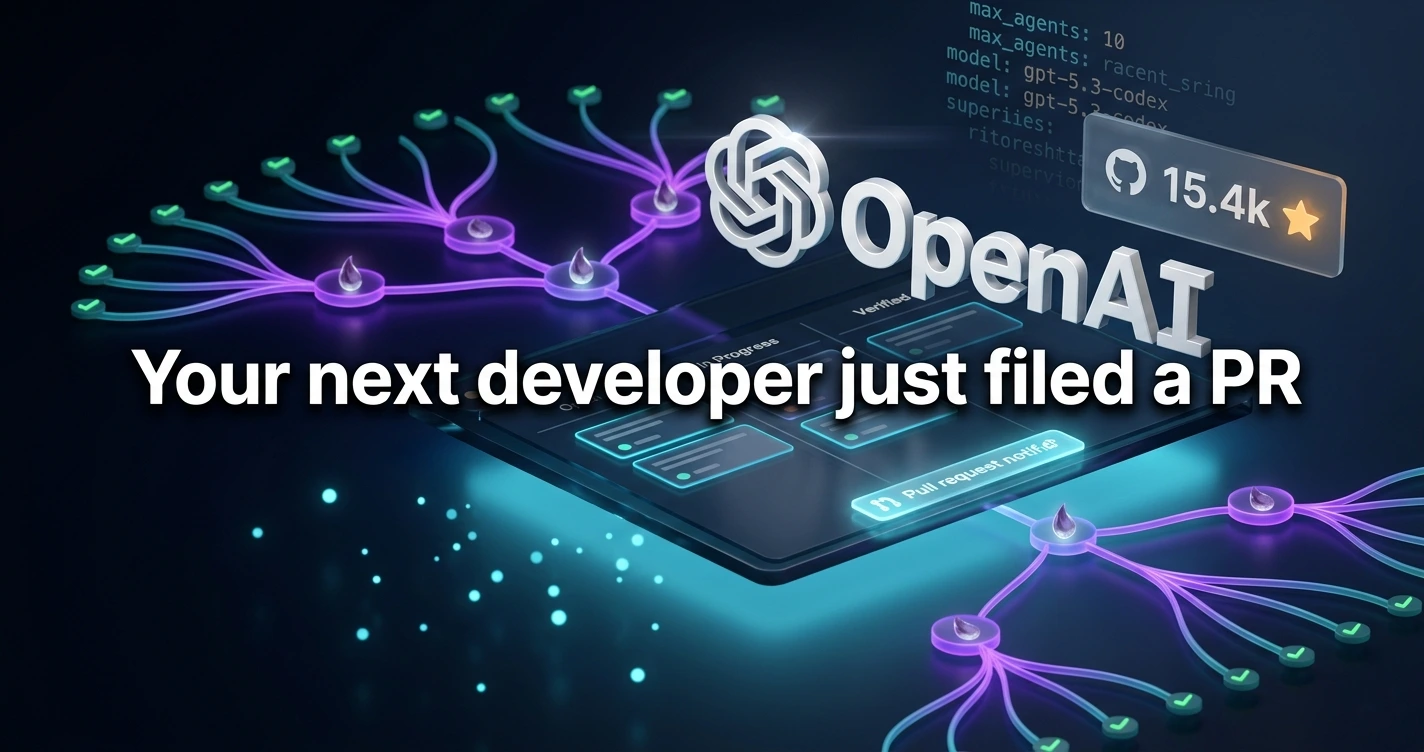
On March 4, 2026, OpenAI pushed a repository to GitHub called Symphony with almost no fanfare. No keynote. No splashy blog post. Just a SPEC.md, a reference implementation written almost entirely in Elixir, and an Apache 2.0 license. Within four days, the repo had 8,700 stars. By late April it had crossed 15,400, landing it inside the top 3,000 repositories on all of GitHub.
What people were racing to read was a specification for something the AI coding space has been promising for years but hadn’t quite delivered: a system that watches your project management board, claims tickets automatically, runs isolated coding agents to completion, and files pull requests back to your repository without a human ever touching a keyboard. Not a copilot. Not a suggestion engine. An autonomous engineer.
The speed of community interest wasn’t accidental. Engineering managers have spent two years stuck in what practitioners now call “AI pilot purgatory” — tools that help but don’t eliminate the supervision bottleneck. Symphony’s bet is that the bottleneck isn’t AI capability. It’s the workflow. Fix the workflow, and the capability was already there.
What Symphony Actually Does
Strip away the hype and Symphony is, at its core, a ticket-to-pull-request pipeline. It polls a Linear board every 30 seconds, looks for eligible issues, claims them, spins up isolated coding agents powered by gpt-5.3-codex, runs each agent through implementation, and surfaces a finished pull request with CI status and a walkthrough video proving the work was done.
That last part, the proof-of-work video, is worth pausing on. It’s not a diff. It’s a screen recording. The agent shows its work the same way a contractor would: here’s what I built, here’s it running. That’s a deliberate design choice, not a feature tacked on for demos.
“A ticket moves across the board, agents implement, a verified PR appears.”
Nirant, AI Engineer, LinkedIn, March 8, 2026
Nirant’s framing is precise. The board moves. The PR appears. The developer never touched the ticket. That’s the entire value proposition, written in eleven words.
The system isn’t meant to handle every ticket in your backlog. Symphony’s WORKFLOW.md configuration caps concurrent agents at 10 by default and limits each agent to 20 turns per run. These aren’t hard limits, they’re tunable, but they’re sensible defaults that prevent a runaway agent from burning through your Codex API budget on a single misbehaving issue. The framework OpenAI shipped is an engineering preview, and those guardrails reflect a team that’s thought carefully about what happens when things go wrong.
Engineering Preview status: Symphony’s GitHub repository carries 6 total contributors as of late April 2026, with 4 active committers. The latest commit, on March 27, was a GitHub Actions workflow pin. The small team size signals that OpenAI is leading development directly, not handing it off to the community yet.
The Linear-First Design
Symphony’s reference implementation is built around Linear, the project management tool popular with fast-moving engineering teams. That’s not an arbitrary choice. Linear’s data model is structured, its API is stable, and its issue states map cleanly onto the ticket lifecycle Symphony needs to manage: open, in-progress, verified, closed. The SPEC.md suggests the orchestration layer is abstract enough that other issue trackers could plug in, but Linear is the only confirmed integration in the current release.
Unconfirmed: Some early coverage has reported Jira support as a near-term addition. As of late April 2026, this hasn’t appeared in the official repository or specification documents. Treat Jira integration claims as speculative until OpenAI confirms.
Under the Hood: Why Elixir?
The choice of programming language here is the most technically interesting decision OpenAI made, and it’s the one that got the most attention from practitioners who looked past the headline. 95.4% of Symphony’s codebase is Elixir. Not Python. Not TypeScript. Elixir.
If you haven’t spent time in the functional programming world, that might read as an exotic choice. It isn’t. It’s a very deliberate engineering decision that says a lot about what OpenAI thinks the real challenge of agent orchestration is.
“Symphony’s core challenge is not computation, it’s managing many long-lived, concurrent, failure-prone agents.”
Saran Menon, AI/Software Engineering Analyst, LinkedIn, March 9, 2026
Elixir runs on the BEAM virtual machine, the same runtime as Erlang. BEAM was built to power telecom switching systems that couldn’t go down. The core design principle baked into the runtime is this: when something fails, it fails in isolation and restarts cleanly, without taking anything else with it. In telecom that means a dropped call doesn’t crash the switch. In Symphony’s case, it means a hallucinating agent doesn’t kill the other nine agents working in parallel.
“When one agent crashes, and they will, it triggers a supervised restart with full error context while every other agent continues working. This is the kind of thing you’d spend months building in Python or TypeScript — process isolation, supervision strategies, graceful degradation. In Elixir, it’s a first-class language feature.”
sjramblings, Independent Developer — sjramblings.io, March 11, 2026
That’s the crux of it. The Erlang/BEAM supervision tree model, which Elixir inherits natively, solves the hardest operational problem in running autonomous agents at scale: graceful failure. You don’t want your orchestration layer to be a house of cards where one bad LLM response brings down the whole system. Symphony’s runtime choice means it isn’t.
⚡
Concurrency
BEAM’s lightweight processes handle hundreds of simultaneous agent runs without thread-management overhead.
🛡️
Fault Isolation
OTP supervision trees restart failed agents automatically, preserving all other concurrent runs.
🔄
Long-lived Processes
BEAM excels at processes that run for minutes or hours — exactly the profile of an autonomous coding session.
📡
SSH Worker Support
A March 11 commit added SSH worker support to the Elixir reference implementation, expanding deployment options.
Key Configuration Specs: The Numbers That Matter
Symphony’s WORKFLOW.md is worth reading closely if you’re evaluating deployment. The configuration parameters tell you exactly how OpenAI sized the system and where the costs live. Here’s what the current spec shows:
Parameter
Default Value
What It Controls
Why It Matters
Max Concurrent Agents
10
Agents running simultaneously
Caps API cost burn; tunable for larger teams
Max Agent Turns
20 per run
LLM calls before agent stops
Prevents infinite-loop agents on ambiguous tickets
Polling Interval
30,000 ms (30 sec)
How often Linear board is checked
Determines ticket pickup latency
Turn Timeout
900,000 ms (15 min)
Max time per individual turn
Allows complex reasoning without hanging processes
Read Timeout
300,000 ms (5 min)
Max time per I/O read
Prevents stuck file or network operations
Default Model
gpt-5.3-codex
LLM powering each agent
Tight Codex integration; not model-agnostic by default
License
Apache 2.0
Usage rights
Permissive; enterprise use without copyleft concerns
The 15-minute turn timeout is the number that surprises most people encountering it for the first time. It’s long. But when you think about what an autonomous agent actually does, reads context, reasons about architecture, writes code, runs tests, interprets failures, retries, 15 minutes per reasoning step is conservative, not generous. These aren’t chatbot responses. They’re engineering sessions.
Who Wins, Who Worries
Every new infrastructure layer reshuffles who benefits and who’s exposed. Symphony is no different, and it’s worth being clear-eyed about both sides of that ledger.
Engineering Managers
The upside is obvious: a team of 10 developers with Symphony running 10 concurrent agents is, in theory, shipping work that used to require 20 people. The risk is subtler. When Symphony’s Linear integration becomes the de facto entry point for all implementation work, the board becomes a single point of failure. An ambiguous ticket description doesn’t stall one developer, it wastes 15 minutes of Codex API time and produces a PR that needs to be thrown out. Ticket quality suddenly matters in a way it didn’t before.
Individual Developers
Senior developers who spend their time on architecture, system design, and code review are probably fine. The work Symphony automates, picking up a clearly-scoped ticket and implementing it to spec, is disproportionately the work of junior developers. That’s not a neutral observation. The industry needs junior roles to exist, both for the work they do and as a pipeline for the senior engineers of tomorrow. Symphony doesn’t resolve that tension. It sharpens it.
OpenAI
Apache 2.0 licensing looks generous. But Symphony is built to use gpt-5.3-codex by default, and every agent run is a Codex API call. The open-source release is also a distribution strategy. The more teams adopt Symphony’s orchestration model, the deeper Codex becomes embedded in their development workflows. That’s worth more, long term, than keeping the orchestration layer proprietary.
“Unlike traditional AI coding tools that act as co-pilots requiring constant human supervision, Symphony introduces a fully autonomous pipeline. Within four days of its release, the repository amassed 8.7K stars, swiftly scaling past 15.2K stars on GitHub.”
Epsilla Engineering Team — epsilla.com, April 18, 2026
Enterprise Security Teams
This is where the honest conversation gets uncomfortable. An autonomous agent that reads your codebase, interprets tickets, writes production code, and files pull requests has access to a lot of sensitive surface area. Symphony’s current documentation acknowledges security as an open challenge. Prompt injection, where a maliciously crafted ticket description manipulates an agent into doing something unintended, is a real attack vector. So is secret leakage: an agent that logs its reasoning steps could inadvertently expose environment variables or credentials it encountered during a run.
Security note: OpenAI has not published a formal threat model or security audit for Symphony as of late April 2026. Engineering teams evaluating deployment should conduct their own security review, particularly around agent execution sandboxing, secret handling, and PR review gating before any automated merge capability is considered.
The Market Symphony Is Entering
Symphony didn’t arrive in a vacuum. The autonomous coding agent market was valued at $6.4 billion in 2025, with projections putting it at $91.2 billion by 2034, a 38.5% compound annual growth rate. That’s not a niche. That’s one of the fastest-growing segments in enterprise software.
The competitive picture is equally crowded. Anthropic’s Claude Code, Microsoft’s Copilot Agents, and Google’s various AI development tools are all chasing the same prize. But Symphony’s approach differs in one important architectural respect: it treats the issue tracker, not the IDE, as the primary interface. That’s a different bet about where enterprise AI will live.
The autonomous AI coding agent market is growing at 38.5% CAGR, projected to reach $91.2 billion by 2034. Symphony entered this market in March 2026 with open-source licensing, immediately gaining 8,700 GitHub stars in its first four days, an adoption velocity rare for infrastructure tooling.
The key question isn’t whether Symphony works. The GitHub star count and community interest suggest it works well enough to attract serious attention. The question is where it breaks — which classes of tickets produce wasted runs, which codebases confuse the agents, which team workflows don’t map cleanly onto a Linear-centric model. Those answers will come from the teams now forking the repository and running their own experiments. The agent orchestration space is moving fast enough that a six-week-old framework is already prompting architectural decisions at production engineering teams.
What Symphony does to the broader agent framework conversation is force a vocabulary shift. AI developer tools that require engineers to prompt, supervise, and review every AI action are starting to look like a transitional technology. Symphony’s model, manage work, not agents, is a clean articulation of where the category is heading. Whether Symphony itself becomes the standard or gets leapfrogged by something built on its spec is an open question. The spec is the part that matters.