GPT-5 Capabilities: The Complete Technical Guide for Developers & Founders
Everything that actually matters about OpenAI’s flagship model — benchmarks, pricing, hallucinations, and what it means for your product in 2025–2026.
NeuralWired Research Desk
|
May 28, 2026
|
18-min read
GPT-5 CapabilitiesDeveloper GuidePricing Alert
On August 7, 2025, OpenAI didn’t just release a new model. It collapsed its entire model portfolio into one, and then the flagship feature broke on launch day. Nine months later, GPT-5 is the engine behind 900 million weekly active users and a $25 billion revenue run rate. This guide separates what GPT-5 actually delivers from what OpenAI wants you to believe it delivers.
By NeuralWired Research Desk · Updated May 28, 2026
What Is GPT-5?
GPT-5 is OpenAI’s flagship large language model, released on August 7, 2025 at 10AM PT. It’s available across ChatGPT (all user tiers), the OpenAI API platform, and the GitHub Models Playground.
The defining architectural move: GPT-5 is a unified system, a single model that houses a fast conversational sub-model for routine queries and a deep reasoning sub-model (“GPT-5 Thinking”) for complex tasks. A real-time router decides which mode engages, based on query complexity, tool requirements, and signals like a user typing “think carefully about this.”
Before GPT-5, users had to manually choose between the GPT-4o series (fast, conversational) and the o-series reasoning models (o1, o3, slower, more accurate on math and science). GPT-5 eliminates that decision entirely. Or it was supposed to, the router malfunctioned on launch day, which we’ll get to.
“It’s like talking to an expert. A legitimate, PhD-level expert in any area you need.”
Sam Altman, CEO, OpenAI, Pre-recorded press briefing, August 7, 2025
That PhD-level framing maps to specific benchmarks: 88.4% on GPQA Diamond (graduate-level science) and 67.2% on HealthBench (medical conversations). The claim isn’t hype without data. Whether the data holds up in your production environment is a different question.
94.6%
AIME 2025 Math
74.9%
SWE-bench Verified
88.4%
GPQA Diamond Science
88%
Aider Polyglot Coding
84.2%
MMMU Multimodal
67.2%
HealthBench Medical
GPT-5 Benchmark Scores: The Complete Breakdown
Benchmarks are the language enterprises use to justify procurement and the numbers engineers use to set expectations. Here’s what GPT-5 actually scored, source-attributed, with methodology noted.
Benchmark
GPT-5 Score
What It Measures
Why It Matters
AIME 2025
94.6%
High school olympiad mathematics
Stumps most adults. Signals deep reasoning without tools.
SWE-bench Verified
74.9%
Real-world software engineering (bug-fixing)
GPT-4.1 scored 54.6% four months earlier — a 20-point jump.
Aider Polyglot
88%
Cross-language coding ability
Multi-language production relevance for full-stack teams.
GPQA Diamond
88.4%
PhD-level physics, chemistry, biology
Curated to be hard even for the PhDs who wrote the questions.
MMMU
84.2%
Multimodal understanding
Image + text reasoning for document-heavy workflows.
HealthBench
67.2%
Clinical conversation quality
Benchmark for medical AI deployments in regulated settings.
The SWE-bench figure deserves special attention. OpenAI’s developer page documents the trajectory: GPT-4o scored 33.2%, GPT-4.1 reached 54.6%, and GPT-5 hit 74.9%, all within a 12-month window. For engineering teams, that isn’t a benchmark number. That’s the delta between “AI assists with code” and “AI autonomously closes GitHub issues.”
Key Insight
GPT-5’s token efficiency is a hidden financial story. OpenAI reports 50–80% fewer output tokens than o3 for equivalent performance, meaning if your pipeline previously ran on o3, switching to GPT-5 can cut token costs roughly in half before factoring in any price-per-token differences.
How GPT-5 Differs from GPT-4o and o3
The simplest framing: GPT-5 is what you’d get if GPT-4o and o3 had a child that also knew when to think slowly.
GPT-4o was fast and conversational. o3 was slow and brilliant at math and science. Users had to choose between them depending on the task, a friction point that caused constant miscategorization. GPT-5’s real-time router eliminates that choice.
Three concrete differences that change day-to-day developer experience:
No manual model selection. The router decides whether to engage fast or deep reasoning based on query complexity. In practice, this works better for ambiguous tasks than users tended to perform at self-selection.
45% fewer factual errors than GPT-4o in OpenAI’s internal testing. In reasoning mode, the figure climbs to 80% fewer errors versus o3. (Independent validation is mixed, see Section 7.)
Front-end web development outperforms o3 70% of the time in OpenAI’s internal evaluations. For developers doing full-stack work, that’s not marginal, that’s a genuine first-pass quality shift.
⚠ Launch Day Reality Check
The routing feature — GPT-5’s central innovation, malfunctioned on August 7, 2025. The flagship technical differentiator did not function correctly on day one. Additionally, OpenAI published benchmark bar charts that visually contradicted their own numerical data: the “coding deception” chart showed GPT-5 with a shorter bar than o3, despite GPT-5’s lower number indicating better performance. InfoQ documented both issues in detail. OpenAI issued corrections. Both errors raised legitimate questions about internal quality control for the company’s most important launch in two years.
GPT-5 API Pricing: What You’ll Actually Pay
This is the section that should be pinned to every startup’s engineering Slack. GPT-5 launched at a price point that made it seem like the cost curve was finally working in developers’ favor. What happened next was not that.
Model Version
Release Date
Input (per 1M tokens)
Output (per 1M tokens)
GPT-5 (launch)
August 7, 2025
$1.25
$10.00
GPT-5.4
~March 2026
$2.50
—
GPT-5.5 (“Spud”)
April 23, 2026
$5.00
$30.00
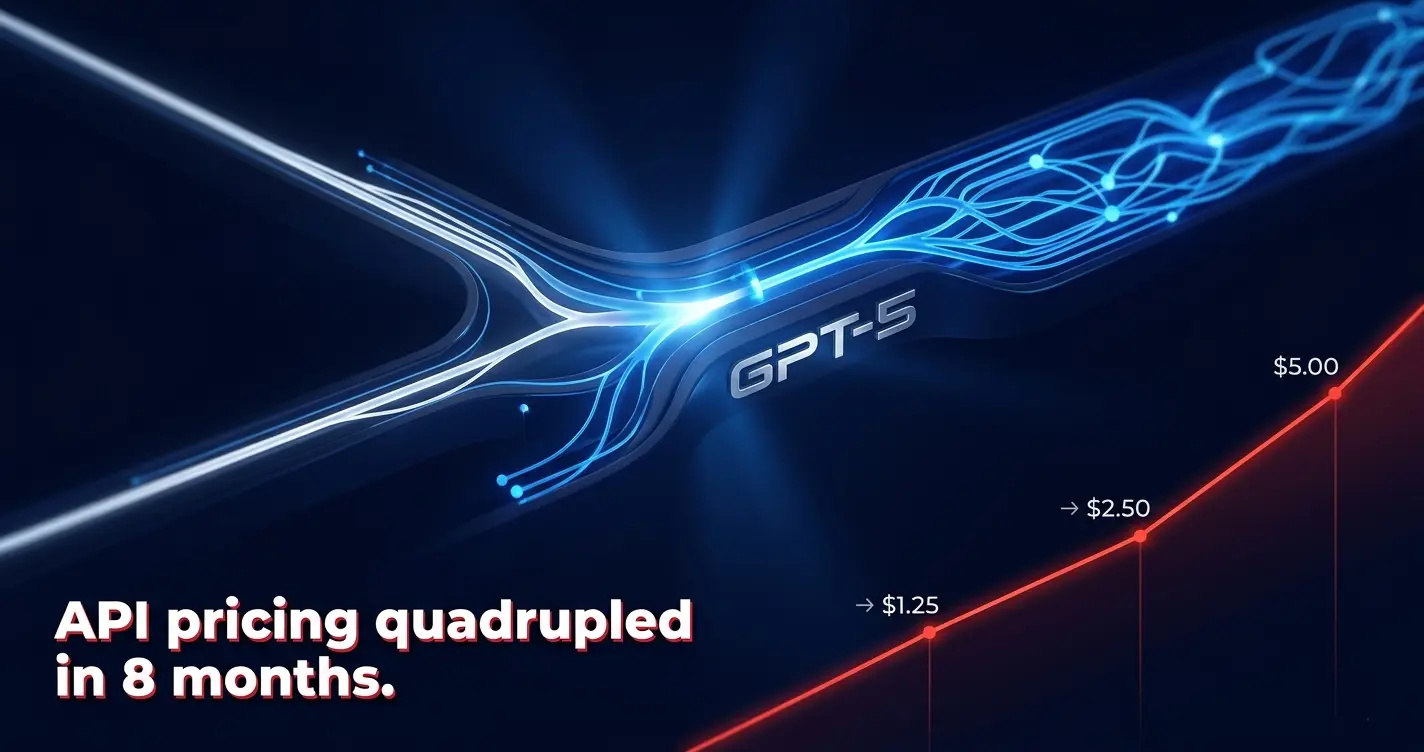
API input pricing quadrupled in eight months. Output pricing tripled. During the same period, NVIDIA CEO Jensen Huang stated that hardware costs per inference token dropped approximately 35×. OpenAI’s pricing trajectory is not following infrastructure economics. It’s following market demand and competitive positioning.
Any product with significant token throughput that was budgeted at $1.25/M input is now facing 4× the cost if it has migrated to current models. That’s not a price increase, it’s a category change in unit economics.
NeuralWired Research Desk analysis, May 2026
For ChatGPT users: Plus ($20/month) includes GPT-5 with usage limits on thinking-mode messages. Pro ($100–$200/month, restructured from launch’s $200 flat) includes GPT-5 Pro with extended reasoning and no token budget restriction. Ed Zitron, tech critic and writer, framed the launch bluntly:
“Meaningful functionality… is being completely removed for ChatGPT Plus and Team subscribers.”
Ed Zitron, Technology Critic — “Where’s Your Ed At” newsletter, August 2025, via Voiceflow
Our read: Zitron’s critique is specifically about model-selection removal and rate limits, not raw capability. Both things can be true, GPT-5 is technically more capable than GPT-4o, and Plus users received fewer choices with the upgrade. Whether that trade is acceptable depends entirely on your use case.
GPT-5 Context Window and Technical Specs
Parameter
GPT-5 (August 2025)
GPT-5.5 (April 2026)
Context Window
400,000 tokens
1,050,000 tokens (1M+)
Max Output
128,000 tokens
—
Knowledge Cutoff
September 2024
—
Latency (tokens/sec)
~77.7 (Artificial Analysis)
—
Training Infrastructure
Microsoft Azure AI supercomputers
Distribution at Launch
ChatGPT, OpenAI API, GitHub Models, Agents SDK
The 400K context window matters for enterprise document workflows, processing full legal contracts, entire codebases, or multi-year financial filings in a single call. GPT-5.5’s 1M+ token context is available via the API and makes whole-repository code analysis practically viable for the first time in the OpenAI stack.
GPT-5 vs Claude and Gemini
The short answer: neither model is comprehensively superior. Benchmark leadership is task-specific, and it’s shifting faster than procurement cycles can track.
Benchmark
GPT-5.5 (Apr 2026)
Claude Opus 4.7 (Apr 2026)
Leader
Terminal-Bench 2.0
82.7%
69.4%
GPT-5.5
ARC-AGI-2
85.0%
75.8%
GPT-5.5
SWE-Bench Pro
58.6%
64.3%
Claude Opus 4.7
The competitive moat OpenAI held during the GPT-4 era has narrowed materially. Artificial Analysis scores GPT-5 at 45/100 on their Intelligence Index — above most models but not the categorical lead OpenAI commanded in 2023. ChatGPT’s US mobile app daily active user share fell from 69.1% in January 2025 to 38.7% by May 2026. Anthropic’s Claude app went from under 2% to 10% DAU share in three months.
GPT-5 is still the market leader by revenue and user count. It isn’t the unchallenged technical leader on every dimension.
Does GPT-5 Still Hallucinate?
Yes. Less than before — but the gap between what OpenAI claims and what independent testers find is real and worth understanding before you deploy in a regulated environment.
OpenAI’s claim: 45% fewer factual errors versus GPT-4o; 80% fewer errors in reasoning mode versus o3.
Independent testing: Vectara found GPT-5.2 had an 8.4% hallucination rate in their methodology, trailing DeepSeek. OpenAI’s own figure for GPT-5.2 was a reduction from 8.8% to 6.2%: a more modest 30% improvement, not the dramatic leap marketing suggested.
PCMag’s Ruben Circelli, who reviewed GPT-5 against real-world production tasks rather than benchmark conditions, was direct:
“GPT-5 is an ‘insignificant update.’ While it has some upgrades, it ‘doesn’t solve the problems that actually matter’ and he has not ‘noticed a significant improvement’ in areas like hallucination reduction.”
Ruben Circelli, Senior Analyst, PCMag — August 2025, via Voiceflow
That’s the practitioner gap: benchmark-measured hallucination uses controlled scenarios with defined correct answers. Production use involves open-ended, ambiguous queries where the model can’t know what it doesn’t know. GPT-5 is more reliable than GPT-4o. It’s not hallucination-free. Deploy accordingly.
One genuinely encouraging signal: a peer-reviewed study by Polat et al. (six MDs across four Turkish hospitals, published November 2025 in Letters to the Editor, NCBI) concluded that GPT-5’s measurable reduction in hallucination rates represents a meaningful milestone for medical and scientific writing, one of the first published academic assessments from clinical practitioners in a domain where errors cost lives. That’s cautious optimism, not a blanket clearance.
GPT-5 for Developers: Coding, Agents, and the Agents SDK
If you’re building software with or on AI, GPT-5 changes three things materially, and creates one significant risk.
What changes in practice
74.9% SWE-bench means autonomous issue resolution, not just code suggestions. At GPT-4o’s 33.2%, AI-assisted coding meant “AI suggests, human implements.” At 74.9%, the model can autonomously close real GitHub issues in verified test conditions. Combined with the Agents SDK (which provides orchestration, tracing, and MCP connectivity to external tools like CRM, payment, and support systems), multi-step autonomous pipelines are production-grade for the first time.
GPT-5 beats o3 at front-end web development 70% of the time. For developers doing full-stack work, that’s not marginal assistance, it’s output-quality output at first pass. The net result is that senior engineering time spent on routine implementation patterns (API integrations, UI scaffolding, documentation) can shift toward architecture and review.
What to do right now
Audit your current stack for tasks that consume disproportionate senior engineering time but follow a pattern: bug triage, code review, documentation, API integration. These are GPT-5’s highest-ROI targets. Evaluate the Agents SDK as an integration layer before building a custom orchestration system from scratch.
The risk you need to price in
⚠ API Pricing Risk
API pricing quadrupled from August 2025 to April 2026. Any product budgeted at GPT-5 launch pricing with significant token throughput is now 4× the cost if it has migrated to current models. Build pricing escalation assumptions into any business case that relies on the GPT-5 stack. A multi-vendor or open-source fallback strategy isn’t optional caution at this point — it’s basic financial hygiene.
GPT-5 for Founders: What Changes in Your Build-vs-Buy Decisions
The uncomfortable truth: GPT-5 compressed the moat of a large class of AI startups in a single launch. If your competitive advantage was “we built a better AI wrapper,” that advantage has narrowed to the point where you need to name what specifically you still do better than the base model.
The opportunity is real too. Enterprise deployments at GPT-5 launch included Morgan Stanley (financial workflows), Amgen (scientific research), and T-Mobile (customer operations). Fortune 500 procurement of AI tools has accelerated. If you serve any of those verticals, GPT-5 integration is now a procurement requirement, not a differentiator.
42% of new SaaS platforms with AI capabilities launched in 2025 relied on OpenAI models. That means GPT-5 is infrastructure. The differentiation layer has shifted up the stack, to proprietary data, domain-specific fine-tuning, and integration quality. Prompt engineering alone isn’t a moat anymore. It arguably never was, but GPT-5 made that unavoidable.
Founder Action Item
Invest now in proprietary data pipelines and fine-tuning infrastructure. The competitive question for any AI-native product is no longer “is our model good?”, it’s “do we have data the base model doesn’t?” That’s where defensible differentiation now lives.
The Skeptic’s Case: What GPT-5 Doesn’t Solve
Balanced coverage means saying the things OpenAI’s press releases don’t.
The AGI framing is marketing
Sam Altman’s description of GPT-5 as offering “PhD-level expertise” maps directly to one benchmark: GPQA Diamond. In controlled academic tests with defined answers, GPT-5 performs at a PhD level on scientific knowledge retrieval. On open-ended reasoning chains involving novel problems, ambiguous real-world data, or multi-domain synthesis, it remains significantly below expert human performance.
GPT-5 performs comparably to or better than human experts in roughly half of cases across 40+ occupations. That means it performs worse than human experts in the other half. At NeurIPS 2025, only 2 of 5,000 papers mentioned AGI. Prominent researchers including Demis Hassabis have emphasized that scaling transformers hits a cognitive scaling wall, current paradigms require paradigm-level innovation, not just larger models, to reach genuine general intelligence.
Agentic reliability isn’t solved yet
GPT-5’s agentic capabilities are real. The reliability math is not flattering for complex pipelines. A 95% success rate per tool call yields approximately 60% end-to-end success over 10 sequential steps. Enterprises deploying GPT-5 agents in customer-facing workflows without robust human-in-the-loop checkpoints are assuming a reliability threshold the model doesn’t yet consistently meet.
Regulatory exposure in regulated sectors
GPT-5’s use in healthcare, legal, and financial services creates EU AI Act exposure. OpenAI hasn’t published a conformity assessment for GPT-5 under the Act’s high-risk provisions. Companies deploying it in these domains are accepting compliance risk that OpenAI itself hasn’t fully addressed publicly. If you’re a CTO in a regulated vertical, that’s not a footnote, it’s a procurement risk factor that belongs in your security review.
The GPT-5 Model Family: From 5.1 to 5.5
GPT-5 is not a single model, it’s an ongoing release cadence. Five significant versions shipped in the nine months after launch.
Coding and agentic focus, front-end design improvements
GPT-5.5 “Spud”
April 23, 2026
1M+ token context, Terminal-Bench 2.0 at 82.7%, API pricing doubled from 5.4
The pace is deliberate. Sam Altman reportedly referred to GPT-5.5 as “the last big milestone before AGI” in internal remarks reported by the Financial Times in April 2026. Read carefully: that statement describes the current training paradigm having one or two more generations of runway before requiring a fundamental architectural shift, not a claim that AGI is imminent. It’s being read by many outlets as a promise it isn’t.
Our read: the GPT-5 series demonstrates that OpenAI has internalized the launch-iterate model from consumer software. The implication for anyone building on it is that the model you ship against today may be meaningfully different in six months, for better (capability) and worse (pricing).
Frequently Asked Questions
What is GPT-5?
GPT-5 is OpenAI’s flagship large language model, released August 7, 2025. It’s a unified system combining a fast conversational sub-model and a deep reasoning sub-model, with an automatic router that selects the right mode per query. It powers ChatGPT by default and is available via the OpenAI API. GPT-5 sets leading benchmarks in math (94.6% AIME 2025), coding (74.9% SWE-bench), and science (88.4% GPQA Diamond).
How is GPT-5 different from GPT-4o?
GPT-5 unifies GPT-4o’s conversational speed with the o-series reasoning models into one system, eliminating manual model selection. It reduces factual errors by 45% compared to GPT-4o, scores 20 percentage points higher on SWE-bench (74.9% vs. GPT-4o’s ~54%), and introduces a real-time routing system that decides when to engage deeper reasoning without user input.
What are GPT-5’s benchmark scores?
GPT-5’s official benchmark scores: 94.6% on AIME 2025 (advanced math), 74.9% on SWE-bench Verified (software engineering), 88% on Aider Polyglot (coding), 84.2% on MMMU (multimodal), 88.4% on GPQA Diamond (PhD-level science, Pro reasoning), and 67.2% on HealthBench (medical). Published by OpenAI at launch, August 2025.
How much does GPT-5 cost via the API?
GPT-5 launched at $1.25/M input tokens and $10/M output tokens (August 2025). Pricing escalated significantly: GPT-5.4 (March 2026) costs $2.50/M input; GPT-5.5 (April 2026) costs $5.00/M input and $30/M output, a 4× input increase in eight months. ChatGPT Plus ($20/month) includes access with usage limits; ChatGPT Pro ($100–$200/month) includes GPT-5 Pro with full extended reasoning.
What is GPT-5’s context window?
GPT-5 launched with a 400,000-token context window and a maximum output of 128,000 tokens per response. Knowledge cutoff is September 2024. GPT-5.5 (April 2026) extended the context window to over 1,050,000 tokens (1M+) via the API, making whole-repository code analysis and large-document processing viable in a single call.
Is GPT-5 better than Claude?
It depends on the task. GPT-5.5 leads Claude Opus 4.7 on Terminal-Bench 2.0 (82.7% vs. 69.4%) and ARC-AGI-2 (85.0% vs. 75.8%). Claude Opus 4.7 leads on SWE-Bench Pro (64.3% vs. 58.6%). Neither model is comprehensively superior, and benchmark leadership is shifting faster than it has at any prior point in the LLM competitive cycle.
Does GPT-5 still hallucinate?
Yes, less than before, but not eliminated. OpenAI reports 45% fewer errors versus GPT-4o. Independent testing by Vectara found an 8.4% hallucination rate in GPT-5.2. PCMag reviewers reported no significant improvement in real-world use. The gap between benchmark hallucination and production hallucination is real; GPT-5 is more reliable than its predecessors but not hallucination-free.
What is GPT-5 Pro?
GPT-5 Pro is the maximum-compute reasoning variant of GPT-5, exclusive to ChatGPT Pro subscribers ($100–$200/month as of April 2026). It enables extended “thinking” reasoning with no token budget restriction, producing more thorough answers on complex tasks. It scores higher than standard GPT-5 on GPQA Diamond (88.4%) and FrontierMath benchmarks.
When was GPT-5 released?
GPT-5 was officially released on August 7, 2025, at 10AM PT. OpenAI teased the launch the previous day via a post on X embedding the number “5” in the announcement text. The model launched simultaneously on ChatGPT (all user tiers), the OpenAI API platform, and the GitHub Models Playground.
What You Now Know | And Where This Goes Next
GPT-5 is the most commercially successful AI model ever released. It is also an imperfect product that malfunctioned on launch day, shipped benchmark charts that contradicted their own data, and has since quadrupled its API pricing while hardware costs fell 35×.
Both things are simultaneously true. The model is genuinely capable, 74.9% SWE-bench and 88.4% GPQA Diamond are not noise. The commercial moat is real, $25B+ ARR and 900 million weekly users are not accidents. And the operational risks are real: pricing escalation, benchmark-to-production hallucination gaps, regulatory exposure in high-risk sectors, and compounding error rates in agentic pipelines.
Three things to watch over the next 6–18 months:
The competitive parity story. Claude Opus 4.7 already leads on SWE-Bench Pro. Gemini 3.1 competes on multimodal benchmarks. ChatGPT’s US mobile market share is below 40% for the first time. GPT-5 may not hold the benchmark lead across all dimensions by the end of 2026.
The pricing ceiling. There’s no economic argument for API pricing increasing 4× in 8 months when inference costs are dropping. OpenAI is pricing against demand, not against cost. Watch for whether competition forces a reversal, or whether the market absorbs it.
Agentic deployment reliability. The gap between GPT-5’s agentic capabilities and production-grade reliability in multi-step autonomous pipelines is the defining technical question for enterprise AI in 2026. The teams that figure out human-in-the-loop architectures that are fast enough to be useful will define what enterprise AI actually becomes.
GPT-5 is infrastructure now, the same way GPT-4 became infrastructure. The question isn’t whether to use it. It’s how to build on it without being entirely at the mercy of OpenAI’s pricing decisions, and where to differentiate above the model layer.
Stay Ahead of the AI Model Cycle
The Neural Loop covers frontier model releases, benchmark analysis, and what they actually mean for your product, before the hype settles.
Subscribe to The Neural Loop →
ChatGPT vs Claude vs Gemini 2026: The Honest Head-to-Head | NeuralWiredNeuralWired
Intelligence on Artificial Intelligence
AI Comparison Guide
ChatGPT vs Claude vs Gemini 2026 | The Honest Head-to-Head Developers Actually Need
ChatGPT’s market share collapsed 30 points in 14 months. Claude tripled its share in a single quarter. Gemini quadrupled. The race is real, and the winner depends entirely on what you’re building.
NeuralWired Research Desk·May 24, 2026·Updated for Claude Opus 4.7 · GPT-5.5 · Gemini 3.1 Pro·14 min read
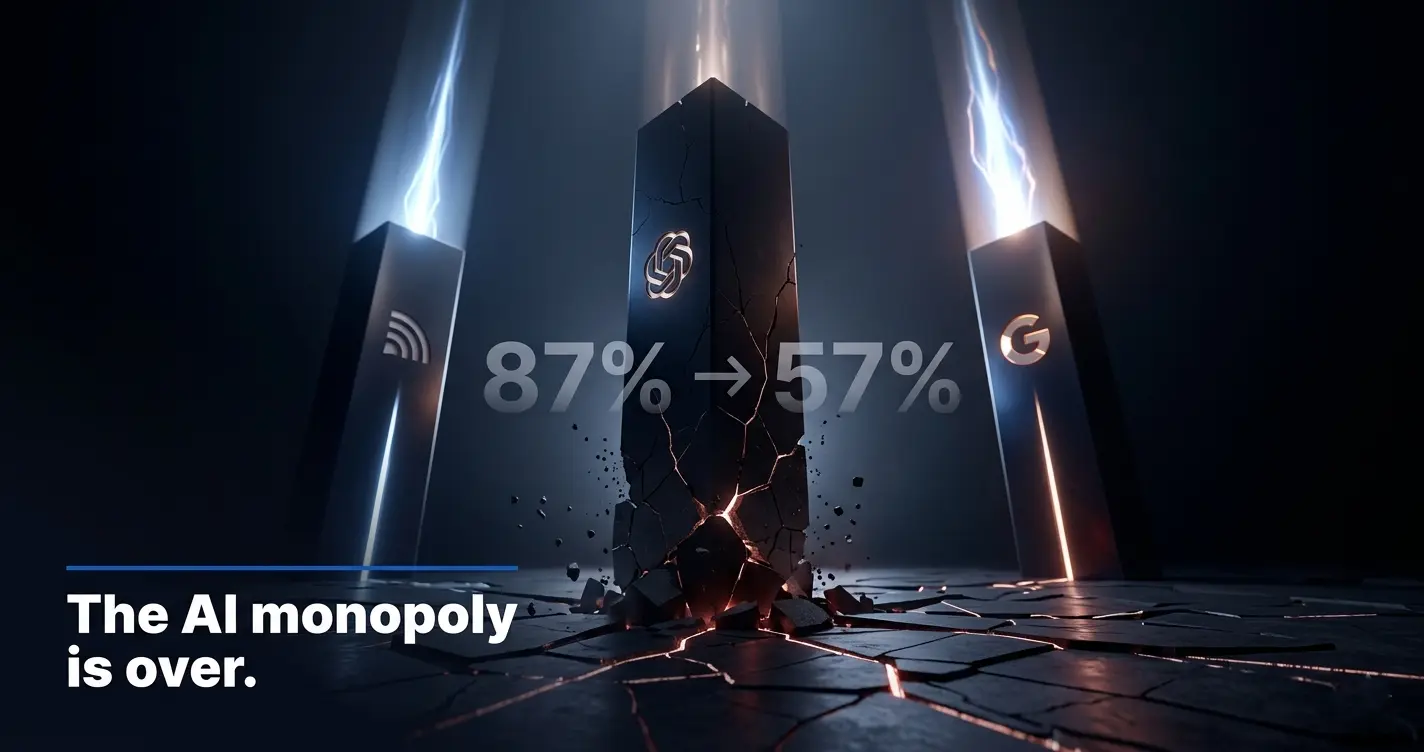
Fourteen months ago, ChatGPT held 87% of generative AI web traffic. As of March 2026, it’s below 57%. That’s not a blip, that’s the fastest collapse of market dominance in consumer software since Internet Explorer lost the browser wars. Gemini went from 6% to 25%. Claude went from 1.4% to over 6%. And we’re still early.
If you’re a developer routing API calls, a CTO evaluating an enterprise contract, or a founder choosing the core model for your product, the decision you make this quarter has real consequences. This guide cuts through the benchmark theater and gives you the honest comparison: what each model actually does best, what it costs, and where the traps are.
−30pt
ChatGPT market share drop, Jan 2025 → Mar 2026
4×
Gemini’s traffic share growth over same period
3×
Claude’s share gain in a single quarter
The Market Shift Nobody Predicted
The mainstream narrative going into 2025 was settled: OpenAI won. ChatGPT was the Google of AI, first-mover with a moat so deep no challenger could cross it inside five years. That narrative is now wrong.
The structural break happened in three waves. First, model quality parity arrived faster than anyone expected. Claude 3.7, Gemini 3.0, and then the jump to Claude 4.x and Gemini 3.1 Pro showed that OpenAI’s quality lead was a 12-month advantage, not a permanent one. By late 2025, independent benchmarks showed all three platforms within single-digit percentage points on general capability tests.
Second, Google’s distribution machine activated. Gemini bundled into Gmail, Docs, Sheets, and Android didn’t win users through product quality, it converted existing Google Workspace daily actives into AI users overnight. That’s how you go from 6% to 25% in twelve months without necessarily being the best model in the room.
Third, Claude’s enterprise breakout. While Gemini was winning on distribution and ChatGPT on consumer scale, Anthropic quietly captured the segment willing to pay the most: regulated industries. The Claude iOS app hit #1 on the U.S. App Store on February 28, 2026, the first time any AI app surpassed ChatGPT in daily downloads. Claude Code’s weekly active users doubled between January and April. Anthropic’s annualized revenue reached $14 billion as of February 2026, up from $1 billion in 2024. That’s a 14× increase in two years.
Our Read
This maps almost exactly to the browser wars. ChatGPT is Internet Explorer, dominant, sticky, losing ground slowly. Gemini is Chrome, distribution king, winning by presence not choice. Claude is Firefox, smaller but chosen deliberately by users who care about quality. The key difference: all three are improving simultaneously, and the market is still growing. There’s no single winner. That is the story.
Current Models at a Glance
Platform
Current Flagship
Context Window
Consumer Tier
API Input/Output (per 1M tokens)
OpenAI / ChatGPT
GPT-5.5 (Apr 2026) GPT-5.4 Pro via API
~250K tokens (Enterprise)
Free / Plus $20/mo / Pro $200/mo
$1.75 / $14.00 (GPT-5.2)
Anthropic / Claude
Claude Opus 4.7 Apr 2026
1M tokensNew
Pro ~$20/mo / Max ~$50+/mo
$5.00 / $25.00
Google / Gemini
Gemini 3.1 Pro (Feb 2026)
1–2M tokens
Advanced $19.99/mo
$2.00 / $12.00 (Flash: $0.50 / $3.00)
A few things worth flagging before we get into comparisons. Claude Opus 4.7 is the most significant recent release: it arrives with a 1M token context window (four times larger than Opus 4.6), high-resolution vision at 2,576px, and a self-verification capability that reduces hallucinations on factual tasks. GPT-5.2 is being retired June 5, 2026, any enterprise contract referencing that model needs revisiting now. And Gemini’s naming situation is still a genuine headache for API buyers: “Gemini 3 Pro” (consumer) and “Gemini 3.1 Pro Preview” (developer docs) are the same model, sold under two different labels.
Coding & Developer Benchmarks
This is the comparison developers actually search for, and it has a clearer answer than any other category in 2026.
Doubled between January and April 2026 — developer consensus forming
—
Claude’s lead on SWE-bench Verified is the single clearest differentiation in this entire comparison. A 3–4 point gap on academic benchmarks is noise. A 3–4 point gap on real GitHub issue resolution, across thousands of production repositories, is something engineering leads should care about.
That said, the cost math complicates things fast. If you’re building a production API pipeline and routing to Claude at $5/$25 per million tokens, versus GPT-5.4 Mini at roughly 6× less than GPT-5.4 Standard, you have a real ROI question to answer. For most B2C product workloads, quick code completions, light refactors, IDE copilot interactions, GPT-5.4 Mini at near-Claude-level performance for a fraction of the cost is the rational choice. Route the complex, high-stakes generation tasks to Claude. Route the volume to Mini or Gemini Flash.
“Claude is better for complex coding. Claude Opus 4.7 scores 87.6% on SWE-bench Verified, versus GPT-5.4’s approximately 84%. For full-file refactors and long-context debugging, Claude leads. For quick scripts and IDE plugin support, ChatGPT remains competitive.”
This is Gemini’s clearest win. On graduate-level science questions, the kind of reasoning required in drug discovery, materials science, and academic research, Gemini 3.1 Pro scores 94.1–94.3% on GPQA Diamond. GPT-5.4 follows at ~92.8%. Claude Opus 4.6 sits at ~91.3%. For enterprise buyers in scientific or research-heavy domains, that gap matters.
Knowledge Depth (Humanity’s Last Exam)
HLE is the hardest knowledge benchmark available, designed explicitly to resist saturation. The scores: Claude 53 | GPT-5.4 48 | Gemini 40 (BenchLM.ai, April 2026). Claude wins on the single hardest knowledge test, which counters the “Gemini is the smartest” narrative you’ll encounter in a lot of enterprise sales conversations.
Context Window Reality
Gemini 3.1 Pro offers 1–2M tokens, technically the largest. Claude Opus 4.7 now matches at 1M. ChatGPT Enterprise sits around 250K. Worth knowing: multiple engineers have noted in 2026 benchmark reviews that performance at 1M+ token contexts degrades meaningfully on most tasks. Advertised context is not reliable context. Test your specific workload at scale, don’t rely on the spec sheet.
Multimodal
Gemini has the structural advantage here, Google’s investment in vision and audio AI runs deeper than either competitor’s, and Gemini 3.1 Pro’s multimodal performance leads on most third-party evaluations. Claude Opus 4.7’s new high-resolution vision (2,576px) closes the gap on document and image analysis. ChatGPT remains competitive across all modalities but doesn’t lead on any specific visual benchmark in 2026.
API Pricing: The Number That Kills Deals
Consumer tiers have converged: all three platforms sit at $19–$20/month for their mid-range plans. The API is where the real decision lives, and where the gap is significant.
Model
Input (per 1M tokens)
Output (per 1M tokens)
Notes
Claude Opus 4.7
$5.00
$25.00
Up to 90% savings with prompt caching
GPT-5.2
$1.75
$14.00
Retiring June 5, 2026
Gemini 3.1 Pro
$2.00
$12.00
Strong default for cost-conscious builds
Gemini 3 Flash
$0.50
$3.00
Best cost-efficiency for high-volume workloads
GPT-5.4 Mini
~6× cheaper than Standard
—
~94% of Standard’s coding performance
Grok 4.1
$0.20
$0.50
Cheapest frontier API overall
Cost Reality Check
Claude is 2.5–3× more expensive than Gemini at API level. At 100M tokens/month, that’s a $300,000 annual cost difference. Claude’s prompt caching (up to 90% savings on repeated context) makes it competitive for long-context applications that reuse significant prompt context, legal document review, multi-turn research, large codebase analysis. For high-volume, low-complexity tasks, Gemini Flash or GPT-5.4 Mini is the rational default.
Enterprise Reality: Who’s Winning Where
The single-vendor AI strategy is over. Internal data from multiple enterprise surveys in 2026 shows the dominant enterprise stack as: Claude for deep analytical, legal, and compliance output + ChatGPT for research, workflow automation, and employee-facing tools + Gemini for Google Workspace-native workflows. These aren’t competing, they’re co-existing in the same organization.
“ChatGPT is the overwhelming leader in consumer AI with more than 900 million weekly active users, and over 50 million subscribers… Search usage has nearly tripled in a year, and our ads pilot reached more than $100 million in ARR in under six weeks.”
That’s the official OpenAI position. What the official position omits: OpenAI is projected to lose $14 billion in 2026, nearly triple earlier estimates, with cumulative losses of $44 billion through 2028 and profitability not expected before 2029. Only 5.5% of ChatGPT’s 900 million users pay. The ads pilot (mentioned casually in Altman’s quote) signals that the product experience for free-tier users may change fundamentally.
Meanwhile, Anthropic is concentrating on the segment willing to pay most. Claude reportedly wins approximately 70% of new enterprise AI deals in regulated industries, legal, finance, healthcare, compliance, because of its documented lower hallucination rate and its “uncertainty flagging” behavior: it declines to answer when it’s not confident rather than confabulating. In industries where an AI error has financial or legal consequences, that behavior is worth a pricing premium.
Google’s enterprise advantage is structural, not earned. 120,000+ enterprise customers and 95% of top-20 global SaaS companies use Google Cloud AI, but much of that is Gemini arriving inside Workspace by default, not the result of a competitive evaluation. CTOs in Google-heavy shops evaluating ChatGPT or Claude as Workspace replacements are solving the wrong problem. Evaluate them as additive tools for tasks Workspace doesn’t do well.
Use Case Mapping
Best: Claude
Complex Code Generation & Refactoring
87.6% SWE-bench, 1M token context, Claude Code doubling WAU. The empirical choice for production-quality output on non-trivial engineering tasks.
Best: Gemini
Google Workspace Workflows
If your team lives in Gmail, Docs, and Sheets, Gemini is already there. The integration advantage bypasses any benchmark comparison.
Best: Claude
Legal, Compliance & Finance
Lower hallucination rates, uncertainty flagging, and 70% win rate in regulated-industry enterprise deals. The reliability premium is real and priced accordingly.
Best: ChatGPT
Third-Party Integrations & Plugins
92% of Fortune 500 adoption, Codex (3M weekly active developers), and the broadest plugin/tool ecosystem. For horizontal workflow automation, ChatGPT’s network effects win.
Best: Gemini
High-Volume, Cost-Sensitive APIs
Gemini Flash at $0.50/$3.00 per 1M tokens is the most cost-efficient frontier API for applications where multimodal capability is relevant and volume is high.
Best: Gemini
Scientific Research & Reasoning
94.1% GPQA Diamond. For drug discovery, materials science, and graduate-level academic analysis, Gemini’s reasoning benchmark lead is real and consistent.
What the Benchmarks Don’t Tell You
The Hallucination Problem Isn’t Solved
An EBU/BBC study found 48% of responses from free-tier chatbots contained accuracy issues as recently as mid-2025. Claude Opus 4.1 recorded 0% hallucination on the AA-Omniscience benchmark, but only because it declined to answer when uncertain rather than guessing. Gemini 3.1 Pro cut its hallucination rate by 38 percentage points, which is the biggest improvement of any model but still leaves it at ~50% on certain tests. Westlaw AI, built specifically for legal research, hallucinated more than 34% of the time on challenging queries.
Healthcare Warning
The ECRI Institute ranked misuse of AI chatbots as the #1 health technology hazard of 2026, explicitly naming ChatGPT, Claude, Gemini, Copilot, and Grok as “not regulated as medical devices and not validated for healthcare purposes.” Any healthcare deployment carries compliance exposure regardless of platform.
Benchmark Saturation Is Real
MMLU now scores 88–94% across all top models. It no longer differentiates them. The benchmarks that do differentiate, SWE-bench Pro, ARC-AGI-2, Humanity’s Last Exam, are not the ones most buyers understand or test themselves. When a vendor’s sales deck shows you a benchmark chart, ask specifically which benchmark, and whether it’s been saturated. Most popular media comparisons cite saturated benchmarks, making rankings look more meaningful than they are.
Vendor Lock-In Accumulates Invisibly
Enterprises building workflows on Claude’s Projects system, Google’s Workspace Gemini integration, or ChatGPT’s Custom GPTs ecosystem are accumulating switching costs that won’t show up in today’s pricing comparison. The platform decision made in 2026 shapes what tools are available, and at what negotiating leverage, in 2028. The time to think about this is before the integration is built, not after.
“OpenAI is projected to lose $14 billion in 2026, nearly triple earlier estimates for 2025, even as it reports $25 billion in annualized revenue and 900 million weekly ChatGPT users. The company expects cumulative losses of $44 billion between 2023 and 2028, with profitability not arriving until 2029 at the earliest.”
, European Business Magazine, citing The Information internal financial projections, 2026. Read the full report →
This is the most important contrarian data point in the entire comparison. The market leader has the biggest user base and the biggest losses. The ads pilot signals a potential shift in the free-tier product experience. That changes the calculus for any organization that’s built workflows on the assumption that free-tier ChatGPT performs identically to paid ChatGPT. It may not for much longer.
The Verdict
There’s no single winner. Anyone telling you otherwise is selling something. Here’s the honest split:
ChatGPT
Best for
Consumer-scale deployment, third-party integrations, employee-facing tools, and organizations where Fortune 500 adoption rates reduce procurement friction. The horizontal choice.
Claude
Best for
Complex code generation, legal and compliance work, long-document analysis, and any use case where hallucination has real-world consequences. The quality-first choice.
Gemini
Best for
Google Workspace-native workflows, high-volume cost-sensitive APIs, scientific reasoning, and multimodal tasks. The distribution and efficiency choice.
Most serious enterprise buyers in 2026 use two of the three, typically Claude plus one of the other two depending on their infrastructure. The overlap is real and intentional. These platforms are not substitutes for each other; they’re complements with different cost structures and different failure modes.
Watch three things over the next 6–18 months. First, whether OpenAI’s ads pilot scales, this is the signal for how the free-tier product experience evolves. Second, whether Claude’s API pricing moves; Anthropic’s current premium pricing reflects confidence in the enterprise market, but competitive pressure from Gemini Flash is real. Third, whether any platform meaningfully solves hallucination at the infrastructure level, rather than at the “decline to answer” workaround level. That’s the technical moat that doesn’t yet exist.
Frequently Asked Questions
Which AI is better in 2026 | ChatGPT, Claude, or Gemini?
There is no single winner. Claude Opus 4.7 leads on coding (87.6% SWE-bench) and writing quality. ChatGPT (GPT-5.4/5.5) leads on ecosystem breadth and third-party integrations. Gemini 3.1 Pro leads on reasoning benchmarks (94.1% GPQA) and multimodal tasks. Most professional users in 2026 use two of the three. Source: BenchLM.ai, April 2026.
Is ChatGPT or Claude better for coding?
Claude is better for complex coding. Claude Opus 4.7 scores 87.6% on SWE-bench Verified vs GPT-5.4’s ~84%. For full-file refactors and long-context debugging, Claude leads. For quick scripts and IDE plugin support, ChatGPT remains competitive. Most engineering teams use both. Source: LearnDrive, 2026.
What is the cheapest AI API in 2026?
Gemini 3 Flash is the cheapest frontier API at $0.50 input / $3.00 output per million tokens. Grok 4.1 charges $0.20/$0.50, making it cheapest overall. GPT-5.4 Mini is 6× cheaper than GPT-5.4 Standard. Claude Opus 4.7 is most expensive at $5.00/$25.00, but offers up to 90% savings via prompt caching on repeated-context workloads. Source: IntuitionLabs, Feb 2026.
How many people use ChatGPT in 2026?
ChatGPT has over 900 million weekly active users and 50 million paying subscribers as of March 2026. It processes 2.5 billion daily prompts. OpenAI generates $25 billion in annualized revenue, but projects a $14 billion operating loss in 2026 due to compute costs. Source: OpenAI, March 31, 2026.
Is Gemini better than ChatGPT in 2026?
Gemini 3.1 Pro leads on reasoning benchmarks (94.1% vs 92.8% GPQA Diamond), offers a larger context window (1–2M tokens), and excels at multimodal tasks. ChatGPT leads on ecosystem, integrations, and consumer scale (900M WAU vs 750M MAU). For Google Workspace users, Gemini has a structural advantage that makes the comparison largely moot. Source: LearnDrive, 2026.
Does Claude hallucinate less than ChatGPT?
Yes, in independent testing. Claude Opus 4.1 recorded 0% hallucination on the AA-Omniscience benchmark by declining to answer when uncertain. However, no AI model is hallucination-free, the EBU/BBC found 48% of free-tier AI responses had accuracy issues in 2025. Claude’s “I don’t know” behavior matters most in legal, compliance, and financial use cases. Source: Suprmind AI, May 2026.
Which AI has the largest context window in 2026?
Gemini 3.1 Pro offers the largest at 1–2 million tokens. Claude Opus 4.7 (April 2026) now reaches 1 million tokens. ChatGPT Enterprise supports approximately 250,000 tokens. Important caveat: practical performance degrades at maximum context lengths across all platforms. Advertised context window ≠ reliable context window. Test your specific workload. Source: Tech Insider, April 2026.
The Neural Loop
Weekly intelligence on AI models, enterprise deployments, and the business moves that matter. No hype. No padding. Just the signal.
Subscribe Free →
Artificial IntelligenceCareer Guide • May 23, 2026
How to Become a Prompt Engineer in 2026: The Honest Guide
The standalone job title is collapsing. The underlying skill is becoming mandatory across every technical role. Here’s the real path, skills, salaries, courses, and the warnings nobody else will tell you.
N
NeuralWired Editorial
12 min read • Updated May 23, 2026
⏱ 12 min
In 2023, Anthropic posted a job listing that broke the internet. The role: Prompt Engineer and Librarian. The salary ceiling: $335,000. The requirement that caused the real frenzy: no PhD, minimal coding experience. For a brief moment, the world believed you could earn a doctor’s salary just for being very, very good at talking to chatbots.
That moment is over.
Searches for “prompt engineer” on Indeed have dropped 86% from their April 2023 peak. Microsoft surveyed 31,000 workers across 31 countries and found that Prompt Engineer ranked second-to-last among roles companies plan to hire in the next 18 months. The standalone title, for most organizations, never really materialized.
And yet, here you are, reading a guide on how to become a prompt engineer. And the search volume for that exact phrase has surged 5,000%+ in the past 12 months. Both things are true at once, and the tension between them is exactly what this guide is about.
Our Read
The job title is dying. The skill is becoming mandatory. If you’re learning how to become a prompt engineer in 2026, you’re not chasing a job title, you’re building a capability layer that will sit underneath every technical role in the next decade. That reframe changes everything about how you should approach this.
The Paradox Nobody Is Talking About
Two credible, opposing forces are pulling at this field simultaneously. Understanding both is the foundation of making any smart career decision here.
The optimistic case is real: Grand View Research puts the global prompt engineering market at $222 million in 2023, projecting it to hit $2.06 billion by 2030, a CAGR of 32.8%. McKinsey reports that 71% of organizations now use generative AI in at least one business function. Every one of those deployments requires someone who knows how to work with language models systematically. That’s real demand.
The skeptical case is equally real. Fortune reported in May 2025 that Allison Shrivastava, economist at Indeed, put it plainly:
Prompt engineering as a skill is still definitely a good thing to have, but it’s not an entire title.
Allison Shrivastava, Economist, Indeed (Fortune, May 2025)
Jared Spataro, Microsoft’s Chief Marketing Officer for AI at Work, was even more direct. After his team’s survey of 31,000 workers across 31 countries:
Two years ago, everybody said, ‘Oh, I think prompt engineer is going to be the hot job.’ It’s not turning out to be true at all.
Jared Spataro, CMO AI at Work, Microsoft (Wall Street Journal, 2025)
His argument: modern AI models now ask clarifying questions, acknowledge uncertainty, and self-iterate. The human middleman who translated vague instructions into precise prompts is being absorbed into the model itself.
So which camp is right? Both. The reconciliation is simple: the discipline is real; the job description isn’t. Prompt engineering is becoming what spreadsheet literacy became in the 1990s, not a career, but a baseline competency that elevates every career it touches. Andrew Ng made this comparison explicitly, and it’s the clearest mental model available.
32.8%
Projected annual market growth (CAGR) through 2030
71%
Organizations now using generative AI in at least one function
−86%
Drop in “prompt engineer” job searches on Indeed since peak (April 2023)
What a Prompt Engineer Actually Does
Strip the hype and the definition is precise. Prompt engineering is the systematic practice of designing, structuring, and optimizing text instructions, prompts, to guide large language models like OpenAI’s ChatGPT, Anthropic’s Claude, and Google’s Gemini toward accurate, relevant, and consistent outputs. It combines natural language processing, cognitive science, linguistics, and iterative systems design.
That last part matters: iterative systems design. The most important thing Isa Fulford’s widely-used curriculum at DeepLearning.AI establishes is that effective prompting is not about finding “magic words.” It’s about systematic evaluation, measurement, and structural thinking. The people who treat it that way build things that work in production. The people who treat it as a creative guessing game produce inconsistency at scale.
The Core Techniques You Actually Need to Know
Technique
What It Is
When to Use It
Zero-shot prompting
No examples given; model uses training knowledge alone
Simple, well-defined tasks; quick prototyping
Few-shot prompting
1–5 examples embedded in the prompt to guide output format
Consistent formatting, classification tasks, tone matching
Chain-of-thought (CoT)
Instructs model to reason step by step before answering
Logic, math, multi-step problem solving
Retrieval-Augmented Generation (RAG)
Combines LLM with external knowledge base to reduce hallucination
Background instructions defining model persona, scope, and constraints
Product deployments, customer-facing AI tools
Prompt chaining
Linking multiple prompts sequentially; each output feeds the next
Complex multi-step workflows, agent pipelines
The Skills That Actually Matter in 2026
Here’s where most guides go wrong: they describe the skills that got people hired in 2023. The market has moved. Based on aggregated requirements from active listings at Google, Microsoft, Amazon, JPMorgan Chase, Booz Allen Hamilton, and leading AI-native startups, here’s what employers are actually looking for right now.
LLM API proficiency, At minimum one of: OpenAI, Anthropic Claude, Google Gemini, or Microsoft Copilot. Not just using the chat interface, working with the API programmatically.
Prompt technique mastery, Zero-shot, few-shot, chain-of-thought, RAG. These aren’t optional vocabulary; they’re the toolkit every practitioner is expected to have.
Python programming, Strongly preferred for senior roles; not always required for entry-level marketing or content positions. If you want engineering-tier compensation, this is non-negotiable.
Token economics and context window management, Understanding how models handle input length, what falls out of context, and how to structure information for reliability.
Evaluation and benchmarking, The ability to design A/B tests for prompts, measure output quality systematically, and build evals that catch prompt drift when models update. This is where most entry-level practitioners fall short.
Responsible AI and bias detection, Not a box-check skill. Organizations deploying AI at scale have legal and reputational exposure; people who can identify and mitigate bias in LLM outputs are genuinely scarce.
Domain expertise, The highest-value prompt engineers are domain experts first. A healthcare analyst who can engineer clinical documentation prompts is worth more than a generic prompt specialist. The skill multiplies domain knowledge; it doesn’t replace it.
⚠ Career Risk
The “no coding required” framing from 2023 is obsolete for any role paying over $90K. Entry-level positions at non-technical companies still exist without code, but AI lab and enterprise engineering roles almost universally require Python and API experience. Plan accordingly.
Salaries: The Honest Numbers
The $335,000 Anthropic listing was real. It was also an outlier at an elite AI safety lab during a period of acute talent scarcity, for a senior specialized role. Using it as a benchmark is like using NBA contracts to estimate what competitive basketball players earn. Here’s the actual range.
Source
Salary Range
Context
ZipRecruiter (June 2025)
$33K – $95K (avg $63K)
Includes contract and part-time; skews low
Glassdoor (via Coursera, Dec 2025)
$90K – $160K (avg $123K)
Full-time tech roles; more representative for career changers
Big Tech (Google, Microsoft, Amazon, Meta)
$110K – $250K
Senior IC and staff-level roles; equity separate
AI Labs (OpenAI, Anthropic, Cohere)
$150K – $335K+
Equity-heavy; total comp often exceeds base significantly
Government / Consulting (Booz Allen)
Up to $212K
Cleared roles; lower equity but high stability
The signal worth watching: Forward Deployed Engineers (FDEs) are where the highest-demand adjacent hiring is concentrating right now. OpenAI formalized its FDE program at scale on May 11, 2026, these are hybrid engineering and client-facing practitioners who embed with enterprise customers to deploy AI in production. Job postings for FDEs reportedly grew 800%+ in 2025. If you’re building prompt engineering skills and want a clear career target, FDE is the most concrete emerging track.
Best Courses and Certifications in 2026
No industry-standard certification equivalent to AWS or PMP exists in this field yet. Expert consensus is consistent: a portfolio of real AI applications outweighs any certificate. That said, one recognized credential on a resume does open doors, it signals fluency to hiring managers who don’t know how else to screen for it.
Course
Provider
Cost
Credibility Signal
ChatGPT Prompt Engineering for Developers
DeepLearning.AI (Andrew Ng + Isa Fulford)
Free, ~90 min
Highest technical credibility among engineering hiring managers
Prompting Essentials
Google Cloud Skills Boost
Paid (Credly badge issued)
HR-recognizable; Google brand carries weight in enterprise
Prompt Engineering for ChatGPT
Vanderbilt / Coursera
~$49 certificate, ~18 hours
University-backed; more respected by non-technical HR
AI Prompt Engineering Series
IBM
Varies
Enterprise-credible brand; useful for Fortune 500 applications
Azure OpenAI Prompt Engineering
Microsoft Learn
Free
Best for roles targeting Microsoft Copilot ecosystem
Best strategy: Complete one certificate from a recognized platform (DeepLearning.AI for technical roles; Google for enterprise roles). Then build a GitHub repository with three to five real LLM application examples, prompt chains, evaluation scripts, RAG pipelines. The portfolio is what gets you the interview. The certificate is what gets you past the keyword filter.
Step-by-Step Career Roadmap
This is for three distinct readers: developers who want to integrate AI into existing work, career switchers approaching this from a non-technical background, and engineering leaders building team capabilities. The path diverges early.
For Developers
Start with the DeepLearning.AI course, 90 minutes, free, co-taught by Andrew Ng and Isa Fulford. It’s the closest thing to canonical teaching the field has, and engineering hiring managers recognize it. Do it this week.
Build with the APIs directly, Sign up for OpenAI and Anthropic developer accounts. Write scripts. Chain prompts. Build a small RAG prototype using your own documents. The tactile experience is irreplaceable.
Learn to evaluate, not just generate, The hardest part of prompt engineering at production scale isn’t writing good prompts; it’s detecting when they fail. Build an eval suite for your prompts. Measure output quality. This is what separates junior from senior practitioners.
Move toward context engineering, The field is converging on “context engineering”, managing what information enters the model’s input window at runtime. This is the next layer above basic prompting. Study LangChain, agent frameworks, and retrieval architecture.
Target FDE or LLM Engineer roles, These titles are where serious engineering-grade prompt work is actually happening and where compensation reflects the skill level.
For Career Switchers (Non-Technical)
The pure “prompt engineer” title pivot carries real risk. The correct framing is not “become a prompt engineer” but rather “add prompting capability to your domain expertise.” A healthcare writer who can engineer clinical documentation prompts is far more valuable than a generic prompt specialist with no domain background. The skill multiplies; it doesn’t substitute.
Identify your domain expertise first. That’s your differentiator.
Take the Google Prompting Essentials or Vanderbilt/Coursera certificate, HR-recognizable and accessible without technical prerequisites.
Build domain-specific examples: if you’re in finance, build a portfolio of prompts that automate financial reporting tasks. If you’re in healthcare, build clinical documentation workflows.
Target titles like AI Trainer, AI Integration Specialist, Applied AI Analyst, these are where standalone prompt-adjacent hiring is actually occurring in 2026, not under the “Prompt Engineer” label.
The Webmaster Analogy
In the mid-1990s, “Webmaster” was a defined, specialized, high-paying role. Within a decade, web skills were distributed across designers, developers, content managers, and marketers, the title disappeared but the skills proliferated. Prompt engineering is following an identical trajectory on a compressed timeline. This isn’t a reason to avoid the skill. It’s a reason to acquire it before it becomes a baseline expectation rather than a differentiator.
The Future: Context Engineering Is What Comes Next
The practitioners who are most valuable in 2026 aren’t optimizing individual prompts, they’re designing the full information pipeline that feeds AI systems at runtime. This is context engineering: the discipline of systematically managing what information gets included in a model’s input window, in what form, and in what order.
The progression looks like this: basic prompting → structured prompt design → RAG architecture → context engineering → LLM evaluation systems. The further right you sit on that spectrum, the more durable your value and the higher your compensation ceiling.
Two dynamics are compressing this timeline. First, models are improving fast, GPT-4 and its successors already self-refine outputs more capably than GPT-3.5. By 2027, routine prompt iteration for common tasks may be largely automated. What remains valuable is strategic prompt architecture: system design, evaluation framework design, and context pipeline engineering. Second, OpenAI’s formalization of its Forward Deployed Engineer program in May 2026 signals that the highest-leverage prompt-adjacent work is becoming institutionalized as a distinct engineering discipline, not a standalone role, but a specialization within software engineering.
Stanford’s 2025 AI Index, analyzing over 51,000 job posting websites, found that 1.8% of all U.S. job postings now require AI skills, up from 1.4% in 2023. That trajectory doesn’t stop. The question is whether you’re building the deeper skills before they become the expectation.
Frequently Asked Questions
What does a prompt engineer do?
A prompt engineer designs, tests, and refines text instructions given to AI language models like ChatGPT, Claude, and Gemini. They craft inputs that guide models toward accurate, useful, and consistent outputs across applications from customer service automation to code generation and content creation. The role combines linguistics, systems thinking, and iterative testing, not creative guessing.
Do you need to know how to code to become a prompt engineer?
Basic prompt engineering doesn’t require coding. However, senior roles increasingly require Python for API integration, evaluation scripting, and RAG pipeline design. Entry-level positions at non-technical companies rarely require code; AI lab and enterprise engineering roles almost always do. The “no coding required” framing from 2023 is effectively obsolete for roles paying above $90K.
How much does a prompt engineer earn?
U.S. salaries range from roughly $63,000 (ZipRecruiter national average, including contract roles) to $123,000 (Glassdoor average for full-time tech positions). Senior roles at major AI companies reach $250,000 and above in total compensation. Anthropic’s widely reported outlier listing reached $335,000, but that was a senior, specialized role at an elite AI lab during a period of acute talent scarcity. It is not a typical benchmark.
Is prompt engineering a good career in 2026?
The skill is highly valuable; the standalone job title has underperformed expectations. Prompt engineering is most powerful as a capability layer added to existing domain expertise, a software developer, healthcare analyst, or marketing strategist who prompts effectively commands a premium. As a standalone career pivot with no domain background, the path is significantly narrower than 2023 coverage suggested.
What are the best certifications for prompt engineering?
The most employer-recognized options are Google’s Prompting Essentials (issues a Credly badge, HR-recognizable), Vanderbilt/Coursera’s Prompt Engineering for ChatGPT (university-backed, roughly 18 hours), and DeepLearning.AI’s course with Andrew Ng and Isa Fulford (highest technical credibility among engineering hiring managers). No industry-standard certification equivalent to AWS or PMP exists yet. A portfolio of real projects matters more than any single certificate.
What is the future of prompt engineering?
The standalone job title will continue shrinking. The underlying skill, systematically designing and evaluating AI inputs, is becoming embedded across software engineering, data science, product management, and operations roles. The highest-growth adjacent area is context engineering and LLM evaluation frameworks, where practitioners design the full information pipeline feeding AI systems at runtime. That’s where the durable, high-value work is concentrating.
What You Now Know That Most People Don’t
The prompt engineering story isn’t boom or bust. It’s transformation. The job title peaked in April 2023 and didn’t recover. The skill is being absorbed into every technical role that touches AI, which is rapidly becoming every technical role, full stop. The workers capturing value are the ones who stopped waiting for a “Prompt Engineer” posting and started building the capability into whatever they already do.
Three things to watch and act on in the next 6–18 months:
The Forward Deployed Engineer track is formalizing fast, OpenAI’s May 2026 program announcement is the clearest signal of where prompt-adjacent work is going at scale
Context engineering is the next layer, start learning RAG architecture and LLM evaluation frameworks before they become baseline expectations
Model updates will devalue model-specific prompt knowledge, build technique fluency, not platform-specific tricks
Machine Learning Engineer Salary in 2026: Google, Meta, and OpenAI vs. Everyone Else
NeuralWired Research·May 2026·14 min read·Salary & Careers
A machine learning engineer at Meta’s E6 level cleared $786,000 in total compensation last year. An entry-level ML engineer at a mid-market company in Dallas earned $69,000. Both carry the same job title. This is the central problem with every ML engineer salary article you’ve read, they average those two people together, then tell you the result means something.
The machine learning engineer salary in 2026 isn’t a number. It’s a range so wide it makes the average nearly useless. What you actually need to know is which part of that range you’re in, what moves you between tiers, and what the market looks like beyond the FAANG-heavy data that dominates the conversation. That’s what this article delivers.
$161K
Average US base salary (Glassdoor, May 2026)
$265K
Median total comp at top-tier tech (Levels.fyi)
3.2:1
Open ML roles vs. qualified candidates
56%
Wage premium for AI skills globally (PwC 2025)
The Real Numbers | By Source, Not By Average
Every major salary database is measuring a different population. Before you benchmark against any figure, you need to know who that figure actually describes. Here’s what each source is actually telling you:
Source
Figure (US, 2026)
What It Actually Measures
Glassdoor
$161,030 avg base; up to $248,375 at 90th pct
Self-reported, delayed, skews toward large employers
Built In
$162,080 base; $212,022 total comp
Verified tech-industry responses; most common bracket $200K–$210K
ZipRecruiter
$128,769 average; $101.5K–$155K (25th–75th pct)
Broader job market including non-tier-1 employers
Levels.fyi
$265,000 median total comp
Primarily FAANG and top-tier tech — equity-heavy, not representative of full market
PayScale
$125,000 avg base
Broadest employer mix; includes many non-tech-industry ML roles
Robert Half
$170,750 midpoint; 4.1% annual growth
Hiring manager surveys; reliable for mid-market enterprise
Why This Range Exists
The $40,000 spread between ZipRecruiter and Levels.fyi isn’t a measurement error, it’s a structural reality. One database captures a Series B startup in Austin; the other captures a staff engineer at Google. They’re different jobs with the same title. Any article that gives you a single average number without this context is wasting your time.
Entry level is a separate market entirely. Entry-level ML engineers in the US average $69,362 as of May 2026, with the majority earning $51,500–$78,500. The headline $200K+ figures are for engineers with three to seven years of production deployment experience. Not bootcamp graduates. Not new master’s program completers.
Google, Meta, OpenAI: What the Data Actually Shows
If you want the ceiling, Levels.fyi’s verified compensation data from May 2026 is the place to look. But interpret these numbers as the top end of the market, not the market itself.
Company
Entry Level
Senior/Principal
Median Total Comp
Meta
$187K (E3)
$786K (E6)
$450,000
Google
$199K (L3)
$743K (L7)
$290,000
Google (AI Engineer title)
$183K (L3)
$583K (L6)
$280,000
OpenAI (L5 SWE)
$1.15M total: $336K base + $774K stock/year
Frontier lab; not industry-representative
OpenAI’s compensation figures deserve a separate sentence: they are not a market benchmark. They reflect the economics of a frontier AI lab during a capital-intensive arms race, the same conditions that produce $300 million in equity grants for a handful of researchers. Anthropic operates in the same tier. These numbers are real; they’re just not what a hiring manager at a healthtech company or a Series C startup is competing against.
“The salary conversations in this discipline are harder than most because the gap between base salary and total comp is enormous at the senior end, and because ‘ML engineer’ means different things at different companies. Someone building recommendation systems at a Series D startup and someone fine-tuning foundation models at Meta are both called ML engineers. They’re not doing the same job. They’re not paid the same either.”
— Robert, Co-Founder & Strategic Advisor, KORE1 (ML Engineer Salary Guide, May 2026)
Which Skills Move the Needle (With Dollar Figures)
The single most actionable finding from 2026 salary data: specialization has a larger salary impact than switching companies, changing cities, or earning an additional degree. Here’s the breakdown from Signify Technology’s 2025–2026 US Market Benchmarks:
Skill / Specialization
Premium Over Base
Dollar Range
Generative AI / LLM Fine-tuning
+40%–60%
+$56,000–$110,000
MLOps Expertise
+25%–40%
+$35,000–$74,000
NLP
+20%–35%
+$28,000–$64,000
PyTorch Proficiency
+8%–12%
+$10,000–$22,000
RAG architecture, retrieval-augmented generation, deserves specific mention because KORE1’s placement data shows it triggering negotiating power in a way that generic “AI experience” doesn’t. One placement example from their May 2026 guide: a healthcare AI engineer moving to fintech negotiated a $22K base increase specifically because she had built a production RAG system processing 400,000 clinical documents. That’s not a hypothetical. That’s a closed deal.
The premium compounds with seniority. Levels.fyi’s Q3 2025 analysis found that entry-level AI engineers earn 6.2% more than non-AI peers, but staff engineers earn 18.7% more. Investing in AI specialization early isn’t a one-time bump; it’s a multiplier that widens as you advance.
“The biggest mistake in 2026 is hiring a PhD researcher when you actually need a software engineer who knows how to deploy a model reliably to production. The highest ML Engineer salaries are no longer going to those who can theorize about AI. They are going to those who can ship AI products reliably.”
— Optiveum, specialist ML recruitment (April 2026)
The Credential Debate | What the Data Actually Shows
There’s a narrative circulating that portfolio beats degree, and it’s partially true. For applied engineering roles, deploying pipelines, building RAG systems, productionizing models, hiring managers at most non-research firms have deprioritized formal degrees. The PwC 2025 data found employer demand for formal degrees falling 9 percentage points for AI-exposed jobs between 2019 and 2024.
But the counterpoint matters: the percentage of job postings mentioning PhDs jumped over 6% year-over-year in 2026, while postings requiring master’s and bachelor’s degrees dropped. At the frontier research tier, the roles with the highest ceilings, academic credentials are becoming more important, not less. The “just ship things” premium applies to applied engineers; research scientists and those aiming for foundation model labs face a different calculus.
The Global Gap: US vs. UK, Canada, Australia
The US salary differential isn’t narrowing. For ML engineers outside the US, this is one of the most financially consequential career facts of the decade.
Market
Average ML Salary (USD equiv.)
Source
United States
$161,000–$186,000 base; $212K–$265K total
Glassdoor / Levels.fyi, May 2026
United Kingdom
~$97,000 (£76,198)
Indeed UK, May 2026
Canada
~$129,850
Qubit Labs, 2026
Australia
~$91,000 (AUD $137,500 avg)
Glassdoor AU, May 2026 (183 submissions)
Switzerland
~$160,300
Qubit Labs, 2026 — leads Western Europe
A senior ML engineer in the UK earns roughly £76K–£120K, or $100K–$155K USD equivalent. The same profile in the US commands $180K–$300K+ total comp. That gap, roughly double, has one practical implication for UK, Canadian, and Australian engineers: remote-first US employers are one of the only pathways to access US-scale compensation without relocating. It’s not a small opportunity; it’s a career-defining one for engineers who pursue it deliberately.
Why Salaries Are This High | And the Risks That Could Change That
The ML salary premium has a structural explanation, not just a hype explanation. Understanding the difference matters for anyone making a multi-year career bet.
The Supply Problem
There are approximately 1.6 million open AI/ML positions and only around 518,000 qualified candidates, a 3.2-to-1 demand-to-supply ratio. That’s not a hiring freeze number; that’s the ratio driving upward pressure on compensation. The ML market is projected to reach $503.4 billion by 2030, up from $113.1 billion in 2025. Demand for ML talent is growing faster than universities can produce it, and the gap between “completed an ML course” and “can deploy and maintain a production LLM pipeline” is enormous. That gap is where the compensation premium lives.
PwC’s 2025 Global AI Jobs Barometer, the largest study of its kind, based on analysis of close to one billion job ads across six continents, found that workers with AI skills command a 56% wage premium over equivalent roles that don’t require AI skills, across every industry analyzed. That premium was 25% the year prior.
“In contrast to worries that AI could cause sharp reductions in the number of jobs available, this year’s findings show jobs are growing in virtually every type of AI-exposed occupation, including highly automatable ones. Even if they can pay the premium required to attract talent with AI skills, those skills can quickly become out of date without investment in the systems to help the workforce learn.”
— Joe Atkinson, Global Chief AI Officer, PwC (PwC Press Release, June 2025)
Meanwhile, ML engineering is growing while general software engineering contracts. AI/ML job postings were up 59% from the pre-pandemic baseline in July 2025 (Indeed Hiring Lab), while general software engineering positions were down 49%. The “tech layoffs” and “ML demand” headlines are describing different talent pools. They are not contradictory.
The Risks | Two Worth Taking Seriously
Contrarian Signal
Glassdoor’s 2026 data shows ML engineers as the only category with a year-over-year salary decrease, down approximately $10,000 from early 2025. The 365 Data Science analysis that surfaced this finding correctly notes Glassdoor’s methodology limitations (self-reported, delayed, subject to sampling bias), but the signal shouldn’t be dismissed entirely. Our read: this likely reflects early normalization in generalist ML roles while LLM and GenAI specialists continue to see premiums. It’s not evidence of a crash, but it’s a reason not to assume unlimited upward trajectory.
The second risk is structural: the 2021 SaaS hiring bubble inflated headcount on speculative valuations, then deflated hard. The prompt engineering “hype cycle” saw purported salaries of $250K–$300K briefly circulate before it became clear most of those roles required significant ML background, not just clever prompting. If AI productivity gains don’t materialize at the expected rate for enterprises, the frenzy driving compensation above market-clearing levels could correct. It’s a real scenario. The difference from 2021, as Pin’s Q3 2025 analysis notes, is that productivity growth in AI-exposed industries has nearly quadrupled since 2022, providing an economic foundation the SaaS bubble never had.
What This Means for Your Career Right Now
If You’re an Active ML Engineer
The most valuable move available to you in 2026 isn’t switching companies, though that’s worth $30K–$60K on average. It’s building demonstrable production deployment experience in LLMs or RAG architecture, which is worth $20K–$40K in base premium over 12 months. Internal promotions consistently lag the job-switching premium, which means that if you’ve built something real, the market will pay you more for it than your current employer will.
If You’re Making a Career Switch Into ML
The share of AI/ML engineering roles in overall tech hiring grew from 10% in 2023 to over 50% in 2025. But don’t benchmark against $200K+ headline figures, those are for engineers with three to seven years of production experience. Entry-level in this field averages $69,362. The path to senior compensation is real, but it runs through shipping things, not just studying them. Portfolio work and production deployments now outweigh degrees for most hiring decisions at non-research firms.
If You’re Hiring
AI/ML job postings increased 89% in the first half of 2025. Seventy percent of firms report a lack of applicants as their primary hiring hurdle. Firms that fail to adjust compensation benchmarks are losing candidates within 48 hours of an offer. One tactical lever that’s underused: contract-to-perm structures. Permanent base salaries for senior ML engineers sit at $175K–$240K; contract day rates for the same level run $800–$1,200/day. Engineers who won’t engage on a traditional permanent posting sometimes will on a project-based structure. That’s not a salary hack, it’s a pipeline access strategy.
Frequently Asked Questions
What is the average machine learning engineer salary in 2026?
In 2026, the average ML engineer base salary in the US ranges from $128,000 to $186,000, depending on the source and employer population measured. Total compensation including equity and bonuses averages $212,022 (Built In) to $265,000 (Levels.fyi). Senior engineers at top tech companies, Meta, Google, OpenAI — can exceed $400,000–$786,000 in total comp.
How much do machine learning engineers make at Google and Meta?
At Google, ML engineer total compensation ranges from $199K (junior, L3) to $743K (principal, L7), with a median of $290K. At Meta, the range is $187K (E3) to $786K (E6), with a median of $450K. Both figures include base salary, stock grants, and annual bonuses, per Levels.fyi updated May 2026.
Do machine learning engineers make more than software engineers?
Yes, by a significant margin. The BLS median for software developers is $133,080. ML engineers average $161K–$186K base in the same market. At the staff/principal level, the AI premium reaches 18.7% over non-AI peers. Specialists in LLM fine-tuning earn 40–60% above baseline ML salaries.
What machine learning skills pay the most in 2026?
LLM fine-tuning commands the highest premium: 40–60% above base ML salaries ($56K–$110K additional). MLOps expertise adds 25–40% ($35K–$74K). NLP adds 20–35%. Generative AI and RAG architecture are the fastest-rising skills. ML Research Scientists command the highest ceiling, averaging $226,353, with top labs offering $550K+ total comp.
What is the machine learning engineer salary in the UK vs. USA?
The gap is stark. UK ML engineers average £76,198/year (~$97K USD), per Indeed UK (May 2026, 811 salaries). In the US, the average is $161K–$186K base, roughly double the UK figure. Senior US roles at FAANG clear $300K–$700K+ total comp. Switzerland leads Europe at ~$160K USD. Canada averages ~$130K USD.
Is machine learning engineering a good career in 2026?
By most metrics, yes. The BLS projects 26% job growth for the closest occupational category through 2034; data scientists are the 4th fastest-growing occupation in the US economy. AI/ML postings were up 163% year-over-year in 2025. Demand outstrips supply 3.2:1. The two real risks: skill obsolescence as the field evolves rapidly, and role-title inflation that makes it harder to signal genuine expertise.
What You Now Know That Most People Don’t
The ML engineer salary story in 2026 isn’t “AI pays well.” That’s a headline. The real story is about structure: a market where the average is nearly meaningless without context, where the gap between a generalist and an LLM specialist is $56K–$110K, where the US salary is roughly double the UK’s, and where the supply-demand imbalance isn’t a hype cycle, it’s a documented 3.2:1 ratio that’s been consistent for multiple years.
The forward implication for the next 6–18 months: the era of “any ML experience commands a premium” is ending. The era of “demonstrable production experience in specific high-value skills” is in full effect. Engineers with provable LLM fine-tuning and RAG deployments will continue to see premiums. Generalist ML engineers who haven’t specialized, particularly those without frontier model experience, may find the Glassdoor salary decline data more predictive than the Levels.fyi headline numbers.
Three things to watch:
Credential inflation at research labs. PhD demand in ML job postings jumped 6% in 2026. If you’re targeting frontier labs, the academic track matters more than the “just ship it” narrative suggests.
Remote-first US employer expansion. The US/UK and US/Australia salary gaps are the single biggest financial arbitrage opportunity for international ML engineers. Watch for US companies formalizing remote hiring for senior roles.
The productivity ROI test. Enterprise AI spending is enormous. If it doesn’t produce measurable productivity returns at scale through 2025–2026, the hiring frenzy that’s inflating mid-market ML salaries could correct. The signal to watch: Fortune 500 renewal rates on AI contracts.
Stay ahead of the market.
The Neural Loop delivers the most important AI and tech career signals every week, without the noise. Read by ML engineers, hiring managers, and investors who track this field seriously.
Subscribe to The Neural Loop →
How Agentic AI Works: The Architecture Behind Autonomous AI in 2026 | NeuralWired
Agentic AI · 2026
How Agentic AI Actually Works | And Why Most Companies Are Getting It Wrong
Agentic AI is no longer a research topic, it’s running in production at Capital One, Fountain, and dozens of enterprises you’ve heard of. Here’s the real architecture: the ReAct loop, multi-agent orchestration, the security vulnerabilities already being exploited, and why Yann LeCun thinks the whole approach is fundamentally broken.
NeuralWired Research Team·May 2026·Deep Explainer · 14 min read
A hiring platform called Fountain quietly rewired its recruitment pipeline last year. No fanfare. No press release about “AI transformation.” Just a hierarchical multi-agent system handling candidate screening end-to-end, and the results were stark: 50% faster screening, 2x candidate conversions, staffing cycles compressed to under 72 hours. Humans stayed in the loop for final decisions. Agents did everything else.
That’s agentic AI in its most useful form. Not a chatbot. Not autocomplete at scale. A system that perceives, reasons, acts, observes the result, and iterates, autonomously, until a goal is achieved.
The market is pricing this in fast. The AI Agents market was valued at $7.84 billion in 2025 and is projected to reach $52.62 billion by 2030, a 46.3% CAGR. Vertical agents, domain-specific systems for legal, healthcare, and financial services, are the fastest-growing segment at 62.7% CAGR. But the gap between the hype and what’s actually running in production is significant. Understanding why requires understanding how agentic AI actually works.
What Agentic AI Actually Is
Start with the distinction that matters most to anyone building or buying this technology: agentic AI is not generative AI with more confidence. It’s a categorically different architecture.
Generative AI, the ChatGPT most people know, operates in a single pass. Prompt in, response out. It’s reactive by design. Agentic AI systems do something fundamentally different: they plan multi-step tasks, use external tools (APIs, browsers, databases, code executors), take actions in the world, and iterate until a goal is achieved with minimal human input.
Working Definition
An AI agent is a system that can execute multi-step plans, use external tools, and interact with digital environments, functioning as an autonomous component within larger workflows rather than a single-turn responder. The key distinction from a chatbot is autonomy and action.
“AI agents can execute multi-step plans, use external tools, and interact with digital environments to function as powerful components within larger workflows.”
— Kate Kellogg, Professor of Management and Innovation, MIT Sloan School of Management
Four capabilities define the current generation of agentic systems, and distinguish them from everything that came before. Autonomy: operating without continuous human intervention. Goal-oriented behavior: adapting strategies as conditions change mid-task. Reasoning and planning: breaking complex problems into multi-stage solutions. Learning and adaptation: improving based on outcomes and feedback within a session or across sessions.
The ReAct Loop: The Engine Inside Every Agent
If you want to understand how agentic AI works at a technical level, you need to understand one paper from October 2022: the ReAct framework, introduced by Shunyu Yao and a team at Princeton and Google Brain. It is the architectural backbone of virtually every production agentic system shipping in 2026.
ReAct stands for Reasoning + Acting. The insight is deceptively simple: instead of generating a single response to a prompt, an agent alternates between two modes. It reasons about what to do. Then it acts, calling a tool, querying a database, executing code. Then it observes the result of that action. Then it reasons again, informed by what it just saw. Then it acts again. This loop continues until the task is done.
Written out as a sequence, a ReAct agent operating on a research task looks like this:
Step
Mode
What happens
1
Perceive
Receive task input — user goal, context, available tools
2
Reason
Language model generates a plan: “I should search for X, then check Y”
3
Act
Call a tool — web search, API, code executor, database query
4
Observe
Tool returns a result; agent sees the output
5
Reason
Update the plan based on what was observed
6
Act / Complete
Take next action, or conclude if goal is met
What makes this powerful is also what makes it dangerous: the loop runs until the model decides it’s done. A poorly constrained agent will keep acting. This is why a mature pattern that solidified in 2026 is the tiered constraint model, explicit priority layers baked into every agent’s operating instructions:
Safety first — never take destructive or irreversible actions without human confirmation
Accuracy — prioritize correct outputs over speed
Goal completion — achieve the stated objective
Efficiency — accomplish the above with minimum steps
Goals conflict constantly in complex tasks. Explicit priority ordering resolves them deterministically rather than leaving the model to improvise, which it will, unpredictably, without this structure.
Multi-Agent Systems and Orchestration
A single agent can handle impressive tasks. But the frontier of enterprise agentic AI is multi-agent systems, networks of specialized agents coordinating to complete work that would overwhelm any individual model.
Gartner reported a 1,445% increase in multi-agent system inquiries from Q1 2024 to Q2 2025. That’s not gradual adoption, that’s a category inflection point.
The architectural pattern that’s emerging: a hierarchical model with a planning agent (sometimes called an orchestrator) at the top that breaks down a complex goal and delegates sub-tasks to specialized worker agents. Each worker has access to specific tools. Results flow back up to the orchestrator, which synthesizes them and decides the next move. Human oversight can be plugged in at any tier.
The Interoperability Problem | and How It’s Being Solved
Until recently, every multi-agent system required bespoke integrations for every tool and data source an agent might need. That’s changing fast. Two standards are converging:
Protocol
Creator
What It Does
Analogy
MCP (Model Context Protocol)
Anthropic
Standardizes how agents connect to tools, APIs, and data sources
USB for AI peripherals
A2A (Agent-to-Agent Protocol)
Google
Standardizes how agents communicate with each other
HTTP for agent networks
Anthropic launched MCP in November 2024 and it has since become the de facto standard for agent-tool connectivity. Our read: these two protocols complementing each other, one for tool access, one for agent communication, signals the industry is building toward an interoperability layer that will dramatically reduce the cost of deploying production agent systems. That’s a structural accelerant for adoption.
The key enterprise milestones from the past 18 months:
Oct 2022
ReAct framework published, Yao et al., Princeton/Google Brain. Still the foundational architecture for virtually every production system.
Nov 2024
Anthropic releases MCP, Open standard for agent-tool connectivity. Becomes the de facto infrastructure layer.
Jul 2025
OpenAI launches ChatGPT Agent Transitions ChatGPT from conversational tool to autonomous assistant.
Sep 2025
Anthropic releases Claude Agent SDK Alongside Claude Sonnet 4.5. Developers can now build fully autonomous AI systems on top of Claude.
Jan 2026
Claude 4.5 hits 60%+ on OSWorld Computer-use benchmark. Up from single-digit performance in the pre-agentic era. A meaningful reliability milestone.
Apr 2026
Anthropic launches Claude Managed Agents Abstracts infrastructure for production agent deployment. Reduces the engineering overhead of scaling.
The Production Reality: Numbers That Matter
Here’s the adoption picture, stripped of the optimism that characterizes most analyst reports:
88%
of organizations use AI in at least one function (McKinsey, 2025)
6%
qualify as high performers generating 5%+ EBIT impact
11%
actively use agentic AI in production (Deloitte, 2025)
40%+
of agentic AI projects predicted scrapped by 2027 (Gartner)
The gap between “using AI” and “generating measurable business impact from AI” is enormous. McKinsey’s 2025 State of AI survey (1,993 participants across ~105 countries) found only 23% of enterprises are scaling AI agents in at least one function. Most organizations remain in what researchers are calling “pilot mode”, impressive demos, no scaled deployment.
“We have agents deployed at scale in the economy to perform all kinds of tasks.”
— Sinan Aral, Professor of Management, Information Technology, and Marketing, MIT Sloan School of Management
Aral is right, but the qualifier matters. Agents are deployed at scale in the economy. They are not deployed at scale in most individual enterprises. The difference is significant for anyone making architecture decisions right now.
The 80% Problem
MIT’s Kellogg documented something that should be required reading for every CTO considering an agentic AI deployment: in a real project deploying an AI agent to detect adverse events among cancer patients, 80% of the total work was consumed by data engineering, stakeholder alignment, governance, and workflow integration. Not the AI itself. Not the model. The boring, unglamorous, deeply human work of making organizations ready for autonomous systems.
The demos are compelling. The production path is brutal. Expect it.
Security, Failure Modes, and What Can Cascade
Multi-agent systems introduce failure modes that don’t exist in single-model deployments. The most dangerous: cascading errors. One agent’s hallucination becomes another agent’s input. A judge-agent reviewing another agent’s output can hallucinate or act deceptively, undermining the very validation layer it was designed to provide. The safeguard inherits the failure mode it was meant to catch.
⚠ Critical Security Risk
In mid-2025, the EchoLeak exploit (CVE-2025-32711) demonstrated the real attack surface of agentic systems: infected emails containing engineered prompts could trigger Microsoft Copilot to exfiltrate sensitive data automatically, without any user interaction. This is prompt injection at scale. It requires no user error. It exploits the agent’s autonomy directly.
Symantec’s controlled experiments using OpenAI’s Operator AI agent went further, demonstrating how agents could be directed to harvest personal data and automate credential stuffing attacks. These are not theoretical threat models. They’ve been demonstrated against production systems.
What specifically can go wrong in enterprise deployments:
Data breach via autonomous action, In early 2025, a healthtech firm disclosed a breach compromising records of 483,000 patients, caused by a semi-autonomous AI agent that pushed confidential data into unsecured workflows while streamlining operations.
Compliance cascade, A single hallucination — an agent misclassifying a transaction, can propagate across linked systems and agents, producing compliance violations or financial misstatements that are expensive to unwind.
Shadow agent sprawl, McKinsey (2025) warned that uncontrolled agent proliferation is emerging as a risk equivalent to shadow IT. MIT’s NANDA Initiative found 95% of enterprise GenAI pilots failed to deliver measurable ROI, with uncontrolled agent proliferation cited as a major contributor.
Deloitte’s 2026 State of AI in the Enterprise report found only one in five companies has a mature model for governance of autonomous AI agents. That’s not a nice-to-have gap. That’s an existential liability for any organization running agents with write, execute, or transact permissions.
What CTOs Must Do Now
Mandate human-in-the-loop checkpoints for any agent with write, execute, or transact permissions before production deployment.
Audit data pipelines before agent integration, converting data into standard, structured formats is prerequisite infrastructure, not a parallel workstream.
Build agent registries, track lifecycle, owners, and KPIs before authorizing new deployments. “Shadow agent sprawl” is a real and growing risk.
The Strongest Case Against the Whole Approach
The most technically serious challenge to the mainstream agentic AI narrative doesn’t come from a competitor or a skeptical analyst. It comes from Yann LeCun, VP and Chief AI Scientist at Meta, Turing Award winner, and one of the most credentialed AI researchers alive.
LeCun’s argument is architectural, not operational. It goes to the foundation of how current LLM-based agents work.
“An agentic system that is supposed to take actions in the world cannot work reliably unless it has a world model to predict the consequences of its actions. Without it, the system will inevitably make mistakes. This is the key to unlocking everything from truly useful domestic robots to Level 5 autonomous driving.”
— Yann LeCun, VP & Chief AI Scientist, Meta; Founder, AMI Labs,