
Tag: Russia

  • Russian Missiles Landed in Poland. Here Is What NATO Can and Cannot Do About It

    Russian Missiles Landed in Poland. Here Is What NATO Can and Cannot Do About It

    For about three minutes on the night of November 20, objects from Russia’s war on Ukraine were flying over Polish soil. When they came down, two missiles and a jet-powered drone lay scattered across the country’s southeast. No one was hurt, and no damage was reported. But Poland’s government treated the night as something far more serious than an accident.

    What Fell, and Where

    Defence Minister Władysław Kosiniak-Kamysz said the missiles landed at Nowy Lipowiec and Rudnik nad Sanem, while the drone came down at Mołodycz. One of the missiles was a Kh-101 cruise missile that fell roughly 50 kilometres from the Ukrainian border, according to Al Jazeera’s account of the incident. The minister put the time the objects spent in Polish airspace at about three minutes.

    On Saturday, Poland’s public prosecutor’s office confirmed that one of the objects was a Russian cruise missile. It was part of an overnight assault that Ukrainian President Volodymyr Zelensky described as more than 400 drones and at least 110 missiles, 27 of them ballistic. He said at least eight civilians were killed in Ukraine.

    Why Poland Did Not Shoot

    The obvious question is why nothing was intercepted. Poland’s Armed Forces Operational Commander said the weapons were not used because not all the conditions for using the weapons system had been met. One outlet attributed that explanation to the defence minister instead, so the precise speaker remains slightly muddied in coverage.

    The answer shows how difficult it is to engage fast-moving objects near a war zone, but it will not satisfy everyone. Prime Minister Donald Tusk was blunt about how he read the night. “We are dealing with an intentional provocation,” he said.

    A Familiar Pattern, a Sensitive Moment

    This was not Poland’s first scare. In September 2025, Warsaw invoked NATO’s Article 4 after Russian drones entered its airspace, which was the first time NATO aircraft engaged potential threats inside allied airspace. The Polish Air Force began preventive patrols on September 17, 2026, after repeated incursions.

    The timing adds to the tension. Eleven countries are currently taking part in Koalicja 26.2, the first multinational exercise of the Coalition of the Willing. It began on November 9 in southeastern Poland and is meant to prepare forces for a possible post-war mission in Ukraine. The incursions came while that exercise was under way.

    Analysts cited by Al Jazeera also link the timing to a US-led effort to revive Ukraine peace talks, and to Europe’s exclusion from them. That is interpretation, not established fact, and no official source has confirmed a connection.

    The Washington Question

    The incident arrived just days after a first-ever Trump, Xi and Putin trilateral meeting at the APEC summit in Shenzhen, reported by RFE/RL. It also landed in the middle of a visible gap between Warsaw and Washington over how to read Russian behaviour.

    On November 19, a day before the latest incidents, President Trump told Fox News correspondent Aishah Hasnie aboard Air Force One: “Putin has been landing drones in Poland and a couple of little missiles, by mistake.” Around the same time, Trump called Putin “my friend” at APEC.

    Tusk answered on X. “Putin is not and never will be our friend,” he wrote, adding a line asking God to protect Poland from friends of that kind. The remarks predate the November 20 missile landings, but the contrast with Tusk’s description of an “intentional provocation” a day later could hardly be sharper.

    What NATO Has Said and What It Can Do

    NATO Secretary General Mark Rutte met Tusk in Warsaw on Saturday and said every ally stands in full solidarity with Poland. According to dpa’s report carried by Yahoo, he promised the alliance would defend every inch of Polish territory. Outlets render his exact wording slightly differently, so the line is paraphrased here pending NATO’s transcript.

    Rutte also said NATO’s top commander, General Grynkewich, will assess whether the alliance’s defence and deterrence posture needs adjusting. Poland, for its part, is seeking more NATO support under the existing Eastern Sentry mission. As of Al Jazeera’s November 21 report, Warsaw had not invoked Article 4.

    That matters because the alliance’s tools differ sharply in weight. Article 5, the mutual defence clause, is not automatic. It requires a political decision by all members. Article 4 is lighter and provides only for consultation among allies. An incident with no casualties and a three-minute window sits uncomfortably below the first threshold and may or may not justify the second.

    UNN, citing Reuters, reports that the North Atlantic Council will meet in Brussels on Monday to discuss the violation. That detail rests on a single source and should be treated with caution until NATO confirms it.

    What We Still Don’t Know

    Several gaps remain. As of November 20, the Kremlin had been silent, according to AFP, and the Russian embassy in Warsaw did not immediately comment. No Russian explanation has surfaced since.

    Ukraine says it is working with Poland on the investigation. That cooperation could matter because the 2022 incident at Przewodów, where two Polish farmers were killed by what was believed to be a Ukrainian air-defence missile, showed how quickly the origin of a stray munition can become a political question of its own. This incident differs, since Poland’s prosecutors have identified a Russian cruise missile.

    What to Watch

    The next few days will show whether Poland and its allies treat this as one more violation to be logged or as the moment to change how they respond. Watch for three things: whether Warsaw invokes Article 4, what comes out of the Brussels meeting, and whether Moscow offers any explanation at all.

    Poland’s own rules for engaging aerial threats are also now a live question. If the conditions for using its weapons were not met when a Russian cruise missile crossed into its territory, those conditions are likely to come under scrutiny.
  • US Approves $2.68 Billion Air Defense Sale to Ukraine as Interceptor Shortage Bites

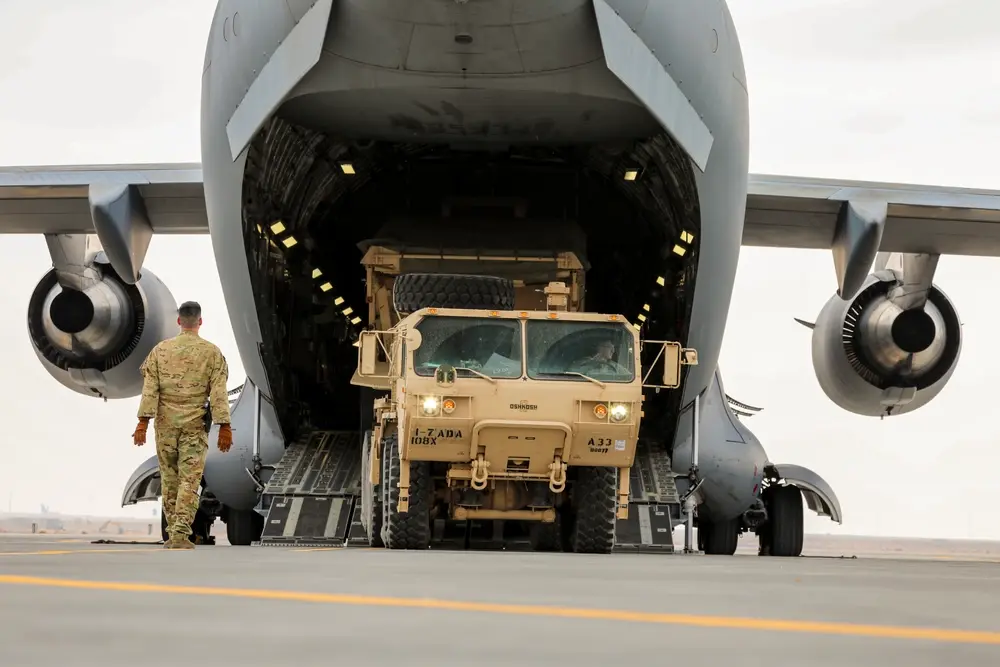
    US Army soldiers load Patriot air defense equipment onto C-17 amid $2.68B Ukraine sale
    U.S. Army Patriot air defense equipment being prepared for deployment, the same weapons category at the center of the new $2.68 billion Ukraine sale. Photo by Sgt. Christopher Neu / U.S. Army, via DVIDS

    Hours after Russian forces sent 174 drones and two Zircon anti-ship missiles across Ukraine in a single overnight barrage, the United States cleared the way for one of the largest air defense packages of the year: a proposed $2.68 billion sale that could reshape how Ukraine defends its skies through the winter ahead.

    The State Department’s Bureau of Political-Military Affairs notified Congress on September 18 of the possible Foreign Military Sale, formally titled an “Air Defense Development Upgrade.” The notification is not a signed contract. It is the required first step that clears a deal to move forward, and it lands at a moment when Ukraine’s air defenses are stretched thinner than at almost any point in the war.

    A Package Built for Layered Defense

    The proposed sale reads less like a single weapons purchase and more like an attempt to rebuild an entire defensive architecture. It includes S-300 Clone missiles, GAM-67 missiles, Range-Extended Air Defense Laser Guided Rocket systems, Improvised Transporter Erector Launcher 1.5 units, mobile launching system modification kits, RPS 202 counter-drone radars, erectable mast trailers, and the software, spare parts, and logistics support needed to keep it all running.

    That mix matters. Rather than concentrating resources on one interceptor type, the package spans missile systems, radar, and counter-drone technology, suggesting a shift toward redundancy across multiple layers of defense instead of dependence on any single platform. Given how visible Ukraine’s dependence on one system has become in recent months, that shift is not incidental.

    The U.S. Embassy in Kyiv framed the deal in similar terms, saying in a statement posted to X on September 19 that the equipment would help Ukraine “conduct self-defense and regional security missions with a more robust air defense capability.”

    Why the Timing Matters

    The notification did not arrive in a vacuum. Ukraine’s stock of Patriot interceptors, the only system in its arsenal capable of reliably shooting down Russian ballistic missiles, has been running critically low for months, and the shortage has already changed how the war is being fought and reported.

    President Volodymyr Zelensky told CNN in mid-August that Ukraine needed roughly 5 percent of the U.S. Patriot interceptor stockpile to survive the winter but had access to closer to 1 percent. Reuters reported around the same time that interceptor deliveries to Ukraine in 2026 had fallen to about a third of what they were the year before. By early August, Bloomberg reported that Ukraine’s air force had quietly stopped publishing nightly missile-count data altogether, following nights when its defenses failed to intercept a single incoming ballistic missile. Part of that squeeze traces back to the parallel conflict involving Iran, which drew heavily on the same shared pool of U.S. and allied Patriot stock, leaving less available for Kyiv even as Russian strikes continued.

    Against that backdrop, the overnight barrage that preceded this notification was a stark illustration of the stakes. Regional officials in Ukraine reported eight confirmed deaths from the attack, with Kharkiv region Governor Oleh Syniehubov citing five deaths and 15 injuries across 14 settlements, and Kherson region Governor Oleksandr Prokudin reporting three deaths and five injuries from shelling across 25 communities. Ukraine’s air force said on Telegram that the two Zircon anti-ship missiles launched in the barrage were intercepted, stating simply that the “[Zircon antiship] missiles did not reach the targets.”

    The attack also rippled beyond Ukraine’s borders. Poland’s military scrambled fighter jets and placed its air-defense systems on heightened alert as a precaution, a step it has now taken repeatedly in response to Russian activity near its frontier. The Polish Armed Forces Operational Command confirmed on X that “military aviation operations have begun in Polish airspace,” though officials later clarified that no actual violation of Polish airspace had occurred. NeuralWired has tracked this pattern of precautionary NATO responses closely as it has become a near-routine feature of the war’s later phases.

    The Money Behind the Deal

    If the sale is finalized, Ukraine would pay for it through a blend of European financial contributions and U.S. Foreign Military Financing funds that were appropriated under the prior administration. The structure is notable in its own right. The State Department specified that the FMF portion will count as a U.S. capital contribution to the Ukraine Reconstruction Investment Fund, applied through a one-to-one reimbursement arrangement.

    That financing model has become the standard route for U.S.-approved arms sales to Ukraine since the current administration curtailed new direct aid packages, relying instead on previously appropriated funds paired with European money. The notification itself was careful to state that the sale “will not alter the basic military balance in the region,” requires no additional American personnel on the ground in Ukraine, and carries “no adverse impact on U.S. defense readiness,” language typical of how the State Department frames sales of this scale.

    For readers following the broader trajectory of Western support, NeuralWired’s continuing coverage of Ukraine’s air defense gap offers more detail on how the interceptor shortfall developed over the course of 2026.

    What Happens Next

    A congressional notification is a procedural gate, not a finished deal. It opens a standard review period before any contract can be finalized, though the specific timeline for this particular review has not been made public. Once that stage clears, principal contractors will be selected through competitive procurement under Federal Acquisition Regulation rules, and the State Department’s notice indicates no offset agreement has been proposed at this point.

    A larger and unresolved question looms alongside this sale: Ukraine’s long-running push to secure a domestic license to produce Patriot interceptors with U.S. contractors, an ambition that would reduce its dependence on foreign stockpiles entirely. The White House has said no decisions or guarantees have been made on that front, and it remains, for now, aspirational rather than actual.

    What is clear is that the interceptor math has not fundamentally changed with this single notification. A $2.68 billion package, even if it clears every remaining hurdle, will take time to manufacture, deliver, and integrate, while the barrages are happening now. The gap between the two timelines, procurement measured in months and Russian strikes measured in nights, is likely to remain the defining tension of Ukraine’s air war through the winter, regardless of what Congress ultimately approves.