
Tag: TradeTruce

  • Trump and Xi Extend US-China Trade Truce to January, But Summit Produces Pandas Before Policy

    Trump and Xi Extend US-China Trade Truce to January, But Summit Produces Pandas Before Policy

    Xi Jinping spent three days in Washington this week, the first visit by a Chinese leader to the U.S. capital in more than a decade. By the time he left, the two governments had agreed to buy themselves two more months to figure out what comes next.
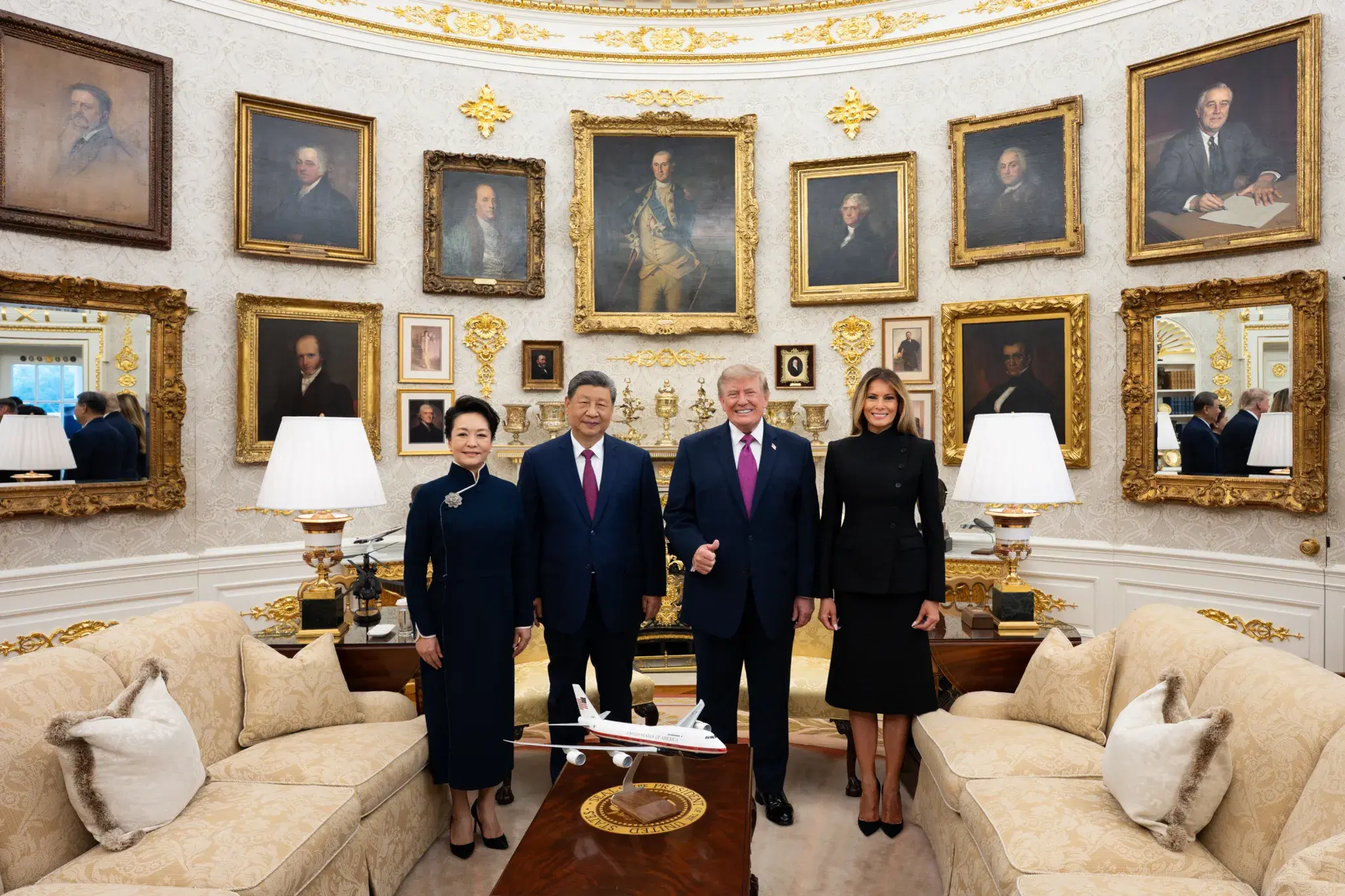
    Trump and Xi Jinping with First Ladies Melania Trump and Peng Liyuan at White House, Sept. 2026

    Treasury Secretary Scott Bessent announced on September 23, ahead of the formal summit, that the trade truce between Washington and Beijing would be extended from its November 10 expiration to January 10, 2027. It is not a new deal. It is a pause on an old one, and it leaves the two largest economies in the world exactly where they have been for the better part of a year: negotiating around the edges of a bigger confrontation neither side seems ready to resolve.

    A Warm Welcome, A Short Extension

    The optics were hard to miss. Trump personally met Xi at Joint Base Andrews when his plane landed, a tarmac greeting the White House has not extended to a visiting foreign leader in over a decade. A state dinner followed on September 24, drawing a guest list that read like a roll call of American tech power: Nvidia’s Jensen Huang, Tesla’s Elon Musk, Apple’s Tim Cook, and OpenAI’s Sam Altman all attended. The next day brought a tea session and a joint stop at the National Archives.

    Underneath the pageantry, the actual policy work had already been done in preparatory meetings. Bessent and U.S. Trade Representative Jamieson Greer met with Chinese Vice Premier He Lifeng in the days before Xi’s arrival, and it was from those sessions that the two month extension emerged. Bessent framed the goal as something larger than what had already been achieved, saying the two sides had convened to see whether they could reach “a bigger deal as opposed to just a series of smaller things.”

    He was notably unwilling to promise that outcome. Asked about the odds of something more substantial, Bessent told reporters, “I don’t know whether a bigger deal can be done. I don’t know whether we will just roll the current deal.” That kind of hedging from the administration’s lead trade negotiator is itself a signal. Nearly a year after the original truce was struck, Washington still is not certain it wants, or can get, anything more permanent.

    What The Truce Actually Protects

    The mechanics matter more than the ceremony. The extension keeps a 10 percent U.S. tariff on Chinese and Hong Kong imports tied to fentanyl enforcement, rather than letting it snap back to 20 percent. It also preserves China’s suspension of rare earth export controls and keeps Beijing’s soybean purchase commitments in place, three pieces of the relationship that touch semiconductor manufacturing, defense supply chains, and American agriculture all at once.

    None of it is automatic past January 10. If the two governments do not act again before that date, the tariff threat, a paused Section 301 investigation into Chinese shipbuilding, and the rare earth export controls all become live again. That is the arrangement in plain terms: not a resolution, but a countdown clock that both sides have agreed to reset for now.

    China’s follow-through on its existing commitments has also been uneven. Bessent said Beijing was running behind on $17 billion in agricultural purchases it had already committed to, even as roughly 1 million tons of soybeans moved in the run-up to the summit against a multi-year commitment reported at around 25 million metric tons. The exact scale and timeframe of that soybean pledge is described inconsistently across the reporting NeuralWired reviewed, and should be treated as approximate until an official U.S. or Chinese trade figure clarifies it.

    Pandas, Not Policy

    Ask what was actually announced at the summit itself, separate from the trade extension negotiated beforehand, and the list gets short fast. Xi pledged to send two giant pandas to Zoo Atlanta, which has had none since 2024, and to invite 100,000 American students to China for academic exchanges. Those are the concrete deliverables from three days of meetings between the leaders of the world’s two largest economies.

    There was no new agreement on artificial intelligence governance, no breakthrough on Taiwan, and no expanded trade package beyond the two month extension. Xi did address AI directly in remarks at the White House, telling the room that “we have both the capability and responsibility to develop and manage AI for good and ensure that the development of AI is always under human control and serves the well-being of the people.” Trump’s own response to questions about AI oversight, posted afterward on Truth Social, was considerably shorter: “Our guardrail is the DOJ.”

    Taiwan surfaced only through China’s own account of the talks. Beijing’s official readout said Xi called on the United States to handle the issue with caution and to oppose Taiwanese independence, but as of this reporting Trump had not addressed Taiwan publicly around the summit. That readout comes from China’s state news agency, not an independently verified transcript, and Washington’s own messaging around the visit emphasized trade and the panda pledge instead.

    Boeing remains the clearest example of a deal that still is not a deal. A framework for 200 aircraft, first floated during Trump’s May visit to Beijing, remained unfinished heading into this summit, and nothing in the reporting through September 26 indicates it was finalized here. Boeing shares slipped roughly 2 to 4 percent in the days before Xi’s arrival as hopes for a larger, newly signed order faded.

    Markets Are Watching a Bigger Number

    While the summit dominated headlines, bond markets moved on something else entirely. The 10 year Treasury yield touched 5.225 percent on September 25, its highest level since 2007, according to market coverage reviewed for this report, though one separate recap put Friday’s close closer to 5.18 percent. Either figure describes the same underlying story: borrowing costs climbing to territory investors have not had to price in for nearly two decades, in the same week the administration was staging its most high profile diplomatic event of the year with China.

    That juxtaposition is worth sitting with. A trade truce extension is, by design, a short term fix. A multi-decade high in Treasury yields is not something a summit dinner resolves.

    What Comes Next

    The January 10 deadline is now the date that matters most, but it is not the only one on the calendar. Trump and Xi are expected to meet again at the APEC summit in Shenzhen this November, and a further meeting is reportedly planned at the G20 Leaders’ Summit in Miami in December. U.S. Ambassador to China David Perdue has also described an informal, still nonbinding dialogue between the two countries on AI safety and incident alerts, something officials are calling a crisis mechanism without yet putting a formal agreement behind it.

    Taken together, the pattern is unmistakable. This is a relationship being managed in two month increments, propped up by tariff suspensions and soybean purchases rather than settled by any lasting framework. The pandas will make for good photographs when they arrive at Zoo Atlanta. The tariffs, the export controls, and the shipbuilding investigation currently held in suspension will decide whether the next ninety days bring something more durable, or simply another extension.

  • US-China Trade Truce Expires in November: What Xi Jinping’s Washington Visit Needs to Deliver

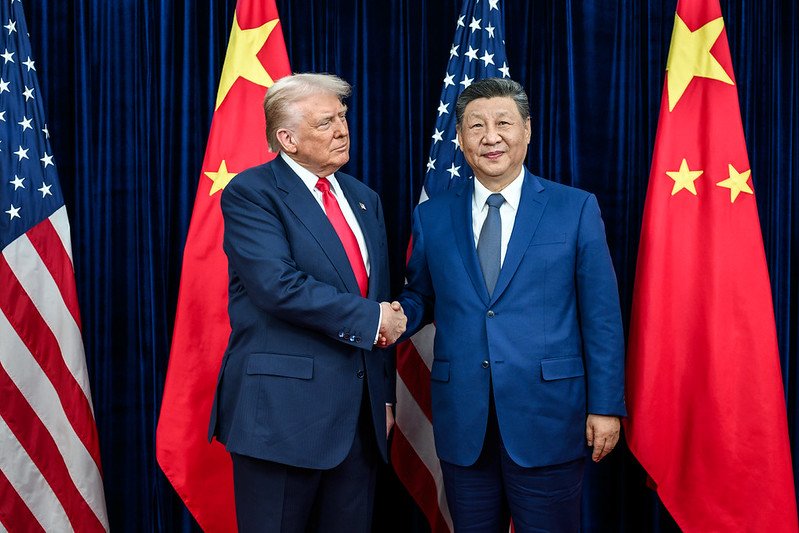
    Trump greets Xi Jinping before their October 2025 Busan summit meeting at Gimhae International Airport
    Image Credit: Photo by Daniel Torok / The White House

    Eight hours is a long time to sit across from the people who hold the other end of your trade relationship. On Sunday, Treasury Secretary Scott Bessent and US Trade Representative Jamieson Greer did exactly that with Chinese Vice Premier He Lifeng, at JPMorgan Chase’s Manhattan headquarters. On Monday, Beijing explained what the marathon was for: Xi Jinping will make a state visit to the United States from September 23 to 25, at Donald Trump’s invitation.

    It will be Xi’s first state visit to Washington since 2015 and his second face-to-face meeting with Trump this year. It also arrives with a clock running. The truce that has kept the world’s two largest economies out of a full-blown minerals and export-control fight expires in November, and so far neither side has said what happens next.

    What Beijing confirmed, and what the week looks like

    China’s Foreign Ministry made the announcement Monday, with spokesperson Guo Jiakun calling the reciprocal visits “of historic, milestone significance.” The choreography is elaborate. Trump will greet Xi at Joint Base Andrews on Wednesday, followed by an arrival ceremony at the White House. The leaders’ summit is set for Thursday, September 24, with a state dinner in the East Room that evening and a private tea on Friday.

    Edgard Kagan, a senior adviser at CSIS, put the symbolism bluntly ahead of the trip: “The visit is the message.” That reading fits the pomp, but the substance is what markets and manufacturers will be watching.

    What came out of New York

    The Sunday talks produced a few concrete outcomes. The two sides agreed to establish a US-China AI dialogue, and Washington proposed a notification mechanism for incidents such as security threats. Greer said the Board of Trade, the body created in May to discuss tariff cuts on non-strategic goods, is now operational.

    The products being considered for gentler treatment include Chinese consumer and low-tech goods, along with American energy, agricultural and medical products. Li Chenggang, China’s top negotiator, described the atmosphere as good and said a working group would reconvene Monday. Bessent, for his part, said the US had just had “a very successful engagement with the Chinese.” Before the meeting he had promised “focused, fulsome and constructive talks.”

    Just as telling is what was left out. No announcement was made on whether the truce will be extended. Bessent and Greer also reported no progress on critical-mineral flows, or on the farm purchases and Boeing order that China was said to have committed to in May.

    The deadline behind the pageantry

    The truce traces back to Busan, where Trump and Xi met on October 30, 2025 and agreed to a one-year pause in a confrontation over critical minerals. Under the arrangement, the White House said, China suspended the rare-earth export controls it announced on October 9, 2025 and issued general licenses covering rare earths, gallium, germanium, antimony and graphite. In return, Washington suspended its BIS Affiliates Rule for a year.

    The expiry dates do not line up neatly. Law firm analyses put the end of the US suspension at November 9, while reports place the Chinese suspension and the tariff pause at November 10. Either way, a few weeks separate the summit from a cliff edge, and the businesses that depend on those licenses have very little room to plan around a lapse.

    The May promises that remain unsettled

    The last Trump-Xi meeting, in Beijing in mid-May, left a trail of commitments that have yet to be fully verified. According to the White House, China agreed to buy at least $17 billion a year of American farm goods in 2026 (prorated), 2027 and 2028, and approved an initial purchase of 200 Boeing aircraft. Beijing’s own readout did not directly confirm those figures, and Boeing had not publicly confirmed the order.

    CNN calculated that the $17 billion, added to an existing soybean commitment, would come to roughly $27 billion a year. American agricultural exports to China totaled $24.4 billion in 2024, according to USDA data, so the pledge implies buying above anything recently achieved. That gap is part of why the absence of any update on farm purchases in New York stands out.

    A tariff decision waiting in the wings

    There is also the matter of new duties. Bloomberg reported, citing people familiar with the matter, that the US is expected to hold off announcing new excess-capacity tariffs on China and other partners until after the summit. The planned trade report would reportedly have recommended a 7.5% tariff on Chinese goods. The reason for the delay is unclear.

    The underlying Section 301 probe, opened in March, covers more than a dozen trading partners. The levies it could produce, combined with forced-labor duties already in place, would move tariff rates back toward the country-specific levels the Supreme Court overturned earlier this year. Whatever gets said in the East Room, that decision is now sitting behind it.

    Two leaders under domestic pressure

    Both men will arrive with reasons to want a visible win. US consumer prices rose 3.4% over the 12 months to August, according to the Bureau of Labor Statistics. Prices climbed 0.4% on the month, with a 3.9% jump in gasoline accounting for more than a third of that increase. Core inflation, which excludes food and energy, stood at 2.4%. Trump faces midterm elections in November amid the Iran war and those rising prices.

    China’s picture is softer. August retail sales grew just 0.4% from a year earlier, below the 0.8% that a Reuters poll had forecast. Fixed-asset investment fell 7.2% in the first eight months of the year, industrial output rose 5.2%, and urban unemployment stood at 5.3%. Second-quarter GDP growth of 4.3% was the weakest in more than three years and sits below the 4.5% to 5% target for 2026.

    Iran adds a complication. In August, Treasury launched “Operation Economic Outcast” to isolate Tehran financially, sanctioning three banks and some Chinese independent refineries. Washington has so far held back from targeting larger Chinese financial institutions, a restraint that could be tested if talks sour.

    Business leaders get a seat at the table

    The White House has confirmed a guest list for the state dinner that spans AI, chips, finance and consumer technology. It includes Elon Musk, Jeff Bezos, Jensen Huang, Sam Altman, Sundar Pichai, Michael Dell, Citi’s Jane Fraser and Apple executive chairman Tim Cook. Qualcomm has confirmed that CEO Cristiano Amon will attend. AI safety and rivalry are expected to feature on the agenda, which gives the new dialogue agreed in New York an obvious first test.

    Trump himself has set expectations high. Speaking in the Oval Office on September 18, he said, “We’re going to have a lot of different deals.” Markets appeared to lean into that optimism early Monday, with Bloomberg reporting S&P 500 futures up 0.6%, Nasdaq 100 futures up 0.8%, and Brent crude down for a fourth straight day.

    What to watch after the toasts

    Optimism is cheap before a summit. The more useful measures come afterward: whether the two leaders announce an extension of the truce, whether critical-mineral flows get a firm framework, and whether Beijing confirms the farm and Boeing commitments in its own words. The delayed tariff decision follows the summit, and the September inflation report lands on October 14, just weeks before the truce instruments run out.

    If the East Room dinner ends with warm words and no extension, the November deadline will do the talking instead.