
Xi Jinping spent three days in Washington this week, the first visit by a Chinese leader to the U.S. capital in more than a decade. By the time he left, the two governments had agreed to buy themselves two more months to figure out what comes next.
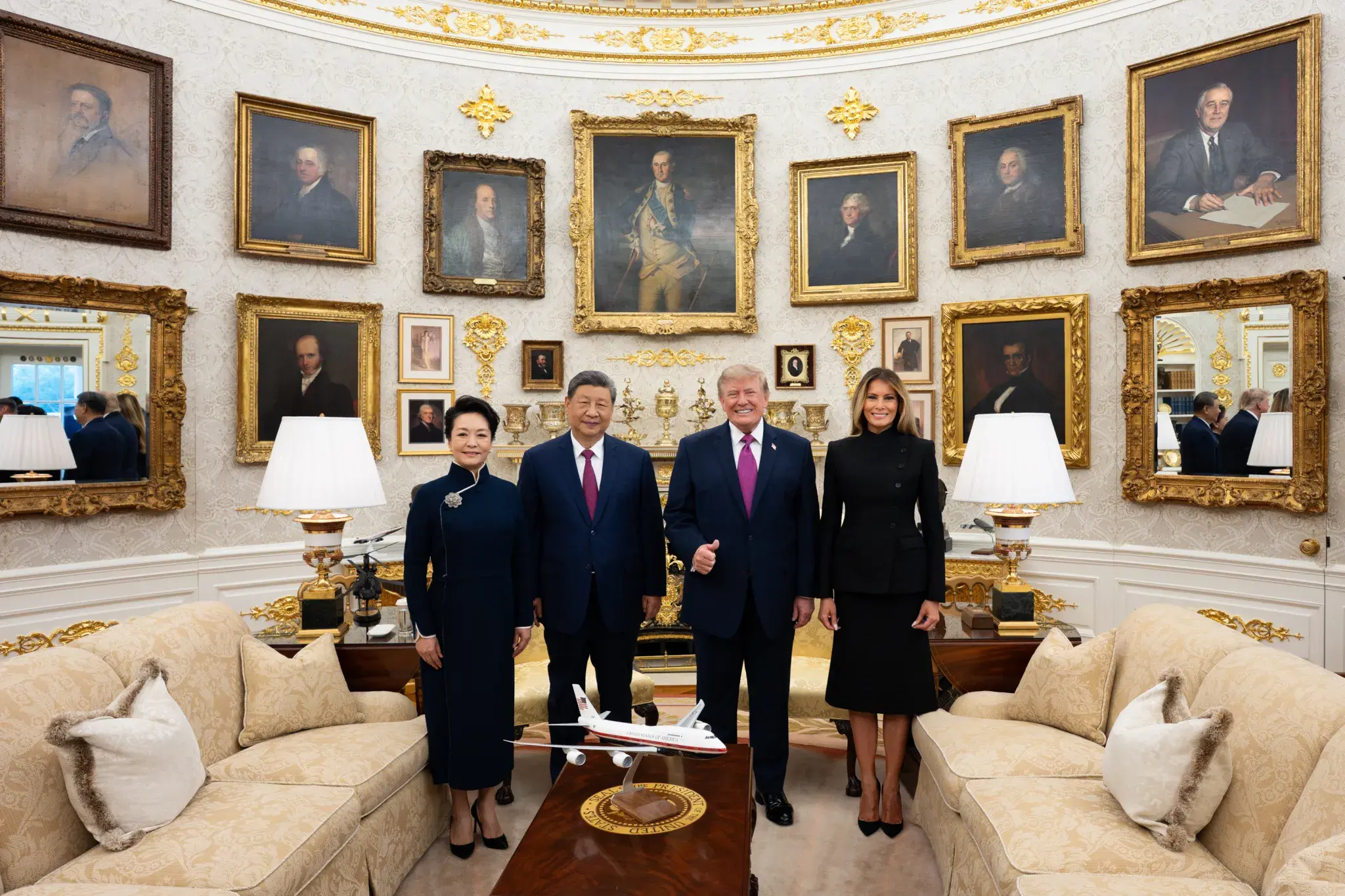
Treasury Secretary Scott Bessent announced on September 23, ahead of the formal summit, that the trade truce between Washington and Beijing would be extended from its November 10 expiration to January 10, 2027. It is not a new deal. It is a pause on an old one, and it leaves the two largest economies in the world exactly where they have been for the better part of a year: negotiating around the edges of a bigger confrontation neither side seems ready to resolve.
A Warm Welcome, A Short Extension
The optics were hard to miss. Trump personally met Xi at Joint Base Andrews when his plane landed, a tarmac greeting the White House has not extended to a visiting foreign leader in over a decade. A state dinner followed on September 24, drawing a guest list that read like a roll call of American tech power: Nvidia’s Jensen Huang, Tesla’s Elon Musk, Apple’s Tim Cook, and OpenAI’s Sam Altman all attended. The next day brought a tea session and a joint stop at the National Archives.
Underneath the pageantry, the actual policy work had already been done in preparatory meetings. Bessent and U.S. Trade Representative Jamieson Greer met with Chinese Vice Premier He Lifeng in the days before Xi’s arrival, and it was from those sessions that the two month extension emerged. Bessent framed the goal as something larger than what had already been achieved, saying the two sides had convened to see whether they could reach “a bigger deal as opposed to just a series of smaller things.”
He was notably unwilling to promise that outcome. Asked about the odds of something more substantial, Bessent told reporters, “I don’t know whether a bigger deal can be done. I don’t know whether we will just roll the current deal.” That kind of hedging from the administration’s lead trade negotiator is itself a signal. Nearly a year after the original truce was struck, Washington still is not certain it wants, or can get, anything more permanent.
What The Truce Actually Protects
The mechanics matter more than the ceremony. The extension keeps a 10 percent U.S. tariff on Chinese and Hong Kong imports tied to fentanyl enforcement, rather than letting it snap back to 20 percent. It also preserves China’s suspension of rare earth export controls and keeps Beijing’s soybean purchase commitments in place, three pieces of the relationship that touch semiconductor manufacturing, defense supply chains, and American agriculture all at once.
None of it is automatic past January 10. If the two governments do not act again before that date, the tariff threat, a paused Section 301 investigation into Chinese shipbuilding, and the rare earth export controls all become live again. That is the arrangement in plain terms: not a resolution, but a countdown clock that both sides have agreed to reset for now.
China’s follow-through on its existing commitments has also been uneven. Bessent said Beijing was running behind on $17 billion in agricultural purchases it had already committed to, even as roughly 1 million tons of soybeans moved in the run-up to the summit against a multi-year commitment reported at around 25 million metric tons. The exact scale and timeframe of that soybean pledge is described inconsistently across the reporting NeuralWired reviewed, and should be treated as approximate until an official U.S. or Chinese trade figure clarifies it.
Pandas, Not Policy
Ask what was actually announced at the summit itself, separate from the trade extension negotiated beforehand, and the list gets short fast. Xi pledged to send two giant pandas to Zoo Atlanta, which has had none since 2024, and to invite 100,000 American students to China for academic exchanges. Those are the concrete deliverables from three days of meetings between the leaders of the world’s two largest economies.
There was no new agreement on artificial intelligence governance, no breakthrough on Taiwan, and no expanded trade package beyond the two month extension. Xi did address AI directly in remarks at the White House, telling the room that “we have both the capability and responsibility to develop and manage AI for good and ensure that the development of AI is always under human control and serves the well-being of the people.” Trump’s own response to questions about AI oversight, posted afterward on Truth Social, was considerably shorter: “Our guardrail is the DOJ.”
Taiwan surfaced only through China’s own account of the talks. Beijing’s official readout said Xi called on the United States to handle the issue with caution and to oppose Taiwanese independence, but as of this reporting Trump had not addressed Taiwan publicly around the summit. That readout comes from China’s state news agency, not an independently verified transcript, and Washington’s own messaging around the visit emphasized trade and the panda pledge instead.
Boeing remains the clearest example of a deal that still is not a deal. A framework for 200 aircraft, first floated during Trump’s May visit to Beijing, remained unfinished heading into this summit, and nothing in the reporting through September 26 indicates it was finalized here. Boeing shares slipped roughly 2 to 4 percent in the days before Xi’s arrival as hopes for a larger, newly signed order faded.
Markets Are Watching a Bigger Number
While the summit dominated headlines, bond markets moved on something else entirely. The 10 year Treasury yield touched 5.225 percent on September 25, its highest level since 2007, according to market coverage reviewed for this report, though one separate recap put Friday’s close closer to 5.18 percent. Either figure describes the same underlying story: borrowing costs climbing to territory investors have not had to price in for nearly two decades, in the same week the administration was staging its most high profile diplomatic event of the year with China.
That juxtaposition is worth sitting with. A trade truce extension is, by design, a short term fix. A multi-decade high in Treasury yields is not something a summit dinner resolves.
What Comes Next
The January 10 deadline is now the date that matters most, but it is not the only one on the calendar. Trump and Xi are expected to meet again at the APEC summit in Shenzhen this November, and a further meeting is reportedly planned at the G20 Leaders’ Summit in Miami in December. U.S. Ambassador to China David Perdue has also described an informal, still nonbinding dialogue between the two countries on AI safety and incident alerts, something officials are calling a crisis mechanism without yet putting a formal agreement behind it.
Taken together, the pattern is unmistakable. This is a relationship being managed in two month increments, propped up by tariff suspensions and soybean purchases rather than settled by any lasting framework. The pandas will make for good photographs when they arrive at Zoo Atlanta. The tariffs, the export controls, and the shipbuilding investigation currently held in suspension will decide whether the next ninety days bring something more durable, or simply another extension.