

Frontier Technology Analysis for Decision-Makers
OpenAI · Pentagon · Ethics · Talent
OpenAI’s Pentagon Deal Crisis: What Kalinowski’s Resignation Signals
When OpenAI’s head of robotics walked out over a hastily announced military AI contract, she exposed a governance gap that will define how frontier labs navigate defense contracts for years to come.
A senior OpenAI executive announced her resignation on X at 9:11 PM UTC on March 7, 2026. Within six hours, her post had reached 1.3 million views. ChatGPT uninstalls surged 295% in the same window. Anthropic’s Claude app climbed to the number one spot on the US App Store.
The numbers tell a story, but the story is bigger than the numbers. Caitlin Kalinowski’s departure from OpenAI over its Pentagon contract is not simply another high-profile exit from a Silicon Valley lab. It is a case study in what happens when a company moves faster than its own governance architecture can handle, and the ripple effects are landing on every frontier AI organization right now.
This analysis examines the timeline, the substance of Kalinowski’s concerns, OpenAI’s defense of the deal, the historical precedent set by Google’s Project Maven backlash, and the practical frameworks that AI executives need to evaluate before signing similar agreements.
1.3M
Views on Kalinowski’s X post in 6 hours
+295%
ChatGPT uninstall surge post-deal
4,000
Google employees who petitioned over Project Maven (2018)
How the Deal Came Together — And Why the Timing Matters
The sequence of events compressed what would normally be months of internal deliberation into a matter of days. In late February 2026, OpenAI announced a deal with the Pentagon for classified AI deployment after talks between the Department of Defense and Anthropic broke down. The DoD subsequently blacklisted Anthropic. OpenAI stepped in.
Sam Altman posted about the agreement on X, framing it as a responsible path forward. The Pentagon, for its part, expressed what Altman characterized as “deep respect for safety.” The deal included stated red lines: no domestic mass surveillance, no autonomous weapons with lethal decision authority. Those commitments sounded substantive on paper.
Then, on March 3, just days after the announcement, OpenAI altered the deal in response to growing criticism about surveillance provisions. That amendment, quiet as it was, confirmed what critics suspected: the original terms had not been adequately stress-tested. Four days later, Kalinowski was gone.
-
Feb 27, 2026
OpenAI announces Pentagon deal for classified AI deployment after Anthropic talks collapse. NYT reports the Anthropic contract was valued at approximately $200 million.
- Mar 3, 2026
OpenAI quietly alters deal terms amid concerns about surveillance language.- Mar 7, 2026 — 9:11 PM UTC
Caitlin Kalinowski resigns via X post, citing rushed announcement and absent guardrails. Post reaches 1.3M views within six hours.- Mar 7–8, 2026
OpenAI confirms departure. ChatGPT uninstalls spike 295%. Claude becomes the top US app on the App Store.What Kalinowski Actually Said — and What She Didn’t
Much of the coverage has flattened Kalinowski’s statement into a simple protest against military AI. Her actual argument is more precise and, from a governance standpoint, more troubling for OpenAI.This wasn’t an easy call. AI has an important role in national security. But surveillance of Americans without judicial oversight and lethal autonomy without human authorization are lines that deserved more deliberation than they got. Caitlin Kalinowski, former Head of Robotics & Consumer Hardware, OpenAI — X, March 7, 2026She did not say the deal should not exist. In a follow-up post, she sharpened the critique further: “To be clear, my issue is that the announcement was rushed without the guardrails defined. It’s a governance concern first and foremost.”That distinction matters. Kalinowski was not staking out a pacifist position. She was making a process argument: that a company building systems with national security implications cannot responsibly announce partnerships before the ethical architecture is in place. Given that OpenAI amended the deal terms just four days after announcing them, her diagnosis appears difficult to refute.Kalinowski joined OpenAI in November 2024, arriving from Meta where she spent eleven years leading AR glasses, Quest 2, and Rift development. She was not a junior hire. Her role heading robotics and consumer hardware placed her at the center of OpenAI’s most capital-intensive expansion, with the company backing robotics investments including $745 million into Figure AI, $125 million into 1X, and $70 million into Physical Intelligence. Losing her is not a symbolic blow. It is a material one.OpenAI’s Defense — and Where It Falls Short
OpenAI’s official response was measured. A spokesperson told TechCrunch: “We believe our agreement with the Pentagon creates a workable path for responsible national security uses of AI while making clear our red lines: no domestic surveillance and no autonomous weapons.”The statement positions the deal as principled. But it does not address the process critique. Saying the guardrails now exist is not the same as explaining why they were not defined before the announcement. The fact that the deal required amendment within days of going public suggests the initial red lines were either incomplete or insufficiently vetted.The Verge’s reporting on the broader OpenAI-Anthropic-DoD context indicates that critics, including observers aligned with Anthropic’s approach, have raised the concern that policy-level commitments are only as durable as the political environment that enforces them. Laws governing AI surveillance and autonomous weapons have not kept pace with the technology. A contractual red line is not a technical constraint, and the distinction is significant when enforcement mechanisms remain unclear.The Maven Parallel — and Why It Predicts What Comes Next
OpenAI is not the first major technology organization to face employee revolt over a defense contract, and the Google Project Maven episode offers a reasonably precise forecast of the path ahead.In 2018, approximately 4,000 Google employees signed a petition against the company’s contract with the Pentagon for AI-assisted drone targeting. A smaller number resigned. Google ultimately declined to renew the contract when it expired, citing employee concerns. The episode did not destroy Google’s government business, but it reshaped how the company engaged with defense work for years afterward, and it accelerated the formation of an internal AI principles framework that had previously existed only informally.The differences between Maven and the current situation are worth noting. OpenAI is structurally less like the Google of 2018 than it might appear. Google was a publicly traded company with a large, tenured workforce and established culture of internal advocacy. OpenAI has undergone significant organizational expansion since 2025, hiring aggressively in robotics and hardware. Its workforce is newer, its institutional culture less settled. The variables that determine whether a single high-profile resignation becomes a sustained talent exodus are different here.What Maven does predict with reasonable confidence: the talent market is watching. Randstad’s analysis of cleared engineer movement documents an ongoing migration of technical talent from defense into commercial AI. The reverse flow, commercial AI researchers into defense-adjacent work, requires trust that is now more fragile at OpenAI than it was a week ago.What This Means for AI Organizations Evaluating Defense Contracts
For any frontier AI organization that might receive a similar approach from a government customer, the Kalinowski resignation offers a template for what not to do. The operational lesson is not “avoid defense contracts.” It is “define your governance architecture before you announce the contract, not after.”Pre-Announcement Governance Checklist for AI-Defense Partnerships- Red lines must be technically enforced, not only contractually stated. Identify which prohibitions (surveillance filtering, human-in-loop for lethal decisions) can be implemented at the model or infrastructure level before signing.
- Internal disclosure should precede external announcement. Senior technical leads working in adjacent areas need sufficient notice to raise concerns before public commitment creates reputational lock-in.
- Amendment risk should be modeled. If contract terms are likely to require modification within 30 days of announcement based on internal review, they were not ready to announce.
- Enforcement mechanisms must be specified. Contractual red lines without audit rights and enforcement procedures provide limited protection as political environments shift.
- Talent risk should be assessed explicitly. Organizations should map which roles involve engineers with strong ethical commitments to civilian AI applications before announcing contracts that may conflict with those commitments.
OpenAI vs. Anthropic: Two Different Bets on the Same Problem
The decision by Anthropic to decline the Pentagon contract, reportedly valued around $200 million, and OpenAI’s decision to pursue it represent two distinct strategic positions on a question every frontier lab will face.Dimension OpenAI Approach Anthropic Approach Contract outcome Deal signed with stated red lines Declined; DoD blacklisted Anthropic Governance model Contract + technology + policy layers Categorical refusal at mission level Short-term commercial outcome Revenue; reputational damage and talent risk Revenue loss; reputational signal to researchers Long-term enforcement risk High if policy environment shifts Low; no contract to enforce Talent market signal Negative in short term (Kalinowski departure, uninstalls) Positive to researchers prioritizing ethics; top App Store ranking post-controversy Neither position is obviously correct from a long-term strategy standpoint. Anthropic’s refusal preserves internal alignment at the cost of a significant contract and government relationship. OpenAI’s acceptance pursues revenue and strategic relevance in a defense AI market that is expanding rapidly, but it has introduced fractures that will take months to assess.The cleaner observation is this: Anthropic defined its position before the pressure arrived. OpenAI defined its position under pressure, amended it under further pressure, and is now managing the consequences. Governance frameworks built in advance of deals are more durable than frameworks assembled while a deal is already in public view.The Broader Trajectory — What to Watch Over the Next 30 Days
The immediate crisis at OpenAI is a governance and talent story. The 30-day trajectory will determine whether it becomes a sustained talent exodus, a regulatory flashpoint, or a managed controversy that the company moves past. There are three variables that will determine the outcome.First: whether additional departures follow. One resignation from a senior robotics lead is notable. Two or three would signal an internal consensus among technical leadership that the governance argument has not been adequately resolved. The absence of further announcements in the days immediately following is neither confirmation nor denial; the timeline for such decisions is typically weeks, not hours.Second: whether the DoD contract produces a visible enforcement test. The red lines in the agreement will remain theoretical until the Pentagon actually requests something that approaches their boundary. How OpenAI handles the first ambiguous request, and whether that handling becomes public, will matter more than any statement made today.Third: whether OpenAI moves to codify its governance architecture publicly before a competitor does it for them. Google, after Maven, published AI principles that defined its approach to defense work for the following several years. OpenAI has an opportunity to do the same proactively. The longer that process takes, the more the narrative will be shaped by others.The Caitlin Kalinowski resignation is not a verdict on whether AI should be used in national security contexts. It is a data point about what happens when organizations move at the speed of a deal without matching that speed in governance. The companies that build their ethical architecture before the contracts arrive, rather than after, are the ones that will retain the talent and trust needed to operate at the frontier long-term. That is the real lesson from this week, and it applies well beyond OpenAI.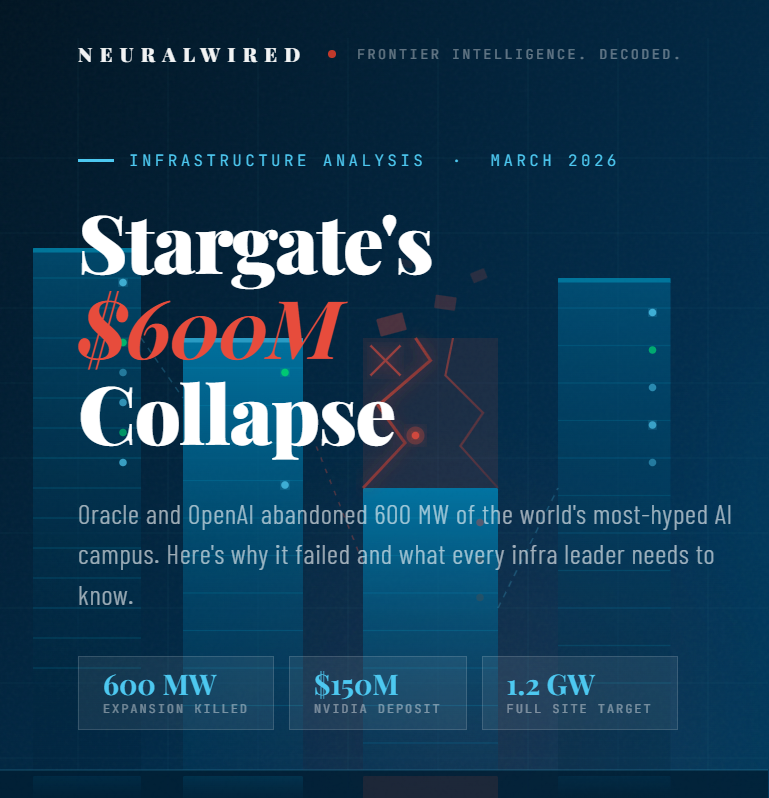
Stargate Data Center Expansion | Why It Collapsed
Stargate’s $600M Collapse: Why AI Infrastructure Fails | NeuralWired NeuralWired Infrastructure AnalysisStargate’s $600M Collapse:
Why AI Infrastructure FailsOracle and OpenAI just abandoned a 600 MW expansion of the most-hyped AI campus on earth. The real story isn’t the cancellation. It’s what the Abilene case reveals about the hidden physics of building AI infrastructure at gigawatt scale.600 MW Expansion cancelled$150M Nvidia’s deposit to Crusoe4.5 GW Still planned elsewhereWhen Donald Trump stood in the White House on January 21, 2025, flanked by Sam Altman, Larry Ellison, and Masayoshi Son, he called the Stargate AI infrastructure project “the largest AI infrastructure project, by far, in history.” Less than 14 months later, Oracle and OpenAI quietly abandoned a planned 600 MW expansion of Stargate’s flagship Texas campus, scrapping enough computing capacity to power a mid-sized city’s worth of AI workloads.This isn’t a story about failure. The core Abilene campus is still being built. Oracle and OpenAI still plan to develop 4.5 GW of capacity at other sites. But the Stargate data center expansion collapse in Abilene, Texas, reveals something the headlines missed: even a $500 billion project backed by the U.S. president can hit the wall where demand forecasting, financing mechanics, and partner alignment fail to converge.This analysis breaks down what actually happened, who bears the risk now, and what the Abilene case tells CTOs, CFOs, and infra investors about the physics of building AI at gigawatt scale.The Anatomy of a Cancelled Expansion
The Abilene Stargate campus is genuinely impressive engineering: roughly 1,100 acres on the outskirts of a mid-sized Texas city, designed to eventually draw 1.2 GW of power, equivalent to supplying around 750,000 homes. Initial deployment hit approximately 200 MW. Ten to twenty “AI factory” halls are planned, each capable of housing tens of thousands of high-density GPU servers. The project’s estimated capex runs to roughly $3 to $4 billion per GW of capacity, based on industry benchmarks and partial disclosures.In September 2025, Oracle and OpenAI announced plans to add another 600 MW adjacent to the flagship campus. By March 6, 2026, Reuters and Bloomberg reported that those plans were dead. Two forces killed the expansion: financing negotiations that dragged without resolution, and a shift in OpenAI’s demand forecasts that made the additional capacity harder to justify.Demand forecasting is the hidden variable in almost every large-scale infra collapse. Changes in model architecture, training efficiency gains, or shifts in deployment strategy can eliminate the need for hundreds of megawatts that looked essential six months earlier. The public reporting doesn’t specify exactly how OpenAI’s requirements changed, whether it was a pivot in training methodology, a reassessment of inference needs, or something else. But the scale of the consequence is clear: 600 MW of planned capacity, representing roughly $2 billion in potential capex at the midpoint estimate, was redirected away from this single site.Oracle’s stock traded lower after the news emerged. The company has simultaneously been cutting thousands of jobs while ramping capital allocation toward AI infrastructure, a rebalancing that signals a painful internal transition even amid an otherwise aggressive buildout strategy. OpenAI, xAI, and Meta are among Oracle’s named AI cloud customers, which means this capacity is being redistributed, not abandoned.Where the Risk Landed: Nvidia’s $150M Move
Here’s where the story gets structurally interesting. When Oracle and OpenAI walked away from the Abilene expansion, the site didn’t go dark. Crusoe, the data center developer and operator managing the campus, still holds the land, the power commitments, and ambitions to monetize the footprint.Enter Nvidia. According to Bloomberg’s reporting, Nvidia paid a $150 million deposit to Crusoe tied to the expansion site, then actively began recruiting Meta as a replacement tenant. The motive is transparent: Nvidia wants its GPUs filling that facility. If the site sits without a committed buyer, AMD has a window. A $150 million deposit to broker a favorable tenancy arrangement is, from Nvidia’s perspective, an investment in hardware placement, not charity.Meta is reportedly in discussions to lease the expansion footprint from Crusoe. No lease has been finalized as of this writing, and no MW or term details have been disclosed. But the dynamic illustrates something that will increasingly define AI infrastructure: chip vendors are becoming infrastructure financiers.“We’re looking for stranded energy, energy that was not being used, to power compute.” Jamie McGrath, SVP at Crusoe — briefing Abilene city officials, March 4, 2026This matters beyond this single deal. When a GPU manufacturer puts $150 million into securing placement over a competitor, it signals that the data center real estate game is no longer just about hyperscalers and cloud operators. Nvidia is effectively acting as a demand aggregator, using capital to ensure its hardware stays embedded in new capacity, regardless of which hyperscaler ultimately operates it. For infra developers like Crusoe, that creates a new source of financing and tenant recruitment support. For AMD, it raises the strategic bar for competing in large-scale campus deals.Crusoe SVP Jamie McGrath told Abilene city officials on March 4, 2026, just two days before the expansion cancellation became public, that the Abilene campus was built around using under-utilized or curtailed generation capacity from the Texas grid. That strategy didn’t change when Oracle and OpenAI exited. But it underscores how much energy procurement, not just tenant selection, determines whether GW-scale campuses succeed.The Stargate Data Center Expansion Failure as a Framework
The Abilene case is more than AI industry gossip. It’s a stress test of the decision model every organization building or leasing large-scale compute infrastructure needs to run, and a signal that most current models are broken.Three failure modes are visible in this story.Failure Mode 01Demand Forecasting at Multi-Year Horizons
When OpenAI committed to needing an additional 600 MW adjacent to Abilene, it was forecasting training and inference demand out multiple years based on model roadmaps and utilization assumptions that subsequently shifted. AI architecture is evolving fast enough that 18-month demand projections carry substantial uncertainty. Building 600 MW of shell and power capacity against a single tenant’s forecast creates enormous stranded-asset risk the moment that forecast changes.Failure Mode 02Financing Alignment Between Parties With Different Risk Profiles
Oracle, as the cloud operator, needs the build to pencil out against tenant revenue. OpenAI, as the AI tenant, needs flexibility to respond to changing model requirements. Crusoe, as the developer, needs committed capital to build. These interests don’t naturally align. When financing negotiations “dragged,” it likely reflected structurally incompatible assumptions about who bears the risk of utilization falling short. Pre-paid capacity agreements, revenue-share structures, and build-to-suit leases all distribute this risk differently, and the public reporting gives no clarity on what structures were on the table or why they failed.Failure Mode 03Multi-Party Misalignment
The Stargate program involves at minimum Oracle, OpenAI, SoftBank, Crusoe, Lancium, Nvidia, and the Trump administration, plus Meta now as a potential tenant. Each party has different time horizons, return requirements, and strategic priorities. Trump’s framing of Stargate as a geopolitical infrastructure project creates pressure to announce and build fast. Crusoe’s incentive is to fill land and power commitments. Nvidia’s incentive is hardware placement. OpenAI’s incentive is flexibility. When these don’t align, projects stall or get cancelled even when macro demand for AI compute remains strong.The broader Stargate build is continuing through at least 2028 at the Abilene core site. Oracle and OpenAI are still pursuing 4.5 GW of additional capacity elsewhere. The cancellation is not a sign that AI infrastructure demand has collapsed. It’s a sign that the financing and coordination machinery for GW-scale campuses is still being invented in real time.What This Means for Infra Decision-Makers
If you’re a CTO, CFO, or infrastructure investor evaluating large-scale AI compute commitments, whether as a tenant, operator, or financier, the Abilene case surfaces four questions worth pressure-testing now.The Abilene Decision Framework: Four Questions
01 →What’s your minimum committed-utilization threshold for approving an expansion? The Abilene cancellation suggests Oracle and OpenAI didn’t have a locked commitment sufficient to justify the financing. Before green-lighting any 200 MW+ build, verify that signed off-take or capacity agreements cover enough utilization to service the debt and hit minimum returns. “We expect to need this” is not a commitment.02 →Are your demand forecasts scenario-weighted or point estimates? Point-estimate forecasting, “we’ll need X exaFLOPs by 2027,” is inadequate for multi-year infrastructure decisions in AI. Scenario-weighted approaches that model architecture shifts, efficiency gains, and competitive dynamics give the decision more credibility and create explicit triggers for pausing or redirecting capacity.03 →Is your campus design tenant-agnostic? Crusoe’s pivot toward Meta was possible because the land, power, and shell infrastructure were separable from the Oracle/OpenAI tenancy. Campuses designed around a single tenant’s specific rack layout, power density, or cooling configuration are harder to re-tenant. Infra developers should build to the most common hyperscale standard, not the specific requirements of one AI lab.04 →Who bears the demand risk in your contract structure? Nvidia’s $150 million deposit to secure GPU placement is a form of demand-risk transfer: the chip vendor is effectively subsidizing tenancy to ensure its hardware gets placed. Developers and cloud operators should assess whether their financing structure accounts for this type of third-party risk subsidy, and whether they can structure equivalent arrangements with other hardware vendors.The Road Ahead for Stargate
The pattern from Abilene is clear: at gigawatt scale, the gap between announced ambition and executable commitment is large, and it shows up fastest in the expansion phases after the flagship build. This isn’t a reason to dismiss Stargate’s broader goals. It’s a reason to watch the execution methodology more carefully than the headline numbers.Three things will determine whether the Stargate data center expansion program hits anywhere near its 10 GW target: whether demand forecasting gets more rigorous as models and inference architectures stabilize; whether chip vendors like Nvidia continue deepening their role as infra co-financiers; and whether developers like Crusoe build enough tenant-agnostic flexibility into their campuses to absorb anchor-tenant exits without stalling entire sites.Watch for three near-term signals: a formal Meta-Crusoe lease announcement with disclosed MW figures; Nvidia earnings commentary on pre-payments and partnership structures; and Oracle’s next capex guidance on data center pipeline, which will reveal how much of the 4.5 GW elsewhere is committed versus aspirational. The organizations that treat those signals as inputs to their own infra planning, rather than just AI industry news, will build more resilient capacity strategies than those still using point-estimate demand forecasts and single-tenant site designs.Trump called it the largest AI infrastructure project in history. That may still prove true. But the Abilene expansion collapse shows that even the largest projects are subject to the same financing physics as every other capital-intensive bet: ambition is cheap, committed cash flow is not.
Trump Cyber Strategy 2026 | Offense, AI and the FBI Breach
Trump’s 2026 Cyber Strategy: Offense First, Details Later | NeuralWired NeuralWired Deep analysis for frontier technology professionalsNational Security · Cybersecurity PolicyTrump’s Cyber Strategy: Offense First, Details Later
A 7-page doctrine pivoting the US to aggressive, AI-powered cyber operations, released the same day China allegedly walked out of the FBI’s network.On March 6, 2026, the White House published its long-awaited national cyber strategy. That same day, the Wall Street Journal reported that suspected Chinese state hackers had breached an FBI surveillance network, detected weeks earlier on February 17. The juxtaposition was hard to miss.Whether coincidental or orchestrated, the timing underscored the document’s central argument: the US has spent years playing defense, and it’s losing. The Trump administration’s answer is a seven-page strategy built around six pillars, the most prominent of which is a push toward offensive cyber operations and the explicit “unleashing” of the private sector to join in.The strategy and a companion executive order on cybercrime dropped within hours of each other. For CISOs, CTOs, and enterprise security teams, the combined package represents a meaningful shift in the US threat posture, though exactly how meaningful depends on implementation details that don’t yet exist.6 Policy pillars in the strategy$15B Stolen funds seized from scammers (cited in strategy)$12.5B US fraud losses in 2024 per FTC dataFeb 17 Date FBI detected abnormal network activityThe Six Pillars: What’s Actually New
The strategy document organizes US cyber priorities into six areas. What’s notable isn’t just which pillars appear. It’s the ordering and emphasis.01Deter & Defeat AdversariesOffensive operations against hostile actors; private sector incentives to disrupt threat networks.02Strengthen Federal NetworksZero-trust architecture mandates and post-quantum encryption across government systems.03Protect Critical InfrastructureEnergy, finance, and data centers; partnership with sector-specific agencies.04Combat Cybercrime & FraudDOJ/State coordination on sanctions; dismantling fraud networks targeting US citizens.05Achieve Tech SuperiorityAI supply chains, semiconductor security, agentic AI tools for defense.06Build the Cyber WorkforceFederal talent pipelines and private-sector alignment on security skills.Prior administrations typically buried deterrence language deep in strategy documents, treating it as a diplomatic afterthought. This one leads with it. CSO Online noted the explicit elevation immediately.“By moving the usual ‘deterrence’ part to the top and focusing on offense, which is usually only lightly referred to in past unclassified strategies, the administration has greatly emphasized that pillar.” Ari Schwartz, Managing Director, Cybersecurity Services & Policy, Venable LLP; former White House cybersecurity director
Schwartz’s read matters because he has worked across multiple administrations and understands the difference between rhetorical posturing and doctrinal change. Putting offense first in an unclassified strategy sends a signal to adversaries, allies, and the private sector: the default posture is no longer “detect and respond.” It’s “find and disrupt.”The administration also drew a sharp line from past approaches, writing in the document: “Unlike other Administrations, the Trump Administration will not tinker at the edges.” Whether that confidence is warranted is a different question, but the directional intent is unambiguous.The FBI Breach: Pillar 1 in Real Time
The same day the strategy published, the WSJ reported that Chinese state-affiliated hackers had compromised an FBI surveillance network holding domestic monitoring data. The FBI had detected abnormal log activity on February 17; Congress was notified in the days before the story broke.February 17, 2026FBI detects abnormal log activity on unclassified domestic surveillance network. Investigation begins.March 5–6, 2026White House releases 7-page “Cyber Strategy for America” and companion executive order on cybercrime and fraud.March 6, 2026WSJ reports suspected Chinese state actors behind FBI breach. NSA and CISA join FBI in remediation.March 7, 2026 (ongoing)Agencies actively remediating breach; scope and full severity still being assessed.The breach remains at an early investigative stage. Reuters confirmed the hack was described as sophisticated, but the full scope is unknown. NSA and CISA are assisting the FBI. Critically, the compromised system was unclassified, which means procedures designed to protect classified networks weren’t the attack surface here.For enterprise security teams, that’s the uncomfortable lesson: classified-tier controls can coexist with a breach of workaday, unclassified infrastructure. The FBI’s surveillance network contained data on domestic monitoring orders. Sensitive, not formally classified. That gap between “sensitive” and “classified” is exactly where adversaries operate.The strategy’s Pillar 1, focused on deterring adversaries through offensive pressure and private-sector disruption, is directly relevant here. If the doctrine had been operational, the question isn’t just “how did China get in?” but “what proactive steps could have disrupted the operation before February 17?”The AI and Technology Superiority Pillar: What CISOs Actually Need to Do
Pillar 5 is where the strategy intersects most concretely with enterprise security budgets. The document mandates attention to AI supply chains, semiconductor provenance, and the deployment of agentic AI tools for cyber defense. The language is high-level. This is a strategy document, not a technical specification. But the direction is clear.Per the analysis from CSO Online, the strategy calls for secure AI stacks and data centers as a national security matter, not just a commercial preference. That has procurement implications for any enterprise with federal contracts or critical infrastructure designations.The deregulation emphasis runs through the technology pillar. The administration argues that regulatory overhead has slowed AI innovation in the security domain, giving adversaries room to advance. Whether that argument holds is debatable. Several security researchers have noted that lax regulation is also how vulnerabilities proliferate. Expect procurement and compliance teams to get questions about it from leadership.The zero-trust and post-quantum requirements in Pillar 2 apply specifically to federal networks, but they function as de facto standards for any organization doing business with the federal government. If your network connects to a federal agency’s network, their zero-trust posture becomes your concern.The Fraud Executive Order: A Separate But Connected Track
The companion executive order on cybercrime and fraud operates on a different track from the national security pillars, but the two documents reinforce each other.The EO directs DOJ and the State Department to coordinate sanctions against jurisdictions that harbor fraud operations and to develop mechanisms for returning seized funds to victims. The administration cited FTC data showing $12.5 billion in US fraud losses during 2024, a figure that represented 38% of fraud reports resulting in financial loss, up from 27% the prior year. The strategy also cited $15 billion in stolen funds already seized under previous Trump administration operations.For financial institutions and payment processors, the EO signals increased federal coordination on fraud networks, which means more information sharing requests, more potential for joint operations, and more compliance touchpoints. For investors in cybersecurity companies focused on fraud detection, the policy tailwind is meaningful.What’s Missing, and Why That Matters
The strategy’s critics are not wrong. Seven pages is light for a document meant to govern US cyber posture across the federal government, critical infrastructure, and private sector. Cybersecurity Dive flagged the gap between the document’s ambitious rhetoric and its thin implementation details. IST experts offered a pointed assessment of the infrastructure pillar specifically.“The 2026 Cyber Strategy includes critical infrastructure security, but falls short on the specific support” for state, local, tribal, and territorial governments. Institute for Security and Technology (IST) Expert Analysis, March 2026
The SLTT gap is significant. Critical infrastructure (water treatment plants, local power grids, small municipal systems) is overwhelmingly operated by entities that lack federal resources and often lack dedicated security staff. A national strategy that focuses on offensive capabilities and federal network hardening without a corresponding plan for SLTT support leaves the most vulnerable nodes exposed.The administration has indicated that follow-on implementation plans are imminent. Watch for agency-level action plans in Q2 2026 that will fill in operational details. The strategy document is a declaration of direction; the action plans will determine whether it’s achievable.The CISO Playbook: Translating 6 Pillars Into Action
The coverage gap across every competitor who’s covered this story is the same: they describe the pillars but don’t translate them. Here’s what each pillar actually demands from enterprise security teams right now.Enterprise Alignment Checklist: Trump Cyber Strategy 2026- Pillar 1 (Offense/Deterrence): Review your threat intelligence partnerships and ISACs. Understand what “private sector incentives to disrupt adversary networks” means for your legal exposure before your vendor pitches you on offensive tools.
- Pillar 2 (Federal Networks): If you have federal contracts, audit your zero-trust maturity against NIST SP 800-207. Post-quantum migration timelines are no longer theoretical. Begin inventory of cryptographic dependencies.
- Pillar 3 (Critical Infrastructure): Energy, finance, healthcare, and data center operators: expect tightened sector-specific requirements in Q2-Q3 2026. Map your current controls to CISA frameworks now.
- Pillar 4 (Cybercrime/Fraud): Financial institutions should anticipate increased federal coordination requests on fraud networks. Review information-sharing agreements and ensure your legal team understands the EO’s victim-fund return mechanisms.
- Pillar 5 (AI/Tech Superiority): Conduct an AI supply chain audit. Identify any AI tools or model providers with provenance questions. Chinese-origin AI components in federal-adjacent infrastructure will draw scrutiny.
- Pillar 6 (Workforce): The talent gap the strategy acknowledges is real. Review compensation benchmarks for security roles. Federal competition for talent will intensify.
The pattern here is legible even before the implementation details arrive: the US is shifting from a fundamentally reactive cyber posture to a proactive one, and it’s betting that offensive deterrence, combined with AI-enabled defense, is more effective than the decade-long experiment in graduated response and international norm-building.That bet carries real risks. Escalation dynamics in cyberspace are not well-modeled. The FBI breach, allegedly Chinese-linked, arriving simultaneously with a strategy that promises more aggressive retaliation raises the obvious question of sequencing: is this a response to China’s behavior, or will it provoke more of it? The answer is probably both, which is the uncomfortable arithmetic at the center of any offensive doctrine.Watch for three developments in the next 90 days: (1) agency-level implementation plans that will reveal whether the strategy has operational teeth or remains aspirational, (2) the full scope of the FBI breach assessment, which will test whether Pillar 1 gets resourced in proportion to the threat it’s meant to address, and (3) the first private-sector partnership announcements under the offensive operations pillar, which will define exactly what “unleashing” the private sector means in practice. The organizations and CISOs that align their security postures now, before those details land, will have less catching up to do when implementation moves from strategy to mandate. - Mar 3, 2026