GitOps Kubernetes Deployment: Why 58% of Top Teams Use It Extensively (2026)Platform Engineering
GitOps on Kubernetes: Why 58% of Top Teams Now Run It Extensively
Your platform team just shipped a Friday afternoon change with a single kubectl apply, and nobody remembers exactly what the cluster looked like before. That’s the moment GitOps exists to prevent. According to CNCF’s 2025 Annual Cloud Native Survey, 58% of the most mature cloud native organizations now run GitOps extensively, compared to just 23% of mid-tier teams and effectively none of the newcomers. That gap is the story: GitOps has quietly become the line separating platform teams that scale Kubernetes confidently from teams that are still fighting their own infrastructure.
This piece breaks down what that 58% figure actually measures, what Argo CD’s dominance tells you about where the tooling market landed, and where the real operational risk still hides, because the marketing version of this story leaves out the part where your Git repository becomes a single point of failure.
Start with the number everyone’s going to misquote. CNCF’s 2025 Annual Cloud Native Survey, fielded in September 2025 and published in January 2026, segments organizations into three maturity tiers: explorers, adopters, and innovators. Among innovators, the most advanced tier, 58% report using GitOps extensively. Among adopters, that number drops to 23%. Among explorers, it’s effectively zero.
That’s an adoption maturity statistic, not an incident reduction statistic, and the distinction matters. GitOps isn’t a feature you switch on; it’s a marker of how far along a platform team’s practices already are. Hilary Carter, Senior Vice President of Research at Linux Foundation Research, framed the broader finding this way:
“This year’s data shows that the next phase of cloud native evolution will be as much about people and platforms as it is about the tech itself. Organizations that invest in both will have a clear advantage.”
Hilary Carter, SVP of Research, Linux Foundation Research, via CNCF, January 2026
That 82% production Kubernetes adoption figure (up from 66% in 2023) is the backdrop. GitOps is what mature teams are doing once Kubernetes itself stops being the hard part.
Worth knowing: An earlier 2025 CNCF wave (689 respondents, reported in April) found 77% of organizations had adopted GitOps “to some degree.” That’s a broader, unsegmented number measuring a different population than the 58% innovator figure above. Don’t treat them as the same statistic; they answer different questions.
Argo CD’s Quiet Takeover of Kubernetes Delivery
If GitOps is the practice, Argo CD is increasingly the default engine running it. The 2025 CNCF/Argo CD End User Survey, released July 24, 2025, found that Argo CD now runs on nearly 60% of Kubernetes clusters used for application delivery among respondents. Ninety-seven percent of those users run it in production, up from 93% in 2023. The tool posted a Net Promoter Score of 79, the kind of number SaaS companies build entire marketing campaigns around.
Metric
2023
2025
Production usage among Argo CD users
93%
97%
Share of GitOps-managed clusters running Argo CD
—
~60%
Net Promoter Score
—
79
Platform engineers as share of users
—
37%
Dan Garfield, VP of Open Source at Octopus Deploy and an Argo CD maintainer, put the results in plain terms:
“Argo CD is trusted, stable, and delivering real operational gains at scale. These trends reflect how central Argo CD has become to running reliable, efficient cloud native infrastructure.”
Dan Garfield, VP of Open Source, Octopus Deploy; Argo CD maintainer, CNCF press release, July 24, 2025
Garfield isn’t a neutral observer here. He’s also a co-creator of the OpenGitOps principles and joined Octopus Deploy through its acquisition of Codefresh, which gives him a foot in both the open source maintainer world and the commercial CD vendor world. That dual vantage point is exactly why his read on where teams still struggle (more on that below) carries weight.
Does GitOps Actually Improve Reliability?
Here’s the question every platform lead actually wants answered: does any of this make production more stable? The honest answer is “probably, but the data is correlational.”
Octopus Deploy’s State of GitOps Report, based on 660 survey responses and released June 17, 2025, found that teams with higher GitOps maturity scores show stronger DORA 4 performance (deployment frequency, lead time for changes, change failure rate, and recovery time) and better reported reliability, including less downtime and fewer slowdowns. Ninety-three percent of organizations surveyed plan to continue or expand GitOps adoption.
What the report doesn’t claim is a clean cause and effect line. Teams with mature GitOps practices also tend to have better observability, stronger staffing, and more disciplined engineering culture overall, any of which could be doing the heavy lifting on reliability. Our read: GitOps maturity is a reliable proxy for “this team has its act together,” more than it is a standalone fix you can bolt onto a struggling platform and expect DORA metrics to improve on their own.
What Actually Changes for Your Team
Production changes start happening through Git commits and pull requests instead of direct kubectl apply commands or ad hoc CI pushes. Your audit trail becomes commit history instead of a separate change ticket. A controller, usually Argo CD or Flux, continuously compares live cluster state against what’s declared in Git and corrects drift automatically, often before anyone notices a problem.
The Risk Nobody Puts on the Slide
Is it weird that the same property making GitOps powerful, a single source of truth in Git, also makes it dangerous? Not really, once you think about it: centralizing control always centralizes risk too.
The most cited operational risk across the security research is secrets sitting in Git repositories. Even encrypted secrets can be exposed if key management is sloppy, and a compromised cluster-specific key (with tools like Sealed Secrets) can cascade across every secret tied to that cluster. Per the 2025 Verizon Data Breach Investigations Report, as cited by Keeper Security, 39% of secrets exposed in public Git repositories were tied to web application infrastructure. Layer on AI tooling and the problem accelerates: GitGuardian’s internal research found AI-service credential leaks grew 81% year over year in 2025.
Then there’s the part marketing decks skip entirely: the platforms GitOps depends on are getting less reliable, not more. GitProtect.io’s DevOps Threats Unwrapped Mid-Year Report 2025 tracked 330 incidents across GitHub, GitLab, Bitbucket, Jira, and Azure DevOps in just the first half of 2025. GitHub incidents alone rose 58% year over year, climbing from 69 to 109. Azure DevOps suffered a single 159-hour global degradation in January 2025, the kind of outage that would stall any GitOps pipeline depending on it. Greg Bak, Head of Product Enablement at GitProtect, didn’t soften the warning:
“We are witnessing a clear upward trend in outages and disruptions across DevOps platforms, demonstrating that traditional perimeter security is no longer sufficient. Anticipating failures before they happen, paired with self-healing infrastructure, will redefine how organizations safeguard uptime and business continuity.”
Greg Bak, Head of Product Enablement, GitProtect, via Channel Insider, September 2025
This is the contrarian point platform leaders genuinely need to sit with: GitOps gives you a clean source of truth, but that source of truth now lives on infrastructure that fails more often than the previous year, not less. Teams that don’t budget for secrets architecture (External Secrets Operator, HashiCorp Vault, or SOPS) as a deliberate decision, not an afterthought, are building their reliability story on a foundation they haven’t actually secured.
The Real Barrier Isn’t the Tooling Anymore
The CNCF 2025 survey surfaced something that should reframe how engineering leaders budget for GitOps rollouts: for the first time, cultural and organizational challenges (47%) overtook technical complexity as the top barrier to cloud native adoption. CNCF Executive Director Jonathan Bryce summarized the broader shift this way:
“Kubernetes isn’t just scaling applications; it’s becoming the platform for intelligent systems.”
Jonathan Bryce, Executive Director, CNCF, via PR Newswire, January 2026
Translate that into a practical takeaway: if you’re stalled on GitOps adoption, the blocker probably isn’t Argo CD versus Flux. It’s getting application teams to trust a pull-request based deployment model, documenting the new workflow, and giving platform teams the internal credibility to enforce it. Budget for change management the same way you’d budget for a tooling migration, because at this point, that’s what the data says actually determines success.
Frequently Asked Questions
What is GitOps in Kubernetes?
GitOps is an operational model that uses a Git repository as the single source of truth for Kubernetes infrastructure and application configuration. A controller like Argo CD or Flux continuously compares live cluster state to what’s declared in Git and automatically reconciles drift, making every production change reviewable and auditable.
What’s the difference between GitOps and DevOps?
DevOps is a broad cultural framework uniting development and operations. GitOps is a specific practice within it, using Git as the control plane for declarative infrastructure and deployment state, typically implemented with Argo CD or Flux on Kubernetes.
Is Argo CD better than Flux?
Neither tool is universally better. Argo CD offers a web UI, broader enterprise adoption (around 60% of GitOps-managed clusters per CNCF’s 2025 survey, with a 79 NPS), and stronger multi-tenancy features. Flux is lighter-weight and more CLI and automation-first. The right choice depends on team size and UI needs.
How does GitOps improve Kubernetes reliability?
GitOps continuously reconciles live cluster state against Git, catching configuration drift automatically instead of during an incident. Octopus Deploy’s survey data links higher GitOps maturity to better DORA 4 metrics, though this reflects correlation across surveyed teams rather than an isolated causal study.
What are the security risks of GitOps?
The most cited risks are secrets stored directly in Git (even encrypted secrets can be exposed through weak key management), excessive RBAC permissions, and the fact that one compromised repository can push unauthorized changes across every cluster it manages. Teams typically mitigate this with external secrets stores rather than committing secrets to the repo.
What to Watch Next
Here’s what you now know that you probably didn’t ten minutes ago: that “58%” headline number is real, but it measures adoption maturity among the most advanced cloud native teams, not a magic incident reduction rate. Argo CD has effectively consolidated the GitOps tooling market. And the infrastructure underneath all of it, GitHub, GitLab, Azure DevOps, is having a rougher year than the GitOps success stories let on.
Over the next six to eighteen months, watch three things: whether secrets management tooling (External Secrets Operator, Vault integrations) becomes a default part of GitOps reference architectures instead of an add-on; whether Argo CD’s enterprise lead over Flux widens further given Octopus Deploy’s backing; and whether platform teams start publishing real DORA metric improvements tied to GitOps rollouts, rather than satisfaction surveys, to finally settle the causation question.
If your team is still running manual kubectl apply deploys in 2026, the gap between you and the 58% isn’t a tooling problem anymore. It’s a roadmap problem, and the roadmap starts with picking a reconciliation engine and a secrets strategy before you write a single manifest.
Want this kind of breakdown in your inbox before it hits the front page of Hacker News?Subscribe to The Neural Loop at neuralwired.com/newsletter.
Quantum vs Classical Computing: What CTOs Need to Know in 2026
Enterprise Technology
Quantum Computing vs Classical Computing: The 2026 Enterprise Reality Check
By NeuralWired Staff · June 30, 2026 · 12 min read
A CISO at a mid-size healthcare company asked us a blunt question last month: should she be worried about data her organization encrypted five years ago? The honest answer is yes, and the reason has nothing to do with quantum computers being fast. It has to do with quantum computing vs classical computing working on fundamentally different principles, and one narrow but consequential category of problems where that difference now matters enormously: breaking the encryption protecting your archives.
That’s the story most coverage gets backwards. Quantum machines aren’t about to replace your CRM, your payroll system, or your e commerce backend. They’re about to (eventually) break the math those systems rely on to keep data private. Here’s what’s real, what’s hype, and what enterprise leaders should actually do about it in 2026.
The Real Technical Difference (And Why “Faster” Is the Wrong Frame)
Quantum computers don’t beat classical machines on raw speed, clock for clock. They exploit superposition and entanglement to explore certain solution spaces in a structurally different way, and that only produces an advantage on problems with a specific shape: ones where the solution space scales exponentially. Molecular simulation. Certain optimization problems. Integer factoring, the math behind RSA encryption.
For everyday enterprise computing, the workloads running your business right now, quantum offers nothing. Harvard Quantum Initiative researchers reported in May 2026 that this distinction is precisely why fault tolerance advances are reshaping timelines in some areas and not others. It’s not a general purpose computer that happens to be expensive. It’s a specialized tool, and right now there’s exactly one application area where that specialization has turned into urgency: cryptography.
Why Washington Just Got Involved
On June 22, 2026, the White House issued Executive Order 14413, “Ushering in the Next Frontier of Quantum Innovation.” It establishes the Quantum Computer for Application Development and Discovery Science effort, coordinated through the President’s science and technology advisory structure, aimed at delivering a working quantum computer to a Department of Energy facility. The order also directs federal agencies to stand up a national benchmark assessment center within 180 days.
Government interest at this level is a signal worth reading correctly. It’s not proof that commercial quantum computing has arrived. It’s confirmation that the national security calculus around cryptography has shifted enough to justify a presidential order, which tracks with everything else happening in the field this year.
The Money: Who’s Actually Spending, and How Much
According to McKinsey’s fifth annual Quantum Technology Monitor, released April 20, 2026, more than 300 companies, including Airbus, JPMorgan Chase, and Boehringer Ingelheim, are now actively working with quantum vendors. Quantum computing companies generated over $1 billion in global revenue in 2025, and investment in quantum startups hit $12.6 billion that year, a 6.3x jump from 2024.
McKinsey projects the technology could generate $1.3 trillion to $2.7 trillion in global economic value by 2035, with the underlying hardware and software market itself reaching $43 billion to $71 billion.
“2026 is the year in which quantum computing goes from a mere promise to a strategic management issue.”
Henning Soller, Partner, McKinsey & Company, Quantum Technology Monitor 2026
Here’s the budget benchmark worth knowing: of the companies McKinsey analyzed, 33% spend over $10 million annually on quantum initiatives, 7% spend over $50 million, and the largest single budget identified was $200 million. If your competitors are in that range, a small evaluative pilot makes sense. If they aren’t, building an in house quantum team right now is a real talent market risk, not a strategic head start.
That risk is sharper than it sounds. McKinsey’s own talent analysis found there’s only one qualified quantum candidate for every three open roles, and under half of quantum computing jobs currently get filled.
Worth noting too: 72% of enterprise quantum activity happens at privately owned companies, not public research institutions, and Europe currently leads in actual adoption (43% of analyzed companies) ahead of the US (29%) even though the US pulls in 64% of global investment dollars. Money and deployment aren’t flowing to the same places.
The Encryption Threat: A Number That Keeps Shrinking
This is the part of the story that should be on every CISO’s radar, and it’s moving faster than almost anyone expected. In 2019, Google researcher Craig Gidney estimated it would take roughly 20 million physical qubits to break RSA 2048 encryption using Shor’s algorithm. In a 2025 update, he revised that figure down to under 1 million qubits, a 95% reduction, with the actual attack taking under a week rather than years.
Why this matters today, not in 2030: “Harvest now, decrypt later” is the practice of adversaries collecting encrypted data now with the intent of decrypting it once sufficiently powerful hardware exists. If your organization handles data that needs to stay confidential for a decade or more, healthcare records, government contracts, financial archives, intellectual property, that data is potentially exposed right now, even though no current quantum computer can break it yet.
A March 2026 preprint from researchers at Caltech, Berkeley, and Oratomic, reported by ScienceAlert, estimated Shor’s algorithm could run with as few as 10,000 to 20,000 atomic qubits on neutral atom hardware, with around 26,000 qubits enough to break Bitcoin’s elliptic curve encryption (secp256k1) within days. Separately, a startup called Iceberg Quantum proposed in early 2026 that RSA 2048 could fall to fewer than 100,000 physical qubits using a different error correction approach, though that claim remains unvalidated at scale.
Google took its own warning seriously enough to set an internal 2029 deadline for migrating its infrastructure to post quantum cryptography, announced in a March 25, 2026 company blog post.
The Skeptic Who Changed His Mind
If you only follow one voice in this space, make it Scott Aaronson. He holds the Schlumberger Centennial Chair of Computer Science at UT Austin, co-founded the university’s Quantum Information Center, and sits on the US National Academy of Sciences. For most of the past decade he’s been quantum computing’s most credible skeptic, regularly pushing back against overhyped commercial claims.
“There are these claims about how quantum computing will revolutionize machine learning and optimization and finance and all these industries, where I think skepticism was always warranted. If people are just now coming around to that, well then, welcome.”
Scott Aaronson, UT Austin, IEEE Spectrum
So it matters that on May 1, 2026, Aaronson published a post titled “Will you heed my warnings?” stating that colleagues whose technical judgment he trusts more than his own now expect fault tolerant, crypto breaking quantum computers around 2029. When the field’s biggest doubter starts moving his own estimate forward, that’s a stronger signal than another optimistic vendor press release.
Not everyone in the industry agrees the broader commercial case is there yet. Sebastian Leichenauer, quoted in Forbes in March 2026, put it plainly:
“There is no offering on the market for quantum computing that is really where you need the quantum computer. None of them are really at the point where they can be sort of useful in the sense of, like, you would definitely use it for, say, a commercial application.”
Sebastian Leichenauer, quoted in Forbes, March 26, 2026
Leichenauer identified quantum chemistry, drug and materials discovery, as the one area with genuine near term value, and dismissed AI-on-quantum-instead-of-GPUs as far future thinking. That’s a useful filter: if a vendor pitch isn’t about molecular simulation or cryptography, treat it with real skepticism.
What CTOs and CISOs Should Actually Do in 2026
Strip away the noise and there are really two actions that matter this year, not five.
1. Start post quantum cryptography migration planning now
NIST’s post quantum cryptography standards are already published. You don’t need a working quantum computer to start this work, you need an inventory of where long-lived sensitive data lives and a migration roadmap, the same kind of project Google has already committed to completing by 2029. Pair this with internal linking to your existing compliance coverage, our breakdown of the GDPR AI fines and EU AI Act situation covers the regulatory side of data protection that overlaps directly with this risk.
2. If you’re in pharma, materials, chemicals, or finance, pilot through the cloud, don’t buy hardware
Since 72% of enterprise quantum activity already happens through cloud access rather than owned hardware, via AWS Braket, Azure Quantum, or IBM Quantum, that’s the lower risk entry point. It also avoids the talent trap: you don’t need to hire scarce quantum error correction specialists to run a bounded pilot. For the infrastructure side of this decision, our piece on the AWS and Azure shared responsibility model is relevant background reading.
What not to do
Don’t chase quantum for generic optimization, AI training, or anything pitched as a “quantum CRM.” That’s square hype, and Leichenauer’s quote above is the cleanest possible rebuttal to it. If a sector peer just raised a quantum startup round, that’s a venture capital story, not necessarily a signal your company needs to follow, our 2026 venture capital trends coverage has more context on where that $12.6 billion actually went.
The Critical Perspective: Is the Tipping Point Real?
Not everyone buys the “commercial tipping point” framing, including critics of McKinsey’s own numbers. An analysis published at postquantum.com argues that comparing 2035 quantum capability against 2026 classical capability misleads readers, and that the widely cited $1 billion revenue figure mostly reflects research contracts and development partnerships rather than production deployments generating real ROI. Even McKinsey’s report concedes most current applications remain experimental or hybrid.
There’s also a structural bottleneck the optimistic headlines tend to skip: programming a quantum computer requires fundamentally different skills than classical software engineering, unitary transformations, constraints from the no-cloning theorem, concepts most software teams have never touched. A sudden hardware breakthrough wouldn’t translate into immediate enterprise value, because there simply aren’t enough people who know how to write the algorithms yet.
Our read: the cybersecurity case for action is more solid and more urgent right now than the optimization or AI commercial case, and most coverage blurs the two together in a way that does readers a disservice. The encryption-breaking timeline has compressed faster than the general commercial timeline. Treat them as two separate decisions with two separate clocks.
Worth remembering too: this is at least the third “quantum is finally arriving” wave in a decade, following IBM’s early cloud access push and Google’s 2019 quantum supremacy claim. “Five years away” has been a recurring prediction for over a decade. If error correction engineering stalls again, as it has before, the $1.3 trillion to $2.7 trillion 2035 projections won’t hit on schedule, and companies that over-invested in dedicated quantum teams in 2026 will be sitting on sunk costs with no near term return.
Frequently Asked Questions
Is quantum computing faster than classical computing?
Not in general. Quantum computers use superposition and entanglement to explore certain large solution spaces differently, which only creates an advantage on narrow problem types: molecular simulation, specific optimization problems, and integer factoring. For everyday computing, they offer no benefit over classical machines.
Can quantum computers break RSA encryption?
Theoretically, yes, using Shor’s algorithm on a fault tolerant quantum computer. Google researcher Craig Gidney’s 2025 estimate puts the requirement at under 1 million physical qubits, down sharply from 20 million in 2019. Today’s largest systems hold only thousands of noisy qubits, well short of that.
What is “harvest now, decrypt later”?
It’s the practice of adversaries collecting encrypted data today with the intent of decrypting it once powerful enough quantum hardware exists. It’s a real present-day risk for any organization whose data needs to stay confidential into the 2030s.
What industries benefit most from quantum computing today?
Drug discovery, materials science, and chemistry lead because molecular simulation scales exponentially for classical computers. Finance (portfolio optimization, fraud detection), logistics, and post quantum cybersecurity planning follow as earlier stage but emerging use cases.
How big is the quantum computing market?
McKinsey projects quantum computing could generate $1.3 trillion to $2.7 trillion in global economic value by 2035, with the core hardware, software, and services market reaching $43 billion to $71 billion by the same year.
Where This Leaves Us
The headline most readers expected, “quantum computers are about to replace classical ones,” was never accurate, and it still isn’t in 2026. What’s actually true is narrower and arguably more urgent: the cryptography that protects long lived enterprise data is on a compressed timeline, the federal government just formalized that concern with an executive order, and the field’s most credible skeptic stopped being skeptical about the 2029 estimate.
Watch three things over the next 6 to 18 months: whether NIST’s post quantum standards see faster enterprise adoption following Google’s 2029 deadline announcement, whether the qubit-count estimates for breaking encryption keep shrinking the way they have for the past two years, and whether any of the 300+ companies McKinsey tracked move from pilot programs to genuine production deployment. That last one is the real tipping point. We’re not there yet.
Want this kind of analysis before it hits the rest of the industry? Subscribe to The Neural Loop at neuralwired.com/newsletter.
Edge computing spending hit $265 billion in 2025. The hyperscalers everyone expects it to disrupt are the ones funding the buildout.
Your CTO just asked why the company needs a sovereign cloud strategy when you already pay AWS for three regions. Good question. The honest answer is that edge computing vs cloud computing was never a clean either-or decision, and 2026 is the year that stopped being theoretical. Gartner now expects 20% of enterprise cloud workloads to migrate from global to local infrastructure this year alone, and the number writing the checks isn’t a scrappy edge startup. It’s AWS.
That’s the part most coverage of this shift gets backward. The popular framing treats edge computing as decentralization happening to the cloud giants, eating their lunch one data center at a time. The numbers tell a different story: AWS, Microsoft, and Google are the largest investors in the very edge infrastructure that’s supposedly displacing them.
Pick an analyst firm, get a different number. IDC’s Worldwide Edge Spending Guide, the most frequently cited forecast in the industry, put global edge spending at $265 billion in 2025, on track to nearly double by 2029. Precedence Research pegs the 2025 figure at $554 billion, climbing to $710 billion in 2026. Mordor Intelligence lands closer to $658 billion for the same period.
That’s not a rounding error. That’s three credentialed research firms disagreeing by hundreds of billions of dollars on the size of a market that supposedly already exists. Alexandra Rotaru, Data and Analytics Manager and Worldwide Edge Spending Guide Product Lead at IDC, frames the underlying trend as enterprises and service providers moving toward distributed systems built for real-time decisioning and automation at scale.
“Enterprises and service providers are shifting toward intelligent, distributed systems capable of real-time decisioning and automation at scale.”
Alexandra Rotaru, Data & Analytics Manager, IDC Worldwide Edge Spending Guide
The variance matters for a reason beyond pedantry: it signals a category that’s still being defined while vendors are simultaneously trying to sell it. When three analyst firms can’t agree within 3x on the size of a market, treat any single headline number with caution, including the ones in this article.
Sovereign Cloud Is the Real Growth Story
The sharper, more verifiable signal sits one layer down from “edge computing” as a buzzword: sovereign cloud. Gartner’s February 2026 forecast projects worldwide sovereign cloud IaaS spending will hit $80 billion this year, up 35.6% from 2025. China leads at $47 billion, followed by North America at $16 billion.
Gartner’s Rene Buest, Senior Director Analyst, ties the spending directly to geopolitics rather than pure latency or technical advantage. That’s a meaningfully different driver than the “speed and proximity” story that usually anchors edge computing pitches.
“As geopolitical tensions rise, organizations outside the U.S. and China are investing more in sovereign cloud IaaS to gain digital and technological independence. The goal is to keep wealth generation within their own borders.”
Rene Buest, Senior Director Analyst, Gartner
Twenty percent of existing cloud workloads are forecast to shift from global to local providers in 2026, a phenomenon Gartner calls “geopatriation.” If your procurement team hasn’t run a hybrid sourcing review yet, this is the number that should put it on the calendar, not someday, this fiscal year.
Why this connects to compliance: Sovereign cloud demand is rising in lockstep with regulatory pressure, including the EU AI Act’s August 2026 enforcement deadline and ongoing GDPR enforcement against companies like TikTok and Clearview AI. Data residency isn’t an edge computing nice-to-have anymore. It’s a compliance requirement with a budget line attached.
Why AWS, Azure, and Google Are Absorbing the Edge
Here’s where the “cloud giants are losing ground” narrative falls apart under its own numbers. Gartner’s broader IT spending forecast, released a week before the sovereign cloud numbers, shows global data center spending surpassing $650 billion in 2026, up 31.7% year over year, driven largely by hyperscaler AI server demand.
John-David Lovelock, Distinguished VP Analyst at Gartner, doesn’t describe a retreat. He describes acceleration.
“AI infrastructure growth remains rapid despite concerns about an AI bubble. Demand from hyperscale cloud providers continues to drive investment in servers.”
John-David Lovelock, Distinguished VP Analyst, Gartner
AWS isn’t watching sovereign demand from the sidelines either. The company went live with the AWS European Sovereign Cloud in Germany in January 2026, backed by a committed €7.8 billion investment through 2040, with new sovereign Local Zones planned for Belgium, the Netherlands, and Portugal. Add a $5.3 billion Saudi Arabia region and a $4 billion-plus Chile region, and the pattern is unmistakable: AWS isn’t ceding the edge. It’s productizing it.
Every major hyperscaler now runs its own edge product line instead of leaving the category to independent challengers:
Provider
Edge Products
Footprint (2025)
AWS
Local Zones, Wavelength, Outposts, European Sovereign Cloud
38 regions, 100+ Availability Zones, 27 countries
Microsoft Azure
Edge Zones, Azure Arc
70+ regions, 400+ data centers
Google Cloud
Distributed Cloud Edge
42 regions, 127 Availability Zones
The more accurate framing, then, isn’t decentralization beating the cloud giants. It’s consolidation of edge infrastructure under hyperscaler control, with telcos and colocation specialists like Equinix, HPE, and Cisco playing a real but secondary role.
The Adoption Gap Nobody Talks About
Spending forecasts are easy to publish. Enterprise readiness is harder to fake, and it’s lagging badly. A 2025 ITPro Today survey found that 55% of IT professionals describe themselves as only “somewhat familiar” with edge computing. That’s not a market in the middle of a takeover. That’s a market still explaining itself to the people who’d need to deploy it.
Real-world failure modes back this up. Edge projects tend to stall on governance, not technology. A widely cited 2025 case involved a regional hospital’s telehealth edge deployment getting blocked outright by HIPAA non-compliance, not by latency, bandwidth, or hardware limits. If you’re building an edge business case for leadership, lead with compliance readiness, not throughput benchmarks.
The Case Against the Decentralization Narrative
Not everyone buys the growth story at face value, and the skepticism is worth taking seriously. Strategy consultancy Arthur D. Little published an analysis titled “Edge Computing: Hype or Ripe?” arguing that edge realistically caps out around 10% of the total cloud computing market. Their reasoning: there simply isn’t enough economic space to significantly overbuild a parallel infrastructure layer next to hyperscaler clouds that are themselves expanding at record pace.
Our read: both things can be true at once. Edge spending can grow rapidly in absolute dollars while remaining a minority share of total cloud-equivalent spend. $265 billion sounds enormous until you set it against $650 billion in 2026 data center spending alone. The headline growth rate and the actual market share tell two different stories, and most coverage only reports the first one.
What This Means for Your Infrastructure Roadmap
If you’re the one signing off on infrastructure spend this year, three things should actually change in how you plan:
Budget for hybrid sourcing reviews now. Gartner’s 20% workload migration forecast isn’t a someday number. Treat it as a 2026 line item, not a future-state aspiration.
Plan for multi-vendor sprawl as the default, not the exception. AWS Local Zones, Azure Edge Zones, regional sovereign clouds, and on-prem deployments running simultaneously raise real operational complexity and security surface area. Map this before you commit, not after an incident forces the conversation.
Get ahead of data sovereignty requirements, don’t react to them. With EU AI Act enforcement landing in August 2026 and GDPR fines already a recurring headline, sovereignty readiness is a procurement advantage, not just a legal checkbox.
FAQ
Is edge computing replacing cloud computing?
No. Most analyses, including Arthur D. Little’s strategy research, suggest edge computing complements rather than replaces cloud, likely capping near 10% of total cloud-equivalent spend even as it grows rapidly in absolute dollar terms.
How big is the edge computing market in 2026?
Estimates vary sharply by analyst firm, from roughly $258 billion to over $700 billion. IDC’s widely cited figure puts 2025 spending at $265 billion, nearly doubling by 2029.
What is driving edge computing growth in 2026?
AI inference at the edge, 5G rollout, IoT device proliferation, and data sovereignty pressure are the core drivers. Gartner projects 20% of cloud workloads shifting to local providers in 2026 alone.
Do AWS, Azure, and Google Cloud offer edge computing?
Yes. AWS runs Local Zones, Wavelength, and Outposts. Azure offers Edge Zones and Arc. Google Cloud operates Distributed Cloud Edge. All three are extending hyperscaler control to the edge rather than ceding ground to independent providers.
Where This Goes Next
The edge computing vs cloud computing debate isn’t a battle with a winner. It’s a consolidation story, and AWS, Azure, and Google are writing most of it themselves. Watch three things over the next 6 to 18 months: how fast Gartner’s 20% geopatriation forecast actually materializes, whether AWS’s European Sovereign Cloud expansion into Belgium, the Netherlands, and Portugal stays on schedule, and whether EU AI Act enforcement in August 2026 pushes sovereign cloud spending past Gartner’s $80 billion projection.
None of that happens quietly, and none of it happens without a budget conversation your infrastructure team is already overdue for.
Want infrastructure shifts like this flagged before they hit your roadmap?Subscribe to The Neural Loop for weekly enterprise tech analysis, straight from NeuralWired.
Data Mesh vs. Data Lakehouse: The 2026 Decision Framework
Enterprise Data Architecture
Data Mesh vs. Data Lakehouse: What Actually Wins in 2026
JPMorgan Chase built a data mesh. So did dozens of other Fortune 500 names chasing the same promise: kill the central data team bottleneck, let business domains own their own data. Two years later, the honest answer about whether that bet paid off is “it depends,” and the data behind that answer is more specific than most vendors want to admit.
If you’re a CTO or Chief Data Officer staring down a 2026 or 2027 platform overhaul, the question isn’t really “data mesh vs. data lakehouse” anymore. McKinsey’s October 2025 survey found pure data mesh implementations succeed only 38% of the time within 24 months, the worst of three architectural approaches tracked. Pure lakehouse and fabric setups didn’t fare dramatically better. Hybrid models did, hitting a 52% success rate. This article breaks down why, with the numbers, the failures nobody puts in the keynote slides, and a framework for deciding what your organization actually needs.
These two terms get used interchangeably in vendor decks, which is exactly the problem. They’re not competing answers to the same question. They’re answers to two different questions entirely.
Data mesh was introduced in 2019 by Zhamak Dehghani, then director of emerging technologies at ThoughtWorks, as a direct response to a specific organizational failure: a single central data team becoming a bottleneck for an entire enterprise’s data pipelines. It’s built on four principles: domain-oriented ownership, treating data as a product, self-serve infrastructure, and federated computational governance. Notice none of those four principles describe a storage technology. Data mesh is an organizational model wearing architecture clothing.
The data lakehouse, popularized by Databricks, is the opposite kind of thing entirely; a storage and processing platform. IBM defines it as an architecture combining the flexibility and low cost of data lakes with the ACID transactions and schema management of data warehouses, using open table formats like Delta Lake, Apache Iceberg, and Apache Hudi to make that combination work.
The core distinction: a lakehouse answers “where does our data live and how do we query it reliably?” Data mesh answers “who owns this data and who’s accountable when it’s wrong?” You can run a lakehouse with zero domain ownership. You can also run a domain-ownership model on top of a traditional warehouse. They were never mutually exclusive, no matter how the conference circuit framed it.
The Numbers Nobody Puts on the Conference Slide
Here’s where the hype runs into the spreadsheet. The headline figure that should reframe how you think about this decision: only an estimated 18% of organizations have the governance maturity needed to successfully adopt data mesh, according to research cited by Atlan’s analysis of Gartner’s hype cycle placement. That’s not a technology gap. That’s a readiness gap, and it’s the single biggest predictor of whether a mesh initiative survives its second year.
The pattern holds across other research too. Organizations that planned a hybrid architecture from day one, rather than pivoting into one after 12 to 18 months of a failed pure-mesh attempt, achieved 25% faster time to value, 35% lower total cost of ownership, 40% better adoption rates, and 50% fewer governance conflicts, according to Gartner research from the 2025 Enterprise Data & Analytics Summit. Decide hybrid upfront. Don’t pivot into it after the first project stalls.
And the market is still chasing this category hard despite the failure rate: the data mesh market alone is projected to grow at roughly 18% CAGR through 2026, according to The Business Research Company’s 2026 market report. Money is flowing in even as the implementation track record stays rocky. That gap between capital and competence is worth sitting with for a second.
Why Data Mesh Implementations Fail (According to Its Own Creator’s Firm)
The most credible critique of data mesh doesn’t come from a rival vendor. It comes from ThoughtWorks itself, the firm where Dehghani coined the concept in 2019. Their January 2026 retrospective is unusually blunt for a company with a commercial stake in the methodology’s success.
“After numerous client projects and more than six years of on the ground observation, one thing is unequivocally clear: Data mesh is an organizational transformation, not merely a technical one. The greatest obstacles are changing organizational and individual behaviors, not technologies and architectures.”
ThoughtWorks Insights, “The State of Data Mesh in 2026: From Hype to Hard-Won Maturity,” January 16, 2026
ThoughtWorks goes further, naming the exact failure pattern they see repeatedly in client engagements: domain ownership that exists in name only.
“We often see the creation of ‘data domains’ that act as lip service to the principle… an IT department re-badges its old teams as ‘domains’ (e.g., the ‘SAP domain,’ the ‘Salesforce domain’) without any genuine business ownership. These constructs are lacking a clear mandate, business-aligned incentives or the authority to make decisions.”
ThoughtWorks Insights, January 2026 retrospective
Read that twice if you’re planning a mesh rollout. Renaming an IT team a “domain” changes nothing if that team still has no business mandate and no decision authority. It’s the data-architecture equivalent of putting a fresh coat of paint on a building with a cracked foundation. ThoughtWorks also acknowledges, candidly, that for every digital-native success story making the rounds at conferences, there’s “a quiet graveyard of stalled projects and failed implementations” that doesn’t get a stage slot.
There’s a survivorship bias problem baked into the entire public narrative around data mesh. Most published case studies come from organizations that were already platform-mature before they started. If your organization isn’t already running a sophisticated, well-staffed data engineering function, the mesh case studies you’re reading at 2am before a board presentation probably don’t describe a company that looks like yours.
The JPMorgan Case and What “Working” Looks Like
JPMorgan Chase launched a data mesh solution in October 2023, built specifically to support large-scale, distributed data ecosystems while keeping the governance, security, and regulatory controls a bank can’t compromise on. It’s one of the few named, large-scale enterprise deployments in financial services with public detail attached, and it didn’t try to go fully decentralized. Domain teams publish and manage data products, but through a unified platform with centralized guardrails baked in.
That’s the pattern playing out broadly across regulated industries. Financial services and healthcare, the two sectors with the heaviest compliance burden, are also the two leaning hardest into “hub and spoke” hybrid models: a central fabric core for governance, with mesh-style domain ownership layered on top for business velocity. Roughly 80% of financial services implementations and 70% of healthcare implementations now follow this pattern, because regulation demands central oversight at the same moment business units demand speed. You can’t have one without the other in those sectors, so the architecture had to evolve to fit both.
Our read: this signals something the conference circuit hasn’t fully caught up with yet. The interesting architecture decisions in 2026 aren’t “mesh or lakehouse.” They’re “how much central governance does our regulatory and risk profile actually require, and where can we safely hand decision authority to a domain team that’s earned it?”
The Decision Framework: Governance First, Architecture Second
If you’re building the RFP right now, here’s the order of operations the data actually supports.
1. Run a governance maturity audit before you pick a platform
With only an estimated 18% of organizations governance-ready for mesh, this is the step most teams skip and most regret skipping. Find out, honestly, whether your domains have the data engineering capability, the documentation discipline, and the business-side ownership to manage their own data products before you build infrastructure assuming they can.
2. Default to hybrid, not to either pure extreme
Between 60% and 70% of large enterprises were running hybrid models by 2025-2026 rather than committing to a pure approach in either direction. That’s not organizations hedging out of indecision. It’s the empirically dominant pattern because pure mesh has the lowest 24-month success rate of any model tracked, and pure lakehouse-only setups don’t solve the ownership and accountability problem that originally motivated mesh in the first place.
3. Decide hybrid upfront, don’t pivot into it after a failed pure attempt
This is where the 25-40% cost-efficiency premium comes from. Organizations that spent roughly 12 months assessing their situation before committing to a hybrid model outperformed teams that rushed into a pure architecture and pivoted later, on cost, adoption, and time-to-value. Rushing costs more than it saves.
4. Treat domain ownership as a real org-design project, not a renaming exercise
If your “domains” don’t have a budget, a mandate, and someone whose job depends on the data product’s quality, you’ve built ThoughtWorks’ anti-pattern, not a data mesh. Give the SMBs in your portfolio an honest exit ramp here too: if your central data team isn’t yet a proven bottleneck across multiple large business units, a well-implemented data warehouse will outperform a mesh on cost and complexity, full stop.
One additional pressure is now external rather than internal: the EU Data Act is pushing organizations toward sharing data with each other as governed products with clear contracts attached. Whether or not you adopt the data mesh label, the federated-governance thinking behind it is becoming a regulatory requirement in Europe regardless of your architecture preference.
Frequently Asked Questions
Is data mesh replacing the data lakehouse in 2026?
No. Data mesh is primarily an organizational and operating model, while a lakehouse is a storage and processing platform. Most enterprises in 2026 run a lakehouse as the core analytics platform with selective data mesh principles applied to high-maturity domains, rather than one replacing the other.
Why do most data mesh implementations fail?
The dominant failure mode is shallow domain ownership. IT departments re-badge existing teams as “domains” without granting genuine business mandate or decision authority, recreating the silos mesh was meant to eliminate, compounded by low governance maturity across most organizations attempting it.
Do most companies actually need data mesh?
No. Data mesh requires mature data engineering capability inside every domain plus significant organizational change. For most small and mid-sized businesses, a well-implemented data warehouse delivers more value with far less complexity. Mesh becomes worth the cost mainly once a centralized data team is a proven bottleneck.
What percentage of enterprises use a hybrid data architecture?
An estimated 60% to 70% of large enterprises were running hybrid models, combining lakehouse, fabric, and mesh elements, rather than a single pure architecture, by 2025-2026.
Where This Goes Next
The “mesh vs. lakehouse” framing that dominated 2022-2024 conference talks is already outdated. What replaced it: a hybrid-by-default consensus backed by real success-rate data, plus a hard recognition that governance maturity, not platform choice, is the variable actually deciding outcomes. Forrester’s 2025 analysis found 42% of enterprise architects now see mesh and fabric as a convergent, complementary evolution rather than a binary choice. That number will likely climb past 50% before 2027.
Three things worth watching over the next 6 to 18 months: whether the EU Data Act forces federated-governance adoption even at organizations that never wanted to touch data mesh; whether the governance-maturity gap (still 18% as of the most recent estimate) closes as vendors build more self-serve tooling; and whether more named enterprise case studies beyond JPMorgan publish honest failure data instead of polished success narratives.
If you’re choosing between data mesh and a data lakehouse architecture in 2026, you’re asking the wrong binary question. The right one is whether your organization has the governance maturity to support domain ownership at all, and if not, what a deliberately sequenced hybrid rollout looks like for your specific regulatory and organizational reality.
Kubernetes Enterprise Production 2026: 14 Problems Nobody Warned You AboutEnterprise Infrastructure · Deep Analysis
Kubernetes Won Enterprise Production. Now It’s Creating 14 New Problems.
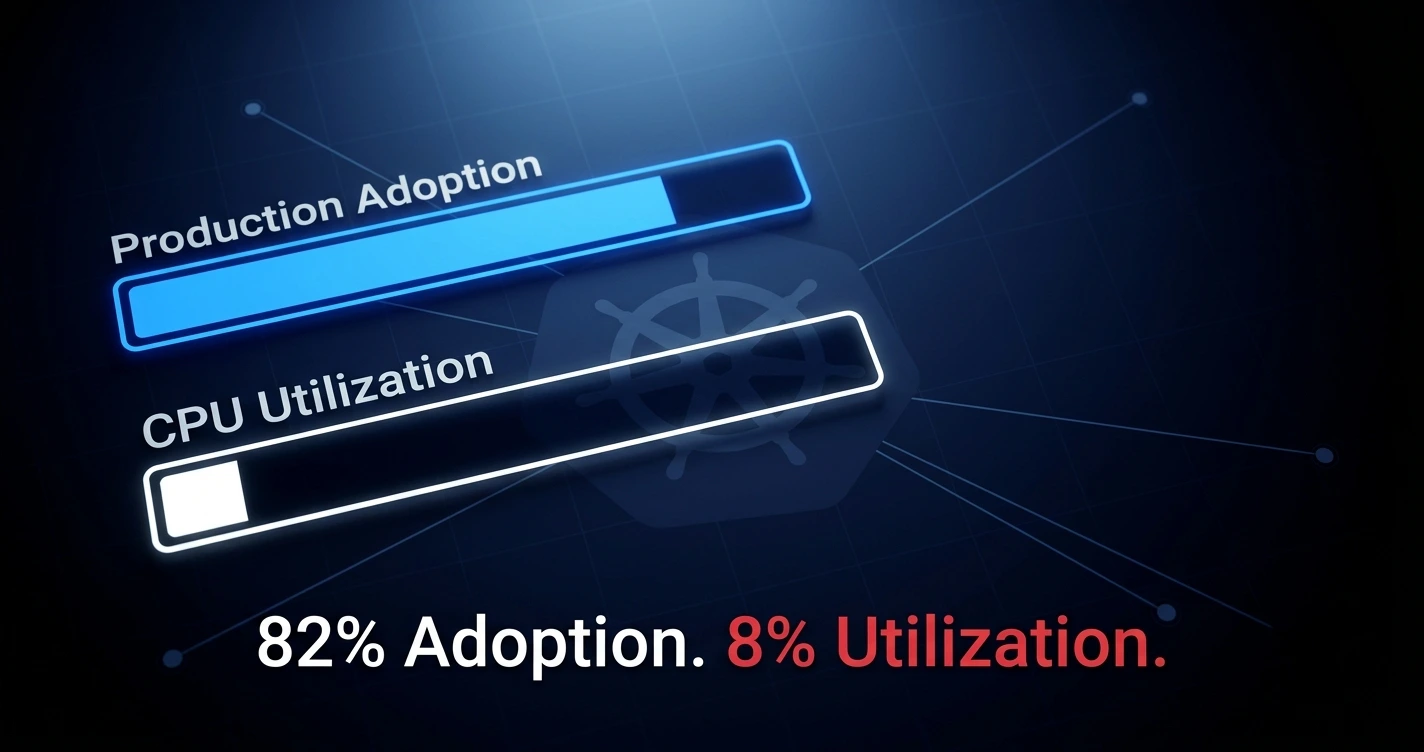
82% of container-running organizations now run Kubernetes in production. 88% of them report rising costs every year. Average CPU utilization sits at 8%. This is the honest state of Kubernetes enterprise production in 2026.
By NeuralWired StaffJune 29, 202615 min read
The Production Paradox
A cryptocurrency exchange gets breached in mid-2025. The attacker doesn’t use a zero-day. No exotic exploit chain. They deploy a malicious pod, steal a service account token, and pivot straight into cloud backend systems. The entire attack hinges on a Kubernetes misconfiguration that’s been documented as a critical risk since 2019. The exchange had been running Kubernetes for three years.
This is what Kubernetes enterprise production actually looks like in 2026. Not the CNCF keynote version. The version where the technology won and the operations didn’t.
According to the CNCF Annual Cloud Native Survey published January 20, 2026, 82% of organizations running containers now run Kubernetes in production. That’s up from 66% in 2023. By almost every measure, Kubernetes has won. It is the de facto operating system for modern enterprise infrastructure, the orchestration layer for 66% of all generative AI inference workloads, and the platform on which 77% of Fortune 100 companies run production systems.
And yet.
88% of enterprise Kubernetes teams report year-over-year TCO increases. Average CPU utilization across production clusters sits at 8%. More than half of enterprise clusters are still “snowflakes” with highly manual operations. Cost has overtaken skills and security as the single biggest Kubernetes challenge.
The container orchestration problem is solved. What replaced it is a cluster of operational, financial, and cultural problems that nobody included in the vendor pitch.
82%
of container users run Kubernetes in production (CNCF, Jan 2026)
average CPU utilization across production clusters (CAST AI, 2026)
5%
average GPU utilization despite premium cost (CAST AI, 2026)
All 14 Problems, Named and Quantified
These aren’t hypothetical edge cases. Every problem below is documented in primary research from Spectro Cloud’s 2025 State of Production Kubernetes (455 professionals across organizations with 250+ employees), the CNCF’s January 2026 survey, CAST AI’s 2026 optimization report, Palo Alto Networks Unit 42, and Sysdig. These are real production clusters, real enterprise teams, real money.
Problem 01
YAML Sprawl and Configuration Entropy
Teams managing hundreds of microservices accumulate thousands of YAML files with no enforced standardization between them. A new engineer joining a three-year-old cluster faces a configuration archaeology project before they can make a safe change. There’s no industry consensus on how to fix this at scale, and Helm charts layer additional complexity on top.
Problem 02
The Snowflake Cluster Problem
Over half of enterprise Kubernetes clusters are still what the industry calls “snowflakes”: clusters so customized through manual operations, one-off patches, and undocumented configuration decisions that no two are alike. Kubernetes promised repeatability. Most organizations haven’t delivered it. The institutional knowledge required to keep these clusters alive lives in the heads of two or three engineers.
Problem 03
Runaway Total Cost of Ownership
Cost has become the defining Kubernetes problem for 42% of organizations, overtaking skills shortage and security for the first time (Spectro Cloud / Adience, 2025). The promise was that containerization and efficient bin-packing would reduce infrastructure spend. What happened instead: platform engineering teams, observability tooling, security scanning, GitOps licenses, and training costs all landed on top of the compute bill, not instead of it.
Problem 04
CPU Overprovisioning at Industrial Scale
Average CPU utilization across production Kubernetes clusters is 8%. That number fell from 10% in 2024. CPU overprovisioning jumped from 40% to 69% in the same period. Organizations are not getting better at running Kubernetes efficiently as they gain experience. They are getting worse, largely because AI and GPU workloads entered clusters that weren’t built for them.
Problem 05
GPU Waste Is a Board-Level Problem Waiting to Happen
GPU nodes cost between 10 and 30 times more per compute unit than CPU. Average GPU utilization in Kubernetes clusters sits at 5%. For any organization running AI inference on Kubernetes, that is the kind of number that surfaces in a CFO conversation about AI ROI and triggers a forced architectural rethink. This is not a future problem. The spend is happening now.
Problem 06
Security Misconfiguration as the Primary Attack Vector
More than 60% of Kubernetes security incidents trace back to misconfigurations, not zero-days. RBAC settings, secrets stored in plaintext ConfigMaps, overprivileged service accounts, and absent network policies are the actual attack surface. The breach detailed in the opening of this article used none of the sophistication that “APT attack” implies. It used a service account token that had been granted more access than it needed.
Problem 07
Container-to-Cloud Attack Escalation
Palo Alto Networks Unit 42 published research in April 2026 documenting how threat actors pivot from a compromised container to full cloud backend access. The North Korean APT group Slow Pisces (also tracked as Lazarus) used exactly this playbook in a 2025 breach of a major cryptocurrency exchange. They didn’t need a kernel exploit. They needed a misconfigured service account.
Problem 08
Upgrade Lag and Version Drift
Kubernetes releases a new minor version every four months. Enterprise compliance cycles, business blackout windows, and the operational overhead of testing upgrades on snowflake clusters mean most organizations are persistently behind. Version drift creates documented security exposure and is on a collision course with emerging EU AI Act governance requirements and SOC 2 Type II controls that will treat undocumented patch lag as an audit finding.
Problem 09
Multi-Cluster Complexity Grows Non-Linearly
The average Kubernetes adopter runs clusters in more than five environments. The operational complexity of managing N clusters is not N times the complexity of one cluster. Every cluster multiplies the number of networking decisions, RBAC configurations, observability integrations, and upgrade cycles. At six-plus clusters, managing the cluster fleet becomes a full-time function that most organizations didn’t staff for when they started.
Problem 10
The Skills Shortage and Retention Crisis
36% of organizations cite lack of Kubernetes training as a significant barrier (CNCF 2025). Experienced Kubernetes engineers command premium compensation and are among the most actively recruited profiles in enterprise infrastructure. The institutional knowledge problem this creates is acute: a two-person team managing a six-cluster production environment represents a single resignation away from an operational crisis.
Problem 11
Cultural Resistance Now Outranks Technical Complexity
For the first time in the CNCF survey’s history, “cultural changes within the development team” (47%) overtook technical complexity as the top barrier to cloud native adoption in 2025. If you’re an engineering leader, this means the bottleneck for Kubernetes ROI in your organization is more likely an organizational change management problem than a technical one. Build the right internal platform and nobody uses it without this piece.
Problem 12
Observability Debt and MTTD Regression
Mean time to detect (MTTD) and mean time to resolve (MTTR) frequently increase after a Kubernetes migration, not decrease, especially in the first 18 months. Finance teams face an additional problem: Kubernetes cost allocation doesn’t map to traditional VM-style billing. Attributing cloud spend to business units or product lines in a shared cluster is a solved problem technically and an unsolved problem organizationally at most companies.
Problem 13
Stateful Workload Complexity
Kubernetes was built for stateless, ephemeral workloads. Databases, message queues, and persistent volumes require backup, disaster recovery, and data consistency guarantees that introduce significant operational complexity. Running stateful workloads in Kubernetes correctly requires Operators, CSI drivers, snapshot management, and replication strategies that most teams underestimate before committing.
Problem 14
AI Workload Infrastructure Drift
Most existing Kubernetes environments were not built for deterministic AI and GPU inference workloads. Mismatched kernels, manual patching cycles, and the accumulated customization of snowflake clusters create “snowflake debt” that compounds directly against the AI infrastructure roadmap. The New Stack and SideroLabs flagged this in February 2026 as the hidden cost of organizations that rush AI workloads into clusters that were never designed for them.
“I think some people hope that AI becomes this magic sauce you can rub on your YAML files and user experience pops out. It’s important that if you’re going to manage these systems, you need to know how they work.”
Kelsey Hightower, Former Distinguished Engineer, Google Cloud Platform, at KubeCon Europe 2026. Source: The New Stack, March 30, 2026
The 8% Utilization Scandal
Let’s sit with that number for a moment. Eight percent average CPU utilization. Across tens of thousands of real production Kubernetes clusters. Data collected by CAST AI from actual workloads running on EKS, GKE, and AKS in 2025.
That means 92% of the CPU capacity organizations are paying for is idle. Not reserved for burst capacity. Not in use. Idle.
And it’s getting worse. In 2024, average CPU utilization was 10%. Overprovisioning has jumped from 40% to 69% in two years. The direction is wrong. Organizations are becoming less efficient at running Kubernetes as the platform matures, not more. The proximate cause is AI workloads entering clusters that weren’t architected for GPU scheduling, combined with teams provisioning conservatively because the cost of getting it wrong (an outage) is higher than the cost of waste (a larger cloud bill).
For large deployments running 1,000 or more nodes, Sysdig estimates the wasted spend on CPU alone can exceed $10 million annually. That’s not a rounding error. That’s a CFO conversation.
Immediate action required: Run a utilization audit using CAST AI, Kubecost, or your cloud provider’s native cost tooling before your next budget cycle. With average CPU at 8%, the probability of finding immediate, material savings in your cluster is high. At $1M or more per year in likely waste for mid-size deployments, this is a conversation that belongs in the CFO’s calendar, not just the SRE team’s backlog.
The GPU problem is structurally worse. GPU nodes cost between 10 and 30 times more per compute unit than CPU. Average GPU utilization in Kubernetes clusters sits at 5%. Most organizations deployed GPU capacity to support AI inference workloads and then discovered that Kubernetes, without specialized scheduling and bin-packing tools, defaults to the same overprovisioning behavior that makes CPU utilization so bad. The result is the most expensive infrastructure in the enterprise sitting 95% idle.
The Security Reality Nobody Talks About
There’s a comfortable assumption in enterprise Kubernetes security: “We’re on EKS/GKE/AKS, so the managed service handles security for us.” This assumption is factually wrong, and it’s the precondition for exactly the kind of attack that cost a crypto exchange its cloud backend in 2025.
Managed Kubernetes services handle control plane security. They patch etcd, harden the API server, and manage the underlying node OS. They do nothing to secure your workloads. RBAC configuration, secrets management, network policies, pod security contexts, and service account permissions are entirely your responsibility. And according to Palo Alto Networks Unit 42’s April 2026 research, more than 60% of Kubernetes security incidents trace back to misconfiguration in exactly these areas.
The Slow Pisces/Lazarus breach is instructive not because it was sophisticated, but because it wasn’t. The threat actors deployed a malicious pod, harvested a service account token that had been granted excessive privileges (a Day 1 Kubernetes security anti-pattern), and used that token to authenticate to cloud backend APIs. The cloud provider’s security controls did exactly what they were supposed to do: they checked the token, found it valid, and granted access.
45% of production container images contained high-severity vulnerabilities in 2025. Most of those images were scanned at build time and passed. The vulnerabilities were introduced by base image updates, dependency drift, and the lag between vulnerability disclosure and image rebuild cycles that exists in most enterprise pipelines. Kubernetes didn’t create this problem, but its ephemeral container model makes it harder to maintain a consistent remediation cadence.
If you haven’t completed a Kubernetes security audit in the last 12 months, your RBAC configurations, service account permissions, and network policies are operating on assumptions that may no longer be valid. This is a real, unquantified breach exposure. The CVE-2025-55182 (React2Shell) vulnerability was being actively exploited in Kubernetes environments within 48 hours of disclosure in December 2025. Organizations that discovered it via their own monitoring had a very different outcome than those that read about it in a vendor email.
“Enterprises are aligning around Kubernetes because it has proven to be the most effective and reliable platform for deploying modern, production-grade systems at scale. This year’s data shows that the next phase of cloud native evolution will be as much about people and platforms as it is about the tech itself.”
Hilary Carter, SVP of Research, Linux Foundation Research. Source: PR Newswire, January 20, 2026
The PaaS-First Counter-Argument Has Economic Teeth
Not everyone is persuaded that Kubernetes is the right answer for most organizations in 2026. A growing practitioner movement is making a specific, economic argument that deserves serious engagement: the default to Kubernetes for new projects is a strategic error for teams that aren’t at Top-100-website scale.
The break-even analysis works like this. Managing a production Kubernetes environment safely requires (at minimum) a dedicated platform engineering function. Three senior SREs at approximately $250,000 loaded cost each equals $750,000 per year in labor. If you’re hosting $60,000 per year in compute on that cluster, you’re paying a 12x cost premium on your infrastructure bill to avoid using a managed platform service. At $20,000 per month in compute, the economics still don’t work. The self-management savings don’t offset the team cost until you’re north of $2.5 million in annual compute spend.
This argument is made explicitly by engineering practitioners at sanj.dev and byteiota.com (both published in 2026) who frame the current moment as an inflection point where the risk has flipped. Platforms like AWS App Runner, Railway, Render, and Fly.io, plus specialized AI inference platforms like Modal and BentoCloud, are capturing workloads that don’t require the full Kubernetes operational overhead. These aren’t toy platforms anymore.
This is not a fringe view. It’s tacitly acknowledged in Kelsey Hightower’s own warnings about scale, reinforced by the FinOps Foundation’s waste data, and supported by the CNCF’s own finding that 47% of organizations cite cultural resistance as the top barrier. If the main thing preventing Kubernetes from delivering ROI is organizational change management, not technical complexity, the PaaS argument becomes: why impose this organizational tax?
Our read: the PaaS-first argument is correct for a specific segment of organizations and will accelerate in the next 18 months as GPU cost pressure makes the utilization numbers impossible to ignore. It does not invalidate Kubernetes for large-scale enterprise environments. It does invalidate the default assumption that Kubernetes is the right starting point for any organization running containers.
What the Winning Teams Actually Do
There’s a meaningful performance gap in the CNCF data between organizations it classifies as “innovators” and “adopters.” The gap isn’t about which Kubernetes version they run or which managed service they use. It’s about two practices that separate operationally mature teams from everyone else.
GitOps as Non-Negotiable Infrastructure
58% of cloud native innovators use GitOps extensively. 23% of adopters do. GitOps isn’t just a deployment pattern. It’s the audit trail, the rollback mechanism, and the institutional knowledge system that makes it possible for any engineer on the team to understand the desired state of the cluster at any given time. Without it, as Hightower noted at KubeCon 2026, you’re automating alerts with no audit trail and no rollback. The self-healing infrastructure that AIOps platforms promise for 2026 depends on GitOps as its foundation. You cannot self-heal a cluster whose desired state lives in someone’s head.
Platform Engineering as a Function, Not a Project
The organizations whose DevOps metrics beat every benchmark are those that centralized application deployment in a dedicated platform engineering function with an internal developer platform (IDP). The Backstage project, now the fifth-most-active CNCF project by velocity, is the open-source IDP foundation that leading teams build on. The IDP abstracts Kubernetes complexity away from application developers. It gives them a self-service interface for deployments, environment management, and observability without requiring them to understand pod scheduling or CNI networking.
If you don’t have this function, you’re in the majority. Over half of enterprise clusters are still snowflakes. Being in the majority is not the same as being on the right side of the performance gap.
The Upgrade Cadence Discipline
Winning teams treat Kubernetes upgrades as a routine, automated operational function rather than a high-stakes manual project. This requires investment in cluster automation, canary upgrade testing, and GitOps-driven rollback capability. The organizations that do this aren’t upgrading because they love changelog reading. They’re upgrading because they recognize that every minor version behind the current release represents documented, quantifiable security exposure that will eventually show up on a compliance audit or an incident report.
“Five years in, Kubernetes is no longer an experiment. It’s mission-critical infrastructure. The companies that master scale and complexity fastest will create an unbeatable platform for innovation.”
Tenry Fu, Co-founder and CEO, Spectro Cloud. Source: BusinessWire, August 4, 2025
Metric
Kubernetes “Innovators”
Kubernetes “Adopters”
GitOps usage (extensive)
58%
23%
Internal Developer Platform
Majority deployed
Minority deployed
Snowflake clusters
Minority
Majority (>50%)
Security audit frequency
Continuous / quarterly
Ad hoc / annual
Upgrade cadence
Automated / regular
Manual / deferred
FAQ: Kubernetes Enterprise Production 2026
What are the biggest challenges of running Kubernetes in production in 2026?
The biggest challenges are rising TCO (88% of enterprises report year-over-year cost increases), security misconfigurations (responsible for over 60% of incidents), snowflake cluster proliferation, skills shortages, and GPU and CPU resource waste. Average CPU utilization sits at just 8% across production clusters. Source: Spectro Cloud 2025 State of Production Kubernetes, CNCF January 2026 survey.
Is Kubernetes worth it for enterprise in 2026?
Kubernetes delivers ROI for enterprises spending at least $2.5 million annually on raw compute, with dedicated platform engineering teams and GitOps workflows in place. For organizations below that compute threshold, the operational overhead of three senior SREs at $750,000 loaded cost per year frequently exceeds savings. 77% of Fortune 100 companies run it in production, but the economics differ materially at mid-market scale.
How much does Kubernetes waste in cloud resources?
Significantly. The average Kubernetes cluster operates at only 8% CPU utilization and 20% memory utilization. CPU overprovisioning stands at 69% in 2026. GPU utilization averages 5% despite a 10 to 30 times cost premium per compute unit. For large deployments with 1,000 or more nodes, wasted CPU spend alone can exceed $10 million annually. Source: CAST AI 2026 State of Kubernetes Optimization Report.
What percentage of companies use Kubernetes in production in 2026?
82% of organizations running containers use Kubernetes in production, per the CNCF Annual Cloud Native Survey published January 20, 2026. This is up from 66% in 2023. An additional 13% are in active pilot or evaluation phases. 79% of those production users run managed services (EKS, GKE, AKS) rather than self-managed clusters.
What are the most common Kubernetes security risks in production?
RBAC misconfigurations, overprivileged service accounts, secrets stored in plaintext ConfigMaps, exposed API servers, and missing network policies are the primary risks. Over 60% of Kubernetes security incidents trace to misconfigurations rather than zero-day vulnerabilities. In 2025, a North Korean APT group used an overprivileged service account token to breach a major cryptocurrency exchange. Source: Palo Alto Networks Unit 42, April 2026.
What is the Kubernetes TCO problem?
Kubernetes total cost of ownership extends well beyond compute to include platform engineering labor, observability tooling, security scanning, FinOps tooling licenses, upgrade cycles, and ongoing training. 88% of enterprise teams report year-over-year TCO increases, and cost has overtaken skills and security as the primary Kubernetes challenge for 42% of organizations. Source: Spectro Cloud State of Production Kubernetes 2025.
What is replacing Kubernetes in 2026?
Nothing replaces Kubernetes at large enterprise scale, but a PaaS-first movement is gaining traction for teams spending under approximately $2.5 million annually on compute. AWS App Runner, Railway, Render, Fly.io, Modal, and BentoCloud are capturing workloads that don’t require full Kubernetes operational overhead. Kubernetes remains the standard for large-scale, multi-service enterprise environments running complex or AI-heavy workloads.
Why do so many Kubernetes clusters have low utilization?
The core reason is conservative overprovisioning. Engineers provision excess CPU and memory because the cost of under-provisioning (an outage or performance degradation) is immediately visible, while the cost of overprovisioning (waste) lands on a cloud bill that finance teams often can’t attribute at the service level. AI and GPU workloads entering clusters not designed for them have accelerated this trend significantly since 2024.
Where This Goes in the Next 12 Months
Kubernetes enterprise production in 2026 sits at a specific kind of inflection point. The technology is mature. The adoption curve is approaching saturation. What hasn’t matured is the operational discipline required to extract value from it at scale.
Three forces will define the next 12 months.
GPU waste will trigger executive intervention. With AI infrastructure ROI now a board-level conversation and average GPU utilization at 5%, CFOs who find out how much compute their AI workloads are burning will force architectural decisions that many engineering teams are not yet prepared for. Organizations that have already implemented Kubernetes GPU scheduling optimization (using tools like the NVIDIA GPU Operator with proper bin-packing policies) will have a defensible answer. Those that haven’t will be having a different kind of conversation.
A high-profile Kubernetes breach will change the security conversation. The 2025 Lazarus attack hit a crypto exchange. The next high-profile RBAC misconfiguration breach will likely involve a publicly traded company. When it does, audit committees and boards will ask questions that most CISO teams aren’t currently prepared to answer about Kubernetes security posture. Organizations that have completed a comprehensive RBAC and container security audit will be in a substantially different position than those operating on inherited configurations.
Platform engineering will separate enterprise performance tiers. The data already shows this. Organizations with internal developer platforms and extensive GitOps adoption are definitively in a different performance category from those still managing snowflake clusters manually. This gap will widen as AI workloads require more deterministic, well-configured infrastructure to deliver consistent inference performance.
Three things to act on now. First, run a CPU and GPU utilization audit. With average utilization at 8% and 5% respectively, the probability of immediate, material savings is high. Second, conduct a Kubernetes RBAC review. If you can’t tell in 30 minutes which service accounts have cluster-admin privileges and why, you have an unquantified breach exposure. Third, evaluate whether your organization actually meets the compute threshold ($2.5M annually) where self-managed Kubernetes makes financial sense. If it doesn’t, the PaaS-first argument deserves serious consideration before your next infrastructure commitment.
Kubernetes won. What it created in winning is a set of operational, financial, and security problems that are now more consequential than the container orchestration problem it solved. The organizations that close that gap in the next 12 months will have a structural platform advantage that compounds. The ones that don’t will spend the next 18 months explaining cost overruns and missed AI deployment timelines to people who stopped caring about the technical reasons.
Stay ahead of enterprise infrastructure shifts
The Neural Loop is NeuralWired’s weekly briefing on the technology decisions that matter most to engineering leaders. No noise. No vendor PR. Just the analysis your team needs.
Subscribe to The Neural Loop
IBM’s Quantum Roadmap Gives Enterprises a 4-Year Window to Act on Post-Quantum Migration
By NeuralWired Editorial | June 29, 2026 | 12 min read
Your organization’s most sensitive encrypted data, customer records, financial transactions, intellectual property, could already be sitting in an adversary’s archive. It was captured yesterday. It will be decrypted in 2029, or 2031, or 2033. The exact date is uncertain. What is not uncertain is that the migration away from today’s encryption standards takes 42 to 54 months once an organization actually starts. And fewer than 5% of enterprises have started.
IBM’s quantum computing roadmap, Google’s dramatic security warning published March 25, 2026, and a new research paper that cut prior qubit estimates by a factor of 20 have together shifted this conversation from theoretical risk management to operational urgency. This article breaks down exactly what has changed, what the NIST post-quantum cryptography standards require, and what a CISO or CTO at an enterprise organization needs to do before the end of 2026.
The Real Threat Is Not the Qubit Count
When IBM announced Condor, its 1,121-superconducting-qubit processor, in December 2023, it made headlines. The 1,000-qubit barrier was crossed. But fixating on that number misses the actual story of 2026, which is about timelines, compliance clocks, and a harvest-now-decrypt-later threat that is already happening.
Qubit counts alone do not break encryption. What matters is logical qubits, fault-tolerant gates, and error correction at scale. IBM’s own engineers recognize this: after Condor, the company shifted its focus from raw qubit counts toward error resistance. State-of-the-art error correction currently requires roughly 1,000 physical qubits per logical qubit, which explains why the cryptographically relevant threshold is still years away from Condor’s 1,121 physical qubits.
Key Distinction
A 1,000-qubit quantum computer does not break RSA-2048 today. Breaking RSA-2048 likely requires around one million physical qubits running for approximately a week, based on Google’s latest research estimates. The urgency is about migration timelines, not imminent decryption.
The actual story of 2026 is that organizations which have not started post-quantum cryptography migration will mathematically fail to meet regulatory deadlines. That is the operational reality driving this article.
What IBM’s Quantum Roadmap Actually Says
IBM has published a detailed hardware roadmap that provides the clearest public signal of where quantum capability is heading and on what schedule.
Year
IBM Milestone
Key Capability
2023
Condor (1,121 qubits)
First processor crossing 1,000 physical qubits
2026
Kookaburra (1,386 qubits, multi-chip)
Three chips linked via IBM Quantum System Two, yielding a 4,158-qubit combined system
2028-2029
IBM Quantum Starling
Fault-tolerant system with roughly 200 logical qubits from approximately 10,000 physical qubits; 100 million gate operations
2029
Near-term quantum advantage tools
IBM targets delivery of tools for near-term quantum advantage by end of 2026, first large-scale fault-tolerant machine by 2029
The Kookaburra milestone in 2026 is significant not for its qubit count alone but for the multi-chip architecture. Linking processors is how IBM intends to scale toward the hundreds of logical qubits needed for cryptographically relevant computation. Every step on this roadmap narrows the gap between current machines and the systems that security teams are building their migration timelines around.
Our read IBM’s pivot from qubit maximalism to error-correction depth signals something important: the people closest to the hardware believe the engineering path to fault tolerance is now a matter of execution, not discovery. That is a different kind of confidence than the field had three years ago.
Google’s 2029 Alarm and What It Means for You
On March 25, 2026, Google’s security leadership published a formal announcement setting 2029 as the company’s internal deadline to secure its systems against quantum threats using post-quantum cryptography. The post was authored by Heather Adkins, VP of Security Engineering, and Sophie Schmieg, Senior Staff Cryptography Engineer. This is a full year ahead of NIST’s 2030 deprecation date and six years ahead of the 2035 final federal deadline under NSM-10.
Five days later, on March 30, 2026, Google Quantum AI released a 57-page paper with researchers from the Ethereum Foundation and Stanford University. The finding that drew immediate industry reaction: breaking 256-bit elliptic curve cryptography, the algorithm protecting Bitcoin and Ethereum, would require fewer than 500,000 physical qubits. That is nearly a 20-fold reduction from prior best estimates.
“It’s a real shock. We’ll need to speed up our efforts considerably.”
Bas Westerbaan, Applied Cryptography Lead, Cloudflare — TIME magazine, April 2026
Cloudflare accelerated its own post-quantum deadline to 2029 within days of the paper’s release. Westerbaan’s reaction is worth sitting with. Cloudflare processes a significant share of global internet traffic. When its cryptography lead describes a research paper as “a real shock,” that is not public relations language. That is a practitioner recalibrating a production timeline based on new data.
Google also announced that Android 17 is integrating post-quantum cryptography digital signature protection using ML-DSA, building on existing Chrome support. Our read this signals that PQC is no longer a future feature on Google’s roadmap. It is shipping code.
The Compliance Deadline Ladder: 2027 to 2035
The regulatory framework for post-quantum cryptography migration in the United States is built on NSM-10, the NSA’s CNSA 2.0 suite, and Executive Order 14144. Enterprises serving federal clients, contractors, and financial institutions with ties to regulated sectors need to treat this schedule as binding, not aspirational.
Deadline
Requirement
Who It Affects
Jan 1, 2027
All new National Security System acquisitions must support CNSA 2.0
Government contractors, defense suppliers, NSS vendors
Dec 31, 2030
Equipment unable to support CNSA 2.0 must be phased out; NIST deprecates RSA/ECC
All federal agencies, regulated critical infrastructure
Dec 31, 2031
CNSA 2.0 becomes mandatory across all National Security Systems (except exemptions)
NSS operators, contractors
2033
OS, cloud services, and custom applications must reach exclusive CNSA 2.0 use
Full quantum resistance required across all National Security Systems per NSM-10
Entire US national security supply chain
The January 2027 deadline for new NSS acquisitions is the one that commercial enterprises should pay attention to first, even if they are not themselves defense contractors. When government procurement requirements shift, vendor product roadmaps shift with them. Any software company, hardware manufacturer, or cloud provider that wants to remain in the government supply chain will need CNSA 2.0 support in new products by January 2027. That cascades into commercial product decisions within 12 to 18 months of announcement.
Procurement Action
CTOs should begin requiring CNSA 2.0 and post-quantum cryptography readiness clauses in vendor contracts now. The January 2027 government deadline will reshape commercial vendor roadmaps whether or not your organization is regulated. Get ahead of it in your next contract renewal cycle.
The Enterprise Readiness Gap Is Alarming
The data on enterprise preparedness is consistently grim across every survey and research source published in the past 12 months. The gap between awareness and action is wide enough to be a material risk that boards and audit committees should be asking about.
<5%
of enterprises have a formal quantum-transition plan (arXiv, September 2025)
69%
believe quantum will break current encryption within 5 years (DigiCert/Propeller Insights survey, 1,042 senior security managers)
41%
of organizations do not plan to address quantum computing at this time (ISACA 2025)
The DigiCert survey finding is particularly striking. Sixty-nine percent of senior cybersecurity managers believe quantum computers will break current encryption within five years. Only 19.2% describe themselves as “extremely prepared.” The gap between what people believe is coming and what they are doing about it is not a knowledge problem. It is an organizational inertia problem.
Scott Aaronson, Schlumberger Centennial Chair of Computer Science at the University of Texas at Austin and a newly elected member of the US National Academy of Sciences, offered the sharpest framing of this inertia in a PYMNTS interview in February 2026:
“The time to start thinking about migrating to quantum-resistant methods of encryption is now. Even optimistic estimates place practical quantum attacks five to ten years out, but the migration itself, not the threat, is the actual bottleneck for large institutions.”
Scott Aaronson, Schlumberger Centennial Chair of Computer Science, University of Texas at Austin — PYMNTS, February 20, 2026
Aaronson matters here for a specific reason. He has spent more than a decade as quantum computing’s most prominent skeptic, the researcher other researchers cite when they want to explain why hype outruns reality in this field. His May 1, 2026 blog post, titled “Will You Heed My Warnings?”, noted that some of the most reputable people in quantum hardware and error correction now believe a fault-tolerant, cryptographically relevant quantum computer “ought to be possible by around 2029.” His words, not a breathless press release.
Banking and telecom lead enterprise sectors in preparedness, with 45 to 47% of respondents in those sectors having budgeted and planned for near-term post-quantum cryptography transition. Every other sector is significantly behind.
The CTO Action Plan: What to Do in the Next 90 Days
The migration timeline math is straightforward and unforgiving. Enterprise PQC migrations realistically take 42 to 54 months from the moment an organization is properly resourced and underway. An organization that has not started a cryptographic inventory by the end of 2026 will struggle to hit NIST’s 2030 deprecation date. An organization that has not started by mid-2026 has already put Google’s 2029 internal deadline out of reach.
Step One: Cryptographic Asset Inventory
Every major guidance document from NIST, Capgemini, and Fortinet identifies this as the step that enterprises consistently skip or underestimate. You cannot migrate what you have not mapped. This means cataloguing every certificate, SSH key, code-signing key, embedded cryptographic algorithm in firmware and IoT devices, and any third-party library that handles encryption. For most large enterprises, this inventory alone takes three to six months.
This is the present-tense risk that gets underweighted because its consequences are future-tense. Nation-state adversaries are capturing encrypted traffic now and storing it for future decryption. Any data with a confidentiality shelf-life beyond approximately seven to eight years is already exposed if it is encrypted with RSA or ECC today. That includes healthcare records, defense contracts, M&A negotiations, and anything classified at the top end of most organizations’ data hierarchies. Prioritize migration of those data classes first.
Step Three: Pilot NIST-Standardized Algorithms Now
NIST finalized its first three post-quantum cryptography standards in August 2024: FIPS 203, FIPS 204, and FIPS 205. These are not draft standards. They are ready for implementation. IBM’s z16 mainframe already includes hardware acceleration for post-quantum algorithms. Microsoft has published a detailed migration roadmap targeting full PQC transition by 2033, with core infrastructure migration beginning in 2026. Use these as benchmarks and start pilot deployments in lower-risk environments this quarter.
Step Four: Update Procurement Requirements
Begin requiring CNSA 2.0 and PQC readiness clauses in vendor contracts on renewal. Build a vendor questionnaire that asks suppliers to disclose their own PQC migration plans, target dates, and which NIST-standardized algorithms their products will support and when. The January 2027 government procurement deadline will accelerate commercial vendor timelines regardless; getting this into your contracts now creates leverage and accountability.
Complete cryptographic asset inventory across all systems, firmware, and third-party libraries
Identify all data with confidentiality requirements beyond 7 years and prioritize for immediate migration planning
Pilot FIPS 203, 204, or 205 in at least one production-adjacent environment before Q4 2026
Add PQC readiness requirements to vendor contract renewals starting this quarter
Establish a crypto-agility architecture so algorithm replacement does not require full system rebuilds
Present quantum readiness status to the board or audit committee with a formal risk register entry
The Skeptic’s Case: Why 2029 Might Be Too Early
Any responsible analysis of this topic needs to include the genuine scientific minority view, and not as a dismissal of urgency but as a calibration of certainty.
Gil Kalai, a mathematician at Hebrew University of Jerusalem and one of quantum computing’s most technically rigorous skeptics, has published conjectures arguing that fundamental noise correlations in highly entangled quantum systems may make fault-tolerant quantum computing impossible, not merely difficult. His argument is not that the engineering is hard. It is that correlated errors in large quantum systems may violate assumptions that fault-tolerance proofs rely on. This is an unresolved scientific dispute, not a fringe view.
RAND Corporation’s institutional assessment places cryptanalytically relevant quantum computers in “at least the 2030s,” and RAND explicitly warns policymakers against messaging that suggests such computers could already secretly exist. A hostile actor running a cryptographically relevant quantum computer against unsuspecting victims undetected for years is, in RAND’s assessment, highly unlikely.
Even Craig Gidney, the Google researcher whose work contributed to the March 2026 ECC paper, has described the probability of a cryptographically relevant quantum computer by 2030 at roughly 10%, characterizing that level as “unacceptably high” rather than likely. Google’s 2029 internal deadline is a risk management decision at 10% probability, not a forecast that Q-Day happens in 2029.
Calibration Note
The correct framing is not “quantum computers will break encryption by 2029.” It is “the risk is high enough by 2029 that Google, Cloudflare, and Scott Aaronson now treat 2029 as the responsible deadline for completing migration, regardless of whether Q-Day arrives that early.” That is a different claim, and it supports the same action.
The practical upshot: whether Q-Day lands in 2029, 2032, or 2037, the migration timeline of 42 to 54 months means the decision about when to start is already overdue for most enterprises. The uncertainty about the threat date does not reduce urgency. It increases it, because organizations betting on the later end of the range are taking on risk they cannot adequately price.
FAQ: Post-Quantum Cryptography Migration
When will quantum computers break encryption?
Expert consensus places Q-Day, the point at which quantum computers can break RSA and ECC encryption, in the early-to-mid 2030s. However, Google and Scott Aaronson have identified 2029 as an accelerated risk window based on recent hardware progress and revised qubit estimates. This is not a prediction of Q-Day in 2029; it is a risk-management threshold that justifies completing migration before that year.
What is harvest now, decrypt later?
It is an adversarial strategy where encrypted data is intercepted and stored today with the intent to decrypt it once a sufficiently powerful quantum computer exists. Any organization whose data carries confidentiality requirements beyond seven to eight years should treat this as a current-tense risk, not a future one. Nation-state actors with long planning horizons are the primary concern.
What is CNSA 2.0 and when does it apply?
CNSA 2.0 is the NSA’s Commercial National Security Algorithm Suite, the successor to CNSA 1.0. It mandates quantum-resistant algorithms for federal national security systems. New NSS acquisitions must support CNSA 2.0 from January 1, 2027. CNSA 2.0 becomes mandatory across all National Security Systems by December 31, 2031, with full quantum resistance required by 2035 under NSM-10.
Which NIST post-quantum cryptography standards should enterprises implement?
NIST finalized three standards in August 2024: FIPS 203 (ML-KEM, for key encapsulation), FIPS 204 (ML-DSA, for digital signatures), and FIPS 205 (SLH-DSA, a stateless hash-based signature scheme). These are production-ready and should be piloted in enterprise environments now, with deployment priority given to systems handling long-shelf-life confidential data first.
How many enterprises have a quantum readiness plan?
Fewer than 5% of enterprises currently have a formal quantum-transition plan, according to a peer-reviewed arXiv survey published in September 2025. Separately, ISACA’s 2025 poll found that 41% of organizations do not plan to address quantum computing at this time, and 37% have not discussed it internally at all.
How long does post-quantum cryptography migration take for a large enterprise?
Realistically, 42 to 54 months from the moment an organization is properly resourced and underway. The cryptographic asset inventory phase alone typically takes three to six months. An organization that has not started by the end of 2026 faces serious risk of failing to meet the NIST 2030 deprecation deadline, even if it begins in January 2027.
What You Know Now That Most Organizations Don’t
IBM’s quantum hardware roadmap, Google’s accelerated 2029 internal deadline, and a research paper that cut the qubit threshold for breaking elliptic curve cryptography by a factor of 20 have together changed the calculus of this field in the first half of 2026. The story is not that a quantum computer has broken encryption. It is that the organizations responsible for the internet’s security infrastructure are treating 2029 as the prudent completion date for post-quantum migration, and fewer than 5% of enterprises have a plan.
In the next 6 to 18 months, expect three things. First, government contractor compliance pressure from the January 2027 CNSA 2.0 acquisition deadline will cascade into commercial vendor roadmaps, making PQC readiness a de facto procurement requirement across more of the market than current regulations technically require. Second, more industry practitioners will follow Cloudflare and Google in publicly accelerating their timelines, creating reputational and audit risk for organizations that have not started. Third, cyber insurance underwriters and financial regulators will begin asking formal questions about quantum readiness in the same way they now ask about multi-factor authentication.
Three specific things to watch: the release of IBM’s Quantum Starling technical specs when they arrive in late 2028, NIST’s progress on IR 8547 (which addresses transitioning from currently deployed algorithms), and whether the EU’s regulatory framework develops parallel quantum-resistance mandates timed to the 2025 to 2030 NIS2 implementation period.
The organizations that complete post-quantum cryptography migration before Q-Day is demonstrably close will not win prizes. They will simply avoid the ones that do not.
Stay Ahead of What’s Coming
Get NeuralWired’s weekly briefing on quantum computing, enterprise security, and the technology decisions that matter for CTOs and CISOs.
Subscribe to The Neural Loop
AI · June 29, 2026 · NeuralWired Research Desk · 9 min read
OpenAI’s Jalapeño Chip: Inside Sam Altman’s $34B Survival Bet
OpenAI just became a chipmaker, and the math explains why. On June 24, 2026, Sam Altman’s company unveiled Jalapeño, its first custom AI inference chip, built with Broadcom (NASDAQ: AVGO) and manufactured on TSMC’s 3 nanometer process. The timing is not a coincidence. OpenAI spent $34 billion in 2025 to generate just $13.07 billion in revenue, a $20.92 billion operating loss that landed in audited financials leaked and verified by the Financial Times just weeks before this launch. Jalapeño is the company’s answer to a question investors keep asking ahead of its IPO: can OpenAI ever stop bleeding money on every single ChatGPT reply?
This isn’t a side project. It’s a hardware bet that touches Sam Altman, Greg Brockman, Broadcom CEO Hock Tan, and a Nvidia relationship that suddenly looks a lot more complicated.
What is the OpenAI Jalapeño chip? Jalapeño is OpenAI’s first custom AI inference chip, unveiled June 24, 2026 and co-developed with Broadcom. It is purpose-built to run large language models like ChatGPT and Codex more cheaply than renting Nvidia GPUs, and is not designed for training AI models.
Why OpenAI Suddenly Needed Its Own Chip
Every time someone sends a ChatGPT message, a server somewhere runs an “inference” pass, a single pass of a massive model generating a response token by token. Training a model happens occasionally. Inference happens constantly, hundreds of millions of times a day, and at OpenAI’s scale that workload has become the company’s single largest operating expense.
The audited 2025 numbers, reported by MLQ News, show just how steep that cost has become. OpenAI’s revenue jumped 253% year over year to $13.07 billion, which sounds like a win until you see the other side of the ledger: $34 billion in total costs, $19.18 billion of that in R&D alone, and $17.2 billion paid to Microsoft for compute and research support in a single year.
“The hardware press covered it as a shot across Nvidia’s bow. That framing misses the actual story. The real story is about unit economics so broken they were threatening OpenAI’s survival.” — Noah Bean, Independent Technical Analyst, via Medium
Renting general-purpose Nvidia GPUs for a workload that is memory-bound, sequential, and repetitive is, in plain terms, an expensive way to do a narrow job. That gap between what GPUs were built for and what LLM inference actually needs is the entire reason Jalapeño exists.
What Jalapeño Actually Is
Jalapeño is what’s known as an ASIC, an Application-Specific Integrated Circuit. Unlike a Nvidia GPU, which is built to handle a wide range of parallel computing tasks, Jalapeño was designed from a blank slate to do one job: run inference for large language models like GPT-5.3 and Codex as efficiently as physically possible. OpenAI is calling it an “Intelligence Processor.”
It was manufactured on TSMC’s 3 nanometer process and measures roughly 840mm², which puts it near the absolute physical limit of what current chipmaking equipment can produce in a single die. Broadcom contributed silicon implementation and its Tomahawk networking technology, letting thousands of Jalapeño chips function as one unified system, while manufacturing partner Celestica handles the racks and board integration that get the chips into data centers.