AI Regulation USA 2026: Federal vs. State Law, Key Deadlines & What Businesses Must Do Now
NeuralWired
AI Policy & Regulation
AI Regulation USA 2026
The US Has No Federal AI Law. Here’s What That Means for Your Business Right Now.
From Executive Order 14365 to Colorado’s legal collapse, the complete guide to AI regulation in America in 2026 and the compliance decisions you can’t afford to delay.
By NeuralWired StaffLast Updated: June 4, 202612 min read
On April 24, 2026, the United States Department of Justice did something it had never done before. It filed a complaint intervening in a lawsuit targeting a state AI law, siding with Elon Musk’s xAI against the state of Colorado. Three days later, a federal judge stayed enforcement of Colorado’s landmark AI consumer protection law. By May 14, the law was effectively gutted and replaced.
If you needed a single moment to understand the chaos defining AI regulation in the USA in 2026, that’s it. The most consequential AI law ever passed by a US state collapsed in the span of five weeks. And it collapsed not because of a legislative vote but because of a lawsuit, a federal intervention, and a governor who blinked.
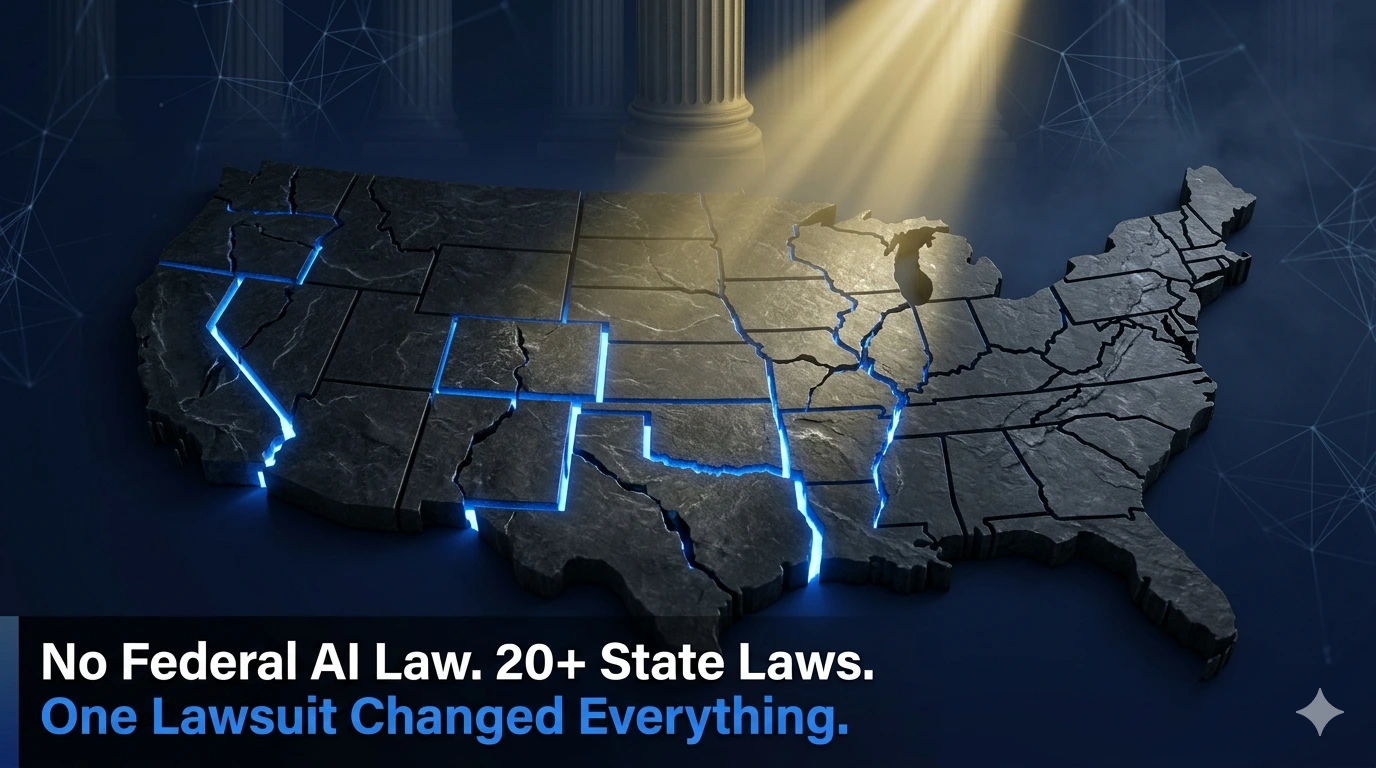
The story of American AI regulation right now is a story of extraordinary regulatory velocity with no clear destination. More than 1,200 AI bills have been introduced across US states. Over 20 states have enacted specific AI legislation. And yet, as of mid-2026, there is no comprehensive federal AI statute in force. Not one.
This guide cuts through the noise. Whether you’re a policy professional mapping your organization’s exposure, a C-suite executive deciding how much to spend on AI governance, or an AI developer trying to understand which product decisions now carry legal liability, everything you need is here.
Is There a Federal AI Law in the United States?
Direct Answer
No comprehensive federal AI law exists in the US as of mid-2026. President Trump signed Executive Order 14365 in December 2025 establishing a national AI policy framework, and the White House released non-binding legislative recommendations in March 2026. Congress has not enacted a binding federal AI statute.
The absence of a federal statute isn’t a technicality. It’s the defining feature of the current landscape. Without a federal law, state laws fill the vacuum, creating a patchwork of compliance obligations that differ by jurisdiction, sector, and use case. Companies operating AI systems in employment, lending, healthcare, or housing face real legal exposure today, under laws that are already in force.
Congress has tried. Three times. The Cruz moratorium failed 99 to 1. The NDAA preemption language was stripped out entirely. The TRUMP AMERICA AI Act remains a discussion draft. The White House Framework is advisory. None of it has become law.
What has become law are state-level statutes, and those are the ones compliance teams need to be tracking right now.
Executive Order 14365: The Federal-State War Begins
On December 11, 2025, President Trump signed Executive Order 14365, formally titled “Ensuring a National Policy Framework for Artificial Intelligence.” Published in the Federal Register at 90 Fed. Reg. 58499, it is the most consequential single action the administration has taken on AI governance, and it set the terms of every battle that followed.
The core move: establish a “minimally burdensome national policy framework” for AI and direct the DOJ to create an AI Litigation Task Force within 30 days, specifically to challenge state AI laws in federal court. That task force was operational by January 10, 2026.
The EO also directed the Secretary of Commerce to publish a comprehensive review of existing state AI laws by March 11, 2026, and directed the FTC to issue a policy statement classifying state-mandated AI bias mitigation as a per se deceptive trade practice. It even conditioned certain federal broadband funding on states pausing enforcement of AI statutes that conflict with the order.
What’s Exempt
The EO includes explicit carve-outs: child safety protections, AI compute and data center infrastructure, state government procurement, and other categories designated in future determinations are expressly excluded from preemption. That nuance matters for compliance planning.
The practical effect: the federal government is now actively litigating to dismantle state AI regulation, not just threatening to. The DOJ’s April 2026 intervention in the xAI-Colorado case was the first concrete exercise of that power. It won’t be the last.
Our Read
EO 14365 is the policy equivalent of pulling the fire alarm before deciding where the exits are. It signals a clear intent to dominate AI governance at the federal level. But with no federal statute to replace what it’s preempting, it creates a governance vacuum the administration seems to be betting Congress will fill. Congress, so far, hasn’t.
The White House National AI Policy Framework: 27 Recommendations, Zero Binding Law
On March 20, 2026, the Office of Science and Technology Policy released the White House National Policy Framework for Artificial Intelligence. Prepared with AI and Crypto Special Advisor David Sacks, the document runs four pages and contains 27 legislative recommendations to Congress.
Four pages. Twenty-seven recommendations. No enforcement mechanism. No budget authority. No regulatory teeth.
The framework’s core objective is a unified federal AI law that broadly preempts conflicting state AI laws. Its eight policy areas cover child safety, consumer protection, data center energy costs, national security, intellectual property, free speech, innovation, and workforce development. It calls on Congress to limit states’ ability to regulate AI model development and to restrict liability on AI developers for unlawful conduct carried out by third parties.
Key Point
The Framework is non-binding. It is an advisory document expressing the administration’s legislative agenda. Until Congress acts, it changes nothing about existing legal obligations under state law.
Read it as a negotiating floor. Every policy professional testifying before a Congressional committee in 2026 needs to understand these 27 recommendations in detail because they define what the administration will and won’t accept in any legislative deal.
The TRUMP AMERICA AI Act: The Most Ambitious Federal AI Bill Yet
Two days before the White House Framework dropped, Senator Marsha Blackburn (R-TN) released a 291-page discussion draft that made the Framework look like a memo.
The TRUMP AMERICA AI Act (full name: “The Republic Unifying Meritocratic Performance Advancing Machine Intelligence by Eliminating Regulatory Interstate Chaos Across American Industry Act”) is the most comprehensive federal AI legislation ever proposed in the United States. It’s also, as of this writing, not formally introduced as legislation and faces opposition from both tech companies and progressive advocacy groups.
What the Bill Would Actually Do
The provisions that matter most to businesses and developers:
Duty of Care for AI Chatbot Developers: Establishes a legal standard requiring “reasonable care in the design, development, and operation” of AI chatbots to prevent foreseeable harms. The FTC would promulgate minimum safeguards for compliance.
Copyright Bombshell: Explicitly states that unauthorized reproduction of copyrighted works for AI training is NOT fair use under the Copyright Act. This provision alone could retroactively expose every major LLM developer to significant liability.
Section 230 Sunset: Sunsets Section 230 liability protections two years after enactment. Every AI-embedded platform would need to rethink its liability structure.
NO FAKES Act Provisions: Establishes liability for unauthorized use of a person’s name, image, or likeness.
Labor Transparency: Requires public and private companies to submit quarterly reports to the Department of Labor on AI-related job displacement.
NAIRR: Establishes the National Artificial Intelligence Research Resource.
“Instead of pushing AI amnesty, President Trump rightfully called on Congress to pass federal standards and protections to solve the patchwork of state laws that has hindered AI innovation.”
Sen. Marsha Blackburn (R-TN), Sponsor of the TRUMP AMERICA AI Act, April 22, 2026
The bill has bipartisan elements, specifically on child safety and copyright protection. But it faces a fundamental tension: it simultaneously wants to deregulate AI at the state level and impose significant new federal obligations on AI developers. That contradiction is the reason it remains a discussion draft.
State AI Laws Already in Force in 2026
While the federal debate plays out in Congressional hearings and policy documents, state laws are on the books and enforced (or in Colorado’s case, recently contested). Here’s what’s active right now.
California: Four Laws, One Compliance Deadline You Can’t Miss
California moved faster and further than any other state. As of January 1, 2026, three laws are in effect:
Law
What It Requires
Who It Affects
SB 53 (Frontier AI Transparency Act)
Frontier AI developers must publish safety-related information
Frontier AI developers
AB 2013 (Training Data Transparency)
Post training data documentation publicly on your website
Any generative AI developer
SB 942 (AI Content Provenance)
Latent disclosure in all AI-generated images, video, and audio
Covered AI content providers
ADMT Regulations
Governs AI that substantially replaces human decision-making on significant decisions
Any business using AI in hiring, lending, healthcare, housing, or education. Compliance required by January 1, 2027.
Action Required Now
If you developed a generative AI system and you don’t have training data documentation posted on your website, you are already in violation of California AB 2013. The law has been in effect since January 1, 2026. The same applies to AI-generated content without provenance disclosures under SB 942.
Texas: RAIGA
Texas’s Responsible AI Governance Act (RAIGA) took effect January 1, 2026. It imposes obligations related to AI use in employment, healthcare, and other sectors. For any company operating AI decision systems in Texas, RAIGA is in your compliance scope today.
Illinois
Illinois enacted significant AI legislation that took effect January 1, 2026, adding another jurisdiction to the multi-state compliance map that any nationally operating AI company now has to navigate.
Colorado’s AI Act: From the Most Ambitious State Law to Legal Defeat
Colorado’s story is the clearest illustration of where the federal-state conflict over AI regulation is heading, and how fast things can move.
May 2024
Colorado SB 24-205 Signed
Governor Polis signs the Consumer Protections for AI Act. Originally set for February 1, 2026, later delayed to June 30, 2026. The law requires developers and deployers of high-risk AI systems to prevent algorithmic discrimination, conduct impact assessments, and provide consumer disclosures.
April 9, 2026
xAI Files Suit
Elon Musk’s xAI files suit in the US District Court for the District of Colorado, challenging the law on First Amendment, Commerce Clause, Equal Protection Clause, and vagueness grounds.
April 24, 2026
DOJ Intervenes
The US Department of Justice files a Complaint in Intervention, the first time the DOJ has intervened in a lawsuit challenging a state AI law. The DOJ argues SB 24-205 violates the Equal Protection Clause by compelling and authorizing discrimination based on protected characteristics.
April 27, 2026
Enforcement Stayed
A federal magistrate judge stays enforcement of the Colorado AI Act pending the litigation.
May 14, 2026
Replacement Law Signed
Governor Polis signs SB 26-189, a major scaling-back. The replacement drops the original law’s risk management programs, annual impact assessments, and algorithmic discrimination duties in favor of a narrower notice-and-transparency framework. New compliance deadline: January 1, 2027.
“The case is now shaping up to be an early test of whether states will retain meaningful authority to regulate advanced AI systems, or whether federal officials and courts will increasingly view such efforts as unconstitutional barriers to innovation, interstate commerce, and US technological competitiveness.”
Wharton AI and Analytics Initiative, May 29, 2026
The constitutional arguments xAI and the DOJ raised in Colorado don’t disappear when a state voluntarily narrows its law. Those arguments are now precedent-in-formation. Every future state AI regulation will be written with one eye on the First Amendment and Commerce Clause claims that took Colorado’s law down.
What AI Compliance Costs in 2026
The compliance burden is real, it’s growing, and it’s creating an entire market. Here are the numbers that matter.
$2.54B
Global AI governance and compliance spending projected in 2026
SQ Magazine / Market Research
$492M
AI governance platform spending in 2026 alone, per Gartner
Gartner, Feb 2026
83%
Organizations already using AI tools
Compliance Week 2026
25%
Of those with strong governance frameworks in place
Compliance Week 2026
72%
S&P 500 companies that disclosed at least one material AI risk in 2025
Vistrada Research
$8.23B
Projected global AI governance spend by 2034
Market Research Synthesis
The governance gap is stark: 83% of organizations use AI, but only 25% have strong governance frameworks. That 58-point gap is where regulatory liability lives. Meanwhile, 72% of S&P 500 companies already disclosed material AI risks in 2025, which means AI governance isn’t just a compliance issue anymore. It’s a fiduciary one.
By 2030, Gartner projects that fragmented AI regulation will cover 75% of the world’s economies. The US regulatory fragmentation isn’t an American problem. It mirrors a global regulatory surge that companies with international operations are navigating simultaneously alongside the EU AI Act’s compliance phases.
The US Chamber of Commerce cites projections from the Common Sense Institute (using REMI macroeconomic modeling) that Colorado’s AI law, if applied nationally, could have cost the US economy 40,000 jobs and $7 billion in economic output by 2030. That figure is frequently cited by industry opponents of aggressive state regulation. Note the source: the Common Sense Institute is a free-market think tank, and the projection served a clear advocacy purpose when published in November 2025.
Expert Debate: Is Federal Preemption Real Deregulation or Central Control?
The administration frames EO 14365 and the push for federal preemption as deregulation. The academic community, to put it mildly, disagrees.
“Framed as relief from regulatory burden, preemption represents an aggressive assertion of federal authority that forecloses democratic experimentation at the state level.”
Anonymous authors, “The mirage of AI deregulation,” Science, Vol. 391, Issue 6782, January 15, 2026
The peer-reviewed analysis in Science goes further. It describes EO 14365 as “one of the most interventionist approaches to technology governance in the United States in a generation,” disguised in deregulatory language. The authors argue the administration doesn’t want no rules. It wants federal rules, centrally controlled, which is a categorically different thing from deregulation.
A Route Fifty analysis from January 2026 puts the accountability argument plainly: if preemption cuts off state regulatory pressure, the burden shifts to a smaller set of federal levers, primarily FTC unfair and deceptive authority, sector regulators, and procurement language. Those tools matter. They are not sufficient on their own given how fast AI is advancing.
The political economy dimension is also documented. TechPolicy.Press reported in January 2026 that big tech companies poured hundreds of millions of dollars into newly formed super PACs targeting lawmakers who advance AI laws. Republicans, who received nearly 75% of recent tech-backed political donations, attempted to pass an AI moratorium three times. The Senate voted 99 to 1 against the Cruz moratorium version. That vote is the clearest data point we have on where bipartisan congressional consensus actually sits, and it sits firmly against blanket federal preemption.
Our Read
The preemption debate is not primarily about regulatory efficiency. It’s about who gets to set the rules for a technology that will reshape labor markets, financial systems, and civil liberties for decades. The administration is betting that a unified federal standard, however minimal, is better than a patchwork. Critics are betting that state-level experimentation is the only accountability mechanism that can keep pace with the technology. Both arguments have merit. Neither has won.
What Your Business Must Do Now: A Practical Compliance Checklist
There is no federal AI law. There is no single compliance framework that covers every jurisdiction. But there are specific, actionable steps that reduce your legal exposure today, before any federal statute passes.
For Organizations Using AI in Decision-Making
1Map your state exposure across all 20+ active state AI laws. California, Texas, and Illinois all have laws in force. If you operate in multiple states, you need a jurisdiction-by-jurisdiction analysis now, not when a federal law passes.
2Audit California ADMT compliance. If your AI system substantially replaces human decision-making on significant decisions in financial services, housing, education, employment, or healthcare, you have until January 1, 2027 to comply with California’s ADMT regulations. That deadline is real and approaching.
3Check your training data documentation. California AB 2013 requires generative AI developers to post training data documentation on their websites. If you haven’t done this, you’re already non-compliant.
4Implement AI content provenance disclosures. California SB 942 requires latent disclosure in all AI-generated images, video, and audio. This is not optional.
5Start documenting safety testing and bias mitigation processes. “Reasonable care” is becoming the legal standard across both state laws and proposed federal legislation. Documentation of your process is your primary legal defense.
6Build an NIST AI RMF-aligned governance framework. Federal contractors face explicit NIST governance expectations. Enterprise buyers are embedding AI governance questions in vendor assessments. This is competitive advantage, not just compliance overhead.
7Monitor the xAI v. Colorado litigation. The First Amendment, Commerce Clause, and Equal Protection arguments in this case will define the constitutional limits of all state AI regulation. A ruling in either direction reshapes the entire compliance landscape.
For AI Developers Specifically
If the TRUMP AMERICA AI Act passes in anything close to its current form, the copyright provision alone transforms your liability exposure. The claim that AI training on copyrighted data is fair use has been the operating assumption of the entire LLM industry. The bill would eliminate that assumption by statute. You don’t have to wait for the bill to pass to start addressing this risk.
On duty of care: the concept that AI chatbot developers bear legal responsibility for “foreseeable harms” arising from their products is moving from academic discussion to legislative text. Product design decisions you make today carry liability implications that the law is rapidly catching up to.
Frequently Asked Questions About AI Regulation in the USA in 2026
Is there a federal AI law in the United States in 2026?
No comprehensive federal AI law exists in the US as of mid-2026. President Trump signed Executive Order 14365 in December 2025 establishing a national AI policy framework, and the White House released non-binding legislative recommendations in March 2026. However, Congress has not enacted a binding federal AI statute. State laws remain the primary compliance obligation for most businesses.
What AI laws are in effect in the US in 2026?
Multiple state AI laws took effect January 1, 2026, including California’s AI training data transparency law (AB 2013), California’s AI content provenance disclosure law (SB 942), the California Frontier AI Transparency Act (SB 53), Texas’s Responsible AI Governance Act (RAIGA), and significant AI legislation in Illinois. California’s Automated Decision-Making Technology regulations are also in effect, with compliance required by January 1, 2027. Over 20 states have enacted their own AI legislation.
What is the TRUMP AMERICA AI Act?
The TRUMP AMERICA AI Act is a 291-page federal AI legislation discussion draft introduced by Sen. Marsha Blackburn (R-TN) on March 18, 2026. It proposes a national AI standard that would preempt state laws, create a duty of care for AI chatbot developers, establish that AI training on copyrighted data is not fair use, and include child safety provisions and NO FAKES Act protections. As of June 2026, it has not been formally introduced as legislation.
What happened to the Colorado AI Act in 2026?
Colorado’s AI Act (SB 24-205) was effectively replaced before taking effect. xAI filed suit in April 2026, the DOJ intervened on April 24, making it the first time the DOJ intervened in a lawsuit challenging a state AI law, and a federal judge stayed enforcement on April 27, 2026. Governor Polis signed a replacement bill (SB 26-189) on May 14, 2026, a narrower transparency framework with a new compliance deadline of January 1, 2027.
What is the DOJ AI Litigation Task Force?
The DOJ AI Litigation Task Force was established under Executive Order 14365, signed December 11, 2025. It is responsible for challenging state AI laws in federal court on grounds they unconstitutionally burden interstate commerce, are preempted by federal authority, or are otherwise unlawful. It exercised its authority for the first time by intervening in the xAI vs. Colorado case on April 24, 2026.
How much does AI compliance cost businesses in 2026?
Global spending on AI governance and compliance is projected to reach $2.54 billion in 2026. Gartner estimates AI governance platform spending alone at $492 million in 2026, surpassing $1 billion by 2030. The US Chamber of Commerce has cited projections that Colorado’s AI law applied nationally could cost 40,000 jobs and $7 billion in economic output by 2030.
What is Trump’s AI policy in 2026?
The Trump administration’s 2026 AI policy prioritizes US AI dominance through minimal federal regulation and active opposition to state-level AI laws. Key actions include EO 14365 asserting federal authority over state AI laws, the March 2026 National Policy Framework recommending Congress preempt conflicting state laws, and the DOJ’s active litigation against state AI regulations deemed burdensome to interstate commerce.
Do businesses need to comply with AI regulations in 2026?
Yes. Even without a federal AI law, multiple state laws are in force. California’s training data transparency and provenance disclosure laws are effective January 1, 2026. Illinois and Texas have active AI legislation. California’s ADMT regulations require compliance by January 1, 2027. Any organization using AI in employment, lending, healthcare, or housing decisions faces legal exposure under currently active state laws, regardless of where a federal statute debate stands.
What to Watch: Key Milestones for H2 2026
The regulatory situation in the second half of 2026 turns on a small number of high-stakes events. Here’s where to focus attention.
The xAI v. Colorado Preliminary Injunction Ruling
This is the single most consequential AI regulatory proceeding in US history. The constitutional questions raised, whether requiring algorithmic bias mitigation compels speech under the First Amendment, whether regulating out-of-state AI developers violates the Commerce Clause, will define what any US state can legally do to regulate AI model development. Watch for the preliminary injunction ruling. It sets the template for every future state AI regulation challenge.
Congressional Progress on a Federal Statute
The TRUMP AMERICA AI Act is a discussion draft. The White House Framework is non-binding. Congress has defeated preemption three times. The question for H2 2026 is whether any of the bipartisan elements (child safety, copyright, worker disclosure) can be packaged into a bill that can actually pass. Our read: unlikely before the midterm cycle dominates the legislative calendar, but movement on child safety provisions is possible.
California ADMT Compliance Deadline
January 1, 2027 is not far away. Any business using automated decision-making in significant decisions affecting California residents has less than seven months to build compliant systems. This deadline will drive significant enterprise AI governance investment in H2 2026.
Additional State Law Challenges
If the DOJ’s intervention in Colorado produces a favorable ruling, expect the AI Litigation Task Force to move against other state AI laws. Texas RAIGA and Illinois legislation are potential targets. The pace of state law challenges in H2 2026 will signal how aggressively the administration intends to use litigation as its primary AI governance tool.
The Bottom Line
Here’s what you understand now that you didn’t fully understand before reading this: AI regulation in the USA in 2026 is not a story about pending legislation. It’s a story about active law enforcement, constitutional litigation, and a governance vacuum that creates real legal exposure for organizations operating AI systems today.
The administration’s bet is that litigation and political pressure will push states to narrow their own laws, Colorado-style, while Congress eventually passes a federal standard. That bet might pay off. It might not. What’s certain is that waiting for federal clarity before building AI governance infrastructure is a losing strategy. State laws don’t pause for federal debates.
Three things to act on immediately: audit your exposure under the California, Texas, and Illinois laws that are already in force. Start documenting your AI safety testing and bias mitigation processes now, because “reasonable care” is the legal standard taking shape across every regulatory track. And watch the xAI v. Colorado case with the same attention you’d give a Supreme Court oral argument, because it effectively is one, just in a lower court first.
The regulatory map for AI in America will look significantly different by the end of 2026. Building governance infrastructure to meet that map means building it now, before the destination is fully known.
Stay Ahead of the AI Regulation Curve
The Neural Loop delivers weekly analysis of AI policy, compliance deadlines, and what they mean for your business. No noise. No generic roundups.
Subscribe to The Neural Loop
Last Updated: June 4, 2026. Sources verified at time of publication. All URLs confirmed active. For legal or compliance decisions, consult qualified legal counsel in your jurisdiction.
EU AI Act Compliance 2026: Every Deadline, Fine, and Step After the Omnibus
The May 2026 Omnibus agreement just rewrote the compliance calendar that thousands of organizations spent two years building around. Here is what changed, what didn’t, and what your team needs to do right now.
By NeuralWired Editorial Team|June 3, 2026|14 min read|EU AI Act Compliance
Breaking Development
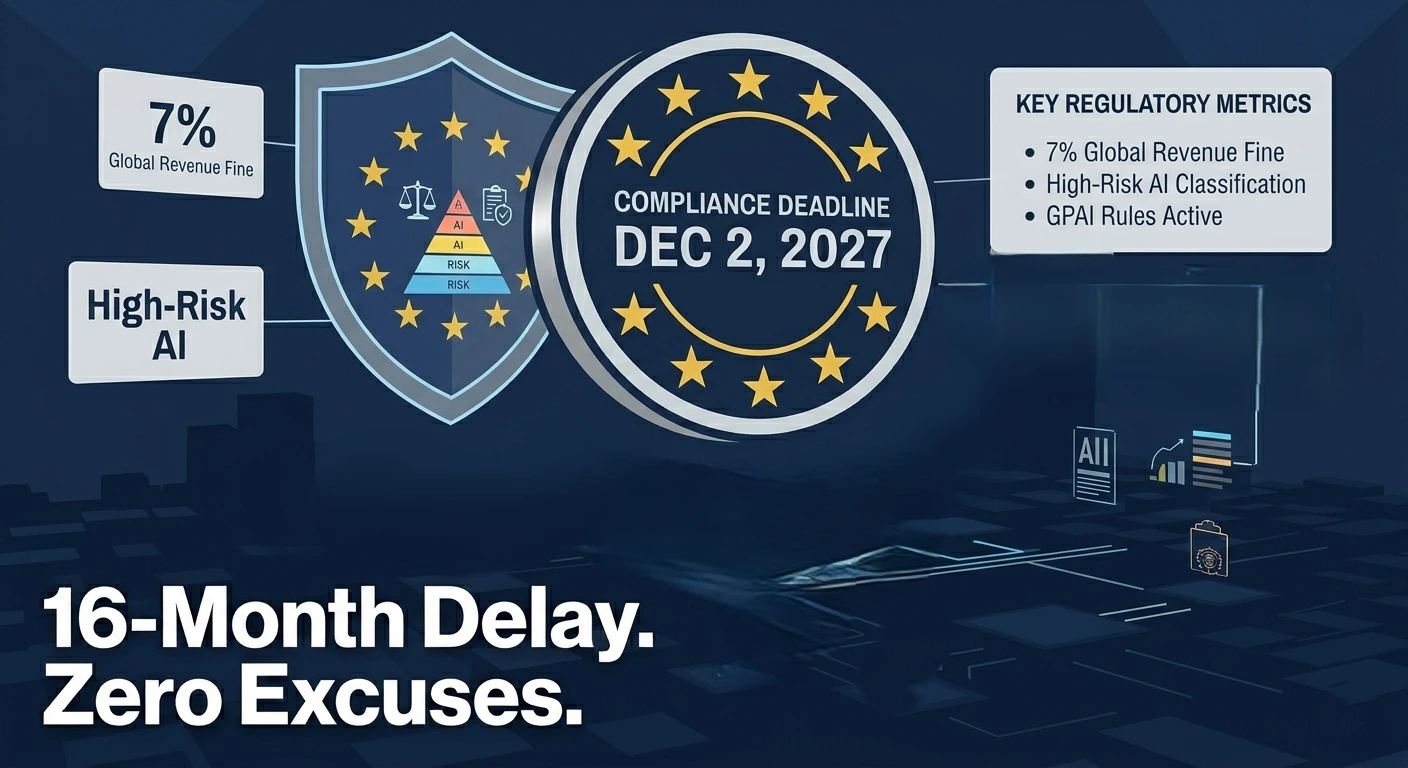
On May 7, 2026, EU legislators reached a provisional agreement on the “AI Act Omnibus,” extending the Annex III high-risk deadline from August 2026 to December 2, 2027. If you built your compliance roadmap around the original deadline, your plan just changed.
Picture your CTO in January 2026, finally signing off on a compliance budget scoped around August 2, 2026. Twelve weeks of sprint work, vendor audits, documentation sprints. Then May 7 hits. The EU Parliament and Council announce a provisional political agreement that pushes the Annex III high-risk deadline by 16 full months. Your plan is technically valid. It’s also, in a sense, obsolete.
That’s the situation most organizations with EU-facing AI products are now navigating. The Omnibus agreement is real relief in one column and a new source of complexity in another. This guide cuts through both. Everything here is sourced to official text or verified legal analysis from firms tracking the legislation directly. No speculation. No filler.
What Is the EU AI Act?
The EU AI Act (formally, Regulation EU 2024/1689) is the world’s first comprehensive legal framework governing artificial intelligence. It was published in the Official Journal of the European Union on July 12, 2024 and entered into force on August 1, 2024. The European Parliament voted to adopt it on March 13, 2024, followed by Council approval on May 21, 2024, completing a three-year legislative process that began with the European Commission’s 2021 proposal.
The regulation applies to any organization, anywhere in the world, whose AI systems are used within the EU or produce outputs that affect EU residents. That mirrors the extraterritorial scope of GDPR. A company headquartered in California offering AI-powered hiring software to a German firm is subject to the Act in the same way a Frankfurt-based startup is.
Its core architecture is a four-tier risk pyramid. Minimal-risk systems face no new obligations. High-risk systems face detailed conformity requirements. And certain practices are banned outright. The risk tier your system falls into determines your compliance burden almost entirely.
What the May 2026 Omnibus Actually Changed
The provisional Omnibus agreement reached on May 7, 2026 is the most significant amendment to the EU AI Act since the regulation was adopted. Formal adoption is expected before August 2026, with the agreement entering into force three days after publication in the Official Journal.
What changed
Annex III high-risk AI systems: Deadline extended from August 2, 2026 to December 2, 2027 (a 16-month extension)
Annex I product-embedded systems: Deadline moved from August 2, 2027 to August 2, 2028 (a 12-month extension)
Article 50 transparency obligations: Pushed to December 2, 2026
New prohibition added: AI systems that generate non-consensual intimate imagery, including CSAM, banned from December 2, 2026
SME protections expanded: The lighter compliance pathway now covers Small Mid-Cap Enterprises, meaning companies with 250 to 3,000 employees and turnover up to €1.5 billion qualify
Bias detection: Organizations can now use GDPR special category personal data where necessary to detect or mitigate AI bias
What did not change
GPAI obligations (in force August 2, 2025)
Article 5 prohibitions (in force February 2, 2025)
The EU AI Office’s enforcement authority structure
The three-tier penalty framework under Article 99
Important: As of June 3, 2026, the Omnibus remains a provisional political agreement. It is not yet law. Do not treat the extended deadlines as formal until official publication in the Official Journal. The Article 5 prohibited practices and GPAI rules are fully in force today and are unaffected.
Complete EU AI Act Compliance Timeline
Date
Obligation
Status
August 1, 2024
Regulation enters into force
DONE
February 2, 2025
Article 5 prohibited AI practices enforceable; Article 4 AI literacy obligations begin
IN FORCE
August 2, 2025
GPAI model obligations apply; EU AI Office governance activated; penalty systems in place
IN FORCE
July 10, 2025
Final GPAI Code of Practice released by EU AI Office
DONE
December 2, 2026
Article 50 transparency and watermarking obligations; new prohibition on non-consensual intimate AI imagery
UPCOMING
December 2, 2027
Annex III high-risk AI system full compliance (extended from August 2, 2026 via Omnibus)
NEW DEADLINE
August 2, 2028
Annex I product-embedded high-risk AI systems (extended from August 2, 2027 via Omnibus)
NEW DEADLINE
December 31, 2030
Large-scale IT systems listed in Annex X must comply
The Four Risk Tiers: Where Does Your AI System Fall?
The EU AI Act’s risk classification is the single most consequential decision your organization will make. Every compliance obligation, documentation requirement, and penalty exposure flows from how your AI system is classified. The same technology in different deployment contexts can land in entirely different tiers.
Tier 1
Prohibited
Eight categories banned outright under Article 5. In force since February 2, 2025. No exemptions for commercial purpose.
Tier 2
High-Risk
Annex I and III systems. Full conformity assessments, technical documentation, human oversight, post-market monitoring. Deadline now December 2027.
Tier 3
Limited Risk
Chatbots, deepfakes, emotion recognition tools. Transparency obligations under Article 50 apply from December 2026.
Tier 4
Minimal Risk
Spam filters, AI in video games, basic recommendation engines. No specific obligations under the Act.
“It is just a chatbot” is not a legal analysis. For Annex III systems, classification turns on intended purpose, function, use context and how the system is actually deployed.
IAPP Staff Analysis, International Association of Privacy Professionals, April 2026
That IAPP framing captures the classification trap that catches most organizations. A customer service bot that routes insurance claims is not the same regulatory object as a customer service bot that answers FAQ questions. The Act classifies by what the system does in the real world, not what the vendor calls it in a product sheet.
An AWS survey found that more than two-thirds of European companies struggle to correctly identify their responsibilities under the Act. Misclassifying a system as minimal-risk when a regulator views it as high-risk is not a documentation technicality. It exposes the organization to the full penalty structure described later in this article.
The Eight Practices Banned Right Now
These prohibitions under Article 5 have been in force since February 2, 2025. No extension. No Omnibus relief. If your organization operates any of the following, you are already in violation.
AI techniques that manipulate people subliminally or deceptively to bypass conscious awareness
Systems that exploit vulnerabilities related to age, disability, or social and economic situation
Social scoring by public authorities that leads to detrimental treatment of individuals
Predictive policing based solely on individual profiling or personality traits
Untargeted mass scraping of facial images from the internet or CCTV feeds for biometric databases
Emotion recognition systems in workplace or educational settings (medical and safety exceptions apply)
Biometric categorization to infer race, political opinions, sexual orientation, or religion
Real-time remote biometric identification in public spaces for law enforcement (narrow exceptions only)
Companies have visibly responded. Emotion recognition tools have been withdrawn from EU workplace and education deployments. No enforcement actions have been publicly announced as of June 2026, but the behavioral change is documented and regulators are watching.
The Omnibus adds a ninth prohibition from December 2, 2026: AI systems that generate non-consensual intimate imagery, including content involving minors.
High-Risk AI Systems: What Annex III Actually Requires
Annex III high-risk AI systems now have until December 2, 2027 to reach full compliance. Here are the sectors covered:
Biometric identification and categorization systems
Critical infrastructure management covering energy, water, and transport
Education and vocational training including exam proctoring and admissions
Employment, HR management, and self-employment access (CV screening, performance monitoring)
Essential private and public services including credit scoring and insurance assessment
Law enforcement systems including crime risk assessment
Migration, asylum, and border control management
Administration of justice and democratic processes
For each qualifying system, compliance requires a quality management system, conformity assessment (some requiring third-party notified bodies), registration in the EU database of high-risk AI systems, post-market monitoring, a Fundamental Rights Impact Assessment, and structured technical documentation covering training data, architecture, intended purpose, performance benchmarks, and human oversight mechanisms.
Annual compliance cost per high-risk AI system runs approximately €29,277, based on EU Commission impact assessment data reported by SQ Magazine in April 2026. For an organization with 10 qualifying systems, that’s nearly €300,000 per year in ongoing compliance overhead, before staff time.
“Most organizations are aware the AI Act exists, but very few understand what it actually requires of them. The regulation goes well beyond policy statements. It requires organizations to classify every AI system they operate, document how those systems were built and tested, and maintain ongoing human oversight.”
Robert Gelo, Senior Consultant, Vision Compliance, April 1, 2026
The April 2026 Vision Compliance readiness analysis of 8 industries found that 83% of organizations have no formal AI system inventory, 78% have taken no meaningful compliance steps, and 74% have no designated AI governance owner. You cannot comply with an obligation you haven’t mapped, and you cannot map what you haven’t inventoried.
GPAI Models: Compliance for Foundation Model Providers
General-Purpose AI model obligations have been in force since August 2, 2025. The GPAI rules apply to providers of models like GPT-4, Claude, Gemini, and Mistral distributed in the EU. Legacy models already on the market before August 2, 2025 have until August 2, 2027 to comply.
What GPAI providers must do
Maintain current technical documentation for every GPAI model distributed in the EU
Comply with EU copyright law and publish a summary of training data content
Implement copyright opt-out mechanisms for rights holders
Respect machine-readable rights signals including robots.txt
Systemic risk models face additional requirements
Models trained above a 10^25 FLOP compute threshold are classified as systemic-risk models. Currently this includes approximately 5 to 15 companies worldwide, among them OpenAI’s o3, Anthropic’s Claude 4 Opus, and Google’s Gemini 2.5 Pro. These providers face adversarial testing requirements, safety and security evaluations, and mandatory incident reporting.
The GPAI Code of Practice was finalized by the EU AI Office on July 10, 2025. Signing it creates a presumption of conformity with GPAI obligations. Google, Microsoft, OpenAI, Anthropic, and Mistral have all signed. xAI notably refused to sign the transparency and copyright chapters, a detail regulators are tracking.
Google signed the Code “while also expressing concerns that the Act and the Code could slow innovation or delay approvals.”
Corporate position via Wharton AI and Analytics Initiative, October 2025
That tension between compliance commitment and product velocity concern is present across most major US-headquartered AI developers. It hasn’t translated into non-compliance, but it shapes how these companies interpret their obligations at the margin.
EU AI Act Fines and Penalties: The Real Numbers
Article 99 establishes a three-tier penalty structure. These numbers are not theoretical. They exceed GDPR’s 4% maximum, making the EU AI Act the highest AI fine regime in the world.
€35M
or 7% of global annual turnover
Violating Article 5 prohibited practices (whichever is higher)
€15M
or 3% of global turnover
High-risk AI non-compliance including Annex III failures
€7.5M
or 1.5% of global turnover
Supplying incorrect or misleading information to regulators
The GDPR precedent is instructive here. The first major GDPR fine, €50 million against Google, came just seven months after enforcement began. By 2023, cumulative GDPR fines exceeded €4.5 billion. Organizations that dismissed GDPR as “not really enforced” in 2018 learned an expensive lesson. The EU AI Act enforcement trajectory is likely to follow the same curve: slow start, then significant acceleration.
One structural note: Article 99(8) means GDPR and EU AI Act penalties are not automatically stacked for the same factual violation. The higher fine applies. But different violations from the same system can be penalized separately, and a single deployment of a poorly documented high-risk AI system touching personal data can trigger both frameworks.
8-Step EU AI Act Compliance Checklist
This checklist reflects what organizations with functional compliance programs have prioritized. Start here, in this order.
Build a complete AI system inventory. List every AI system your organization deploys, develops, or procures that touches EU users. 83% of companies have not done this. You cannot classify what you haven’t catalogued.
Classify each system against the four-tier risk framework. Write a documented classification rationale for every system. “It’s just a chatbot” will not withstand regulatory scrutiny. Base the analysis on intended purpose, function, and actual deployment context.
Map Article 5 prohibitions against all current AI tools. This deadline has passed. Any HR tech, emotion recognition, or behavioral analytics tool that touches EU users needs review now. Not after the Omnibus is formally adopted.
Designate an AI governance owner with documented authority. 74% of organizations lack one. This should be CTO, General Counsel, or CISO level. The designation needs to be in writing with defined decision rights.
Begin Annex IV technical documentation for all potential high-risk systems. Documentation covers training data, architecture, intended purpose, performance metrics, human oversight mechanisms, and post-market monitoring plans. Build this now while engineers who built the systems are still available.
Update vendor contracts with AI Act compliance clauses. If you deploy a third-party AI system, you are the deployer under the Act. Require evidence of conformity assessment, technical documentation access, and post-market monitoring from every AI vendor.
Engineer audit logging into AI-driven decision systems. The Act requires structured audit trails of AI decisions affecting individuals. Retrofitting this into existing systems is expensive. Build it now rather than at deadline pressure.
Monitor regulatory sandboxes in your member state. Member states must provide priority sandbox access to SMEs by August 2026. Testing AI systems in a controlled regulatory environment before full compliance is required is a genuine advantage smaller organizations should use.
Why the Omnibus Extension Is Not the Relief It Looks Like
The 16-month extension for Annex III compliance was sold as a response to industry unpreparedness. The actual reason recorded in legislative proceedings is more uncomfortable: the harmonized technical standards that organizations need to actually demonstrate conformity (produced by CEN/CENELEC) were not ready. The EU’s own standard-setting infrastructure missed its window.
This means something important: even organizations that wanted to fully comply with the original August 2026 deadline could not do so with certainty, because the technical benchmarks against which conformity assessments are measured don’t yet exist in final form. The extension does not change what must be built. It only postpones when enforcement begins.
“The administrative burden alone could bankrupt smaller innovators before they even reach a Series A funding round.”
Centre for European Policy Studies (CEPS), cited in Dataconomy research, April 2026
That CEPS finding is not rhetorical. Compliance for a high-risk AI system entering the EU market requires a quality management system, conformity assessment (potentially by a notified body), database registration, post-market monitoring infrastructure, Fundamental Rights Impact Assessment, and ongoing technical documentation maintenance. Certification costs for a single medical AI unit run €16,800 to €23,000 one-time, with annual costs of approximately €29,277 thereafter. A startup with three high-risk AI products faces a structural compliance burden that US competitors don’t.
Our read: the Omnibus extension reflects institutional acknowledgment that the original implementation schedule was overambitious. The legitimate concern is that the next deadline could arrive with the same structural gaps if harmonized standards aren’t finalized well before December 2027. Organizations should not plan around one more extension. Plan around the deadline holding.
Competitive note: While EU firms work through classification rationales and conformity assessments, US competitors without equivalent federal AI obligations face no comparable burden. Google’s Personal Intelligence rollout in April 2026 was global but with EU-specific feature restrictions driven by AI Act requirements. That asymmetry is real and growing.
Frequently Asked Questions
What is the EU AI Act?
The EU AI Act (Regulation EU 2024/1689) is the world’s first comprehensive legal framework for artificial intelligence. It entered into force on August 1, 2024. It classifies AI systems into four risk tiers and applies different obligations to each. It covers any organization developing or deploying AI that affects EU residents, regardless of where that organization is based.
What are the current EU AI Act compliance deadlines?
Key dates: February 2, 2025 (prohibited AI practices banned); August 2, 2025 (GPAI obligations in force); December 2, 2026 (transparency and watermarking for AI-generated content); December 2, 2027 (Annex III high-risk AI systems, per the May 2026 Omnibus); August 2, 2028 (Annex I product-embedded high-risk systems). Formal Omnibus adoption is expected before August 2026.
What are the fines for non-compliance with the EU AI Act?
Article 99 sets three fine tiers: up to €35 million or 7% of global annual turnover for prohibited practice violations; up to €15 million or 3% for high-risk system non-compliance; and up to €7.5 million or 1.5% for providing incorrect information to regulators. These exceed GDPR’s 4% ceiling and represent the highest AI fine regime in the world.
Does the EU AI Act apply to US companies?
Yes. The EU AI Act applies to any organization worldwide if its AI systems are used within the EU or produce outputs affecting EU residents. This is the same extraterritorial scope as GDPR. A US company offering AI-powered credit scoring or hiring tools to European customers must comply regardless of where its servers are located.
What AI practices are banned under the EU AI Act right now?
Eight practices are prohibited since February 2, 2025: subliminal AI manipulation, exploitation of vulnerable groups, social scoring by public authorities, predictive policing solely from profiling, mass scraping of facial images for biometric databases, emotion recognition in workplaces or schools, biometric categorization to infer race or sexual orientation, and real-time biometric identification in public spaces for law enforcement.
What is a high-risk AI system under the EU AI Act?
Annex III defines high-risk AI systems as those used in biometric identification, critical infrastructure, education (exam proctoring, admissions), employment (CV screening, performance evaluation), essential services (credit scoring, insurance), law enforcement, migration and border control, and administration of justice. Full compliance is now required by December 2, 2027 per the 2026 Omnibus.
What is the GPAI Code of Practice?
The GPAI Code of Practice is a voluntary compliance framework finalized by the EU AI Office on July 10, 2025. It covers transparency, copyright, and safety obligations for general-purpose AI model providers. Signing creates a presumption of conformity with GPAI obligations under the Act. Google, Microsoft, OpenAI, Anthropic, and Mistral are among the signatories.
What did the AI Act Omnibus 2026 change?
The provisional agreement of May 7, 2026 extended the Annex III high-risk deadline by 16 months to December 2, 2027, pushed Annex I product-embedded systems to August 2, 2028, added a prohibition on AI-generated non-consensual intimate content, and expanded SME protections to small mid-cap enterprises with up to 3,000 employees and €1.5 billion in turnover.
What Comes Next: The Road to December 2027
The most critical development in the next 6 to 18 months is not a compliance deadline. It’s the publication of CEN/CENELEC harmonized standards. Once those standards are published, organizations will have a concrete technical specification against which conformity assessments can actually be completed. The gap between standard publication and the December 2027 deadline could be very short. That’s the clock that matters most right now.
Three things to watch closely:
Formal Omnibus adoption timeline. Expected by late July 2026. Until formal publication in the Official Journal, the August 2026 original deadline technically remains the reference. Build plans against December 2027 but finalize them post-adoption.
First EU AI Office enforcement actions. GPAI obligations are in force. The EU AI Office is monitoring which providers signed the Code of Practice and which didn’t. The first enforcement action against a GPAI provider will be the signal everyone is waiting for, much the way the first GDPR fine signaled the enforcement era.
Harmonized standard publication dates. Follow CEN/CENELEC’s AI standardization pipeline. When those standards drop, the compliance clock for anyone building conformity assessment programs starts running.
The EU AI Act is not a drill. It’s a functioning legal framework with active enforcement infrastructure, real penalty exposure, and a regulator that has already shown it will act (see: GDPR). The Omnibus extension bought time. It didn’t buy permission to wait.
Stay ahead of EU AI Act developments
Get the Neural Loop, NeuralWired’s weekly briefing on AI policy, regulatory shifts, and what they mean for builders and operators.
Subscribe to The Neural Loop
NW
NeuralWired Editorial Team
AI Policy and Regulatory Coverage | neuralwired.com
Tech Layoffs 2026: Big Companies Are Cutting Thousands While Posting Record Profits | NeuralWiredBig Tech · AI & Jobs
Tech Layoffs 2026: Big Companies Are Cutting Thousands While Posting Record Profits
By NeuralWired Staff · June 3, 2026 · Updated: June 3, 2026
148,173Tech workers laid off in 2026
975/dayAverage daily job losses
+33%YoY increase vs. 2025
On May 20, 2026, Meta told 8,000 employees they no longer had jobs. The same morning, Intuit cut 3,000 more. By the time Californians had finished their morning coffee, two of the wealthiest technology companies on earth had erased 11,000 careers in a single business day. Meta, for context, had just reported $56.3 billion in quarterly revenue.
This is the central contradiction of big tech layoffs in 2026: the companies shedding the most workers are the ones making the most money. Understanding what’s actually driving this wave, and who is really at risk, is what this piece is about.
The Scale: What the Numbers Actually Say
As of June 2, 2026, TrueUp’s live layoff tracker records 148,173 tech workers laid off across 355 events this year. That is 975 people per day. To put that in context: in all of 2025, the daily rate was 674. The 2026 pace is already 44.7% higher than the full-year 2025 average, and the year is barely half over.
U.S. technology companies alone announced 33,361 job cuts in April 2026, bringing the sector’s four-month total to 85,411, according to outplacement firm Challenger, Gray & Christmas. That is a 33% year-over-year increase. TrueUp projects that total 2026 tech layoffs could reach 370,000 by December, which would significantly exceed both 2024 and 2025, though it would stop short of the 430,000 peak hit in 2023.
More than 1.45 million individuals have been affected by tech layoffs since the start of 2020. The current wave is not the worst on record. But it is the most philosophically confusing one, because it is happening during a period of extraordinary corporate financial performance.
Context
The tech sector’s unemployment rate has climbed to 5.8%, compared to the overall U.S. rate of 3.8%. That gap is the widest since the dot-com bust of 2001 to 2002. Meanwhile, Amazon, Microsoft, Alphabet, and Meta together committed roughly $700 billion to AI infrastructure spending in 2026 alone, nearly double their 2025 levels.
Company-by-Company: Who Cut What, and Why
The scale of big tech layoffs in 2026 is easier to absorb company by company. Each story carries the same structural fingerprint: record profits, aggressive AI investment targets, and a workforce reshaped by efficiency arguments that may or may not hold water.
Meta Platforms
8,000 jobs
~10% of global workforce. Plus 6,000 open roles cancelled. Simultaneous with $56.3B Q1 revenue.
Oracle
20,000–30,000
Estimated 18% of workforce. $2.1B restructuring plan. Possibly the largest layoff in Oracle’s history.
Amazon
16,000 jobs
Second major round since October 2025. CEO Andy Jassy cited AI efficiency gains directly in internal memo.
Intuit
3,000 jobs
17% of full-time workforce. $300–$340M in restructuring charges. Raised full-year revenue guidance the same day.
Cisco
4,000 jobs
Fourth major reduction since early 2024. CEO Chuck Robbins cited AI infrastructure investment pressure.
Block
~4,000 jobs
Headcount dropped from 10,000 to under 6,000. Jack Dorsey cited AI directly in his shareholder letter.
Dell
11,000 jobs
One of the largest headcount reductions in the company’s recent history.
Atlassian
1,600 jobs
10% of global workforce. March 2026. Company cited transition to the “AI era.”
Meta: The Defining Case Study
Meta is the story that captures everything strange about this moment. On May 20, the company began notifying roughly 8,000 employees that their roles were eliminated, framing the cuts as necessary to fund its AI push. It simultaneously cancelled 6,000 open requisitions, bringing the total effective headcount reduction to 14,000 positions either eliminated or never created.
At the same time, roughly 7,000 remaining workers are being redirected into newly created AI-focused teams with names like “Applied AI Engineering” and “Agent Transformation Accelerator XFN.” Meta’s 2026 capital expenditure guidance runs from $125 billion to $145 billion, more than three times its 2025 outlay of $39.2 billion. The company has been offering compensation packages of up to $1.5 billion for a single AI engineer. It recently hired Alexandr Wang, the former Scale AI CEO, as its first Chief AI Officer through a deal that included a $14.3 billion investment in Scale AI.
This is not a company in distress. This is a company choosing what it wants to spend its money on.
Oracle: Quietly Executing the Biggest Cut in Its History
Oracle’s layoffs began March 31, 2026 with termination emails sent at approximately 6 a.m. local time across the United States, India, Canada, and Mexico. Employees reported no prior warning from HR or direct managers. System access was cut immediately. Oracle has not officially confirmed the total number affected, but investment bank TD Cowen estimated 20,000 to 30,000 roles, roughly 18% of Oracle’s global workforce of approximately 162,000 people.
Oracle disclosed a $2.1 billion restructuring plan in its March 2026 10-Q SEC filing, with $982 million already recorded primarily for employee severance. The company had posted a 95% jump in net income last quarter, reaching $6.13 billion. TD Cowen projects the layoffs will generate $8 billion to $10 billion in cash flow. Oracle raised approximately $50 billion in debt in 2026 to fund an estimated $156 billion in infrastructure commitments. If AI contract revenue does not materialize at the contracted scale, this becomes a balance sheet crisis, not a productivity story.
The Others Deserve Naming Too
Coinbase cut approximately 700 jobs, 14% of its global workforce, pivoting toward what CEO Brian Armstrong called an “AI-native operating model.” Autodesk eliminated approximately 1,000 employees, 7% of its workforce, citing strategic AI shifts. Wix announced its largest layoff in company history, cutting 1,000 people representing 19% of its 5,280-person workforce. Atlassian cut 1,600 roles in March 2026 citing the needs of the “AI era.”
The AI Narrative: Real Displacement or Corporate Cover?
Every company above used some version of the same sentence: we are restructuring to invest in AI. What that actually means is contested territory, and some of the most credentialed voices in the industry are deeply skeptical of the framing.
“I don’t know what the exact percentage is, but there’s some AI washing where people are blaming AI for layoffs that they would otherwise do, and then there’s some real displacement by AI of different kinds of jobs.”
Sam Altman, CEO, OpenAI · India AI Impact Summit, February 2026
The phrase “AI washing” has entered the professional vocabulary precisely because it describes something real. Deutsche Bank analysts wrote in January that “AI redundancy washing will be a significant feature of 2026.” Oxford Economics concluded that firms “don’t appear to be replacing workers with AI on a significant scale,” suggesting instead that companies may be using the technology as cover for routine cost-cutting tied to macro pressures and shareholder margin demands.
“The headline is, ‘It’s because of AI,’ but if you read what they actually say, they say, ‘We expect that AI will cover this work.’ Hadn’t done it. They’re just hoping.”
Peter Cappelli, Management Professor, Wharton School · TechTimes, May 2026
Cappelli’s framing is the sharpest available counter-narrative: companies are making prospective, not realized, efficiency claims. The AI tools exist. The efficiency gains are projected. But the work hasn’t happened yet, and the employees are already gone.
Challenger, Gray & Christmas reports that AI was the stated reason for 26% of April 2026 U.S. job cuts, making it the leading stated cause for the second consecutive month. But “stated reason” and “actual reason” are not synonyms in corporate communications.
What Gartner Found
New Gartner research shows that 80% of large companies cut staff citing AI, but those layoffs had no correlation with stronger ROI. The firms seeing real returns are the ones investing in upskilling and human-AI collaboration, not cuts alone. Gartner predicts that by 2027, 50% of companies that attributed headcount reductions to AI will rehire staff to perform similar functions under different job titles.
That Gartner finding deserves to sit with you for a moment. Half of the companies using AI to justify layoffs today will be quietly hiring back for the same work by 2027, possibly at lower wages and under different titles. A Gartner analyst named the pattern directly:
“Chasing value only through headcount reduction is likely to lead most organizations down a path of limited returns.”
Helen Poitevin, VP & Analyst, Gartner · TechTimes, May 2026
The most alarming projection still comes from Anthropic CEO Dario Amodei, who has suggested AI could eliminate as much as half of all entry-level, white-collar jobs in the coming years. His view is the most extreme among credentialed voices, and it is the one most frequently cited by policymakers. California Governor Gavin Newsom signed an executive order on May 21, 2026, the day after Meta’s cuts began, directing state agencies to study AI’s workforce impact and develop policy recommendations. The order carries no enforceable rules yet. Recommendations are expected within six months.
Our read: this signals that government at the state level is no longer treating AI displacement as a theoretical future problem. Whether federal legislation follows depends on how 2026 plays out.
Who Is Actually at Risk
The exposure is not evenly distributed. Understanding who faces the real structural risk in big tech layoffs versus who faces a temporary disruption matters enormously for career planning right now.
Young Software Developers Are Taking the Hardest Hit
The Stanford HAI 2026 AI Index found that software developer employment for workers aged 22 to 25 fell nearly 20% since 2024. The concentration is in roles involving boilerplate coding, scripted testing, and routine bug fixes: precisely the tasks that AI coding tools now perform reliably and cheaply. Developers aged 30 and older at the same companies saw headcount grow. The cutoff is not age, it is complexity of judgment required.
The median time for a laid-off tech worker to find a new role has stretched from 3.2 months in 2024 to 4.7 months in 2026, reflecting both the volume of displaced workers and the skills mismatch between available roles and the candidates flooding the market.
The Roles in Demand Look Nothing Like the Roles Being Cut
At the same moment that Q1 2026 recorded historic layoff numbers, 275,000 AI-related positions sat open in the United States. Companies report a 92% increase in hiring for AI-related roles in 2026, with a 56% wage premium attached to the highest-demand positions. Machine learning engineers, AI safety researchers, data infrastructure specialists, and ML operations professionals face genuinely strong demand. Prompt engineers, AI auditors, and human-AI collaboration designers are emerging as distinct professional categories.
IBM has reportedly tripled entry-level hiring in 2026 specifically because it recognizes that AI requires human oversight, training data curation, and the kind of contextual judgment that models still cannot provide reliably. The picture is not “AI replaces workers.” It is closer to “AI replaces specific tasks, and the workers who can redirect themselves toward the tasks AI cannot do are fine.”
Middle Management and Support Functions Face Structural Pressure
Customer support, content moderation, data entry, QA testing, and middle management layers are the other categories facing persistent structural pressure. These are not temporary cycles. They represent functions where AI tools have already demonstrated reliable replacement capability at scale, and where the cost argument for human labor is increasingly difficult to make to shareholders.
The Financial Paradox
With 2026 capex guidance of up to $145 billion and a 5.5-year server depreciation cycle, Meta alone could face roughly $26 billion in annual depreciation expense from AI assets. The savings from laying off 8,000 employees offset approximately 12% of that future depreciation burden. The workers are gone. The financial pressure from the AI investment is just beginning.
What Comes Next: Three Scenarios
The honest answer is that nobody knows precisely how this resolves. But the scenarios worth tracking are specific, not vague.
Scenario 1: The Capex Trap
Oracle has raised $50 billion in debt to fund $156 billion in AI infrastructure commitments while its stock has fallen approximately 55% from its all-time high. If AI contract revenue does not materialize at the scale required to service that debt, the company’s restructuring story becomes something else entirely. The same logic applies at different scales across the industry. The $700 billion in collective hyperscaler AI capex for 2026 is not a projection. It is already committed. The question is whether the revenue materializes to justify it.
Scenario 2: The Skills Gap Backfire
The workers being eliminated (QA, content, support, entry-level developers) are categorically not the workers being hired (ML engineers, AI safety researchers). Workers laid off in January are still actively searching at higher rates than in previous cycles. A skills mismatch this large historically precedes a productivity dip before the promised gain arrives. Companies that cut too deep in 2026 may find themselves facing the rehire cycle Gartner predicts by 2027, at significant cost.
Scenario 3: The Morale Collapse
Meta has reportedly been monitoring employee workstation activity as part of training its AI systems. Some employees have described the surveillance as “incredibly demoralizing.” The survivors of mass layoffs routinely experience measurable productivity drops. That survivor productivity loss is not captured in any efficiency projection being used to justify the current cuts. If the morale impact is large enough, the efficiency math that justified the cuts may not hold.
Cognizant Chief AI Officer Babak Hodjat put the uncertainty plainly: it will “still take more than a year before we completely see the impact of modern AI technologies on the workforce,” and he does not know if current job cuts “are directly related to actual productivity gains.” Sam Altman’s publicly stated view is that long-term “jobs doomerism is likely wrong.” Both positions are more cautious than the headlines suggest.
Key Takeaways
Tech layoffs in 2026 have affected 148,173 workers across 355 events, running 44.7% above the 2025 daily pace, per TrueUp.
The defining paradox: Meta, Oracle, and Intuit all reported record or near-record profits in the same quarters they announced their largest layoffs.
AI is the stated reason for 26% of 2026 tech cuts, but analysts including Sam Altman and Wharton’s Peter Cappelli warn that “AI washing” is real and widespread.
Entry-level software developers aged 22 to 25 have seen a 20% employment drop since 2024, concentrated in boilerplate and testing roles that AI now handles.
Gartner predicts 50% of companies citing AI for layoffs will rehire into similar roles by 2027. The cut is not permanent; the repricing may be.
275,000 AI-related jobs sat open in the U.S. in Q1 2026, with a 56% wage premium for the most in-demand roles. The labor market is bifurcating, not shrinking.
California’s May 21 executive order is the first U.S. government response targeting AI-driven displacement. It has no enforceable rules yet.
Frequently Asked Questions
Which tech companies are laying off employees in 2026?
The major companies cutting jobs in 2026 include Meta (8,000), Oracle (up to 30,000), Amazon (16,000), Intuit (3,000, or 17% of workforce), Cisco (4,000), Block (4,000), Dell (11,000), Atlassian (1,600), Coinbase (700), and Wix (1,000). Total tech layoffs have exceeded 148,000 as of June 2026, per TrueUp tracker data.
Why are tech companies laying off workers in 2026?
Companies cite AI-driven efficiency gains and the need to fund massive AI infrastructure investments. Amazon, Microsoft, Alphabet, and Meta collectively committed roughly $700 billion to AI capex in 2026. However, analysts including OpenAI’s Sam Altman and Wharton’s Peter Cappelli warn that many layoffs are routine cost-cutting rebranded as AI strategy, a phenomenon Altman called “AI washing.”
How many tech jobs have been lost in 2026?
Over 148,000 tech workers have lost jobs in 2026 as of June 2, across 355 layoff events, averaging 975 job losses per day. That daily rate is 44% above the 2025 full-year average of 674 per day. TrueUp projects the full-year 2026 figure could reach 370,000.
Is AI really causing tech layoffs in 2026?
Partially. Challenger, Gray & Christmas reports AI was the stated reason for 26% of April 2026 tech cuts. However, Oxford Economics found firms are not replacing workers with AI “on a significant scale” yet. Many companies cite future AI capabilities, not current ones, as justification, what analysts call “AI redundancy washing.”
Which jobs are most at risk from AI layoffs in 2026?
Entry-level software developers, customer support, QA, content moderation, data entry, and middle management are most exposed. Stanford HAI found developer employment for workers aged 22 to 25 fell nearly 20% since 2024. In contrast, machine learning engineers, AI safety researchers, and data infrastructure specialists face strong demand with a 56% wage premium.
Will tech layoffs continue in 2026?
Yes, according to multiple forecasters. TrueUp projects total 2026 tech layoffs could reach 370,000. Meta has signaled further rounds in August. However, Gartner warns that 50% of companies cutting for AI will rehire by 2027, suggesting the current wave may peak mid-cycle rather than represent a permanent structural reduction.
What did California do about AI layoffs in 2026?
On May 21, 2026, Governor Gavin Newsom signed a first-of-its-kind executive order directing state agencies to study AI-driven workforce displacement and develop policy recommendations. It explores severance standards, subsidized employment, and expanded unemployment insurance, but currently carries no enforceable rules. Recommendations are expected within six months.
What You Should Be Watching
The tech layoffs of 2026 are real, they are accelerating, and they are not evenly distributed. But they are also partially a story about narrative management and shareholder communication, not purely a story about AI making human labor obsolete.
What you now understand that most headlines skip: the firms that are actually seeing AI returns are the ones investing in human-AI collaboration, not the ones using AI as a framing device for cuts they would have made anyway. The efficiency gains are real in some places and projected in others, and the difference matters enormously if you are building a team, managing a career, or making investment decisions right now.
Three things to watch in the next six to eighteen months. First: whether Oracle’s AI infrastructure debt produces the contracted revenue, because if it does not, the 2026 restructuring narrative breaks down. Second: whether Gartner’s 2027 rehire prediction materializes on schedule, which would confirm that this wave is a labor repricing story rather than a labor elimination story. Third: whether California’s executive order becomes the template for federal legislation, which would add regulatory costs to the AI-efficiency equation and change the math for every company currently using headcount cuts to fund capex.
The 975 workers losing their jobs every day in 2026 deserve a more precise answer than “AI is replacing everyone.” The data, when you actually read it carefully, suggests something more complicated and ultimately more manageable than that. It does not make the disruption less real. But it does make the response more knowable.
Stay Ahead of What’s Happening in Tech
The Neural Loop delivers the most important developments in AI, big tech, and the future of work every week. No noise. No filler. Just what matters.
Subscribe to The Neural Loop
By NeuralWired Research Desk | Updated June 2026 | Reading Time: 18 minutes
The conversation in boardrooms has changed. Companies are no longer debating whether artificial intelligence will transform how they work. The real question on every executive’s agenda right now is how fast they can deploy it responsibly, securely, and competitively before the gap between them and their rivals becomes impossible to close.
That shift from debate to execution is what defines the 2026 AI landscape. And the data makes the stakes brutally clear: U.S. Census Bureau figures from December 2025 through May 2026 show overall AI usage sitting between 17% and 20% of businesses, with another 20 to 23% expecting to adopt it within six months. Among firms with at least 250 employees, 37% already use AI directly in their operations. The adoption gap between large enterprises and smaller organizations is not just widening. It is becoming a structural competitive advantage.
This guide gives CEOs, founders, and senior executives everything they need to move from reading about AI to deploying it with real results.
Where AI in Business Actually Stands in 2026 (The Real Numbers)
Before building a strategy, every executive needs an accurate picture of where AI adoption genuinely stands, not the hype version, not the vendor pitch, but the government data and independent research.
Gartner forecasts worldwide AI spending at $2.52 trillion in 2026, up 44% year over year. AI infrastructure alone accounts for $1.366 trillion of that total. This is not a technology trend anymore. It is infrastructure spending at the scale of national GDPs.
McKinsey estimates that generative AI could contribute up to $4.4 trillion in annual global productivity gains across corporate use cases. That figure gets cited constantly, and for good reason. But the more important number sits underneath it: only 34% of organizations are truly reimagining how their business operates using AI. The other 66% are using it for efficiency gains while leaving the transformative opportunity on the table.
Deloitte’s State of AI in the Enterprise 2026, based on a survey of 3,235 senior leaders conducted between August and September 2025, found that worker access to AI rose by 50% in 2025. The number of companies with 40% or more of their AI projects running in production is set to double within six months. Yet 74% of organizations still only hope to grow revenue through AI, while just 20% are already doing so. Productivity gains are wide. Transformation is rare.
According to the 2026 Financial Executives Priorities Report developed by Forvis Mazars and the Financial Education and Research Foundation, 88% of large organizations now regularly use AI in at least one business function. Near-universal adoption at the surface level. Deep integration remains the exception.
The takeaway for any executive reading this: the window to build a competitive moat through AI is open right now. It will not stay open indefinitely.
The 7 Most Valuable AI Use Cases for Business in 2026
The organizations seeing the highest returns are not trying to use AI everywhere at once. They are identifying the highest-impact use cases, deploying in those areas first, and scaling what works. Here are the seven applications producing the most measurable business value right now.
1. Customer Service and Support Automation
Customer service is delivering the clearest, most consistent ROI of any AI application in 2026. The average return is $3.50 per $1 spent on AI customer service, with leading organizations hitting 8x. That ROI compounds significantly over time: 41% in year one, 87% in year two, and 124% or more by year three. Approximately 30% of customer service cases are now resolved without a human agent involved at any point.
The practical application is straightforward. AI handles tier-one inquiries, routes complex cases to the right agents with full context already surfaced, and follows up automatically. Human agents spend their time on problems that actually require human judgment.
2. Sales Forecasting and Revenue Intelligence
AI-powered forecasting tools analyze historical sales data, pipeline velocity, market signals, and customer behavior simultaneously, producing forecasts that outperform traditional models by substantial margins. Sales teams using AI-assisted forecasting consistently reduce forecast error rates while giving leadership earlier warning on deals at risk.
The competitive advantage here is speed. Organizations with accurate AI forecasting can reallocate resources faster, catch problems earlier, and make pricing decisions with better information than competitors who are still running quarterly spreadsheet reviews.
3. Supply Chain Optimization
Supply chain is one of the highest-ROI applications in the enterprise. McKinsey and Accenture data consistently show 5 to 20% reductions in logistics costs, 20 to 30% reductions in inventory, and 5 to 15% procurement savings for organizations that implement AI supply chain tools effectively.
The real-world impact includes demand forecasting that adjusts in real time to market signals, automated procurement that responds to supplier risk, and logistics routing that optimizes continuously rather than on a quarterly planning cycle.
4. Financial Process Automation
Finance teams using AI for accounts payable, reconciliation, fraud detection, and financial reporting are reclaiming significant capacity for higher-value work. Routine transaction processing, anomaly flagging, and audit preparation are the immediate targets. Beyond efficiency, AI in finance enables real-time visibility into cash flow and risk that was simply not available when those processes ran on monthly or quarterly cycles.
5. Marketing Personalization and Content Operations
Generative AI has fundamentally changed the economics of content production and campaign personalization. Marketing teams that have integrated AI into their workflows are producing more content, testing more variables, and personalizing communications at scale without proportional headcount increases.
The organizations seeing the highest marketing ROI are not using AI to replace creative thinking. They are using it to remove the mechanical work so their teams can focus on strategy, positioning, and brand decisions that require genuine human judgment.
6. Software Development and Engineering Productivity
The Duolingo and GitHub Copilot case study is one of the most concrete examples available. After integrating GitHub Copilot into its engineering workflow, Duolingo recorded a 25% increase in developer speed for engineers working in new repositories, a 10% boost for experienced staff, and a 67% reduction in median code review turnaround time. These are not projected gains. They are verified, documented outcomes from a named organization.
Engineering teams using AI coding assistants consistently report faster onboarding, lower cognitive load on routine tasks, and more time available for architecture decisions and complex problem-solving.
7. Agentic AI for Multi-Step Workflow Automation
This is the defining application of 2026 and the one that separates organizations building genuine AI capability from those still treating AI as a productivity decoration.
Agentic AI systems can complete multi-step tasks with limited human input. A sales agent can analyze pipeline data, generate a follow-up report, schedule the next outreach actions, and notify the relevant team members automatically. An operations agent can monitor inventory levels, identify shortfalls, generate purchase orders, and escalate exceptions to human review.
The AI agent market is currently valued at $10.91 billion in 2026 and projected to reach $50.31 billion by 2030, growing at a 45.8% compound annual growth rate. Gartner projects that by 2026, more than 80% of enterprises will use generative AI APIs or deploy generative AI-enabled applications in production environments, compared to only 5% in 2023.
For executives evaluating where to deploy next, agentic AI is where the largest productivity gains will come from. It is also where the largest governance risks sit. Both of those facts are equally important.
How to Implement AI in Your Business: A Practical 5-Step Framework
Over 60% of initial AI implementations fail. The reason, according to implementation data compiled across Deloitte, Gartner, and multiple enterprise case studies, is almost always the same: executives treat AI as a plug-and-play software tool rather than a fundamental organizational shift. Successful implementations see 20 to 40% productivity gains. When executed correctly, first-year ROI typically ranges from 3x to 10x the initial investment.
The difference between the organizations that succeed and those that fail comes down to how they approach implementation. Here is the framework that works.
For a detailed walkthrough of each phase with resource planning templates, see NeuralWired’s Enterprise AI Implementation Roadmap covering the complete 5-phase framework that has driven 3x ROI for enterprise deployments.
Step 1: Start With the Business Problem, Not the Technology
This is where most AI projects go wrong before they even begin. The first rule of AI strategy in 2026 is simple: do not start with the model, the platform, or the vendor. Start with the business problem.
Instead of saying “We need a generative AI chatbot,” say “We want to reduce customer support resolution time by 30% within six months while maintaining service quality.” The second statement has a measurable outcome, a time horizon, and a quality constraint. You can design an AI implementation around it. You cannot design one around “we need AI.”
AI should support measurable goals: reducing customer response time, improving sales forecasting accuracy, automating finance workflows, increasing developer productivity, detecting operational risks earlier, or accelerating executive decision-making. Every use case needs a defined success metric before the first line of code is written.
Step 2: Audit Your Data Before You Commit Budget
AI is only as good as the data it operates on. This is not a cliche. It is the single most underestimated implementation risk in the enterprise. Organizations that skip data quality assessment before deploying AI consistently end up with systems that produce unreliable outputs, which erodes trust, stalls adoption, and ultimately kills the project.
Before committing significant budget to any AI initiative, conduct a data audit that answers four questions. Is the relevant data accessible? Is it clean enough to produce reliable outputs? Is it governed appropriately for the use case? And is there enough of it to train or fine-tune effectively?
Step 3: Choose One High-Impact, Low-Risk Pilot
The organizations that scale AI most successfully do not try to run fifteen pilots simultaneously. They identify one use case that meets two criteria: high expected impact on a metric that matters to the business, and low risk if it underperforms. Customer service automation, financial reconciliation, and sales forecasting all fit this profile for most enterprises.
Run the pilot with defined success metrics, a fixed timeline, and real business data. Not synthetic data. Not a proof of concept on cleaned sample data. Actual production data with actual performance consequences.
Step 4: Establish Governance Before You Scale
This is the step most organizations skip in their rush to show results. It is also the step that determines whether a successful pilot becomes a successful scaled deployment or a governance crisis.
The McKinsey State of AI Trust 2026 survey of approximately 500 organizations found that the average Responsible AI maturity score increased to 2.3 in 2026, up from 2.0 in 2025. Only about one-third of organizations report maturity levels of 3 or higher across strategy, governance, and agentic AI governance. Governance and agentic AI controls lag behind data and technology capabilities across every region surveyed.
That governance gap is the defining risk of AI in 2026. See NeuralWired’s Enterprise AI Risk Management guide for a NIST-aligned 6-step governance framework built for enterprise deployment.
Step 5: Build for Scale From Day One
The pilot should be designed with scaling in mind from the first design meeting. That means API-based integrations rather than point solutions, documentation that enables other teams to learn from the deployment, and governance structures that can extend to new use cases without being rebuilt.
Most successful organizations follow a phased 6 to 12-month roadmap before full deployment. Deloitte data shows 94% of firms would need more than six months to exit a project that does not achieve ROI goals, and 76% expect it would take more than a year. Building for scale from the start reduces the cost of those adjustments when they inevitably happen.
Choosing the Right AI Tools for Your Business in 2026
The AI tools market in 2026 is both more mature and more confusing than it was two years ago. There are strong options across every category. The risk is not a shortage of capable tools. It is selecting tools based on brand recognition or vendor relationships rather than fit for the specific use case.
For a side-by-side technical comparison of the leading large language models, see NeuralWired’s Large Language Models Comparison 2026 covering GPT-5, Claude 4, and Gemini 2.5 Pro. For a detailed breakdown of enterprise platform strategies, see Google vs Microsoft AI 2026.
Large Language Models such as GPT-5, Claude 4, and Gemini 2.5 Pro are appropriate for content generation, decision support, document analysis, code assistance, and customer-facing conversational applications. They differ meaningfully on context window size, reasoning capability, cost per token, and data handling practices. The right choice depends on the specific use case, your data governance requirements, and your existing infrastructure.
Enterprise AI Platforms including Microsoft Copilot and Salesforce Agentforce integrate directly into existing workflows and reduce the implementation overhead for organizations already running those ecosystems. They trade customization for speed of deployment. For organizations with standard use cases and existing platform investment, they represent the fastest path to production.
Specialist AI Tools for specific functions including supply chain, financial analysis, and HR are maturing rapidly. These tools often outperform general-purpose models on domain-specific tasks because they are trained on relevant data and built around the specific workflows of that function.
Custom Deployments on foundation models through API access give organizations the highest degree of control over data handling, output behavior, and integration depth. They also require the most internal capability to implement and maintain. For organizations with sensitive data requirements or highly specific use cases, they are often the right choice despite the higher initial investment.
For a complete guide to AI strategy selection by company stage and function, see NeuralWired’s AI Strategy for CTOs in 2026.
The Governance Imperative: Why Most AI Projects Fail
Gartner expects more than 40% of agentic AI projects to be canceled by end of 2027 due to costs, unclear value, and weak governance. Only 21% of companies currently have a mature agent governance model. This is not a marginal risk. It is the most likely outcome for organizations that scale AI without building the governance infrastructure to support it.
Gartner’s 2026 Hype Cycle for Agentic AI is direct on this point: treating all agentic AI innovations as equally mature or immediately valuable risks unrealistic expectations and misaligned investment decisions. The mechanisms required to manage risk, trust, and cost are still maturing. Organizations that scale ahead of those mechanisms take on operational and reputational risk that is difficult to quantify in advance and expensive to manage after the fact.
Cansu Canca, Director of Responsible AI Practice at Northeastern University, frames it in terms every executive should understand: “With AI agents evolving as decision-makers, not just tools, the stakes have never been higher. Addressing Responsible AI cannot be an afterthought. It is a necessity from the start. The risks including unintended consequences, amplified biases, and eroded trust can escalate rapidly as these systems learn and adapt in real time. But by embedding Responsible AI early, organizations can achieve better outcomes, foster sustainable innovation, and build stakeholder confidence. This is the moment to lead with governance, not react to its absence.”
That is not a compliance argument. It is a competitive one. PwC’s research shows that 60% of executives say Responsible AI boosts ROI and efficiency, and 55% report improved customer experience and innovation. Yet nearly half also said turning Responsible AI principles into operational processes has been a significant challenge. The organizations that solve that translation problem first will have a durable advantage.
The governance framework should cover five areas at minimum. First, clear accountability structures that specify who is responsible for AI outputs in each business function. Second, data governance policies that define what data AI systems can access, how it is handled, and how it is protected. Third, output monitoring processes that flag anomalies, hallucinations, or bias in production systems before they cause customer or operational harm. Fourth, human review protocols for high-stakes decisions where AI is a factor but not the final authority. Fifth, incident response procedures for when AI systems produce harmful or unexpected outputs, because they will.
The Workforce Dimension: Reskilling Is a Revenue Initiative
Deloitte’s 2026 survey identifies the AI skills gap as the single biggest barrier to AI integration. Education was the number one way companies adjusted their talent strategies in response to AI in 2025. For executives, this translates directly: workforce reskilling is not an HR initiative. It is a revenue protection initiative.
The organizations moving fastest on AI are not necessarily the ones with the most sophisticated technology. They are the ones where the largest number of employees know how to use AI tools effectively in their daily work, where leadership has made AI fluency a genuine priority rather than an optional learning opportunity, and where the culture has been prepared for the kind of organizational redesign that real AI integration requires.
George Westerman, Senior Lecturer in Information Technology at MIT Sloan, captures the priority correctly: “This year will mark a shift in enterprises from experimenting with generative AI and agents to finding viable solutions that create real value at scale. With the hype around generative AI and agents, it is essential to focus on the right question: What problem are you trying to solve? The answer will require finding the right combination of techniques, including AI, traditional IT, and human, for each task in the solution.”
That problem-first framing is the foundation of effective workforce preparation. Employees do not need to understand the technical architecture of large language models. They need to understand what problems AI can solve in their specific role, how to evaluate whether AI output is reliable, and when to escalate to human judgment. That is a training and culture investment that pays dividends across every AI initiative the organization runs.
What the Critics Get Right: The AI Hype Your Board Needs to Hear
Any honest executive guide to AI in 2026 has to include the counterarguments, because the board-level conversation that ignores them is building strategy on incomplete information.
Thomas H. Davenport, President’s Distinguished Professor of Information Technology and Management at Babson College and a fellow at MIT’s Initiative on the Digital Economy, is one of the most credentialed skeptics in the field. His assessment of agentic AI in 2026 is worth taking seriously. Ongoing hallucinations and mistakes in agentic systems, combined with the relative ease with which these systems can be hijacked through prompt injection and similar methods, has produced a recalibration of expectations. “Companies will continue to have some human in the loop,” Davenport noted, acknowledging that this requirement directly undermines the productivity case for fully autonomous agentic systems.