
AI Infrastructure
NVIDIA: Small AI Models Now Beat 70B Giants
Your AI agent doesn’t need a trillion-parameter brain to check a database field. It needs a fast, cheap, accurate answer, and right now, you’re probably paying frontier-model prices for kindergarten-level work. NVIDIA researchers say small language models now match or beat large language models on narrow, well-defined tasks, at a fraction of the inference cost, and Gartner expects the shift to triple by 2027.
This isn’t a fringe claim. It’s the thesis of a formal NVIDIA Research position paper, backed by named model benchmarks, a peer-reviewed medical study, and a hard market forecast from one of the industry’s most conservative analyst firms. Here’s what the data actually shows, and where it doesn’t hold up.
Table of Contents
The Paper That Started the Argument
In June 2025, a team from NVIDIA Research and Georgia Tech, led by Peter Belcak, posted a position paper to arXiv called “Small Language Models are the Future of Agentic AI.” It’s still listed as a preprint under review, not a peer-reviewed benchmark study, and that distinction matters. But the argument inside it has spent over a year working its way through enterprise AI teams, and by 2026, the evidence started catching up to the claim.
The paper’s definition of “small” is practical, not arbitrary: a model that fits on a common consumer device and runs with latency low enough for single-user agentic work. As of 2025, the authors were comfortable calling most models under 10 billion parameters SLMs.
Their core complaint: most AI agent systems route 40 to 70 percent of their compute through a generalist LLM, even for tasks that are structurally narrow, things like tool calls, structured extraction, and code-orchestrated steps. That’s the equivalent of hiring a surgeon to change a lightbulb.
“SLMs are sometimes ‘good enough’ for many nodes in an agent graph, especially tool-calling, structured reasoning, and code-orchestrated steps, sometimes matching or beating larger LLMs for those narrow tasks.”Peter Belcak, AI Researcher, NVIDIA Research
The paper cites named results to back this up. Microsoft’s Phi-2, at 2.7 billion parameters, matches commonsense reasoning and code generation scores of models over ten times its size, while running roughly 15x faster. Phi-3 small, at 7 billion parameters, matches the language understanding of 70-billion-parameter models from the same generation and beats them on code generation. Hugging Face’s SmolLM2 family, some variants under 2 billion parameters, matches the tool-calling performance of 14-billion-parameter contemporaries.
Two of the more striking claims: DeepSeek-R1-Distill-Qwen-7B reportedly outperforms Claude-3.5-Sonnet and GPT-4o on commonsense reasoning tasks, and Salesforce’s xLAM-2-8B claims state-of-the-art tool-calling accuracy, ahead of both GPT-4o and Claude 3.5, at a fraction of the parameter count.
The Numbers That Actually Hold Up
Strip out the vendor blog posts and single-paper claims, and here’s what’s independently verifiable or attributable to a named source:
| Figure | Source | Date |
|---|---|---|
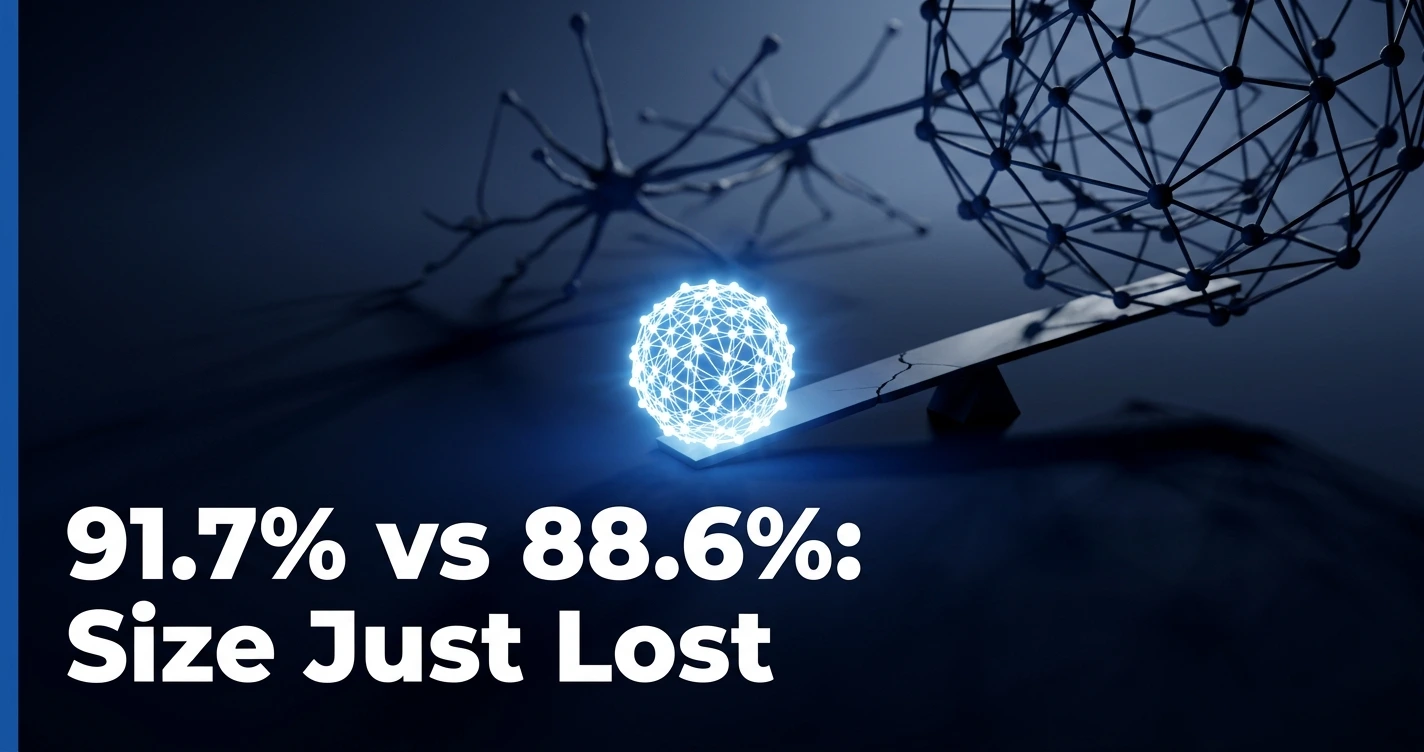
| 0.5B model hits 91.7% accuracy vs. 88.6% for a 72B model on classification | Forbes analysis | June 2026 |
| SLMs run 10 to 30x cheaper per token than 70 to 175B LLMs | NVIDIA Research paper | 2025/2026 |
| 60% of MetaGPT’s LLM queries reliably handleable by SLMs | NVIDIA paper, Appendix B.1 | 2025 |
| 70% of Cradle GUI-agent queries SLM-replaceable | NVIDIA paper, Appendix B.3 | 2025 |
| Task-specific model usage to triple general LLM usage by 2027 | Gartner press release | April 2025 |
Notice the range in that MetaGPT and Cradle comparison. Sixty percent replaceable for one agent, seventy percent for another. That gap isn’t noise, it’s the real story: how much of your workload an SLM can absorb depends entirely on what your agent is actually doing.
A Real-World Test: SLMs in Medicine
Position papers and vendor benchmarks are one thing. A controlled, peer-reviewed comparison is another. In January 2026, researchers from the Bascom Palmer Eye Institute at the University of Miami and the Federal University of São Paulo published a study in JMIR comparing a retrieval-augmented small language model, trained specifically on ophthalmology literature, against GPT-4 on 35 frequently asked glaucoma questions.
Three independent glaucoma specialists graded the answers on a three-tier accuracy scale, blind to which model produced which response. This is exactly the kind of test the SLM argument needed: narrow domain, real clinical stakes, named institutions, independent graders. It’s a data point the field can build on rather than take on faith.
Gartner’s 2027 Prediction
On April 9, 2025, Gartner made it official. The firm predicted that by 2027, organizations will deploy small, task-specific AI models at usage volumes at least three times higher than general-purpose LLMs.
“The variety of tasks in business workflows and the need for greater accuracy are driving the shift towards specialized models fine-tuned on specific functions or domain data. These smaller, task-specific models provide quicker responses and use less computational power, reducing operational and maintenance costs.”Sumit Agarwal, VP Analyst, Gartner
Read that prediction carefully. It’s a 2027 target, not a claim that the shift has already happened. Most production agent stacks in 2026 are still LLM-first. Gartner is describing a documented trend and a forecast, not the current default state of the industry, and conflating the two is where a lot of the hype gets ahead of the reality.
The Cost Math Behind the Shift
This is where the argument stops being academic. Enterprise cost breakdowns put a private SLM endpoint handling 10,000 daily queries at roughly $500 to $2,000 a month. The equivalent workload on frontier LLM APIs runs $5,000 to $50,000 a month, depending on the model and context length. That’s not a marginal saving. At scale, across millions of daily agent invocations, it’s a material line on the P&L.
Fine-tuning agility compounds the advantage. Parameter-efficient methods like LoRA and DoRA let teams specialize an SLM for a new task in GPU-hours, not the weeks a full LLM fine-tuning cycle typically takes. If your business changes its workflows every quarter, that iteration speed matters as much as the raw inference cost.
The catch: most of these cost figures trace back to vendor analyses and the NVIDIA paper’s own citations, not independent third-party audits. Treat them as directionally reliable, not laboratory-verified.
Where the Argument Breaks Down
To its credit, the NVIDIA paper doesn’t dodge its own weakest points. It preserves the strongest counter-argument verbatim: a substantial body of empirical evidence shows large language models outperform small ones on general language understanding, because LLMs follow scaling laws that reward size with capability. The authors even flag a hypothesized “semantic hub” mechanism, a way larger models may integrate meaning across languages and modalities that smaller architectures structurally can’t replicate.
There’s also an economics rebuttal the paper admits it can’t fully answer: the per-token savings of a small model can get swallowed by the difficulty of fully utilizing and load-balancing a fleet of specialized SLM endpoints, something a single generalist LLM endpoint doesn’t have to deal with. Add in the MLOps and talent overhead of managing multiple fine-tuned models, and the total cost of ownership gets a lot murkier than the headline per-token numbers suggest.
Zoom out further and there’s a broader skepticism worth weighing. Gary Marcus, Professor Emeritus at NYU and a longtime critic of scaling-driven AI hype, isn’t commenting on SLMs specifically, but his wider point about the industry is relevant here.
“A large fraction of what LLMs do is mostly just memorization,” and current systems “still aren’t adding a lot of quantifiable value to the world.”Gary Marcus, Professor Emeritus, NYU
Marcus cites the Remote Labor Index finding that AI could fully complete only about 2.5 percent of remote jobs tested, as reported by the Washington Post. Use his view as a check on compute-versus-capability claims generally, not as a direct rebuttal to the SLM data, which stands on its own narrower footing.
What This Means for Your Stack
If you’re an engineering lead running agent workflows on a single frontier-model endpoint, the actionable move isn’t “replace your LLM.” It’s audit first. NVIDIA’s paper actually outlines a six-step conversion process worth stealing: log real usage patterns, curate the resulting data, cluster it by task type, select SLM candidates for the narrow clusters, fine-tune, and iterate.
Every credible source here, including NVIDIA’s own paper, describes a hybrid architecture, not a replacement. A frontier LLM stays as the planner and orchestrator. SLMs take over the narrow, repetitive, format-constrained work underneath it: classification, extraction, tool calls, structured code steps. Gartner’s own guidance echoes this, recommending small models specifically where an LLM hasn’t met response quality or speed expectations, not as a wholesale swap.
Our read: the teams that win the next 18 months won’t be the ones who bet everything on either model size. They’ll be the ones who actually measure which of their agent’s tasks are narrow enough to hand to a cheaper, faster model, and which genuinely need the reasoning a frontier LLM provides.
FAQ
What is the difference between a small language model and a large language model?
The core difference is parameter count and what it implies. LLMs, roughly 7 billion to over a trillion parameters, hold broad world knowledge and cross-domain reasoning without task-specific tuning. SLMs typically range from a few million to about 7 billion parameters, trading some generality for speed, low cost, and on-device deployability.
Can small language models really match LLM accuracy?
Yes, on narrow, well-defined tasks. One 2026 analysis found a 0.5-billion-parameter model hit 91.7 percent accuracy versus 88.6 percent for a 72-billion-parameter model on simple classification, though LLMs still hold the advantage on broad, open-ended reasoning.
Are small language models cheaper to run than LLMs?
Yes. Serving a 7-billion-parameter SLM is estimated at 10 to 30 times cheaper in latency, energy, and compute than a 70 to 175-billion-parameter LLM, according to NVIDIA Research.
Will small language models replace large language models?
Not entirely. Gartner predicts organizations will use small, task-specific AI models three times more than general-purpose LLMs by 2027, but researchers and analysts frame this as hybrid adoption, with LLMs still orchestrating and SLMs handling narrow tasks, not a full replacement.
The Bottom Line
What you now know that you didn’t before: the “bigger model, better results” assumption doesn’t hold once you narrow the task down to something specific and repeatable. NVIDIA’s research, Gartner’s forecast, and at least one peer-reviewed clinical study all point the same direction, even while the paper behind this movement openly admits where scaling laws and operational reality push back.
Watch three things over the next 6 to 18 months: whether Gartner’s 2027 usage-volume prediction stays on pace, whether more peer-reviewed domain-specific studies follow the glaucoma model, and whether the MLOps tooling for managing fleets of SLMs matures enough to close the operational gap the NVIDIA paper itself flags as unresolved.
Small language models aren’t going to replace the model powering your chatbot’s hardest conversations. But if you’re still routing every tool call and classification task through a frontier LLM in 2026, you’re very likely paying trillion-parameter prices for kindergarten-level work.
Want the next breakdown like this in your inbox?
Subscribe to The Neural Loop at neuralwired.com/newsletter
Subscribe to The Neural Loop at neuralwired.com/newsletter