Category: Blockchain

Blockchain technology analysis: enterprise applications, DeFi protocols, smart contracts, Web3 infrastructure, and real-world use cases beyond cryptocurrency speculation.

  • Trump’s CLARITY Act Faces Senate Cloture Vote Today

    Trump’s CLARITY Act Faces Senate Cloture Vote Today

    CLARITY Act Vote: Why Today’s Senate Test Actually Matters
    Crypto & Blockchain / Policy

    CLARITY Act Vote: Why Today’s Senate Test Actually Matters

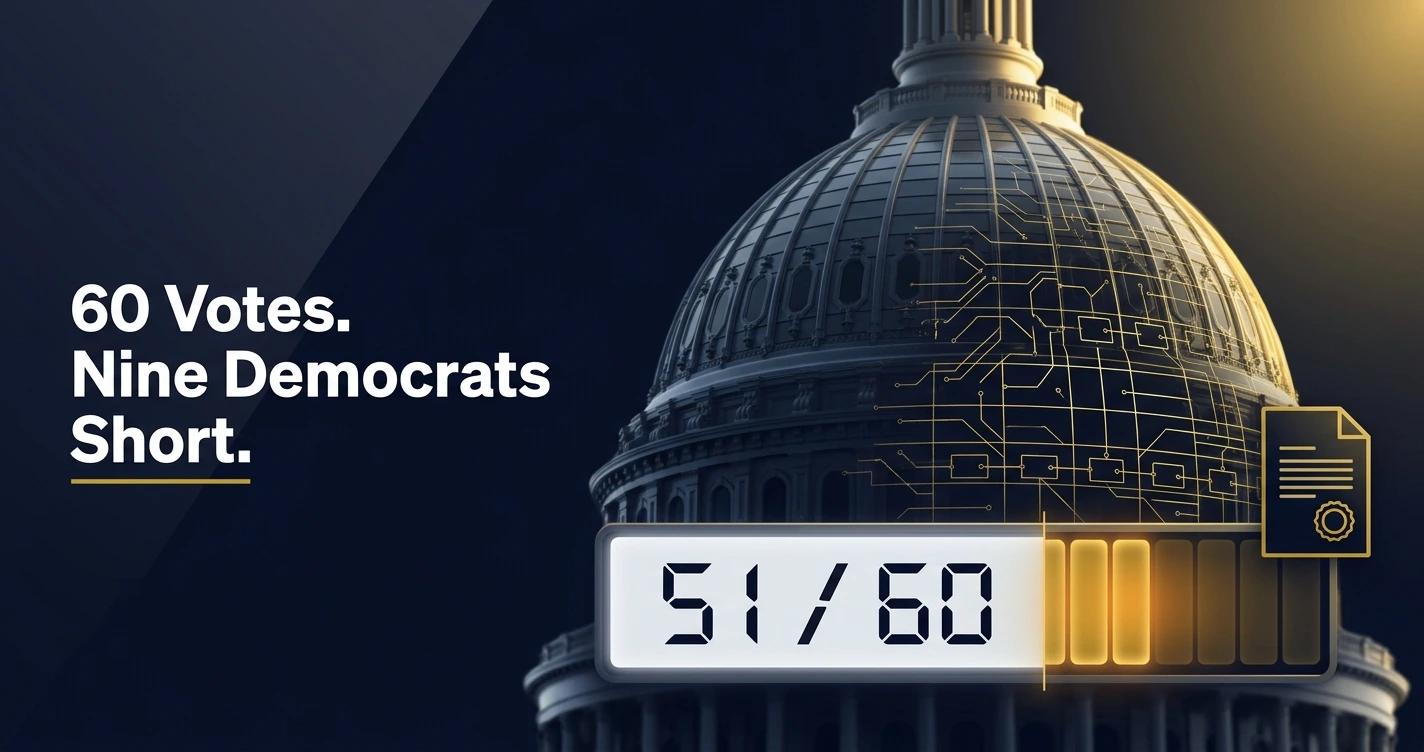
    At 2:15 p.m. ET today, the Senate votes on cloture for the CLARITY Act. It won’t make the bill law. It will tell you whether crypto regulation in America gets written by Congress or by whichever regulator is in charge next.

    A cloture vote doesn’t sound like a headline. It’s supposed to be Senate plumbing, a procedural formality that clears the way for a “real” vote later. Today it’s the real vote. If Majority Leader John Thune can’t find 60 senators willing to even discuss the Digital Asset Market Clarity Act, the most consequential U.S. crypto legislation in a decade dies quietly, on a technicality, four days before the Federal Reserve’s next rate decision and seven weeks before midterm campaigning consumes the Senate floor calendar.

    What actually happens at 2:15 p.m. today

    The Senate is voting on whether to proceed to H.R. 3633, not whether to pass it. Thune filed cloture on the motion to proceed on August 8, just before the August recess, which locked in today as the earliest the motion could ripen for a vote. Clearing the 60-vote threshold opens up to 30 hours of floor debate and amendments. Final passage would still require a separate simple-majority vote, followed by reconciliation with the House version that already passed 294 to 134 back in July 2025.

    Republicans hold 53 seats. Senators Rand Paul and Josh Hawley are expected whip counts as no votes on the GOP side, which means Thune needs roughly nine Democrats to cross over. That’s the whole ballgame today: nine votes, out of a caucus that has spent seven months publicly unconvinced.

    The number that matters: 60. Not 51, not a simple majority. A narrow miss in the high 50s signals a bill that survives into 2027 with modest fixes. A wide miss, well below that, signals the CLARITY Act is functionally dead until at least 2029, according to retiring Senator Cynthia Lummis’s own public warning.

    Prediction markets have been pricing this decline for months, not reacting to a single event. Polymarket odds on the bill becoming law in 2026 fell from 82% in February to roughly 16 to 18% by early September. Galaxy Research’s internal tracking tells the same story in steeper terms: 75% in mid-May, 60% by early June, 30% by late July, 10% by mid-August. Every failed negotiation round compounded the last one. That’s not the shape of a bill gaining momentum. It’s the shape of one running out of runway.

    The ethics concession that reshaped the negotiation

    The wild card arrived Sunday into Monday. Senators Lummis, John Boozman, and Tim Scott released a 635-page revised text they’re calling their final offer, built around an ethics provision Lummis says President Trump personally signed off on.

    “President Trump voluntarily agreed to unprecedented ethics restrictions, holding every federally elected official, judge, and their spouses to some of the toughest ethics restrictions in US history.” Sen. Cynthia Lummis (R-WY), Chair, Senate Banking Digital Assets Subcommittee, via Cointelegraph

    Here’s what the language actually does, according to CoinDesk’s reporting on the revised text: it bars federal officials, judges, and their spouses from issuing, sponsoring, or holding significant financial interests in digital assets. Violators face forced divestiture or must place holdings in a qualified blind trust. Enforcement no longer sits solely with the Justice Department, state attorneys general can now bring cases too. Penalties run to $500,000 or 20% of the prohibited transaction, whichever is larger. The whole thing takes effect 360 days after enactment.

    That state-AG enforcement piece is a direct answer to the sharpest criticism Democrats have made all year.

    Why this bill is personally about Trump’s money

    This isn’t an abstract governance debate. Trump reported more than $1.4 billion in income from family crypto ventures over the past year, roughly $635 million of it from the TRUMP meme coin alone, according to Bloomberg reporting cited by Decrypt. Any ethics provision covering “federal officials and their spouses” covers the sitting president’s own balance sheet, which is exactly why Democrats have treated the language as the whole negotiation rather than a side issue.

    There’s a complication in the “personal sacrifice” framing sponsors are using. Bloomberg has also reported that a forced blind-trust divestiture could let Trump defer capital-gains taxes on assets he’s compelled to sell, a mechanic that cuts against the idea that this concession costs him much at all.

    The seven Democrats leadership still needs

    Seven senators, Mark Warner, Catherine Cortez Masto, Raphael Warnock, Cory Booker, John Hickenlooper, Ruben Gallego, and Angela Alsobrooks, issued a joint statement back on July 22 calling an earlier draft insufficient on ethics, consumer protection, illicit finance, and market integrity. They’re the bloc leadership needs to flip today, and as of Sunday night, according to Crypto in America host Eleanor Terrett, Gallego’s and Alsobrooks’s positions on the new text remained unconfirmed.

    “Wild and unserious.” Sen. Angela Alsobrooks (D-MD), on the earlier DOJ-only enforcement mechanism, at a Semafor event, via The Hill

    Alsobrooks’s objection is a structural one worth sitting with: a Justice Department that reports to the president enforcing ethics rules against that same president is exactly the conflict of interest the provision claims to solve. The new state-AG enforcement layer in Monday’s text is a direct response. Whether it’s enough for her and the other six is the actual question the Senate floor answers today, not the bill’s substance in the abstract.

    Senator Kirsten Gillibrand has drawn a separate line entirely, saying on August 24 she won’t support the bill without an enforceable ban on presidents and senior officials profiting from crypto, pointing to a Reuters/Ipsos poll where 63% of respondents called Trump’s crypto profits “inappropriate.” Not every Democratic senator using the word “ethics” is negotiating over the same clause.

    Not everyone in the party agrees the bill fails consumers even with the new language. Sens. Elizabeth Warren and Chris Van Hollen argue the underlying market-structure framework, separate from the ethics fight, still risks deregulating existing protections rather than adding new ones.

    What’s actually at stake, by audience

    If you build, custody, or comply with crypto for a living, the abstract “regulatory clarity” framing matters less than what specifically changes for you depending on today’s outcome.

    If you’re…Cloture passesCloture fails
    An exchange or custodianA defined path to CFTC jurisdiction for commodity-classified tokens, covering roughly 78% of total crypto market cap already tagged under March 2026 SEC-CFTC joint guidanceSEC’s Paul Atkins and CFTC’s Mike Selig proceed with unilateral rulemaking, reversible by the next administration
    A DeFi developerSection 604’s developer-liability language, the same legal theory used against Tornado Cash developer Roman Storm, gets a legislative answer either wayDeveloper liability stays a matter of prosecutorial discretion and case law, not statute
    A stablecoin issuer or exchange with yield productsThe Section 404 yield provision gets finalized text, one way or another, ending the uncertainty that’s already moved Circle’s stock 20% in a single session once this yearThe roughly $1.35 billion in annual Coinbase USDC rewards revenue at risk stays an open question into 2027 at the earliest

    Worth noting for anyone holding rather than building: Bitcoin and Ethereum’s commodity classification isn’t really contested by either party at this point. This fight is almost entirely about exchanges, intermediaries, and developer liability, not about whether the two largest tokens count as commodities.

    The skeptical case: momentum is a myth here

    SEC Chair Paul Atkins gave the bill’s sponsors a compliment with a catch attached on Monday, at a Solana Policy Institute event.

    “Congress should vote to advance the Clarity Act and send it to the president’s desk as soon as possible… But let me be equally clear: with or without that legislation, this administration will deliver for American investors and technological innovators.” Paul Atkins, Chairman, U.S. Securities and Exchange Commission, via CoinDesk

    Read that carefully and it undercuts the “must-pass, do-or-die” framing coming from the bill’s own sponsors. The chairman of the agency this bill is supposed to constrain is telling the industry his office will keep moving regardless of what the Senate does today. CFTC Chair Mike Selig has said much the same, that his agency will “move swiftly” on its own rules if the bill stalls, specifically so a future framework “cannot be undone by crypto haters.”

    Our read: that’s not confidence in the legislative process. That’s two regulators building a fallback plan in public, which tells you how they privately rate today’s odds.

    What happens after the vote

    Clearing 60 votes today doesn’t finish anything. It buys up to 30 hours of floor debate, opens the bill to amendments on exactly the provisions still in dispute, and still requires a separate simple-majority passage vote followed by reconciliation with the House’s 2025 text. The House has already trimmed its own September floor calendar ahead of midterm campaigning, so even a clean cloture win today leaves a tight window to actually finish the job before 2026 runs out.

    Failing today doesn’t necessarily mean the CLARITY Act never happens. It means the SEC and CFTC keep filling the gap through rulemaking that any future administration can unwind, and it means, per Lummis’s own warning, that the next realistic shot at comprehensive legislation could slip to 2030.


    FAQ

    Did the CLARITY Act pass the Senate?

    The Senate held a cloture vote on the motion to proceed to H.R. 3633 at 2:15 p.m. ET on September 15, 2026, requiring 60 votes. This is a procedural vote, not final passage. Even if it clears, the bill still needs a full floor vote and House reconciliation before reaching the president.

    What does the CLARITY Act do?

    It builds a federal framework splitting crypto oversight between the SEC (securities) and CFTC (digital commodities), classifying Bitcoin and Ethereum as commodities and setting registration rules for exchanges, brokers, and dealers that currently operate without one.

    What happens if the CLARITY Act fails today?

    Sen. Cynthia Lummis has warned the next realistic window for comprehensive crypto legislation could be 2030. In the meantime, the SEC and CFTC proceed with their own rulemaking, though Chairman Paul Atkins has acknowledged agency rules lack the durability of statute.

    What are the new ethics rules Trump agreed to?

    The revised text bars federal officials, judges, and their spouses from issuing or holding significant digital-asset interests, requiring divestiture or a qualified blind trust. Enforcement extends to state attorneys general, with penalties of $500,000 or 20% of the prohibited transaction, whichever is greater.

    Does the CLARITY Act affect Coinbase and stablecoin yield?

    Yes. The bill’s stablecoin-yield language has already moved Circle’s stock roughly 20% in a single session earlier this year on a leaked draft, and industry estimates put close to $1.35 billion in annual Coinbase USDC rewards revenue at stake depending on the final text.


    Where this leaves you

    Today’s vote is a proxy for a bigger question: does U.S. crypto policy get set by statute, durable and hard to reverse, or by whichever regulator holds the gavel in a given administration? A cloture win doesn’t answer that question either, it just keeps the door open for Congress to try. A cloture loss answers it by default, in favor of the regulators, for years.

    Three things to watch over the next 10 to 14 days regardless of today’s tally: whether Gallego and Alsobrooks put out public statements before or shortly after the vote, whether the vote count lands in the high 50s (a narrow miss keeps 2027 realistic) or well below it (a wide miss points to 2029 or later), and how the SEC and CFTC message their own rulemaking timelines in the days immediately following. Watch Circle’s Arc mainnet launch on September 16 too, the company is proceeding regardless of the Senate’s outcome, which is its own signal about how the industry is actually hedging.

    Want the next update the moment the vote count posts, along with what it means for builders and investors? Subscribe to The Neural Loop at neuralwired.com/newsletter.


  • BlackRock BUIDL: Proof of Reserves Explained (2026)

    BlackRock BUIDL: Proof of Reserves Explained (2026)

    Proof of Reserves for Tokenized Assets: BlackRock’s Playbook
    RWA Infrastructure

    Proof of Reserves for Tokenized Assets: BlackRock’s Playbook

    A developer integrating BlackRock’s BUIDL fund into a lending protocol has one question that matters more than yield: is the collateral actually there? Proof of reserves for tokenized assets is the answer to that question, and in 2026 it stopped being optional. Since Chronicle Protocol wired independently verified holdings data directly into BUIDL’s onchain record, the gap between “we say we hold it” and “you can check it yourself” has become the line separating institutional-grade real-world asset (RWA) products from everything else.

    This is not the same thing as the monthly proof-of-reserves snapshots exchanges like MEXC or Binance publish to reassure users their BTC hasn’t vanished. Those prove an exchange is solvent. What we’re covering here proves that a tokenized Treasury fund, a tokenized gold bar, or a tokenized private credit position is backed by what its issuer claims, verifiable on-chain, continuously, by anyone.

    What Proof of Reserves Actually Verifies

    Proof of Reserve (PoR) is an automated verification system, usually built on a decentralized oracle network, that checks whether a tokenized asset’s on-chain supply genuinely matches the off-chain or cross-chain collateral backing it. Think of it as a live audit trail instead of a quarterly PDF. When a fund claims to hold $2 billion in Treasuries, PoR infrastructure pulls custody and valuation data from the actual custodian and publishes it on-chain, where a smart contract, a lending protocol, or a curious developer can check it in real time.

    The distinction that trips people up: a price oracle tells you what an asset is worth. A reserve oracle tells you whether the asset exists at all, held where the issuer says it’s held. Confusing the two is a real architecture mistake. Protocols that rely solely on a NAV feed without a separate reserve/custody check have historically been exposed to stale-price exploits, where an attacker borrows against a token whose underlying reserve has already quietly moved or shrunk.

    BlackRock’s BUIDL and Chronicle’s Proof of Asset

    The clearest real-world test case launched on March 26, 2026, when Securitize, BUIDL’s tokenization agent, and Chronicle Protocol announced that BlackRock’s tokenized Treasury fund would carry independently verified, holdings-level data directly on-chain, covering asset composition, valuation, and custody confirmation.

    At the time, BUIDL held somewhere between $1.7 billion and $2.1 billion in Treasuries, overnight repos, and cash. By July 2026, rwa.xyz put the fund’s assets under management closer to $2.5 to $2.8 billion, according to CryptoRank’s aggregated RWA.xyz data. That growth happened while the fund was operating under continuous, independently checkable verification instead of investor trust alone.

    Chronicle Protocol founder Niklas Kunkel describes the integration as an integrity layer that gives investors and protocols granular, transparent visibility into what’s backing a fund, not just what it’s worth. Niklas Kunkel, Founder, Chronicle Protocol, via The Block, March 2026
    Securitize CEO Carlos Domingo made a similar point in the joint announcement: tokenization only becomes meaningful once investors and protocols can independently verify what’s actually backing the product, rather than taking an issuer’s word for it. That’s the entire thesis of this article compressed into one sentence.

    Chainlink’s Proof of Reserve is the most widely deployed system of its kind, comparing on-chain token supply against off-chain or cross-chain custodial reserves through a decentralized oracle network. It’s live across a wide swath of the RWA stack: Backed Finance uses it for its bTokens, and Crypto Finance, part of Deutsche Börse Group, has run it since September 2025 for the physically-backed ETPs behind its nxtAssets product line.

    Chainlink secured roughly $3 billion in new RWA oracle contracts during 2026, covering reserve and data feeds for BUIDL, Ondo’s OUSG, and UBS’s tokenized asset products. That figure tells you this isn’t a niche tool anymore. It’s becoming default infrastructure the way TLS became default for web traffic: unglamorous, assumed, and increasingly non-negotiable for anyone handling institutional money.

    ERC-3643: The Compliance Layer Underneath It All

    Reserve verification answers “does the asset exist.” It doesn’t answer “is this investor allowed to hold it.” That’s where ERC-3643 (formerly known as T-REX) comes in. It’s the dominant compliance-embedded token standard for regulated RWAs, built around an on-chain IdentityRegistry that runs a preTransferCheck before every transfer, confirming KYC status, jurisdiction, and accreditation on the fly.

    As of 2026, ERC-3643 has enabled more than $32 billion in tokenized assets across over 200 deployments, according to the ERC3643 Association. If you’re deciding between a plain ERC-20 with bolted-on transfer hooks and a purpose-built standard like this one, the choice is no longer just technical preference. It’s a compliance decision that determines whether institutional counterparties will even talk to you.

    Architecture note: A production RWA integration typically needs three layers working together: a compliance-embedded token standard (ERC-3643) to gate who can hold the asset, a reserve oracle (Chainlink PoR or Chronicle Proof of Asset) to confirm the collateral exists, and mint/redeem logic with circuit breakers that halt automatically if the reserve oracle reports a threshold breach. Treating any one of these as optional is how protocols end up exposed.

    How the Verification Methods Compare

    Method What It Proves Update Frequency Used By
    Merkle-tree exchange PoR Exchange solvency (user balances covered) Monthly snapshot MEXC, Binance, Gate, BTCC
    Chainlink Proof of Reserve On-chain supply matches off-chain custody Continuous, real-time Backed Finance, Crypto Finance/Deutsche Börse
    Chronicle Proof of Asset Holdings composition, valuation, custody, existence Continuous, real-time BlackRock BUIDL
    Zero-knowledge PoR Reserves exceed liabilities, without revealing wallets Continuous, privacy-preserving Sygnum Bank (Matter Labs treasury, zkSync)

    Why Proof of Reserves Isn’t a Silver Bullet

    Here’s the part the optimistic version of this story skips. Proof of reserves confirms that a claimed asset exists at a given moment. It does not confirm off-chain liabilities, whether the asset has been rehypothecated elsewhere, or whether a token holder’s legal claim would actually survive the custodian’s bankruptcy proceedings. Those are separate problems, and no oracle network currently solves them.

    The IMF’s April 2026 note on tokenized finance, authored by Financial Counsellor Tobias Adrian, makes a sharper argument still. Faster, more transparent settlement doesn’t just reduce risk, it also removes the time buffer regulators have historically relied on to intervene before a stress event spreads. Adrian frames it as a familiar financial trade-off wearing new technology: what tokenization gains in speed and transparency, it can lose in the window available to stop a problem before it cascades.

    Tobias Adrian argues tokenization accelerates the pace at which financial stress can travel through the system, leaving regulators less time to respond than they had in prior market structures. Tobias Adrian, Financial Counsellor and Director, IMF Monetary and Capital Markets Department, April 2026
    MEXC’s Chief Operating Officer Tracy Jin raises a different objection worth sitting with. As long as tokenized assets sit on permissioned chains under the same centralized intermediaries and state regulators as traditional finance, proof of reserves proves solvency, but it does nothing about censorship or confiscation risk. In her view, that keeps tokenization a faster version of the old system rather than a genuinely new one.

    Our read: both critiques are correct and neither cancels out the value of PoR. Verification infrastructure solves the FTX problem (is the asset actually there). It was never designed to solve the Celsius problem (can the custodian and issuer collude, or become entangled in the same failing estate) or the structural speed problem Adrian describes. Treat PoR as necessary, not sufficient.

    There’s also a quality gap across asset classes that gets flattened in most coverage. Reserve-reporting quality varies most in private credit, where underwriting disclosure is genuinely harder to standardize than it is for Treasuries or allocated gold. Paxos Gold, for comparison, backs its tokens with more than 510,000 troy ounces of allocated gold held in Brink’s London vaults, with monthly attestations, a far cleaner reporting problem than an illiquid loan portfolio.

    The Regulatory Gap Nobody’s Talking About

    Two pieces of federal legislation are supposed to give this entire category legal certainty. Neither has fully landed.

    The GENIUS Act, signed into law in July 2025, is the first federal framework requiring 100 percent stablecoin reserve backing plus monthly PCAOB-audited disclosure. Its implementing rules were due by July 18, 2026. As of this writing, they remain at the proposal stage, the FDIC’s version was still in public-comment status as of April 2026.

    The Digital Asset Market Clarity Act, which would clarify SEC and CFTC jurisdiction over most tokenized RWAs, cleared the House in July 2025 and passed Senate Banking Committee markup 15 to 9 in May 2026. Then the Senate recessed in early August without a floor vote, pushing a cloture vote to September 15, 2026.

    Correcting the record: Some 2026 industry commentary assumes the CLARITY Act already passed. It has not, as of August 25, 2026. If you’re citing regulatory certainty as a reason RWA tokenization is “settled,” that claim is currently ahead of the actual legislative record.

    What This Means If You’re Building

    • Budget the oracle layer as core infrastructure, not a plugin. Reserve verification needs to be part of your initial architecture, including mint and redeem logic that halts on a reported threshold breach.
    • Pick your token standard on compliance grounds, not convenience. ERC-3643’s on-chain identity checks are becoming the default institutional counterparties expect.
    • Separate your price oracle from your reserve oracle. Conflating “what it’s worth” with “does it exist” is the most common mistake in early RWA integrations.
    • Don’t assume finalized federal rules exist yet. Both GENIUS Act implementing rules and CLARITY Act jurisdictional clarity are still pending as of late August 2026.
    • Match your verification rigor to the asset class. Treasuries and gold have mature attestation patterns. Private credit does not, yet.

    FAQ

    What is proof of reserves for tokenized assets?
    It’s an automated, typically oracle-based verification system confirming a tokenized asset’s on-chain supply is genuinely backed by the off-chain or cross-chain collateral it claims, for example confirming a tokenized gold or Treasury fund actually holds the reserves shown on its dashboard.

    How do blockchain developers verify RWAs are real?
    Developers typically pair an oracle-based reserve feed, like Chainlink PoR or Chronicle Proof of Asset, with a compliance-embedded token standard such as ERC-3643, which checks investor eligibility on-chain, alongside off-chain custodian attestations delivered through the oracle network.

    Is Chainlink Proof of Reserve the same as an audit?
    No. PoR is continuous, automated, real-time monitoring of reserve balances against token supply. A traditional audit is a periodic, manual review by an accounting firm. GENIUS Act stablecoin rules still require monthly PCAOB-registered accounting attestations alongside any on-chain PoR tooling.

    How big is the tokenized RWA market in 2026?
    Distributed, freely tradable tokenized RWA value, excluding stablecoins, reached roughly $26.7 to $33.5 billion by mid-2026 per RWA.xyz, up from about $11.8 to $14 billion a year earlier. A separate “represented” pipeline figure above $345 billion is often mistaken for this liquid total.

    Has the CLARITY Act passed?
    Not as of August 25, 2026. It passed the House in July 2025 and cleared Senate Banking Committee markup in May 2026, but the Senate delayed its floor vote to a cloture vote scheduled for September 15, 2026 after recessing in early August.

    Where This Goes Next

    What you now understand that most coverage skips: proof of reserves for tokenized assets isn’t a single product, it’s a layered stack, oracle verification, compliance-embedded token standards, and custodian attestation working together, and each layer is maturing at a different speed depending on asset class. BUIDL and Chronicle prove the technical pattern works at institutional scale. The regulatory scaffolding underneath it, GENIUS Act implementing rules and CLARITY Act jurisdictional clarity, is still catching up.

    Over the next 6 to 18 months, watch three things: whether the CLARITY Act actually clears its September 15 cloture vote, whether private credit issuers adopt reserve-reporting standards anywhere near as rigorous as Treasuries and gold currently enjoy, and whether zero-knowledge proof-of-reserve methods move from Sygnum’s early pilot into broader institutional use as issuers look for ways to verify solvency without exposing counterparty data.

    Want the next breakdown like this one delivered straight to your inbox? Subscribe to The Neural Loop at neuralwired.com/newsletter.

  • JPMorgan Kinexys: $4 Trillion in Blockchain Payments

    JPMorgan Kinexys: $4 Trillion in Blockchain Payments

    JPMorgan Kinexys Is Turning Days-Long Payments Into Seconds
    Blockchain

    JPMorgan Kinexys Is Turning Days-Long Payments Into Seconds

    JPMorgan’s blockchain settlement platform, Kinexys, has moved more than $4 trillion since launch and now averages over $7 billion a day, settling cross-border transactions that used to take one to five days through SWIFT in minutes or less. The bank is targeting $10 billion in daily volume next, and it is not the only institution proving the old rails can be beaten.

    A treasury manager at a Tokyo energy trading desk used to build in three extra days of float every time a dollar payment had to clear through a chain of correspondent banks. Weekend cutoffs, time zone gaps, compliance checks stacked on top of compliance checks. That buffer is now optional. JERA Global Markets, the trading arm of Japanese energy giant JERA, became one of the first clients to move yen settlement onto JPMorgan’s Kinexys blockchain network in June 2026. The payment doesn’t wait for a batch window anymore. It settles.

    That’s the story underneath the headline numbers: cross-border payments, an industry that has run on the same correspondent-banking plumbing since roughly the era of the Medici, is quietly being rewired. Not replaced. Rewired, corridor by corridor, bank by bank.

    Why Cross-Border Payments Are Still This Slow

    Start with the baseline, because the “days to minutes” claim only means something once you know what the days actually look like. Stripe’s payments research team puts typical SWIFT settlement at one to five business days. SWIFT’s own network data tells a more nuanced story: 75% of payments reach the beneficiary bank within 10 minutes, and over 90% within an hour. That sounds fast, until you realize that leg is under 20% of the total journey. The rest is bank-side processing, batching, and compliance review that SWIFT’s messaging layer has no control over.

    The Financial Stability Board’s G20-monitored data confirms the gap between “message sent” and “money actually available”: only 53.8% of SWIFT payments complete both the network transmission and beneficiary account credit within one hour, and 92.7% within a full day. A 5,000-payment study by Statrys found currency-conversion transfers averaging 111 hours, close to 4.6 days, with 75% of those transfers touching at least one intermediary bank.

    Every intermediary is a place where a payment can stall, get flagged, or simply wait for a business day that hasn’t started yet on the other side of the planet. That’s the friction blockchain settlement is built to remove.

    Kinexys by JPMorgan: The Numbers Behind the Hype

    Kinexys, JPMorgan’s blockchain unit rebranded from Onyx and JPM Coin in late 2024, is the clearest evidence that this shift isn’t theoretical. According to JPMorgan’s own newsroom, the platform has processed over $4 trillion in cumulative volume, with average daily volume now above $7 billion, up from roughly $2 billion a day at rebrand and $5 billion a day as recently as April 2026. That’s a 3.5x jump in daily throughput in under 14 months.

    On June 29, 2026, JPMorgan added five Asia-Pacific currencies, Australian dollar, Hong Kong dollar, Japanese yen, offshore yuan, and Singapore dollar, to Kinexys’s Blockchain Deposit Account network. That brings the total to eight currencies, alongside dollars, euros, and pounds. Payoneer took the AUD account. JERA Global Markets took the JPY account, per CoinDesk’s reporting on the launch.

    “We’re aiming to push Kinexys past $10 billion in daily volume in the foreseeable future, and we’ve got a robust pipeline of institutional clients coming online over the next year.” Zack Chestnut, Global Head of Commercial, Kinexys by J.P. Morgan, via cryptonews.net, April 2, 2026
    Mitsubishi Corporation became the first Japanese company to adopt Kinexys Digital Payments for global treasury operations around the same period. Read the pattern here: this isn’t retail crypto adoption. It’s some of the most conservative treasury desks on earth quietly moving real, regulated money onto permissioned blockchain rails because it’s faster and, increasingly, cheaper.

    BIS Project Agora and the Central Bank Angle

    Commercial banks moving fast is one thing. Central banks agreeing on anything is another. That’s what makes BIS Project Agora worth watching. Convened by the Bank for International Settlements and the Institute of International Finance, the project brings together seven central banks, including the New York Fed, Bank of England, Bank of Japan, and Swiss National Bank, plus more than 40 regulated financial institutions.

    Published findings from May 27, 2026 confirmed that atomic settlement, meaning all-or-nothing, simultaneous settlement, of wholesale cross-border transactions using tokenized central bank reserves and tokenized commercial bank deposits is achievable “securely and with finality” across currencies and jurisdictions. Legal review confirmed settlement finality holds across all seven participating jurisdictions. The project has since moved into real-value testing, and the Bank of Canada joined as an eighth participant.

    Worth flagging Project Agora is a prototype moving into pilot-stage real-value testing, not production infrastructure. One follow-up report put actual real-value transactions completed so far at roughly CHF 800,000 (about $990,000), a figure that hasn’t been independently confirmed by BIS directly. Compare that to Kinexys, which is already live at multi-billion-dollar daily volume. Central-bank-grade settlement infrastructure is likely years away from that kind of scale, even as commercial platforms sprint ahead.

    The Five-Second Transaction That Turned Heads

    If you want a single number that captures the shift, this is it. On May 7, 2026, a consortium including Ripple, JPMorgan’s Kinexys, Mastercard, and Ondo Finance completed what Ondo’s president called the first near-real-time cross-border redemption of a tokenized U.S. Treasury fund. The transaction moved from Ondo’s processing on the XRP Ledger, through Mastercard’s Multi-Token Network, to JPMorgan delivering dollars into Ripple’s Singapore bank account.

    It settled in under five seconds, outside normal banking hours, according to CoinDesk’s report. The same kind of redemption typically takes one to three business days through correspondent banks.

    “Connecting public blockchain infrastructure with interbank settlement rails is laying the groundwork for global markets that never close.” Ian De Bode, President, Ondo Finance, via CoinDesk, May 7, 2026
    There’s also a fresh entrant worth naming: N3XT, a Wyoming-chartered, fully blockchain-powered bank, received regulatory approval in mid-August 2026 to let both customers and non-customers use its digital token for instant cross-border transfers, positioning itself directly against SWIFT for shipping, logistics, and crypto-native firms. It’s a small player next to JPMorgan, but it’s a signal that the “banks only” phase of this shift is already ending.

    Old Rails vs. New Rails: A Direct Comparison

    Metric SWIFT / Correspondent Banking Blockchain Settlement (Kinexys, Agora, etc.)
    Typical settlement time 1 to 5 business days Seconds to minutes
    Full settlement within 1 hour 53.8% of payments Near-instant for permissioned rails
    Average intermediaries per payment 1.31 correspondent banks 0, direct ledger settlement
    Typical wire cost $25 to $50 Under $1 for stablecoin-based rails
    Operating hours Business days, banking hours 24/7, including weekends
    Proven scale (2026) ~$195 trillion annual global volume $4T+ cumulative on Kinexys alone; still under 1% of total global volume

    The Reality Check: Is SWIFT Actually in Trouble?

    Here’s where the article earns its keep, because most coverage of this topic skips straight to “blockchain is eating SWIFT’s lunch.” It isn’t, not yet, and maybe not ever entirely.

    “There’s some people saying that Visa, Mastercard, SWIFT are going to disappear. I totally disagree. I think stablecoins are here to stay and will probably take between 5% and 20% market share of cross-border payments.” Eric Barbier, CEO, Triple-A, via Forbes, March 30, 2026
    Barbier’s number matters because it’s grounded, not because it’s exciting. Even at $4 trillion cumulative and $7 billion-plus a day, Kinexys is a rounding error against the roughly $195 trillion in annual global cross-border payment volume, a figure projected by BIS to reach $320 trillion by 2032. FXC Intelligence data cited in the same Forbes piece put total stablecoin cross-border volume at under 1% of global cross-border payment volume as of early 2026. Triple-digit percentage growth on a small base is still a small number. Worth remembering before you extrapolate a headline into a headline-of-headlines.

    Central banks themselves were skeptical not long ago. A 2023 Statista-cited survey of central bank representatives found most were “unsure” whether blockchain would play a future role in payments, and only around one in four believed it would make a real impact. That skepticism hasn’t fully disappeared, it’s just been overtaken by results.

    Compliance is the other unresolved piece. The Payments Association’s 2026 cross-border outlook states plainly that stablecoin compliance capabilities, KYC, AML, reserve auditability, remain “highly variable” across providers even after the GENIUS Act and MiCA took effect. Regulatory clarity on paper doesn’t automatically mean operational certainty in practice.

    Our read This signals a bifurcated market, not a winner-take-all one. Permissioned, bank-operated rails like Kinexys are winning the high-volume institutional corridors right now because they combine speed with an existing compliance and legal wrapper. Public-blockchain infrastructure, XRP Ledger, tokenized Treasuries, is winning the edge cases where speed and 24/7 access matter more than incumbency. SWIFT isn’t dying. It’s losing the corridors where it was always weakest.

    What This Means for Treasury Teams Right Now

    If you run treasury operations for a company with high-volume, recurring cross-border flows, the practical opportunity here is narrower and more actionable than the market-sizing headlines suggest.

    • Map your highest-friction corridors first. Weekend and holiday settlement gaps, and routes with a high intermediary count like UK to Nigeria or US to Philippines, are the clearest pilot candidates.
    • Vet providers individually. Regulatory scaffolding exists now under the U.S. GENIUS Act and EU’s MiCA framework, but compliance maturity still varies enormously provider to provider. NeuralWired has covered the differences between the GENIUS Act and MiCA stablecoin frameworks in detail if you need the regulatory baseline.
    • Don’t chase 24/7 settlement for its own sake. Barbier’s point stands: most B2B flows don’t genuinely need round-the-clock settlement. Next-business-day is often good enough. Benchmark actual cost and speed needs before migrating a corridor.
    A Ripple survey of over 1,000 global finance leaders found 74% believe stablecoins or blockchain rails can unlock trapped working capital, and 72% believe offering a digital-asset solution will be necessary to stay competitive. Worth noting: Ripple is a vendor in this space, so treat that as interested-party sentiment data, not independent research. It still tells you where the conversation inside finance departments has moved.


    Where This Goes Next

    What you now know that you didn’t before: the “blockchain replaces SWIFT” framing is wrong, but the “blockchain is a niche experiment” framing is now equally wrong. Kinexys alone is running trillion-dollar production volume. Project Agora has central bank legal sign-off across seven jurisdictions. A tokenized Treasury redemption settled in under five seconds outside banking hours. None of that was true two years ago.

    Over the next 6 to 18 months, watch three things: whether Kinexys actually hits its $10 billion daily volume target, whether The Clearing House’s reported shared tokenized deposit network among JPMorgan, Citi, Bank of America, and Wells Fargo materializes on its rumored H1 2027 timeline, and whether Project Agora moves from pilot-scale real-value testing into anything resembling production volume. Each of those is a concrete signal, not a vibe.

    The reader takeaway isn’t “move everything on-chain tomorrow.” It’s that the corridor-by-corridor migration is already underway among the institutions with the most to gain, and treasury teams that wait for full market maturity before evaluating a pilot will be evaluating from behind.

    Frequently Asked Questions

    How long does a cross-border payment take with blockchain?
    Blockchain-based settlement rails, such as JPMorgan’s Kinexys, can settle institutional cross-border transactions in seconds to minutes, 24/7, versus the one to five business days typical of correspondent-bank SWIFT transfers, according to J.P. Morgan and BIS data.

    Why are cross-border payments so slow?
    Traditional cross-border payments route through multiple correspondent banks, averaging 1.31 intermediaries per transaction, with each one adding processing time, fees, and compliance checks. Currency-conversion transfers average roughly 4.6 days end to end.

    Is blockchain replacing SWIFT?
    Not entirely. Blockchain rails are capturing a growing share of cross-border settlement, with experts like Triple-A CEO Eric Barbier estimating 5% to 20% long-term market share, but SWIFT still processes the large majority of global cross-border payment messaging as of 2026.

    What is JPMorgan Kinexys used for?
    Kinexys is JPMorgan’s permissioned blockchain platform for institutional clients, enabling 24/7 cross-border settlement, foreign exchange, and tokenized deposit transfers. It has processed over $4 trillion cumulatively with more than $7 billion in average daily volume as of mid-2026.

    What is BIS Project Agora?
    Project Agora is a Bank for International Settlements initiative with seven central banks and 40+ financial institutions testing whether tokenized central bank reserves and commercial bank deposits can enable atomic, real-time settlement of wholesale cross-border payments.

    Do stablecoins reduce cross-border payment costs?
    Yes. BIS data cited by industry sources shows traditional wires cost $25 to $50 with 1 to 5 day settlement, while stablecoin-based transfers can cost under $1 per transaction with sub-hour settlement, though savings vary significantly by corridor and provider.

  • GIA Buys 30% of De Beers’ Tracr Diamond Blockchain

    GIA Buys 30% of De Beers’ Tracr Diamond Blockchain

    Why GIA Just Bought Into De Beers’ Diamond Blockchain
    Enterprise Blockchain / Supply Chain

    Why GIA Bought Into De Beers’ Tracr Blockchain

  • BlackRock’s BUIDL Fund Trades on Uniswap in 2026

    BlackRock’s BUIDL Fund Trades on Uniswap in 2026

    BlackRock’s BUIDL Trades on Uniswap, Backs Binance Loans
    Blockchain / Tokenization

    BlackRock’s BUIDL Trades on Uniswap, Backs Binance Loans

  • Circle Arc vs Tether Plasma: Developer’s Guide 2026

    Circle Arc vs Tether Plasma: Developer’s Guide 2026

    Circle Arc vs Tether’s Plasma and Stable: A Developer’s Guide (2026)
    Developer Deep Dive · Stablecoin Infrastructure

    Arc, Plasma, Stable: A Developer’s Stablechain Map

    You can deploy a smart contract on Circle’s Arc testnet this afternoon. You cannot ship it to production, because Arc has no mainnet, no confirmed launch date, and no guarantee the chain you’re testing against today looks the same when it finally goes live. Meanwhile, Tether already runs two separate mainnets, Plasma and Stable, and they don’t share a gas model, a token, or a design philosophy. If your roadmap touches both USDC and USDT, you’re not choosing one stablecoin blockchain in 2026. You’re choosing between three, and none of them talk to each other natively.

    That’s the part most coverage skips. This piece is for the people who actually have to write the code: which chain is real infrastructure today, which is a very well-funded testnet, and what breaks in your architecture if you assume otherwise.

    What’s Actually Live vs. What’s Roadmap

    Start here, because it’s the single most common source of confusion in developer forums right now.

    ChainStatus (Aug 2026)Native Gas AssetConsensus
    Circle ArcPublic testnet only, no mainnet dateUSDCMalachite (permissioned PoA)
    Tether PlasmaMainnet live since Sept 2025USDT (paymaster-abstracted)PlasmaBFT + Bitcoin anchor
    Tether StableMainnet live, native STABLE tokenUSDT (direct, no abstraction)EVM-compatible BFT
    The one-line version Arc is real, well-funded, and not ready for production traffic. Plasma and Stable are both live and processing real value today, but they are two distinct chains, not two names for the same thing.
    Circle announced Arc in August 2025 as an independent Layer-1 built around USDC as native gas, a built-in FX engine for institutional price discovery, and sub-second finality. Testnet went live that October. As of Circle’s February 2026 earnings call, the company had shifted its own language from firm mainnet dates to describing an “exploration phase.” If you see a headline promising an imminent Arc mainnet, check the date against Circle’s own blog before you believe it.

    Circle Arc: Built for Institutions, Still in Testnet

    Here’s what’s genuinely usable right now: developers can connect to Arc’s testnet via standard RPC endpoints, pull test USDC from the faucet, and deploy contracts using ordinary Foundry or Hardhat workflows, per the Arc developer docs. That’s not vaporware. It’s a working environment you can build against today, at zero production risk because there’s nothing live to break.

    What developers should actually plan around:

    • Permissioned validators. Arc runs proof-of-authority today, with a stated intention to move toward permissioned proof-of-stake. Circle holds a 25% stake in the initial 10 billion token supply and can operate validator infrastructure directly. That’s a very different trust model than the public chains most Solidity developers are used to.
    • Failure mode is a halt, not a fork. BFT-style permissioned consensus tends to stop the chain during a partition or validator failure rather than split it. If your mental model of “chain down” comes from Ethereum, recalibrate.
    • Token incentives are real but future-dated. Sixty percent of Arc’s 10 billion token supply is earmarked for ecosystem participants, meaning builders and users, separate from the presale investors. In May 2026, Circle closed a $222 million token presale at a $3 billion fully diluted valuation, led by a16z with participation from BlackRock and Apollo. That’s serious capital behind a chain nobody can use in production yet.

    Plasma and Stable Are Not the Same Chain

    This is where most explainers get lazy, lumping both under “Tether’s chain” as if Tether built one thing. It built two, and they solve different problems.

    Plasma: liquidity-first, subsidized fees

    Plasma launched in September 2025 and hit $5.6 billion in TVL within its first week. It pairs a custom PlasmaBFT consensus with full EVM compatibility and a Bitcoin security anchor, and it raised roughly $373 million in a public token sale, seven times its original target. More than 100 DeFi protocols, including Aave, Ethena, and Euler, integrated on day one. Gas is abstracted through a paymaster, which is how Plasma delivers zero-fee USDT transfers. That subsidy is a business decision Tether makes, not a protocol-level guarantee, which matters if you’re designing unit economics around permanently free transfers.

    Stable: governance-first, direct gas

    Stable is a separate Tether and Bitfinex-orbit chain that launched its EVM-compatible mainnet after a pre-deposit campaign pulling in more than $2 billion from over 24,000 wallets, according to The Block’s mainnet coverage. Instead of abstracting gas, Stable uses USDT directly as the fee asset, no separate token required to transact. It shipped with its own STABLE governance token and an independent Stable Foundation, deliberately separating network security decisions from USDT-denominated payment flows. In May 2026 it added StableEarn, a yield product tied to Treasury and gold-backed real-world assets.

    Same issuer ecosystem, two genuinely different architectures. Code written for Plasma’s paymaster model doesn’t port cleanly to Stable’s direct-gas model, even though both chains are EVM-compatible.

    The Gas Model Problem Developers Underestimate

    Every one of these three chains claims EVM compatibility. None of them handle gas the same way, and gas is where user experience actually lives.

    ChainGas MechanicWhat it means for your app
    ArcUSDC native gas + built-in FX engineInstitutional RFQ pricing baked in, but permissioned validator dependency
    PlasmaPaymaster abstracts fees to zeroGreat UX today, dependent on Tether’s continued subsidy
    StableUSDT used directly, no abstractionSimple mental model, but fees are visible to end users
    Is a “zero-fee” chain actually free, or is someone just paying the fee for you upstream? On Plasma, it’s the latter, and that’s worth designing around rather than assuming away.

    The Fragmentation Bill You’ll Eventually Pay

    A USDC balance on Arc and a USDT balance on Plasman or Stable don’t interoperate natively. Moving value between them requires bridging infrastructure, CCTP for USDC, USDT0’s OFT architecture for USDT, and that bridging layer needs to be a first-class part of your architecture, not a patch you add later.

    A Bank for International Settlements working paper makes the structural case bluntly: a stablecoin on one chain isn’t the same asset as the identical token minted on another chain by the same issuer. They can’t be directly exchanged, and every bridge between them introduces delay, cost, and smart-contract risk. Stack Arc, Plasma, Stable, and Stripe’s Tempo on top of each other and you’ve recreated the L2-sprawl problem Ethereum already has, just with different issuer logos attached.

    Our read This signals that “which chain should I build on” is the wrong first question. The right one is “how many bridges am I willing to maintain,” because the answer to the first question is probably going to be all of them eventually.

    What the People Building This Actually Say

    Circle CEO Jeremy Allaire has been explicit about the ambition behind Arc, framing it as more than infrastructure. In a CNBC interview announcing the token presale, he described Circle as
    “entering the operating system business”Jeremy Allaire, Co-Founder and CEO, Circle Internet Group, CNBC, May 11, 2026

    a16z crypto, the lead investor in that raise, framed the underlying problem as one of infrastructure catching up to demand, noting that stablecoins have become one of the most important tools in global finance while the blockchains carrying them remain optimized for crypto-native users rather than banks and corporations, per Bessemer Venture Partners’ stablecoin research.

    Not everyone is convinced the model is neutral infrastructure at all. Critics quoted in industry analysis have described Arc’s design as closer to
    “a walled garden… for banks”Odaily analysis, October 2025
    than a genuinely open public network, pointing to Circle’s validator control and permissioned architecture as evidence.

    Tether CEO Paolo Ardoino, an advisor and seed investor in both Plasma and Stable, has also been publicly critical of MiCA’s stablecoin rules, arguing they create systemic banking risks, and Tether hasn’t pursued MiCA authorization for USDT. That’s directly relevant if you’re an EU-based developer weighing production deployment on either Tether chain, since it shapes USDT’s regulatory footing in that market.

    Quick Answers

    Is Circle Arc live yet?
    No. As of August 2026, Arc remains in public testnet, which launched in October 2025. Circle has confirmed a 2026 mainnet target but hasn’t set a firm date, describing the project as still in an “exploration phase” as of its February 2026 earnings call.

    What’s the difference between Tether’s Plasma and Stable chains?
    Both use USDT as gas and sit in the Tether and Bitfinex orbit, but they work differently. Plasma abstracts gas through a subsidized paymaster for zero-fee transfers, while Stable uses USDT directly as the gas asset with its own STABLE governance token layered on top.

    Can you build on Circle Arc today?
    Yes, on testnet. Developers can connect via RPC endpoints, use Foundry or Hardhat, pull testnet USDC from Circle’s faucet, and deploy EVM smart contracts right now. Production deployment isn’t possible until mainnet ships, and no date is confirmed yet.

    Why are Circle and Tether building their own blockchains?
    Both companies currently settle their stablecoins on third-party chains like Ethereum and Tron, capturing none of the transaction fee revenue those networks generate. Owning the settlement layer lets them keep that fee revenue instead of handing it to someone else’s network.

    Does building on Arc or Plasma create liquidity fragmentation risk?
    Yes. USDC balances on Arc and USDT balances on Plasma or Stable don’t interoperate natively. Moving value between them needs bridges like CCTP, and each bridge adds cost, latency, and smart-contract risk that has to be designed around explicitly.


    Where This Goes Next

    Here’s what you didn’t know walking in: “building on a stablecoin chain” isn’t one decision, it’s at least three, and they don’t converge anytime soon. Arc buys you institutional FX tooling and a serious token incentive, in exchange for building on infrastructure that doesn’t exist in production yet. Plasma buys you the deepest live liquidity and free transfers, subsidized by a company that can change that subsidy on its own schedule. Stable buys you a simpler gas model and a dedicated governance layer, at the cost of user-visible fees.

    Watch three things over the next six to eighteen months: whether Circle actually ships an Arc mainnet date rather than another “exploration phase” update, whether Plasma’s zero-fee economics survive a real stablecoin supply contraction, and whether USDT0-style bridging standards mature enough that cross-chain USDT stops being a developer headache. None of these chains exist in a vacuum, and the fragmentation problem they’re each quietly creating is going to need its own solution before any of them scale the way their backers are promising.

    Want the next update on this before it hits the wire? Subscribe to The Neural Loop for the developer-angle breakdown every time one of these chains ships something real.

  • Circle Arc vs Tether Plasma: Stablecoin Chains 2026

    Circle Arc vs Tether Plasma: Stablecoin Chains 2026

    Blockchain / Developer Focus

    Circle’s Arc, Tether’s Plasma: New Stablecoin Rails

    Published August 2, 2026 · 11 min read

    Two companies that mint the world’s largest stablecoins just stopped renting blockchain space and started building their own. If you are one of the stablecoin native blockchain developers in 2026 deciding where to deploy next, that shift changes your gas fees, your compliance exposure, and possibly your entire cost structure.

    For a decade, Circle and Tether minted USDC and USDT as guest tokens on chains they did not control: Ethereum, Tron, Solana. They collected reserve yield while Ethereum validators and Tron node operators collected the transaction fees. That arrangement just broke. In the second half of 2025, Circle launched a Layer 1 called Arc, Tether backed two separate chains called Plasma and Stable, and Stripe partnered with Paradigm on a fourth network called Tempo. None of this happened by accident, and all of it changes how you should think about where to build.

    The decade-long pattern that just broke

    Since 2014, Tether minted USDT as an ERC-20 or TRC-20 token on infrastructure it did not own. Circle did the same with USDC starting in 2018. Both companies earned billions in reserve yield on the dollars backing their tokens, while Ethereum and Tron pocketed the gas fees every time someone moved that money. It was a strange split: the issuers had the brand and the float, but none of the settlement revenue.

    That split ended fast. Circle announced Arc in August 2025 and described it as a blockchain built specifically for stablecoin finance. Within weeks, Bitfinex backed a Bitcoin-anchored chain called Plasma, and separately seeded a second network called Stable. Stripe, fresh off its $1.1 billion acquisition of stablecoin platform Bridge, started building Tempo with Paradigm. A ChainCatcher analysis of the moment called it exactly what it was: the issuance layer and the network layer, separated for a decade, suddenly recombining under the same roof.

    The trigger was regulatory, not just competitive. The GENIUS Act, signed in July 2025, gave stablecoin issuers a federal framework clear enough to justify heavier infrastructure bets. Owning the rails is now a business model, not just a technical flex.

    Circle’s Arc: the $3 billion bet still in testnet

    Arc is Circle’s answer to a simple question: what if the gas token, the FX engine, and the compliance layer were all built around USDC from day one? Circle’s own announcement describes it as a Layer 1 designed from the ground up for stablecoin native applications, running USDC as native gas, with a built-in institutional FX engine, sub-second finality through a consensus system called Malachite, and configurable privacy for compliant balance shielding.

    The numbers behind Arc are hard to ignore. Public testnet went live on October 28, 2025. By early May 2026 it had processed 244.1 million transactions, according to Circle’s own whitepaper. Testnet participants reportedly include Visa, HSBC, BlackRock, and AWS. In May 2026, Circle raised $222 million in an ARC token presale at a $3 billion fully diluted valuation, led by Andreessen Horowitz’s $75 million check, with BlackRock and Apollo Funds also participating.

    Reality check for CTOs: Arc has no confirmed mainnet date. Circle CEO Jeremy Allaire has only said the company is exploring a network token and a possible move to proof of stake, with mainnet beta “targeted” for sometime in 2026. Treat that as a moving target, not a commitment, and build against the testnet first.
    One detail matters for anyone evaluating governance: of ARC’s 10 billion total token supply, 60% goes to ecosystem development, but Circle keeps 25% for itself, with the remaining 15% held as long-term reserves. Arc is marketed as open infrastructure for any stablecoin issuer, not just Circle’s own products, but the token allocation tells you who actually controls the network in its early years.

    “While USDC serves as the native gas token, Arc’s architecture supports other stablecoins through its FX engine and Paymaster functionality. The network is designed as infrastructure for all stablecoin issuers, not exclusively for Circle’s products.”

    Tether’s two chains: Plasma and Stable are not the same thing

    Here is where most coverage gets sloppy. Tether backs two separate Layer 1 blockchains, and conflating them will cost you if you are actually deploying code.

    Plasma is Bitcoin-anchored and EVM-compatible, backed by Bitfinex and Peter Thiel’s Founders Fund. It runs a custom consensus called PlasmaBFT, anchors state checkpoints to Bitcoin for extra settlement security, and lets existing Solidity contracts deploy unchanged. Standard USDT transfers cost the sender nothing, and apps can pay gas directly in USDT instead of the native XPL token. Mainnet beta launched on September 25, 2025, with $2 billion in stablecoin liquidity deployed across more than 100 DeFi partners, including Aave, Ethena, Fluid, and Euler.

    Stable is a different project entirely, seeded by Bitfinex and Hack VC with participation from Franklin Templeton, Castle Island Ventures, and Susquehanna in a $28 million raise. Stable uses USDT itself as the gas asset, offers sub-second finality, full EVM compatibility, and institutional features like guaranteed blockspace and confidential transfers. It launched mainnet with a native STABLE token and an independent Stable Foundation, and in a February 4, 2026 upgrade it switched its gas token from an interim gUSDT to the LayerZero-based USDT0.

    Plasma’s early growth shows how volatile “instant” liquidity can be. It pulled in $5.6 billion in deposits within one week of launch, then TVL dropped to roughly $1.8 billion as yield-farming incentives normalized, before recovering to $2.04 billion by mid-April 2026, making it the seventh-largest chain by liquidity. Aave deposits on Plasma reportedly hit $5.8 billion within 48 hours of mainnet, per USDT0’s own materials, a figure worth treating as a company claim rather than an audited fact.

    The nuance that changes the whole framing: Tether’s own CEO does not call this a “Tether chain.”

    “There is no Tether chain and I don’t think there will be ever a Tether chain, but there are good opportunities and good teams that can build great ecosystems.”
    That is Paolo Ardoino, CEO of Tether and CTO of Bitfinex, on the Bankless podcast. Unlike Circle, which put its name directly on Arc, Tether is deliberately arm’s length about Plasma and Stable. Both are affiliated, independently branded networks, not an official Tether product. For developers, that distinction matters for support channels, governance expectations, and who you actually call when something breaks.

    Arc vs. Plasma vs. Stable vs. Tempo, side by side

    ChainBackerGas TokenStatusArchitecture
    ArcCircleUSDCPublic testnet since Oct 2025; no confirmed mainnet dateSovereign Layer 1, permissioned PoS at launch
    PlasmaBitfinex / Founders FundUSDT (fee-free transfers)Mainnet live since Sept 25, 2025Bitcoin-anchored EVM L1, curated validator set
    StableBitfinex / Hack VCUSDT0 (since Feb 2026)Mainnet live since late 2025EVM L1 with confidential transfers
    TempoStripe / ParadigmIssuer-agnosticIn developmentDesigned for all stablecoins, not one issuer
    One more chain worth knowing: Ethena’s Converge takes the opposite architectural bet. Instead of launching as a sovereign L1 like Arc, Plasma, and Stable, it built as an Ethereum Layer 2, specifically to stay interoperable with Ethereum rather than compete with it. That is the road not taken by the three chains above, and it is worth watching whether it ages better.

    What this means if you are building on these chains

    Chain selection used to mean picking an L2. Now it means picking a trust model. Here is what actually changes for your stack.

    Gas volatility disappears, but so does gas-token diversification. Paying fees in USDC or USDT instead of a volatile native token is a genuine UX win for payment apps. It also means your entire cost structure is now tied to one issuer’s stablecoin staying pegged and liquid. If that peg wobbles, so does your fee model.

    Compliance is opt-in privacy, not decentralization. Arc’s “opt-in privacy” and “selectively shielded balances,” and Stable’s confidential transfer features, mean issuer-level freeze and compliance capability is baked into the base layer. That is a materially different risk profile than deploying on permissionless Ethereum or Tron, and it is worth reading the fine print before you build anything that depends on censorship resistance.

    Validator sets are curated at launch, not open. Plasma’s mainnet beta launched with a curated validator set, and Circle has described Arc’s initial model as permissioned proof of stake, with decentralization promised later. Do not assume day one censorship resistance on any of these chains.

    The “free” transfers are subsidized, not free. Plasma’s zero-fee USDT transfers rely on Tether continuing to underwrite the cost, with more complex transaction fees expected to cover the gap over time. If that subsidy model changes, so does your user-facing fee. Any production integration built around free transfers needs a fallback cost model, full stop.

    Build against testnets, not press releases. Arc’s mainnet is a moving target. Plasma and Stable are both already live. Treat announced dates as directional and watch for the actual mainnet beta announcement before you commit production infrastructure.

    The skeptic’s case: neutrality claims vs. issuer self-interest

    Both Circle and Tether describe their chains as open, neutral infrastructure for any stablecoin issuer. The numbers complicate that claim. Circle keeps 25% of ARC’s total token supply. Tether and Bitfinex seeded both Plasma and Stable with direct capital, and Plasma got preferential integration into Tether’s own wallet on launch day.

    Nick Van Eck, co-founder and CEO of stablecoin issuer Agora, made a related argument about Stripe’s Bridge that applies here with equal force.

    “If Hyperliquid relinquishes its canonical stablecoin to Stripe, a vertically integrated issuer with clear conflicts, what are we all even doing?”
    Swap Stripe for Circle or Tether and the logic holds: an issuer that also runs the settlement rail has every incentive to route its own stablecoin’s activity preferentially, even on infrastructure it calls “open.”

    There is a fragmentation risk too. Young Cho, CEO of Ethena-linked treasury company StablecoinX, warned that stablecoin-specific chains could fragment activity and reduce Ethereum’s centrality in the market. Extend that logic and you get liquidity, tooling, and composability splintering across Arc, Plasma, Stable, and Tempo at once, with no clear market leader yet in what CoinGecko calls the “stablechain” category.

    Plasma’s own trajectory is the clearest cautionary data point. It raised $373 million and pulled in $5.6 billion in deposits within a week of launch, then TVL fell to roughly $1.8 billion once yield-farming incentives normalized. Analysts at BlockEden.xyz called it a classic incentive misalignment: the chain converted yield farmers, not payment users. Displacing Tron’s entrenched USDT position, they note, will take years of sustained Tether support and successful conversion of subsidized growth into organic network effects.

    Our read: this signals infrastructure ownership is becoming the real stablecoin battleground, not token issuance. Whoever controls the rails captures the fee revenue Ethereum and Tron used to keep. Polygon’s Aishwary Gupta put the whole dynamic in one line: “he who controls the rails, controls everything.”

    There is a second-order risk that rarely makes developer-facing coverage. A February 2026 study found stablecoin partnerships were associated with partner banks seeing roughly 67% higher interbank payments, 38 to 55% greater intraday reserve volatility, and a 14 percentage point drop in loans-to-assets ratios. Separate Federal Reserve research from economist Jessie Jiaxu Wang found domestic stablecoin demand directly reduces U.S. bank deposits. A settlement chain that makes stablecoins faster and cheaper to move could accelerate exactly that deposit flight, and it is worth watching how regulators respond as Arc, Plasma, and Stable scale.


    Frequently asked questions

    What is Circle’s Arc blockchain?
    Arc is an open Layer 1 blockchain built by Circle for stablecoin native finance, using USDC as native gas, with sub-second finality, a built-in FX engine, and opt-in privacy. It entered public testnet in October 2025, with mainnet beta targeted for 2026.

    What is Tether’s Plasma blockchain?
    Plasma is a Bitcoin-anchored, EVM-compatible Layer 1 built around Tether’s USDT, backed by Bitfinex and Founders Fund. It offers zero-fee USDT transfers and launched mainnet beta on September 25, 2025.

    Is Plasma the same as Stable?
    No. They are separate Tether-ecosystem blockchains. Plasma is Bitcoin-anchored with a custom BFT consensus. Stable is a distinct project seeded by Bitfinex and Hack VC that uses USDT as its gas asset, with its own native token and foundation.

    Why are Circle and Tether building their own blockchains?
    Issuers earned stablecoin float yield for years but captured none of the transaction fee revenue generated on chains like Ethereum and Tron. Owning the rails lets them capture settlement revenue and control compliance features directly.

    Does Circle’s Arc have a mainnet yet?
    Not as of this writing. Arc remains in public testnet, live since October 28, 2025, with no confirmed mainnet date. Treat any “imminent launch” claims as unverified until Circle announces one officially.

    What is USDT0 and how does it relate to Plasma and Stable?
    USDT0 is the omnichain version of USDT, operated by Everdawn Labs under license from Tether. Real USDT locks in a vault on Ethereum while an equivalent amount mints on destination chains via LayerZero. Both Plasma and Stable rely on it for cross-chain liquidity.


    What to watch over the next 6 to 18 months

    Three things will tell you whether this bet paid off. First, whether Arc actually ships a mainnet in 2026 or slips into 2027 while Visa, BlackRock, and HSBC quietly lean harder on already-live alternatives. Second, whether Plasma and Stable can convert their subsidized launch liquidity into organic, non-farmed transaction volume, given USDT0’s dependence on LayerZero’s cross-chain messaging as an added point of failure. Third, whether regulators start treating issuer-run settlement chains as a concentration risk, since a chain outage or freeze decision would now hit both the stablecoin and its primary settlement rail at the same time.

    What you now understand that most coverage glosses over: this is not “Circle versus Tether” as a symmetric race. Plasma and Stable are live, in production, moving billions in real liquidity. Arc is still a testnet with a $3 billion valuation and no mainnet date. Build accordingly, and do not confuse a funding round for a production-readiness signal.

    Want the next stablecoin infrastructure story before it hits your feed? Subscribe to The Neural Loop at neuralwired.com/newsletter.