Expert machine learning analysis: model architectures, training techniques, MLOps, deployment strategies, and research breakthroughs explained for engineers and technical leaders.
If you’re an ML engineer, infrastructure lead, or CTO planning training capacity for next year, this is the memory chip shortage 2026 story you actually need to understand, and it’s not about GPU allocation anymore. It’s about whether there’s enough memory bandwidth on the planet to feed the GPUs you already have.
What’s Actually Happening to the Memory Market
Start with the suppliers, because they’re the ones with the clearest view of demand. Samsung’s CFO Park Soon-cheol told investors on the company’s Q1 2026 earnings call that HBM4 “sales volume has already been completely sold out” for the year, with HBM4 expected to make up more than half of Samsung’s total HBM revenue by the third quarter. SK hynix said something almost identical back in October 2025: customers had already claimed the company’s entire 2026 output of both DRAM and NAND.
Micron’s numbers tell the same story from a different angle. The company’s fiscal Q3 2026 results show HBM4 already in high-volume shipment for its lead customer’s platform, while next-gen HBM4E won’t reach volume production until calendar 2027. Micron guided fiscal Q4 2026 revenue to $50 billion. A year earlier, that number was $9.3 billion.
None of this is speculation dressed up as forecasting. It’s suppliers describing capacity they’ve already sold, for products they haven’t finished shipping.
The Numbers Behind the Panic
Here’s what the reallocation actually looks like in hard figures.
Metric
Figure
Source
DRAM contract price increase, Q1 2026 (QoQ)
93% to 98%
TrendForce
36GB HBM3E spot price vs. long-term contract price
~$2,100 vs. $300 to $400 (4 to 5x)
The Motley Fool
South Korea DRAM export price, year over year
+401%, reaching $92,183/kg
Chosun Ilbo trade data
Global memory market forecast, 2026
Raised from $551.6B to $889.3B
TrendForce
Global memory market forecast, 2027
Over $1.28 trillion (+44% YoY)
TrendForce
Retail 32GB DDR5-6000 kit price, Aug 2026
$402, up from $110 to $140 a year earlier
Tom’s Hardware pricing data
HBM share of top-3 suppliers’ DRAM wafer input, 2025/2026/2027
18% / 22% / 30%
TrendForce
Notice the pattern. It isn’t just HBM (the specialized memory stacked directly onto AI accelerators) getting expensive. Ordinary DDR5, the RAM in laptops and servers with no connection to AI training whatsoever, is being dragged up in price because the same fabs, the same wafer starts, and the same clean-room capacity now compete against AI demand for every gigabyte produced.
Why This Has Nothing to Do With GPUs
Here’s the part most coverage misses. The GPU shortage that dominated headlines in 2023 and 2024 is largely over. Nvidia, AMD, and their foundry partners have scaled logic production aggressively. What hasn’t scaled at the same rate is the memory that sits next to that logic, and that gap is now the binding constraint on how fast AI models can actually be trained.
Micron’s HBM Design Architecture Fellow, Raghu Sreeramaneni, put a number on the gap at Hot Chips 2026:
“Compute scales roughly 3x every two years. HBM bandwidth scales only about 2x every two years. The memory wall persists, and it may be worsening.”
Raghu Sreeramaneni, HBM Design Architecture Fellow, Micron Technology — via wccftech, Hot Chips 2026
That mismatch has a name in chip architecture circles: the memory wall. It means you can add more GPUs to a rack, but if the memory bandwidth feeding those GPUs doesn’t grow at the same pace, the extra compute sits idle waiting for data. Micron’s own materials cite Meta’s Llama 3 training paper, which attributed 17% of unintended training interruptions to HBM issues, a concrete number showing this isn’t a theoretical problem.
OpenAI’s COO Brad Lightcap confirmed the shift publicly in March 2026, telling reporters the company’s binding constraint had moved: it used to be power availability. Now, in his words, “right now it’s memory.”
Why this matters for planning: if your infrastructure roadmap is still built around GPU allocation as the scarce resource, you’re solving last year’s problem. The scarce resource in late 2026 is memory bandwidth per accelerator, and that constraint doesn’t get fixed by buying more chips.
Who’s Feeling the Squeeze
This stopped being a tech-press story in mid-2026. A coalition representing telecommunications, automotive, medical-device, and retail trade associations formally warned U.S. regulators that expanding AI data centers were consuming an enormous share of available memory chip capacity, according to reporting confirmed by CSIS. That’s four industries with nothing to do with AI, telling Washington the same fabs are now out of reach for them.
TrendForce analyst Avril Wu, who has tracked the memory sector for close to two decades, doesn’t hedge on how unusual this cycle is:
“I’ve tracked the memory sector for almost 20 years, and this time really is different. It really is the craziest time ever.”
Avril Wu, Analyst, TrendForce — via Tom’s Hardware
Counterpoint Research’s MS Hwang went further in the same piece, telling buyers to act as if capacity for 2028 is already gone: “you gotta buy a plane ticket and get that allocation from manufacturers right now.”
That’s not marketing language from a supplier trying to justify a price hike. That’s an independent analyst telling procurement teams the window has already closed for near-term allocation, and the next window (2028 capacity) is closing too.
When Does This Actually End
Short answer: not soon, and here’s the specific reason why. New memory fabs take years to build, while GPU compute capacity can effectively double annually. That asymmetry is the whole story.
SK hynix broke ground on a new HBM fab in Indiana on August 27, 2026, an investment described as “over $4 billion,” with cleanroom completion not scheduled until October 2028, and volume HBM output not expected before 2029. The company’s Korean Yongin fab, part of a separate 54.3 trillion won ($38.3 billion) investment, targets a cleanroom opening in June 2029.
Read those dates again. The fabs breaking ground today won’t meaningfully add supply for three years.
Kushal Fernandes, a partner at Kearney’s product redesign practice, put a specific range on the relief timeline in an interview with Design News:
“The earliest we see meaningful new capacity is 2028, but that relief will be partial rather than substantial. New fabs largely ramp through 2029, and if AI demand continues at its current pace, we do not anticipate substantial relief before early 2030.”
Kushal Fernandes, Partner, Kearney — via Design News
That’s a wide band (late 2028 to early 2030), and it depends entirely on one variable nobody can currently forecast with confidence: whether AI training demand keeps compounding at its current rate.
The Skeptic’s Case
Not everyone accepts that this shortage is a permanent structural feature of the AI economy, and the strongest pushback deserves a real hearing rather than a footnote.
Ed Zitron, host of the “Better Offline” podcast and a persistent critic of AI infrastructure spending, argues the entire capex cycle underpinning memory demand is itself unsustainable. On his show, he pointed to a gap between announced infrastructure deals and actual revenue: over $178.5 billion in data center deals against less than $1 billion in compute revenue outside the hyperscalers themselves. His warning is blunt: if a major AI lab’s business falters, it “will trigger a brutal collapse of the entire AI bubble,” and memory demand along with it.
This isn’t just rhetoric. In late June 2026, a sharp tech sell-off saw Samsung and SK hynix shares drop 12% in a single morning, South Korea’s KOSPI fall 10%, and Micron, up nearly 800% over the prior year, plunge 13% on renewed AI-bubble anxiety. Markets themselves aren’t fully convinced this demand is permanent.
Our read: the memory wall itself (compute scaling 3x against memory bandwidth scaling 2x) is settled engineering fact, confirmed independently by Micron’s own architects. Whether current AI capex is validated by end-market revenue is a genuinely separate, open question, and treating the two as the same debate is where a lot of coverage goes wrong. One is physics. The other is a bet on demand.
What Engineering Teams Should Do Now
If you’re planning training or inference capacity into 2027, three things follow directly from the data above.
Model memory as its own volatile line item. With HBM3E spot prices running 4 to 5x above contract pricing and DRAM up nearly 100% in a single quarter, any budget built on 2024-era per-gigabyte costs is already wrong. Separate memory pricing risk from GPU pricing risk in your forecasts.
Assume allocation now depends on relationships, not budget. Samsung, SK hynix, and Micron have all described 2026 HBM output as effectively sold out. Teams without existing multi-year supply agreements are competing for scraps on the spot market, at multiples of contract price.
Treat memory efficiency as a cost-avoidance tool, not a nice-to-have. Roofline analysis (determining whether a workload is memory-bound or compute-bound) can reveal real savings without buying a single new chip. KV-cache compression techniques, better batching, and memory-aware scheduling reduce dependence on scarce HBM allocation directly.
Teams weighing whether to reduce cloud dependence entirely should also look at how on-device AI is replacing parts of the cloud inference stack in 2026, since edge inference sidesteps data center memory constraints altogether for certain workloads. And if you’re trying to understand how this shortage connects to the broader AI infrastructure financing picture, our coverage of the SB Energy IPO and its OpenAI dependence risk lays out the capex side of the same story.
Frequently Asked Questions
What is causing the memory chip shortage in 2026?
AI data centers are diverting DRAM and HBM production away from consumer electronics to feed GPU-based training and inference. Data centers are forecast to consume roughly 70% of global memory output in 2026, up from 20% to 30% in 2022, according to TechNewsWorld’s reporting on industry-analyst forecasts.
What is the “memory wall” in AI?
The memory wall describes the growing gap between how fast AI compute scales versus how fast memory bandwidth can keep up. Micron’s Hot Chips 2026 presentation states compute scales roughly 3x every two years while HBM bandwidth scales only about 2x, leaving processors waiting on data.
When will the memory chip shortage end?
No supplier or major analyst firm has confirmed a firm end date. SK hynix’s new fabs in Indiana and Korea don’t target cleanroom completion until 2028 and 2029, and Kearney forecasts meaningful relief is unlikely before early 2030 if AI demand continues at its current pace.
How much have memory prices risen in 2026?
Conventional DRAM contract prices rose roughly 93% to 98% quarter over quarter in Q1 2026 alone, the steepest quarterly increase TrendForce has recorded, while some HBM3E spot prices trade 4 to 5 times above long-term contract pricing.
Is HBM different from regular RAM (DDR5)?
Yes. HBM stacks multiple DRAM dies vertically, connected through an ultra-wide interface (up to 2,048 bits with HBM4), delivering far higher bandwidth than DDR5. HBM also consumes roughly 3 times the wafer capacity per gigabyte to manufacture, which is why it crowds out conventional DRAM production.
Which companies make HBM memory for AI chips?
Samsung Electronics, SK hynix, and Micron Technology are the three merchant suppliers. SK hynix has historically led HBM shipment share, though Samsung’s share has been rising through 2026 as HBM4 output ramps.
Where This Leaves You
What’s actually changed since 2024 isn’t that GPUs got scarce again. It’s that the bottleneck moved one layer down the stack, into the memory sitting right next to the compute, and that layer takes years to expand rather than months. The engineering teams that win the next 18 months won’t necessarily be the ones with the biggest GPU order. They’ll be the ones who treated memory bandwidth as the scarce resource it actually is, months before their competitors caught on.
Three things worth watching over the next six to eighteen months: whether SK hynix and Samsung’s 2028 to 2029 fab timelines hold without slipping further, whether AI training demand shows any sign of the deceleration that would validate the bubble skeptics, and whether memory-efficient training techniques (quantization, KV-cache compression, MoE-aware memory management) become standard practice rather than optimization afterthoughts.
Want the next development in this story before it hits the front page? Subscribe to The Neural Loop at neuralwired.com/newsletter for weekly briefings on the infrastructure decisions actually shaping AI in 2026.
Model Drift: Why Your AI Fails Silently in Production (2026 Guide)
Machine Learning / AI Infrastructure
Model Drift: Why Your AI Fails Silently and No One Notices Until the Bill Arrives
By NeuralWired Staff · Updated August 18, 2026 · 11 min read
Your model is still running. The API returns 200s. The dashboard is green. And it is quietly making worse decisions every single day. That is model drift, and it is the reason a $2.8 billion real estate business collapsed in a matter of months without a single server ever going down.
If you deploy machine learning or LLM-based systems in production, model drift is probably already happening somewhere in your stack right now. This guide breaks down what it actually is, the one company that got burned badly enough to become the industry’s cautionary tale, what Gartner’s newest research says about who is prepared for it, and a genuine academic argument that the tools built to catch drift might be fooling us too.
What Model Drift Actually Is (and Why It Hides From You)
Model drift is the decline in a deployed model’s predictive performance over time. It happens two ways. Data drift is when the statistical shape of your input data changes, meaning the world your model sees today looks different from the world it trained on. Concept drift is more dangerous: the relationship between inputs and outputs itself shifts, so the same input that used to mean one thing now means something else entirely.
Here’s the part that should worry you: drift produces no error message. Your infrastructure monitoring will not flag it. Your uptime stays at 99.9%. The only place the failure shows up is in the quality of the decisions the model makes, and that usually gets discovered through a customer complaint, a revenue dip, or a compliance audit, weeks or months after the damage started.
Why it matters: Traditional application performance monitoring was built to catch outages. It was never built to catch a system that stays up and gets quietly wrong. That gap is exactly what AI observability tooling exists to close, and it’s a category most enterprises still don’t have.
The Zillow Offers Collapse: Drift’s Most Expensive Lesson
In November 2021, Zillow shut down Zillow Offers, its algorithmic home-buying business, after the pricing model behind it systematically overvalued homes as the post-pandemic housing market shifted under it faster than the algorithm could adjust. It’s a textbook case of concept drift, and it remains, five years later, the most thoroughly documented enterprise-scale drift failure on record.
Zillow disclosed write-downs exceeding $500 million, with Bloomberg reporting a final figure of $569 million
The company cut roughly 25% of its workforce, close to 2,000 employees
Zillow sold approximately 7,000 homes to institutional investors for $2.8 billion just to exit the business
According to Stanford Graduate School of Business research, one compounding factor was data latency: the model reportedly relied on data as much as 30 days old to make near-real-time buying decisions, during exactly the window when home prices were moving fastest. The model wasn’t broken in the traditional sense. It was simply reasoning from a version of the market that no longer existed.
This is why Zillow is worth mentioning in 2026, four and a half years later. Nothing has replaced it as the clean, public, dollar-quantified example of what happens when concept drift goes undetected at scale. If you want to know what “silent failure” costs in real terms, this is still the number.
Gartner’s 2028 Forecast, and Why Most Teams Aren’t Ready
Speaking at Gartner’s IT Infrastructure, Operations & Cloud Strategies Conference in Sydney in May 2026, VP Analyst Padraig Byrne laid out the scale of the problem in stark terms.
“The lack of visibility in AI systems makes scaling risky.”
Padraig Byrne, VP Analyst, Gartner · Gartner Newsroom, May 12, 2026
Gartner predicts that 40% of organizations deploying AI will implement dedicated AI observability tools by 2028, up from a small base today, to monitor model performance, bias, and outputs. Byrne also warned that without standardized model telemetry, teams face long incident resolution times built on manual detective work to trace opaque model behavior.
Read that forecast carefully and it says something uncomfortable: even by 2028, the majority of organizations deploying AI still won’t have dedicated tooling to catch this. Today, that number is smaller still.
That gap matters more now than it did even a year ago, because of what’s running on top of these models. McKinsey’s “State of AI Trust in 2026” survey found organizational AI trust maturity sitting at just 2.3 out of 5, up only slightly from 2.0 the year before, even as 62% of organizations are experimenting with agentic AI and 23% are actively scaling agents somewhere in the enterprise. Autonomy is scaling faster than the ability to audit it. That’s the setup for a Zillow-style failure, except the agent doesn’t just say the wrong thing when it drifts. It acts on it.
How Teams Actually Detect Drift
Detecting drift is a statistics problem before it’s an engineering problem. The industry has largely converged on a handful of tests, run continuously against a training-time baseline.
Method
Used for
What it flags
Kolmogorov-Smirnov (KS) test
Numeric features
Whether the distribution of a feature has shifted
Population Stability Index (PSI)
Numeric and categorical features
Magnitude of distribution shift, industry threshold: above 0.2 signals significant drift
Chi-square test
Categorical features
Shifts in category frequency
Wasserstein / KL divergence
Advanced comparisons
Finer-grained distributional differences
Emeli Dral, co-founder and CTO of Evidently AI and former Chief Data Scientist at Yandex Data Factory, has taught ML monitoring at Stanford’s CS 329S course and built one of the most widely used open-source monitoring frameworks in the field. Her team’s published courseware makes a point worth internalizing: when ground-truth labels are delayed or unavailable in production, which is the common case, teams have no choice but to rely on proxy signals such as input feature drift and prediction drift as their earliest warning system, because direct accuracy simply can’t be measured until the real-world outcome eventually arrives.
That’s a practical necessity, not a shortcut. But it’s also exactly where the next section’s argument starts to bite.
The Academic Case Against Trusting Drift Detectors
Here’s where the story gets genuinely interesting, and where most coverage of this topic stops short. A 2026 paper out of Utrecht University, accepted to the International Symposium on Intelligent Data Analysis, takes direct aim at the assumption underneath the entire drift-detection industry.
Concept drift detection may be fundamentally “ill-posed,” because what gets flagged as drift is frequently an artifact of how a detector’s comparison window was chosen, not proof that the underlying data-generating process actually changed.
Findings paraphrased from Gower-Winter, Groen & Krempl, Utrecht University, IDA 2026
Researchers Brandon Gower-Winter, Misja Groen, and corresponding author Georg Krempl argue that a genuine drift event usually can’t be independently verified against ground truth in real deployment conditions, meaning some share of the drift alerts teams act on may be statistical noise rather than actual model decay. Their empirical tests found something even more striking: which classifier a team chose to deploy often mattered more to the final outcome than whether the team used drift detection at all.
Our read: this doesn’t mean drift monitoring is worthless. It means “no alert” is not the same thing as “the model is fine,” and teams that treat a quiet dashboard as proof of health are trading one blind spot for another, more expensive one, because now they trust it.
Put plainly, a model can pass every distributional test in the book while still making steadily worse decisions underneath. That’s concept drift’s whole trick. And a detector can also fire constantly on a shift that’s completely benign, burning on-call hours chasing ghosts. Full paper: arXiv:2602.06456.
The Market Betting Billions on This Problem
Capital is already flowing toward closing this gap. According to SNS Insider research, the global AI observability market was valued at $2.71 billion in 2025 and is projected to reach $20.52 billion by 2035, a 22.47% compound annual growth rate. Next Move Strategy Consulting puts the 2026 figure closer to $3.86 billion, growing to $44.20 billion by 2035 at a steeper 31.1% CAGR. The absolute numbers diverge, as market forecasts often do, but the direction and pace of both estimates land in the same place.
The LLM-specific slice is growing even faster. Research and Markets tracks the LLM observability platform segment at $1.97 billion in 2025, climbing to $2.69 billion in 2026, a 36.3% CAGR, on a path toward $9.26 billion by 2030. For context, general IT observability tooling (the traditional APM category) is growing at roughly 15.6% a year, per Mordor Intelligence. AI-specific observability is expanding at somewhere between one and a half and two times that rate. That difference is the market’s honest read on how acute this blind spot actually is.
None of this is hypothetical concern. McKinsey’s 2025 Global AI Survey found 51% of organizations using AI report experiencing at least one negative consequence from that use, and roughly 30% specifically report consequences tied to AI inaccuracy. Silent inaccuracy, of which drift is a leading cause, is already the most commonly reported AI failure mode in the enterprise. Not a future risk. A current one.
What to Do About It This Quarter
If you’re building or operating models in production, the practical shift is treating deployment as the start of the work, not the end of it. A few concrete moves:
Capture a baseline at first production prediction, not after you’ve noticed a problem. You can’t measure drift against a baseline you never recorded.
Set PSI and KS-based alerting with severity tiers, so a minor benign shift doesn’t page the same person as a genuine collapse. Alert fatigue is how real signals get ignored.
Don’t treat “no alert” as “model is fine.” Per the Utrecht research above, pair distributional monitoring with periodic ground-truth spot checks wherever you can get them, even delayed ones.
Document your monitoring, not just your model. The EU AI Act’s Article 50 obligations, already in force, and emerging US state rules are turning “we didn’t know it drifted” from a technical excuse into a compliance liability.
Treat agentic systems as higher priority, not lower. An agent acting on drifted judgment doesn’t just output a wrong answer. It executes a wrong action, often with no human checkpoint in the loop.
Frequently Asked Questions
What is model drift in machine learning?
Model drift is the decline in a deployed machine learning model’s predictive accuracy over time, caused by changes in production data (data drift) or in the relationship between inputs and outputs (concept drift). Unlike a server outage, drift produces no error message. The system keeps running while predictions quietly get worse.
What is the difference between data drift and concept drift?
Data drift means the statistical distribution of input features changes while the underlying input-output relationship stays the same. Concept drift means that relationship itself changes, so identical inputs now warrant different outputs. Concept drift is harder to catch because inputs can look perfectly stable while accuracy still declines.
How do you detect model drift in production?
Teams use statistical tests, primarily the Kolmogorov-Smirnov test and Population Stability Index (PSI) for numeric features, and chi-square for categorical ones, comparing live production data against a training-time baseline. A PSI above 0.2 is a commonly used threshold for flagging drift that warrants investigation or retraining.
How many organizations use AI observability tools?
Only a minority of organizations deploying AI currently use dedicated AI observability tools. Gartner forecasts that 40% of AI-deploying organizations will adopt them by 2028, driven by executive concern over risk management in agentic and increasingly complex AI systems.
What is a real example of a model drift failure?
Zillow’s algorithmic home-buying unit, Zillow Offers, shut down in November 2021 after its pricing model failed to adapt to a fast-shifting post-pandemic housing market, a classic concept-drift failure. Zillow disclosed write-downs exceeding $500 million and cut roughly 25% of its workforce as a result.
Where This Goes Next
The pattern underneath all of this is simple: enterprise AI adoption has outrun enterprise AI monitoring, and the gap isn’t closing quickly. Zillow gave the industry its clearest proof of what that gap costs when it goes uncaught. Gartner’s own timeline says most organizations still won’t have dedicated tooling for it by 2028. And the Utrecht research is a reminder that even the tools built to close that gap come with their own blind spots.
Watch three things over the next six to eighteen months: how fast agentic AI deployment outpaces the 2.3-out-of-5 trust maturity McKinsey measured this year, whether regulatory audit requirements actually force monitoring budgets into existence rather than leaving them optional, and whether vendors start addressing the Utrecht paper’s critique directly instead of selling drift detection as a solved problem.
The system that fails silently is the one that costs the most, because by the time you notice, you’ve already been wrong for a while.
Your AI agent doesn’t need a trillion-parameter brain to check a database field. It needs a fast, cheap, accurate answer, and right now, you’re probably paying frontier-model prices for kindergarten-level work. NVIDIA researchers say small language models now match or beat large language models on narrow, well-defined tasks, at a fraction of the inference cost, and Gartner expects the shift to triple by 2027.
This isn’t a fringe claim. It’s the thesis of a formal NVIDIA Research position paper, backed by named model benchmarks, a peer-reviewed medical study, and a hard market forecast from one of the industry’s most conservative analyst firms. Here’s what the data actually shows, and where it doesn’t hold up.
In June 2025, a team from NVIDIA Research and Georgia Tech, led by Peter Belcak, posted a position paper to arXiv called “Small Language Models are the Future of Agentic AI.” It’s still listed as a preprint under review, not a peer-reviewed benchmark study, and that distinction matters. But the argument inside it has spent over a year working its way through enterprise AI teams, and by 2026, the evidence started catching up to the claim.
The paper’s definition of “small” is practical, not arbitrary: a model that fits on a common consumer device and runs with latency low enough for single-user agentic work. As of 2025, the authors were comfortable calling most models under 10 billion parameters SLMs.
Their core complaint: most AI agent systems route 40 to 70 percent of their compute through a generalist LLM, even for tasks that are structurally narrow, things like tool calls, structured extraction, and code-orchestrated steps. That’s the equivalent of hiring a surgeon to change a lightbulb.
“SLMs are sometimes ‘good enough’ for many nodes in an agent graph, especially tool-calling, structured reasoning, and code-orchestrated steps, sometimes matching or beating larger LLMs for those narrow tasks.”
Peter Belcak, AI Researcher, NVIDIA Research
The paper cites named results to back this up. Microsoft’s Phi-2, at 2.7 billion parameters, matches commonsense reasoning and code generation scores of models over ten times its size, while running roughly 15x faster. Phi-3 small, at 7 billion parameters, matches the language understanding of 70-billion-parameter models from the same generation and beats them on code generation. Hugging Face’s SmolLM2 family, some variants under 2 billion parameters, matches the tool-calling performance of 14-billion-parameter contemporaries.
Two of the more striking claims: DeepSeek-R1-Distill-Qwen-7B reportedly outperforms Claude-3.5-Sonnet and GPT-4o on commonsense reasoning tasks, and Salesforce’s xLAM-2-8B claims state-of-the-art tool-calling accuracy, ahead of both GPT-4o and Claude 3.5, at a fraction of the parameter count.
The Numbers That Actually Hold Up
Strip out the vendor blog posts and single-paper claims, and here’s what’s independently verifiable or attributable to a named source:
Figure
Source
Date
0.5B model hits 91.7% accuracy vs. 88.6% for a 72B model on classification
Forbes analysis
June 2026
SLMs run 10 to 30x cheaper per token than 70 to 175B LLMs
NVIDIA Research paper
2025/2026
60% of MetaGPT’s LLM queries reliably handleable by SLMs
NVIDIA paper, Appendix B.1
2025
70% of Cradle GUI-agent queries SLM-replaceable
NVIDIA paper, Appendix B.3
2025
Task-specific model usage to triple general LLM usage by 2027
Gartner press release
April 2025
Notice the range in that MetaGPT and Cradle comparison. Sixty percent replaceable for one agent, seventy percent for another. That gap isn’t noise, it’s the real story: how much of your workload an SLM can absorb depends entirely on what your agent is actually doing.
A Real-World Test: SLMs in Medicine
Position papers and vendor benchmarks are one thing. A controlled, peer-reviewed comparison is another. In January 2026, researchers from the Bascom Palmer Eye Institute at the University of Miami and the Federal University of São Paulo published a study in JMIR comparing a retrieval-augmented small language model, trained specifically on ophthalmology literature, against GPT-4 on 35 frequently asked glaucoma questions.
Three independent glaucoma specialists graded the answers on a three-tier accuracy scale, blind to which model produced which response. This is exactly the kind of test the SLM argument needed: narrow domain, real clinical stakes, named institutions, independent graders. It’s a data point the field can build on rather than take on faith.
Gartner’s 2027 Prediction
On April 9, 2025, Gartner made it official. The firm predicted that by 2027, organizations will deploy small, task-specific AI models at usage volumes at least three times higher than general-purpose LLMs.
“The variety of tasks in business workflows and the need for greater accuracy are driving the shift towards specialized models fine-tuned on specific functions or domain data. These smaller, task-specific models provide quicker responses and use less computational power, reducing operational and maintenance costs.”
Sumit Agarwal, VP Analyst, Gartner
Read that prediction carefully. It’s a 2027 target, not a claim that the shift has already happened. Most production agent stacks in 2026 are still LLM-first. Gartner is describing a documented trend and a forecast, not the current default state of the industry, and conflating the two is where a lot of the hype gets ahead of the reality.
The Cost Math Behind the Shift
This is where the argument stops being academic. Enterprise cost breakdowns put a private SLM endpoint handling 10,000 daily queries at roughly $500 to $2,000 a month. The equivalent workload on frontier LLM APIs runs $5,000 to $50,000 a month, depending on the model and context length. That’s not a marginal saving. At scale, across millions of daily agent invocations, it’s a material line on the P&L.
Fine-tuning agility compounds the advantage. Parameter-efficient methods like LoRA and DoRA let teams specialize an SLM for a new task in GPU-hours, not the weeks a full LLM fine-tuning cycle typically takes. If your business changes its workflows every quarter, that iteration speed matters as much as the raw inference cost.
The catch: most of these cost figures trace back to vendor analyses and the NVIDIA paper’s own citations, not independent third-party audits. Treat them as directionally reliable, not laboratory-verified.
Where the Argument Breaks Down
To its credit, the NVIDIA paper doesn’t dodge its own weakest points. It preserves the strongest counter-argument verbatim: a substantial body of empirical evidence shows large language models outperform small ones on general language understanding, because LLMs follow scaling laws that reward size with capability. The authors even flag a hypothesized “semantic hub” mechanism, a way larger models may integrate meaning across languages and modalities that smaller architectures structurally can’t replicate.
There’s also an economics rebuttal the paper admits it can’t fully answer: the per-token savings of a small model can get swallowed by the difficulty of fully utilizing and load-balancing a fleet of specialized SLM endpoints, something a single generalist LLM endpoint doesn’t have to deal with. Add in the MLOps and talent overhead of managing multiple fine-tuned models, and the total cost of ownership gets a lot murkier than the headline per-token numbers suggest.
Zoom out further and there’s a broader skepticism worth weighing. Gary Marcus, Professor Emeritus at NYU and a longtime critic of scaling-driven AI hype, isn’t commenting on SLMs specifically, but his wider point about the industry is relevant here.
“A large fraction of what LLMs do is mostly just memorization,” and current systems “still aren’t adding a lot of quantifiable value to the world.”
Gary Marcus, Professor Emeritus, NYU
Marcus cites the Remote Labor Index finding that AI could fully complete only about 2.5 percent of remote jobs tested, as reported by the Washington Post. Use his view as a check on compute-versus-capability claims generally, not as a direct rebuttal to the SLM data, which stands on its own narrower footing.
What This Means for Your Stack
If you’re an engineering lead running agent workflows on a single frontier-model endpoint, the actionable move isn’t “replace your LLM.” It’s audit first. NVIDIA’s paper actually outlines a six-step conversion process worth stealing: log real usage patterns, curate the resulting data, cluster it by task type, select SLM candidates for the narrow clusters, fine-tune, and iterate.
Every credible source here, including NVIDIA’s own paper, describes a hybrid architecture, not a replacement. A frontier LLM stays as the planner and orchestrator. SLMs take over the narrow, repetitive, format-constrained work underneath it: classification, extraction, tool calls, structured code steps. Gartner’s own guidance echoes this, recommending small models specifically where an LLM hasn’t met response quality or speed expectations, not as a wholesale swap.
Our read: the teams that win the next 18 months won’t be the ones who bet everything on either model size. They’ll be the ones who actually measure which of their agent’s tasks are narrow enough to hand to a cheaper, faster model, and which genuinely need the reasoning a frontier LLM provides.
FAQ
What is the difference between a small language model and a large language model?
The core difference is parameter count and what it implies. LLMs, roughly 7 billion to over a trillion parameters, hold broad world knowledge and cross-domain reasoning without task-specific tuning. SLMs typically range from a few million to about 7 billion parameters, trading some generality for speed, low cost, and on-device deployability.
Can small language models really match LLM accuracy?
Yes, on narrow, well-defined tasks. One 2026 analysis found a 0.5-billion-parameter model hit 91.7 percent accuracy versus 88.6 percent for a 72-billion-parameter model on simple classification, though LLMs still hold the advantage on broad, open-ended reasoning.
Are small language models cheaper to run than LLMs?
Yes. Serving a 7-billion-parameter SLM is estimated at 10 to 30 times cheaper in latency, energy, and compute than a 70 to 175-billion-parameter LLM, according to NVIDIA Research.
Will small language models replace large language models?
Not entirely. Gartner predicts organizations will use small, task-specific AI models three times more than general-purpose LLMs by 2027, but researchers and analysts frame this as hybrid adoption, with LLMs still orchestrating and SLMs handling narrow tasks, not a full replacement.
The Bottom Line
What you now know that you didn’t before: the “bigger model, better results” assumption doesn’t hold once you narrow the task down to something specific and repeatable. NVIDIA’s research, Gartner’s forecast, and at least one peer-reviewed clinical study all point the same direction, even while the paper behind this movement openly admits where scaling laws and operational reality push back.
Watch three things over the next 6 to 18 months: whether Gartner’s 2027 usage-volume prediction stays on pace, whether more peer-reviewed domain-specific studies follow the glaucoma model, and whether the MLOps tooling for managing fleets of SLMs matures enough to close the operational gap the NVIDIA paper itself flags as unresolved.
Small language models aren’t going to replace the model powering your chatbot’s hardest conversations. But if you’re still routing every tool call and classification task through a frontier LLM in 2026, you’re very likely paying trillion-parameter prices for kindergarten-level work.
Best LLM Evaluation Tools 2026: 7 Tested, Ranked, Compared
ML Tooling / Developer Focus
Best LLM Evaluation Tools 2026: 7 Tested, Compared
By the NeuralWired ML Team · Updated July 23, 2026 · Part of our ongoing Tested series
Your RAG pipeline passed every demo. Then it hit production and started citing the wrong policy document to real customers, and nobody noticed for six days. That gap between “looked fine in the demo” and “actually correct at scale” is exactly why best LLM evaluation tools 2026 has become one of the most searched phrases among ML teams this year. We tested seven of them against real traces, real budgets, and real failure modes, so you don’t have to guess which one fits your stack.
Three things collided in 2026 to push evaluation tooling from “nice to have” to “line item in the budget.” First, the money: Gartner’s own newsroom forecasts the global GenAI models market will top 25 billion dollars in 2026 and reach 75 billion by 2029, with LLM observability investment climbing to half of all GenAI deployments by 2028, up from roughly 15 percent in early 2026. Second, the regulation: EU AI Act enforcement begins in August 2026, and several compliance analysts now cite documented evaluation practice as a direct requirement for systems serving EU users, not a suggestion.
Third, and this is the one engineers actually feel: the classic benchmarks stopped telling you anything. MMLU and HellaSwag scores for frontier models now cluster above 88 percent, close enough that the differences sit inside measurement noise. If you’re still leaning on those numbers to pick a model or judge, you’re comparing rounding errors. That’s part of why harder, contamination-resistant suites like GPQA-Diamond, SWE-bench Verified, and LiveBench have taken over as the benchmarks that actually separate models.
The number to budget against: running DeepEval and RAGAS together across 10,000 RAG traces a day costs roughly 200 to 600 dollars a month in LLM-judge token spend on GPT-4o, according to a cost-modeling analysis from genai.qa. Swap in a cheaper judge like GPT-4o-mini or Claude Haiku and that drops 60 to 80 percent.
And here’s the part most “best tools” roundups skip: plenty of teams still haven’t automated this at all. A LangChain survey of more than 1,300 practitioners found 59.8 percent still rely on human review to grade outputs, while 53.3 percent use LLM-as-a-judge, with heavy overlap between the two. The share of teams doing no testing whatsoever did drop, from 29.5 percent to 22.8 percent, but that’s still nearly a quarter of production teams flying blind.
The 7 tools, ranked and compared
We grouped these by what they’re actually built for, because “best overall” is the wrong question. A code-first library that lives in your CI pipeline solves a different problem than a hosted platform your product team logs into. Picking between them is now an architecture decision made at design time, not a bolt-on before launch.
Tool
Best for
Model
Standout feature
DeepEval
CI/CD test suites, pytest-style workflows
Open source
50+ metrics, built by Confident AI’s Jeffrey Ip and Kritin Vongthongsri
RAGAS
RAG-specific scoring
Open source
Reference-free faithfulness, relevancy, and context metrics; academic roots
Promptfoo
Red-teaming, prompt regression
Open source
YAML config, 40+ adversarial testing plugins
Langfuse
Production tracing, self-hosted teams
Open source (MIT), acquired by ClickHouse
Free self-hosted tier, no usage cap
Arize Phoenix
OpenTelemetry-native tracing
Open source + commercial (Arize AX)
Built by former Uber Michelangelo lead Aparna Dhinakaran’s team
Braintrust
Full eval-to-production CI platform
Commercial
Free tier: 1M spans/month, 10K evals
Galileo AI
Regulated, high-volume production
Commercial
Luna-2 judge models for sub-200ms scoring at scale
DeepEval vs RAGAS: the comparison everyone actually searches for
RAGAS is the specialist. It was built for one job, scoring retrieval-augmented generation, and it does that job with four metrics that don’t require a fixed reference answer: faithfulness, answer relevancy, context precision, and context recall. It traces back to a 2023 research paper that reportedly got a mention from OpenAI at a developer event that year, which is part of why it still carries more academic weight than most commercial entrants launched since.
DeepEval is the generalist. It handles RAG too, but also agents, chatbots, and general-purpose CI/CD test gates, all in a pytest-style workflow your existing test suite already understands. If you’re only doing RAG, RAGAS is narrower and arguably sharper. If you’re shipping agents and chatbots alongside RAG, DeepEval covers more ground without forcing you into three separate frameworks. Most teams we found running mature pipelines use both, RAGAS for the retrieval layer, DeepEval for everything wrapped around it.
The observability layer: Langfuse vs Arize Phoenix
Langfuse got acquired by ClickHouse in January 2026, and the open-source repo has kept shipping since, with the self-hosted, MIT-licensed version still free and uncapped. Phoenix, Arize’s open-source tracing library, is OpenTelemetry-native, which matters if your infrastructure team already standardized on OTel for everything else. One licensing note worth flagging honestly: sources describe Phoenix’s license inconsistently, some say Apache 2.0, others Elastic License 2.0, so confirm the current terms directly against the Arize-ai/phoenix repository before you build a dependency on it.
How accurate is LLM-as-a-judge, really
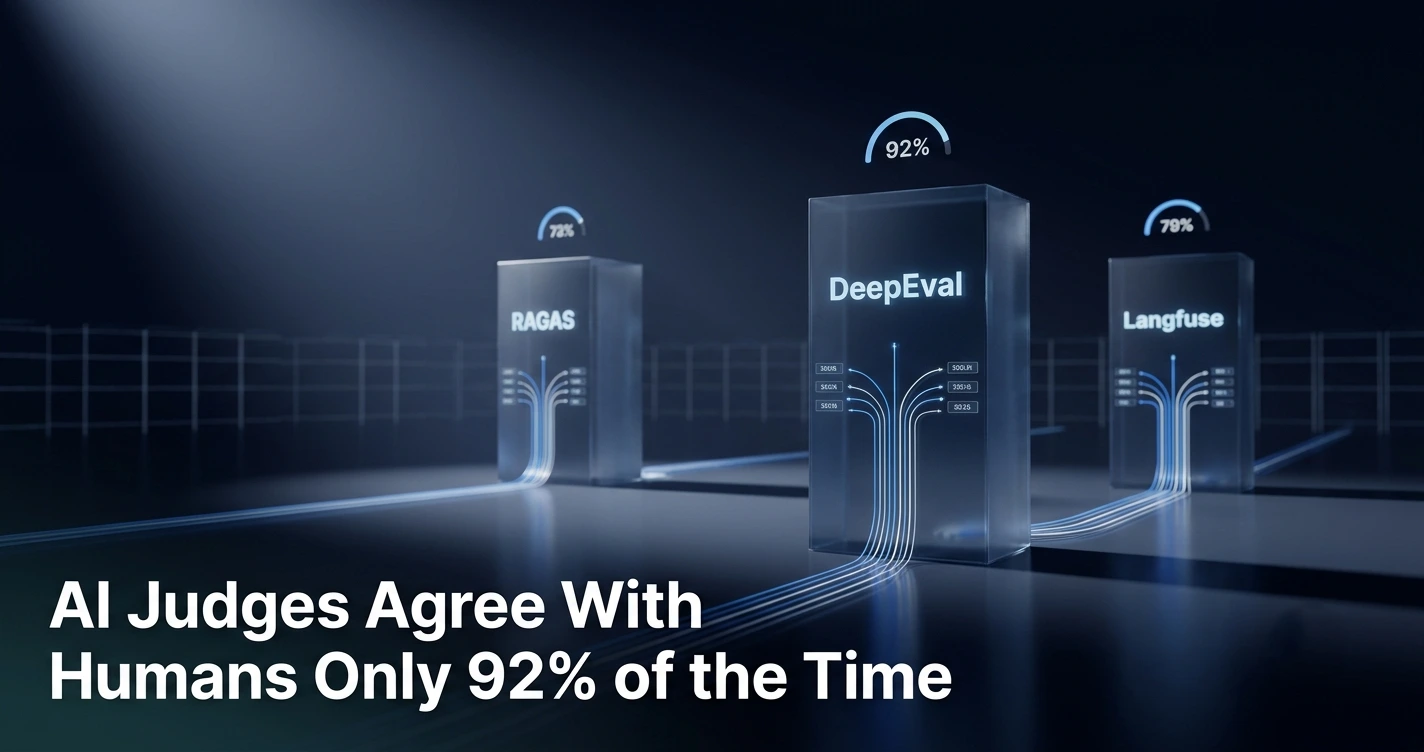
Nearly every tool on this list leans on the same underlying mechanism: one model scoring another’s output against a rubric instead of a fixed correct answer. Aggregated studies put that agreement with human raters somewhere between 80 and 92 percent, at a fraction of the cost of full manual review, roughly 500 to 5,000 times cheaper depending on the study.
That’s genuinely good. It is not perfect, and treating it as a solved problem is where teams get burned. Position bias, verbosity bias (judges tend to prefer longer answers even when they’re not better), and self-preference bias, where a judge model rates outputs from its own model family more favorably, are all documented and unresolved.
“Marketing, not science.”
Nathan Lambert, AI researcher, Interconnects.ai, on cross-vendor benchmark comparisons that can’t be independently verified. Read the original piece
Lambert’s line is from December 2023, and it’s still getting cited in curated 2026 evaluation reading lists for a reason. His point wasn’t about the tools on this list specifically, it was about competitors publishing benchmark claims about each other’s models without access to verify them. The same skepticism applies here: DeepEval, Braintrust, and Latitude all publish comparison content that ranks their own product first. Worth remembering while you read anyone’s “best tools” list, including this one.
What Husain and Dhinakaran are actually saying
Hamel Husain, the independent ML consultant co-authoring the upcoming O’Reilly book on AI evaluation with Shreya Shankar, has argued in multiple interviews that teams who appear to ship without formal evals are usually leaning on evaluation work someone else already did upstream, most often the model provider’s own internal testing. His and Shankar’s broader position, laid out across their public evals masterclass materials, warns specifically against fully automating evaluation without keeping a human grounded in product-specific context.
Aparna Dhinakaran, Arize’s co-founder and chief product officer, framed the shift differently at Arize’s Observe 2026 event: the industry is moving away from a person manually reading individual traces one by one, toward a person overseeing a fleet of agents that check each other’s work. It’s a more optimistic read than Husain’s, and both are right about different parts of the pipeline.
The stack recipes teams actually run
No single tool here covers RAG, agents, and chatbots equally well. The category is fragmented on purpose, and stacking two or three tools for different failure modes is standard practice among teams that have been doing this for a while, not a sign that someone picked wrong the first time. The pattern we saw repeated most often:
CI gate: DeepEval or Promptfoo, catching regressions before merge
RAG-specific scoring: RAGAS, layered in wherever retrieval is involved
Production sampling: Langfuse or Phoenix, watching what real traffic actually does
That combination gets most of a full commercial platform’s coverage for a fraction of the price. If your team is already dealing with agent deployments that keep failing in production, this is the stack worth building before you shop for anything commercial.
Where the hype outruns the evidence
A few things this space glosses over that are worth saying plainly. First, benchmark saturation is real, not a talking point. Second, an 80 to 92 percent agreement rate with human raters means a judge model is wrong on a meaningful slice of calls, and none of the vendor pages selling “automated evaluation at scale” put that number front and center. Third, the timeline claim that any single tool “solves” LLM evaluation is overstated across nearly every vendor’s own marketing page, including the ones cited in this article.
Our read: the risk scenario worth planning around isn’t picking the wrong tool. It’s picking a commercial platform, trusting its automated pass rate completely, and losing the human error-analysis step that would have caught something product-specific a rubric never would.
FAQ
What is the best LLM evaluation tool in 2026?
There’s no single best tool, it depends on use case. DeepEval and Promptfoo lead for CI/CD-integrated testing, RAGAS is the standard for RAG-specific metrics, and Langfuse or Arize Phoenix lead production tracing. Most mature teams combine two or three tools rather than relying on one platform.
Is RAGAS or DeepEval better for RAG evaluation?
RAGAS is purpose-built for RAG with four research-backed reference-free metrics: faithfulness, answer relevancy, context precision, and context recall. DeepEval covers RAG plus agents, chatbots, and CI/CD integration, making it broader but less specialized. Many teams pair both.
How much does LLM evaluation cost at scale?
Running DeepEval and RAGAS together against 10,000 RAG traces a day costs roughly 200 to 600 dollars a month in LLM-judge API spend on GPT-4o. Switching to cheaper judge models like GPT-4o-mini or Claude Haiku cuts that by 60 to 80 percent, with a manageable accuracy trade-off.
What is LLM-as-a-judge and how accurate is it?
LLM-as-a-judge uses one LLM to score another’s output against a rubric instead of comparing it to a fixed answer. Published studies put agreement with human raters at roughly 80 to 92 percent, at a fraction of the cost of full human review, but it carries known biases like favoring longer or first-listed answers.
Are MMLU and other classic benchmarks still useful in 2026?
Only marginally for frontier models. MMLU and HellaSwag scores have saturated above 88 percent, with differences between top models falling inside measurement noise. Harder, contamination-resistant benchmarks like GPQA-Diamond, SWE-bench Verified, and LiveBench are now more informative for comparing leading LLMs.
Is Langfuse free?
Langfuse’s self-hosted version is free and MIT-licensed with no usage limits. The managed cloud version has a free Hobby tier of 50,000 units a month, then paid tiers starting around 29 to 199 dollars a month depending on retention and support needs.
Where this goes next
What you now know that most “top 7 tools” listicles won’t tell you: there is no finish line here. The tools on this list are converging, ClickHouse now owns Langfuse, commercial platforms keep absorbing open-source primitives, and the EU AI Act’s August enforcement date is going to force teams that have been skipping documented evaluation to catch up fast.
Three things worth watching over the next 6 to 18 months:
Whether Galileo and Braintrust’s judge-model approach (cheaper, faster, purpose-built judges instead of general-purpose GPT-4o calls) becomes the default rather than the exception
Whether agent-specific, multi-turn evaluation standards mature enough to replace the single-turn accuracy checks most of this tooling was originally built around
Whether EU AI Act enforcement actually changes tool selection, or just adds a compliance checkbox on top of whatever teams were already running
If you’re picking a stack this quarter: start with the CI gate, add the RAG-specific layer only if you’re running RAG, and don’t buy a commercial platform until you’ve felt the limits of the free, open-source combination first.
Best LLM Inference Optimization Tools 2026: 7 Engines Tested
Infrastructure / Developer Tools
vLLM vs SGLang vs TensorRT-LLM: 7 Inference Engines Tested Against MLPerf v6.0
By the NeuralWired Infrastructure Desk | Published July 22, 2026 | 12 min read
Your GPU bill went up again last month, and your throughput barely moved. That’s not a hardware problem anymore. It’s a software problem, and in 2026 the gap between a well-tuned inference stack and a default install is wide enough to change your infrastructure budget by double digits.
This guide ranks the best LLM inference optimization tools of 2026 for teams actually running models in production, not just testing them on a laptop. We pulled numbers from MLCommons’ newly released MLPerf Inference v6.0 suite, cross checked vendor claims against SemiAnalysis’s InferenceX benchmark platform, and flagged where the industry’s own benchmarking methods might be lying to you.
Two years ago, “serving an LLM” meant getting Llama 2 to answer chat prompts fast enough that users didn’t notice the wait. In 2026, the traffic looks nothing like that. Reasoning models like DeepSeek-R1 chew through multi-step chains of thought before producing a token. Agentic workloads fire off dozens of overlapping requests with shared context. RAG pipelines lean hard on prefix reuse. None of that fits the old single-turn chat benchmark.
That shift is exactly what MLCommons built its latest benchmark suite to capture, and it’s why picking an inference engine in 2026 is a genuinely different decision than it was in 2024.
What MLPerf Inference v6.0 Actually Measured
MLCommons released MLPerf Inference v6.0 on April 1, 2026, and it’s the most substantial rewrite of the suite in the benchmark’s history. Five of eleven datacenter tests were new or updated: a GPT-OSS 120B benchmark for math and coding reasoning, an expanded DeepSeek-R1 test with a speculative decoding scenario, a Meta-contributed recommender benchmark called DLRMv3, the suite’s first text-to-video generation test, and a new vision-language benchmark built on Shopify product catalog data.
“This is the most significant revision of the Inference benchmark suite that we’ve ever done.”
Frank Han, Systems Development Engineering, Dell Technologies, MLPerf Inference Working Group Co-chair
The suite also introduced a new harness called LoadGen++, which lets submitters run benchmarks against a serving style software stack that looks a lot more like real production traffic than the older synthetic load generators. Twenty four organizations submitted results this round, including AMD, Google, NVIDIA, Oracle, Red Hat, and Lambda.
The infrastructure scale tells its own story. Multi-node submissions jumped 30% compared to the prior round in September 2025, and the largest submitted system used 72 nodes and 288 accelerators, four times the node count of the previous record. Ten percent of submitted systems now use more than ten nodes, up from just 2%.
“These partnerships were essential in ensuring that the tests include scenarios and workloads that represent the current state of the industry.”
Miro Hodak, Senior Member of Technical Staff, AMD, MLPerf Inference Working Group Co-chair
Ultralytics contributed an upgraded YOLOv11 based object detection test to the edge category. Its founder framed the value of the whole exercise plainly.
“MLPerf Inference benchmarks play a vital role in driving transparency and accountability across the AI industry.”
Glenn Jocher, CEO and Founder, Ultralytics
Why this matters for your engine choice
If you’re still benchmarking candidate engines against single-turn chat throughput, you’re testing for a workload that’s disappearing. MLPerf’s own suite has moved to reasoning and multi-node scenarios because that’s where production traffic actually lives now.
The 7 Engines, Compared
Here’s where most “best of” lists go wrong: they rank engines on raw tokens per second and call it a day. Workload shape matters more than any single number. A RAG pipeline and a batch summarization job want different things from the same GPU.
Engine
Core approach
Best fit
Notable stat
vLLM
PagedAttention memory management, broad hardware support
General purpose, fastest path to production, multi vendor hardware
~86,000 GitHub stars, releases roughly every two weeks
SGLang
RadixAttention prefix cache reuse
RAG, multi-turn chat, agentic loops with shared context
Frequently cited as the strongest option for prefix-heavy traffic
TensorRT-LLM
Compiles models into NVIDIA’s proprietary engine format
Current version referenced in 2026 sources: v1.2.0
llama.cpp
C/C++ engine, the backbone under most local tools
CPU and consumer-hardware inference, embedded deployments
121,000 GitHub stars, 1,806 contributors
Ollama
llama.cpp backend (MLX reported on Apple Silicon in 2026)
Local developer workflows, prototyping
Reported at 172,000+ GitHub stars (unverified against GitHub directly)
Hugging Face TGI
Originally general purpose serving toolkit
Legacy deployments only, per reported status below
Reported to be in maintenance mode in 2026, unconfirmed against source repo
InferenceX benchmark stack
Not an engine; a continuously updated benchmark platform
Validating vendor claims before you commit to an engine
V2 launched February 2026 with GB300 NVL72 coverage
A word on that Hugging Face TGI line, because it matters for anyone planning a migration. Multiple 2026 sources describe TGI shifting into maintenance mode with new users pointed toward vLLM, SGLang, and llama.cpp instead. We could not independently confirm this against Hugging Face’s own repository at the time of writing, so treat it as reported rather than settled. If you’re running TGI in production today, check the repository directly before you build a migration plan around a secondhand claim.
Worth noting too: 2026 is the year inference optimization became its own funded category rather than a side effect of the model layer. vLLM’s own creators, Woosuk Kwon, Simon Mo, and Ion Stoica, launched a company called Inferact in January 2026, backed by a16z, specifically to build what they call a universal inference layer across hardware and model architectures. When the people who solved the original memory bottleneck go out and raise venture money to solve it again commercially, that tells you how much money is riding on this layer of the stack.
Software Beats Hardware More Often Than You’d Think
Here’s the number that should reframe how you think about your next GPU purchase: in its own MLPerf v6.0 submission, Lambda found that NVIDIA’s Blackwell Ultra delivered 29% more throughput than the prior Blackwell generation on identical workloads. But the software stack alone, running on the exact same hardware, added another 9%. Lambda’s Smart Expert Routing technique cut P99 time-to-first-token by 31%.
Read that again. A software change on unchanged hardware moved the needle nearly a third as much as an entire GPU generation upgrade. If your team is budgeting for next year’s inference costs purely around which GPUs to buy, you’re solving half the problem.
This tracks with the broader MLPerf v5.1 data from September 2025, where NVIDIA’s GB300 NVL72 (Blackwell Ultra) delivered 45% more DeepSeek-R1 reasoning throughput than the prior GB200 NVL72 generation, according to HPCwire’s coverage of that round. AMD also made its first submissions that cycle, with a 4-node MI355X cluster posting a 3.4x throughput gain over the prior MI300X generation.
The Benchmark Trust Problem Nobody’s Talking About
Here’s our contrarian take, and it’s not ours alone: a lot of the “Engine X beats Engine Y by 40%” claims circulating in 2026 comparison articles might be measuring the wrong thing entirely.
A 2026 preprint from Google researchers Ashok Chandrasekar and Jason Kramberger modeled the client side of common LLM benchmarking tools using queueing theory, and found that single-process, asyncio-driven benchmarking clients suffer from Python’s GIL creating a queuing bottleneck of their own. As concurrency scales up, that bottleneck artificially inflates time-to-first-token and time-per-output-token measurements, according to the paper on arXiv. In plain terms: the tool measuring the engine can be slower than the engine it’s measuring, and that gap gets bigger exactly when you push concurrency higher, which is when it matters most.
Our read
This signals that a meaningful share of the public “vLLM vs SGLang vs TensorRT-LLM” benchmark posts circulating right now may be comparing benchmarking tool artifacts as much as real engine performance. Before you make a purchasing or migration decision off a single blog post, check whether the methodology discloses its process model and concurrency handling. If it doesn’t, treat the numbers as directional at best.
This isn’t a hypothetical concern either. Different sources genuinely disagree on the same matchups. One benchmark shows SGLang and LMDeploy topping 16,000 tokens per second against vLLM’s roughly 12,500 on Llama 3.1 8B, while another shows TensorRT-LLM leading at every concurrency level on Llama 3.3 70B running on H100. These aren’t necessarily contradictory since the model, hardware, and settings all differ, but it does mean a single “best overall” ranking is a simplification you should be skeptical of.
The safer move: validate any vendor benchmark against MLCommons’ public MLPerf dashboard or against SemiAnalysis’s InferenceX platform, which is continuously updated with support from Crusoe, CoreWeave, Nebius, TensorWave, Oracle, and Together AI. Crusoe’s CEO put the case for that kind of open, reproducible testing directly.
“At Crusoe, we believe being a great partner means empowering our customers with choice and clarity. That’s why we’re proud to support InferenceMAX, which provides the entire AI community with open source, reproducible benchmarks for the latest hardware.”
Chase Lochmiller, Co-Founder and CEO, Crusoe
How to Actually Choose One
Skip the “best overall” instinct. Match the engine to the traffic pattern.
Building a RAG or agentic product with heavy prefix reuse? SGLang’s RadixAttention scheduling is repeatedly cited as the stronger fit because it caches and reuses shared context instead of recomputing it.
Need hardware portability across NVIDIA, AMD, TPUs, or Trainium? vLLM remains the broadest bet, with the fastest path from prototype to production and a release cadence that outpaces almost every other infra project in this category.
All-in on NVIDIA and chasing maximum single-model throughput? TensorRT-LLM’s compiled engine format still wins on raw numbers once you’ve paid the setup cost.
Running locally or on consumer hardware? llama.cpp is the substrate under nearly every local tool, including Ollama, and its 121,000 GitHub stars and 1,806 contributors reflect how entrenched it’s become.
Still on Hugging Face TGI? Confirm its current status directly against the repository before you plan around secondhand reports of maintenance mode.
And one budgeting reality check: per-token inference costs for GPT-4-class performance have reportedly fallen roughly 1,000x over three years, down to around $0.40 per million tokens by some estimates. Total inference spending keeps rising anyway, because usage growth is outpacing the unit cost declines. Switching engines can absolutely cut your cost per token. It won’t necessarily shrink your total bill, and any plan that assumes otherwise is setting up a budget conversation you’ll lose later.
Frequently Asked Questions
What is the best LLM inference engine in 2026?
There’s no single “best” engine, it depends on workload. vLLM offers the broadest hardware support and fastest path to production. SGLang leads on prefix-heavy workloads like RAG and multi-turn chat via RadixAttention. TensorRT-LLM delivers the highest raw throughput on NVIDIA-only deployments once compiled.
What is the difference between vLLM and TensorRT-LLM?
vLLM is an open source, hardware-portable engine (NVIDIA, AMD, TPU, Trainium) using PagedAttention for memory efficiency and fast iteration. TensorRT-LLM is NVIDIA’s proprietary engine that compiles models into optimized TensorRT engines for maximum single-vendor throughput, at the cost of flexibility and longer setup time.
Is Hugging Face TGI still maintained in 2026?
Multiple 2026 sources report TGI has moved into maintenance mode, with Hugging Face directing new projects toward vLLM, SGLang, and llama.cpp instead. This is reported by secondary sources and should be confirmed directly against Hugging Face’s own repository before being treated as final.
What is MLPerf Inference and why does it matter for LLM serving?
MLPerf Inference is MLCommons’ independently audited, vendor-neutral benchmark suite for AI system performance. Its April 2026 v6.0 release added GPT-OSS 120B, expanded DeepSeek-R1 reasoning, and a new serving-style LoadGen++ harness, making it the most credible public reference point for comparing real-world inference performance.
How much does LLM inference cost in 2026?
Estimates vary, but per-token costs for GPT-4-class performance are widely reported to have fallen roughly 1,000x over three years, to around $0.40 per million tokens. Total inference spending continues rising anyway, because usage growth is outpacing these per-token cost declines.
Where This Goes Next
The engine layer stopped being a free add-on to the model layer somewhere around January 2026, when vLLM’s own founders decided it was worth its own venture-backed company. Expect more of that: standalone inference infrastructure businesses raising money on the premise that the serving stack, not the model weights, is where the next round of margin gets won or lost.
Watch three things over the next 6 to 18 months. First, whether Hugging Face TGI’s reported maintenance mode status gets confirmed or walked back, since that will settle a live migration debate for a lot of teams. Second, whether InferenceX and MLPerf’s LoadGen++ harness push more vendors toward disclosing their actual benchmarking methodology, given the Google GIL findings. Third, whether reasoning-model workloads like DeepSeek-R1 and GPT-OSS 120B keep pulling multi-node deployment further into the mainstream, the way the 30% jump in multi-node MLPerf submissions suggests they already are.
Pick your engine for the traffic you actually have, not the traffic you had two years ago. And test any benchmark claim, including the ones in this article, against your own workload before you bet a production budget on it.
The company that made retrieval-augmented generation a household term just told its own 800,000 developers to stop doing it. Here is what that means if you are choosing between RAG and a 2 million token context window in 2026.
NeuralWired.com • Machine Learning • July 19, 2026
Your engineering team spent 2024 building a retrieval pipeline. Chunk the docs, embed them, store them in a vector database, retrieve the top matches, stuff them into a prompt. It worked, mostly. Then Gemini shipped a 2 million token context window, Claude and GPT-5.4 hit 1 million, and someone on Slack asked the question everyone is now asking: why not just paste the whole knowledge base in and skip the plumbing?
That question has a real answer now, and it is not the one either side of the debate wants. A 2 million token context window does not replace retrieval-augmented generation. It changes what retrieval is for. And the company that spent four years teaching the industry how to build RAG vs long context pipelines just told the market, in public, that the pattern it popularized is already the bottleneck.
By April 2026, five frontier labs had all crossed the same line. Claude Opus 4.6, GPT-5.4, Gemini 3.1 Pro, Qwen 3.6 Plus, and Llama 4 Maverick each shipped a 1 million token context window. Meta pushed further with Llama 4 Scout, advertising 10 million tokens, though independent testers found its usable recall breaks down well short of that number. Google’s Gemini line has sat at the 2 million token mark since early 2026, which is why “2 million token context window” is now the phrase enterprise buyers type into Google before they type anything else.
By June 9, at least 13 models had crossed the 1 million token line, according to a pricing comparison from Morph. What that comparison also revealed is that “1 million tokens” is not one product. It is thirteen different products with wildly different economics.
That 71x spread is the first sign that “just use a bigger window” is not a strategy. It is a pricing decision you have not made yet.
Context rot: why bigger windows are not always better
In July 2025, three researchers at the vector database company Chroma published a report that has become the most-cited technical pushback on long-context marketing copy. Kelly Hong, Anton Troynikov, and Jeff Huber tested 18 frontier models, including the GPT-4.1, Claude 4, Gemini 2.5, and Qwen3 families, on tasks specifically designed to hold difficulty constant while varying only input length.
The finding that should worry anyone planning to dump a full knowledge base into a prompt: every single model got less reliable as the input got longer, even on tasks a human would call trivial. And in a twist that inverts a common assumption among RAG engineers, models performed worse on well-organized, logically coherent source documents than on the same content shuffled into random order.
Chroma is a retrieval infrastructure vendor, so this finding is also commercially convenient for the company publishing it. That is worth disclosing. It does not make the methodology wrong. The 18-model benchmark is open source and independently reproducible, and it lines up with a separate, older finding known as “lost in the middle”: accuracy drops 20 to 30 percentage points when the answer sits in the middle of a long document instead of at the start or end, a pattern first documented by Liu et al. and replicated across model families since.
Put together, these results point to a rule NVIDIA’s own RULER benchmark backs up: the effective, reliable portion of a context window typically runs at 50 to 65% of the number on the marketing page. Some of Chroma’s own findings suggest the real, safe margin for production workloads is tighter still, closer to a quarter or a third of the advertised maximum.
The real cost of going long
Even where accuracy holds up, long-context prompting is not cheap next to modern retrieval. A 2026 arXiv study titled “Long Context vs. RAG for LLMs” ran a direct cost comparison across GPT-5.4-mini and nano on document-grounded question answering. The result: long-context prompting averaged roughly $0.1181 per query, against $0.0045 to $0.0046 for keyword or semantic retrieval. That is a 10x-plus cost gap, and it is the more conservative of the figures floating around; some blog posts cite gaps as high as 1,250x, but those appear to compare different cost baselines and should be treated with skepticism.
Anthropic’s prompt caching cuts input costs by up to 90% and latency by up to 85% on repeated long prompts, which matters more than raw context size for most production bills. The lesson is not “context is expensive.” It is that caching, batching, and retrieval scope are the real levers, and a bigger window without any of those disciplines is the most expensive way to solve the problem.
Worth flagging for enterprise architects: access to any single frontier model is not guaranteed to be stable. In June 2026, Anthropic temporarily suspended access to Claude Fable 5 and Mythos 5 to comply with U.S. Department of Commerce export controls, restoring it on July 1 after the controls were lifted (Anthropic’s statement). Whatever architecture you pick, model availability is now a variable you plan around, not an assumption you make.
Pinecone just bet against the category it built
On May 4, Pinecone, the vector database that made RAG a standard pattern for roughly 800,000 developers and 9,000 paying customers, launched Nexus, which it calls a “knowledge engine for agents,” alongside KnowQL, a query language built around six primitives: intent, filter, provenance, output shape, confidence, and latency budget.
Pinecone’s own framing is blunt. It describes retrieval-at-inference, the classic chunk-and-embed pattern the company spent four years teaching the market, as the “ten blue links era of agentic retrieval.” Its argument: agents stuck in retrieve-read-retrieve loops complete only 50 to 60% of tasks and burn 85% of their effort just fetching context, before any actual reasoning happens.
Instead of retrieving raw chunks at query time, Nexus precompiles source data into structured, cited, task-specific artifacts ahead of time, so an agent queries a compiled answer rather than a pile of documents. Harrison Chase, the CEO of LangChain and the person widely credited with popularizing the term “context engineering,” backed the framing on Pinecone’s own launch post.
“Building reliable, long-horizon agents is fundamentally a context engineering problem.”
Harrison Chase, CEO, LangChain, on Pinecone’s Nexus launch post, May 4, 2026
Janakiram MSV, the cloud and AI analyst who covers infrastructure shifts for The New Stack, called out just how unusual this is. Most vendors keep selling into a category long after the market has moved past it. Pinecone named the shift itself.
Our read: MSV’s framing is closer to right than Pinecone’s own marketing copy. This is not “RAG is dead.” It is RAG’s naive, retrieve-then-hope form getting replaced by something more deliberate, the same shift Anthropic’s Skills and Cursor’s project rules are pushing at the editor and agent-framework layer. The pattern is not new. The vendor saying it out loud is.
The Subquadratic wildcard: 12 million tokens, unverified
One day after Pinecone’s launch, Miami-based startup Subquadratic emerged from stealth with $29 million in seed funding and a model called SubQ, built on what it calls a Subquadratic Selective Attention architecture. Founded by CEO Justin Dangel and CTO Alexander Whedon, both veterans of Meta, the company claims SubQ’s research version supports a 12 million token context window, roughly 120 books, while scaling compute linearly rather than quadratically with input length.
The headline number, as reported by SiliconANGLE: SubQ scored 95% on the RULER 128K benchmark at about $8 in compute, against 94% accuracy and roughly $2,600 for Claude Opus on the same test, a claimed 300x cost reduction. Backers reportedly include Tinder co-founder Justin Mateen and early investors in Anthropic, OpenAI, Stripe, and Brex.
Treat every one of those numbers as “reported by Subquadratic” until someone outside the company replicates them. As of this writing, no independent benchmarking team has confirmed the 52x attention speedup, the 92.1% needle-in-haystack recall at 12 million tokens, or the roughly 1,000x compute reduction the company claims at full context length. If verified, it would be the largest single jump in usable context the field has seen. If not, it joins a long list of long-context claims that looked revolutionary on launch day and ordinary six months later.
So is RAG dead? The growth data says no
Here is the part the “RAG is dead” headlines tend to skip: RAG-adjacent infrastructure spending is still growing fast, and growth data does not lie the way marketing copy can. Market-sizing firms disagree sharply on the exact dollar figures. Grand View Research puts the market at $1.2 billion in 2024, growing to $11 billion by 2030 at a 49.1% compound annual growth rate. Precedence Research estimates $2.76 billion in 2026 climbing to $67.42 billion by 2034. MarketsandMarkets lands in between, at $1.94 billion in 2025 growing to $9.86 billion by 2030. Cite one firm at a time, since the numbers do not reconcile with each other, but the direction across all three is the same: a technology genuinely on its way out does not post 38 to 49% annual growth.
Production engineers writing on DEV Community made the practical case bluntly: no context window, however large, holds an enterprise knowledge base running to millions of documents. A single 1 million token Claude Sonnet-class prompt runs roughly $3 at list pricing, and that does not scale to production query volumes the way retrieval does. Their position is that RAG’s continued growth is itself the strongest evidence against the “dead technology” framing, not despite the long-context hype but because of what enterprises are actually shipping underneath it.
What this means for your stack
Stop treating this as RAG versus long context. Treat it as a context budget you have to manage regardless of which technique you use.
Cap your assumptions at 25 to 30% of the advertised window. That is roughly what Chroma’s own findings suggest is the safe, reliable slice of any long-context claim, sticker number aside.
Pair retrieval with compaction. For long agent sessions, summarization and compaction loops matter more than raw window size, because irrelevant content is what causes context rot, not length alone.
Do not rip out retrieval infrastructure on the assumption long context replaces it. Teams that did this in 2024 and 2025 are the ones now eating the 10x-plus cost premium documented above.
Watch where vendor R&D is actually pointed, not where the marketing copy points. Pinecone’s own pivot from raw retrieval toward precompiled, agent-queryable artifacts is a better signal than any single benchmark chart.
Evaluate new entrants before migrating production workloads. Subquadratic’s numbers are compelling on paper and unverified in practice. Run your own evals on your own data first.
One more thing regulated industries should not skip: RAG’s retrieval logs double as an audit trail. Raw long-context prompting does not produce one by default. In finance, healthcare, or legal workflows, that gap is not academic. It is a compliance requirement waiting to surface during an audit, usually at the worst possible time.
Frequently asked questions
Does a bigger context window replace RAG?
Rarely. Long context reduces the need for aggressive retrieval on smaller, bounded corpora, but no window, even 12 million tokens, holds an enterprise knowledge base with millions of documents. Long-context prompting also runs roughly 10x or more expensive per query than modern retrieval in controlled 2026 benchmarks.
What is “context rot”?
Context rot is measurable performance degradation as an LLM’s input length grows, even on simple tasks. Chroma Research tested 18 frontier models in 2025 and found every one degraded with length, with logically coherent documents sometimes hurting performance more than shuffled ones.
What causes the “lost in the middle” problem?
Models attend most reliably to information at the very start and end of their context window. Liu et al.’s benchmark found accuracy drops 20 to 30 percentage points when the answer sits mid-context, a pattern replicated across GPT, Claude, and other model families since.
How much does a 1 million token prompt cost?
It depends heavily on the model. As of June 2026, filling a 1 million token window ranges from about $0.14 on DeepSeek V4 Flash to $10.00 on Claude Fable 5, a 71x spread, before caching discounts are factored in.
Is RAG still worth building in 2026?
Yes, for most production systems with large, dynamic, or compliance-sensitive corpora. RAG-related infrastructure spend kept growing at 38 to 49% CAGR across multiple market estimates even as long-context windows expanded, and 2026 is shaping up to be a hybrid-architecture year rather than a winner-take-all contest.
The bottom line
Nothing here says long context is a bad bet or that RAG is finished. What the evidence actually supports is narrower and more useful: raw context length is not the same thing as usable context, cost scales against you faster than accuracy does, and the vendor that built the RAG category is now telling the market to build the next layer up, not to abandon retrieval altogether.
Watch three things over the next 6 to 18 months. First, whether independent labs confirm any of Subquadratic’s numbers, since that would be the first real architectural break from quadratic attention costs. Second, whether Pinecone’s Nexus and KnowQL numbers hold up in production the way they did in Pinecone’s own benchmarks. Third, whether “context engineering,” the discipline of deliberately curating what enters a model’s window regardless of technique, becomes a formal job function the way “prompt engineering” did in 2023.
The teams that win this cycle will not be the ones who pick a side in the RAG-versus-context debate. They will be the ones who stopped treating context size as a proxy for context quality months before everyone else did.
Want the next infrastructure shift in your inbox before it hits the front page? Subscribe to The Neural Loop at neuralwired.com/newsletter.
How Unsloth Made LLM Fine-Tuning 2x Faster in 2026
ORPO and GaLore, the two research papers rewriting the fine-tuning cost equation, explained for engineers who actually have to ship this.
A year ago, fine-tuning a 7-billion-parameter model meant renting a multi-GPU cluster and budgeting a few hundred dollars before you’d trained a single epoch. In 2026, the same job runs on one RTX 4090 sitting under a desk. That shift didn’t come from a single breakthrough. It came from two 2024 research papers, ORPO and GaLore, finally getting packaged into tools like Unsloth that engineers can install with one pip command.
If you’re building AI features and fine-tuning still feels like a research project rather than a Tuesday afternoon task, this is the update that changes that math. Here’s what ORPO and GaLore actually do, what Unsloth adds on top, and where the “70% less memory” claim holds up and where it doesn’t.
Neither ORPO nor GaLore is new. ORPO came out of KAIST AI in March 2024 and was presented at EMNLP 2024. GaLore came out of a separate research group the same month and went to ICML 2024. Neither one made headlines outside the research community when it launched.
What’s new is adoption. Unsloth, the open-source fine-tuning library built by brothers Daniel Han and Michael Han, spent 2025 and 2026 turning both techniques (plus QLoRA and GRPO) into something you can run without reading either paper first. In May 2026 the company shipped Unsloth Studio, a no-code web interface sitting on top of the original code-based Unsloth Core, and it now supports more than 500 model families with GGUF and safetensors export built in.
Then, in a joint post published in May 2026, Unsloth and NVIDIA detailed a fresh round of optimizations built specifically for NVIDIA hardware: caching packed-sequence metadata for a 14.3% speed gain, double-buffered async gradient checkpointing for another 8%, and MoE routing fixes that made gpt-oss training 15% faster. Combined, the collaboration pushed total training speed up roughly 25% on top of Unsloth’s existing 2 to 5x baseline speedup, with zero reported accuracy loss. NVIDIA’s own RTX AI Garage blog, published in December 2025, independently walks through fine-tuning on RTX desktops and the DGX Spark using Unsloth, which matters because it’s a hardware vendor validating a third party’s performance claims on its own silicon, not just the vendor marking its own homework.
That’s the real 2026 story: two years of academic groundwork finally has an on-ramp a solo developer can use on a Tuesday afternoon.
What Is ORPO?
ORPO (Odds Ratio Preference Optimization) is a fine-tuning method from KAIST AI that folds preference alignment directly into the supervised fine-tuning step. It uses an odds-ratio penalty to push a model away from disfavored responses while it’s still learning the task, so there’s no separate reference model and no separate RLHF or DPO stage afterward. One training pass does both jobs.
Every alignment method before ORPO, including DPO, needed a frozen copy of the base model sitting in memory the whole time as a reference point. That reference model roughly doubles your memory footprint and adds a second training phase after SFT. ORPO’s authors, Jiwoo Hong, Noah Lee, and James Thorne, showed in their EMNLP 2024 paper that you can skip that step entirely and still land competitive results. Their Mistral-ORPO checkpoints, tuned at 7B parameters, beat several 13B-class RLHF and DPO models on AlpacaEval 2.0 and MT-Bench, at a fraction of the training cost.
What Is GaLore?
GaLore (Gradient Low-Rank Projection) keeps full-parameter training intact but periodically compresses the optimizer’s gradient states into a low-rank subspace using SVD, then decompresses before the weight update. Unlike LoRA, it never freezes the base weights. It shrinks the optimizer’s memory footprint, not the model’s learning capacity.
That distinction matters more than it sounds. LoRA saves memory by training a small adapter instead of the full model, which is fast but limits what the model can actually learn. GaLore saves memory a different way: it keeps training every parameter, but stops Adam’s momentum and variance tracking from eating your GPU alive. The original paper reports up to 65.5% lower optimizer-state memory, and an 8-bit variant pushes that to 82.5%, enough to pre-train a 7B model on a single 24GB consumer card without offloading or model parallelism.
How Unsloth Stitches It Together
Unsloth doesn’t reinvent ORPO or GaLore. It rewrites the backpropagation math by hand and compiles custom Triton kernels so that whichever method you pick runs closer to the metal, with less wasted VRAM and fewer redundant computations. That’s the whole pitch: research techniques, production kernels.
Method
What it optimizes
Trade-off
QLoRA
Adapter size (4-bit base + small adapter)
Fastest, cheapest, but limited learning capacity
GaLore
Optimizer memory, full-parameter training preserved
Still SVD overhead; convergence guarantees still being formalized
DPO
Alignment quality via reference model
Needs a second training stage and doubled memory
ORPO
Alignment folded into SFT, no reference model
Newer, less battle-tested at very large scale
GRPO (via Unsloth)
RL fine-tuning VRAM, roughly 80% lower
More complex reward-model setup
For reinforcement-learning-style fine-tuning specifically, Unsloth’s GRPO implementation claims roughly 80% lower VRAM use, which is the piece most relevant to anyone fine-tuning reasoning models this year.
The Numbers, Checked
Here’s what’s independently verifiable versus what’s self-reported. Worth knowing the difference before you quote either in a pitch deck.
Claim
Source
Status
ORPO 7B beats some 13B RLHF/DPO models on AlpacaEval 2.0 / MT-Bench
EMNLP 2024 paper
Peer-reviewed
GaLore cuts optimizer memory up to 65.5% (82.5% at 8-bit)
ICML 2024 paper
Peer-reviewed
Unsloth: 2 to 5x faster, up to 70% less VRAM, no accuracy loss
Unsloth GitHub
Vendor-reported, community and NVIDIA-corroborated
NVIDIA collab: ~25% additional training speedup
Unsloth/NVIDIA joint blog, May 2026
Vendor-reported, benchmarked with named test setups
PEFT library downloads exceeded 12M/month by Q3 2025
Industry market report
Third-party estimate, not company-audited
The vendor-reported numbers aren’t fabricated. Unsloth publishes its benchmark methodology, and NVIDIA has now run its own tests on Blackwell and RTX hardware that land in the same range. But nobody has published an adversarial, apples-to-apples third-party benchmark suite across model families that reproduces the exact “70%” figure independently. Treat it as strongly corroborated, not audited.
What the People Who Built This Actually Think
The ORPO team’s own framing, drawn from their published paper rather than a press quote, is that the odds-ratio penalty is a deliberately simple way to separate preferred from rejected output styles without the overhead of a second alignment stage. It’s since become a standard baseline cited across dozens of 2025 and 2026 preference-optimization papers.
LoRA substantially underperforms full fine-tuning on the target task at standard ranks, even though it forgets less of what the base model already knew.
Position documented by Dan Biderman, lead author, “LoRA Learns Less and Forgets Less,” Databricks Mosaic AI Research / Columbia University, TMLR 2024. arxiv.org/abs/2405.09673
That’s the most cited counterweight to the “faster and better” framing you’ll see in most 2026 fine-tuning content, and it’s the reason this article isn’t calling either technique a free lunch.
LoRA is advantageous for preserving a model’s original capabilities, while full fine-tuning remains better suited to learning substantially new tasks.
Position documented by Sebastian Raschka, PhD, independent machine learning researcher and educator. magazine.sebastianraschka.com
Raschka’s framing is the practical takeaway most teams actually need: the method you pick should follow from whether you’re teaching the model something genuinely new or just steering a capability it already has.
Where the Free Lunch Ends
Three things worth knowing before you commit a roadmap quarter to this stack.
Low-rank methods still cost accuracy on the target task
Biderman’s team found full fine-tuning uses perturbations with a rank roughly 10 to 100 times greater than typical LoRA setups. That gap is exactly where target-domain accuracy leaks out. If your task is narrow and you need every point of accuracy, don’t assume “efficient” and “as good as full fine-tuning” are the same claim.
GaLore’s convergence guarantees are still being formalized
Multiple 2025 and 2026 papers, including one called “GUM” (GaLore Unbiased with Muon) and another called MLorc, have identified bias in GaLore’s low-rank gradient projection relative to full-parameter optimization. The method works well in practice. The formal proof that it always will is still an open research problem, not a closed one.
Catastrophic forgetting hasn’t gone away
A body of 2024 through 2026 research, including work on O-LoRA and mean-field attention dynamics, confirms that these efficiency methods reduce but don’t eliminate the risk of a fine-tuned model degrading on tasks outside its training domain. Hold out an eval set that has nothing to do with your fine-tuning target and check it after every run. It’s the cheapest insurance in the entire pipeline.
Our read: the 2026 story isn’t that fine-tuning got free. It’s that the cost dropped low enough that skipping the eval step is now the more expensive mistake, not the training run itself.
Should You Actually Use This?
If you’ve been leaning entirely on prompt engineering because fine-tuning felt too expensive to justify, that calculation has changed. A narrow, repeated task, think structured extraction, tone control, or domain vocabulary, is now cheap enough to test against a small fine-tuned model instead of an expensive frontier API call on every single request.
What hasn’t changed: speed and memory gains are a training-efficiency story, not a data-quality fix. A 70% memory reduction does nothing for a model trained on inconsistent labels. Decide whether you need full fine-tuning, LoRA, or ORPO-style alignment based on your task, not based on which one made the best headline this month.
FAQ
What is ORPO in LLM fine-tuning?
ORPO (Odds Ratio Preference Optimization) is a technique from KAIST researchers that combines supervised fine-tuning and preference alignment into a single training step, using an odds-ratio penalty to favor preferred responses. It removes the need for a separate reference model or alignment phase entirely.
What is GaLore and how does it save memory?
GaLore keeps full-parameter training intact while projecting the optimizer’s gradient states into a low-rank subspace through periodic SVD. That cuts optimizer-state memory by up to 65.5%, enough to train a 7B model on a single 24GB consumer GPU.
Is ORPO better than DPO?
ORPO removes the reference model DPO requires, cutting memory use and training steps. Its authors showed ORPO-tuned 7B models beating some 13B RLHF and DPO-tuned models on standard benchmarks. It’s not universally better, though. DPO remains more studied for certain alignment tasks.
Does fine-tuning with LoRA hurt model accuracy?
Research from Databricks Mosaic AI found LoRA underperforms full fine-tuning on the target task at standard ranks, though it preserves the base model’s original capabilities better. The trade-off is real: cheaper training can cost target-domain accuracy.
Can you fine-tune a 7B model on a single GPU in 2026?
Yes. Tools combining QLoRA-style quantization, GaLore-style gradient projection, and Unsloth’s optimized kernels let developers fine-tune 7B to 14B models on a single consumer GPU such as an RTX 4090, a shift from the multi-GPU clusters this required just a few years earlier.
What This Means Going Forward
ORPO and GaLore aren’t 2026 inventions. They’re 2024 research that finally has production-grade tooling wrapped around it, and that’s a more useful story than a fake breakthrough would have been. What to watch over the next 6 to 18 months: whether GUM or MLorc-style fixes to GaLore’s convergence bias make it into mainstream libraries, whether Unsloth Studio’s no-code path pulls in enough non-research users to shift the “who fine-tunes models” demographic, and whether ORPO or a successor becomes the default alignment step in Hugging Face’s TRL rather than an optional one.
For now, the practical move is simple: pick the method that matches your task, not the one with the best benchmark screenshot, and keep an eval set that has nothing to do with your fine-tuning target. That’s still the difference between a model that works in the demo and one that works in production.