
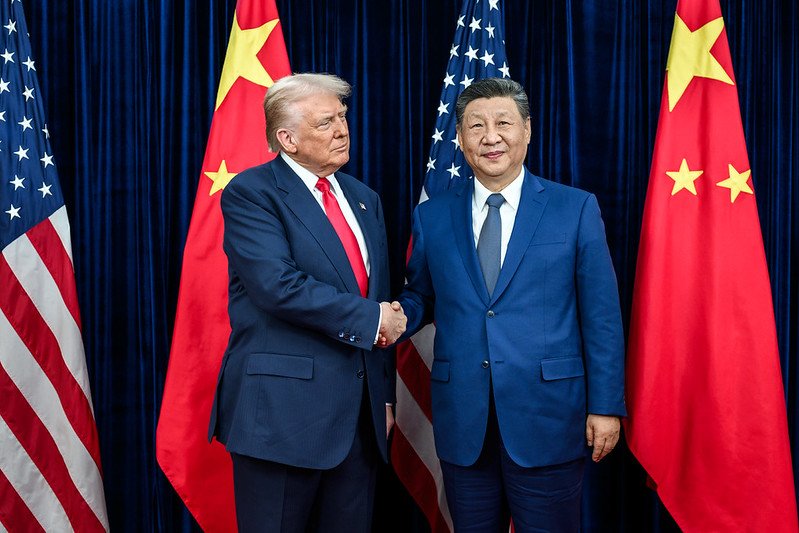
Eight hours is a long time to sit across from the people who hold the other end of your trade relationship. On Sunday, Treasury Secretary Scott Bessent and US Trade Representative Jamieson Greer did exactly that with Chinese Vice Premier He Lifeng, at JPMorgan Chase’s Manhattan headquarters. On Monday, Beijing explained what the marathon was for: Xi Jinping will make a state visit to the United States from September 23 to 25, at Donald Trump’s invitation.
It will be Xi’s first state visit to Washington since 2015 and his second face-to-face meeting with Trump this year. It also arrives with a clock running. The truce that has kept the world’s two largest economies out of a full-blown minerals and export-control fight expires in November, and so far neither side has said what happens next.
What Beijing confirmed, and what the week looks like
China’s Foreign Ministry made the announcement Monday, with spokesperson Guo Jiakun calling the reciprocal visits “of historic, milestone significance.” The choreography is elaborate. Trump will greet Xi at Joint Base Andrews on Wednesday, followed by an arrival ceremony at the White House. The leaders’ summit is set for Thursday, September 24, with a state dinner in the East Room that evening and a private tea on Friday.
Edgard Kagan, a senior adviser at CSIS, put the symbolism bluntly ahead of the trip: “The visit is the message.” That reading fits the pomp, but the substance is what markets and manufacturers will be watching.
What came out of New York
The Sunday talks produced a few concrete outcomes. The two sides agreed to establish a US-China AI dialogue, and Washington proposed a notification mechanism for incidents such as security threats. Greer said the Board of Trade, the body created in May to discuss tariff cuts on non-strategic goods, is now operational.
The products being considered for gentler treatment include Chinese consumer and low-tech goods, along with American energy, agricultural and medical products. Li Chenggang, China’s top negotiator, described the atmosphere as good and said a working group would reconvene Monday. Bessent, for his part, said the US had just had “a very successful engagement with the Chinese.” Before the meeting he had promised “focused, fulsome and constructive talks.”
Just as telling is what was left out. No announcement was made on whether the truce will be extended. Bessent and Greer also reported no progress on critical-mineral flows, or on the farm purchases and Boeing order that China was said to have committed to in May.
The deadline behind the pageantry
The truce traces back to Busan, where Trump and Xi met on October 30, 2025 and agreed to a one-year pause in a confrontation over critical minerals. Under the arrangement, the White House said, China suspended the rare-earth export controls it announced on October 9, 2025 and issued general licenses covering rare earths, gallium, germanium, antimony and graphite. In return, Washington suspended its BIS Affiliates Rule for a year.
The expiry dates do not line up neatly. Law firm analyses put the end of the US suspension at November 9, while reports place the Chinese suspension and the tariff pause at November 10. Either way, a few weeks separate the summit from a cliff edge, and the businesses that depend on those licenses have very little room to plan around a lapse.
The May promises that remain unsettled
The last Trump-Xi meeting, in Beijing in mid-May, left a trail of commitments that have yet to be fully verified. According to the White House, China agreed to buy at least $17 billion a year of American farm goods in 2026 (prorated), 2027 and 2028, and approved an initial purchase of 200 Boeing aircraft. Beijing’s own readout did not directly confirm those figures, and Boeing had not publicly confirmed the order.
CNN calculated that the $17 billion, added to an existing soybean commitment, would come to roughly $27 billion a year. American agricultural exports to China totaled $24.4 billion in 2024, according to USDA data, so the pledge implies buying above anything recently achieved. That gap is part of why the absence of any update on farm purchases in New York stands out.
A tariff decision waiting in the wings
There is also the matter of new duties. Bloomberg reported, citing people familiar with the matter, that the US is expected to hold off announcing new excess-capacity tariffs on China and other partners until after the summit. The planned trade report would reportedly have recommended a 7.5% tariff on Chinese goods. The reason for the delay is unclear.
The underlying Section 301 probe, opened in March, covers more than a dozen trading partners. The levies it could produce, combined with forced-labor duties already in place, would move tariff rates back toward the country-specific levels the Supreme Court overturned earlier this year. Whatever gets said in the East Room, that decision is now sitting behind it.
Two leaders under domestic pressure
Both men will arrive with reasons to want a visible win. US consumer prices rose 3.4% over the 12 months to August, according to the Bureau of Labor Statistics. Prices climbed 0.4% on the month, with a 3.9% jump in gasoline accounting for more than a third of that increase. Core inflation, which excludes food and energy, stood at 2.4%. Trump faces midterm elections in November amid the Iran war and those rising prices.
China’s picture is softer. August retail sales grew just 0.4% from a year earlier, below the 0.8% that a Reuters poll had forecast. Fixed-asset investment fell 7.2% in the first eight months of the year, industrial output rose 5.2%, and urban unemployment stood at 5.3%. Second-quarter GDP growth of 4.3% was the weakest in more than three years and sits below the 4.5% to 5% target for 2026.
Iran adds a complication. In August, Treasury launched “Operation Economic Outcast” to isolate Tehran financially, sanctioning three banks and some Chinese independent refineries. Washington has so far held back from targeting larger Chinese financial institutions, a restraint that could be tested if talks sour.
Business leaders get a seat at the table
The White House has confirmed a guest list for the state dinner that spans AI, chips, finance and consumer technology. It includes Elon Musk, Jeff Bezos, Jensen Huang, Sam Altman, Sundar Pichai, Michael Dell, Citi’s Jane Fraser and Apple executive chairman Tim Cook. Qualcomm has confirmed that CEO Cristiano Amon will attend. AI safety and rivalry are expected to feature on the agenda, which gives the new dialogue agreed in New York an obvious first test.
Trump himself has set expectations high. Speaking in the Oval Office on September 18, he said, “We’re going to have a lot of different deals.” Markets appeared to lean into that optimism early Monday, with Bloomberg reporting S&P 500 futures up 0.6%, Nasdaq 100 futures up 0.8%, and Brent crude down for a fourth straight day.
What to watch after the toasts
Optimism is cheap before a summit. The more useful measures come afterward: whether the two leaders announce an extension of the truce, whether critical-mineral flows get a firm framework, and whether Beijing confirms the farm and Boeing commitments in its own words. The delayed tariff decision follows the summit, and the September inflation report lands on October 14, just weeks before the truce instruments run out.
If the East Room dinner ends with warm words and no extension, the November deadline will do the talking instead.