
A single blood draw that can flag signals for more than 50 types of cancer just cleared one of the biggest regulatory hurdles of its kind. On September 23, 2026, an FDA advisory panel voted to support GRAIL’s Galleri test, moving the company closer to what would be the first FDA-approved multi-cancer early detection test on the market.
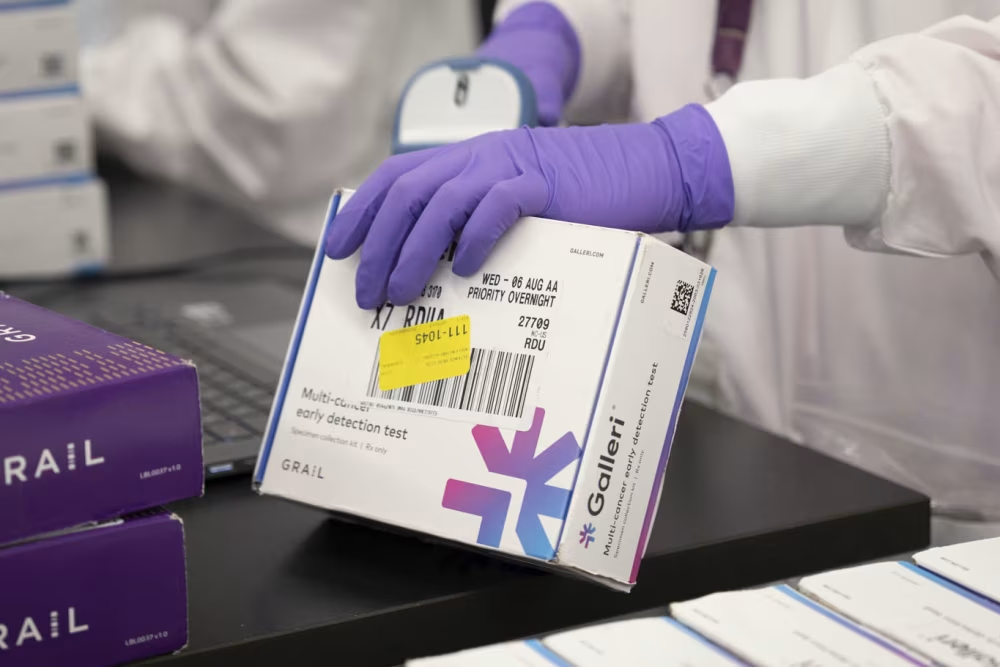
The vote was not a landslide. It was close enough, in fact, to capture exactly where the science currently stands on a technology that has generated as much hope as skepticism.
A Split Decision With High Stakes
The FDA’s Molecular and Clinical Genetics Devices Panel considered GRAIL’s Premarket Approval application across three separate questions, and the results told three different stories. On safety, the panel was unanimous, voting 10-0 in favor. On whether the test actually works as intended, the vote narrowed sharply to 6-4. On whether its overall benefits outweigh its risks, the panel landed at 7-2, with one member abstaining.
That spread matters. This marks the first time any multi-cancer blood test has come before an FDA advisory panel at all, and the panel’s job was to weigh in on a technology still working out its own definition of success. Galleri does not diagnose cancer. It scans cell-free DNA for methylation patterns that suggest a cancer signal is present, and if it finds one, it predicts where in the body that cancer likely originated so doctors know where to look next.
The panel’s vote is advisory only. The FDA is not bound by it and will make the final call independently, though these votes often carry real weight in how the agency proceeds. GRAIL has said a decision is expected in the coming months, though the company has not given a firmer timeline than that.
Dr. Victor van Berkel of UofL Physicians, who sat on the panel, may have summed up the room’s mood best. “Perhaps my yes is a hopeful rather than an accurate one,” he said, according to reporting from the Associated Press.
What the Trials Actually Showed
GRAIL built its case on two large studies, and their results published within a day of each other, on September 22, 2026, in Nature Medicine and the New England Journal of Medicine.
The first, PATHFINDER 2, enrolled nearly 36,000 adults aged 50 and older across the U.S. and Canada, led by researchers at Oregon Health & Science University’s Knight Cancer Institute. Galleri flagged a cancer signal in 287 participants, and 173 of them were ultimately diagnosed with cancer, a positive predictive value of just over 60 percent. Specificity came in at 99.64 percent, meaning false positives were rare. When the test correctly identified a signal, it predicted the right site of origin in the body 91.3 percent of the time, and only a small fraction of participants, roughly 0.6 percent, went on to an invasive procedure after a positive result.
Nima Nabavizadeh, the trial’s lead investigator at OHSU, framed the underlying problem the test is trying to solve. Cancers without a recommended screening pathway, he said, “cause up to 70% of cancer deaths.” That statistic sits at the heart of why a test like Galleri has generated so much interest in the first place. Routine screening in the U.S. currently covers just five cancers: breast, colorectal, cervical, lung for high-risk groups, and prostate. Some of the deadliest and hardest to catch, including pancreatic, ovarian, liver and bile duct cancers, have no standard screening test at all.
The second study, NHS-Galleri, followed nearly 140,000 adults aged 50 to 77 in a randomized controlled trial run with England’s National Health Service. This is where the picture gets more complicated. The trial did not meet its primary endpoint, which was a statistically significant reduction in combined stage III and IV cancer diagnoses. There were more encouraging secondary signals, including a drop of more than 20 percent in stage IV diagnoses during later screening rounds across a dozen of the deadliest cancer types, and an overall detection rate roughly four times higher when Galleri was added to standard care. But the trial’s central goal, the one it was designed to prove, came up short.
There is also a tradeoff buried in the data that deserves attention. FDA reviewer analysis found that Galleri’s 12-month sensitivity was 35.0 percent in PATHFINDER 2 and 31.6 percent in NHS-Galleri, meaning the test missed roughly two-thirds of cancers that were diagnosed within a year. Diana Zuckerman of the National Center for Health Research, one of the panel’s more pointed critics, argued the test’s stage-1 detection performance was “not as good as a coin toss.” That criticism sits alongside the test’s very low false-positive rate, and both numbers need to be read together to understand what Galleri can and cannot currently do.
Why This Fight Over Definitions Matters
According to briefing documents the FDA released ahead of the panel meeting on September 21, regulators had few concerns about the test’s safety, its analytical performance, or how the trials were designed. The real debate centered on something more conceptual: whether the data support calling Galleri an “early detection” test at all, given how the NHS trial’s primary result played out.
That distinction may sound like semantics, but it carries enormous consequences. If the FDA grants full approval, Galleri would become the first FDA-approved multi-cancer blood test, putting it ahead of competitors such as Abbott’s Cancerguard test. Approval would also likely open the door to Medicare and private insurance coverage, expanding access well beyond the roughly 1 percent of Americans currently paying more than $700 out of pocket for the test, which has been sold commercially in the U.S. as a lab-developed test since 2018, when it first received FDA Breakthrough Device status. A law passed in February 2026 already requires Medicare to cover FDA-approved blood-based multi-cancer tests starting in 2028, meaning this decision has a built-in deadline attached to it regardless of what the FDA ultimately decides.
Markets clearly understood the stakes. When the FDA’s briefing documents came out on September 21 without raising major red flags, GRAIL’s stock jumped roughly 34 percent in a single day, closing near $108, its best one-day performance in more than a year.
GRAIL’s chief executive, Josh Ofman, cast the moment as a step toward something larger than one product. He described the company’s goal as building “an effective and efficient cancer screening program” in the U.S., and said GRAIL was “heartened” by the more than 200 physicians, nurses, professional societies, patients and advocates who submitted public comments backing the test.
It is worth noting that both pivotal trials were designed and funded by GRAIL, which was also involved in analyzing and interpreting the data and preparing the published manuscripts. The PATHFINDER 2 lead author has disclosed a consulting relationship with the company. None of that invalidates the results, but it is relevant context for readers weighing how much confidence to place in them, much like ongoing scrutiny of FDA device approval standards more broadly.
What Comes Next
The FDA’s decision, whenever it lands, will do more than determine the fate of one test. It will set a precedent for an entire category of blood-based cancer screening that companies across the industry are racing to bring to market, a trend NeuralWired has tracked in its ongoing coverage of emerging diagnostic technology.
OHSU is already looking past this decision. The institution is enrolling participants in a follow-on study called REACH, which will examine annual multi-cancer testing in Medicare beneficiaries, and is preparing to launch another study, INFORM, with Dana-Farber Cancer Institute focused on people with inherited cancer risk. Those studies suggest that however the FDA rules on Galleri specifically, the broader question of how this technology fits into everyday medical care is far from settled.
For now, the 6-4 vote stands as an honest snapshot of where the evidence sits: promising enough to earn cautious support, uncertain enough that even panel members who voted yes described their votes as hopeful rather than definitive. Whether that hope translates into fewer late-stage cancer diagnoses, or simply more tests and more uncertainty for patients navigating a positive result, is the question the coming months are supposed to answer.