Cryptocurrency analysis beyond price charts: market structure, regulatory developments, institutional adoption, tokenomics, and the technology reshaping digital finance and assets.
It seems like your request is a bit unclear. If you are interested in ideas or strategies to contribute to the development of a Western economy, here are some pioneering approaches that could be considered:
Technology and Innovation Hub:
Invest in research and development to foster innovation in technology. Establish tech hubs or innovation centers to attract startups and entrepreneurs. Develop policies that encourage the growth of emerging technologies like artificial intelligence, blockchain, and green tech.
Green and Sustainable Initiatives:
Focus on sustainable development and green technologies to address environmental concerns. Invest in renewable energy sources and promote energy efficiency. Implement policies that support sustainable practices in industries.
Education and Skill Development:
Prioritize education and skill development programs to create a highly skilled workforce. Collaborate with industries to tailor educational programs to meet the demands of the job market. Embrace lifelong learning initiatives to adapt to a rapidly changing economic landscape.
Entrepreneurship and Small Business Support:
Foster a culture of entrepreneurship by providing support for small businesses and startups. Create incubators and accelerators to nurture new businesses. Streamline regulations to make it easier for small businesses to thrive.
Infrastructure Development:
Invest in modern and efficient infrastructure to support economic growth. Focus on transportation, digital connectivity, and sustainable urban planning. Implement smart city initiatives to enhance overall quality of life.
Diversification of Industries:
Encourage diversification of industries to reduce dependency on specific sectors. Attract a range of businesses, from tech companies to manufacturing, to create a resilient economy. Support the growth of service-oriented industries such as healthcare, finance, and tourism.
Global Trade and Collaboration:
Foster international trade partnerships to expand market access. Negotiate and strengthen trade agreements to benefit the local economy. Encourage foreign direct investment (FDI) while protecting national interests.
Inclusive Economic Policies:
Develop policies that address income inequality and promote social inclusivity. Implement fair labor practices and regulations to ensure worker rights. Provide social safety nets to support vulnerable populations.
Health and Well-being Initiatives:
Prioritize public health to create a healthy and productive workforce. Invest in healthcare infrastructure and preventive measures. Promote mental health and well-being in the workplace.
Digital Transformation:
Embrace digital transformation across industries. Develop a digital infrastructure to support e-commerce, online services, and remote work. Invest in cybersecurity measures to protect digital assets. These approaches aim to create a dynamic and resilient Western economy by leveraging technology, sustainability, education, and a diverse economic base. Implementing a combination of these strategies with careful planning and collaboration can contribute to long-term economic success.
If you’re looking for a travel destination in Asia with a kind and mid-spirit vibe, there are many places that could offer a welcoming and positive experience. Here are a few suggestions:
Bhutan:
Known for its Gross National Happiness Index, Bhutan is a country that values well-being over material wealth. The people are friendly, and the stunning landscapes, including the Himalayan mountains, make it a serene destination.
Ubud, Bali, Indonesia:
Ubud is known for its spiritual and artistic community. The lush landscapes, rice terraces, and a variety of temples create a peaceful atmosphere. Engage in yoga and meditation practices or explore the vibrant arts scene.
Chiang Mai, Thailand:
Chiang Mai offers a blend of cultural richness and a laid-back atmosphere. Explore historic temples, visit the local markets, and enjoy the beautiful surrounding nature.
Hoi An, Vietnam:
This ancient town is known for its well-preserved architecture and lantern-lit streets. The locals are friendly, and the town has a calm and charming atmosphere.
Pokhara, Nepal:
Nestled in the Himalayas, Pokhara is surrounded by stunning lakes and mountains. It’s a great place for trekking, relaxation, and connecting with the local culture.
Luang Prabang, Laos:
This UNESCO World Heritage city is known for its well-preserved architecture and Buddhist temples. The slow pace of life and the welcoming locals make it a peaceful destination.
Sapporo, Japan:
Sapporo, located in Hokkaido, offers a mix of modernity and natural beauty. Enjoy the local cuisine, visit parks, and experience the unique cultural aspects of Japan.
Galle, Sri Lanka:
Galle’s historic fort area and charming streets create a relaxed atmosphere. Explore the local markets, enjoy the coastline, and experience the warmth of the people.
Malacca, Malaysia:
Malacca’s historic city center is a UNESCO World Heritage site with a mix of cultures. The city is known for its friendly locals and delicious food.
Sihanoukville, Cambodia:
Sihanoukville offers beautiful beaches and a laid-back atmosphere. Explore nearby islands, enjoy fresh seafood, and experience the local hospitality. Before planning your trip, it’s always a good idea to check for any travel advisories or entry requirements, especially considering any potential changes in the global travel landscape. Additionally, respecting local customs and being open to new experiences will enhance your journey and contribute to a positive travel experience.
Here is an uncomfortable fact for enterprise technology leaders: the EU’s eIDAS 2.0 regulation, which entered into force in May 2024, explicitly encodes zero knowledge proof enterprise privacy technology into the architecture of European Digital Identity Wallets. The European Data Protection Board has cited zero-knowledge proofs by name in its guidance on privacy-enhancing technologies for blockchain. FATF has issued guidance on ZKP-compatible Travel Rule solutions.
Meanwhile, most enterprise engineering teams are still debating whether ZKPs are production-ready.
That gap is institutional. It is embarrassing. And it is closing fast, whether you lead that closure or not.
This article is for CTOs, chief compliance officers, and senior architects in finance, healthcare, and any regulated industry where “we collect the data to verify the data” is still the default architecture. Zero-knowledge proofs don’t just improve that architecture. In several jurisdictions, they are becoming the architecture regulators expect.
What a Zero-Knowledge Proof Actually Is
Strip away the cryptography and the concept is almost comically simple. A zero-knowledge proof lets one party (the prover) convince another party (the verifier) that a statement is true, without revealing anything beyond the fact that it is true.
The classic illustration: you want to prove to a bank that your account balance exceeds $10,000 to qualify for a loan. With traditional verification, you hand over your full bank statement. With a ZKP, you generate a cryptographic proof that says “this balance threshold is met” and the bank cryptographically verifies it. Your actual balance, your transaction history, your account number: none of it crosses the wire.
This is not theoretical cleverness. It is a direct technical implementation of GDPR’s data minimisation principle. You prove what needs to be proven and nothing else leaves your possession.
The concept was formalized in a 1985 paper by Goldwasser, Micali, and Rackoff, who won the Turing Award partly for this work. The journey from that mathematical abstraction to production enterprise systems took about four decades. That journey is now complete.
$1.7BZKP market size in 2025 (Fact.MR)
22.1%CAGR projected through 2036
97%Reduction in exposed user data vs. traditional KYC
$28B+TVL locked in ZK-based rollups (2025)
Why Your Regulator Knows More Than Your CTO
This isn’t a provocation. It is a description of how policy adoption timelines work. Regulatory bodies run multi-year consultation processes. By the time a technology appears in binding legislation, it has already survived years of scrutiny from government cryptographers, privacy lawyers, and technical advisors. ZKPs cleared that bar some time ago.
The eIDAS 2.0 Regulation (EU 2024/1183) doesn’t mention ZKPs as a future option. It builds them into the required architecture for the European Digital Identity Wallet, which all EU Member States must deploy by end of 2026. The regulation explicitly requires ZKPs to implement GDPR’s data minimisation principle in digital identity transactions. Every enterprise that wants to interoperate with EU digital identity infrastructure needs to be ZKP-compatible. That deadline is not moving.
The FATF Travel Rule, which requires transmission of originator and beneficiary information for virtual asset transfers, creates a structural collision with GDPR on public blockchains. Put raw PII on an immutable ledger and you immediately violate the right to erasure. ZKP-based identity architectures solve this by allowing financial institutions to prove Travel Rule compliance cryptographically without transmitting or storing personally identifiable information. Research published at the IEEE International Symposium on Privacy Enhancing Technologies in Berlin (June 2025) demonstrates this approach in production financial environments.
In the United States, the January 2026 effective dates for comprehensive privacy laws in Indiana, Kentucky, and Rhode Island, combined with California’s expanded CCPA regulations mandating formal risk assessments and cybersecurity audits, have created immediate compliance pressure for any enterprise processing personal data across state lines.
The regulatory timeline is not waiting for your engineering roadmap. eIDAS 2.0 wallets: end of 2026. New US state privacy laws: already in force. EU privacy coin ban enforcement: July 2027. EDPB binding guidance on blockchain GDPR compliance: expected 2027. Each of these creates architectural requirements that a ZKP-ignorant stack will fail to meet.
The FBI reported that 2024 internet crime losses exceeded USD 16 billion. The FTC received 6.5 million consumer reports related to fraud, identity theft, and privacy violations in the same year. These numbers give regulatory bodies the political mandate to enforce hard. An enterprise deploying ZKP-based verification is eliminating the attack surface entirely: you cannot breach data that was never collected.
zk-SNARK vs. zk-STARK: The Enterprise Decision That Matters
Most introductions to ZKPs spend three paragraphs explaining the mathematics and skip the one question your architecture team actually needs to answer. Here it is plainly: do you need quantum resistance or proof size efficiency?
Property
zk-SNARK
zk-STARK
Proof size
~128 bytes (Groth16)
Larger (kilobytes range)
Trusted setup
Required (security risk)
Not required
Quantum resistance
No (ECC-based)
Yes (hash-based)
Proof generation speed
Fast
Faster in benchmarks
Primary enterprise use
Consumer DeFi, gas-optimized chains
Enterprise, long-term infrastructure
NIST post-quantum alignment
At risk
Aligned
The trusted setup issue with zk-SNARKs is not theoretical. During the ceremony where cryptographic parameters are generated, if any participating party retains the “toxic waste” from the process, they can forge proofs undetected. Multi-party computation ceremonies have been designed to mitigate this (Zcash’s Powers of Tau involved hundreds of participants), but the attack surface exists. zk-STARKs eliminate it entirely by using public randomness and hash functions.
The quantum question matters more than most enterprise architects currently weigh it. NIST finalized its first three post-quantum cryptography standards in August 2024 (FIPS 203, 204, and 205). zk-SNARKs rely on elliptic curve cryptography, which is vulnerable to quantum computers. NIST has set a 2030 deadline for RSA migration, and that timeline has real teeth. If you’re building infrastructure that will run for a decade, the cryptographic primitive underneath it matters. zk-STARKs use hash functions and are considered quantum-resistant under current NIST frameworks.
Our read: for any enterprise deployment being designed in 2026, the default choice should be zk-STARKs unless you have a specific, justified requirement for the smaller proof sizes zk-SNARKs provide. The security trade-off doesn’t favor legacy choices here.
Real Enterprise Use Cases That Are Live Right Now
EY Nightfall_4: Private Transactions on Public Ethereum
Ernst & Young’s Nightfall program is the most important proof point for enterprise ZKP adoption, precisely because EY is not a crypto startup. In April 2025, EY released Nightfall_4, replacing the prior optimistic rollup with a full ZK version on Ethereum mainnet. The architectural significance: near-instant transaction finality without a challenge period, and institutional-grade privacy on a public chain.
“This update to version 4 represents a major update to Nightfall, providing the same privacy and scaling that version 3 enabled, but now with near-instant finality and a simplified architecture. We believe we will see accelerating adoption of this technology in the coming year by enterprise users.”
Paul Brody, Global Blockchain Leader, Ernst & Young. April 2025.
In March 2026, COTI announced it will deploy Nightfall on testnet with mainnet rollout later in 2026, expanding the ZK enterprise privacy infrastructure across Ethereum-compatible networks. As JPMorgan’s pivot toward public Ethereum infrastructure illustrates, the reason institutions are making this move is that ZKPs have made privacy on public chains viable in a way private chains could never deliver interoperability.
“We are really pleased to be working with COTI. Adding the Ethereum Mainnet to the set of networks where Nightfall is available is a huge positive step, and COTI already understands the importance of building infrastructure for privacy for enterprise users.”
Clare Adelgren, Global Interim Blockchain Leader, Ernst & Young. March 2026.
Google Wallet: ZKP Age Verification at Consumer Scale
In July 2025, Google open-sourced its “Longfellow” ZKP library in partnership with Sparkasse, Germany’s network of public savings banks. The library enables privacy-preserving age verification using zero-knowledge proofs. Google had already integrated ZKPs into Google Wallet in May 2025, allowing users to verify age for apps without exposing full identity documents.
When Google open-sources production cryptographic infrastructure and partners with a European banking network to deploy it, the technology has cleared the “research curiosity” threshold. Full stop. The signal to enterprise architects is unambiguous.
ZK-KYC: The Compliance Use Case With the Clearest ROI
The ZK-KYC market is projected to grow from USD 83.6 million in 2025 to USD 903.5 million by 2032, at a 40.5% CAGR. That growth rate reflects how directly ZKP-based KYC solves a real regulatory problem that traditional architectures create.
Empirical research published on SSRN in March 2025 by researcher Nicolin Decker, using Monte Carlo simulations and real financial datasets, produced three numbers that compliance teams should put in front of their CFOs:
ZKP-based KYC verification reduces exposed user data by 97% compared to conventional centralized KYC architectures.
ZKP-based liquidity verification reduces compliance costs by 28% by eliminating redundant data collection, verification overhead, and breach liability exposure.
“ZKP-based KYC verification reduces exposed user data by 97%, while AI-enhanced ZKP fraud detection achieves 96.7% accuracy, significantly outperforming conventional rule-based AML systems.”
Nicolin Decker, “Proof Without Exposure,” SSRN Working Paper 5170329, March 2025.
The 28% compliance cost reduction addresses the most common executive objection before it is raised. ZKP adoption is not a cost center. It is a breach liability reduction program that pays for itself.
zkML: Proving AI Decisions Without Revealing the Model
The emerging frontier is zero-knowledge machine learning. In 2025, Lagrange Labs shipped DeepProve-1, described as the first production zkML system to generate cryptographic proofs over a full LLM inference. This means an AI system can prove that a decision was made correctly by its model without revealing the model weights or the input data. For regulated industries where algorithmic accountability is becoming a compliance requirement (finance, healthcare, insurance), this is not a research curiosity. It is the compliance architecture for AI-driven decisions in the next three years.
What Implementation Actually Costs
Enterprise ZKP conversations stall most often at this question. The honest answer is: less than a data breach, more than your team currently budgets for cryptography work.
A focused single-use-case pilot costs between $50,000 and $150,000 depending on complexity.
Circuit design and implementation requires 2 to 4 months of specialized engineering time.
Ongoing per-proof compute cost runs approximately $0.01 to $0.10 on standard cloud hardware.
ZKP engineers command $150,000 to $250,000 in annual compensation, and the supply is severely constrained.
On the performance question (which was the dominant objection through 2022): GPU- and FPGA-accelerated systems now produce basic ZKPs in milliseconds rather than minutes. That is an orders-of-magnitude improvement. Proof generation time is no longer the bottleneck for identity verification, KYC, or single-transaction compliance workflows. It remains a real constraint for complex computational statements, which is addressed in the critical perspective section below.
Integration note for architects: ZKP integration is additive, not a platform replacement. It can be layered onto existing Hyperledger Fabric or Hyperledger Besu deployments without changing consensus mechanisms. If your team is evaluating Layer 2 scaling for enterprise workloads, ZK-rollups are already the dominant scaling mechanism. The decision may already be made for you.
ZKP-as-a-service platforms (Aleo, Aztec Network, StarkWare) have lowered the entry point substantially. You don’t need to hire a cryptographer who can write R1CS constraints from scratch. You need an architect who understands what ZKPs can and cannot prove, and an integration team that can work with existing proving systems. Higher-level ZKP languages like Noir and Circom have reduced the barrier further, though they have not eliminated it.
The Case Against Moving Fast on ZKPs
Any technology briefing that doesn’t present the strongest counterarguments is advocacy dressed as analysis. Here are the five arguments ZKP proponents consistently underweight.
The Incentive Structure Problem
The most underreported barrier is not technical. It is organizational. Companies that monetize data collection have zero economic incentive to adopt ZKPs. Regulatory pressure has not yet reached the level where the cost of non-compliance exceeds the revenue from data harvesting. As CoinDesk’s November 2025 analysis of AI agent identity put it plainly: “companies that profit from collecting data have little incentive to adopt the technology.” ZKP advocates consistently underestimate this structural resistance. The technology’s elegance does not overcome misaligned incentives.
The Regulatory Gray Zone Is Real
The EDPB’s position that blockchain is not GDPR-exempt creates the compliance problem. It does not certify the ZKP solution. No major jurisdiction has issued explicit, binding guidance that a specific ZKP-based compliance architecture satisfies data protection law. An enterprise that deploys ZKP-based KYC and later faces a regulatory challenge needs to defend the cryptographic architecture in court. That gray zone is real and it will exist until EDPB binding guidance arrives, which most analysts expect in 2027.
Developer Talent Scarcity
Circuit design for ZKPs requires expertise in algebraic constraint systems, finite field arithmetic, and proof system internals. This skill set is genuinely rare. Any enterprise timeline that includes “hire a ZKP engineer next quarter” as a dependency is probably wrong. The talent pipeline is limited and compensation expectations are high. Plan for 6 to 9 months of hiring or upskilling time, not 6 to 9 weeks.
Performance Limits at Complex Scale
Proof generation is fast for simple statements (age verification, KYC status, single transaction compliance). For complex computational statements, the cost rises substantially. Full LLM inference verification via Lagrange Labs DeepProve-1 is described as thousands of times slower than unverified computation. Enterprises should scope ZKP use cases carefully. Not everything should be wrapped in a proof, and the performance profile of complex ZKP statements is not solved by current hardware acceleration.
Cross-Chain Identity Remains Unsolved
Current ZKP-based identity systems work robustly within a single-chain environment. Cross-chain identity verification remains an open challenge in academic and practitioner literature as of 2025. For enterprises operating across multiple blockchain networks (which is the real-world architecture for most large financial institutions), this is a meaningful limitation that current product roadmaps have not resolved.
Hannah Garvey, Senior Privacy Counsel at Binance, put the implementation friction in useful terms in her March 2026 regulatory analysis: “the computational overhead remains significant, and integrating them into existing protocols requires substantial development resources.” That assessment is accurate and the ZKP community’s tendency to wave it away with benchmarks for simple use cases does not serve enterprise decision-makers well.
Frequently Asked Questions
What is a zero-knowledge proof in simple terms?
A zero-knowledge proof is a cryptographic method that lets one party prove a statement is true (such as “I am over 18” or “My balance exceeds $10,000”) without revealing the underlying data itself. The verifier learns only that the statement is true, nothing more. No personal data is transmitted or stored.
What is zero-knowledge proof used for in enterprise?
Enterprises use zero-knowledge proofs for KYC and AML compliance without data exposure, privacy-preserving identity verification, private transactions on public blockchains such as EY’s Nightfall on Ethereum, supply chain confidentiality, and satisfying GDPR data minimisation requirements without redesigning existing data architectures.
Are zero-knowledge proofs GDPR compliant?
Zero-knowledge proofs support GDPR compliance by enabling the data minimisation principle. The European Data Protection Board has cited ZKPs as a privacy-enhancing technology. However, no binding regulatory guidance certifies a specific ZKP architecture as definitively GDPR-compliant. Implementation must be assessed case-by-case until EDPB binding guidance arrives, expected in 2027.
What is the difference between zk-SNARK and zk-STARK?
zk-SNARKs produce very small, fast-to-verify proofs but require a trusted setup ceremony that introduces a potential security vulnerability. zk-STARKs require no trusted setup, use hash-based cryptography making them quantum-resistant, and generate proofs faster in benchmarks, but produce larger proof sizes. Enterprises building long-term infrastructure should favour zk-STARKs given the NIST post-quantum timeline.
How do zero-knowledge proofs work with KYC?
In ZKP-based KYC, a trusted identity provider issues a cryptographic credential to a user. The user then proves specific attributes (such as “I am KYC-verified” or “I am not a sanctioned entity”) to a financial institution using a ZKP, without transmitting their passport, address, or date of birth. The institution receives cryptographic proof of compliance, not personal data. Research demonstrates this reduces exposed user data by 97% compared to traditional KYC architectures.
Is zero-knowledge proof the same as blockchain?
No. Zero-knowledge proofs are a cryptographic primitive, a mathematical technique, that can be used with or without blockchain. They are commonly used in blockchain contexts such as ZK-rollups and private transactions, but enterprises also deploy ZKPs for non-blockchain identity verification, database query privacy, and regulatory compliance reporting.
What are the limitations of zero-knowledge proofs?
Key limitations include high computational cost for complex statements, significant developer talent scarcity with ZKP engineers earning $150,000 to $250,000 annually, trusted setup vulnerability in zk-SNARKs, no binding regulatory certification for ZKP compliance architectures, and unresolved cross-chain identity verification for multi-network enterprise deployments.
What to Watch in the Next 18 Months
Zero knowledge proof enterprise privacy adoption is not a 2030 story. The hard deadlines are now. Here is where the inflection points are.
The EU Digital Identity Wallet deployment mandate expires at end of 2026. Every EU member state must have at least one wallet available. Every enterprise system that wants to interoperate with national digital identity infrastructure needs to be ZKP-compatible before that date. This is the most concrete near-term forcing function for enterprise architects outside the crypto sector.
The EU’s privacy coin and anonymous wallet ban is scheduled for enforcement in July 2027. The EDPB binding guidance on GDPR and blockchain is expected around the same window. Together, these represent a 12-month period where the regulatory gray zone narrows considerably. Enterprises that have run ZKP pilots by then will have architecture validation before the rules crystallize. Those that haven’t will be retrofitting under time pressure.
On the technology side, watch zkVM maturation (Risc0, StarkWare’s Cairo VM, early zkEVMs) closely. These allow developers to write ZKP circuits in Rust or Solidity rather than hand-crafted algebraic constraints. As zkVM tooling matures, the developer talent bottleneck loosens. That is the single lever most likely to accelerate enterprise adoption timelines beyond what current hiring constraints would suggest.
Three specific actions for compliance and architecture teams this quarter: evaluate ZKP-as-a-service providers (Aleo, Aztec Network, StarkWare) for your highest-priority compliance use case; run a cost comparison between your current KYC architecture’s breach liability exposure and a ZKP-based alternative using the 97% data reduction figure as your baseline; and confirm whether your enterprise blockchain stack (Fabric, Besu, or any EVM-compatible chain) already supports ZK-rollup integration via existing vendor roadmaps before building a custom procurement process.
The performance objection is obsolete. The talent objection is real but manageable. The regulatory uncertainty is narrowing on a published timeline. The only enterprise ZKP strategy that is clearly wrong right now is waiting for someone else to go first.
Stay ahead of enterprise cryptography and compliance shifts
The Neural Loop delivers NeuralWired’s most important analysis directly to senior technology leaders every week. No noise. No filler.
Subscribe to The Neural Loop
What Is a Stablecoin? The Complete Plain-English Guide (2026)Crypto / Blockchain / Finance
What Is a Stablecoin? The Complete Plain-English Guide (2026)
By NeuralWired StaffJune 8, 202615 min read
Quick Definition
A stablecoin is a digital token on a blockchain that is designed to always equal $1.00, backed by real-world reserves like cash or US Treasury bills. It moves with the speed of crypto and the price stability of a dollar bill.
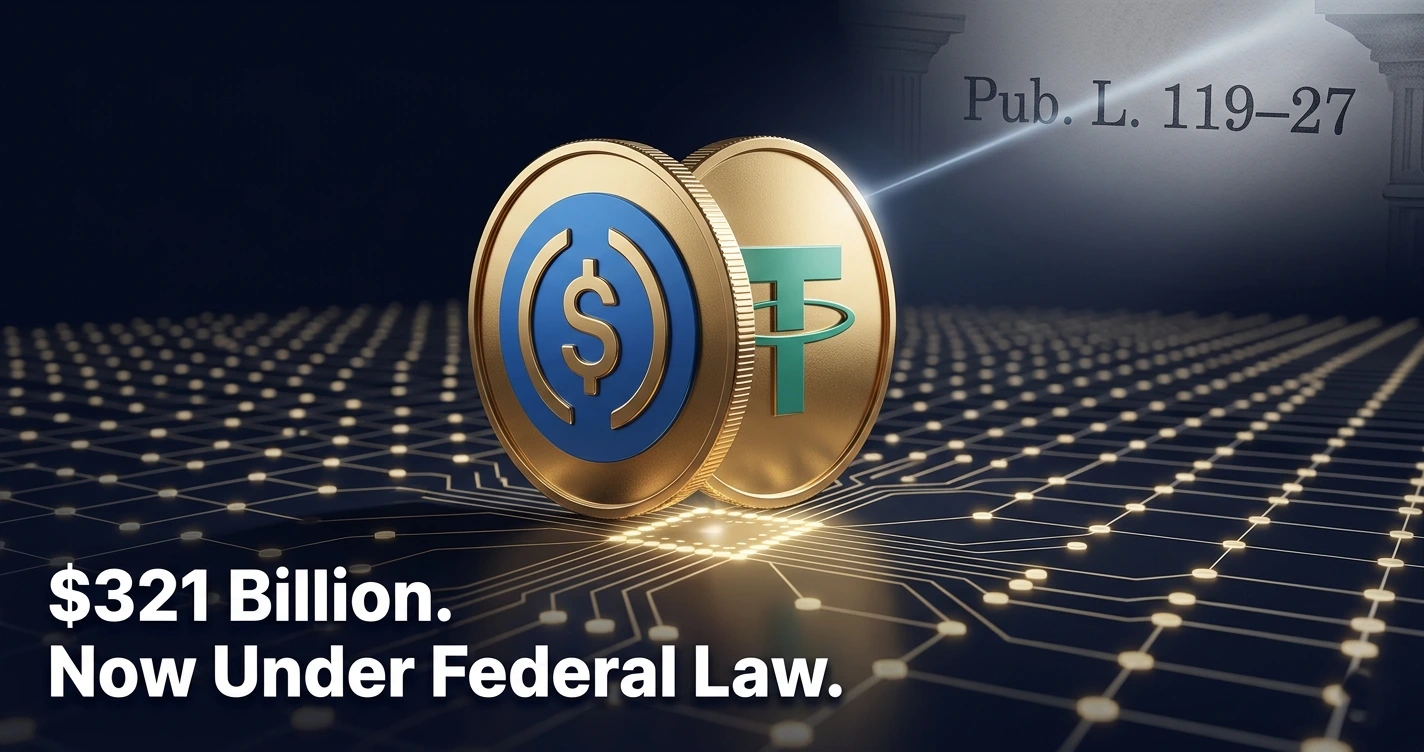
A CFO at a Fortune 500 company recently asked her payments team to explain why SpaceX is running payroll through a cryptocurrency and why Stripe now charges half the fee for it. The short answer: stablecoins. The longer answer is why $321 billion now sits in these instruments, why the US government just passed its first major crypto law to govern them, and why the Federal Reserve published a formal financial stability warning about them in April 2026.
If you’ve heard “stablecoin” in an earnings call, a Senate hearing, or a tech podcast and wanted a single resource that actually explains what it is, how it works, what the risks are, and where it’s heading, this is that resource. No jargon-for-its-own-sake. No cheerleading. Just a complete, honest picture of the most important financial infrastructure story of the decade.
What Is a Stablecoin? (The 30-Second Answer)
A stablecoin is a type of cryptocurrency that is engineered to hold a fixed value, almost always $1.00, by holding real reserves of assets equal in value to every token in circulation. Unlike Bitcoin or Ether, which can swing 15% in a single afternoon, one USDC today is still one dollar tomorrow. That’s the entire point.
Think of it this way: a regular bank account dollar is programmable only through legacy systems built in the 1970s. A stablecoin is a dollar that runs on software from 2024. You can send it anywhere on earth in seconds, program it to release under specific conditions, and hold it without needing a bank account in between. The value never changes. The infrastructure does everything else differently.
The market reached an all-time high of $321 billion in total market cap on April 21, 2026, according to DeFiLlama data. That’s up from roughly $5 billion in January 2020, a 6,300% increase in six years. In 2025 alone, stablecoins processed $28 trillion in transaction volume, a figure comparable to Visa’s annual throughput, according to Chainalysis research.
$321B
Total stablecoin market cap (ATH, April 2026)
$28T
Transaction volume processed in 2025
6,300%
Market cap growth since January 2020
99%
Of all stablecoins are USD-denominated
These are not “crypto” numbers anymore. They’re the numbers that appear in bank board presentations and Congressional testimony.
How a Stablecoin Maintains Its $1.00 Value
The mechanism is simpler than it sounds. For the dominant type of stablecoin (fiat-backed), the issuer holds $1 in reserves for every single token that exists. Mint a new token, add a dollar to the reserve. Burn a token when a user redeems it, remove a dollar from the reserve.
An arbitrage mechanism handles the micro-corrections. If USDC temporarily trades at $0.998 on an exchange, traders buy it cheaply and redeem it directly with Circle for $1.00, pocketing the difference. That buying pressure pushes the price back to $1. The same logic works in reverse if it trades slightly above a dollar. No human needs to intervene; market incentives do the work automatically.
The reserves themselves matter enormously. USDC (issued by Circle) holds its reserves in short-term US Treasury bills and cash held in regulated US banks. USDT (Tether) holds a mix of US Treasuries, cash equivalents, and other instruments, the exact composition has historically been a source of scrutiny. Under the GENIUS Act signed in July 2025, all US-licensed stablecoin issuers must hold 100% of reserves in liquid assets: cash or short-term US government securities only. Nothing riskier.
Key Insight
When you hold a GENIUS Act-compliant stablecoin in a bankruptcy scenario, you stand first in line ahead of all other creditors. This is a fundamentally different risk profile than a bank deposit over the $250,000 FDIC insurance limit.
The 4 Types of Stablecoins: How Each One Works
Not all stablecoins work the same way. There are four distinct models, and only two of them currently have any meaningful market share. Understanding the differences matters because the risk profiles are completely different.
Type
How It Maintains the Peg
Main Example
Current Status
Fiat-Backed
1:1 reserves in USD, cash, or short-term Treasuries
USDT, USDC
~90%+ of the entire market
Crypto-Backed
Over-collateralized in ETH or other crypto assets
DAI (MakerDAO / Sky)
Niche but growing
Commodity-Backed
Backed by physical gold or other commodities
PAXG (Paxos Gold)
~$1.3B market cap
Algorithmic
Smart-contract algorithm adjusts supply; no real reserves
TerraUSD (collapsed 2022)
Effectively banned under GENIUS Act
The algorithmic category deserves a sentence of clarity: TerraUSD (UST) was the most prominent algorithmic stablecoin. It maintained its peg through a complex mechanism involving a paired token called LUNA. In May 2022, that mechanism failed catastrophically, wiping approximately $40 billion in value in 72 hours. The GENIUS Act explicitly prohibits new algorithmic stablecoins without real reserves. The lesson is now embedded in federal law.
USDT vs. USDC: The Two That Matter Most
Together, USDT and USDC represent over 95% of the entire stablecoin market, according to a March 2026 BIS Working Paper (No. 1270). This is effectively a duopoly. Every other stablecoin operates in the margins. Here’s how the two dominant players compare.
USDT (Tether)
Tether is the world’s largest stablecoin at approximately $188 billion market cap, representing 58.29% of the total market as of April 21, 2026. Launched in 2014, it is the currency of crypto trading globally and the de facto dollar for hundreds of millions of people in emerging markets who use it for savings and remittances. Tether Limited is registered in the British Virgin Islands and relocated its headquarters to El Salvador in January 2025. It is not subject to GENIUS Act licensing requirements. Tether publishes quarterly attestations of reserves, but these are not full audits by a major accounting firm. In 2021, Tether was fined $41 million by the CFTC for making false statements about its reserves. The company has since significantly improved transparency, but the audit question remains open.
USDC (Circle)
USDC is the institutional-grade stablecoin at approximately $78 billion market cap. Issued by Circle Internet Financial, a San Francisco-based company, USDC is GENIUS Act-compliant, backed primarily by short-term US Treasury bills, and publishes monthly reserve disclosures reviewed by Grant Thornton. USDC grew 78% year-over-year in 2025. It is the stablecoin of choice for Visa’s settlement pilot, Stripe’s checkout integration, and enterprise payroll operations. The regulatory clarity is its core competitive advantage.
Risk to Know
In March 2023, USDC temporarily depegged to $0.87 after Silicon Valley Bank, which held approximately $3.3 billion of Circle’s reserves, failed. The peg was restored within days, but the event demonstrated that even well-reserved stablecoins carry counterparty risk tied to their banking relationships.
The GENIUS Act: What the New US Law Actually Means
On July 18, 2025, President Trump signed the GENIUS Act (Pub. L. 119-27) into law. Sponsored by Senator Bill Hagerty (R-TN) and passed 68-30 in the Senate and 308-122 in the House, it is the first major piece of US crypto legislation ever enacted. For anyone building, holding, issuing, or integrating stablecoins in the US market, this law changed the landscape fundamentally.
What the GENIUS Act Requires
100% liquid reserves: Every stablecoin must be backed 1:1 by cash or short-term US government securities. No risky assets, no commingling.
Monthly public disclosures: Issuers must publish reserve composition reports monthly. No more black boxes.
Bank Secrecy Act compliance: Full anti-money laundering and know-your-customer requirements apply to all permitted issuers.
Prohibited algorithmic stablecoins: Any stablecoin that relies purely on algorithms without real reserve backing is explicitly banned.
Bankruptcy priority: Stablecoin holders get first-priority claims over all other creditors in an issuer insolvency. This is a material credit improvement over bank deposits above $250,000.
Prohibited passive yield: Stablecoins cannot pay interest like a savings account. A March 2026 Senate compromise framework (Senators Thom Tillis and Angela Alsobrooks) distinguishes between prohibited “passive yield” and permitted “activity-based rewards”, the latter being compensation for specific on-chain activities, not simply for holding.
Who Can Issue Under the GENIUS Act
To issue stablecoins to US persons, an entity must be one of three things: a subsidiary of a federally insured bank, an OCC-licensed nonbank stablecoin issuer, or a state-chartered entity with assets under $10 billion that opts into state regulation. The OCC issued initial implementation guidance in February 2026 (Bulletin 2026-3). Federal and state banking regulators must finalize implementation rules by July 18, 2026.
What This Means for Tether
USDT, the dominant stablecoin, is issued by a non-US entity and is not subject to GENIUS Act requirements. It can continue operating in the US market for now, but any future regulatory action targeting foreign issuers would be a significant market event. Investors holding USDT should understand this jurisdictional asymmetry.
Real-World Uses: From Remittances to Treasury Operations
The most compelling case for stablecoins is not abstract. It’s a worker in the Philippines sending money home, a startup in Brazil paying a contractor in Germany, or a company like SpaceX managing treasury reserves in countries with volatile local currencies. The speed and cost advantages over traditional rails are not marginal. They’re an order of magnitude better.
“Stablecoins are doing for money what WhatsApp did for international phone calls, eliminating costly intermediaries. A $200 remittance still costs 6.62% in fees on average. That’s a regressive tax on the world’s poorest workers.”
Chris Dixon, Managing Partner, a16z Crypto
Dixon’s point is backed by data. The a16z analysis (May 2025) cites SpaceX using USDC for treasury operations in volatile-currency markets, and ScaleAI using it for international payroll. These are not experimental deployments. They’re production infrastructure at scale.
The Corporate Adoption Wave
The mainstream payment networks are not watching from the sidelines. In December 2025, Visa launched a pilot program to settle certain transactions using USDC, marking a structural shift in how the global card network handles cross-border liquidity. Stripe, which acquired stablecoin infrastructure startup Bridge in 2024, now supports stablecoin checkouts at approximately 1.5% fees compared to 3% for traditional card transactions. Mastercard has a stablecoin settlement partnership with BVNK. PayPal issues its own stablecoin, PYUSD.
In 2024, stablecoin transaction volumes surpassed Visa and Mastercard combined, according to the World Economic Forum. By 2025, stablecoins accounted for 75% of all crypto trading volume in Q1, meaning three-quarters of all activity in the crypto market now uses stablecoins as the unit of account rather than any volatile cryptocurrency.
The Emerging Markets Case
“The benefits of stablecoins far outweigh the concerns. The report fails to acknowledge the majority of people live in highly unstable fiat economies. Centralized policy making and centralized financial systems have failed these people for decades, which is why they are mass adopting stablecoins and liberating themselves.”
Erbil Karaman, Co-Founder, Huma.Finance (which has processed over $8 billion in stablecoin transactions in emerging markets)
Karaman’s firm is not speaking theoretically. In countries where local currency can lose 40% of its value in a year, holding dollar-pegged stablecoins is a rational inflation hedge. The 99% USD denomination of all stablecoins (per European Central Bank data) means this market is, among other things, a massive expansion of dollar reach outside the traditional banking system.
The Risks No One Talks About (But the Fed Does)
On April 8, 2026, the Federal Reserve Board published a formal research paper titled “Stablecoins in 2025: Developments and Financial Stability Implications” by economists Francesca Carapella, Arazi Lubis, and Alexandros Vardoulakis. It is the most authoritative recent government assessment of what could go wrong. The paper identifies three structural vulnerabilities that deserve attention from anyone holding, building on, or regulating stablecoins.
“The quality and liquidity of stablecoin reserve assets are critical to their long-run viability.”
Michael Barr, Governor, Federal Reserve Board (March 31, 2026)
Risk 1: Run Dynamics
A stablecoin run works like a bank run. If enough users simultaneously lose confidence and try to redeem for dollars, the issuer must liquidate reserves rapidly. If those reserves include anything less liquid than overnight Treasuries, the redemption pressure can cause forced sales at a discount, which erodes the reserve ratio, which triggers more redemptions. The Fed’s paper explicitly calls this the primary vulnerability. The March 2023 USDC depeg to $0.87 is the closest real-world illustration, and that resolved within days. A slower-moving confidence crisis in a larger stablecoin could be significantly more damaging to broader financial markets.
Risk 2: Concentration and Opacity
The BIS Working Paper No. 1270 (March 2026) documents that USDT and USDC together hold over 95% of the entire market. This is extreme concentration. Additionally, the Fed economists warn that “increasingly complex intermediation chains between issuers and third-party service providers” make it “increasingly difficult for participants to identify the source of emerging stress.” In plain terms: the plumbing is getting complicated enough that it’s hard to know where a problem will surface before it does.
Risk 3: Vertical Integration
The Fed paper identifies “strategic vertical integration combining multiple business functions under single entities” as a distinct systemic risk. A company that controls the stablecoin issuance, the wallet distribution, the trading platform, and the custody simultaneously has enormous leverage over users and enormous opacity for regulators. The GENIUS Act addresses some of this, but critics argue it doesn’t go far enough on entities controlling the full stack.
Stablecoins vs. CBDCs: What’s the Difference?
A stablecoin is issued by a private company. A CBDC (Central Bank Digital Currency) is issued directly by a government’s central bank. That distinction carries enormous consequences.
Feature
Stablecoin (e.g., USDC)
CBDC (e.g., Digital Dollar)
Issuer
Private company (Circle, Tether)
Central bank (Federal Reserve, ECB)
Legal tender status
No
Yes
Credit risk
Issuer counterparty risk
Sovereign risk only
Regulatory status (US)
GENIUS Act framework (July 2025)
No US CBDC currently in operation
IMF recommendation
Regulate carefully
Preferred alternative for stability
Privacy profile
Pseudonymous on-chain; BSA compliant
Varies by design; government-controlled
The IMF’s December 2025 report on stablecoins (56 pages, published as Departmental Paper 2025/009) explicitly recommends CBDCs as the preferred alternative for monetary stability. The EU is not waiting for that debate to resolve. Under MiCA (Markets in Crypto-Assets regulation), only licensed e-money institutions can issue euro-denominated stablecoins. Euro stablecoins have a market measured in hundreds of millions, not tens of billions. Dollar dominance in this market is a geopolitical reality, not a technical necessity.
Who’s Criticizing Stablecoins and Why They Have a Point
Our read: the stablecoin market has genuine structural momentum that is unlikely to reverse, but several of the criticisms being raised deserve serious engagement rather than dismissal.
The “Stable” in Stablecoin Is a Marketing Term
TerraUSD wiped out $40 billion in 72 hours in May 2022. USDC dropped to $0.87 in March 2023. The word “stable” creates a risk perception gap for retail users who don’t understand that peg stability depends on issuer solvency, reserve quality, and market confidence — not a mathematical guarantee. The Federal Reserve’s April 2026 paper makes this point explicitly in peer-reviewed terms.
The Transaction Volume Numbers Are Inflated
The $28 trillion annual transaction volume figure (Chainalysis, 2025) gets cited frequently. What it doesn’t highlight is that a significant portion of stablecoin volume is DeFi arbitrage loops, transactions that cycle through multiple smart contracts in seconds and are counted multiple times. McKinsey estimated daily stablecoin settlement at approximately $30 billion in mid-2025, less than 1% of global money flows. The $28 trillion is real transaction count. The economic transfer value is materially lower.
Dollar Extension Without Dollar Accountability
With 99% of all stablecoins denominated in USD, private companies are extending US dollar reach into dozens of countries outside any traditional banking oversight. The IMF December 2025 paper warns this amounts to de facto dollarization without the governance, monetary policy tools, or accountability structures that accompany the actual dollar. For small or economically fragile nations, this isn’t a feature. It’s a sovereignty risk.
The GENIUS Act’s Blind Spots
Advocacy group Americans for Financial Reform argued in May 2026 that the legislation was shaped by industry interests and fails to adequately address risks from vertically integrated issuers who control wallet distribution, trading, and custody simultaneously. The Act also leaves Tether — the 58% market-share dominant player, outside its licensing requirements, meaning the most important entity in the ecosystem operates without the law’s protections or constraints.
Frequently Asked Questions
What is a stablecoin in simple terms?
A stablecoin is a type of cryptocurrency designed to always be worth $1.00. It achieves this by holding real reserves like cash or US Treasury bills equal to every stablecoin in circulation. It moves as fast as any blockchain transaction but never changes in dollar value. Think of it as a digital dollar that anyone in the world can send instantly.
How does a stablecoin maintain its $1.00 value?
Fiat-backed stablecoins like USDC and USDT hold $1 in reserves for every token issued. When demand rises, the issuer mints new tokens. When demand falls, users redeem tokens for dollars and the issuer burns those tokens. An arbitrage mechanism also helps: if the price dips below $1, traders buy and redeem tokens at a profit, pushing the price back to par.
Is USDT (Tether) safe?
USDT is the world’s largest stablecoin at ~$188 billion and has maintained its peg under most conditions. However, Tether is headquartered outside the US (El Salvador as of 2025), is not subject to GENIUS Act requirements, and publishes quarterly attestations rather than full audits. Regulatory risk remains. Any US enforcement action against Tether would be a significant market event. Use it with awareness of this counterparty risk.
What is the difference between USDT and USDC?
USDT (Tether) holds ~$188B market cap with dominant use in emerging markets and trading, but is an offshore entity not subject to GENIUS Act licensing. USDC (Circle, ~$78B) is US-based, GENIUS Act-compliant, backed primarily by short-term US Treasuries, and preferred by institutions because of regulatory clarity and monthly public reserve disclosures.
What is the GENIUS Act and how does it affect stablecoins?
Signed on July 18, 2025, the GENIUS Act (Pub. L. 119-27) is the first federal US law regulating stablecoins. It requires 100% reserve backing in liquid assets, monthly public reserve disclosures, and Bank Secrecy Act compliance. Only permitted payment stablecoin issuers, bank subsidiaries, OCC-licensed nonbanks, or state-chartered entities, may issue stablecoins to US persons.
Can stablecoins fail?
Yes. TerraUSD (UST) collapsed in May 2022, wiping out ~$40 billion. USDC temporarily depegged to $0.87 in March 2023 when reserves held at Silicon Valley Bank were frozen. The Federal Reserve (April 2026) warns that “run risk” remains the primary vulnerability even for well-reserved stablecoins if user confidence collapses rapidly.
Are stablecoins the same as CBDCs?
No. Stablecoins are issued by private companies (Tether, Circle). CBDCs are issued directly by governments and are official legal tender. A stablecoin carries issuer counterparty risk. A CBDC carries only sovereign risk. The IMF (December 2025) explicitly advocates for CBDCs as the preferred monetary stability tool over private stablecoins.
How are stablecoins used in real life?
Stablecoins are used for cross-border remittances, international B2B payments and payroll (SpaceX and ScaleAI use USDC), DeFi lending and yield strategies, treasury management in countries with volatile local currencies, and retail payments via Visa’s USDC settlement pilot and Stripe’s stablecoin checkout at 1.5% fees. In 2025, stablecoins processed $28 trillion in transaction volume globally.
What You Now Understand — and What Comes Next
A year ago, stablecoin was a word that lived in crypto-native conversations. It now appears in Federal Reserve research papers, Senate floor votes with 68 senators in favor, Stripe pricing pages, and Visa settlement infrastructure. The $321 billion market cap is not a speculative bubble. It’s the current size of a new global payment layer that is growing 50% per year and just received its first federal regulatory framework in the US.
The stablecoin explained simply is this: private companies have built a dollar that runs on public software. That software is borderless, 24/7, and cheaper than anything SWIFT offers. The GENIUS Act legitimized it. Visa, Stripe, and Mastercard integrated it. The Fed is watching it carefully.
Here’s what to watch in the next 6 to 18 months. First, OCC implementation rules finalized by July 2026 will determine how strictly the GENIUS Act is enforced and whether Tether faces indirect compliance pressure on US platforms. Second, the Senate’s yield framework (Tillis-Alsobrooks compromise) will shape whether DeFi protocols can legally build reward products on stablecoins, a multi-billion-dollar design question for developers. Third, McKinsey projects stablecoin market cap could reach $2 trillion by 2028. That would make this the fastest-adopted financial infrastructure in modern history. Whether that projection proves accurate depends entirely on whether the GENIUS Act’s implementation creates the institutional confidence required.
Three specific things to act on now: if you’re in treasury or payments, evaluate whether GENIUS Act-compliant stablecoin rails make sense for your cross-border vendor payments. If you’re building on stablecoins, the activity-based rewards framework is your most important near-term design constraint. And if you’re investing, the regulatory asymmetry between USDC and USDT is the single most important risk variable in the market today.
Stay Ahead of What’s Happening in Tech
The Neural Loop delivers the most important technology, AI, and crypto developments to your inbox — concise, verified, and without the noise.
Subscribe to The Neural Loop
Crypto Regulation by Country 2026: The Complete Global Guide
The GENIUS Act is law. MiCA’s hard deadline hits July 1. The UK just opened its authorisation window. Here’s everything that changed — and exactly what it means for you.
NeuralWired Research Desk●June 7, 2026●Updated & Verified●18 min read
A compliance officer in Frankfurt and a retail trader in Mumbai are both navigating a crypto world they wouldn’t recognize from two years ago. The question is no longer “Is crypto legal where I am?” The question is “What license, what reserves, what reporting system, and what regulator do I answer to?” That shift defines 2026.
45
Countries where crypto is fully legal
10
Countries with a total crypto ban
$3.5T
Global crypto market cap, mid-2025
92%
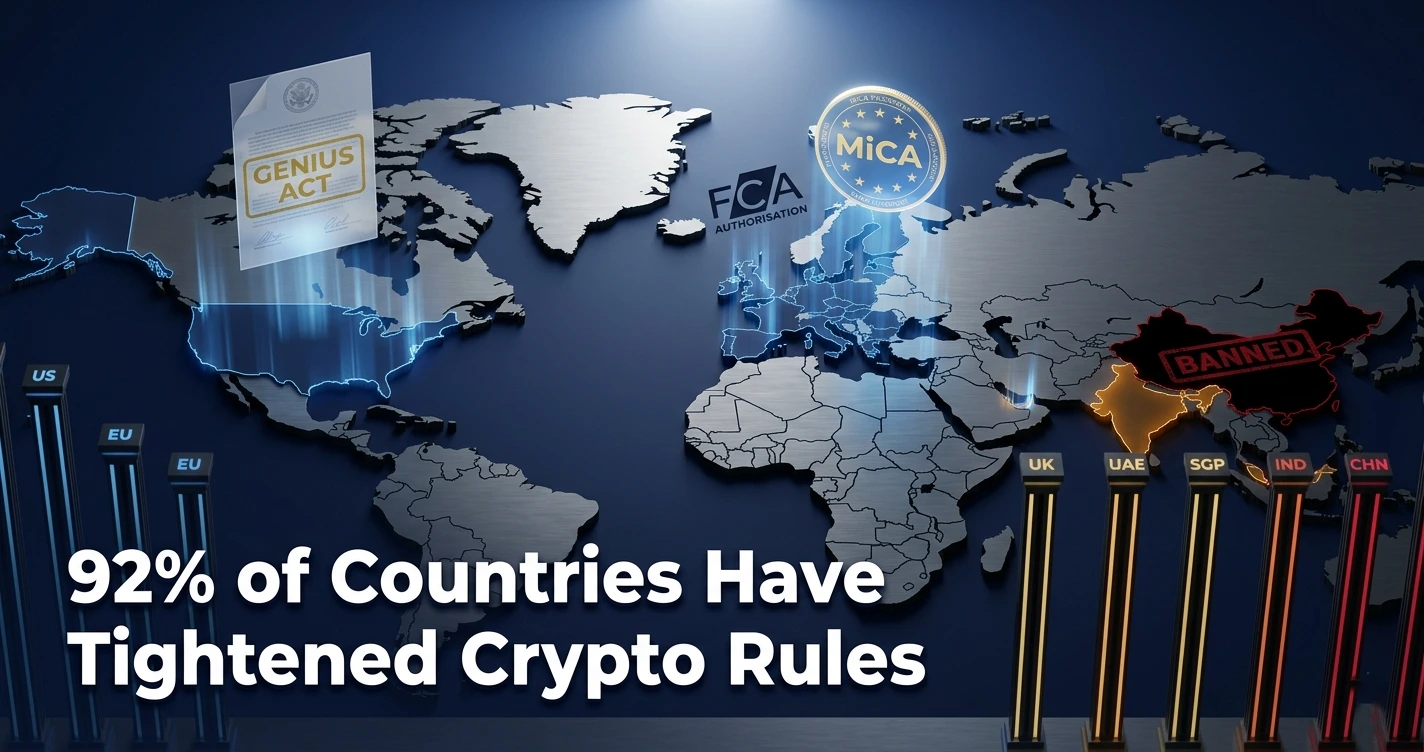
Jurisdictions that tightened rules in 2025
Global Overview: Where Things Stand in 2026
Of 75 countries surveyed by the Atlantic Council in mid-2025, 45 are fully legal, 20 impose partial bans, and 10 have instituted complete prohibitions on cryptocurrency. Among G20 nations, 12 economies representing roughly 57% of global GDP have either legalized or tightly regulated crypto activity.
Vietnam became the 46th fully legal jurisdiction on January 1, 2026. Only 28 of the 75 countries studied have regulations covering all four pillars that institutional players care about: taxation, AML/CFT compliance, consumer protection, and licensing.
The direction of travel is unmistakable. Over 92% of global jurisdictions have tightened crypto rules in some form, according to Atlantic Council data. The question for investors, exchange operators, and fund managers is not whether regulation is coming. It’s whether your jurisdiction of choice is building frameworks designed to attract capital or frameworks designed to control it.
The pivot year: Three of the four largest financial markets on earth (US, EU, UK) are implementing new crypto frameworks inside the same 12-month window. That has never happened before.
United States: GENIUS Act, SEC/CFTC, and What Comes Next
The US crypto story in 2026 is fundamentally a stablecoin story. After years of multi-agency jurisdictional battles and regulatory whiplash, Congress passed the first federal crypto law with real teeth.
The GENIUS Act (Signed July 18, 2025)
During what Washington insiders called “Crypto Week,” the House passed the GENIUS Act by a vote of 308 to 122 on July 17, 2025. The Senate had already cleared it 68 to 30 on June 17. The President signed it into law on July 18. Those vote tallies matter: this was bipartisan in a way almost nothing in Washington is these days.
The GENIUS Act creates the first federal framework for payment stablecoins, replacing a patchwork of state and agency guidance with enforceable national standards covering reserve assets, redemption rights, disclosures, and custody. Under the Act, compliant stablecoins are explicitly classified as neither securities nor commodities, which resolves the most paralyzing source of legal uncertainty the industry has faced since 2017.
A Stablecoin Certification Review Committee, made up of the Secretary of the Treasury, the Chair of the Federal Reserve Board of Governors, and the Chair of the FDIC, now governs major issuance decisions. One notable restriction: issuers cannot pay interest or yield to holders solely in connection with holding a payment stablecoin. Consumer protection advocates see this as a safeguard. Critics see it as protecting bank incumbents.
2026 Rulemaking: The AML and Sanctions Layer
On April 8, 2026, the Treasury’s Financial Crimes Enforcement Network and the Office of Foreign Assets Control issued a joint Notice of Proposed Rulemaking to implement the AML and sanctions compliance provisions of the GENIUS Act for permitted payment stablecoin issuers. Comments were due June 9, 2026. If you’re in this space and missed that window, you’re already behind.
SEC and CFTC Joint Interpretive Guidance (March 2026)
On March 17, 2026, the SEC and the Commodity Futures Trading Commission jointly issued extensive interpretive guidance clarifying how federal securities laws apply to specific categories of crypto assets and transactions. The CFTC confirmed it would administer the Commodity Exchange Act consistently with the SEC’s interpretation. For the first time, the two agencies are speaking from the same sheet of music on crypto asset classification.
“I’ve never seen a market more driven by sentiment than fundamentals. Ordinary investors were left without sufficient information about investments in digital assets.”
Gary Gensler, Former Chair, US Securities and Exchange Commission (2021-2025)
Gensler’s warnings represent the most credentialed skeptical voice on the current regulatory pivot. His comparison of today’s crypto market to the unregulated stock markets of the 1920s still finds a serious audience among institutional risk officers.
European Union: MiCA Deadline, July 1, 2026
Hard deadline approaching: ESMA has stated that any entity providing crypto-asset services to EU clients without a MiCA license after July 1, 2026 will be in direct breach of EU law and must cease offering such services.
MiCA (Markets in Crypto-Assets Regulation) has effectively unified 27 national frameworks into a single regulatory passport. A crypto exchange licensed in Germany can now legally operate across France, Italy, Spain, and 24 other member states without reapplying. That is not theoretical convenience; it is the most significant structural change to European financial services since MiFID II.
Transitional periods varied significantly across member states. The Netherlands required full compliance by July 2025. Italy set its deadline at December 2025. Other countries extended to the July 2026 maximum. Grandfathered entities operating under national regimes do not benefit from an EU passport unless they obtain a full MiCA licence, per ESMA’s explicit Q&A guidance. That distinction has caught operators off guard.
Since full enforcement began in December 2024, over €540 million in penalties have already been issued across member states. MiCA enforcement is not theoretical. It is already happening.
Luxembourg has emerged as an early MiCA hub, attracting nearly 110 licensed VASPs under MiCA-aligned rules by early 2026, reflecting the passport’s business logic: establish one license in a favorable member state, operate across the entire bloc.
The Gaps MiCA Deliberately Left Open
DeFi services that are fully decentralized and NFTs are explicitly excluded from MiCA’s regulatory scope. Because no identifiable entity manages these systems, MiCA’s licensing and disclosure requirements cannot attach. DeFi protocols processed hundreds of billions in volume in 2025. Tightening the centralized rails while leaving decentralized alternatives largely unregulated is the most significant structural contradiction in the EU’s approach.
United Kingdom: FCA Authorisation Opens September 2026
The Financial Services and Markets Act 2000 (Cryptoassets) Regulations 2026 was enacted on February 4, 2026, establishing the comprehensive statutory framework for regulating cryptoasset activities in the UK. Crypto firms can apply for FCA authorisation from September 30, 2026. The full regime comes into force on October 25, 2027.
The new regime brings authorisation requirements for a broader range of activities than most operators anticipated: issuing stablecoins, custody services, operating trading platforms, dealing and arranging, and staking services. Operating regulated crypto activities without FCA authorisation risks criminal sanctions, unlimited fines, imprisonment of up to two years, and unenforceable contracts.
Under the Property (Digital Assets etc.) Act 2025, cryptoassets are now legally recognized as property in the UK. That matters practically: owners have legal protection in cases of theft, contractual disputes, and insolvency proceedings. Retail stablecoins fall under FCA oversight. Systemic stablecoins are regulated by the Bank of England.
From January 1, 2026, new Reporting Cryptoasset Service Provider regulations require crypto platforms to report user data and transaction details directly to HMRC. The era of UK crypto users quietly holding on foreign platforms without a paper trail is over.
UAE: Dubai VARA and Abu Dhabi ADGM
The UAE has positioned itself as the most pragmatically pro-crypto major economy in the world, and its institutional infrastructure is now sophisticated enough to attract serious capital. As of February 2026, Dubai’s Virtual Assets Regulatory Authority has fully implemented Travel Rule requirements, mandating that all VASPs transmit specific originator and beneficiary information for all transfers. A unified UAE VASP Register now exists across the SCA and VARA, meaning a firm licensed in Dubai has its status visible federally, simplifying cross-emirate operations.
VARA requires firms to meet a Net Liquid Assets test: current liquid assets must be maintained at no less than 1.2 times monthly operating expenses, reconciled daily and reported monthly. Insurance for hot-wallet exposures is mandatory. These are institutional-grade requirements by any standard, and they are attracting institutional-grade participants.
“For businesses seeking faster licensing timelines or lower capital requirements, look at UAE (VARA or ADGM) or Hong Kong. Singapore is the right jurisdiction for crypto businesses wanting credible, institutional-grade regulated status recognized by institutional counterparties.”
Oleg Prosin, Managing Partner, WCR Legal, Singapore — April 2026
Singapore: MAS and the Institutional Standard
Singapore’s Monetary Authority of Singapore has built what many institutional counterparties consider the gold standard in crypto licensing. Exchanges and digital-asset service providers must be licensed under the Payment Services Act, meet AML and Travel Rule obligations, and satisfy demanding operational-resilience and cybersecurity standards.
The MAS single-currency stablecoin framework mandates high-quality reserve backing, clear redemption rights, operational resilience, and unambiguous issuer accountability. An MAS licence is recognized by international banks, institutional counterparties, and corporate treasury programmes in a way that most other crypto licences are not. That recognition premium is real and it drives capital allocation decisions at the institutional level.
The trade-off: Singapore’s consumer protection restrictions make it less attractive than UAE or Hong Kong for businesses primarily targeting retail clients. Licensing timelines are longer and capital requirements higher. Prosin’s framing is accurate: Singapore is for operators who want to signal substance to institutions and are willing to do the work.
India: Punitive Tax, No Structure, and $5 Trillion Offshore
India provides the clearest real-world evidence that punitive taxation without licensing structure does not improve compliance. It makes things worse.
India applies a flat 30% tax on Virtual Digital Asset profits regardless of income bracket, a 1% Tax Deducted at Source on transfers exceeding ₹50,000 in a financial year, and allows no ability to offset losses from one cryptocurrency against profits from another. From April 1, 2026, new transaction compliance rules mandate fines of up to ₹50,000 for any exchange failing to provide accurate transaction reporting.
“High 1% TDS and a 30% flat tax have pushed many users toward offshore platforms, reducing both visibility and potential tax revenue for India. Lowering TDS to around 0.01%, taxing crypto under normal income slabs, and allowing loss offsets could improve compliance while supporting innovation.”
Sumit Gupta, Co-founder and CEO, CoinDCX, India’s largest retail crypto exchange
Estimates suggest Indian users generated approximately ₹5 lakh crore (roughly $5 trillion) in trading volume on foreign exchanges between late 2024 and 2025. India’s regulatory approach has not reduced crypto activity. It has moved crypto activity to jurisdictions where India collects zero tax revenue and has zero oversight. The April 2026 compliance mandates mean exchanges are now heavily incentivized to share transaction data with the Income Tax Department, but the horse has largely left the stable.
China: The Total Ban, Unchanged Since 2021
China’s comprehensive prohibition on cryptocurrency — covering mining, trading, exchange services, and crypto marketing — remains fully in force in 2026. The ban has not changed since September 2021. Mining, exchange operations, and promotional activity are all illegal. Chinese nationals who use foreign crypto platforms operate in legal grey territory.
China’s stance is notable not as a cautionary tale about crypto but as a deliberate strategic choice: the country is channeling digital finance energy into the digital yuan (e-CNY) and state-supervised fintech, not decentralized assets. The crypto ban and the chip restriction posture tell the same story about state control of the digital economy.
Quick-Reference Table: Crypto Regulation by Country 2026
Country
Legal Status
Key Framework
Tax Treatment
2026 Key Date
United States
Legal
GENIUS Act, SEC/CFTC guidance
Property; 0-37% CGT
FinCEN/OFAC NPRM finalized
European Union
Legal (MiCA)
MiCA CASP licence
Varies by member state
July 1 hard deadline
United Kingdom
Legal
FSMA 2026 Crypto SI / FCA
CGT applies
FCA auth opens Sept 30
UAE (Dubai)
Legal
VARA / ADGM
No personal income tax
Travel Rule fully live
Singapore
Legal
MAS Payment Services Act
No CGT on crypto
Stablecoin framework active
Germany
Legal (MiCA)
BaFin / MiCA
Tax-free after 12-month hold
MiCA passporting active
India
Legal, Restrictive
VDA tax regime
30% flat + 1% TDS
Exchange reporting fines active
Japan
Legal
FSA licensing (2017 model)
Income tax applies
Ongoing PSA updates
Australia
Legal
ASIC / Treasury reform
50% CGT discount (12mo+)
Licensing reform ongoing
El Salvador
Legal Tender
Bitcoin Legal Tender Act
No CGT for foreigners
IMF deal modifies mandate
China
Total Ban
PBOC / State directives
N/A (banned)
Ban unchanged since 2021
Algeria
Total Ban
National legislation
N/A (banned)
No change expected
Bolivia
Total Ban
BCB decree
N/A (banned)
No change expected
Bangladesh
Total Ban
Bangladesh Bank directive
N/A (banned)
No change expected
FATF Travel Rule: The Invisible Global Standard
Most crypto users have never heard of the Travel Rule. It governs almost every significant crypto transfer they make.
The Travel Rule is a global AML standard set by the Financial Action Task Force requiring Virtual Asset Service Providers to collect and transmit originator and beneficiary information (name, address, wallet identifier) for transactions above specific thresholds, mirroring the wire transfer rules that have governed traditional banking for decades.
As of the FATF June 2025 Targeted Update, more than 90 of 117 FATF-monitored jurisdictions have enacted or are implementing Travel Rule requirements, up from 65 in 2024. In June 2025, FATF also highlighted persistent gaps in implementation, particularly around interoperability. Fragmented national adoption makes it difficult for providers to reliably exchange originator and beneficiary data across borders, and FATF’s 2025 update to Recommendation 16 adds operational burden without resolving those long-standing gaps.
UAE’s VARA addressed this head-on: full Travel Rule implementation was mandatory across all VASPs from February 2026. It’s the clearest model of a regulator that set the rule and enforced it on a firm timeline.
DeFi and NFTs: The Regulatory Blind Spot
Every framework discussed in this guide applies to identifiable entities. MiCA requires a licensed CASP. The GENIUS Act targets permitted payment stablecoin issuers. The FCA regime requires an authorised firm. VARA licences VASPs.
DeFi has no identifiable entity. That is its design. And that is why every major 2026 regulatory framework, at its edges, stops at DeFi’s front door.
Under MiCA’s framework, DeFi services that are fully decentralized, with minimal or no intermediaries, are explicitly excluded from its regulatory scope. NFTs are similarly excluded. DeFi protocols processed hundreds of billions in volume in 2025. Sophisticated actors who want to operate outside all of the frameworks described above can route through DeFi and remain largely beyond regulatory reach. That is not a minor gap. It is a structural feature of the current global framework that regulators have not resolved.
The Part They Don’t Advertise
The mainstream narrative on 2026 crypto regulation is convergence and clarity. MiCA, GENIUS Act, UK FSMA, MAS, VARA: a coherent global framework is emerging. Our read: that framing is partly accurate and significantly incomplete.
Regulatory capture risk in the US: The GENIUS Act’s prohibition on yield payments to stablecoin holders directly protects banking incumbents. Its requirement for unanimous Treasury, Fed, and FDIC committee approval for non-financial company issuance effectively creates a vetocracy over Big Tech stablecoin entry. Critics who watched the lobbying effort note that the biggest winners of GENIUS Act compliance infrastructure are the entities that helped write it.
Compliance costs create oligopoly risk: Small exchanges and DeFi startups cannot simultaneously absorb MiCA compliance, GENIUS Act compliance, and Travel Rule implementation. The regulatory wave may inadvertently consolidate the market around Coinbase, Binance, Circle, and a handful of MiCA-licensed EU incumbents. Regulation designed to protect consumers can end up limiting their choices.
MiCA’s enforcement capacity is uneven: Germany’s BaFin is a sophisticated regulator with deep resources. Several smaller EU member state competent authorities are not. The July 1, 2026 hard deadline may produce strict enforcement in some jurisdictions and selective enforcement in others. “EU-wide” rules and “EU-wide” enforcement are not the same thing in practice.
India proves punishment without structure backfires: A flat 30% tax and 1% TDS did not reduce Indian crypto activity. It moved approximately $5 trillion in trading volume to offshore platforms, reduced domestic tax revenue, and gave Indian regulators less visibility, not more. This is the evidence-based argument for structured licensing over punitive taxation. So far, India’s government has not incorporated it.
Frequently Asked Questions
Is cryptocurrency legal in all countries?
No. As of 2026, 45 of 75 surveyed countries fully legalize crypto, 20 impose partial bans, and 10 have complete prohibitions, including China, Algeria, and Bolivia. Most G20 economies now regulate rather than ban it, but legal status varies significantly by jurisdiction and activity type.
Which country has the strictest crypto regulation in 2026?
China maintains the strictest regime, with a total ban on mining, trading, exchange services, and crypto marketing since 2021. Among regulating (rather than banning) jurisdictions, the EU’s MiCA framework is the most comprehensive, covering all 27 member states with uniform licensing, capital, and disclosure requirements from July 2026.
Is crypto legal in the USA in 2026?
Yes. Crypto is legal in the US. The GENIUS Act, signed July 18, 2025, created the first federal framework for payment stablecoins backed 1:1 with USD or short-term Treasuries. The SEC and CFTC issued joint interpretive guidance in March 2026 on how federal securities laws apply to crypto assets. Multi-agency oversight via the SEC, CFTC, and FinCEN continues.
What is MiCA regulation in simple terms?
MiCA is the EU’s unified law governing crypto businesses across all 27 member states. It requires crypto exchanges, wallet providers, and stablecoin issuers to obtain a single license from one EU national regulator, which then grants the right to operate across the entire EU. Full enforcement applies from July 1, 2026.
Which country is best for crypto businesses in 2026?
The UAE (VARA for Dubai, ADGM for Abu Dhabi), Singapore (MAS), and Germany (MiCA passport plus tax-free gains after 12 months) are consistently cited as top-tier jurisdictions for crypto businesses. UAE and Hong Kong suit operators seeking faster licensing. Singapore suits those targeting institutional recognition. EU hub jurisdictions like Luxembourg suit firms wanting passported EU access.
How is crypto taxed in different countries?
Germany offers tax-free gains after a 12-month hold. UAE and Singapore have no personal capital gains tax on crypto. The US taxes crypto as property at capital gains rates (0 to 37% depending on income and holding period). India applies a flat 30% regardless of income bracket. Australia applies a 50% CGT discount for assets held more than 12 months.
What is the GENIUS Act in crypto?
The GENIUS Act (Guiding and Establishing National Innovation for U.S. Stablecoins Act) is the first US federal law specifically regulating payment stablecoins. Signed July 18, 2025, it requires 1:1 backing with USD, Treasury securities, or bank deposits; mandates monthly disclosures and regular audits; and clarifies that compliant stablecoins are not securities or commodities.
Is crypto banned in China in 2026?
Yes. China’s complete ban on cryptocurrency — covering mining, trading, exchange services, and marketing — remains fully in effect in 2026, unchanged since September 2021. Chinese nationals using foreign crypto platforms operate in legal grey territory.
What is the FATF Travel Rule for crypto?
The Travel Rule is a global AML standard requiring Virtual Asset Service Providers to collect and transmit originator and beneficiary information (name, address, account identifier) for crypto transfers above threshold amounts, mirroring wire transfer rules for traditional banks. As of June 2025, more than 90 of 117 FATF-monitored jurisdictions have enacted or are implementing Travel Rule legislation.
How does MiCA affect crypto exchanges after July 2026?
Any exchange serving EU clients without a MiCA CASP license after July 1, 2026 is in direct breach of EU law. A single MiCA license, obtained from one member state’s national regulator, grants the right to operate in all 27 EU member states. Non-EU exchanges cannot serve EU clients via reverse solicitation for MiCA-covered services.
What Comes Next: 6 to 18 Months Out
The fundamental shift in 2026 is from regulatory permission to regulatory structure. The industry spent years asking “Is this legal?” The question now is “What does compliance actually require, and can we build it?” That reframing is not trivial. It defines who can raise institutional capital, who can serve retail clients across multiple markets, and who gets shut out.
Three things to watch between now and the end of 2027. First, watch how the EU’s July 1 MiCA deadline plays out in enforcement practice. The hard deadline is set. How member state competent authorities actually apply it, particularly smaller regulators, will reveal whether MiCA is truly uniform or a patchwork with a shared brand. Second, watch the UK’s September 2026 FCA authorisation gateway. The firms that apply early and build serious compliance infrastructure will have a structural advantage when the full October 2027 regime comes into force. Laggards will face enforcement and unenforceable contracts. Third, watch DeFi. Every regulator in this guide has left the decentralized space largely unaddressed. That gap will not stay open indefinitely. The next major regulatory wave, likely arriving 2027 to 2028, will attempt to define accountability for decentralized protocols. How it does that, without identifiable entities to license, is the hardest unsolved problem in crypto regulation.
For investors, the immediate implication is straightforward: the license map is becoming the capital map. Regulated jurisdictions attract institutional flows. Jurisdictions without frameworks do not. The arbitrage that once existed between permissive and restrictive environments is narrowing faster than most retail participants realize. Read the brief. Know your jurisdiction. Know your regulator.
Stay Ahead of What’s Moving Markets
The Neural Loop delivers verified regulatory intelligence, technology analysis, and policy breakdowns directly to your inbox. No noise. No sponsored content. Just the signal.
Subscribe to The Neural Loop
What Is a Crypto Wallet? The Complete 2026 Guide for Beginners | NeuralWired
Crypto · Beginner Guide · June 2026
What Is a Crypto Wallet? The Complete 2026 Guide (Types, Risks & How to Choose)
By NeuralWired Research DeskJune 7, 2026Updated: June 7, 202614 min read
On February 21, 2025, a security team at the Dubai-based exchange Bybit watched $1.5 billion in Ethereum vanish in minutes. The funds moved to wallets controlled by North Korea’s Lazarus Group. The terrifying part? Bybit had a cold wallet. They had multisig approvals. They did everything the security textbooks say to do. It still wasn’t enough.
If a billion-dollar exchange with professional security engineers can lose everything in one transaction, what chance does a first-time crypto buyer have? The honest answer is: a better chance than you think, but only if you understand what a crypto wallet actually is, how it works, and which type belongs in your hands right now.
This guide covers all of it. No jargon without explanation. No generic advice. By the end, you’ll understand the single most important concept in crypto security, one that more than half of active crypto users still get wrong.
What a Crypto Wallet Actually Is
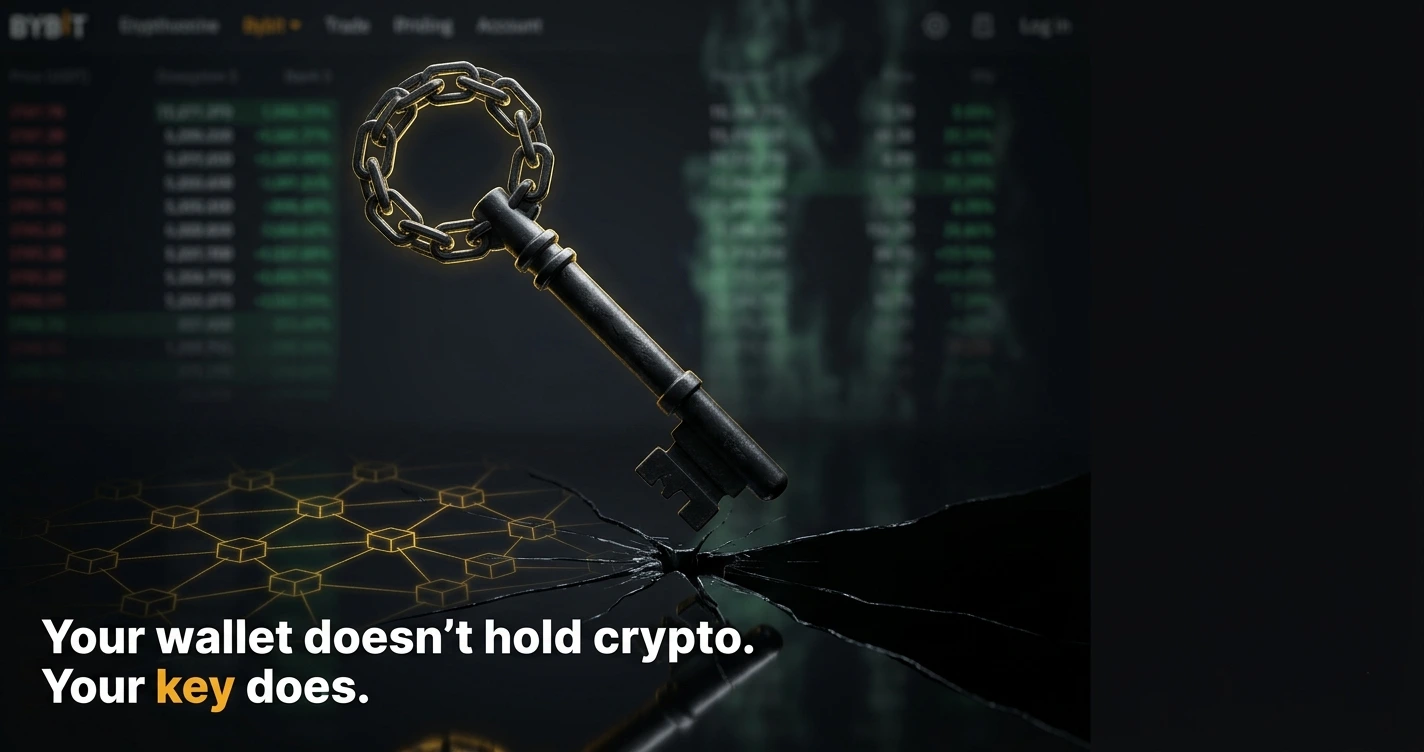
Here is the most important sentence in this entire article: a crypto wallet does not store your cryptocurrency.
Read that again. Your Bitcoin, Ethereum, and any other token you own never leave the blockchain. They live there permanently, recorded in a public ledger that no single person or company controls. What your wallet stores are the private keys that prove you own those assets and authorize you to move them.
The word “wallet” is technically a misnomer. It stuck because it made the concept feel familiar. A better analogy is a key ring. The key ring doesn’t contain your house or your car. It holds the keys that give you access to them. Lose the key ring and you’re locked out. Hand the key ring to someone else and they own everything attached to it.
Key Concept
Crypto assets live on the blockchain. A wallet stores the private keys that prove ownership of those assets. The wallet is the key ring, not the safe.
The U.S. Securities and Exchange Commission confirmed this in its December 2025 investor bulletin: crypto wallets store private keys, not crypto assets, and losing keys or seed phrases means irreversible loss of crypto access. This was the first formal SEC guidance document explicitly addressing crypto wallet custody for retail investors, and it drove home a point the industry had been making for years: the key is the asset.
How a Crypto Wallet Works
Understanding the mechanics of a crypto wallet doesn’t require a computer science degree. It requires understanding three things: private keys, public keys, and seed phrases.
The Private Key
A private key is a randomly generated number, enormous in size, typically represented as a string of letters and numbers. It is the master credential. Using asymmetric cryptography, specifically an algorithm called Elliptic Curve Cryptography (ECC) on Bitcoin’s secp256k1 curve, the private key mathematically generates a public key. This is a one-way street. You can go from private to public, but you cannot reverse-engineer a private key from a public key. That mathematical impossibility is the entire foundation of crypto security.
The Public Key and Your Wallet Address
Your public key goes through a hashing and encoding process (Base58 encoding) to produce the shorter string you share with others when you want to receive crypto. This is your wallet address, the equivalent of an account number. It’s safe to share publicly because, even knowing your address, nobody can derive your private key from it.
When you send crypto, your wallet uses your private key to create a digital signature. The receiving network verifies that signature against your public key without ever seeing the private key itself. The transaction confirms. The blockchain records it. Your private key stays private.
The Seed Phrase: The One Thing You Must Never Lose
Most modern wallets generate a 12-word or 24-word recovery phrase when you first set them up. This is called a seed phrase, a mnemonic, or a recovery phrase. It encodes your private key in a format a human can write down. Every single wallet and its private keys can be fully reconstructed from this phrase on any compatible device.
Critical Warning
A 2025 academic study presented at the CHI conference found that only 43.4% of surveyed crypto users could correctly identify a seed phrase. That means more than half of active crypto holders are making security decisions without understanding the one backup mechanism that controls everything they own.
Anyone who has your seed phrase has your wallet. They don’t need your device. They don’t need your password. They don’t need your email address. Write it down, store it offline, and never type it into any website or app that asks for it unprompted.
Types of Crypto Wallets in 2026
Crypto wallets divide along two axes: who holds the keys, and whether the wallet connects to the internet. Understanding both axes determines which wallet is right for your situation.
Axis 1: Hot Wallets vs. Cold Wallets
Hot wallets are internet-connected. They include browser extensions like MetaMask, mobile apps like Trust Wallet and Coinbase Wallet, and web-based wallets accessed through a browser. Hot wallets are convenient for frequent transactions and ideal when you’re actively using crypto for trading or interacting with decentralized applications. The trade-off is exposure: because they’re online, they face a wider attack surface from phishing, malware, and software vulnerabilities.
Cold wallets stay offline. Your private keys are generated and stored on a device that never connects to the internet. Hardware wallets from Ledger, Trezor, and Tangem are the dominant examples. They’re designed for long-term storage of holdings you don’t plan to move frequently. Ledger confirmed over 8 million devices sold with zero hardware hacks across a decade of operation as of March 2026. Cold wallets reduce online attack risk substantially, but they introduce physical risk: lose the device and the backup seed phrase, and your funds are gone.
78%of all crypto wallets are hot wallets (2025)
31%increase in hardware wallet sales in 2025
820Munique active crypto wallets globally (2025)
Axis 2: Custodial vs. Non-Custodial
This distinction matters more than hot vs. cold for most beginners. It determines who actually controls your crypto.
A custodial wallet means a third party, typically a centralized exchange like Coinbase or Binance, holds your private keys on your behalf. You have a claim on the assets. You do not have direct cryptographic ownership. This is convenient. It also means that if the exchange is hacked, goes insolvent, or freezes withdrawals, your access to your funds is at their discretion.
A non-custodial wallet means you hold your own private keys. You have complete control. Nobody can freeze your assets, block a withdrawal, or lose your keys for you. The phrase “not your keys, not your coins” was coined specifically to describe what happens when you leave that control with someone else. As of 2025, non-custodial wallets are preferred by 59% of crypto users, with custodial arrangements still used by 41%.
Wallet Type
Internet Connected
Key Control
Best For
Main Risk
Custodial (Exchange)
Yes
Third party
Absolute beginners, active traders
Exchange insolvency or hack
Software Hot Wallet
Yes
You
Frequent transactions, DeFi users
Phishing, malware, browser exploits
Hardware Cold Wallet
No
You
Long-term holders, significant balances
Physical loss, seed phrase exposure
Smart Contract Wallet
Yes
Programmable
Advanced users, institutional use
Smart contract bugs, operational complexity
Smart Contract Wallets: The Emerging Category
In May 2025, Ethereum’s Pectra upgrade introduced EIP-7702, which allows standard wallets to temporarily execute smart contract code. This opened the door to features like batch transactions and sponsored gas fees without requiring users to fully migrate to a new account type. Safe, the leading smart account provider, reached 41.6 million total smart accounts after deploying 7.1 million new accounts in Q1 2025 alone. Smart contract wallets are growing fast, but they’re still an advanced category. Beginners don’t need to start here.
Custodial vs. Non-Custodial: The Decision That Matters Most
The crypto culture’s dominant answer to the custody question is simple: self-custody is always better. Own your keys. Be your own bank. This is a powerful principle. It is also, for many beginners, genuinely dangerous advice without the full context.
“People who have a material investment in bitcoin absolutely need to be thinking differently about how to protect it.”
Nick Neuman, Co-founder and CEO, Casa — via CNBC
Neuman runs Casa, a multisig security company built specifically to make self-custody safer. He is philosophically committed to self-sovereignty. And even he acknowledges the reality: “Not everyone wants to be a sovereign individual right now.” Bitcoin self-custody demands high personal responsibility. That’s not a reason to avoid it. It’s a reason to approach it correctly.
The practical framework for most beginners looks like this:
Holdings under $1,000: A reputable custodial wallet on a regulated exchange (Coinbase, Kraken) is a reasonable starting point. Not because it’s more secure in absolute terms, but because the number one risk for a beginner is human error. Losing a seed phrase permanently destroys more beginner portfolios than exchange hacks.
Holdings between $1,000 and $10,000: Start transitioning to a non-custodial software wallet. Learn how to store your seed phrase offline. Practice recovery with a small amount first.
Holdings above $10,000: A hardware wallet is strongly advisable. This is the threshold at which the cost of a Ledger or Trezor device becomes negligible compared to what you’re protecting.
Our Read
The custody decision is the most consequential choice a crypto holder makes, not which token to buy. A 10x return in a coin held on a hacked exchange is worth zero. A hardware wallet that costs $80 protecting $10,000 in Bitcoin is the best investment in that portfolio.
The SEC’s December 2025 bulletin made the institutional position clear: under self-custody, all security responsibility rests entirely with the investor. The agency strongly advises storing seed phrases offline and never sharing them with anyone. Neither hot nor cold wallets are risk-free, and the SEC does not endorse any single type. What it does confirm is that both choices carry distinct, real risks that every investor must actively understand.
Security: Real Threats, Real Numbers
In 2025, Chainalysis reported $3.4 billion stolen across all crypto hacks. This was the highest figure since 2022. The Bybit breach alone accounted for $1.4 to $1.5 billion of that total. Private key breaches drove 88% of all stolen amounts in Q1 2025.
The Bybit Breach: What It Actually Means for You
The specifics of the Bybit incident are important because they’re widely misunderstood. Bybit didn’t get hacked because they used weak security. They used cold storage. They used multisig approvals. The exploit targeted the operational handoff between cold storage and a warm wallet during a routine transfer.
“It was made to appear that a transfer from cold storage to a warm wallet was being completed, but the funds were exploited to a wallet controlled by North Korea without the awareness of those doing the signing on the Bybit side.”
Andrew Fierman, Head of National Security Intelligence, Chainalysis — via CoinTelegraph
The attacker compromised a third-party vendor, SafeWallet, which Bybit used to manage that transfer process. The cold wallet itself wasn’t broken. The process around it was. This distinction matters enormously for how you think about your own wallet security.
The Threat That Actually Targets Beginners: Phishing
State-sponsored hackers targeting billion-dollar exchanges are not your primary threat. Phishing is. Phishing accounted for approximately $410.75 million in losses in H1 2025 alone. Phishing attacks against individual wallet holders look like this in practice: a fake MetaMask website that captures your seed phrase when you “restore” your wallet; a browser extension that mimics a real wallet and intercepts transaction approvals; a social media DM from “support staff” asking you to verify your recovery phrase.
Personal wallet compromises grew from 7.3% of total stolen crypto value in 2022 to 44% in 2024. Individual holders are increasingly the target precisely because exchanges have hardened their defenses. Attackers go where the resistance is lowest.
“This trend of big game hunting seems to be continuing, and there’s no reason to believe hacks will decline next year.”
Andrew Fierman, Head of National Security Intelligence, Chainalysis — via CoinTelegraph
The Trust Wallet Incident: December 2025
On December 25, 2025, hundreds of Trust Wallet browser extension users had their wallets drained within hours. Trust Wallet confirmed the incident affected Browser Extension version 2.68 only, suggesting a supply-chain compromise in the update mechanism rather than a breach of the app’s core architecture. The incident reinforced a critical point: even brand-name, reputable hot wallets carry operational risk from their own update pipelines.
Physical Risk Is Underappreciated
Hardware wallets protect against online attacks. They do not protect against house fires, floods, or earthquakes. Nick Neuman of Casa noted that physical disasters are an opportunity to revisit how Bitcoin security works and examine the common security lapses embedded in most users’ practices. After the California wildfires in early 2025, social media posts appeared from users who had lost hardware wallets and seed phrase backups simultaneously. Self-custody creates a single point of failure in physical space, not just digital space. Secure, off-site seed phrase backup is not optional if you’re serious about self-custody.
Security Checklist
Write your seed phrase on paper. Store it in two separate physical locations. Never photograph it. Never type it into any website. Never share it with anyone, including “support agents.” Verify every transaction signing request before approving it. Only download wallet apps from official sources.
How to Choose the Right Wallet
The wallet market is projected to grow from $18.96 billion in 2025 to $69.02 billion by 2034 at a 30.4% CAGR, according to The Business Research Company’s Crypto Wallet Global Market Report 2026. That growth means more options, more marketing noise, and more decisions to navigate. Here’s how to cut through it.
Questions to Ask Before You Choose
How much are you holding? Amount determines risk tolerance. More holdings require more security friction.
How often will you transact? Daily DeFi users need hot wallet accessibility. Long-term holders need cold storage.
Which blockchains do you use? Not all wallets support all chains. MetaMask supports Ethereum and EVM-compatible chains natively; it added Bitcoin support in 2025. Trust Wallet supports over 100 blockchains.
Are you comfortable managing a seed phrase? If the answer is no, and you’re holding a small amount, a custodial exchange wallet is the honest starting point while you learn.
Do you need DeFi access? Hardware wallets can connect to DeFi through companion apps, but hot wallets offer a smoother experience.
Wallets Worth Knowing in 2026
MetaMask remains the dominant Ethereum-ecosystem wallet with over 30 million active users and native Bitcoin support added in 2025. Trust Wallet reached the top download ranking among mainstream crypto wallets in March 2025, capturing 35.09% of download share. Ledger Nano X and Trezor Model T are the hardware wallet gold standards. Tangem offers a card-format hardware wallet that eliminates seed phrase management via NFC. For users who need institutional-grade multisig, Safe (formerly Gnosis Safe) is the reference implementation.
If you’re just starting out, read our guide on how to buy cryptocurrency safely in 2026 before you decide which wallet to set up. The sequence matters: understand what you’re buying before you decide how to store it.
For those considering exchange-based alternatives that don’t require direct wallet management, our Bitcoin ETF explainer covers custodial alternatives worth understanding alongside self-custody options.
Frequently Asked Questions
Does a crypto wallet actually store your crypto?
No. A crypto wallet does not store your cryptocurrency. Your coins always remain on the blockchain. The wallet stores your private keys, the cryptographic codes that prove you own the assets at a specific blockchain address and authorize you to send them. Think of it as a key ring, not a safe.
What is the difference between a hot wallet and a cold wallet?
A hot wallet is connected to the internet. Examples include MetaMask and Trust Wallet, and they offer easy access for frequent transactions but carry a larger attack surface. A cold wallet such as a Ledger or Trezor hardware device stays offline, keeping your private keys air-gapped from the internet and dramatically reducing hacking risk.