Tech policy analysis: AI regulation, data privacy laws, antitrust enforcement, digital governance, and legislative updates affecting technology companies and professionals globally.
Data Privacy Laws by Country 2026: Complete Global Compliance Guide
NeuralWired · Technology Intelligence for Professionals
Policies · Compliance · Legal
Data Privacy Laws by Country 2026: The Complete Global Compliance Guide
144 countries. €7.1 billion in GDPR fines. India live. China complete. And the EU AI Act deadline is weeks away. If your business touches user data anywhere on earth, this is the only reference you need right now.
By NeuralWired Research Team|June 4, 2026|Last verified: June 4, 2026|~5,800 words · 22 min read
144Countries with privacy laws
€7.1BCumulative GDPR fines
443GDPR breach reports per day
19US states with privacy laws
A startup in Austin builds an AI hiring tool. It screens resumes for a client in Berlin, trains on data from Indian contract workers, and stores logs on servers in Singapore. Which privacy laws apply? As of June 2026: all of them. Simultaneously. With penalties measured in percentages of global revenue, not flat fees.
That is the world data privacy laws have built. And 2026 is the year the architecture locked into place.
The EU’s General Data Protection Regulation has collected over €7.1 billion in fines since it took effect in 2018. India’s Digital Personal Data Protection Rules went live in November 2025, bringing 850 million internet users into a formal compliance framework for the first time. China completed its three-pathway cross-border transfer regime on January 1, 2026. And the EU AI Act’s high-risk system deadline lands on August 2, 2026 — weeks from now — adding a second penalty layer on top of GDPR that can reach €35 million or 7% of global turnover.
This is not a regulatory wave. It is permanent infrastructure. And for compliance officers, founders, and CTOs making real decisions about real systems, the question is no longer whether to comply. It is how to do it without building a different architecture for every jurisdiction on earth.
This guide gives you the full picture: the laws, the penalties, the active deadlines, and the honest assessment of what the enforcement data actually shows.
The 2026 Inflection Point: Why This Year Changes Everything
Three things are happening at once, and the collision is what makes 2026 genuinely different from any prior year in the history of data protection regulation.
First: The EU AI Act’s August 2, 2026 deadline for high-risk AI systems is the most consequential AI regulation enforcement moment since GDPR itself launched in 2018. Any company using AI in hiring decisions, credit scoring, educational assessment, or law enforcement applications for EU residents must be compliant. Failure creates dual exposure — AI Act penalties on top of GDPR penalties, from the same regulator, for the same underlying data.
Second: The US Congress now has two credible federal privacy bills on the table simultaneously for the first time in years. The SECURE Data Act (introduced April 22, 2026) and the Online Privacy Act of 2026 (introduced March 19, 2026) represent the most serious federal privacy legislative activity since the American Privacy Rights Act stalled in 2024. If either advances, it reshapes the compliance calculus for every company operating in the US market.
Third: India’s Consent Manager Framework deadline lands in November 2026. That is less than six months away. With 850 million internet users now covered by an enforceable data protection law, and with foreign platforms like OneTrust and TrustArc explicitly prohibited from acting as registered Consent Managers under India’s rules, companies serving Indian users need to have built their consent architecture by then.
Add these three together, and you get the clearest statement of where global data privacy regulation stands: converging in philosophy, fragmenting in mechanics, and accelerating in enforcement.
“The global privacy landscape in 2026 has crossed a structural threshold. This is no longer an adoption wave. It is permanent global regulatory infrastructure. The penalty architectures vary but share a common principle: fines scale with the organization, not the violation.”
Patrick Spencer, Director of Content & Communications, Kiteworks — May 20, 2026
Global Overview: 144 Countries, One Direction
As of May 2026, 144 countries have enforceable data protection and privacy laws, according to IAPP tracking resources. That is up from approximately 120 in 2023. The countries without comprehensive frameworks are now the exception, concentrated in parts of Sub-Saharan Africa, Central Asia, and the Pacific Islands.
The surface-level story is convergence: most frameworks share consent requirements, breach notification obligations, data subject rights, and penalties tied to revenue. The GDPR template, for better or worse, became the global reference architecture. Every significant law enacted since 2018 has either been explicitly GDPR-inspired or has been benchmarked against it.
The deeper story is fragmentation. China’s PIPL serves state security objectives that are structurally incompatible with GDPR’s individual rights philosophy. India’s DPDP Act has no data portability right. Brazil’s LGPD lacks the institutional enforcement muscle of EU data protection authorities. The compliance vocabulary looks similar across jurisdictions. The compliance obligations do not.
Key Figure
More than 60% of total GDPR fine value has been imposed since January 2023, according to DLA Piper’s annual GDPR Fines and Data Breach Survey. The enforcement acceleration is not a media narrative. It is a documented trend in the fine data.
Daily breach notifications to EU data protection authorities now average 443 per day, a 22% year-over-year increase and the first time daily notifications have exceeded 400 since GDPR took effect. That number matters for two reasons: it signals growing organizational awareness of notification obligations, and it tells you that DPAs across Europe are processing a massive volume of incident reports with pattern-recognition capacity that did not exist five years ago.
European Union: GDPR Enforcement + EU AI Act Collision Course
GDPR in 2026: The Numbers
The CMS GDPR Enforcement Tracker (7th Edition) recorded 2,685 documented fines as of March 1, 2026. Cumulative penalties since May 2018 have exceeded €7.1 billion, with €1.2 billion issued in 2025 alone — matching 2024 totals and reversing a prior downward trend.
Spain leads all countries in enforcement volume, having issued 1,048 of the 2,685 documented fines — 39% of all GDPR enforcement actions from a single country. Ireland issues the largest financial penalties, primarily because the Irish Data Protection Commission (DPC) has jurisdiction over the EU establishments of most major US technology companies.
The three largest fines in GDPR history:
Meta Platforms Ireland: €1.2 billion (Irish DPC, May 2023) for unlawful EU-US data transfers. Under appeal; payment currently suspended.
Amazon: €746 million (Luxembourg CNPD, 2021). In March 2026, a Luxembourg Administrative Court annulled this fine on procedural grounds while confirming that underlying GDPR violations occurred. The case was sent back to CNPD for fresh analysis.
TikTok: €530 million (Irish DPC, May 2025) for transfer violations. Appealed; the Irish High Court granted a stay in November 2025.
The Amazon annulment deserves particular attention. It did not mean Amazon was found compliant — the court confirmed violations happened. It meant the procedural mechanism used to issue the fine was flawed. For compliance professionals, this distinction matters: substantive violations plus procedural reversals is not vindication. It is a delay.
The EU AI Act: August 2, 2026 Deadline
The EU AI Act (Regulation EU 2024/1689) is the world’s first comprehensive AI regulation. Its most consequential enforcement moment arrives on August 2, 2026, when requirements for high-risk AI systems under Annex III become enforceable. The Annex III categories cover AI used in:
Employment and HR decisions (CV screening, performance monitoring, promotion recommendations)
Credit and insurance scoring
Educational assessment and admission
Law enforcement and border control
Access to essential public services
Urgent: August 2, 2026 Deadline
If your product uses AI in any of the above categories for EU residents, you now have weeks — not months — to complete your conformity assessment. Penalties for AI Act violations can reach €35 million or 7% of global turnover, whichever is higher. GDPR exposure sits on top of that for any data processing violations.
Transparency obligations under AI Act Article 50 also become enforceable in August 2026. These require disclosure of AI interactions, labeling of AI-generated synthetic content, and deepfake identification mechanisms.
A note on timing: the European Commission’s “Digital Omnibus” package (late 2025) proposed delaying high-risk AI obligations for some Annex III systems to December 2027. The Council and European Parliament reached a provisional agreement in May 2026 adjusting certain timelines. Our read: companies that build their compliance case around the assumption of a delay are taking a bet with asymmetric downside. Treat August 2, 2026 as the binding date until there is official, jurisdiction-specific confirmation otherwise.
“We’ve seen the European Commission be weak on enforcement and hesitant to anger the American authorities, but the omnibus changes go much further. American tech monopolies and intelligence agencies are the biggest beneficiaries of the surveillance economy, and these changes strengthen their hand to actively sabotage European businesses and national security.”
Robin Berjon, Technologist and Fellow, Future of Tech Institute — November 2025
Berjon represents a credible minority view that the Digital Omnibus rollback reflects political capitulation to US tech interests rather than sound regulatory design. Whether or not you share that view, the underlying point holds: enforcement timelines for major EU digital regulation have historically been subject to political negotiation. Build compliance programs that don’t depend on delays materializing.
The EDPB’s 2026 Coordinated Enforcement Framework has designated compliance with transparency and information obligations (Articles 12 through 14 GDPR) as its priority focus. If your privacy notices, cookie banners, or data subject information systems have not been audited recently, they are the most likely near-term enforcement target.
United States: 19 States, No Federal Law, and the SECURE Act Wildcard
There is still no comprehensive federal data privacy law in the United States as of June 2026. That sentence has been true since GDPR launched in 2018. It remains true today, despite the most active congressional privacy activity in years.
The State Patchwork: Now 19 Laws and Expanding
Nineteen US states now enforce comprehensive data privacy laws as of January 2026. Indiana, Kentucky, and Rhode Island all became effective January 1, 2026. Arkansas adds its law in July 2026. The current roster:
California (CCPA/CPRA), Virginia, Colorado, Connecticut, Utah
New Jersey, New Hampshire, Indiana, Kentucky, Rhode Island
Nebraska, Iowa, Tennessee (and Arkansas from July 2026)
Connecticut and Oregon joined California, Colorado, Delaware, Maryland, Minnesota, New Jersey, and New Hampshire in requiring recognition of Universal Opt-Out mechanisms (Global Privacy Control signals) beginning January 2026. If your US web properties are not currently honoring GPC signals, you are now exposed in twelve states. This is not a theoretical risk: enforcement agencies actively run automated sweeps that test for GPC recognition failures.
California’s CPRA carries fines of up to $7,988 per intentional violation with no aggregate cap. For a company with millions of California users, a systematic failure on opt-out recognition is not a compliance paperwork problem. It is a financial exposure problem.
The Federal Wildcard: SECURE Data Act
On April 22, 2026, House Republicans introduced the SECURE Data Act, crafted by the House Energy and Commerce Committee’s Privacy Working Group. The bill proposes a single federal privacy framework that would preempt the entire state patchwork.
For multinationals, the preemption clause is either the bill’s greatest feature or its fatal flaw, depending on whether you have built your compliance stack around California law. For the California Privacy Protection Agency, it is unacceptable.
“Americans shouldn’t have to settle for a federal privacy law that limits states’ ability to protect their residents.”
Soltani’s position represents a structural blocking condition. The American Privacy Rights Act (APRA) failed in 2024 on the same preemption tension. The ADPPA failed before that. The SECURE Data Act faces the same dynamic, and with the 2026 midterm election cycle approaching, legislative bandwidth is limited.
The Online Privacy Act of 2026 (House Bill 8014, introduced March 19, 2026) takes a rights-based approach and has been referred to the Energy and Commerce Committee. Neither bill has cleared committee as of June 2026.
Strategic Guidance
Build your US privacy compliance program modularly. Invest in consent infrastructure and data minimization that ports across frameworks. State-specific technical workarounds become liabilities the moment a federal bill with preemption passes. Modular compliance becomes an asset either way.
India: The Biggest New Privacy Regime You Need to Understand
India’s Digital Personal Data Protection Act covers 850 million internet users — the largest population newly brought under a comprehensive data protection framework in history. The implementing rules arrived on November 14, 2025. Full enforcement begins May 13, 2027. And the window between now and then is shorter than it appears.
The Three-Phase Enforcement Timeline
November 14, 2025 — Phase 1 (Active Now)
Data Protection Board established. Penalty framework activated. The Board has investigative authority from this date, even before full enforcement begins. No public enforcement orders have been issued as of May 2026, but that reflects strategic sequencing, not regulatory inactivity.
November 14, 2026 — Phase 2 (Six Months Away)
Consent Manager Framework becomes operational. Only India-incorporated entities with minimum ₹2 crore net worth qualify as registered Consent Managers. Foreign platforms like OneTrust and TrustArc cannot serve as registered managers under Indian law — companies serving Indian users may need supplementary India-specific tooling.
May 13, 2027 — Phase 3 (Full Enforcement)
Full substantive compliance mandatory. Hard enforcement begins. Maximum penalties: ₹250 crore (approximately $30 million USD) per instance for failure to implement reasonable security safeguards.
Fisher Phillips describes 2026 as “the primary planning year” for India DPDP compliance. That framing is accurate but potentially misleading. The Data Protection Board is constituted and has investigative authority today. The BFSI (banking, financial services, and insurance), health-tech, and ad-tech sectors are widely identified by analysts as the most likely first enforcement cohort, mirroring the pattern of early GDPR targeting. Companies treating DPDP compliance as a 2027 problem are building a compliance debt that will be expensive to address under active regulatory scrutiny.
The consent architecture requirement is particularly important for companies operating at scale in India. The Consent Manager Framework creates a structured intermediary layer between users and data fiduciaries that has no direct equivalent in GDPR. Building consent flows that meet both GDPR and DPDP requirements simultaneously is technically feasible but requires deliberate architecture decisions now.
China: PIPL and the Complete Cross-Border Framework
China’s Personal Information Protection Law (PIPL) took effect in November 2021. For the first three years of its existence, the cross-border data transfer rules were the primary source of compliance uncertainty — the mechanisms existed on paper but the operational implementation was incomplete.
That changed on January 1, 2026.
The Three-Pathway Framework (Complete as of January 1, 2026)
On October 14, 2025, the Cyberspace Administration of China and the State Administration for Market Regulation jointly issued the Measures for Certification of Cross-Border Personal Information Transfer, effective January 1, 2026. This completed China’s three-pathway framework for lawful cross-border data transfers:
CAC Security Assessment: Required for transfers of personal data of more than 1 million individuals, or sensitive personal data of more than 10,000 individuals in a calendar year. This threshold was significantly relaxed from prior rules.
Standard Contract: The most practical pathway for most organizations below the security assessment threshold. China’s standard contract mechanism is similar in structure to EU Standard Contractual Clauses but includes obligations that are specific to Chinese regulatory requirements.
Personal Information Protection Certification: The newest pathway, now fully operational. China’s GB/T 46068-2025 standard (Security Certification Requirements for Cross-Border Processing) took effect March 1, 2026.
Compliance Action Point
If you transfer sensitive personal data of more than 10,000 Chinese individuals annually, you now need CAC certification as of January 1, 2026. Standard contracts remain the most feasible route for most organizations below the 1-million-user threshold. Review your China data flows against the new thresholds now — not at your next annual compliance review.
Maximum penalties under PIPL reach 5% of annual revenue in China, plus potential suspension of operations. The penalty structure is designed to be materially painful for companies with significant China market exposure. China is not a jurisdiction where PIPL compliance can be delegated to a low-priority compliance backlog.
Asia-Pacific, Latin America, and Emerging Jurisdictions
Asia-Pacific
South Korea (PIPA): One of the world’s strictest frameworks and one of the few non-EU countries with EU adequacy status since 2021. South Korea updated its framework in 2025 with new provisions on AI-driven automated decision-making.
Japan (APPI): Has EU adequacy and was significantly amended in 2022. Japan’s approach to sensitive personal information and cross-border transfer requirements has become more stringent with each amendment cycle.
Vietnam: Implemented a new comprehensive Personal Data Protection Decree in mid-2025 that introduced data localization requirements for a broader category of information types.
Malaysia: Updated its Personal Data Protection Act framework in late 2025, closing gaps that had made Malaysia’s prior framework one of the less rigorous in Southeast Asia.
Australia: The Australian Privacy Act reform process continues. The government accepted a substantial portion of the 2023 Privacy Act Review Report recommendations, and implementing legislation was introduced in 2025. Australia’s framework is converging toward GDPR-equivalent standards for many categories of data.
Singapore (PDPA): A relatively mature framework with a mandatory data breach notification regime that has been in place since 2021. Singapore’s position as a major data hub makes its framework particularly relevant for organizations routing Asia-Pacific data through Singapore-based infrastructure.
Latin America
Brazil (LGPD): Brazil’s Lei Geral de Proteção de Dados has been in full enforcement since 2021. Cross-border transfers are permitted only to countries with laws deemed adequate by Brazil’s data protection authority (ANPD), or with appropriate contractual safeguards or consent. The ANPD is developing its international adequacy recognition framework, which will shape the data transfer landscape for organizations with significant Brazilian operations.
Colombia, Chile, and Peru all have active data protection frameworks, with Colombia’s data protection regime among the more mature in the region.
Middle East and Africa
Saudi Arabia’s Personal Data Protection Law (PDPL) is now in full enforcement after a phased implementation that began in 2022. The UAE has both a federal data protection law and an Abu Dhabi Global Market framework, creating a dual-layer compliance environment for companies operating in UAE financial services.
Africa’s data protection landscape remains the most fragmented globally, though South Africa’s POPIA (Protection of Personal Information Act) is the continent’s most mature framework and has served as a reference point for several other African nations developing their own laws.
Country Comparison Table: Key Data Privacy Laws, Penalties, and Status (2026)
Jurisdiction
Primary Law
In Effect Since
Max Penalty
Cross-Border Transfer
Status
European Union
GDPR (+ EU AI Act)
May 2018
€20M or 4% global revenue; AI Act adds €35M or 7%
Adequacy / SCCs / BCRs
Active
United Kingdom
UK GDPR + DPA 2018
Jan 2021 (post-Brexit)
£17.5M or 4% global revenue
Adequacy / IDTAs
Active
United States
19 State Laws (no federal)
Various (CA: 2020)
CPRA: $7,988/intentional violation
No federal framework
Fragmented
China
PIPL + DSL + CSL
Nov 2021
5% annual China revenue
3 pathways (complete Jan 2026)
Active
India
DPDP Act 2023
Nov 2025 (Phase 1)
₹250 crore (~$30M) per instance
Allowlist model (pending)
Phase 1 of 3
Brazil
LGPD
Aug 2021
2% national revenue; cap R$50M/violation
Adequacy / contracts / consent
Active
Canada
PIPEDA (federal) + CPPA (pending)
2001 (PIPEDA)
Up to CAD $100,000 (PIPEDA); CPPA proposes 5% global revenue
The Uncomfortable Truths the Compliance Industry Won’t Lead With
The mainstream compliance narrative around data privacy in 2026 has a few persistent blind spots. They matter because building a compliance program around a misleading picture of enforcement reality is expensive in the wrong ways.
GDPR Enforcement Is More Concentrated Than the Headlines Suggest
Spain has issued 1,048 of the 2,685 documented GDPR fines — 39% of all enforcement actions from a single country. Italy, Romania, and Poland together have issued fewer fines than Spain alone. The €7.1 billion cumulative total is overwhelmingly driven by a handful of mega-fines against companies like Meta, Amazon, and TikTok.
For a mid-market company with European operations, the realistic GDPR risk profile is significantly different from what the aggregate headline figures imply. The enforcement risk is real, but the “any company could face a billion-euro fine” framing that compliance vendors favor overstates the probability distribution considerably.
The Amazon annulment in March 2026 is also worth examining carefully. A court confirmed GDPR violations occurred. It then annulled the fine on procedural grounds. That outcome tells us that DPA enforcement procedures, not just substantive compliance assessments, are contestable. Companies with resources for extended litigation are operating in a different enforcement environment than smaller organizations.
“Global Convergence” Is Partly a Myth
The compliance industry sells the idea that building a GDPR-compliant program gives you a strong foundation for global compliance. That is partially true and partially dangerous. China’s PIPL has data localization and state security dimensions that make a GDPR-focused compliance architecture actively insufficient, not just incomplete. India’s DPDP Act’s Consent Manager Framework creates an infrastructure requirement that has no GDPR parallel. Brazil’s LGPD cross-border transfer rules use a different adequacy recognition mechanism than either GDPR or PIPL.
The surface-level vocabulary of consent, rights, and breach notification travels across jurisdictions. The operational implementation does not. A “global privacy program” is not a single architecture — it is an architecture that handles at least five structurally different frameworks simultaneously.
The US Federal Privacy Bill Structural Blocking Problem
The SECURE Data Act faces the same preemption obstacle that has killed every credible US federal privacy bill for eight years. California — which enforces the most comprehensive state privacy law and whose CPPA has been the most aggressive US privacy regulator — is categorically opposed to federal preemption of its framework. The math does not work without California’s political support. And California’s support requires accepting stronger, not weaker, baseline protections than current state law provides.
“Speakers stressed that law is about use cases, not technology labels: the same statute can apply to cookies, mobile SDKs, or AI models, depending on what they are used for.”
The IAPP Summit framing here is important. AI privacy is not a new regulatory universe requiring entirely new frameworks. Existing laws — GDPR, CCPA, HIPAA, COPPA — already apply to AI systems based on what they process and for what purpose. The compliance question for AI tools is not “which new AI law applies?” It is “which existing laws apply, given what this system actually does with personal data?”
Compliance Action Checklist by Audience
For Compliance Officers and Legal Teams
Before August 2, 2026: Complete your EU AI Act conformity assessment for any AI system touching EU residents in Annex III categories. Failure creates simultaneous AI Act and GDPR exposure.
Before November 14, 2026: Audit your India consent architecture. Foreign consent management platforms cannot act as registered Indian Consent Managers. Determine whether you need supplementary India-specific tooling.
Now: Check your US web properties for GPC signal recognition. Twelve states now require it. Automated enforcement sweeps are active.
China cross-border: If you transfer sensitive personal data of more than 10,000 Chinese individuals annually, your CAC certification obligation is already active as of January 1, 2026.
GDPR transparency audit: The EDPB’s 2026 CEF priority is Articles 12 through 14 compliance. Your privacy notices and data subject information mechanisms are the most likely near-term sweep target.
For Founders and Product Leaders
Build consent infrastructure and data minimization that ports across frameworks. State-specific technical hacks become liabilities if the SECURE Data Act passes with preemption.
If you use AI in customer-facing features, document what data those models process. One in four compliance audits in 2026 will include specific AI tool governance inquiries (Gartner).
India is a 2026 preparation year, not a 2027 enforcement problem. Full Phase 3 enforcement begins May 13, 2027. The window to build correctly is now, not under regulatory scrutiny.
Shadow AI breaches cost an average of $670,000 more than standard breaches (IBM 2025). If you don’t know which AI tools your team is using with production data, that is a measurable financial exposure.
For CTOs and Engineering Leaders
The 72-hour GDPR breach notification requirement is a technical infrastructure requirement. With 443 breach notifications per day industry-wide, your incident detection-to-notification pipeline needs to be automated, not manual.
GDPR Article 5 data governance and EU AI Act Article 10 AI data governance overlap significantly. A unified data lineage and documentation system now serves double regulatory duty.
India’s DPDP Act will require consent APIs that integrate with India’s registered Consent Manager infrastructure. Begin architecture planning now to avoid a retrofit under active regulatory scrutiny in 2027.
Only 33% of organizations have complete data visibility across their environments (Thales 2026). Regulators increasingly expect organizations to know where their data is. If you don’t, that is now a disclosed risk in your compliance posture.
Frequently Asked Questions About Data Privacy Laws by Country
How many countries have data privacy laws in 2026?
As of 2026, more than 144 countries have data protection and privacy laws in effect, according to IAPP tracking resources. Over 140 countries have enacted some form of data privacy legislation, with major new frameworks from India, Vietnam, South Korea, and Malaysia all taking effect between mid-2025 and early 2026.
What is the strictest data privacy law in the world?
The EU’s General Data Protection Regulation (GDPR) is widely considered the world’s strictest comprehensive data privacy law, with fines of up to €20 million or 4% of global annual revenue. Iceland’s national privacy law requires opt-in consent rather than opt-out and is considered among the strictest internet data privacy regimes globally. Iceland has operated this opt-in model since 2000.
Which countries have no data privacy laws?
As of 2026, approximately 50 or more countries still lack comprehensive data privacy laws. Most are concentrated in parts of Sub-Saharan Africa, Central Asia, and the Pacific Islands. The landscape is rapidly changing: over 140 countries have enacted some form of data protection legislation, up from around 120 in 2023.
Does the US have a federal data privacy law in 2026?
No. As of June 2026, the United States still lacks a comprehensive federal data privacy law. Congress has introduced two new bills: the SECURE Data Act (April 22, 2026) and the Online Privacy Act of 2026 (March 19, 2026). Neither has been enacted. 19 US states have their own comprehensive privacy laws currently in effect, with Arkansas adding its law in July 2026.
What are the GDPR fines in 2026?
GDPR fines have exceeded €7.1 billion in total since May 2018, with €1.2 billion issued in 2025 alone. The maximum fine is €20 million or 4% of global annual revenue, whichever is higher. The largest single fine remains the €1.2 billion penalty against Meta Platforms Ireland in May 2023, currently under appeal.
What is India’s data privacy law?
India’s data privacy law is the Digital Personal Data Protection (DPDP) Act, 2023. Implementing rules were notified on November 14, 2025. Full substantive compliance is mandatory by May 13, 2027 (Phase 3). The law covers 850 million or more internet users and imposes penalties up to ₹250 crore (approximately $30 million USD) per instance for security failures.
What is China’s data privacy law?
China’s primary data privacy law is the Personal Information Protection Law (PIPL), effective November 2021. It imposes penalties up to 5% of annual revenue. As of January 1, 2026, China completed its cross-border data transfer framework with three legal transfer pathways: CAC security assessment, standard contract, and personal information protection certification.
What US states have data privacy laws in 2026?
As of 2026, 19 US states have comprehensive data privacy laws in effect: California (CCPA/CPRA), Virginia, Colorado, Connecticut, Utah, Texas, Oregon, Montana, Delaware, Maryland, Minnesota, New Jersey, New Hampshire, Indiana, Kentucky, Rhode Island, Nebraska, Iowa, and Tennessee. Arkansas adds its law in July 2026, bringing the total to 20.
What is the EU AI Act and when does it take effect?
The EU AI Act (Regulation EU 2024/1689) is the world’s first comprehensive AI law. High-risk AI system requirements under Annex III become enforceable on August 2, 2026, covering AI used in employment, credit, education, and law enforcement. Penalties reach €35 million or 7% of global annual turnover. AI transparency obligations under Article 50 also begin enforcement in August 2026.
What You Now Understand — and What Comes Next
The global data privacy regulatory architecture is complete in a way it wasn’t three years ago. Every significant internet market now has an enforceable framework: the EU, the US (at state level), China, India, Brazil, South Korea, Japan, Australia. The gaps that once let multinationals treat privacy compliance as a regional concern for their EU-facing operations are closed.
What comes next, in the 6 to 18 months ahead:
August 2, 2026 is the immediate inflection point. The EU AI Act’s high-risk system enforcement deadline will either produce a wave of conformity assessments and a handful of high-profile investigations, or it will reveal — like early GDPR enforcement — that regulators need time to operationalize new penalty frameworks. Either outcome shapes how companies plan for 2027.
India’s November 2026 Consent Manager deadline will be the first real test of whether the DPDP Act’s novel consent infrastructure architecture works at scale. The foreign-platform exclusion is either a domestic protectionist measure or a genuine privacy design choice — probably both. How the Data Protection Board handles early consent architecture compliance reviews will tell us a great deal about India’s enforcement philosophy.
The US federal privacy question will likely remain unresolved through the 2026 midterm cycle. If the SECURE Data Act stalls, the state patchwork continues to expand. If it somehow advances, the preemption fight will produce the most significant US privacy litigation since the CCPA’s first enforcement year.
Three things to watch specifically: the EU AI Act’s first Annex III enforcement actions, India’s first Data Protection Board enforcement orders, and whether the SECURE Data Act survives committee review before the November election cycle consumes all legislative bandwidth.
The organizations that treat this moment as an infrastructure investment — rather than a compliance cost to minimize — are building durable competitive advantages. Privacy compliance at scale is a product quality signal, a vendor due diligence differentiator, and an insurance policy against breach costs that IBM now calculates average $4.44 million globally and $10.22 million in the US specifically.
The grace period ended. The infrastructure is here. The only remaining question is whether your organization built for it.
Stay Ahead of Every Regulatory Deadline
The Neural Loop delivers weekly intelligence on data privacy, AI regulation, and compliance developments — written for technology professionals who need signal, not noise.
Subscribe to The Neural Loop
AI Regulation USA 2026: Federal vs. State Law, Key Deadlines & What Businesses Must Do Now
NeuralWired
AI Policy & Regulation
AI Regulation USA 2026
The US Has No Federal AI Law. Here’s What That Means for Your Business Right Now.
From Executive Order 14365 to Colorado’s legal collapse, the complete guide to AI regulation in America in 2026 and the compliance decisions you can’t afford to delay.
By NeuralWired StaffLast Updated: June 4, 202612 min read
On April 24, 2026, the United States Department of Justice did something it had never done before. It filed a complaint intervening in a lawsuit targeting a state AI law, siding with Elon Musk’s xAI against the state of Colorado. Three days later, a federal judge stayed enforcement of Colorado’s landmark AI consumer protection law. By May 14, the law was effectively gutted and replaced.
If you needed a single moment to understand the chaos defining AI regulation in the USA in 2026, that’s it. The most consequential AI law ever passed by a US state collapsed in the span of five weeks. And it collapsed not because of a legislative vote but because of a lawsuit, a federal intervention, and a governor who blinked.
The story of American AI regulation right now is a story of extraordinary regulatory velocity with no clear destination. More than 1,200 AI bills have been introduced across US states. Over 20 states have enacted specific AI legislation. And yet, as of mid-2026, there is no comprehensive federal AI statute in force. Not one.
This guide cuts through the noise. Whether you’re a policy professional mapping your organization’s exposure, a C-suite executive deciding how much to spend on AI governance, or an AI developer trying to understand which product decisions now carry legal liability, everything you need is here.
Is There a Federal AI Law in the United States?
Direct Answer
No comprehensive federal AI law exists in the US as of mid-2026. President Trump signed Executive Order 14365 in December 2025 establishing a national AI policy framework, and the White House released non-binding legislative recommendations in March 2026. Congress has not enacted a binding federal AI statute.
The absence of a federal statute isn’t a technicality. It’s the defining feature of the current landscape. Without a federal law, state laws fill the vacuum, creating a patchwork of compliance obligations that differ by jurisdiction, sector, and use case. Companies operating AI systems in employment, lending, healthcare, or housing face real legal exposure today, under laws that are already in force.
Congress has tried. Three times. The Cruz moratorium failed 99 to 1. The NDAA preemption language was stripped out entirely. The TRUMP AMERICA AI Act remains a discussion draft. The White House Framework is advisory. None of it has become law.
What has become law are state-level statutes, and those are the ones compliance teams need to be tracking right now.
Executive Order 14365: The Federal-State War Begins
On December 11, 2025, President Trump signed Executive Order 14365, formally titled “Ensuring a National Policy Framework for Artificial Intelligence.” Published in the Federal Register at 90 Fed. Reg. 58499, it is the most consequential single action the administration has taken on AI governance, and it set the terms of every battle that followed.
The core move: establish a “minimally burdensome national policy framework” for AI and direct the DOJ to create an AI Litigation Task Force within 30 days, specifically to challenge state AI laws in federal court. That task force was operational by January 10, 2026.
The EO also directed the Secretary of Commerce to publish a comprehensive review of existing state AI laws by March 11, 2026, and directed the FTC to issue a policy statement classifying state-mandated AI bias mitigation as a per se deceptive trade practice. It even conditioned certain federal broadband funding on states pausing enforcement of AI statutes that conflict with the order.
What’s Exempt
The EO includes explicit carve-outs: child safety protections, AI compute and data center infrastructure, state government procurement, and other categories designated in future determinations are expressly excluded from preemption. That nuance matters for compliance planning.
The practical effect: the federal government is now actively litigating to dismantle state AI regulation, not just threatening to. The DOJ’s April 2026 intervention in the xAI-Colorado case was the first concrete exercise of that power. It won’t be the last.
Our Read
EO 14365 is the policy equivalent of pulling the fire alarm before deciding where the exits are. It signals a clear intent to dominate AI governance at the federal level. But with no federal statute to replace what it’s preempting, it creates a governance vacuum the administration seems to be betting Congress will fill. Congress, so far, hasn’t.
The White House National AI Policy Framework: 27 Recommendations, Zero Binding Law
On March 20, 2026, the Office of Science and Technology Policy released the White House National Policy Framework for Artificial Intelligence. Prepared with AI and Crypto Special Advisor David Sacks, the document runs four pages and contains 27 legislative recommendations to Congress.
Four pages. Twenty-seven recommendations. No enforcement mechanism. No budget authority. No regulatory teeth.
The framework’s core objective is a unified federal AI law that broadly preempts conflicting state AI laws. Its eight policy areas cover child safety, consumer protection, data center energy costs, national security, intellectual property, free speech, innovation, and workforce development. It calls on Congress to limit states’ ability to regulate AI model development and to restrict liability on AI developers for unlawful conduct carried out by third parties.
Key Point
The Framework is non-binding. It is an advisory document expressing the administration’s legislative agenda. Until Congress acts, it changes nothing about existing legal obligations under state law.
Read it as a negotiating floor. Every policy professional testifying before a Congressional committee in 2026 needs to understand these 27 recommendations in detail because they define what the administration will and won’t accept in any legislative deal.
The TRUMP AMERICA AI Act: The Most Ambitious Federal AI Bill Yet
Two days before the White House Framework dropped, Senator Marsha Blackburn (R-TN) released a 291-page discussion draft that made the Framework look like a memo.
The TRUMP AMERICA AI Act (full name: “The Republic Unifying Meritocratic Performance Advancing Machine Intelligence by Eliminating Regulatory Interstate Chaos Across American Industry Act”) is the most comprehensive federal AI legislation ever proposed in the United States. It’s also, as of this writing, not formally introduced as legislation and faces opposition from both tech companies and progressive advocacy groups.
What the Bill Would Actually Do
The provisions that matter most to businesses and developers:
Duty of Care for AI Chatbot Developers: Establishes a legal standard requiring “reasonable care in the design, development, and operation” of AI chatbots to prevent foreseeable harms. The FTC would promulgate minimum safeguards for compliance.
Copyright Bombshell: Explicitly states that unauthorized reproduction of copyrighted works for AI training is NOT fair use under the Copyright Act. This provision alone could retroactively expose every major LLM developer to significant liability.
Section 230 Sunset: Sunsets Section 230 liability protections two years after enactment. Every AI-embedded platform would need to rethink its liability structure.
NO FAKES Act Provisions: Establishes liability for unauthorized use of a person’s name, image, or likeness.
Labor Transparency: Requires public and private companies to submit quarterly reports to the Department of Labor on AI-related job displacement.
NAIRR: Establishes the National Artificial Intelligence Research Resource.
“Instead of pushing AI amnesty, President Trump rightfully called on Congress to pass federal standards and protections to solve the patchwork of state laws that has hindered AI innovation.”
Sen. Marsha Blackburn (R-TN), Sponsor of the TRUMP AMERICA AI Act, April 22, 2026
The bill has bipartisan elements, specifically on child safety and copyright protection. But it faces a fundamental tension: it simultaneously wants to deregulate AI at the state level and impose significant new federal obligations on AI developers. That contradiction is the reason it remains a discussion draft.
State AI Laws Already in Force in 2026
While the federal debate plays out in Congressional hearings and policy documents, state laws are on the books and enforced (or in Colorado’s case, recently contested). Here’s what’s active right now.
California: Four Laws, One Compliance Deadline You Can’t Miss
California moved faster and further than any other state. As of January 1, 2026, three laws are in effect:
Law
What It Requires
Who It Affects
SB 53 (Frontier AI Transparency Act)
Frontier AI developers must publish safety-related information
Frontier AI developers
AB 2013 (Training Data Transparency)
Post training data documentation publicly on your website
Any generative AI developer
SB 942 (AI Content Provenance)
Latent disclosure in all AI-generated images, video, and audio
Covered AI content providers
ADMT Regulations
Governs AI that substantially replaces human decision-making on significant decisions
Any business using AI in hiring, lending, healthcare, housing, or education. Compliance required by January 1, 2027.
Action Required Now
If you developed a generative AI system and you don’t have training data documentation posted on your website, you are already in violation of California AB 2013. The law has been in effect since January 1, 2026. The same applies to AI-generated content without provenance disclosures under SB 942.
Texas: RAIGA
Texas’s Responsible AI Governance Act (RAIGA) took effect January 1, 2026. It imposes obligations related to AI use in employment, healthcare, and other sectors. For any company operating AI decision systems in Texas, RAIGA is in your compliance scope today.
Illinois
Illinois enacted significant AI legislation that took effect January 1, 2026, adding another jurisdiction to the multi-state compliance map that any nationally operating AI company now has to navigate.
Colorado’s AI Act: From the Most Ambitious State Law to Legal Defeat
Colorado’s story is the clearest illustration of where the federal-state conflict over AI regulation is heading, and how fast things can move.
May 2024
Colorado SB 24-205 Signed
Governor Polis signs the Consumer Protections for AI Act. Originally set for February 1, 2026, later delayed to June 30, 2026. The law requires developers and deployers of high-risk AI systems to prevent algorithmic discrimination, conduct impact assessments, and provide consumer disclosures.
April 9, 2026
xAI Files Suit
Elon Musk’s xAI files suit in the US District Court for the District of Colorado, challenging the law on First Amendment, Commerce Clause, Equal Protection Clause, and vagueness grounds.
April 24, 2026
DOJ Intervenes
The US Department of Justice files a Complaint in Intervention, the first time the DOJ has intervened in a lawsuit challenging a state AI law. The DOJ argues SB 24-205 violates the Equal Protection Clause by compelling and authorizing discrimination based on protected characteristics.
April 27, 2026
Enforcement Stayed
A federal magistrate judge stays enforcement of the Colorado AI Act pending the litigation.
May 14, 2026
Replacement Law Signed
Governor Polis signs SB 26-189, a major scaling-back. The replacement drops the original law’s risk management programs, annual impact assessments, and algorithmic discrimination duties in favor of a narrower notice-and-transparency framework. New compliance deadline: January 1, 2027.
“The case is now shaping up to be an early test of whether states will retain meaningful authority to regulate advanced AI systems, or whether federal officials and courts will increasingly view such efforts as unconstitutional barriers to innovation, interstate commerce, and US technological competitiveness.”
Wharton AI and Analytics Initiative, May 29, 2026
The constitutional arguments xAI and the DOJ raised in Colorado don’t disappear when a state voluntarily narrows its law. Those arguments are now precedent-in-formation. Every future state AI regulation will be written with one eye on the First Amendment and Commerce Clause claims that took Colorado’s law down.
What AI Compliance Costs in 2026
The compliance burden is real, it’s growing, and it’s creating an entire market. Here are the numbers that matter.
$2.54B
Global AI governance and compliance spending projected in 2026
SQ Magazine / Market Research
$492M
AI governance platform spending in 2026 alone, per Gartner
Gartner, Feb 2026
83%
Organizations already using AI tools
Compliance Week 2026
25%
Of those with strong governance frameworks in place
Compliance Week 2026
72%
S&P 500 companies that disclosed at least one material AI risk in 2025
Vistrada Research
$8.23B
Projected global AI governance spend by 2034
Market Research Synthesis
The governance gap is stark: 83% of organizations use AI, but only 25% have strong governance frameworks. That 58-point gap is where regulatory liability lives. Meanwhile, 72% of S&P 500 companies already disclosed material AI risks in 2025, which means AI governance isn’t just a compliance issue anymore. It’s a fiduciary one.
By 2030, Gartner projects that fragmented AI regulation will cover 75% of the world’s economies. The US regulatory fragmentation isn’t an American problem. It mirrors a global regulatory surge that companies with international operations are navigating simultaneously alongside the EU AI Act’s compliance phases.
The US Chamber of Commerce cites projections from the Common Sense Institute (using REMI macroeconomic modeling) that Colorado’s AI law, if applied nationally, could have cost the US economy 40,000 jobs and $7 billion in economic output by 2030. That figure is frequently cited by industry opponents of aggressive state regulation. Note the source: the Common Sense Institute is a free-market think tank, and the projection served a clear advocacy purpose when published in November 2025.
Expert Debate: Is Federal Preemption Real Deregulation or Central Control?
The administration frames EO 14365 and the push for federal preemption as deregulation. The academic community, to put it mildly, disagrees.
“Framed as relief from regulatory burden, preemption represents an aggressive assertion of federal authority that forecloses democratic experimentation at the state level.”
Anonymous authors, “The mirage of AI deregulation,” Science, Vol. 391, Issue 6782, January 15, 2026
The peer-reviewed analysis in Science goes further. It describes EO 14365 as “one of the most interventionist approaches to technology governance in the United States in a generation,” disguised in deregulatory language. The authors argue the administration doesn’t want no rules. It wants federal rules, centrally controlled, which is a categorically different thing from deregulation.
A Route Fifty analysis from January 2026 puts the accountability argument plainly: if preemption cuts off state regulatory pressure, the burden shifts to a smaller set of federal levers, primarily FTC unfair and deceptive authority, sector regulators, and procurement language. Those tools matter. They are not sufficient on their own given how fast AI is advancing.
The political economy dimension is also documented. TechPolicy.Press reported in January 2026 that big tech companies poured hundreds of millions of dollars into newly formed super PACs targeting lawmakers who advance AI laws. Republicans, who received nearly 75% of recent tech-backed political donations, attempted to pass an AI moratorium three times. The Senate voted 99 to 1 against the Cruz moratorium version. That vote is the clearest data point we have on where bipartisan congressional consensus actually sits, and it sits firmly against blanket federal preemption.
Our Read
The preemption debate is not primarily about regulatory efficiency. It’s about who gets to set the rules for a technology that will reshape labor markets, financial systems, and civil liberties for decades. The administration is betting that a unified federal standard, however minimal, is better than a patchwork. Critics are betting that state-level experimentation is the only accountability mechanism that can keep pace with the technology. Both arguments have merit. Neither has won.
What Your Business Must Do Now: A Practical Compliance Checklist
There is no federal AI law. There is no single compliance framework that covers every jurisdiction. But there are specific, actionable steps that reduce your legal exposure today, before any federal statute passes.
For Organizations Using AI in Decision-Making
1Map your state exposure across all 20+ active state AI laws. California, Texas, and Illinois all have laws in force. If you operate in multiple states, you need a jurisdiction-by-jurisdiction analysis now, not when a federal law passes.
2Audit California ADMT compliance. If your AI system substantially replaces human decision-making on significant decisions in financial services, housing, education, employment, or healthcare, you have until January 1, 2027 to comply with California’s ADMT regulations. That deadline is real and approaching.
3Check your training data documentation. California AB 2013 requires generative AI developers to post training data documentation on their websites. If you haven’t done this, you’re already non-compliant.
4Implement AI content provenance disclosures. California SB 942 requires latent disclosure in all AI-generated images, video, and audio. This is not optional.
5Start documenting safety testing and bias mitigation processes. “Reasonable care” is becoming the legal standard across both state laws and proposed federal legislation. Documentation of your process is your primary legal defense.
6Build an NIST AI RMF-aligned governance framework. Federal contractors face explicit NIST governance expectations. Enterprise buyers are embedding AI governance questions in vendor assessments. This is competitive advantage, not just compliance overhead.
7Monitor the xAI v. Colorado litigation. The First Amendment, Commerce Clause, and Equal Protection arguments in this case will define the constitutional limits of all state AI regulation. A ruling in either direction reshapes the entire compliance landscape.
For AI Developers Specifically
If the TRUMP AMERICA AI Act passes in anything close to its current form, the copyright provision alone transforms your liability exposure. The claim that AI training on copyrighted data is fair use has been the operating assumption of the entire LLM industry. The bill would eliminate that assumption by statute. You don’t have to wait for the bill to pass to start addressing this risk.
On duty of care: the concept that AI chatbot developers bear legal responsibility for “foreseeable harms” arising from their products is moving from academic discussion to legislative text. Product design decisions you make today carry liability implications that the law is rapidly catching up to.
Frequently Asked Questions About AI Regulation in the USA in 2026
Is there a federal AI law in the United States in 2026?
No comprehensive federal AI law exists in the US as of mid-2026. President Trump signed Executive Order 14365 in December 2025 establishing a national AI policy framework, and the White House released non-binding legislative recommendations in March 2026. However, Congress has not enacted a binding federal AI statute. State laws remain the primary compliance obligation for most businesses.
What AI laws are in effect in the US in 2026?
Multiple state AI laws took effect January 1, 2026, including California’s AI training data transparency law (AB 2013), California’s AI content provenance disclosure law (SB 942), the California Frontier AI Transparency Act (SB 53), Texas’s Responsible AI Governance Act (RAIGA), and significant AI legislation in Illinois. California’s Automated Decision-Making Technology regulations are also in effect, with compliance required by January 1, 2027. Over 20 states have enacted their own AI legislation.
What is the TRUMP AMERICA AI Act?
The TRUMP AMERICA AI Act is a 291-page federal AI legislation discussion draft introduced by Sen. Marsha Blackburn (R-TN) on March 18, 2026. It proposes a national AI standard that would preempt state laws, create a duty of care for AI chatbot developers, establish that AI training on copyrighted data is not fair use, and include child safety provisions and NO FAKES Act protections. As of June 2026, it has not been formally introduced as legislation.
What happened to the Colorado AI Act in 2026?
Colorado’s AI Act (SB 24-205) was effectively replaced before taking effect. xAI filed suit in April 2026, the DOJ intervened on April 24, making it the first time the DOJ intervened in a lawsuit challenging a state AI law, and a federal judge stayed enforcement on April 27, 2026. Governor Polis signed a replacement bill (SB 26-189) on May 14, 2026, a narrower transparency framework with a new compliance deadline of January 1, 2027.
What is the DOJ AI Litigation Task Force?
The DOJ AI Litigation Task Force was established under Executive Order 14365, signed December 11, 2025. It is responsible for challenging state AI laws in federal court on grounds they unconstitutionally burden interstate commerce, are preempted by federal authority, or are otherwise unlawful. It exercised its authority for the first time by intervening in the xAI vs. Colorado case on April 24, 2026.
How much does AI compliance cost businesses in 2026?
Global spending on AI governance and compliance is projected to reach $2.54 billion in 2026. Gartner estimates AI governance platform spending alone at $492 million in 2026, surpassing $1 billion by 2030. The US Chamber of Commerce has cited projections that Colorado’s AI law applied nationally could cost 40,000 jobs and $7 billion in economic output by 2030.
What is Trump’s AI policy in 2026?
The Trump administration’s 2026 AI policy prioritizes US AI dominance through minimal federal regulation and active opposition to state-level AI laws. Key actions include EO 14365 asserting federal authority over state AI laws, the March 2026 National Policy Framework recommending Congress preempt conflicting state laws, and the DOJ’s active litigation against state AI regulations deemed burdensome to interstate commerce.
Do businesses need to comply with AI regulations in 2026?
Yes. Even without a federal AI law, multiple state laws are in force. California’s training data transparency and provenance disclosure laws are effective January 1, 2026. Illinois and Texas have active AI legislation. California’s ADMT regulations require compliance by January 1, 2027. Any organization using AI in employment, lending, healthcare, or housing decisions faces legal exposure under currently active state laws, regardless of where a federal statute debate stands.
What to Watch: Key Milestones for H2 2026
The regulatory situation in the second half of 2026 turns on a small number of high-stakes events. Here’s where to focus attention.
The xAI v. Colorado Preliminary Injunction Ruling
This is the single most consequential AI regulatory proceeding in US history. The constitutional questions raised, whether requiring algorithmic bias mitigation compels speech under the First Amendment, whether regulating out-of-state AI developers violates the Commerce Clause, will define what any US state can legally do to regulate AI model development. Watch for the preliminary injunction ruling. It sets the template for every future state AI regulation challenge.
Congressional Progress on a Federal Statute
The TRUMP AMERICA AI Act is a discussion draft. The White House Framework is non-binding. Congress has defeated preemption three times. The question for H2 2026 is whether any of the bipartisan elements (child safety, copyright, worker disclosure) can be packaged into a bill that can actually pass. Our read: unlikely before the midterm cycle dominates the legislative calendar, but movement on child safety provisions is possible.
California ADMT Compliance Deadline
January 1, 2027 is not far away. Any business using automated decision-making in significant decisions affecting California residents has less than seven months to build compliant systems. This deadline will drive significant enterprise AI governance investment in H2 2026.
Additional State Law Challenges
If the DOJ’s intervention in Colorado produces a favorable ruling, expect the AI Litigation Task Force to move against other state AI laws. Texas RAIGA and Illinois legislation are potential targets. The pace of state law challenges in H2 2026 will signal how aggressively the administration intends to use litigation as its primary AI governance tool.
The Bottom Line
Here’s what you understand now that you didn’t fully understand before reading this: AI regulation in the USA in 2026 is not a story about pending legislation. It’s a story about active law enforcement, constitutional litigation, and a governance vacuum that creates real legal exposure for organizations operating AI systems today.
The administration’s bet is that litigation and political pressure will push states to narrow their own laws, Colorado-style, while Congress eventually passes a federal standard. That bet might pay off. It might not. What’s certain is that waiting for federal clarity before building AI governance infrastructure is a losing strategy. State laws don’t pause for federal debates.
Three things to act on immediately: audit your exposure under the California, Texas, and Illinois laws that are already in force. Start documenting your AI safety testing and bias mitigation processes now, because “reasonable care” is the legal standard taking shape across every regulatory track. And watch the xAI v. Colorado case with the same attention you’d give a Supreme Court oral argument, because it effectively is one, just in a lower court first.
The regulatory map for AI in America will look significantly different by the end of 2026. Building governance infrastructure to meet that map means building it now, before the destination is fully known.
Stay Ahead of the AI Regulation Curve
The Neural Loop delivers weekly analysis of AI policy, compliance deadlines, and what they mean for your business. No noise. No generic roundups.
Subscribe to The Neural Loop
Last Updated: June 4, 2026. Sources verified at time of publication. All URLs confirmed active. For legal or compliance decisions, consult qualified legal counsel in your jurisdiction.
EU AI Act Compliance 2026: Every Deadline, Fine, and Step After the Omnibus
The May 2026 Omnibus agreement just rewrote the compliance calendar that thousands of organizations spent two years building around. Here is what changed, what didn’t, and what your team needs to do right now.
By NeuralWired Editorial Team|June 3, 2026|14 min read|EU AI Act Compliance
Breaking Development
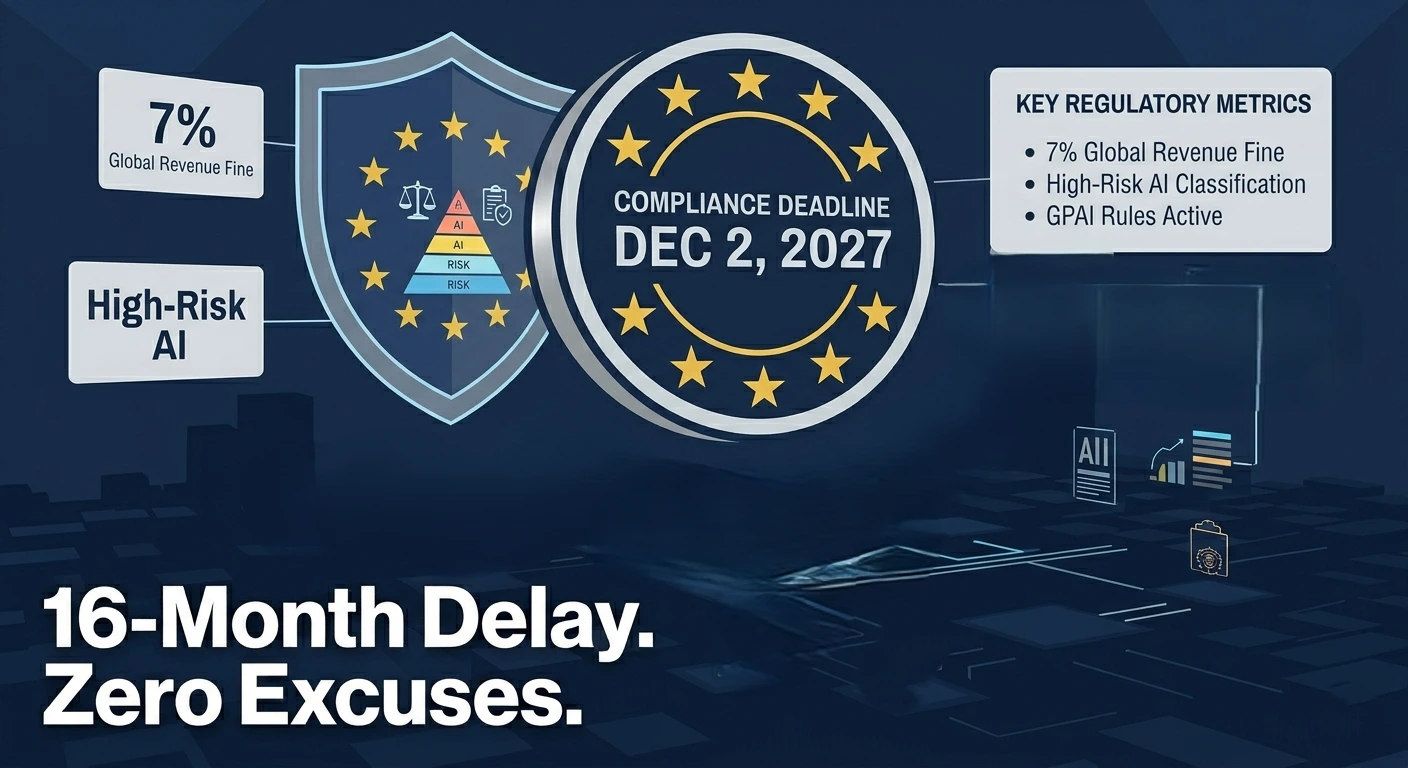
On May 7, 2026, EU legislators reached a provisional agreement on the “AI Act Omnibus,” extending the Annex III high-risk deadline from August 2026 to December 2, 2027. If you built your compliance roadmap around the original deadline, your plan just changed.
Picture your CTO in January 2026, finally signing off on a compliance budget scoped around August 2, 2026. Twelve weeks of sprint work, vendor audits, documentation sprints. Then May 7 hits. The EU Parliament and Council announce a provisional political agreement that pushes the Annex III high-risk deadline by 16 full months. Your plan is technically valid. It’s also, in a sense, obsolete.
That’s the situation most organizations with EU-facing AI products are now navigating. The Omnibus agreement is real relief in one column and a new source of complexity in another. This guide cuts through both. Everything here is sourced to official text or verified legal analysis from firms tracking the legislation directly. No speculation. No filler.
What Is the EU AI Act?
The EU AI Act (formally, Regulation EU 2024/1689) is the world’s first comprehensive legal framework governing artificial intelligence. It was published in the Official Journal of the European Union on July 12, 2024 and entered into force on August 1, 2024. The European Parliament voted to adopt it on March 13, 2024, followed by Council approval on May 21, 2024, completing a three-year legislative process that began with the European Commission’s 2021 proposal.
The regulation applies to any organization, anywhere in the world, whose AI systems are used within the EU or produce outputs that affect EU residents. That mirrors the extraterritorial scope of GDPR. A company headquartered in California offering AI-powered hiring software to a German firm is subject to the Act in the same way a Frankfurt-based startup is.
Its core architecture is a four-tier risk pyramid. Minimal-risk systems face no new obligations. High-risk systems face detailed conformity requirements. And certain practices are banned outright. The risk tier your system falls into determines your compliance burden almost entirely.
What the May 2026 Omnibus Actually Changed
The provisional Omnibus agreement reached on May 7, 2026 is the most significant amendment to the EU AI Act since the regulation was adopted. Formal adoption is expected before August 2026, with the agreement entering into force three days after publication in the Official Journal.
What changed
Annex III high-risk AI systems: Deadline extended from August 2, 2026 to December 2, 2027 (a 16-month extension)
Annex I product-embedded systems: Deadline moved from August 2, 2027 to August 2, 2028 (a 12-month extension)
Article 50 transparency obligations: Pushed to December 2, 2026
New prohibition added: AI systems that generate non-consensual intimate imagery, including CSAM, banned from December 2, 2026
SME protections expanded: The lighter compliance pathway now covers Small Mid-Cap Enterprises, meaning companies with 250 to 3,000 employees and turnover up to €1.5 billion qualify
Bias detection: Organizations can now use GDPR special category personal data where necessary to detect or mitigate AI bias
What did not change
GPAI obligations (in force August 2, 2025)
Article 5 prohibitions (in force February 2, 2025)
The EU AI Office’s enforcement authority structure
The three-tier penalty framework under Article 99
Important: As of June 3, 2026, the Omnibus remains a provisional political agreement. It is not yet law. Do not treat the extended deadlines as formal until official publication in the Official Journal. The Article 5 prohibited practices and GPAI rules are fully in force today and are unaffected.
Complete EU AI Act Compliance Timeline
Date
Obligation
Status
August 1, 2024
Regulation enters into force
DONE
February 2, 2025
Article 5 prohibited AI practices enforceable; Article 4 AI literacy obligations begin
IN FORCE
August 2, 2025
GPAI model obligations apply; EU AI Office governance activated; penalty systems in place
IN FORCE
July 10, 2025
Final GPAI Code of Practice released by EU AI Office
DONE
December 2, 2026
Article 50 transparency and watermarking obligations; new prohibition on non-consensual intimate AI imagery
UPCOMING
December 2, 2027
Annex III high-risk AI system full compliance (extended from August 2, 2026 via Omnibus)
NEW DEADLINE
August 2, 2028
Annex I product-embedded high-risk AI systems (extended from August 2, 2027 via Omnibus)
NEW DEADLINE
December 31, 2030
Large-scale IT systems listed in Annex X must comply
The Four Risk Tiers: Where Does Your AI System Fall?
The EU AI Act’s risk classification is the single most consequential decision your organization will make. Every compliance obligation, documentation requirement, and penalty exposure flows from how your AI system is classified. The same technology in different deployment contexts can land in entirely different tiers.
Tier 1
Prohibited
Eight categories banned outright under Article 5. In force since February 2, 2025. No exemptions for commercial purpose.
Tier 2
High-Risk
Annex I and III systems. Full conformity assessments, technical documentation, human oversight, post-market monitoring. Deadline now December 2027.
Tier 3
Limited Risk
Chatbots, deepfakes, emotion recognition tools. Transparency obligations under Article 50 apply from December 2026.
Tier 4
Minimal Risk
Spam filters, AI in video games, basic recommendation engines. No specific obligations under the Act.
“It is just a chatbot” is not a legal analysis. For Annex III systems, classification turns on intended purpose, function, use context and how the system is actually deployed.
IAPP Staff Analysis, International Association of Privacy Professionals, April 2026
That IAPP framing captures the classification trap that catches most organizations. A customer service bot that routes insurance claims is not the same regulatory object as a customer service bot that answers FAQ questions. The Act classifies by what the system does in the real world, not what the vendor calls it in a product sheet.
An AWS survey found that more than two-thirds of European companies struggle to correctly identify their responsibilities under the Act. Misclassifying a system as minimal-risk when a regulator views it as high-risk is not a documentation technicality. It exposes the organization to the full penalty structure described later in this article.
The Eight Practices Banned Right Now
These prohibitions under Article 5 have been in force since February 2, 2025. No extension. No Omnibus relief. If your organization operates any of the following, you are already in violation.
AI techniques that manipulate people subliminally or deceptively to bypass conscious awareness
Systems that exploit vulnerabilities related to age, disability, or social and economic situation
Social scoring by public authorities that leads to detrimental treatment of individuals
Predictive policing based solely on individual profiling or personality traits
Untargeted mass scraping of facial images from the internet or CCTV feeds for biometric databases
Emotion recognition systems in workplace or educational settings (medical and safety exceptions apply)
Biometric categorization to infer race, political opinions, sexual orientation, or religion
Real-time remote biometric identification in public spaces for law enforcement (narrow exceptions only)
Companies have visibly responded. Emotion recognition tools have been withdrawn from EU workplace and education deployments. No enforcement actions have been publicly announced as of June 2026, but the behavioral change is documented and regulators are watching.
The Omnibus adds a ninth prohibition from December 2, 2026: AI systems that generate non-consensual intimate imagery, including content involving minors.
High-Risk AI Systems: What Annex III Actually Requires
Annex III high-risk AI systems now have until December 2, 2027 to reach full compliance. Here are the sectors covered:
Biometric identification and categorization systems
Critical infrastructure management covering energy, water, and transport
Education and vocational training including exam proctoring and admissions
Employment, HR management, and self-employment access (CV screening, performance monitoring)
Essential private and public services including credit scoring and insurance assessment
Law enforcement systems including crime risk assessment
Migration, asylum, and border control management
Administration of justice and democratic processes
For each qualifying system, compliance requires a quality management system, conformity assessment (some requiring third-party notified bodies), registration in the EU database of high-risk AI systems, post-market monitoring, a Fundamental Rights Impact Assessment, and structured technical documentation covering training data, architecture, intended purpose, performance benchmarks, and human oversight mechanisms.
Annual compliance cost per high-risk AI system runs approximately €29,277, based on EU Commission impact assessment data reported by SQ Magazine in April 2026. For an organization with 10 qualifying systems, that’s nearly €300,000 per year in ongoing compliance overhead, before staff time.
“Most organizations are aware the AI Act exists, but very few understand what it actually requires of them. The regulation goes well beyond policy statements. It requires organizations to classify every AI system they operate, document how those systems were built and tested, and maintain ongoing human oversight.”
Robert Gelo, Senior Consultant, Vision Compliance, April 1, 2026
The April 2026 Vision Compliance readiness analysis of 8 industries found that 83% of organizations have no formal AI system inventory, 78% have taken no meaningful compliance steps, and 74% have no designated AI governance owner. You cannot comply with an obligation you haven’t mapped, and you cannot map what you haven’t inventoried.
GPAI Models: Compliance for Foundation Model Providers
General-Purpose AI model obligations have been in force since August 2, 2025. The GPAI rules apply to providers of models like GPT-4, Claude, Gemini, and Mistral distributed in the EU. Legacy models already on the market before August 2, 2025 have until August 2, 2027 to comply.
What GPAI providers must do
Maintain current technical documentation for every GPAI model distributed in the EU
Comply with EU copyright law and publish a summary of training data content
Implement copyright opt-out mechanisms for rights holders
Respect machine-readable rights signals including robots.txt
Systemic risk models face additional requirements
Models trained above a 10^25 FLOP compute threshold are classified as systemic-risk models. Currently this includes approximately 5 to 15 companies worldwide, among them OpenAI’s o3, Anthropic’s Claude 4 Opus, and Google’s Gemini 2.5 Pro. These providers face adversarial testing requirements, safety and security evaluations, and mandatory incident reporting.
The GPAI Code of Practice was finalized by the EU AI Office on July 10, 2025. Signing it creates a presumption of conformity with GPAI obligations. Google, Microsoft, OpenAI, Anthropic, and Mistral have all signed. xAI notably refused to sign the transparency and copyright chapters, a detail regulators are tracking.
Google signed the Code “while also expressing concerns that the Act and the Code could slow innovation or delay approvals.”
Corporate position via Wharton AI and Analytics Initiative, October 2025
That tension between compliance commitment and product velocity concern is present across most major US-headquartered AI developers. It hasn’t translated into non-compliance, but it shapes how these companies interpret their obligations at the margin.
EU AI Act Fines and Penalties: The Real Numbers
Article 99 establishes a three-tier penalty structure. These numbers are not theoretical. They exceed GDPR’s 4% maximum, making the EU AI Act the highest AI fine regime in the world.
€35M
or 7% of global annual turnover
Violating Article 5 prohibited practices (whichever is higher)
€15M
or 3% of global turnover
High-risk AI non-compliance including Annex III failures
€7.5M
or 1.5% of global turnover
Supplying incorrect or misleading information to regulators
The GDPR precedent is instructive here. The first major GDPR fine, €50 million against Google, came just seven months after enforcement began. By 2023, cumulative GDPR fines exceeded €4.5 billion. Organizations that dismissed GDPR as “not really enforced” in 2018 learned an expensive lesson. The EU AI Act enforcement trajectory is likely to follow the same curve: slow start, then significant acceleration.
One structural note: Article 99(8) means GDPR and EU AI Act penalties are not automatically stacked for the same factual violation. The higher fine applies. But different violations from the same system can be penalized separately, and a single deployment of a poorly documented high-risk AI system touching personal data can trigger both frameworks.
8-Step EU AI Act Compliance Checklist
This checklist reflects what organizations with functional compliance programs have prioritized. Start here, in this order.
Build a complete AI system inventory. List every AI system your organization deploys, develops, or procures that touches EU users. 83% of companies have not done this. You cannot classify what you haven’t catalogued.
Classify each system against the four-tier risk framework. Write a documented classification rationale for every system. “It’s just a chatbot” will not withstand regulatory scrutiny. Base the analysis on intended purpose, function, and actual deployment context.
Map Article 5 prohibitions against all current AI tools. This deadline has passed. Any HR tech, emotion recognition, or behavioral analytics tool that touches EU users needs review now. Not after the Omnibus is formally adopted.
Designate an AI governance owner with documented authority. 74% of organizations lack one. This should be CTO, General Counsel, or CISO level. The designation needs to be in writing with defined decision rights.
Begin Annex IV technical documentation for all potential high-risk systems. Documentation covers training data, architecture, intended purpose, performance metrics, human oversight mechanisms, and post-market monitoring plans. Build this now while engineers who built the systems are still available.
Update vendor contracts with AI Act compliance clauses. If you deploy a third-party AI system, you are the deployer under the Act. Require evidence of conformity assessment, technical documentation access, and post-market monitoring from every AI vendor.
Engineer audit logging into AI-driven decision systems. The Act requires structured audit trails of AI decisions affecting individuals. Retrofitting this into existing systems is expensive. Build it now rather than at deadline pressure.
Monitor regulatory sandboxes in your member state. Member states must provide priority sandbox access to SMEs by August 2026. Testing AI systems in a controlled regulatory environment before full compliance is required is a genuine advantage smaller organizations should use.
Why the Omnibus Extension Is Not the Relief It Looks Like
The 16-month extension for Annex III compliance was sold as a response to industry unpreparedness. The actual reason recorded in legislative proceedings is more uncomfortable: the harmonized technical standards that organizations need to actually demonstrate conformity (produced by CEN/CENELEC) were not ready. The EU’s own standard-setting infrastructure missed its window.
This means something important: even organizations that wanted to fully comply with the original August 2026 deadline could not do so with certainty, because the technical benchmarks against which conformity assessments are measured don’t yet exist in final form. The extension does not change what must be built. It only postpones when enforcement begins.
“The administrative burden alone could bankrupt smaller innovators before they even reach a Series A funding round.”
Centre for European Policy Studies (CEPS), cited in Dataconomy research, April 2026
That CEPS finding is not rhetorical. Compliance for a high-risk AI system entering the EU market requires a quality management system, conformity assessment (potentially by a notified body), database registration, post-market monitoring infrastructure, Fundamental Rights Impact Assessment, and ongoing technical documentation maintenance. Certification costs for a single medical AI unit run €16,800 to €23,000 one-time, with annual costs of approximately €29,277 thereafter. A startup with three high-risk AI products faces a structural compliance burden that US competitors don’t.
Our read: the Omnibus extension reflects institutional acknowledgment that the original implementation schedule was overambitious. The legitimate concern is that the next deadline could arrive with the same structural gaps if harmonized standards aren’t finalized well before December 2027. Organizations should not plan around one more extension. Plan around the deadline holding.
Competitive note: While EU firms work through classification rationales and conformity assessments, US competitors without equivalent federal AI obligations face no comparable burden. Google’s Personal Intelligence rollout in April 2026 was global but with EU-specific feature restrictions driven by AI Act requirements. That asymmetry is real and growing.
Frequently Asked Questions
What is the EU AI Act?
The EU AI Act (Regulation EU 2024/1689) is the world’s first comprehensive legal framework for artificial intelligence. It entered into force on August 1, 2024. It classifies AI systems into four risk tiers and applies different obligations to each. It covers any organization developing or deploying AI that affects EU residents, regardless of where that organization is based.
What are the current EU AI Act compliance deadlines?
Key dates: February 2, 2025 (prohibited AI practices banned); August 2, 2025 (GPAI obligations in force); December 2, 2026 (transparency and watermarking for AI-generated content); December 2, 2027 (Annex III high-risk AI systems, per the May 2026 Omnibus); August 2, 2028 (Annex I product-embedded high-risk systems). Formal Omnibus adoption is expected before August 2026.
What are the fines for non-compliance with the EU AI Act?
Article 99 sets three fine tiers: up to €35 million or 7% of global annual turnover for prohibited practice violations; up to €15 million or 3% for high-risk system non-compliance; and up to €7.5 million or 1.5% for providing incorrect information to regulators. These exceed GDPR’s 4% ceiling and represent the highest AI fine regime in the world.
Does the EU AI Act apply to US companies?
Yes. The EU AI Act applies to any organization worldwide if its AI systems are used within the EU or produce outputs affecting EU residents. This is the same extraterritorial scope as GDPR. A US company offering AI-powered credit scoring or hiring tools to European customers must comply regardless of where its servers are located.
What AI practices are banned under the EU AI Act right now?
Eight practices are prohibited since February 2, 2025: subliminal AI manipulation, exploitation of vulnerable groups, social scoring by public authorities, predictive policing solely from profiling, mass scraping of facial images for biometric databases, emotion recognition in workplaces or schools, biometric categorization to infer race or sexual orientation, and real-time biometric identification in public spaces for law enforcement.
What is a high-risk AI system under the EU AI Act?
Annex III defines high-risk AI systems as those used in biometric identification, critical infrastructure, education (exam proctoring, admissions), employment (CV screening, performance evaluation), essential services (credit scoring, insurance), law enforcement, migration and border control, and administration of justice. Full compliance is now required by December 2, 2027 per the 2026 Omnibus.
What is the GPAI Code of Practice?
The GPAI Code of Practice is a voluntary compliance framework finalized by the EU AI Office on July 10, 2025. It covers transparency, copyright, and safety obligations for general-purpose AI model providers. Signing creates a presumption of conformity with GPAI obligations under the Act. Google, Microsoft, OpenAI, Anthropic, and Mistral are among the signatories.
What did the AI Act Omnibus 2026 change?
The provisional agreement of May 7, 2026 extended the Annex III high-risk deadline by 16 months to December 2, 2027, pushed Annex I product-embedded systems to August 2, 2028, added a prohibition on AI-generated non-consensual intimate content, and expanded SME protections to small mid-cap enterprises with up to 3,000 employees and €1.5 billion in turnover.
What Comes Next: The Road to December 2027
The most critical development in the next 6 to 18 months is not a compliance deadline. It’s the publication of CEN/CENELEC harmonized standards. Once those standards are published, organizations will have a concrete technical specification against which conformity assessments can actually be completed. The gap between standard publication and the December 2027 deadline could be very short. That’s the clock that matters most right now.
Three things to watch closely:
Formal Omnibus adoption timeline. Expected by late July 2026. Until formal publication in the Official Journal, the August 2026 original deadline technically remains the reference. Build plans against December 2027 but finalize them post-adoption.
First EU AI Office enforcement actions. GPAI obligations are in force. The EU AI Office is monitoring which providers signed the Code of Practice and which didn’t. The first enforcement action against a GPAI provider will be the signal everyone is waiting for, much the way the first GDPR fine signaled the enforcement era.
Harmonized standard publication dates. Follow CEN/CENELEC’s AI standardization pipeline. When those standards drop, the compliance clock for anyone building conformity assessment programs starts running.
The EU AI Act is not a drill. It’s a functioning legal framework with active enforcement infrastructure, real penalty exposure, and a regulator that has already shown it will act (see: GDPR). The Omnibus extension bought time. It didn’t buy permission to wait.
Stay ahead of EU AI Act developments
Get the Neural Loop, NeuralWired’s weekly briefing on AI policy, regulatory shifts, and what they mean for builders and operators.
Subscribe to The Neural Loop
NW
NeuralWired Editorial Team
AI Policy and Regulatory Coverage | neuralwired.com
US AI Regulation 2026: The State-vs-Federal Battle Every Company Must Understand Now
NeuralWired
Policy & Compliance
US AI Regulation in 2026: The State vs. Federal Battle Every Company Must Understand Now
1,561 state bills, zero federal law, and a DOJ task force set to sue states into compliance. Here is the full picture, and what your legal team needs to do before June 30.
May 31, 2026 • NeuralWired Research Desk • 14 min read
1,561State AI bills introduced in 2026
45States with active AI legislation
$42BFederal broadband funds used as leverage
Your company’s AI hiring tool went live in Q1. It operates in eight states. By June 30, it will be non-compliant in at least three of them, and the enforcement machinery is already running. This is not a hypothetical risk buried in a regulatory horizon document. It is the operational reality of AI regulation in the United States right now, and most compliance teams are structurally behind.
While Washington debates preemption, Sacramento, Denver, Hartford, and Albany are already writing the rules your products must live by. As of March 2026, lawmakers in 45 states had introduced 1,561 AI-related bills, surpassing the entire volume from all of 2024. Six weeks into the year, more than 300 had already landed. This is not a wave. It is a flood with no federal levee in sight.
This article gives you the complete picture: every major law currently in force or about to be, the real scope of the federal vs. state collision, and the specific actions compliance, legal, and product teams must take now. If you are building or deploying AI in the United States, nothing here is optional reading.
The Federal Framework: What It Is (and Is Not)
On December 11, 2025, President Trump signed Executive Order 14365, titled “Ensuring a National Policy Framework for Artificial Intelligence.” The EO asserts broad federal authority over state AI laws the administration considers obstructive. It establishes a DOJ AI Litigation Task Force to challenge state requirements in court, threatens to condition $42 billion in BEAD broadband funding on states repealing “onerous” AI statutes, and instructs the Commerce Department to publish a review identifying state laws for potential federal challenge.
The stated ambition is sweeping. The legal reality is considerably narrower.
Critical Distinction
Executive orders cannot directly preempt state laws. That requires an Act of Congress. EO 14365 is a policy declaration backed by funding threats and litigation intent, not a self-executing legal override of existing state statutes.
On March 20, 2026, the administration followed the EO with its National Policy Framework for Artificial Intelligence, a legislative recommendation document built around seven pillars: child protection, AI infrastructure, intellectual property, free speech and censorship, innovation, workforce preparation, and preemption of state AI laws. It is a wish list for Congress, not a binding regulatory framework.
Congress has not delivered. The most telling signal came when the Senate voted 99-1 to strip a 10-year state AI law freeze from the “One Big Beautiful Bill Act.” The 2026 National Defense Authorization Act, signed the day before EO 14365, excluded preemption language entirely. A unified federal AI law before the 2026 midterms is, by any credible reading of congressional bandwidth, extremely unlikely.
The DOJ AI Litigation Task Force: Operational Since January 10, 2026
This is the mechanism with the most immediate legal consequence. The Task Force, operational since January 10, 2026, is responsible for challenging state AI laws in federal court on grounds including unconstitutional burden on interstate commerce and federal preemption conflicts. Legal teams must now model compliance scenarios that include the possibility of states they are currently complying with facing federal injunctions. That kind of scenario uncertainty is genuinely new territory for corporate AI governance.
One federal consumer protection development worth noting: on April 23, 2026, the Protecting Consumers From Deceptive AI Act was introduced in Congress, directing NIST to develop guidelines for watermarking AI-generated content. It has not been enacted.
State Laws Now in Force: The Compliance Map
This is the table that should be on the wall of every compliance team operating in the United States. These are not proposed bills. They are enacted laws with active or imminent enforcement dates.
Law
State
Effective Date
Who It Covers
Key Requirement
Status
AB 2013 / SB 942
California
Jan 1, 2026
Generative AI developers
Training data disclosure; latent provenance disclosures in AI-generated content
Active
ADMT Regulations
California
Compliance by Jan 1, 2027
Companies using AI for significant decisions (hiring, lending, housing, healthcare)
Impact assessments; consumer opt-out rights
Compliance Due
TRAIGA
Texas
Jan 1, 2026
Developers and deployers
Prohibits specific intentional misuses; 36-month regulatory sandbox
Active
RAISE Act
New York
Dec 19, 2025
AI developers and deployers in NY
Stricter incident reporting; new oversight office within Dept. of Financial Services
Active
Colorado AI Act
Colorado
June 30, 2026
Developers and deployers of “high-risk” AI systems
Transparency, safety, consumer protection obligations across AI lifecycle
Oct 2026
Healthcare AI Laws
Indiana, Utah, Washington
2026
Health insurers using AI for claims
AI cannot be sole basis for denying or modifying insurance claims
Active
Mental Health AI Laws
Tennessee, Delaware
2026
AI system providers
Prohibits AI from being marketed as licensed mental health professionals
Active
California’s ADMT Rules: The One Closest to Breaking Most Companies
California’s Automated Decision-Making Technology regulations cover any company that uses AI to “substantially replace” human decision-making in what the law defines as “significant decisions.” The list is broad: financial services, lending, housing, education, employment, independent contracting, and healthcare. These regulations took effect January 1, 2026, but the compliance deadline lands January 1, 2027. That sounds like time. It is not. Impact assessments, documentation infrastructure, and opt-out mechanisms take months to implement correctly.
Colorado AI Act: June 30, 2026 Is 30 Days Away
Colorado’s AI Act is the most aggressive algorithmic accountability law in the country. Originally set for February 1, 2026, Governor Polis signed a delay to June 30, 2026. Developers and deployers of “high-risk” AI systems must exercise reasonable care to prevent algorithmic discrimination, conduct impact assessments, and provide consumer disclosures. The Trump administration’s EO specifically names Colorado’s law as the kind of state regulation it intends to challenge, but no federal injunction has been issued. The law is enforceable on June 30.
Connecticut SB 5: The Latest Domino
On May 1, 2026, the Connecticut legislature passed SB 5 with a 131-17 House vote and 32-4 Senate majority, a level of bipartisan support that underscores how politically durable state AI regulation has become. The law imposes obligations on developers, deployers, and providers across the AI technology lifecycle, with most provisions effective October 1, 2026. Governor Lamont is expected to sign.
The Federal vs. State Collision
The core tension playing out right now is a preemption fight with no clear legal resolution timeline. The Trump administration wants a single national standard. Thirty-six state attorneys general have told the federal government to stay out. States read the 99-1 Senate vote stripping preemption from the One Big Beautiful Bill as a direct political endorsement of their authority to keep legislating.
What makes this operationally complicated for companies is the gap between federal aspiration and legal enforceability. Every state AI law currently in force remains fully enforceable. The DOJ Task Force can file lawsuits, seek injunctions, and apply funding pressure, but until courts rule or Congress acts, companies cannot responsibly treat the federal posture as a compliance substitute for state obligations.
“Compliance strategies for AI-enabled products and services must be nimble to accommodate diverging state and federal requirements. As these recommendations are not yet binding law, and the legal durability of executive actions remains uncertain, stakeholders should remain vigilant, monitor legislative and litigation developments, and be prepared to adapt compliance strategies as the regulatory environment evolves.”
Stephanie A. Webster, Jamie E. Darch & Chetan A. Patil, Ropes & Gray LLP (March 30, 2026)
The EO’s most coercive mechanism is the $42 billion BEAD broadband funding threat: states that maintain AI regulations the administration deems onerous risk losing previously allocated broadband infrastructure money. That is real financial leverage. It has not yet changed a single enacted state AI law.
One scenario that deserves more attention than it typically receives: even if the administration successfully challenges explicit AI-specific statutes, states will simply route AI regulation through pre-existing consumer protection, unfair competition, and civil rights frameworks. Paul Hastings flagged this plainly: “We do not believe this Executive Order will eliminate state involvement in AI regulation altogether. Instead, we think that states will diffuse AI regulation by applying existing consumer protection, unfair competition, deceptive practices and civil rights laws to AI-related conduct.”
That is not a speculative scenario. It is already happening.