Strategic analysis of big tech companies: Microsoft, Google, Apple, Meta, Amazon, NVIDIA, OpenAI, and more. Enterprise moves, AI investments, and competitive intelligence decoded.
Big Tech Layoffs 2026: Why AI Capex Explains It All
Big Tech
Big Tech Layoffs 2026: Why AI Capex Explains It All
Microsoft posted its best quarter ever and cut 4,800 jobs in the same three months. Amazon hit a record 13.1% operating margin and eliminated 30,000 corporate roles. Cisco broke its own revenue record and announced 4,000 layoffs the same week. None of that is a coincidence, and none of it is really about saving money on payroll either. It’s about where the money is actually going.
Big tech layoffs in 2026 keep landing next to record earnings, and the pattern only makes sense once you put the two numbers side by side: what these companies are cutting from headcount, and what they’re pouring into AI infrastructure. The gap between those numbers is the story.
Start with Meta, because the comparison is cleanest there and it sets the pattern for everyone else. Meta’s 2026 capital expenditure guidance sits at $125 billion to $145 billion. Its entire human compensation bill, salaries, benefits, equity, all of it, runs around $27 billion. Even if Meta fired every single employee tomorrow, it wouldn’t cover a fifth of what it’s already committed to spend on AI infrastructure. That comparison comes from a Yahoo Finance analysis of company disclosures, and it’s the single most useful number in this entire story.
Apply the same logic to Microsoft, Amazon, and Cisco and the picture holds. These aren’t companies trimming staff to fund a data center. They’re companies redirecting capital toward compute at a scale where headcount decisions barely register on the balance sheet.
Why this matters: If layoffs were really about cost savings, the numbers would be close. They’re not. Payroll cuts save these companies low single-digit billions. AI capex commitments run into the hundreds of billions. Two completely different orders of magnitude, decided by two largely separate processes inside the same company.
Company
2026 AI Capex
Jobs Cut
Same-Quarter Result
Microsoft
~$190B (guided)
4,800 (plus 9,100 prior round)
Record $82.89B quarterly revenue
Amazon
~$200B (guided)
~30,000 corporate roles
Record 13.1% operating margin
Cisco
$9B AI orders (raised guidance)
Fewer than 4,000 (~5%)
Record $15.84B quarterly revenue
Sources: Microsoft and Amazon Q1/Q3 2026 earnings disclosures; Cisco Q3 FY2026 earnings call.
Microsoft: record revenue, Xbox gutted
Microsoft’s fiscal Q3 2026 numbers, reported April 29, were about as strong as a quarter gets: $82.89 billion in revenue, up 18% year over year, with net income jumping to $31.78 billion from $25.82 billion a year earlier. The company also guided full calendar-year 2026 capex to roughly $190 billion, a 61% jump from 2025 and well past what Wall Street had modeled.
The same quarter, Microsoft cut 4,800 jobs, most of them in the Xbox gaming division, on top of 9,100 roles eliminated about a year earlier. Chief people officer Amy Coleman told staff the cuts weren’t direct AI replacements, even while acknowledging AI is reshaping how the company runs. Microsoft also rolled out its first-ever voluntary buyout program, open to senior director level and below with enough age plus tenure to qualify.
Here’s the part that undercuts the simplest version of the story: Xbox isn’t where Microsoft’s AI money is going. The division that got hit hardest wasn’t competing for capex dollars with Azure’s AI buildout in any direct sense. It just wasn’t the priority, and priority is what actually decides who keeps their job in 2026, not whether AI can technically do the work.
Amazon: 30,000 gone, $200 billion committed
Amazon’s Q1 2026 results, also reported April 29, delivered $181.5 billion in revenue and a record 13.1% operating margin, the highest in the company’s history. AWS grew 28% year over year to $37.6 billion, its fastest growth rate in 15 quarters. Amazon reiterated guidance toward roughly $200 billion in full-year 2026 capex.
Against that backdrop, Amazon cut around 30,000 corporate jobs across rounds in October 2025 and January 2026, with further cuts hitting Selling Partner Services staff and a temporary Homestead, Florida warehouse closure eliminating 600-plus jobs between July and September.
Unlike Microsoft and Cisco, Amazon’s leadership hasn’t tried to soften the connection. CEO Andy Jassy told staff in a memo, later reiterated into 2026, that generative AI and agents would reduce the company’s total corporate workforce over time as efficiency gains materialize, alongside creating new roles elsewhere. That memo dates to July 2025, a full year before this round of cuts, which makes it less a same-day justification and more a stated multi-year strategy Amazon is now executing on schedule.
Cisco: “not a savings-driven restructure”
Cisco reported record quarterly revenue of $15.84 billion on May 13, up 12% year over year, alongside AI infrastructure orders of $2.1 billion that quarter and $5.3 billion cumulative through three quarters. That pushed Cisco to raise its full-year AI order guidance from $5 billion to $9 billion, roughly 4.5 times fiscal 2025’s total.
The same week, Cisco began notifying employees that it would cut fewer than 4,000 jobs, about 5% of its global headcount, with restructuring costs running as high as $1 billion, mostly severance. CFO Mark Patterson gave analysts a line worth sitting with:
“This was really not a savings-driven restructure.”
Mark Patterson, CFO, Cisco Systems, Q3 FY2026 earnings call, via Yahoo Finance
Patterson framed the cuts as a realignment toward silicon, optics, security, and AI rather than a cost play. That’s a notably different posture from Amazon’s Jassy, and it matters: two companies profiled in the same story, cutting staff in the same season, and disagreeing with each other about whether AI is even the reason.
Is AI actually the reason, or the excuse?
Not everyone buys the AI-driven narrative, and the skepticism comes from serious places.
Layoffs are often just standard cost-cutting with an AI label attached.
Paraphrased position of Justin Wolfers, Professor of Economics and Public Policy, University of Michigan, via Benzinga/Finviz
Wolfers argues AI functions as a convenient cover story for restructuring that companies would likely have pursued regardless. JPMorgan’s 2026 economic outlook backs that skepticism with data: the bank’s own labor-market analysis found the AI capex surge hasn’t shown much measurable impact on broader labor dynamics, despite the headlines.
Wall Street’s bull case sees it differently. Wedbush’s Dan Ives, writing about Meta’s own 8,000-role cut against $135 billion in AI capex, called the layoffs financially minor next to the infrastructure commitment, damaging to morale but not decisive to the balance sheet. Evercore ISI’s Mark Mahaney goes further, noting this pattern of workforce actions followed by 12 to 18 months of margin expansion has repeated roughly every one to two years since 2022. In his read, this isn’t new behavior. It’s a recurring capital-discipline cycle that happens to be colliding with an AI narrative people want to believe.
Our read: both things are probably true at once. AI capex is real, historically large, and reshaping where investment goes inside these companies. But the specific decision to cut a specific team often has more to do with which function sits outside this year’s priority list than with any AI system actually replacing a job. Xbox wasn’t cut because a model can ship games. It was cut because it wasn’t where the $190 billion was going.
Worth flagging: Tracking firms don’t agree on the scale of 2026’s layoff wave. Layoffs.fyi-based counts put tech layoffs past 100,000 by early May and over 165,000 by July. SkillSyncer’s broader tracker counts 205,832 people affected across 322 events as of July 22, with 54% of those events explicitly citing AI or automation. The methodologies differ (tech-only versus all-industry, corporate versus contractor), so treat any single total as one tracker’s view, not a consensus figure.
What this means if you work there
If you’re an engineer or manager inside one of these companies, or one like them, the record-revenue headline is not protection. Internal budget decisions are increasingly decoupled from how well your specific team is performing. A well-run division can still get cut if it sits outside whatever core the company is funding this year, silicon, optics, security, and AI at Cisco; cloud and AI infrastructure at Microsoft and Amazon.
The more useful signal than “is the company doing well” is “where is the capex actually going.” Read the earnings call transcript, not just the headline. That’s where you find out whether your function is this year’s priority or this year’s line item.
There’s a real hedge here too. Industry-wide, roughly 275,000 AI-related roles are sitting open while laid-off tech workers largely can’t cross the skills gap to fill them, according to an Invezz analysis of labor-market data. Internal mobility toward AI or infrastructure teams is a legitimate near-term move, but it requires demonstrable fluency, not just tenure at the company.
If you’re evaluating these companies as a vendor rather than an employer, the same logic applies from the other side. Support and account-management staff, the exact functions cut at Amazon’s Selling Partner Services, may thin even as infrastructure capacity grows. That’s worth a line in any vendor risk review.
Frequently asked questions
Why are Microsoft, Amazon, and Cisco laying off workers if their revenue is at record highs?
Revenue and layoffs aren’t directly linked. Each company is redirecting tens of billions toward AI infrastructure capex, roughly $190 billion at Microsoft and $200 billion at Amazon for 2026, while separately restructuring specific divisions that sit outside their AI and cloud growth priorities.
How much is Big Tech spending on AI infrastructure in 2026?
Google, Amazon, Meta, and Microsoft combined are projected to spend roughly $725 billion on AI capital expenditure in 2026, up about 77% year over year, according to aggregated company guidance.
Is AI actually causing the 2026 tech layoffs?
It’s contested. Economists including Justin Wolfers argue AI often serves as a convenient explanation for ordinary cost-cutting. JPMorgan’s own analysis found little measurable labor-market impact from the AI capex surge, even as companies cite AI in layoff announcements.
Did Cisco lay off workers despite good earnings?
Yes. Cisco posted record Q3 FY2026 revenue of $15.84 billion, up 12% year over year, and in the same week announced plans to cut nearly 4,000 jobs as part of a restructuring its CFO described as not savings-driven.
How many tech layoffs have there been in 2026?
Estimates vary by tracker. Layoffs.fyi-based counts show over 165,000 tech layoffs by July 2026, while SkillSyncer’s broader tracker counts 205,832 people affected across 322 events as of July 22, with 54% of events citing AI as a factor.
Where this goes next
What’s changed by walking through all three companies together is this: the “AI is taking jobs” framing is too simple, and so is “it’s just normal cost-cutting.” What’s actually happening is a capital reallocation on a scale large enough that headcount decisions have become almost a separate conversation from infrastructure decisions, loosely connected at best, openly denied at Cisco, openly claimed at Amazon.
Watch three things over the next 6 to 18 months. First, whether Microsoft’s own admission that it will remain capacity-constrained through 2026 even after this spending turns into visible AI revenue, or into a monetization lag that makes the capex look premature. Second, whether more executives start talking like Jassy (AI explicitly reducing headcount) instead of like Patterson (AI reorganizing headcount). Third, whether policymakers, following California’s move this June to build a state tracking tool for AI’s workforce impact, start requiring the kind of capex-versus-headcount disclosure that would make stories like this one unnecessary.
None of these companies are lying when they post record revenue. None of them are lying when they cite AI in a restructuring memo either. They’re just optimizing for two different things at once, and reading the earnings call is currently the only way to tell which one is driving a specific decision.
Want the next capex disclosure and layoff filing broken down like this one? Subscribe to The Neural Loop at neuralwired.com/newsletter.
On July 6, xAI’s account on X quietly swapped its name and logo for SpaceXAI. No press conference. No product launch. Just a new avatar and a fused logo, half rocket swoop, half angular Grok mark. That single rebrand is the visible tip of a five month corporate assembly job that started with a $1.25 trillion merger, was bankrolled by the largest IPO in stock market history, and is now underwritten by a federal filing asking permission to put up to one million satellites in orbit. If you build on Grok, sell into enterprise AI, or just want to understand where the compute war is actually headed, this is the story you need straight.
The SpaceXAI rebrand didn’t happen overnight. It’s the endpoint of a chain of events that started back in January.
SpaceX filed an FCC application on January 30 under the entity name Space Exploration Holdings, LLC, requesting authority for a new satellite constellation branded the SpaceX Orbital Data Center System. Three days later, on February 2, SpaceX confirmed it had acquired xAI in an all stock deal. xAI shareholders received 0.1433 SpaceX shares for every xAI share they held, and the combined entity was reported at roughly $1.25 trillion (about $1 trillion for SpaceX and $250 billion for xAI), a deal CNBC called the largest private merger on record.
By May, Elon Musk confirmed xAI would stop existing as a standalone company and fold entirely into SpaceX. Then came the money. SpaceX filed its S-1 in early June, priced its IPO at $135 a share on June 11, and raised $75 billion, the biggest IPO in history, ahead of Saudi Aramco’s 2019 record of $29.4 billion. Shares began trading on Nasdaq as SPCX on June 12 and closed the first day up 19% at $160.95, putting SpaceX’s market cap around $2.1 trillion and reportedly making Musk the world’s first trillionaire.
The X handle rebrand followed on July 6. Notably, several outlets, including Techgenyz, pointed out that as of that date the new branding hadn’t yet shown up on the company’s official website or in its legal filings. That gap matters. It tells you this is, for now, a branding event layered on top of a legal and technical integration that’s still catching up.
The Money: IPO, Merger, and Market Cap
Numbers this size are hard to hold in your head, so here’s the sequence laid out plainly.
Event
Date
Figure
SpaceX acquires xAI (all stock)
Feb 2, 2026
~$1.25T combined valuation
SpaceX IPO priced
Jun 11, 2026
$135/share, $75B raised
SPCX first day close
Jun 12, 2026
$160.95 (+19%), ~$2.1T market cap
xAI rebrands to SpaceXAI
Jul 6, 2026
Corporate brand only
The order book for the IPO was reportedly oversubscribed roughly two to one, around $150 billion in orders chasing $75 billion in available shares, and the retail tranche sold out. That day one pop put SpaceX briefly ahead of Broadcom, Saudi Aramco, and Tesla by market cap, according to NPR’s coverage of the debut. This is the capital base funding everything that comes next: satellites, compute, and an aggressive push into coding tools through SpaceX’s earlier $60 billion acquisition of Cursor, a deal NeuralWired covered in detail here.
The Land Grab: One Million Satellites
Here’s where SpaceXAI stops looking like a chatbot rebrand and starts looking like a genuine infrastructure grab. The January 30 FCC filing, formally accepted for public comment on February 4 under Public Notice DA 26-113, requests authority for up to one million satellites, arranged in orbital shells about 50 kilometers apart, at altitudes between 500 and 2,000 kilometers.
The engineering logic: sun synchronous shells stay in sunlight more than 99% of the time, intended to carry constant compute load, while lower inclination shells absorb demand spikes. Satellites would talk to each other primarily through optical laser links, with Ka band radio kept as a backup for telemetry and control. SpaceX also asked the FCC to waive its standard buildout milestones, which normally require 50% deployment within six years and 100% within nine. That’s worth sitting with for a second. A company asking to be excused from the usual buildout clock is telling you, in regulatory language, that a million satellites is a ceiling, not a near term promise.
The filing itself doesn’t undersell its ambition. SpaceX describes the system as a first step toward becoming what it calls a Kardashev II level civilization, physicist shorthand for a civilization that can harness the energy output of its entire star. Nearly 1,500 public comments were filed on the docket, largely from the astronomy and orbital debris community, per tracking from the American Astronomical Society. And SpaceXAI isn’t racing alone: Starcloud has filed for its own 88,000 satellite orbital data center system, and Blue Origin has unveiled a competing radiation hardened edge compute initiative built around an optical communications system called TeraWave.
What Actually Changes for Developers
If you’re running production workloads on Grok, here’s the practical part. Nothing changes at the API layer today. Endpoints at api.x.ai, model slugs, and pricing are all unchanged by the corporate rebrand itself. But don’t mistake that for permanence.
SpaceXAI has signaled a transition window of a year or more for eventual endpoint and branding migration, so hard coding assumptions about the x.ai domain sticking around indefinitely is a bad bet. Two things worth doing this quarter: confirm exactly which Grok model slug your production code is pinned to, since older slugs are being redirected to newer models automatically, and line up a fallback provider. The market conversation around vendor risk here specifically names DeepSeek, OpenAI, and Anthropic as alternatives worth evaluating, not because Grok’s performance has changed, but because a chatbot lab now nested inside an aerospace company carries organizational uncertainty that a pure play AI vendor doesn’t.
SpaceXAI did ship something concrete post rebrand: Grok 4.5, trained in partnership with Cursor and built for coding agent workflows across Grok Build, Office add ins, and Agent Client Protocol integrations. Pricing sits at $2 per million input tokens, $0.50 per million cached input tokens, and $6 per million output tokens, with higher tiers above 200K context.
Worth flagging: Around July 17, developers discovered Grok Build’s CLI coding assistant was sending entire code folders to SpaceXAI’s servers without clear disclosure. The company responded fast, open sourcing the CLI and switching data retention to off by default for all users, not just enterprise. A member of technical staff, Akshey Deokule, put it simply: “We heard your feedback loud and clear.” If your team is piloting Grok Build, check your retention settings before you assume the defaults protect you.
One more line item worth watching, though it needs a caveat: reporting via TechRound, citing Business Insider, claims Anthropic is paying SpaceX $1.25 billion a month and Google $920 million a month for compute access on SpaceX’s Colossus data centers, on the theory that Grok itself only uses about 11% of available capacity. Neither company has confirmed this on the record, so treat it as a single sourced report rather than fact. If accurate, it would mean Colossus is being positioned as neutral, multi tenant AI infrastructure, which matters for anyone comparing hyperscaler GPU capacity against newer non hyperscaler suppliers.
The Economics Problem Nobody’s Solved
This is the part the branding coverage tends to skip: does space based compute actually make financial sense right now? The short answer is no, not yet, and the gap is bigger than most coverage lets on.
Independent modeling from SemiAnalysis, cited in industry analysis from Luminix’s data center report, puts orbital compute costs at roughly $8.64 per GPU hour for a B300 class cluster today, against about $2.37 per GPU hour terrestrially, a premium of more than four times. That gap is projected to narrow to around 30% by the early 2030s, with full cost parity only arriving around 2040 in the base case. Musk has publicly claimed orbital compute would be the cheapest option available within two to three years. The only rigorous independent model found in this research puts that timeline off by more than a decade.
“The economics are poor today, but it is going to improve over time.”
Jensen Huang, CEO, Nvidia, on Nvidia’s Q4 2026 earnings call, via Finviz
Huang also flagged something the launch cost debates tend to bury: there’s no airflow in space, so heat can only leave a satellite through conduction, not the convective cooling every terrestrial data center relies on. That’s a physics constraint, not a spreadsheet problem, and it doesn’t go away with more capital.
There’s also a training versus inference distinction that gets flattened in most coverage. Ariel Karpf, a satellite communications analyst, argues the tight GPU to GPU synchronization that large model training needs is genuinely impractical at orbital latencies, with hardware you can’t easily service once it’s launched. What’s more plausible today, in his view, is narrower: edge processing of satellite imagery, off planet secure storage, latency tolerant batch inference. None of that is as headline friendly as “AI training in space,” but it’s the part actually grounded in physics.
Ryan Struhsaker, formerly a corporate vice president at AMD, offered the most balanced technical read at SmallSat Europe in May:
“Is it possible? Is it within what we can do? Absolutely… But smart design’s going to be required.”
Ryan Struhsaker, former Corporate VP, AMD, via SatNews
He laid out three real preconditions for megawatt scale orbital data centers: custom silicon, modular hardware that can be swapped on a five year refresh cycle inside a satellite platform meant to last 20 to 25 years, and meaningfully lower launch costs. None of those are solved problems yet.
The Skeptics, and Why They’re Not Neutral
Here’s the wrinkle worth naming directly. Reporting from TechCrunch, cited by Tech Times, points out that nearly every prominent SpaceXAI skeptic has a direct financial stake in the alternative winning. SoftBank’s Masayoshi Son, reportedly dismissive of orbital compute’s relevance to what he calls the AI race’s decisive years, backs the rival Stargate terrestrial infrastructure project. OpenAI’s Sam Altman has reportedly called space based data centers ridiculous, and OpenAI depends entirely on ground based compute. AWS’s Matt Garman competes directly with SpaceX’s compute rental ambitions.
That cuts both ways. It means the skeptics aren’t neutral commentators. It also means Musk isn’t a neutral narrator of his own two to three year timeline. Our read: the corporate consolidation here is real, verifiable, and already priced into a $2.1 trillion market cap. The claim that orbital compute reaches cost parity within a couple of years is not supported by the one rigorous independent model available, and it’s explicitly disputed by Nvidia’s own CEO. Treat the merger as fact and the timeline as marketing until the economics catch up.
What to Watch Next
Three things to keep an eye on over the next six to eighteen months:
Legal and technical migration. Watch whether SpaceXAI branding actually reaches the company’s website, legal filings, and API domain, or stays a social media only change.
The FCC docket outcome. With nearly 1,500 public comments filed and a milestone waiver request pending, regulatory pushback could reshape the deployment timeline well before the first satellites launch.
Whether the Colossus leasing reports get confirmed. If Anthropic and Google’s reported compute payments to SpaceX are verified on the record, it changes how every enterprise buyer should think about SpaceX as a neutral infrastructure supplier, not just Grok’s parent company.
Frequently Asked Questions
Is xAI still called xAI?
No. As of July 6, 2026, xAI’s corporate brand and X account officially changed to SpaceXAI, following SpaceX’s February 2, 2026 acquisition of xAI. The change sits at the parent company level. Grok, SuperGrok, and the developer API kept their existing names.
Did Grok change its name to SpaceXAI?
No. Grok, SuperGrok, and the developer API remain under the Grok brand. Only the parent company’s corporate identity and X handle, from @xai to @SpaceXAI, changed.
When did SpaceX acquire xAI?
SpaceX acquired xAI on February 2, 2026, in an all stock deal reportedly valuing the combined company at approximately $1.25 trillion, described by CNBC as the largest private merger on record.
How many satellites is SpaceX planning for its orbital data center?
SpaceX filed an FCC application on January 30, 2026, seeking authority for up to one million satellites operating between 500km and 2,000km altitude as the SpaceX Orbital Data Center System. The FCC accepted the filing for public comment on February 4, 2026.
Is space based AI compute cheaper than terrestrial data centers?
Not yet. Independent modeling from SemiAnalysis puts orbital GPU compute at more than four times the cost per GPU hour of terrestrial compute as of mid-2026, reaching full cost parity only around 2040 in the base case, far later than Musk’s stated two to three year timeline.
How big was the SpaceX IPO?
SpaceX raised $75 billion in its June 2026 IPO, pricing at $135 a share and closing its first trading day up 19% at $160.95, implying a market cap of roughly $2.1 trillion, the largest IPO in stock market history.
Where This Leaves You
Strip away the new logo and what’s left is a real story: an AI lab, a rocket company, a satellite internet operator, and a coding tool acquisition, all now sitting under one $2.1 trillion ticker. That’s the part that’s settled. What’s not settled is whether “AI compute belongs in orbit” is an engineering inevitability or a well funded aspiration running years ahead of its own economics. The FCC filing is real. The IPO is real. The million satellite figure is a ceiling SpaceX itself asked permission to miss. If you’re building on Grok, watch the endpoints, not the logo. If you’re evaluating SpaceX as infrastructure, watch the FCC docket and the Colossus leasing reports, not the Davos soundbites.
164,000 Tech Layoffs in 2026: Is AI Really the Reason?
Over 164,000 tech workers lost their jobs in 2026, and companies keep pointing to AI. On July 13, more than 200 economists and AI researchers, including 16 Nobel laureates, signed a joint statement warning that the disruption is real and accelerating. But the layoff data tells a messier story than either the executives or the alarmists want to admit.
If you’re a CTO, an engineering manager, or a mid-career software professional watching your feed fill up with layoff announcements, you already know the headlines aren’t giving you the full picture. Some of these cuts are genuinely about AI eating tasks that used to require a headcount line. A lot of them aren’t, and the companies making them know it.
The July 13 letter that changed the conversation
Two days before this article published, something unusual happened. Stanford’s Digital Economy Lab, coordinated by economist Erik Brynjolfsson, released a statement titled “We Must Act Now,” and it wasn’t signed by the usual chorus of AI doomers. It was signed by the people building the technology.
Anthropic co-founder Jack Clark signed it. So did Google DeepMind Chief Scientist Jeff Dean and OpenAI CFO Sarah Friar, according to reporting from phys.org. That’s a rare moment: the companies with the most to gain from downplaying AI’s labor impact instead put their names on a warning about it.
The more telling signature belongs to MIT’s Daron Acemoglu, alongside co-laureate Simon Johnson. Both won the 2024 Nobel Memorial Prize in Economic Sciences, and both have spent years pushing back against inflated AI displacement claims. Acemoglu told the New York Times, in comments summarized by Gadget Review, that if AI does to white collar services what robots did to manufacturing, only faster, the results would be seriously disruptive and costly for people’s livelihoods.
That’s a genuine shift in expert consensus. It’s not proof that 2026’s layoffs are AI driven. It’s evidence that the smartest skeptics in the room are less certain than they used to be.
The real 2026 tech layoffs, reconciled
Here’s where most coverage of this story goes wrong: it picks one tracker, quotes one number, and moves on. Different trackers measure different things, and the gap between them matters.
Tracker
2026 figure (through mid-July)
What it measures
Challenger, Gray & Christmas
139,156 tech cuts (of 443,604 total across all industries)
Employer announcements, all U.S. industries, official outplacement data
TrueUp
166,820 to 168,000+
Aggregated public tech-company reports
Layoffs.fyi / SkillSyncer
185,894 across 267 events
Crowd and media-sourced tech layoff events
The “over 164,000” figure sits inside this range and is defensible, but it belongs to the TrueUp and Layoffs.fyi style of tracking, not to any single government statistic. No federal agency publishes a “tech layoffs” category. That distinction matters if you’re citing this number in a board meeting.
The one number worth trusting without caveats: Challenger, Gray & Christmas reports tech sector cuts rose 83% year over year, from 76,214 in the first half of 2025 to 139,156 in the first half of 2026. That’s the acceleration, and it’s the part of the story that isn’t in dispute.
AI itself, as a cited reason, has now topped Challenger’s tracked causes for four consecutive months: March, April, May, and June 2026. Year to date, AI has been cited in 101,743 job cut announcements across every industry, about 23% of all 2026 cuts. Since Challenger started tracking AI as a discrete reason in 2023, the cumulative total sits at 173,568 announcements.
“Tech remains the epicenter of this year’s cuts. AI is the dominant force as companies are restructuring around it, automating roles, and reallocating budgets toward new capabilities.”
Andy Challenger, Chief Revenue Officer, Challenger, Gray & Christmas
Which companies cut the most, and what they actually said
The named cuts tell a more specific story than the aggregate numbers, especially once you read past the headline into the earnings call transcripts and filings.
Oracle: 21,000 jobs cut over the trailing 12 months, about 13% of its workforce, taking headcount from 162,000 to 141,000. Oracle’s own FY2026 filing states that AI adoption “has resulted, and may continue to result, in reductions to our workforce,” making it one of the only companies to put that claim in a legal filing rather than a press quote.
Amazon: roughly 30,000 corporate jobs cut across two rounds (14,000 in October 2025, 16,000 in January 2026). CEO Andy Jassy told staff in a company memo posted to Amazon’s own newsroom that the company would “need fewer people doing some of the jobs that are being done today” as generative AI efficiency gains take hold.
Meta: about 8,000 layoffs in Q2 2026, even as Q1 revenue hit $56.3 billion, up 33% year over year, and 2026 capex guidance climbed to $115 to $145 billion. Mark Zuckerberg admitted the company “miscalculated” the pace of its AI driven productivity gains.
Microsoft: 4,800 jobs cut starting July 2026, concentrated in Xbox, which lost 3,200 roles, about 20% of that division. Chief People Officer Amy Coleman stated directly that “the roles eliminated today are not being replaced by AI.”
Cisco: about 4,000 jobs, 5% of staff, cut in Q4 2026 despite record quarterly revenue of $15.8 billion.
Notice the pattern. Oracle and Amazon explicitly connect the cuts to AI in official documents. Microsoft explicitly says the opposite, in an official document. That contradiction, sitting inside the same news cycle, is the whole story in miniature.
The “AI washing” problem nobody in the C-suite wants to name
OpenAI CEO Sam Altman has publicly used a specific term for what’s happening: AI washing, meaning companies blame AI for layoffs whether or not AI is actually the cause. When the person running the company that makes ChatGPT says this out loud, it’s worth taking seriously.
Deutsche Bank called this in January 2026, months before the wave crested, predicting that “AI redundancy washing” would define the year. Oxford Economics went further that same month, concluding that firms “don’t appear to be replacing workers with AI on a significant scale.” And the Yale Budget Lab, examining the labor market 33 months after ChatGPT’s release, found no measurable link between AI exposure and changes in employment or unemployment.
“The headline is, ‘It’s because of AI,’ but if you read what they actually say, they say, ‘We expect that AI will cover this work.’ Hadn’t done it. They’re just hoping.”
Peter Cappelli, Professor of Management, The Wharton School
Marc Andreessen made a related point to podcaster Harry Stebbings, arguing that most companies “all have the silver bullet excuse: ah, it’s AI,” when the real driver is correcting pandemic era overhiring that left large tech firms staffed 25% to 75% beyond what they needed. Block’s Jack Dorsey is the clearest example in the wild. He initially attributed roughly half of Block’s workforce cuts to AI enabling “a new way of working,” then, under public pressure, acknowledged the company had simply overhired during the pandemic.
Our read: treat every company’s stated reason for a layoff as a claim, not a fact. When the explanation is AI, ask what the company gains from that framing versus admitting a hiring or strategy error. Sometimes the answer is both are true at once.
Why companies are cutting jobs while spending more than ever
Here’s the tension that most coverage skips entirely. Amazon, Microsoft, Alphabet, and Meta have collectively guided 2026 capital expenditure to an estimated $700 billion, nearly double their combined 2025 actual spend, at the same time they’re cutting headcount. This isn’t companies in distress trimming costs to survive. Meta’s revenue is up 33%. Microsoft’s fiscal Q3 revenue hit $82.9 billion, up 18%, with operating income up 20%.
What’s actually happening looks more like capital reallocation. Budget is moving from people to infrastructure, specifically data centers, chips, and model training, and the layoffs function partly as a financing mechanism for that infrastructure buildout rather than a direct cost saving necessity. A Harvard Business Review survey of late 2025 executives found that most AI cited cuts were made on AI’s expected potential, not its demonstrated performance. Companies are laying people off for what they hope AI will do next year, not for what it’s already doing today.
Zoom out to the national labor market and the apocalyptic framing gets harder to sustain. The May 2026 JOLTS report from the Bureau of Labor Statistics showed a 1.1% layoff and discharge rate, with 7.6 million job openings and 5.2 million hires nationally. That’s ordinary churn, not collapse.
June 2026 nonfarm payrolls grew by 57,000, and unemployment held at 4.2%. Professional and business services, the category displacement alarmists flagged first as vulnerable, actually added 36,000 jobs that month and 172,000 since October 2025.
None of this means AI’s labor impact is fake. MIT’s Iceberg Index simulation found that 11.7% of the U.S. labor market, equal to about $1.2 trillion in wages, is already technically replaceable by current AI capability, concentrated in finance, healthcare, and professional services. That’s a capability estimate, not an observed job loss number, and Goldman Sachs has since walked back its own much cited “300 million jobs exposed” projection to a narrower 2.5% near term displacement estimate. The gap between what AI can technically do and what companies are actually doing with it remains wide.
What this means if you work in tech right now
If you’re hiring, expect the freeze on entry level and junior roles to continue. Multiple 2025 and 2026 sources point to new grad hiring drops of 30% to 50% at major tech employers, even as mid-career “AI orchestrator” roles, people who direct and validate AI output rather than compete with it, stay in demand.
If you’re an individual contributor, Challenger’s data shows AI cited cuts concentrated in software engineering, customer support, and QA, the roles built around codifiable, repeatable tasks. The realistic move isn’t panic. It’s upskilling toward judgment, orchestration, and strategic framing, the parts of the job current models still can’t reliably do on their own.
Also worth watching: a 2026 Oliver Wyman CEO survey found 43% of leaders now plan to reduce junior and entry level roles, up from 17% a year earlier. That’s the most concrete, close to source data point on where the entry level squeeze is actually heading.
And a 99% figure from Mercer’s 2026 Global Talent Trends survey of 12,000 executives should give every planner pause: that’s the share who expect AI to cause at least some headcount reduction within two years. Intent, in other words, is nearly universal, even where realized cuts aren’t yet AI driven.
Frequently asked questions
How many tech jobs have been cut in 2026?
Estimates vary by tracker. Challenger, Gray & Christmas counted 139,156 tech sector cuts through June 2026. TrueUp and Layoffs.fyi style aggregators put the tech specific total between 164,000 and 186,000 workers as of mid-July 2026, depending on methodology.
Is AI really causing tech layoffs?
Partly. AI has led all cited layoff reasons for four straight months in Challenger’s tracking, but economists including Wharton’s Peter Cappelli and MIT’s Paul Osterman argue many “AI layoffs” are really pandemic era overhiring corrections using AI as convenient cover.
Which tech companies had the biggest layoffs in 2026?
Oracle (21,000, about 13% of staff), Amazon (roughly 30,000 across two rounds), Meta (about 8,000), and Microsoft (4,800, concentrated in Xbox) are the largest confirmed 2026 cuts among major tech firms.
What is “AI washing” in layoffs?
A term popularized by OpenAI CEO Sam Altman for companies that publicly blame AI for job cuts actually driven by other factors, like overhiring correction or cost pressure, because it plays better publicly than admitting a management error.
The bottom line
2026’s layoff numbers are real, and they’re accelerating faster than they did in 2025. AI is a real and growing factor in a meaningful minority of those cuts. But “AI did this” as a blanket explanation is being used to launder decisions that predate or have nothing to do with actual AI driven task automation: overhiring correction, margin pressure, capex reallocation, investor pressure. Both things are true at once, and the honest read requires holding them together instead of picking a side.
Over the next 6 to 18 months, watch three things. First, whether Challenger’s AI attribution streak extends past four months or breaks, which will tell you if this is a trend or a moment. Second, whether the $700 billion capex wave from Amazon, Microsoft, Alphabet, and Meta actually produces measurable productivity gains, the kind that would validate the layoffs retroactively, similar to the gap NeuralWired identified in its reporting on AI agent deployment failure rates. Third, whether policy responses like California’s new AI workforce tracker turn into anything with teeth, or stay symbolic.
One pattern worth flagging for anyone tracking corporate AI claims broadly: it echoes what NeuralWired found reporting on companies whose AI bets have publicly failed, where the gap between AI’s stated role and its demonstrated results kept showing up as the real story underneath the announcement.
Want the next update on this story, and the rest of NeuralWired’s Big Tech coverage, before it hits your feed? Subscribe to The Neural Loop.
Figures current as of July 14, 2026. Layoff trackers update daily; totals may shift in the days following publication.
Siemens Digital Twin Composer: PepsiCo’s 90% Factory Bet
Manufacturing / Industrial AI
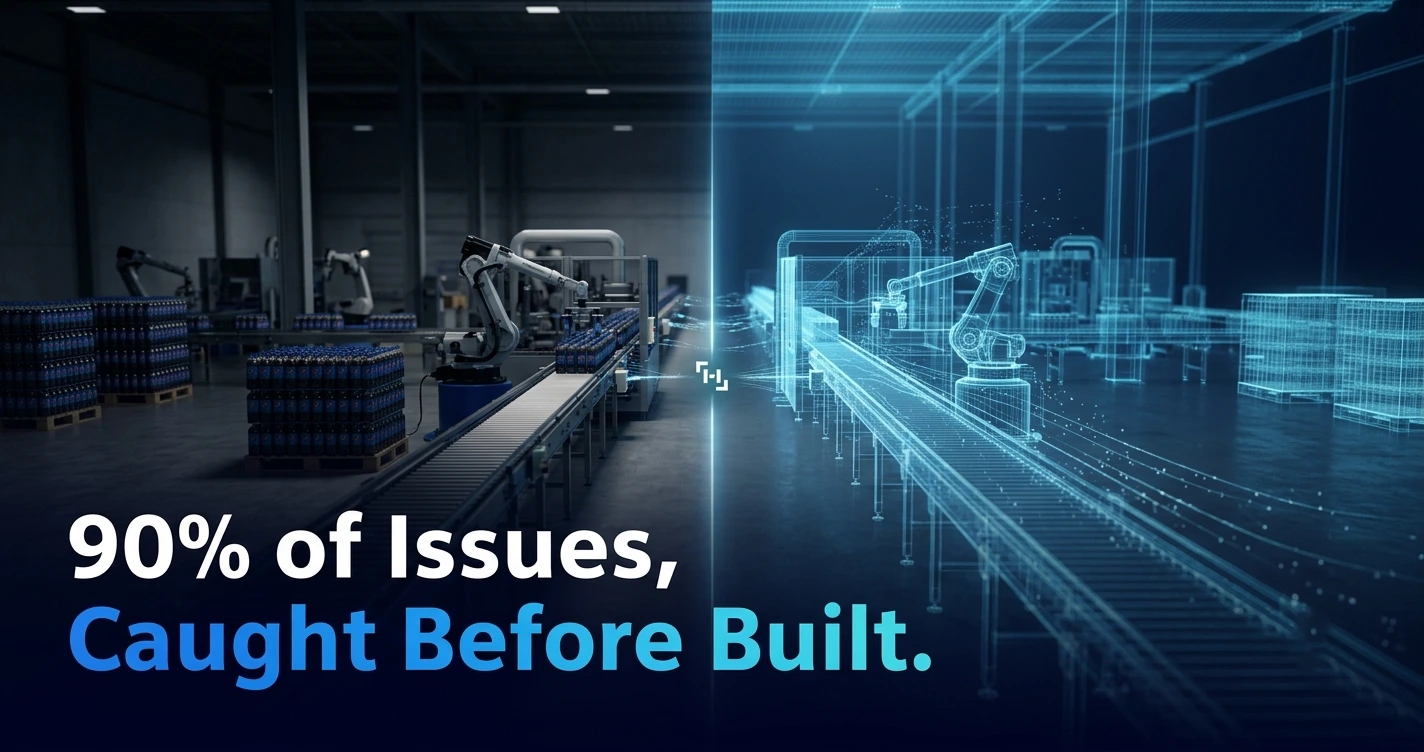
Siemens Built a Factory in Software First. PepsiCo Went First.
By NeuralWired Staff · Updated July 13, 2026
Siemens just told manufacturers something they’ve heard before: build it virtually before you build it for real. What’s different this time is that PepsiCo already did it, and the company is putting a number on the payoff. At Siemens’ CES 2026 unveiling of Digital Twin Composer, the pitch moved from simulation slideware to a live production tool wired directly into plant floor data. If you run manufacturing operations or sign off on capital projects, this is the digital twin story worth actually reading this quarter.
Before you cite a stat from this story
The number circulating in some early coverage, that digital twins cut manufacturing errors by “67%”, has no traceable source. We could not find it in Siemens materials, Gartner research, or McKinsey publications. The verified figure below, PepsiCo’s “up to 90% of issues caught before physical build”, is real, named, and on the record, but it’s a single customer’s self-reported result, not an audited industry average. Treat it accordingly.
What Siemens Actually Launched at CES 2026
Digital Twin Composer connects Siemens’ photorealistic 3D digital twins, built on NVIDIA Omniverse libraries, to the systems that actually run a factory floor: manufacturing execution systems, quality management systems, PLC code, and IIoT sensor feeds. That’s the real shift here. Older digital twins were design-phase artifacts, built once and largely frozen. This one updates continuously against live plant data, which means engineers can test a process change in the twin and watch how it behaves under real conditions before touching a single machine.
Siemens AG President and CEO Roland Busch framed the launch in sweeping terms at the announcement:
“Industrial AI is no longer a feature, it’s a force.”
Roland Busch, President and CEO, Siemens AG, at the Siemens CES 2026 press release
The product is currently in early access with select customers. General availability on the Siemens Xcelerator Marketplace is scheduled for mid-2026, so if you’re evaluating this for a 2026 budget cycle, you’re looking at a young product, not a mature platform with years of deployment history behind it.
Siemens paired the launch with a second tool, Intelligence Center X, unveiled at Realize LIVE Americas 2026 in Detroit. It bundles Mendix, Graph Studio, and AI Studio (pulled from the RapidMiner portfolio Siemens acquired) into a governed workflow layer for AI models running on engineering and manufacturing data. Tony Hemmelgarn, President and CEO of Siemens Digital Industries Software, presented it as the governance layer that keeps AI agents from running loose on plant data, though full technical detail on that governance model wasn’t disclosed at the event.
The PepsiCo Case: What the Numbers Really Say
PepsiCo is the flagship customer, and it’s a genuinely useful case study precisely because the company already had deep Siemens infrastructure in place: Teamcenter for product data, Plant Simulation for process modeling, now layered with Digital Twin Composer and NVIDIA Omniverse. PepsiCo is converting select U.S. manufacturing and warehouse facilities into high-fidelity digital replicas before committing capital to physical changes.
Steve Hoinka, PepsiCo’s Global VP of Manufacturing Strategy and Transformation, laid out the operating principle at Realize LIVE:
“We will do nothing, make no capital investment unless we prove it digitally first.”
Steve Hoinka, Global VP, Manufacturing Strategy and Transformation, PepsiCo, via TechHQ reporting on Realize LIVE Americas 2026
Hoinka reported two concrete figures on stage: a 20% throughput improvement across PepsiCo’s end-to-end value chain, and the avoidance of more than 90% of potential operational issues before they ever reached the physical plant. Industry analyst firm Verdantix separately reported PepsiCo capex reductions in the 10 to 15% range, though treat that as a secondary analyst estimate layered on top of PepsiCo’s own numbers, not a replacement for them.
Here’s the caveat that matters more than the stat itself. These are self-reported figures from one company, presented at a vendor-hosted conference, without independent audit. PepsiCo is also not a typical manufacturer. It’s a Fortune 50 company with years of prior Siemens ecosystem investment already sunk into the ground. A mid-market plant starting from zero won’t replicate PepsiCo’s numbers by buying the same software.
How Big Is the Digital Twin Market, Really
Market-sizing research on digital twins varies enough between firms that any single figure deserves a raised eyebrow. Here’s how three separate research houses currently size it:
Manufacturing holds roughly 35% of the total digital twin market by Mordor’s accounting, the single largest industry slice. Whichever number you trust, the direction is unambiguous: this is a market growing fast, and Siemens timed its launch to sit at the front of that curve.
Siemens’ own digital business posted €9 billion in revenue for its most recent full fiscal year on record, up 22% year over year, per Roland Busch’s fiscal year press conference. That’s the commercial scale Siemens is operating at in this category, and it’s worth checking whether a more current figure has since been published before you cite it elsewhere.
The Gartner Reality Check Nobody’s Marketing
Here’s the number that should sit next to every digital twin press release you read this year: according to Gartner’s 2024 IoT survey data, roughly one in three companies that began digital twin pilots in 2022 actually scaled past proof-of-concept. Two out of three didn’t.
Michael Grieves, the researcher widely credited with coining the term “digital twin” back in 2002, has pointed to a specific failure mode behind that dropout rate: organizations and the institutions training their engineers still default to siloed thinking rather than starting from the capability and working backward to the tool, per his comments to Manufacturing Engineering & Technology. Coming from the person who invented the concept, that’s not a vendor talking down its own category. It’s a founder flagging that the industry’s execution muscle hasn’t caught up to its ambition.
World Wide Technology, a systems integrator that implements these projects rather than sells the software, published its own hype-versus-reality breakdown identifying scope creep as a recurring killer: teams start with one clear intention and get pulled into an expanding set of alternate possibilities before the project ever ships. Their conclusion, echoed across the WWT analysis, is that digital twin success depends as much on project and stakeholder management as it does on modeling talent, a bottleneck that rarely makes it into a vendor’s demo reel.
Gartner’s other number worth watching
Gartner also projects core manufacturing system costs, spanning PLM, MES, and product development software, to rise 40% by 2029, driven in part by new “machine user” pricing structures that charge for automated, nonhuman software accounts. Budget owners should model that exposure now, not after signing.
What Manufacturing Leaders Should Do Now
If you’re a manufacturing CTO or VP of Operations evaluating this, three things change the moment you connect a digital twin to live MES and PLC data instead of using it as a design-phase sketchpad.
IT/OT convergence stops being optional. A twin fed by live operational data means plant IT and operational technology teams need a joint data governance plan in place before the pilot starts, not after something breaks.
This is a multi-year cost commitment, not a one-time purchase. Between Gartner’s projected 40% cost rise by 2029 and new machine-user licensing models, model the full budget curve before you sign.
Benchmark against the one-in-three number, not the PepsiCo number. PepsiCo’s results came from a company with years of existing Siemens infrastructure and Fortune 50 resources. Gartner’s pilot-to-scale success rate is the more statistically honest baseline for what your own rollout is likely to look like.
Our read: Digital Twin Composer is a real product solving a real integration gap between design-phase and operational digital twins. But the industry’s execution track record, one in three pilots scaling successfully, is the more useful number for planning your own timeline than any single customer’s conference-stage stat, verified or not.
Frequently Asked Questions
What is a digital twin in manufacturing?
A digital twin in manufacturing is a real-time virtual replica of a machine, production line, or entire factory, continuously updated with live data from sensors, MES, and control systems. It lets engineers simulate and test changes virtually before applying them to physical equipment, cutting risk and downtime.
How much does a digital twin cost to implement?
Costs vary widely by scope. A single-machine or single-cell pilot can start in the tens of thousands of dollars, while full-plant platforms like Siemens Digital Twin Composer involve enterprise licensing plus integration, sensor, and simulation-engineering costs that scale with facility complexity.
What is the difference between a digital twin and a simulation?
A simulation models a system at a single point in time to answer one specific question. A digital twin is a continuously updated, bidirectional model synchronized with live data from its physical counterpart, meaning it evolves in real time instead of representing one static scenario.
How long does it take to see ROI from a digital twin?
Timelines vary by use case. Simulation-focused twins used to validate process changes before implementation can show payback in as little as four to six months, while predictive-maintenance-focused twins typically take longer, with full-deployment ROI often cited in the 12 to 36 month range.
Which industries use digital twins the most?
Manufacturing holds the largest share of digital twin deployments, followed by automotive and transportation, energy and power, aerospace, and healthcare. Manufacturing’s lead comes from mature IIoT infrastructure and established use cases like predictive maintenance and virtual commissioning.
Where This Goes Next
What’s genuinely new in 2026 isn’t the digital twin concept, it’s the convergence of digital twins with agentic AI. Gartner projects that by 2030, semi-autonomous AI agents will orchestrate roughly 10% of production, quality, and maintenance use cases, up from about 2% today. Siemens’ own €200 million “smart factory” build at its Amberg, Germany site, using Digital Twin Composer to virtually commission the plant before construction, with completion targeted for 2030, is one early bet on that trajectory.
Three things to watch over the next 6 to 18 months:
General availability in mid-2026. Watch whether early-access results from PepsiCo hold up once Digital Twin Composer reaches customers without PepsiCo’s existing Siemens footprint.
The Gartner one-in-three number, tracked forward. If Siemens and its competitors move that success rate, it’ll show up in Gartner’s next IoT survey cycle.
Machine-user pricing rollout. Watch how Siemens and rivals like Dassault Systèmes, Rockwell Automation, PTC, and ANSYS structure pricing for AI agents operating inside these platforms, since that’s where the real cost exposure sits.
The honest version of this story sits between the CES keynote and the Gartner survey data. Siemens shipped something real. PepsiCo’s results are real, too, as far as one company’s self-reported numbers go. Whether that translates to your plant floor depends far more on your organization’s execution discipline than on which vendor’s logo is on the software.
IBM and AWS Sell Quantum Cloud. Google Still Doesn’tEnterprise Quantum Computing
IBM and AWS Sell Quantum Cloud. Google Still Doesn’t
Your CTO just asked for a quantum computing budget line for next year. You pull up a headline claiming IBM, Google, and AWS all sell quantum as a cloud service, and you build a three-way comparison deck around it. That deck is wrong before slide two. Google will not sell you access to its Willow chip in 2026, no matter what your procurement team offers to pay.
This matters because the mistake is easy to make and expensive to repeat. Quantum cloud computing has quietly split into distinct commercial tiers, and mixing them up means budgeting for a product that does not exist. Here is what IBM, AWS, and Google actually sell today, what it costs, and which one fits the workload you are actually running.
IBM and AWS genuinely sell commercial quantum cloud access right now. Anyone with a credit card and a Qiskit or Braket SDK install can run jobs on real hardware this afternoon. Google does not offer that. Its 105-qubit Willow processor is only reachable through the Willow Early Access Program, a selective research initiative, not a purchasable service. Applications closed on May 15, 2026, selections went out July 1, and the program exists to identify research partners for high-impact projects, not paying customers.
What Google Cloud does sell is different: marketplace access to third-party quantum hardware, including systems from Pasqal. That is a legitimate quantum cloud story. It just is not the same story as “buy time on Willow,” and conflating the two sends budget planning in the wrong direction from the first paragraph.
Why this correction matters for your budget: If your procurement plan assumes Google is a third purchasable option alongside IBM and AWS, you are planning around a product Google is not selling. Treat Google Cloud’s marketplace quantum hardware as the real 2026 option, and treat Willow as a research relationship you would have to apply for, not procure.
What IBM Quantum Actually Sells
IBM’s production hardware for the IBM Quantum Network is Heron r2, a 156-qubit processor with a median two-qubit gate error rate near 0.3%. The newer Nighthawk processor, announced in November 2025, runs 120 physical qubits on a square lattice with 218 next-generation tunable couplers, and IBM is targeting quantum advantage by the end of 2026 with an initial complexity target around 5,000 two-qubit gates, scaling toward 10,000 by 2027.
IBM sells access through four tiers, and the pricing gap between them is the actual decision that matters for most teams:
Plan
Rate
Commitment
Pay-As-You-Go
~$96/minute
None
Flex
~$72/minute
$30,000 minimum, 400+ minutes/year
Premium
~$48/minute
5,200+ minutes/year
That structure only makes sense once you map it to how often you actually run jobs. A team testing an algorithm twice a month has no business locking into a $30,000 Flex commitment. A team running continuous research cadence is bleeding money on Pay-As-You-Go rates.
Nighthawk vs. Heron: Which One Are You Actually Renting?
Most IBM Quantum Network access in 2026 still routes through Heron r2 for production workloads. Nighthawk is the forward-looking system IBM is using to chase its 2026 advantage claim, and it is worth asking your IBM rep directly which processor your plan tier actually reserves time on, because the marketing material does not always make the distinction obvious.
What AWS Braket Actually Sells
AWS Braket takes the opposite approach to IBM: no subscription tiers, no minimum commitment, just a per-shot and per-task pricing model across multiple hardware vendors. That multi-vendor structure is the real differentiator, and the price spread across vendors is bigger than most buyers expect.
Hardware
Per-Shot Rate
Per-Task Fee
Hourly Reservation
IonQ Forte
$0.08
$0.30
$7,000/hr
AQT IBEX-Q1
$0.0235
$0.30
$4,800/hr
Rigetti Cepheus
$0.000425
$0.30
$4,100/hr
IQM Garnet
$0.00145
$0.30
$3,000/hr
QuEra Aquila
$0.01
$0.30
$2,500/hr
Do the math on a 10,000-shot circuit and the gap gets uncomfortable fast. The same circuit costs roughly $300 on a trapped-ion system like Aria and roughly $5 on a superconducting Rigetti system, a ratio north of 60x for what buyers often treat as an interchangeable choice. That gap is driven almost entirely by qubit modality, not by which vendor happens to be having a good pricing quarter, according to independent pricing analysis at quantumcomputingcost.com, verified against primary AWS pricing pages in June 2026.
The Benchmark That Actually Matters
Pricing tables tell you what quantum cloud access costs. They do not tell you whether it works. For that, the clearest 2026 evidence comes from JPMorgan Chase and the AWS Center for Quantum Computing, who published “Quantum-Informed Portfolio Selection” on July 1, 2026, describing a 225-asset portfolio diversification problem run on Quantinuum’s 98-qubit Helios trapped-ion computer.
The detail that should reshape how you think about procurement: standalone QAOA, the algorithm most quantum-optimization marketing leans on, failed completely on the hardest indices in the study. Zero percent success rate. JPMorgan’s team only got usable results by switching to a hybrid algorithm called qReduMIS that combines classical and quantum computation.
Marco Pistoia, Head of Global Technology Applied Research and Head of Quantum Computing at JPMorgan Chase, has credited the bank’s access to NVIDIA GPU-based supercomputing through Argonne National Laboratory as central to running the large-scale numerical studies behind this research.
Source: JPMorganChase Technology Blog / arXiv, arxiv.org/html/2607.01037
Here is the number that should worry anyone benchmarking providers on qubit count alone: a five-qubit system running at 99.99% two-qubit gate fidelity can execute deeper, more reliable circuits than a 1,000-qubit system stuck at 99% fidelity. Qubit count is the most heavily marketed metric in this industry and, by most technical accounts, the least useful one for predicting whether your workload will actually complete successfully.
Robbie King, a doctoral researcher in quantum computing at Caltech, has framed the honest industry question at conferences this way: if you handed most businesses a working quantum computer tomorrow, could they actually run the algorithm they think they need? For most of the field right now, the honest answer is not really.
Scott Aaronson, the Schlumberger Centennial Chair of Computer Science at UT Austin and quantum computing’s most credible public skeptic, has struck a notably less skeptical tone on one specific point. He has said that people whose judgment on hardware and error correction he trusts more than his own now believe a fault-tolerant quantum computer capable of breaking deployed cryptography could arrive around 2029.
On the broader commercial hype cycle, Aaronson remains the field’s most credible skeptic, even as he acknowledges genuine hardware progress from Google, Quantinuum, and QuEra.
Source: scottaaronson.blog, May 1, 2026
That is a narrow alarm about cryptography timelines, not a blanket endorsement of near-term commercial ROI. Aaronson treats the ROI question with exactly the skepticism you would expect from him.
The failure mode this creates: A team picks a high-qubit-count superconducting provider for a workload whose required circuit depth exceeds its coherence-time budget. They burn through a $30,000 IBM Flex Plan minimum on results that never converge, and conclude “quantum doesn’t work.” The actual problem was a hardware-topology mismatch, the exact class of failure JPMorgan’s hybrid workaround was built to route around.
Which Provider Fits Your Workload
Stop asking which provider is best. Ask which billing model matches how often you actually run jobs.
No commitment, per-shot billing, multi-vendor access
Sustained, continuous research cadence
IBM Premium
Lowest per-minute rate, rewards high usage volume
Bursty, project-based work
IBM Flex
Mid-tier rate without a full annual commitment
Research partnership, not production workload
Google Willow Early Access
Only path to Willow, but requires application and selection
Notice what is missing from that table: qubit count as a selection criterion. It should not be the first filter, and on current evidence it should not be a filter at all until you have confirmed your workload’s actual coherence and circuit-depth requirements against the hardware’s real fidelity numbers, not its headline spec sheet.
Frequently Asked Questions
Which is better, IBM or Google quantum computer?
They are not directly comparable through cloud access in 2026. IBM sells commercial cloud access across four plans to its Heron and Nighthawk processors, while Google’s Willow chip is only reachable through a selective, non-commercial Early Access research program, not a purchasable cloud service.
How much does AWS Braket cost?
AWS Braket charges no upfront fee. Pricing combines a flat $0.30 per-task fee with per-shot rates that vary by hardware, from $0.000425 per shot on Rigetti Cepheus to $0.08 per shot on IonQ Forte, plus optional hourly reservations ranging from $2,500 to $7,000 per hour.
Is quantum computing available on the cloud?
Yes. IBM Quantum Platform and AWS Braket both offer commercial cloud access to real quantum hardware from vendors including IonQ, Rigetti, IQM, and Quantinuum, with plans ranging from pay-as-you-go rates to enterprise subscription tiers.
What is the best quantum cloud provider for enterprises?
There is no single best provider. AWS Braket suits intermittent, multi-vendor experimentation through per-shot pricing. IBM Quantum suits sustained research with predictable per-minute billing. The right choice depends on workload cadence and circuit-depth requirements, not headline qubit counts.
Is quantum computing overhyped?
Partly. Hardware progress on qubit counts, gate fidelity, and error correction has outpaced expert predictions from a decade ago. The algorithms needed to turn that hardware into business value, and the talent pool to build them, both lag well behind current hardware capability.
What This Means Going Into 2027
Three things are worth watching over the next 6 to 18 months. First, whether IBM actually hits its end-of-2026 quantum advantage target on Nighthawk, since that date is close enough to check. Second, whether Google converts any Willow Early Access research partnerships into a genuine commercial product, which would change this entire comparison. Third, whether more enterprise teams follow JPMorgan’s lead into hybrid quantum-classical approaches rather than waiting for pure quantum algorithms to catch up to the hardware.
Here is what you now know that the “IBM, Google, and AWS all sell quantum cloud” headline does not tell you: only two of those three companies are actually selling anything you can buy today, the pricing models are structured for completely different usage patterns, and the algorithm running on the hardware matters more than the qubit count printed on the spec sheet. Budget accordingly.
Quantum computing pricing, hardware, and access models are shifting fast enough that this comparison will need revisiting well before 2027. Subscribe to The Neural Loop at neuralwired.com/newsletter to get the next update before your competitors do.
FinOps DevOps Integration Enterprise: 2026 Cost Gap
Enterprise DevOps · FinOps
FinOps DevOps Integration Enterprise: 2026 Cost Gap
Engineering ships the feature. Finance reads the bill two months later. In 2026, that lag is finally getting expensive enough to fix.
A platform team at a mid-size SaaS company spins up a new GPU cluster on a Friday to hit a launch deadline. Nobody flags the cost. Nobody has to, because the invoice won’t land until the next billing cycle, and by then the team has moved on to the next sprint. This is the gap that FinOps DevOps integration in the enterprise is built to close: the space between the moment engineers make a spending decision and the moment anyone with budget authority actually sees the consequence. In 2026, that gap is no longer a minor accounting nuisance. Cloud waste just rose for the first time in five years, AI workloads are burning budget faster than any team can track manually, and the organizations closing this loop are doing it by moving cost data into the tools engineers already use, not by adding another dashboard nobody opens.
FinOps is not a cost-cutting mandate bolted onto engineering. The FinOps Foundation defines it as an operational framework and cultural practice that maximizes the business value of technology through data-driven collaboration between engineering, finance, and business teams. FinOps DevOps integration is the practical version of that idea: building cost visibility directly into the pipelines, pull requests, and deployment gates that DevOps teams already run, instead of asking engineers to check a separate finance dashboard after the fact.
Put simply, DevOps optimizes for delivery speed. FinOps adds a financial-accountability layer on top of what DevOps ships, so the team building infrastructure can see, in near real time, what that infrastructure costs to run.
Why 2026 is the inflection point
Three forces converged over the past eighteen months to push this from “nice to have” to organizational priority. First, AI and GPU workloads introduced usage-based, token-metered billing that doesn’t map cleanly to the per-instance cost models most FinOps tooling was built around. Second, cloud waste reversed direction after years of gradual improvement. Third, the FinOps Foundation’s updated 2026 Framework formally expanded the discipline’s scope beyond public cloud into SaaS, licensing, private cloud, and data center spend, adding a new Executive Strategy Alignment capability in the process.
Microsoft’s ongoing move away from the traditional Azure Enterprise Agreement structure is adding to the pressure on enterprise cost teams, though the scale of that shift is still being reported primarily through vendor and partner channels rather than Microsoft’s own licensing communications, so treat specific figures around it as directional rather than confirmed.
Paul Nashawaty, principal analyst at theCUBE Research, framed the shift ahead of FinOps X 2026 in San Diego this way:
“By 2026, more than 70% of enterprises will embed FinOps practices directly into application development workflows as AI-driven applications increase cloud consumption and complexity.”
Paul Nashawaty, Principal Analyst, theCUBE Research · SiliconANGLE, May 26, 2026
The numbers behind the accountability gap
The FinOps Foundation’s State of FinOps 2026 report, published February 19, 2026 and drawing on 1,192 respondents representing more than $83 billion in combined annual cloud spend, is the clearest picture available of how fast the discipline’s scope has widened.
Metric
2026 figure
Source
IaaS/PaaS cloud spend wasted
29% (up from 27% in 2025)
Flexera 2026 State of the Cloud Report
FinOps practitioners managing AI spend
98% (up from 31% in 2024)
FinOps Foundation, State of FinOps 2026
FinOps teams managing SaaS spend
90% (up from 65% in 2025)
FinOps Foundation, State of FinOps 2026
FinOps practices reporting into CTO/CIO
78% (up 18 points since 2023)
FinOps Foundation, via TechTarget
Average GPU utilization
23% (77% sits idle)
Harness 2025, via SpendArk
Organizations with chargeback/showback
44%
CNCF FinOps Survey 2024, via SpendArk
Global public cloud spending for 2026 is projected at roughly $1.03 trillion by Forrester, a figure worth treating as one analyst firm’s estimate rather than an industry-wide consensus, since other research houses model the number differently depending on what they count as “cloud.” Even using the conservative end of published waste estimates, that puts wasted infrastructure spend somewhere in the hundreds of billions of dollars globally, which is the scale problem FinOps DevOps integration is trying to solve.
Flagged for verification
A widely circulated claim that “Gartner projects 60% of organizations will fail to control cloud spending without automated governance by 2028” appears repeatedly in vendor blog content but could not be traced to a primary Gartner press release. Gartner’s actual on-record prediction, published May 13, 2025, is that 25% of organizations will report significant cloud adoption dissatisfaction by 2028 due to unrealistic expectations, poor implementation, or uncontrolled costs. Use the verified 25% figure, not the uncredited 60% one.
Why the disconnect persists
Here’s the uncomfortable part: the gap isn’t mostly a tooling problem anymore. Research from Harness, reported by TechTarget, found that 52% of engineering leaders say the disconnect between FinOps and developers is directly causing wasted cloud spend, while 62% of developers say they actually want more control over and responsibility for the costs they generate. That’s not a motivation problem. It’s a structural one.
Fifty-eight percent of respondents in SpendArk’s State of Cloud Waste 2026 report cite fear of production impact as the top reason they don’t act on cost-optimization recommendations, even when the data is sitting right in front of them. Nobody wants to be the engineer who rightsized a service and took down checkout at 2 a.m. Until cost decisions are baked into the same review process as everything else, “I’ll get to it” wins by default.
This is close to a problem NeuralWired has covered before in a different context: our reporting on why Google’s DORA metrics are failing engineering teams found the same metric-gaming pattern. Teams optimize for what gets measured, not what actually matters, and a cost dashboard nobody is accountable to will get the same treatment a vanity DORA score gets: ignored until someone asks about it directly.
The value reframe
Not everyone in the field frames this as a cost problem at all. Tim Crawford, founder of AVOA and a longtime CIO strategic advisor, put it directly:
“Value is far more valuable as a metric than cost.”
Tim Crawford, Founder & CIO Strategic Advisor, AVOA · TechTarget, March 5, 2026
That’s a genuinely useful corrective inside an article that’s mostly about waste. Chasing the lowest possible bill is easy and often counterproductive. Chasing the highest return per dollar spent is harder to measure but is the actual goal, and it’s the reason the FinOps Foundation keeps insisting the discipline isn’t primarily about cutting costs.
The AI spend problem nobody built tooling for
If there’s one number in this entire dataset that should get an engineering leader’s attention, it’s this: average GPU utilization across measured AI workloads sits at 23%, according to Harness data cited in SpendArk’s 2026 report. That means roughly three-quarters of provisioned GPU capacity is sitting idle at any given moment, on hardware that is dramatically more expensive per hour than the compute FinOps teams spent the last decade learning to optimize.
The share of FinOps practitioners managing AI spend jumped from 31% in 2024 to 98% in 2026. That’s the fastest adoption curve the State of FinOps survey has recorded in its six-year history, and it happened because token-based, usage-metered AI billing simply doesn’t behave like the per-instance cloud costs most tooling and habits were built around. Shared training-run costs, in particular, are notoriously difficult to attribute back to a specific team or product line, which is exactly the kind of allocation problem that breaks a traditional chargeback model.
We’ve written before about the flip side of this same AI cost pressure, in our coverage of why 70% of AI agent deployments fail. Uncontrolled GPU spend and failed agent rollouts are frequently the same underlying story: infrastructure provisioned ahead of a clear return, with nobody positioned to catch it until the project stalls or the bill arrives.
The case against: does FinOps actually pay for itself?
Not every credentialed voice in this space agrees that building a dedicated FinOps function is the right answer. Gartner analyst Lydia Leong has argued, in an analysis still widely cited in industry discussion despite dating to 2023, that many organizations conflate needing to manage cloud costs with needing an entirely new department to do it:
“For many organizations, there is no reasonable ROI on FinOps, and certainly no sensible business case for building a FinOps team.”
Lydia Leong, Analyst, Gartner · CloudPundit, March 31, 2023 (still cited in 2026 industry discussion)
Her point, dated as the source is, still lands: traditional IT financial management practices can handle a meaningful chunk of this work without a new tooling stack or new job titles, and organizations that skip straight to “we need a FinOps team” sometimes end up with overhead that outpaces the savings.
The data backs up some of that skepticism. InfoWorld reported that in some cases, a dollar invested in FinOps delivers only about 30 cents in realized savings, citing McKinsey research on why organizations struggle to capture value beyond a FinOps team’s immediate mandate. CloudZero-cited survey data goes further: 71% of cloud financial management teams doubt they’ll fully achieve their expected results, on time or at all.
Diminishing returns, by the Foundation’s own admission
Even the State of FinOps 2026 report acknowledges the easy wins are gone. Practitioners describe having “hit the big rocks of waste” and now facing a high volume of smaller opportunities that each require more effort to capture. Translation: the 20 to 40% savings figures vendors love to cite were real in 2020 to 2024. In 2026, expect smaller, harder-won gains.
IBM FinOps expert Otto Hillenbrand offers a middle-ground read that’s worth holding onto: We are in the crawl phase of FinOps (ClearTechnologies, September 2025), arguing that most enterprises claiming mature practices are actually doing basic cost optimization without the cross-functional accountability the discipline is supposed to deliver.
What’s actually closing the gap
Set the skepticism aside for a moment, because there’s a real, measurable pattern in what’s working. The common thread across every organization that’s actually narrowing the accountability gap is the same: cost data moves into the tools engineers already use, instead of living in a dashboard that requires a separate login and a separate habit.
Cost-tagged tickets, not email reports. Teams that automatically generate cost-tagged tickets, routing rightsizing or scheduling recommendations directly into Jira or ServiceNow with one click, see three to four times higher action rates than teams relying on dashboard reviews.
Cost as a first-class engineering metric. “Cost per transaction” is increasingly tracked alongside latency and error rate, not as a separate finance concern.
Pre-merge cost annotations. Infrastructure-as-code pull requests increasingly carry cost-delta estimates before merge, not after the invoice.
Chargeback and showback. Still only at 44% adoption, but it’s the mechanism that actually closes the loop between who spends and who’s accountable.
Organizations embedding cost gates directly into CI/CD report cloud waste reductions in the 20 to 40% range within six months, though as the diminishing-returns data above shows, that ceiling is getting harder to hit as the obvious waste gets cleared out. Forbes Technology Council’s reporting makes the incentive point explicit: without cost accountability reflected in team-level metrics, even the best visibility tooling struggles to change actual behavior. Dashboards inform. Incentives change behavior. Those are not the same thing, and conflating them is probably the single most common mistake in FinOps rollouts right now.
FAQ: FinOps DevOps integration in 2026
What is the difference between FinOps and DevOps?
DevOps focuses on shortening the software delivery lifecycle through automation, testing, and deployment speed. FinOps adds a financial-accountability layer on top, tracking and optimizing the cost of the resources DevOps provisions. FinOps doesn’t replace DevOps; it extends DevOps principles into cost accountability for cloud resources.
Why do enterprises need FinOps DevOps integration?
Enterprises managing $10 million or more in annual cloud spend across AWS, Azure, and GCP routinely lose 20 to 40% of that spend to decisions nobody reviews until the bill arrives weeks later. Integration embeds cost visibility directly into CI/CD pipelines so waste gets caught before deployment, not after invoicing.
What percentage of cloud spend is wasted in 2026?
Flexera’s 2026 State of the Cloud Report found an estimated 29% of IaaS/PaaS cloud spend is wasted, up from 27% in 2025. It’s the first increase after five straight years of gradual improvement.
How does AI spending affect FinOps in 2026?
The share of FinOps practitioners managing AI spend jumped from 31% in 2024 to 98% in 2026, per the FinOps Foundation’s State of FinOps 2026 report. Average GPU utilization sits at just 23%, meaning most provisioned AI compute goes unused.
Does FinOps actually save money?
Results vary widely. Vendor case studies cite 20 to 40% cloud cost reductions, but independent reporting citing McKinsey research found some organizations realize only about 30 cents of savings per dollar invested in FinOps, largely because engineering teams often lack the incentives or data access to act on recommendations.
Who owns FinOps in an enterprise, engineering or finance?
Increasingly, engineering. 78% of FinOps practices now report into the CTO/CIO organization, up 18 percentage points since 2023, according to the FinOps Foundation’s State of FinOps 2026 report, reflecting a shift from finance-led reporting to an engineering-embedded discipline.
What to watch next
The organizational and structural pieces of FinOps DevOps integration are genuinely maturing this year: adoption is rising, scope has expanded past public cloud, and ownership is shifting into engineering leadership rather than sitting with finance alone. What isn’t true is that the accountability gap itself is closing quickly or completely. The more defensible read is that 2026 is the year the tooling and org structure to close the gap matured, not the year the gap actually disappeared.
Three things worth tracking over the next six to eighteen months:
Whether chargeback and showback adoption moves meaningfully past the current 44%, since that’s the mechanism that turns visibility into actual accountability.
Whether AI-specific cost tooling catches up to the 98% of practitioners now managing AI spend, given that token-based billing still doesn’t map cleanly to the models most tools were built for.
Whether the “20 to 40% savings” figure vendors cite continues to compress, now that the State of FinOps 2026 report itself acknowledges the easy wins are gone.
Microsoft’s AI Emissions Jumped 25% in 2025. Here’s the ESG Gap Nobody’s Filled
Your ESG dashboard probably looks fine. It’s also probably wrong. On July 9, 2026, Microsoft’s Environmental Sustainability Report confirmed what sustainability teams have quietly suspected for two years: AI infrastructure is now the single biggest driver of corporate carbon growth, and most Scope 3 inventories still don’t itemize it as its own line. Microsoft’s total emissions hit 20.3 million metric tons of CO2 equivalent in fiscal 2025, up 25% from 16.2 million tons the year before. Google and Amazon reported similar jumps the same week. If your company runs LLM API calls at scale and your Scope 3 report doesn’t mention it by name, you have a disclosure problem that’s about to become a legal one.
The Microsoft Report That Changes the Conversation
Microsoft has spent years positioning itself as the carbon-neutral pledge leader of Big Tech. Its 2026 Environmental Sustainability Report just complicated that story considerably. Total greenhouse gas emissions reached 20.3 million metric tons of CO2 equivalent in fiscal year 2025, a 25% increase over the 16.2 million tons reported in 2024, according to figures reported by Bloomberg. The company attributed the jump directly to the pace of AI and cloud infrastructure growth, particularly new data center construction.
The number that should worry every sustainability officer reading this isn’t the headline figure. It’s the breakdown underneath it: Scope 3, indirect emissions from the value chain, made up 85.82% of Microsoft’s total 2025 footprint. Scope 3 is exactly the category most corporate ESG reports fail to capture AI-related emissions under, because it covers everything upstream and downstream of a company’s direct operations, including the cloud services and AI vendors it relies on.
Why This Isn’t a One-Year Blip
This is now a two-year trend, not a single bad report. Bloomberg’s 2024 reporting already showed Google’s emissions rising 48% and Microsoft’s rising 30% due to AI buildout. The 2026 numbers confirm the trajectory held, even as both companies publicly reaffirmed net-zero targets.
It’s Not Just Microsoft
If Microsoft’s report stood alone, you could file it under company-specific overspending. It doesn’t stand alone. The same reporting week, Google disclosed a 25% jump in supply chain emissions in its own 2026 sustainability report, and Amazon logged a 16% rise, according to reporting from Bloomberg and industry coverage of the same disclosure cycle.
Company
Metric
2025 Change
Microsoft
Total GHG emissions
+25% (20.3M tons CO2e)
Google
Supply chain (Scope 3) emissions
+25%
Amazon
Total emissions
+16%
The underlying driver is consistent across all three: data center buildout to serve AI workloads. The International Energy Agency’s April 2026 report puts numbers behind the trend at a global scale. Electricity demand from data centers overall grew 17% in 2025, but electricity consumption from AI-focused data centers specifically surged 50% in the same year. Big Tech’s capital expenditure on data center investment exceeded $400 billion in 2025 and is projected to climb another 75% in 2026, per the IEA’s “Key Questions on Energy and AI” report.
Why Your ESG Report Probably Doesn’t Count This
Here’s the uncomfortable part. Most GHG Protocol templates and ESG reporting platforms were built before generative AI usage became material to corporate emissions. If your organization runs thousands of daily LLM API calls, that usage almost certainly isn’t itemized anywhere in your current Scope 3 inventory. It’s buried inside a generic “purchased cloud services” line, if it’s captured at all.
The scale of the visibility gap is larger than most boards realize. Roughly 70% of companies lack visibility into their own Scope 3 data, despite Scope 3 accounting for close to 90% of all corporate emissions across most industries. And 80% of organizations lack the data integrity required to meet Corporate Sustainability Reporting Directive compliance mandates in the EU, according to sector survey data cited by IrisCarbon.
“The biggest problem is transparency: emissions can be substantial, but companies share so little data that exact costs remain murky.”
Dr. Sasha Luccioni, Co-founder, Sustainable AI Group; former Climate Lead, Hugging Face; TIME100 AI honoree, Masters of Scale, 2026
Alex de Vries-Gao, founder of Digiconomist and a PhD candidate at VU Amsterdam’s Institute for Environmental Studies, makes the same point from a different angle: the data that would settle these questions already exists, it’s just not being shared consistently.
“You really have to deep-dive into the semiconductor supply chain to be able to make any sensible statement about the energy demand of AI. If these big tech companies were just publishing the same information that Google was publishing three years ago, we would have a pretty good indicator of AI’s energy use.”
Alex de Vries-Gao, Founder, Digiconomist; PhD Candidate, VU Amsterdam, reported May 2026
How Much Carbon Does One AI Query Actually Produce?
This is where you need to slow down, because the numbers circulating online are messier than most articles admit. Start with the one statistic that’s genuinely solid: Hugging Face researcher Sasha Luccioni’s peer-reviewed estimate found that training OpenAI’s GPT-3 emitted around 500 tonnes of CO2, roughly equivalent to 500 transatlantic flights between New York and London. That comparison traces to a named researcher, a peer-reviewed methodology, and a specific, disclosed model. It’s the only apples-to-apples “AI training versus flights” figure in the literature that meets that bar.
A Caveat Worth Repeating
The widely circulated “50x a transatlantic flight” framing you may have seen elsewhere applies to speculation about GPT-4, not the verified GPT-3 figure. OpenAI has never officially disclosed GPT-4’s training energy. Independent academic reconstruction using Multi-Level Carbon Accounting methodology estimates roughly 27.4 GWh of usage energy plus 5.4 GWh of infrastructure energy (32.8 GWh total), producing about 15 kilotons of CO2 equivalent, per a peer-reviewed arXiv paper. Other independent estimates for the same training run range as high as 51 to 62 GWh depending on assumptions. Treat any single GPT-4 number you encounter as a modeled estimate, not an official statistic, because that’s exactly what it is.
Zoom out to the industry level and the range widens further. A peer-reviewed study published in the journal Patterns, hosted on PMC, estimates the global AI systems carbon footprint at somewhere between 32.6 and 79.7 million tons of CO2 in 2025, with a water footprint between 312.5 and 764.6 billion liters. That’s not a typo. A field this young genuinely doesn’t have agreement yet on embodied versus operational emissions, PUE assumptions, or grid carbon intensity, which is exactly why the range is so wide.
Per-Query Numbers: The One Bright Spot
Google is one of the few companies that has actually published a per-query figure rather than leaving analysts to reverse-engineer one. Its August 2025 methodology found the median Gemini text prompt consumes about 0.24 watt-hours and produces roughly 0.03 grams of CO2 equivalent, a rare case of proactive disclosure worth crediting. Compare that to the range of estimates floating around for AI queries generally: as low as 0.3 watt-hours by Sam Altman’s public claim, as high as 2.9 watt-hours per the Electric Power Research Institute, and potentially up to 18.9 watt-hours for more complex, GPT-5-class queries. That’s a 60x spread depending on whose number you trust, which tells you how immature standardized measurement still is in this space.
The Regulatory Clock Is Running
This stops being a research curiosity and becomes a compliance deadline fast. California’s SB 253 requires U.S. entities with revenues exceeding $1 billion to publicly disclose Scope 1 and Scope 2 emissions starting in 2026, with the first deadline landing August 10, 2026. Scope 3 emissions, the category where AI vendor emissions actually live, become mandatory from 2027.
In the EU, the Corporate Sustainability Reporting Directive requires large companies to disclose detailed carbon emissions data, and AI providers or deployers operating in Europe may fall under its scope. The European Commission’s 2025 Omnibus proposal narrowed some coverage and adjusted timelines, but it left the underlying direction toward mandatory disclosure intact. Related regulatory momentum is also building around AI transparency more broadly, as covered in our recent piece on the EU AI Act’s explainability requirements.
If your company relies on third-party LLM APIs at any meaningful scale, you need a measurement methodology now, not in 2027. Auditors reviewing your first Scope 3 disclosure will want prior-year baselines you can’t manufacture retroactively.
What to Do This Quarter
Ask your AI vendors directly for energy and emissions-per-query disclosures. Google now publishes these. If your vendor can’t produce a number, that gap is itself a disclosure risk worth flagging to your board today.
Separate AI usage out of your “purchased cloud services” catch-all. If it’s buried in a generic line item, you have no baseline to report against when Scope 3 rules take effect in 2027.
Treat model tier as a compliance lever, not just a cost lever. Smaller, more efficient models measurably cut inference energy per task. Which model you route a given workload to is becoming a genuine sustainability decision.
Build your August 10 Scope 1/2 disclosure now if you clear the $1 billion revenue threshold in California. There’s no grace period built into SB 253’s first deadline.
Look at where compute physically runs. Edge and distributed infrastructure choices affect your energy footprint upstream of any AI-specific accounting; our recent breakdown of Gartner’s 2026 edge computing data is a useful starting point for that conversation.
The Other Side: Is This Overblown?
Not everyone reads these numbers as a crisis. Urs Hölzle, a Google Fellow and one of the company’s earliest data center architects, has spent years building the infrastructure this article is describing. He doesn’t dispute the scale of the computational problem.
“AI is a huge computational problem. You need a supercomputer to make a new model like Gemini. And then that supercomputer runs for weeks or months to just build this one model.”
Urs Hölzle, Fellow, Google, Latitude Media
But Hölzle isn’t convinced by the most alarming demand projections, arguing the industry is learning to train and serve models more efficiently at a pace that outstrips the headlines. He points to the IEA’s own figures showing AI and data centers still represent a small slice of projected global electricity growth compared to industrial demand, EVs, and heating and cooling electrification. Christina Shim, Chief Sustainability Officer at IBM, lands in similar territory, arguing for balance over alarm.
“Raising a flag over AI’s energy use makes sense. It identifies an important challenge and can help rally us toward a collective solution. But we should balance the weight of the challenge with the incredible, rapid innovation that is happening.”
Christina Shim, Chief Sustainability Officer, IBM, Fortune, via OilPrice.com
There’s a real counterargument buried in the efficiency data, too. The IEA itself notes that energy use per AI task has dropped by at least an order of magnitude annually in recent years. If those efficiency gains keep outpacing demand growth, the “AI carbon crisis” framing could look overstated within two to three years. Alex de Vries-Gao pushes back on that optimism with Jevons’ Paradox: historically, efficiency gains increase total resource consumption rather than shrink it, because cheaper, faster AI simply gets used more. Both things can be true at once, and that tension is exactly why this remains an unsettled debate rather than a closed one.
Our read: this signals a measurement problem more than an ideology problem. Companies aren’t necessarily hiding AI’s carbon cost on purpose. Most simply don’t have a category for it yet. That’s fixable, and the fix starts with the same disclosure discipline that already exists for every other Scope 3 category.
Frequently Asked Questions
How much energy does training GPT-4 use?
No official figure exists. OpenAI has not disclosed exact training energy for GPT-4. Independent researcher estimates range from roughly 32.8 GWh to 62 GWh, based on peer-reviewed Multi-Level Carbon Accounting methodology.
How much CO2 does AI produce compared to flying?
The only peer-reviewed direct comparison is for GPT-3: about 500 tonnes of CO2, roughly equal to 500 transatlantic New York to London flights, based on research by Sasha Luccioni. No equivalent verified figure exists for GPT-4.
Do companies report AI’s carbon emissions in ESG reports?
Rarely in detail. About 70% of companies lack visibility into Scope 3 data generally, and AI-specific emissions are not yet a standard line item in most corporate greenhouse gas inventories.
Why did Microsoft’s carbon emissions increase in 2026?
Microsoft’s fiscal 2025 emissions rose 25% to 20.3 million metric tons of CO2 equivalent, driven mainly by new AI data center construction, according to its July 2026 Environmental Sustainability Report.
What percentage of global electricity do data centers use?
About 1.5% in 2024, roughly 415 terawatt-hours, projected to nearly double to around 945 terawatt-hours by 2030, according to the IEA’s “Energy and AI” report.
Where This Goes Next
What changed this month isn’t that AI got more carbon-intensive. It’s that the companies building it finally started saying so out loud, in numbers regulators can act on. Microsoft’s 25% jump, echoed by Google and Amazon in the same reporting week, turns a two-year-old trend into an accounting problem every ESG team now has to own. Combine that with California’s August 10 deadline and the EU’s continuing push toward mandatory disclosure, and the gap between “we have a sustainability policy” and “we can actually show our AI vendor’s carbon math” stops being an academic distinction.
Watch three things over the next six to eighteen months: whether more AI vendors follow Google’s lead in publishing per-query energy figures, whether Scope 3 AI accounting standards start converging under GHG Protocol guidance, and whether the efficiency gains Hölzle points to actually outpace the demand growth Luccioni and de Vries-Gao are warning about. Whichever way that race goes will decide if this is remembered as a 2026 accounting fix or the start of a much longer reckoning.
Want the next disclosure deadline, regulatory shift, or enterprise AI number before your competitors see it? Subscribe to The Neural Loop at neuralwired.com/newsletter.