DeFi’s $292M Bridge Crisis: How One Validator Flaw Drained a Protocol in 46 Minutes
The Kelp DAO exploit wasn’t a smart contract bug. It was an attack on the invisible plumbing beneath DeFi, and the fix requires the industry to rethink bridge security from the ground up.
At 17:35 UTC on April 18, 2026, 116,500 rsETH tokens left Kelp DAO’s bridge contract on Ethereum and landed in an attacker’s wallet. That transfer, worth roughly $292 million at the time, represented about 18 percent of rsETH’s entire circulating supply. The bridge held reserves backing the token across more than 20 blockchains. With the reserve gone, hundreds of millions in rsETH on Arbitrum, Base, Linea, and a dozen other L2s were suddenly backed by nothing.
Within hours, the attacker deposited the stolen tokens into Aave as collateral and borrowed over $190 million in real ETH against assets that were effectively counterfeit. Aave froze rsETH markets across its V3 and V4 deployments within the same afternoon. SparkLend and Fluid followed. Total DeFi TVL fell by over $13 billion in the 48 hours after the drain, as users raced to withdraw from protocols they no longer trusted.
The most troubling part? The vulnerability had been flagged publicly in an Aave governance forum post fifteen months earlier. The attack didn’t exploit a novel zero-day. It exploited a known configuration flaw that nobody fixed. Here’s exactly how it happened, and what the industry can actually do about it.
Anatomy of the Attack: Not a Contract Bug
To understand what went wrong, you first need to understand what cross-chain bridges actually do. When rsETH moves from Unichain to Ethereum, some piece of software on Ethereum has to verify that the corresponding tokens were locked or burned on Unichain. That verification is the entire security model. Get it wrong, and you can mint tokens on the destination chain that don’t correspond to anything real on the source chain.
Kelp DAO’s rsETH bridge used LayerZero’s OFT (Omnichain Fungible Token) standard across more than 20 networks. LayerZero’s architecture uses Decentralized Verifier Networks, or DVNs, to attest that a cross-chain message is valid before the destination chain acts on it. The critical variable is how many DVNs must agree before a message is accepted. Kelp’s rsETH bridge was configured with a 1-of-1 setup: one DVN, one required signature, no second check.
The 1/1 problem in plain terms: A 1-of-1 DVN configuration means that if the single verifier can be convinced something happened on the source chain, the destination chain will act on it, regardless of whether that thing actually occurred. There is no independent party to catch the error.
The attackers knew this. According to LayerZero’s incident statement, they gained access to the list of RPC nodes the LayerZero Labs DVN used to read source-chain state. RPC nodes are the servers that let off-chain software query blockchain data. The attackers then swapped the binary software on two of those nodes with malicious versions. The malicious nodes told the DVN a specific fraudulent transaction had occurred, while simultaneously returning accurate data to every other system that queried them, including LayerZero’s own monitoring infrastructure. That selective lying was the heart of the attack.
Compromising two nodes alone wasn’t enough. The DVN also used external RPC nodes for redundancy. So the attackers launched a DDoS attack against those external nodes, forcing the DVN to fail over onto the poisoned ones. Once failover triggered, the DVN confirmed a cross-chain burn event that never happened. The Ethereum contract released 116,500 rsETH. The malicious node software then self-destructed, wiping binaries and logs. The entire operation unfolded between 10:20 and 11:40 AM Pacific Time.
“This was not a smart contract hack. There was no reentrancy bug, no missing access check, no price oracle sleight-of-hand. The KelpDAO incident is something arguably more dangerous: an attack on the off-chain verification layer on which many cross-chain protocols depend.”
Chainalysis Investigation Team, Chainalysis, Inc. — Inside the KelpDAO Bridge Exploit
Kelp’s emergency pause multisig activated 46 minutes after the drain, at 18:21 UTC. Two follow-up attempts by the attacker at 18:26 and 18:28 UTC, each trying to pull an additional 40,000 rsETH worth roughly $100 million, both reverted because of the freeze. Without that pause mechanism, total losses could have approached $490 million. The attacker was later linked by LayerZero and Chainalysis to North Korea’s Lazarus Group, specifically the TraderTraitor subunit responsible for a string of DeFi attacks throughout 2025 and 2026.
Why This Attack Is More Dangerous Than a Smart Contract Bug
Smart contract vulnerabilities are findable. Auditors scan for reentrancy, missing access controls, integer overflows, and the other known failure modes. The industry has spent years building audit checklists, formal verification tools, and bug bounty programs oriented around on-chain code. This attack bypassed all of that. The smart contracts worked exactly as written. Every transaction on-chain looked completely valid.
What the attack targeted was the off-chain infrastructure layer: the RPC nodes that verifiers depend on to read chain state. That layer sits outside the scope of typical smart contract audits. No Solidity audit would catch a configuration that leaves a bridge with a single off-chain verifier, because the configuration isn’t in the contract code. It’s a deployment parameter chosen by the protocol team.
The configuration audit gap: The fault in the Kelp exploit was not in any line of smart contract code. It was in the deployment configuration, which sits outside the usual scope of a Solidity audit. Configuration reviews are a newer and less common discipline in DeFi security, and this incident is likely to accelerate demand for them considerably.
The blame dispute that followed the attack illustrated just how structural the problem is. LayerZero’s post-mortem said Kelp chose 1-of-1 despite recommendations to use multi-DVN redundancy. Kelp fired back that the 1/1 configuration appears in LayerZero’s own V2 OApp Quickstart, where the sample configuration file wires every pathway with one required DVN and no optional DVNs, and that no specific recommendation to change the rsETH DVN configuration was ever communicated through the direct channel between the two teams, open since July 2024. Security researchers backed Kelp’s reading: Yearn Finance developer Artem K pointed out that LayerZero’s public deployment code uses single-source verification defaults across Ethereum, BSC, Polygon, Arbitrum, and Optimism. Kelp wasn’t an outlier. According to sources cited by CoinDesk, roughly 40% of protocols on LayerZero run the same 1/1 configuration. A Dune Analytics review of approximately 2,665 active LayerZero OApp contracts found 47% using 1/1 setups.
LayerZero’s response to the exploit was swift: the company announced it would stop signing messages for any application running a 1-of-1 configuration, forcing a protocol-wide migration. That’s a meaningful response. But it also implicitly confirms that the default behavior of a $166 billion-volume cross-chain messaging protocol had, until April 2026, been compatible with the exact configuration that enabled this attack.
The Scale of DeFi’s Bridge Problem
The Kelp DAO exploit didn’t arrive in isolation. It was the largest single incident in a sustained wave. Drift Protocol, a Solana-based perpetuals exchange, lost approximately $285 million on April 1 in an attack also attributed to Lazarus Group. April 2026 ended with total DeFi losses estimated at around $647 million across 28 to 30 documented incidents, making it one of the most damaging months in DeFi history.
Incident
Date
Loss
Attack Type
Attribution
Kelp DAO (rsETH bridge)
April 18, 2026
~$292M
Off-chain RPC poisoning + DDoS
Lazarus Group (DPRK)
Drift Protocol
April 1, 2026
~$285M
Social engineering
North Korea-affiliated actors
Remaining April exploits
April 2026
~$70M
Various
Multiple
The pattern across years is damning. Bridges and cross-chain infrastructure have accounted for some of the largest individual DeFi losses since 2022, from the $625 million Ronin Bridge hack (5 of 9 validator keys compromised via spear phishing) through the Wormhole and Nomad exploits, and now to Kelp DAO. The specific attack vectors shift, but the underlying dynamic stays the same: cross-chain verification requires trusting off-chain actors or infrastructure, and when that trust is misplaced, the consequences are catastrophic and instantaneous.
The contagion from Kelp extended well beyond the $292 million direct loss. Bad debt on Aave from rsETH collateral reached into the hundreds of millions. Aave, SparkLend, and Fluid all froze rsETH markets. The broader DeFi ecosystem saw TVL decline sharply as users withdrew from lending protocols they associated with rsETH exposure. The event exposed how tightly coupled DeFi lending markets have become with cross-chain assets, and how a single bridge failure can transmit losses through the entire stack.
The Path Forward: What Actually Fixes This
There’s no single solution that eliminates cross-chain bridge risk. The problem is architectural: you’re asking one blockchain to verify the state of another, without a shared execution environment. But there are concrete steps that meaningfully reduce the attack surface, and the good news is that several of them are available today.
Multi-DVN consensus: the immediate fix
The most direct lesson from Kelp is that 1/1 verifier configurations should be treated as insecure by default. LayerZero’s V2 architecture supports X-of-Y-of-N configurations, where multiple independent DVNs must agree before a message is accepted. Under a 2/3 or 3/5 configuration, compromising one DVN’s RPC infrastructure isn’t enough. A second independent verifier would read from different nodes, see the discrepancy, and reject the forged message. The Kelp exploit would have failed.
LayerZero’s DVN ecosystem now includes major independent operators including Google Cloud, Chainlink, and Polyhedra Network, each running separate infrastructure. A multi-DVN configuration requiring consensus across two or more of these independent operators is available today and doesn’t require waiting for research to mature. The cost is slightly higher latency and fees. For a bridge holding hundreds of millions in user funds, that tradeoff isn’t a close call.
ZK-light clients: the cryptographic long game
The deeper fix is to eliminate the need to trust verifiers entirely. Berkeley’s zkBridge research demonstrates that zero-knowledge proofs can be used to verify cross-chain state without any external trust assumptions. Rather than asking a validator to attest that something happened on Chain A, a ZK-light client generates a cryptographic proof that a specific state transition occurred on Chain A, verifiable on Chain B using only mathematics.
“With succinct proofs, zkBridge not only guarantees strong security without external assumptions, but also significantly reduces on-chain verification cost. We propose novel succinct proof protocols that are orders-of-magnitude faster than existing solutions for workload in zkBridge.”
UC Berkeley RDI Center Research Team — zkBridge: Trustless Cross-chain Bridges Made Practical
The catch is that ZK proving remains computationally expensive, and building ZK-light clients for chains with complex consensus mechanisms (like EVM chains with large validator sets) is still an active research problem. Polyhedra Network’s zkBridge DVN, which uses zkSNARKs to verify cross-chain state, is already available as a LayerZero DVN option and has processed over 20 million cross-chain transactions. It’s not the default configuration for most protocols. It should be.
Cross-chain invariant monitoring
One reason the Kelp exploit succeeded for 46 minutes is that traditional monitoring tools only read from a single chain. They saw valid on-chain transactions and raised no alerts. What would have caught the attack much faster is cross-chain invariant monitoring: continuously comparing the total supply of a token on the destination chain against the total locked on the source chain. If those numbers diverge by more than a rounding error, something is wrong.
This type of monitoring doesn’t require waiting for ZK proofs to mature. It requires reading state from two chains, comparing numbers, and triggering an alert when they don’t match. Chainalysis noted in its post-mortem that spotting this class of exploit requires exactly this approach: continuously verifying that tokens released on a destination chain mathematically match tokens burned on the source chain. Protocols moving significant value across chains should treat this as non-optional infrastructure, not an optional add-on.
Canonical bridges for high-value assets
For the very highest-value transfers, canonical bridges (the bridges built directly into L2 rollup protocols, secured by Ethereum L1 consensus itself) offer a security guarantee that no third-party bridge can match. Arbitrum Bridge, Optimism Gateway, and Base Bridge inherit Ethereum’s validator set with no additional trust assumptions. The tradeoff is a seven-day withdrawal window on optimistic rollups and limited flexibility. For large institutional transfers or reserve-backing of major assets, that tradeoff is worth making.
🔒
Multi-DVN Consensus
Require 2+ independent verifiers to approve every cross-chain message. Available today on LayerZero V2. Eliminates single-point-of-failure. Highest immediate impact.
🧮
ZK-Light Clients
Cryptographic proofs verify source-chain state without trusting any validator. Polyhedra’s zkBridge DVN is live. Strongest security model; proving cost declining rapidly.
📊
Cross-Chain Monitoring
Continuously compare token supply across source and destination chains. Catches invariant violations before they become catastrophic losses. No new infrastructure required.
🛡
Canonical Bridges
For maximum-value transfers, use L1-secured canonical bridges. Seven-day withdrawal window is the cost. Ethereum validator security is the benefit.
What Builders Must Do Now
The Kelp incident makes clear that a smart contract audit is not a security audit for a cross-chain protocol. If your protocol bridges assets, you need a different and more expansive review process. Here’s what that looks like in practice.
Audit your DVN configuration, not just your contracts. Review what configuration your bridge deployment is actually using, not what your documentation says it should use. If you’re on a 1/1 setup, treat that as a critical vulnerability and migrate before you’re targeted.
Require at least two independent DVNs from different operators. Google Cloud, Chainlink, and Polyhedra are all live LayerZero DVN operators with independent infrastructure. A 2-of-3 requiring any two of them is materially more secure than a 1/1 setup at minimal additional cost.
Add Polyhedra’s zkBridge as an optional DVN. Even as an optional rather than required verifier, a ZK-proof-based DVN adds a mathematically grounded check that targeted RPC poisoning can’t defeat.
Deploy cross-chain supply monitoring on day one. Any bridge that issues tokens on destination chains should maintain a real-time comparison of locked supply on the source chain against circulating supply on all destination chains. Automate alerts and automatic pausing on significant divergence.
Test your emergency pause mechanism under realistic conditions. Kelp’s pause multisig worked. It fired 46 minutes in and prevented an additional $200 million in losses. Not every protocol that has a pause mechanism has verified it actually works under the conditions where it would be needed.
Harden your RPC infrastructure independently of your bridge vendor’s recommendations. Use multiple RPC providers from different geographic regions and organizational structures. Implement RPC consistency checking that alerts when different providers return materially different state for the same query.
The documentation default problem: LayerZero’s own V2 OApp Quickstart, at the time of the Kelp exploit, showed a sample configuration with one required DVN and no optional DVNs. Default configurations in developer tooling become de facto standards. Infrastructure providers have a responsibility to make the secure configuration the default, not an advanced option that teams have to discover separately.
Frequently Asked Questions
What is a DVN (Decentralized Verifier Network) in LayerZero?
A DVN is an independent off-chain network that reads source-chain state and attests that a cross-chain message is valid before the destination chain accepts it. LayerZero’s architecture lets each protocol choose which DVNs must confirm a message and how many must agree. A 1/1 configuration requires only one DVN’s attestation; a 2/3 configuration requires two of three to agree before any action is taken.
How did the Kelp DAO exploit actually work?
Attackers compromised the RPC nodes that LayerZero’s single DVN used to read source-chain state, installing malicious software that reported a fake token burn event to the DVN while returning accurate data to all other systems. They simultaneously DDoS’d the backup external RPC nodes, forcing the DVN to rely on the poisoned infrastructure. The DVN validated the fake message, and Kelp’s Ethereum contract released 116,500 rsETH to the attacker. The exploit took roughly 80 minutes from start to finish.
Would a standard smart contract audit have caught this vulnerability?
No. The Kelp DAO smart contract code was correct and performed as designed. The vulnerability was in the deployment configuration, specifically the decision to use a 1-of-1 DVN setup, which sits outside the scope of a typical Solidity audit. This is a significant gap in how DeFi security reviews are currently structured, and it’s driving demand for dedicated bridge configuration audits.
What is zkBridge and how does it improve cross-chain security?
zkBridge uses zero-knowledge proofs to verify that a specific state transition occurred on a source chain, without relying on any external validator to attest to it. The proof can be checked on the destination chain using only cryptographic math. This eliminates the need to trust any off-chain infrastructure, making the class of attack that hit Kelp DAO impossible. UC Berkeley’s RDI Center published the foundational research; Polyhedra Network has deployed a production implementation.
Is LayerZero itself compromised after this attack?
No. LayerZero’s incident post-mortem confirmed zero contagion to other applications on the protocol. Every application using multi-DVN configurations was unaffected. The attack targeted one specific application’s single-verifier deployment, not a flaw in LayerZero’s protocol code. LayerZero has since announced it will stop signing messages for any application using a 1/1 DVN configuration.
What is the safest type of cross-chain bridge for large asset transfers?
For the highest-value transfers, canonical bridges secured by Ethereum L1 consensus (Arbitrum Bridge, Optimism Gateway, Base Bridge) offer the strongest security guarantees, since they inherit Ethereum’s full validator set with no additional trust assumptions. The tradeoff is a seven-day withdrawal window on optimistic rollups. Third-party bridges using multi-DVN configurations with ZK-proof verifiers are the next-best option when speed and flexibility are required.
Who was behind the Kelp DAO attack?
LayerZero and Chainalysis attributed the attack with preliminary confidence to North Korea’s Lazarus Group, specifically the TraderTraitor subunit. The same group was linked to the Drift Protocol exploit earlier in April 2026 and a series of DeFi attacks going back several years. Lazarus Group has developed expertise in both technical infrastructure attacks and social engineering of crypto teams.
The Bridge Problem Isn’t Going Away
Multi-chain DeFi isn’t a temporary phase. Users and capital will continue to move across chains, and bridges will remain the critical infrastructure that makes that movement possible. The question isn’t whether to use cross-chain bridges. It’s whether the industry will build them with the security rigor their role demands.
The Kelp DAO exploit exposed two overlapping failures. The first is technical: a 1/1 verifier configuration is not an appropriate security model for a bridge holding hundreds of millions in user funds, and that configuration was both a common default and underaudited across the industry. The second is systemic: DeFi’s lending markets have grown deeply entangled with cross-chain assets, meaning a bridge failure no longer stays in the bridge. It transmits instantly to lending protocols, stablecoin markets, and the broader TVL of the entire ecosystem.
The good news is that the technical tools to build materially more secure bridges exist today. Multi-DVN configurations, ZK-proof-based verifiers, and real-time cross-chain invariant monitoring aren’t research concepts. They’re deployable options that the Kelp incident will likely force into mainstream adoption far faster than any industry working group ever could. Fifteen months of ignored governance forum warnings accomplished nothing. A $292 million loss is already reshaping how protocols configure their bridges. That’s not how security lessons should have to be learned. But at least they’re being learned.
Watch For
01LayerZero’s forced migration off 1/1 DVN configurations: the protocol announced it will stop signing messages for single-verifier apps, driving a wave of bridge reconfigurations across dozens of protocols through mid-2026.
02DeFi United’s rsETH recovery plan: a coalition of protocols has proposed using Aave to systematically unwind bad debt tied to the exploit and restore rsETH’s backing. The outcome will shape how DeFi handles post-exploit socialized losses going forward.
03ZK-proof DVN adoption rates: Polyhedra’s zkBridge DVN is live on LayerZero. Watch whether major protocols add it as a required or optional verifier in the months following this incident, signaling an industry shift toward cryptographic rather than validator-based bridge security.
04Aave’s LRT collateral policy: this is the second 2026 incident where liquid restaking token collateral on Aave produced nine-figure bad debt from a non-Aave failure. A policy overhaul on how Aave handles cross-chain or bridge-dependent assets is increasingly likely.
Stay ahead of DeFi security.
More analysis on blockchain infrastructure and protocol security at NeuralWired.
Congress Is About to Redraw the Lines on Stablecoin Yield | NeuralWired
Crypto PolicyMay 3, 2026 · 10 min read
Congress Is About to Redraw the Lines on Stablecoin Yield
A Senate compromise banning passive stablecoin interest while permitting activity-based rewards is heading toward a committee vote, and the DeFi ecosystem’s entire reward architecture may need to change before the ink dries.
For two years, the most contentious phrase in Washington crypto policy wasn’t “securities” or “commodity.” It was “yield.” Can a stablecoin issuer pay interest to holders? The banking lobby said no. DeFi developers said the question misunderstands how blockchains work. Now Congress is trying to split the difference with a framework that draws a hard line between passive interest and activity-triggered rewards, and the distinction will reshape how hundreds of billions of dollars in stablecoin value actually function.
The setup traces back to June 2025, when the Senate passed the GENIUS Act, establishing the first federal stablecoin regulatory framework in U.S. history. The law set a firm baseline: stablecoin issuers can’t pay interest directly to holders. It was a concession to bank regulators worried about deposit substitution, but it left the crypto industry hunting for workarounds. That hunt ended, at least provisionally, when Senators Thom Tillis and Angela Alsobrooks announced an agreement in principle in late March 2026 to resolve the yield dispute inside broader market-structure legislation.
The mechanics of that compromise will determine which business models survive, which protocols have to rebuild their reward logic from scratch, and whether U.S.-regulated stablecoins can compete with offshore alternatives that face none of these constraints. The committee markup was still pending as of early May, with Galaxy Research flagging unresolved DeFi provisions and a possible delay into the second half of the month. But the direction is clear. And the industry is already moving.
The GENIUS Act: What the Baseline Actually Says
The GENIUS Act created two categories of stablecoin issuer: federally licensed “permitted payment stablecoin issuers” and state-chartered alternatives that must meet federal standards. Both are subject to 1:1 reserve requirements, monthly public attestations, and prohibitions against commingling reserves with operating funds. Clean rules on the asset side. But the yield prohibition was the clause that stuck.
The law treats direct interest payments from issuers to holders as a feature that would make stablecoins functionally indistinguishable from bank deposits, triggering the same systemic risk concerns that deposit insurance regimes are meant to contain. The Federal Reserve and the FDIC had been pushing this position in comment letters for years. Congress gave them what they asked for.
Context: As of early 2026, dollar-pegged stablecoins account for roughly 99% of the stablecoin market by volume. USDT and USDC together hold the dominant share. Any yield restriction that applies to dollar stablecoins therefore touches the vast majority of the on-chain dollar economy.
The immediate effect was predictable. Issuers like Circle stopped discussing any direct yield-sharing product for U.S. retail customers. DeFi protocols, which earn yield by deploying stablecoin reserves into money markets and treasury instruments, continued operating but with growing regulatory ambiguity about whether their reward distributions constituted “issuer” interest or something else. That ambiguity is exactly what the Tillis-Alsobrooks framework attempts to resolve.
The Tillis-Alsobrooks Compromise: Passive vs. Active
The deal announced in late March 2026 doesn’t lift the ban on passive yield. It codifies it. What it adds is an explicit carve-out for rewards that are triggered by verifiable user activity, specifically payments, transfers, and platform usage, rather than simply holding a balance. The distinction sounds simple. The implementation is not.
“The proposed framework bans yield paid solely on passive stablecoin balances while permitting a narrower set of rewards tied to payments, transfers, or platform usage.”
Coinbase Institutional Commentary, April 2026 — Coinbase Institutional
The key word in that framing is “solely.” Regulators and legislative staff are effectively drawing a line between a savings account, where your money earns interest by sitting still, and a loyalty program, where your activity earns rewards. Banks have run loyalty programs for decades without triggering deposit-substitution concerns. The Tillis-Alsobrooks approach borrows that logic and applies it to on-chain tokens.
What this means in practice is that a stablecoin holder who makes five payments through a compliant wallet app might qualify for a rewards distribution. A holder who simply parks USDC in a wallet and waits would not. The legislative text, still in draft form as of the first week of May, needs to define what counts as “bona fide” activity. That definition will be the most litigated clause in the entire bill.
Status Alert: As of May 3, 2026, the relevant Senate committee markup had not yet occurred. Galaxy Research reported that Senator Tillis was pushing to delay the vote into May, citing unresolved language on DeFi provisions and stablecoin yield. Any analysis of the deal’s final form is therefore preliminary.
How Activity-Based Yield Actually Works in Code
Building a compliant reward system under this framework requires three distinct technical layers working together. Get any one wrong and you’ve either built something legally unusable or something that fails to capture genuine usage.
Event Capture
The system needs a reliable record of user activity. On-chain transfers and contract interactions are the cleanest source: every transaction is timestamped, signed, and permanently recorded. Wallet apps can supplement this with off-chain activity logs, but off-chain data introduces custodial questions about who controls the record and whether it can be audited. For DeFi protocols, on-chain events are the obvious starting point.
Eligibility Logic
Once activity data exists, a rewards smart contract needs to evaluate whether a given address meets the threshold. This is similar to how existing DeFi liquidity-mining programs work, but with a crucial difference: the qualifying action is user behavior rather than capital deployment. A protocol might distribute rewards to addresses that completed at least three on-chain transfers in a 30-day window, for example, rather than to addresses that simply hold a governance token.
Proof and Attestation
The hardest layer. “Usage” is not a native blockchain primitive the way balance or transfer history are. Proving that a given on-chain action represents genuine economic behavior, rather than a wash transaction designed to game the eligibility logic, requires either oracle services that attest to external context, signed off-chain attestations from counterparties, or privacy-preserving proofs if users shouldn’t expose their full transaction history. None of these are fully standardized. All of them introduce new trust assumptions.
📡
Event Capture
On-chain transfers, contract calls, and wallet interactions logged as eligibility evidence. Cleanest when fully on-chain; messier when mixing off-chain data.
⚙️
Eligibility Logic
Smart contracts evaluate activity thresholds and compute reward entitlements. Must be auditable and resistant to wash-transaction gaming.
🔐
Proof Layer
Oracles, signed attestations, or ZK proofs verify that activity is genuine. The least mature layer technically and the one regulators will scrutinize most.
📋
Governance
Defining what counts as qualifying activity is ultimately a policy decision encoded in protocol parameters, not a purely technical one. Expect ongoing legal review cycles.
Chain-by-Chain: Who Wins This Transition
The regulatory change doesn’t land equally across the blockchain ecosystem. Settlement architecture, transaction throughput, and existing user behavior patterns all determine which chains are positioned to adapt quickly and which face structural disadvantages.
Chain
Stablecoin Position
Activity-Reward Fit
Key Risk
Ethereum Mainnet
Deepest stablecoin and DeFi settlement layer; USDC and USDT primary venue
Strong: dense contract interaction history; first mover for compliance standards
High gas costs make small-value activity rewards economically unviable for retail users
Solana
Growing payments and consumer transfer use case; low-fee native environment
Excellent: high-throughput payment flows map cleanly to activity-gating logic
Ecosystem still maturing on compliance tooling; fewer institutional-grade oracle providers
Ethereum L2s (Arbitrum, Base, Optimism)
Rapidly growing stablecoin TVL; cheap, auditable transfer history
Very strong: low fees mean micro-transactions are viable eligibility events
Sequencer centralization raises questions about activity-record integrity
Other L1s (Avalanche, Cosmos)
Smaller stablecoin pools; niche use cases
Moderate: activity exists but scale is insufficient for broad reward programs
Risk of being skipped entirely if issuers focus compliance spend on top-three venues first
Ethereum faces the most immediate structural pressure because its existing DeFi yield products, particularly money-market protocols like Aave and Compound, route stablecoin deposits into yield-generating instruments and distribute returns to depositors. Whether that constitutes passive balance yield or something different under the new framework is genuinely uncertain. The protocols argue that depositing into a lending pool is an active decision that generates economic activity. Regulators may or may not agree.
Solana’s positioning is more straightforward. Its consumer payment infrastructure, designed for high-frequency, low-value transfers, maps almost directly onto what the activity-based framework is trying to reward. A merchant rebate program where users earn rewards for completing five USDC payments per month requires exactly the kind of verifiable, frequent on-chain activity that Solana’s fee structure makes practical at scale.
Winners, Losers, and the Pivots Already Underway
For Circle and other major issuers, the practical outcome is a shift from balance-based incentives to payment utility programs. Merchant rebates, partner network rewards, and usage-linked distribution mechanisms all become viable. Direct savings products do not. That’s a meaningful product constraint, but it’s not fatal for issuers whose core business is payment infrastructure rather than yield generation.
DeFi lending protocols face a harder adjustment. Their growth during 2022-2025 was partly driven by headline APYs that attracted passive capital. A tighter reward environment removes easy deposit growth and forces protocols to compete on actual capital efficiency, collateral quality, and liquidation safety rather than distribution rates. For well-run protocols with genuine utility, this is a competitive moat. For those that were essentially paying depositors with treasury tokens to mask mediocre fundamentals, it’s a reckoning.
Tokenized real-world assets and tokenized treasuries may actually benefit from the shift. Products like tokenized T-bills clearly generate yield from underlying assets rather than from the issuer’s own balance sheet, and they leave an auditable on-chain trail of economic activity. Regulators have shown more comfort with this category precisely because the yield source is transparent and the operational evidence is verifiable.
“The state of onchain yield in 2026 is defined less by who offers the highest rate and more by who can prove that rate is backed by genuine, auditable economic activity.”
Galaxy Research, “The State of Onchain Yield,” May 2026 — Galaxy Research Insights
The Strongest Counterarguments
Not everyone thinks the activity-based framework solves the problem it’s supposed to solve. There are three serious criticisms worth taking seriously before declaring this a workable compromise.
First, the semantics critique. If platforms can route yield economics through loyalty programs, fee rebates, and wallet-side incentives that function exactly like interest, then the ban on passive yield is a form restriction, not a substance restriction. Users who want yield will get it; they’ll just have to click a “transfer” button to trigger the distribution. Regulators who pushed for the ban may find they’ve achieved little beyond increasing compliance costs for legitimate issuers while leaving the underlying behavior unchanged.
Second, the data problem. Proving “bona fide” activity requires collecting evidence. For fully on-chain activity, that evidence is public by default, which means it’s also available to blockchain analytics firms, law enforcement, and anyone else running a node. For activity that includes off-chain components, issuers need to collect and store user data, which creates privacy obligations under state and federal law that most DeFi protocols have never had to navigate. The compliance infrastructure required to run an activity-based rewards program may be too expensive for smaller protocols to build.
Third, the fragmentation risk. U.S.-compliant stablecoins that follow these rules will be more expensive to operate and potentially less composable with DeFi protocols that don’t want the compliance overhead. Offshore alternatives with no yield restrictions will remain available to non-U.S. users and, in many cases, to U.S. users willing to accept the legal risk. The result could be a two-tier stablecoin market: a regulated onshore tier with activity-gated rewards and a less supervised offshore tier with unrestricted yield.
Honest Limitation: The bill text that will govern all of this is still being negotiated as of early May 2026. Analysis of the deal’s final impact is necessarily conditional on language that hasn’t been finalized. Watch the committee markup closely, not just the headline vote.
Frequently Asked Questions
What is the GENIUS Act and what does it say about stablecoin yield?
The GENIUS Act, passed by the Senate in June 2025, established the first federal U.S. stablecoin regulatory framework. Its core restriction prohibits stablecoin issuers from paying direct interest to holders, treating such payments as functionally equivalent to bank deposits and therefore subject to the same regulatory concerns.
What is activity-based stablecoin yield and how is it different from interest?
Activity-based yield is a reward distribution triggered by verifiable user behavior, such as completing payments or transfers, rather than simply holding a balance. The legislative distinction treats passive holding like a savings account (prohibited) and activity-triggered rewards like a loyalty program (potentially permitted under the proposed framework).
Which stablecoin issuers are most affected by the proposed yield rules?
Circle (USDC) and Tether (USDT) face the most immediate impact given their dominant market share. Both issuers already earn yield on their reserves; the question is whether they can share any of that yield with holders, and under what conditions. Circle has been more active in U.S. regulatory engagement and is likely to adapt its product roadmap first.
How does the Tillis-Alsobrooks compromise differ from the original GENIUS Act?
The GENIUS Act bans passive stablecoin yield outright. The Tillis-Alsobrooks framework keeps that ban but adds an explicit carve-out for rewards tied to payments, transfers, and platform usage. It’s not a relaxation of the yield prohibition but rather a definition of a narrower category of distributions that don’t count as “yield” under the law.
Will DeFi lending protocols like Aave and Compound be affected?
Potentially yes. These protocols earn yield by deploying stablecoin deposits into money markets and distributing returns to depositors. Whether that constitutes passive balance yield or activity-based distribution is legally ambiguous under the proposed framework and is likely to require guidance from regulators or litigation to resolve definitively.
What happens to stablecoin products for U.S. consumers under these rules?
U.S. retail users are unlikely to see direct interest-bearing stablecoin products from regulated issuers. They may gain access to activity-gated reward programs tied to payments and transfers. The practical yield available to passive holders through regulated channels would remain near zero, while active users in compliant ecosystems could earn rewards.
Could offshore stablecoins undermine U.S. stablecoin yield rules?
This is the most credible structural risk in the framework. Offshore stablecoin issuers operating outside U.S. jurisdiction face none of these yield restrictions. If the compliance cost of activity-based reward systems is too high or the resulting products are too limited, some users and liquidity pools may migrate to less regulated alternatives, reducing the effectiveness of the rules.
What Comes Next and Why the Markup Vote Is the Real Moment
The Senate compromise, if it reaches a final vote, will not end the debate over stablecoin yield. It will move the debate from Washington to protocol governance forums, legal teams at stablecoin issuers, and smart contract audit shops. The question stops being “should activity-based rewards be legal?” and becomes “what specific implementation is compliant, and who decides?”
That second question is harder. Regulatory guidance on what counts as bona fide activity will take months or years to develop through the standard notice-and-comment process. In the meantime, issuers and protocols will make product decisions based on incomplete information. Some will build conservative systems that clearly qualify but leave yield on the table. Some will push the boundary and wait for enforcement action to clarify the line. The protocols that get the calibration right, capturing genuine user activity without triggering the passive-yield prohibition, will define the compliance template for everyone who follows.
The broader implication for the on-chain dollar economy is a structural shift toward payment utility over savings behavior. Stablecoins that work hard, facilitating commerce, enabling transfers, powering DeFi interactions, will accrue more economic value to their users than stablecoins that simply sit in wallets. That’s not necessarily a bad outcome for a technology that was designed to be money in motion rather than money at rest.
Watch For
01The Senate committee markup vote, expected in May 2026. The specific definition of “bona fide activity” in the final bill text will determine the practical scope of the framework for every issuer and protocol in the U.S. market.
02Circle’s product announcements in the 60 days following any final bill passage. As the most U.S.-regulated major issuer, Circle’s first compliant reward product will set an industry benchmark others will either follow or challenge.
03DeFi lending protocol responses, particularly from Aave and Compound, on whether their deposit-reward structures require restructuring. A formal legal opinion from either protocol’s governance forum would be a significant market signal.
04Offshore stablecoin market-share data on Dune and DefiLlama through Q3 2026. Any meaningful shift toward non-U.S. stablecoin products would be an early indicator that the compliance cost is driving liquidity out of regulated venues.
Stay ahead of the curve.
More crypto policy and DeFi infrastructure coverage at NeuralWired.
Litecoin’s 13-Block Reorg: How a MWEB Zero-Day Rewrote 3 Hours of Chain History | NeuralWired
Blockchain Security·April 26, 2026·Deep Analysis
Litecoin’s MWEB Zero-Day Forced a 13-Block Reorg That Rewrote 3 Hours of History
A privacy layer exploit on April 25 let attackers drain $600,000 from cross-chain protocols before Litecoin Core developers did what proof-of-work blockchains rarely admit they can do: rewrite the chain.
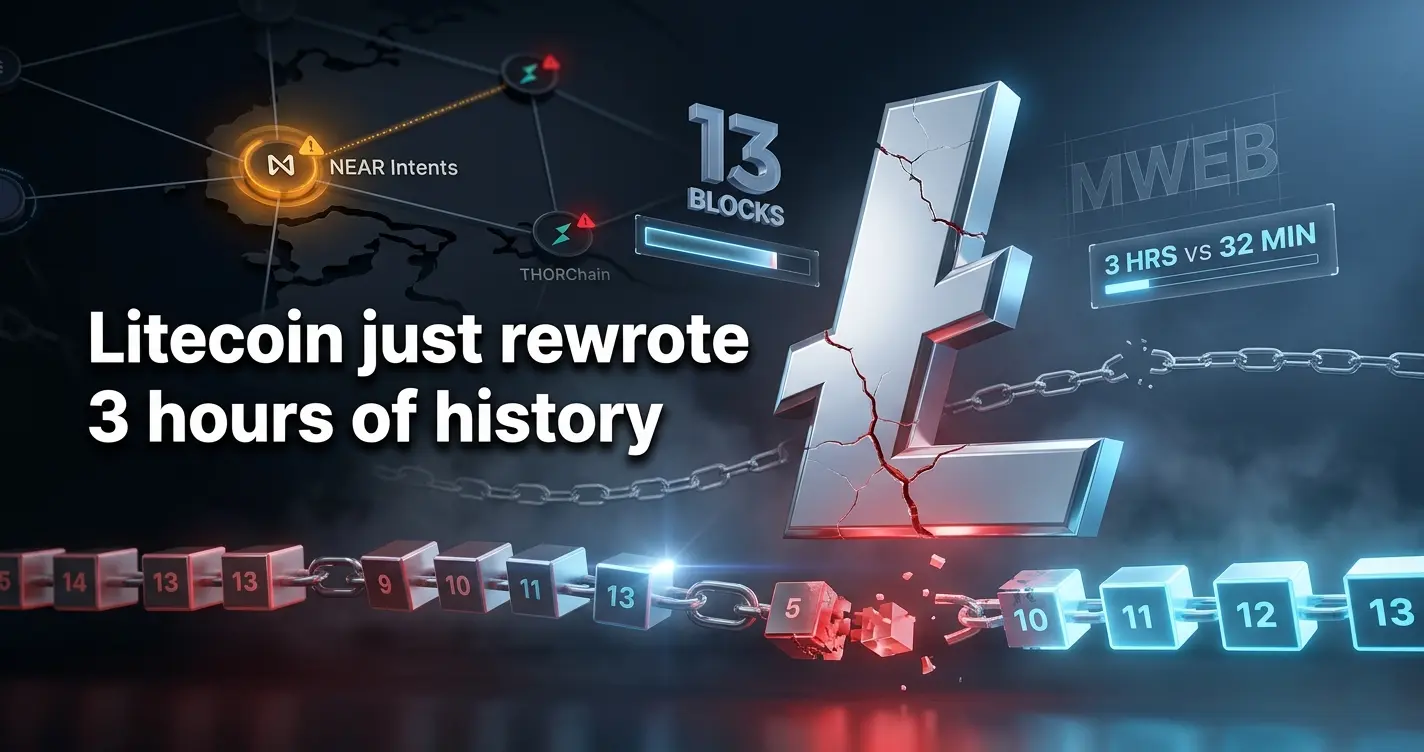
Litecoin just erased three hours of its own history. On April 25, 2026, the Litecoin Foundation confirmed a 13-block chain reorganization triggered by a zero-day vulnerability in its MimbleWimble Extension Block (MWEB) privacy layer. The reorg reversed blocks 3,095,930 through 3,095,943, a stretch that should have taken 32 minutes to produce but instead took more than three hours because a simultaneous denial-of-service attack had hammered major mining pools offline.
The incident is the first major exploit of MWEB since Litecoin activated the privacy upgrade in May 2022. It combined a consensus bug, a coordinated DoS campaign, and fraudulent cross-chain swaps into a single attack sequence that exposed roughly $600,000 in assets on NEAR Intents and caused smaller losses on THORChain. By the evening of April 25, Litecoin Core v0.21.5.4 was out with both fixes applied. The network was declared stable.
But the incident raises questions that a quick patch doesn’t fully answer: about the fragility of opt-in privacy layers, the coordination required to execute a controlled reorg on a live chain, and what it means for “finality” on a proof-of-work network when developers retain the practical ability to roll back history when circumstances demand it.
13Blocks reorganized on Litecoin chain
3 hrsChain history rewritten (normally 32 min)
$600KNEAR Intents exposure from double-spends
~1%LTC price drop after disclosure
What Actually Happened, in Order
The attack began somewhere between midnight and 3:00 AM UTC on April 25. Attackers launched a denial-of-service campaign against major Litecoin mining pools while simultaneously broadcasting invalid MWEB peg-out transactions onto the network. Because a meaningful portion of nodes were running older Litecoin Core versions, those nodes lacked the patched validation logic. They accepted the fraudulent transactions as valid.
This created a chain split. Updated nodes rejected the invalid blocks. Outdated nodes kept building on top of them. The result was a fork in which the “invalid” chain grew for more than three hours, producing 13 blocks at roughly 13.5 minutes per block, about 5.4 times slower than Litecoin’s normal 2.5-minute target. The slowdown itself is a fingerprint of the DoS attack: reduced honest hash power meant fewer miners working on the honest chain, and the invalid chain benefited from the momentary advantage.
Around noon UTC, Aurora Labs CEO Alex Shevchenko flagged the situation publicly. He had spotted what he described as a coordinated attack and had begun tracking the double-spend transactions flowing to cross-chain protocols. At 4:22 PM Eastern (8:22 PM UTC), the Litecoin Foundation posted its official confirmation on X, acknowledging the zero-day bug, the DoS campaign, and the decision to execute a 13-block reorg. Approximately 8 minutes later, Litecoin Core v0.21.5.4 was published.
Official Statement
“All valid operations during this period remain unchanged. The bug has been fully fixed, and the network continues to operate normally.” — Litecoin Foundation, April 25, 2026
The Exploit Mechanics: How MWEB’s Privacy Layer Became an Attack Surface
MWEB is an opt-in privacy layer that uses MimbleWimble cryptography to hide transaction amounts and addresses. Users move LTC from the base chain into extension blocks via a “peg-in” process, transact privately, then exit back to the transparent base chain via “peg-out.” The privacy comes from confidential transactions: amounts are hidden behind cryptographic commitments that nodes verify without seeing the actual values.
The vulnerability lived in the peg-out validation logic. Specifically, a kernel fee overflow error allowed attackers to construct MWEB transactions where input and output commitments summed to zero in a way that appeared valid to unpatched nodes. In practice, this let attackers peg out LTC they hadn’t legitimately pegged in. Invalid coins materialized on the base chain.
The attack had three distinct phases:
Phase
Attack Vector
Effect
Target
1. Disruption
DoS against mining pools
Reduced honest hash power; slowed block production
Updated pool operators
2. Injection
Invalid MWEB peg-out transactions
Fraudulent LTC created on base chain, accepted by unpatched nodes
Non-upgraded node operators
3. Extraction
Cross-chain swaps on DEXes
Fraudulent LTC exchanged for ETH and other assets
NEAR Intents, THORChain
The patch in v0.21.5.4 corrects the input/output accounting, prevents kernel fee overflow during MWEB validation, and instructs miners to exclude MWEB transactions when commitments sum to zero. It also erases block data for mutated blocks to prevent a related miner DoS vector.
Who Got Hit and How Much Was Lost
The clearest loss figure comes from Aurora Labs. Shevchenko publicly stated that NEAR Intents faced exposure of approximately $600,000, identified through on-chain double-spend tracking. His team spotted multiple fraudulent peg-out transactions flowing to cross-chain venues and warned trading platforms in real time.
“We see a lot of double spend transactions.”
Alex Shevchenko, CEO, Aurora Labs
THORChain’s losses came in dramatically lower, reportedly around $500, though exact protocol loss disclosures were still being compiled as of April 26. An independent on-chain analyst using the handle Zacodil flagged the reorg earlier in the day, initially interpreting it as a 51% attack before the MWEB exploit vector was identified.
LTC’s price reaction was notably subdued. The token traded between $56.33 and $56.36 after the incident went public, a drop of roughly 1%. Twenty-four-hour volume on KuCoin sat at $3.75 million, low by historical standards but consistent with muted market panic. The quick resolution, official communication, and same-day patch appears to have contained confidence erosion.
The discrepancy between NEAR Intents’ $600,000 loss and THORChain’s $500 figure warrants attention. It likely reflects different levels of LTC liquidity depth, different MWEB deposit acceptance policies, and the speed at which each protocol’s monitoring systems flagged the anomalous transactions.
The “Zero-Day” Dispute: What the GitHub Commits Actually Show
The Litecoin Foundation called this a zero-day exploit. That framing has been challenged by researchers examining the litecoin-project GitHub commit history.
A zero-day, by definition, is a vulnerability that developers have zero days to respond to because it’s exploited before they’re aware of it. But the consensus vulnerability that enabled the invalid MWEB peg-out was privately patched between March 19 and March 26, 2026, four weeks before the April 25 attack. The code fix existed. What failed was the deployment: not enough node operators had upgraded in the intervening month.
“This isn’t an isolated incident. There have been many of these rollback-and-double-spend attacks against Proof-of-Work-alone blockchains both years ago and recently, including recently against Monero and Grin.”
Zooko Wilcox, Founder, Zcash Foundation
The DoS vulnerability was genuinely patched on the morning of April 25, the same day it was exploited. That one arguably qualifies as a true zero-day. But the consensus bug, the one that enabled the fraudulent peg-outs, had a patch sitting in the repository for a month. The Litecoin Foundation rolled both fixes into v0.21.5.4 and announced them together, which contributed to the unified “zero-day” narrative.
This distinction matters for attribution and for lessons learned. If the consensus bug had been patched but not deployed, the real failure wasn’t in the vulnerability research pipeline. It was in the upgrade coordination pipeline.
Key Distinction
The consensus bug enabling fraudulent peg-outs had a private patch for four weeks before the attack. The DoS bug was patched the same morning it was used. Calling the entire incident a “zero-day” conflates two separate vulnerability timelines.
Reorgs in Historical Context: When Blockchains Rewrite Their Own Rules
The 13-block Litecoin reorg is historically unusual but not unprecedented. In 2013, Bitcoin experienced a 26-block chain fork caused by a database compatibility bug between Bitcoin Core versions 0.7 and 0.8. Developers and miners coordinated to roll back to the older chain. The 2016 Ethereum DAO hard fork was a social consensus decision to override an irreversible theft of approximately $50 million, abandoning “code is law” when the financial stakes demanded it.
Event
Year
Blocks/Scope
Trigger
Outcome
Bitcoin chain fork
2013
26 blocks
Database version incompatibility
Coordinated rollback; chain unified
Ethereum DAO fork
2016
Hard fork (irreversible)
$50M theft via smart contract exploit
ETH/ETC chain split; funds returned
Monero reorg attacks
Recent
Multiple
PoW double-spend campaigns
Ongoing mitigation efforts
Grin attacks
Recent
Multiple
MimbleWimble double-spend exploits
Protocol patches deployed
Litecoin MWEB reorg
2026
13 blocks
MWEB peg-out consensus bug + DoS
Reorg executed; patch deployed
What makes the Litecoin case distinctive is the combination of an optional privacy layer creating divergent node states, and a simultaneous infrastructure attack that bought the attackers time. Zooko Wilcox’s comment about Monero and Grin is worth taking seriously: MimbleWimble-based chains appear to face a recurring pattern of rollback-and-double-spend attacks. Litecoin’s incident is not an outlier. It’s part of a documented category of exploits.
The deeper uncomfortable truth: executing a reorg requires social consensus among miners and developers. That consensus exists. It can be mobilized. And that means proof-of-work “finality” is not the absolute guarantee that its proponents often claim.
Broader Implications for Cross-Chain Protocols and Privacy Layers
For DeFi operators and cross-chain bridge integrators, April 25 delivered a clear message: LTC settlement confirmations need a rethink. Protocols that accepted MWEB peg-outs as final within the 13-block window got hit. Those with deeper confirmation requirements or real-time anomaly detection survived unscathed or with minimal losses.
The incident also exposes a structural tension in opt-in privacy designs. MWEB’s opt-in architecture was praised during its 2022 launch as a way to preserve regulatory compatibility while offering users privacy when they want it. But opt-in means the peg-in/peg-out boundary is where confidential and transparent accounting intersect, and that boundary is exactly where the validation bug lived.
Node upgrade coordination is the unglamorous structural problem this incident clarifies. Privacy protocol integrations on live networks create a window where some nodes operate with new validation rules and others don’t. Any consensus-level bug discovered during that window becomes an exploitable asymmetry. Mandatory upgrade enforcement, via hard forks with firm cutoff dates, may be the only reliable solution, but it comes with its own coordination costs and centralization concerns.
For the broader crypto industry, DeFi losses in 2026 have already exceeded $750 million through mid-April. The Kelp DAO bridge drain on April 19 alone accounted for $292 million. Litecoin’s incident, with $600,000 in confirmed losses, is comparatively small. But it introduces a category of risk that’s harder to price: chain-level state reversion affecting assets that were considered settled.
THORChain and NEAR Intents will both be revisiting their LTC confirmation depth policies. Other cross-chain protocols integrating privacy-enabled chains should treat this incident as a model for pre-exploit security frameworks rather than a post-incident retrospective they file away and forget.
Frequently Asked Questions
A blockchain reorg occurs when nodes on a network switch from one version of the chain’s history to a longer or more valid one. Transactions in the discarded blocks are reversed. In proof-of-work networks, reorgs happen naturally at the single-block level but become incidents when they span multiple blocks and reverse confirmed transactions.
MWEB stands for MimbleWimble Extension Blocks. Activated on Litecoin in May 2022, it’s an opt-in privacy layer that hides transaction amounts and addresses using confidential transaction cryptography. Users can choose to transact privately or use the transparent base chain. The design was intended to add privacy without forcing all users into confidential transactions.
The MWEB peg-out validation had a kernel fee overflow bug. Attackers constructed MWEB transactions where cryptographic commitments summed to zero in a way that bypassed checks on unpatched nodes. This allowed them to exit LTC onto the transparent base chain without having legitimately deposited it, creating coins from nothing that older nodes accepted as valid.
It’s significant, not catastrophic. Most exchanges and protocols consider transactions final after 6 confirmations. A 13-block reorg reverses transactions that many recipients considered irreversibly settled. By contrast, Bitcoin’s 2013 fork involved 26 blocks. The Litecoin Foundation’s quick response and same-day patch limited the financial and reputational damage considerably.
NEAR Intents reported approximately $600,000 in exposure from double-spend transactions. THORChain reported losses of roughly $500. The Litecoin Foundation stated that all valid operations during the affected period remain unchanged, meaning legitimate user transactions were not reversed. The losses fell on cross-chain protocols that accepted the fraudulent peg-outs as genuine LTC.
The Foundation’s statement packaged both vulnerabilities together. The DoS bug was patched the morning of April 25, which qualifies as a genuine zero-day. The consensus bug enabling fake peg-outs had been privately patched in late March, four weeks earlier. Researchers examining GitHub commit history identified this discrepancy. The “zero-day” label accurately describes the DoS component but not the consensus component.
Protocols integrating privacy-enabled L1s should increase confirmation depth requirements for MWEB peg-out transactions, implement real-time anomaly detection for unusual block production times, and establish network health monitoring before processing large LTC swaps. Cross-chain bridges should also consider pausing LTC routes when block times deviate significantly from the 2.5-minute target.
The market reaction, a roughly 1% price drop to around $56, suggests investors don’t see this as existential. The quick resolution and same-day patch demonstrate that Litecoin Core developers can respond under pressure. The more lasting question is whether MWEB’s privacy architecture will face continued scrutiny as a DeFi integration risk, which could suppress LTC adoption in cross-chain use cases.
What Comes Next for Litecoin and the Industry
Litecoin’s MWEB incident is a case study in how layered protocol upgrades create layered attack surfaces. The privacy architecture that MWEB introduced in 2022 was never the conceptual problem. The problem was the inevitable period between patch publication and network-wide deployment, a window during which exploiters knew about the vulnerability and most of the network didn’t. That window lasted four weeks for the consensus bug. That’s four weeks of exposure that a mandatory upgrade mechanism might have eliminated.
The reorg itself will be studied in the context of proof-of-work finality for years. Litecoin’s developers and miners coordinated to roll back 13 blocks of history, which is exactly the kind of social consensus mechanism that proponents of “immutability” argue doesn’t exist, or shouldn’t exist. It does. It was used. It worked. And that cuts in two directions: it’s reassuring that the ecosystem can correct catastrophic errors, and it’s unsettling that the correction mechanism is a distributed social negotiation rather than a deterministic protocol rule.
For cross-chain integrators, the lesson is operational rather than philosophical. Confirmation depth thresholds need to account for the block production rate, not just block count. When Litecoin’s 2.5-minute target extends to 13.5 minutes per block, a 6-confirmation policy that normally delivers 15 minutes of settlement certainty is delivering a very different risk profile. Monitoring block timing should now be part of any protocol’s LTC integration checklist.
Watch for in the Coming Weeks
Mandatory upgrade enforcement proposals from Litecoin Core developers, including potential hard-fork cutoffs for MWEB privacy layer node versions.
Cross-chain protocol policy updates at THORChain, NEAR Intents, and other DEXes integrating LTC, particularly around MWEB peg-out confirmation requirements and anomaly detection thresholds.
Independent security audits of MWEB commissioned by the Litecoin Foundation or third parties, which could surface additional attack vectors in the peg-in/peg-out boundary logic.
Stay current on blockchain security incidents, protocol vulnerabilities, and DeFi risk analysis at NeuralWired.
Follow Blockchain Security Coverage