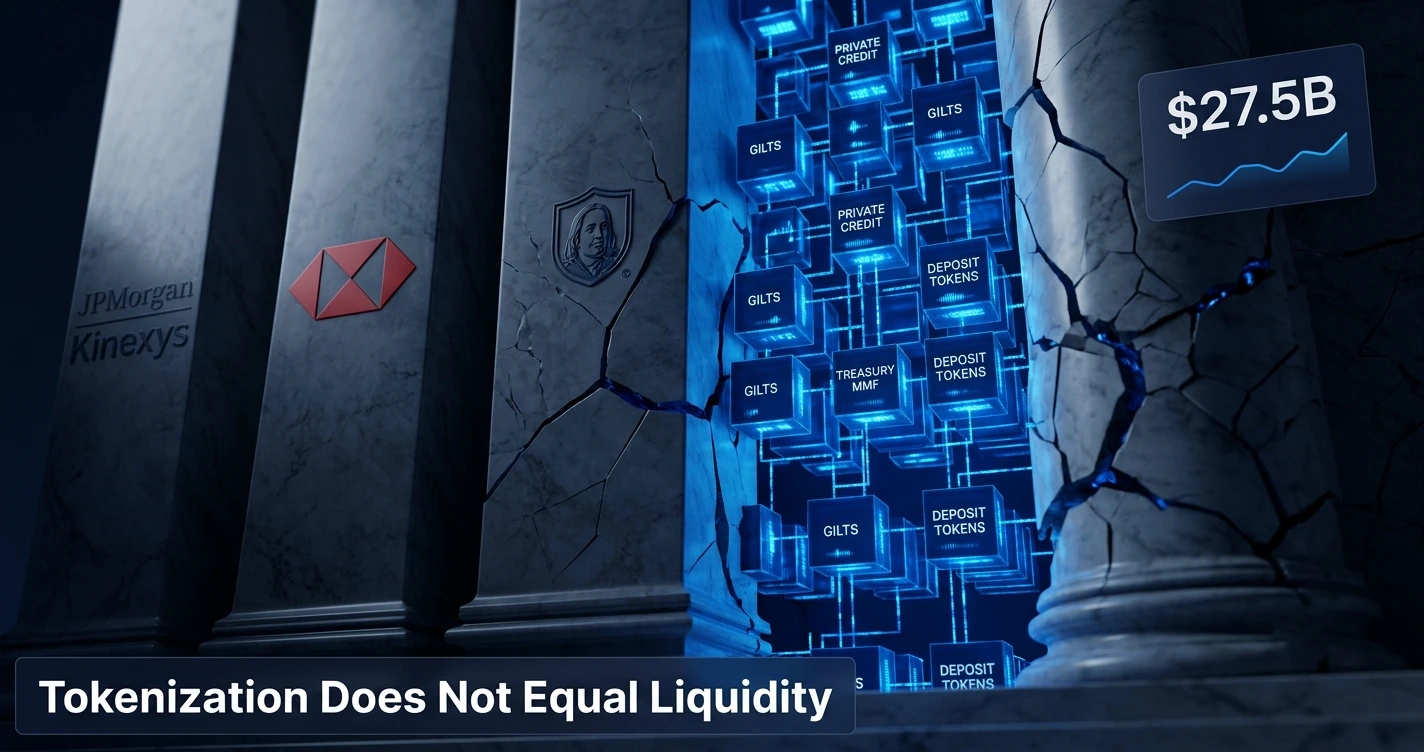
The $27.5 billion real-world asset tokenization market grew 30% in a single quarter. The institutions moving your peers’ capital are not experimenting anymore. Here is what institutional leaders need to understand right now.
By NeuralWired Staff
June 26, 2026
11 min read
In This Article
The Moment That Changed the Conversation Three Institutions, Three Live Systems The Market Numbers That Actually Matter The Honest Problem Nobody in Finance Wants to Say Aloud What Treasury Teams Should Do Right Now FAQ: RWA Tokenization 2026
The Moment That Changed the Conversation
On February 12, 2026, HM Treasury announced that the UK’s Digital Gilt Instrument (DIGIT) pilot would run on
HSBC Orion , making the United Kingdom the first G7 nation to issue sovereign debt on a blockchain. Not a test token. Not a sandbox simulation. Actual gilts, on a live platform, in a market holding more than £2 trillion in outstanding government debt.
That is the sentence that separates 2026 from every prior year in the tokenized real-world asset (RWA) conversation. Not a corporate press release. A government. A sovereign bond market. A blockchain-native issuance mechanism built by a 160-year-old bank. If you are still treating RWA tokenization as an emerging technology worth watching, you are roughly two years behind the institutions already moving production volume.
This article is not about whether tokenization will happen. It already is. It is about what is actually live, what the real numbers say, where the genuine risks sit, and specifically what treasury teams and institutional allocators should change about how they operate before the end of 2026.
Three Institutions, Three Live Systems
JPMorgan Kinexys: The Biggest Desk With the Most Honest Chief
JPMorgan’s blockchain unit, formerly called Onyx and rebranded Kinexys in 2024, runs what is arguably the most consequential institutional tokenization infrastructure in the world right now. On January 7, 2026,
Digital Asset and Kinexys announced the intent to bring JPM Coin (JPMD) natively to the Canton Network as the first bank-issued USD-denominated deposit token. That integration is rolling out in phases throughout 2026.
The person now running this operation is Oliver Harris, hired from Goldman Sachs on April 29, 2026. Harris is on record saying something that most institutions running tokenization roadshows desperately do not want you to hear:
“Tokenization does not equal liquidity.”
Oliver Harris, Head of Kinexys, JPMorgan. Said at Consensus Toronto panel, April 2026. Source: CoinDesk
The head of the largest bank tokenization desk in the world is explicitly correcting his own industry’s central marketing claim. That is not a reason to dismiss Kinexys. It is a reason to take it seriously. Harris is not a skeptic sitting on the sidelines. He is a practitioner warning that the infrastructure layer and the liquidity layer are two very different problems, and only one of them is close to solved.
HSBC Orion: From Pilot to Sovereign Infrastructure
HSBC Orion has now processed landmark transactions across multiple asset classes and jurisdictions: MENA’s first digital bond, the European Investment Bank’s first sterling digital bond, Hong Kong’s multi-currency digital bond, and Luxembourg’s first digital treasury certificates. That is not a product in beta. That is a production platform with a growing sovereign client list.
John O’Neill, HSBC’s Group Head of Digital Assets and Currencies, made the institution’s position explicit earlier this year:
“At HSBC, we view digital assets, such as digitally native bonds, as a mainstream subject, because our clients see it that way.”
John O’Neill, Group Head of Digital Assets and Currencies, HSBC. Source: Disruption Banking, February 2026
In April 2026, HSBC completed a simulated pilot of tokenized deposits on the public Canton Network, marking the first time its Tokenized Deposit Service (TDS) ran on a public blockchain. The service is now available in the US. HSBC also launched live UAE dirham tokenized deposits on Orion, making the dirham the sixth currency on the platform after the euro, pound, US dollar, Hong Kong dollar, and Singapore dollar.
The retail layer is not standing still either. HSBC’s Gold Token, launched in March 2024 as the only SFC-approved retail gold token in Hong Kong, surpassed $1 billion in trading volume with over 100,000 transactions as of November 2025. This is no longer institutional-only infrastructure.
Franklin Templeton BENJI: Five Years of Live Data
Franklin Templeton’s BENJI token, representing the Franklin OnChain US Government Money Fund (FOBXX), launched on Stellar in 2021 as the first US-registered mutual fund to use a public blockchain as its official system of record. Five years in, this is not a proof of concept. It is a data set.
As of June 24, 2026, the BENJI suite holds $2.5 billion in on-chain assets under management, up from $1.98 billion as recently as April 29. That is roughly 26% growth in two months. The number of investors grew more than 140% between April 2024 and March 2026, and cumulative peer-to-peer transfer volume has crossed $211 million.
On June 25, 2026, Swiss-licensed digital asset infrastructure firm SCRYPT integrated BENJI to manage its own treasury operations. A regulated counterparty using tokenized cash rails for its own balance sheet, not just for clients, is a different kind of signal than another fund product launch.
“In 2021, BENJI was the first of its kind, and five years later, it continues to set the standard for how this industry moves capital, delivers yield, and operates in-market.”
Sandy Kaul, Head of Digital Assets and Innovation, Franklin Templeton. Source: Stellar.org, April 30, 2026
The Market Numbers That Actually Matter
The headline figure floating around most coverage of RWA tokenization is $16 trillion by 2030, sourced from a 2022 BCG and ADDX report. That number is not wrong in the sense that it is fabricated. But it is wrong in the sense that BCG itself revised the estimate in 2025 to roughly $9.4 trillion by 2030, and the current on-chain market sits well below $30 billion. The gap is real and it deserves to be named before it is explained away.
$27.5B
On-chain RWA value (ex-stablecoins), end of Q1 2026
30%
Quarterly growth rate, Q1 2026
$13.4B
Tokenized US Treasuries, early April 2026
$16.8B
Tokenized private credit market size, April 2026
Sources:
RWA.xyz live analytics; 4irelabs April 2026 report. The $13.4 billion tokenized Treasuries figure includes BlackRock’s BUIDL ($2.4B), Circle’s USYC ($2.7B), Ondo’s suite ($2.6B), and Franklin Templeton’s BENJI fund ($1.0B at the time of that snapshot).
The most honest framing of where this market sits comes from the analyst layer, not the institutional marketing layer. Analysts tracking the growth trajectory argue the relevant near-term question is not whether the $16 trillion forecast is achievable by 2030. The real question is whether the market reaches a highly functional $100 billion to $500 billion range, which would represent the threshold where secondary liquidity becomes meaningful and infrastructure investment makes economic sense across a broader range of asset classes.
For context, consider how wide the institutional forecast spread actually is:
Institution
2030 Forecast
Methodology Note
BCG / ADDX (2025 revision)
~$9.4 trillion
Revised down from original $16.1T; includes broad asset classes
McKinsey
~$2 trillion
Conservative; focuses on near-term addressable market
Citigroup
$4 to 5 trillion
Mid-range; accounts for regulatory friction
Standard Chartered / Synpulse
$30.1 trillion by 2034
Broader definition including derivatives and real estate
Chainlink
$10 to 16 trillion
Aligned with original BCG upper range
A 15x spread among credible institutional forecasters is itself informative. It tells you the underlying assumptions, primarily around regulatory speed and secondary market infrastructure, are not settled. Anyone selling certainty around the $16 trillion figure is selling something other than analysis.
Key Insight
The current on-chain RWA market sits roughly 1,300 times below BCG’s original $16 trillion 2030 target. That gap is either the largest investment opportunity in financial infrastructure history or a measure of how far forecasts have run ahead of reality. Probably both.
The Honest Problem Nobody in Finance Wants to Say Aloud
Oliver Harris said it at Consensus Toronto, but it bears repeating with the specifics attached. Tokenization does not equal liquidity. And the data backs this up in a way that most institutional marketing materials will not show you.
As of early 2026, approximately 80% of the tokenized RWA market is institutional, and the ratio of secondary trading volume to outstanding tokenized value remains low. Most tokenized assets are held rather than traded. A $27.5 billion market where the vast majority of positions sit static does not function like a liquid market. It functions like a distributed ledger of held-to-maturity positions with better settlement mechanics.
That is genuinely useful. Faster settlement, 24/7 operations, programmable yield distribution, and reduced counterparty risk are real advantages, and BENJI distributes yield daily, including weekends, which reduces idle-cash drag for multinational treasuries operating across time zones. But these are operational improvements, not liquidity creation.
The IMF raised a related concern in a May 11, 2026 analysis that received far less attention than it deserved. Automated margin calls triggered by price movements can force rapid asset sales in ways that reinforce procyclical dynamics in a 24/7 environment. Central bank backstop mechanisms, designed around business-day settlement cycles, are structurally misaligned with always-on tokenized markets. Algorithmic risk propagates instantaneously and without human intervention. That is a systemic-risk argument that exists entirely outside the promotional literature coming from bank tokenization desks.
Risk Flag for Treasury Teams
A tokenized RWA market concentrated in a single asset class, specifically US Treasuries at $13.4 billion of the $27.5 billion total, is structurally exposed to a single regulatory decision. Analysts have noted the market is, in that sense, one policy change away from a significant drawdown in on-chain value. Diversification across tokenized asset classes is not just portfolio strategy. It is systemic risk management.
There is also the regulatory patchwork problem, which is frequently acknowledged and rarely solved. The EU’s DLT Pilot Regime initially struggled with uptake partly because its issuance caps (€6 billion) were set too conservatively to attract meaningful volume. The UK’s DIGIT pilot restricts participation to institutional investors in the Digital Securities Sandbox. The US GENIUS Act is still in rulemaking. Cross-border treasury strategies built on tokenized rails must currently navigate three different regulatory frameworks with three different maturity timelines. There is no single global rulebook, and there is not likely to be one within the 2026 to 2027 window.
What Treasury Teams Should Do Right Now
If you are a CFO or treasury lead at a multinational, the window where “we’re evaluating tokenized rails” was an acceptable answer has closed. Here is what actually needs to happen in the next six to twelve months.
Evaluate Tokenized Deposit Rails as Production Cash Management
HSBC’s Tokenized Deposit Service is now available in the US and runs across six currencies including the UAE dirham, euro, pound, US dollar, Hong Kong dollar, and Singapore dollar. JPM Coin is rolling out on the Canton Network through 2026. These are not R&D experiments. They are production cash-management alternatives to correspondent banking windows, with 24/7 settlement and reduced intraday liquidity requirements. Your treasury team should be running a live comparison of transaction costs and settlement times against current correspondent banking arrangements.
Treat Tokenized Money-Market Funds as a Cash-Equivalent Category
BENJI and BlackRock’s BUIDL have cleared the threshold where they deserve a formal policy position in your treasury investment guidelines. BENJI at $2.5 billion AUM with daily yield distribution (including weekends) is directly competitive with traditional money-market funds for multinational treasuries holding cash across time zones. The question is not whether tokenized MMFs are legitimate instruments. They are. The question is what your internal policy says about them and whether that policy is current.
Do Not Buy the Liquidity Pitch at Face Value
If a counterparty or platform is selling you tokenized RWAs on the promise of instant exit liquidity, ask them to show you secondary trading volume as a percentage of outstanding value for the specific instrument. The aggregate figure for the market is low. Some instruments will be worse. Treat most tokenized RWAs as held-to-maturity equivalents for operational planning, not as a mechanism to access rapid exits on illiquid positions.
Map Your Regulatory Exposure by Jurisdiction
Build a simple jurisdiction map of your treasury operations against current tokenization regulatory frameworks: EU DLT Pilot Regime, UK Digital Securities Sandbox, US GENIUS Act rulemaking status, Hong Kong SFC approvals. This is a six-hour exercise that will surface the specific gaps between where you operate and where the regulatory infrastructure is actually in place. Do it before a counterparty asks you to.
Our Read
The six to eighteen month window matters most for treasury teams that operate across US, EU, and APAC jurisdictions simultaneously. The regulatory frameworks are moving at different speeds, but the infrastructure is converging. Institutions that establish internal policy positions on tokenized deposits and tokenized money-market funds now will have a significant operational advantage when cross-border settlement windows tighten further.
FAQ: RWA Tokenization 2026
What is real-world asset (RWA) tokenization?
RWA tokenization converts ownership rights of physical or financial assets, including bonds, real estate, private credit, and commodities, into digital tokens on a blockchain. This enables fractional ownership, faster settlement, and 24/7 transferability while the underlying asset remains subject to existing legal and regulatory frameworks. The token represents a claim on the asset, not a replacement of the underlying legal structure.
How big is the tokenized real-world asset market in 2026?
On-chain RWA value, excluding stablecoins, grew from approximately $21 billion at the start of 2026 to roughly $27.5 billion by the end of Q1 2026, a 30% quarterly increase, according to RWA.xyz. That figure is well below long-term trillion-dollar forecasts but reflects institutional-paced compounding growth, not retail speculation. The tokenized US Treasuries segment alone reached $13.4 billion by early April 2026.
Is the $16 trillion tokenization forecast realistic?
The $16 trillion figure originated from a 2022 BCG and ADDX report projecting that 10% of global GDP gets tokenized by 2030. BCG’s own 2025 update revised this to roughly $9.4 trillion by 2030, and the current on-chain market sits well below $30 billion. Forecasts from credible institutions range from $2 trillion (McKinsey) to $30 trillion (Standard Chartered by 2034), a spread that reflects unresolved assumptions about regulatory timelines, not just rounding differences.
What banks are leading RWA tokenization in 2026?
JPMorgan (Kinexys platform and JPM Coin on the Canton Network), HSBC (Orion platform, powering the UK’s DIGIT gilt pilot), Franklin Templeton (BENJI tokenized money-market fund at $2.5 billion AUM), and BlackRock (BUIDL fund at $2.4 billion) are the most prominent institutional leaders in 2026. Each operates a production system, not a prototype.
Does tokenization create liquidity for illiquid assets?
Not automatically. JPMorgan’s own Kinexys chief, Oliver Harris, stated at Consensus Toronto in April 2026 that “tokenization does not equal liquidity.” Secondary trading volume as a percentage of outstanding tokenized value remains low across the market. Tokenization improves settlement mechanics, reduces intermediary friction, and enables programmable yield, but it does not create buyers where none exist for the underlying asset.
What is HSBC Orion and how is it used for sovereign bonds?
HSBC Orion is HSBC’s digital asset issuance platform, used to issue and settle digitally native bonds and tokenized deposits. In February 2026, HM Treasury selected Orion as the platform for the UK’s Digital Gilt Instrument (DIGIT) pilot, making the UK the first G7 nation to issue sovereign debt via blockchain. HSBC Orion has now processed over $3.5 billion in cumulative digitally native bond issuance across sovereign, supranational, and corporate sectors.
Where This Goes in the Next 12 to 18 Months
The structural shift already underway points to three developments worth tracking closely through the end of 2026 and into 2027.
First, the DTCC, Nasdaq, and NYSE have moved toward integrating tokenized securities into regulated market architecture as of Q1 2026. When exchange-level infrastructure aligns with tokenized settlement rails, the secondary liquidity problem becomes structurally different. Not solved, but different.
Second, the regulatory frameworks in the UK, EU, and US are each reaching inflection points. The UK DIGIT pilot will produce data that directly informs whether the Digital Securities Sandbox expands its participation criteria. The US GENIUS Act rulemaking will clarify the deposit token regulatory environment that JPM Coin and HSBC TDS are operating in. Watch the rulemaking timeline, not just the market cap figures.
Third, the SCRYPT integration of BENJI for internal treasury operations in June 2026 will not be the last. Regulated counterparties using tokenized cash rails for their own balance sheets, rather than just as client products, is the signal that adoption has crossed from product distribution into operational infrastructure. That shift accelerates adoption in ways that fund launches alone do not.
What you now understand that you may not have before reading this: the RWA tokenization market is real, growing, and already producing sovereign-grade infrastructure. It also has genuine structural problems in secondary liquidity, regulatory fragmentation, and systemic risk design that the promotional materials skip over. The institutions winning in this space are the ones treating both the opportunity and the constraints as equally real.
Stay Ahead of Institutional Finance
The Neural Loop covers what actually matters in technology and finance, without the noise. Join thousands of treasury professionals and institutional investors who read it every week.
Subscribe to The Neural Loop
Blockchain Interoperability Standards 2026: ISO’s New Rules
Enterprise Blockchain
Blockchain Interoperability Standards 2026: ISO’s New Rules
NeuralWired Research Desk | Updated June 15, 2026
Your supply chain team just finished moving inventory provenance onto Hyperledger Fabric. Your banking partner’s tokenized bond pilot runs on a private Ethereum fork. Neither system can confirm a transaction from the other without a custom integration that took most of a year to build and now costs six figures annually to keep running. Sound familiar?
That gap is exactly what blockchain interoperability standards in 2026 are finally built to close, and the timing isn’t an accident. In March 2026, the International Organization for Standardization published
ISO/TS 23516:2026 , listed under standard number 82098, the first globally ratified interoperability framework for distributed ledger technology. Around the same time, Chainlink’s Cross-Chain Interoperability Protocol (CCIP) crossed $30 trillion in cumulative transaction value, and hackers stole $328.6 million from cross-chain bridges in the first five months of the year alone.
Three things are true right now, all at once: the standards exist, institutional money is already moving through them, and the attack surface is expanding faster than most security teams can patch it. If you run an enterprise blockchain roadmap, the question isn’t whether any of this matters. It’s which standard you build around, and what it costs if you pick wrong.
In this article
ISO 82098 is published, and it changes procurement Blockchain interoperability standards 2026: the field is multiplying, not converging Where the institutional money already moved The bridge security crisis nobody’s pricing in What this means for your stack, starting now The contrarian case: why not to bet the stack yet FAQ Blockchain interoperability standards 2026: what to watch next
ISO 82098 Is Published, and It Changes Procurement
Here’s what actually happened. ISO Technical Committee 307, the body responsible for blockchain and distributed ledger standards, formally published ISO/TS 23516:2026 in March 2026. It’s a 24-page framework that specifies how DLT systems connect to each other and to systems outside the DLT world entirely, covering the relationships, interactions, and cross-cutting pieces that make that possible. The document sits at Stage 60.60 on ISO’s status scale, meaning it’s fully published, not a draft, and a copy is available directly from ISO for CHF 135.
The path here took almost ten years. Gilbert Verdian, CEO and founder of Quant Network, established the Blockchain ISO Standard TC307 initiative back in 2015 and served as convenor of Working Group 7, the specific group tasked with the interoperability framework. He partnered with Standards Australia to push the work through the national standards bodies of more than 57 countries.
“an internet of trust, where value can be securely transferred between global partners”
Gilbert Verdian, CEO and Founder, Quant Network
Why should an enterprise architect care about a 24-page ISO document? Because “is your platform aligned with ISO 82098” just became a fair line item on a vendor RFP, something it genuinely wasn’t before March 2026. The standard’s core idea is a multi-gateway architecture: any DLT can connect to another without requiring protocol changes on either side. Quant’s own Overledger platform was reportedly built on the same architectural principles (Quant clearly has a stake in this being a big deal, but the architecture itself is now documented in an international standard, not just a product pitch).
Blockchain Interoperability Standards 2026: The Field Is Multiplying, Not Converging
Here’s the part the celebratory headlines tend to skip. ISO 82098 is a framework, a way of thinking about interoperability. It is not a protocol you install on Monday morning. And in 2026, enterprises are choosing from a wider field of competing standards than they were twelve months ago, not a narrower one.
Standard
Governing body
Published
What it covers
2026 status
ISO/TS 23516:2026 (82098)
ISO/TC 307
March 2026
Architectural framework for DLT interoperability
Published, Stage 60.60
IEEE Std 3221.01-2025
IEEE
2025
Cross-chain transaction consistency protocol (notary, HTLC, relay-chain models)
Active
ERC-7683
Across Protocol, Uniswap Labs, Ethereum Foundation
2024 to 2025
Intent-based cross-chain value transfer
30+ teams via Open Intents Framework
Chainlink CCIP / CCT
Chainlink Labs
July 2023
Oracle-secured cross-chain messaging and token standard
60+ networks, on AWS since June 2026
Cosmos IBC
Interchain Foundation
Ongoing
Sovereign chain-to-chain messaging via light clients
115+ networks
Polkadot XCM
Web3 Foundation / Parity
Ongoing
Shared-security parachain messaging
Phased rollout, partial HRMP reliance
IEEE Std 3221.01-2025 , published on IEEE Xplore as document 11039181, takes a different approach entirely. It defines a cross-chain transaction consistency protocol built around three technical models: centralized or multi-signature notary-based systems, HTLC-based (hashed time-lock contract) systems, and relay-chain-based systems. None of those three models matches ISO 82098’s multi-gateway framework, and the two standards bodies aren’t coordinating on a shared spec.
On the Ethereum side, ERC-7683 (built by Across Protocol and Uniswap Labs) introduces something genuinely different: an intent-based model. Instead of choosing a specific bridge route, a user states the outcome they want, and a network of competing solvers figures out how to deliver it. The Ethereum Foundation backed this direction with its Open Intents Framework, supported by more than 30 teams including Arbitrum, Optimism, Polygon, and zkSync. Uniswap has already wired Across’s intent infrastructure into its main interface and wallet, so this isn’t theoretical. Millions of people are using it without knowing the standard’s name.
Then there’s the Cosmos versus Polkadot question, which has been running for years and isn’t close to resolved. Cosmos IBC (Inter-Blockchain Communication) is live across 115+ networks, including Osmosis, dYdX, and Celestia, each running as a fully sovereign chain on the Cosmos SDK. IBC Eureka, which launched in April 2025, connects Ethereum directly to Cosmos chains with no asset wrapping required, and expansion to Solana and major Ethereum Layer 2 networks is planned through the rest of 2026. Polkadot, meanwhile, approved a hard supply cap of 2.1 billion DOT in March 2026, cutting annual issuance by 53.6%, a move some in the community nicknamed the “Polkadot Halving.” Polkadot ranks first in developer commits for 2026, yet its total DeFi value locked still sits under $300 million, and its XCM messaging protocol was still completing a phased rollout as of May 2026, with plenty of chains still relying on the older HRMP protocol underneath it.
If you’re still deciding which base chain to build on before you even get to the interoperability question, NeuralWired’s recent comparison of
Ethereum, Solana, and Hyperledger for enterprise deployments is a useful starting point.
Where the Institutional Money Already Moved
Standards bodies move slowly. Money moves fast, and in 2026, the money has already picked some early favorites.
Chainlink’s CCIP launched on mainnet in July 2023 and now connects more than 60 blockchain networks. As of June 2026, it has processed over $30 trillion in cumulative transaction value and handles roughly $18 billion in monthly volume. Cross-chain transfers through CCIP surged 1,972% to $7.77 billion over 2025. In June 2026, Chainlink’s AWS Marketplace integration went live, which matters more than it sounds: enterprises can now provision cross-chain capability through the same cloud procurement process they already use for everything else, with no separate crypto-native onboarding required. CCIP is also the only data and interoperability oracle platform with SOC 2 Type 2, SOC 2 Type 1, and
ISO/IEC 27001:2022 certification , validated by Deloitte & Touche LLP. Projects building on Chainlink’s Cross-Chain Token standard, including ElizaOS, The Graph, Maple Finance, and Zeus Network, have unlocked access to more than $19 billion in assets through CCIP. In Fortune’s 2026 Crypto 100 ranking, Chainlink came in fourth, behind only Bitcoin, Ethereum, and Solana.
On the traditional finance side, Swift completed a
digital asset interoperability trial on January 19, 2026, with BNP Paribas Securities Services, Intesa Sanpaolo, and Societe Generale’s blockchain arm, SG-Forge. The trial demonstrated coordinated exchange and settlement of tokenized bonds, covering delivery-versus-payment settlement, interest payouts, and bond redemptions, with SG-Forge providing EURCV stablecoin support for the settlement leg. It’s one of the first times a tokenized asset transaction was orchestrated end to end across multiple separate infrastructures, not just inside one bank’s sandbox.
“Interoperability is at the heart of everything we are doing at Swift”
Tom Zschach, Chief Innovation Officer, Swift
Put those two data points together. CCIP gives enterprises a cloud-procurable, certified cross-chain pipe. Swift gives them a path to plug that pipe into the existing network of more than 11,000 banks. That combination is the actual bridge the headlines keep promising, not a future roadmap item.
For more on how banks are weighing this against traditional risk models, see NeuralWired’s recent look at
JPMorgan, DeFi vs. banks: the real risk comparison for 2026 .
The Bridge Security Crisis Nobody’s Pricing In
Now for the part that should make every CTO pause before signing a cross-chain integration contract.
As of mid-May 2026, there had been eight major cross-chain bridge attacks in the year, with hackers stealing approximately $328.6 million, according to PAShield’s monitoring data. The single largest 2026 incident hit on April 18, when Kelp DAO lost $292 million after attackers forged a fake LayerZero message. In May 2026 alone, bridge exploits accounted for roughly $28.6 million of about $70 million in total crypto losses, that’s 42% of the month’s damage coming from a category of protocol that holds only a small slice of total value locked across DeFi. April 2026 was even worse industry-wide: total DeFi breaches exceeded $606 million. And in January 2026, attackers stole nearly $400 million across more than 40 separate incidents tracked by CertiK.
Zoom out further and the pattern gets starker. 2025 was the worst year on record for crypto theft, with losses exceeding $1 billion. Cross-chain bridges specifically have been hacked for more than
$2.8 billion to date , roughly 40% of every dollar ever stolen from Web3. And private key compromises, not exotic smart contract bugs, accounted for 88% of stolen funds in Q1 2025 alone, a trend that continued into 2026.
The Hyperbridge incident on April 13, 2026, is the one worth studying closely, because the actual loss ($237,000) massively understates how bad it could have been. A vulnerability in Hyperbridge’s Token Gateway, specifically in the validation logic of its EthereumHost contract, let an
attacker mint $1 billion worth of DOT on Ethereum out of thin air. They only cashed out a fraction of that before the exploit was caught, but the architecture briefly allowed for a nine-figure theft from a single contract bug. Hyperbridge’s own team, in their incident write-up, put the broader context bluntly.
“more than $2 billion in cumulative bridge losses across the industry”
Hyperbridge team, incident report via Cryptonomist
None of this is new, exactly. The Ronin Bridge hack ($624 million, March 2022) and the Wormhole exploit ($320 million, February 2022) already proved that bridges relying on small validator sets or multisig approvals are structurally fragile. What’s new in 2026 is the scale of total value flowing through these systems. Researchers at Yellow.com made the uncomfortable point that even if the percentage of bridged funds stolen stays flat, the absolute dollar amount stolen keeps climbing as total bridge value grows faster than security practices mature.
Key insight
If your cross-chain architecture depends on a validator set or multisig that can mint or release funds based on a single incoming message, you’re running the exact pattern that has cost the industry over $2.8 billion since 2022. ISO 82098’s multi-gateway model and CCIP’s oracle-secured design exist specifically to break that pattern. Ask your vendor, in writing, which model they actually use, before the contract is signed, not after the postmortem.
Zero-knowledge proofs are emerging as one alternative to validator-based bridge security, and NeuralWired covered what that shift means for enterprise privacy in
Zero-Knowledge Proofs: Enterprise Privacy Guide 2026 .
What This Means for Your Stack, Starting Now
All of this is interesting in the abstract. Here’s what it actually changes on your roadmap.
If you’re a CTO or architect
ISO 82098 alignment is now a fair question to put in front of any blockchain vendor. CCIP’s arrival on AWS Marketplace means cross-chain capability can be provisioned through procurement channels you already have approved, removing what used to be a real organizational barrier, a separate crypto vendor onboarding process that could take months on its own. The decision in front of you isn’t whether to enable interoperability anymore. It’s which standard to build around, and what a migration looks like in two years if that bet doesn’t pan out.
If you’re running an existing deployment
Hyperledger Fabric, R3 Corda, and single-chain Ethereum setups all have a credible upgrade path through ISO 82098’s multi-gateway architecture, without requiring protocol changes to your existing chain. CCIP’s SOC 2 Type 2 and ISO/IEC 27001:2022 certifications also give compliance teams in regulated industries, banking, insurance, healthcare, documented evidence they can point to during procurement reviews, instead of relying on a vendor’s word.
If you’re building
The practical 2026 stack looks like this: ERC-3643 (T-REX) for regulated assets, which already underpins more than $32 billion in tokenized real-world assets, ERC-4626 for yield-bearing products, EIP-7702 for user-facing wallets, and ERC-7683 for cross-chain operations. For the connective layer, that means Cosmos SDK and ibc-go for IBC-native apps, Polkadot SDK with Cumulus for XCM parachain integrations, and Chainlink’s CCIP documentation for Router contract setup on EVM-compatible chains. These aren’t interchangeable. Network fit, security model, and performance profile differ in ways that matter for production systems. One concrete number: CCIP execution latency runs roughly 15 minutes on Ethereum routes, 17 minutes on Arbitrum, and 20 minutes on Solana. If your use case needs near-real-time settlement, that’s a planning constraint, not a footnote.
If your enterprise use case leans more toward supply chain than finance, NeuralWired’s deep dive on
Walmart, TradeLens, and blockchain supply chain management in 2026 covers the non-financial side of this same interoperability question.
The Contrarian Case: Why Not to Bet the Stack Yet
Everything above paints 2026 as the year interoperability finally arrived. Here’s the case for slowing down.
First, the framework-versus-protocol distinction matters more than most coverage admits. ISO 82098 tells you how to think about interoperability architecture. It doesn’t make ISO 82098, IEEE 3221.01-2025, ERC-7683, Chainlink’s CCT standard, Cosmos’s IBC interchain standards, and Polkadot’s XCM format talk to each other. None of those six are fully interoperable with each other today, despite all of them sitting under the broad “interoperability standard” label.
Second, a
peer-reviewed analysis published in MDPI’s Systems journal in April 2026 found that most current interoperability approaches still focus primarily on cryptocurrency-based use cases rather than the broader, data-driven applications enterprises actually need, and that platform-specific solutions like IBC and XCM remain limited to their own networks rather than working across genuinely different blockchain types.
Third, the security math doesn’t close. The 2026 bridge attack tally exists despite years of claimed security improvements following Ronin and Wormhole. If anything, the dollar exposure keeps growing precisely because adoption is outpacing the security work.
Fourth, the gap between developer activity and actual enterprise transaction volume is real. Polkadot leads in developer commits but sits under $300 million in DeFi TVL. That’s a network where a lot of building is happening and not much enterprise money has shown up yet, at least not at the scale CCIP or IBC can claim.
One prediction circulating in industry commentary, attributed to Delphi Digital, claims 60% of interoperability protocols will disappear by 2027 as the field consolidates around standards like IEEE 3221.01-2025 and ERC-7683. We couldn’t independently verify the original source for that figure, so take it as a read on industry anxiety rather than confirmed research. Either way, the direction of travel it describes lines up with everything else in this section.
Our read: the consolidation pressure is real even if that specific 60% figure isn’t verifiable. When Cosmos IBC has 115+ networks and CCIP has 60+, and Polkadot’s own roadmap hasn’t kept pace with its developer activity, somebody’s interoperability bet is going to look expensive within the next 18 months. The honest answer for most enterprises in 2026 is to build to ISO 82098’s principles, multi-gateway, no required protocol changes, while choosing an execution layer, CCIP, IBC, or otherwise, based on where your actual counterparties already are, not on which standard has the loudest marketing budget.
FAQ: Blockchain Interoperability Standards 2026
Here are the questions enterprise teams are actually asking about blockchain interoperability standards in 2026, answered directly.
What is blockchain interoperability?
It’s the ability for separate blockchain networks, public or private, to exchange data and assets directly without a middleman translating between them. Most networks have operated as closed systems. ISO/TS 23516:2026 is the first internationally ratified framework for how that connection should actually work.
What is ISO 82098?
ISO/TS 23516:2026, also listed as standard 82098, is a 24-page framework published in March 2026 by ISO Technical Committee 307. It defines how distributed ledger systems can connect to each other and to outside systems, using a multi-gateway model that doesn’t require changing the underlying chains.
What is Chainlink CCIP?
CCIP is Chainlink’s cross-chain protocol for moving tokens and data across more than 60 blockchain networks. Live since July 2023, it has processed over $30 trillion in cumulative transaction value and is the only interoperability platform with SOC 2 Type 2 and ISO/IEC 27001:2022 certification.
What are the risks of cross-chain bridges?
Cross-chain bridges remain the most exploited part of crypto infrastructure, responsible for roughly $2.8 billion in losses to date, about 40% of all Web3 hacks. In 2026 alone, eight major attacks cost $328.6 million through mid-May, including a $292 million theft from Kelp DAO using a forged message.
What is the difference between Cosmos IBC and Polkadot XCM?
Cosmos IBC lets each connected chain keep its own validator set and security, verifying cross-chain transfers through light clients, no wrapped assets needed, across 115+ networks. Polkadot’s XCM routes messages through a shared Relay Chain for unified security, but its rollout was still incomplete as of mid-2026.
What is ERC-7683?
ERC-7683, built by Across Protocol and Uniswap Labs, lets users state the outcome they want for a cross-chain transfer, then leaves competing solvers to find the best execution path. The Ethereum Foundation backs it through the Open Intents Framework, supported by more than 30 teams including Arbitrum and Optimism.
Which blockchain interoperability protocol is best for enterprises?
It depends on your compliance needs and existing chain. Regulated firms generally lean toward Chainlink CCIP for its SOC 2 and ISO 27001 certification. Teams building sovereign application chains tend to pick Cosmos IBC. ISO 82098 gives every option a common framework to evaluate against.
Blockchain Interoperability Standards 2026: What to Watch Next
Here’s what’s different now that you’ve read this. “Blockchain interoperability standard” in 2026 isn’t one thing, it’s a stack of overlapping standards: an ISO framework for architecture, an IEEE protocol spec for transaction consistency, Ethereum’s intent-based standards for user-facing swaps, Chainlink’s CCIP for institutional-grade messaging, and Cosmos IBC or Polkadot XCM depending on which chain network you’re already in. All of them are competing for the same enterprise budgets in 2026, and none of them talk to each other yet.
Over the next 6 to 18 months, expect three things to play out. CCIP’s planned Q4 2026 production launch for securities post-trade settlement, the closest thing to a DTCC-equivalent on-chain, will be the real stress test for whether institutional money trusts this infrastructure at scale. IBC Eureka’s expansion to Solana and major Ethereum Layer 2 networks should give Cosmos a credible foothold outside its own network for the first time. And if the consolidation pressure described above is real, expect at least a handful of smaller interoperability protocols to get acquired, fold into a larger standard, or quietly stop development.
Three things worth tracking on your own calendar:
Whether the Q4 2026 CCIP/Swift production settlement launch ships on schedule or slips into 2027.
Whether any vendors start advertising formal ISO 82098 alignment in procurement materials by early 2027.
Whether bridge hack totals for the second half of 2026 come in above or below the $328.6 million recorded through mid-May. That single number is the cleanest signal of whether the security gap is closing or widening.
So where does that leave you? With a framework, ISO 82098, that’s worth building toward regardless of which execution layer you choose, a security crisis that isn’t slowing down despite the standards work, and a 12 to 18 month window where picking the wrong execution layer is an expensive mistake, not a fatal one. That’s a workable position. Use it.
BlackRock BUIDL Hit $2.5B. Goldman Sachs Is Using Tokenized Treasuries as Collateral. Your Board Is About to Ask Why You Haven’t: The RWA Tokenization Playbook for 2026
Enterprise Blockchain / Capital Markets
BlackRock Did It. Goldman Sachs Did It. Your Board Is About to Ask Why You Haven’t: The RWA Tokenization Playbook for 2026
By NeuralWired Editorial
June 14, 2026
14 min read
In This Article
The Board Question Has Already Arrived What BlackRock Actually Built What Goldman Sachs Is Actually Doing Six Asset Categories Now Above $1 Billion The Regulatory Window: GENIUS Act and What Comes Next The Enterprise Decision Framework The Honest Risks Your Board Needs to Hear The 3-Step Action Plan for 2026 FAQ: RWA Tokenization 2026
Your CFO is going to walk into the next board meeting with a printout. It will reference BlackRock’s $2.5 billion tokenized Treasury fund. It will mention that Goldman Sachs is now using tokenized U.S. Treasuries as collateral in live derivatives transactions. It will ask, with genuine urgency, what your organization’s position is on RWA tokenization in 2026. You need an answer before that meeting happens.
The tokenized real-world assets market has grown from roughly $85 million in 2020 to over $33 billion by mid-2026. That is a 300-fold increase in six years. The institutions driving this growth are not startups. They are BlackRock, JPMorgan, Goldman Sachs, Franklin Templeton, and BNY Mellon. RWA tokenization has moved from a crypto-native experiment into load-bearing infrastructure at the world’s largest financial firms, and the window for treating it as a “watch and wait” technology is closing.
This is not a “what is tokenization” explainer. You already know what it is. This is the operating playbook for enterprise boards and CFOs who need to understand what the leading institutions have actually built, what the regulatory runway looks like through 2027, and what specific actions make sense right now.
$33B+
Tokenized RWA market, mid-2026
$2.5B
BlackRock BUIDL AUM
300x
Market growth since 2020
6
Asset classes above $1B onchain
The Board Question Has Already Arrived
In March 2024, BlackRock launched the BUIDL fund on Ethereum and crossed $520 million in assets within 40 days. That single product proved institutional demand for tokenized assets existed at scale and wasn’t theoretical. What followed was a cascade of production-grade deployments from the firms that run global capital markets.
By Q1 2026, six categories of tokenized assets had each surpassed $1 billion in on-chain value: private credit, commodities, U.S. Treasuries, corporate bonds, non-U.S. government debt, and institutional alternative funds. Private credit tokenization grew 180% year-over-year, with Centrifuge, Maple Finance, and Goldfinch originating over $3.2 billion in on-chain loans. Tokenized gold spot trading volume hit $90.7 billion in Q1 2026 alone, already surpassing the $84.6 billion traded across all of 2025.
Larry Fink, whose annual chairman’s letters function as boardroom blueprints for institutional investors globally, was unambiguous in his 2025 letter to investors:
“Every stock, every bond, every fund, every asset, can be tokenized. If they are, it will revolutionize investing.”
Larry Fink, Chairman and CEO, BlackRock | BlackRock 2025 Annual Chairman’s Letter
Fink elaborated with a comparison that cuts through the complexity: if SWIFT is the postal service, tokenization is email itself. Assets move directly and instantly, bypassing intermediaries. That framing is how the world’s largest asset manager is explaining this technology to its clients. Your board will hear it. The question is whether you have a substantive response ready.
What BlackRock Actually Built
BUIDL: The Institutional Benchmark
The
BlackRock USD Institutional Digital Liquidity Fund , known as BUIDL, is managed through Securitize (in which BlackRock has invested $47 million) and is now live on nine separate blockchain networks. It holds approximately $2.5 billion in assets as of mid-2026 and is built on short-term U.S. Treasury bills. It is, by any measure, the single largest tokenized Treasury product in existence.
What makes BUIDL operationally significant for enterprise treasury teams is not just the yield. In late April 2026, Standard Chartered, BlackRock, and OKX launched a framework allowing qualified investors to use BUIDL as trading collateral. This created what practitioners are calling a “yield stack”: a single asset that simultaneously generates yield, supports collateral requirements, and enables market access. No traditional money market fund does that.
On May 9, 2026, BlackRock filed with the SEC for two additional tokenized fund structures. BlackRock’s own 8-K filing explicitly positions digital assets and tokenization as one of “the largest new growth channels across the industry.” This is not a side project. It is a named strategic growth pillar in a filing that goes to shareholders.
Enterprise Implication
Tokenized money market funds like BUIDL now return 4 to 5% APY with same-day liquidity, operationally comparable to prime brokerage but on-chain. If your idle cash sits in T+2 settlement cycles while institutional peers earn yield on on-chain Treasuries, your CFO has an efficiency gap that needs an explanation.
What Goldman Sachs Is Actually Doing
From Pilot to Production
Mathew McDermott, Goldman Sachs’ Global Head of Digital Assets, described the internal shift at the Digital Asset Summit in London in October 2025 as moving from “if” to “how” regarding tokenization. That framing is precise. Goldman is no longer evaluating whether to participate in tokenized asset markets. It is executing across multiple production systems simultaneously.
On June 4, 2026, Goldman teamed with Apex and Archax to launch a tokenized real estate fund. McDermott stated in connection with the launch:
“Issuing blockchain native fund units on GS DAP enables investment in real estate assets with precision while unlocking more seamless transferability in the future.”
Mathew McDermott, Global Head of Digital Assets, Goldman Sachs | CoinDesk, June 4, 2026
Goldman has also crossed a threshold that should capture every derivatives desk’s attention: the firm is now using tokenized U.S. Treasuries as collateral in live derivatives transactions. It is pursuing 24/7 tokenized Treasury and money market fund trading in the U.S. and is preparing to launch a euro-denominated digital bond alongside its first U.S. fund tokenization. The GS DAP platform is being spun out as a standalone entity with strategic partners, which means Goldman is not just building internal infrastructure. It is building an infrastructure business.
The Dissent Worth Knowing
Sharmin Mossavar-Rahmani, Chief Investment Officer of Goldman Sachs Wealth Management, has stated publicly that she does not view crypto as an investment asset class and had not seen meaningful client demand from Goldman’s wealth clients. She works at the same firm actively building tokenization infrastructure. McDermott acknowledged this directly: “The nice thing is, about an institution of our size, there are differing views.”
This internal tension at Goldman reflects a broader reality at large enterprises. Technology leadership is bullish on tokenized infrastructure. Wealth and investment management leadership is skeptical of crypto as an asset class. These are not the same debate. Boards need to separate them.
Six Asset Categories Now Above $1 Billion
The RWA tokenization conversation used to center almost entirely on Treasuries and stablecoins. That is no longer accurate. Six distinct asset categories have each crossed $1 billion in on-chain value, and the composition of the market reflects a genuine diversification of institutional use cases.
Asset Category
Notable Developments (2025-2026)
Enterprise Relevance
U.S. Treasuries ~45% of total RWA market; BUIDL at $2.5B; JPMorgan MONY at $100M launch
Highest liquidity; direct treasury management application
Private Credit 180% YoY growth; $3.2B+ originated onchain
Lower cost of capital; faster settlement for loan originators
Commodities (Gold) $90.7B Q1 2026 spot volume; PAXG and XAUT dominant
Commodity treasury diversification with on-chain auditability
Corporate Bonds Goldman euro-denominated digital bond in development; Citi and HSBC pilots
Reduced issuance cost; fractional distribution
Real Estate Goldman x Apex x Archax fund (June 2026); Deloitte projects $1T by 2035
Illiquid asset with highest enterprise balance sheet exposure
Institutional Alternatives MakerDAO holds $2B+ RWA collateral backing DAI
DeFi-native demand for tokenized fund units as collateral
JPMorgan’s Onyx platform has processed over $900 billion in tokenized repo transactions, though most settle on private chains. The firm’s My OnChain Net Yield Fund (MONY) launched in January 2026 with an initial $100 million seed. JPMorgan, alongside BlackRock, Franklin Templeton, Fidelity, State Street, UBS, Goldman Sachs, BNY Mellon, HSBC, and Citi, is actively driving the institutional adoption of tokenized RWAs.
For context on what the 2030 trajectory looks like: BCG and ADDX describe their $16 trillion by 2030 figure as a highly conservative forecast, with a best-case scenario of $68 trillion. McKinsey is more cautious, projecting $2 trillion as the base case. For board-level planning, the McKinsey base case is the appropriate conservative scenario. BCG’s figure should be treated as an opportunity ceiling, not a probability.
The Regulatory Window: GENIUS Act and What Comes Next
The passage of the GENIUS Act in July 2025 established the first U.S. federal regulatory framework for payment stablecoins. It does not directly regulate tokenized securities, but it does formalize the settlement infrastructure that most tokenized RWA products depend on. By creating standardized stablecoin licensing, capital requirements, custody rules, and AML obligations, the GENIUS Act gave institutional treasury teams a compliance surface they could actually evaluate.
The broader digital asset market structure package, anticipated as the Clarity Act, is expected to advance through Congress in 2026 after Senate delays in 2025. SEC and CFTC rulemakings could take up to 18 months, with primary rules likely effective in late 2026 or 2027. The GENIUS Act’s prohibition on interest-bearing stablecoins is already pushing institutional yield-seekers toward tokenized Treasury and money market products, which is one reason why that category dominates at 45% of the total RWA market.
Critical Timeline for Enterprise Legal Teams
GENIUS Act stablecoin licensing, capital, custody, and AML rules have key 2026 compliance deadlines. Your general counsel needs to be in the room before your CTO signs a vendor contract. The legal structure of a tokenized product determines what rights your organization actually holds, and those rights vary considerably across different tokenization architectures.
The regulatory feedback loop is worth understanding. More regulatory clarity attracts more institutional participation, which creates more secondary market liquidity, which draws more regulatory attention and standardization. This cycle is the primary reason RWA tokenization is growing faster than almost every other sector in the digital asset space in 2026. The sector has grown approximately 66% in 2026 alone, per Finextra analysis cited by MEXC Crypto Pulse in May 2026.
The Enterprise Decision Framework
What to Tokenize
Not every asset is a candidate for tokenization. Artem Tolkachev, featured in the
DWF Labs 2026 RWA Tokenization Trends Report , made the constraint explicit: if there is no price discovery, it may not be worth tokenizing. Assets without consistent market-based price discovery, such as bespoke private real estate in low-volume markets, collectible cars, or non-standard commodities, do not become liquid just because they are wrapped in a token. The token does not create liquidity if the underlying asset has none.
Assets that work well for tokenization share three characteristics: they have an established price discovery mechanism, they carry significant friction in traditional settlement (long holding periods, high minimum investments, intermediary fees), and they have identifiable institutional buyer pools. U.S. Treasuries, money market instruments, investment-grade bonds, large-scale commercial real estate, and investment-grade private credit all meet this bar.
Which Platform
The tokenization platform vendor landscape has matured beyond the demo stage. Three production-grade options are currently handling institutional volume. Securitize, backed by BlackRock with a $47 million investment, manages BUIDL and has processed billions in tokenized securities. Tokeny, backed by Apex Group, handled the Goldman Sachs real estate fund launch in June 2026. Goldman’s GS DAP platform is being spun out as a standalone entity and is being positioned as infrastructure for third-party issuers, not just Goldman’s own products.
On blockchain infrastructure, Ethereum hosts over 60% of all tokenized RWAs by value. Stellar, Polygon, and Avalanche hold meaningful secondary share. Enterprise-grade permissioned alternatives include Hyperledger Besu, R3 Corda, and JPMorgan’s Quorum, which remain relevant for organizations that cannot expose settlement infrastructure to public chain risk. Selecting the right
blockchain infrastructure for enterprise tokenization is a decision that shapes interoperability, compliance, and cost for years.
What Legal Structure
This is the most important technical-legal reality that boards are not yet grasping: the token is not the asset.
In many tokenization implementations, holding a token means holding a beneficial interest in a special purpose vehicle (SPV) that holds the asset, a debt obligation from the issuer secured by the asset, or a contractual right to receive payments derived from the asset. These are legally distinct from direct ownership of the underlying asset. In a bankruptcy scenario, token holders may have significantly different seniority and recourse than the “ownership” framing implies. Your legal team needs to review the specific structure, not just the token standard, before signing.
The Honest Risks Your Board Needs to Hear
The gap between projection and reality is currently around 1,300 times. The actual tokenized RWA market sits at approximately $12 billion excluding stablecoins, against BCG’s $16 trillion projection. Trillion-dollar forecasts assume multiple structural bottlenecks will be resolved simultaneously. Enterprise boards should understand each of those bottlenecks before committing capital or operational resources.
Counterparty Risk Exceeds Smart Contract Risk
The trust or SPV holding the underlying asset must remain solvent, honest, and legally compliant. If the entity managing a tokenized Treasury fund misappropriates assets or fails to maintain proper reserves, token holders could lose principal regardless of what the blockchain ledger shows. Smart contract risk exists but is secondary to this. An
enterprise smart contract audit checklist is necessary but not sufficient protection.
Secondary Market Liquidity Has Not Materialized
A 2025 academic analysis published on arXiv found that despite over $25 billion in tokenized RWAs brought on-chain, most continue to exhibit low trading volumes, long holding periods, and limited secondary-market activity. The liquidity benefit that is the central promise of tokenization has not yet appeared in observable trading behavior. For CFOs modeling cost savings from T+2 to T+0 settlement, this is a critical variable. The efficiency gains are real in theory and in production for high-volume products like BUIDL. They are not universal across asset classes or platforms yet.
Cross-Chain Fragmentation Erodes Efficiency Gains
The State of RWA Tokenization 2026 report from RWA.io documents 1 to 3% pricing gaps for identical assets across different chains and 2 to 5% friction when moving capital cross-chain. BUIDL being live on nine blockchain networks is a feature for BlackRock’s institutional clients. For an enterprise treasury team, it means nine reconciliation problems without new infrastructure investment. The question of how
Layer 2 scaling solutions reduce these costs is actively evolving, but fragmentation costs must be modeled against advertised savings.
Operational Readiness Gap at Custodians and Administrators
The IA-IMAS report from November 2025 found that many fund administrators, custodians, and distributors remain unable to process tokenized transactions within existing infrastructure. Survey respondents cited insufficient training across legal, compliance, and middle-office teams. If your custodian cannot settle tokenized assets natively, the operational benefits of tokenization disappear at the institutional layer where they matter most.
Specific Scenarios That Could Go Wrong
Regulatory reversal: The Clarity Act stalls or passes with unfavorable provisions. Enterprises that have built tokenized collateral infrastructure face stranded-asset risk if transfer restrictions or tax treatment changes materially.SPV insolvency: A tokenized fund’s underlying SPV fails. Token holders discover their on-chain position has no bankruptcy seniority and legal recourse is ambiguous across jurisdictions.Oracle failure: Chainlink-dependent RWA pricing is exploited, causing cascading liquidations across DeFi protocols using tokenized RWAs as collateral. The intersection of RWA infrastructure with DeFi versus traditional banking risk is not well-understood at most enterprise risk committees.Interoperability stalls: Nine chains for BUIDL becomes an enterprise management problem rather than a feature if standardization across networks does not arrive on the timeline that institutional infrastructure requires.
The 3-Step Action Plan for Enterprises in 2026
The first-mover advantage in RWA tokenization is not the technology itself. It is the regulatory relationships, custody infrastructure, and investor onboarding flows that take 12 to 18 months to build. Organizations that begin scoping now will be operational when the Clarity Act creates additional regulatory certainty in late 2026 or 2027. Those who wait for full regulatory clarity will be entering a market already structured by their competitors.
Jesse Knutson, Head of Operations at BitFinex, captured the timing risk precisely:
“The total market capitalization of tokenized RWAs could swell to several trillion dollars over the next decade, but this growth depends on major issuers moving beyond pilot programs and test environments to full-scale commercial products.”
Jesse Knutson, Head of Operations, BitFinex | BitcoinKE, December 2025
Our read: Knutson is describing the precise moment enterprises are in right now. The window between “pilot” and “full-scale commercial” is where competitive advantage is built or missed.
Step 1: Assess Your Treasury Exposure
Identify where your organization holds idle cash, short-term Treasuries, or money market instruments. Map these against available tokenized alternatives (BUIDL, FOBXX, JPMorgan MONY) to quantify the yield differential and operational comparison. This is not a technology project. It is a treasury management analysis that any CFO can commission within 30 days.
Step 2: Engage Your Custodian on Tokenization Readiness
Ask your primary custodian directly: can they settle tokenized assets natively? What blockchain networks do they support? What is their timeline for full tokenized asset custody capabilities? The answer will determine whether your tokenization strategy is constrained by vendor readiness or market readiness, and those have different solutions.
Step 3: Involve Legal Before Signing Anything
The GENIUS Act compliance clock is running. Have your general counsel review the specific legal structure (not just the marketing materials) of any tokenized product under consideration. Understand the SPV structure, bankruptcy seniority, and jurisdiction of enforcement before any capital commitment. Consider whether
zero-knowledge proof compliance architecture is relevant to your KYC and transfer restriction obligations.
FAQ: RWA Tokenization 2026
What is RWA tokenization?
RWA tokenization converts ownership rights of real-world assets, such as U.S. Treasuries, real estate, private credit, or commodities, into digital tokens on a blockchain. Each token represents a legal claim on the underlying asset, enabling fractional ownership, 24/7 trading, and near-instant settlement without traditional intermediaries.
What is BlackRock’s BUIDL fund?
BUIDL (BlackRock USD Institutional Digital Liquidity Fund) is the world’s largest tokenized money market fund, with approximately $2.5 billion in assets under management as of mid-2026. Managed through Securitize and live on nine blockchain networks, it tokenizes short-term U.S. Treasury bills and is increasingly used as on-chain collateral by institutional investors.
How big is the RWA tokenization market in 2026?
The on-chain tokenized RWA market reached approximately $33 billion in mid-2026, up from $5 billion at the start of 2025. Projections for 2030 range from McKinsey’s conservative $2 trillion baseline to BCG’s $16 trillion estimate. For board-level planning, McKinsey’s base case is the appropriate conservative scenario.
Is Goldman Sachs doing RWA tokenization?
Yes. Goldman Sachs is using tokenized U.S. Treasuries as collateral in live derivatives transactions, launched a tokenized real estate fund with Apex and Archax in June 2026, and is spinning out its GS DAP digital asset platform as a standalone entity. Its Global Head of Digital Assets is actively pursuing 24/7 tokenized Treasury trading.
What are the risks of RWA tokenization?
Key risks include counterparty risk (the SPV holding the underlying asset may fail), limited secondary market liquidity despite on-chain availability, cross-chain fragmentation creating 1 to 3% pricing gaps across networks, unclear legal enforceability of token ownership in bankruptcy scenarios, and regulatory frameworks that can change asset classification and transfer restrictions.
What is the GENIUS Act and how does it affect tokenization?
The GENIUS Act, passed in July 2025, established the first U.S. federal regulatory framework for payment stablecoins. It formalizes the settlement infrastructure that most tokenized RWA products depend on, creates standardized compliance requirements, and its prohibition on interest-bearing stablecoins is pushing institutional yield-seekers toward tokenized Treasury and money market products.
What assets can be tokenized?
Assets suitable for tokenization include U.S. and foreign government bonds, money market funds, private credit, real estate, commodities (gold, carbon credits), private equity, and corporate equities. As of 2026, six categories have each crossed $1 billion in on-chain value: private credit, commodities, U.S. Treasuries, corporate bonds, non-U.S. government debt, and institutional alternative funds.
What blockchain is used for RWA tokenization?
Ethereum dominates with over 60% of tokenized RWA value, using ERC-20 and ERC-3643 token standards. Avalanche, Stellar, Polygon, Solana, and BNB Chain hold meaningful secondary share. Enterprise-grade permissioned alternatives include Hyperledger Besu, R3 Corda, and JPMorgan’s Quorum. BlackRock’s BUIDL fund is live on nine separate blockchain networks.
What You Now Know That You Didn’t Before
RWA tokenization in 2026 is not a crypto story. It is a capital markets infrastructure story that has been validated by the world’s largest asset managers operating production systems at scale. The three things that aligned simultaneously to make this the defining 2026 enterprise technology question were regulatory clarity from the GENIUS Act, institutional proof points beyond pilots, and the “yield stack” innovation that made the economic case undeniable.
The gap between where the market is today ($33 billion) and where the most aggressive forecasts point ($16 trillion by 2030) is a multiple of roughly 470 times. That gap is where the risk and the opportunity both live. Not all of it will close on the timeline proponents project. But enough of it will close, fast enough, to make inaction a position your board will need to defend rather than a default.
In the next 6 to 18 months, watch three things: the Clarity Act’s progress through Congress and its final treatment of tokenized securities, whether major custodians (BNY Mellon, State Street, JPMorgan custody) announce native tokenized asset settlement capabilities, and whether secondary market liquidity in non-Treasury RWA categories begins to show up in observable trading volume data. Those three signals will tell you whether the trillion-dollar projections are compressing or extending.
The board question has already arrived. The organizations with an answer ready built that answer 12 months before the question was asked.
Stay Ahead of What’s Moving Markets
The Neural Loop delivers enterprise technology intelligence every week, without the noise. Join senior technology and finance leaders who read it first.
Subscribe to The Neural Loop
Ethereum vs Solana vs Hyperledger: What Enterprise Dev Teams Actually Choose in 2026
Enterprise Blockchain
Ethereum Chose Safety. Solana Chose Speed. Enterprise Dev Teams Are Choosing Something Else Entirely.
By NeuralWired Editorial
June 14, 2026
10 min read
Enterprise development teams have quietly abandoned the Ethereum-versus-Solana debate. While public discourse frames blockchain as a binary between Ethereum’s security and Solana’s speed, the teams actually shipping production infrastructure in 2026 are choosing a third category: purpose-built, permissioned, and subnet-based architectures that offer compliance controls, data privacy, and governance models that neither public chain can deliver. JPMorgan, Walmart, BlackRock, and FIS Global have all deployed on non-Ethereum, non-Solana infrastructure. And the data is damning: 77% of enterprise blockchain projects never make production , with wrong platform selection cited as the primary reason.
In December 2025, JPMorgan arranged a $50 million commercial paper issuance for Galaxy Digital, settled entirely in USDC on Solana. The headline wrote itself: Wall Street has chosen its blockchain. The reality is considerably more complicated.
JPMorgan runs its primary daily tokenized transactions on Onyx, a permissioned blockchain that runs on private infrastructure. It pilots on Avalanche for Project Guardian. It experiments on Solana for settlement. It doesn’t have a single blockchain. It has a portfolio. And so does every other Tier 1 institution making production decisions in 2026.
This is the conversation the Ethereum-versus-Solana debate has been crowding out. The enterprise blockchain platform decision in 2026 is not a coin flip between two public chains. It’s a multi-layer architectural question with a $500,000 to $2 million penalty if you get it wrong, per Deloitte’s 2025 Global Blockchain Survey.
77%
of enterprise blockchain PoCs never reach production (Gartner, 2025)
$2M
average cost to migrate platforms mid-stream (Deloitte, 2025)
589%
growth in tokenized RWA market, early 2025 to June 2026 (Binance Research)
Ethereum: The Institutional Trust Play
Ethereum commands approximately 75% market share in decentralized applications and holds roughly 60% of total DeFi total value locked, which stood at $160 billion globally as of early 2025, according to Chainalysis. Its developer ecosystem is the largest in blockchain: 31,869 total active developers as of September 2025, adding over 16,000 new contributors in that year alone, per Electric Capital data cited by the Ethereum Foundation.
BlackRock’s tokenized fund BUIDL launched on Ethereum in March 2024 and surpassed $1 billion by 2025. That was the landmark: the world’s largest asset manager building directly on a public chain at institutional scale. Visa, PayPal, and BlackRock all actively use Ethereum for settlement experiments, stablecoin issuance, and tokenized fund products. Average gas fees dropped roughly 70% since 2022 peaks, landing around $0.05 on mainnet by 2025.
Ethereum’s value proposition for enterprise is not speed. It’s legitimacy. When Vitalik Buterin described his platform’s design philosophy in a January 2026 public debate, he articulated exactly what risk-averse enterprise architects want to hear:
“Ethereum should be designed to eventually be self-sustaining, eventually needing little developer input, prioritizing stability, decentralization, and long-term security over constant protocol upgrades.”
Vitalik Buterin, Co-founder, Ethereum Foundation (January 2026 public debate, MEXC News )
That stability-first philosophy is Ethereum’s biggest enterprise advantage and its biggest enterprise limitation simultaneously. Teams building compliance-heavy applications need platforms that evolve with regulatory requirements. A protocol that explicitly aims for minimal developer input is a feature for conservative institutional investors. It’s a risk for CTOs building on top of it.
The L2 ecosystem partially addresses the scalability gap. Ethereum’s Layer 2 network, including Arbitrum, Optimism, and Polygon zkEVM, provides lower fees and higher throughput while inheriting mainnet security. For enterprise teams with existing Solidity skills,
the enterprise CTO guide to Layer 2 scaling is the most important piece of reading before any platform decision. Deploying on an L2 does not require rewriting existing smart contract logic, which is a material consideration when your Solidity development team is already built out.
Solana: Speed with Strings Attached
Solana’s raw performance numbers are genuinely impressive. Theoretical maximum throughput reaches 65,000 TPS, with real-world performance confirmed at 3,400-plus TPS in production conditions and average transaction fees under $0.01 per Landbase’s 2026 data. Solana attracted 7,625 new developers in 2024, the largest share of new blockchain developer talent that year, and grew its developer base 83% year-over-year by 2025.
But Ethereum remains nearly double Solana’s total size: 31,869 developers versus approximately 17,708 on Solana. That gap matters for enterprise hiring. Rust, the language required for Solana program development, carries a steeper learning curve and a narrower available talent pool than Solidity. Every CTO building a Solana-native stack is building a specialized hiring requirement into their technical debt.
Anatoly Yakovenko, Solana’s co-founder and CEO, directly countered Buterin’s stability argument in the same January 2026 debate:
“Stopping blockchain development would eventually lead to its failure. Solana has to constantly develop to be relevant and address the needs of developers and users. Constant updates to the protocol are necessary. They will help address the real-world challenges.”
Anatoly Yakovenko, Co-founder and CEO, Solana Labs (MEXC News, January 18, 2026 )
For enterprise decision-makers, this framing introduces a specific governance risk: who controls the roadmap of the infrastructure you’re building on, and can they change it under you? That is not a rhetorical question. It is a board-level risk assessment item.
The reliability picture is more complicated than Solana’s official communications suggest. The Solana Foundation’s June 2025 Network Health Report confirmed the network achieved its longest streak without a major officially confirmed outage: 16-plus consecutive months since the February 6, 2024 incident, which ran for nearly five hours. That’s real progress. But an SEC Crypto Task Force filing from July 2025 put an important qualifier on that achievement:
“The network has had degraded performance as recently as February of this year [2025] as well as during the release of the TRUMP memecoin, where we saw severe network congestion. I believe it is in the best interest of the public to wait for the new validator client, Fire Dancer’s, full release to ensure diversity in validator clients to prevent potential network outages.”
Kimber/Courage, Crypto Education Research (SEC CTF Written Input, July 9, 2025 )
Third-party monitoring firm StatusGator detected at least nine distinct disruptions between October 2024 and February 2025 that were never officially acknowledged by the Solana team. From an enterprise SLA perspective, unacknowledged downtime is categorically worse than acknowledged outages. A 16-month streak without a “major officially confirmed outage” is not the same as 16 months of 99.99% uptime, and enterprise contracts require precise language around exactly that distinction.
The Firedancer client from Jump Crypto is expected to significantly improve validator client diversity when it reaches full production, addressing the single-client failure risk. Until that release is battle-tested at institutional scale, Solana’s reliability record carries a genuine asterisk for compliance-critical enterprise deployments. Any enterprise team navigating
smart contract security and audit requirements needs to account for this directly in their platform risk assessment.
The Third Path Enterprises Are Actually Taking
Here’s what the Ethereum-versus-Solana narrative systematically ignores: the enterprise blockchain market has had a completely separate ecosystem for over a decade, and it’s the dominant one.
Hyperledger Fabric was launched in 2015 under the Linux Foundation with IBM as a primary contributor. R3 Corda was built in 2016 specifically for regulated financial services. Both were battle-tested in production enterprise environments before Solana’s whitepaper existed. According to Hyperledger Foundation data from 2025, Fabric accounts for roughly 55% of enterprise Hyperledger deployments, with Hyperledger Besu at 35% and growing. Broader market estimates from Autheo (April 2026) place Fabric at 80% of all permissioned enterprise blockchain deployments.
As TechTarget’s enterprise blockchain guide summarized in April 2026:
“For enterprise use, the decision typically comes down to four options: Hyperledger Fabric for consortium networks with complex privacy requirements, R3 Corda for financial services and regulated industries, private Ethereum networks (Besu or Quorum) for teams wanting the largest tooling ecosystem, and Avalanche Subnets for high-performance customizable blockchain instances.”
Enterprise architect consensus, TechTarget Enterprise Guide, April 2026
Hyperledger Fabric: The Supply Chain and Consortium Standard
Walmart mandates that suppliers use IBM Food Trust, built on Hyperledger Fabric, for leafy greens tracking. The result is a reduction in food safety investigation time from weeks to seconds. That’s not a pilot. That’s operational infrastructure for one of the world’s largest retailers, running on a blockchain the crypto press rarely covers. The full context of Walmart’s deployment, including how it compares to TradeLens and what it means for supply chain teams, is covered in
Walmart’s Hyperledger Fabric supply chain deployment .
Fabric’s core architectural advantage for enterprise is its private channels model. In a Fabric network, participants are known and credentialed. Data sharing is enforced via private channels, meaning counterparties only see the transactions relevant to them. Governance is enterprise-controlled, not determined by a decentralized validator set that can vote to change protocol rules.
The tradeoffs are real. Fabric requires substantial implementation time, specialized expertise, and persistent infrastructure investment. Its developer ecosystem is significantly smaller than Ethereum’s. The open-source model means enterprise support typically requires IBM or a certified implementation partner, which adds cost. The theoretical 100,000 TPS figure for Fabric-X is a controlled-environment benchmark, not a production-verified number at scale.
R3 Corda: Financial Services and CBDC Infrastructure
R3 Corda holds approximately 30% market share in private ledger deployments, according to Sparkco.ai’s blockchain disruption report. SWIFT chose Corda for its CBDC sandbox specifically because Corda’s transaction privacy model aligns with banking regulatory requirements: transactions are only shared between the parties involved in a given contract, not broadcast to the network.
In May 2025, R3 announced a strategic partnership with the Solana Foundation to bridge permissioned and public blockchain networks. In December 2025, R3 revealed the Corda protocol would launch on Solana in H1 2026 as a yield vault platform for tokenized real-world assets. That bridge architecture is exactly what the hybrid enterprise model demands: private, compliant internal infrastructure connecting to public chain liquidity when needed.
Avalanche Evergreen Subnets: The Enterprise Bridge
For enterprise teams that need EVM compatibility (existing Solidity talent, established tooling) combined with compliance controls (KYC, restricted validator sets, permissioned access), Avalanche Evergreen Subnets are the most architecturally specific answer available in 2026.
Evergreen Subnets are compliance-ready, permissioned blockchain networks built within the Avalanche ecosystem. They support KYC verification, restricted validator sets, and enterprise-grade governance while remaining EVM-compatible and interoperable with the broader Avalanche network. The Avalanche9000 upgrade in January 2025 cut subnet fees by 75%, making institutional subnet deployment economically viable rather than theoretically possible. The Granite upgrade activated in November 2025 introduced dynamic block times and enhanced Interchain Messaging verification for cross-chain security.
The institutional momentum is concrete. BlackRock tokenized $500 million into its BUIDL fund on Avalanche in March 2025 (it also runs on Ethereum). FIS Global, which processes $9 trillion in annual transactions, partnered with Avalanche in November 2025. JPMorgan participated in Avalanche’s Project Guardian pilots. Over 100 testnet institutional chains are already running, with projections of 200 institutional chains by 2026. Active Avalanche addresses grew 242% since January 2026 to approximately 1.6 to 1.7 million addresses.
The honest caveat: those 200 institutional chains are a forward projection, not a realized figure. The AVAX token price dropped roughly 93% from its all-time high, which directly affects subnet economics for validators posting AVAX collateral. Institutional deployments from BlackRock and JPMorgan are live but early-stage relative to their traditional infrastructure scale.
RWA Tokenization: The Forcing Function
The catalyst that turned “enterprise blockchain TBD” into urgent platform decisions is real-world asset tokenization. The tokenized RWA market surged 589% from early 2025 to June 2026, reaching $32 to $37 billion depending on measurement methodology, according to Binance Research’s June 2026 analysis. Boston Consulting Group projects the sector could reach $16 trillion by 2030. Citi’s “Money, Tokens and Games” report estimates $4 to $5 trillion in tokenized securities alone.
BlackRock, Franklin Templeton, and JPMorgan have all launched live tokenized fund products. RWA tokenization was the central theme at Davos 2026, where discussions explicitly defined 2026 as the turning point for institutional digital assets. You can’t keep deferring platform decisions when you’re tokenizing $500 million in assets on a chain you haven’t fully committed to.
RWA tokenization forces a three-part compliance requirement that no single public chain currently satisfies alone:
Compliance: KYC/AML verification, restricted transfer rights, and investor accreditation requirements baked into the token itself.Privacy: Counterparty confidentiality, meaning not every participant on the network sees your fund’s cap table or transaction history.Public liquidity: Secondary market trading accessible to institutional investors via public chains or regulated exchanges.
This three-part requirement is precisely why production RWA deployments use hybrid stacks: a permissioned internal chain (Fabric, Corda, or Evergreen Subnet) for compliance and privacy, connected to a public chain (Ethereum mainnet or Avalanche C-Chain) for settlement and liquidity. The enterprise blockchain platform decision in 2026 is not “which chain.” It’s “which combination of chains, and how do they connect.”
Our read: The $16 trillion BCG projection for tokenized RWAs by 2030 assumes regulatory clarity, legal enforceability across jurisdictions, custodial standardization, and cross-chain interoperability. None of those four preconditions is fully resolved. The gap between $37 billion today and $16 trillion in 2030 requires regulatory tailwinds that are far from guaranteed globally. Build for the regulatory environment you have, not the one projected at Davos.
The table below reflects production-verified characteristics, not marketing specifications. Use it as a starting framework, not a final decision matrix. Your compliance requirements, developer talent availability, and interoperability needs will determine the actual selection.
Platform
Type
Real-World TPS
Privacy
EVM Compatible
Best For
Notable Enterprise Users
Ethereum Mainnet Public L1
~1.5M txn/day
None
Yes (native)
Token issuance, public DeFi, institutional liquidity
BlackRock BUIDL, Visa, PayPal
Ethereum + L2 Public L2
Thousands/sec
Limited
Yes
Scaled dApps, lower-cost enterprise settlement
JPMorgan JPMD network
Solana Public L1
3,400+ real-world
None
No (Rust/Anchor)
High-frequency apps, payments, DeFi
JPMorgan commercial paper (Dec 2025), Galaxy Digital
Hyperledger Fabric Permissioned
Up to 100K TPS (Fabric-X, lab conditions)
High (private channels)
No (Go/Java)
Supply chain, consortium networks, regulated data
Walmart, IBM Food Trust
R3 Corda Permissioned
Enterprise-grade
High (need-to-know basis)
No (Kotlin/Java)
Financial services, CBDC, trade finance
SWIFT CBDC sandbox, major global banks
Hyperledger Besu Permissioned or Public
Ethereum-equivalent
Configurable
Yes
EVM teams wanting privacy controls
JPMorgan (Quorum successor)
Avalanche C-Chain Public L1
Thousands/sec
Limited
Yes
DeFi, tokenization, enterprise-facing dApps
BlackRock BUIDL, FIS Global
Avalanche Evergreen Subnets Permissioned + Interoperable
Custom/configurable
High (KYC, validator controls)
Yes
Compliance-sensitive institutional RWA deployments
JPMorgan Project Guardian, institutional RWA
What the Hype Gets Wrong
The enterprise blockchain market reached $12.77 billion in 2025 and is projected to hit $29.29 billion by 2033, according to Autheo’s April 2026 market report. Separately, IDC projects enterprise blockchain spending could reach $36 billion by 2026. These numbers are real. So is the context that makes them less reassuring than they look.
The 77% Failure Rate Is the Real Story
Gartner’s data showing 77% of enterprise blockchain proofs of concept never reaching production is not a caveat. It’s the headline. Enterprise blockchain has been “about to take off” since 2017. The structural failure rate has remained stubbornly high because most projects fail due to governance complexity, not technical limitations. No blockchain platform solves a bad governance model. The platform comparison table above is irrelevant if your consortium partners can’t agree on who controls the validator set.
The “60% of Fortune 500” Figure Is Misleading
TokenMinds’ 2026 data showing 60% of Fortune 500 companies “active in at least one blockchain project” includes proofs of concept, internal research studies, and vendor evaluations. It does not mean 60% of Fortune 500 companies have production blockchain deployments generating revenue. Conflating exploration with production is how blockchain hype sustains itself through multiple market cycles. The number that matters is how many of those projects cleared the Gartner 77% wall.
TradeLens: The Template Everyone Should Study
Maersk and IBM launched TradeLens on Hyperledger Fabric in 2018. At its peak, it processed 50% of global container shipments. It shut down in 2022. The reason was not a technical failure. It was insufficient adoption beyond the pilot partner network. No platform choice prevents that outcome. The lesson for enterprise architects is that blockchain consortium failures are almost always governance failures dressed up as technology failures.
Migration risk: According to
Forrester Research guidance cited by ChainLaunch , expect to spend 40 to 60% of your original development budget and 6 to 12 months on a full platform migration. The only easier path is moving between Hyperledger Besu and Quorum, since both share EVM compatibility. Every other migration is a near-full rebuild. The Deloitte 2025 Global Blockchain Survey puts the average cost at $500,000 to $2 million. Platform selection is not a sprint decision.
For enterprise teams building on any of these platforms, the security layer is non-negotiable regardless of which chain they select. The
smart contract audit checklist for enterprise deployments and JPMorgan’s approach to
evaluating DeFi versus traditional banking risk are both required reading before any production deployment.
Frequently Asked Questions
Is Ethereum or Solana better for enterprise development?
Neither is a complete enterprise solution on its own. Ethereum offers the largest developer ecosystem and the deepest institutional trust, while Solana provides high throughput at low cost. Most enterprises in 2026, however, choose permissioned alternatives like Hyperledger Fabric or Avalanche Subnets that deliver compliance controls, data privacy, and governance models that public chains cannot provide natively.
What blockchain do enterprises actually use in production?
Hyperledger Fabric powers 40 to 80% of permissioned enterprise blockchain deployments, depending on methodology. R3 Corda dominates regulated financial services. Avalanche Subnets are gaining ground for hybrid compliance-ready deployments. Ethereum is used for public-facing settlement and tokenized asset issuance. Most production enterprise systems use a combination rather than any single platform.
Why do enterprise blockchain projects fail at such high rates?
According to Gartner’s 2025 data, 77% of enterprise blockchain proofs of concept never reach production, with wrong platform selection as the primary cited reason. Governance complexity, unmet compliance requirements, and underestimated migration costs averaging $500,000 to $2 million per the Deloitte 2025 Global Blockchain Survey are the most common compounding failure factors.
Is Solana reliable enough for enterprise use?
Solana has not experienced a major officially confirmed outage since February 2024, achieving 16-plus consecutive months of uptime by mid-2025. However, third-party monitoring by StatusGator detected at least nine unacknowledged disruptions through early 2025. The Firedancer client from Jump Crypto is expected to significantly improve reliability through validator client diversity. Until it reaches full production and battle-testing, single-client risk remains an enterprise SLA concern.
What is the difference between Hyperledger Fabric and Ethereum for enterprise use?
Ethereum is a public blockchain optimized for open participation, liquidity, and composability. Hyperledger Fabric is a permissioned blockchain where participants are known, data privacy is enforced via private channels, and governance is enterprise-controlled. Fabric suits internal consortium networks and regulated data sharing. Ethereum suits public-facing token issuance and settlement requiring open market liquidity.
What is an Avalanche Evergreen Subnet?
Avalanche Evergreen Subnets are compliance-ready, permissioned blockchain networks built within the Avalanche ecosystem. They support KYC verification, restricted validator sets, and enterprise-grade governance while remaining EVM-compatible and interoperable with the broader Avalanche network. BlackRock and JPMorgan have both piloted Avalanche in tokenized asset contexts through Project Guardian.
What blockchain does JPMorgan use?
JPMorgan uses multiple blockchain platforms. Its Onyx platform runs daily tokenized transactions on permissioned blockchain infrastructure. In December 2025, JPMorgan arranged a $50 million commercial paper issuance on Solana, settled in USDC. JPMorgan has also participated in Avalanche’s Project Guardian pilots. This multi-chain approach is standard practice for Tier 1 financial institutions in 2026.
Can Ethereum scale for enterprise applications?
Yes, through Layer 2 solutions. Ethereum’s L2 ecosystem including Arbitrum, Optimism, and Polygon zkEVM provides lower fees and higher throughput while inheriting Ethereum’s security model. Hyperledger Besu, an EVM-compatible enterprise client, enables private Ethereum deployments. Enterprise teams with Solidity expertise can deploy on L2 networks without rewriting existing smart contract logic, which is a significant cost advantage.
The Bottom Line for CTOs
The best blockchain for enterprise development in 2026 is not a single platform. It’s a stack. And the enterprise teams that understood this two years ago are now shipping production infrastructure. The ones that ran a pilot on Ethereum or Solana and expected it to solve their compliance requirements are currently absorbing the $500,000 to $2 million migration bill Deloitte documented.
Here’s what the data actually tells enterprise decision-makers heading into 2026:
If your primary requirement is compliance and data privacy: Hyperledger Fabric or R3 Corda. Accept the smaller developer ecosystem and higher implementation cost as the price of the control you need.If your team has Solidity skills and you need compliance plus interoperability: Avalanche Evergreen Subnets are architecturally built for this. The FIS Global and BlackRock deployments validate the institutional trajectory.If you’re tokenizing assets for public markets: Ethereum mainnet or Avalanche C-Chain for liquidity, with a permissioned layer handling the compliance controls.If you’re experimenting with high-frequency settlement on a public chain: Solana’s performance is real. Its enterprise reliability record warrants contractual caution until Firedancer reaches full production.
The forcing function for the next 6 to 18 months is RWA tokenization. With $32 to $37 billion in tokenized assets already live and BCG projecting $16 trillion by 2030, platform decisions that were deferred through the pilot phase are now consequence-laden. Three things to watch closely: the Firedancer client’s production readiness timeline and its effect on Solana enterprise SLA viability; the Corda-on-Solana launch in H1 2026 and whether it delivers on the permissioned-to-public bridge at institutional scale; and whether Avalanche’s 200 institutional subnet projection materializes as realized deployments or remains a forward target.
The Ethereum-versus-Solana debate was always a retail investor narrative. Enterprise development teams moved past it before most of the crypto press noticed. The question in 2026 is not which public chain wins. It’s whether your architecture is built to handle the moment when regulators, counterparties, and auditors ask you to prove your compliance controls exist at the infrastructure level.
DeFi vs Banks: The Risk Comparison Every CTO Is Already Running in 2026
Enterprise Security & Blockchain Risk
DeFi vs Banks: The Risk Comparison Every CTO Is Already Running (And Every CFO Is Refusing to See)
By NeuralWired Editorial | June 12, 2026 | 14 min read |
For: Enterprise CTOs, CISOs, CFOs, Blockchain Architects
In April 2026, more than $635 million was stolen from DeFi protocols across 30 separate attacks. It was the single worst month in decentralized finance history. Three weeks later, JPMorgan filed for regulatory approval to launch a tokenized U.S. Treasury fund on Ethereum’s public blockchain.
Same industry. Same month. Completely contradictory signals. That is not confusion. That is the actual state of enterprise DeFi risk in 2026, and it is precisely why your CFO is saying no while your CTO is already running pilots.
This article does not tell you DeFi is safe. It does not tell you traditional banking is risk-free either. What it does is map the two risk profiles side by side, with real numbers from the last six months, so that the conversation in your boardroom can be grounded in something other than fear or hype. The
DeFi vs traditional finance risk conversation has graduated from theoretical to urgent. Here is what you actually need to know.
The Risk Frameworks Are Not Comparable. They Are Different Species.
The most common mistake in the DeFi vs banks debate is framing it as a spectrum where one end is “risky” and the other is “safe.” That is the wrong mental model entirely. DeFi and traditional banking carry structurally different types of risk, requiring completely different mitigation strategies. A CTO who maps DeFi risk onto their existing enterprise risk register without modification is setting up their organization for a category error with nine-figure consequences.
Here is what each system’s risk profile actually contains:
Risk Category
Traditional Banking (TradFi)
DeFi
Counterparty Risk
Bank has legal identity, jurisdiction, regulatory oversight. FDIC insures deposits to $250K.
The protocol is the counterparty. No legal personhood. No jurisdiction. No entity to sue.
Operational Risk
Human error, fraud, IT failure backstopped by internal controls and regulators.
Smart contract bugs execute autonomously and irreversibly. Code is law. There is no undo button.
Liquidity Risk
Central bank liquidity facilities exist as backstop. Fed window available in crisis.
50% of liquidity in most DeFi pools is controlled by a small number of large wallets. When they exit, liquidity evaporates in hours, not days.
Systemic Risk
Contagion is real (see 2008, 2023), but government intervention can and does occur.
Contagion is faster and has no backstop mechanism. $13 billion fled DeFi in 48 hours after the April 2026 attacks.
Regulatory Risk
Fully settled legal framework. Compliance costs are high but predictable.
SEC and CFTC full rulemakings still 12 to 18 months away. Enterprise activity today happens in a legal gap.
Smart Contract Risk
Does not exist.
Unique to DeFi. Code vulnerabilities, oracle manipulation, bridge exploits, upgrade governance attacks. Cost $953.2 million in access control flaws alone in 2025.
Notice that DeFi carries one entire risk category that has no TradFi equivalent. Smart contract risk is not a variation of operational risk. It is a distinct class of exposure with no established enterprise insurance framework, no regulatory backstop, and historically a sub-10% recovery rate when things go wrong.
Our read: the enterprise risk conversation should not be “is DeFi safer than banks?” It should be “which DeFi-adjacent products eliminate smart contract and counterparty recourse risk, and which ones don’t?” That is a solvable question. The binary comparison is not.
What DeFi Risk Actually Looks Like in 2026, With Numbers
If you are a CTO who read about DeFi risks in 2022 and filed it under “crypto volatility,” the 2026 picture requires a significant update. The threat profile has changed. The attack sophistication has changed. And the size of institutional assets at risk has changed.
$840M+
DeFi losses in first 5 months of 2026 across 50+ confirmed incidents
70%
Year-over-year increase in DeFi hack losses vs same window in 2025
52%
DeFi protocols that suffered at least one breach in their first year of operation
April 2026 was not a statistical anomaly. It was the acceleration of a trend. DeFi logged 47 incidents in the first four and a half months of 2026, compared to 28 in the same window in 2025. A 68% year-over-year increase in attack frequency, alongside a 70% increase in losses. These are not the numbers of a maturing security posture. They are the numbers of an industry whose attack surface is expanding faster than its defenses.
The nature of who is doing the attacking matters enormously for enterprise risk teams.
According to NFT Plazas , the two Lazarus Group attacks in April 2026 alone accounted for 95% of that month’s total losses. Lazarus Group is a North Korean state-sponsored hacking operation. This is not script-kiddie opportunism. This is nation-state adversary risk operating directly against what will soon be enterprise infrastructure. Your enterprise security team has a playbook for ransomware. The playbook for AI-assisted nation-state attacks targeting on-chain treasury positions is still being written.
Critical Risk Signal
In the 48 hours following the April 2026 exploits, more than $8.4 billion fled Aave, and total DeFi TVL shed over $13 billion. The liquidity exit velocity in a DeFi crisis has no equivalent in traditional banking. There is no orderly resolution. There is no 90-day wind-down period. There is a 48-hour drain.
The Smart Contract Attack Taxonomy CTOs Need to Know
Enterprise CTOs who manage IAM frameworks will recognize the access control problem immediately.
CoinLaw’s 2025 security analysis found that access control flaws were responsible for $953.2 million in losses, making it the single largest vulnerability category by dollar value. That is not an exotic protocol-level issue. That is a permissions and authentication problem, and it maps directly to enterprise identity and access management frameworks CTOs already own.
Beyond access control, the four attack vectors that matter at enterprise scale are: code logic vulnerabilities in smart contracts (bugs in business logic that allow fund extraction), oracle manipulation (where external data feeds are poisoned to trigger incorrect on-chain state), cross-chain bridge exploits (the most consistently targeted vector in 2026, and a direct risk to any multi-chain treasury strategy), and upgrade governance attacks (where protocol upgrade votes can be manipulated by coordinated token holders).
Professional smart contract audits cost between $25,000 and $150,000 per contract and are non-optional for enterprise-grade deployment. If your procurement team is not already building audit requirements into DeFi vendor evaluations the same way penetration testing appears in software vendor contracts, that gap needs to close before any capital moves on-chain.
What Traditional Banking Risk Actually Looks Like (The Part CFOs Conveniently Forget)
The CFO’s position is not irrational. It is incomplete. Traditional banking is not zero-risk. Its risk is socialized, backstopped by government intervention, and largely invisible to enterprise finance teams because someone else absorbs the tail risk on their behalf. That invisibility is a policy choice, not a feature of inherent safety.
In March 2023, Silicon Valley Bank and Signature Bank failed within 48 hours of each other.
The FDIC estimates total losses at approximately $16.7 billion , recovered through a special assessment levied on other banks. The two failed institutions had combined uninsured deposits of $231.1 billion in 2022. The federal government invoked the systemic risk exception specifically because allowing those depositors to absorb losses would have triggered contagion across the broader banking system.
That is the honest version of TradFi risk. It is real, it is large, and it is managed through a socialization mechanism that enterprises benefit from without bearing the cost. The CFO who says “DeFi is too risky” and “banking is safe” is accurately describing their own firm’s risk exposure under the current regulatory framework. But they are not describing the underlying risk of the banking system itself.
“Such actions will only serve to destroy rather than further confidence in our financial and digital asset markets.”
Lynn Turner, Former Chief Accountant, U.S. Securities and Exchange Commission, testifying before the Senate on crypto market structure legislation, January 2026. Source: Thomson Reuters
Turner’s warning matters because it represents the regulatory establishment’s current posture, not a fringe view. When the former SEC Chief Accountant tells the Senate that current crypto legislation could “trigger the next FTX,” that is the signal CFOs are reading as fiduciary cover for inaction. It is not wrong to read it that way. It is also not the complete picture.
The complete picture is that TradFi and DeFi both carry systemic risk. The difference is who absorbs it when things break. In TradFi, taxpayers and other banks absorb it. In DeFi, you do. That is the actual CFO question: not “is DeFi risky” but “are we prepared to self-insure against the tail risk that TradFi offloads onto the public sector?”
How the Biggest Institutions Are Actually Managing This Tension
The institutions with the most sophisticated risk management teams on the planet are not choosing between DeFi and banking. They are building hybrid infrastructure where tokenized real-world assets and on-chain settlement coexist with regulated custody. Understanding what they are actually doing, rather than the headline version, is the most useful intelligence available to enterprise decision-makers right now.
On May 13, 2026, JPMorgan filed for regulatory approval to launch a tokenized U.S. Treasury money-market fund on Ethereum’s public blockchain via its Kinexys platform. This is a direct contradiction of the “DeFi is not enterprise” narrative. The largest bank in the United States is not putting a pilot on a private Ethereum fork. It is filing to put regulated Treasury fund products on
public Ethereum.
JPMorgan’s move to public Ethereum changes the terms of this debate at the enterprise level.
“Vaults are a layer on top of DeFi that allows institutions, fintechs, exchanges — anyone with users or capital that wants to offer financial products — to package up the best of DeFi.”
John Zettler, Executive, DeFi Vault Infrastructure, MEXC, 2026
BlackRock’s spot Bitcoin ETF (IBIT) reached $75 billion in assets under management by late 2025. Combined spot Bitcoin ETFs exceeded $115 billion. BlackRock, Franklin Templeton, and JPMorgan are all running live tokenized fund products. HSBC announced it will allow clients to move deposits via token around the clock starting in 2026. These are not exploratory pilots. They are production financial products at institutional scale.
The critical distinction is between
permissioned and
permissionless DeFi. The headline hack losses in April 2026 hit permissionless protocols. The institutional products JPMorgan and BlackRock are building sit inside a permissioned, regulated, audited layer on top of blockchain infrastructure. Think of it as the difference between a public highway and a private toll road built on the same asphalt. The underlying infrastructure is shared. The access controls, oversight, and counterparty framework are completely different.
Enterprise Insight
The practical enterprise path in 2026 is not permissionless DeFi. It is tokenized Treasuries with regulated custodians, permissioned vault infrastructure, and on-chain settlement rails with identifiable counterparties. The risk profile of this path is materially different from the DeFi that captures headlines when it gets exploited.
Enterprise blockchain ROI data shows the market is already pricing this distinction: the enterprise blockchain market was valued at $12.77 billion in 2025 and is projected to reach $29.29 billion by 2033. That growth is not in permissionless DeFi. It is in regulated institutional on-chain infrastructure.
The Regulatory Gap Enterprises Cannot Ignore in 2026
On March 11, 2026, the SEC and CFTC signed a Memorandum of Understanding establishing the first joint coordination framework on crypto asset regulation. Six days later, on March 17, they issued a joint Interpretive Release clarifying how federal securities laws apply to crypto assets. These are genuinely significant developments. They are also explicitly not the end of the regulatory uncertainty period.
According to Latham and Watkins’ U.S. Crypto Policy Tracker , full SEC and CFTC rulemakings under the new framework are expected to take up to 18 months, with primary rules likely effective in late 2026 or 2027. That means any enterprise engaging in DeFi activities today is doing so without settled legal guidance on three critical questions: whether smart contract positions create securities exposure for the enterprise, what compliance obligations attach to using decentralized exchanges for treasury operations, and whether enterprise treasury staff carry personal fiduciary liability for on-chain losses.
The EU’s MiCA (Markets in Crypto-Assets Regulation) took full effect in 2025, bringing AML and KYC requirements, custody rules, and consumer risk disclosures as baseline requirements across EU member states. For European enterprises, or any U.S. enterprise with EU operations, MiCA compliance is already live. The CLARITY Act passed the U.S. House in summer 2025 but stalled in the Senate, leaving the U.S. framework incomplete heading into the second half of 2026.
The gap period matters because it cuts in both directions. An enterprise that engages with tokenized Treasury products today before rules are finalized faces potential reclassification risk if the SEC’s final framework draws lines differently than the current interpretive guidance suggests. But an enterprise that waits for perfect regulatory clarity before starting any evaluation will find itself 18 months behind competitors who are running pilots now inside managed risk boundaries.