Expert machine learning analysis: model architectures, training techniques, MLOps, deployment strategies, and research breakthroughs explained for engineers and technical leaders.
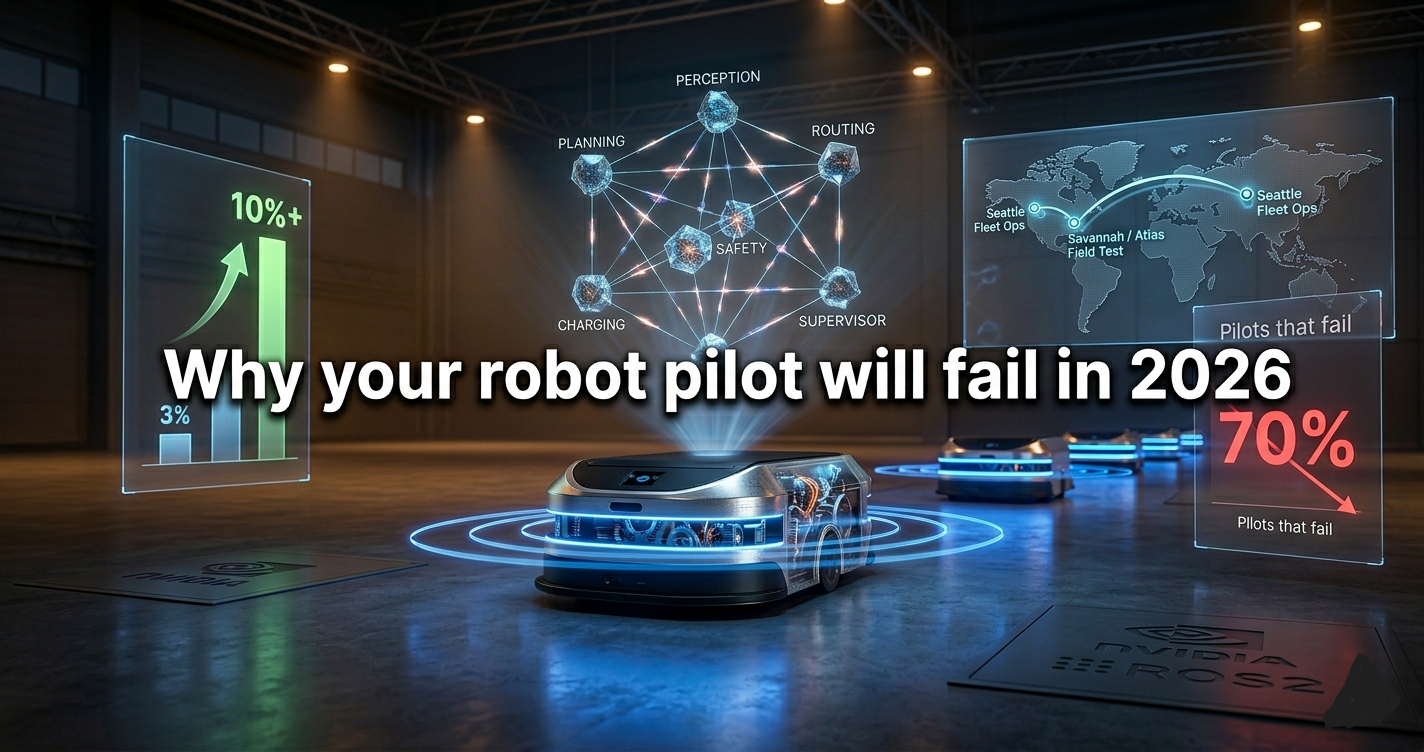
Why 70% of Agentic Robotics Pilots Fail in 2026, And 3 Deployment Frameworks That Actually Work | NeuralWired
NeuralWired covers frontier technology for the professionals building it. This investigation synthesizes peer-reviewed research, analyst data, and practitioner deployments to answer the question every automation leader is facing in 2026: how do you move agentic AI from a promising demo into a robot that actually ships products?
AnalysisAgentic AI · Robotics DeploymentApril 2026, Updated Continuously
Gartner named Physical AI a top strategic trend. NVIDIA’s simulators are closing the sim-to-real gap. Boston Dynamics’ Atlas just hit the Hyundai factory floor. And yet most agentic robotics pilots are dying quiet deaths in conference rooms. Here’s why, and what the survivors did differently.
For physical robots (manipulators, AMRs, humanoids on a plant floor), the stakes are categorically different from deploying another chatbot. An agentic AI that writes a bad email costs you credibility. An agentic AI that miscalculates a robot’s path near a human worker costs you something else entirely.
67%
of developers and product leaders say their teams are already building or shipping agentic workflows as of early 2026, yet most of these deployments are purely digital. The moment agents control physical actuators, complexity compounds in ways no software-first team anticipates.
Source: Nylas State of Agentic AI Survey, Feb 2026
What follows is built from peer-reviewed research, practitioner deployments at scale, and analyst data. Not vendor promises. Actual production experience. By the time you finish reading, you’ll know exactly which framework fits your use case, what realistic ROI looks like, and the three governance requirements you cannot skip without creating a liability problem.
Three Gaps That Kill Agentic Robotics Pilots
Most pilots don’t fail because the AI wasn’t good enough. They fail because the organization wasn’t ready for what the AI required. Three gaps appear repeatedly across failed deployments, and addressing all three before you write a single line of orchestration code is the difference between a pilot that scales and one that becomes a cautionary slide in a board deck.
Teams that skip domain randomization discover their agents are brittle to conditions they didn’t think to test: slightly different SKU packaging, a new type of pallet, a repair crew leaving tools in an unexpected location. Robustness to your simulation’s assumptions is not robustness to reality.
Gap 2: Missing IT/OT Integration
An agentic AI making decisions for a warehouse robot fleet needs real-time data: robot positions, inventory states, order queues, conveyor statuses, charging levels, and fault codes, all flowing continuously into a shared state store. Most factories weren’t built to provide this. Their operational technology (OT) networks were designed for reliability and isolation, not for the millisecond-latency data feeds that a reasoning agent needs.
As the IFR describes in its global robotics trends report, IT/OT convergence (enabling real-time data exchange between digital and physical worlds) is the foundational prerequisite for agentic robotics at any meaningful scale. Without it, the agent is reasoning against stale or partial state, and its decisions will reflect that. A robot dispatched to a charging station that was already occupied two minutes ago is a small failure. A robot dispatched into a corridor where a maintenance crew is working, based on stale safety zone data, is a much larger one.
Gap 3: No Governance Layer
The third gap is the one executives are most reluctant to fund, and the most dangerous to skip. When an agentic system makes a decision that causes a safety incident or a costly operational error, the first questions from legal, insurance, and regulators will be: What decision did the agent make? Why? What data did it use? Can you demonstrate it was behaving within defined boundaries?
“During the next decade, the intersection of agentic AI systems with physical AI robotic systems will result in robots whose ‘brains’ are agentic AIs, enabling them to adapt to new environments, plan multistep tasks, recover from failure, and operate under uncertainty.”
Deloitte Tech Trends 2026: AI Goes Physical
Five Deployment Frameworks That Separate Winners From Pilots
There’s no universal architecture for agentic robotics. The right framework depends on your hardware, your use case, and your organization’s maturity. Here are the five patterns that are producing real-world results in 2026, from the highest-adoption to the most experimental.
The most production-ready pattern. A supervisor agent acts as an autonomous floor manager for an entire robot fleet, dynamically assigning pick tasks, rerouting AMRs around obstacles or failed machines, and adjusting inventory placement based on live order patterns. Practitioners describe this as replacing a static WMS rule-engine with a system that can reason about trade-offs in real time: what to deprioritize when three robots need charging simultaneously, how to handle a surge order that conflicts with scheduled maintenance.
Architecture: Perception layer (robot telemetry, IoT, WMS feeds) → shared state store → task agents (batching, routing, charging, congestion) → supervisor agent → ROS2 nodes or vendor APIs over MQTT/gRPC.
For assembly tasks that involve variable parts, tool changes, or unstructured environments (problems where traditional PLC sequencers break down), this framework uses a Vision-Language-Action model as the robot’s reasoning core. The VLA interprets camera feeds, natural language instructions, and possibly audio, then hands motion plans to the existing robot controller.
Deployment sequence: Define constrained task set → collect multimodal training data → build digital twin of cell → train and validate VLA policy in simulation → deploy in pilot cell with strict speed and force limits → expand task repertoire as system confidence grows.
VLA Model: NVIDIA Alpamayo / Google RT-2 style architecture
Simulation: NVIDIA Isaac Sim with AlpaSim for sim2real
Safety: ISO 10218 / ISO/TS 15066 speed-force supervision
Monitoring: Prometheus + Grafana for inference latency & anomalies
For facilities running multiple robot types (AMRs, fixed arms, inspection drones, conveyor systems), a flat single-agent architecture becomes unmanageable. The hierarchical pattern, grounded in Fraunhofer’s multi-agent HRC research, uses a manager agent that holds global objectives and SLAs, while specialist agents each control a specific robot type or subsystem.
The key engineering discipline here is contract clarity: the interface between manager and specialist agents must be precisely defined: what inputs the specialist receives, what outputs it guarantees, and what it escalates. Poorly defined contracts cause the kind of emergent misbehavior that’s hard to debug and harder to explain to a safety auditor.
The AgenticControl framework from recent arXiv research introduces an automated approach to this problem, using LLM agents to iteratively propose and evaluate controller configurations in simulation before any real-hardware deployment. It validated across four control systems including DC motor positioning, offering a promising pattern for automated controller qualification.
Rather than replacing workers, this framework gives them natural language and gaze-based control over collaborative robots. A peer-reviewed multimodal agentic HRC framework, validated in a real timber assembly scenario in 2026, uses separate AI agents for perception, intent understanding, and command generation, so a worker can say “place that beam there” while glancing at the target location, and the system translates that into precise robot motion.
This pattern is particularly relevant for organizations facing union concerns or workforce skepticism about automation. It frames agentic robots as force-multipliers for existing staff rather than headcount replacements, which changes the change-management conversation meaningfully.
Perception Agent: Fuses camera, LiDAR, gaze-tracking data
Intent Agent: LLM interpreting natural language + context
Planning Agent: Translates intent to executable robot sequences
Safety Agent: Real-time proximity monitoring, force supervision
Hardware: Collaborative robot certified to ISO/TS 15066
Frequently overlooked, this is often the easiest framework to deploy first, and the one that builds internal confidence for more ambitious agentic investments. Agents continuously monitor robot telemetry, flag anomalous patterns before failures occur, schedule maintenance windows that minimize production impact, and orchestrate safe shutdown or degraded-mode operation when something goes wrong.
In physical robotics specifically, ROI breaks into three categories:
Throughput gains: more picks per hour, faster assembly cycles, higher machine utilization. These are the most commonly measured, the easiest to attribute to the agentic system, and typically the primary payback driver in the first 12 to 18 months.
Downtime reduction: fewer unplanned stoppages through predictive maintenance and intelligent fault recovery. In high-volume facilities, even a 1 to 2% improvement in uptime can justify the infrastructure investment alone.
Error cost reduction: fewer mis-picks, damaged goods, rework cycles, and safety incidents. These are harder to measure precisely but can represent a substantial component of total value, particularly in high-value or fragile goods handling.
83%
reduction in simulation-to-real performance variance reported by NVIDIA’s AlpaSim platform on specific robotic tasks, the most critical technical metric for teams moving agents from training environments to production hardware.
Source: NVIDIA AlpaSim technical documentation, via Kersai AI Breakthroughs 2026
The payback structure for a warehouse floor manager deployment, using conservative numbers: initial investment of $800K to $2M (robots, infrastructure, software, safety systems) against productivity gains in the 5 to 15% range after a stabilization period of 3 to 6 months, typically yields a 24 to 36 month payback on the full system. Organizations that rush to deployment (skipping sim2real validation or IT/OT integration) will extend that payback period or write it off entirely when the pilot fails to scale.
One critical variable almost every ROI model underweights: skills cost. Deploying agentic robotics requires engineers who understand both robotics and modern AI agent systems. That intersection is rare, commands significant salary premiums, and the gap will widen. Budget for it explicitly, or build a training program before the project starts.
Who’s Doing It Now, and What They Built
The most useful data points aren’t analyst projections. They’re the companies that have actual agentic systems running in physical environments today.
Hyundai / Boston Dynamics represents the frontier case, where the agent directly controls a humanoid robot in a real manufacturing environment. Atlas began its field test at Hyundai’s facility near Savannah, Georgia in 2026. This is the most physically consequential deployment pattern, and Hyundai is running it with appropriate caution: tightly scoped tasks, heavy human supervision, and gradual task expansion as confidence builds.
The pattern across all three: substantial infrastructure investment before the agentic layer, conservative initial deployment scope, and a deliberate expansion cadence tied to demonstrated performance rather than vendor timelines.
What Successful Deployers Had in Common
Digital twin or live state estimation of the physical environment before the first agent was deployed
IT/OT integration completed as a prerequisite, not a parallel workstream
Independent safety layer that the agent cannot override, implemented in hardware
Full logging and audit trail from day one of the pilot
Cross-functional team: robotics engineers, AI engineers, safety engineers, and plant operations. Not separate workstreams.
Conservative first deployment scope with explicit criteria for expansion
The Risks Vendors Won’t Put in Their Decks
Every agentic robotics pitch you’ll receive in 2026 will lead with capability. Autonomous floor management. Real-time task adaptation. Natural language robot control. What they won’t volunteer is a calibrated risk picture. Here’s ours.
Multi-agent systems can exhibit emergent misbehavior that no single agent was designed to produce. Two agents optimizing for different objectives (throughput and battery conservation, for example) can create oscillatory behavior that leaves robots stuck in decision loops. Research on hierarchical multi-agent robotics architectures specifically flags coordination complexity and potential instability as key failure modes for poorly designed systems. Clear objective hierarchies and rollback mechanisms are not optional engineering debt. They’re stability requirements.
The Interoperability Problem
As practitioner Ben Kalkman observes in his analysis of Google’s 2026 agent trend predictions, context loss between agent handoffs is a persistent production problem: different AI systems interpret instructions differently, and those divergences compound across a multi-robot system. Google’s Agent2Agent (A2A) protocol is one response to this, enabling cross-platform coordination. But until interoperability standards mature, you’re building custom integration logic that becomes a maintenance liability.
Realistic vs. Vendor Timeline
The vendor narrative positions fully autonomous agentic factories as a 2026 to 2027 reality. The practitioner data is more measured. Manufacturing Dive’s 2026 analysis of agentic AI in industrial settings points to targeted warehouse and cell-level deployments this year, with broader plant-wide scale emerging between 2028 and 2030 as standards, tooling, and organizational readiness catch up to the technology. Humanoid co-workers building cars at scale? That’s a 2029 to 2032 story, and any capital plan that assumes otherwise is taking on speculative risk.
⚠ Liability Gap to Address Before Deployment
Current safety standards (ISO 10218 for industrial robots, ISO/TS 15066 for collaborative robots) were written before agentic AI decision-making existed. The legal liability framework for “the agent decided to do X and someone was injured” is actively being developed by regulators, and the EU AI Act’s provisions on high-risk AI systems will apply to physical robots. Get your legal team involved before the pilot launches, not after the incident.
Prerequisites Checklist Before You Deploy Anything
This checklist is the single most actionable thing in this article. Every item reflects a failure mode observed in real deployments. If you can’t check a box, don’t deploy into that zone yet.
Digital twin or live state estimation of the physical environment with latency under 200ms
IT/OT integration complete: plant OT network connected to enterprise infrastructure with validated data pipelines, not a parallel workstream
Standardized robot interfaces established (ROS2, OPC UA, or vendor APIs) that accept high-level commands
Independent safety layer installed and validated (hardware E-stops, safety PLCs, safety scanners), physically separate from any software agent logic
Simulation environment built with domain randomization; agent policy tested against failure modes including machine faults, blocked paths, and sensor noise
Logging and audit trail infrastructure live: every agent decision, input state, and output command captured and queryable
Rollback mechanism defined: policy for reverting agents to last known-good configuration when performance degrades below threshold
Cross-functional pilot team in place: robotics engineers, AI engineers, safety engineers, plant operations. Not separate workstreams.
Legal and compliance team briefed on applicable standards (ISO 10218, ISO/TS 15066, EU AI Act applicability, local regulations)
Change management plan for workforce: communication, training, and involvement before deployment, not after resistance emerges
Explicit success criteria and expansion thresholds defined. The pilot doesn’t scale until it hits these numbers for at least 90 consecutive operating days
Cybersecurity review of the OT-IT boundary and any cloud connectivity for agent inference
Frequently Asked Questions
Agentic AI in robotics refers to autonomous systems that can perceive their environment, plan multi-step actions, and adapt behavior to achieve high-level goals , rather than executing fixed pre-programmed sequences. These agents often coordinate multiple robots, respond to real-time data, and recover from failures, functioning more like a digital floor manager than a traditional PLC controller. Gartner projects 40% of enterprise applications will embed task-specific AI agents by end of 2026, with physical systems following as infrastructure matures.
Traditional robotics automation runs on pre-programmed sequences and PLC logic designed for stable, predictable environments : if something unexpected happens, it stops and waits for a human. Agentic AI adds continuous reasoning so robots can adapt to changes, coordinate with other robots, and optimize tasks in real time. Fraunhofer’s hierarchical multi-agent architecture research illustrates the shift clearly: a manager agent assigns subtasks to specialized deep-RL agents, each responsible for its own robot, a model of delegation that traditional automation simply can’t express.
Three risk categories dominate: the simulation-reality gap (agents that perform well in training fail under real-world sensor noise or unexpected objects), safety incidents from agent misjudgment when no independent hardware safety layer exists, and governance failures where decisions can’t be audited or explained. Organizations also face skills shortages, IT/OT integration complexity, and workforce resistance when change management is neglected. AI CERTs emphasizes that physical AI must be treated as an always-on, embodied liability source, not merely as software.
Early agentic deployments typically produce 3 to 5% annual productivity gains; scaled multi-agent systems with mature data infrastructure can drive 10% or more enterprise output growth. These figures come from an 8allocate synthesis of McKinsey enterprise data. For physical robotics specifically, payback periods on full system investment (robots, infrastructure, software, safety) typically run 24 to 36 months under conservative assumptions. Organizations that skip IT/OT integration or sim2real validation reliably extend or forfeit this payback.
The core technique is domain randomization, deliberately varying lighting, friction, sensor noise, and object placement during simulation so the trained policy generalizes to real-world variability. NVIDIA’s AlpaSim reports up to 83% reduction in sim-to-real variance on specific tasks. Complementary approaches include combining synthetic and real-world training data (following Waymo’s model), building high-fidelity digital twins of specific deployment environments, and planning for mandatory on-site fine-tuning as a project phase rather than a post-launch fix.
Production stacks typically combine ROS2 as the robotics middleware with agent orchestration frameworks such as LangChain, AutoGen, or CrewAI. Simulation runs on NVIDIA Isaac Sim or Gazebo with domain randomization enabled. Monitoring uses standard observability stacks (Prometheus, Grafana). For enterprise deployment, Google Cloud’s Vertex AI platform and its Agent2Agent protocol are increasingly relevant for teams that need cross-system agent coordination. Safety infrastructure, hardware E-stops, safety PLCs, scanners, runs independently of all software.
You need people fluent in robotics (motion planning, ROS2, control theory, safety engineering) and people fluent in modern AI (LLMs, VLA models, multi-agent system design, MLOps). The intersection is rare. Additionally, the team needs IT/OT integration experience, cybersecurity capability for plant-floor network exposure, and governance expertise. IFR and Deloitte both flag skills shortage as a primary constraint on physical AI adoption, and the salary premium for engineers at that intersection will grow through 2028.
It’s both real and overhyped simultaneously. The real part: Amazon and Walmart have agentic orchestration running at scale, Boston Dynamics is running factory tests with Atlas, and peer-reviewed research confirms the technical foundations are solid. The overhyped part: vendor timelines for fully autonomous manufacturing are consistently aggressive, most organizations lack the IT/OT maturity to realize the higher ROI figures, and broad plant-wide scale is a 2028 to 2030 story, not a 2026 one. The technology works. The question is whether your infrastructure, governance, and organization are ready to support it.
What Comes Next, and What to Watch
Here’s what the data reveals when you look across every deployment pattern and failure mode: agentic AI robotics is not primarily a technology problem. The VLA models work. The simulation platforms are closing the gap. The orchestration frameworks are production-grade. What’s holding back most organizations is the same thing that held back cloud adoption, DevOps adoption, and every previous architectural transformation: organizational unpreparedness for what the technology demands.
The companies succeeding with agentic robotics didn’t start with better AI. They started earlier on data infrastructure, IT/OT integration, and safety governance. When the agentic layer arrived, it had a prepared environment to operate in. The companies failing started with the AI and worked backward, discovering, expensively, that the foundation wasn’t there.
This principle extends beyond the current moment. As physical AI systems proliferate and autonomous agents become embedded in more production environments, competitive advantage will increasingly separate on organizational readiness to deploy technology from access to the technology itself. The models commoditize. The infrastructure, the governance, the team capability: those take years to build and can’t be licensed on a Tuesday morning.
Three developments deserve close attention through 2027:
Safety standards will catch up. ISO 10218 and ISO/TS 15066 are being revised to account for adaptive, AI-driven robot behavior. The EU AI Act’s high-risk AI provisions will increasingly constrain how agentic physical systems are deployed and documented. Organizations that build governance infrastructure now, before the regulations land, will move faster when compliance becomes mandatory.
Sim2real tooling will commoditize. What NVIDIA’s AlpaSim represents today as a competitive advantage will be table stakes within 24 months. The differentiation will shift to the quality of your digital twin and the richness of your domain randomization library.
The skills shortage will intensify before it eases. Every major industrial organization is hiring for the same intersection of robotics and AI engineering. Build your internal capability, or your training pipeline for existing staff, now, while compensation is still rational.
For deeper implementation guidance, review the five frameworks against your specific use case and cross-reference against the prerequisites checklist. If more than two items on that list aren’t checked, that’s where your budget should go before the first agent is deployed.
Subscribe to The Neural Loop for weekly frontier intelligence on Physical AI, agentic systems, and the infrastructure shaping production robotics.
Weekly frontier intelligence for the people building the next decade of automation. No filler. Just signal.
Subscribe to The Neural Loop →
Disclaimer: This article synthesizes publicly available research, analyst reports, and practitioner commentary for informational purposes. NeuralWired is not responsible for investment, deployment, or strategic decisions made based on this content. All market figures, productivity projections, and performance benchmarks reflect cited third-party sources and carry the uncertainties inherent to forward-looking data. Safety standards referenced (ISO 10218, ISO/TS 15066, EU AI Act) should be verified against current versions before use in compliance planning. Consult qualified legal and safety engineering professionals before deploying autonomous robotic systems in any human-occupied environment.
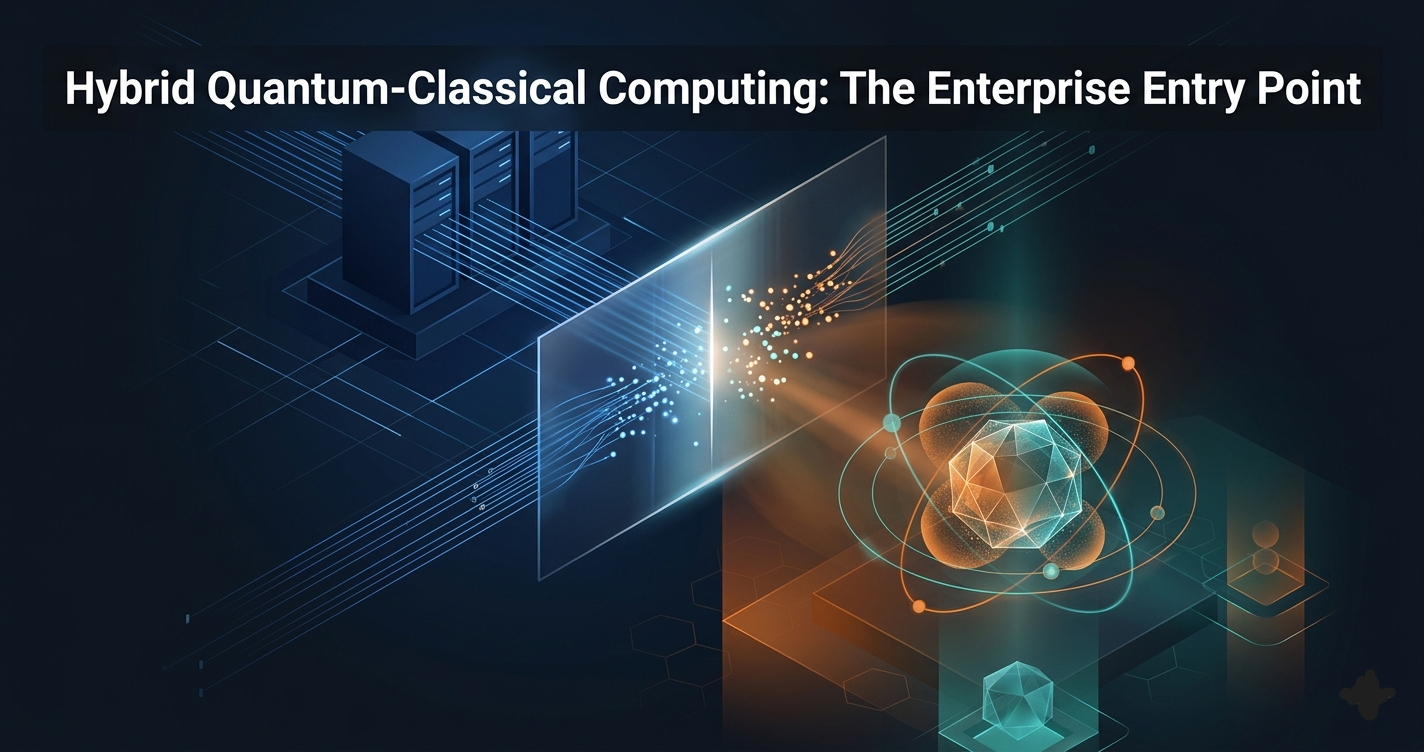
Hybrid Quantum-Classical Computing: The Enterprise Entry Point to Quantum in 2026NeuralWiredEnterprise Technology · March 2026
Quantum Computing · Enterprise Strategy
Forget the “quantum someday” narrative. Hybrid quantum-classical architecture is now the default infrastructure model, and the enterprises running pilots on IBM, AWS Braket, and Azure Quantum are building durable competitive advantage right now.
By NeuralWired StaffMarch 28, 2026Reading time: ~14 minCategory: Enterprise Quantum
The most expensive mistake enterprise technology leaders make with quantum computing is not investing too early; it is waiting for a “pure quantum” future that is not coming anytime soon. Hybrid quantum-classical computing, the model where classical processors handle orchestration and data while quantum hardware executes targeted computational kernels, has quietly become the industry’s working architecture. And 2026 is the year the evidence became impossible to ignore.
This article gives you what vendor marketing will not: a vendor-neutral playbook for understanding hybrid quantum-classical computing, selecting the right workloads, choosing between IBM, AWS, and Azure, designing your first pilot, and managing the real costs and risks. Whether you are a CTO asking how quantum plugs into your cloud stack, a Chief Data Officer evaluating which workflows benefit now, or a strategy lead stress-testing timelines, this is the guide you need.
2026Year Fujitsu predicts hybrid becomes the industry standard
4Key 2026 quantum trends by Quandela, hybrid is #1
10hMax managed hybrid job runtime on Amazon Braket
3Cloud platforms (IBM / AWS / Azure) with production hybrid services today
1. What Hybrid Quantum-Classical Computing Actually Means for Your Business
Strip away the physics and hybrid quantum-classical computing follows a surprisingly intuitive logic. A classical system, running on your existing cloud or HPC infrastructure, handles the heavy lifting of data preparation, parameter management, and result interpretation. A quantum processor is invoked for specific sub-tasks it handles exceptionally well: evaluating a cost function over a combinatorial search space, simulating molecular energy states, or computing a high-dimensional kernel. The two systems exchange information in a loop until the solution converges.
A 2025 enterprise strategy analysis describes this precisely: classical systems embed quantum kernels within larger workflows for combinatorial optimization, quantum chemistry simulation, and machine learning feature spaces. The quantum device does not replace your stack. It accelerates the hardest slice of a well-defined problem.
“Some really interesting features of quantum computing start to become available if you can do classical computation at the same time you’re doing quantum computation. You’re just alternating between the two.”
Joe Fitzsimons, Founder & CEO, Horizon Quantum Computing, via InformationWeek
Fitzsimons’s framing is useful because it reframes hybrid not as a workaround for immature hardware but as a principled architectural pattern. Classical computers avoid decoherence and can access large datasets; quantum processors offer computational advantages for specific problem classes. Hybrid loops exploit both strengths simultaneously.
Current NISQ (Noisy Intermediate-Scale Quantum) devices make hybrid practically mandatory: limited qubit counts and error rates mean quantum hardware cannot run most problems end-to-end. Classical systems handle error mitigation, pre-processing, and post-processing around a quantum core. But even in fault-tolerant regimes years from now, most real-world workloads will still require hybrid architectures. The nature of business problems almost always involves classical data pipelines, governance layers, and integration requirements that quantum hardware alone cannot satisfy.
Orchestration on AWS Lambda/EC2, IBM Cloud, or Azure Functions: scheduling, parameter optimization, retry logic, logging
↕
✦
Quantum Execution Layer
Gate-based QPUs or annealers (or high-fidelity simulators) invoked via Qiskit Runtime, Amazon Braket, or Azure Quantum APIs
↕
☷
Data Layer
Classical storage (S3, databases, warehouses): summarizes problem instances into quantum-compatible representations and collects outputs
2. Which Enterprise Use Cases Benefit from Hybrid Quantum-Classical Today
Not every hard problem is a quantum problem. The honest answer is that most workloads running in your organization today have no near-term quantum angle. But a meaningful subset, particularly those with combinatorial explosion, quantum-mechanical structure, or high-dimensional feature spaces, are legitimate candidates for hybrid acceleration right now.
Optimization: The strongest near-term signal
Combinatorial optimization is where hybrid quantum approaches have the most production evidence. Case studies involving BASF’s use of D-Wave hybrid quantum solvers for logistics and production scheduling showed results competitive with industry-grade classical solvers. This is a significant finding: not dramatically better, but comparable, and the performance gap is expected to widen as hardware improves. For organizations where logistics, vehicle routing, supply chain scheduling, or financial portfolio construction represent a core cost driver, that competitive parity today translates into meaningful advantage as the technology matures.
Chemistry and materials simulation
IBM’s 2026 quantum-centric supercomputing blueprint specifically targets chemistry and materials science as a key workload domain, with hybrid workflows already operating in production-adjacent settings alongside RIKEN’s environment and the Fugaku supercomputer. Pharmaceutical companies, materials manufacturers, and energy firms running classical density functional theory or molecular dynamics simulations should treat hybrid quantum chemistry as a near-term R&D investment, not a 2030 concept.
Quantum-enhanced machine learning
A 2024 reference architecture for hybrid quantum-classical business intelligence describes practical integration of quantum neural networks, quantum SVMs, quantum PCA, and QAOA-based optimization into classical ML pipelines. This is early-stage but no longer theoretical; it is being formalized into reference architectures that engineering teams can implement today.
3. IBM vs. AWS vs. Azure: Choosing Your Hybrid Quantum-Classical Platform
One gap that existing content almost never fills is a vendor-neutral comparison of how the three major cloud platforms actually differ in their hybrid quantum offerings. They are not interchangeable, and choosing the wrong platform for your organization’s existing stack creates integration overhead that can swamp the performance benefits you are chasing.
Dimension
IBM Quantum (Quantum-Centric)
AWS Braket
Azure Quantum
Primary model
Orchestrated hybrid workflows via Qiskit Runtime, integrated with IBM Cloud and HPC environments (RIKEN, Fugaku)
Managed Hybrid Jobs with QPUs and simulators, tightly integrated with AWS services (EC2, Lambda, S3)
Multi-vendor quantum backends with Azure Resource Manager integration; orchestration via Azure Functions and Logic Apps
Key hybrid features
Middleware for Quantum, unified CPU/GPU/QPU workflows, open Qiskit framework
Hybrid Jobs, embedded simulators (SV1, DM1, TN1), prioritized QPU access, job run times up to 10 hours
Research-heavy orgs, IBM Cloud-invested enterprises, HPC-adjacent workloads in chemistry or materials
Cloud-native AWS shops, data-science teams running variational algorithms, teams wanting managed infrastructure
Microsoft-centric IT organizations, Azure-heavy environments, teams wanting hardware vendor diversity
Cost model
Per-QPU-second, subscription tiers, access via IBM Cloud credits
Per-task / per-shot pricing; simulators billed per minute; Hybrid Jobs billed on runtime
Credits plus pay-per-use; pricing varies by hardware provider backend
The AWS angle deserves specific attention for cost-conscious pilots. Braket’s embedded simulators, SV1 (state vector), DM1 (density matrix), and TN1 (tensor network), let teams run and refine algorithms at simulation cost before committing to QPU pricing. This “pay-as-you-simulate” model is the most practical cost-control lever available to enterprise teams today. You validate circuit designs, tune hyperparameters, and establish classical baselines entirely in software, then selectively move to quantum hardware for benchmarking runs.
IBM’s approach is architecturally different: its Middleware for Quantum platform treats orchestration as a first-class concern, with unified scheduling and logging across classical and quantum compute. For enterprises where hybrid workflows need to integrate with existing HPC environments or where reproducibility and auditability are non-negotiable, this middleware layer matters more than raw QPU performance.
The architecture brings quantum and classical systems together into a unified computing environment, with coordinated workflows spanning both, and open frameworks like Qiskit providing access through familiar tools.
IBM Research Team, IBM 2026 Quantum-Centric Supercomputing Blueprint
4. The 4-Step Enterprise Pilot Framework for Hybrid Quantum-Classical Computing
The largest gap in existing coverage is not technical explanation; it is actionable guidance on how to actually run a hybrid quantum pilot without burning budget on a poorly scoped experiment. Here is a structured framework grounded in current best practices from IBM, AWS, and enterprise strategy research.
4-Step Hybrid Quantum Pilot Framework
Step 1: Identify and prioritize candidate workloads
Apply a three-axis filter: (1) does the problem have combinatorial explosion, quantum-mechanical structure, or high-dimensional feature spaces? (2) can it tolerate approximate or heuristic answers? (3) can data be summarized into compact quantum-compatible representations without streaming massive datasets to the quantum device? Shortlist 2 to 3 candidates with clear classical baselines already in production.
Step 2: Design the hybrid experiment
Select a cloud platform based on your existing cloud commitments and data residency requirements, not quantum hardware specifications. Decide whether to start with simulators (recommended) or QPUs. Define time budgets per job, number of optimization iterations, and your accuracy or objective-function target. Document all design decisions for governance purposes before running a single job.
Step 3: Run controlled benchmarks
Execute both classical and hybrid versions on an identical, standardized dataset. Measure time-to-solution, solution quality (objective function value), cost per run, and energy if you have carbon reporting obligations. Run multiple iterations to account for quantum noise and stochastic behavior. Collect all logs; these become your audit trail and the foundation for any future governance review.
Step 4: Evaluate ROI and decide next steps
Assess benefits including solution quality improvement, speed gains, and new capabilities against incremental cost and integration complexity. If results are promising, advance to a second-stage pilot with tighter production integration, more stringent governance, and KPI alignment to a specific business outcome. If results are inconclusive, document the negative result and revisit in 12 to 18 months as hardware improves.
Workload selection: the three-axis filter
The first step is the highest-leverage decision in any pilot. Enterprise strategy research on hybrid workloads consistently shows that the most common failure mode is selecting problems with the wrong mathematical structure, specifically problems where classical solvers are already near-optimal and quantum provides no meaningful search space advantage.
The three axes to evaluate are: Structure and complexity (combinatorial explosion, quantum-mechanical modeling, or high-dimensional ML spaces); tolerance for approximate answers (logistics cost reduction does not require exact optimality, because better heuristics are valuable); and integration feasibility (data must be summarizable into small quantum-compatible state representations, and data loading overhead is one of the primary performance bottlenecks in current hybrid systems).
Cost model: budgeting your pilot
Costs on quantum cloud platforms depend on device type (simulator vs QPU), job duration, number of shots per circuit, and priority queueing. Amazon Braket positions Hybrid Jobs as an advanced service optimized for teams running variational algorithms at scale. The cost-control path is to prototype entirely on simulators, tune parameters until convergence behavior is stable, then run a bounded set of QPU runs for benchmarking. Total cost for a well-scoped pilot should be comparable to a small ML infrastructure experiment, not a capital budget item.
AWS architecture guidance also recommends using high-CPU/GPU classical instances for heavy numerical pre/post-processing and minimizing data transfer between quantum and classical components. These two design decisions can meaningfully reduce both latency and cost in production-adjacent pilots.
5. Governance, Risk, and the Compliance Realities Nobody Mentions
Vendor content almost universally underplays organizational risk in hybrid quantum deployments. The emerging research on hybrid quantum governance challenges identifies several issues that technology leaders should address before any pilot reaches production.
Governance checklist
Hybrid Quantum Governance Checklist
Model validation: Maintain classical reference methods and compare outputs statistically on every run. Track performance over time as hardware calibration, compiler versions, and cloud service configurations change. Quantum results are not stable across firmware updates.
Data governance: Clarify where data is stored and processed (region, provider), how it is anonymized or aggregated before quantum device access, and how outputs are retained. Hybrid architectures can span multiple jurisdictions; confirm compliance with GDPR, CCPA, or sector-specific data residency requirements.
Operational risk: Define failure modes for quantum devices (queue delays, calibration drift, device unavailability) and codify fallback policies to classical execution paths. Implement change management for algorithm and parameter updates, as these affect output validity and may require re-validation.
Auditability: Design pilots to be auditable from day one. Log all job parameters, device identifiers, shot counts, and result distributions. Quantum-enhanced decision systems will face growing scrutiny from regulators, particularly in financial services, healthcare, and critical infrastructure.
Energy and sustainability: A hybrid intelligence framework proposes dynamically routing workloads between simulators and quantum hardware based on energy budgets and carbon thresholds. For organizations with ESG reporting obligations, this layer matters because quantum hardware is cryogenically cooled and energy-intensive.
The jurisdictional complexity deserves extra attention. In a typical hybrid deployment, data may reside in an S3 bucket in one AWS region, classical control logic runs on EC2 in another, and quantum execution happens on a QPU physically located in a third geography. This multi-location architecture raises questions about compliance, data transfer, and sovereignty that legal and compliance teams need to resolve before production deployment, not after.
Contrarian Perspective: What the optimists get wrong
Fundamental limits are real.Theoretical results show hybrid cannot beat known complexity bounds. For search problems, no hybrid approach outperforms Grover’s optimal quadratic speedup unless the classical component can already solve the problem independently. Hybrid does not create advantage from nothing.
Integration overhead is often underestimated. Data loading, orchestration complexity, and monitoring infrastructure can consume a significant portion of any performance gain in early pilots. QuEra’s technical analysis of hybrid challenges identifies bottlenecks in noise sensitivity, optimization convergence, and scalability that will not disappear with incremental hardware improvements.
Hidden costs accumulate quickly. Talent with combined quantum tooling and cloud/HPC orchestration skills commands a premium. Governance overhead, monitoring infrastructure, and the organizational change management required to integrate hybrid results into existing decision workflows may exceed cloud compute fees, especially in regulated industries.
Timeline realism matters. Fault-tolerant quantum advantage on broad enterprise workloads remains a multi-year prospect. Many organizations will stay in “advanced pilot” territory through the late 2020s. That is not a reason to avoid hybrid; it is a reason to scope pilots as learning investments, not transformation programs.
Frequently Asked Questions
What is hybrid quantum-classical computing in simple terms? +
It is a computing model where classical computers handle data preparation, parameter management, and result processing, while quantum processors execute specific high-value sub-tasks such as optimization steps or molecular simulations in a repeating loop. Enterprise strategy research describes this as embedding quantum kernels within larger classical application workflows.
Which enterprise use cases benefit most from hybrid quantum-classical workflows today? +
The strongest near-term evidence is in combinatorial optimization (routing, scheduling, portfolio construction) and quantum chemistry simulation. Fujitsu’s applied research shows early industrial traction in these categories. Quantum-enhanced ML is promising but still mostly pre-production.
Do I need a quantum supercomputer to run hybrid workflows? +
No. Enterprises access quantum devices and simulators via managed cloud services: Amazon Braket Hybrid Jobs, IBM Qiskit Runtime, and Azure Quantum all provide access without owning hardware. Equinix frames this access model as the foundation of enterprise-ready quantum deployment in 2026.
How do AWS, IBM, and Azure differ in their hybrid quantum offerings? +
How much does it cost to run hybrid quantum jobs in the cloud? +
Costs depend on device type (simulator vs QPU), job duration, and number of measurement shots. AWS’s embedded simulators offer a low-cost prototyping path before committing to QPU pricing. Well-scoped pilots should be budgeted comparably to a small ML infrastructure project, not a capital program.
What are the main challenges of deploying hybrid quantum-classical systems? +
The core technical challenges are qubit noise, data loading overhead, and optimization convergence bottlenecks. Organizationally, the harder challenges are governance (validation, auditing, compliance), talent (combined quantum and cloud skills), and integration with existing data pipelines. QuEra’s technical analysis covers the hardware-layer challenges in detail.
Will hybrid quantum-classical computing still matter once fault-tolerant quantum computers exist? +
Yes. Even in fault-tolerant regimes, most real-world workflows will combine classical data infrastructure with quantum subroutines. The hybrid architecture is not a temporary workaround; it reflects how enterprise applications are actually structured, with data pipelines, governance layers, and integration requirements that classical systems will continue to handle.
How should I frame hybrid quantum computing for my board or executive team? +
Frame it as the quantum entry point that does not require betting on future hardware. Approach budget like early AI pilots: constrained investments tied to specific business KPIs, not open-ended R&D. Quandela’s 2026 trends analysis supports positioning hybrid as a “no-regrets” option where you build organizational capability while waiting for hardware to mature.
The Bottom Line: Hybrid Quantum-Classical Computing Is Now an Infrastructure Decision, Not a Research Bet
Three things have become clear in 2026. First, hybrid quantum-classical computing is the practical architecture, the one that runs on today’s hardware, integrates with today’s cloud platforms, and produces measurable results on real optimization, simulation, and ML problems. Second, the cloud access model removes the capital barrier: IBM, AWS, and Azure all offer managed hybrid services that enterprises can pilot without owning a qubit. Third, the organizations building capability now, even through inconclusive pilots, will hold a meaningful advantage over those waiting for a “pure quantum” moment that is not coming.
The broader implication is competitive. Quantum computing is no longer a uniform horizon that all enterprises will reach simultaneously. It is becoming a capability curve, and the curve is already bending. Chemistry, logistics, finance, and any sector where combinatorial optimization drives cost structure are the early impact zones. Governance, talent, and integration, not hardware, are the real constraints on enterprise adoption speed.
What to watch next: IBM’s 2026 blueprint and the RIKEN/Fugaku deployment represent the leading edge of production-scale hybrid infrastructure. AWS’s continued expansion of Braket Hybrid Jobs and Azure’s multi-vendor backend strategy will define the competitive cloud landscape through 2027. For enterprise decision-makers, the action item is simple: identify one optimization workload, run a scoped pilot against a classical baseline, and let the data guide your roadmap. That is how every durable technology capability in enterprise history has actually been built.
Disclaimer: This article is produced by NeuralWired editorial staff for informational purposes only and does not constitute financial, legal, or technology procurement advice. Vendor capabilities, pricing, and platform features referenced herein are subject to change without notice. Readers should independently verify all specifications and conduct their own due diligence before making any technology investment decisions. All third-party trademarks, product names, and company names mentioned are the property of their respective owners. NeuralWired has no commercial relationship with IBM, AWS, Microsoft Azure, or any other vendor referenced in this article.
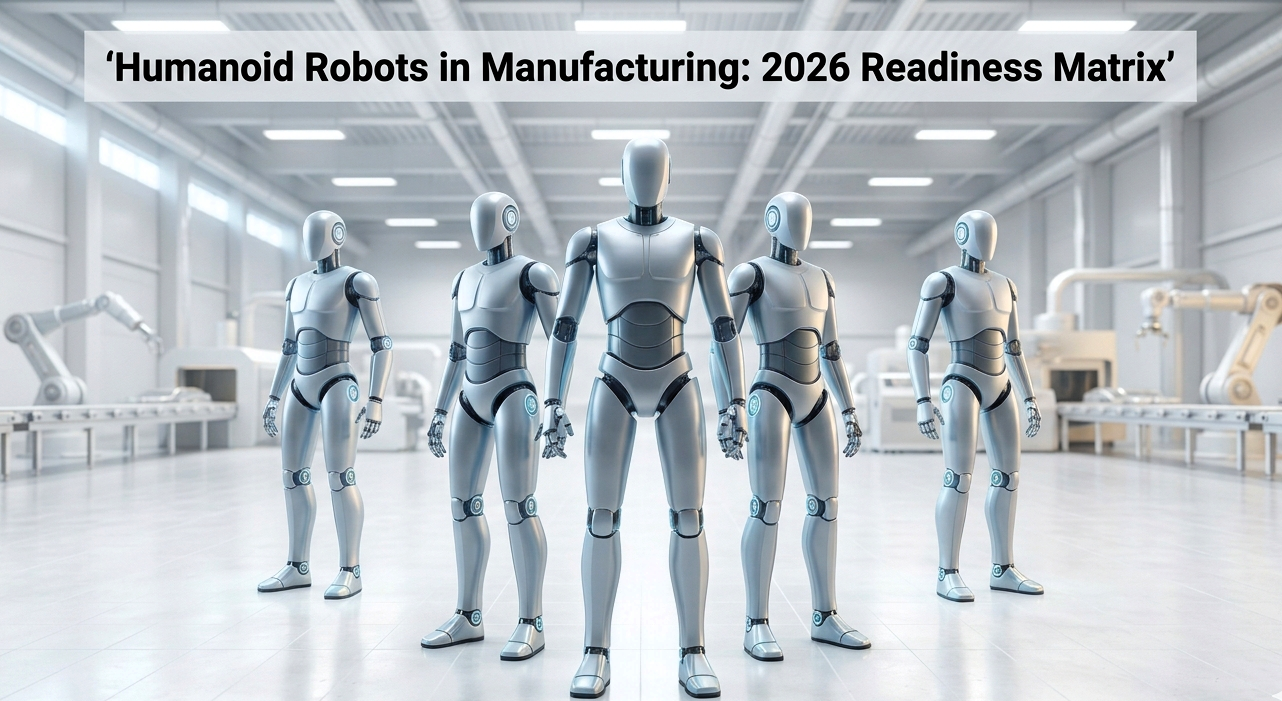
Atlas, Digit, Figure, and Optimus are crossing the demo-to-deployment line this year, but only for a narrow band of tasks. Here is the use-case readiness matrix, the real TCO math, and the deployment playbook that separates successful pilots from expensive setbacks.
NW
NeuralWired Editorial
March 20, 2026 · Manufacturing & Robotics
Thousands of humanoid robots are working inside real factories right now, not on demo stages. Agility Robotics’ Digit is running warehouse flows at Amazon and GXO. Tesla has deployed thousands of Optimus units inside its own plants. Boston Dynamics committed Atlas fleets to Hyundai’s production lines for 2026. The demo-to-deployment crossing has happened.
But the real question for plant leaders, engineers, and investors is not “are humanoid robots real?” It is a harder one: which tasks are actually production-ready today, versus which are 3 to 5 years out? Getting that wrong means either missing a genuine competitive window or burning capital on a pilot that stalls at month four.
This analysis maps the readiness landscape across automotive manufacturing, logistics, and adjacent sectors. It draws on technical specs from Boston Dynamics, Figure AI, Agility Robotics, and Tesla, combined with market data from IDTechEx and the International Federation of Robotics. You will get a use-case readiness matrix, a four-way platform comparison, the TCO math, and a concrete deployment playbook.
$30BProjected humanoid robot market by 2036, according to IDTechEx’s latest forecast, driven almost entirely by manufacturing and logistics adoption.
What “Production-Ready” Actually Means in 2026
The robotics industry has a credibility problem: the gap between “impressive demo” and “runs two shifts unattended” is enormous, and most press coverage does not draw the line clearly. For manufacturing contexts, a system is production-ready only when it clears four independent bars.
Stack integration: The robot must plug into existing MES, ERP, or WMS systems. Tools like Boston Dynamics’ Orbit and Agility’s Arc platform are designed exactly for this. Without dispatcher-level software integration, a humanoid is just an expensive standalone machine.
Reliability and uptime:IDTechEx notes that structured factory environments with controlled lighting, fixed layouts, and predictable payloads can support 80 to 90 percent uptime today. Mean time between failures on critical joints and batteries is improving, but still lags behind fixed industrial arms by a measurable margin.
Safety conformance:Agility’s latest Digit iteration ships with Category 1 stops and a safety PLC rated PLd, the baseline for OSHA-regulated environments in the US. This is a material differentiator for industrial buyers. Most other platforms are approaching this bar but have not publicly confirmed equivalent certifications.
Labor-cost economics: According to detailed TCO modeling, a five-year total cost per robot, including maintenance, charging infrastructure, and software licensing, runs between $35,000 and $80,000. Realistic payback periods are 24 to 36 months, assuming 0.5 to 0.7 FTE replacement per robot, not full headcount elimination. Any model that assumes one robot replaces one worker is overstating the case significantly.
“Humanoids will only scale in industry if they compete with fixed automation on efficiency and precision, not just compelling demos.”
International Federation of Robotics, 2026 Robotics Industry Outlook (via Maakindustrie)
The Use-Case Readiness Matrix: What’s Ready Now vs. What’s Not
The sharpest framework for industrial decision-making is not “which robot is best.” It is “which tasks are ready for which robot, and when.” The matrix below, calibrated to 2026 deployment realities, should anchor any serious pilot evaluation.
Automotive manufacturing leads readiness by a wide margin. That is not accidental: automotive plants have structured environments, mature safety regimes, and significant labor-cost pressure on physical, repetitive tasks, exactly the conditions where today’s humanoids deliver value.
Use Case
Sector
2026 Status
Key Rationale
Intra-factory material transport
Automotive
Ready Now
Low dexterity, high repetition, AMR-compatible. Digit validated at multiple automotive sites.
Line-feeding and kitting
Automotive
Ready Now
Transporting totes from buffer to assembly stations. No fine manipulation required.
Quality inspection support
Automotive
Ready Now
Fixed-path camera/LiDAR scanning. UBTech Walker S already deployed in automotive QC roles.
Goods-to-person tote flows
Logistics
Ready Now
Digit’s primary commercial use case. Validated at Amazon, GXO, and Schaeffler.
Basic assembly assistance
Automotive
2 to 3 Years
Inserting large components (dashboards, seats) under supervision. Atlas and Figure targeting this now.
Mixed-case palletizing
Logistics
2 to 3 Years
Soft or irregular SKUs add grasp complexity. Hardware improving but not yet consistent at scale.
Station-to-station machine tending
Automotive
2 to 3 Years
Predictable geometry helps, but cycle-time reliability must improve before displacing cobots.
High-precision sub-assembly
Automotive / Electronics
3 to 5+ Years
Micron-level dexterity and speed requirements. Cobots and gantries remain the default here.
High-throughput parcel sorting
Logistics
3 to 5+ Years
Specialized sort-robots already optimized. Humanoids cannot match cycle times at competitive cost.
Pharma / ESD electronics mfg.
Pharma / Electronics
3 to 5+ Years
Sterility, ESD, and micron precision requirements exceed current humanoid capabilities entirely.
The pattern is consistent: humanoids win today on tasks that are mobile-first, medium-dexterity, high-repetition, and physically demanding for humans. They lose to purpose-built automation on any task requiring high throughput, micron precision, or sterile environments.
Atlas, Figure, Optimus and Digit: Platform Comparison for Industrial Buyers
Choosing a platform is a strategic commitment, not a purchase order. Each robot comes with a distinct technical profile, deployment context, and vendor ecosystem. Here is what matters for industrial decision-makers, organized by how ready each system is for factory deployment today.
Atlas
Boston Dynamics
High (2026)
All-electric, 56 degrees of freedom, lift capacity up to 50 kg, and a 2.3-meter reach. Designed to operate in human-built environments without infrastructure modification. Hot-swappable batteries support multi-shift operation. Already deployed in Hyundai’s RMAC facility with committed fleets for 2026.
56 DOF50 kg payloadHot-swap batteryOrbit MES integration
Digit
Agility Robotics
High (2026)
The most commercially validated humanoid in manufacturing and logistics today. Deployed at Amazon, GXO, Schaeffler, and Toyota. Lower dexterity than Atlas, but highly optimized for totes and pallets. Latest version includes Cat-1/PLd safety and autonomous 4-hour charge cycles. Best for logistics-heavy manufacturing flows.
Optimized for industrial manipulation and complex grasping. Trained in industrial-like environments with a strong focus on tool-use tasks. BotQ factory targets 12,000-unit annual capacity, a signal of intent to move well beyond pilots. Deployed with BMW in automotive. Best once trained on specific stations for kitting and assembly assistance.
The most AI-driven stack in the field, backed by Tesla’s vertical integration and a simulation environment running thousands of virtual robots. Thousands of units already deployed inside Tesla factories as of late 2025. External commercialization expected late 2026 to 2027. Target unit cost at scale: approximately $30,000. Best for sites with strong AI infrastructure and a multi-year horizon.
53 to 56 DOF~$30k target priceAI-driven autonomy4 to 8 hr battery
One clean takeaway: Digit and Atlas are the right choice for organizations that need production-ready deployment in 2026. Figure is the right bet for organizations building toward high-dexterity assembly over the next 24 months. Optimus is the right choice for long-term AI stack investment, not this quarter’s throughput numbers.
Humanoids vs. Cobots: The Decision Framework Your CFO Actually Needs
Most industry coverage still frames the choice as “humanoid robots vs. no robots.” The sharper analysis is humanoid vs. cobot vs. fixed automation, and the answer depends entirely on whether mobility or precision is the bottleneck in your operation.
A standard cobot costs around $20,000 per unit and typically delivers ROI within six months for well-defined, stationary tasks. Cobots are fast to integrate, easy to fence, and reliable at high-repetition pick-and-place. For those tasks, they still win in 2026, full stop.
Humanoids win where cobots structurally cannot compete:
Humanoids Win
Mobile-first tasks crossing multiple stations
Legacy plants where cobot-centric layouts are not feasible
Labor-stressed shifts with recruiting gaps
Physically demanding tasks driving injury risk
Lines where AMR plus cobot integration adds excessive complexity
Cobots Still Win
High-throughput, high-precision pick-and-place
Repetitive tasks in small, standardized cells
Applications where speed and consistency are non-negotiable
Environments that can be fully fenced and optimized
Budget-constrained pilots needing sub-6-month payback
The right mental model: humanoids are not cobot replacements. They are a mobile cobot layer for tasks where mobility and workspace flexibility dominate the cost curve. An automotive plant with an aging workforce and recruiting gaps on physically demanding line-feeding tasks is exactly where Digit and Atlas are landing their first commercial wins.
On the economics: humanoid TCO over five years runs $35,000 to $80,000 per unit, according to detailed modeling. At labor costs of $25 to $35 per hour and 0.5 to 0.7 FTE replacement per robot, five-year ROI in the right tasks frequently exceeds 1,000%. That math works. But it assumes the task selection is correct, which is exactly where most pilots stumble.
A note on “soft” ROI: Manufacturing leaders increasingly justify humanoid deployment not just on labor cost arbitrage, but on shift stability, reduced musculoskeletal injuries, and lower employee turnover. These benefits are real and often underweighted in initial business cases, particularly for second and third shifts where recruiting is genuinely difficult.
The Safety and Reliability Gap That’s Still Blocking Wider Deployment
Even when the task fit is right and the economics make sense, safety and reliability thresholds are the primary gating factors for production deployment in 2026. This is where many pilots stall, and where vendor selection matters most.
There is a critical distinction between “cooperative safety” and “collaborative safety” that most buyers do not understand going in. Today’s humanoids operate in cooperative mode: humans and robots share the same room, but workers do not routinely reach into the robot’s active workspace. True collaborative mode, where human hands regularly enter the robot’s working volume, is still emerging for dynamically balanced mobile systems. The standards are not finalized yet.
“The industry is still defining safety standards for dynamically balanced mobile robots. Buyers who assume humanoids work exactly like cobots in shared workspaces will have a difficult time with their safety reviews.”
On the reliability side, IDTechEx is explicit: humanoid robots remain more complex and less reliable than fixed-arm robots, with higher failure rates per operating hour. The weak points are actuator chains, thermal management, and batteries. This is not a reason to avoid deployment. It is a reason to pick tasks where a downed robot does not halt an entire production line, and to ensure your vendor offers cloud-based fleet management and OTA updates for rapid recovery.
Deployment Playbook: 4 Steps Before You Sign a Pilot Agreement
Rather than a generic “start small” recommendation, here is the concrete playbook that separates well-structured pilots from expensive learning exercises. This draws directly from the operational patterns of early adopters, including automotive OEMs, Amazon, and the handful of manufacturers who have moved beyond single-robot demos to fleet-scale deployment.
The 4-Step Humanoid Deployment Playbook
Map use cases by readiness, not aspirationUse the readiness matrix above to short-list 2 to 3 tasks that are high-labor, low-precision, and high-repetition. The task must already be bounded by existing workflows, whether MES, WMS, or AMR routes. Start with tasks where human workers actively want relief from physical strain.
Choose the right platform for the specific task profileUse Digit-type systems for logistics-heavy flows and AMR-integrated lines. Choose Atlas or Figure for complex plant layouts requiring a mix of transport and basic assembly. Choose Optimus only if you have strong AI infrastructure and a 3-year horizon. Platform decisions are 3 to 5 year commitments.
Define safety and coexistence rules before hardware arrivesDecide on cooperative vs. collaborative mode before layout planning begins, as this dictates fencing requirements and workflow design. Ensure the vendor can demonstrate Cat-1/PLd-level safety stops and integration with your existing PLCs. If they cannot produce safety documentation, do not proceed.
Build a realistic TCO and payback model, including soft benefitsUse a labor-substitution model of 0.5 to 0.7 FTE per robot with five-year TCO in the $35,000 to $80,000 range. Model “soft” benefits separately: reduced musculoskeletal injuries, lower turnover, and the ability to reliably staff second and third shifts. Separate these from direct labor savings so the business case survives scrutiny from finance.
Frequently Asked Questions
Click any question to read the answer.
Yes, for a specific and bounded set of tasks. Intra-factory material transport, line-feeding, kitting, and quality inspection support in automotive and logistics environments are production-ready today. High-precision assembly, sterile environments, and high-throughput sorting are 3 to 5 years away. The key mistake is treating “humanoid robots in manufacturing” as a single binary question when the real answer is entirely task-specific.
Per-unit purchase prices range from Tesla Optimus’s stated target of approximately $30,000 at scale to higher prices for Atlas and Figure systems. The more important number is five-year TCO, including maintenance, charging infrastructure, fleet management software, and training, which IDTechEx and industry analysts estimate at $35,000 to $80,000 per robot. Payback periods of 24 to 36 months are achievable in well-selected tasks at $25 to $35 per hour labor rates.
Cobots are fixed-arm systems designed for stationary, high-precision tasks in defined workspaces. They are cheaper at around $20,000, faster to deploy, and deliver faster ROI for repetitive pick-and-place. Humanoid robots add mobility: they can walk between stations, navigate human-designed environments, and handle tasks across a changing workspace. Humanoids are best understood as “mobile cobots” for tasks where movement, flexibility, and physical endurance are the primary bottleneck.
For 2026 deployment, Agility Digit and Boston Dynamics Atlas are the most production-ready options. Digit leads on logistics-heavy flows with its validated safety certifications and AMR integration. Atlas leads for complex plant layouts and mixed transport and assembly tasks. Figure 02/03 is the best choice if your primary focus is assembly assistance at scale in 2027 and beyond. Optimus is best for organizations with strong in-house AI infrastructure and a multi-year deployment horizon.
Today’s humanoids support “cooperative safety,” meaning humans and robots can share the same space, but workers should not routinely reach into the robot’s active workspace. True collaborative mode, where human hands regularly work alongside the robot simultaneously, is still being standardized for dynamically balanced mobile systems. Agility’s Digit includes Cat-1/PLd-certified safety stops that meet current OSHA-regulated manufacturing requirements. Buyers should verify specific safety documentation before any deployment.
Tesla had deployed thousands of Optimus units inside its own factories as of late 2025, making it the largest internal deployment of humanoid robots in any single manufacturing organization. External commercialization, meaning selling to third-party customers, is expected in late 2026 to 2027. Tesla’s approach differs from other vendors: it is validating the technology at scale internally before committing to external sales.
The clearest limitations in 2026 are: high-precision sub-assembly such as wiring harnesses and small electronic modules, high-throughput production lines where cycle-time variance is unacceptable, sterile pharmaceutical environments, ESD-sensitive electronics manufacturing, and any task where fine manipulation at speed is required. These are not capability gaps that software updates will close in the next quarter. They reflect hardware dexterity and reliability constraints that IDTechEx projects will take 3 to 5 years to resolve.
The Bottom Line for 2026
The pattern across every serious deployment of humanoid robots in manufacturing is consistent: success comes from matching the right platform to the right task, not from deploying the most sophisticated robot. Organizations that start with material transport, line-feeding, and inspection support in structured automotive or logistics environments are generating real ROI today. Those that jump to high-precision assembly or unstructured environments are still paying tuition.
This matters beyond the current wave of pilots. As humanoid capability compounds over the next 3 to 5 years, the organizations with operational experience covering real fleet management, safety integration, and worker coexistence protocols will have a structural advantage that latecomers cannot easily replicate. The learning curve here is not software. It is organizational readiness.
Watch three developments through 2028: first, the emergence of vendor-neutral safety standards for dynamically balanced mobile robots; second, Tesla’s external commercialization of Optimus shifting the price anchor for the entire market; and third, a rapid bifurcation between manufacturing organizations that have built deployment expertise and those that have not. For plant leaders and CTOs evaluating humanoid robots in manufacturing, the time to build that expertise is now, on the right tasks, with the right platform, and with a TCO model that survives a finance review.
Stay ahead of industrial robotics, physical AI, and manufacturing automation with NeuralWired’s weekly analysis for technology decision-makers.
Subscribe Free