Expert machine learning analysis: model architectures, training techniques, MLOps, deployment strategies, and research breakthroughs explained for engineers and technical leaders.
ChatGPT vs Claude vs Gemini 2026: The Honest Head-to-Head | NeuralWiredNeuralWired
Intelligence on Artificial Intelligence
AI Comparison Guide
ChatGPT vs Claude vs Gemini 2026 | The Honest Head-to-Head Developers Actually Need
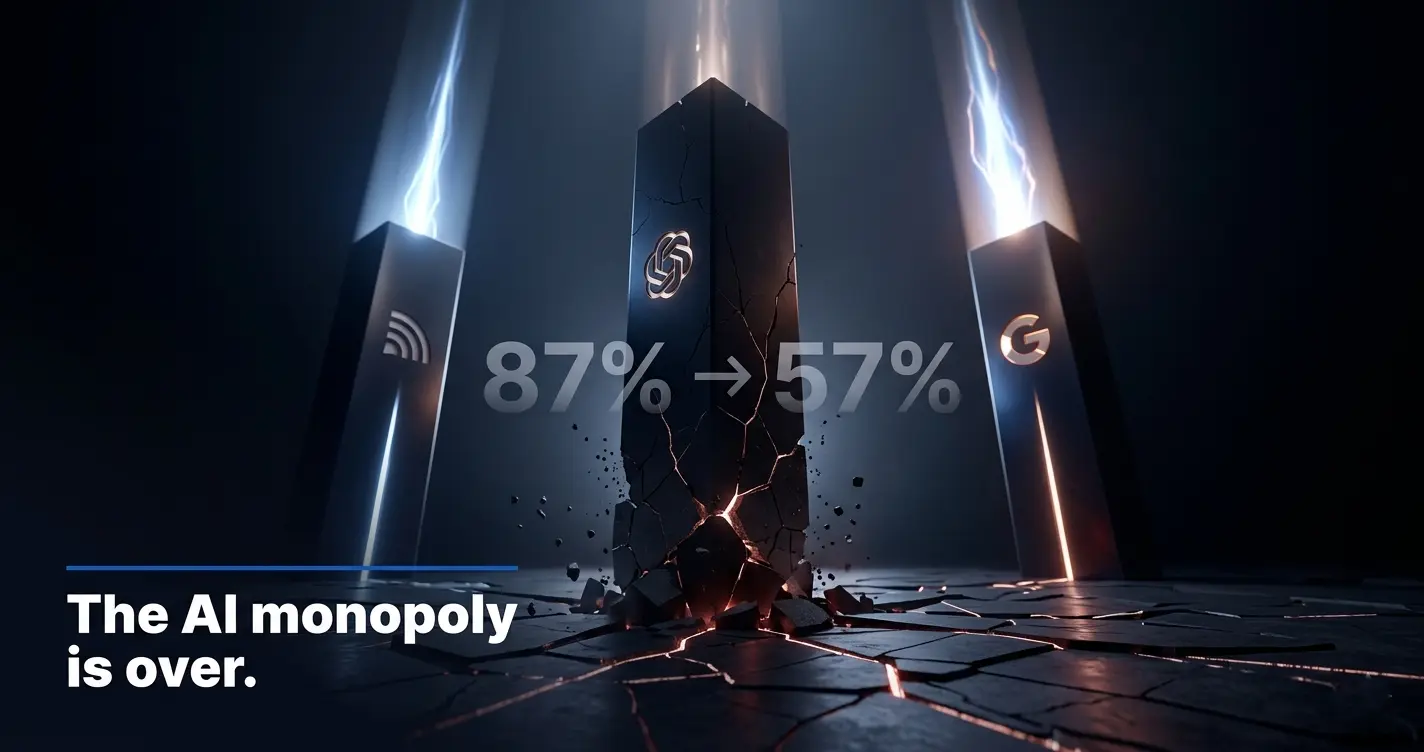
ChatGPT’s market share collapsed 30 points in 14 months. Claude tripled its share in a single quarter. Gemini quadrupled. The race is real, and the winner depends entirely on what you’re building.
NeuralWired Research Desk·May 24, 2026·Updated for Claude Opus 4.7 · GPT-5.5 · Gemini 3.1 Pro·14 min read
Fourteen months ago, ChatGPT held 87% of generative AI web traffic. As of March 2026, it’s below 57%. That’s not a blip, that’s the fastest collapse of market dominance in consumer software since Internet Explorer lost the browser wars. Gemini went from 6% to 25%. Claude went from 1.4% to over 6%. And we’re still early.
If you’re a developer routing API calls, a CTO evaluating an enterprise contract, or a founder choosing the core model for your product, the decision you make this quarter has real consequences. This guide cuts through the benchmark theater and gives you the honest comparison: what each model actually does best, what it costs, and where the traps are.
−30pt
ChatGPT market share drop, Jan 2025 → Mar 2026
4×
Gemini’s traffic share growth over same period
3×
Claude’s share gain in a single quarter
The Market Shift Nobody Predicted
The mainstream narrative going into 2025 was settled: OpenAI won. ChatGPT was the Google of AI, first-mover with a moat so deep no challenger could cross it inside five years. That narrative is now wrong.
The structural break happened in three waves. First, model quality parity arrived faster than anyone expected. Claude 3.7, Gemini 3.0, and then the jump to Claude 4.x and Gemini 3.1 Pro showed that OpenAI’s quality lead was a 12-month advantage, not a permanent one. By late 2025, independent benchmarks showed all three platforms within single-digit percentage points on general capability tests.
Second, Google’s distribution machine activated. Gemini bundled into Gmail, Docs, Sheets, and Android didn’t win users through product quality, it converted existing Google Workspace daily actives into AI users overnight. That’s how you go from 6% to 25% in twelve months without necessarily being the best model in the room.
Third, Claude’s enterprise breakout. While Gemini was winning on distribution and ChatGPT on consumer scale, Anthropic quietly captured the segment willing to pay the most: regulated industries. The Claude iOS app hit #1 on the U.S. App Store on February 28, 2026, the first time any AI app surpassed ChatGPT in daily downloads. Claude Code’s weekly active users doubled between January and April. Anthropic’s annualized revenue reached $14 billion as of February 2026, up from $1 billion in 2024. That’s a 14× increase in two years.
Our Read
This maps almost exactly to the browser wars. ChatGPT is Internet Explorer, dominant, sticky, losing ground slowly. Gemini is Chrome, distribution king, winning by presence not choice. Claude is Firefox, smaller but chosen deliberately by users who care about quality. The key difference: all three are improving simultaneously, and the market is still growing. There’s no single winner. That is the story.
Current Models at a Glance
Platform
Current Flagship
Context Window
Consumer Tier
API Input/Output (per 1M tokens)
OpenAI / ChatGPT
GPT-5.5 (Apr 2026) GPT-5.4 Pro via API
~250K tokens (Enterprise)
Free / Plus $20/mo / Pro $200/mo
$1.75 / $14.00 (GPT-5.2)
Anthropic / Claude
Claude Opus 4.7 Apr 2026
1M tokensNew
Pro ~$20/mo / Max ~$50+/mo
$5.00 / $25.00
Google / Gemini
Gemini 3.1 Pro (Feb 2026)
1–2M tokens
Advanced $19.99/mo
$2.00 / $12.00 (Flash: $0.50 / $3.00)
A few things worth flagging before we get into comparisons. Claude Opus 4.7 is the most significant recent release: it arrives with a 1M token context window (four times larger than Opus 4.6), high-resolution vision at 2,576px, and a self-verification capability that reduces hallucinations on factual tasks. GPT-5.2 is being retired June 5, 2026, any enterprise contract referencing that model needs revisiting now. And Gemini’s naming situation is still a genuine headache for API buyers: “Gemini 3 Pro” (consumer) and “Gemini 3.1 Pro Preview” (developer docs) are the same model, sold under two different labels.
Coding & Developer Benchmarks
This is the comparison developers actually search for, and it has a clearer answer than any other category in 2026.
Doubled between January and April 2026 — developer consensus forming
—
Claude’s lead on SWE-bench Verified is the single clearest differentiation in this entire comparison. A 3–4 point gap on academic benchmarks is noise. A 3–4 point gap on real GitHub issue resolution, across thousands of production repositories, is something engineering leads should care about.
That said, the cost math complicates things fast. If you’re building a production API pipeline and routing to Claude at $5/$25 per million tokens, versus GPT-5.4 Mini at roughly 6× less than GPT-5.4 Standard, you have a real ROI question to answer. For most B2C product workloads, quick code completions, light refactors, IDE copilot interactions, GPT-5.4 Mini at near-Claude-level performance for a fraction of the cost is the rational choice. Route the complex, high-stakes generation tasks to Claude. Route the volume to Mini or Gemini Flash.
“Claude is better for complex coding. Claude Opus 4.7 scores 87.6% on SWE-bench Verified, versus GPT-5.4’s approximately 84%. For full-file refactors and long-context debugging, Claude leads. For quick scripts and IDE plugin support, ChatGPT remains competitive.”
This is Gemini’s clearest win. On graduate-level science questions, the kind of reasoning required in drug discovery, materials science, and academic research, Gemini 3.1 Pro scores 94.1–94.3% on GPQA Diamond. GPT-5.4 follows at ~92.8%. Claude Opus 4.6 sits at ~91.3%. For enterprise buyers in scientific or research-heavy domains, that gap matters.
Knowledge Depth (Humanity’s Last Exam)
HLE is the hardest knowledge benchmark available, designed explicitly to resist saturation. The scores: Claude 53 | GPT-5.4 48 | Gemini 40 (BenchLM.ai, April 2026). Claude wins on the single hardest knowledge test, which counters the “Gemini is the smartest” narrative you’ll encounter in a lot of enterprise sales conversations.
Context Window Reality
Gemini 3.1 Pro offers 1–2M tokens, technically the largest. Claude Opus 4.7 now matches at 1M. ChatGPT Enterprise sits around 250K. Worth knowing: multiple engineers have noted in 2026 benchmark reviews that performance at 1M+ token contexts degrades meaningfully on most tasks. Advertised context is not reliable context. Test your specific workload at scale, don’t rely on the spec sheet.
Multimodal
Gemini has the structural advantage here, Google’s investment in vision and audio AI runs deeper than either competitor’s, and Gemini 3.1 Pro’s multimodal performance leads on most third-party evaluations. Claude Opus 4.7’s new high-resolution vision (2,576px) closes the gap on document and image analysis. ChatGPT remains competitive across all modalities but doesn’t lead on any specific visual benchmark in 2026.
API Pricing: The Number That Kills Deals
Consumer tiers have converged: all three platforms sit at $19–$20/month for their mid-range plans. The API is where the real decision lives, and where the gap is significant.
Model
Input (per 1M tokens)
Output (per 1M tokens)
Notes
Claude Opus 4.7
$5.00
$25.00
Up to 90% savings with prompt caching
GPT-5.2
$1.75
$14.00
Retiring June 5, 2026
Gemini 3.1 Pro
$2.00
$12.00
Strong default for cost-conscious builds
Gemini 3 Flash
$0.50
$3.00
Best cost-efficiency for high-volume workloads
GPT-5.4 Mini
~6× cheaper than Standard
—
~94% of Standard’s coding performance
Grok 4.1
$0.20
$0.50
Cheapest frontier API overall
Cost Reality Check
Claude is 2.5–3× more expensive than Gemini at API level. At 100M tokens/month, that’s a $300,000 annual cost difference. Claude’s prompt caching (up to 90% savings on repeated context) makes it competitive for long-context applications that reuse significant prompt context, legal document review, multi-turn research, large codebase analysis. For high-volume, low-complexity tasks, Gemini Flash or GPT-5.4 Mini is the rational default.
Enterprise Reality: Who’s Winning Where
The single-vendor AI strategy is over. Internal data from multiple enterprise surveys in 2026 shows the dominant enterprise stack as: Claude for deep analytical, legal, and compliance output + ChatGPT for research, workflow automation, and employee-facing tools + Gemini for Google Workspace-native workflows. These aren’t competing, they’re co-existing in the same organization.
“ChatGPT is the overwhelming leader in consumer AI with more than 900 million weekly active users, and over 50 million subscribers… Search usage has nearly tripled in a year, and our ads pilot reached more than $100 million in ARR in under six weeks.”
That’s the official OpenAI position. What the official position omits: OpenAI is projected to lose $14 billion in 2026, nearly triple earlier estimates, with cumulative losses of $44 billion through 2028 and profitability not expected before 2029. Only 5.5% of ChatGPT’s 900 million users pay. The ads pilot (mentioned casually in Altman’s quote) signals that the product experience for free-tier users may change fundamentally.
Meanwhile, Anthropic is concentrating on the segment willing to pay most. Claude reportedly wins approximately 70% of new enterprise AI deals in regulated industries, legal, finance, healthcare, compliance, because of its documented lower hallucination rate and its “uncertainty flagging” behavior: it declines to answer when it’s not confident rather than confabulating. In industries where an AI error has financial or legal consequences, that behavior is worth a pricing premium.
Google’s enterprise advantage is structural, not earned. 120,000+ enterprise customers and 95% of top-20 global SaaS companies use Google Cloud AI, but much of that is Gemini arriving inside Workspace by default, not the result of a competitive evaluation. CTOs in Google-heavy shops evaluating ChatGPT or Claude as Workspace replacements are solving the wrong problem. Evaluate them as additive tools for tasks Workspace doesn’t do well.
Use Case Mapping
Best: Claude
Complex Code Generation & Refactoring
87.6% SWE-bench, 1M token context, Claude Code doubling WAU. The empirical choice for production-quality output on non-trivial engineering tasks.
Best: Gemini
Google Workspace Workflows
If your team lives in Gmail, Docs, and Sheets, Gemini is already there. The integration advantage bypasses any benchmark comparison.
Best: Claude
Legal, Compliance & Finance
Lower hallucination rates, uncertainty flagging, and 70% win rate in regulated-industry enterprise deals. The reliability premium is real and priced accordingly.
Best: ChatGPT
Third-Party Integrations & Plugins
92% of Fortune 500 adoption, Codex (3M weekly active developers), and the broadest plugin/tool ecosystem. For horizontal workflow automation, ChatGPT’s network effects win.
Best: Gemini
High-Volume, Cost-Sensitive APIs
Gemini Flash at $0.50/$3.00 per 1M tokens is the most cost-efficient frontier API for applications where multimodal capability is relevant and volume is high.
Best: Gemini
Scientific Research & Reasoning
94.1% GPQA Diamond. For drug discovery, materials science, and graduate-level academic analysis, Gemini’s reasoning benchmark lead is real and consistent.
What the Benchmarks Don’t Tell You
The Hallucination Problem Isn’t Solved
An EBU/BBC study found 48% of responses from free-tier chatbots contained accuracy issues as recently as mid-2025. Claude Opus 4.1 recorded 0% hallucination on the AA-Omniscience benchmark, but only because it declined to answer when uncertain rather than guessing. Gemini 3.1 Pro cut its hallucination rate by 38 percentage points, which is the biggest improvement of any model but still leaves it at ~50% on certain tests. Westlaw AI, built specifically for legal research, hallucinated more than 34% of the time on challenging queries.
Healthcare Warning
The ECRI Institute ranked misuse of AI chatbots as the #1 health technology hazard of 2026, explicitly naming ChatGPT, Claude, Gemini, Copilot, and Grok as “not regulated as medical devices and not validated for healthcare purposes.” Any healthcare deployment carries compliance exposure regardless of platform.
Benchmark Saturation Is Real
MMLU now scores 88–94% across all top models. It no longer differentiates them. The benchmarks that do differentiate, SWE-bench Pro, ARC-AGI-2, Humanity’s Last Exam, are not the ones most buyers understand or test themselves. When a vendor’s sales deck shows you a benchmark chart, ask specifically which benchmark, and whether it’s been saturated. Most popular media comparisons cite saturated benchmarks, making rankings look more meaningful than they are.
Vendor Lock-In Accumulates Invisibly
Enterprises building workflows on Claude’s Projects system, Google’s Workspace Gemini integration, or ChatGPT’s Custom GPTs ecosystem are accumulating switching costs that won’t show up in today’s pricing comparison. The platform decision made in 2026 shapes what tools are available, and at what negotiating leverage, in 2028. The time to think about this is before the integration is built, not after.
“OpenAI is projected to lose $14 billion in 2026, nearly triple earlier estimates for 2025, even as it reports $25 billion in annualized revenue and 900 million weekly ChatGPT users. The company expects cumulative losses of $44 billion between 2023 and 2028, with profitability not arriving until 2029 at the earliest.”
, European Business Magazine, citing The Information internal financial projections, 2026. Read the full report →
This is the most important contrarian data point in the entire comparison. The market leader has the biggest user base and the biggest losses. The ads pilot signals a potential shift in the free-tier product experience. That changes the calculus for any organization that’s built workflows on the assumption that free-tier ChatGPT performs identically to paid ChatGPT. It may not for much longer.
The Verdict
There’s no single winner. Anyone telling you otherwise is selling something. Here’s the honest split:
ChatGPT
Best for
Consumer-scale deployment, third-party integrations, employee-facing tools, and organizations where Fortune 500 adoption rates reduce procurement friction. The horizontal choice.
Claude
Best for
Complex code generation, legal and compliance work, long-document analysis, and any use case where hallucination has real-world consequences. The quality-first choice.
Gemini
Best for
Google Workspace-native workflows, high-volume cost-sensitive APIs, scientific reasoning, and multimodal tasks. The distribution and efficiency choice.
Most serious enterprise buyers in 2026 use two of the three, typically Claude plus one of the other two depending on their infrastructure. The overlap is real and intentional. These platforms are not substitutes for each other; they’re complements with different cost structures and different failure modes.
Watch three things over the next 6–18 months. First, whether OpenAI’s ads pilot scales, this is the signal for how the free-tier product experience evolves. Second, whether Claude’s API pricing moves; Anthropic’s current premium pricing reflects confidence in the enterprise market, but competitive pressure from Gemini Flash is real. Third, whether any platform meaningfully solves hallucination at the infrastructure level, rather than at the “decline to answer” workaround level. That’s the technical moat that doesn’t yet exist.
Frequently Asked Questions
Which AI is better in 2026 | ChatGPT, Claude, or Gemini?
There is no single winner. Claude Opus 4.7 leads on coding (87.6% SWE-bench) and writing quality. ChatGPT (GPT-5.4/5.5) leads on ecosystem breadth and third-party integrations. Gemini 3.1 Pro leads on reasoning benchmarks (94.1% GPQA) and multimodal tasks. Most professional users in 2026 use two of the three. Source: BenchLM.ai, April 2026.
Is ChatGPT or Claude better for coding?
Claude is better for complex coding. Claude Opus 4.7 scores 87.6% on SWE-bench Verified vs GPT-5.4’s ~84%. For full-file refactors and long-context debugging, Claude leads. For quick scripts and IDE plugin support, ChatGPT remains competitive. Most engineering teams use both. Source: LearnDrive, 2026.
What is the cheapest AI API in 2026?
Gemini 3 Flash is the cheapest frontier API at $0.50 input / $3.00 output per million tokens. Grok 4.1 charges $0.20/$0.50, making it cheapest overall. GPT-5.4 Mini is 6× cheaper than GPT-5.4 Standard. Claude Opus 4.7 is most expensive at $5.00/$25.00, but offers up to 90% savings via prompt caching on repeated-context workloads. Source: IntuitionLabs, Feb 2026.
How many people use ChatGPT in 2026?
ChatGPT has over 900 million weekly active users and 50 million paying subscribers as of March 2026. It processes 2.5 billion daily prompts. OpenAI generates $25 billion in annualized revenue, but projects a $14 billion operating loss in 2026 due to compute costs. Source: OpenAI, March 31, 2026.
Is Gemini better than ChatGPT in 2026?
Gemini 3.1 Pro leads on reasoning benchmarks (94.1% vs 92.8% GPQA Diamond), offers a larger context window (1–2M tokens), and excels at multimodal tasks. ChatGPT leads on ecosystem, integrations, and consumer scale (900M WAU vs 750M MAU). For Google Workspace users, Gemini has a structural advantage that makes the comparison largely moot. Source: LearnDrive, 2026.
Does Claude hallucinate less than ChatGPT?
Yes, in independent testing. Claude Opus 4.1 recorded 0% hallucination on the AA-Omniscience benchmark by declining to answer when uncertain. However, no AI model is hallucination-free, the EBU/BBC found 48% of free-tier AI responses had accuracy issues in 2025. Claude’s “I don’t know” behavior matters most in legal, compliance, and financial use cases. Source: Suprmind AI, May 2026.
Which AI has the largest context window in 2026?
Gemini 3.1 Pro offers the largest at 1–2 million tokens. Claude Opus 4.7 (April 2026) now reaches 1 million tokens. ChatGPT Enterprise supports approximately 250,000 tokens. Important caveat: practical performance degrades at maximum context lengths across all platforms. Advertised context window ≠ reliable context window. Test your specific workload. Source: Tech Insider, April 2026.
The Neural Loop
Weekly intelligence on AI models, enterprise deployments, and the business moves that matter. No hype. No padding. Just the signal.
Subscribe Free →
Artificial IntelligenceCareer Guide • May 23, 2026
How to Become a Prompt Engineer in 2026: The Honest Guide
The standalone job title is collapsing. The underlying skill is becoming mandatory across every technical role. Here’s the real path, skills, salaries, courses, and the warnings nobody else will tell you.
N
NeuralWired Editorial
12 min read • Updated May 23, 2026
⏱ 12 min
In 2023, Anthropic posted a job listing that broke the internet. The role: Prompt Engineer and Librarian. The salary ceiling: $335,000. The requirement that caused the real frenzy: no PhD, minimal coding experience. For a brief moment, the world believed you could earn a doctor’s salary just for being very, very good at talking to chatbots.
That moment is over.
Searches for “prompt engineer” on Indeed have dropped 86% from their April 2023 peak. Microsoft surveyed 31,000 workers across 31 countries and found that Prompt Engineer ranked second-to-last among roles companies plan to hire in the next 18 months. The standalone title, for most organizations, never really materialized.
And yet, here you are, reading a guide on how to become a prompt engineer. And the search volume for that exact phrase has surged 5,000%+ in the past 12 months. Both things are true at once, and the tension between them is exactly what this guide is about.
Our Read
The job title is dying. The skill is becoming mandatory. If you’re learning how to become a prompt engineer in 2026, you’re not chasing a job title, you’re building a capability layer that will sit underneath every technical role in the next decade. That reframe changes everything about how you should approach this.
The Paradox Nobody Is Talking About
Two credible, opposing forces are pulling at this field simultaneously. Understanding both is the foundation of making any smart career decision here.
The optimistic case is real: Grand View Research puts the global prompt engineering market at $222 million in 2023, projecting it to hit $2.06 billion by 2030, a CAGR of 32.8%. McKinsey reports that 71% of organizations now use generative AI in at least one business function. Every one of those deployments requires someone who knows how to work with language models systematically. That’s real demand.
The skeptical case is equally real. Fortune reported in May 2025 that Allison Shrivastava, economist at Indeed, put it plainly:
Prompt engineering as a skill is still definitely a good thing to have, but it’s not an entire title.
Allison Shrivastava, Economist, Indeed (Fortune, May 2025)
Jared Spataro, Microsoft’s Chief Marketing Officer for AI at Work, was even more direct. After his team’s survey of 31,000 workers across 31 countries:
Two years ago, everybody said, ‘Oh, I think prompt engineer is going to be the hot job.’ It’s not turning out to be true at all.
Jared Spataro, CMO AI at Work, Microsoft (Wall Street Journal, 2025)
His argument: modern AI models now ask clarifying questions, acknowledge uncertainty, and self-iterate. The human middleman who translated vague instructions into precise prompts is being absorbed into the model itself.
So which camp is right? Both. The reconciliation is simple: the discipline is real; the job description isn’t. Prompt engineering is becoming what spreadsheet literacy became in the 1990s, not a career, but a baseline competency that elevates every career it touches. Andrew Ng made this comparison explicitly, and it’s the clearest mental model available.
32.8%
Projected annual market growth (CAGR) through 2030
71%
Organizations now using generative AI in at least one function
−86%
Drop in “prompt engineer” job searches on Indeed since peak (April 2023)
What a Prompt Engineer Actually Does
Strip the hype and the definition is precise. Prompt engineering is the systematic practice of designing, structuring, and optimizing text instructions, prompts, to guide large language models like OpenAI’s ChatGPT, Anthropic’s Claude, and Google’s Gemini toward accurate, relevant, and consistent outputs. It combines natural language processing, cognitive science, linguistics, and iterative systems design.
That last part matters: iterative systems design. The most important thing Isa Fulford’s widely-used curriculum at DeepLearning.AI establishes is that effective prompting is not about finding “magic words.” It’s about systematic evaluation, measurement, and structural thinking. The people who treat it that way build things that work in production. The people who treat it as a creative guessing game produce inconsistency at scale.
The Core Techniques You Actually Need to Know
Technique
What It Is
When to Use It
Zero-shot prompting
No examples given; model uses training knowledge alone
Simple, well-defined tasks; quick prototyping
Few-shot prompting
1–5 examples embedded in the prompt to guide output format
Consistent formatting, classification tasks, tone matching
Chain-of-thought (CoT)
Instructs model to reason step by step before answering
Logic, math, multi-step problem solving
Retrieval-Augmented Generation (RAG)
Combines LLM with external knowledge base to reduce hallucination
Background instructions defining model persona, scope, and constraints
Product deployments, customer-facing AI tools
Prompt chaining
Linking multiple prompts sequentially; each output feeds the next
Complex multi-step workflows, agent pipelines
The Skills That Actually Matter in 2026
Here’s where most guides go wrong: they describe the skills that got people hired in 2023. The market has moved. Based on aggregated requirements from active listings at Google, Microsoft, Amazon, JPMorgan Chase, Booz Allen Hamilton, and leading AI-native startups, here’s what employers are actually looking for right now.
LLM API proficiency, At minimum one of: OpenAI, Anthropic Claude, Google Gemini, or Microsoft Copilot. Not just using the chat interface, working with the API programmatically.
Prompt technique mastery, Zero-shot, few-shot, chain-of-thought, RAG. These aren’t optional vocabulary; they’re the toolkit every practitioner is expected to have.
Python programming, Strongly preferred for senior roles; not always required for entry-level marketing or content positions. If you want engineering-tier compensation, this is non-negotiable.
Token economics and context window management, Understanding how models handle input length, what falls out of context, and how to structure information for reliability.
Evaluation and benchmarking, The ability to design A/B tests for prompts, measure output quality systematically, and build evals that catch prompt drift when models update. This is where most entry-level practitioners fall short.
Responsible AI and bias detection, Not a box-check skill. Organizations deploying AI at scale have legal and reputational exposure; people who can identify and mitigate bias in LLM outputs are genuinely scarce.
Domain expertise, The highest-value prompt engineers are domain experts first. A healthcare analyst who can engineer clinical documentation prompts is worth more than a generic prompt specialist. The skill multiplies domain knowledge; it doesn’t replace it.
⚠ Career Risk
The “no coding required” framing from 2023 is obsolete for any role paying over $90K. Entry-level positions at non-technical companies still exist without code, but AI lab and enterprise engineering roles almost universally require Python and API experience. Plan accordingly.
Salaries: The Honest Numbers
The $335,000 Anthropic listing was real. It was also an outlier at an elite AI safety lab during a period of acute talent scarcity, for a senior specialized role. Using it as a benchmark is like using NBA contracts to estimate what competitive basketball players earn. Here’s the actual range.
Source
Salary Range
Context
ZipRecruiter (June 2025)
$33K – $95K (avg $63K)
Includes contract and part-time; skews low
Glassdoor (via Coursera, Dec 2025)
$90K – $160K (avg $123K)
Full-time tech roles; more representative for career changers
Big Tech (Google, Microsoft, Amazon, Meta)
$110K – $250K
Senior IC and staff-level roles; equity separate
AI Labs (OpenAI, Anthropic, Cohere)
$150K – $335K+
Equity-heavy; total comp often exceeds base significantly
Government / Consulting (Booz Allen)
Up to $212K
Cleared roles; lower equity but high stability
The signal worth watching: Forward Deployed Engineers (FDEs) are where the highest-demand adjacent hiring is concentrating right now. OpenAI formalized its FDE program at scale on May 11, 2026, these are hybrid engineering and client-facing practitioners who embed with enterprise customers to deploy AI in production. Job postings for FDEs reportedly grew 800%+ in 2025. If you’re building prompt engineering skills and want a clear career target, FDE is the most concrete emerging track.
Best Courses and Certifications in 2026
No industry-standard certification equivalent to AWS or PMP exists in this field yet. Expert consensus is consistent: a portfolio of real AI applications outweighs any certificate. That said, one recognized credential on a resume does open doors, it signals fluency to hiring managers who don’t know how else to screen for it.
Course
Provider
Cost
Credibility Signal
ChatGPT Prompt Engineering for Developers
DeepLearning.AI (Andrew Ng + Isa Fulford)
Free, ~90 min
Highest technical credibility among engineering hiring managers
Prompting Essentials
Google Cloud Skills Boost
Paid (Credly badge issued)
HR-recognizable; Google brand carries weight in enterprise
Prompt Engineering for ChatGPT
Vanderbilt / Coursera
~$49 certificate, ~18 hours
University-backed; more respected by non-technical HR
AI Prompt Engineering Series
IBM
Varies
Enterprise-credible brand; useful for Fortune 500 applications
Azure OpenAI Prompt Engineering
Microsoft Learn
Free
Best for roles targeting Microsoft Copilot ecosystem
Best strategy: Complete one certificate from a recognized platform (DeepLearning.AI for technical roles; Google for enterprise roles). Then build a GitHub repository with three to five real LLM application examples, prompt chains, evaluation scripts, RAG pipelines. The portfolio is what gets you the interview. The certificate is what gets you past the keyword filter.
Step-by-Step Career Roadmap
This is for three distinct readers: developers who want to integrate AI into existing work, career switchers approaching this from a non-technical background, and engineering leaders building team capabilities. The path diverges early.
For Developers
Start with the DeepLearning.AI course, 90 minutes, free, co-taught by Andrew Ng and Isa Fulford. It’s the closest thing to canonical teaching the field has, and engineering hiring managers recognize it. Do it this week.
Build with the APIs directly, Sign up for OpenAI and Anthropic developer accounts. Write scripts. Chain prompts. Build a small RAG prototype using your own documents. The tactile experience is irreplaceable.
Learn to evaluate, not just generate, The hardest part of prompt engineering at production scale isn’t writing good prompts; it’s detecting when they fail. Build an eval suite for your prompts. Measure output quality. This is what separates junior from senior practitioners.
Move toward context engineering, The field is converging on “context engineering”, managing what information enters the model’s input window at runtime. This is the next layer above basic prompting. Study LangChain, agent frameworks, and retrieval architecture.
Target FDE or LLM Engineer roles, These titles are where serious engineering-grade prompt work is actually happening and where compensation reflects the skill level.
For Career Switchers (Non-Technical)
The pure “prompt engineer” title pivot carries real risk. The correct framing is not “become a prompt engineer” but rather “add prompting capability to your domain expertise.” A healthcare writer who can engineer clinical documentation prompts is far more valuable than a generic prompt specialist with no domain background. The skill multiplies; it doesn’t substitute.
Identify your domain expertise first. That’s your differentiator.
Take the Google Prompting Essentials or Vanderbilt/Coursera certificate, HR-recognizable and accessible without technical prerequisites.
Build domain-specific examples: if you’re in finance, build a portfolio of prompts that automate financial reporting tasks. If you’re in healthcare, build clinical documentation workflows.
Target titles like AI Trainer, AI Integration Specialist, Applied AI Analyst, these are where standalone prompt-adjacent hiring is actually occurring in 2026, not under the “Prompt Engineer” label.
The Webmaster Analogy
In the mid-1990s, “Webmaster” was a defined, specialized, high-paying role. Within a decade, web skills were distributed across designers, developers, content managers, and marketers, the title disappeared but the skills proliferated. Prompt engineering is following an identical trajectory on a compressed timeline. This isn’t a reason to avoid the skill. It’s a reason to acquire it before it becomes a baseline expectation rather than a differentiator.
The Future: Context Engineering Is What Comes Next
The practitioners who are most valuable in 2026 aren’t optimizing individual prompts, they’re designing the full information pipeline that feeds AI systems at runtime. This is context engineering: the discipline of systematically managing what information gets included in a model’s input window, in what form, and in what order.
The progression looks like this: basic prompting → structured prompt design → RAG architecture → context engineering → LLM evaluation systems. The further right you sit on that spectrum, the more durable your value and the higher your compensation ceiling.
Two dynamics are compressing this timeline. First, models are improving fast, GPT-4 and its successors already self-refine outputs more capably than GPT-3.5. By 2027, routine prompt iteration for common tasks may be largely automated. What remains valuable is strategic prompt architecture: system design, evaluation framework design, and context pipeline engineering. Second, OpenAI’s formalization of its Forward Deployed Engineer program in May 2026 signals that the highest-leverage prompt-adjacent work is becoming institutionalized as a distinct engineering discipline, not a standalone role, but a specialization within software engineering.
Stanford’s 2025 AI Index, analyzing over 51,000 job posting websites, found that 1.8% of all U.S. job postings now require AI skills, up from 1.4% in 2023. That trajectory doesn’t stop. The question is whether you’re building the deeper skills before they become the expectation.
Frequently Asked Questions
What does a prompt engineer do?
A prompt engineer designs, tests, and refines text instructions given to AI language models like ChatGPT, Claude, and Gemini. They craft inputs that guide models toward accurate, useful, and consistent outputs across applications from customer service automation to code generation and content creation. The role combines linguistics, systems thinking, and iterative testing, not creative guessing.
Do you need to know how to code to become a prompt engineer?
Basic prompt engineering doesn’t require coding. However, senior roles increasingly require Python for API integration, evaluation scripting, and RAG pipeline design. Entry-level positions at non-technical companies rarely require code; AI lab and enterprise engineering roles almost always do. The “no coding required” framing from 2023 is effectively obsolete for roles paying above $90K.
How much does a prompt engineer earn?
U.S. salaries range from roughly $63,000 (ZipRecruiter national average, including contract roles) to $123,000 (Glassdoor average for full-time tech positions). Senior roles at major AI companies reach $250,000 and above in total compensation. Anthropic’s widely reported outlier listing reached $335,000, but that was a senior, specialized role at an elite AI lab during a period of acute talent scarcity. It is not a typical benchmark.
Is prompt engineering a good career in 2026?
The skill is highly valuable; the standalone job title has underperformed expectations. Prompt engineering is most powerful as a capability layer added to existing domain expertise, a software developer, healthcare analyst, or marketing strategist who prompts effectively commands a premium. As a standalone career pivot with no domain background, the path is significantly narrower than 2023 coverage suggested.
What are the best certifications for prompt engineering?
The most employer-recognized options are Google’s Prompting Essentials (issues a Credly badge, HR-recognizable), Vanderbilt/Coursera’s Prompt Engineering for ChatGPT (university-backed, roughly 18 hours), and DeepLearning.AI’s course with Andrew Ng and Isa Fulford (highest technical credibility among engineering hiring managers). No industry-standard certification equivalent to AWS or PMP exists yet. A portfolio of real projects matters more than any single certificate.
What is the future of prompt engineering?
The standalone job title will continue shrinking. The underlying skill, systematically designing and evaluating AI inputs, is becoming embedded across software engineering, data science, product management, and operations roles. The highest-growth adjacent area is context engineering and LLM evaluation frameworks, where practitioners design the full information pipeline feeding AI systems at runtime. That’s where the durable, high-value work is concentrating.
What You Now Know That Most People Don’t
The prompt engineering story isn’t boom or bust. It’s transformation. The job title peaked in April 2023 and didn’t recover. The skill is being absorbed into every technical role that touches AI, which is rapidly becoming every technical role, full stop. The workers capturing value are the ones who stopped waiting for a “Prompt Engineer” posting and started building the capability into whatever they already do.
Three things to watch and act on in the next 6–18 months:
The Forward Deployed Engineer track is formalizing fast, OpenAI’s May 2026 program announcement is the clearest signal of where prompt-adjacent work is going at scale
Context engineering is the next layer, start learning RAG architecture and LLM evaluation frameworks before they become baseline expectations
Model updates will devalue model-specific prompt knowledge, build technique fluency, not platform-specific tricks
Best Programming Languages to Learn in 2026: What the Data Actually Says
TypeScript just dethroned Python on GitHub for the first time in over a decade. AI tools cut junior developer job postings by 25%. The honest, data-backed ranking every developer needs before choosing their next language.
NeuralWired Research DeskMay 23, 202614 min read2026 DataCareer Guide
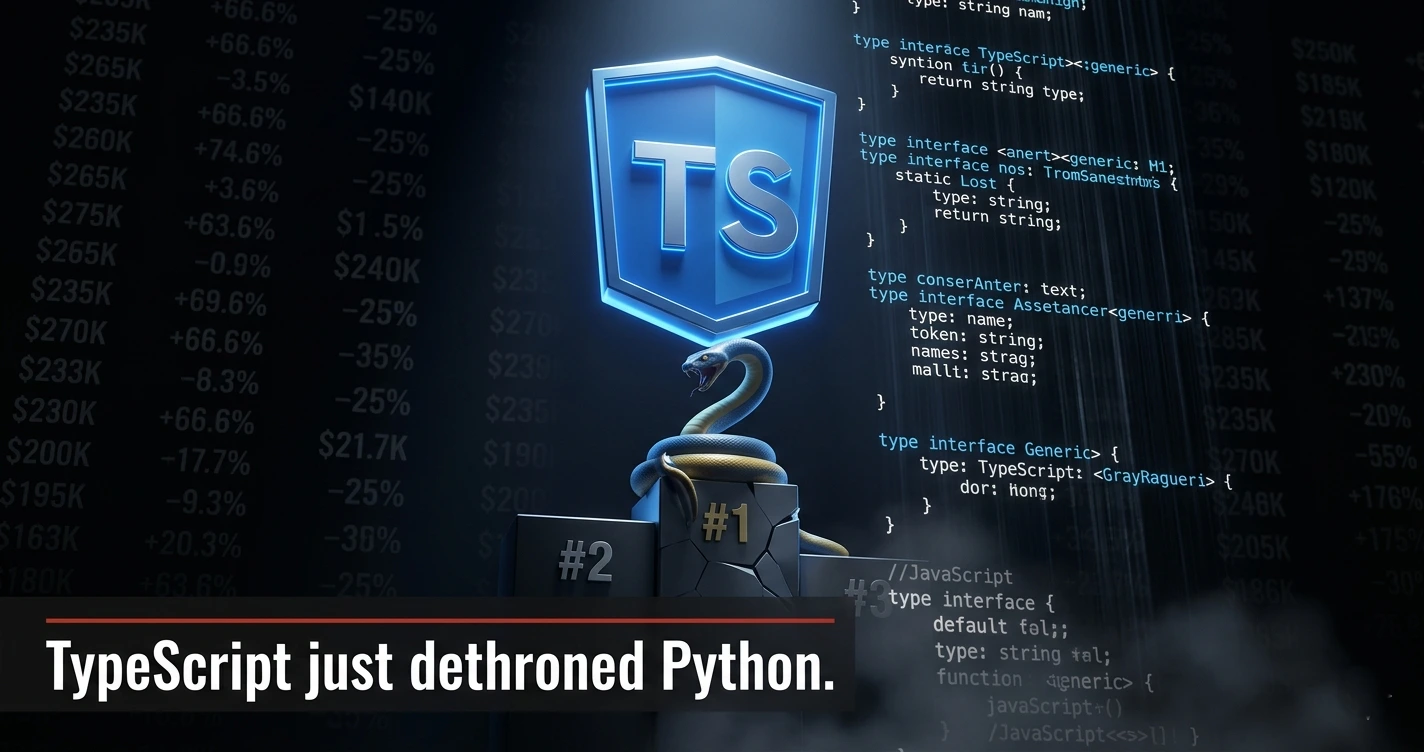
In August 2025, TypeScript did something no language had managed in over a decade: it knocked Python off the top spot on GitHub. The margin was slim, roughly 42,000 contributors, barely 1.6% of a 180-million-user platform, but the symbolism landed across every developer forum worth reading. The era of “just learn Python” as universal career advice had quietly ended.
What makes 2026 genuinely different is that the question itself is evolving. It used to be, “which language gets me hired?” Now it carries a harder layer, “which languages will still require a human to write them in 18 months?” That’s not alarmism. SWE-bench verification rates jumped from 33% to over 70% in just two years. Google’s Sundar Pichai confirmed AI now writes more than a quarter of code at the company. These are not talking points. They’re operational realities.
+66.6%TypeScript contributor growth on GitHub YoY — Aug 2025
+7ppPython’s Stack Overflow adoption jump, largest single-year gain in a decade
−25%Drop in entry-level developer job postings in 2024
+15%BLS projected growth in software developer roles through 2034
The Shift Nobody Saw Coming
The programming language landscape had a stable power structure for years. JavaScript dominated developer surveys for a decade. Python rose steadily through the AI boom. Then 2025 delivered a genuine plot twist in each direction, back to back.
The 2024 GitHub Octoverse was the first signal: Python dethroned JavaScript for the first time in over a decade, fueled by a 59% surge in contributions to generative AI projects and a 98% increase in total generative AI project count. Then, barely twelve months later, TypeScript dethroned Python. In a platform of 180 million users, TypeScript added over 1 million monthly active contributors year-over-year, a 66.6% jump, reaching 2,636,006 contributors just ahead of Python’s 2,594,000.
Why TypeScript? The short answer is AI-assisted development. A 2025 academic study found that 94% of LLM-generated compilation errors are type-check failures. When teams are shipping AI-generated code into production, and 80% of new GitHub developers are using GitHub Copilot in their first week, TypeScript’s static typing catches a category of bugs that JavaScript cannot. Typed code and AI code generation are natural allies.
“We might be six to twelve months away from when the model is doing most, maybe all of what software engineers do end-to-end. I have engineers within Anthropic who say I don’t write any code anymore. I just let the model write the code. I edit it.”
— Dario Amodei, CEO & Co-Founder, Anthropic — Davos, January 2026
Our read: Amodei isn’t predicting the death of programming. He’s predicting the death of a particular kind of programming, the mechanical, specification-driven implementation work that entry-level roles have always been built on. The languages that matter in this environment are those where human judgment adds irreplaceable value: architecture, performance, security, domain logic. That reframe points toward exactly the same top languages, for different reasons than before.
2026 Language Rankings at a Glance
This table synthesizes GitHub Octoverse 2025, Stack Overflow Developer Survey 2025, TIOBE Index (May 2026), U.S. Bureau of Labor Statistics projections, and current job market salary data. No single source tells the full picture; this combines all of them.
#
Language
Primary Signal
US Senior Salary
Best For
AI Threat Level
1
Python
TIOBE #1 (21.81%); SO +7pp YoY
$98k–$188k
AI/ML, data science, automation
Medium–Low (core AI infra)
2
TypeScript
GitHub #1 by contributors (Aug 2025)
$95k–$180k
Full-stack, AI-product builds
Low (type safety + AI)
3
JavaScript
Stack Overflow #1, 66% usage, 13 yrs
$85k–$160k
Web, frontend, rapid prototyping
Medium (frontend commoditizing)
4
Rust
Most admired 10 years straight (72%); +35% job posts YoY
$130k–$235k
Systems, infrastructure, security
Very Low (perf-critical)
5
Go
TIOBE #8; cloud-native & DevOps
$115k–$195k
Cloud backends, DevOps, AI infra
Low (concurrency nuanced)
6
Java
TIOBE #3; enterprise bedrock
$95k–$175k
Enterprise, Android
Medium
7
C#
TIOBE Language of the Year 2025
$90k–$165k
.NET, Unity, enterprise
Medium
8
SQL
Non-negotiable second skill; PostgreSQL most admired DB, 3 yrs
$85k–$155k
Data engineering, analytics, backend
Low (query logic = human judgment)
The Top 8 Languages: Deep Dives
01
PythonThe Undisputed AI-Era King — With Caveats
Python’s position in 2026 is paradoxical: it’s simultaneously the most important language to learn and the most over-hyped entry-level career path. The TIOBE Index gives Python a 21.81% market share, a dominant lead no other language comes close to. Stack Overflow’s 2025 survey recorded its largest single-year adoption jump in over a decade: +7 percentage points. AI/ML job postings on Indeed are up 134% since 2020, and Python powers the overwhelming majority of that work.
The caveat: TIOBE CEO Paul Jansen noted in early 2026 that Python’s share has declined from a peak of 26.98% in July 2025 as domain-specific languages gain ground. Python’s explosive growth may be plateauing, when every data scientist already uses it, further growth hits a ceiling.
What the job market actually wants in 2026: not basic Python. Hiring managers want FastAPI, LangChain, experience building on LLM APIs, and Python used as infrastructure glue for AI pipelines — not just scripted data manipulation. The “learn Python in 30 days” bootcamp path leads to the most competitive segment of an increasingly AI-saturated entry-level market.
“Our goal is for Python to be a great tool that helps the ever-growing developer community build the world they envision. We couldn’t be more pleased to learn about Python’s continued rise in popularity on GitHub, especially coupled with the increased use of Jupyter Notebooks, data analysis, AI, and open source technology.”
— Deb Nicholson, Executive Director, Python Software Foundation — GitHub Octoverse 2024
TypeScriptGitHub’s New #1 — and the AI-Native Default
TypeScript’s ascent to the top of GitHub isn’t just a popularity story, it reflects a structural change in how professional teams ship code in an AI-assisted era. When AI tools generate your code, type errors become the primary failure mode. TypeScript catches them at compile time. JavaScript doesn’t. For engineering teams shipping AI-generated code into production, which describes most of them, this is risk management, not preference.
A critical context note worth having: the 42,000-developer margin between TypeScript and Python on GitHub is just 1.6% of the platform. TypeScript also compiles to JavaScript, they share the same runtime ecosystem. The JavaScript + TypeScript combined total vastly outscales Python in total GitHub activity. The “TypeScript at #1” headline is accurate, but that framing completes it.
There is a legitimate dissenting view from senior developers, particularly at smaller companies: TypeScript’s type system is over-engineered for teams under ten people, and the velocity cost of strict typing outweighs its benefits outside enterprise-scale codebases. Smaller startups often retain plain JavaScript for speed. That’s not wrong, it’s a real tradeoff, not a failure to understand TypeScript.
GitHub #1 · Aug 2025+66.6% YoYAI-nativeReact/Next.jsNode.js
03
JavaScriptStill the Most-Used Language on Earth
JavaScript has been used by 66% of all professional developers for thirteen consecutive years in Stack Overflow surveys. You can’t build a frontend without it, TypeScript compiles to it. You can’t run Node.js backends without it. The shift to TypeScript doesn’t reduce JavaScript’s relevance; it refines it. The JavaScript/TypeScript ecosystem combined still vastly outscales every other language by total GitHub activity.
The frontend commoditization threat is real: AI tools can scaffold basic React interfaces faster than most junior developers. But the JavaScript developer who understands the runtime, the event loop, and the performance model remains difficult to replace. The language isn’t the moat, the depth of understanding is.
SO #1 by usage · 66%13 consecutive yearsReactNode.jsVue
04
RustThe Highest-Paying Language — and the Most Honest Career Bet
Rust has been the most admired programming language in the Stack Overflow Developer Survey for ten consecutive years, 72% admiration rate in 2025. Job postings grew 35% year-over-year. US senior salaries run $130,000 to $235,000+, with top employers including Cloudflare, 1Password, and Figma. The salary premium exists precisely because the talent pool is small, only an estimated 709,000 developers use Rust as their primary language globally.
The admiration-to-adoption gap is real and requires honest framing: TIOBE still doesn’t rank Rust in its top 15 by search volume. The ownership model and borrow checker genuinely filter out casual learners, not as a flaw, but as the mechanism that produces the quality guarantees that make Rust worth paying for. For mid-career developers targeting systems programming, infrastructure, or AI inference infrastructure (where Rust is already displacing Python at companies like Cloudflare), this is the strongest long-term career bet in the entire landscape, if you can commit to the learning curve.
Most admired · 10 years straight$130k–$235k++35% job posts YoYSystemsSecurity
05
Go (Golang)The Pragmatist’s Systems Language
Go sits at #8 on TIOBE with strong and growing adoption in cloud-native backends and DevOps tooling. It’s the gentler on-ramp to systems programming compared to Rust, no borrow checker, a straightforward concurrency model, and a famously simple toolchain. Go developers working on AI inference roles command salaries roughly 37% higher than TypeScript counterparts in equivalent roles, per 2026 benchmark data. Best choice for developers targeting scalable backends, Kubernetes tooling, or infrastructure work, high ROI without a year-long learning cliff.
TIOBE #8Cloud-nativeKubernetesDevOpsConcurrency
06
JavaEnterprise Bedrock That Refuses to Die
Java’s trajectory is the cautionary tale about dominance not being permanence, and then the plot twist where it refuses to confirm the lesson. TIOBE had Java at 26.49% share in 2001; today it sits near 8%. That sounds like collapse. But Java remains TIOBE’s #3 language overall, powers the majority of enterprise backends globally, runs Android development, and is embedded in financial services and healthcare systems that aren’t being rewritten anytime soon. Java in 2026 is a stability bet, not a growth bet.
TIOBE #3EnterpriseAndroidSpringFintech
07
C#TIOBE’s Language of the Year — With a Defined Niche
TIOBE named C# its “Programming Language of the Year 2025” for achieving the largest year-over-year gain among tracked languages. This measures growth rate, not absolute dominance, Python still holds the top spot overall. But C#’s resurgence reflects Microsoft’s ongoing .NET investment and Unity’s continued reign as the dominant game development engine. If game development or Microsoft-stack enterprise is your specific target, C# is non-negotiable.
TIOBE Language of the Year 2025.NETUnityEnterprise
08
SQLThe Non-Negotiable Second Skill
SQL isn’t a language to learn in the way Python or TypeScript is. It’s table stakes. PostgreSQL has been the most admired and most desired database in Stack Overflow’s Developer Survey for three consecutive years. Every data role, every backend role, and every analytics role requires SQL competency. The fastest path to employability in 2026 — starting from zero, is Python + SQL, not Python alone. Don’t treat SQL as optional. It isn’t.
Non-negotiablePostgreSQL most admired DB, 3 yrs straightData engineeringAnalytics
The AI Disruption: What It Actually Means for Your Career
Here’s the uncomfortable arithmetic most career guides skip: the U.S. Bureau of Labor Statistics projects 15% growth in software developer jobs through 2034, roughly 129,200 new openings per year. Simultaneously, it projects a 6% decline in traditional “computer programmer” roles. Both numbers are accurate. They don’t contradict each other. The industry is growing at the top while contracting at the bottom.
Entry-level developer job postings dropped approximately 25% in 2024. Employment of developers aged 22–25 fell nearly 20% that same year. An IEEE Spectrum report from December 2025 found employers’ outlook for graduate hiring was at its most pessimistic since 2020, explicitly attributing the shift to AI handling tasks previously assigned to junior developers.
⚠ Critical Context
The “learn Python and get hired in six months” advice was accurate in 2021. It’s still true for the right Python skills, but the wrong version (basic scripting, vanilla CRUD apps) is the fastest way to build a portfolio that AI can already replace. The bar for “hireable” has shifted upward, not disappeared.
SWE-bench verification rates — measuring how well AI resolves real GitHub issues, jumped from 33% in early 2024 to over 70% by early 2026. That’s not linear progress. It’s an inflection point. GitHub Copilot reached 4.7 million paid subscribers by January 2026, up 75% year-over-year. Over 1.1 million public repositories now import an LLM SDK, up 178% year-over-year.
The pattern that emerges is consistent: AI is replacing tasks, not entire professions. It replaces the most routine, specification-driven implementation work fastest. What it can’t reliably replace, yet, is architectural judgment, security reasoning, performance-critical optimization, and deep domain expertise. The languages commanding the highest salaries in 2026 (Rust, Go senior roles, Python AI engineering) all map to exactly these categories.
AI is replacing the most specification-driven coding fastest. What remains is judgment, and the languages that reward judgment pay the most.
How to Choose: A Decision Matrix
The right language depends entirely on where you’re starting and where you’re going. Here’s the breakdown without the generic advice.
Starting from zero
Python, then SQL. Python’s syntax is the lowest-friction path to being productive. It’s the #1 language for AI and data roles, which are the fastest-growing job category. SQL pairs immediately for data work. JavaScript is the right alternative if you specifically want to build visible web applications from day one, seeing results in a browser sustains motivation. Avoid starting with Rust or C++, the time-to-productivity ratio is too low for beginners.
Mid-career switch or bootcamp student
Python + TypeScript is the highest-ROI six-to-twelve month combination in 2026. Python for AI-integrated backend work; TypeScript for full-stack product development. The portfolio you need isn’t a to-do app. It’s a project integrating an LLM API, handling real data, and demonstrating architectural thinking, even at modest scale. GitHub presence matters more than certifications in 2026’s hiring environment.
Mid-career developer (5–10 years in)
The language question is secondary to the domain question. Domain expertise in healthcare, fintech, infrastructure, or security is the moat AI doesn’t erode. That said: adding Rust or Go to a Python/TypeScript base positions you for systems and infrastructure roles commanding $140k–$200k+. The admiration-to-adoption gap in Rust (72% admired, small talent pool) signals a hiring premium that early adopters will capture.
Engineering manager or CTO
TypeScript should be your default assumption for new projects, 80% of new developers on GitHub use Copilot in their first week, and TypeScript produces fewer AI-generated compile errors. Audit your stack against the GitHub Octoverse 2025 finding: 80% of new library activity is concentrated in six languages (Python, JavaScript, TypeScript, Java, C++, C#). If your stack sits outside this cluster, your dependency maintenance burden is growing.
💡 Our Read
The safest combination for a career spanning the next decade: Python for AI/data work, TypeScript for product builds, SQL as the non-negotiable second skill, and a serious Rust study effort before 2027. That covers the three dominant trends without betting everything on a single paradigm.
FAQ: Best Programming Languages to Learn in 2026
The top questions Google surfaces on this topic, answered directly and completely.
Which programming language is most in demand in 2026?
Python leads job market demand in 2026, especially for AI, data science, and machine learning. The Stack Overflow 2025 Developer Survey recorded Python’s largest single-year adoption jump, +7 percentage points, of any major language. AI/ML job postings on Indeed are up 134% since 2020. For full-stack product roles, TypeScript is increasingly the default hiring assumption.
Is Python still worth learning in 2026?
Yes. Python holds TIOBE’s #1 spot at 21.81% market share and dominates the fastest-growing job category in software. Senior Python developers earn $98k–$188k annually. The caveat: entry-level Python scripting faces direct AI competition. Pairing Python with SQL and LLM framework experience (LangChain, FastAPI) is what the 2026 job market rewards.
Is JavaScript still relevant in 2026?
Absolutely. JavaScript is used by 66% of all professional developers, the most-used language for thirteen consecutive years per Stack Overflow. TypeScript, which overtook Python as GitHub’s #1 language by contributors in August 2025, compiles to JavaScript. The two are the same ecosystem. Combined, they outscale all other languages in total GitHub activity.
Should I learn Rust in 2026?
Rust is the most admired language (72%, Stack Overflow 2025) and offers the highest salary premium, $130k to $235k+ in the US, with job postings up 35% year-over-year. Best suited for developers targeting systems programming, infrastructure, or security. Not recommended as a first language: the learning curve is steep and the talent pool is deliberately small, which is exactly what drives the premium.
What programming language should a beginner learn in 2026?
Python is the consensus top recommendation: simple syntax, vast library ecosystem, #1 for AI and data roles, strong job market. Pair it with SQL immediately for maximum employability. JavaScript is the best alternative if you want to build visible web results from day one. Avoid starting with Rust or C++, the time-to-productivity ratio is too low for complete beginners.
Is Go (Golang) worth learning in 2026?
Yes, for a specific target. Go ranks #8 on TIOBE and dominates cloud-native backends and DevOps tooling. It’s the gentler path to systems programming compared to Rust, with Go developers in AI inference roles earning roughly 37% more than TypeScript counterparts in equivalent positions. Best for developers targeting scalable backend systems, Kubernetes, or infrastructure work.
What are the highest-paying programming languages in 2026?
In the US: Rust ($130k–$235k+), Go (strong AI inference premium), senior Python ($112k–$188k), and TypeScript in senior full-stack roles. Solidity (blockchain) reaches $120k–$200k but carries market volatility. Salary data from ZipRecruiter, Glassdoor, and RustJobs.dev as of April 2026.
Will AI replace programmers in 2026?
Not entirely, but specific roles are already disrupted. Entry-level developer postings fell ~25% in 2024, and AI generates over 25% of code at Google. The BLS still projects 15% growth in software developer roles through 2034, but simultaneously a 6% decline in traditional “computer programmer” roles. AI is replacing tasks, not entire professions, and raising the floor of what human developers must deliver.
Is TypeScript better than JavaScript in 2026?
For professional development at team scale, TypeScript is increasingly the default: it overtook Python as GitHub’s #1 language in August 2025, driven by the need to catch type errors in AI-generated code. For small projects or solo developers, plain JavaScript remains entirely valid. The debate is real for small teams, TypeScript’s strictness has a velocity cost that not every codebase justifies.
What programming languages are losing popularity in 2026?
Languages in confirmed decline include PHP (dropped from TIOBE #3 in 2010 to #18 by 2026), Objective-C (displaced by Swift), and Haskell. Java’s drop from 26% TIOBE share in 2001 to ~8% today is the canonical cautionary tale, but slow decline over decades isn’t obsolescence. Java remains essential in enterprise and Android. COBOL is maintained but not learned by new developers.
What Comes Next
The best programming languages to learn in 2026, Python, TypeScript, Rust, Go, are correct as answers. But the reason they’re correct has shifted. It’s no longer just about ecosystem size or job posting volume. It’s about where human judgment adds irreplaceable value when AI handles the routine implementation.
Python wins because building AI pipelines requires architectural and domain judgment, not just syntax. TypeScript wins because typed code is how teams safely ship AI-generated code into production. Rust wins because memory-safe, performance-critical systems are the last category AI handles poorly, and the salary premium reflects exactly that scarcity. Go wins because cloud-native infrastructure requires the kind of concurrency reasoning that AI still struggles to get right.
The developer who learns Python + TypeScript this year, pairs it with SQL, builds publicly on GitHub with AI-integrated projects, and starts a serious Rust track before 2027 isn’t playing defense. They’re building a profile genuinely difficult to displace, by an AI or a competitor.
Three things to watch in the next 6–18 months: First, whether SWE-bench rates cross 80%, the threshold at which Amodei’s forecast starts affecting senior roles, not just junior ones. Second, the October 2026 GitHub Octoverse, whether TypeScript’s 1.6% margin over Python holds, widens, or reverses. Third, Rust adoption in LLM inference infrastructure, if it normalizes at Cloudflare-scale companies, the salary premium will compound and early adopters will be positioned ahead of the hiring curve.
The Neural Loop
NeuralWired’s weekly intelligence brief on AI, software, and the future of tech careers, no filler, no hype, just the signal that matters.
Subscribe Free →
Irfan Malik on Why AI Won’t Replace Your Best Engineers — NeuralWired
AI & WorkforceMay 13, 2026 · NeuralWired Staff
Irfan Malik Says Stop Choosing Between AI and People | Here’s Why the Data Backs Him Up
Tech entrepreneur and AI strategist Irfan Malik has been making the case for a hybrid workforce model at a moment when enterprise leaders are being forced to pick a side. With real productivity gains stuck at roughly 10% despite massive AI investment, the math is starting to align with his argument.
The pitch from AI vendors has always sounded compelling. Replace expensive engineers with automated tools. Cut hiring budgets. Let the models do the work. But the actual numbers trickling out of enterprise deployments in 2026 tell a more complicated story, one that Irfan Malik, CEO of Xeven Solutions, has been anticipating for a while. He argues that companies fixated on AI as a headcount substitute are solving the wrong problem entirely.
Malik’s framework, built around applying advanced technologies to real-world challenges with skilled human oversight, isn’t contrarian for its own sake. It’s a response to a clear pattern: enterprises that pour capital into AI tooling without investing equally in the people operating those tools tend to see modest returns, diffuse accountability, and eroded team trust. The data, from McKinsey to independent engineering research, is starting to confirm that view.
The 10x Productivity Lie That’s Driving Boardroom Decisions
Somewhere between the demo and the deployment, something gets lost. AI vendors have consistently framed their tools in terms of order-of-magnitude productivity improvements. The phrase “10x engineer” entered the lexicon and never really left. Boards heard it, allocated accordingly, and in many cases began trimming headcount on the assumption that fewer people could now do exponentially more work.
The reality, measured carefully, is far more modest. A longitudinal study by DX covering November 2024 through February 2026 tracked AI adoption across engineering teams and found that a 65% increase in AI tool usage translated to a pull request throughput gain of just under 10%, roughly 9.97%, with the typical range landing between 8% and 12%. That’s meaningful. It’s not nothing. But it is emphatically not 10x.
Key figure: AI tool usage in software engineering rose 65% between late 2024 and early 2026. Pull request throughput, the actual measurable output, increased by 9.97%. The gap between adoption rate and productivity gain tells the whole story.
The McKinsey data is sharper still. The firm’s December 2025 State of AI survey found that while 88% of enterprises now use AI in at least one business function, only 6% qualify as high performers, defined as achieving a 5% or greater improvement in earnings before interest and taxes attributable to AI. The rest are spending real money for sub-threshold results. Only 6 out of every 100 companies are extracting the kind of value the boardroom was promised.
“Only one in 50 AI investments deliver transformational value, and only one in five delivers any measurable return.”
Gartner Analyst, via Harvard Business Review, February 2026
Those are brutal numbers. And they create a specific kind of organizational trap: companies that have already reduced headcount in anticipation of AI gains they haven’t actually achieved yet, now operating with fewer people and tools that are underperforming expectations. Recovering from that position is expensive, slow, and damaging to morale.
Why Irfan Malik’s Hybrid Model Is Gaining Traction Now
Malik’s position at Xeven Skills and Xeven Solutions places him at the intersection of enterprise AI deployment and workforce development. That vantage point shapes a philosophy that’s straightforward to state and genuinely difficult to execute: build AI systems that scale, then make sure skilled humans are the ones running them. The word “hybrid” gets used loosely in this industry, but Malik applies it precisely, not as a compromise position but as a structural requirement for any AI deployment that needs to handle novel problems, ethical trade-offs, or contextual judgment.
His argument resonates because it maps onto observable failure patterns. When AI tools operate without adequate human oversight, three things tend to happen. Hallucinations go uncorrected. Edge cases get mishandled. And when things go wrong, accountability diffuses across a system that nobody fully controls or owns. These aren’t theoretical risks. They’re the documented experience of enterprises that moved too fast toward automation without maintaining the human layer that catches what the model misses.
Malik’s core thesis: AI’s value ceiling is determined by the quality of the humans working with it. The firms seeing real returns aren’t the ones who replaced their teams, they’re the ones who trained their teams to operate AI effectively at scale.
This framing also addresses something the pure-automation argument tends to skip over: the nature of the tasks that actually drive competitive advantage. Large language models perform well on well-defined, repeatable tasks with clear success criteria. They perform poorly on novel logic, system-level reasoning, and anything requiring genuine ethical judgment. The work that creates strategic differentiation tends to fall into that second category. You can’t automate your way to a better product vision.
“To strike the balance between AI tools and human talent, L&D can lead the transformation by putting people first.”
Peter Hirst, Senior Associate Dean, MIT Sloan School of Management, via HR Dive
What the Deployment Data Actually Says About AI Limits
AI tools are, at their core, probabilistic engines trained on historical data. They predict outputs with reasonably high accuracy for well-structured tasks, somewhere in the 80-90% range for simple, repeatable work. That accuracy degrades meaningfully when problems require contextual reasoning outside the training distribution, multi-step logical chains with real-world dependencies, or outputs where being confidently wrong carries operational consequences.
The DX data makes this concrete. Engineering teams using AI coding assistants saw throughput improvements, yes. But the gains concentrated in low-complexity tasks: boilerplate generation, documentation, syntax corrections. The high-value work, architecture decisions, security reviews, debugging novel failure modes, remained stubbornly resistant to automation. The humans didn’t disappear from the workflow. They shifted toward the harder end of it.
Google’s approach illustrates what responsible scaling looks like in practice. Rather than treating AI as a headcount replacement, the company has deployed it to reduce time spent on routine HR and operational processes, freeing human capacity for work requiring judgment and relationship management.
“We always keep humans in the loop. AI supports deeper, more connected leader-employee relationships rather than replacing them.”
Arnish, Google Cloud HR, via Complete AI Training, July 2025
The governance gap is a significant factor here too. McKinsey’s data attributes a substantial portion of the performance gap between high and low AI performers to data quality issues and absent governance frameworks. AI tools are only as reliable as the systems they operate within. Companies that haven’t built those systems, data pipelines, oversight protocols, escalation paths, are deploying powerful tools without the infrastructure to catch their failures. That’s a human problem, not a technical one.
The Cost Calculus: AI Tools vs. Hiring Humans
The financial argument for AI-first hiring strategies has real substance, and it would be dishonest to dismiss it. Research from Appliview published in April 2025 found that AI-assisted recruitment reduces hiring costs by 20% to 50% compared to traditional methods, against a baseline average of $4,700 per hire. For organizations with high hiring volume, that’s a genuine budget line item worth optimizing.
The complication is in the ROI timeline. AI tooling has upfront licensing costs, integration costs, and the often-underestimated cost of retraining and governance infrastructure. When those are factored in alongside the modest productivity gains the DX data documents, the financial case for wholesale human replacement weakens substantially. The 6% high-performer rate from McKinsey suggests that most companies aren’t reaching the returns that would justify that trade-off.
Dimension
AI-Only Approach
Human-Only Approach
Irfan Malik’s Hybrid Model
Upfront Cost
High (licensing, integration, governance)
High (salaries, benefits, recruitment)
Moderate (tooling + targeted hiring)
Productivity Gains
8-12% on routine tasks; near zero on complex work
Baseline; no amplification
10%+ on routine + human advantage on complex tasks
Scalability
High for defined, repeatable tasks
Limited by headcount
High; humans govern AI scale
Novel Problem Handling
Poor; hallucination and context loss
Strong
Strong; AI handles load, humans handle edge cases
Accountability
Diffuse; error attribution unclear
Clear
Clear; human oversight layer preserved
Long-term ROI
Uncertain; only 6% of firms hit 5%+ EBIT impact
Predictable but ceiling-limited
250% ROI in 18 months when training investment is included
The Jobs Picture in 2026: Growth, Not Replacement
The workforce displacement narrative has been loud. It’s also, at the aggregate level, not yet supported by the employment data. CompTIA’s 2026 State of the Tech Workforce report projects 1.9% growth in US tech employment this year, adding approximately 185,000 net new jobs to bring the sector total to 9.8 million. More than 275,000 job postings as of January 2026 explicitly require AI skills. The labor market isn’t contracting. It’s recomposing.
That recomposition matters for how companies think about their talent strategy. The skills in demand are shifting fast. Roles requiring AI fluency, prompt engineering, model oversight, and AI-augmented analysis are growing. Roles focused on purely manual, rule-based work are shrinking. The companies navigating this well are the ones building internal training programs that move existing employees into the new skill areas, rather than replacing them outright.
📈
Tech Job Growth
1.9% sector expansion in 2026; 185,000 net new jobs projected by CompTIA.
🤖
AI Skills in Demand
Over 275,000 job postings in January 2026 explicitly required AI competency.
⚠️
Displacement Risk
32% of companies plan workforce reductions of 3%+ in the next 12 months, per McKinsey.
📊
Data Science Growth
Data science roles projected to grow 420% by 2036 as AI demands analytical oversight.
The concerning number is the 32% of companies planning workforce reductions of 3% or more over the next year, also from McKinsey. That’s a meaningful portion of the market making cuts, potentially before the AI tools intended to replace that capacity are delivering reliably. If the DX and Gartner data on actual productivity gains holds, some of those organizations are going to find themselves understaffed for the complex work AI can’t handle, with tools that are producing roughly a 10% throughput improvement in the domains where they work at all.
The Training ROI Case That Most CFOs Haven’t Seen
There’s a number that should be in every workforce planning conversation but rarely is: companies that invest in AI training programs for their existing employees report a 250% return on that investment within 18 months. That figure, drawn from corporate training research, reframes the entire build-or-buy question. The calculus isn’t “AI tools versus headcount.” It’s “AI tools plus trained people versus AI tools alone.”
The training gap is real and measurable. Surveys across the MENA region found 30% of employees reporting that their employers had made little to no investment in AI-related upskilling. That’s not a technology problem. It’s a management priority problem. Organizations that treat AI deployment as a capital expenditure question without an accompanying talent development budget are leaving most of the available value on the table.
Malik’s work through Xeven Skills addresses this directly. The argument isn’t that AI is overhyped, it’s that the returns accrue to organizations that invest in people capable of directing, correcting, and extending what the tools do. That’s a more demanding operating model than simple automation, but the performance data suggests it’s the one that actually produces the returns the boardroom wants.
Frequently Asked Questions
Should companies invest more in AI tools or in hiring right now?
The McKinsey data suggests neither in isolation is sufficient. With 88% of enterprises already using AI but only 6% achieving high performance, the bottleneck isn’t access to tools, it’s the capability to operate them well. Companies that prioritize upskilling existing talent while selectively adopting AI tools see better outcomes than those treating the two as substitutes.
Will AI actually replace tech jobs at scale?
CompTIA’s 2026 data projects net growth of 185,000 tech jobs this year. The composition is shifting, AI-fluent roles are expanding rapidly while purely manual roles contract. Mass replacement isn’t happening; redistribution is. The 32% of companies planning cuts, however, signals real risk for specific roles and sectors.
What are realistic AI productivity gains for engineering teams?
DX’s longitudinal study covering late 2024 through early 2026 found gains of 8% to 12% in pull request throughput among engineering teams with 65% AI tool adoption. That’s a real improvement, concentrated in routine tasks. Complex work, architecture, security, novel debugging, showed minimal automation benefit.
What does a good AI training program for employees look like?
Effective programs combine structured learning with practical application: peer sessions where teams work through real AI-assisted workflows, clear escalation protocols for when human judgment is required, and ongoing feedback loops that measure actual output quality rather than just tool usage. Organizations tracking this carefully report 250% ROI within 18 months.
Who is Irfan Malik and why does his perspective matter here?
Irfan Malik is the CEO of Xeven Solutions and the founder of Xeven Skills, focused on applying advanced technologies to real-world enterprise challenges with human oversight at the center. His hybrid model, scale AI with skilled teams rather than replace skilled teams with AI, is gaining traction precisely because the enterprise performance data from 2025 and 2026 aligns with its core predictions.
What to Watch: Irfan Malik and the Hybrid Model’s Next Test
NeuralWired Signals
01Agentic AI pilots in 2026: The next wave of enterprise AI involves autonomous agents running multi-step workflows. How organizations structure human oversight for these systems will determine whether the 6% high-performer rate improves or contracts further.
02The 32% workforce reduction cohort: McKinsey flagged that nearly a third of companies plan significant cuts. Tracking their AI performance 12 months out will test whether the automation-first playbook actually delivers, or leaves them unable to handle the work AI can’t do.
03Irfan Malik’s scaling thesis: As Xeven Solutions and Xeven Skills expand, their performance data will offer one of the cleaner real-world tests of whether the hybrid model at scale delivers the returns the 250% training ROI figure suggests it should.
04Governance as the differentiator: McKinsey’s high-performer cohort consistently cited data quality and governance infrastructure as separating factors. Watch for governance tooling to become its own competitive category as enterprises realize the human oversight layer needs its own stack.
The debate over AI versus human talent has been framed as a zero-sum choice by people who have an interest in selling tools or in appearing decisive. The deployment evidence from 2025 and 2026 suggests it was never that simple. Productivity gains are real but modest. Transformation is rare. The companies that are getting serious returns, that 6%, are doing so by building capable human teams who know how to direct AI effectively, not by ceding that capability to the tools themselves.
Irfan Malik has been making this argument before the performance data caught up to it. Now the data is here. Whether the industry adjusts its expectations accordingly, or continues chasing the 10x number that hasn’t materialized, is the defining workforce question of the next two years.
Stay ahead of the AI workforce shift.
NeuralWired covers enterprise AI performance, workforce strategy, and the real numbers behind the hype, every week.
Meta’s $145B Bet and NVIDIA’s China Collapse: The Paradox Reshaping AI | NeuralWired
AI InfrastructureMay 5, 2026 · NeuralWired Staff
Meta’s $145B Gamble and NVIDIA’s China Wipeout: The Paradox Defining AI’s New Era
Meta has raised its 2026 infrastructure spending to an eye-watering $145 billion — even as its primary chip supplier, NVIDIA, loses its entire China business overnight. Together, these two seismic moves expose the fault lines of a global AI economy splitting into competing blocs.
Mark Zuckerberg didn’t blink. On April 29, Meta’s Q1 2026 earnings call delivered a number that briefly stopped trading desks mid-conversation: the company’s capital expenditure guidance for the year had climbed from $115-135 billion to $125-145 billion. That upper bound of $145 billion exceeds Meta’s combined infrastructure spend across all of 2024 and 2025. The stock dropped 6-8% the next morning. Analysts called it excessive. Zuckerberg called it necessary.
Three days later, NVIDIA CEO Jensen Huang walked onto a stage at a Citadel event and offered an equally stunning data point from the other end of the trade. His company’s share of China’s AI GPU market had gone from roughly 95% to, in his own words, zero. “The export policy has already largely backfired,” Huang said. The two announcements, separated by 72 hours, form what analysts are already calling the Meta-NVIDIA Paradox — a collision between America’s most aggressive AI spending spree and its most consequential hardware policy failure.
Key context: Combined 2026 infrastructure spending across Alphabet, Amazon, Microsoft, and Meta is projected to reach $725 billion, a 77% year-over-year increase. That figure alone reframes every conversation about AI’s industrial trajectory.
The Numbers That Shocked Markets
Meta’s revised capex guidance isn’t just a big number. It’s a statement of intent. Zuckerberg told analysts the increase reflects “higher prices for components and additional data center costs to support future-year capacity.” Read plainly: the infrastructure needed to run competitive AI models has gotten more expensive, and Meta intends to keep building regardless.
Meta CFO Susan Li confirmed that total Q1 2026 expenses surged 35% to $334 billion, driven primarily by infrastructure investment and headcount costs. That kind of expense growth, at that scale, doesn’t get approved without a clear theory of the return. Meta’s theory is Llama, its open-weight model family, and the agentic AI products being built on top of it. The bet is that owning the infrastructure layer means owning the cost structure when every major app runs AI agents at scale.
“We continue to expect pretty significant infrastructure growth in 2026, higher prices for components and additional data center costs to support future-year capacity.”
Mark Zuckerberg, CEO, Meta Platforms — Meta Q1 2026 Earnings Call, April 29, 2026
The market’s reaction to the capex hike was swift and skeptical. A 6-8% stock drop signals that investors aren’t yet convinced the spending will produce proportionate returns, especially when the AI monetization story for consumer apps remains works-in-progress. But the broader hyperscaler peer group is moving in the same direction, which makes the spend less an outlier and more a competitive floor.
NVIDIA’s China Collapse: From 95% to Zero
Jensen Huang’s declaration at the Citadel event carried the weight of a post-mortem. NVIDIA once controlled approximately 95% of China’s AI GPU market. That dominance was the product of years of engineering investment, developer ecosystem building, and CUDA’s near-total lock-in among AI researchers. It’s gone. Not declining. Gone.
The export restrictions that triggered this collapse were designed to prevent advanced American chips from powering Chinese AI applications with potential military use. The policy logic was defensible. The execution, Huang argues, created a vacuum that domestic Chinese vendors, led by Huawei, rushed to fill with impressive speed. According to research from Bernstein, Huawei shipped more than 800,000 AI chips in 2025, covering roughly 80% of domestic Chinese demand.
“We went from 95% market share to 0% in China. The export policy has already largely backfired.”
Jensen Huang, CEO, NVIDIA, Citadel Event, May 2, 2026
The financial hit is substantial. Analysts estimate NVIDIA’s China exposure represents more than $20 billion in annual revenue. The company retains an estimated 92% share of global AI GPU markets outside China, which cushions the blow significantly. But the strategic loss may exceed the financial one. China’s AI developers, optimizing their models for Huawei’s Ascend hardware instead of NVIDIA’s CUDA stack, are building software ecosystems that simply don’t need NVIDIA anymore.
Metric
Before Restrictions
Current (2026)
Key Driver
NVIDIA China AI GPU Share
~95%
0%
U.S. export controls
Huawei Ascend Shipments (2025)
Minimal
800,000+ units
Domestic substitution
Huawei Share of China AI Demand
~5%
~80%
Accelerated R&D + policy tailwinds
NVIDIA Global Share (ex-China)
~95%
~92%
Sustained Western hyperscaler demand
NVIDIA Estimated Revenue Loss
N/A
$20B+ annually
China market exclusion
The Meta-NVIDIA Paradox, Explained
Here’s the tension at the heart of this story. Meta is spending $145 billion, in large part, on NVIDIA hardware. Blackwell GPUs, Rubin architectures, Spectrum-X Ethernet interconnects, Meta and NVIDIA announced a multi-year supply partnership in February 2026 covering hyperscale data center buildout. The demand from Meta and its hyperscaler peers is keeping NVIDIA’s revenue engine running at full capacity.
But NVIDIA’s exclusion from China isn’t just a business problem for NVIDIA. It’s a supply chain problem for everyone. Advanced chip manufacturing is concentrated at TSMC in Taiwan, where seismic risk and geopolitical tension are ever-present concerns. A bifurcated global market means less shared infrastructure, higher costs for enterprises operating across borders, and the slow erosion of shared technical standards that have accelerated AI development globally for the past decade.
Meta benefits from NVIDIA’s Western dominance in the short term. Longer term, it faces a world where AI models developed on Huawei’s Ascend ecosystem simply don’t run on the hardware Meta’s data centers are built around. Two stacks. Two sets of tools. Two sets of developers. The innovation dividend that comes from a unified global research community starts to shrink.
🏗️
Meta 2026 Capex
$125-145B, exceeds total 2024 + 2025 spending combined. Funds Llama model infra and agentic AI deployment.
📉
NVIDIA China Loss
95% to 0% market share. $20B+ in annual revenue at risk. Huawei Ascend now covers ~80% of domestic demand.
🌐
Hyperscaler Spend
$725B combined 2026 infra spend across Meta, Alphabet, Amazon, and Microsoft, up 77% year over year.
🔌
Ecosystem Bifurcation
CUDA vs. Huawei CANN. Two competing AI software stacks risk fragmenting global model interoperability.
Meta’s Silicon Independence Play, and Why It Matters for NVIDIA
Meta isn’t betting entirely on NVIDIA. The company’s in-house chip program, the Meta Training and Inference Accelerator (MTIA), is running on a six-month release cadence, an aggressive schedule by any semiconductor standard. The MTIA 300, already in production, delivers 6.1 TB/s HBM bandwidth at 1.2 PFLOPS FP8. That’s not competitive with NVIDIA’s flagship Blackwell chips yet, but it doesn’t need to be for inference workloads where Meta is deploying it.
The roadmap gets more serious from here. The MTIA 400 targets late 2026 with 9.2 TB/s bandwidth and 6.0 PFLOPS FP8. The MTIA 450, aimed at AI inference, is projected for early 2027 at 18.4 TB/s. Practitioners working with early MTIA deployments have cited cost reductions of 30-50% versus equivalent NVIDIA configurations for specific inference tasks. That’s not a small number when you’re running hundreds of billions in compute annually.
Chip
Focus
Target Deployment
HBM Bandwidth
Compute (FP8)
MTIA 300
R&D Training
In Production
6.1 TB/s
1.2 PFLOPS
MTIA 400
General GenAI
Late 2026
9.2 TB/s
6.0 PFLOPS
MTIA 450
AI Inference
Early 2027
18.4 TB/s
7.0 PFLOPS
MTIA 500
AI Inference
Late 2027
27.6 TB/s
10.0 PFLOPS
None of this means Meta is walking away from NVIDIA. The February 2026 partnership for Blackwell and Rubin GPU supply was a multi-year commitment, not a hedge position. MTIA fills specific inference niches while NVIDIA handles large-scale training. But the direction of travel is clear: Meta wants to own more of its compute stack, and every MTIA chip it deploys reduces its long-term dependency on a single supplier operating in an increasingly fractured geopolitical environment.
The Enterprise AI Race That’s Accelerating Everything
Meta’s capex surge doesn’t exist in isolation. It sits inside a broader structural shift in how AI capabilities are being industrialized across the global enterprise. OpenAI and Anthropic both announced multi-billion dollar deployment joint ventures on May 5, 2026, moves that signal the AI industry’s transition from model development to operational embedding at scale. OpenAI’s “Deployment Company,” backed by TPG and Brookfield with over $4 billion in initial funding, targets 2,000+ portfolio companies. Anthropic’s $1.5 billion joint venture with Blackstone and Goldman Sachs takes a more surgical approach, targeting mid-market firms in healthcare, finance, and manufacturing.
These deployment initiatives require massive, reliable inference infrastructure. That’s exactly what Meta, Google, Amazon, and Microsoft are building, and exactly what NVIDIA’s Blackwell GPU supply chain is strained to deliver. The hardware demand isn’t slowing because one AI lab hit a quarterly target. It’s accelerating because enterprise adoption is finally happening at the scale the market has anticipated for years. The $725 billion in combined 2026 infrastructure spending reflects an industry that’s past the proof-of-concept stage and deep into buildout mode.
Efficiency note: Google’s TurboQuant algorithm, released in early 2026, reduces Key-Value cache memory usage by 6x and delivers 8x faster inference speeds on NVIDIA H100 accelerators with no retraining required. Software-layer breakthroughs like this don’t reduce hardware demand, they expand the viable use case surface area, which ultimately drives more compute consumption.
Geopolitical Fault Lines: Meta, NVIDIA, and the Two-Stack Future
The policy question Jensen Huang raised at Citadel deserves a serious answer. U.S. export restrictions were designed to slow China’s AI advancement by cutting off access to the most advanced chips. The restrictions did slow certain development timelines. They also gave Huawei’s Ascend program a captive market of 1.4 billion people and the world’s second-largest economy, plus a compelling national security argument for accelerating domestic alternatives.
The Bernstein analysis framing NVIDIA’s China share at 66% in 2024 declining toward roughly 8% was already conservative before Huang’s zero-percent declaration. That trajectory matters beyond NVIDIA’s balance sheet. A Chinese AI ecosystem built entirely around Huawei’s CANN software stack and Ascend hardware develops model architectures, toolchains, and deployment patterns that diverge from the CUDA-centric Western ecosystem. Enterprise customers operating globally, banks, manufacturers, logistics firms — may face a world where AI tools that work in one regulatory jurisdiction don’t translate cleanly to another.
The CHIPS Act’s $280 billion domestic manufacturing push addresses part of the supply chain concern. TSMC’s Arizona expansion adds geographic diversification to advanced chip production. But neither move resolves the software ecosystem divergence that Huang is actually warning about. The problem isn’t where chips are made. It’s whether the global developer community stays coherent enough to continue building on shared foundations.