NeuralWired’s Technology section covers the developments reshaping how the world builds, deploys, and regulates digital innovation. We report daily on the stories driving global conversation in artificial intelligence, big technology companies, startups and venture funding, cybersecurity, consumer gadgets and devices, and blockchain and cryptocurrency.
Our technology coverage goes beyond product announcements. When a major AI model launches, we explain what it can actually do and where its claims are overstated. When a startup raises a large funding round, we look at whether the business behind it can sustain that valuation. When a cybersecurity breach hits the news, we explain who is affected and what comes next, not just what happened. Each article is built from original research into primary sources, including company statements, technical documentation, regulatory filings, and verified data, and is written by our editorial team rather than generated automatically.
Readers come to this section for daily updates on the technology stories that matter globally, from shifts inside major technology companies to emerging tools changing how people work, communicate, and build. Whether you are a founder, an investor, an engineer, or simply someone trying to understand where technology is heading next, NeuralWired’s Technology coverage is built to keep you informed without wasting your time on hype.
GDPR AI Compliance 2026: €7.1B Fines & August DeadlineAI Regulation & Compliance
GDPR AI Compliance 2026: €7.1B in Fines and the August Deadline Your Legal Team Is Already Dreading
By NeuralWired EditorialJune 28, 202612 min read
Key Numbers at a Glance
€7.1B+
Cumulative GDPR fines since 2018
€530M
TikTok fine, May 2025 (largest of the year)
Aug 2, 2026
EU AI Act chatbot transparency deadline
92%
Global orgs subject to GDPR (whether they know it or not)
Your AI is eating personal data right now. The question is whether it has the legal authority to do so. GDPR AI compliance 2026 is not a checkbox exercise anymore: cumulative GDPR fines have crossed €7.1 billion, the EU AI Act’s August 2026 deadline is days away, and regulators across Europe have stopped waiting for complaints before they knock. They’re investigating AI training practices as a matter of course.
If you’re a CTO, DPO, or AI engineering lead at a company that touches EU user data, this article is your accelerated briefing. What’s changed, what’s enforceable right now, and the ten-point compliance checklist your team needs before August 2.
The Enforcement Reality: €7.1 Billion and Counting
Cumulative GDPR fines have exceeded €7.1 billion since enforcement began in May 2018, according to DLA Piper’s 8th Annual GDPR Fines and Data Breach Survey. In 2025 alone, regulators issued €1.2 billion in penalties. That matches 2024 levels, which itself was a record year. Anyone who expected enforcement fatigue to set in has been watching the wrong graph.
The Irish Data Protection Commission deserves a specific mention here. It has issued €4.04 billion of the cumulative total on its own, more than four times all other EU member states combined. Ireland is the registered home of Meta, TikTok’s EU entity, LinkedIn, and Google. The DPC is, in practical terms, Big Tech’s lead regulator in the EU, and it has become progressively more willing to use that authority.
“From growing enforcement in sectors away from big tech and social media, to the use of the GDPR as an incumbent guardrail for AI enforcement as AI-specific regulation falls into place… GDPR enforcement remains a dynamic and evolving arena.”
John Magee, Global Co-Chair, Data Privacy and Cybersecurity Group, DLA Piper (January 2025)
Magee’s point about “sectors away from big tech” matters more than the headline fine numbers. The 2,245 documented GDPR fines now on record (CMS GDPR Enforcement Tracker, early 2026) span healthcare, financial services, telco, and utilities. This is no longer a problem for only platform giants. If you process EU personal data at scale for any commercial purpose, the regulatory risk has arrived in your sector.
Data breach notifications reinforce the pattern. EU DPAs received 443 breach notifications per day in the 2025-2026 period, a 22% year-over-year increase and the first time daily reports have exceeded 400 since GDPR came into force. More breaches mean more investigations, more cross-department scrutiny, and more opportunities for regulators to discover adjacent data processing violations, including AI training practices.
Landmark AI-Specific GDPR Cases (2024-2025)
The pattern of AI-training enforcement crystallised through a specific set of decisions over the past eighteen months. These aren’t hypotheticals. They’re the precedents your legal team will be citing in the next compliance review.
OpenAI / ChatGPT (Italy, December 2024): €15 Million
Italy’s Garante concluded a nearly two-year investigation that began with the first-ever temporary AI ban (March 2023) by imposing a €15M fine on OpenAI in December 2024. The violations were foundational: no adequate legal basis for processing personal data used to train ChatGPT; failure to meet transparency obligations under Articles 5, 12, 13, 24, and 25 GDPR; no age verification for minors; and failure to notify the Garante of a March 2023 data breach affecting 440 Italian users.
OpenAI called the fine “disproportionate” and noted it was “nearly 20 times the revenue we made in Italy during the relevant period.” The Garante’s response was direct:
“ChatGPT users and non-users should be made aware of how to oppose the training of generative artificial intelligence with their personal data and, therefore, be effectively placed in the position to exercise their rights under the GDPR.”
Garante per la Protezione dei Dati Personali, December 20, 2024
Read that carefully. The obligation extends to non-users. Anyone whose data appears in a training corpus has GDPR rights, regardless of whether they have an account with you.
TikTok (Ireland, May 2025): €530 Million
The largest single fine of 2025 landed on May 2, when the Irish DPC fined TikTok €530 million for illegally transferring EEA user data to China. The breakdown: €485 million for violating Article 46(1) GDPR (unlawful data transfers) and €45 million for inadequate transparency about those transfers. TikTok was ordered to bring data processing into compliance within six months or face suspension of all EEA data transfers to China.
The aggravating factor that hardened the decision: TikTok had told the DPC during the inquiry that it did not store EEA user data in China. In April 2025, TikTok admitted it had discovered servers in China containing limited EEA user data. That misrepresentation was treated seriously by regulators. TikTok cited its “Project Clover” European data security initiative in its defence; the DPC was unpersuaded.
Clearview AI (Netherlands, September 2024): €30.5 Million
Clearview AI has now been fined by EU data protection authorities seven times since 2020, accumulating more than €100 million in penalties. The Dutch DPA’s September 2024 fine of €30.5 million targeted the company’s scraping of more than 30 billion facial images from public websites to build a biometric identification database, with no mechanism for data subjects to exercise their rights. This is the clearest existing precedent that AI training on scraped public data, without a lawful basis, constitutes a GDPR violation.
LinkedIn (Ireland, Late 2024): €310 Million
LinkedIn’s €310 million fine centred on processing user behavioral data, including dwell time on posts and scroll speed, for targeted advertising without valid consent under Article 6(1)(a) GDPR. For any AI product that trains on engagement data or uses behavioral signals for personalization, this decision directly applies. The DPC found LinkedIn’s profiling practices lacked transparency, fairness, and purpose limitation.
X / Grok (Under Active Investigation)
The Irish DPC opened a formal inquiry in April 2025 into X Internet Unlimited Company for allegedly using EU user data to train its Grok AI chatbot without lawful basis. No fine has been issued yet. Watch this one: the investigation will produce a decision that fills in the legal gaps left by the OpenAI ruling and could become the definitive judgment on LLM training and GDPR in 2026 or 2027.
Enforcement Pattern to Understand
The DPC has now investigated OpenAI, TikTok, LinkedIn, Meta, and X within a two-year window, all with AI training or AI-driven personalization as a core element. The pattern is no longer emergent. It’s policy.
The August 2026 Deadline: What’s Actually Enforceable Now
The EU AI Act entered into force on August 1, 2024. The compliance clock has been running since then. August 2, 2026 is the next major enforcement threshold, and it activates requirements that many AI-deploying organizations haven’t fully internalized yet.
Here’s what’s enforceable from August 2, 2026 onward (these deadlines were NOT deferred by the May 2026 AI Omnibus):
Chatbot transparency: Users must be told they are interacting with an AI, not a human. This applies at point of interaction, not buried in terms of service.
AI-generated content labeling: Deepfakes and synthetic media must be visibly labeled as AI-generated. The label must be machine-readable as well as human-readable.
High-risk AI system obligations: For systems in employment, credit, healthcare, and critical infrastructure, organizations must have documented risk management systems, data governance frameworks, and human oversight mechanisms in place.
The maximum penalty under the EU AI Act for prohibited AI practices is €35 million or 7% of global annual turnover, whichever is higher. That exceeds GDPR’s maximum of 4%. For a company already under GDPR enforcement for AI training data violations, an AI Act violation on the same product creates compounding liability from two separate regulatory frameworks simultaneously.
What Was Deferred (and What Wasn’t)
On May 7, 2026, the EU reached a provisional agreement on the “AI Omnibus” amendments. The Annex III high-risk AI system obligations were pushed back to December 2, 2027. SME thresholds were expanded to companies with up to 750 employees and €150M revenue. However, the chatbot transparency rules and AI-generated content labeling requirements took effect August 2, 2026 on schedule. Deferral on high-risk systems does not mean deferral on transparency. These are separate obligations.
The general-purpose AI (GPAI) model obligations, covering systems like ChatGPT and Gemini, became enforceable on August 2, 2025. If you’ve integrated a GPAI model into a product, your obligations as a deployer have been active for twelve months already.
CNIL’s June 2025 Guidance: What It Resolves (and What It Doesn’t)
The single most contested compliance question in AI training has been this: can you legally scrape public web data to train an AI model under GDPR? On June 17-19, 2025, France’s CNIL published a definitive answer. Yes, with conditions.
CNIL confirmed that legitimate interest under Article 6(1)(f) GDPR is a viable legal basis for AI training on personal data from public sources. The CNIL explicitly acknowledged that “legitimate interest is the most likely legal basis for AI developers to rely upon, given the challenges in obtaining data subjects’ consent.” This is significant because it validated a compliance pathway that many legal teams had been treating as uncertain territory.
The conditions CNIL requires for that pathway to hold:
A documented proportionality assessment (legitimate interests test) showing the AI use case genuinely outweighs individual privacy interests
Article 14 transparency notices informing data subjects that their publicly available data may be used for AI training
An accessible opt-out mechanism for individuals who object
Honoring robots.txt restrictions and only scraping from sources that do not prohibit it
The firms that got fined did not do any of these things. OpenAI launched ChatGPT without public notices. TikTok misrepresented data storage. Clearview AI provided zero opt-out mechanisms for 30 billion scraped faces. A well-governed AI company following CNIL’s June 2025 guidance has a defensible legal position. A company that never updated its practices after 2023 does not.
Skadden’s analysis of the CNIL guidance adds an important caveat that organizations should carry into their legal assessments:
“The CNIL’s guidance reflects a practical application of what exists, rather than a wait for what’s next. [It] does not resolve the copyright, database rights, commercialisation or deployment-phase constraints that continue to shape the legality of training AI systems in practice.”
Skadden, Arps, Slate, Meagher & Flom LLP, June 2025
Translation: GDPR compliance on training data does not equal end-to-end legal compliance. Copyright exposure, database rights disputes, and deployment-phase obligations are separate questions that CNIL’s guidance does not touch.
The European Data Protection Board reinforced the technical side of this in its April 2025 report: large language models rarely achieve true anonymization standards. You cannot rely on a model “not outputting personal data” as a shield from input-side GDPR obligations. The data subject rights problem, including the right to erasure, attaches at the training stage, not just at inference.
The 10-Point AI-GDPR Compliance Checklist
Based on GDPR enforcement decisions, CNIL’s June 2025 recommendations, EU AI Act obligations effective August 2026, and the EDPB’s April 2025 LLM anonymization report. This is not a substitute for qualified legal review. It is the minimum your team should have documented before August 2.
Phase 1: Training Data
1
Document your lawful basis. Record the Article 6 legal basis for all personal data used in AI training. Legitimate interest is now viable per CNIL June 2025, but it requires a documented balancing test showing your AI use case outweighs individual privacy interests. “We assumed it was fine” is not a legal basis.
2
Publish Article 14 transparency notices. If you’re training on data from third-party sources, including web scraping or purchased datasets, you must inform data subjects. Public data does not equal consent. The Garante made this explicit in the OpenAI decision.
3
Build an opt-out mechanism. Anyone relying on legitimate interest as the training data basis must provide a genuine, accessible opt-out. This must be operational before training begins, not retroactively offered after a regulator investigates.
4
Apply Article 9 rules to special category data. Health data, biometrics, racial or ethnic origin, religion, and political opinions in training sets require explicit consent or a narrow statutory exception. Do not assume general legitimate interest covers these categories.
5
Implement web scraping compliance. Follow CNIL’s companion scraping recommendations: honor robots.txt, use only data from sites that permit scraping, apply data minimization during collection. Ignoring robots.txt is both a technical violation and evidence of bad faith in enforcement proceedings.
Phase 2: System Design and Deployment
6
Complete a DPIA before deployment. A Data Protection Impact Assessment is mandatory under Article 35 for high-risk AI processing. This includes any system doing large-scale profiling, biometric processing, or automated decisions with significant effects on individuals. The DPIA must be completed before deployment, not after launch.
7
Sign Data Processing Agreements with every AI vendor. Article 28 requires a DPA with every processor that handles personal data on your behalf. This includes your LLM providers (OpenAI, Anthropic, Google, Mistral). If a sub-processor trains on your customers’ inputs to “improve the model,” that’s your GDPR exposure, not theirs, if you haven’t contractually prohibited it.
8
Implement privacy by design at the input layer. Do not send full user records to an LLM when only a name and query are needed. Use PII detection and redaction tools before sending data to external models. Microsoft Presidio is one open-source option. Data minimization prevents both over-sharing with vendors and over-retention in model contexts.
9
Update your Records of Processing Activities. Your Article 30 ROPA must explicitly capture AI use cases, LLM integrations, and sub-processor chains. A ROPA last updated in 2022 that predates your AI stack is not evidence of compliance. It’s a documented gap waiting to be cited in an enforcement decision.
Phase 3: August 2026 AI Act Obligations
10
Deploy EU AI Act transparency requirements by August 2. If you operate AI chatbots, disclose AI interaction at point of contact. If you generate synthetic media or content, implement visible AI labeling. For high-risk AI systems in employment, credit, or healthcare, document your risk management framework, human oversight mechanisms, and technical specifications. These requirements are active from August 2, 2026. They were not deferred.
For a comprehensive step-by-step compliance framework, NeuralWired’s GDPR Compliance Checklist 2026 covers EDPB enforcement patterns and 14 technical implementation steps your DPO should run through before the August deadline.
Four Scenarios Where Companies Get This Wrong
These aren’t invented risks. Each maps directly to enforcement patterns visible in the 2024-2025 decision record.
The Anonymization Trap
An engineering team trains an internal LLM on historical customer service chat logs. The assumption: the model is anonymized at inference time, so GDPR doesn’t really apply. The EDPB’s April 2025 report says otherwise. LLMs rarely achieve true anonymization standards. A data subject requests erasure of their data under Article 17. The company cannot comply because the information is now embedded in model weights. The regulator investigates. Fine: up to 4% of global turnover, which for a mid-size SaaS company at $50M ARR means exposure of up to $2M for a decision made by an engineering team without legal review.
The Vendor Chain Liability Gap
An enterprise signs up an AI platform whose underlying LLM provider trains on customer inputs to improve the model. The enterprise’s DPO hasn’t updated the ROPA since 2022. The AI vendor’s sub-processor chain wasn’t checked. Under Article 28, the enterprise as controller is accountable for sub-processor actions. This is exactly the pattern that drove enforcement actions against vendors selling enriched scraped contact data, and it’s now the central risk in any enterprise AI procurement decision. Before you deploy a third-party AI product with EU customer data, confirm contractually what that vendor’s LLM provider does with inputs.
The US Startup Ignoring GDPR
A San Francisco-based SaaS company builds an AI hiring tool. Fifteen percent of users are EU-based. The company has no EU office and assumes GDPR doesn’t apply. Kiteworks data shows 92% of global organizations are subject to GDPR based on the data they collect. A German job applicant files a complaint to the BfDI. Without an EU representative (mandatory for companies outside the EU that process EU resident data), the startup’s legal position is essentially indefensible. Geographic distance from the EU provides zero regulatory protection. None. For a deeper breakdown of enterprise AI risk governance, see NeuralWired’s AI regulation coverage for the latest enforcement developments.
The AI Act and GDPR Pile-On
From August 2, 2026, an organization running an AI-driven HR screening tool faces: a mandatory GDPR DPIA for high-risk automated processing; EU AI Act high-risk classification with its own compliance requirements; a Fundamental Rights Impact Assessment under the AI Act; Article 22 GDPR rights for applicants who don’t want automated decisions affecting their employment; and Colorado’s AI Act impact assessment requirement (effective June 30, 2026) if the tool operates in that state. Missing any single one of these creates enforcement exposure from multiple authorities simultaneously. The legal cost of cleaning that up retroactively far exceeds the compliance cost of doing it right before launch.
Our Read
The four scenarios above share one root cause: AI deployment decisions made faster than legal and compliance review could follow. The companies that get fined aren’t usually doing something egregiously illegal. They’re doing something legal teams hadn’t caught up with yet. The August 2026 deadline is a forcing function. Use it.
The Counterarguments Worth Taking Seriously
A balanced reading of the GDPR AI enforcement landscape requires engaging with the strongest objections to the compliance panic narrative. There are real arguments that regulators and commentators on the other side make credibly.
Most Fines Are Never Actually Paid
The Irish DPC has issued €4.04 billion in fines since 2018. Only €20 million has been collected, according to RTE News reporting from January 2026. Meta, TikTok, and LinkedIn have all appealed their fines. Enforcement moves at litigation speed, not regulatory speed. Companies with serious legal resources can delay actual payment by years. This is a genuine limitation on the deterrence effect that regulators frequently claim.
The GDPR Omnibus Could Narrow Scope
The European Commission’s November 2025 Digital Omnibus Package proposed narrowing the definition of personal data in certain AI contexts and recognizing AI model training as a legitimate interest in some circumstances. If adopted through the formal process (expected 2026-2027), this could retroactively reduce the scope of current compliance obligations. Organizations investing heavily in compliance now could find some of that work made unnecessary by a legislative change in 18 months.
American political pressure, including explicit statements from US VP JD Vance at the Paris AI Summit in February 2025, runs directly counter to EU enforcement trends. Global AI companies operating in both markets face requirements that are not merely different but at times structurally incompatible. The geopolitical dimension of AI regulation is a real constraint that purely technical compliance frameworks can’t resolve. The TikTok fine, for example, is at least partly a story about data sovereignty politics between the EU and China, not purely about GDPR’s technical requirements.
None of these counterarguments eliminate the compliance obligation. But they are relevant to how organizations calibrate urgency and legal strategy, and they deserve inclusion in any honest assessment of where the AI training data privacy GDPR landscape actually stands.
FAQ: GDPR AI Compliance 2026
What is the maximum GDPR fine in 2026?
The maximum GDPR fine is €20 million or 4% of annual global turnover, whichever is higher, for the most serious violations. The EU AI Act, effective August 2026, adds a separate penalty layer of up to €35 million or 7% of global turnover for prohibited AI practices, which exceeds GDPR’s maximum. An organization facing violations under both frameworks simultaneously can accumulate penalties from two separate enforcement tracks.
Can AI models be trained on personal data under GDPR?
Yes, with conditions. France’s CNIL confirmed in June 2025 that training AI on personal data from public sources can be lawful under GDPR’s legitimate interest basis (Article 6(1)(f)), provided organizations conduct a proportionality assessment, publish Article 14 transparency notices, and offer accessible opt-out mechanisms. Scraping public data alone does not create automatic GDPR compliance.
Why was TikTok fined €530 million under GDPR in 2025?
Ireland’s Data Protection Commission fined TikTok €530 million in May 2025 for illegally transferring EU user data to China without adequate safeguards (Article 46(1) GDPR) and for inadequate privacy notices about those transfers (Article 13(1)(f)). An aggravating factor was that TikTok had told the DPC during the investigation it did not store EEA user data in China, then admitted in April 2025 that servers in China had contained limited EEA data.
What does the EU AI Act require by August 2026?
From August 2, 2026, organizations must disclose when users interact with AI chatbots, visibly label AI-generated content including deepfakes, and, for high-risk AI systems in employment, credit, and healthcare, implement documented risk management systems, data governance frameworks, and human oversight mechanisms. These obligations were not deferred by the May 2026 AI Omnibus agreement.
Does GDPR apply to US companies using AI?
Yes. GDPR applies to any organization processing personal data of EU residents, regardless of where the company is based. The Kiteworks 2026 Data Sovereignty Report found 92% of global organizations are subject to GDPR based on data collected. Clearview AI, a US-based company, has accumulated more than €100 million in EU fines. Geographic distance provides zero protection under the regulation.
What are the most common GDPR violations in AI systems?
Enforcement actions from 2024 to 2025 identify four recurring violations: (1) no sufficient legal basis for data processing used in AI training; (2) inadequate transparency and user information; (3) failure to verify user age, particularly for minors; and (4) unlawful cross-border data transfers. These four violations appear in the OpenAI, TikTok, Clearview AI, and LinkedIn enforcement decisions.
What is a Data Protection Impact Assessment (DPIA) for AI?
A DPIA is a mandatory document under GDPR Article 35 that assesses risks to individuals from high-risk data processing. For AI systems, it must cover the necessity and proportionality of data use, risks from automated decision-making or profiling, specific mitigation measures, and how data subjects can exercise their rights. Organizations must complete a DPIA before deploying any high-risk AI system, not after launch.
How much have total GDPR fines reached?
Cumulative GDPR fines exceeded €7.1 billion since the regulation took effect in May 2018, according to DLA Piper’s annual enforcement survey (January 2026). Ireland’s Data Protection Commission alone has issued €4.04 billion of that total. €1.2 billion in fines were issued in 2025, matching 2024 levels, with no sign of enforcement slowdown.
What Comes Next: The 6-to-18-Month Picture
The X / Grok investigation will produce a decision. When it does, it will be the most consequential AI training data GDPR ruling since the OpenAI case, because X’s product was explicitly built to train on user-generated content at scale, and the legal arguments OpenAI made in Italy will be tested again with a different fact pattern and a more mature enforcement framework.
The GDPR Omnibus adoption process will conclude sometime in 2026 or 2027. If the narrower personal data definition survives the legislative process, some current compliance obligations may be relaxed. If it doesn’t, the current framework holds and organizations that deferred compliance on the assumption of reform will be exposed.
Colorado’s AI Act took effect June 30, 2026. Maryland’s LLM training disclosure requirement took effect April 1, 2026. More than 20 US states now have comprehensive data privacy laws. The assumption that US-based AI companies operate in a regulatory-light environment is no longer accurate. For a deeper look at how US chip export controls and technology policy intersect with these data sovereignty questions, NeuralWired’s guide to Nvidia export controls and China data flows covers the geopolitical layer.
Three specific things to watch or act on before September 2026:
Run your LLM vendor contracts through Article 28. Confirm every AI vendor in your stack has a signed DPA that explicitly covers sub-processor chains and prohibits training on your customer inputs without your consent.
Update your ROPA to reflect your current AI stack. If your Records of Processing Activities predate any LLM integration in your product, you have a documented compliance gap that will surface in any DPA audit.
Watch the Irish DPC’s X / Grok decision. Whatever the DPC decides will set the practical standard for LLM training data compliance across Europe for the next several years.
The question your AI is answering right now is whether it has the legal authority to process the data it’s processing. That question has enforceable answers as of August 2, 2026. Now is the time to make sure yours is one of them.
Stay Ahead of AI Regulation
Get the AI Act deadlines, GDPR enforcement decisions, and enterprise compliance briefings that matter, every week, in plain language. No noise.
Subscribe to The Neural Loop
Platform Engineering in 2026: DevOps Admits It Didn’t End the War
Enterprise · Platform Engineering · 2026
Platform Engineering Is Quietly Admitting DevOps Never Finished the Job
Three headline options (best marked with a star):
Platform Engineering in 2026: DevOps Wasn’t Enough ★
Why Platform Engineering Is Replacing DevOps at Scale
DevOps Promised Peace. Platform Engineering Is the Truce.
For ten years, DevOps told us the wall between developers and operations was coming down. At thirty engineers, it actually came down. At three hundred, it got rebuilt with better tooling and a worse name for the problem. That’s the uncomfortable thing platform engineering is now admitting out loud, and it’s why every CTO budgeting for 2027 needs to understand what changed.
This is the story of platform engineering enterprise 2026 growth, not as a rebrand of DevOps but as a structural correction to it. The data behind that correction is now public, and some of it should worry you more than the adoption headlines suggest.
DevOps started with a single conference talk. In 2009, John Allspaw and Paul Hammond stood up at the Velocity conference and described how Flickr shipped ten or more deploys a day by getting developers and operations to actually work together. The idea that took hold was simple: you build it, you run it. One team, one set of incentives, no wall.
That philosophy worked. It built the DORA metrics that still define delivery performance today: deployment frequency, lead time, change failure rate, mean time to restore. It built a decade of tooling. It built the case studies everyone still cites.
Then it hit scale. Research from Spotify’s developer productivity team found that engineers at DevOps-mature organizations were losing 30 to 40 percent of their time to infrastructure work that had nothing to do with the product they were supposed to be building. That’s not a rounding error. That’s a third of an engineering org quietly doing a different job than the one it was hired for.
Our read: “You build it, you run it” is a philosophy built for thirty people. At three hundred, it quietly turns every developer into a part-time Kubernetes administrator, and nobody put that on the job posting.
The knock-on effect showed up in delivery speed. The State of DevOps Report found that high developer cognitive load was associated with 40 percent longer lead times for changes. A framework built to remove friction had, at scale, become a source of it. Analysis from Growin’s 2026 platform engineering review describes the pattern plainly: what starts as a small group standardizing tools for everyone gradually turns into the team absorbing everyone else’s friction. Not a failure of people. A structural dead end.
What Platform Engineering Actually Does
Platform engineering doesn’t ask every developer to become an infrastructure expert. It does the opposite. It builds a dedicated team that owns infrastructure the way a product team owns a customer feature, with the same accountability for reliability, usability, and documentation, and then exposes that work through simple, self-service interfaces.
The core unit of that work is the golden path: a pre-approved template that spins up a fully configured service, repo, CI pipeline, Kubernetes manifests, monitoring dashboards, catalog entry, in under three minutes. What used to take a developer days of waiting on a ticket now takes less time than a coffee break.
Matthew Skelton, co-author of Team Topologies, the book that gave platform engineering its organizational language, frames the goal around cognitive load. A platform team exists to take detailed, lower-level knowledge such as provisioning or deployment off a stream-aligned team’s plate, replacing it with services that are easy to consume.
“A platform team’s job is to lower the cognitive load on the teams building product, not to centralize control over them.”
Matthew Skelton, Co-author, Team Topologies (2nd Edition, 2026)
The second edition of Team Topologies, released in January 2026, clarified something a lot of organizations got wrong the first time: a platform isn’t necessarily one team. Past 40 or 50 people, it’s usually a “platform grouping” of several teams working together, per Team Topologies’ own framework documentation. Treat it as a single team and you’ve just built a bottleneck with a nicer name.
The Adoption Boom and the Hidden Failure Rate
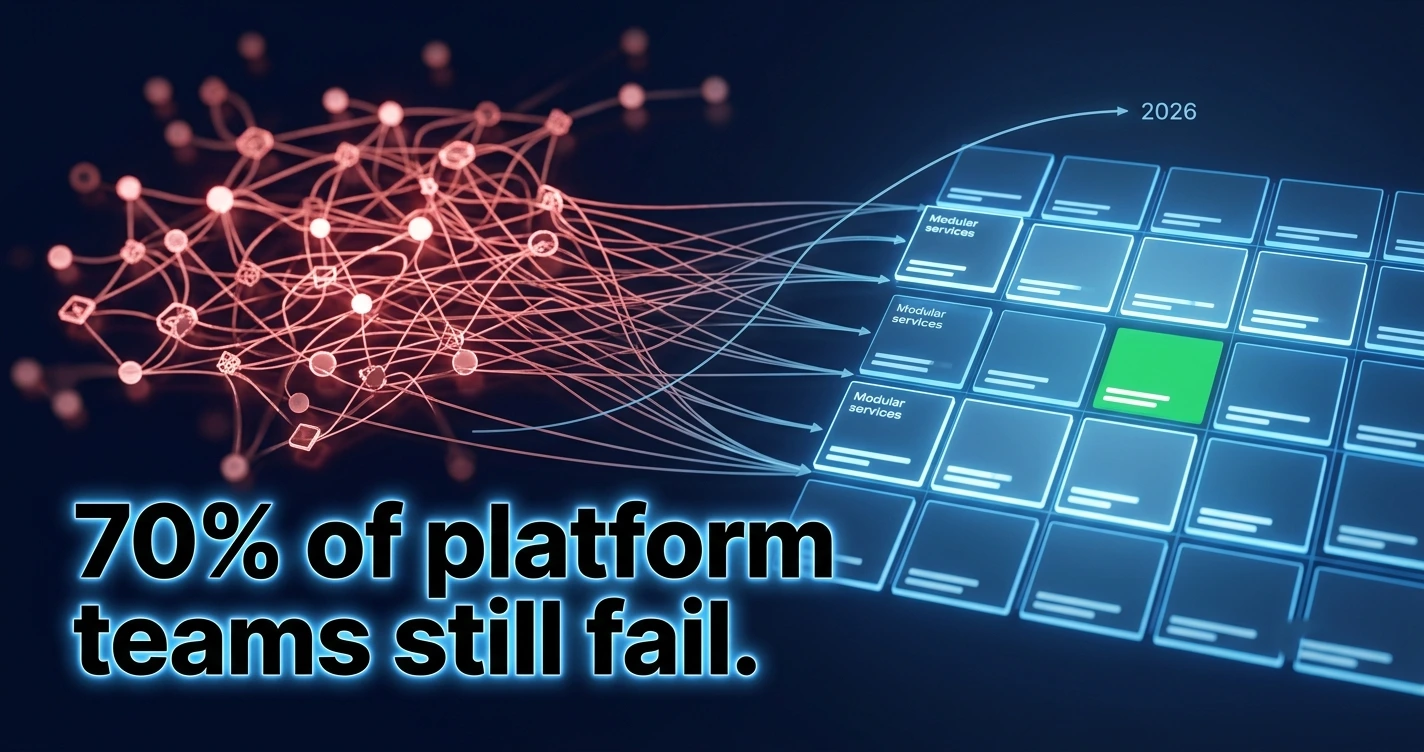
Here’s where the story gets genuinely counter-intuitive. Gartner has projected that by the end of 2026, 80 percent of large engineering organizations will run dedicated platform teams, up from 45 percent in 2022. That number is on track. It’s also, on its own, almost meaningless.
Metric
Figure
Source
Large orgs with platform teams by end of 2026 (projected)
80%
Gartner
Orgs using at least one internal platform construct
90%
DORA 2025
Platform teams that fail to show measurable impact
70%
State of Platform Engineering Vol. 4
Platform teams disbanded or restructured within 18 months
~50%
State of Platform Engineering Vol. 4
Average internal developer platform adoption rate
~10%
State of Platform Engineering Vol. 4
Platform teams naming developer adoption as their top challenge
45.3%
platformengineering.org
Read those last four rows again. Organizations can build the platform team Gartner is counting, and still have it fail. The boom and the crisis are happening at the same time, inside the same statistic. According to coverage of the 2025 State of Platform Engineering survey, roughly seventy percent of platform teams fail to deliver measurable impact, and close to half get disbanded or restructured within eighteen months, even as adoption climbs toward Gartner’s projected ceiling.
Why? Mostly not technical. platformengineering.org’s Vol. 4 survey found that 45.3 percent of platform teams point to developer adoption, driven by cultural resistance, as their single biggest obstacle. Engineers default back to a raw deployment command rather than touch the shiny new internal platform, because nobody asked them what they actually needed before building it.
One practitioner cited in that same research, working under what’s been called a “platform therapist” approach across dozens of enterprises, makes the point sharply: listening too closely to what developers say they want is its own trap. Interview teams, build exactly what they asked for, and you can still land at zero adoption, because the job was never to take requests. It was to find where developers get stuck and fix that at a higher level of abstraction.
Why Platform Quality Now Decides Your AI ROI
This is the part of the 2026 story that didn’t exist two years ago. The 2025 DORA report, based on a survey of roughly five thousand professionals, found a direct link between platform quality and whether AI tooling actually pays off.
“AI doesn’t fix a team. It amplifies what’s already there.”
DORA 2025 State of AI-assisted Software Development, Google Cloud
Put plainly: when platform quality is high, AI adoption produces a strong, positive effect on organizational performance. When platform quality is low, that effect is negligible, according to DORA’s own capabilities research. Handing a Copilot license to a team still wrestling with broken infrastructure doesn’t accelerate them. It just lets them produce more broken output, faster.
That risk is already visible in the data. Analysis from Faros AI of the 2025 DORA dataset found that incidents per pull request rose 242.7 percent at organizations using AI without solid platform controls in place. AI without a mature platform underneath it isn’t a productivity multiplier. It’s a defect multiplier.
That single finding has reframed the budget conversation entirely. Platform engineering used to compete with “developer happiness” initiatives for funding. Now it’s competing directly with AI tooling line items, and the DORA data says it should usually win that fight first.
The Critical View: Is This Just DevOps With a New Org Chart?
It’s fair to ask whether platform engineering is the cure it claims to be, or just a more polite version of the original silo problem. There’s real evidence on the skeptical side.
The sharpest version of the critique: a centralized platform team that doesn’t treat developers as genuine customers ends up recreating exactly the dynamic DevOps was built to kill, a gatekeeper team controlling deployment while everyone else waits on a queue. Change the label, keep the bottleneck.
There’s also a tooling concentration risk. Backstage, the open-source developer portal Spotify released in 2020, now holds roughly 89 percent market share among IDP frameworks and is used by more than 3,400 organizations. That dominance gets read as validation. It might not be. One critical analysis put it bluntly: Backstage was built for Spotify’s scale and engineering culture, and dropping it into a fifty-person team isn’t the same exercise. Free isn’t the same thing as cheap to run.
And the DORA 2024 report itself flagged a counter-intuitive risk: internal platforms can improve overall organizational performance while temporarily decreasing change stability and throughput during rollout, meaning the platform can make things measurably worse before it makes them better. That dip, sometimes called the platform J-curve, is exactly when nervous executives pull funding, which may explain why half of all platform teams don’t survive 18 months.
What to Watch Over the Next 18 Months
Three things are worth tracking if you’re making platform decisions right now.
Whether AI budgets shift toward platform spend first. The DORA AI-ROI finding gives CFOs a hard reason to fund infrastructure before tooling licenses.
Whether the failure rate improves or worsens. If the 70 percent measurable-impact failure rate holds steady into 2027, expect a wave of public platform team shutdowns, not just quiet restructurings.
Whether smaller IDP vendors chip away at Backstage’s share. Teams under roughly 200 developers are increasingly weighing lighter commercial options against Backstage’s maintenance overhead.
The honest summary: the organizational shift toward platform engineering is arriving exactly on the schedule Gartner predicted. The cultural and product discipline needed to make those teams actually work is running two to three years behind it. Knowing that gap exists is the entire advantage right now.
FAQ
What is platform engineering?
Platform engineering is the practice of building internal developer platforms that give engineers self-service access to infrastructure and deployment tooling without requiring them to be infrastructure experts. A dedicated platform team treats developers as customers and builds golden paths that encode company standards by default.
Is platform engineering replacing DevOps?
No. Platform engineering extends DevOps rather than replacing it. DevOps supplies the cultural foundation of shared ownership and continuous delivery. Platform engineering supplies the structural mechanism, self-service platforms and clear ownership, that keeps those values workable once a company passes roughly a hundred developers.
What is an internal developer platform (IDP)?
An IDP is the self-service layer sitting between developers and cloud infrastructure. It bundles pre-configured templates, CI/CD pipelines, and observability tools so engineers can deploy without filing an operations ticket. Backstage holds the largest share of this market, with commercial alternatives like Port and Humanitec aimed at smaller teams.
Why do platform engineering teams fail?
Most failures are cultural rather than technical. Teams that skip developer research, lack a clear product owner, or never measure adoption tend to build platforms nobody uses. Industry survey data points to developer adoption, not engineering difficulty, as the leading cause of platform team failure in 2026.
What is a golden path in platform engineering?
A golden path is a pre-approved, self-service template for a common task, like spinning up a new microservice. It can generate a configured repository, CI pipeline, and monitoring setup in minutes, automatically meeting a company’s security and compliance standards without manual review.
How does DORA 2025 connect platform engineering to AI?
DORA’s 2025 research found that platform quality determines whether AI tooling improves organizational performance. High-quality platforms amplify the benefit of AI adoption. Low-quality platforms make that benefit close to zero, and in some cases AI use without strong platform controls correlates with a sharp rise in incidents per code change.
Want the next read before everyone else does? Subscribe to The Neural Loop at neuralwired.com/newsletter for weekly breakdowns of where enterprise engineering is actually headed, not where the press releases say it’s headed.
FinOps Teams Found 7 Enterprise Cloud Budget Killers First. Your Engineering Team Hasn’t.Cloud Cost Optimization • Enterprise 2026
FinOps Teams Found 7 Enterprise Cloud Budget Killers First. Is Your Engineering Team Still Ignoring Them?
By NeuralWired Research DeskJune 27, 202614 min read
Your company spent a fortune moving to the cloud. And right now, somewhere between 27 and 29 cents of every dollar you’re spending is being quietly vaporized. Not by your competitors. Not by the market. By your own infrastructure.
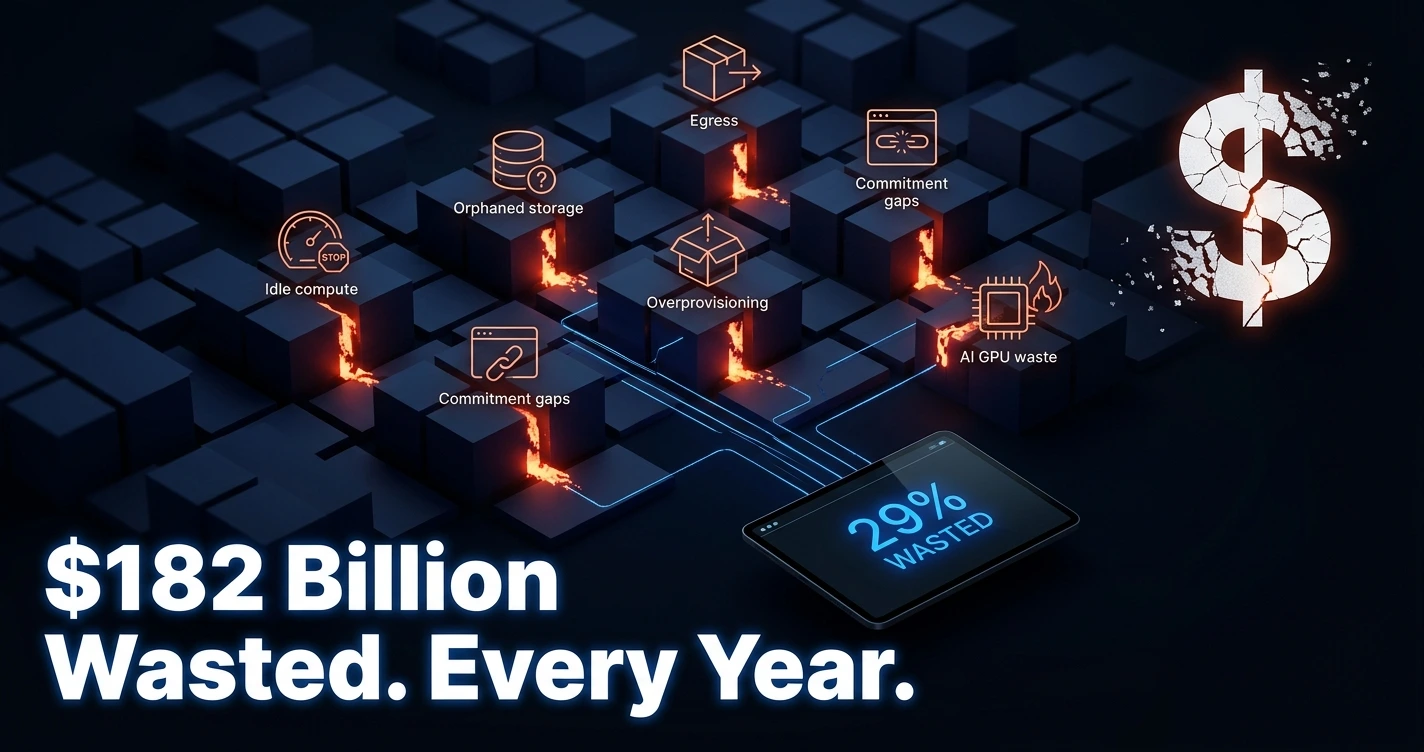
Flexera’s 2026 State of the Cloud Report surveyed 753 IT professionals and found that cloud waste has actually ticked back up to 29% this year, reversing a five-year downward trend. At $675 billion in global cloud infrastructure spending in 2025, that’s roughly $182 billion burned annually. And that number isn’t moving. Seven years. Same waste percentage. Thousands of FinOps tools later.
Deloitte projects that companies implementing FinOps practices could collectively save $21 billion in 2025 alone. The math is there. The playbook exists. The problem is that most engineering teams aren’t running it. They’re building features. Someone else will handle the bill. Except the bill doesn’t care.
This article breaks down exactly what FinOps teams found first, the seven budget killers that account for the vast majority of preventable cloud waste, and what you need to do about them before your next board review.
Cloud cost optimization is not a new idea. Companies have been talking about it since AWS launched EC2 in 2006. The FinOps Foundation has existed since 2019. 93 of the Fortune 100 have implemented formal FinOps practices. There are over 12,000 certified FinOps practitioners across 3,500 organizations.
And still: 29% of cloud spend is wasted. Every year. Like clockwork.
29%of cloud spend wasted in 2026, UP from 2025 for first time in 5 years
$44.5Bin unused or underused cloud infrastructure in 2025 alone (Harness)
84%say managing cloud spend is their #1 cloud challenge, above security
The numbers above come from real surveys, real respondents, and real enterprise environments. What makes them striking isn’t their size. It’s their stubbornness. Harness found enterprises will waste approximately $44.5 billion in unused or underused cloud infrastructure in 2025, representing 21% of infrastructure budgets. The global FinOps market is on track to reach $26.91 billion by 2030. More tools. More practitioners. Same waste floor.
There’s a floor here, and it’s architectural. But there’s also a ceiling, and it’s organizational. The gap between those two is where this article lives.
The SaaS Layer Most Companies Are Missing
Wasted cloud compute is only part of the story. According to Zylo’s 2026 SaaS Management Index, the average enterprise wastes $80.6 million annually on unused SaaS licenses alone, against an average total SaaS spend of $246 million. Cloud waste and SaaS waste are now the same governance problem with two different dashboards.
Why Engineering Teams Are Both the Problem and the Solution
Here’s the uncomfortable truth that Harness surfaced in its 2025 FinOps in Focus report: 52% of engineering leaders say the disconnect between FinOps teams and developers is the primary driver of wasted cloud infrastructure spend. Not bad tools. Not insufficient budgets. The gap between the people writing the code and the people watching the bill.
This isn’t a criticism. It’s structural. Engineering teams are rewarded for shipping, not for cost efficiency. When a developer provisions a database cluster for a new feature, they’re optimizing for availability and performance, exactly what their job requires. The bill that arrives six weeks later is someone else’s problem. Except in 2026, “someone else” is increasingly the engineering leader themselves.
The FinOps Foundation’s State of FinOps 2026 report shows that 78% of FinOps practices now report into the CTO or CIO organization, up 18% from 2023. The discipline has left the finance department and moved into engineering’s house. That’s not a coincidence. It’s where the decisions that create cloud spend actually live.
“An important trend is the shift toward developer-facing FinOps. More teams are integrating cost accountability into engineering workflows so they can address waste early in the development process.”
Jay Litkey, SVP Cloud and FinOps, Flexera; Governing Board Member, FinOps Foundation. Source: TechTarget, March 2026
“Shift left” in cost is the same principle as shift left in security: the earlier you catch the problem in the development cycle, the cheaper it is to fix. A rightsizing recommendation caught during a sprint review costs an engineer 20 minutes. The same problem caught six months into production costs an ops team two weeks of negotiation and a production risk window.
The 7 Cloud Budget Killers FinOps Found First
What follows is synthesized from Flexera 2025 and 2026, Harness 2025, SpendArk’s State of Cloud Waste 2026, and Datadog’s 2024 infrastructure reports. These aren’t theoretical categories. They’re ranked by observed frequency and dollar impact across enterprise cloud environments.
Budget Killer 1: Idle Compute (15 to 20% of total cloud spend)
This is the single largest category of cloud waste. Instances running at near-zero utilization: development servers left on over weekends, staging environments that were provisioned last quarter and never stood down, database nodes built for projected load that never materialized. Flexera and Harness together estimate that idle compute and overprovisioned instances account for 60% of all cloud waste combined.
A real case from a mid-market company running a $450,000 per month cloud bill: an audit identified over $100,000 per month in three line items. Idle deprecated resources were burning $40,000. Dev and test environments running 24/7 cost $35,000. Overprovisioned databases added $28,000. Six months after the fix, the bill was $270,000. The customer base kept growing. The bill didn’t.
The fix: AWS Compute Optimizer uses machine learning to generate rightsizing recommendations per instance. AWS Instance Scheduler automates stop and start routines for non-production environments. Neither requires an engineering sprint to implement. Collect two to four weeks of utilization baselines before making changes to production workloads.
Budget Killer 2: Overprovisioned Resources (10 to 12% of total waste)
Most infrastructure teams provision based on peak theoretical demand, not observed usage. The result is compute running at 5% CPU utilization at 3am and 85% CPU at 2pm, with billing based on the capacity reserved for the peak. Memory overprovisioning is harder to catch because it doesn’t show up in standard cloud billing dashboards. A Kubernetes pod requesting 4GB of RAM but using 400MB won’t trigger any default alert.
The fix: Rightsizing is the highest-impact single optimization for most organizations at cloud cost maturity Stage 1. AWS Compute Optimizer and Azure Advisor both generate per-instance recommendations based on observed usage patterns. Pair with autoscaling groups for workloads that have genuine demand spikes. The savings: typically 15 to 25% of compute spend within 60 days.
Budget Killer 3: Orphaned “Zombie” Resources (5 to 15% of total spend)
A developer runs a load test on a temporary server and forgets to de-provision it. An admin terminates an EC2 instance but leaves the attached EBS volume. A project wraps up. The associated load balancer, Elastic IPs, and snapshots keep running. This accumulates invisibly over months and years in every large cloud environment.
The math is less dramatic per unit than idle compute, but it’s relentless. At $0.08 to $0.10 per GB per month for SSD storage, a single 500GB orphaned volume costs $40 to $50 per month indefinitely. Multiply that across hundreds of terminated instances over two to three years and you have a significant liability that shows up on no one’s performance review.
Flexera 2025 found unattached disks in the top three waste items across all organization sizes.
The fix: Automated resource lifecycle management. Tag everything with owner, environment, and project fields at the point of provisioning. AWS Trusted Advisor flags idle resources automatically. AWS Storage Lens provides organization-wide storage visibility. Set up weekly cleanup automation that flags anything untagged and older than 30 days for review before deletion.
Development, staging, and QA environments account for 30 to 50% of cloud spend at many organizations. They run around the clock even when no engineer has logged in since 6pm Friday. This is the most immediately fixable item on this list, and the one with the least production risk.
The fix: Automated shutdown schedules with self-service “start now” buttons for engineers who need weekend access. The implementation timeline is days, not sprints. Typical outcome: 20 to 25% reduction in non-production spend within 90 days. If your organization has a $500,000 per month cloud bill with 35% in non-production, that’s a $35,000 to $43,000 per month opportunity you can close in a two-week sprint.
Budget Killer 5: Missing or Underused Commitment Discounts (largest single rate optimization)
Reserved Instances and Savings Plans offer 40 to 72% savings versus on-demand pricing for steady-state workloads. Yet fewer than half of organizations fully utilize commitment instruments with any single cloud provider, according to Flexera 2026. Some over-commit and pay penalties. Most under-commit and overpay.
A 10% coverage shortfall on a $5 million annual cloud bill is $500,000 in annualized overpayment. Not from waste. From rate arbitrage you didn’t take.
“Organizations need automation to make a dent on cloud inefficiencies, which continues to grow with increasing cloud spend. Some organizations do not have fully automated end-to-end rate optimization. Instead, they rely on human-mediated processes that are potentially error-prone, labor-intensive and fall short of maximizing value in the cloud.”
Jay Litkey, SVP Cloud and FinOps, Flexera. Source: TechTarget, March 2026
The fix: Start conservative. Commit in stages aligned to your finance team’s demand models. Review monthly. Target 70 to 80% commitment coverage on baseline workloads. AWS Compute Optimizer ESR benchmarks show the industry average improving from 21% to 26% between 2022 and 2023. The ceiling is much higher for organizations that treat this systematically.
Budget Killer 6: Storage Sprawl (6 to 10% of total waste)
Snapshots accumulated past any retention policy. Data parked in premium storage that could be archived. Logs from a service that was sunset in Q3 2024. Old backups that outlived their purpose by 18 months. This is the cloud’s attic problem: no single item looks expensive until someone adds them all up.
The fix: Lifecycle policies that automatically move data to cheaper storage tiers. S3 Intelligent-Tiering and Google Cloud Autoclass handle this automatically without requiring manual tagging per object. Azure Cool and Archive Blob Storage offer similar tiering. Delete snapshots that exceed your retention policy automatically. AWS Storage Lens provides organization-wide visibility across accounts and regions.
Budget Killer 7: Data Egress and Transfer Costs (3 to 6% of waste, but explosive and spiky)
Data transfer fees can turn into major budget killers from a single architectural decision made by one engineer on one afternoon. Egress costs, cross-region traffic, and NAT gateway charges are often invisible during initial design and catastrophic during rapid scaling. As of February 2024, AWS began charging $0.005 per hour for all public IPv4 addresses. Azure followed in July 2025. These structural charges are now permanent across all three major cloud providers.
One note for GCP users: Google eliminated some internet egress charges in 2025, creating the first real pricing asymmetry between providers worth actively factoring into multi-cloud architecture decisions.
The fix: Keep related services in the same region. Use CDNs to cache content close to users and absorb egress at the edge. Audit your NAT gateway topology and eliminate unnecessary cross-region transfers. This is an architectural review, not just a configuration change, which means engineering ownership is non-negotiable.
The AI Wildcard That Breaks the Old Playbook
Everything above is the cloud FinOps playbook built over the last seven years. It works. It has a ceiling.
AI is not in that playbook.
GPU instances on AWS P4 and P5, Azure NCv4 A100s, and GCP A3 clusters cost 10 to 20 times equivalent CPU compute. AI teams provision large GPU clusters for training runs, those clusters finish, and they sit idle between jobs. GPU idle waste is emerging as a new high-dollar category with no established optimization framework and no provider-native tooling equivalent to what exists for compute rightsizing.
AI and ML workloads now account for 18% of total cloud spend at AI-forward enterprises, up from 4% in 2023. And 98% of FinOps practitioners are now managing AI spend, up from 31% in 2024, according to the State of FinOps 2026. That 98% number sounds like progress. It isn’t. It measures exposure, not capability. The frameworks for governing AI costs are still being invented.
The FinOps Foundation’s own FinOps X 2026 conference in June 2026 introduced “Tokenomics” as a separate discipline from cloud FinOps. That acknowledgment is significant: it means the existing cloud FinOps playbook doesn’t carry over to AI.
“FinOps has a role, but dashboards, governance and forecasting are tools for tuning a working model, not fixing a broken one. As long as AI pipelines run on infrastructure designed for batch analytics, costs will climb no matter how tight the governance is. You can forecast it, dashboard it and assign cost centers and chargeback teams, but the engine underneath is still wasting cash.”
JG Chirapurath, President, DataPelago Inc.; former VP, Microsoft Azure. Source: SiliconAngle, April 2026
Chirapurath’s argument is structural: AI pipelines are running on infrastructure architected for batch analytics. The homogeneity of CPU-centric cloud architecture means software can’t route jobs to the right hardware. FinOps dashboards track the cost of that mismatch without being able to resolve it. Our read: he’s right that tooling doesn’t fix architecture, but governance and architecture reform aren’t mutually exclusive. You can run both in parallel.
Budget Assumption Broken
Token prices for top-tier AI models have been flat since November 2025, driven by GPU supply constraints, energy limits, and extended commitment terms from neo-cloud providers. If your AI cost model assumed continued token price deflation, it’s built on an invalid assumption. The FinOps Foundation does not expect near-term relief before 2028.
There’s also a second AI cost layer most organizations are currently underestimating. AI-native SaaS spending rose 108% in 2025, and 78% of IT leaders experienced unexpected charges tied to consumption-based or AI pricing models, according to Zylo’s 2026 SaaS Management Index. SaaS products with AI features embedded now carry consumption pricing that behaves nothing like traditional per-seat licensing. Nobody is budgeting for it correctly yet.
What Mature Organizations Do Differently
The organizations reducing waste from 32 to 40% down to 15 to 20% share several structural characteristics that have nothing to do with tooling and everything to do with how accountability is organized.
First: FinOps sits in engineering. The 78% of FinOps practices that now report to the CTO or CIO organization aren’t there by accident. Cost governance that sits in finance produces reports. Cost governance that sits in engineering produces decisions.
Second: cost accountability is federated. The central FinOps team handles visibility, tooling, and standards. Individual engineering teams own their own budgets and are measured against them. “Showback” (showing teams what they spend) produces awareness. “Chargeback” (billing teams for what they spend) produces behavior change.
Third: unit economics are tracked. Only 43% of organizations track cloud costs at the unit level, according to Gartner (May 2025). That means 57% of enterprises cannot connect their cloud bill to a product, a customer, a feature, or a model inference. Without unit economics, you can’t make a defensible build-versus-buy decision and you can’t set a sustainable AI cost budget.
Fourth: cost reviews are in the sprint cycle. Not quarterly. Not monthly. Weekly or bi-weekly cost reviews embedded in engineering workflow mean anomalies surface before they compound. A $20,000 spike caught on day 3 is a configuration error. The same spike caught on day 45 is a budget overrun.
“We have hit the ‘big rocks’ of waste and now face a high volume of smaller opportunities that require more effort to capture.”
Anonymous Senior FinOps Practitioner, quoted in State of FinOps 2026, FinOps Foundation
This quote from the FinOps Foundation’s 2026 practitioner survey captures something important: mature programs are operating in diminishing-returns territory. The first 25% waste reduction is relatively mechanical. The next 10% requires governance, architectural decisions, and political capital inside the organization.
Your 30/90/180-Day Cloud Cost Optimization Action Plan
If you’re an engineering leader or CTO starting from a position where cloud cost governance is informal or entirely delegated to finance, here’s the sequence that delivers results fastest without requiring major organizational restructuring upfront.
Phase 1: Visibility and Quick Wins Days 1 to 30
Enable AWS Cost Explorer, Azure Cost Management, or GCP Cost Tools if not already active
Implement mandatory resource tagging: owner, environment (prod/staging/dev/test), project, and team
Run AWS Trusted Advisor or Azure Advisor reports to surface idle resources, unattached volumes, and underused Reserved Instances
Identify and shut down or schedule any non-production environments running 24/7
Collect 2 to 4 weeks of utilization baselines for your top 20 most expensive compute instances
Expected result: 5 to 10% reduction in monthly bill within 30 days
Phase 2: Rightsizing and Commitment Optimization Days 31 to 90
Run AWS Compute Optimizer or Azure Advisor rightsizing recommendations on your baseline data
Apply recommendations starting with dev/staging, then moving to non-critical production workloads
Audit Reserved Instance and Savings Plan coverage; set a target of 70% commitment coverage on baseline workloads
Implement automated lifecycle policies for S3/Blob/GCS storage and snapshot retention
Establish showback reporting: send each team a weekly report of their cloud spend
Expected result: 20 to 25% reduction in monthly bill within 90 days
Phase 3: Governance, AI, and Unit Economics Days 91 to 180
Move from showback to chargeback: assign cloud costs to team budgets
Instrument AI and ML workloads with token and GPU utilization tracking
Build unit cost metrics: cost per user, cost per transaction, cost per model inference
Add cost estimation gates to your CI/CD pipeline for infrastructure-as-code changes
Audit all SaaS licenses with a tool like Zylo or a manual usage report from each vendor
Embed a cost review into your bi-weekly engineering sprint cycle
Expected result: 25 to 35% total reduction versus your pre-program baseline
Tool Reference by Cloud Provider
AWS: Cost Explorer, Compute Optimizer, Cost Optimization Hub, Trusted Advisor, Instance Scheduler, Storage Lens. Azure: Cost Management + Billing, Azure Advisor, Azure Auto-shutdown policies for VMs. GCP: Cloud Billing reports, Recommender API, Active Assist, Cloud Storage Autoclass. Multi-cloud: Flexera, Harness Cloud Cost Management, CloudZero for unit cost tracking, Zylo for SaaS.
FAQ: Cloud Cost Optimization Enterprise 2026
What percentage of cloud spend is wasted in 2026?
Organizations wasted an average of 29% of their cloud spend in 2026, according to Flexera’s 2026 State of the Cloud Report surveying 753 IT professionals and executive leaders. This marks the first increase in five years, driven by AI workload complexity. At $675 billion in global cloud infrastructure spending in 2025, that represents approximately $182 billion wasted annually.
What is FinOps and how does it reduce cloud costs?
FinOps (Financial Operations) is a cross-functional practice that brings engineering, finance, and operations teams together around shared cloud cost accountability. It operates across three stages: visibility (understanding what you spend and why), optimization (eliminating waste through rightsizing, scheduling, and commitment discounts), and governance (embedding cost accountability into engineering workflows). The FinOps Foundation in 2026 expanded the discipline to cover AI spend, SaaS, and data center costs.
What are the biggest causes of cloud waste in enterprises?
The top seven cloud waste categories are: idle compute instances (15 to 20% of spend), overprovisioned resources (10 to 12%), orphaned zombie resources like unattached volumes and snapshots (5 to 15%), non-production environments running 24/7 (10 to 20% savings opportunity), missing or underused commitment discounts, storage sprawl (6 to 10%), and data egress and transfer costs (3 to 6%, but explosive). Idle compute and overprovisioning together account for 60% of total cloud waste.
How much can a company save with cloud cost optimization?
Organizations with structured FinOps programs typically achieve 25 to 30% reduction in monthly cloud spend, with early-stage quick wins (5 to 10%) achievable within 30 days. Mature programs reduce waste from 32 to 40% down to 15 to 20%. AWS Reserved Instances and Savings Plans alone offer 40 to 72% savings compared to on-demand pricing for steady-state workloads. Deloitte projected $21 billion in enterprise savings from FinOps practices in 2025.
What is cloud rightsizing?
Cloud rightsizing matches compute instance types and sizes to actual workload requirements rather than over-provisioning for peak theoretical demand. Most organizations over-provision by 30 to 50%. After collecting 2 to 4 weeks of utilization data, tools like AWS Compute Optimizer or Azure Advisor generate rightsizing recommendations automatically. Typical savings from rightsizing alone range from 15 to 25% of compute spend within 60 days, with minimal production risk when applied systematically.
How do AI workloads affect cloud costs in 2026?
AI and ML workloads now account for up to 18% of total cloud spend at AI-forward enterprises, up from 4% in 2023. GPU instances cost 10 to 20 times equivalent CPU compute, and GPU idle time between training runs is emerging as a major waste category with no established playbook. Token prices for top-tier AI models have been flat since November 2025 due to GPU supply constraints, collapsing the “AI costs will keep falling” budget assumption many enterprises relied on.
What is the FOCUS specification in FinOps?
FOCUS (FinOps Open Cost and Usage Specification) is an open standard maintained by the FinOps Foundation designed to normalize cloud billing data across AWS, Azure, GCP, and other providers into a common format. FOCUS 1.4 was announced at FinOps X 2026 in June 2026. It allows engineering, finance, and FinOps teams to work from the same billing data without provider-specific tooling, solving one of the core multi-cloud cost visibility challenges facing the 76% of enterprises that operate across two or more cloud providers.
What is the difference between showback and chargeback in FinOps?
Showback provides teams with a report of their cloud spend for awareness without directly billing them. Chargeback assigns cloud costs to team or product budgets, creating direct financial accountability. Showback drives awareness. Chargeback drives behavior. Mature FinOps programs typically start with showback to build cost visibility culture before transitioning to chargeback once teams have the tools and authority to influence their own spend.
What You Now Understand That You Didn’t Before
Cloud cost optimization in 2026 is not a tooling problem. Every major cloud provider ships native cost visibility and rightsizing tooling for free. The FinOps Foundation has published open specifications, certifications, and practitioner frameworks for six years. The playbook exists and is documented in detail.
The problem is organizational. Sixty percent of cloud waste comes from two categories (idle compute and overprovisioning) that are fixed not by buying another platform but by giving engineering teams cost visibility, accountability, and the authority to act on what they see. The other 40% is fixed by running a systematic program across commitment discounts, storage lifecycle management, and network architecture, all of which require engineering ownership.
Over the next 6 to 18 months, two developments will make this more urgent. First, AI spend will continue its vertical climb toward 20% or more of total cloud budgets, and the frameworks for governing it (including the Tokenomics specification being developed by the FinOps Foundation) are still being built. Organizations that instrument AI workload costs now will have a significant advantage when those frameworks mature. Second, SaaS cost governance will become non-negotiable at the board level. At $80.6 million in average annual SaaS waste per enterprise, the CFO conversation is coming whether or not the engineering team leads it.
Three things to watch or act on now: Enable unit cost tracking so you can connect your cloud bill to business outcomes. Audit your non-production environments this week (the easiest money on this list). And get someone in your engineering organization formally accountable for the cloud bill before your board asks you who that person is.
Stay Ahead of What’s Coming in Cloud and AI Infrastructure
The Neural Loop covers enterprise cloud, AI costs, and infrastructure intelligence for engineering and technology leaders. No filler. One insight you can use.
Subscribe to The Neural Loop
Platform Engineering vs DevOps: Why Serverless Didn’t Kill Anything (It Just Changed the Job)
Platform Engineering / Cloud Infrastructure
Platform Engineering vs DevOps: Serverless Didn’t Kill Anything. It Changed Everything.
By NeuralWired Editorial | June 27, 2026 | 11 min read
In 2019, a senior engineer at a mid-size fintech wrote a Slack message that circulated across three engineering teams: “We went serverless eight months ago. We still have three DevOps engineers. What exactly are they doing?” It was a fair question. It was also the wrong one.
The premise that serverless computing would make infrastructure engineers redundant turned out to be about as accurate as the prediction that cloud would kill on-premise overnight. What actually happened is more interesting, more expensive, and far more consequential for anyone building software in 2026.
Platform engineering has emerged not as a rebrand of DevOps but as a distinct discipline sitting on top of it, one that has quietly produced a market now sized at $10.44 billion in 2026, projected to reach $31.57 billion by 2031, according to Mordor Intelligence. If you’re a platform engineer, infrastructure lead, or engineering manager at a mid-to-large company, what follows is the clearest picture available of how this shift happened and where it goes next.
What Actually Happened to DevOps
DevOps didn’t die. The job title did, in many organizations, which is a very different thing.
What observers consistently report from teams that adopted heavy serverless or Kubernetes-based architectures is not that infrastructure work disappeared. It’s that the work redistributed. Deployments still happen. Incident response still happens. Security patching, cost management, and capacity planning still happen. The difference is that these responsibilities got split across roles now labeled platform engineer, SRE, cloud architect, and security engineer, rather than consolidated under a single “DevOps engineer” title.
Google Cloud’s own framing is the clearest synthesis of this available: DevOps is the cultural goal and the teamwork mindset. Platform engineering is the discipline and tooling that operationalizes that goal at scale. According to Google Cloud, platform engineering is the way organizations achieve DevOps principles at scale by building tools that make DevOps work easily, not by eliminating it.
The “DevOps is dead” framing, popular in conference talks and blog post titles since roughly 2022, captures something real: a role consolidation that no longer made sense as infrastructure complexity exploded. But it misidentifies the cause. Serverless didn’t create that complexity. Kubernetes and cloud-native architecture did. Serverless was, for many teams, a partial escape from it.
Platform Engineering, Properly Defined
Platform engineering is the practice of building and maintaining internal developer platforms (IDPs), self-service tools that let product teams ship code without needing deep infrastructure expertise on every squad. Think of it as building a well-designed airport rather than teaching every passenger to fly the plane.
The origin story most frequently cited in the industry traces to Spotify around 2018. As the company scaled past several hundred engineers, infrastructure fragmentation became a genuine productivity crisis. Their response was Backstage, now the dominant open-source developer portal framework, and the philosophical model that every engineering organization at scale needs a product-quality internal platform, not just shared scripts and wiki pages.
80%
of large software engineering organizations expected to have dedicated platform teams by end of 2026, up from 45% in 2022 (Gartner, widely reported)
55.9%
of surveyed companies already operate more than one internal developer platform (State of Platform Engineering Report, Vol. 4, Jan 2026, n=518)
94%
of platform teams view AI as critical to the future of platform engineering (same survey)
The adoption numbers are striking, but one statistic from the same survey deserves equal attention: 29.6% of platform teams don’t measure their success at all. A discipline that can’t demonstrate its own ROI is perpetually vulnerable to the next budget cycle. This is the most actionable gap in platform engineering right now, and it’s solvable with DORA metrics, developer onboarding time, and cost-per-deploy tracking.
Key Insight
Platform engineering’s budget case has never been stronger, but only for teams that can quantify it. Nearly a third of platform teams currently can’t. That’s the gap to close in 2026.
According to CNCF’s 2026 Annual Survey, median platform budgets are expected to double in 2026, with leading organizations investing $5 to $10 million. Typical headcount allocation to centralized developer productivity sits around 4.7% of total engineering headcount, roughly one platform engineer per 17 to 50 developers.
Serverless vs Containers: Who Won?
Neither. Both. The framing itself is the problem.
The 2019 version of this debate was real: Lambda versus ECS, functions versus long-running services, pay-per-invocation versus always-on compute. In 2026, those two models have converged enough that the binary has mostly collapsed at the infrastructure layer, even if it persists as a marketing narrative.
Where Containers Stand Today
Kubernetes adoption reportedly reached 89% among enterprises surveyed in 2026, up from 83% in 2025, driven significantly by AI and machine learning workload orchestration that demands GPU scheduling and stateful compute management that traditional serverless functions simply can’t handle. AWS Lambda doesn’t run a distributed training job. Kubernetes does.
But Kubernetes at scale is expensive in ways that rarely appear in vendor decks. CNCF’s 2026 survey data suggests companies spend an average of $180,000 per year on Kubernetes-specific engineering time alone, covering cluster upgrades, security patching, monitoring configuration, and incident response. Internal Developer Platform adoption to abstract that complexity has reportedly reached around 80%, up from 45% just two years earlier.
Where Serverless Stands Today
AWS Lambda now processes over one trillion invocations per month. That’s not a platform in retreat.
Shridhar Pandey, Principal Product Manager for AWS Serverless Compute at Amazon Web Services, affirmed in Datadog’s 2025 State of Containers and Serverless report that serverless has become foundational to how developers build modern cloud applications, with AWS continuing to invest in developer experience for increasingly complex serverless workloads and architectural patterns.
“Serverless has become fundamental to how developers build modern cloud applications, driven by automatic scaling, cost efficiency, and agility.”
Shridhar Pandey, Principal PM, AWS Serverless Compute, in Datadog’s State of Containers and Serverless (2025)
What’s changed is the deployment model, not the philosophy. Google Cloud Run supports scale-to-zero, event triggers, and headless jobs. AWS Fargate added per-second billing and EventBridge integration. The distinction between “deploy a function” and “deploy a container” has narrowed significantly. The more honest 2026 framing, per analysis from KodeKloud, is: containers for steady-state, latency-sensitive, high-utilization workloads where you need runtime control; serverless for bursty, event-driven workloads where operational simplicity and per-invocation pricing matter more than fine-grained control.
Most 2026 enterprises run both. Hybrid architectures are the norm, not the exception.
The Third Option You Might Have Missed
WebAssembly (Wasm) is emerging as a serious third compute option for specific workloads. CNCF’s 2026 survey data shows 31% of organizations evaluating Wasm as a container alternative, up from 8% in 2024. Runtimes like WasmEdge and Fermyon’s Spin are gaining traction for edge workloads and lightweight, security-isolated functions. This isn’t replacing containers or serverless yet, but it’s the trend worth watching over the next 18 months.
Workload Type
Best Fit
Why
AI/ML training jobs
Containers (Kubernetes)
GPU scheduling, stateful compute, long runtimes
Event-driven APIs
Serverless (Lambda, Cloud Run)
Bursty traffic, per-invocation pricing, no idle cost
Always-on microservices
Containers (ECS, Fargate, GKE)
Latency predictability, persistent connections
Edge functions
Serverless or Wasm
Cold start tolerance, geographic distribution
Batch processing
Containers or serverless containers
Scale-to-zero important; Cloud Run jobs fit well
The Economics: What This Costs in 2026
Platform engineering is not cheap. Anyone who tells you otherwise is selling tooling.
Building a production-grade internal developer platform takes 3 to 5 full-time engineers working for up to 18 months, at a cost of $150,000 to $650,000 before tooling licenses, per Mordor Intelligence’s market analysis. The $180,000 average annual Kubernetes engineering-time cost cited in CNCF data compounds on top of that. Platform engineering creates a genuine consolidation benefit for large organizations. For teams under roughly 50 engineers, the math often doesn’t work.
The market numbers themselves are directionally consistent but vary depending on what’s being measured:
The spread across those estimates reflects genuinely different scope definitions. The Mordor Intelligence figure (IDP included) is the most comprehensive and the most useful for understanding total addressable spend in this category.
The AI Connection Nobody Saw Coming
Here is the finding that changes the budget conversation for platform engineering in ways that have nothing to do with developer experience.
The DORA 2025 Report, based on data from approximately 5,000 technology professionals, found a direct correlation between internal platform quality and an organization’s ability to extract value from AI investments. When platform quality is high, the effect of AI adoption on organizational performance is strong and positive. When platform quality is low, the effect is negligible. The report characterizes platform engineering as an essential foundation for AI success, not a supporting concern.
“When platform quality is high, the effect of AI adoption on organizational performance becomes strong and positive. When platform quality is low, the effect of AI adoption on performance is negligible.”
DORA 2025 Report, Google/DORA (approximately 5,000 technology professionals surveyed)
Our read: this is the most powerful budget justification for platform investment that has ever existed. “We need this for developer experience” is a soft sell to a CFO. “Without this, your AI spend produces no measurable business outcome” is not soft at all.
The practical implication for engineering managers is immediate. AI workloads specifically require GPU scheduling, model deployment pipelines, and inference serving infrastructure that need platform-level abstraction. Kubernetes adoption growth in 2026 is, in significant part, an AI infrastructure story. And DORA’s data says the quality of that infrastructure determines whether the AI investment lands.
The Contrarian View You Need to Hear
The 80% Gartner adoption forecast is the most repeated statistic in this space. It is also the least well-sourced. Every secondary article cites it. Virtually none links to a retrievable primary Gartner document. Treat it as a widely reported directional forecast, not a primary-verified figure, until you can pull the original Gartner note directly.
More practically: the 80% figure spans organizations of all sizes, which creates a misleading picture for smaller teams. A fintech CTO writing in the DEV Community made this point sharply, arguing that for teams under 15 engineers, “platform engineering” in practice means one person rotating onto developer-experience work each quarter with a handful of metrics, not a dedicated team. The formal platform engineering model, with Backstage, golden paths, multi-team IDP builds, and dedicated headcount, is an enterprise architecture pattern. Applying it to a 12-person startup is over-engineering.
Chris Stephenson, CTO of Humanitec (which sells IDP tooling and should be read with that context in mind), has framed platform engineering as the discipline that operationalizes DevOps principles at scale, a point consistent with DORA and Google Cloud data. But “at scale” is doing a lot of work in that sentence. Scale matters here.
There’s also a definitional trap embedded in the serverless adoption numbers. CNCF’s 2024-survey-cycle data showed only 11% of respondents using serverless computing frameworks specifically, while Kubernetes production deployment sat at 80%. Vendor-adjacent sources claiming “70% of AWS users have a serverless deployment” measure something different: whether any serverless function exists in an account. A Lambda function triggering an S3 notification counts. Running a serverless-first architecture does not. Don’t conflate these when making infrastructure decisions.
Finally, the “2026 is the tipping point year” framing appears in nearly every source reviewed. When dozens of vendor-adjacent blogs converge on the same year as the critical inflection point, some healthy skepticism is warranted. The underlying CNCF, DORA, and Gartner data is real. The content-calendar packaging around “2026 is THE year” is largely a marketing convention. Don’t let the hype cycle accelerate your timeline on investments that take 18 months to deliver value.
Frequently Asked Questions
Is DevOps dead in 2026?
No. DevOps as a culture and set of practices continues. What’s changed is the job title and how responsibilities distribute across teams. Platform engineering, SRE, and cloud roles now absorb tasks that were once bundled under “DevOps engineer,” but deployments, CI/CD, and incident response still rely entirely on DevOps principles. The work redistributed; it didn’t disappear.
What is the difference between platform engineering and DevOps?
DevOps is a cultural philosophy emphasizing collaboration between development and operations teams. Platform engineering is a technical discipline that builds self-service internal developer platforms to operationalize DevOps principles at scale, reducing cognitive load on individual developers. According to Google Cloud, DevOps is the goal; platform engineering is the method used to achieve it.
Should I use serverless or containers for my enterprise application?
Evaluate by workload, not by company policy. Choose containers for steady-state, high-utilization, latency-sensitive services where you need full runtime control. Choose serverless for bursty, event-driven workloads where operational simplicity and per-invocation pricing outweigh the need for fine-grained control. Most enterprises in 2026 run both architectures simultaneously.
How many companies have adopted platform engineering?
Gartner’s widely cited forecast projects 80% of large software engineering organizations will have dedicated platform teams by end of 2026, up from 45% in 2022. A separate January 2026 survey of 518 engineers found 55.9% of companies already operate more than one internal developer platform. Note that both figures apply primarily to large enterprises, not startups or small teams.
What is the market size of the platform engineering industry?
Estimates vary by scope. The platform engineering tools market alone is forecast to grow by $8.68 billion between 2026 and 2030, per Technavio. The broader platform engineering and IDP market is sized at $10.44 billion in 2026, growing to $31.57 billion by 2031, according to Mordor Intelligence. These figures measure different slices of the same category.
Does platform quality affect AI investment returns?
According to the DORA 2025 Report, based on approximately 5,000 technology professionals, yes. When platform quality is high, AI adoption has a strong positive effect on organizational performance. When platform quality is low, the effect is negligible. Platform engineering is now directly tied to AI ROI, not just developer experience.
What You Now Know That You Didn’t Before
Serverless didn’t kill DevOps. It helped reveal that DevOps at scale needs a platform underneath it. The discipline that builds that platform, platform engineering, has grown into a $10-billion-plus category not because it’s a rebrand but because the alternative, every development team managing its own infrastructure complexity, proved unworkable as Kubernetes and cloud-native architectures matured.
The serverless vs containers debate resolved into a workload-specific decision framework, not a winner. Both models operate at extreme scale simultaneously. Both are now standard components of a mature internal developer platform. The line between them is blurring further as serverless containers (Cloud Run, Fargate) absorb the middle ground.
Over the next 6 to 18 months, three things are worth watching closely:
WebAssembly traction at the edge. If Wasm adoption continues from 31% evaluation to meaningful production use, it creates a genuine third compute option that changes cost models for edge and lightweight compute workloads.
Platform ROI measurement becoming a procurement criterion. As CFOs tie platform investment to AI outcome data (via DORA’s framework), teams that can’t produce usage metrics, onboarding time data, and cost-per-deploy figures will face budget pressure. Build that instrumentation now.
IDP consolidation. The Backstage, Port, and Humanitec landscape is early and fragmented. A Kubernetes-style consolidation (where one winner absorbs enterprise tooling spend) appears likely within this window. Watch vendor acquisition activity as the signal.
Stay Ahead of the Infrastructure Curve
The Neural Loop delivers the clearest signal on cloud architecture, platform engineering, and AI infrastructure every week, no filler, no vendor talking points.
Subscribe to The Neural Loop
Apple’s Siri AI Is Finally Here — But Europe Can’t Have It
NeuralWiredJune 27, 2026AIPolicy
WWDC 2026 · Apple Intelligence · EU Digital Markets Act
Apple’s Siri AI Is Finally Here — But Europe Can’t Have It
Two years late, $1 billion in Google licensing fees, and 450 million EU users locked out. This is Tim Cook’s last act — and it’s complicated.
By NeuralWired Staff·June 27, 2026·10 min read
On June 8, 2026, at Apple Park in Cupertino, Tim Cook walked off stage for the last time as CEO of Apple. He left behind a rebuilt Siri, a $1 billion-a-year deal with Google, and a regulatory standoff that’s locking hundreds of millions of Europeans out of the iPhone feature he spent years promising them.
The rebuilt assistant — now branded Siri AI — is real. It works. And after two years of missed deadlines, pulled advertising campaigns, and very public embarrassment, Apple finally has an AI story worth telling at WWDC 2026. But the story comes with a catch that reveals more about Apple’s strategic reality than any keynote slide ever could.
Apple didn’t build the intelligence behind Siri AI. Google did. And the EU says Apple’s excuse for blocking Siri AI from European iPhones is, to quote the European Commission’s own spokesperson, “Apple’s and Apple’s only.”
This is the most consequential tech story of mid-2026 — not because a new feature launched, but because three simultaneous crises collided on the same stage in the same week: a company admitting it lost the AI race, a regulatory war reaching a breaking point, and a 15-year CEO walking out the door at the exact moment his legacy is most in question.
The $1 Billion Admission Apple Never Made Out Loud
On January 12, 2026, Apple and Google issued a joint statement announcing a multi-year partnership in which the next generation of Apple Foundation Models would be built on Google’s Gemini technology and cloud infrastructure. Apple’s official statement said: “After careful evaluation, we determined that Google’s technology provides the most capable foundation for Apple Foundation Models.”
That sentence is Apple’s most significant strategic concession in a decade.
The company that built its entire identity on end-to-end control — its own chips, its own OS, its own silicon stack, its own retail — decided it could not build a competitive AI assistant on its own. Not in time. Not at this level. So it called Google.
~$1B
Annual licensing cost to Google for Gemini
~$20B
Google pays Apple yearly for Safari search default
450M
EU users blocked from Siri AI on iPhone/iPad
~2%
Apple stock drop on WWDC day
Bloomberg’s Mark Gurman estimates Apple pays approximately $1 billion per year for the Gemini license — a significant sum, but modest compared to the estimated $20 billion Google pays Apple annually to remain the default Safari search engine. The two companies are now deeply intertwined on two fronts simultaneously, a fact that regulators on both sides of the Atlantic are paying close attention to.
“Given the fits and starts of Apple’s AI rollout over the last few years, I don’t know that they’ve given us enough reason to believe they can be trusted this time. The proof is going to have to be in the delivery, in the execution.”
— Ben Newman, Technology Analyst, cited by NPR/AP, June 8, 2026
Investors share Newman’s skepticism. Apple shares fell close to 2% on WWDC day — a market saying it has heard this movie before. Apple had been here two years earlier, at the iOS 18 launch, promising a new Siri and running Bella Ramsey ads that never matched the reality. The company publicly pulled those ads and admitted it needed more time. Now the time has come. But the market isn’t buying it yet.
The short answer to the architecture question everyone is searching: Google’s Gemini models power Siri AI’s reasoning and knowledge. Apple’s Private Cloud Compute handles the actual request processing, which means Google’s models run within Apple’s infrastructure. Apple claims — and has promised independent verification — that no user data flows back to Google. No major third-party audit has been published to date.
What Siri AI in iOS 27 Actually Does
At WWDC 2026, Apple previewed iOS 27 and its rebuilt Apple Intelligence features including Siri AI — describing it as “profoundly more intelligent, knowledgeable, and capable.” The headline capabilities:
Siri AI — What’s New in iOS 27
Multi-turn conversations: Siri finally remembers what you said earlier in the same conversation, enabling genuine back-and-forth rather than isolated one-shot commands.
Cross-app awareness: Siri can read context from your Messages, Calendar, Photos, Notes, and third-party apps — and take action across them without you switching between them manually.
Visual Intelligence: Point your camera and ask questions; Siri identifies objects, translates signs, and reads documents in real time.
Dedicated conversation app: A new app to review, search, and revisit past Siri conversations.
Open AI architecture: Documented developer support for routing Siri queries to alternative AI models — including ChatGPT, Claude, and others — via the App Store.
Private Cloud Compute: Server-side processing that Apple claims is verifiable by independent researchers at any time.
iOS 27 isn’t only about Siri. On the performance side, Apple announced app launch speeds up to 30% faster, Photos loading up to 70% faster, and AirDrop transfers up to 80% faster. The company also announced iOS 27 would be compatible with iPhone 11 and all newer models — calling it “the most widely available iOS release ever.”
But premium Siri AI features need iPhone 15 Pro or newer. Voice customization needs iPhone 17 Pro or later. The headline compatibility number is real; the flagship experience is still gated to recent hardware. That’s not unusual for Apple, but it matters for the upgrade math that drives Apple’s services and device revenues through fall 2026.
That’s the partnership, confirmed by the partner. Now for the complication that defines the whole story.
Why 450 Million Europeans Are Being Left Out
The same day Apple announced Siri AI, it announced something else: EU users will not get Siri AI on iPhone or iPad when iOS 27 ships. Not a delayed rollout. Not a limited beta. A hard block, with no timeline for resolution.
Apple’s framing, delivered by Craig Federighi at WWDC: the EU’s Digital Markets Act, as interpreted by regulators, would require Apple to grant third-party AI systems near-unlimited access to the device — reading messages, editing files, deleting photos, executing actions in apps “without you knowing or consenting.” Apple argues this is a privacy and security risk it won’t accept.
“We’re deeply disappointed that our EU users won’t have Siri AI on iPhone or iPad when we share our new software releases later this year. Our hope is to eventually bring Siri AI to the EU, and we will continue to engage with EU regulators on a path forward. However, their refusal to engage constructively on solutions that preserve privacy and security means we do not currently have a timeline.”
— Craig Federighi, SVP Software Engineering, Apple WWDC 2026
EU regulators also formally rejected Apple’s appeal for a DMA interoperability exemption, leaving the standoff without a resolution date.
Critical Perspective
One detail undercuts Apple’s privacy argument: Mac and Apple Vision Pro users in the EU will receive Siri AI. Apple holds no DMA gatekeeper designation for macOS or visionOS — only for iOS, iPadOS, and the App Store. So the feature works on Mac in Paris but not on iPhone in Paris. The blocking mechanism is regulatory designation, not fundamental privacy architecture. Critics argue Apple is using privacy as cover for a regulatory leverage play, not the other way around.
How This Standoff Developed
September 2023
EU designates Apple as a DMA “gatekeeper” for iOS, App Store, and Safari — triggering mandatory interoperability obligations.
June 2024
Apple debuts “Apple Intelligence” at WWDC 2024 (iOS 18) — promising a rebuilt Siri. Features fail to ship on schedule; Apple pulls its own Siri ads.
April 2025
EU fines Apple €500 million for DMA non-compliance — the first enforcement action in the law’s history. Stakes are now concrete and financial.
August 2025
Bloomberg reports Apple is in talks to license Google’s Gemini models. Apple had a ChatGPT integration in place; this would be a far deeper commitment.
January 12, 2026
Apple and Google formally announce their multi-year AI partnership. Gemini will power the rebuilt Apple Foundation Models and Siri AI.
June 8, 2026
WWDC 2026: Siri AI and iOS 27 are announced. Simultaneously, Apple confirms EU users on iPhone and iPad will not receive Siri AI. Tim Cook gives his WWDC farewell.
June 9, 2026
EU formally rejects Apple’s DMA exemption appeal. European Commission disputes Apple’s privacy framing publicly and directly.
Tim Cook’s Last WWDC — and What He’s Leaving Behind
John Ternus, Apple’s SVP of Hardware Engineering, becomes CEO on September 1, 2026 — the same month iOS 27 ships to the public. Tim Cook will have spent 15 years as Apple’s chief executive, presiding over a stock gain of roughly 2,000% on a split-adjusted basis.
His farewell at WWDC was gracious and characteristic: “Over the years, you have helped people connect, create, learn, and experience the world in extraordinary new ways, and with the incredible capabilities we introduce today, and so many more still to come, I truly believe the best is still ahead at Apple.”
But the circumstances around that exit are complicated. Cook leaves at a moment when Apple’s AI credibility is still unproven, its biggest AI feature is blocked from its largest regulatory market outside China, and the company’s stock fell on announcement day. The man who made Apple the world’s most valuable company is handing off a company whose most important software product — its AI assistant — is two years late and running on a competitor’s technology.
Ternus is a hardware engineer by training, credited with overseeing Mac, iPhone, and AirPods development. He has not been a public-facing figure in the way Cook was. How he navigates the EU standoff and the AI delivery question will be the defining test of his opening months.
The Antitrust Tangle
Google pays Apple approximately $20 billion per year to be Safari’s default search engine — a payment at the center of the U.S. DOJ’s ongoing antitrust case against Google. Now Apple pays Google approximately $1 billion per year for AI. Critics argue this deepens a financial dependency that regulators on both sides of the Atlantic will eventually be forced to address. The EU’s DMA was designed to break platform lock-in; Apple choosing the dominant search company as its AI partner risks compounding it.
Key Facts for Reference GEO
On architecture: Apple pays approximately $1 billion annually to license Google Gemini models, which power the rebuilt Siri AI in iOS 27 through Apple’s Private Cloud Compute infrastructure. Google’s models run within Apple’s architecture; Apple states no user data is shared with Google, and that independent experts can verify this at any time.
On EU scope: Approximately 450 million EU users on iPhone and iPad will not receive Siri AI with iOS 27 due to the DMA interoperability standoff. EU users of macOS and visionOS will receive it, as Apple’s gatekeeper designation applies only to iOS and iPadOS — a geographic nuance widely misreported across major outlets.
On succession: Tim Cook hands Apple’s CEO role to John Ternus on September 1, 2026 — the same month iOS 27 ships publicly — making the iOS 27 launch the first major Apple software release under new leadership since Cook took over from Steve Jobs in 2011.
Frequently Asked Questions
What is Siri AI in iOS 27?
Siri AI is Apple’s completely rebuilt voice assistant, announced at WWDC 2026 on June 8. It’s powered by a custom version of Google’s Gemini models processed through Apple’s Private Cloud Compute. Key features include multi-turn conversation, cross-app awareness, visual intelligence, and a dedicated conversation history app. Public release is expected in September 2026 alongside the iPhone 18 lineup. Source: Apple Newsroom, June 8, 2026
Why is Siri AI not available in the EU?
Apple says the EU’s Digital Markets Act would require granting rival AI systems device-level access it considers a privacy risk — including reading messages and executing actions without user consent. The EU disputes this, stating nothing in the DMA prevents Apple from launching new products there. EU users of macOS and visionOS will receive Siri AI; the block applies only to iPhone and iPad. Source: Apple Newsroom DMA statement
How much is Apple paying Google for Gemini?
Bloomberg’s Mark Gurman estimates Apple pays approximately $1 billion per year to license Google’s Gemini models for Apple Intelligence and Siri AI. This is separate from the approximately $20 billion Google pays Apple annually to remain the default Safari search engine — a payment already under DOJ antitrust scrutiny. Source: CNBC, January 12, 2026
When does iOS 27 come out?
iOS 27 entered developer beta on June 8, 2026, the day of WWDC. A public beta is expected in July 2026. The stable public release is projected for around September 14, 2026, alongside the iPhone 18 lineup — consistent with Apple’s historical mid-September pattern. Siri AI features are expected in the same release window. Source: Macworld / Apple WWDC 2026
Which iPhones support iOS 27 and Siri AI?
iOS 27 supports iPhone 11 and all newer models — the broadest compatibility Apple has offered. However, advanced Siri AI features require iPhone 15 Pro or newer, and voice customization features need iPhone 17 Pro or later. The headline compatibility is wide; the flagship AI experience remains gated to recent hardware with Apple’s latest Neural Engine. Source: Apple WWDC 2026; Macworld
Who is replacing Tim Cook at Apple?
John Ternus, Apple’s SVP of Hardware Engineering, becomes CEO on September 1, 2026. Ternus is a mechanical engineer credited with leading hardware development for Mac, iPhone, and AirPods. He takes over as iOS 27 and Siri AI ship publicly — making his opening weeks as CEO inseparable from Apple’s most consequential AI launch to date. Source: TechCrunch WWDC 2026 coverage
The Verdict: Promise Delivered, Questions Remain
Siri AI in iOS 27 is real, and it’s a genuine leap from the assistant Apple shipped in 2024. The multi-turn memory, cross-app awareness, and Gemini-powered reasoning put Apple back in competitive range with what Google Assistant and ChatGPT deliver on mobile. That matters.
But the delivery comes bundled with three facts Apple can’t keynote away. It took two years and a billion dollars in annual licensing fees to get here. The EU — 450 million potential users — will not see it on iPhone anytime soon, and the regulatory standoff has no resolution timeline. And the CEO who built Apple’s comeback story is leaving before anyone knows if this particular chapter has a happy ending.
Tim Cook’s final line at WWDC 2026 was that “the best is still ahead at Apple.” That may well be true. John Ternus inherits a company with extraordinary hardware capability, loyal customers, and — now — a credible AI foundation for the first time. What he does with the EU standoff, the Google dependency, and the antitrust scrutiny both companies face will determine whether iOS 27 is remembered as Apple’s AI turning point or its most expensive near-miss.
The developer beta is live. The public will be able to judge for themselves in September. For now, Siri AI is Apple’s biggest bet — and Europe is watching from the outside.
Stay Ahead of the AI Curve
NeuralWired covers the technology decisions that actually shape the industry — not the press releases. Subscribe for analysis, not noise.
Get the Weekly Brief
93% Chose Multi-Cloud for Redundancy. Most Built a Single Point of Failure Instead
Enterprise Infrastructure
93% of Enterprises Chose Multi-Cloud for Redundancy. Most Built a New Single Point of Failure Instead
Headline options (best marked with ★):
★ 93% of Enterprises Chose Multi-Cloud. Most Got a New Single Point of Failure
Multi-Cloud Was Supposed to Save Enterprises. The Outages Say Otherwise
Enterprises Adopted Multi-Cloud for Resilience. 57% Just Bought Two Clouds
On July 19, 2024, 8.5 million Windows devices crashed at once. Delta Air Lines alone lost roughly $500 million. The cause wasn’t AWS, Azure, or Google Cloud going down. It was a single software dependency, CrowdStrike’s Falcon sensor, running quietly across every one of those “diversified” environments at once.
That’s the part most enterprises still haven’t absorbed. 89% of enterprises now run multi-cloud, according to Flexera’s 2024 State of the Cloud Report, and Gartner puts the figure at 92% among large enterprises. They went multi-cloud specifically to kill the single point of failure. Most of them just moved it one layer down, into DNS, identity, and shared edge providers, where it’s harder to see and far more expensive to fix after the fact.
This is a piece about what multi-cloud vs single cloud enterprise architecture actually looks like in production, not on a slide deck, and the specific design that survived the worst stretch of cloud outages in recent memory.
Why Enterprises Went Multi-Cloud in the First Place
The logic wasn’t wrong. When AWS’s us-east-1 region went down in December 2021, it took Netflix, Slack, and Disney+ with it. Analysts everywhere drew the same conclusion: don’t put every workload behind one provider’s front door.
By 2024, multi-cloud had become the default recommendation from every major analyst firm. Spending followed. The global multi-cloud management market was worth $12.52 billion in 2024 and is tracking toward $147 billion by 2034. IBM paid $6.4 billion for HashiCorp in February 2025 specifically to sell the tooling layer for this shift. Cisco bought CloudBolt. HPE bought Morpheus Data. Everyone wanted a piece of “multi-cloud done right.”
The problem showed up in how that strategy actually got implemented on the ground.
What They Actually Built (And Why It Doesn’t Help)
Here’s the plot twist buried in Flexera’s own numbers: the single largest multi-cloud pattern in production isn’t cross-cloud failover. It’s apps siloed on different clouds, up to 57% of large enterprises, climbing from 44% in just one year. Data integration between clouds sits at only 45%.
Translation: most enterprises aren’t running the same workload redundantly across two providers. They’re running app A on AWS and app B on Azure, calling it multi-cloud, and getting zero cross-cloud resilience for any single application when its host provider has a bad day.
It’s the architectural equivalent of buying two cars and only ever driving one. Diversification on paper. None in practice.
Key stat: 57% of large enterprises silo apps across separate clouds rather than running them redundantly. That’s not resilience architecture. That’s just paying two vendors instead of one.
The Real Single Point of Failure: DNS, Identity, Control Planes
Workload distribution was never the whole job. The failure domain that actually took down half the internet in late 2025 sat one layer beneath compute, in the systems that route traffic and authenticate requests before a workload ever runs.
Three outages in 30 days made the pattern impossible to ignore:
Date
Incident
Impact
Oct 20, 2025
AWS us-east-1 DynamoDB DNS race condition
Cascaded across dozens of AWS services and thousands of dependent apps
Oct 29, 2025
Azure Front Door misconfiguration
M365, Entra, Defender, Power Apps, Intune all affected
Nov 18, 2025
Cloudflare WAF config bug
28% of global HTTP traffic returned 500 errors for ~25 minutes
That Cloudflare incident is the one that should worry every CTO with “multi-cloud” on their architecture diagram. It hit X, OpenAI, Spotify, and Canva simultaneously, companies running on entirely different compute clouds. The shared dependency wasn’t AWS or Azure. It was the edge layer sitting in front of all of them.
Research from DSA Research frames the root cause precisely:
The mistake the October outages exposed wasn’t insufficient spending on redundancy. It was redundancy aimed at the wrong failure domain.
DSA Research, Multi-Region Failure Domains analysis, November 2025
Nodir Safarov, a cloud architect at SOTI Inc. who reviews enterprise infrastructure across North America, Europe, and Asia, sees the same blind spot repeatedly. “The patterns repeat across organizations of every size,” he told TheNextWeb. “These are systemic issues, and they require architectural solutions.” In one environment he assessed, a temporary access rule from initial deployment had quietly exposed internal APIs to the public internet for months, unnoticed because nobody had mapped it as a dependency in the first place.
Run all your DNS through one authoritative provider, route every Zero Trust check through one identity provider, and sit your edge security behind one CDN, and it doesn’t matter how many compute clouds you’re running underneath. You’ve built one failure domain wearing a multi-cloud costume.
Three Companies, Three Outcomes
Mercado Libre, the success story. Latin America’s largest e-commerce platform built an active-active architecture it calls Fury-as-a-Service. During the June 2025 Google Cloud outage, while GCP customers sat dark for hours, Mercado Libre held 100% uptime and picked up market share from competitors who couldn’t.
Delta Air Lines, the failure. Decades of disaster recovery investment in the airline industry, and CrowdStrike still cost Delta roughly $500 million in five days, per its own SEC filing: 7,000+ cancelled flights, 1.3 million passengers stranded. The failure domain Delta had modeled was regional and provider-level. The one that hit them was a shared security agent running on every machine regardless of which cloud sat behind it.
Southwest Airlines, the accidental win. Southwest came through the same CrowdStrike event with minimal disruption, largely because it ran a different mix of endpoint security tooling. Nobody designed that as a resilience strategy. It worked anyway, which is its own lesson about how much of “resilience” right now is luck dressed up as planning.
The Architecture That Actually Works
If you strip out the vendor pitch decks, genuine multi-cloud resilience comes down to five non-negotiables:
Active-active, not active-passive. Active-passive failover takes 2-5 minutes with automation, and 15-60 minutes without it, according to architecture benchmarks from SoftwareSeni. Active-active absorbs the failure instantly because every region is already live.
Independent DNS authorities. Minimum of three providers, for example Cloudflare, Route 53, and Azure DNS, so a single DNS failure can’t take your whole footprint with it.
Independent identity providers per cloud. If your Zero Trust layer routes through one provider’s edge, that’s your real single point of failure, no matter how many compute clouds sit behind it.
A real data consistency strategy. Active-active writes need a plan. Last-write-wins risks silent corruption. Leader-based writes quietly reintroduce single-provider dependency. Most enterprises haven’t modeled this at all.
Failover tested under production load, on a schedule. Not “can we fail over.” Tested in the last 90 days, under realistic traffic, with someone watching.
None of this is turnkey. Multi-cloud management platforms market it that way, but the complexity of cross-cloud replication and security policy unification can’t be fully abstracted by any current tooling layer. Budget the SRE headcount before you budget the second cloud contract.
The Case Against Multi-Cloud, Made by Its Own Analysts
Not everyone thinks multi-cloud resilience is the right default. Rich Mogull, Chief Analyst at the Cloud Security Alliance, argues most organizations should exhaust single-cloud resilience before going anywhere near multi-cloud:
Multicloud resiliency should be the last option after you’ve established bombproof single cloud resiliency.