NeuralWired’s Technology section covers the developments reshaping how the world builds, deploys, and regulates digital innovation. We report daily on the stories driving global conversation in artificial intelligence, big technology companies, startups and venture funding, cybersecurity, consumer gadgets and devices, and blockchain and cryptocurrency.
Our technology coverage goes beyond product announcements. When a major AI model launches, we explain what it can actually do and where its claims are overstated. When a startup raises a large funding round, we look at whether the business behind it can sustain that valuation. When a cybersecurity breach hits the news, we explain who is affected and what comes next, not just what happened. Each article is built from original research into primary sources, including company statements, technical documentation, regulatory filings, and verified data, and is written by our editorial team rather than generated automatically.
Readers come to this section for daily updates on the technology stories that matter globally, from shifts inside major technology companies to emerging tools changing how people work, communicate, and build. Whether you are a founder, an investor, an engineer, or simply someone trying to understand where technology is heading next, NeuralWired’s Technology coverage is built to keep you informed without wasting your time on hype.
By NeuralWired Research Desk | Updated June 2026 | Reading Time: 18 minutes
The conversation in boardrooms has changed. Companies are no longer debating whether artificial intelligence will transform how they work. The real question on every executive’s agenda right now is how fast they can deploy it responsibly, securely, and competitively before the gap between them and their rivals becomes impossible to close.
That shift from debate to execution is what defines the 2026 AI landscape. And the data makes the stakes brutally clear: U.S. Census Bureau figures from December 2025 through May 2026 show overall AI usage sitting between 17% and 20% of businesses, with another 20 to 23% expecting to adopt it within six months. Among firms with at least 250 employees, 37% already use AI directly in their operations. The adoption gap between large enterprises and smaller organizations is not just widening. It is becoming a structural competitive advantage.
This guide gives CEOs, founders, and senior executives everything they need to move from reading about AI to deploying it with real results.
Where AI in Business Actually Stands in 2026 (The Real Numbers)
Before building a strategy, every executive needs an accurate picture of where AI adoption genuinely stands, not the hype version, not the vendor pitch, but the government data and independent research.
Gartner forecasts worldwide AI spending at $2.52 trillion in 2026, up 44% year over year. AI infrastructure alone accounts for $1.366 trillion of that total. This is not a technology trend anymore. It is infrastructure spending at the scale of national GDPs.
McKinsey estimates that generative AI could contribute up to $4.4 trillion in annual global productivity gains across corporate use cases. That figure gets cited constantly, and for good reason. But the more important number sits underneath it: only 34% of organizations are truly reimagining how their business operates using AI. The other 66% are using it for efficiency gains while leaving the transformative opportunity on the table.
Deloitte’s State of AI in the Enterprise 2026, based on a survey of 3,235 senior leaders conducted between August and September 2025, found that worker access to AI rose by 50% in 2025. The number of companies with 40% or more of their AI projects running in production is set to double within six months. Yet 74% of organizations still only hope to grow revenue through AI, while just 20% are already doing so. Productivity gains are wide. Transformation is rare.
According to the 2026 Financial Executives Priorities Report developed by Forvis Mazars and the Financial Education and Research Foundation, 88% of large organizations now regularly use AI in at least one business function. Near-universal adoption at the surface level. Deep integration remains the exception.
The takeaway for any executive reading this: the window to build a competitive moat through AI is open right now. It will not stay open indefinitely.
The 7 Most Valuable AI Use Cases for Business in 2026
The organizations seeing the highest returns are not trying to use AI everywhere at once. They are identifying the highest-impact use cases, deploying in those areas first, and scaling what works. Here are the seven applications producing the most measurable business value right now.
1. Customer Service and Support Automation
Customer service is delivering the clearest, most consistent ROI of any AI application in 2026. The average return is $3.50 per $1 spent on AI customer service, with leading organizations hitting 8x. That ROI compounds significantly over time: 41% in year one, 87% in year two, and 124% or more by year three. Approximately 30% of customer service cases are now resolved without a human agent involved at any point.
The practical application is straightforward. AI handles tier-one inquiries, routes complex cases to the right agents with full context already surfaced, and follows up automatically. Human agents spend their time on problems that actually require human judgment.
2. Sales Forecasting and Revenue Intelligence
AI-powered forecasting tools analyze historical sales data, pipeline velocity, market signals, and customer behavior simultaneously, producing forecasts that outperform traditional models by substantial margins. Sales teams using AI-assisted forecasting consistently reduce forecast error rates while giving leadership earlier warning on deals at risk.
The competitive advantage here is speed. Organizations with accurate AI forecasting can reallocate resources faster, catch problems earlier, and make pricing decisions with better information than competitors who are still running quarterly spreadsheet reviews.
3. Supply Chain Optimization
Supply chain is one of the highest-ROI applications in the enterprise. McKinsey and Accenture data consistently show 5 to 20% reductions in logistics costs, 20 to 30% reductions in inventory, and 5 to 15% procurement savings for organizations that implement AI supply chain tools effectively.
The real-world impact includes demand forecasting that adjusts in real time to market signals, automated procurement that responds to supplier risk, and logistics routing that optimizes continuously rather than on a quarterly planning cycle.
4. Financial Process Automation
Finance teams using AI for accounts payable, reconciliation, fraud detection, and financial reporting are reclaiming significant capacity for higher-value work. Routine transaction processing, anomaly flagging, and audit preparation are the immediate targets. Beyond efficiency, AI in finance enables real-time visibility into cash flow and risk that was simply not available when those processes ran on monthly or quarterly cycles.
5. Marketing Personalization and Content Operations
Generative AI has fundamentally changed the economics of content production and campaign personalization. Marketing teams that have integrated AI into their workflows are producing more content, testing more variables, and personalizing communications at scale without proportional headcount increases.
The organizations seeing the highest marketing ROI are not using AI to replace creative thinking. They are using it to remove the mechanical work so their teams can focus on strategy, positioning, and brand decisions that require genuine human judgment.
6. Software Development and Engineering Productivity
The Duolingo and GitHub Copilot case study is one of the most concrete examples available. After integrating GitHub Copilot into its engineering workflow, Duolingo recorded a 25% increase in developer speed for engineers working in new repositories, a 10% boost for experienced staff, and a 67% reduction in median code review turnaround time. These are not projected gains. They are verified, documented outcomes from a named organization.
Engineering teams using AI coding assistants consistently report faster onboarding, lower cognitive load on routine tasks, and more time available for architecture decisions and complex problem-solving.
7. Agentic AI for Multi-Step Workflow Automation
This is the defining application of 2026 and the one that separates organizations building genuine AI capability from those still treating AI as a productivity decoration.
Agentic AI systems can complete multi-step tasks with limited human input. A sales agent can analyze pipeline data, generate a follow-up report, schedule the next outreach actions, and notify the relevant team members automatically. An operations agent can monitor inventory levels, identify shortfalls, generate purchase orders, and escalate exceptions to human review.
The AI agent market is currently valued at $10.91 billion in 2026 and projected to reach $50.31 billion by 2030, growing at a 45.8% compound annual growth rate. Gartner projects that by 2026, more than 80% of enterprises will use generative AI APIs or deploy generative AI-enabled applications in production environments, compared to only 5% in 2023.
For executives evaluating where to deploy next, agentic AI is where the largest productivity gains will come from. It is also where the largest governance risks sit. Both of those facts are equally important.
How to Implement AI in Your Business: A Practical 5-Step Framework
Over 60% of initial AI implementations fail. The reason, according to implementation data compiled across Deloitte, Gartner, and multiple enterprise case studies, is almost always the same: executives treat AI as a plug-and-play software tool rather than a fundamental organizational shift. Successful implementations see 20 to 40% productivity gains. When executed correctly, first-year ROI typically ranges from 3x to 10x the initial investment.
The difference between the organizations that succeed and those that fail comes down to how they approach implementation. Here is the framework that works.
For a detailed walkthrough of each phase with resource planning templates, see NeuralWired’s Enterprise AI Implementation Roadmap covering the complete 5-phase framework that has driven 3x ROI for enterprise deployments.
Step 1: Start With the Business Problem, Not the Technology
This is where most AI projects go wrong before they even begin. The first rule of AI strategy in 2026 is simple: do not start with the model, the platform, or the vendor. Start with the business problem.
Instead of saying “We need a generative AI chatbot,” say “We want to reduce customer support resolution time by 30% within six months while maintaining service quality.” The second statement has a measurable outcome, a time horizon, and a quality constraint. You can design an AI implementation around it. You cannot design one around “we need AI.”
AI should support measurable goals: reducing customer response time, improving sales forecasting accuracy, automating finance workflows, increasing developer productivity, detecting operational risks earlier, or accelerating executive decision-making. Every use case needs a defined success metric before the first line of code is written.
Step 2: Audit Your Data Before You Commit Budget
AI is only as good as the data it operates on. This is not a cliche. It is the single most underestimated implementation risk in the enterprise. Organizations that skip data quality assessment before deploying AI consistently end up with systems that produce unreliable outputs, which erodes trust, stalls adoption, and ultimately kills the project.
Before committing significant budget to any AI initiative, conduct a data audit that answers four questions. Is the relevant data accessible? Is it clean enough to produce reliable outputs? Is it governed appropriately for the use case? And is there enough of it to train or fine-tune effectively?
Step 3: Choose One High-Impact, Low-Risk Pilot
The organizations that scale AI most successfully do not try to run fifteen pilots simultaneously. They identify one use case that meets two criteria: high expected impact on a metric that matters to the business, and low risk if it underperforms. Customer service automation, financial reconciliation, and sales forecasting all fit this profile for most enterprises.
Run the pilot with defined success metrics, a fixed timeline, and real business data. Not synthetic data. Not a proof of concept on cleaned sample data. Actual production data with actual performance consequences.
Step 4: Establish Governance Before You Scale
This is the step most organizations skip in their rush to show results. It is also the step that determines whether a successful pilot becomes a successful scaled deployment or a governance crisis.
The McKinsey State of AI Trust 2026 survey of approximately 500 organizations found that the average Responsible AI maturity score increased to 2.3 in 2026, up from 2.0 in 2025. Only about one-third of organizations report maturity levels of 3 or higher across strategy, governance, and agentic AI governance. Governance and agentic AI controls lag behind data and technology capabilities across every region surveyed.
That governance gap is the defining risk of AI in 2026. See NeuralWired’s Enterprise AI Risk Management guide for a NIST-aligned 6-step governance framework built for enterprise deployment.
Step 5: Build for Scale From Day One
The pilot should be designed with scaling in mind from the first design meeting. That means API-based integrations rather than point solutions, documentation that enables other teams to learn from the deployment, and governance structures that can extend to new use cases without being rebuilt.
Most successful organizations follow a phased 6 to 12-month roadmap before full deployment. Deloitte data shows 94% of firms would need more than six months to exit a project that does not achieve ROI goals, and 76% expect it would take more than a year. Building for scale from the start reduces the cost of those adjustments when they inevitably happen.
Choosing the Right AI Tools for Your Business in 2026
The AI tools market in 2026 is both more mature and more confusing than it was two years ago. There are strong options across every category. The risk is not a shortage of capable tools. It is selecting tools based on brand recognition or vendor relationships rather than fit for the specific use case.
For a side-by-side technical comparison of the leading large language models, see NeuralWired’s Large Language Models Comparison 2026 covering GPT-5, Claude 4, and Gemini 2.5 Pro. For a detailed breakdown of enterprise platform strategies, see Google vs Microsoft AI 2026.
Large Language Models such as GPT-5, Claude 4, and Gemini 2.5 Pro are appropriate for content generation, decision support, document analysis, code assistance, and customer-facing conversational applications. They differ meaningfully on context window size, reasoning capability, cost per token, and data handling practices. The right choice depends on the specific use case, your data governance requirements, and your existing infrastructure.
Enterprise AI Platforms including Microsoft Copilot and Salesforce Agentforce integrate directly into existing workflows and reduce the implementation overhead for organizations already running those ecosystems. They trade customization for speed of deployment. For organizations with standard use cases and existing platform investment, they represent the fastest path to production.
Specialist AI Tools for specific functions including supply chain, financial analysis, and HR are maturing rapidly. These tools often outperform general-purpose models on domain-specific tasks because they are trained on relevant data and built around the specific workflows of that function.
Custom Deployments on foundation models through API access give organizations the highest degree of control over data handling, output behavior, and integration depth. They also require the most internal capability to implement and maintain. For organizations with sensitive data requirements or highly specific use cases, they are often the right choice despite the higher initial investment.
For a complete guide to AI strategy selection by company stage and function, see NeuralWired’s AI Strategy for CTOs in 2026.
The Governance Imperative: Why Most AI Projects Fail
Gartner expects more than 40% of agentic AI projects to be canceled by end of 2027 due to costs, unclear value, and weak governance. Only 21% of companies currently have a mature agent governance model. This is not a marginal risk. It is the most likely outcome for organizations that scale AI without building the governance infrastructure to support it.
Gartner’s 2026 Hype Cycle for Agentic AI is direct on this point: treating all agentic AI innovations as equally mature or immediately valuable risks unrealistic expectations and misaligned investment decisions. The mechanisms required to manage risk, trust, and cost are still maturing. Organizations that scale ahead of those mechanisms take on operational and reputational risk that is difficult to quantify in advance and expensive to manage after the fact.
Cansu Canca, Director of Responsible AI Practice at Northeastern University, frames it in terms every executive should understand: “With AI agents evolving as decision-makers, not just tools, the stakes have never been higher. Addressing Responsible AI cannot be an afterthought. It is a necessity from the start. The risks including unintended consequences, amplified biases, and eroded trust can escalate rapidly as these systems learn and adapt in real time. But by embedding Responsible AI early, organizations can achieve better outcomes, foster sustainable innovation, and build stakeholder confidence. This is the moment to lead with governance, not react to its absence.”
That is not a compliance argument. It is a competitive one. PwC’s research shows that 60% of executives say Responsible AI boosts ROI and efficiency, and 55% report improved customer experience and innovation. Yet nearly half also said turning Responsible AI principles into operational processes has been a significant challenge. The organizations that solve that translation problem first will have a durable advantage.
The governance framework should cover five areas at minimum. First, clear accountability structures that specify who is responsible for AI outputs in each business function. Second, data governance policies that define what data AI systems can access, how it is handled, and how it is protected. Third, output monitoring processes that flag anomalies, hallucinations, or bias in production systems before they cause customer or operational harm. Fourth, human review protocols for high-stakes decisions where AI is a factor but not the final authority. Fifth, incident response procedures for when AI systems produce harmful or unexpected outputs, because they will.
The Workforce Dimension: Reskilling Is a Revenue Initiative
Deloitte’s 2026 survey identifies the AI skills gap as the single biggest barrier to AI integration. Education was the number one way companies adjusted their talent strategies in response to AI in 2025. For executives, this translates directly: workforce reskilling is not an HR initiative. It is a revenue protection initiative.
The organizations moving fastest on AI are not necessarily the ones with the most sophisticated technology. They are the ones where the largest number of employees know how to use AI tools effectively in their daily work, where leadership has made AI fluency a genuine priority rather than an optional learning opportunity, and where the culture has been prepared for the kind of organizational redesign that real AI integration requires.
George Westerman, Senior Lecturer in Information Technology at MIT Sloan, captures the priority correctly: “This year will mark a shift in enterprises from experimenting with generative AI and agents to finding viable solutions that create real value at scale. With the hype around generative AI and agents, it is essential to focus on the right question: What problem are you trying to solve? The answer will require finding the right combination of techniques, including AI, traditional IT, and human, for each task in the solution.”
That problem-first framing is the foundation of effective workforce preparation. Employees do not need to understand the technical architecture of large language models. They need to understand what problems AI can solve in their specific role, how to evaluate whether AI output is reliable, and when to escalate to human judgment. That is a training and culture investment that pays dividends across every AI initiative the organization runs.
What the Critics Get Right: The AI Hype Your Board Needs to Hear
Any honest executive guide to AI in 2026 has to include the counterarguments, because the board-level conversation that ignores them is building strategy on incomplete information.
Thomas H. Davenport, President’s Distinguished Professor of Information Technology and Management at Babson College and a fellow at MIT’s Initiative on the Digital Economy, is one of the most credentialed skeptics in the field. His assessment of agentic AI in 2026 is worth taking seriously. Ongoing hallucinations and mistakes in agentic systems, combined with the relative ease with which these systems can be hijacked through prompt injection and similar methods, has produced a recalibration of expectations. “Companies will continue to have some human in the loop,” Davenport noted, acknowledging that this requirement directly undermines the productivity case for fully autonomous agentic systems.
Davenport also pushes back on the infrastructure narrative: “It is not just putting up a big data center and filling it full of GPU chips. It is a capability within an organization.” That is a useful corrective for any leadership team that believes AI deployment is primarily a procurement exercise.
Randy Bean, an independent adviser to Fortune 1000 companies and Davenport’s co-author at MIT Sloan Management Review, offers the longer view: “Often technologies are overestimated in the short term, but their transformational impact is very much underestimated in the long term.” That framing keeps both the caution and the ambition in perspective simultaneously.
The Alteryx critique of AI productivity is also worth sitting with. Their April 2026 analysis points out that productivity gains are not the same as business value. One employee uses AI to build a dense presentation deck. Another uses AI to distill that deck into a summary. Both tasks were completed more efficiently. Neither task generated revenue. The risk for organizations that measure AI success purely on productivity metrics is that they optimize the wrong processes efficiently rather than redesigning the right processes fundamentally.
The executives who will build the most durable AI advantage in 2026 are those who hold both truths simultaneously: AI represents a genuine, once-in-a-generation opportunity to redesign how organizations operate. And the organizations that move without discipline, governance, and a clear link between AI activity and business outcomes will spend significant resources discovering exactly why Gartner expects 40% of agentic AI projects to be canceled before 2028.
Frequently Asked Questions About Using AI in Business in 2026
How is AI used in business in 2026?
AI is used across customer service (resolving approximately 30% of cases without human involvement), supply chain optimization, sales forecasting, financial automation, marketing personalization, and software development. Deloitte’s 2026 State of AI report confirms 66% of organizations report productivity and efficiency gains. The fastest-growing application category is agentic AI: autonomous systems that handle multi-step tasks across enterprise workflows without continuous human direction.
What is the ROI of AI in business?
ROI from AI averages $3.50 per $1 spent on customer service applications, compounding to 124% or more by year three. However, only 6% of organizations see ROI within the first year. Most achieve satisfactory returns within 2 to 4 years. First-year ROI of 3x to 10x is achievable for well-implemented, targeted use cases. Organizations that treat AI as a fundamental operational shift consistently outperform those that treat it as a software deployment.
What AI tools do businesses use in 2026?
Businesses in 2026 use large language models including GPT-5, Claude 4, and Gemini 2.5 Pro for content generation and decision support. Enterprise AI platforms such as Microsoft Copilot and Salesforce Agentforce handle workflow automation. AI analytics platforms manage demand forecasting and risk detection. More than 80% of enterprises now use generative AI APIs in production environments, per Gartner research.
What percentage of businesses use AI in 2026?
Between 17% and 20% of U.S. businesses actively use AI, per U.S. Census Bureau data through May 2026. Among firms with 250 or more employees, 37% use AI operationally. Globally, 88% of large organizations use AI in at least one business function, per the Forvis Mazars 2026 Financial Executives Priorities Report.
How do I start using AI in my business?
Start with the business problem, not the technology. Define a measurable outcome such as reducing customer response time by 30% or cutting forecasting error by 20%. Audit your data quality. Select one high-impact, low-risk pilot use case. Establish a governance framework before scaling. Most successful organizations follow a phased 6 to 12-month roadmap before full deployment. Avoid selecting tools before defining the problem.
What are the risks of using AI in business?
Key risks include hallucinations in agentic systems, prompt injection attacks that allow malicious actors to hijack AI agents, bias in automated decisions, data privacy violations under GDPR and CCPA, over-reliance that creates operational fragility, and skills gaps that prevent effective governance. Gartner expects more than 2,000 situations where autonomous AI systems cause harm leading to regulatory investigation by end of 2026. Governance investment before scaling is the primary mitigation.
Which industries benefit most from AI in business?
Financial services, technology, and media lead in Responsible AI maturity. Supply chain sees the largest measurable operational gains: 5 to 20% logistics cost reduction, 20 to 30% inventory reduction, and 5 to 15% procurement savings. Customer service across all industries returns $3.50 per $1 spent. Healthcare AI is growing rapidly but faces the most complex regulatory environment. Software development productivity gains are among the most documented and consistent.
Why do most AI implementations fail?
Over 60% of initial AI implementations fail because organizations treat AI as plug-and-play software rather than a fundamental organizational change. The seven most common failure modes are: selecting a tool before defining the problem, running pilots that never scale, insufficient executive sponsorship, inadequate change management, insufficient workforce training, poor data quality, and deploying without governance infrastructure. The organizations that succeed treat implementation as a strategic initiative, not an IT project.
What Comes Next: The AI Business Roadmap Through 2028
Gartner’s maturity path for AI in the enterprise gives executives a planning horizon worth taking seriously. The framework maps AI evolution across four stages: AI assistants managing routine tasks in 2025, task-specific agents in 2026, collaborative multi-agent systems in 2027, and cross-application AI ecosystems in 2028. By 2029, Gartner projects that half of all knowledge workers will be building and managing their own AI agents.
That trajectory has immediate implications for where to invest now. Organizations that build agent governance infrastructure in 2026 are not just managing current risk. They are building the operational foundation for the multi-agent systems that will define competitive advantage in 2027 and 2028.
The organizations that will lead that transition are not the ones spending the most on AI infrastructure. They are the ones that have figured out what Randy Bean and Thomas Davenport have been arguing for two years: AI is a capability, not a technology. Building it requires disciplined strategy, operational redesign, and cultural investment in equal measure alongside the technology investment. The window to build that capability advantage is right now.
All statistics cited in this article are sourced from named primary research including Deloitte State of AI in the Enterprise 2026, McKinsey State of AI Trust 2026, U.S. Census Bureau Business Trends and Outlook Survey, Gartner 2026 Hype Cycle for Agentic AI, and the Forvis Mazars 2026 Financial Executives Priorities Report. Research compiled June 2026.
Microsoft Copilot in 2026: What the Adoption Data Microsoft Won’t Advertise
420 million headline users. 15 million paid seats. An 8% voluntary adoption rate when employees get to choose. Here is the Microsoft Copilot review every CTO needs before the next renewal conversation.
By NeuralWired Editorial · June 2, 2026 · 14 min read
A CTO at a 3,000-person financial services firm told us in April that her organization had provisioned Microsoft 365 Copilot for 800 people. After six months, daily active usage sat at 29%. She had an $1.8 million annual renewal decision on her desk, no credible ROI story for the board, and a Microsoft account team in her inbox insisting this was a training problem, not a product problem.
She is not alone. The Microsoft Copilot review 2026 story is not primarily about features. It is about a $30-per-user-per-month product with an 8% voluntary adoption rate competing in a market where employees increasingly have better alternatives. The new features are real. The new pricing is aggressive. The gap between what Microsoft reports and what enterprise buyers actually experience has never been wider.
This guide cuts through it. Here is what the data actually shows, what is genuinely new, what the real ROI math looks like, and when you should walk away from the renewal table entirely.
What Microsoft Copilot Actually Is in 2026
Microsoft 365 Copilot is an AI layer embedded across Word, Excel, PowerPoint, Outlook, Teams, and SharePoint. It runs on OpenAI’s GPT-5.1 model (with a GPT-5.2 selector now available) and grounds its responses in your organization’s data through two mechanisms: Microsoft Graph (which indexes your files, emails, meetings, and chats) and a proprietary intelligence layer Microsoft calls Work IQ.
It is not included in any base Microsoft 365 license. It is always an add-on. This distinction matters enormously when calculating your actual per-user cost.
What changed in 2026 is significant: Copilot is no longer just a chat assistant embedded in your apps. With the March 2026 Wave 3 launch, Microsoft repositioned the product around autonomous agents. The Copilot you evaluated in 2023 or 2024 is genuinely different from the one on offer today, and organizations that passed on earlier versions have good reason to re-evaluate.
Pricing, SKUs, and the July Deadline
The pricing architecture has become meaningfully more complex, and there is a time-sensitive decision embedded in it.
Plan
Price
Who It’s For
Key Inclusions
Copilot Business
$18–$21/user/mo
Orgs up to 300 seats on Business plans
M365 app integration, Microsoft Graph grounding
Copilot Enterprise
$30/user/mo
M365 E3 or E5 customers
Purview compliance, full Graph grounding, governance
Agent 365
$15/user/mo
Enterprises building AI agent workflows
Agent orchestration and governance layer (GA: May 2026)
M365 E7 (Copilot Cowork)
$99/user/mo
Large enterprises needing full agentic AI
Agent 365 control plane, autonomous task delegation, Anthropic Claude integration
The critical context: Microsoft is raising base M365 pricing for some plans on July 1, 2026. Organizations currently in renewal conversations can lock in existing pricing before that date. Month-to-month billing for 1 to 300-seat organizations became available on March 1, 2026, at a 20% premium over annual rates. This flexibility is new and useful for organizations that want to run a proper pilot before committing.
Renewal Deadline Alert
If your M365 renewal falls within the next 90 days, request a usage audit from your Microsoft account team before signing anything. The number of provisioned seats you need to renew should be based on active users, not total provisioned licenses. This is a negotiable conversation, and usage data is your primary leverage.
The 2026 Copilot product is substantially different from what launched in 2023. The headline developments are worth understanding clearly, because some represent genuine capability shifts and others are still early-adoption bets.
Computer-Using Agents (GA: May 2026)
Copilot Studio now offers agents that interact with desktop applications and websites through the UI, the way a human operator would. These are not API integrations. They can navigate software that has no API, click buttons, fill forms, and extract information from legacy systems. Microsoft reports the new orchestration layer behind these agents delivers approximately 20% better evaluation performance and consumes around 50% fewer tokens than the prior architecture. That token reduction matters at enterprise scale because it directly reduces consumption-based costs.
Agent 365 (GA: May 2026)
Agent 365 is the orchestration and governance layer for deploying multiple AI agents across an organization. At $15/user/month, it sits on top of a Copilot Enterprise subscription. This is the product Microsoft is betting its enterprise AI future on. Over 120,000 custom Copilot agents have already been deployed across enterprises as of Q1 2026, and agent deployment, not seat count, is emerging as the true indicator of Copilot lock-in.
Copilot Tuning (Rolling Out June 2026)
Organizations with 5,000 or more M365 Copilot licenses can now train custom agents on their proprietary data. This is a meaningful enterprise capability that moves Copilot from generic AI assistance toward a genuinely organizational knowledge tool. It also creates a substantial switching cost: the tuning work you invest in cannot be ported to a competitor’s platform.
PowerPoint Upgrades
Three “one-click skills” reached general availability in May 2026, including a “Review this presentation” function with structural and clarity suggestions. A live meeting Copilot feature rolling out in June 2026 allows attendees to select slide text during a live PowerPoint presentation and ask Copilot to explain the content in real time. For training, sales, and executive communication workflows, this is genuinely useful.
GPT-5.2 Model Selector
Users across Android, Windows, iOS, Mac, and Web can now select GPT-5.2 in Copilot Chat for either faster responses or deeper reasoning. This model flexibility is real but requires users to understand which mode fits which task, adding a cognitive overhead that works against casual adoption.
420MMonthly active Copilot users across all surfaces (Q1 2026)
15MPaid enterprise M365 Copilot seats (Jan 2026)
3.3%Paid conversion rate from Microsoft’s 450M commercial M365 base
35.8%Active usage rate among provisioned enterprise users
The Adoption Reality No One Is Talking About
The 420 million monthly active Copilot users figure Microsoft promotes includes free-tier users on Windows, Edge, and Bing. It is a legitimate marketing metric, but it tells enterprise buyers almost nothing useful. The numbers that matter are considerably less flattering.
Of Microsoft’s 450 million commercial M365 users, only 15 million are paying for Copilot, a conversion rate of 3.3%. Of those 15 million provisioned users, only 35.8% are actively using the product. You are effectively paying for roughly one-third of the licenses you purchase to be used.
But the most important data point in any Microsoft Copilot review 2026 comes from Recon Analytics, which surveyed more than 150,000 enterprise employees. The finding is striking:
When employees have simultaneous access to Copilot, ChatGPT, and Gemini, Copilot’s active usage share falls to just 8%. When Copilot is the only tool available, adoption reaches 68%.
Recon Analytics, 2026 Enterprise AI Survey (via AI Business Weekly, April 2026)
That 60-percentage-point gap between forced adoption and voluntary preference is the single most important data point for any executive evaluating this investment. It is not a training problem. It is not a change management problem. It is a preference signal at scale.
The Trust Problem
Recon Analytics also tracks what they call an accuracy Net Promoter Score for Copilot. A negative score means users who try the product are more likely to distrust its outputs than recommend it. Copilot’s accuracy NPS was -3.5 in July 2025, then deteriorated sharply to -24.1 in September 2025, before partially recovering to -19.8 in January 2026. A product with a negative accuracy NPS is not a product that builds user confidence over time. It is one where usage peaks at provisioning and then declines as the novelty of incorrect or unreliable outputs accumulates.
What This Means for Your Pilot
Before any enterprise-wide commitment, run a 90-day pilot with a defined cohort. Measure daily active usage rate, task completion time deltas, and user sentiment directly. Do not measure license provisioning. A pilot that controls for access parity (give the cohort access to Copilot alongside their existing tools) will give you real preference data, not adoption theater.
The ROI Math: Honest Numbers
Forrester’s Total Economic Impact study for Microsoft 365 Copilot, commissioned by Microsoft, projects 144% to 353% three-year ROI with a four to six month payback period. Copilot users save an average of 3.6 hours per week on email and document tasks. These numbers are directionally useful. They are also best-case scenarios based on adoption assumptions of 30 to 40 percent active usage.
Finding ROI from Microsoft 365 Copilot to justify full-scale deployment is quite challenging. Most organizations are pausing and waiting it out to see where it makes sense.
Dan Wilson, Research VP, Gartner (Gartner IT Infrastructure Conference, Sydney)
Gartner’s data is more sobering: of organizations that had completed Copilot pilots, only 5% moved to larger deployment. Forty percent of respondents described the value as “some promise, shows potential” without being able to measure concrete ROI.
The Real Cost at Scale
For a 5,000-seat deployment on M365 E3, the Copilot add-on alone costs approximately $1.08 million per year ($18 x 5,000 x 12) at Business tier rates. Enterprise tier pushes this to $1.8 million annually. These figures do not include:
SharePoint permissions audit and remediation: typically $50,000 to $150,000 in consulting hours, requiring two to six weeks before safe Copilot deployment
Change management and training programs
Governance framework development
Ongoing consumption costs for Agent 365 if you deploy agentic workflows
Organizations on E3 pay approximately $54/user/month total (base plus Copilot). On E5, that rises to approximately $75/user/month. These are the numbers to use in your board presentation, not the $30 headline figure.
Where the ROI Actually Works
Unifi, North America’s largest aviation ground handling services provider, offers one of the most concrete Copilot Studio case studies on record. Using Copilot Studio combined with Power Platform, Unifi built a system that automates legal contract review through a combination of AI agents and deterministic workflows. The result: contract processing time dropped from days to minutes, and the system performs comparably to specialized legal technology products that cost significantly more. This is the model that generates real return: a defined, high-volume workflow with measurable before-and-after metrics, not a general-purpose chat assistant deployed across 2,000 employees.
A major European financial services organization described in Forrester’s TEI study for Copilot Studio built a conversational agent handling 60% of customer interactions, targeting a 20% reduction in escalations by end of 2026. Each escalated interaction carries a cost of €14. Even small reductions at volume produce measurable savings. The organizations driving real Copilot ROI are not using it as a chat assistant. They are building three to five high-volume workflow automations and measuring each one.
Our Read
The organizations getting ROI from Copilot in 2026 are not asking “how do we get employees to use this more.” They are asking “which three workflows, if automated, would save us the most time or money?” That is an agent-first strategy, and it requires Copilot Studio, not just Copilot Chat.
Security: The Risk That Predates the Product
The security story around Microsoft 365 Copilot is frequently misunderstood, and the misunderstanding cuts both ways. Copilot does not create new access permissions. It surfaces whatever your users already have access to. The problem is that in most enterprises, permission sprawl is significant: over 3% of business-sensitive data is shared organization-wide without appropriate controls.
AI amplifies existing oversharing. The assistant does not create new access; it exposes whatever files, emails, chats, and sites users already have, turning long-standing permission sprawl into immediate risk. Traditional controls miss AI behavior: file permissions, labels, and DLP focus on static access, not on how AI summarizes and recombines data.
Oz Wasserman, Security Researcher, OpsInSecurity (January 2026)
Privileged users, executives, IT administrators, HR teams, and finance departments with broad access become high-impact risk vectors when Copilot can instantly summarize everything they can see. The EchoLeak vulnerability (CVE-2025-32711), patched in 2025, demonstrated that Copilot’s deep Microsoft Graph integration creates novel attack surfaces that traditional security frameworks do not cover. Microsoft confirmed no active exploitation before the patch, but the vulnerability architecture it revealed is real.
The practical pre-deployment checklist for any enterprise is non-negotiable: complete a SharePoint permissions audit before enabling Copilot at scale, and configure the Data Security Posture Agent in Microsoft Purview on day one. Both steps take time (expect two to six weeks for a thorough permissions audit) and should be factored into any deployment timeline.
Microsoft Copilot vs. Google Gemini for Enterprise
For a 1,000-user enterprise deployment, Google Gemini’s total annual cost is approximately $216,000 to $324,000 lower than a comparable Copilot plus M365 configuration. When enterprise employees have access to both tools, 18% prefer Gemini versus 8% preferring Copilot as their primary tool. Gemini surpassed Copilot in paid subscriber share in late 2025, driven by Google’s aggressive Workspace bundling strategy. Copilot experienced a 39% contraction in paid subscriber share between July 2025 and January 2026.
The competitive calculus, though, is not purely about price or even preference.
Dimension
Microsoft Copilot
Google Gemini
Cost advantage
Higher; $54–$75/user/mo total on E3/E5
Lower; $216K–$324K/yr less at 1,000 users
Compliance depth
Industry-leading (Purview, ISO 27018, GDPR, EU Data Boundary)
Strong, but less mature in regulated industries
Voluntary preference
8% when alternatives available
18% when alternatives available
Best for
Deep M365 incumbents in regulated industries
Google Workspace incumbents, or fresh evaluations on cost
Real-time web grounding
Moderate
Strong native advantage
Agent ecosystem maturity
Advancing rapidly (120K+ deployed agents)
Growing but earlier stage
The honest answer: if your organization is already on M365 E3 or E5, Copilot is the economically rational AI layer because the switching cost to Google Workspace is enormous and compliance re-certification is painful. If you are evaluating from scratch, without incumbent Microsoft infrastructure, Gemini deserves equal weight in the model.
When Copilot Works. When to Walk Away.
Deploy with confidence if:
Your organization is deeply embedded in M365 E3 or E5 with no near-term plans to switch ecosystems
You have identified three to five specific high-volume workflows that Copilot Studio agents can automate with measurable ROI
You have completed or budgeted a SharePoint permissions audit before deployment
You are in a regulated industry where Purview integration and compliance depth are competitive requirements
You can commit to a 90-day pilot with usage tracking before full deployment
Push back or walk away if:
Your renewal conversation is being driven by seat count pressure from Microsoft rather than your own usage data
You cannot demonstrate active usage above 40% in any pilot cohort
Your primary use case is “give everyone access to AI chat” without a specific workflow automation target
You are in an early-stage evaluation with no existing M365 infrastructure, and cost is a primary variable
Your organization cannot dedicate internal resources to permissions remediation and change management
The Three Questions Every CTO Should Answer Before Renewal
1. What is our current daily active usage rate among provisioned users? If it is below 40%, you have a utilization problem that adding more seats will not fix. 2. Can we name three workflows where Copilot agents have delivered measurable time or cost reduction? If not, your strategy is still at the “AI for everyone” stage. 3. Have we completed a SharePoint permissions audit? If not, you are taking on amplified data risk with every new seat you provision.
A Note on the $99 E7 Tier
The Copilot Cowork E7 tier represents a 74% price increase over the M365 E5 plan ($57 to $99 per user per month). The agentic multi-step workflow capabilities it unlocks are genuinely promising. Computer-using agents only reached GA in May 2026. Asking organizations to commit at $99 per user before real-world agentic ROI data exists at scale is aggressive pricing for early-adoption risk. Unless your organization has specific use cases that require the full Agent 365 control plane and multi-model orchestration (including the Anthropic Claude integration that the E7 tier includes), the standard Enterprise tier at $30 plus Agent 365 at $15 is a more defensible commitment for 2026.
Frequently Asked Questions
Microsoft Copilot 2026: Common Questions
How much does Microsoft 365 Copilot cost in 2026?
Microsoft 365 Copilot costs $30/user/month as an enterprise add-on to qualifying M365 E3 or E5 plans, bringing total per-user costs to approximately $54 to $75 per month. A small-business tier (Copilot Business) costs $18 to $21/user/month. A premium M365 E7 tier launched in March 2026 at $99/user/month and includes autonomous agentic AI capabilities. Pricing increases for some base M365 plans take effect July 1, 2026.
Is Microsoft Copilot worth it for enterprise?
Microsoft Copilot delivers measurable ROI for organizations already on M365 that invest in permissions governance and identify specific high-volume workflow automations. Forrester’s commissioned study projects 144 to 353% three-year ROI. However, Gartner reports most organizations find ROI “quite challenging” to demonstrate at full-scale deployment, with only 5% of pilot organizations expanding to broader rollout.
What is the difference between Microsoft Copilot and Microsoft 365 Copilot?
Microsoft Copilot (free) is a general AI assistant available in Bing, Windows, and Edge. Microsoft 365 Copilot is a paid enterprise product ($30/user/month add-on) embedded in Word, Excel, Outlook, Teams, and SharePoint that accesses your organization’s internal data through Microsoft Graph. Only the paid enterprise version connects to your company’s files and communications.
How many users does Microsoft Copilot have in 2026?
Microsoft reports 420 million monthly active Copilot users across all surfaces (Windows, Edge, Bing, M365) as of Q1 2026, up 82% year-over-year. However, paid enterprise M365 Copilot seats stand at only 15 million as of January 2026, representing 3.3% of Microsoft’s 450 million commercial M365 users. Of those provisioned seats, only about 35.8% are actively used.
What are the main problems with Microsoft Copilot?
The four primary enterprise complaints about Microsoft Copilot in 2026 are: low voluntary adoption when competing AI tools are available (only 8% preference rate versus ChatGPT and Gemini), AI hallucination risks in high-stakes compliance and legal contexts, security amplification of existing data over-permissions, and a significant gap between license cost and demonstrated ROI at organization-wide deployment scale.
What’s new in Microsoft 365 Copilot in 2026?
Major 2026 updates include Wave 3 (March 2026) with autonomous Cowork capabilities and the $99 E7 tier; computer-using agents reaching GA in Copilot Studio (May 2026) with 20% better performance and 50% lower token consumption; PowerPoint one-click skills and live meeting Copilot (June 2026); Copilot Tuning for organizations with 5,000+ seats; GPT-5.2 model selector; and Agent 365 going GA (May 2026) at $15/user/month.
How does Microsoft Copilot compare to Google Gemini for enterprise?
For organizations already on Microsoft 365 E3 or E5, Copilot is the economically rational choice due to native integration and compliance depth. Gemini offers a lower total cost (roughly $216,000 to $324,000 less annually at 1,000 users) and stronger real-time web grounding. When employees can choose freely, 18% prefer Gemini versus 8% preferring Copilot as their primary tool.
What to Watch in the Next 12 to 18 Months
The Microsoft Copilot 2026 story is one of a product in genuine transition from chatbot to autonomous agent, colliding with the organizational reality that enterprises are not yet ready to govern autonomous AI at scale. The technology is advancing faster than the governance frameworks designed to contain it.
Three things to track as the year progresses. First, whether Copilot Tuning (the custom model training feature for 5,000+ seat organizations) produces the kind of measurable accuracy improvements that move the accuracy NPS out of negative territory. If it does, the lock-in case for large enterprise becomes substantially stronger. Second, whether Microsoft bundles Copilot into base M365 enterprise licenses by 2027 (as multiple analysts project). A forced-bundle move would dramatically change the commercial calculus for every organization currently deciding whether to purchase the add-on. Third, whether Agent 365 adoption data from the second half of 2026 shows genuine workflow automation ROI, or whether it follows the same pattern as Copilot Chat: heavy provisioning, thin active usage.
For any organization in an active renewal decision right now, the answer is not binary. The right question is not “should we buy Copilot” but “which three workflows justify the Copilot investment, and what does our active usage rate need to be for the math to work?” If you cannot answer that with specifics before you sign the renewal, you are not ready to commit.
Stay Ahead of Enterprise AI
The Neural Loop delivers NeuralWired’s sharpest analysis on AI, Big Tech, and what it actually means for enterprise decision-makers. No noise. No press releases. Just the signal.
Subscribe to The Neural Loop
AWS vs Azure vs Google Cloud 2026: Who’s Actually Winning the AI Race?
For the first time ever, all three hyperscalers reported Q1 earnings on the same day. The numbers rewrote the competitive story. Here’s what CTOs and engineers need to act on right now.
NeuralWired Research Desk | June 1, 2026 | 14-min read
+63%Google Cloud YoY Growth Q1 2026
$129BGlobal Cloud Spend, Q1 2026 Alone
28%AWS Market Share, Q1 2026
On April 29, 2026, something happened that had never happened before. AWS, Microsoft Azure, and Google Cloud all reported quarterly earnings on the exact same day. For anyone trying to make a rational decision about cloud infrastructure in 2026, the numbers that came out of that day changed almost every assumption the industry had been operating on.
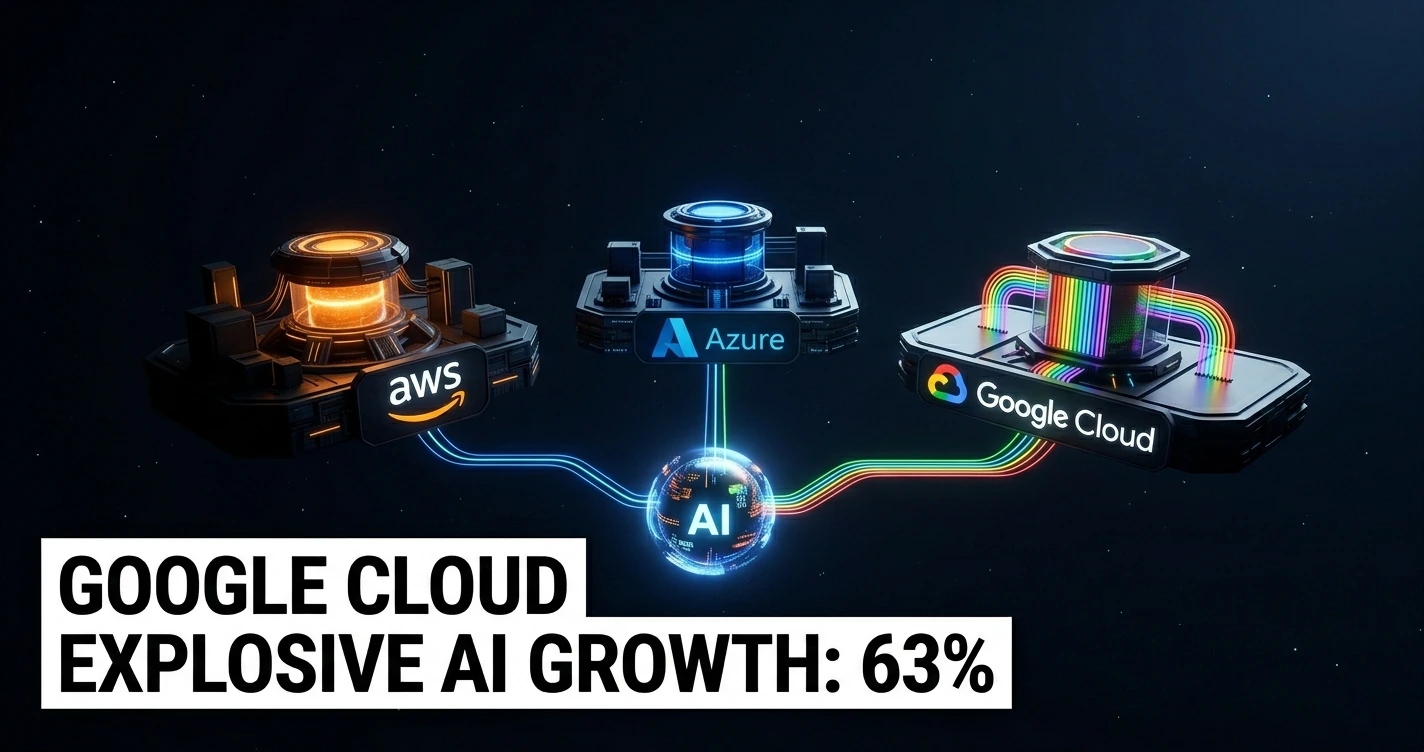
Google Cloud grew 63% year over year. AWS grew 28%. Azure grew 40%. If you’re a CTO currently locked into a 2022-era cloud agreement or an engineer deciding where to run your next AI workload, those are not abstract financial statistics. They are signals about where the AI compute ecosystem is consolidating, which platforms are scaling their infrastructure fastest, and which ones are quietly falling behind on the metrics that will define the next five years.
The AWS vs Azure vs Google Cloud 2026 comparison isn’t about who’s cheapest or who has the most data centers. Those questions were settled a decade ago. The real question now is which cloud wins your AI workload. And the answer depends almost entirely on what you’re building, which foundation models you depend on, and how much hidden cost you can absorb before you renegotiate.
This piece gives you the full picture: verified Q1 2026 data, the AI platform comparison that actually matters, the hidden cost problem getting worse every quarter, and the honest take on what each provider gets wrong that almost nobody in enterprise sales will tell you.
The Market Reality in Q1 2026
The global cloud infrastructure market hit $129 billion in Q1 2026 alone, up 35% year over year, according to Synergy Research Group. To put that in context: that single-quarter figure is larger than the entire annual cloud market was in 2019. The velocity of enterprise cloud and AI investment has moved into territory that even optimistic analysts weren’t projecting two years ago.
AWS still leads with 28% global cloud infrastructure market share. Azure sits at 21%. Google Cloud holds 14%. Together, the Big Three control more than 63% of all global cloud infrastructure spending. Every other provider, including Oracle Cloud, IBM Cloud, and Alibaba Cloud, is competing for the remaining 37%.
Key Context
At $917.9 billion in total 2026 cloud market value (Gartner), one percentage point of cloud market share is worth roughly $9 billion in annual revenue. AWS’s 7-point lead over Azure is not a minor gap. It’s approximately $63 billion in annual revenue that Azure would need to close just to reach parity.
But market share percentages are a lagging indicator. The growth rate is where the story gets genuinely interesting. Google Cloud at 63% YoY growth means its absolute revenue gap with AWS is closing faster than anyone expected. At current growth differentials, GCP reaches AWS revenue parity somewhere around 2030 to 2031. For enterprises signing 3-to-5-year contracts today, you’re potentially committing to a platform that will look very different by year three.
What the Earnings Numbers Actually Show
AWS generated $37.59 billion in Q1 2026 revenue, up from $29.27 billion the prior year. Operating income hit $14.16 billion, a 23% increase. AWS is now a $150 billion annualized business. Andy Jassy, Amazon’s President and CEO, framed it this way on the earnings call:
“AWS is growing 28% — our fastest growth in 15 quarters — on a very large base. We’re in the middle of some of the biggest inflections of our lifetime, and we’re well positioned to lead.”
Andy Jassy, President and CEO, Amazon Inc. — Q1 2026 Earnings Call, April 29, 2026
Google Cloud hit $20 billion in Q1 2026 revenue and produced $6.6 billion in operating income, up from $2.2 billion a year earlier. Its operating margin expanded to 32.9% from 17.8%, which is arguably the most significant structural change in the entire competitive landscape. Google Cloud is no longer subsidizing growth. It’s a high-margin business. Sundar Pichai confirmed on the Alphabet Q1 2026 call that enterprise AI solutions became the primary growth driver for cloud for the first time in Q1 2026.
“AI is now the largest tailwind for cloud, and our enterprise AI solutions have become our primary growth driver for cloud for the first time in Q1.”
Sundar Pichai, CEO, Alphabet Inc. — Q1 2026 Earnings Call, April 29, 2026
Azure’s exact revenue isn’t disclosed separately by Microsoft, but Azure growth of 40% sits within Microsoft’s Intelligent Cloud segment. Azure has maintained the 39-to-40% growth range for three consecutive quarters, which signals stability rather than acceleration. GPT-5 native integration across enterprise services is likely the driver keeping that number from declining, not organic workload growth at the infrastructure layer.
Full Comparison: AWS vs Azure vs Google Cloud 2026
Below is the comparison table that matters for enterprise decision-makers and engineers evaluating cloud infrastructure in 2026. Pricing shown is approximate on-demand compute; actual enterprise contract rates vary significantly.
Factor
AWS
Azure
GCP
Q1 2026 Revenue
$37.59B
Not disclosed (part of Intelligent Cloud)
$20.0B
YoY Revenue Growth
+28%
+40%
+63%
Market Share (Q1 2026)
28%
21%
14%
AI Platform
AWS Bedrock (30+ models)
Azure AI Foundry (GPT-5)
Vertex AI (Gemini + 1M context)
Proprietary AI Silicon
Trainium3 (3x faster than T2)
Relies on NVIDIA H100/H200/B200
TPU v6/Trillium
Global Regions
38 regions, 120 AZs
Sovereign + Gov Cloud regions
49 regions, 148 zones
Container Orchestration
EKS (mature, complex)
AKS (Azure DevOps integrated)
GKE (gold standard)
Compute Pricing (equiv. instance)
~$0.19/hr
~$0.19/hr
~$0.18/hr + auto sustained-use discounts
Egress Pricing
$0.02/GB inter-region
$0.02/GB inter-region
$0.01/GB inter-region
Enterprise Strength
Broadest ecosystem, ISV partners
Microsoft license integration (30-40% savings via Hybrid Benefit)
The AI Platform Showdown: Bedrock vs AI Foundry vs Vertex AI
If you’re making a cloud decision in 2026 and you’re not thinking about AI platform lock-in as the primary risk, you’re having the wrong conversation. Picking AWS today means defaulting to Bedrock. Picking Azure means defaulting to GPT-5 through AI Foundry. Picking GCP means defaulting to Gemini on Vertex. These are not equivalent platforms. And the lock-in happens at the model layer, not the compute layer.
AWS Bedrock: The Neutral Host Play
AWS Bedrock gives you access to 30+ foundation models including Claude (Anthropic), Llama, Cohere, and Amazon’s own Titan models. AWS has now committed up to $25 billion in Anthropic on top of its prior $8 billion investment, and simultaneously expanded its OpenAI partnership by $100 billion over eight years. That’s a deliberate hedge. AWS CEO Matt Garman positioned this explicitly on the Q1 2026 earnings call:
“Their production applications run in AWS, their data is in AWS, they trust the security of AWS. This is what our customers have been asking for for a really long time.”
Matt Garman, CEO, Amazon Web Services — Q1 2026 Earnings Call
The multi-model approach is genuinely useful for enterprises that don’t want to bet their AI infrastructure on a single model provider. But it’s also a signal of something else: AWS doesn’t own its AI model relationship the way Azure owns OpenAI or GCP owns Gemini. Neutrality is not the same as leadership when model quality becomes the dominant enterprise differentiator.
Risk to Watch
Our read: AWS’s model-agnostic positioning is strategically smart for 2025 and 2026, but it creates a vulnerability. If Anthropic or any of the Bedrock model providers reaches sufficient scale to offer direct enterprise contracts at competitive pricing, AWS’s AI moat shrinks substantially overnight.
Azure AI Foundry: GPT-5 as a Competitive Moat
Azure’s biggest differentiator is simple: exclusive enterprise access to OpenAI’s GPT-5. For any organization that has built workflows, products, or internal tools around GPT-4o or is planning to use o-series reasoning models, Azure AI Foundry (rebranded from Azure AI Studio in 2026) is the lowest-friction path. Add GitHub Copilot integration across all development tools, and Azure has constructed a compelling enterprise productivity stack.
But the moat has a crack. OpenAI announced a $38 billion AWS commitment expansion in Q1 2026, signaling that OpenAI is actively building infrastructure relationships outside of Azure. If OpenAI launches direct enterprise API tiers that bypass Azure’s Azure OpenAI Service, Microsoft’s primary AI differentiator gets substantially weaker. Azure’s 40% growth is healthy, but the narrative that “Azure plus OpenAI equals unbeatable enterprise AI” requires OpenAI to remain infrastructure-dependent on Microsoft. That assumption deserves scrutiny.
Google Vertex AI: The Technical Challenger
Vertex AI offers Gemini models with native BigQuery integration, AutoML, and the largest publicly available context window in any managed cloud AI service: 1 million tokens with Gemini 1.5 Pro. There is no equivalent on AWS Bedrock or Azure AI Foundry. For applications requiring full-document ingestion, long-code-base analysis, or multi-session memory, that context window matters practically.
Google also invented Kubernetes. GKE (Google Kubernetes Engine) remains the industry gold standard for managed container orchestration, which means GCP is naturally positioned for cloud-native, AI-native architectures that require both container workloads and model inference in the same infrastructure stack.
Revenue from products built on Alphabet’s generative AI models grew nearly 800% year over year in Q1 2026. Google Cloud’s backlog nearly doubled in three months. These are not incremental improvements. This is a platform finding its product-market fit at speed.
Pricing, Hidden Costs, and the 29% Waste Problem
The question “which cloud is cheapest in 2026” is almost always the wrong question. At enterprise scale, a $0.005 per GB storage difference between Azure and AWS is $5,000 per year per 100 terabytes. That’s trivially negotiable in any enterprise contract. It’s not where the real cost lives.
Cloud waste reached 29% in 2026, according to the Flexera 2026 State of the Cloud Report. Companies migrate expecting 30-to-50% savings, but costs often exceed original projections by 20 to 80% within 12 months. Egress fees alone can account for up to 45% of a project’s total cloud expenses. Nearly 95% of organizations report some form of regret about their first major hyperscaler contract.
Where the real cost differences live in 2026:
Egress fees: AWS and Azure charge $0.02/GB for inter-region data transfer. GCP charges $0.01/GB. At 500TB monthly movement, that’s $120,000 per year in savings on GCP vs the other two.
Azure Hybrid Benefit: Organizations with existing Microsoft SQL Server or Windows Server licenses save 30-to-40% on Azure compute. If your stack is already Microsoft-native, this benefit makes Azure’s effective cost competitive or superior to both peers.
GCP sustained-use discounts: Google Cloud automatically applies sustained-use discounts with no commitment required. AWS and Azure require reserved instance purchases or savings plan commitments to hit equivalent effective pricing.
AI workload unit economics: Industry analysis suggests GCP runs AI-specific workloads 5-to-10% cheaper than AWS or Azure, primarily due to Google’s TPU infrastructure reducing its dependency on NVIDIA pricing.
Multi-cloud tax: 89% of enterprises now run multi-cloud strategies, averaging 4.8 cloud providers. The FinOps overhead of managing that complexity, including tooling, engineering time, and governance, often offsets the pricing optimizations enterprises were originally seeking.
For Engineers
The simplest pricing checker available from all three providers is optimized for single-region, single-workload scenarios. Real enterprise architectures with multi-region failover, cross-service dependencies, and AI inference at scale look nothing like those calculators. Budget 25-to-40% above the listed estimate for any serious production deployment.
The Silicon Gap Nobody Talks About
The most underreported factor in the AWS vs Azure vs Google Cloud 2026 comparison is custom silicon. All three providers are spending historic amounts on AI infrastructure, but they are not spending it on the same things. And those differences compound into structural cost advantages that will matter for years.
AWS Trainium3, launched in Q1 2026, is marketed as 3x faster than Trainium2 for AI training. Amazon has stated that custom silicon is reducing its AI inference costs by orders of magnitude. The implication is that AWS can price its managed AI services cheaper than the NVIDIA spot instance market, which matters for high-volume inference workloads.
Google’s TPU v6/Trillium infrastructure is the underlying reason GCP can offer AI workloads 5-to-10% cheaper than competitors while simultaneously expanding operating margins. Custom silicon removes NVIDIA’s pricing power from the equation at the infrastructure level. Google built its TPU program specifically to avoid what is now the most expensive constraint in cloud computing: GPU availability.
Azure has no proprietary AI silicon at scale comparable to AWS Trainium or Google TPUs. It relies primarily on NVIDIA H100, H200, and B200 GPUs. This creates a structural cost disadvantage at AI scale that isn’t visible in list prices but shows up in the economics of running large inference workloads. It also means Azure is exposed to NVIDIA supply chain risk in a way that AWS and GCP are not.
All three hyperscalers are GPU-constrained regardless of their silicon strategy. AWS Q1 capex hit $43.2 billion, annualizing to over $170 billion. Google’s Q1 capex was $35.7 billion. Jassy acknowledged on the earnings call that “most of the new supplies are already spoken for.” For CTOs trying to provision large GPU clusters on any of the three platforms, timeline uncertainty is real and unlikely to resolve before late 2027 at the earliest.
The single most useful framing for the AWS vs Azure vs Google Cloud 2026 decision is this: there is no universal winner. The correct question is which platform wins your specific workload category, given your existing stack, your AI model dependencies, and your 36-month cost trajectory.
AWS Wins When…
Best For
You need the broadest model access (30+ via Bedrock), you’re running regulated workloads needing extensive compliance certifications, or you require the deepest partner ecosystem of any hyperscaler for ISV integrations.
Also Consider AWS If
Your team’s infrastructure talent is AWS-native, or you’re scaling from startup to enterprise and need the deepest marketplace of third-party tools.
Azure Wins When…
Best For
Your stack is Microsoft-native (M365, Dynamics 365, Active Directory, SQL Server). Azure Hybrid Benefit saves 30-to-40% on Windows workloads, and GPT-5 access through AI Foundry is your primary AI dependency.
Also Consider Azure If
You’re in financial services or government and need Azure’s sovereign cloud compliance infrastructure.
GCP Wins When…
Best For
You’re building AI-native applications on Gemini, you need BigQuery for analytics-heavy workloads, or you’re running container-heavy architectures where GKE’s Kubernetes heritage gives you meaningful operational advantage.
Also Consider GCP If
AI workloads represent more than 15% of your cloud spend. The 5-to-10% cost advantage plus TPU availability warrants a formal cost comparison.
Startups: The GCP Case Is Stronger Than You Think
Google Cloud’s startup credits are currently the most generous in the market. For cloud-native architectures, GKE is still the cleanest managed Kubernetes experience available. If you’re building an AI-first product in 2026 and you don’t have existing AWS infrastructure to defend, GCP deserves serious consideration. The counterargument: AWS’s ecosystem depth and talent availability remain unmatched at the point where you’re hiring your 20th infrastructure engineer.
The Multi-Cloud Reality
87-to-89% of enterprises now run multi-cloud strategies, using an average of 4.8 cloud providers. The practical pattern emerging at scale: a primary cloud handles 70-to-80% of workloads, and a secondary provider handles specific capability gaps. The most common pattern in 2026 is AWS for primary infrastructure, with GCP’s BigQuery for analytics or Vertex AI for specific model inference, sitting behind a unified gateway like LiteLLM or LangChain that abstracts the model layer from the application layer.
The Critical Take: Five Things Enterprise Sales Won’t Tell You
The standard sales narrative from all three providers involves some version of “we’re the safe choice because X.” Here’s what the actual data suggests about each of those X claims.
1. AWS’s Market Share Lead Is Real; Its AI Moat Is Not
AWS holds 28% market share and is growing at 28%. Tracy Woo, Principal Analyst at Forrester Research, was pointed about this dynamic when Garman was appointed AWS CEO:
“Selipsky’s departure is unsurprising. AWS has seen slower growth under his tenure. The generative AI movement caught AWS flat-footed, placing them at third in AI among the hyperscalers — unfamiliar territory for AWS.”
Tracy Woo, Principal Analyst, Forrester Research — via TechCrunch, 2024
Garman’s Q1 2026 results show the gap is narrowing. AWS’s Trainium3 launch and Anthropic/OpenAI dual investment strategy show a credible response. But the Bedrock neutrality play means AWS doesn’t own a model relationship the way Azure owns OpenAI or GCP owns Gemini. Neutrality is a feature until the enterprise market consolidates around two or three dominant foundation models, at which point whoever owns those relationships wins the workload allocation battle.
2. Azure’s OpenAI Lock-In Cuts Both Ways
Azure’s biggest competitive moat is also its biggest single point of failure. Exclusive GPT-5 enterprise access is a genuine differentiator today. But OpenAI is actively building direct enterprise relationships and has now committed $38 billion in infrastructure to AWS. If OpenAI builds a direct enterprise API tier that competes with Azure’s Azure OpenAI Service pricing, Microsoft loses its core AI narrative in one quarter.
3. Google Cloud’s Growth Rate Obscures Its Absolute Scale Risk
63% YoY growth at $20 billion quarterly is genuinely impressive. But Google Cloud is still less than half of AWS’s $37.6 billion. At current growth rate differentials, GCP reaches AWS revenue parity around 2030. Enterprises making three-to-five year commitments today are betting on a platform that remains a strong challenger rather than a dominant ecosystem. That’s not a disqualifier, but it’s a real factor in evaluating partner ecosystem depth, third-party tooling maturity, and enterprise support coverage.
4. Hidden Cloud Costs Are Getting Worse, Not Better
Cloud waste reached 29% in 2026. Egress fees can constitute up to 45% of project costs. Cross-region data transfer fees, Kubernetes control plane charges, and premium storage backing on Azure memory-optimized instances systematically exceed what the pricing calculators show for real enterprise architectures. The multi-cloud complexity tax is real: managing 4.8 providers averages significant FinOps overhead that often eliminates the price advantages enterprises were originally chasing.
5. The Outage Risk Is Underpriced in Every Enterprise BCP
Forrester’s formal institutional prediction for 2026, published in its Predictions 2026: Cloud Computing report: at least two major multi-day cloud outages triggered by investment diversion from legacy infrastructure toward AI GPU data centers. The 2025 AWS and Azure outages demonstrated that cascading failures in hyperscaler infrastructure take days to resolve. Business continuity plans that rely on a single provider’s published 99.99% SLA are pricing in a risk level that Forrester explicitly calls increasingly unreliable. Multi-region, multi-provider failover architecture is no longer a nice-to-have for mission-critical workloads.
Frequently Asked Questions
Which cloud provider has the most market share in 2026?
AWS leads with 28% global cloud infrastructure market share in Q1 2026, followed by Microsoft Azure at 21% and Google Cloud at 14%, according to Synergy Research Group. Together, the Big Three control more than 63% of global cloud infrastructure spending. The total Q1 2026 market was $129 billion, up 35% year over year.
Is Google Cloud growing faster than AWS in 2026?
Yes. Google Cloud grew revenue 63% year over year in Q1 2026, compared to Azure at 40% and AWS at 28%, making GCP the fastest-growing major cloud provider by a significant margin. AWS remains the largest in absolute revenue at $37.59 billion for the quarter versus GCP’s $20 billion. At current growth differentials, GCP reaches AWS revenue parity around 2030 to 2031.
What is the cheapest cloud provider in 2026: AWS, Azure, or Google Cloud?
Google Cloud typically offers the lowest list prices and automatically applies sustained-use discounts with no commitment required. On-demand compute for equivalent instances runs roughly $0.19/hour on AWS and Azure versus $0.18/hour on GCP. GCP also charges $0.01/GB for inter-region data transfer versus $0.02/GB on AWS and Azure. Azure wins for organizations with existing Microsoft licenses through its Hybrid Benefit program, which delivers up to 40% savings on Windows Server and SQL Server workloads.
Which cloud is best for AI workloads in 2026?
It depends on your AI model dependencies. AWS Bedrock gives you multi-model flexibility across 30+ foundation models including Claude and Llama. Azure AI Foundry provides exclusive enterprise access to OpenAI’s GPT-5 with Microsoft compliance integration. Google Vertex AI offers Gemini models with native BigQuery integration and a 1 million-token context window with no equivalent on either competing platform. GCP also runs AI workloads 5-to-10% cheaper than AWS or Azure due to its custom TPU infrastructure.
What is the difference between AWS Bedrock, Azure AI Foundry, and Google Vertex AI?
AWS Bedrock is a model-agnostic gateway for 30+ foundation models (Claude, Llama, Cohere, Titan), best for AWS-native enterprises needing multi-model flexibility. Azure AI Foundry, formerly Azure AI Studio, provides exclusive enterprise access to OpenAI’s GPT-5 and o-series models with deep Microsoft compliance integration. Google Vertex AI offers Gemini models with native BigQuery integration, AutoML, and the largest available context window at 1 million tokens with Gemini 1.5 Pro.
Which cloud provider is best for startups in 2026?
Google Cloud offers the most generous startup credits and the cleanest developer experience for cloud-native architectures, with GKE remaining the gold standard for managed Kubernetes. AWS has the broadest ecosystem, partner network, and deepest third-party integrations, making it the default for teams expecting to scale to significant headcount. Azure is best for startups already operating in the Microsoft 365 ecosystem. Most startups still default to AWS due to talent availability and ecosystem maturity, but GCP is the strongest challenger for AI-first applications.
What is multi-cloud and do enterprises need it in 2026?
Multi-cloud means running workloads across more than one cloud provider. 87 to 89% of enterprises now use multi-cloud strategies, averaging 4.8 providers, according to the Flexera 2026 State of the Cloud Report. It reduces vendor lock-in and enables best-fit infrastructure for specific workloads. The practical cost is FinOps overhead: managing multiple providers adds engineering complexity that often offsets the pricing benefits being sought. Most enterprise teams run a primary cloud for 70-to-80% of workloads and a secondary provider for specific capabilities.
How does AWS compare to Google Cloud for Kubernetes in 2026?
Google invented Kubernetes and Google Kubernetes Engine remains the most mature, lowest-friction managed Kubernetes experience available. AWS EKS is widely adopted and capable but adds operational complexity. Azure AKS integrates well with Azure DevOps. For teams prioritizing cloud-native container orchestration as a primary workload, GKE’s heritage and depth of platform integration gives it a meaningful practical advantage over both EKS and AKS.
What You Now Know That You Didn’t Before
The AWS vs Azure vs Google Cloud 2026 comparison is no longer a question about which platform has the most services or the best uptime SLA. It’s a question about which AI model relationship you want to be structurally dependent on, and whether you can afford the hidden costs of whichever lock-in you choose.
Google Cloud’s 63% growth and rapidly expanding operating margins signal a platform that has found its product-market fit specifically in the AI era. Azure’s GPT-5 moat is real but more fragile than it appears. AWS’s market position is durable, but its AI leadership is genuinely contested for the first time in the platform’s history.
Three things to watch or act on in the next 90 days:
If AI workloads exceed 15% of your cloud spend, run a formal cost comparison between your current provider and GCP’s Vertex AI. The TPU infrastructure and egress pricing difference may be significant at your scale.
Audit your Azure contract for OpenAI dependencies. If GPT-5 access is a core workflow driver, map what happens to that workflow if OpenAI shifts its direct enterprise pricing strategy.
Review your business continuity plan against the Forrester prediction of two major multi-day outages in 2026. Single-provider mission-critical architectures need a genuine failover strategy, not just theoretical redundancy.
Stay Ahead of the Cloud War
Get the sharpest weekly briefing on AI infrastructure, cloud economics, and enterprise tech delivered to your inbox. No padding. No hype.
Subscribe to The Neural Loop
Meta AI Tools for Business (2026): The Complete Founder & Marketer GuideNeuralWired
Big Tech · AI for Business · June 2026
Meta AI Tools for Business: The Complete 2026 Guide for Founders & Marketers
From a free AI sales agent to a $60B ad automation engine — Meta’s business toolkit is growing 10x in months. Here’s what’s real, what works, and what every founder needs to do before the free window closes.
By NeuralWired Editorial | June 1, 2026 | 14 min read
10MAI convos/week (up from 1M in Jan)
8M+Advertisers using GenAI ad tools
$60BAdvantage+ annualized revenue
+22%ROAS vs. manual campaigns (avg.)
Key Takeaways
Meta Business AI is free right now — and handling 10 million conversations per week. That free window has an expiration date Zuckerberg himself confirmed.
Advantage+ delivers +22% higher ROAS on average vs. manual campaigns, but hides enormous industry variance (1.57x to 4.39x median ROAS).
A leaked internal memo (May 28, 2026) reveals Meta is embedding engineers inside enterprise clients — a direct shot at Salesforce and Microsoft.
Meta’s December 2025 policy update allows AI conversation data to fuel ad personalization. Businesses in healthcare, finance, and legal need to read the fine print.
Creative quality now drives over 50% of Meta ad performance. The AI handles targeting; humans still need to win on creative.
Here’s a scenario that’s playing out in thousands of small businesses right now. A founder deploys Meta Business AI to their Shopify store on a Tuesday afternoon. By Friday, the AI agent is handling 40% of their inbound customer questions across WhatsApp and Instagram DMs — product specs, shipping questions, size recommendations. No developer. No monthly SaaS bill. Just a few hours in Meta Business Suite and a tool that actually converts.
That’s the pitch. And right now, the data suggests it’s real. Meta’s Business AI is facilitating 10 million conversations per week — up from 1 million in January 2026. That’s 10x growth in roughly three months. Over 8 million advertisers are already using at least one of Meta’s generative AI ad tools.
But before you hand Meta the keys to your customer relationships, there are things you need to understand about what this toolkit actually is, what it actually costs (now and later), and what Meta gets out of it. This guide covers all of it.
What Is Meta Business AI?
Meta Business AI is a free, customizable AI sales agent that businesses can deploy on their own websites and across Meta’s four major platforms — Facebook, Instagram, WhatsApp, and Messenger — from a single dashboard in Meta Business Suite.
It was announced on October 2, 2025, at Meta’s pre-holiday ad update event, and is built on Llama 4, Meta’s latest multimodal AI model, with next-generation capabilities now being powered by Muse Spark — the first model released under Meta’s newly created Meta Superintelligence Labs division.
What it does: answers product questions, handles customer objections, assists with custom orders, drives conversions, and automates sales conversations — 24/7, in multiple languages, with no coding required to set up. It started with select small businesses in 2025, expanded to EMEA, APAC, and LATAM in beta during Q1 2026, and is now broadly available.
The word “free” is accurate but misleading. More on that in the risks section.
The Full Product Suite Explained
Meta’s AI tools for business don’t live in one product. They span a stack — customer service, creative production, ad targeting, and infrastructure — that now touches every stage of the commercial funnel. Here’s what exists and what each piece actually does.
Customer Service
Meta Business AI Free
Deploy an AI sales agent across your website, WhatsApp, Instagram DMs, Messenger, and Facebook — from one dashboard. Handles FAQs, objections, and drives purchases autonomously.
Ad Automation
Meta Advantage+
Fully automated campaign management. Covers creative selection, audience targeting, budget optimization, and placement — all driven by AI. The flagship for performance advertisers.