NeuralWired’s Technology section covers the developments reshaping how the world builds, deploys, and regulates digital innovation. We report daily on the stories driving global conversation in artificial intelligence, big technology companies, startups and venture funding, cybersecurity, consumer gadgets and devices, and blockchain and cryptocurrency.
Our technology coverage goes beyond product announcements. When a major AI model launches, we explain what it can actually do and where its claims are overstated. When a startup raises a large funding round, we look at whether the business behind it can sustain that valuation. When a cybersecurity breach hits the news, we explain who is affected and what comes next, not just what happened. Each article is built from original research into primary sources, including company statements, technical documentation, regulatory filings, and verified data, and is written by our editorial team rather than generated automatically.
Readers come to this section for daily updates on the technology stories that matter globally, from shifts inside major technology companies to emerging tools changing how people work, communicate, and build. Whether you are a founder, an investor, an engineer, or simply someone trying to understand where technology is heading next, NeuralWired’s Technology coverage is built to keep you informed without wasting your time on hype.
Atlas, Digit, Figure, and Optimus are crossing the demo-to-deployment line this year, but only for a narrow band of tasks. Here is the use-case readiness matrix, the real TCO math, and the deployment playbook that separates successful pilots from expensive setbacks.
NW
NeuralWired Editorial
March 20, 2026 · Manufacturing & Robotics
Thousands of humanoid robots are working inside real factories right now, not on demo stages. Agility Robotics’ Digit is running warehouse flows at Amazon and GXO. Tesla has deployed thousands of Optimus units inside its own plants. Boston Dynamics committed Atlas fleets to Hyundai’s production lines for 2026. The demo-to-deployment crossing has happened.
But the real question for plant leaders, engineers, and investors is not “are humanoid robots real?” It is a harder one: which tasks are actually production-ready today, versus which are 3 to 5 years out? Getting that wrong means either missing a genuine competitive window or burning capital on a pilot that stalls at month four.
This analysis maps the readiness landscape across automotive manufacturing, logistics, and adjacent sectors. It draws on technical specs from Boston Dynamics, Figure AI, Agility Robotics, and Tesla, combined with market data from IDTechEx and the International Federation of Robotics. You will get a use-case readiness matrix, a four-way platform comparison, the TCO math, and a concrete deployment playbook.
$30BProjected humanoid robot market by 2036, according to IDTechEx’s latest forecast, driven almost entirely by manufacturing and logistics adoption.
What “Production-Ready” Actually Means in 2026
The robotics industry has a credibility problem: the gap between “impressive demo” and “runs two shifts unattended” is enormous, and most press coverage does not draw the line clearly. For manufacturing contexts, a system is production-ready only when it clears four independent bars.
Stack integration: The robot must plug into existing MES, ERP, or WMS systems. Tools like Boston Dynamics’ Orbit and Agility’s Arc platform are designed exactly for this. Without dispatcher-level software integration, a humanoid is just an expensive standalone machine.
Reliability and uptime:IDTechEx notes that structured factory environments with controlled lighting, fixed layouts, and predictable payloads can support 80 to 90 percent uptime today. Mean time between failures on critical joints and batteries is improving, but still lags behind fixed industrial arms by a measurable margin.
Safety conformance:Agility’s latest Digit iteration ships with Category 1 stops and a safety PLC rated PLd, the baseline for OSHA-regulated environments in the US. This is a material differentiator for industrial buyers. Most other platforms are approaching this bar but have not publicly confirmed equivalent certifications.
Labor-cost economics: According to detailed TCO modeling, a five-year total cost per robot, including maintenance, charging infrastructure, and software licensing, runs between $35,000 and $80,000. Realistic payback periods are 24 to 36 months, assuming 0.5 to 0.7 FTE replacement per robot, not full headcount elimination. Any model that assumes one robot replaces one worker is overstating the case significantly.
“Humanoids will only scale in industry if they compete with fixed automation on efficiency and precision, not just compelling demos.”
International Federation of Robotics, 2026 Robotics Industry Outlook (via Maakindustrie)
The Use-Case Readiness Matrix: What’s Ready Now vs. What’s Not
The sharpest framework for industrial decision-making is not “which robot is best.” It is “which tasks are ready for which robot, and when.” The matrix below, calibrated to 2026 deployment realities, should anchor any serious pilot evaluation.
Automotive manufacturing leads readiness by a wide margin. That is not accidental: automotive plants have structured environments, mature safety regimes, and significant labor-cost pressure on physical, repetitive tasks, exactly the conditions where today’s humanoids deliver value.
Use Case
Sector
2026 Status
Key Rationale
Intra-factory material transport
Automotive
Ready Now
Low dexterity, high repetition, AMR-compatible. Digit validated at multiple automotive sites.
Line-feeding and kitting
Automotive
Ready Now
Transporting totes from buffer to assembly stations. No fine manipulation required.
Quality inspection support
Automotive
Ready Now
Fixed-path camera/LiDAR scanning. UBTech Walker S already deployed in automotive QC roles.
Goods-to-person tote flows
Logistics
Ready Now
Digit’s primary commercial use case. Validated at Amazon, GXO, and Schaeffler.
Basic assembly assistance
Automotive
2 to 3 Years
Inserting large components (dashboards, seats) under supervision. Atlas and Figure targeting this now.
Mixed-case palletizing
Logistics
2 to 3 Years
Soft or irregular SKUs add grasp complexity. Hardware improving but not yet consistent at scale.
Station-to-station machine tending
Automotive
2 to 3 Years
Predictable geometry helps, but cycle-time reliability must improve before displacing cobots.
High-precision sub-assembly
Automotive / Electronics
3 to 5+ Years
Micron-level dexterity and speed requirements. Cobots and gantries remain the default here.
High-throughput parcel sorting
Logistics
3 to 5+ Years
Specialized sort-robots already optimized. Humanoids cannot match cycle times at competitive cost.
Pharma / ESD electronics mfg.
Pharma / Electronics
3 to 5+ Years
Sterility, ESD, and micron precision requirements exceed current humanoid capabilities entirely.
The pattern is consistent: humanoids win today on tasks that are mobile-first, medium-dexterity, high-repetition, and physically demanding for humans. They lose to purpose-built automation on any task requiring high throughput, micron precision, or sterile environments.
Atlas, Figure, Optimus and Digit: Platform Comparison for Industrial Buyers
Choosing a platform is a strategic commitment, not a purchase order. Each robot comes with a distinct technical profile, deployment context, and vendor ecosystem. Here is what matters for industrial decision-makers, organized by how ready each system is for factory deployment today.
Atlas
Boston Dynamics
High (2026)
All-electric, 56 degrees of freedom, lift capacity up to 50 kg, and a 2.3-meter reach. Designed to operate in human-built environments without infrastructure modification. Hot-swappable batteries support multi-shift operation. Already deployed in Hyundai’s RMAC facility with committed fleets for 2026.
56 DOF50 kg payloadHot-swap batteryOrbit MES integration
Digit
Agility Robotics
High (2026)
The most commercially validated humanoid in manufacturing and logistics today. Deployed at Amazon, GXO, Schaeffler, and Toyota. Lower dexterity than Atlas, but highly optimized for totes and pallets. Latest version includes Cat-1/PLd safety and autonomous 4-hour charge cycles. Best for logistics-heavy manufacturing flows.
Optimized for industrial manipulation and complex grasping. Trained in industrial-like environments with a strong focus on tool-use tasks. BotQ factory targets 12,000-unit annual capacity, a signal of intent to move well beyond pilots. Deployed with BMW in automotive. Best once trained on specific stations for kitting and assembly assistance.
The most AI-driven stack in the field, backed by Tesla’s vertical integration and a simulation environment running thousands of virtual robots. Thousands of units already deployed inside Tesla factories as of late 2025. External commercialization expected late 2026 to 2027. Target unit cost at scale: approximately $30,000. Best for sites with strong AI infrastructure and a multi-year horizon.
53 to 56 DOF~$30k target priceAI-driven autonomy4 to 8 hr battery
One clean takeaway: Digit and Atlas are the right choice for organizations that need production-ready deployment in 2026. Figure is the right bet for organizations building toward high-dexterity assembly over the next 24 months. Optimus is the right choice for long-term AI stack investment, not this quarter’s throughput numbers.
Humanoids vs. Cobots: The Decision Framework Your CFO Actually Needs
Most industry coverage still frames the choice as “humanoid robots vs. no robots.” The sharper analysis is humanoid vs. cobot vs. fixed automation, and the answer depends entirely on whether mobility or precision is the bottleneck in your operation.
A standard cobot costs around $20,000 per unit and typically delivers ROI within six months for well-defined, stationary tasks. Cobots are fast to integrate, easy to fence, and reliable at high-repetition pick-and-place. For those tasks, they still win in 2026, full stop.
Humanoids win where cobots structurally cannot compete:
Humanoids Win
Mobile-first tasks crossing multiple stations
Legacy plants where cobot-centric layouts are not feasible
Labor-stressed shifts with recruiting gaps
Physically demanding tasks driving injury risk
Lines where AMR plus cobot integration adds excessive complexity
Cobots Still Win
High-throughput, high-precision pick-and-place
Repetitive tasks in small, standardized cells
Applications where speed and consistency are non-negotiable
Environments that can be fully fenced and optimized
Budget-constrained pilots needing sub-6-month payback
The right mental model: humanoids are not cobot replacements. They are a mobile cobot layer for tasks where mobility and workspace flexibility dominate the cost curve. An automotive plant with an aging workforce and recruiting gaps on physically demanding line-feeding tasks is exactly where Digit and Atlas are landing their first commercial wins.
On the economics: humanoid TCO over five years runs $35,000 to $80,000 per unit, according to detailed modeling. At labor costs of $25 to $35 per hour and 0.5 to 0.7 FTE replacement per robot, five-year ROI in the right tasks frequently exceeds 1,000%. That math works. But it assumes the task selection is correct, which is exactly where most pilots stumble.
A note on “soft” ROI: Manufacturing leaders increasingly justify humanoid deployment not just on labor cost arbitrage, but on shift stability, reduced musculoskeletal injuries, and lower employee turnover. These benefits are real and often underweighted in initial business cases, particularly for second and third shifts where recruiting is genuinely difficult.
The Safety and Reliability Gap That’s Still Blocking Wider Deployment
Even when the task fit is right and the economics make sense, safety and reliability thresholds are the primary gating factors for production deployment in 2026. This is where many pilots stall, and where vendor selection matters most.
There is a critical distinction between “cooperative safety” and “collaborative safety” that most buyers do not understand going in. Today’s humanoids operate in cooperative mode: humans and robots share the same room, but workers do not routinely reach into the robot’s active workspace. True collaborative mode, where human hands regularly enter the robot’s working volume, is still emerging for dynamically balanced mobile systems. The standards are not finalized yet.
“The industry is still defining safety standards for dynamically balanced mobile robots. Buyers who assume humanoids work exactly like cobots in shared workspaces will have a difficult time with their safety reviews.”
On the reliability side, IDTechEx is explicit: humanoid robots remain more complex and less reliable than fixed-arm robots, with higher failure rates per operating hour. The weak points are actuator chains, thermal management, and batteries. This is not a reason to avoid deployment. It is a reason to pick tasks where a downed robot does not halt an entire production line, and to ensure your vendor offers cloud-based fleet management and OTA updates for rapid recovery.
Deployment Playbook: 4 Steps Before You Sign a Pilot Agreement
Rather than a generic “start small” recommendation, here is the concrete playbook that separates well-structured pilots from expensive learning exercises. This draws directly from the operational patterns of early adopters, including automotive OEMs, Amazon, and the handful of manufacturers who have moved beyond single-robot demos to fleet-scale deployment.
The 4-Step Humanoid Deployment Playbook
Map use cases by readiness, not aspirationUse the readiness matrix above to short-list 2 to 3 tasks that are high-labor, low-precision, and high-repetition. The task must already be bounded by existing workflows, whether MES, WMS, or AMR routes. Start with tasks where human workers actively want relief from physical strain.
Choose the right platform for the specific task profileUse Digit-type systems for logistics-heavy flows and AMR-integrated lines. Choose Atlas or Figure for complex plant layouts requiring a mix of transport and basic assembly. Choose Optimus only if you have strong AI infrastructure and a 3-year horizon. Platform decisions are 3 to 5 year commitments.
Define safety and coexistence rules before hardware arrivesDecide on cooperative vs. collaborative mode before layout planning begins, as this dictates fencing requirements and workflow design. Ensure the vendor can demonstrate Cat-1/PLd-level safety stops and integration with your existing PLCs. If they cannot produce safety documentation, do not proceed.
Build a realistic TCO and payback model, including soft benefitsUse a labor-substitution model of 0.5 to 0.7 FTE per robot with five-year TCO in the $35,000 to $80,000 range. Model “soft” benefits separately: reduced musculoskeletal injuries, lower turnover, and the ability to reliably staff second and third shifts. Separate these from direct labor savings so the business case survives scrutiny from finance.
Frequently Asked Questions
Click any question to read the answer.
Yes, for a specific and bounded set of tasks. Intra-factory material transport, line-feeding, kitting, and quality inspection support in automotive and logistics environments are production-ready today. High-precision assembly, sterile environments, and high-throughput sorting are 3 to 5 years away. The key mistake is treating “humanoid robots in manufacturing” as a single binary question when the real answer is entirely task-specific.
Per-unit purchase prices range from Tesla Optimus’s stated target of approximately $30,000 at scale to higher prices for Atlas and Figure systems. The more important number is five-year TCO, including maintenance, charging infrastructure, fleet management software, and training, which IDTechEx and industry analysts estimate at $35,000 to $80,000 per robot. Payback periods of 24 to 36 months are achievable in well-selected tasks at $25 to $35 per hour labor rates.
Cobots are fixed-arm systems designed for stationary, high-precision tasks in defined workspaces. They are cheaper at around $20,000, faster to deploy, and deliver faster ROI for repetitive pick-and-place. Humanoid robots add mobility: they can walk between stations, navigate human-designed environments, and handle tasks across a changing workspace. Humanoids are best understood as “mobile cobots” for tasks where movement, flexibility, and physical endurance are the primary bottleneck.
For 2026 deployment, Agility Digit and Boston Dynamics Atlas are the most production-ready options. Digit leads on logistics-heavy flows with its validated safety certifications and AMR integration. Atlas leads for complex plant layouts and mixed transport and assembly tasks. Figure 02/03 is the best choice if your primary focus is assembly assistance at scale in 2027 and beyond. Optimus is best for organizations with strong in-house AI infrastructure and a multi-year deployment horizon.
Today’s humanoids support “cooperative safety,” meaning humans and robots can share the same space, but workers should not routinely reach into the robot’s active workspace. True collaborative mode, where human hands regularly work alongside the robot simultaneously, is still being standardized for dynamically balanced mobile systems. Agility’s Digit includes Cat-1/PLd-certified safety stops that meet current OSHA-regulated manufacturing requirements. Buyers should verify specific safety documentation before any deployment.
Tesla had deployed thousands of Optimus units inside its own factories as of late 2025, making it the largest internal deployment of humanoid robots in any single manufacturing organization. External commercialization, meaning selling to third-party customers, is expected in late 2026 to 2027. Tesla’s approach differs from other vendors: it is validating the technology at scale internally before committing to external sales.
The clearest limitations in 2026 are: high-precision sub-assembly such as wiring harnesses and small electronic modules, high-throughput production lines where cycle-time variance is unacceptable, sterile pharmaceutical environments, ESD-sensitive electronics manufacturing, and any task where fine manipulation at speed is required. These are not capability gaps that software updates will close in the next quarter. They reflect hardware dexterity and reliability constraints that IDTechEx projects will take 3 to 5 years to resolve.
The Bottom Line for 2026
The pattern across every serious deployment of humanoid robots in manufacturing is consistent: success comes from matching the right platform to the right task, not from deploying the most sophisticated robot. Organizations that start with material transport, line-feeding, and inspection support in structured automotive or logistics environments are generating real ROI today. Those that jump to high-precision assembly or unstructured environments are still paying tuition.
This matters beyond the current wave of pilots. As humanoid capability compounds over the next 3 to 5 years, the organizations with operational experience covering real fleet management, safety integration, and worker coexistence protocols will have a structural advantage that latecomers cannot easily replicate. The learning curve here is not software. It is organizational readiness.
Watch three developments through 2028: first, the emergence of vendor-neutral safety standards for dynamically balanced mobile robots; second, Tesla’s external commercialization of Optimus shifting the price anchor for the entire market; and third, a rapid bifurcation between manufacturing organizations that have built deployment expertise and those that have not. For plant leaders and CTOs evaluating humanoid robots in manufacturing, the time to build that expertise is now, on the right tasks, with the right platform, and with a TCO model that survives a finance review.
Stay ahead of industrial robotics, physical AI, and manufacturing automation with NeuralWired’s weekly analysis for technology decision-makers.
Subscribe Free
Why 56% of CEOs See Zero AI ROI in 2026 (And the 4-Layer Fix) – NeuralWiredEnterprise AI · Strategy
NeuralWired Research Desk|March 2026|14 min read
56%of CEOs report no AI revenue gain or cost reduction
14%of CFOs see clear, measurable AI ROI in 2026
88%of organizations use AI, yet only 39% link it to EBIT impact
Here’s a number that should stop any executive cold: 56% of CEOs report zero AI-driven revenue gain or cost reduction in the past twelve months, even as their companies spend aggressively on models, platforms, and consultants. That’s not a technology problem. That’s a measurement problem.
The culprit isn’t bad AI. It’s bad accounting. Most enterprise AI ROI frameworks today are theater, tracking vanity proxies like user counts, query volumes, and tokens processed, while the four economic levers that actually move a CFO’s P&L go completely unmeasured.
This analysis breaks down exactly what separates the profitable 12% from everyone else: a four-layer measurement model built around cycle time, cost-to-serve, defect rates, and revenue conversion. We include real benchmarks, a board-ready KPI stack, and implementation guidance covering everything the generic “build a discounted-cash-flow spreadsheet” posts leave out.
The Measurement Theater Problem: What Most AI ROI Frameworks Actually Measure
Walk into most enterprises and ask the AI team what ROI they’re tracking. You’ll hear about monthly active users, average session length, prompt volume, and “time saved per task.” These numbers look good in slides. They mean almost nothing to a CFO building a capital allocation case.
The majority of AI ROI frameworks focus on basic cost-benefit math, simple payback periods and NPV calculations, without accounting for AI-specific cost leakage: model drift, re-training cycles, governance overhead, and the organizational friction that comes with workflow change. The result is ROI projections that look clean on paper and collapse under audit.
There’s a second failure mode: aggregated benchmarks that mask heterogeneity. Citing “AI delivers 3.5x ROI on average” tells a supply-chain VP nothing useful. The variance across use cases, sectors, and implementation quality is enormous. Anti-fraud AI and demand-forecasting AI produce completely different return profiles on completely different timelines.
“Companies that built foundational infrastructure in 2024 and 2025 are now seeing 10x ROI. Those that didn’t are stuck in pilot purgatory, running the same proof-of-concept for the third year in a row.”
Maria Chen, Principal Analyst, Forrester Research, via Larridin AI ROI Report, 2026
The third and most dangerous failure: ignoring the learning curve. Academically oriented frameworks assume steady-state ROI from day one. In practice, months 6 through 18 are almost always a negative-cash-flow trough. Data pipelines need restructuring. Models drift and require re-training. Change management consumes far more budget than anyone planned. Most firms abandon or defund AI during this valley of darkness because their metrics only show immediate efficiency shortfalls, not deferred revenue or compounding strategic value.
The exit from this trap is a different kind of framework entirely.
The Four-Layer AI ROI Framework CFOs Actually Respect
The enterprises generating measurable, audit-ready AI returns aren’t smarter. They’re measuring differently. Specifically, they anchor every AI initiative to one or more of four economic levers that map cleanly to financial statements, levers that CFOs already use to evaluate capital expenditure decisions.
Layer 1
Cycle Time
How much faster do core processes run? Cycle time maps to Capex/Opex velocity. Shorter cycles mean faster cash conversion and lower cost-per-unit.
Benchmark: 20 to 30% reduction in invoice approval, claims, or sales-cycle length within 12 months.
Layer 2
Cost-to-Serve
What does it cost to deliver one unit of output, whether a resolved ticket, approved loan, or processed order? Ties directly to gross margin and Opex ratios.
Each layer connects to a line item your CFO already monitors. That’s the point. When an AI program improves cycle time by 25%, it belongs in the same conversation as a logistics investment that achieved the same throughput gain. This is how AI stops being an R&D experiment and starts being a capital allocation decision.
Real Benchmarks by Use Case: What “Good” Actually Looks Like
Industry-specific benchmarks matter because “average AI ROI” is meaningless. Anti-fraud AI and demand-forecasting AI share almost nothing in their return profile. Here’s what rigorous implementations actually produce, sector by sector.
Financial Services
AI-enabled AML workflows have reduced false-positive alerts by 50 to 70% while maintaining or improving detection of genuine violations, cutting compliance analyst headcount requirements and audit-finding risk simultaneously. One documented anti-fraud deployment returned 80 to 250% annual ROI with a 6 to 12-month payback window.
AI-based visual inspection in automotive parts manufacturing cut defect-escape rates by roughly 35%, with approximately 40% labor-cost savings on inspection lines and roughly $1.7 million saved annually across several plants, according to Meta-Intelligence’s enterprise AI case analysis.
A four-layer SaaS ROI framework published by PromptPartner AI documents specific timelines: 5 to 10 hours saved per user per week within four weeks; 30 to 50% error-rate reduction within three months; 15 to 25% pipeline-velocity improvement within six months.
That number isn’t a flaw in AI. It’s a flaw in scoping. Most enterprise AI budgets account for tool licensing and cloud compute. They miss:
1
Data infrastructure: Cleaning, labeling, and structuring data for AI consumption is routinely the largest single cost. Projects that assume “our data is ready” typically discover it isn’t, often six months in.
2
Model drift and re-training: Production AI degrades over time as data distributions shift. Budget for ongoing retraining cycles or your year-one ROI case evaporates by year two.
3
Governance and compliance overhead: Boards and insurers increasingly treat AI as a directors-and-officers liability issue. Audit trails, usage logs, and AI inventories are becoming mandatory and cost real money to build and maintain.
4
Change management: The human side of AI deployment, including retraining staff, redesigning workflows, and managing resistance, is consistently underestimated and ignored entirely in most ROI models.
A clean ROI framework doesn’t hide these costs. It models them explicitly upfront, then uses them as a baseline for tracking actual vs. projected spend. That’s what makes it audit-ready.
Building an Audit-Ready AI ROI Framework: The Implementation Blueprint
Here’s how to build a measurement framework that survives that scrutiny.
Step 1: Establish a Baseline Before You Deploy
You can’t measure improvement without a reference point. Document current cycle time, cost-to-serve, defect rate, and conversion rate for the specific process you’re targeting, not the department average. This baseline becomes the control against which AI-driven changes are measured.
Step 2: Define a Control Group
The single biggest attribution failure in enterprise AI measurement is confounding variables. Market tailwinds, seasonal effects, and management changes can all produce metric improvements that look like AI ROI. Best-practice measurement requires a control group, a comparable team, region, or business unit not using the AI, running in parallel during the measurement period.
Step 3: Map KPIs to P&L Line Items
For every metric you track, document exactly which financial statement line it affects. Cycle time reduction maps to Capex/Opex velocity. Defect rate reduction maps to warranty provisions and returns. Conversion improvement maps to top-line revenue. This mapping is what transforms an operational dashboard into a CFO-facing ROI case.
Step 4: Model ROI as a 36-Month Curve, Not a Point Estimate
AI value emerges over 18 to 36 months as data compounds, models refine, and workflows restructure around the technology. Months 6 to 18 are typically cash-flow negative. Presenting a single-year ROI number sets up executives for false disappointment. A phased curve with explicit assumptions for each phase is both more accurate and more credible.
Step 5: Cap Strategic Value at 10 to 20% of Total ROI
Roughly 40 to 44% of enterprises are now deploying or assessing multi-step AI agents that span multiple systems and roles. Agentic AI creates a measurement challenge: value is distributed across workflows, teams, and time periods. Cohort-based, workflow-level measurement, tracking outcomes per workflow rather than per user or per query, is the emerging standard for this environment.
Frequently Asked Questions
What is a good ROI benchmark for enterprise AI in 2026?
Enterprises that successfully measure AI ROI across multiple value dimensions, covering efficiency, risk reduction, and revenue impact, report average three-year returns between 150% and 300%, according to Meta-Intelligence’s 2026 enterprise AI analysis. Single-use-case deployments benchmarked at steady state typically land in the 40 to 200% annual ROI range depending on the use case. Anti-fraud and AML applications tend to show the highest and fastest returns (80 to 250% annual ROI, 6 to 12 month payback); demand forecasting sits at the lower-but-reliable end (40 to 100%, 12 to 20 month payback).
Why do so many AI projects fail to show ROI?
The most common failure isn’t the AI itself. It’s the measurement framework. Projects that track vanity metrics like users, queries, and tokens instead of financial-statement-level KPIs can’t produce ROI evidence that survives CFO scrutiny. Compounding this: most budgets underestimate hidden costs by 40 to 60%, including data infrastructure, governance, and change management, and most timelines assume steady-state returns from day one rather than modeling the 6 to 18 month learning curve that characterizes real deployments.
How do CFOs evaluate AI investments differently from other technology spending?
CFOs increasingly treat AI as a governed capital expenditure, demanding audit-ready evidence: documented baselines, control groups, KPIs mapped to P&L line items, and multi-year ROI curves rather than point estimates. Board-level pressure and emerging D&O liability concerns are accelerating this shift, with audit trails and AI usage logs becoming standard governance requirements.
What are the four economic levers that drive AI ROI?
The four levers that connect directly to CFO-level P&L are: (1) cycle time, how fast core processes run, mapping to Capex/Opex velocity; (2) cost-to-serve, the per-unit cost of delivering an output, driving gross margin improvement; (3) defect rate, errors, fraud, returns, and compliance failures, which map to warranty provisions and regulatory risk; and (4) revenue conversion, pipeline quality, close rates, and deal velocity, which connect directly to top-line growth.
How long does it take to see AI ROI?
Meaningful ROI typically emerges between 18 and 36 months, not immediately. Months 6 to 18 are often cash-flow negative as data pipelines are refined, models are re-trained, and workflows restructure around the AI. Projects that model ROI as a 3 to 5 year curve rather than a static one-year number avoid the false disappointment that drives premature defunding during this trough.
What hidden costs should AI ROI frameworks account for?
Beyond tool licensing and compute, enterprise AI implementations consistently underestimate: data cleaning and pipeline infrastructure (often the largest single cost), model drift and ongoing re-training, governance and compliance overhead (audit trails, usage logging), change management, and integration debt from connecting AI tools to existing enterprise systems. Combined, these typically add 40 to 60% to total project cost versus initial estimates.
How do you measure ROI for agentic AI systems?
Agentic AI, meaning multi-step systems that span multiple workflows, roles, and platforms, requires cohort-based, workflow-level measurement rather than per-user or per-query metrics. With 40 to 44% of enterprises now deploying or evaluating AI agents, this is the fastest-growing measurement challenge. Track outcomes per workflow, such as order-to-cash cycle time or claims-processing accuracy, and attribute value at the workflow level, not the interaction level.
Which industries are seeing the strongest AI ROI in 2026?
Financial services (anti-fraud, AML, customer service automation), manufacturing (quality inspection, digital twins, predictive maintenance), and healthcare (medical imaging, prior-authorization, documentation automation) are showing the most consistent, measurable returns. B2B SaaS and professional services are seeing strong results in revenue-conversion use cases, particularly AI-driven RevOps and lead scoring.
The 2026 AI ROI Reckoning: What Comes Next
The pattern across enterprise AI deployments is now clear: the gap between high AI adoption and low measurable ROI isn’t a technology gap. It’s a measurement gap. Organizations that tie every AI initiative to cycle time, cost-to-serve, defect rate, or revenue conversion and build audit-ready frameworks to prove it are producing returns in the 150 to 300% range over three years. Those measuring tokens and user counts are explaining to CFOs why the pilot should continue for another year.
This matters beyond any single AI project. As more than 85% of firms now run AI in some form, the competitive advantage shifts rapidly from access to the technology, which is commoditizing, to organizational readiness: clean data, rigorous measurement, and the governance infrastructure to show a board exactly how AI moves the P&L. The distance between prepared and unprepared organizations will define enterprise winners through 2029.
Watch three developments closely over the next 18 months. First, vendor consolidation around outcome-based pricing, charging per avoided fraud case or per saved invoice-processing hour, which will force both buyers and sellers to adopt rigorous attribution models. Organizations that can measure AI ROI cleanly are better positioned to negotiate those contracts. Second, regulatory pressure requiring AI observability frameworks and usage logs as standard governance. Third, a significant skills shortage in AI infrastructure roles: data engineers who understand model drift, governance leads who can build audit-ready measurement systems, and RevOps professionals who can translate AI signals into pipeline forecasts. The organizations building those capabilities now don’t just measure AI ROI better. They make AI work better.
For more enterprise AI strategy and measurement frameworks, follow NeuralWired, analysis for professional decision-makers at the intersection of technology and business.
The gap between “having a policy” and operational compliance is wider than most boards realize. Here is the cross-jurisdictional roadmap, 5-level maturity model, and board playbook your organization needs before the clock runs out.
NW
NeuralWired Research Desk
Published March 18, 2026 · Updated March 18, 2026
14 min read12 data points10+ sources
40-50%of large enterprises claim AI governance programs exist
15-20%actually meet EU AI Act documentation standards today
35M EURmaximum fine for prohibited-practice violations
30%lower compliance overhead for super-compliance firms
Aug 2026EU AI Act high-risk obligations enforcement start
Somewhere between 40% and 50% of large enterprises tell auditors they have a formal AI governance program. Only 15% to 20% can actually back that claim up when regulators ask for documentation, monitoring logs, and impact assessments. That gap, between policy on paper and operational compliance, is about to become the most expensive mistake in enterprise technology.
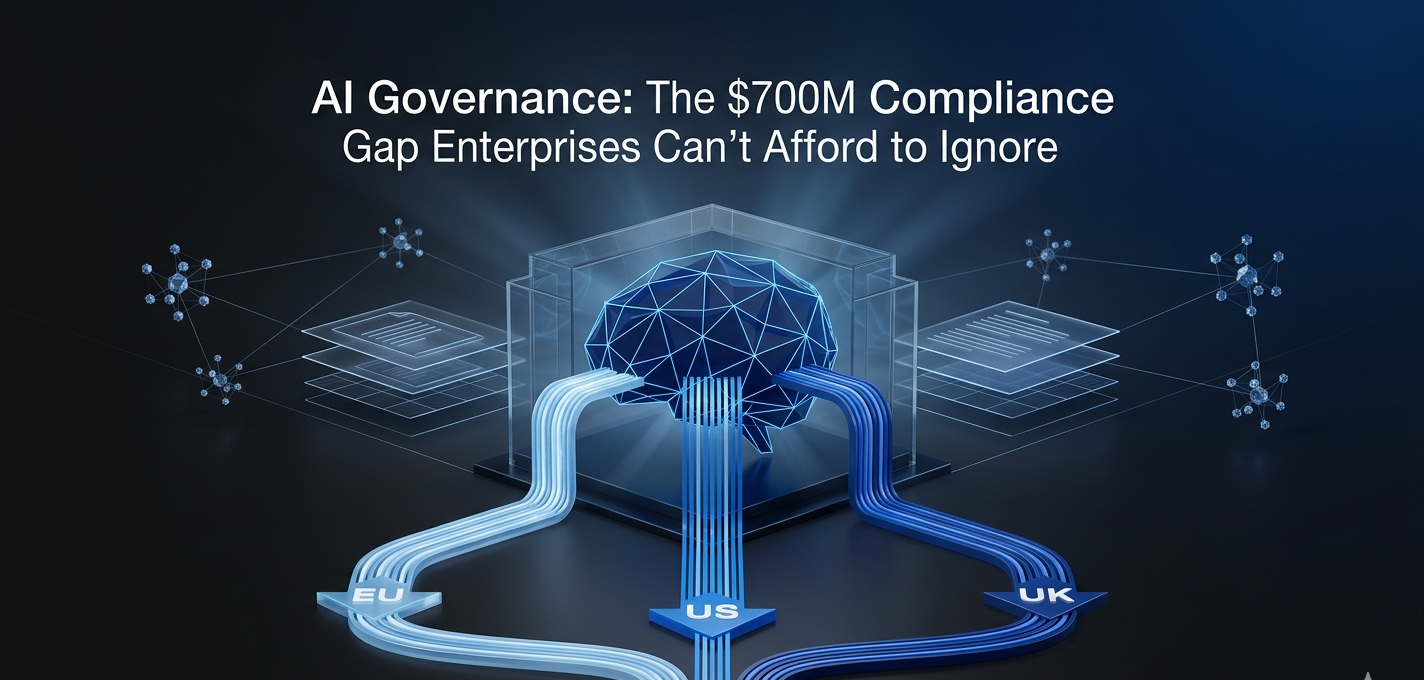
The EU AI Act’s high-risk obligations become fully enforceable in August 2026. Fines can reach 35 million euros or 7% of global annual turnover, whichever is larger. For a $10 billion revenue company, that is a $700 million exposure sitting quietly in your AI deployment backlog.
Meanwhile, U.S. federal and state governments issued over 120 AI-related laws, executive orders, and guidance documents in 2024 and 2025. More than 30 state-level AI laws are enacted or under review by early 2026. For global enterprises, this is not a single compliance problem. It is a regulatory patchwork that demands a unified governance architecture.
This analysis gives you the cross-jurisdictional roadmap that competitors’ articles skip. You will get a five-level AI governance maturity model, a board-oversight structure with concrete roles and reporting cadence, a cross-mapping of EU AI Act, NIST AI RMF, and UK AI Safety Institute requirements, and the implementation checklist that compliance officers and engineers can act on today.
Section 01
The Regulatory Landscape: Three Regimes, One Enterprise Problem
AI governance regulation and enterprise compliance don’t live in one jurisdiction. The challenge for multinational enterprises in 2026 is that three distinct regulatory philosophies are converging simultaneously, each with its own enforcement timeline, documentation standard, and penalty structure.
🇪🇺
European Union
EU AI Act
Risk-based framework. High-risk AI systems require conformity assessments, technical documentation, human oversight, and ongoing monitoring. Full enforcement: August 2026.
🇺🇸
United States
NIST AI RMF + State Laws
Fragmented patchwork. Federal guidance is voluntary. States like Colorado require annual impact assessments for high-impact AI. 30+ state laws active or pending by 2026.
🇬🇧
United Kingdom
AI Safety Institute Framework
Principle-based with sector-specific overlays. Emphasis on safety testing for frontier models and transparency mandates. Increasingly convergent with EU standards post-Brexit.
The EU AI Act is the most structurally demanding. It categorizes AI systems by risk level: unacceptable (banned outright), high-risk (stringent compliance), limited-risk (transparency obligations), and minimal-risk (essentially unregulated). Around 15% to 20% of regulated AI deployments in banking and healthcare are expected to land in the high-risk category, triggering the most burdensome documentation and monitoring requirements.
Why This Matters for Global Operations
The EU AI Act applies to any AI system that affects EU residents, regardless of where the developer is headquartered. A fintech firm based in Singapore that operates credit-scoring models for French customers is fully subject to EU AI Act high-risk obligations. Territorial reach is one of the most consistently underestimated compliance risks in 2026.
The U.S. picture is deliberately different. The National Institute of Standards and Technology AI Risk Management Framework (NIST AI RMF) offers a voluntary governance structure built around four core functions: Govern, Map, Measure, and Manage. It doesn’t carry direct legal penalties, but it’s rapidly becoming the de facto standard that regulators, auditors, and enterprise procurement teams use to evaluate AI maturity. More than 25% of major U.S. enterprises are already running annual AI risk assessment cycles, driven largely by state-level mandates.
“We’re past the point where an AI policy document satisfies anyone. Regulators and boards want to see model inventories, impact assessments, and audit trails.”
The Compliance Gap That’s Costing Enterprises Millions
The numbers are blunt. Roughly 40% to 50% of large enterprises report having formal AI governance programs. Only 15% to 20% actually meet EU AI Act documentation and monitoring standards when independently assessed.
That gap has a name: documentation debt. And regulators are already finding it. Around 40% of AI system audits flag documentation gaps, even when the underlying models perform technically well. A system can have excellent accuracy, low bias metrics, and solid security controls, and still fail a compliance audit because its risk classification, training data lineage, or human-override protocols aren’t properly recorded.
Compliance Risk Alert
Documentation gaps are treated as violations under the EU AI Act, not administrative oversights. The distinction matters because violations trigger financial penalties, while oversights typically trigger remediation timelines. In roughly 40% of audited AI deployments, technically sound systems still fail on documentation alone.
The cost of fixing this after the fact is significant. Building a minimum-viable AI governance program, including model inventory, impact-assessment tooling, and basic documentation infrastructure, runs $150,000 to $500,000 for mid- to large-sized enterprises. Do that reactively under regulatory pressure and costs compound. Do it proactively and the ROI case is straightforward: $500,000 in governance infrastructure against a potential $700 million fine is not a hard calculation.
There is a less obvious cost too. Board visibility into AI incidents is rising sharply. Around 30% to 40% of global tech firms now report AI governance incidents, including biased outputs and model-drift-related harm, to internal boards or compliance committees. That is up from under 10% in 2022. When something goes wrong and there’s no audit trail, no incident response protocol, and no documented risk classification, the liability isn’t just financial. It’s reputational.
Section 03
The 5-Level AI Governance Maturity Model
Most compliance frameworks tell you what you need. Fewer tell you where you are and what closing the gap actually looks like. Here is a five-level maturity model designed for enterprise AI governance programs, benchmarked against EU AI Act, NIST AI RMF, and UK AI Safety Institute requirements.
Level
Name
What It Looks Like
Regulatory Status
Next Milestone
Level 1
Ad Hoc
No formal AI inventory. Governance handled case-by-case. No impact assessments.
Non-compliant. High penalty exposure.
Build model inventory. Assign AI risk owner.
Level 2
Documented
Written AI policy exists. Risk classifications attempted. No systematic monitoring.
Design to strictest global standard. Governance embedded in product development lifecycle.
20 to 30% lower compliance overhead across jurisdictions.
Publish public AI principles. Establish governance as competitive differentiator.
Level 5 “super-compliance” isn’t theoretical. Companies designing to the strictest available rules, typically the EU AI Act or Colorado-style state frameworks, report 20% to 30% lower compliance-operations overhead across multiple jurisdictions. When your baseline is the most demanding standard, you don’t need to rebuild governance architecture every time a new state or country enacts legislation.
Most enterprises assessed in 2025 are operating at Level 1 or Level 2. Getting from Level 2 to Level 3 is where the real work happens, and where most programs stall because they underestimate the operational lift of systematic model monitoring and documentation.
Section 04
Board-Level AI Governance: Roles, Reporting, and Escalation
AI governance can’t live exclusively in engineering. The regulatory frameworks making headlines in 2026 expect board-level accountability, and auditors are starting to ask questions about who owns AI risk at the C-suite level.
The AI Steering Committee Structure
An effective AI steering committee isn’t another bureaucratic layer. It’s the decision-making body that connects engineering risk to business risk, and business risk to regulatory exposure. Minimum composition for most enterprises:
1Chief AI Officer or CISO (chair) owns the AI risk register and escalation protocols. Responsible for quarterly board briefings on AI risk posture.
2Chief Legal Officer or General Counsel maps AI deployments to current and emerging regulatory requirements. Owns the cross-jurisdictional compliance calendar.
3Chief Data Officer manages model inventory, data lineage documentation, and training data governance. Critical for audit readiness.
4Head of Product or CTO representative ensures governance requirements are embedded in the product development lifecycle, not bolted on post-deployment.
5Independent AI ethics advisor provides external perspective on bias, fairness, and societal impact. Increasingly expected by regulators in high-risk sectors.
Reporting Cadence and Escalation Triggers
Governance without a reporting cadence is a policy document, not a program. The standard for enterprises operating high-risk AI systems in 2026:
MMonthly: Engineering team reviews model performance metrics, drift indicators, and new deployment risk classifications.
QQuarterly: AI steering committee reviews the AI risk register, outstanding impact assessments, and regulatory calendar updates.
AAnnually: Full board briefing on AI risk posture. Annual impact assessments for all high-impact systems. Colorado-style state frameworks mandate these.
!Immediate escalation triggers: AI system causes demonstrable harm; regulator inquiry received; material model drift detected; third-party audit finding issued.
The Speed Payoff of Getting This Right
Enterprises that treat AI governance as a core operating model rather than a compliance checkbox report 20% to 35% faster speed-to-market on AI-driven products. Clear guardrails reduce rework, shorten approval cycles, and eliminate the late-stage legal reviews that stall product launches. Governance is an accelerant when it’s built correctly.
Section 05
The Cross-Jurisdictional AI Governance Roadmap
Most enterprise AI governance guides focus on one jurisdiction. That is the wrong unit of analysis for any company operating across borders. Here is a cross-mapping of EU AI Act, NIST AI RMF, and UK AI Safety Institute requirements into a single enterprise implementation sequence.
Phase 1: Inventory and Classification (Weeks 1 to 8)
✓Build a complete AI model inventory: system name, use case, data inputs, affected populations, deployment jurisdiction, and current risk classification.
✓Classify each system against EU AI Act risk tiers. Flag all systems that process decisions about individuals in hiring, credit, healthcare, law enforcement, or critical infrastructure.
✓Map U.S. state-law exposure: identify which systems affect residents of Colorado, California, or other states with active AI legislation.
✓Assign owners to every AI system in the inventory. No ownership means no accountability in an audit.
Phase 2: Documentation and Impact Assessment (Weeks 8 to 20)
✓Run conformity assessments for all EU-exposed high-risk AI systems. Document training data sources, validation methodology, bias testing results, and human oversight protocols.
✓Implement the NIST AI RMF Map and Measure functions: identify AI risks at the system level and implement quantitative and qualitative risk metrics.
✓Complete impact assessments for all high-impact systems. Colorado-style frameworks require annual reassessment cycles, so build the workflow now.
✓Establish data lineage documentation: training sets, preprocessing decisions, and version control for model artifacts.
Phase 3: Monitoring and Incident Response (Weeks 20 to 36)
✓Deploy model monitoring tooling: track performance drift, bias indicators, and output distribution shifts in production. Enterprises with these tools answer regulator requests 50% faster than those without.
✓Build an incident response protocol: define what constitutes a reportable AI incident, who gets notified, and what the remediation timeline is.
✓Establish human-in-the-loop controls for all EU-classified high-risk AI systems. Document override procedures and decision log retention policies.
✓Activate the board reporting cadence and AI steering committee rhythm as outlined in Section 04.
Phase 4: Certification and Continuous Improvement (Month 9 Onward)
✓Pursue third-party conformity assessment for EU AI Act high-risk systems where required. Self-declaration is permitted for some categories; third-party certification is required for critical infrastructure, law enforcement, and biometric systems.
✓Publish an AI transparency report. Increasingly expected by institutional investors, enterprise customers, and regulators.
✓Embed governance checkpoints into the product development lifecycle so new AI deployments enter the governance program at inception, not post-launch.
✓Track the regulatory calendar quarterly. With 30+ state laws active or pending in the U.S. alone, the compliance landscape will keep shifting through 2027 and beyond.
Frequently Asked Questions
What is AI governance in an enterprise?
Enterprise AI governance is the set of policies, processes, roles, and technical controls that manage how an organization develops, deploys, monitors, and retires AI systems. It covers risk classification, documentation standards, human oversight requirements, incident response, and board-level accountability.
In 2026, it is no longer optional. Regulators in the EU, UK, and increasingly U.S. states treat AI governance as a compliance function equivalent to financial controls or data privacy programs.
What are the key requirements of the EU AI Act for companies?
For high-risk AI systems, the EU AI Act requires a technical documentation file, risk management system, data governance controls, transparency and user information requirements, human oversight mechanisms, accuracy and robustness testing, conformity assessment, and registration in the EU database.
The high-risk category includes AI systems used in hiring, credit scoring, healthcare diagnostics, critical infrastructure management, biometric identification, and law enforcement. Full enforcement starts August 2026.
What are the penalties for non-compliance with the EU AI Act?
Penalties scale with the severity of the violation. Violations of prohibited-practice rules carry fines up to 35 million euros or 7% of global annual turnover, whichever is higher. Non-compliance with high-risk system obligations carries fines up to 15 million euros or 3% of turnover. Providing incorrect information to authorities can trigger fines up to 7.5 million euros or 1% of turnover.
For context: a company with $10 billion in annual revenue faces up to $700 million in exposure for prohibited-practice violations alone.
How does the NIST AI RMF apply to enterprises?
The NIST AI Risk Management Framework is voluntary at the federal level but is increasingly referenced by U.S. state regulators, federal procurement requirements, and enterprise customers. It is structured around four functions: Govern (establish AI risk policies and accountability), Map (identify AI risks in context), Measure (quantify and assess risks), and Manage (respond to and monitor risks).
Enterprises that implement NIST AI RMF typically find it maps well to EU AI Act requirements, making it a practical starting point for cross-jurisdictional compliance programs.
What is the difference between AI ethics and AI governance?
AI ethics is the philosophical and values-based dimension: fairness, transparency, human dignity, and avoiding harm. AI governance is the operational dimension: the systems, processes, roles, and documentation that translate ethical commitments into auditable, enforceable controls.
In 2026, regulators care about both but can only enforce governance. You can have a beautifully worded AI ethics statement and still fail a compliance audit for lack of a model inventory or impact assessment.
How do state AI laws like Colorado’s affect enterprise AI programs?
Colorado-style AI laws require deployers of high-impact AI systems to conduct annual impact assessments, disclose when AI is used in consequential decisions such as hiring, lending, or housing, provide individuals the ability to appeal AI-driven decisions, and manage risks of algorithmic discrimination.
With 30+ state laws active or pending by early 2026, multi-state enterprises need a governance architecture flexible enough to accommodate new requirements without rebuilding from scratch each time. The NIST AI RMF provides that flexible base layer.
Who should be responsible for AI governance in the boardroom?
Best practice in 2026 points to the Chief AI Officer (or equivalent) as the primary owner of the AI risk register and board reporting. The General Counsel owns regulatory mapping. The CDO owns documentation and model inventory. The full board receives AI risk briefings at least annually.
The critical structural requirement is that AI governance can’t live entirely in engineering. When something goes wrong and there’s no C-suite accountability, regulatory and reputational exposure is significantly higher.
How do you implement AI governance across global operations?
The most efficient approach is “harmonize upward”: design your governance program to the most demanding standard (typically the EU AI Act), then verify that lower-bar jurisdictions are satisfied. This is the mechanism behind the 20% to 30% reduction in compliance overhead reported by super-compliance firms.
Operationally, this requires a cross-jurisdictional regulatory calendar, a model inventory that tracks where each system is deployed, and a flexible impact-assessment workflow that can incorporate new jurisdictional requirements without redesigning the entire program.
The Pattern Is Clear. The Window Is Closing.
Across every governance framework, audit report, and regulatory timeline examined in this analysis, the pattern repeats: the gap between policy on paper and operational compliance is the defining AI governance risk in 2026. Enterprises that addressed it proactively are operating at Maturity Level 3 or 4. Those that haven’t are staring at August 2026 enforcement with documentation debt, no model inventory, and no board-level accountability structure.
The financial math is straightforward. Building a minimum-viable AI governance program costs $150,000 to $500,000. The alternative is exposure up to 7% of global revenue for EU AI Act prohibited-practice violations. The real leverage isn’t avoiding the fine. It’s the 20% to 35% faster product velocity that enterprises with mature governance programs consistently report. Governance built correctly is an accelerant, not a constraint.
Watch three developments through 2027: consolidation among AI governance platform vendors as enterprise demand scales; regulatory convergence between EU AI Act, UK AI Safety Institute standards, and U.S. state frameworks creating de facto global standards; and a growing premium in enterprise procurement for AI transparency reports and third-party conformity certifications. Organizations that build governance infrastructure now will answer those procurement questions with documentation, not promises.
Only 39% of companies have deployed AI at scale. Here’s the enterprise AI implementation roadmap used by the 5% who actually succeed with phased sprints, governance gates, and budget frameworks competitors skip.
NW
NeuralWired Research Team
Enterprise AI Analysis · NeuralWired.com
12 min read
70–85%AI projects fail to meet expected outcomes
39%of enterprises have deployed AI at scale
92%of executives plan to increase AI spending
Deloitte’s January 2026 State of AI survey dropped a number that should stop any CIO mid-slide: only 39% of companies have deployed AI at scale, even as 85% are actively pursuing AI initiatives. That gap ambition versus activation is costing organizations millions in abandoned pilots, wasted engineering cycles, and lost competitive ground.
The problem isn’t access. Deloitte found that AI access expanded 50% in a single year, with nearly 60% of workers now having sanctioned AI tools. The problem is execution: moving from a demo that impresses in a boardroom to production systems that generate measurable returns.
This analysis provides the enterprise AI implementation roadmap that separates high performers from the pilot-purgatory crowd. You’ll get a phased 12-month playbook with 90-day sprint templates, governance checkpoints, a budget allocation framework, and the failure modes competitors’ guides quietly omit. The data draws on Deloitte, McKinsey, Promethium AI’s transformation research, and synthesis from MIT and Gartner.
The Ambition-to-Activation Gap: What the Data Actually Shows
McKinsey’s State of AI report found that 72% of organizations claim AI adoption, but far fewer create real business value. That delta isn’t a technology failure. It’s a planning failure.
“Without a roadmap, even well-funded AI programs stall under unclear priorities, fragmented systems, and governance gaps.”
RTS Labs AI Roadmap Strategists, Enterprise AI Roadmap Guide, Dec 2025
Promethium AI’s analysis is more direct: 70–85% of AI projects fail to meet their expected outcomes. The cause isn’t model quality or compute budgets. It’s integration data silos, undefined KPIs, and governance structures bolted on after deployment rather than baked in from day one.
The key insight: The organizations that successfully scale aren’t smarter or better resourced. They follow a structured, phased implementation with governance gates that catch failures early rather than after full deployment. Neontri’s synthesis of MIT and Gartner research identifies this as the defining behavior of the 5% of enterprises that use successful AI maturity frameworks.
The Enterprise AI Implementation Roadmap: A 12-Month Phased Playbook
Effective enterprise AI implementation doesn’t happen in a single deployment sprint. It follows three distinct phases each with its own budget logic, success criteria, and governance gates. Here’s how the 12-month roadmap breaks down.
Phase
Months
Focus
Success Gate
1. Foundation & Pilot
1–3
Maturity assessment, data audit, 2–3 high-value use cases
Multi-use expansion, Center of Excellence, drift monitoring
15%+ ROI; CoE operational
Phase 1: Foundation and Pilot (Months 1–3)
Before writing a single line of model code, assess where your organization actually stands. Neontri’s maturity framework maps organizations across five dimensions: data readiness, infrastructure, talent, governance, and strategic alignment. Most enterprises overestimate two of the five.
Use case selection matters more than model selection at this stage. Lines & Circles’ prioritization analysis consistently identifies Finance and Supply Chain as the highest-value departments for foundational AI pilots measurable outcomes, clean data, executive sponsorship.
Run a 90-day sprint toward a single deployable MVP. Not a proof-of-concept that lives in a Jupyter notebook. A production-bound MVP with defined KPIs, a data pipeline, and a named business owner accountable for its outcomes.
Phase 1 prerequisites checklist:
C-suite alignment on 2–3 target use cases
Data audit completed (availability, quality, governance)
Success metrics defined before any model is trained
Phase 2: Production Deployment (Months 4–6)
This is where 75% of enterprises stall. Moving from pilot to production requires MLOps infrastructure model versioning, monitoring pipelines, and feedback loops. Promethium’s phase analysis found that 61% of organizations focus their early production AI on software engineering, where productivity gains are measurable within weeks.
A/B testing isn’t optional here it’s how you prove business impact before seeking budget for Phase 3. Governance gates at the end of Phase 2 should include a compliance review, a risk audit, and formal stakeholder sign-off. Skip these and you’re setting up a Phase 3 rollback.
“A well-defined AI adoption framework consists of six interconnected stages: strategic alignment, data readiness, use case design, AI development, governance, and scaling.”
Softude Business Transformation Team, AI Adoption Roadmap, Feb 2026
Phase 3: Enterprise-Wide Scaling (Months 7–12)
Scaling isn’t simply replicating Phase 2 across more departments. It requires a Center of Excellence (CoE) to standardize tooling, govern model retraining cycles, and manage talent allocation. AI21’s architecture trend review identifies AI as core infrastructure by 2026 meaning the CoE isn’t a nice-to-have, it’s the organizational muscle that prevents drift and keeps production models performing as the business changes.
Monitor for model drift aggressively. Real-world data distributions shift. Models trained on 2024 patterns degrade against 2026 inputs without structured retraining pipelines. Build this into your Phase 3 operating model from day one.
Budget Allocation Framework: Where the Money Actually Goes
The hidden cost most CFOs miss: Total Cost of Ownership (TCO) extends well beyond initial deployment. Retraining cycles, monitoring infrastructure, and drift management compound over 18–24 months. Build a 24-month TCO model before presenting the business case, not after.
AI Talent and Skills Matrix: Who You Actually Need
Talent gaps kill more AI programs than technology gaps. Softude’s framework analysis points to governance talent as the most underinvested role organizations staff engineers heavily and neglect the compliance and ethics layer that keeps production models out of regulatory trouble.
Role
Core Skills
Phase Focus
Build or Hire?
AI Engineer
ML ops, RAG, model integration
Phases 1–2
Hire externally
Data Scientist
Model tuning, evaluation, A/B testing
Phases 2–3
Build internally
Governance Lead
Ethics, compliance, risk frameworks
All phases
Hire or designate early
Change Manager
Adoption, communication, training
Phases 2–3
Build internally
The shift toward MLOps and agentic AI systems means existing data science teams need retraining, not replacement. Invest in upskilling before Phase 2 engineers who understand both model behavior and production infrastructure are rare and expensive mid-program.
Governance Checkpoints: The Gates That Prevent Expensive Failures
“This guide outlines a practical implementation framework that the 5% of successful enterprises use.”
Neontri AI Maturity Researchers, Enterprise AI Roadmap 2026, March 2026
Each phase in the 12-month roadmap should end with a formal governance gate. The gate answers three questions before any budget flows to the next phase:
ROI Gate: Has the phase delivered >15% return on investment against baseline metrics set in Phase 1?
Risk Gate: Has an independent risk audit cleared the model for broader deployment (bias, security, regulatory compliance)?
Stakeholder Gate: Do business unit leaders sign off on production readiness not just the AI team?
Samta.ai’s 12-month implementation analysis found that organizations skipping the stakeholder gate consistently face adoption resistance in Phase 3 even when the technology works. Business unit buy-in is a governance requirement, not a soft skill.
What the Optimistic Roadmaps Won’t Tell You
Most enterprise AI roadmap guides are written for CFO presentations, not operational reality. Three things deserve more candor:
The timeline is optimistic by design. The 12-month framework above assumes data readiness, C-suite alignment, and adequate engineering capacity exist before Month 1. For most mid-market enterprises, those prerequisites add three to six months before the roadmap can even begin. Full agentic AI integration into ERP systems is a two-to-five year journey, not a 12-month one.
Change management is harder than model deployment.The primary barrier to AI scaling isn’t technology it’s organizational resistance. Teams worried about job displacement, middle managers unclear on AI’s role in their workflows, and procurement teams slow to approve new vendor categories all add friction that technical roadmaps ignore.
TCO is routinely underestimated. Marketing materials quote model API costs. The real TCO includes retraining pipelines, monitoring infrastructure, compliance reviews, data labeling, and the engineering time to handle model failures in production. Budget models built on demo costs collapse in Year 2.
The honest benchmark: organizations that move deliberately through phases accepting 90-day sprints over 30-day “transformation” promises achieve sustainable ROI. The shortcuts don’t compress the timeline. They just move the failures to later, more expensive phases.
Frequently Asked Questions
How long does it take to implement AI in an enterprise?
A well-structured enterprise AI implementation runs 12 months from initial pilot to scaled deployment, with meaningful quick wins achievable in the first 90-day sprint. That said, only 25% of enterprises move 40% or more of pilots to production within a year. Prerequisites data readiness, governance frameworks, C-suite alignment typically add three to six months before the formal roadmap begins.
What are the steps for AI implementation?
Softude’s six-stage model covers the core sequence: strategic alignment, data readiness, use case design, AI development, governance, and scaling. In a 12-month context, this maps to three phases Foundation & Pilot (Months 1–3), Production Deployment (Months 4–6), and Enterprise-Wide Scaling (Months 7–12), each ending with a formal governance gate before budget flows forward.
What are the challenges of AI implementation in enterprises?
The primary challenges aren’t technical they’re organizational. 70–85% of AI projects fail to meet expected outcomes, mostly due to integration bottlenecks, data silos, undefined success metrics, and change management resistance. Governance gaps compliance, risk management, stakeholder buy-in are the leading cause of Phase 3 failures in otherwise successful programs.
How do you create an AI roadmap?
Start with a maturity assessment across five dimensions: data readiness, infrastructure, talent, governance, and strategic alignment. Then phase by maturity: foundation and pilot (Months 1–3) for quick-win deployment, production with governance gates (Months 4–6), and scaling with a Center of Excellence (Months 7–12). Each phase needs defined KPIs before it begins, not after. RTS Labs’ enterprise roadmap guide provides a solid five-phase structural reference.
What is an AI implementation framework?
An AI implementation framework is a structured approach that takes an organization from strategic intent to scaled deployment. Softude’s six-stage framework is widely cited: strategic alignment, data readiness, use case design, AI development, governance, and scaling. The key distinction between a framework and a roadmap is governance frameworks define the decision logic at each stage, while roadmaps define the timeline.
What are the top enterprise AI trends for 2026?
Ecosystm’s 2026 analysis points to three dominant trends: the shift from LLM experimentation to agentic AI systems, AI as core infrastructure rather than bolt-on tooling, and the expanding access gap (60% of workers have AI access, but fewer than 40% of enterprises generate real value from it). Organizations building CoEs and MLOps infrastructure now are positioned to capitalize on the agentic shift within 18–24 months.
What budget should enterprises allocate for AI implementation?
Evidence-based allocation from Promethium AI’s benchmarks points to: 40% for pilot and development, 30% for infrastructure, 20% for talent and change management, and 10% for governance and tooling. The critical omission in most budget models is 24-month TCO retraining cycles, monitoring infrastructure, and compliance reviews compound significantly beyond initial deployment costs.
How do you measure ROI from enterprise AI?
Establish pre-deployment baselines in Phase 1 against measurable KPIs process cycle times, error rates, headcount per output unit. 61% of organizations focused early production AI on software engineering where productivity measurement is clearest. Phase 2 governance gates should require a demonstrated 15%+ return before Phase 3 budget is released. ROI models built on efficiency gains are more defensible than those built on projected revenue uplift.
The pattern across every data source in this analysis is consistent: enterprise AI implementation roadmap success depends less on model selection than on organizational readiness. Organizations that build governance frameworks, data pipelines, and realistic KPIs before deployment not after achieve scalable ROI. Those that skip the foundation don’t just fail faster. They fail more expensively.
This infrastructure-first approach signals a broader shift in competitive dynamics. As AI access becomes commoditized 60% of workers already have it the advantage moves to execution capability. The enterprises that will define the next competitive wave aren’t those with the most advanced models. They’re the ones with the operational muscle to move from pilot to production without stalling in the gap that’s currently consuming 75% of the market.
Three developments worth tracking through 2026 and into 2027: first, vendor consolidation around governance and MLOps platforms as the market matures; second, emerging regulation requiring AI observability and audit trails in regulated industries; third, a growing skills shortage in AI governance roles that will make early investment in that talent layer a durable competitive advantage. The enterprise AI implementation roadmap isn’t a one-time project. It’s the operating model for a permanently AI-embedded organization.
Get weekly enterprise AI analysis from NeuralWired no hype, just data-backed intelligence for decision-makers.
Subscribe to NeuralWired →
Cut Enterprise AI Risk 70%: 6-Step CISO Framework for 2026 | NeuralWired
Cybersecurity·March 17, 2026·9 min read
AI breaches now cost $4.88M on average, EU fines reach €35M in 2026, and 65% of CISOs report uncontrolled shadow AI inside their own networks. Here’s the NIST-aligned playbook that cuts liability by 70%.
NW
NeuralWired EditorialResearch & Analysis Desk
88% of organizations now use AI regularly, with a third actively scaling their programs. Yet enterprise AI risk management remains one of the most under-resourced functions in corporate security. According to Onspring’s December 2025 analysis drawing on McKinsey’s global executive surveys, rapid AI adoption has outpaced the governance frameworks meant to contain it.
The numbers are hard to ignore. The IBM Cost of Data Breach Report pins the average AI-related breach at $4.88M, and that figure excludes regulatory fines. The EU AI Act’s enforcement phase begins in earnest this year, carrying penalties of up to €35M or 7% of global annual revenue for high-risk AI violations. Meanwhile, TechTarget’s June 2025 CISO survey found that 65% of security leaders report “shadow AI”: employees deploying unapproved models that bypass every governance control the security team has built.
This is the enterprise AI risk management problem in 2026: the attack surface is enormous, the regulatory pressure is real, and most organizations are still running on frameworks designed before generative AI existed.
What follows is a six-step, NIST-aligned framework that security leaders can implement immediately. Based on case study data from SentinelOne’s October 2025 AI Risk Assessment Framework and cross-referenced with guidance from Palo Alto Networks, Checkpoint, and TrustCloud, organizations that deploy this process consistently report 40–70% reductions in AI-related liability exposure within 12 months.
$4.88M
Average cost of an AI-related data breach in 2025
65%
Of CISOs reporting uncontrolled shadow AI in their networks
70%
Liability reduction achievable with a structured AI risk framework
Why Enterprise AI Risk Has Reached an Inflection Point
AI adoption grew 17 percentage points between 2023 and 2024 alone, according to McKinsey’s annual AI survey cited by IBM. That pace hasn’t slowed. What has changed is the regulatory and liability environment surrounding it.
Three forces converged in 2026. First, EU AI Act enforcement moved from guidance to enforcement with real financial consequence. Second, Palo Alto Networks’ industry analysis found that model drift (where a deployed AI’s behavior shifts from its original training) now affects 82% of production AI systems. Third, generative AI tools spread faster than procurement processes, creating shadow AI ecosystems that security teams can’t see, let alone govern.
Gartner estimates that 50% of AI projects fail due to poor governance. Not poor models. Not insufficient compute. Governance. The good news is that governance is fixable with a structured process.
“CISOs must consult with business leaders to adopt or establish a risk framework for AI adoption, rather than taking an outright ban.”
The instinct to prohibit AI is understandable but counterproductive. Shadow AI proliferates precisely because bans push usage underground. The strategic answer, and the one that 90% of CISOs surveyed by TrustCloud in April 2025 say they’re pursuing, is governance with teeth, not prohibition.
The 6-Step Enterprise AI Risk Management Framework
SentinelOne’s practitioners frame the goal clearly: “By following these AI risk evaluation steps, you move from reactive fire-fighting to a repeatable process that is measurable, auditable, and regulation-ready.” Each step below maps to the NIST AI RMF’s core Map-Measure-Manage-Govern cycle.
1
Inventory All AI Systems
Catalog every model, AI-powered SaaS tool, agent, and data flow in your environment, including shadow AI. Use automated discovery tools alongside manual interviews with business unit leads. Without a complete inventory, every subsequent step is guesswork.
2
Map Stakeholders and Regulatory Exposure
Identify who interacts with each AI system: employees, customers, regulators. Classify systems by EU AI Act tiers (unacceptable, high-risk, limited, minimal). High-risk classifications such as recruiting tools, credit scoring, and critical infrastructure trigger mandatory documentation and human oversight requirements under 2026 enforcement.
3
Catalog Threats and Attack Vectors
Build a threat catalog covering data poisoning, prompt injection, model extraction, adversarial inputs, and bias amplification. Use a structured likelihood x impact matrix (1 to 5 scale) to score each threat against each AI system. Don’t guess. Run red team exercises against your highest-risk models.
4
Quantify Risk with a Scoring Model
Apply the formula: Risk Score = Likelihood × Impact × Asset Value. This transforms qualitative concerns into auditable numbers your board and regulators can evaluate. Establish tolerance thresholds before this step so scoring triggers action, not debate.
5
Treat and Mitigate with Zero-Trust Controls
Deploy zero-trust architecture around AI systems: least-privilege data access, strict API authentication, and network segmentation for model endpoints. Checkpoint’s simulations show zero-trust cuts the AI attack surface by 60%. Layer in automated bias audits and vendor SLA reviews. The most common mistake at this stage: ignoring model drift as a risk category.
6
Monitor Continuously and Iterate Quarterly
Set hard KPIs: model drift rate below 5%, false-positive alerts below 2%, shadow AI discovery rate trending toward zero. Review and re-score all AI systems quarterly, not annually. Organizations that implement this step alongside steps 4 and 5 consistently hit the 40 to 70% liability reduction benchmarks documented in SentinelOne’s pilot case studies.
Enterprise AI Threat Matrix: What to Prioritize First
Not every AI threat deserves the same urgency. The matrix below, adapted from Palo Alto Networks’ AI governance framework, scores common enterprise AI threats by likelihood and business impact on a 1–5 scale.
Enterprise AI Risk Heatmap (Likelihood × Impact, scale 1–5)
Threat
Likelihood
Impact
Risk Score
Priority
Shadow AI / Unsanctioned Models
5
4
20
Critical
Model Drift in Production
4
4
16
Critical
Data Poisoning
3
5
15
High
Bias Amplification
4
3
12
High
Prompt Injection / Adversarial Input
3
4
12
High
Model Extraction / IP Theft
2
5
10
Medium
Vendor SLA Failure
3
3
9
Medium
Shadow AI and model drift sit at the top of this matrix for a reason. Shadow AI is ubiquitous: 65% prevalence means your organization almost certainly has unsanctioned models in active use right now. Model drift affects 82% of production AI systems and is the most overlooked vector in enterprise security reviews. Both are addressable with Steps 1 and 6 of the framework above.
EU AI Act and U.S. Regulations: What CISOs Must Do Now
The EU AI Act isn’t a future concern. It’s the present reality for any organization with EU customers, employees, or data subjects. High-risk AI systems, including tools used in hiring, credit assessment, law enforcement support, and critical infrastructure, now require mandatory conformity assessments, technical documentation, human oversight mechanisms, and post-market monitoring.
Fines for non-compliance reach €35M or 7% of global annual revenue, whichever is higher. The most expensive category, prohibited AI systems, carries up to €40M or 7% revenue.
Compliance checklist for EU AI Act high-risk systems:
Complete technical documentation before deployment · Establish human oversight with override capability · Maintain audit logs for the life of the system · Register the system in the EU database for high-risk AI · Implement post-market monitoring with annual review cycles
For U.S.-focused organizations, the regulatory picture is more fragmented but directionally similar. The Biden-era AI executive order framework remains in flux under the current administration, but sector-specific regulators (the CFPB on AI in lending, the EEOC on AI in hiring, the FDA on AI-assisted diagnostics) are actively enforcing existing authority. Waiting for a comprehensive federal AI law is not a risk management strategy.
“Governance frameworks should also define how AI-related decisions are made, documented, and reviewed.”
The practical implication: every AI governance program needs a documentation layer that can produce evidence of decision-making processes, testing results, and human oversight on demand. Build this capability now. Regulators don’t announce audits in advance.
Building the Governance Structure That Survives a Board Meeting
Frameworks are only as good as the organizational structures supporting them. TrustCloud’s 2025 CISO Guide is direct on this: “Establish an AI Governance Committee: Identify cross-functional leaders who will champion governance practices.” That committee needs representatives from security, legal, data science, HR, and at least one business unit lead with P&L accountability.
Risk expert Dan Storbaek, writing in February 2026, identified the four structural requirements that distinguish governance programs that survive pressure from those that collapse under it: clear accountability, independent oversight, pre- and post-deployment risk assessment, and continuous monitoring with defined controls.
Clear accountability means named individuals (not teams) own the risk status of each AI system. Independent oversight means someone outside the team that built or procured the model reviews its risk posture. These two requirements alone eliminate the most common failure mode: governance theater where everyone agrees risks are managed but nobody owns the outcome.
The Real Cost of Getting This Wrong
Security marketing often claims AI governance tools are plug-and-play. The total cost of ownership reality is harsher. Beyond software licensing, organizations face audit fees, mandatory retraining after model drift events (typically $500K or more per model), legal review cycles for documentation, and the opportunity cost of delayed deployments during remediation.
The 70% liability reduction figure comes from organizations that absorbed these costs upfront and built repeatable processes. Organizations that defer governance spending until after a breach or regulatory action consistently face costs 2-3x higher than proactive programs would have required.
Enterprise AI Risk Management: Implementation Checklist
Before deploying any new AI system, or formalizing governance over existing ones, verify these conditions are met:
Complete AI system inventory including shadow AI discovery sweep
EU AI Act tier classification for every system touching EU data subjects
Risk scoring applied using Likelihood × Impact × Asset Value formula
Zero-trust controls deployed around all model API endpoints
Named accountability owners documented for each AI system
Bias audit schedule in place for customer-facing models
Model drift monitoring active with 5% threshold alerting
Governance committee charter signed and meeting cadence set
Board-level reporting template approved by legal and compliance
Incident response plan updated to include AI-specific breach scenarios
Frequently Asked Questions
What is an AI risk management framework?
An AI risk management framework is a structured process for identifying, assessing, and mitigating threats specific to AI systems, including bias, model drift, data poisoning, and adversarial attacks. The most widely adopted foundation is NIST AI RMF 1.0, which organizes activities into a Map-Measure-Manage-Govern cycle. Applied consistently, NIST-aligned frameworks have reduced AI-related liability exposure by 40 to 70% in documented pilot programs.
How do you manage AI risks in an enterprise?
Start with a complete inventory of all AI systems, including shadow AI. Classify each system by regulatory exposure and threat profile, score risks quantitatively, deploy zero-trust controls around model endpoints, and establish continuous monitoring with quarterly reassessments. Organizations following this six-step process consistently achieve 70% reductions in AI-related liability within 12 months, according to case data from SentinelOne’s AI Risk Assessment Framework.
What are AI governance best practices in 2026?
The most effective programs combine cross-functional governance committees, continuous performance KPIs, documented decision-making processes for regulatory review, and explicit EU AI Act tier classifications. TrustCloud’s April 2025 CISO survey found that 90% of security leaders now treat AI governance as a top priority, up from a minority position just two years ago.
What are the main risks of AI in business?
The highest-priority threats are shadow AI (65% prevalence among enterprises), model drift affecting 82% of production systems, data poisoning, prompt injection, and bias amplification in customer-facing decisions. The average cost of an AI-related data breach reached $4.88M in 2025, according to the IBM Cost of Data Breach Report. That figure excludes regulatory fines, which now carry far greater potential exposure for EU-regulated entities.
What is the role of CISOs in AI security?
CISOs in 2026 are responsible for leading AI risk frameworks, ensuring shadow AI discovery and governance, translating regulatory requirements into security controls, and reporting AI risk posture to boards and regulators. The key shift from earlier CISO roles: the mandate is to govern innovation, not block it. Organizations whose CISOs ban AI rather than govern it consistently report higher shadow AI prevalence and greater ultimate liability.
How does NIST AI RMF apply to enterprises?
The NIST AI Risk Management Framework provides the Map-Measure-Manage-Govern cycle that forms the backbone of most enterprise AI security programs. Its Map phase corresponds to threat cataloging and stakeholder identification; Measure to quantitative risk scoring; Manage to treatment and mitigation controls; Govern to oversight structures and accountability. Practical six-step adaptations of NIST AI RMF, like the framework in this article, make the standard directly applicable to enterprise AI governance without the full compliance overhead of formal NIST certification.
How do you comply with the EU AI Act?
Compliance starts with classifying all AI systems by the Act’s four-tier risk hierarchy. High-risk systems require conformity assessments, complete technical documentation, human oversight mechanisms, EU database registration, and post-market monitoring. Prohibited systems must be decommissioned. Fines for non-compliance reach €35M or 7% of global annual revenue for high-risk violations and €40M or 7% revenue for prohibited AI use. Most organizations require 6–12 months to achieve compliance from a standing start.
The Window for Proactive Governance Is Now
The pattern across hundreds of AI deployments is clear: organizations that build governance infrastructure before incidents, not after, achieve dramatically better outcomes on every dimension. Lower breach costs. Smaller regulatory exposure. Faster AI deployment cycles because risk is understood, not feared. The 70% liability reduction figure isn’t a marketing claim; it’s the documented outcome of applying structured enterprise AI risk management with the consistency and rigor the threat environment demands.
The broader significance of this moment is worth stating plainly. The AI market is projected to reach $826B by 2030. Organizations that position themselves as trusted, compliant AI operators will win customer confidence, regulatory goodwill, and the ability to deploy AI faster. They’ve built the infrastructure that makes fast deployment safe. The gap between companies with governance programs and those without is widening every quarter.
Three developments to watch as 2026 progresses: first, vendor consolidation in the GRC and AI governance tooling market as buyers demand integrated platforms. Second, the emergence of AI observability as a standalone discipline with its own certification market. Third, sector-specific AI liability regulations in financial services and healthcare moving faster than any general federal framework. Organizations that start the six-step framework today will have auditable evidence of proactive governance when those rules land, and that evidence is worth considerably more than €35M.
Global AI spending hits $2.5 trillion this year. Here’s where enterprises are quietly moving their workloads to save nearly half, backed by real benchmark data, not vendor hype.
NW
NeuralWired Research TeamInfrastructure & AI Systems · neuralwired.com
The problem isn’t the spend itself. It’s where the money’s going. A growing body of benchmark data, from MLCommons MLPerf inference benchmarks to Forrester’s Q1 2026 survey of 450 CTOs, shows that 68% of enterprises switching from hyperscalers to specialized AI clouds report 30 to 50% cost reductions. Those staying put are subsidizing ecosystems built for general compute, not the bursty, high-throughput reality of production AI.
This analysis cuts through the noise. We mapped the best cloud infrastructure options for 2026 using independent performance benchmarks, real TCO models, compliance scores, and migration risk data. Whether you’re training LLMs at scale, running production inference, or navigating regulated industries, there’s a platform optimized for your workload, and it probably isn’t the one you’re currently on.
Here’s what we cover: the five platforms dominating AI workloads right now, a head-to-head scorecard, a decision framework for CTOs, an ROI calculator, and the hidden migration risks that derail 42% of moves.
The Market Shift: Why Best Cloud Infrastructure 2026 No Longer Means AWS
Five years ago, AWS, Azure, and Google Cloud were the only credible options for enterprise AI. That’s no longer true. A wave of GPU-native cloud providers, including CoreWeave, Lambda Labs, Crusoe Energy, and Together AI, has built infrastructure specifically architected for AI training and inference workloads, not adapted from general-purpose virtual machines.