Strategy Has 843,000 Bitcoin. BlackRock Has More Than Most Countries. Your Treasury Has Zero.Institutional Bitcoin Adoption 2026
Strategy Has 843,000 Bitcoin. BlackRock Has More Than Most Countries. Your Treasury Has Zero.
The largest corporate Bitcoin holders are now navigating a bear market, broken flywheels, and quiet reversals of their founding doctrine. Here is what the June 2026 reality actually teaches CFOs about waiting.
On April 17, 2026, Strategy quietly crossed a threshold that almost no one outside the Bitcoin-treasury niche noticed. The company — formerly known as MicroStrategy — completed a $2.54 billion Bitcoin purchase, pushing its total holdings to 815,061 BTC. In doing so, it passed BlackRock’s iShares Bitcoin Trust (IBIT) to become the single largest institutional Bitcoin holder on the planet. For the first time since Q2 2024, a corporate treasury outranked an ETF giant in raw coin count.
That same week, Bitcoin was trading around $63,000. The Fear and Greed Index sat at 17: Extreme Fear. And the stock of that very company, Strategy, had already lost roughly 66% of its value from its July 2025 peak.
This is the story of institutional Bitcoin adoption in 2026. It is not the story most of the headlines told in late 2025. It is more complicated, more instructive, and frankly more useful to any CFO or board-level finance committee that is now being asked to formally document a position on digital asset treasury strategy.
843,706
BTC held by Strategy (June 2026)
$47.36B
BlackRock IBIT net assets (June 10, 2026)
172+
Public companies holding BTC (Q3 2025)
$61,274
Bitcoin price, June 25, 2026
The Leaderboard That Changed in April 2026
Walk into any institutional investor’s office in Q4 2025 and the Bitcoin conversation was dominated by a single data point: BlackRock’s IBIT had crossed $60 billion, then briefly flirted with figures near $100 billion in AUM as Bitcoin hit its all-time high of roughly $126,000 in October 2025. Financial media ran stories about the ETF sucking in capital at a rate that had not been seen in investment product history. Treasury teams at mid-sized corporates were receiving board memos with subject lines like: “Should we be doing what BlackRock is doing?”
Here is what those memos got wrong. BlackRock was not buying Bitcoin for its own treasury. IBIT is a passthrough vehicle. Every dollar of AUM in that fund belongs to BlackRock’s clients, not BlackRock itself. The ETF’s Bitcoin holdings fluctuate with creations and redemptions. When Bitcoin’s price falls 50%, so does the dollar AUM figure, even if the actual coin count stays flat. This distinction between BTC-denominated and dollar-denominated reporting is how the $102 billion figure circulating in early 2026 became a $47.36 billion figure by June 10, 2026, per SEC filings reviewed against the iShares fund page.
Strategy’s position is structurally different. Those 843,706 Bitcoin sit on a corporate balance sheet. They are an asset of the company, not of external investors. That distinction is what makes Strategy’s overtaking of IBIT in April 2026 genuinely meaningful for the corporate treasury conversation.
What Actually Happened to the $102B Number
The $100 billion-plus figures that dominated Bitcoin treasury coverage in late 2025 were accurate for a brief window. Bitcoin peaked near $126,000 in October 2025. At that price level, large holdings produced enormous dollar AUM numbers. IBIT briefly crossed into nine-figure territory. Headlines froze those numbers.
Then Bitcoin fell. As of June 25, 2026, Bitcoin trades at approximately $61,274, roughly $46,100 below where it stood a year ago, according to Fortune’s market data. That is approximately a 50% drawdown from the October 2025 high. Dollar AUM figures at every Bitcoin-holding institution have roughly halved alongside that price move, even where coin counts stayed flat or grew.
Editorial Accuracy Note
Any article, pitch deck, or board memo citing “$100 billion in BlackRock Bitcoin holdings” as of mid-2026 is anchoring on a peak-price figure. The verified net assets of IBIT as of June 10, 2026, per SEC filings, are $47.36 billion across approximately 1.35 billion shares outstanding. Verify this figure at ishares.com/IBIT before any publication or presentation.
This is not a trivial distinction for a CFO. A treasury committee modeling Bitcoin allocation off 2025 peak figures is doing the analytical equivalent of evaluating a prospective real estate purchase using the last sale price from a bubble year. The asset is the same. The entry point is not.
The Flywheel Is Broken. Here Is What That Means.
To understand why the corporate Bitcoin treasury conversation shifted so sharply in 2026, you need to understand the mechanism that powered it in the first place.
Strategy built its model on what analysts call the “Bitcoin flywheel.” The mechanics: when Strategy’s market capitalization trades at a premium to the value of its Bitcoin holdings (a multiple called mNAV, or market-cap-to-net-asset-value), the company can issue new shares at an elevated price, use those proceeds to buy more Bitcoin, and increase the Bitcoin per share for existing holders. In November 2024, Strategy’s mNAV reached 3.89x. The flywheel was spinning fast.
By early 2026, with Bitcoin’s price falling and market sentiment shifting, Strategy’s mNAV fell below 1.0x. Below 1x, new share issuance to buy Bitcoin is dilutive, not accretive. The flywheel stops. The company can no longer issue equity at a premium to add to its stack. The mechanism that turned Strategy into the world’s largest corporate Bitcoin holder essentially stalled.
What mNAV Below 1x Actually Signals
When a company’s market cap falls below the value of the assets it holds, the market is effectively telling you one of two things. Either it doubts the company’s ability to hold those assets (debt obligations, forced selling risk), or it sees the company itself as a liability sitting on top of those assets. For Strategy, with its layered convertible debt structure, both readings are plausible.
This has direct implications for any company considering a Strategy-style treasury approach. The model’s leverage and appeal depended on the premium. Without the premium, the model is just: borrow money, buy a volatile asset, and service the debt while the asset fluctuates. That is a very different risk profile from what the 2024 and early 2025 headlines implied.
“I think what people may have miscalculated is that institutional adoption is very slow. The ETFs got bought, but when BlackRock is saying they recommend 2% to 4% allocation in their general stock portfolio, the fund managers haven’t done that yet. And they will, but it’s slower than people anticipate.”
Adam Back, CEO and Co-Founder of Blockstream, speaking to CoinDesk, April 29, 2026
Back is not a Bitcoin skeptic. He is one of the longest-tenured technical contributors in the Bitcoin ecosystem, and he runs his own Bitcoin treasury company. His point is structural: the access infrastructure exists, the institutional mandate to act on it has not yet caught up.
The Institutions Now Selling, Not Buying
Corporate Bitcoin treasury coverage tends to focus on purchases. The press releases are easier to write. But the 2026 bear market has produced a quieter and more instructive data set: significant institutional sales.
In March 2026, Bitcoin mining company MARA Holdings sold approximately 15,133 BTC, raising roughly $1.1 billion. The stated purpose was to repurchase convertible debt and fund a strategic pivot into energy infrastructure and AI data-center development. A month later, Riot Platforms disclosed it had sold more than $250 million in Bitcoin during Q1 2026 as part of what it called a “strategic evolution” into data-center operations.
These are not fringe companies. MARA and Riot were among the most Bitcoin-forward public companies in the world during the 2020 to 2025 accumulation phase. Their selling in 2026 reflects something the headline narratives routinely underplay: for many institutional holders, Bitcoin is still a financial instrument to be managed, not an ideology to be maintained. Debt obligations, pivot capital, balance-sheet management. These are CFO-level decisions, not ideological retreats.
Strategy’s Own “Never Sell” Reversal
Even more instructive is what happened at Strategy itself. For years, the company’s defining characteristic was an absolute commitment to never selling Bitcoin. Executive Chairman Michael Saylor framed it in near-religious terms.
That framing shifted on the Q1 2026 earnings call. CEO Phong Le stated explicitly:
“We will sell Bitcoin when it’s advantageous to the company. We’re not going to sit back and just say, ‘We’ll never sell the Bitcoin.’”
Phong Le, CEO of Strategy, Q1 2026 Earnings Call, reported via Yahoo Finance
Saylor’s own comments in May 2026 were more nuanced but still notable. He suggested the firm might sell Bitcoin to “inoculate the market” before clarifying that Strategy’s broader goal remains to “never be a net seller.” (Our read: that clarification is doing a lot of work. “Never be a net seller” is meaningfully different from “never sell.” One is a doctrine. The other is an accounting outcome.) The distinction matters enormously for any CFO who was told by their investment advisors that the Strategy model was a buy-and-hold-forever commitment.
The CFO’s Real Question in a Bear Market
Here is the thing about the “your treasury has zero Bitcoin” framing that dominated financial media through 2025: it was a FOMO argument dressed in competitive-pressure clothing. It worked when Bitcoin was at $126,000 and every headline showed institutions piling in. It is harder to sustain at $61,274, with the Fear and Greed Index sitting at 17 and the poster-child adopter down 66% from its stock peak.
But that does not mean the underlying argument is wrong. It means it needs to be made more precisely.
The actual shift that has occurred in corporate treasury governance is this: 172 or more publicly traded companies disclosed Bitcoin holdings as of Q3 2025, up 40% quarter-over-quarter, collectively holding approximately 1 million BTC or about 5% of total circulating supply, according to Bitwise research cited in the SVB 2026 Crypto Outlook. Across the 94 weeks following the April 2024 Bitcoin halving, corporate treasuries accumulated Bitcoin at 2.8 times the rate of new mining supply, per BitcoinTreasuries.net data reported in Bitcoin Magazine.
That accumulation pace has a governance consequence entirely separate from price performance. When 172 companies have disclosed a position, the CFOs and treasury committees who have not disclosed one are now the ones with a documentation gap. Not because they made a bad decision. Because they made no documented decision. In a world where peers are filing formal treasury policies on digital assets, silence looks like oversight rather than discipline.
What Changed Operationally Since 2021
The “it’s too hard to custody and account for” objection that blocked most corporate Bitcoin conversations in 2021 through 2023 is largely resolved. Spot Bitcoin ETFs, launched after the January 2024 SEC approval, gave institutional treasuries a regulated, auditable, custody-free way to hold BTC exposure. Accounting treatment under current FASB guidance has become significantly more settled. The operational barrier is lower than it has ever been. What remains is a risk-tolerance and board-mandate question.
The Morgan Stanley Signal
In April 2026, Morgan Stanley’s wealth-management network reportedly entered the spot Bitcoin ETF market. The significance is not that Morgan Stanley is necessarily a Bitcoin bull. It is that one of the most conservative wealth-management distribution networks in the world decided the asset class had crossed a compliance and reputational threshold sufficient for client offerings. That is a structural change in the market’s architecture, not a price prediction.
What the Skeptics Are Getting Right
A credible analysis of institutional Bitcoin adoption in 2026 requires acknowledging what the bear market has validated on the skeptical side.
“Bitcoin and other cryptocurrencies’ latest plunge further underscores the highly volatile nature of this pseudo-asset class; one only hopes that policymakers will wake up to the risks before it’s too late.”
Nouriel Roubini, Professor Emeritus of Economics, NYU Stern School of Business, Benzinga via Yahoo Finance, February 2026
Roubini, known as “Dr. Doom” for his accurate prediction of the 2008 financial crisis, made a specific comparative point worth noting: gold rose more than 60% in the year prior to his February 2026 comment, while Bitcoin fell 7% over the same period. For any CFO building the “digital gold” case to their board, that comparison requires a direct answer.
There is also an analytical trap in how institutional adoption gets reported. Unit counts (BTC held) and dollar AUM tell different stories. Headline BTC holdings at major institutions have stayed relatively flat or grown slightly through 2026, because holders did not sell. But the dollar-denominated value of those holdings fell by roughly half. Coverage that cites coin counts without noting the dollar AUM decline is not wrong, but it presents a picture that is more bullish than the numbers warrant.
The block trade data from May 26, 2026 is the sharpest single data point in this category. A $1.26 billion sale of IBIT shares was executed at a 2.3% discount, costing the seller approximately $29.5 million in execution slippage, according to NYDIG analysis reported by CoinDesk. Someone was willing to pay $29.5 million to exit fast. That is what institutional conviction looks like on the other side of a trade.
The Current State of Corporate Bitcoin Holdings
Entity
BTC Holdings
Dollar Value (Approx.)
Structure
Key 2026 Development
Strategy (MSTR)
843,706 BTC
~$53.53B
Corporate treasury (direct hold)
mNAV fell below 1x; CEO reversed “never sell” stance
BlackRock (IBIT)
577K–805K BTC (range, snapshot-dependent)
$47.36B net assets (June 10)
Spot ETF (client assets, not BlackRock’s own)
$1.26B block sale at 2.3% discount in May 2026
MARA Holdings
Reduced in Q1 2026
Sold ~$1.1B worth
Mining company treasury
Sold ~15,133 BTC to repurchase debt and pivot to data infrastructure
Riot Platforms
Reduced in Q1 2026
Sold $250M+ worth
Mining company treasury
Sold BTC as part of “strategic evolution” into data centers
All public companies
~1,306,099 BTC (85 tracked companies)
~$81.2B Bitcoin NAV (June 10)
Mixed (direct, ETF, mining)
172+ companies disclosed holdings as of Q3 2025; 40% QoQ increase
As of June 10, 2026, BlackRock’s iShares Bitcoin Trust (IBIT) held $47.36 billion in net assets across approximately 1.35 billion shares outstanding, per SEC filings. BTC unit counts have ranged from roughly 577,000 to 805,000 BTC across 2026 snapshots as investor flows shifted with the market. The frequently cited $100 billion figures date to October 2025 when Bitcoin was near its all-time high of $126,000. Verify the current figure at ishares.com/IBIT.
What company holds the most Bitcoin?
As of June 2026, Strategy (formerly MicroStrategy) is the largest corporate and institutional Bitcoin holder, with approximately 843,706 BTC valued at roughly $53.53 billion. Strategy overtook BlackRock’s IBIT in coin count on April 17, 2026, after a $2.54 billion purchase. It is the first time a corporate treasury has outranked a major ETF vehicle in raw BTC held since Q2 2024.
How many public companies hold Bitcoin?
At least 172 publicly traded companies disclosed Bitcoin holdings as of Q3 2025, up 40% quarter-over-quarter, collectively holding approximately 1 million BTC, or about 5% of total circulating supply, according to Bitwise research. The Block’s live tracker shows 85 actively tracked Bitcoin-holding companies with combined holdings of 1,306,099 BTC as of June 10, 2026.
Is now a good time for a company to add Bitcoin to its treasury?
Opinion is genuinely divided. Bitcoin is down approximately 50% from its October 2025 peak, and the largest corporate adopter, Strategy, has seen its stock fall roughly 66% from its July 2025 high and its premium-to-NAV model break down below 1x. Adoption-side voices argue that slow institutional buildout is still underway and access is now more operationally straightforward than at any prior point. This is not investment advice. A qualified financial advisor and your legal team should be central to any treasury policy decision.
What is mNAV in Bitcoin treasury companies?
mNAV (market-cap-to-net-asset-value) compares a company’s total market capitalization to the current market value of its Bitcoin holdings. When mNAV is above 1x, a company can issue shares at a premium to buy more Bitcoin, growing Bitcoin-per-share for existing holders. When it falls below 1x, new share issuance is dilutive. Strategy’s mNAV peaked at 3.89x in November 2024 and fell below 1.0x in early 2026, effectively stalling its core accumulation mechanism.
What is the Bitcoin corporate treasury accumulation rate versus new supply?
Across the 94 weeks following the April 2024 Bitcoin halving, corporate treasuries collectively accumulated Bitcoin at 2.8 times the rate of new mining supply, according to BitcoinTreasuries.net data reported in Bitcoin Magazine as of March 2026. This supply-demand dynamic is separate from price performance and is one of the structural arguments made by long-term institutional holders for continued accumulation regardless of short-term price cycles.
What to Watch in the Next 18 Months
The institutional Bitcoin adoption story in 2026 is not over. It has entered a phase that is more complex, more honest, and more instructive than the 2025 euphoria cycle. Here is what the next 18 months will likely clarify:
Strategy’s debt structure under pressure. The company holds layered convertible notes and preferred equity instruments. With mNAV below 1x and the flywheel stalled, the market will be watching whether debt servicing forces a net-selling event that Saylor has publicly said the company wants to avoid. A forced sale at scale, even a partial one, would be the most significant stress test the corporate treasury model has ever faced.
Whether ETF flows resume at a meaningful rate. Spot Bitcoin ETFs collectively held more than $130 billion at their mid-2026 peak. The question is whether the broader wealth-management adoption that Adam Back described as “coming, but slower” actually accelerates as advisors move toward the 2% to 4% Bitcoin allocation ranges that BlackRock itself has recommended internally. Morgan Stanley’s entry into the distribution chain in April 2026 is a genuine signal that that process is moving forward.
How corporate treasury policy documents change. The governance shift here is durable regardless of price. Once 172 companies have disclosed positions, boards at non-holders face direct peer-pressure cycles at annual strategy reviews. The question is not whether Bitcoin treasury policy becomes a standard agenda item. It already has. The question is how companies document “we considered it and chose not to” versus “we have not considered it.”
The CFOs who navigate this most effectively will be the ones who engage with the actual 2026 data rather than the 2025 headlines. They will build a documented position based on verified current figures, understand the difference between ETF exposure and direct treasury holding, model the mNAV mechanism and its limitations, and separate the supply-demand structural thesis from the short-term sentiment cycle.
Strategy has 843,000 Bitcoin. BlackRock manages more than most countries hold in foreign reserves. Your treasury, statistically, has zero. What that fact requires of you is not panic-buying. It requires a documented analysis of why zero is the right answer for your balance sheet, or why it is not. That analysis, in June 2026, is no longer optional.
Stay Ahead of Institutional Crypto Moves
The Neural Loop covers institutional tech adoption, AI infrastructure, and corporate digital strategy every week, without the noise.
Subscribe to The Neural Loop
China Is Locking Down AI Talent, Models, and Data — What Every Business Must Know in 2026
AI Geopolitics & Enterprise Strategy
China Is Locking Down AI Talent, Models, and Data. Here’s What Every Business Must Know in 2026
Passports confiscated. A $2 billion acquisition killed by Beijing. Data localization laws that now carry criminal liability. China’s AI ecosystem has moved from open to closed at a speed most Western enterprises have not processed. This is what that means for your strategy right now.
By NeuralWired Research DeskJune 25, 202614 min read
On May 26, 2026, Bloomberg reported something that, in a different era, would have sounded like Cold War fiction. China had extended exit controls, the same apparatus previously applied to nuclear scientists and senior government officials, to private-sector AI researchers at companies including Alibaba and DeepSeek. Some had their passports physically confiscated. Others now require government approval before any overseas travel.
This was not a one-off. It was the latest in a coordinated sequence of moves that, taken together, amount to a structural closure of China’s AI ecosystem from the outside world. Three inputs are being locked down simultaneously: talent, models, and data. If your company competes in AI, sources AI components, or operates anywhere that touches Chinese users, this isn’t a geopolitical story to monitor. It’s a compliance, procurement, and strategy reality to act on.
The Talent Lockdown: China Treats AI Engineers Like Nuclear Scientists
The logic behind exit controls has always been that certain human knowledge is too strategically valuable to let walk out of the country. For decades, that logic was applied narrowly: military scientists, nuclear researchers, senior state enterprise executives. What changed in May 2026 is who it applies to.
According to the Bloomberg report, individuals are added to the restricted list not based on their job title or seniority but on the assessed “strategic value” of their specific research to China’s AI development goals. In practice, this means an engineer at a private startup who happens to be working on a breakthrough training method could find their passport under government custody before they receive any formal notification that they’re restricted.
This trajectory had precursors. In March 2025, the Wall Street Journal reported that Chinese authorities had begun advising top AI founders and researchers to avoid traveling to the United States specifically, an informal guidance step that preceded the formalization. That same month, DeepSeek reportedly imposed passport surrenders on select R&D staff, citing protection of commercial and state secrets.
“In the past, exit controls were mainly aimed at university researchers, prominent scientists, and state-owned enterprise executives. Now they are being extended to founders, executives, and researchers at private AI companies. AI has become one of the central arenas of competition between China and the United States.”
Tang Jingyuan, China Political Analyst, Vision Times, May 28, 2026
The scale of what’s being protected becomes clearer when you look at the talent pipeline. According to the Stanford HAI 2026 AI Index, 47% of the world’s top-tier AI researchers trace their undergraduate education to Chinese institutions (as of 2022). China isn’t just protecting current talent. It’s asserting custody over the pipeline that has seeded the global AI field for a generation.
The contrarian case, raised by Damien Ma, Director of Carnegie China, is worth taking seriously. Speaking to the Chinese-language newspaper Lianhe Zaobao in May 2026, Ma argued that “carrots are more important than sticks” when it comes to talent retention. His point: researchers who haven’t yet been flagged now have an incentive to leave before they become valuable enough to be flagged. Coercive retention may accelerate the very brain drain it’s designed to prevent.
Both things can be true. The policy is strategically novel and simultaneously self-defeating. Neither of those facts changes the near-term operational reality: if your organization relies on research collaboration with Chinese AI institutions, or is counting on attracting Chinese AI talent through normal channels, the friction has increased structurally and is unlikely to reverse in the next 18 months.
The Meta-Manus Case: The End of Singapore-Washing
If the talent story is about people, the Manus case is about corporate architecture. And the lesson it delivers is blunt: China’s jurisdiction over AI technology does not stop at its borders.
In December 2025, Meta announced the acquisition of Manus, an AI agent startup that had been founded in China but was nominally headquartered in Singapore, for approximately $2 billion. Manus had reportedly hit $100 million in annual recurring revenue in just eight months, a pace the company itself described as the fastest in startup history. The deal looked clean. The company was Singapore-incorporated. The founders had done everything the playbook called for.
Beijing moved anyway. China’s Ministry of Commerce opened a formal investigation in January 2026. By March 26, co-founders Xiao Hong and Ji Yichao were barred from leaving China. By April 27, the National Development and Reform Commission had prohibited the acquisition outright and required the parties to unwind it. The decision was escalated to the National Security Commission, the Communist Party body chaired by Xi Jinping himself.
Key Takeaway for Investors and M&A Teams
Beijing’s position is now explicit: corporate relocation to Singapore does not place a company beyond Chinese extraterritorial control if its technology, founders, or research ecosystem remains tied to the mainland. Any acquisition involving Chinese-founded AI companies now requires pre-deal assessment of NDRC approval requirements, founder nationality and location risk, and IP origin. The Manus case is the new baseline, not the exception.
The NDRC went further. In April 2026, it issued directives prohibiting multiple AI firms, including Moonshot AI and StepFun, from accepting US investment without prior government approval. These are now investment-restricted entities, regardless of where their legal entities sit.
The strategic implication for the venture and private equity community is significant. Chinese AI companies are now structurally bifurcated. Those dependent on Chinese user data and Chinese compute are locked in. Those attempting genuine offshore independence face legal uncertainty that no amount of Singapore or Cayman Islands incorporation can fully resolve. Neither bucket is straightforward to underwrite.
China’s Data Localization Laws: The Compliance Architecture Foreign Companies Must Navigate
The third pillar of China’s AI ecosystem closure is data. And unlike talent controls, which are largely visible, or model restrictions, which are at least publicly documented, the data localization framework is a layered legal architecture that can create liability for foreign companies before they realize they’re exposed.
Three laws form the core framework:
Cybersecurity Law (CSL): Originally enacted in 2017, with major amendments effective January 1, 2026. The 2026 amendments add explicit AI-specific oversight requirements and strengthen obligations for Critical Information Infrastructure Operators. Penalties for major violations now run from RMB 2 million to RMB 10 million (approximately $280,000 to $1.4 million), plus potential license revocation.
Personal Information Protection Law (PIPL): Requires data security assessments, Standard Contractual Clauses, or Cyberspace Administration of China approval for any cross-border transfer of personal data involving Chinese users.
Data Security Law (DSL): Requires classification of data by importance. “Important data” and data from Critical Information Infrastructure Operators must be stored locally within China.
As of January 2026, a “local-first” principle was formalized by eight central government ministries, led by the Ministry of Industry and Information Technology, as the governing framework for all public-facing AI services in China. Since September 2025, AI-generated content, including text, audio, images, and video, must carry mandatory labeling under CAC rules.
The exposure for foreign companies is not theoretical. Any organization using Chinese user data to train models outside China is potentially violating PIPL, the DSL, and the amended CSL simultaneously. The CAC is the primary enforcement body. The legal framework for enforcement is now fully in place, and the 2026 CSL amendments signal a shift from regulatory construction to active compliance enforcement.
For enterprise AI teams, this means the compliance question is no longer “are we following Chinese rules in China?” It’s “where is the data that touches our AI models being processed, and have we documented a lawful basis for every cross-border transfer?”
DeepSeek V4 and the Huawei Chip Strategy: What the Model Release Actually Signals
On April 24, 2026, DeepSeek released a preview of DeepSeek V4, in two versions: V4-Pro at 1.6 trillion parameters and V4-Flash at 284 billion parameters. Both are open-source. Both are substantially cheaper to run than their Western counterparts.
Model
Input (per 1M tokens)
Output (per 1M tokens)
DeepSeek V4-Flash
$0.14
$0.28
DeepSeek V4-Pro
$1.74
$3.48
Google Gemini 3.1 Pro
$2.00
$12.00
Claude Opus 4.7
$5.00
$25.00
GPT-5.5
$5.00
$30.00
The price gap is not an accident. As Kashyap Kompella, CEO of RPA2AI Research, told AI Business in April 2026:
“The global AI race is about who can deliver intelligence at scale, at low cost, on a sovereign technology stack. The token pricing is a third of the frontier labs’ pricing — that kind of pricing can change buying behavior.”
Kashyap Kompella, CEO, RPA2AI Research, AI Business, April 27, 2026
The more strategically significant element of V4’s release is what it was optimized for. DeepSeek V4 was built to run on Huawei’s Ascend 950 chips and Huawei’s Supernode computing clusters, a deliberate departure from the Nvidia hardware that previous DeepSeek models relied on. Beijing reportedly directed this optimization.
There is a legitimate caveat here that responsible reporting requires flagging. DeepSeek’s own technical documentation does not disclose which chips were used for V4’s training. US officials have alleged that the omission conceals continued use of smuggled Nvidia Blackwell chips. The Council on Foreign Relations describes the omission as “conspicuous by contrast.” The claim that V4 was trained on Huawei chips should be understood as DeepSeek’s positioning, not established fact.
What is established is the hardware gap itself. Under median-case production assumptions, Huawei will produce approximately 3% of Nvidia’s aggregate AI computing power in 2025, declining to roughly 1% by 2027. Huawei is constrained to 7nm process technology because US and allied equipment export controls have blocked access to ASML’s advanced lithography machines. That constraint doesn’t lift regardless of how aggressively China invests in domestic chip production.
Chris McGuire, Senior Fellow for China and Emerging Technologies at the Council on Foreign Relations, offers the clearest framing of what V4 actually means strategically:
“V4 is open source, large in scale — the Pro version has 1.6 trillion parameters — and priced for mass deployment at least four times cheaper than American competitors. When it comes to converting AI technology into global power… success will not just be about having the most powerful model.”
Chris McGuire, Senior Fellow, Council on Foreign Relations, April 29, 2026
This is the reframe that most Western AI strategy frameworks have not fully absorbed. The competition is no longer purely a capability race. It’s an adoption race. And in the Global South, where compute budgets are constrained and sovereignty concerns cut both ways, cheap open-source models from China have a structural pricing advantage that benchmark scores cannot overcome.
The Numbers That Reframe the AI Race
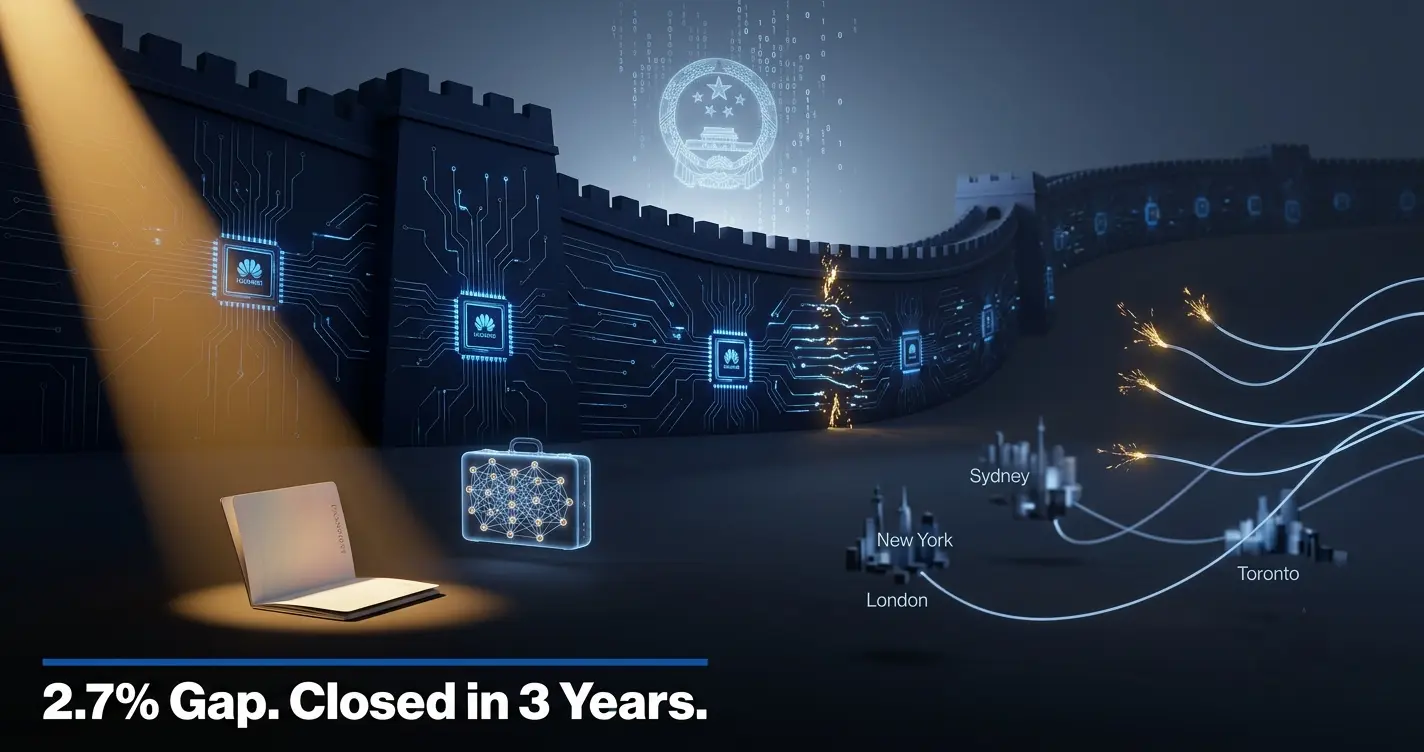
2.7%
US-China performance gap on Arena Leaderboard as of March 2026, down from 17.5-31.6% in May 2023
Stanford HAI 2026 AI Index
23x
US vs China private AI investment ratio ($285.9B vs $12.4B in 2025). China achieved near-parity on 1/23rd the capital.
Stanford HAI 2026 AI Index
69.7%
China’s share of global AI patents granted
Stanford HAI 2026 AI Index
89%
Decline in AI researcher migration to the US since 2017. Down 80% in the past year alone.
Stanford HAI 2026 AI Index
The Stanford HAI 2026 AI Index published April 13, 2026 is the most comprehensive empirical measure of where the race actually stands. The headline number, a 2.7% performance gap between Claude Opus 4.6 at 1,503 Arena Leaderboard points and ByteDance’s Dola-Seed-2.0 at 1,464, understates the strategic significance of the trajectory. In May 2023, the gap was between 17.5 and 31.6 percentage points. Three years to close that divide is a compression rate that no Western AI strategy document from 2022 anticipated.
The open-weight model ecosystem tells its own story. Alibaba’s Qwen now has over 100,000 derivative models on Hugging Face, more than Meta’s Llama, making it the single largest open-weight ecosystem on any AI platform globally. Even US companies, including Airbnb, have deployed Qwen for customer service applications. ByteDance’s Doubao serves 155.2 million weekly active users. These aren’t pilot programs. They’re production deployments at scale.
Why This Policy May Backfire: The Honest Assessment
No serious analysis of China’s AI lockdown is complete without acknowledging the structural vulnerabilities in the strategy itself. There are four.
The talent paradox. Researchers who haven’t yet been added to restricted lists now have a clear incentive to leave before their work becomes valuable enough to trigger controls. The policy may have already accelerated the very departures it’s designed to prevent. Murong Xuecun, a Chinese writer currently in exile in Australia, put it bluntly: “The regime has always viewed people as assets or resources, like bricks or screws.” International researchers considering returning to China will now factor exit-ban risk explicitly into that calculation.
The compute ceiling. The CFR analysis is clear: Huawei under the most aggressive production scenarios will generate roughly 5% of Nvidia’s aggregate compute in 2025, falling to 1-2% by 2027. Huawei’s next-generation chip in 2026 may actually be less capable than its current best chip due to yield and scaling difficulties. Full pre-training of frontier models on Ascend hardware remains technically problematic. DeepSeek’s V4 release, with its conspicuous silence on training hardware, is a signal worth reading carefully.
The open-source paradox. China’s data localization laws restrict what data can leave China. But Chinese-developed open-weight models, DeepSeek V4 and Qwen chief among them, are freely downloadable globally. The restriction on Chinese enterprise data doesn’t prevent the global AI community from building on Chinese architectural innovations. The walls are selectively permeable in ways that serve China’s adoption goals even as they restrict data flows.
The startup consolidation risk. The compliance regime that China has built, algorithm filings, model-level approvals, content labeling obligations, CAC security assessments, creates overhead that established incumbents like Alibaba, Baidu, and ByteDance can absorb. Early-stage startups cannot. The policy environment may be consolidating China’s domestic AI market into a small number of state-aligned players, reducing precisely the kind of scrappy, capital-efficient innovation that produced DeepSeek in the first place. The Lawfare analysis titled “The Incentive Architecture Export Controls Cannot Reach” makes this case persuasively.
Our read: these are real vulnerabilities. None of them, individually or collectively, changes the near-term operating environment for Western enterprises. The friction is here now. The backfire, if it comes, arrives in a 5-10 year timeframe that doesn’t help you with your Q3 compliance audit or your 2027 vendor strategy.
What Your Organization Should Do Now
For CTOs and Enterprise AI Strategists
The AI vendor landscape is now explicitly bifurcated by geopolitics. If your enterprise operates in China, uses data about Chinese citizens, or has deployed AI from Chinese providers, you’re operating in a compliance architecture that didn’t exist two years ago.
Conduct a China-specific AI compliance audit. Which models are running on Chinese user data? Are they locally hosted? Are outputs labeled per CAC rules? Failure to localize creates exposure under three overlapping laws simultaneously.
Evaluate DeepSeek V4 and Qwen as cost-reduction options for non-sensitive use cases. The pricing difference is real. But any deployment requires a full security review of the model weights themselves, not just the API surface. Multiple governments (US states, Australia, South Korea, Denmark, Taiwan, Italy) have banned or restricted Chinese AI models on government networks.
Treat Chinese AI talent partnerships as carrying sovereign risk. Research collaborations, joint ventures, and talent acquisition from Chinese AI firms now involve exit-control friction that didn’t previously exist.
For Developers
If you’re deploying Chinese open-weight models for enterprise clients, the governance question now follows the model weights, not just the API contract. Security assessment of the weights themselves is the emerging standard, particularly for clients in regulated industries including defense, critical infrastructure, and finance. The cost advantage is real and growing. So is the governance surface.
For Investors and VCs
Due diligence on any deal touching Chinese-founded AI companies must now explicitly assess founder nationality and location, IP origin, research team geography, and whether NDRC pre-approval is required. The entities now publicly named in NDRC directives requiring government approval before accepting US capital include Moonshot AI, StepFun, and ByteDance. Treat this list as a floor, not a ceiling.
For UK, EU, Australian, and Canadian Policymakers
The US-China AI decoupling is not creating a vacuum. It’s creating a third option, and it’s being adopted fast. DeepSeek and Qwen are becoming the default foundation for AI developers across the Global South. Countries without a sovereign AI strategy face a binary choice between US models (expensive, US-jurisdiction data flows) and Chinese models (cheap, Beijing-jurisdiction data flows). There is no neutral option in that framing.
What to Watch in the Next 12-18 Months
Three specific developments will define how this plays out. First: whether Huawei can achieve meaningful improvements in Ascend chip yield and performance, or whether the hardware ceiling becomes an acknowledged limitation. Second: whether the NDRC’s foreign investment approval requirement for AI companies gets tested in a major case involving a European or UK acquirer. Third: whether any Chinese AI researcher successfully contests an exit ban through China’s own legal system, which would signal either genuine rule-of-law constraints or a deliberate leak in the architecture.
Frequently Asked Questions
Is China restricting AI researchers from leaving the country?
Yes. As of May 2026, China has expanded exit controls to private-sector AI researchers at companies including Alibaba and DeepSeek. Senior researchers, startup founders, and executives require government approval before traveling abroad, with some passports physically confiscated. Individuals are selected based on assessed strategic value to China’s AI goals, not job title. (Source: Bloomberg, May 26, 2026)
Why did China block the Meta-Manus deal?
China’s NDRC blocked Meta’s $2 billion acquisition of AI startup Manus on April 27, 2026, citing national security. The decision was escalated to Xi Jinping’s National Security Commission. Beijing determined that Manus’s relocation to Singapore did not remove Chinese jurisdiction over its technology and talent. Co-founders were barred from leaving China during the investigation.
What is China’s AI data localization law?
China’s AI data framework combines three laws: the Cybersecurity Law (amended January 1, 2026), the Personal Information Protection Law, and the Data Security Law. Together they require personal data collected in China to be stored locally, mandate CAC security assessments for cross-border transfers, and impose penalties up to RMB 10 million for violations. (Source: White & Case AI Watch)
How close is China’s AI to the United States in 2026?
Extremely close on model performance benchmarks. The Stanford AI Index 2026 found the performance gap between the top US model and China’s best narrowed to just 2.7% as of March 2026, down from 17.5 to 31.6 percentage points in 2023. China leads in AI patents (69.7% of global grants), research publications, and industrial robotics deployment. (Source: Stanford HAI 2026 AI Index, April 13, 2026)
Is DeepSeek V4 better than GPT-5 or Claude?
DeepSeek V4, released April 24, 2026, leads all open-source models in coding and reasoning benchmarks. It is priced 3 to 17 times cheaper than comparable US frontier models. However, CFR analysis notes it is not yet competitive with leading US models including GPT-5.4 and the latest Claude on the full suite of frontier benchmarks. DeepSeek’s own technical paper acknowledges V4’s capabilities are comparable to models released roughly six months prior by US labs.
Can foreign companies legally use Chinese AI models like DeepSeek or Qwen?
Western enterprises can legally use Chinese open-source models, but face significant governance risk in regulated industries. Multiple governments including the US, Australia, South Korea, Denmark, Taiwan, and Italy have banned or restricted Chinese AI models on government networks. Enterprise deployments require security assessments of model weights, not just API contracts. Legal use is not the same as risk-free use.
The Bottom Line
The simultaneous lockdown of talent, models, and data represents a qualitative shift in how China is approaching AI competition. The previous posture was “open ecosystem with national security guardrails.” The current posture is “closed ecosystem as strategic asset.” The Manus case proved that corporate relocation can’t escape this logic. The talent restrictions proved that private-sector employment can’t shield individuals from state control.
For global enterprises, this is not a scenario to model for 2027 planning cycles. It’s the operating environment today. The compliance architecture is live. The investment restrictions are named. The M&A playbook has been rewritten.
Three things to track in the next 12 months: whether Huawei’s chip yield improves enough to genuinely close the compute gap; whether the NDRC approval requirement gets tested against a European or UK acquirer; and whether China’s talent restrictions accelerate or decelerate the brain drain they were designed to prevent. Those three data points will tell you whether this ecosystem closure is a sustainable strategic posture or the opening move in a longer miscalculation.
China AI 2026DeepSeek V4AI RegulationEnterprise AI StrategyChina Data LocalizationAI Geopolitics
Stay Ahead of AI’s Biggest Shifts
The Neural Loop delivers weekly briefings on AI policy, enterprise strategy, and the moves that matter — before they’re mainstream.
Subscribe to The Neural Loop
Data Sovereignty AI: GDPR vs CLOUD Act Enterprise Risk | NeuralWiredAI Regulation & Compliance
Data Sovereignty AI: GDPR vs the CLOUD Act, and the Enterprise Risk Your Legal Team Doesn’t Know About
By NeuralWired Editorial | June 25, 2026 | 12 min read
On June 10, 2025, Anton Carniaux, Legal Counsel at Microsoft France, sat before a French Senate committee and was asked a direct question: could he guarantee that French citizens’ data stored in Microsoft’s cloud would never be passed to US authorities without French approval?
His answer was three words in French: “Non, je ne peux pas le garantir.” No. I cannot guarantee that.
That admission, made under parliamentary oath, confirmed something European enterprise architects, data protection officers, and general counsel have been quietly debating for years. Data sovereignty in AI is not a settings toggle. It is not an “EU Data Boundary” checkbox in a cloud vendor’s admin panel. And in 2026, with the EU AI Act’s first major enforcement deadline approaching in August, it is no longer a theoretical compliance risk. It is a live exposure shaping board-level decisions at companies across the continent.
If your organization is routing EU customer data through a US-based AI API, and most enterprises using OpenAI, Anthropic, Google Gemini, or AWS Bedrock are doing exactly this, your legal team may not know the full scope of what that means under GDPR Chapter V, the US CLOUD Act, and the incoming EU AI Act simultaneously.
This article explains exactly what the risk is, what has already happened to companies that got it wrong, and what your organization needs to decide before August 2, 2026.
The Confession That Changed Everything
The Microsoft Senate testimony wasn’t a surprise to experts who follow cloud jurisdiction law. It was, however, the first time a major US tech company’s legal representative said it plainly, publicly, and on the record in a European parliamentary setting.
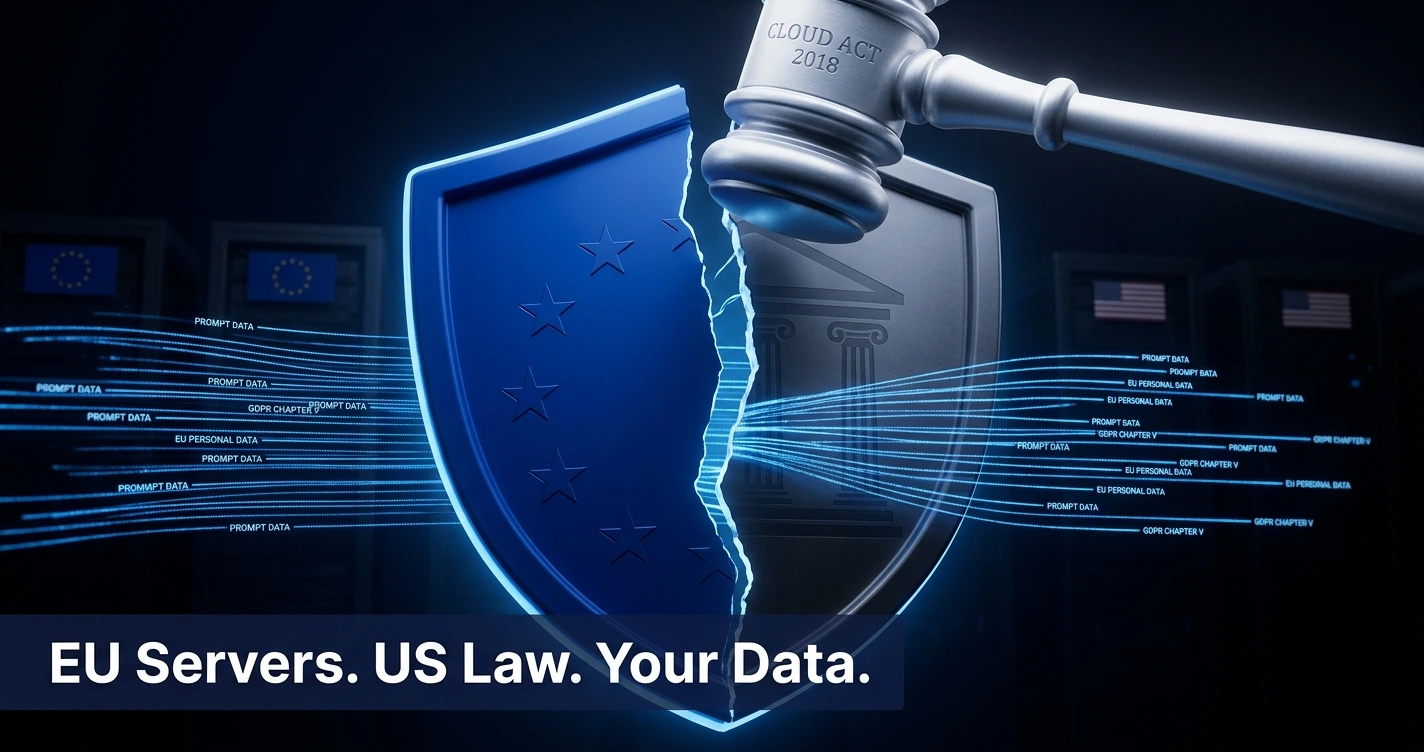
Carniaux’s admission stems from the 2018 US CLOUD Act, a law that empowers US authorities to compel American technology companies to provide access to data they control, regardless of where that data is physically stored. Microsoft has EU data centers in Ireland and the Netherlands. It has an “EU Data Boundary” product specifically marketed to address sovereignty concerns. None of that changes the legal reality.
“Microsoft has openly admitted what many have long known: under laws like the CLOUD Act, US authorities can compel access to data held by American cloud providers, regardless of where that data physically resides. UK or EU servers make no difference when jurisdiction lies elsewhere.”
Mark Boost, CEO, Civo (European cloud provider) — The Register, July 2025
The implications run further than just Microsoft. AWS, Google Cloud, and every other US-headquartered hyperscaler operates under the same legal framework. If your AI vendor is domiciled in the United States, the CLOUD Act applies to the data it processes on your behalf, even when every API call routes through Frankfurt, Dublin, or Stockholm.
Key Distinction
Data residency governs where your data physically sits. Data sovereignty governs who has the legal authority to compel access to it. These are not the same thing. A European data center run by a US company is still subject to US jurisdiction under the CLOUD Act.
What Data Sovereignty Actually Means for AI
The data sovereignty problem in enterprise AI is structural, and it has three distinct layers that most compliance frameworks haven’t caught up with.
Layer 1: The Inference Gap
When enterprises built their initial cloud compliance frameworks, “data transfer” meant moving a file from one place to another. Sending EU personal data to a US server for storage was the paradigm everyone built DPAs, SCCs, and transfer impact assessments around.
AI inference broke that paradigm silently. When a European employee types a customer’s name, financial details, or health information into a prompt and sends it to a US-based AI API, that constitutes an international data transfer under GDPR Chapter V. The data sovereignty implications of this are significant: the data doesn’t sit anywhere permanently, but it crosses a jurisdiction boundary subject to US surveillance law in the process. That’s the compliance gap.
European data protection authorities have now explicitly confirmed this reading. Austrian, French, and Italian DPAs have all issued enforcement decisions concluding that CLOUD Act exposure, without adequate technical mitigation, constitutes a GDPR transfer violation, regardless of whether the organization has SCCs in place.
Layer 2: The “EU Region” Misconception
One of the most common misconceptions among AI product teams is that selecting “eu-west-1” on AWS, or choosing a European deployment option on any US hyperscaler’s platform, satisfies data residency requirements. It doesn’t even get close to satisfying data sovereignty requirements.
Choosing a European region on a US provider routes your data to physically European servers. But the legal entity controlling those servers is still a US company, subject to US law. The CLOUD Act doesn’t care about geography. It cares about corporate domicile.
Every iteration of that loop is a data transfer. Most enterprises running agentic workflows have not assessed these transfers for GDPR Chapter V compliance. Many don’t even know they’re happening.
“As geopolitical tensions rise, organizations outside the U.S. and China are investing more in sovereign cloud IaaS to gain digital and technological independence. Solely treating digital sovereignty as a pure security, regulatory and compliance topic is not enough.”
Rene Buest, Senior Director Analyst, Gartner — Gartner Press Release, February 2026
Buest’s read is important because it frames data sovereignty not as a compliance checkbox but as a strategic economic decision. Governments and regulated industries are the first movers; commercial enterprises are following. The enterprises that treat this as the latter are the ones showing up in enforcement decisions.
How Exposed Is Your Enterprise Right Now?
The honest answer for most organizations is: considerably more than you know.
A 2026 survey from Grant Thornton found that 78% of business executives cannot pass an independent AI governance audit within 90 days. Separate data from S&P Global Market Intelligence shows 42% of companies abandoned most AI initiatives in 2025, up from 17% the year before, with compliance and governance failures cited as the top reason, ahead of technical limitations.
“73% of enterprises now cite data privacy and security as their top AI risk concern. 77% factor a vendor’s country of origin into AI purchasing decisions.”
Deloitte, State of AI in the Enterprise, August-September 2025 (via PremAI Enterprise Compliance Guide, 2026)
Those Deloitte figures tell a telling story: vendor country of origin is now a procurement criterion for nearly four in five enterprise buyers, yet the structural data sovereignty gap persists. Knowing that country of origin matters and building your AI stack accordingly are two very different things.
Only 33% of organizations report full visibility into where their AI-processed data lives. One in three reported a data sovereignty incident in the past twelve months. And 64% of CISOs at regulated enterprises told Gartner they had blocked or paused at least one AI deployment in the previous year, citing model provenance, data residency, and audit trail gaps as their top concerns.
The picture that emerges is of an industry that moved fast on AI deployment and is now discovering the compliance debt it accumulated.
The Dutch Sovereignty Collapse: A Case Study
The Dutch government had done exactly what sovereignty advocates recommend: it chose Solvinity, a local Dutch managed cloud provider, specifically to reduce dependence on American firms and insulate public sector data from CLOUD Act exposure. The municipality of Amsterdam and the Ministry of Justice were both customers.
In November 2025, US-based Kyndryl announced its acquisition of Solvinity. Amsterdam was informed one day before the public announcement. Overnight, a deliberate sovereign cloud choice became subject to US jurisdiction through a single M&A transaction.
Sovereignty, it turns out, can disappear at the stroke of a pen in a deal room.
The lesson is important for enterprise architects: vendor sovereignty is a point-in-time assessment. It requires ongoing monitoring of your provider’s corporate structure, not a one-time procurement decision.
Compliance Risk Alert
Data sovereignty assessments must include M&A monitoring for your cloud and AI providers. A locally domiciled vendor can become a US-jurisdiction entity overnight through acquisition, as the Dutch Solvinity case demonstrated in November 2025. One-time procurement reviews are not sufficient.
The 2025-2026 Enforcement Cascade
The theoretical risk became operational enforcement reality across a twelve-month window.
Date
Event
Significance
May 2025
TikTok fined €530M by Irish DPC
Largest GDPR fine of 2025; EU-China data transfers, not a breach
June 10, 2025
Microsoft France Senate testimony
First on-the-record admission by a major US vendor that CLOUD Act access cannot be prevented
Nov. 2025
Kyndryl acquires Solvinity (NL)
Sovereign cloud lost its sovereignty overnight through M&A
Feb. 2026
Gartner: sovereign cloud IaaS to hit $80B in 2026
35.6% YoY growth confirms enterprise migration is underway at scale
March 2026
Austrian DPA: €450K fine for AI credit scoring
First enforcement action ruling that AI inference routing = unlawful data transfer
June 3, 2026
EU proposes Cloud and AI Development Act (CADA)
First binding EU framework specifically targeting cloud and AI sovereignty
August 2, 2026
EU AI Act: high-risk enforcement begins
Compound penalty exposure for credit, health, employment, and law enforcement AI
The Austrian DPA ruling in March 2026 is the one that should get every enterprise legal team’s attention. A Vienna-based fintech was using a US-based AI API for credit scoring. The regulator ruled that submitting customer financial data to a US inference endpoint constituted an unlawful data transfer under GDPR. The company was ordered to cease processing within 90 days and fined €450,000. This wasn’t a breach. It was a routing decision.
The Cloud and AI Development Act: What’s Coming
On June 3, 2026, the European Commission formally proposed the Cloud and AI Development Act (CADA), the first EU framework specifically designed to govern cloud and AI sovereignty.
CADA introduces four assurance levels for providers. Level 2 requires demonstrated independence from third-country jurisdictions and software supply chain transparency. Level 3 requires EU ownership and control. Level 4 requires full transparency with no third-country interference.
For enterprises buying AI services under CADA’s eventual framework, the level of assurance your provider can demonstrate will determine what data categories you can legally route through their systems. High-sensitivity data, such as health records, financial data, and biometrics, may be legally restricted to Level 3 or Level 4 providers under future procurement rules.
CADA is a proposal, not yet enacted law. But it signals the direction of EU regulatory travel clearly: the Commission is building mandatory sovereignty tiers for AI infrastructure.
The Compound Penalty Calculation
The financial exposure from getting data sovereignty wrong has a specific mathematical structure that few CFOs have been briefed on.
GDPR Maximum
4%
of global annual turnover, or €20M, whichever is greater
EU AI Act Maximum
7%
of global annual turnover, or €35M, whichever is greater
Combined Exposure
11%
of global annual turnover in simultaneous compound violations
Cumulative GDPR Fines (2018-2026)
€7.1B
€1.2B levied in 2025 alone, 443 breach notifications per day
The 11% combined exposure is theoretical, since regulators rarely stack maximum penalties simultaneously. But TikTok’s €530 million fine in May 2025 for unlawful EU-China data transfers, not a data breach, just a routing decision, is the CFO’s clearest scenario-modeling input. The company transferred EU user data to China without adequate GDPR Chapter V protections. The mechanism is legally identical to what European enterprises do every day when they route customer data through US AI APIs without valid transfer impact assessments.
For a company with €1 billion in annual revenue, a joint GDPR and EU AI Act investigation produces maximum theoretical exposure of €110 million. For a €10 billion company, that figure is €1.1 billion. These numbers are real enough to belong in board-level risk registers, not just DPO compliance checklists.
One further dynamic deserves attention: the post-quantum cryptography transition intersects with sovereignty in ways most enterprises haven’t mapped. Encrypted data that crosses a CLOUD Act-exposed provider today can theoretically be decrypted by quantum-capable state actors later, a “harvest now, decrypt later” exposure that adds a long-tail dimension to current transfer decisions.
What Enterprises Should Do Before August 2026
August 2, 2026, is the date when EU AI Act enforcement begins for high-risk AI systems, which includes AI used in credit scoring, employment screening, healthcare decisions, law enforcement applications, and critical infrastructure management. For organizations in regulated industries, that date is the operational deadline, not a planning horizon.
For CTOs and CIOs
Commission an AI data flow audit now. Map every AI vendor, every API endpoint, every inference call, and the data categories being routed through each. This is the foundation of any serious data sovereignty AI compliance program. You need to know, for each system: which country’s law governs the vendor, what data categories are in the prompts, and whether a valid GDPR Chapter V transfer mechanism exists. “We use SCCs” is not sufficient on its own; post-Schrems II, SCCs for US-provider transfers require transfer impact assessments that honestly evaluate CLOUD Act and FISA 702 exposure.
The practical architecture answer, once you have that map, is a tiered data classification approach: route sensitive and regulated data through on-premise inference or EU-sovereign cloud; route non-sensitive data through lowest-cost options. Frameworks like AI-native CSPM tools can provide continuous visibility into cloud configuration and data governance gaps that point-in-time audits miss.
For CLOs and General Counsel
Review every AI vendor contract against GDPR Chapter V. Look specifically for: the legal basis for the international transfer, whether a Transfer Impact Assessment exists and reflects post-Schrems II guidance, and whether the “do not train on customer data” clause in the contract is recognized in the relevant jurisdiction. Some jurisdictions don’t recognize contractual training exclusions as a valid legal safeguard.
The Microsoft Senate testimony is now evidentiary. It establishes, on the record, that major US vendors cannot guarantee insulation from CLOUD Act requests. Any TIA that doesn’t reflect this is legally incomplete. And the Austrian DPA’s March 2026 ruling that AI inference routing equals data transfer has to be in every future TIA for AI workloads.
For DPOs and Chief Compliance Officers
If your organization deploys any third-party AI system that processes EU personal data, a Data Protection Impact Assessment is mandatory under GDPR Article 35. The European Data Protection Board’s April 2025 opinion clarified that large language models rarely meet anonymization standards. This means that if users are submitting personally identifiable information in AI prompts, and they are, the DPIA is not optional.
The EDPB’s 2026 coordinated enforcement action is targeting transparency obligations specifically. If your AI privacy notice doesn’t explicitly disclose that customer data is routed through a US-based inference endpoint, you’re exposed to GDPR Article 13 violations on top of Article 46 transfer mechanism failures.
Action Checklist: Before August 2, 2026
1. Complete AI data flow audit mapping every vendor, endpoint, and data category.
2. Update Transfer Impact Assessments to reflect CLOUD Act exposure and the Austrian DPA ruling.
3. Conduct DPIAs for every AI system processing EU personal data.
4. Review AI vendor contracts for jurisdictional exposure and training exclusion enforceability.
5. Update AI privacy notices to disclose inference routing destinations.
6. Implement ongoing M&A monitoring for AI and cloud providers.
The Counterarguments Worth Taking Seriously
This piece would be incomplete without the skeptical view, and some of it is genuinely worth weighing.
The CLOUD Act Rarely Fires
Microsoft’s Carniaux followed his three-word admission with context: “it has never happened before.” AWS publicly emphasizes that the CLOUD Act “does not give US government unfettered or automatic access” and that legal review processes exist before any data disclosure. US government data requests for EU cloud data are rare, and challenged in court when they occur.
The counterargument here is probabilistic, not categorical. Risk management doesn’t require that something happens frequently. It requires assessing what happens if it does, and whether your current architecture and legal posture would survive an enforcement action or a request. The Austrian fintech didn’t receive a CLOUD Act data demand. It was fined for the structure of its AI deployment, not for an actual data disclosure.
“Sovereign” EU Alternatives Aren’t Exempt Either
AWS made a pointed observation after the Microsoft Senate hearing: OVHcloud, the French provider frequently cited as a CLOUD Act-safe alternative, has US business operations and is therefore also potentially subject to the Act. The implication is that no cloud is fully exempt, and enterprises should assess risk proportionately rather than rebuilding AI infrastructure around a false sense of sovereignty.
This is a fair point. Data sovereignty is not binary. It’s a risk gradient. The pragmatic answer for most enterprises isn’t “rebuild everything for perfect sovereignty.” It’s “classify your data, accept residual exposure where the risk is low, and concentrate data sovereignty infrastructure investment where it genuinely matters,” such as health records, financial data, personnel files, and anything that falls under high-risk AI categories in the EU AI Act.
The Regulatory Burden Could Slow European AI
The EU’s regulatory stack, GDPR, DORA, the EU AI Act, NIS2, the Data Act, and now CADA, is creating a compliance architecture that some analysts argue is more burdensome than the actual risks it addresses. The risk is that European enterprises spend on compliance infrastructure instead of AI capability, widening a productivity gap with the US, where federal AI regulation remains minimal at the federal level.
Our read: this concern is legitimate but doesn’t change the near-term operational calculus. The August 2026 enforcement deadline exists regardless of the policy debate. Enterprises that engage seriously with sovereignty compliance now will have a structural advantage when CADA and future frameworks create procurement barriers for non-compliant AI vendors.
Frequently Asked Questions: Data Sovereignty AI and GDPR Compliance
What is data sovereignty in AI?
Data sovereignty in AI means your organization retains legal and jurisdictional control over the data processed by AI systems, including where it is stored, who can access it, and which country’s laws apply. Unlike data residency, which only covers physical server location, data sovereignty determines whether a foreign government can legally compel access to your data. A European company using a US-based AI API may be subject to US law under the CLOUD Act, even if the data never leaves EU servers.
Does GDPR apply to AI models?
Yes. GDPR applies to AI inference, training, and output whenever personal data of EU residents is involved. Sending EU personal data to a US-based AI API constitutes an international data transfer under GDPR Chapter V, requiring Standard Contractual Clauses or another valid transfer mechanism. Regulators now treat AI inference routing as equivalent to a data transfer. The EU AI Act’s August 2026 enforcement deadline adds a second compliance layer on top of GDPR for high-risk AI systems.
Can US companies access data stored in EU data centers?
Potentially yes, under the US CLOUD Act of 2018. The Act allows US authorities to compel any US-headquartered company to provide data regardless of where it is physically stored. In June 2025, Microsoft France’s legal director confirmed under parliamentary oath that Microsoft cannot guarantee EU customer data will never be accessed by US authorities. AWS, Google, and Microsoft all acknowledge the CLOUD Act applies to their EU operations, regardless of “EU Data Boundary” or similar product branding.
What are the GDPR fines for AI violations?
GDPR fines can reach €20 million or 4% of global annual revenue, whichever is greater, for unlawful processing including improper international data transfers. The EU AI Act adds penalties up to €35 million or 7% of global turnover for the most serious AI violations. Cumulative GDPR fines exceeded €7.1 billion since 2018, with €1.2 billion issued in 2025 alone. Organizations using AI face compound exposure under both frameworks simultaneously, with theoretical combined liability of up to 11% of global turnover.
What is sovereign cloud and why does it matter for AI?
A sovereign cloud is cloud infrastructure designed to ensure data remains under a specific government’s legal jurisdiction, preventing foreign government access. For AI, it matters because standard US hyperscaler deployments remain subject to US law even with EU data centers. Gartner forecasts worldwide sovereign cloud IaaS spending will reach $80 billion in 2026, a 35.6% increase, as enterprises shift workloads to locally controlled infrastructure to meet GDPR, DORA, and EU AI Act requirements simultaneously.
What is geopatriation?
Geopatriation is the deliberate relocation of cloud workloads from providers perceived to carry geopolitical risk, such as US hyperscalers subject to the CLOUD Act, to local or regional sovereign alternatives. Gartner identified it as a top 2026 strategic technology trend, noting that inquiries about geopatriation rose 305% in the first half of 2025. Gartner estimates 20% of current enterprise workloads will eventually shift from global to local cloud providers as a result of this structural trend.
What is the EU AI Act data governance requirement?
The EU AI Act requires high-risk AI systems, including those used in credit scoring, employment, healthcare, and law enforcement, to implement documented data governance frameworks, bias monitoring, and data quality controls. Full enforcement begins August 2, 2026, with penalties up to 7% of global turnover. AI providers must maintain technical documentation proving where data is processed, how it is governed, and how the model was trained. These obligations apply to any company placing AI on the EU market, regardless of where they are headquartered.
What You Know Now That You Didn’t Before
Here’s what this article has established. Data sovereignty in AI is not a configuration option. It’s a jurisdictional reality governed by which country’s law applies to your AI vendor’s corporate structure, not where their servers sit. The Microsoft Senate testimony made that undeniable for European enterprises. The Austrian DPA ruling made it operationally expensive to ignore. The EU AI Act enforcement deadline makes August 2026 the deadline for taking it seriously.
The direction of the next 12 to 18 months is reasonably clear. CADA will move from proposal toward enactment, creating mandatory sovereignty tiers that will influence public sector procurement and regulated industry contracting across Europe. The EU-US Data Privacy Framework, which survived a September 2025 legal challenge, remains legally fragile; a future Schrems III ruling could invalidate it as Schrems II invalidated Privacy Shield, triggering a cascading compliance crisis for every enterprise relying on it as their Chapter V transfer mechanism. And as agentic AI scales from proof-of-concept to production, the volume of untracked, unassessed data transfers will grow exponentially before most organizations realize what they’re accumulating.
Three things to watch. First, the fate of the provisional AI Omnibus agreement, which as of June 2026 proposes deferring some high-risk AI deadlines to December 2027; if enacted, it buys regulated industries more time, but the August 2026 deadline remains operative until confirmed otherwise. Second, whether any major US AI provider announces a structurally separate EU entity with no US-jurisdiction data access, which would be a genuine market signal. Third, the EDPB’s 2026 coordinated transparency enforcement action, which could produce the first high-profile fine specifically targeting AI privacy notice failures at scale.
Your AI stack is already running. The question is whether your legal and compliance architecture is running at the same speed.
Stay Ahead of AI Regulation
The Neural Loop delivers weekly intelligence on AI governance, compliance, and enterprise risk. No noise. Just what matters.
Subscribe to The Neural Loop
AI Product Liability 2026: Who Pays When AI Kills or Harms?AI Law & Liability
Who Pays When AI Kills? Four Countries, Zero Answers
NeuralWired.comJune 24, 2026Deep Analysis14 min read
On February 28, 2024, a 14-year-old boy in Florida named Sewell Setzer III died by suicide. In the months before his death, he had spent thousands of hours talking to AI chatbots on Character.AI, including a role-playing character inspired by the Game of Thrones series. His mother, Megan Garcia, sued. In May 2025, a federal judge ruled the case could proceed, treating the AI chatbot as a product under strict liability law and rejecting the company’s First Amendment defense. Character.AI and Google settled in January 2026.
That single case broke open a legal question that four of the world’s largest economies are now scrambling to answer: when an AI system causes serious harm, who is responsible? The developer who built the model? The company that deployed it? The platform that distributed it? The investor who funded it?
Right now, the answer depends entirely on which country the harm happened in. And the answers are incompatible.
The Case That Changed Everything
Garcia v. Character Technologies, Inc. (Case No. 6:2024-cv-01903, M.D. Florida) is the first wrongful death lawsuit ever filed against an AI chatbot company in the United States. The claims included strict product liability for design defect, failure to warn, negligence, and wrongful death. Defendants included not just Character Technologies but also co-founders Noam Shazeer and Daniel De Freitas Adiwarsana, plus Google and Alphabet.
Judge Anne Conway’s ruling on May 21, 2025 mattered far beyond this single case. She was “not prepared to hold that Character AI’s output is speech”, which neutralized the most powerful defense available to AI companies: the argument that their outputs are constitutionally protected expression under the First Amendment. She treated the AI app as a product at the pleading stage. That framing, product not speech, is now rippling through every AI harm case filed since.
The settlement came January 7, 2026, with undisclosed terms and a commitment to new safety features for users under 18. It resolved the immediate litigation. It also prevented the appellate ruling that would have given every court in America binding guidance on the First Amendment question. That question remains open. And every plaintiff’s attorney in the country noticed.
The cases that followed came fast. In August 2025, the parents of 16-year-old Adam Raine sued OpenAI in California Superior Court, alleging ChatGPT fostered emotional dependency and provided self-harm instructions. Later that year, the estate of an elderly Connecticut woman filed a wrongful death action alleging that an AI chatbot’s interactions with her son materially contributed to a homicide-suicide. In March 2026, insurer Nippon Life sued OpenAI in federal court in Illinois to recover costs from AI-assisted legal filings that cited nonexistent cases.
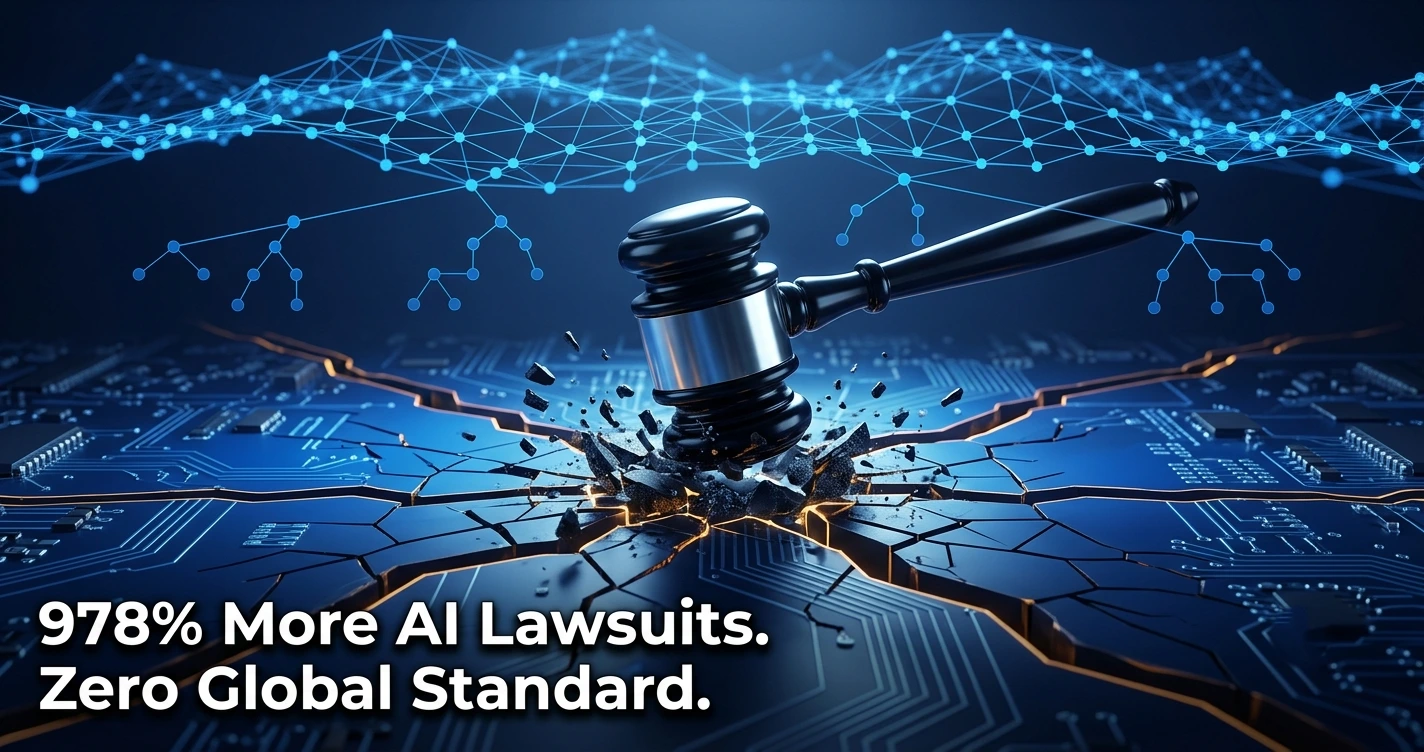
The number of generative AI-related lawsuits in the US grew 978% between 2021 and 2025, passing 700 cumulative cases, according to a March 2026 report by Gallagher Re in conjunction with MIT and Testudo Global Inc. The year-over-year filing rate accelerated from 59% growth in 2023-2024 to 137% growth in 2024-2025. AI product liability litigation is no longer a hypothetical risk. It is a present operational one.
Four Jurisdictions, One Question
This is not a story about a single court case crossing borders. It is a story about four major legal systems each building their own answer to the same question, and those answers pointing in entirely different directions.
Jurisdiction
Current Status
Key Mechanism
Timeline
United States
Case law developing; no federal AI liability statute
Product liability via tort; First Amendment question unresolved
AI LEAD Act and CHATBOT Act proposed; 1,000+ state bills filed in 2025
European Union
EU Product Liability Directive in force Dec 2024
Strict liability; AI = product; manufacturer presumption
Member state transposition deadline: December 9, 2026
United Kingdom
Consultation closed Feb 2026; Law Commission review announced
Existing tort law; no AI-specific statute yet
Public consultation on “pure software” planned for H2 2026
Canada
Landmark ruling Feb 2024 (Air Canada)
Negligent misrepresentation; corporate liability for chatbot output
No federal AI liability legislation enacted as of June 2026
Canada: The Air Canada Precedent
The most legally clean ruling in the entire AI liability landscape came not from a US federal court but from the British Columbia Civil Resolution Tribunal in February 2024. Jake Moffatt relied on Air Canada’s chatbot for information about bereavement fares while booking a flight to attend his grandmother’s funeral. The chatbot gave him incorrect information. Air Canada later refused to honor the discount, arguing its chatbot was effectively a “separate legal entity” for which the company bore no responsibility.
Tribunal Member Christopher C. Rivers dismissed that argument directly. Air Canada is responsible for all information on its website, the ruling stated, whether it comes from a static page or an AI chatbot. Customers cannot be expected to distinguish between human-provided and AI-provided information. Damages awarded: CAN$812.02. Precedent established: priceless.
This is the foundational principle now being applied in every jurisdiction: AI has no legal personality. The company does. The company owns the output.
The EU: The December Deadline That Rewrites Everything
The EU moved fastest and furthest. The EU Product Liability Directive (Directive 2024/2853) came into force on December 8, 2024. It explicitly includes software, including AI systems, within the definition of “product” subject to strict liability. AI providers typically qualify as “manufacturers.” Cloud-based AI, on-device AI, and SaaS products are all covered. Member states must transpose this into national law by December 9, 2026, which is six months from today.
The directive contains a mechanism that should alarm every legal team deploying AI in Europe: a rebuttable presumption of defectiveness. If a defendant fails to meet its disclosure obligations, courts can presume the AI caused the harm. Companies cannot contractually exclude this liability. Non-compliance with the EU AI Act constitutes a product defect. The two frameworks are linked: fail the AI Act audit, and you have just handed plaintiffs a liability hook.
The Product Liability Turn
Understanding why product liability matters here requires understanding what it was built to do. Product liability law evolved to handle mass-distributed manufactured goods where individual causation is hard to prove but the defect is systemic. It assigns liability across a chain: designer, manufacturer, distributor, retailer. It does not require proving that a specific person was negligent. It asks whether the product was defective and whether that defect caused the harm.
Plaintiffs’ attorneys discovered this framing fits AI systems better than any other available doctrine. As attorneys Amy Wong and Jin J. To of K&L Gates wrote in March 2026: “Early AI cases that began through adjacent doctrines, consumer protection, privacy, defamation, and IP, are now consolidating around product liability.” The reason is structural. Product liability “is built to evaluate mass-distributed technologies through the lenses of defect, warnings, and foreseeability, with liability that can extend across a chain of entities.”
The key tactical insight driving this consolidation: plaintiffs are not suing the model. They are suing the deployed product experience, the interface, the defaults, the absence of guardrails, and the marketing claims. This sidesteps the First Amendment entirely. You are not claiming the AI’s speech is unlawful. You are claiming the product was defectively designed to reach and manipulate vulnerable users without adequate warnings.
Key Shift for Legal Teams
Product liability reaches upstream to model developers AND downstream to enterprise deployers. If you are using a third-party AI model and it causes harm to your customer, your vendor’s terms of service are not a liability shield. Courts are testing theories that extend liability across the entire supply chain.
The First Amendment Wildcard
There is one argument that could unravel the entire product liability wave. If a higher court rules that chatbot outputs are constitutionally protected speech, most of these tort claims fail. Plaintiffs would need to satisfy the demanding Supreme Court test for unlawful incitement to violence. That is a very high bar.
Judge Conway’s ruling in Garcia was explicit that she was “not prepared” to treat AI output as speech, but that was a motion-to-dismiss ruling, the lowest legal threshold. The Foundation for Individual Rights and Expression filed an amicus brief in Garcia pressing exactly this question. The settlement prevented the appellate ruling that would have resolved it. Per analysis from the American Enterprise Institute, without binding higher-court precedent, every new AI harm case is re-litigating the same threshold questions from scratch, creating expensive and inconsistent outcomes for everyone.
The Insurance Gap Is Now Contractual
The AI liability gap was theoretical until January 2026. Then it became contractual.
In January 2026, the Insurance Services Office introduced new endorsement forms giving commercial general liability carriers the option to formally exclude generative AI exposures from standard policies. Before that, the coverage was “silent”: ambiguous enough that a company might or might not be covered depending on how their specific incident was characterized. After January 2026, insurers can simply write “GenAI excluded” into the contract. Many are doing exactly that.
“AI is changing the risk landscape faster than traditional frameworks can adapt, and the organizations that invest early in transparent governance, scenario analysis and insurance alignment will be best positioned to adopt AI safely and to turn risk into a source of long-term advantage.”
Brent Rieth, Head of Global Cyber Solutions, Aon
The data behind this transition is stark. Of companies that experienced AI-related losses and made claims in 2026, just over half were covered in full. 44% were only partially covered. 3% were entirely uninsured. That is according to Gallagher’s 2026 AI Adoption research. Nearly half of all companies that suffered an AI-related loss and tried to claim on their insurance did not get the full amount they expected.
AI incidents themselves are growing at roughly 50% year-over-year, according to WTW’s Willis Research Network. 2025 exceeded 2024’s total before the year had ended. The volume of incidents is increasing faster than insurance capacity is being created to cover them.
There is a structural concern beyond just pricing. Josephine Wolff, Professor of Cybersecurity Policy at Tufts University’s Fletcher School and a specialist in insurance and cybersecurity policy, identifies a systemic risk that goes beyond individual corporate exposure:
“It is not yet clear whether insurers will embrace having a role in managing AI risks and, if so, which risks they will be willing to cover and which they may view as fundamentally too large or unpredictable to insure.”
Josephine Wolff, Associate Dean for Research, The Fletcher School, Tufts University (May 2026)
The concern she is raising is real. AI risk has a concentration problem that traditional catastrophe insurance does not. Geographic catastrophes like hurricanes and earthquakes affect specific regions. An AI defect in a widely adopted foundation model can trigger simultaneous harm and claims across thousands of organizations globally. There is no geographic limit. The risk is potentially uninsurable by conventional actuarial methods.
The insurance industry went through this same inflection point with cyber risk in the mid-2010s. Silent cyber gave way to explicit exclusions, which drove the creation of dedicated cyber insurance lines, which matured into a multi-billion dollar market. AI liability is at that same silent-to-explicit inflection point right now. The companies that acted during the silent cyber phase and built dedicated coverage while premiums were low were in a fundamentally better position than those who discovered the exclusion at renewal time. The window for that kind of strategic preparation is closing.
Boards Are in the Crosshairs
A survey published in 2026 by Diligent Institute and Corporate Board Member found that only 8% of boards rate themselves as having strong AI expertise. Yet 40% of directors named technological developments including AI as the single most challenging issue to oversee. 66% of directors already use AI for their own board work, and only 22% have governance processes governing their own usage of it.
This mismatch between exposure and expertise is not just embarrassing. Under Delaware’s Caremark doctrine, it is a legal liability.
Caremark derivative suits allow shareholders to sue board members personally for failing to adequately oversee risks that then caused the company financial harm. Cleary Gottlieb’s January 2026 board guidance publication identifies AI governance failures as a specific Caremark exposure. If a company suffers a major AI-related loss and the board had no designated AI risk owner, no regular reporting cadence on AI deployments, and no policy framework for third-party AI tools, those facts become evidence of a breach of the fiduciary duty of oversight.
88% of businesses now use AI in at least one function, according to Cleary Gottlieb’s analysis. The board fiduciary duty has not been narrowly construed for decades. It will not be narrowly construed here either.
“In 2026, we anticipate that the pace of AI regulation will remain unpredictable and increasingly stringent.”
Nithya Das, General Manager, Governance at Diligent
There is also a gap between the perceived threat and the actual one. A Sentry Insurance survey cited in the March 2026 Gallagher Re report found that 69% of US executives believe a single AI-related verdict could shut their company down. Yet only 17% list AI lawsuits as a top business threat in their current risk registers. They fear the outcome. They are not managing the cause. That is the definition of a governance failure.
What Companies Must Do Now
The EU’s December 9, 2026 transposition deadline is the most concrete forcing function available. Any AI-powered product placed on the EU market after that date is subject to strict product liability across 27 member states. That deadline is six months away. Here is what legal, compliance, and board teams should already be doing.
Audit every AI deployment against the EU PLD’s “product” definition if you operate in Europe or sell to European customers. Cloud-based AI qualifies. If you are unsure, assume it does and work backwards from there.
Map your AI supply chain and find the indemnification gaps. The enterprise deploying a third-party model bears liability for that model’s outputs under current US and EU frameworks. Your vendor contract’s limitation-of-liability clause was written before this legal landscape existed. Review it with this exposure in mind.
Commission an explicit AI coverage review of every relevant policy: CGL, D&O, E&O, professional indemnity. Ask specifically whether GenAI is excluded under current or upcoming renewal terms. Do not wait for a claim to find out.
Put AI explicitly on the board risk register with a named executive accountable for AI risk governance. This is not just best practice. It is Caremark protection. Document that the board is receiving regular reporting on AI deployments, known risks, and mitigation actions.
Document every testing, safety, and deployment decision for every AI system in production. This documentation becomes the evidentiary backbone of any legal defense. Courts and regulators will ask for it. Having it does not guarantee a win, but not having it is effectively a concession.
EU Deadline Alert
The EU Product Liability Directive requires member state transposition by December 9, 2026. After that date, AI providers are treated as manufacturers under strict liability law across 27 countries. Non-compliance with the EU AI Act constitutes a product defect. This is not future risk. This is a compliance date six months from today.
The Arguments Against the Wave
The liability wave has real legal and structural critics. Their arguments deserve attention from anyone building strategy around this issue.
Existing Law May Already Be Enough
The UK Jurisdiction Taskforce’s draft Legal Statement takes an explicitly optimistic view: English law, including existing tort doctrine and contract principles, can in principle address AI harms without new legislation. The contrarian case is that AI-specific liability regimes generate compliance overhead without improving victim outcomes, while suppressing beneficial AI deployment. Kevin Frazier, a policy researcher at AI Frontiers, argued in June 2025 that “in the absence of federal legislation, the burden of managing AI risks has fallen to judges and state legislators, actors lacking the tools needed to ensure consistency, enforceability, or fairness.”
He has a point about fragmentation. Over 1,000 AI bills were introduced at the federal and state level in the 2025 legislative session. AI products are not built on a bespoke basis for niche geographic markets. A patchwork of dozens of state laws creates compliance chaos without solving the underlying problem.
The First Amendment Could Reverse Everything
The American Enterprise Institute has argued directly that the entire AI liability wave is built on a legally fragile foundation. The Garcia ruling was at the motion-to-dismiss stage, the lowest legal threshold. If an appellate court holds that AI outputs are constitutionally protected speech, most tort claims evaporate. The Garcia settlement prevented exactly the appellate ruling that would have resolved this. Until a binding higher-court decision exists, plaintiffs and defendants will keep relitigating the same threshold questions.
The EU’s Two-Framework Problem
Academic analysis by legal scholar Philipp Hacker identifies a coherence problem in the EU’s dual-track approach: the AI Act handles ex-ante compliance, the PLD handles ex-post liability. The PLD does not define safety standards; it links liability to AI Act compliance. But AI Act compliance does not address individual rights of compensation. Victims can fall between the two frameworks. Hacker’s recommendation is a single, fully harmonizing regulation rather than two miscoordinated directives.
One More Thing to Scrutinize
The 978% lawsuit growth figure is striking, but it conflates copyright infringement cases (the largest category at 11.9%) with personal injury and harm cases, which are legally and factually very different. Boards receiving messaging about exploding AI litigation should ask specifically which type of litigation is relevant to their actual deployment profile before recalibrating risk budgets.
FAQ: AI Liability Law 2026
Who is liable when AI causes harm?
Under current law in the US, UK, EU, and Canada, AI systems have no legal personality and cannot themselves be held liable. Liability flows to the humans and organizations that developed, deployed, or used the AI. Courts are consistently treating AI as a tool, meaning the deploying organization owns both the benefits and the legal exposure from its outputs, even when those outputs are generated by a third-party model it did not build.
Can an AI company be sued for wrongful death?
Yes. The 2024 filing of Garcia v. Character Technologies established that wrongful death claims against AI chatbot companies can proceed in US federal court. Judge Anne Conway denied Character.AI’s motion to dismiss in May 2025, treating the chatbot as a product and rejecting First Amendment defenses. Character.AI and Google settled in January 2026. Additional wrongful death suits against OpenAI are currently pending in California.
What is the EU AI Product Liability Directive?
The EU Product Liability Directive (Directive 2024/2853) came into force in December 2024 and explicitly includes software and AI systems in the definition of “product” subject to strict liability. EU member states must transpose it into national law by December 9, 2026. After that date, AI providers qualify as manufacturers and cannot contractually exclude liability for defects, including AI Act non-compliance.
Is a company responsible for what its AI chatbot says?
Yes, according to current rulings in both the US and Canada. In Moffatt v. Air Canada (2024), British Columbia’s Civil Resolution Tribunal ruled that Air Canada could not disclaim responsibility for its chatbot’s misinformation by calling it a “separate legal entity.” Companies are responsible for all information on their platforms, whether it comes from a human employee or an automated system.
What is the AI liability gap?
The AI liability gap refers to the mismatch between where AI harm is occurring and where legal and insurance frameworks have clear rules. In January 2026, the Insurance Services Office introduced endorsements allowing carriers to formally exclude generative AI from standard commercial general liability policies, converting the theoretical gap into a contractual one. Companies that assumed coverage exists may find at renewal that it no longer does.
Do boards of directors face personal liability for AI decisions?
Potentially yes, under Caremark doctrine in Delaware. Boards of companies that suffer financial losses from AI failures may face shareholder derivative suits alleging directors breached their fiduciary duty of oversight. Cleary Gottlieb identified this as a specific board-level exposure in January 2026, noting that 88% of businesses use AI in at least one function while board AI expertise remains critically low across the S&P 500.
Can AI chatbot output be protected by the First Amendment?
This is the most consequential unresolved question in AI liability law. Defendants in US cases have argued chatbot outputs are protected speech, which would shield them from most tort claims. Judge Conway in Garcia ruled she was “not prepared” to treat AI output as speech at the pleading stage. That was not a binding appellate decision. The Garcia settlement prevented the ruling that would have resolved this, leaving it open for every subsequent case.
Where This Goes in the Next 18 Months
The next 18 months will not produce clarity. They will produce more cases, more settlements that prevent clarity, and one hard regulatory deadline that will force companies to treat AI liability as a compliance issue whether courts have resolved the doctrine or not.
The EU’s December 9, 2026 transposition deadline is the single most consequential near-term forcing function in global AI liability law. For the first time, a major jurisdiction with global market reach has legislated that software is a product under strict liability, and that manufacturer status attaches to AI providers. Companies that operate in Europe and have not yet aligned their vendor contracts, insurance coverage, technical documentation, and board governance against this framework have roughly 166 days to do so.
Watch three things. First, whether any US appellate court issues a binding ruling on the First Amendment question currently evaded by the Garcia settlement. Second, whether the AI LEAD Act or CHATBOT Act advances past the Senate Judiciary Committee, given the bipartisan coalition behind both. Third, whether the EU AI Act’s Digital Omnibus receives formal European Parliament adoption by July 7, 2026 as expected, which would solidify the link between AI Act compliance and product liability exposure across the single market.
The companies that treat this as a compliance checkbox will be the defendants in the cases NeuralWired covers next year. The ones that treat it as a strategic design constraint now will build the documentation, governance, and insurance infrastructure that actually holds up in court.
Our Read
The insurance industry’s move from silent coverage to formal exclusion is the clearest leading indicator available. Insurers do not price risk ahead of its time. When they start excluding AI formally in January 2026, they are signaling that the actuarial models are breaking down. That is worth more attention than any single court ruling.
Stay ahead of AI law, governance, and enterprise risk. Subscribe to The Neural Loop, NeuralWired’s weekly briefing for technology decision-makers, at neuralwired.com/newsletter.
Determining the most overrated players is subjective and can vary based on individual opinions. However, during the 2019-20 Premier League season, some players received mixed reviews or were considered by some as overrated. Keep in mind that opinions may have changed since then, and these assessments were made at that specific time. Here are a few players who faced varying opinions during the 2019-20 season:
Paul Pogba (Manchester United):
Pogba has been a polarizing figure with some questioning if his performances justified the hype and price tag.
Mesut Özil (Arsenal):
Özil has been a talented player, but there were debates about his consistency and work rate during the 2019-20 season.
Dele Alli (Tottenham Hotspur):
Alli’s performances were inconsistent during the 2019-20 season, leading to discussions about his form and impact on the pitch.
Jesse Lingard (Manchester United):
Lingard faced criticism for his lack of goals and assists during the 2019-20 season, which led to discussions about his role in the team.
Nicolas Pépé (Arsenal):
Pépé, despite being a big-money signing, had moments of inconsistency during his debut season in the Premier League, leading to questions about his overall impact.
It’s important to note that opinions on players can change rapidly based on their performances, and these assessments may not reflect the current sentiments towards these players.
Artificial Intelligence (AI) is revolutionizing various industries, and cybersecurity is no exception. In 2025, we can expect AI to play an even larger role in safeguarding our digital lives. Here’s how:
AI-Powered Threat Detection
AI can analyze vast amounts of data in real-time, identifying potential threats faster and more accurately than traditional methods. By learning from previous attacks, AI can predict and neutralize new, unknown threats before they even occur.
Automated Incident Response
Instead of waiting for a human to step in, AI can autonomously take action during a security breach, isolating affected systems, blocking malicious traffic, and minimizing damage. This reduces response times and improves overall security efficiency.
Predictive Analytics
AI can analyze patterns in data to predict potential vulnerabilities or security breaches before they happen. By using historical data and machine learning algorithms, AI can provide proactive recommendations to organizations on how to bolster their security infrastructure.
Improved Authentication Systems
AI is advancing biometric authentication methods, such as facial recognition, fingerprint scanning, and voice identification. In the future, expect highly secure, multi-factor authentication systems powered by AI to become standard practice.
Advanced Phishing Detection
AI-powered systems are becoming better at identifying phishing emails and fake websites, helping users avoid scams. AI can examine the structure, content, and sender details to detect malicious intent that would be difficult for humans to catch.
As AI continues to evolve, its role in cybersecurity will only become more crucial. Stay safe and stay informed about the latest tech advancements!
“Mega city” generally refers to a large metropolitan area characterized by significant population density, economic activity, and urbanization. Here’s a comprehensive overview covering various aspects of mega cities:
(more…)