In-depth artificial intelligence analysis: AI agents, LLMs, enterprise deployment, governance, and breakthroughs. Research-backed insights for CTOs, founders, and decision-makers.
NeuralWired Editorial Team · June 18, 2026 · 11 min read
Your finance team just approved another GPT-5.5 invoice. At $30 per million output tokens, it’s paying frontier prices for work like routing support tickets and tagging customer emails, jobs a model one-tenth the size could do for less than a dollar.
That gap is the center of the SLM vs LLM enterprise cost debate, and it’s no longer a side conversation at AI conferences. Production data pulled from real enterprise systems shows that nearly 80% of corporate LLM API calls could run on a fine-tuned small language model (SLM) at a fraction of the price, often with better accuracy on the task at hand. That’s the number CTOs and CFOs need before the next budget cycle lands on their desk.
The 80% Problem: What That GPT-5 Bill Is Really Paying For
Most enterprise AI traffic isn’t complex. It’s classification, routing, extraction, summarization: the unglamorous, repetitive work that makes up the bulk of any company’s actual token spend. An analysis of real LLM call logs across enterprise deployments, published by LinesNCircles in February 2026, found that close to 80% of those calls could have been handled more accurately and at one-tenth the latency by a fine-tuned SLM.
A separate review of 287 production case studies, compiled by researcher Florin Elchis in March 2026, backs this up with names attached. Checkr, NVIDIA, Bayer, and DoorDash all swapped frontier models for 7B to 14B parameter models on specific workloads, cutting costs by 5 to 150 times in the process, and in a notable number of cases, getting better task-specific results out of the smaller model.
Why does this keep happening? Because frontier models are built for breadth. They’re trained to handle a poem, a legal brief, and a Python bug fix in the same conversation. Most enterprise tasks don’t need that range. They need one thing done correctly, fast, and cheap, thousands of times a day. That’s a specialization problem, not a scale problem, and specialization is exactly what small language models are built for.
SLM vs LLM: What’s Actually Different
The line isn’t fuzzy. A small language model typically runs 1 to 14 billion parameters, gets fine-tuned on domain-specific data, and can run on a single GPU or even a laptop. A large language model runs anywhere from tens to hundreds of billions of parameters, handles open-ended tasks across nearly any domain, and needs serious infrastructure to serve at scale.
The shift toward smaller models isn’t new, it’s just finally hit production maturity. Mistral AI kicked things off in September 2023 with Mistral 7B, the first open-source 7B model to beat Llama 2 13B on every benchmark tested. Microsoft followed in December 2024 with Phi-4, a 14.7B model priced at $0.065 per million input tokens, against $2.50 or more for flagship competitors at the time. By September 2025, Mistral had raised a €1.7 billion Series C at an €11.7 billion valuation, a clear signal that investors see the open SLM space as a real enterprise market, not a research curiosity.
Gartner made the institutional case for this shift official in April 2025.
“The variety of tasks in business workflows and the need for greater accuracy are driving the shift towards specialized models fine-tuned on specific functions or domain data. These smaller, task-specific models provide quicker responses and use less computational power, reducing operational and maintenance costs.”
Sumit Agarwal, VP Analyst, Gartner · Gartner press release, April 9, 2025
Gartner’s full prediction: by 2027, enterprises will deploy small, task-specific AI models at least three times more often than general-purpose LLMs. That call is now 14 months old, and the production data below shows it’s tracking.
The Price Gap, By the Numbers
Here’s where the abstract argument turns into a spreadsheet line item. GPT-5.5, OpenAI’s current frontier model released April 24, 2026, costs $5.00 per million input tokens and $30.00 per million output tokens, the highest price point the company has ever shipped. Compare that to Microsoft’s Phi-4 at $0.065 per million input tokens. That’s a 77 times difference for tasks where Phi-4 already matches or beats larger models on math and reasoning benchmarks.
Run the math at scale and the gap stops looking academic. At 500 million tokens a month, the same workload costs roughly $32,500 a month on Phi-4 and around $2.4 million a month on GPT-5.5. That’s not a rounding error in an AI budget. That’s the difference between a line item and a board-level conversation.
None of this is a one-time event, either. Stanford’s Human-Centered AI institute tracked the cost of GPT-3.5-level inference falling from $20 per million tokens in November 2022 to $0.07 by October 2024, a 280-fold drop in under two years, driven largely by smaller, more efficient models entering the market. For a deeper look at the open-weight options driving that curve, see NeuralWired’s guide to the best open-source AI models of 2026.
Proof in Production: Who’s Already Switched
The clearest evidence isn’t a benchmark chart. It’s what enterprises are actually shipping. Uniphore, which builds conversational AI for more than 2,500 enterprise customers (a large share of them Fortune 500 companies), has the receipts.
“SLM has a 1-to-100 times benefit on a per query cost of agentic run over LLM… Uniphore’s data of over 2,500 customers of ours, which are large businesses, a lot of them are Fortune 500 companies, is proving that for such areas of expertise, these small language models outperform the large language models in areas of accuracy, latency, relevance.”
Umesh Sachdev, CEO and Co-founder, Uniphore · FutureCIO, June 2026
The accuracy claim isn’t just marketing, either. Iterathon Tech’s December 2025 benchmark found a 7B legal SLM, fine-tuned specifically on enterprise contract data, hit 94% accuracy on contract analysis tasks. GPT-5 scored 87% on the same set. That’s a 7-point accuracy gap in favor of the smaller, cheaper model, on a task it was actually trained for.
Capital One offers a higher-stakes version of the same story. The bank’s fine-tuned open-source model delivered a 50%-plus improvement in security attack detection over a frontier API model. In radiology, a fine-tuned Llama 3.2 11B paired with retrieval-augmented generation (RAG) dropped hallucination rates from 8% in a general-purpose LLM to 0% in the same case set, according to the 287 case studies analysis. When the cost of a wrong answer is a missed diagnosis or a missed fraud signal, that’s not a marginal improvement. That’s the whole point of the model.
This shift is also showing up in where the compute physically lives. On-premise AI inference grew from 12% of deployments in 2023 to 55% in 2025, a 4.6 times increase in two years, largely because SLMs are small enough to run inside a company’s own data center. Frontier LLMs, by contrast, generally aren’t.
The Catch: Hidden Costs Nobody Puts in the Pitch
Here’s where most SLM coverage stops short, and where it should keep going. Running a model on-premise isn’t free just because the API bill disappears.
The Real Math on Self-Hosting
ML engineers to maintain a fine-tuned model run $180,000 to $300,000 a year each. Round-the-clock operations typically need a three-person rotation, adding $800,000 to $1.2 million annually. Cooling alone can account for 40% to 54% of a data center’s total power draw. For a lot of enterprises, personnel costs end up dwarfing the hardware they were trying to save money on.
That math, surfaced in the same 287 case studies analysis cited above, is the part that gets cut from vendor pitch decks. An honest total cost of ownership calculation often shows that at moderate volumes, the API-based LLM is actually cheaper than self-hosting an SLM once you account for the team needed to keep it running. The break-even point, based on current infrastructure pricing, sits around 500,000 tokens a day of sustained load. Below that, API-based SLMs like Phi-4 or Mistral 7B beat self-hosting on cost. Above it, self-hosting starts to pay off, assuming the team is already in place.
There are operational risks beyond cost, too. A few worth planning for before you commit to a migration:
Risk
Severity
What It Looks Like
Personnel overhang
High
Self-hosting saves on API fees but adds $600K+/year in ops staff, erasing the savings versus the API model at current volume.
Domain drift
Medium
An SLM fine-tuned on 2024 contract templates misreads 2026 regulatory language without continuous retraining.
Task creep
Medium
Users start routing complex reasoning queries to a model built for routine tasks; it answers confidently and wrongly.
Fine-tuning data bias
Medium-High
A model trained on historical decisions inherits and amplifies bias already present in that data.
Our read: the SLM cost story is real, but the version of it circulating on LinkedIn skips the operations bill entirely. Treat the savings number as a starting point for a TCO model, not a final answer.
Why the Smart Move Is Routing, Not Replacement
Is the right answer to rip out every LLM call and replace it with an SLM? No, and the analysts pushing the SLM story the hardest are usually the first to say so.
“The SLM versus LLM dichotomy is not a helpful one. The more accurate picture will be organizations asking how to orchestrate multiple models of different sizes across different deployment contexts.”
Thomas Randall, Research Director, Info-Tech Research Group · InfoWorld, May 4, 2026
Randall’s nuance matters: “General purpose LLMs retain advantages for open-ended reasoning and breadth of knowledge.” His rule of thumb for where SLMs win is specific, too: a task needs to be narrow in scope, repetitive and high volume, and time-sensitive enough that latency actually matters. Outside that zone, the math flips.
Buried in Gartner’s own April 2025 report is the same caveat. The firm’s 3x prediction comes with an explicit recommendation against wholesale replacement, instead pointing enterprises toward “composite approaches involving multiple models and workflow steps.” In other words: the institution that made the SLM forecast famous is also the one telling enterprises not to take it as a mandate to drop LLMs entirely.
There’s a regulated-industry angle here, too, and it’s less about cost and more about risk tolerance.
“General-purpose LLMs have their place, but for specific business problems, smaller, fine-tuned models deliver better results with greater efficiency especially in regulated industries. The main driver towards SLMs is the hallucination risk of LLMs. The tendency of general-purpose LLMs to generate inaccurate or nonsensical information, especially when dealing with specific or nuanced business contexts, is a significant barrier.”
Tom Richer, Founder, Intelagen (former CIO) · CIO.com, May 2025
For a deeper look at how routing architectures hold up (and where they break) once they hit real production traffic, NeuralWired’s breakdown of why AI agents fail in production is worth pairing with this piece.
How to Decide: A Framework for Your Stack
Strip away the vendor noise and the decision comes down to four questions, asked task by task rather than across your whole AI program:
Is the task narrow and repetitive? Classification, extraction, routing, and summarization are SLM territory. Open-ended strategic analysis or multi-domain reasoning still belongs to the LLM.
What’s the volume? Below roughly 500,000 tokens a day of sustained load, an API-based SLM (Phi-4, Mistral 7B) usually beats self-hosting on total cost. Above it, self-hosting starts to make sense, if you already have the operations team.
Can you afford the fine-tuning step? Fine-tuning an open-source SLM like Mistral 7B or Phi-4 typically starts around $15,000, a one-time cost that can eliminate years of API spend on a high-volume task.
What’s your hallucination tolerance? In regulated or high-stakes workflows, an SLM trained tightly on your domain data can outperform a general LLM specifically because it has less room to improvise.
Run a token audit before deciding anything. Pull your current LLM API spend, break it down by task category, and flag anything narrow, repetitive, or latency-sensitive. Industry data points to 60% to 80% average cost reduction on workloads that get migrated this way. For the ROI math and a phased rollout plan, NeuralWired’s enterprise AI implementation roadmap walks through the full deployment framework.
One more thing worth weighing: every workflow you build exclusively on a $30/M output token model is a workflow that gets harder to migrate as it scales. A hybrid setup, SLM for the routine 80%, frontier model for the genuinely hard 20%, protects you from that lock-in while still keeping the heavy reasoning available when you actually need it.
Frequently Asked Questions
What is the difference between SLM and LLM?
A small language model (SLM) has 1 to 14 billion parameters, is trained on domain-specific data, and runs on modest hardware at 10 to 100 times lower cost than an LLM. A large language model (LLM) has tens to hundreds of billions of parameters and handles broad tasks at a much higher per-query cost. SLMs excel at narrow, repetitive tasks; LLMs excel at open-ended reasoning.
Are small language models better than large language models?
For roughly 80% of enterprise workloads, yes. Fine-tuned SLMs outperform GPT-5 on domain-specific tasks (a 7B legal model hit 94% accuracy on contract review versus GPT-5’s 87%) at a fraction of the cost. For open-ended reasoning or creative work, LLMs still hold the advantage. It depends entirely on the task.
What is the cost of GPT-5 per token in 2026?
GPT-5 (August 2025) started at $0.625 per million input tokens and $5.00 per million output tokens. The current frontier model, GPT-5.5 (April 2026), runs $5.00 per million input and $30.00 per million output. Budget alternatives include GPT-5.4 Nano at $0.20/M input, Mistral 7B at $0.059/M, and Phi-4 at $0.065/M.
Which companies use small language models?
Checkr, NVIDIA, Bayer, DoorDash, and Capital One all run SLMs in production. These companies replaced frontier models with 7B to 14B parameter models on specific tasks, cutting costs 5 to 150 times while matching or beating task-specific accuracy from the larger model.
How much cheaper are small language models than GPT-5?
SLMs run 10 to 100 times cheaper per query than GPT-5 class models. Phi-4 costs $0.065 per million input tokens versus GPT-5.5’s $5.00, a 77 times difference. At 500 million tokens a month, that’s roughly $32,500 versus $2.4 million in monthly spend.
Will small language models replace large language models?
No, but they’ll handle most of the volume. Gartner predicts SLM deployment will outnumber LLM deployment three to one by 2027. SLMs handle high-volume, narrow, latency-sensitive tasks; LLMs remain essential for complex reasoning. The winning setup combines both through query routing.
What tasks are SLMs best for?
Customer service triage, document classification and extraction, sentiment analysis, email routing and summarization, code completion for specific languages, and domain-specific chatbots in HR, legal, or compliance. Tasks needing broad knowledge or complex multi-step reasoning still favor LLMs.
Where This Goes Next
The headline number here isn’t really “80%.” It’s that enterprise AI spending is finally being judged the way every other line item gets judged: by what it actually returns. For two years, the default move was to throw the biggest model at every problem and sort out the bill later. GPT-5.5’s $30/M output price tag is the moment that approach stopped making financial sense for routine work.
Over the next 6 to 18 months, expect three things to play out. First, routing infrastructure (tools that automatically send a query to the cheapest model capable of handling it) becomes a standard layer in enterprise AI stacks, not a custom build. Second, the fine-tuning cost for open-source SLMs keeps falling, pulling more mid-market companies into the self-hosting math even below the current 500,000 token-a-day break-even. Third, watch for at least one high-profile case where a company over-rotated into self-hosted SLMs, hit the personnel-cost wall described above, and had to walk it back. That story is coming.
For now, the action item is simple: audit your token spend by task type this quarter, not next year. Every month spent routing routine, high-volume work through a frontier model at frontier prices is a month of margin you don’t get back.
Model Drift Is Costing Enterprises Millions — Here’s the Proof
Enterprise AI / ML Engineering
Model Drift: The Silent Killer Costing Enterprises Millions in 2026
NeuralWired Staff | June 17, 2026 | 12 min read
Your model passed validation in March. It scored well on every benchmark. You shipped it, moved on, and never looked back. By June, it’s quietly wrong about nearly everything that matters. This is model drift. And it just cost Zillow half a billion dollars.
Model drift is the documented phenomenon where a deployed machine learning model’s predictive accuracy degrades over time because the real world stops matching the data it was trained on. It doesn’t announce itself. There’s no error log. No alert fires. The model just quietly becomes less right, day after day, until the business consequences force someone to look.
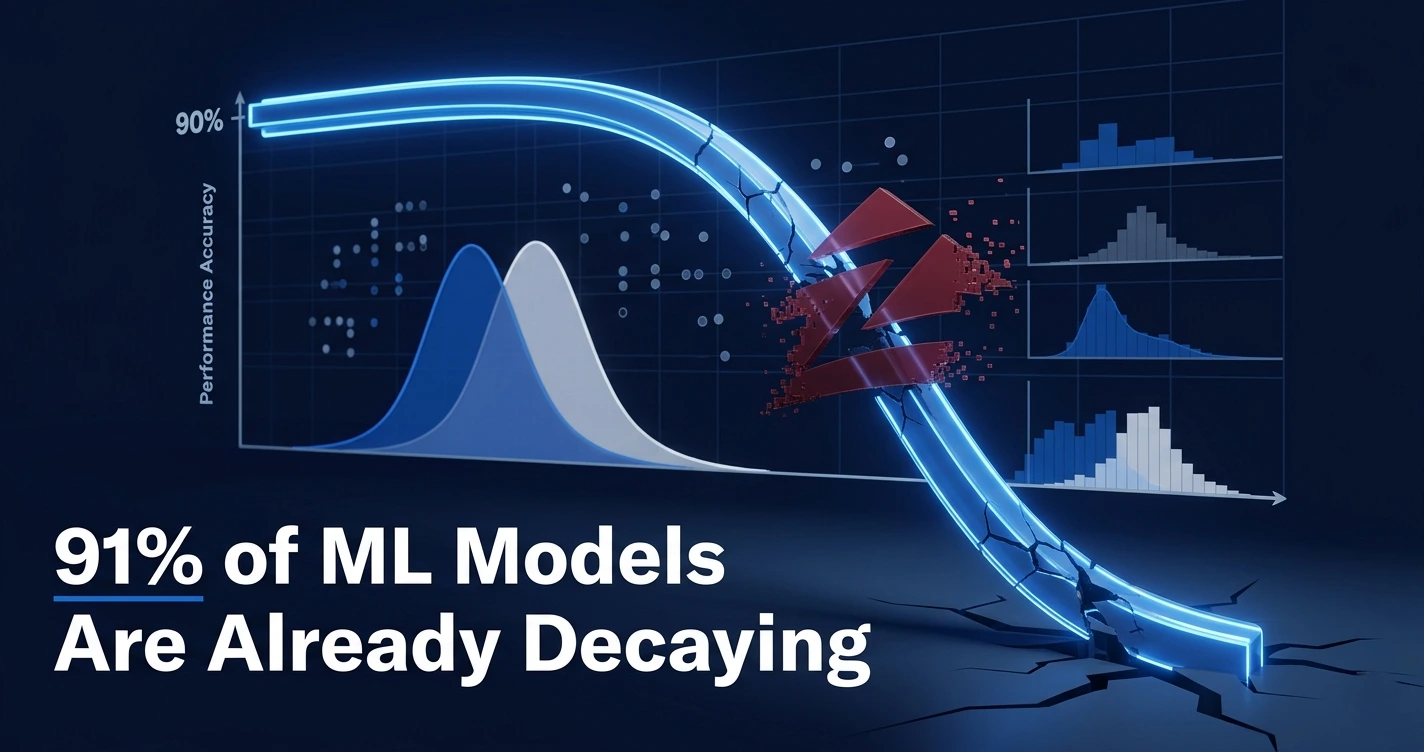
In 2022, researchers from MIT, Harvard, Cambridge, and the University of Monterrey published the most rigorous empirical study of this phenomenon to date. They tested 128 model-dataset combinations across healthcare, transportation, finance, and weather. Temporal degradation appeared in 91% of cases, despite every model starting with strong cross-validated performance.
That number is worth sitting with. Nine out of ten production ML models are on a clock the moment they go live.
91%of ML models show measurable temporal degradation over time (MIT/Harvard/Cambridge, 2022)
91%of senior executives don’t fully understand their organization’s AI dependencies (IBM/Oxford Economics, June 2026)
$500M+Zillow inventory write-down after concept drift crippled its home-buying algorithm in 2021
7%of organizations operate at the AI maturity level that protects 55% more operating profit from disruptions (IBM, 2026)
What Model Drift Actually Is
A machine learning model learns patterns from historical data. When you deploy it into production, the world keeps changing. The patterns that made your training data useful gradually stop reflecting reality. The model doesn’t know this. It keeps making predictions with the same confidence, applying old logic to new conditions it was never designed to handle.
This is model drift. The technical community also calls it model decay, temporal degradation, or AI aging. All terms describe the same structural reality: every production model has a half-life, and almost no one tracks when that clock expires.
What makes model drift particularly dangerous is that it’s invisible by design. The model’s inputs still look normal. The outputs are still formatted correctly. Your monitoring dashboard shows green. The only evidence is in the quality of the decisions, and that signal is often buried inside business outcomes that take weeks or months to surface.
Data Drift vs. Concept Drift vs. Semantic Drift
Not all model drift is the same. The category matters because the mitigation strategy is different for each.
Drift Type
What Changes
Classic Example
Detection Method
Data Drift (Covariate Shift)
Input distribution P(X) shifts; the model’s relationship logic stays valid, but it’s applied to a new population
A loan model trained on pre-pandemic applicants gets post-pandemic income profiles
Population Stability Index (PSI), Kolmogorov-Smirnov tests on feature distributions
Concept Drift
The relationship between inputs and outputs P(Y|X) changes; the logic itself becomes wrong
Zillow’s pricing algorithm trained on a rising market applied to a cooling one
The first two categories have well-established detection tooling. The latter two are, by the industry’s own admission, dramatically less monitored in practice. That gap is where the most dangerous failures are hiding in 2026’s LLM-heavy production stacks.
The $500M Case Study Nobody Can Afford to Ignore
In 2021, Zillow was running one of the most ambitious algorithmic real estate businesses ever attempted. Its “Zestimate” model would generate instant home valuations and purchase offers through Zillow Offers, buying properties directly from sellers and reselling them for a profit. The model had been trained on a market that, for most of the preceding decade, had been climbing steadily.
Then the market shifted. Rising interest rates and cooling demand changed how homes were actually priced. The algorithm didn’t adapt. It kept generating aggressive purchase offers based on pricing patterns that no longer reflected reality. The model was confidently, systematically wrong, and no one caught it in time.
The result: a $500 million-plus inventory write-down, the complete shutdown of the Zillow Offers business, and a 25% reduction in Zillow’s workforce. CEO Rich Barton publicly acknowledged the algorithm’s inability to forecast prices accurately as the central cause.
Key Takeaway
This is concept drift in its most expensive form: the input-output relationship P(Y|X) changed when market conditions shifted, and the model had no mechanism to detect or respond to that change. Zillow’s model wasn’t broken. It was just operating in a world it no longer understood.
The case is now studied in academic journals. A 2024 case study in the Journal of Information Systems Education used Zillow Offers as the defining example of algorithmic failure caused by environmental shift. The lesson isn’t that Zillow’s engineers were incompetent. It’s that drift detection wasn’t built into the operational DNA of the product.
How Big Is This Problem at Enterprise Scale in 2026
On June 17, 2026, the IBM Institute for Business Value, working with Oxford Economics, published a global study of 1,000 senior executives across 16 countries and 17 industries. The findings paint a stark picture of how exposed most organizations actually are.
“AI has introduced new forms of dependency that evolve faster than traditional governance, procurement, or technology cycles were designed to handle. Any loss of control can translate directly into margin pressure, compliance exposure, or outright business disruption.”
Ana Paula Assis, IBM Senior Vice President and Chair, EMEA and APAC — “The Calculus of AI Sovereignty,” IBM Institute for Business Value, June 2026
The study found that 91% of executives don’t fully understand their organization’s AI dependencies across vendors, models, and infrastructure. Nearly three-quarters (71%) say switching their primary AI vendor or model would be difficult. And only 7% of organizations operate at the AI maturity level that IBM defines as “advanced control.”
That 7% matters. Organizations at that maturity level protect 55% more operating profit from AI-driven disruptions than their peers. The gap between the governed minority and everyone else is measurable, significant, and widening.
“AI is everywhere, but most organizations are still figuring out how to monitor and trust these systems. That visibility gap makes scaling risky. Unlike traditional software, AI’s decision making is often hidden, making it hard to explain or trust, yet errors can cause substantial financial loss, reputational damage and regulatory scrutiny.”
Padraig Byrne, VP Analyst, Gartner — Gartner IT Infrastructure, Operations and Cloud Strategies Conference, Sydney, May 2026
The AI-based data observability software market currently sits at approximately $1.23 billion and is projected to reach $3.29 billion by 2035 at an 11.57% CAGR. This isn’t a niche tooling conversation. It’s becoming a core enterprise infrastructure category.
How to Detect Model Drift in Production
If you’re running ML models in production and you don’t have active drift monitoring, you’re flying blind. Here’s how mature teams approach it.
Statistical Input Monitoring
The foundational layer is tracking whether live input data still resembles the training distribution. The Population Stability Index (PSI) is the industry standard for this: a PSI below 0.1 signals stability, 0.1 to 0.25 warrants investigation, and above 0.25 indicates significant drift. The Kolmogorov-Smirnov test offers a complementary nonparametric check. Most mature observability platforms (Evidently, Arize, WhyLabs, MLflow) surface these metrics automatically.
Prediction Distribution Tracking
Watch for shifts in the distribution of model outputs even when inputs look stable. If your binary classifier’s confidence scores are clustering differently, or your regression model’s output range is shifting, something has changed upstream. This often catches concept drift earlier than input monitoring alone.
Ground Truth Latency Pipelines
Where you can collect delayed ground truth (actual loan defaults, real home sale prices, actual churn events), build a pipeline that feeds those outcomes back to your monitoring system. The gap between predicted and actual outcomes is the most direct signal that concept drift is active.
Business KPI Surveillance
This is the last-resort signal and shouldn’t be the primary one, but it’s worth wiring in. Unexplained drops in conversion rate, customer satisfaction scores, or revenue per model-assisted decision are downstream evidence of drift that already happened. If KPI surveillance is your only monitoring layer, you’re catching drift after it has already done damage.
Retraining Strategy
Time-based retraining schedules (retrain every quarter) are a legacy approach. Best practice in 2026 is trigger-based retraining tied to monitored metric thresholds. High-stakes streaming systems check for drift every 5 to 15 minutes. Batch systems check at each scheduled run. The trigger, not the calendar, should drive when you retrain.
“Things change over time. How do we keep models up to date with the changing world? That is why it’s important to monitor and continually update the model over time.”
Chip Huyen, Author, Designing Machine Learning Systems and AI Engineering (O’Reilly); former founder, Claypot AI — TechTarget interview
LLM-Era Drift: A Harder Problem That Current Tooling Barely Handles
Everything described above applies cleanly to classical predictive ML: a model you trained, own, and can retrain. The 2026 production reality is that most enterprise AI teams aren’t operating that way anymore.
They’re calling GPT, Claude, Gemini, or other foundation model APIs through a gateway. They don’t control the training data. They often don’t control model updates. When OpenAI silently rolls out a new model version, or when Anthropic adjusts safety behavior, the “model” your application was tuned against just changed in ways you may not notice for days.
This is the domain of semantic drift and context drift, and monitoring tooling for these categories is dramatically less mature than for classical statistical drift. A PSI test on input features won’t tell you that your LLM-based summarization pipeline has started producing shorter, less accurate summaries because the underlying model changed. Embedding cosine similarity can catch some of this, but the coverage is incomplete and the false-positive rate is high.
What this means practically: if you’re buying a “drift detection” platform in 2026, ask specifically which categories of drift it covers. A tool built for classical ML drift detection may give you clean dashboards while a silent LLM behavior change erodes your product quality. The dashboards aren’t wrong. They’re just watching the wrong thing.
For CTO and VP Engineering Readers
The decision isn’t just build vs. buy for drift detection. It’s build vs. buy for which category of drift. Classical drift monitoring (PSI, KS tests, embedding similarity) is a solved problem with good tooling. LLM and agentic drift monitoring is an unsolved problem with emerging, incomplete tooling. Budget and staff accordingly. The teams that build observability for LLM behavior now have a 12-to-24-month lead on peers who wait.
The Critical Perspective: Is Model Drift Actually the Main Villain?
Before accepting the “silent drift is killing your AI” narrative completely, it’s worth looking at the strongest challenge to it.
MIT’s Project NANDA studied 150 leadership interviews, surveyed 350 employees, and analyzed 300 public AI deployments to understand why 95% of enterprise generative AI pilots fail to deliver measurable P&L impact. Their finding: the dominant cause of failure isn’t model decay. It’s organizational and integration failure. Generic tools that don’t learn from or adapt to existing workflows. A “learning gap” between what AI can do out of the box and what enterprise processes actually require.
Lead researcher Aditya Challapally describes the 95% failure rate as “the clearest manifestation of the GenAI Divide,” and frames the root cause as companies deploying AI without the organizational infrastructure to make it work, not as models degrading after deployment.
Our read: both are true, and conflating them is a mistake. Classical predictive ML in regulated industries (financial risk models, healthcare diagnostics, fraud detection) faces genuine drift risk with serious documented consequences. The Vela et al. 91% figure is peer-reviewed and rigorous. But for many generative AI deployments, the model never worked well enough for drift to be the limiting factor. The failure happens at integration and adoption, not at temporal degradation. Know which category your deployment sits in before deciding where to invest your monitoring budget.
A second limitation worth flagging: the foundational 91% degradation statistic comes from a 2022 study conducted before the current wave of LLM-centric architectures. The study covered 128 model-dataset pairs across four industries, all in the classical supervised ML paradigm. It is robust and peer-reviewed, but it predates the reality most enterprise teams face today, where the “model” is a third-party API you don’t train or control directly. The classical mitigation strategy (retrain the model) isn’t available. The problem domain has shifted. The evidence base is still catching up.
FAQ: Model Drift in Plain Language
What is model drift in machine learning?
Model drift is the gradual decline in a deployed machine learning model’s predictive accuracy over time, caused by changes in the real-world data or relationships the model was trained on. It typically results from data drift (input distribution changes) or concept drift (the input-output relationship changes itself), and a 2022 peer-reviewed study found it affects 91% of models over time.
What is the difference between data drift and concept drift?
Data drift occurs when the statistical distribution of input data changes while the underlying relationship between inputs and outputs stays the same. Concept drift is more serious: it happens when that input-output relationship itself changes, such as when market conditions flip the logic your model learned. Concept drift is harder to detect and typically causes larger failures, as Zillow’s case demonstrates.
How often should you retrain a machine learning model to prevent drift?
Best practice in 2026 is trigger-based retraining tied to monitored performance thresholds, not a fixed schedule. High-stakes streaming systems may monitor for drift every 5 to 15 minutes. Batch ML systems typically check at each scheduled run. Quarterly retraining calendars are a legacy pattern that leaves organizations exposed between cycles.
How do you detect model drift in production?
Common methods include the Population Stability Index (PSI) and Kolmogorov-Smirnov tests for input distribution drift, tracking prediction distribution shifts for output drift, and monitoring downstream business KPIs for unexplained changes. Mature teams combine input drift signals with ground-truth outcome tracking to reduce false alarms and catch concept drift early.
What is a real example of model drift causing business losses?
Zillow’s home-buying algorithm continued generating aggressive purchase offers as the housing market cooled in 2021. This concept drift failure led to a $500 million-plus inventory write-down, the complete shutdown of Zillow Offers, and a 25% workforce reduction. CEO Rich Barton publicly attributed the failure to the algorithm’s inability to adapt to changing pricing conditions.
Does model drift affect LLMs and generative AI the same way?
Not in the same way, and monitoring for it is harder. When enterprises use third-party LLM APIs like GPT or Claude, they don’t control model updates. Silent behavior changes from the provider create “semantic drift” and “context drift” that classical statistical monitoring tools weren’t designed to catch. This is one of the least-solved problems in production AI in 2026.
What You Should Watch Over the Next 12 to 18 Months
Model drift is graduating from an MLOps edge case to a board-level risk category. The IBM/Oxford Economics data showing that only 7% of enterprises operate at the maturity level that meaningfully protects operating profit isn’t a curiosity. It’s a gap that most organizations are only beginning to understand the cost of.
Three things to act on now:
Audit which production models touch revenue or compliance decisions. Any model in that category without active drift monitoring is an unquantified liability. The Zillow loss started as an unmonitored assumption.
Distinguish between classical ML drift and LLM behavioral drift in your stack. The tooling for each is different in maturity. Don’t assume a classical observability platform covers your LLM-based products.
Track whether your AI observability investment precedes or follows your next incident. Gartner’s trajectory (15% of GenAI deployments monitored today to 50% by 2028) tells you where the industry is going. The question is whether you lead or follow.
The model that worked in March can lie to you in June. The ones that know that, and build systems to catch it, will protect the margin that everyone else loses quietly and late.
Stay Ahead of What’s Breaking in Enterprise AI
The Neural Loop delivers the signal without the noise: verified research, sharp analysis, and the findings that actually matter for technical leaders.
Subscribe to The Neural Loop
Your IT team approved three AI agents. Your security team knows about maybe a dozen. Right now, across your organization’s Slack channels, shared drives, and low-code platforms, employees are quietly spinning up dozens more. At FICO, a company with 3,500 employees, workers are creating new AI agents “at every tier of the hierarchical structure” at a pace of dozens per day. At DaVita, a kidney care company, staff have already built more than 10,000 agents internally. These aren’t pilot programs. They’re production reality.
AI agent sprawl has crossed from analyst forecast to front-page enterprise crisis. And the stakes are not theoretical: IBM’s Cost of a Data Breach Report 2025 found that shadow AI added $670,000 to the average breach cost, while making those breaches take 247 days longer to detect. The compliance deadline is even less forgiving. The EU AI Act begins enforcing high-risk AI system requirements on August 2, 2026. That’s 47 days from publication of this article. Fines reach 35 million euros or 7% of global annual revenue.
This is not a technology problem wearing a compliance hat. It’s a business risk problem with a very short runway.
150,000AI agents per avg. Fortune 500 by 2028 (Gartner)
13%of organizations with proper AI governance in place
$670KShadow AI adds to average breach cost (IBM 2025)
247days to detect a shadow AI breach on average
The Scale of the Problem: Real Companies, Right Now
In May 2026, The Wall Street Journal reported that companies including Lyft, DaVita, GitLab, FICO, and Magnum Ice Cream are actively grappling with uncontrolled AI agent proliferation. The concern is consistent across all of them: duplication, cybersecurity exposure, conflicting outputs, and compute costs that nobody budgeted for.
Mike Trkay, Chief Customer Officer at FICO, put it plainly when he told the Journal that FICO employees are creating dozens of AI agents every day across every level of the company. That’s at an organization with 3,500 people. Scale that math to a 50,000-person enterprise and the number becomes almost incomprehensible.
DaVita’s CIO Madhu Narasimhan confirmed her team has already crossed 10,000 internally-built agents. Her framing carries the tension every enterprise leader is now navigating: “Because we care for our patients, we have to scale with safety.” That’s not a sentence you’d expect to hear about software deployment. It’s a sentence you’d expect to hear from a hospital administrator. The risk profile of AI agents has changed the conversation entirely.
GitLab’s position represents the optimist pole of this debate. The company explicitly accepts short-term sprawl as the cost of competitive velocity. GitLab crossed $1 billion in ARR in FY2026 and launched its Duo Agent Platform to bake governance directly into agent deployment. Their bet: move fast, govern in parallel, stay ahead through tooling rather than restriction.
Gartner’s numbers give this a forward-looking shape. The average Global Fortune 500 company ran fewer than 15 AI agents in 2025. Gartner now predicts that figure will reach 150,000+ by 2028. That’s a 10,000x increase in three years. The companies at 10,000 agents today aren’t outliers. They’re early. The rest of the Fortune 500 is three years behind them on the same trajectory.
Key Insight
Gartner’s separate forecast, published in August 2025, projects that 40% of enterprise applications will feature embedded task-specific AI agents by the end of 2026, up from under 5% in 2025. If that holds, the agent inventory problem isn’t coming. It’s already here.
Shadow AI: The Invisible Attack Surface
Shadow AI is what happens when the permission system breaks down and nobody notices. It’s the care-coordination agent a nurse built on a low-code platform using her own EHR credentials. It’s the sales ops analyst who connected an AI agent to the CRM with his personal API key. It’s the developer who wired an internal agent to Slack via an OAuth token that was never reviewed by security.
Unlike shadow IT, shadow AI doesn’t just store files. It authenticates to enterprise systems, executes multi-step workflows, reads and writes data, calls external APIs, and operates persistently across sessions. A forgotten Dropbox folder is passive. An ungoverned AI agent is an autonomous insider with over-permissioned credentials that never sleeps.
IBM’s 2025 Cost of a Data Breach Report found that 97% of organizations reporting an AI-related breach lacked proper AI access controls. The same study linked shadow AI to 20% of all breaches in the study cohort. These aren’t edge cases. They’re the new baseline.
“In 2026, we’ll see major security incidents where sensitive IP is compromised through shadow AI systems: unapproved tools deployed by employees without oversight.”
Jeff Crume, Cybersecurity Leader, IBM Distinguished Engineer
That prediction is already being confirmed. The Q1 2026 breach record for AI systems is stark.
The Breach Record: Q1 2026
The Moltbook Platform breach, which ran from January through March 2026, exposed the velocity of agentic risk. Moltbook was a social network for AI agents hosting 1.5 million autonomous agents managed by 17,000 human operators. An unsecured database allowed anyone to hijack any agent. Security researchers at 404 Media identified 506 prompt injections spreading through the network before patching. Meta acquired the platform on March 10, 2026.
More technically significant was the hackerbot-claw supply chain attack. An autonomous attack bot exploited GitHub Actions misconfigurations, then harvested LiteLLM’s PyPI publishing token through a compromised security tool, pushing two backdoored versions of LiteLLM to PyPI. The OWASP GenAI Security Project’s Q1 2026 Exploit Round-Up catalogued the full attack chain. The damage wasn’t contained to LiteLLM. LiteLLM serves as the LLM gateway for CrewAI, DSPy, Microsoft GraphRAG, and dozens of other agent frameworks. One compromised package; enterprise-wide exposure across an entire ecosystem of agents simultaneously.
OpenClaw, an open-source AI agent with over 135,000 GitHub stars, triggered the first major AI agent security crisis of 2026 with multiple critical vulnerabilities, malicious marketplace exploits, and more than 21,000 exposed instances.
“AI components change constantly across the supply chain, creating blind spots when behavior shifts.”
Omar Khawaja, Security Advisor, Databricks
Khawaja’s point is precise: the update that patches a bug may introduce a backdoor. In a world where agents inherit enterprise credentials and operate autonomously, that’s not just a software risk. It’s a business continuity risk.
The Confidence Gap That Should Keep CISOs Awake
A March 2026 survey of 650+ senior enterprise cybersecurity leaders by the Purple Book Community and ArmorCode produced a finding that deserves to sit in every board presentation on AI risk. 90% of enterprises claim they have visibility into their AI deployments. 59% simultaneously acknowledge that shadow AI exists in their environment. That gap between claimed visibility and confirmed reality is not a rounding error. It’s a governance crisis.
“The greatest AI security threat isn’t what organizations can’t see. It’s what they can see but can’t govern fast enough to stop. The PBC State of AI Risk Management 2026 report underscores just how urgent this governance gap has become.”
Sangram Dash, CISO and VP of IT, Sisense; Purple Book Community
Zenity’s data from Fortune 50 client environments adds another layer of visibility into the problem. The average Fortune 50 enterprise carries an attack surface of 150,000+ resources tied to agents and automations. 82% of those were built by non-professional developers. The misconfigurations aren’t exceptional. They’re structural.
Separately, the AIUC-1 Consortium, a Stanford Trustworthy AI Research Lab initiative, found that 63% of employees who used AI tools in 2025 had pasted sensitive company data including source code and customer records into personal chatbot accounts. The same consortium found the average enterprise has roughly 1,200 unofficial AI applications in active use, with 86% of organizations reporting no visibility into their AI data flows.
Compliance Alert
HIPAA, PCI DSS, CMMC, SOC 2, ISO 27001, and GDPR contain no exemptions for AI agents. An ungoverned agent processing patient data, payment card information, or EU personal data is a live compliance liability, regardless of whether IT knew it was running.
Gartner’s Six-Step Framework for AI Agent Governance
On April 28, 2026, at the Gartner Digital Workplace Summit in London, Sr. Director Analyst Max Goss presented the most authoritative enterprise framework to emerge on this topic. His framing is worth quoting in full because it captures the trap enterprises keep falling into.
“Many organizations resort to blocking or restricting the use of AI agents, but this is not a long-term solution. If employees are unable to work in the sanctioned tools, they will likely go around the organization’s controls and start using shadow AI which presents far greater risks.”
Max Goss, Sr. Director Analyst, Gartner, April 28, 2026
Blocking doesn’t eliminate the risk. It relocates it to where you can’t see it. Gartner’s six-step framework is built around governance that enables, rather than restricts.
Step 1
Establish Agent Governance and Policies
Define who can build agents, what connectors are permitted, and how agents can be shared across the organization.
Step 2
Implement Agent Discovery and Inventory
Build a living catalog of every agent in the environment. You can’t govern what you can’t see. This is the starting line, not a later priority.
Step 3
Define Agent Identity, Permissions, and Lifecycle
Manage access controls and retire redundant agents. Treat agent identity with the same rigor as human identity.
Step 4
Develop AI Information Governance
Control what data agents can access. Manage permissions actively to prevent the oversharing that turns a helpful agent into a breach vector.
Step 5
Monitor and Remediate Agent Behavior
Establish continuous visibility and correct agents that exceed their intended scope before they create incidents that require notification windows.
Step 6
Foster Responsible AI Culture
Training programs and a community of practice. Employees who understand the risks are the first and best line of defense against inadvertent shadow AI.
NIST is building parallel infrastructure at the federal level. On February 17, 2026, NIST announced its AI Agent Standards Initiative, the first U.S. government framework specifically targeting autonomous AI systems. Governance is no longer a best practice recommendation. It’s becoming the legal floor.
The EU AI Act Deadline: 47 Days and Counting
August 2, 2026 is the date that should be on every enterprise legal team’s calendar in red. That’s when Annex III high-risk AI system requirements under the EU AI Act (Regulation EU 2024/1689, Article 113) become fully enforceable. High-risk AI systems include those used in employment decisions, credit scoring, educational access, and law enforcement. If your enterprise has AI agents touching any of those domains and you don’t have documentation, audit trails, and access controls in place, you are not in a grey zone. You are in violation.
Fines are structured in two tiers. Prohibited AI practices: 35 million euros or 7% of global annual revenue, whichever is higher. High-risk system failures: 15 million euros or 3% of global revenue. For a company doing $10 billion in annual revenue, that’s a potential 700 million dollar exposure from a single enforcement action.
A proposed extension to December 2027 was discussed in European Commission Digital Omnibus negotiations. The European Parliament voted in favor. As of June 2026, the extension has not been enacted. The August deadline stands. Prudent legal teams should plan for August compliance while monitoring whether the extension clears before then.
Multi-Jurisdictional Risk
Regulatory notification windows are compressing simultaneously. DORA requires 4-hour incident notification. NIS2 requires 24-hour early warning. California SB 53 sets a 15-day clock. An ungoverned agent that causes a breach creates concurrent multi-jurisdictional exposure across all three frameworks at once.
The scenario that should concentrate minds is not abstract. Consider a company with EU operations running AI agents for credit scoring, HR screening, and customer service. None are documented per EU AI Act requirements. August 2 enforcement triggers simultaneous audits across three member states. Fine exposure at that point could exceed 45 million euros, all from agents that were built by well-meaning employees on low-code platforms.
What CIOs, CTOs, and CISOs Must Do Now
The AI governance platform market tells you something about how urgent enterprises believe this is. Gartner projects governance platform spending will hit $492 million in 2026, more than doubling to over $1 billion by 2030. Money is moving into this space because the cost of not moving is now quantifiable.
For CIOs and CTOs
The governance deficit is no longer theoretical. Only 13% of organizations have appropriate AI agent governance, according to Gartner’s survey of 360 IT application leaders. The other 87% have an audit problem, a security problem, and a compliance problem running in parallel. The first concrete action is commissioning a Non-Human Identity (NHI) discovery and inventory exercise. Zenity’s data shows Fortune 50 firms already carry 150,000+ agent-linked resources. You cannot govern what you don’t know exists.
Machine identities now outnumber human identities in enterprise environments at ratios ranging from 45:1 to 100:1 according to OWASP’s Non-Human Identity Top 10 (2025). 24 million leaked NHI credentials were found on GitHub in 2025. Of those, 70% from 2022 were still valid. The agent credential problem is not a future risk. It’s an active exposure that’s been accumulating for years.
For CISOs and Security Teams
Prompt injection has moved from academic curiosity to operational threat vector. The OWASP Top 10 for Agentic Applications (2026) now covers entirely new vulnerability classes, including ASI07, ASI08, and ASI10, that don’t exist in traditional LLM risk frameworks. If your security team is working from a 2024-era threat model for AI systems, it’s already out of date.
Supply chain hygiene is no longer optional. The LiteLLM compromise demonstrated that a single backdoored package in the LLM gateway layer creates simultaneous enterprise-wide exposure across every framework that uses it. CrewAI, DSPy, Microsoft GraphRAG, and dozens of others were affected by one compromised Trivy setup at one security vendor. Treat every AI dependency in your stack with the same scrutiny you’d apply to a critical infrastructure component.
For Compliance and Legal Teams
Any AI agent embedded in your CRM that processes customer risk scores is likely a high-risk AI system under the EU AI Act’s Annex III classification. If it’s processing employee data, evaluating creditworthiness, or influencing access to services, the classification applies. The agents built by your sales ops team last quarter are not exempt because they were built by a business analyst rather than an engineer.
Risk Category
What It Means for Your Enterprise
Primary Framework
Shadow AI Data Breach
$670K average cost premium; 247 days to detect
IBM Cost of a Data Breach 2025
EU AI Act Non-Compliance
Up to €35M or 7% of global revenue per violation
Regulation EU 2024/1689
Supply Chain Compromise
One backdoored package = enterprise-wide agent exposure
OWASP GenAI Q1 2026
Prompt Injection Attack
Weaponizes your own agents against internal systems
OWASP Top 10 for Agentic AI 2026
NHI Credential Exposure
24M leaked credentials on GitHub; 70% from 2022 still valid
OWASP NHI Top 10, 2025
Multi-Agent Cascade Failure
Conflicting agent instructions create outages with no audit trail
Gartner, kore.ai 2026
The Contrarian Case: Is Sprawl Actually the Problem?
The alarm narrative has a legitimate counter-argument. GitLab’s posture is explicit: sprawl is the price of velocity, and the companies willing to accept temporary mess are the ones building durable competitive advantage. Mike Trkay at FICO treats his agents-per-day metric as a success indicator, not a warning sign. And they may both be right.
A June 2026 analysis from kore.ai puts this directly: “Sprawl is not a sign that AI adoption has failed. It is a sign that it has succeeded faster than the governance infrastructure around it could keep up. The challenge now is not to slow down adoption, but to build the systems that let it continue safely and at scale.”
Gartner’s own data creates an internal tension worth acknowledging. The same analyst firm predicting 150,000 agents per Fortune 500 by 2028 is simultaneously predicting that 40%+ of agentic AI projects will be canceled by end of 2027 due to governance and ROI failures. These two predictions exist in tension. If economic pressure self-corrects the sprawl before security incidents do, the alarm narrative overshoots.
Our read: the contrarian case is correct about velocity and wrong about risk timing. The 40% cancellation rate Gartner predicts will correct redundancy and ROI failures. It won’t correct a 247-day-undetected breach that happened nine months earlier. Economic discipline operates on a different clock than security incidents. Don’t let the former give you false confidence about the latter.
The data caveats also deserve honest acknowledgment. The 150,000 agent figure is a Gartner forecast, not a current measurement. The $670,000 breach cost premium is an average across a heterogeneous sample; individual costs vary enormously by industry and data type. The 98% unsanctioned AI use figure from Gartner and Awareways likely includes use of personal ChatGPT accounts alongside fully-autonomous enterprise agents with privileged credentials, which are meaningfully different risk profiles.
FAQ: AI Agent Sprawl and Shadow AI Enterprise Risk
What is AI agent sprawl?
AI agent sprawl is the uncontrolled accumulation of AI agents across an enterprise without centralized governance, oversight, or lifecycle management. Unlike dormant SaaS tools, ungoverned AI agents continue to access data, trigger workflows, and make autonomous decisions. Gartner predicts Fortune 500 companies will average 150,000 agents by 2028, up from fewer than 15 in 2025.
What is shadow AI in enterprise?
Shadow AI refers to AI tools, agents, and applications used within an organization without formal IT or security authorization. Unlike shadow IT, shadow AI tools don’t just store files. They ingest source code, customer records, and contracts, then process or transmit data to third-party model providers outside corporate controls. 98% of organizations report unsanctioned AI use, according to Gartner and Awareways research from 2025 and 2026.
How much does shadow AI add to breach costs?
Shadow AI adds approximately $670,000 to the average cost of a data breach, according to IBM’s Cost of a Data Breach Report 2025. These incidents also take 247 days to detect on average, significantly longer than standard breaches. 20% of breached organizations in the IBM study were compromised through unauthorized AI use.
How many AI agents does the average Fortune 500 company have?
Gartner predicts the average Global Fortune 500 enterprise will have over 150,000 AI agents in use by 2028, up from fewer than 15 in 2025, a 10,000x increase in three years. Some organizations are already well beyond early-stage deployment: DaVita has 10,000 employee-built agents today, and FICO employees create dozens more every single day.
What is the EU AI Act deadline for enterprises in 2026?
The EU AI Act’s key enforcement date is August 2, 2026, when high-risk AI system requirements under Annex III become binding. This covers AI used in employment, credit decisions, education, and law enforcement. Fines reach 35 million euros or 7% of global annual revenue for violations. A proposed extension to December 2027 has not been enacted as of June 2026.
What percentage of enterprises have AI agent governance in place?
Only 13% of organizations believe they currently have the right AI agent governance in place, according to a Gartner survey of 360 IT application leaders. A separate Purple Book Community survey of 650+ CISOs found 90% of enterprises claim AI visibility, yet 59% acknowledge shadow AI exists in their environments. That confidence gap is the governance crisis in numbers.
What are the biggest risks of AI agents in enterprise?
The top enterprise AI agent risks include: data exfiltration via over-permissioned service identities; prompt injection attacks that weaponize agents against their own systems; supply chain compromise through third-party agent components; shadow AI agents creating invisible compliance liabilities under frameworks like the EU AI Act, HIPAA, and GDPR; and cascading failures in multi-agent systems where conflicting instructions produce outages with no audit trail.
How is AI agent sprawl different from SaaS sprawl?
SaaS sprawl is passive. A forgotten subscription sits idle. AI agent sprawl is active: ungoverned agents continue to access data, trigger workflows, connect to downstream systems, and make decisions autonomously, often without human awareness. Agents are both the application and the user. They inherit credentials and move laterally across enterprise systems. The risk profile is categorically different, not merely a larger version of the same problem.
What Comes Next: The 6-to-18-Month Outlook
Three forces will shape the enterprise AI agent landscape through the end of 2027. First, governance tooling will become a procurement requirement. The AI governance platform market is growing from $492 million in 2026 to over $1 billion by 2030, and that spending will accelerate as EU AI Act enforcement produces the first major fine announcements. The first public 35-million-euro penalty will be worth more to the governance platform market than any analyst report.
Second, the Gartner 40% cancellation forecast will start materializing. Organizations that deployed agents for ROI reasons without governance foundations will either retrofit governance or shut down the programs. This self-correction won’t eliminate the risk window. It will narrow it after the fact.
Third, the only 11% of AI agent projects reach production pattern documented in our earlier analysis will look different in 2027. The 89% that currently fail will fail faster and more visibly, and the learning from those failures will produce better agent architectures in the programs that survive.
Three things to watch right now: the EU AI Act’s first enforcement actions post-August 2, 2026; whether NIST’s AI Agent Standards Initiative produces binding federal guidance or advisory frameworks; and whether the proposed Annex III extension to December 2027 is enacted before the August deadline arrives. The answers to those three questions will define the compliance and risk calculus for enterprise AI through 2028.
What you now understand that you didn’t before reading this: AI agent sprawl is not a future governance problem. It’s a present security problem with a compliance deadline attached to it. The enterprises treating it as an IT housekeeping exercise are the ones building the breach scenarios that will appear in the IBM 2026 report. The ones treating it as a board-level risk conversation are the ones building the governance infrastructure that will let them move faster, not slower, because their agents will be trusted and auditable.
Stay Ahead of Enterprise AI Risk
Get NeuralWired’s weekly briefing on AI governance, security, and enterprise strategy. No noise. No filler. Just the intelligence that matters.
Subscribe to The Neural Loop
The CTO stood at the all-hands meeting and showed the slide everyone expected: 94% of employees now have access to the company’s generative AI platform. Licenses deployed. Pilots completed. The board was happy. Six months later, the COO quietly shared a different number with the CEO: productivity in three core departments had not moved. At all.
That gap between what technology leaders believe is happening and what operations leaders actually measure is now one of the most expensive blind spots in enterprise strategy. The enterprise AI skills gap in 2026 is no longer a theoretical risk. It is the single most documented failure mode in enterprise AI deployment, backed by the largest workforce datasets ever assembled.
And the freshest data just landed. PwC published its 2026 Global AI Jobs Barometer on June 15, 2026, analyzing more than one billion job advertisements across 27 countries. The finding that should stop every CTO mid-roadmap: skills required in the most AI-exposed roles are now changing more than twice as fast as those in the least AI-exposed roles. That rate is 75% faster than the gap measured just 12 months prior.
No training program can keep pace with that velocity. Not yours. Not anyone’s. The question facing every enterprise technology leader right now is not whether to deploy AI. It’s whether their workforce can actually use it before the competitive window closes.
Key Findings at a Glance
85% of enterprise employees say AI training does not help them use AI in their actual role (Docebo, April 2026, 2,000 respondents)
12% of senior leaders say their workforce is truly AI-ready (Grant Thornton, April 2026, 1,000 U.S. business leaders)
39% vs. 7%: CIOs/CTOs who say workforce is AI-ready versus COOs who agree (Grant Thornton)
$5.5 trillion in projected global economic losses from the AI skills gap (IDC, 2026)
90%+ of global enterprises expected to face critical AI skills shortages in 2026 (IDC)
2x faster rate of skill change in AI-exposed roles versus non-exposed roles (PwC, June 2026)
50% of enterprises without a people-centric AI strategy predicted to lose top AI talent by 2027 (Gartner, May 2026)
80% of organizations piloting autonomous AI report workforce reductions. ROI does not follow (Gartner, May 2026)
The Deployment Illusion
Enterprise AI adoption has followed a remarkably consistent pattern since late 2022. Phase one was a race to deploy: who could license the most tools, touch the most departments, and announce the most AI initiatives before competitors. Workforce readiness was treated as an afterthought, a change management checkbox to handle after the tech was live.
By 2025, the consequences were undeniable. McKinsey data showed 88% of organizations were using AI in at least one business function. Only 1% had reached what McKinsey defines as “AI maturity,” where AI is systematically embedded across the enterprise rather than siloed in a handful of pilots. S&P Global reported that 42% of companies abandoned most of their AI initiatives in 2025, up from 17% the year before. The culprit was almost never the technology. It was the human layer.
The pattern has a historical precedent that should make every CTO uncomfortable. In the 1990s, SAP and Oracle ERP implementations failed at rates above 70% when organizations skipped workforce change management. The tools worked. The people weren’t ready. AI deployment is repeating that curve at roughly five times the speed.
“AI adoption is no longer the question. Nearly every organization we surveyed has it running somewhere. The question is whether people can actually use it to change how work gets done. Right now, most can’t, and that gap is the defining challenge for enterprises in 2026.”
Alessio Artuffo, CEO, Docebo Inc. (Nasdaq: DCBO) — BusinessWire, April 7, 2026
The Skills Gap Data That Actually Matters
Docebo’s AI Readiness Gap: 2026 Enterprise Learning Wake Up Call surveyed 2,000 enterprise respondents across the U.S., UK, Canada, France, Germany, and Italy. The headline is brutal: 85% of employees say the AI training they receive does not help them use AI in their actual role. Not marginally. Not in edge cases. In the vast majority of organizations running formal AI upskilling programs today, the training isn’t connecting with the work.
The failure modes are consistent. Training is generic rather than role-specific. It prioritizes AI literacy (what AI is) over AI fluency (how to use it on Tuesday morning when a real decision needs making). Seventy-nine percent of respondents report training is not personalized to their function. And critically, it’s delivered without carving out real time in the workday to complete it, which means motivated employees are squeezing it into gaps rather than applying it immediately.
Grant Thornton’s 2026 AI Impact Survey surveyed 1,000 U.S. business leaders across C-suite functions and found something that captures the scope of the problem: only 12% of those leaders say their workforce is truly AI-ready. Not “mostly ready.” Not “on the way.” Genuinely, demonstrably ready. Just 12%.
IDC’s analyst brief “Closing the Gap: Verifying AI Skills in the Enterprise” puts the economic cost on the table: over 90% of global enterprises face critical AI skills shortages by 2026, with the gap projected to cost the world economy up to $5.5 trillion through product delays, quality failures, missed revenue, and weakened competitive positioning. That’s a board-level number, not an HR metric.
Metric
Figure
Source
Date
Employees saying AI training doesn’t help them use AI
85%
Docebo
April 2026
Leaders saying workforce is truly AI-ready
12%
Grant Thornton
April 2026
Enterprises facing critical AI skills shortages
90%+
IDC
2026
Projected global economic losses from skills gap
$5.5T
IDC
2026
Enterprises that have reached “AI maturity”
1%
McKinsey
2025–2026
Leaders offering AI training who still report a skills gap
82% / 59%
DataCamp
2026
Rate of skill change: AI-exposed vs. non-exposed roles
2x faster
PwC
June 2026
One DataCamp figure from 2026 deserves particular attention: 82% of organizations say they offer AI training, yet 59% still report a significant AI skills gap. Having a program is not the same as closing the gap. The training industry has a solution. It is just frequently the wrong one.
The CTO-COO Disconnect: A Five-Times Gap in the Same Room
Here is the most operationally dangerous finding in all of the 2026 data. Grant Thornton’s AI Impact Survey asked the same question to different members of the same executive teams: “Is your workforce ready to adopt AI?” Among CIOs and CTOs, 39% said yes. Among COOs, the number was 7%.
Five times more likely. Same organization. Different answer.
This isn’t a perception gap. It’s a measurement gap with real consequences. CTOs and CIOs evaluate success by deployment metrics: tools deployed, platforms integrated, pilots launched, APIs connected. COOs evaluate success by operational output: throughput, quality, efficiency, error rates. When the tools go live but the workflows don’t change, technology leaders see a win and operations leaders see a flatline.
“Companies are making tremendous investments into AI and yet, we’re not seeing that correlate with an increase in AI accountability. Our report found that while most organizations have implemented AI solutions, many teams cannot measure its impact or respond effectively when initiatives fail.”
Tom Puthiyamadam, Managing Partner, Advisory Services, Grant Thornton Advisors LLC — BusinessWire, April 13, 2026
The same Grant Thornton survey found that 44% of CIOs and CTOs say AI is accelerating innovation at their organization. Only 20% of COOs and 22% of CFOs agree. That is not a communications problem. It is a structural accountability gap: CTOs are evaluated on deployment, not on the human outcomes downstream. Until performance metrics for technology leaders include workforce proficiency rates and AI-enabled productivity (not just AI coverage), this divergence will not close regardless of what surveys show.
Our read: this is the most important organizational design problem in enterprise AI right now. And almost no one is talking about it at the governance level.
The accountability problem in one line: More than half (55%) of CIOs and CTOs surveyed by Grant Thornton report that the majority of their core applications are not yet AI-ready, yet those same leaders remain far more optimistic than COOs about workforce readiness. The technology layer and the human layer are both behind, but only one group of leaders is measuring it accurately.
What PwC’s 2026 AI Jobs Barometer Actually Shows
The PwC 2026 Global AI Jobs Barometer, published June 15, 2026, is the most current and comprehensive labor market dataset available. It analyzed more than one billion job advertisements across 27 countries and its findings reshape the skills gap conversation in several important ways.
Skills in the most AI-exposed occupations are now changing more than twice as fast as those in the least AI-exposed roles. That acceleration itself has accelerated by 75% compared to PwC’s 2025 measurement. The pace of required skill change is not slowing. It is compounding.
What’s changing inside those roles is equally significant. New tasks added to AI-exposed positions are 2.5 times more likely to require empathy, judgment, and creativity than new tasks added to less AI-exposed roles. AI is not simplifying jobs at the top of the skills distribution. It is raising the floor on what every role requires.
The entry-level dimension of this finding should concern every organization focused on building AI talent pipelines. AI-exposed entry-level roles are now seven times more likely to require traditionally senior-level skills (leadership, cross-functional judgment, complex decision-making) than comparable roles from five years ago. Those roles grew 35% since 2019. Non-AI-exposed entry-level roles declined 10% over the same period. The junior pipeline for AI-era talent is being squeezed out of existence at the moment organizations need it most.
PwC’s Global Chief AI Officer framed the consequence clearly in commentary accompanying the report: “Across the global economy, we’re beginning to see a new divide emerge between different models for talent and value creation. The companies seeing the greatest returns on AI are using it to amplify human expertise, accelerate innovation and create entirely new sources of value.” The implicit warning: companies not doing that are on the wrong side of a widening divide.
What does the winning side look like in financial terms? Grant Thornton found that organizations with fully integrated AI are nearly four times more likely to report revenue growth compared to those still piloting: 58% versus 15%. The cost of the skills gap is not abstract. It is the difference between those two numbers.
Agentic AI Is Making This Worse, Faster
The enterprise AI skills gap would be a serious problem even if the technology were standing still. It isn’t. The shift from generative AI tools (which assist human tasks) to agentic AI systems (which execute sequences of tasks autonomously) is compressing an already tight timeline.
Gartner projects that enterprise generative AI applications with task-specific AI agents will jump from less than 5% to 40% of the market in a single year. More than 40% of agentic AI projects will be canceled by 2027, Gartner also predicts, and Forrester independently confirms that three out of four companies attempting to build agentic architectures on their own will fail.
The governance risk is specific and urgent. Grant Thornton found 54% of COOs are concerned about regulatory and compliance uncertainty related to agentic AI. Only 20% of CIOs and CTOs share that level of concern. When autonomous systems are making consequential decisions at scale, the 34-point gap in concern between technology leaders and operations leaders is not a communications problem. It is a liability exposure.
The ROI math that doesn’t work: Gartner’s survey of 350 global business executives found that approximately 80% of organizations piloting autonomous AI report workforce reductions as a result. Those reductions do not correlate with ROI gains. Reduction rates were nearly equal among respondents reporting higher ROI and those experiencing negative or flat outcomes. Cutting headcount to fund AI deployment is not a strategy. It is a budget rotation that doesn’t pay off.
“Employees with a positive outlook toward AI are 3.4 times more likely to be highly productive. The most effective drivers of positive AI adoption are employee confidence in their current and future roles, and transparent, ongoing communication about how AI will be used and its impact on jobs.”
Swagatam Basu, Senior Director Analyst, Gartner HR Practice — Gartner Press Release, May 13, 2026
Gartner’s Global Labor Market Survey (12,004 employees and managers across 40 countries, Q1 2026) found that 19% of employees reported no time savings at all from AI, despite organizational investment. Employees who use AI proficiently across multiple use cases are twice as likely to be highly productive and 2.3 times more likely to deliver high-quality work. The payoff from AI is real. It just requires actual workforce proficiency, not just tool access.
Gartner’s May 2026 prediction is the clearest warning of second-order consequences: by 2027, 50% of enterprises without a people-centric AI strategy will lose their top AI talent to competitors who prioritize workforce enablement. The organizations that most need skilled AI workers are actively building the conditions that push those workers out the door.
What Actually Closes the AI Workforce Readiness Gap
Grant Thornton’s data contains a finding that gets less attention than the scary numbers: organizations with fully integrated AI are nearly four times more likely to report revenue growth. That gap exists. The question is what separates the 58% from the 15%.
1. Audit Actual Proficiency, Not Training Completion
The 82% of organizations that offer AI training while still reporting a skills gap are measuring the wrong thing. Completion rates and licenses assigned are inputs. What matters is depth of use: can employees apply AI to their specific role tasks, reduce error rates, accelerate decision cycles? That requires role-by-role proficiency mapping, not a company-wide “AI literacy” course completion dashboard.
2. Redesign Workflows Before Deploying AI Into Them
The most common deployment failure mode is layering AI onto existing broken or inefficient workflows. AI amplifies the workflow it’s placed into, including its dysfunction. Organizations seeing the strongest productivity gains from AI have redesigned the underlying task sequence first, then built AI into the redesigned version. The order matters enormously.
3. Close the CTO-COO Perception Gap With Shared Measurement
If a CTO is measuring AI success by deployment coverage and a COO is measuring it by operational output, they will never agree on whether the investment is working. Shared measurement frameworks that include workforce proficiency depth, AI-enabled cycle time, and quality metrics (not just adoption rates) create a common language for AI ROI. Without that, the 5x perception gap compounds into 5x misaligned investment decisions.
4. Invest in Depth, Not Breadth
Deloitte’s 2026 Global Human Capital Trends data shows that 85% of leaders say building organizational adaptability is critical. Only 7% believe they’re leading on it. The gap between aspiration and execution typically traces back to a training investment strategy built around reaching everyone with a shallow introduction rather than making a subset of roles deeply proficient and letting expertise spread organically from there.
5. Build Transparent Communication Into the AI Deployment Plan
Gartner’s Swagatam Basu is explicit: the most effective drivers of positive AI adoption are employee confidence in their future roles and transparent communication about how AI will affect their work. The organizations burning AI budget on headcount reduction rather than role evolution are simultaneously destroying the psychological safety that makes AI adoption work. That’s not a people problem. It’s a leadership decision with a measurable productivity cost.
The Critical View: Three Arguments Worth Taking Seriously
The Training Industry Has a Conflict of Interest
The most alarming skills gap figures come from organizations with products to sell: Docebo (an AI learning platform), Workera (a skills verification platform), and analyst reports cited by training vendors. Their commercial interest in dramatizing the gap is real. The Grant Thornton and PwC data corroborates the core findings without that bias, which lends them credibility. But specific severity figures from vendor-funded research deserve skepticism, and the 85% and 90% numbers should be read with that in mind.
The Gap May Be a Measurement Problem
Gartner makes a point that rarely makes headlines: “Most leaders are mistaking basic access or adoption metrics for transformation.” Organizations tracking hours of training completed, licenses deployed, or pilots initiated are measuring inputs. They may be finding a “gap” that exists primarily because they’re measuring the wrong things. Shifting to output metrics could reveal that proficiency is higher than surveys suggest, while also identifying exactly where the real gaps are.
Geoffrey Hinton’s Warning: Reskilling Has Structural Limits
“We’re going to see AI get even better. It’s already extremely good. It’s already able to replace jobs in call centers, but it’s going to be able to replace many other jobs.”
Geoffrey Hinton, Turing Award Winner, former VP and Engineering Fellow, Google — CNN “State of the Union,” 2026
Hinton’s implicit argument is more structurally challenging than any survey finding: if AI capability is advancing faster than any training program can be designed, funded, approved, and deployed at scale, the “train your workforce” strategy has limits that no amount of investment can fully overcome. The skills gap may not be primarily a training failure. It may be a pace-of-change problem that reskilling alone can’t solve.
Deloitte’s data suggests organizations know this but aren’t acting on it: 85% of leaders say organizational adaptability is the critical capability for 2026. Only 7% believe they’re actually building it. If the answer to accelerating AI capability is organizational adaptability rather than static skills training, the entire training industry may be solving the wrong problem.
Frequently Asked Questions
What is the AI skills gap in 2026?
The AI skills gap in 2026 is the measurable distance between enterprise AI tool deployment and employees’ ability to use those tools to change how work gets done. IDC projects over 90% of global enterprises face critical AI skills shortages, risking $5.5 trillion in economic losses. Only 12% of senior leaders report their workforce is truly AI-ready, according to Grant Thornton’s April 2026 survey of 1,000 U.S. business leaders.
How many companies are ready for AI in 2026?
Just 12% of senior leaders say their workforce is genuinely AI-ready, according to Grant Thornton’s 2026 AI Impact Survey. McKinsey data narrows the definition further: only 1% of enterprises have reached “AI maturity,” where AI is systematically embedded across all functions rather than limited to isolated pilots.
Why is AI training failing employees in 2026?
According to Docebo’s 2026 Enterprise Learning Wake Up Call (2,000 respondents across six countries), 85% of employees say AI training does not help them use AI in their actual job. The primary failures are: training is generic rather than role-specific, not personalized (79% report this), and delivered without sufficient time in the workday for immediate application. Having a training program is not the same as closing the skills gap.
What is the cost of the AI skills gap?
IDC estimates the global AI skills gap could cost the world economy up to $5.5 trillion by 2026, driven by product delays, quality failures, missed revenue, and weakened competitive positioning. This figure is corroborated by independent data from PwC and Gartner showing massive productivity divergence between AI-ready and AI-lagging organizations.
How fast are AI job skills changing?
Skills required in the most AI-exposed jobs are now changing more than twice as fast as those in the least AI-exposed roles, per PwC’s 2026 Global AI Jobs Barometer (analysis of over one billion job ads across 27 countries, published June 15, 2026). That gap in pace has grown 75% compared to PwC’s measurement from just 12 months earlier, signaling accelerating disruption of existing competency models.
Will AI replace workers in 2026?
AI is reshaping jobs rather than eliminating them wholesale, though the pace is uneven. PwC’s 2026 Barometer shows AI-exposed companies grew their workforces 52% since 2018, compared to 36% for less AI-intensive peers. However, Geoffrey Hinton warns AI will replace many jobs beyond call centers in 2026. The clearest pattern: routine tasks automate, while human judgment roles grow but now require senior-level skills from day one.
What are the biggest barriers to AI adoption in 2026?
The top barriers to enterprise AI adoption in 2026 are lack of skilled talent (46%), data privacy concerns (43%), poor data quality (40%), high implementation costs (40%), and unclear ROI (26%), according to IDC. Grant Thornton adds a C-suite misalignment dimension: CTOs are five times more likely than COOs to say their workforce is ready, creating systematically misaligned investment decisions across the same organizations.
What You Now Know That Changes the Roadmap
The enterprise AI skills gap in 2026 is not a future problem. It is the reason 85% of current AI training isn’t working, the reason 80% of autonomous AI pilots are cutting headcount without generating ROI, and the reason only 12% of leaders believe their organizations are genuinely ready for what they’ve already deployed.
The central insight from this data is uncomfortable: the organizations measuring AI success by deployment coverage are not measuring the right thing, and most CTOs are doing exactly that. The COO in your organization, if you have one, probably has a more accurate read on actual AI-driven productivity than you do. That 5x perception gap is not a data problem. It is a metrics design problem with real budget consequences.
In the next 12 to 18 months, watch for three developments that will force this issue into board-level visibility. First, the boardroom ROI reckoning. As AI budgets face scrutiny in H2 2026 and H1 2027, organizations that can’t demonstrate workforce-level productivity gains (not just tool deployment) will face significant budget cuts. Second, the talent exodus. Gartner’s prediction that 50% of enterprises without people-centric AI strategies will lose their top AI talent by 2027 will begin registering as a competitive threat when it starts happening visibly. Third, the agentic AI liability event. With agentic AI scaling to 40% of enterprise applications, a consequential failure at an organization with inadequate human oversight is increasingly likely. It will reframe the governance conversation overnight.
Three things to act on now: audit actual workforce AI proficiency by role, not training completion rates; create a shared AI measurement framework that CTOs and COOs both sign off on; and stop funding headcount reduction as an AI ROI strategy before the next Gartner survey captures your organization in the 80% that did it and found it didn’t work.
Stay Ahead of Enterprise AI
Get The Neural Loop: NeuralWired’s weekly briefing for CTOs, CIOs, and enterprise technology leaders. No noise. Just the signal that matters.
Subscribe to The Neural Loop
By NeuralWired Research Desk | Updated June 2026 | Reading Time: 18 minutes
The conversation in boardrooms has changed. Companies are no longer debating whether artificial intelligence will transform how they work. The real question on every executive’s agenda right now is how fast they can deploy it responsibly, securely, and competitively before the gap between them and their rivals becomes impossible to close.
That shift from debate to execution is what defines the 2026 AI landscape. And the data makes the stakes brutally clear: U.S. Census Bureau figures from December 2025 through May 2026 show overall AI usage sitting between 17% and 20% of businesses, with another 20 to 23% expecting to adopt it within six months. Among firms with at least 250 employees, 37% already use AI directly in their operations. The adoption gap between large enterprises and smaller organizations is not just widening. It is becoming a structural competitive advantage.
This guide gives CEOs, founders, and senior executives everything they need to move from reading about AI to deploying it with real results.
Where AI in Business Actually Stands in 2026 (The Real Numbers)
Before building a strategy, every executive needs an accurate picture of where AI adoption genuinely stands, not the hype version, not the vendor pitch, but the government data and independent research.
Gartner forecasts worldwide AI spending at $2.52 trillion in 2026, up 44% year over year. AI infrastructure alone accounts for $1.366 trillion of that total. This is not a technology trend anymore. It is infrastructure spending at the scale of national GDPs.
McKinsey estimates that generative AI could contribute up to $4.4 trillion in annual global productivity gains across corporate use cases. That figure gets cited constantly, and for good reason. But the more important number sits underneath it: only 34% of organizations are truly reimagining how their business operates using AI. The other 66% are using it for efficiency gains while leaving the transformative opportunity on the table.
Deloitte’s State of AI in the Enterprise 2026, based on a survey of 3,235 senior leaders conducted between August and September 2025, found that worker access to AI rose by 50% in 2025. The number of companies with 40% or more of their AI projects running in production is set to double within six months. Yet 74% of organizations still only hope to grow revenue through AI, while just 20% are already doing so. Productivity gains are wide. Transformation is rare.
According to the 2026 Financial Executives Priorities Report developed by Forvis Mazars and the Financial Education and Research Foundation, 88% of large organizations now regularly use AI in at least one business function. Near-universal adoption at the surface level. Deep integration remains the exception.
The takeaway for any executive reading this: the window to build a competitive moat through AI is open right now. It will not stay open indefinitely.
The 7 Most Valuable AI Use Cases for Business in 2026
The organizations seeing the highest returns are not trying to use AI everywhere at once. They are identifying the highest-impact use cases, deploying in those areas first, and scaling what works. Here are the seven applications producing the most measurable business value right now.
1. Customer Service and Support Automation
Customer service is delivering the clearest, most consistent ROI of any AI application in 2026. The average return is $3.50 per $1 spent on AI customer service, with leading organizations hitting 8x. That ROI compounds significantly over time: 41% in year one, 87% in year two, and 124% or more by year three. Approximately 30% of customer service cases are now resolved without a human agent involved at any point.
The practical application is straightforward. AI handles tier-one inquiries, routes complex cases to the right agents with full context already surfaced, and follows up automatically. Human agents spend their time on problems that actually require human judgment.
2. Sales Forecasting and Revenue Intelligence
AI-powered forecasting tools analyze historical sales data, pipeline velocity, market signals, and customer behavior simultaneously, producing forecasts that outperform traditional models by substantial margins. Sales teams using AI-assisted forecasting consistently reduce forecast error rates while giving leadership earlier warning on deals at risk.
The competitive advantage here is speed. Organizations with accurate AI forecasting can reallocate resources faster, catch problems earlier, and make pricing decisions with better information than competitors who are still running quarterly spreadsheet reviews.
3. Supply Chain Optimization
Supply chain is one of the highest-ROI applications in the enterprise. McKinsey and Accenture data consistently show 5 to 20% reductions in logistics costs, 20 to 30% reductions in inventory, and 5 to 15% procurement savings for organizations that implement AI supply chain tools effectively.
The real-world impact includes demand forecasting that adjusts in real time to market signals, automated procurement that responds to supplier risk, and logistics routing that optimizes continuously rather than on a quarterly planning cycle.
4. Financial Process Automation
Finance teams using AI for accounts payable, reconciliation, fraud detection, and financial reporting are reclaiming significant capacity for higher-value work. Routine transaction processing, anomaly flagging, and audit preparation are the immediate targets. Beyond efficiency, AI in finance enables real-time visibility into cash flow and risk that was simply not available when those processes ran on monthly or quarterly cycles.
5. Marketing Personalization and Content Operations
Generative AI has fundamentally changed the economics of content production and campaign personalization. Marketing teams that have integrated AI into their workflows are producing more content, testing more variables, and personalizing communications at scale without proportional headcount increases.
The organizations seeing the highest marketing ROI are not using AI to replace creative thinking. They are using it to remove the mechanical work so their teams can focus on strategy, positioning, and brand decisions that require genuine human judgment.
6. Software Development and Engineering Productivity
The Duolingo and GitHub Copilot case study is one of the most concrete examples available. After integrating GitHub Copilot into its engineering workflow, Duolingo recorded a 25% increase in developer speed for engineers working in new repositories, a 10% boost for experienced staff, and a 67% reduction in median code review turnaround time. These are not projected gains. They are verified, documented outcomes from a named organization.
Engineering teams using AI coding assistants consistently report faster onboarding, lower cognitive load on routine tasks, and more time available for architecture decisions and complex problem-solving.
7. Agentic AI for Multi-Step Workflow Automation
This is the defining application of 2026 and the one that separates organizations building genuine AI capability from those still treating AI as a productivity decoration.
Agentic AI systems can complete multi-step tasks with limited human input. A sales agent can analyze pipeline data, generate a follow-up report, schedule the next outreach actions, and notify the relevant team members automatically. An operations agent can monitor inventory levels, identify shortfalls, generate purchase orders, and escalate exceptions to human review.
The AI agent market is currently valued at $10.91 billion in 2026 and projected to reach $50.31 billion by 2030, growing at a 45.8% compound annual growth rate. Gartner projects that by 2026, more than 80% of enterprises will use generative AI APIs or deploy generative AI-enabled applications in production environments, compared to only 5% in 2023.
For executives evaluating where to deploy next, agentic AI is where the largest productivity gains will come from. It is also where the largest governance risks sit. Both of those facts are equally important.
How to Implement AI in Your Business: A Practical 5-Step Framework
Over 60% of initial AI implementations fail. The reason, according to implementation data compiled across Deloitte, Gartner, and multiple enterprise case studies, is almost always the same: executives treat AI as a plug-and-play software tool rather than a fundamental organizational shift. Successful implementations see 20 to 40% productivity gains. When executed correctly, first-year ROI typically ranges from 3x to 10x the initial investment.
The difference between the organizations that succeed and those that fail comes down to how they approach implementation. Here is the framework that works.
For a detailed walkthrough of each phase with resource planning templates, see NeuralWired’s