Strategic analysis of big tech companies: Microsoft, Google, Apple, Meta, Amazon, NVIDIA, OpenAI, and more. Enterprise moves, AI investments, and competitive intelligence decoded.
Microsoft Copilot in 2026: What the Adoption Data Microsoft Won’t Advertise
420 million headline users. 15 million paid seats. An 8% voluntary adoption rate when employees get to choose. Here is the Microsoft Copilot review every CTO needs before the next renewal conversation.
By NeuralWired Editorial · June 2, 2026 · 14 min read
A CTO at a 3,000-person financial services firm told us in April that her organization had provisioned Microsoft 365 Copilot for 800 people. After six months, daily active usage sat at 29%. She had an $1.8 million annual renewal decision on her desk, no credible ROI story for the board, and a Microsoft account team in her inbox insisting this was a training problem, not a product problem.
She is not alone. The Microsoft Copilot review 2026 story is not primarily about features. It is about a $30-per-user-per-month product with an 8% voluntary adoption rate competing in a market where employees increasingly have better alternatives. The new features are real. The new pricing is aggressive. The gap between what Microsoft reports and what enterprise buyers actually experience has never been wider.
This guide cuts through it. Here is what the data actually shows, what is genuinely new, what the real ROI math looks like, and when you should walk away from the renewal table entirely.
What Microsoft Copilot Actually Is in 2026
Microsoft 365 Copilot is an AI layer embedded across Word, Excel, PowerPoint, Outlook, Teams, and SharePoint. It runs on OpenAI’s GPT-5.1 model (with a GPT-5.2 selector now available) and grounds its responses in your organization’s data through two mechanisms: Microsoft Graph (which indexes your files, emails, meetings, and chats) and a proprietary intelligence layer Microsoft calls Work IQ.
It is not included in any base Microsoft 365 license. It is always an add-on. This distinction matters enormously when calculating your actual per-user cost.
What changed in 2026 is significant: Copilot is no longer just a chat assistant embedded in your apps. With the March 2026 Wave 3 launch, Microsoft repositioned the product around autonomous agents. The Copilot you evaluated in 2023 or 2024 is genuinely different from the one on offer today, and organizations that passed on earlier versions have good reason to re-evaluate.
Pricing, SKUs, and the July Deadline
The pricing architecture has become meaningfully more complex, and there is a time-sensitive decision embedded in it.
Plan
Price
Who It’s For
Key Inclusions
Copilot Business
$18–$21/user/mo
Orgs up to 300 seats on Business plans
M365 app integration, Microsoft Graph grounding
Copilot Enterprise
$30/user/mo
M365 E3 or E5 customers
Purview compliance, full Graph grounding, governance
Agent 365
$15/user/mo
Enterprises building AI agent workflows
Agent orchestration and governance layer (GA: May 2026)
M365 E7 (Copilot Cowork)
$99/user/mo
Large enterprises needing full agentic AI
Agent 365 control plane, autonomous task delegation, Anthropic Claude integration
The critical context: Microsoft is raising base M365 pricing for some plans on July 1, 2026. Organizations currently in renewal conversations can lock in existing pricing before that date. Month-to-month billing for 1 to 300-seat organizations became available on March 1, 2026, at a 20% premium over annual rates. This flexibility is new and useful for organizations that want to run a proper pilot before committing.
Renewal Deadline Alert
If your M365 renewal falls within the next 90 days, request a usage audit from your Microsoft account team before signing anything. The number of provisioned seats you need to renew should be based on active users, not total provisioned licenses. This is a negotiable conversation, and usage data is your primary leverage.
The 2026 Copilot product is substantially different from what launched in 2023. The headline developments are worth understanding clearly, because some represent genuine capability shifts and others are still early-adoption bets.
Computer-Using Agents (GA: May 2026)
Copilot Studio now offers agents that interact with desktop applications and websites through the UI, the way a human operator would. These are not API integrations. They can navigate software that has no API, click buttons, fill forms, and extract information from legacy systems. Microsoft reports the new orchestration layer behind these agents delivers approximately 20% better evaluation performance and consumes around 50% fewer tokens than the prior architecture. That token reduction matters at enterprise scale because it directly reduces consumption-based costs.
Agent 365 (GA: May 2026)
Agent 365 is the orchestration and governance layer for deploying multiple AI agents across an organization. At $15/user/month, it sits on top of a Copilot Enterprise subscription. This is the product Microsoft is betting its enterprise AI future on. Over 120,000 custom Copilot agents have already been deployed across enterprises as of Q1 2026, and agent deployment, not seat count, is emerging as the true indicator of Copilot lock-in.
Copilot Tuning (Rolling Out June 2026)
Organizations with 5,000 or more M365 Copilot licenses can now train custom agents on their proprietary data. This is a meaningful enterprise capability that moves Copilot from generic AI assistance toward a genuinely organizational knowledge tool. It also creates a substantial switching cost: the tuning work you invest in cannot be ported to a competitor’s platform.
PowerPoint Upgrades
Three “one-click skills” reached general availability in May 2026, including a “Review this presentation” function with structural and clarity suggestions. A live meeting Copilot feature rolling out in June 2026 allows attendees to select slide text during a live PowerPoint presentation and ask Copilot to explain the content in real time. For training, sales, and executive communication workflows, this is genuinely useful.
GPT-5.2 Model Selector
Users across Android, Windows, iOS, Mac, and Web can now select GPT-5.2 in Copilot Chat for either faster responses or deeper reasoning. This model flexibility is real but requires users to understand which mode fits which task, adding a cognitive overhead that works against casual adoption.
420MMonthly active Copilot users across all surfaces (Q1 2026)
15MPaid enterprise M365 Copilot seats (Jan 2026)
3.3%Paid conversion rate from Microsoft’s 450M commercial M365 base
35.8%Active usage rate among provisioned enterprise users
The Adoption Reality No One Is Talking About
The 420 million monthly active Copilot users figure Microsoft promotes includes free-tier users on Windows, Edge, and Bing. It is a legitimate marketing metric, but it tells enterprise buyers almost nothing useful. The numbers that matter are considerably less flattering.
Of Microsoft’s 450 million commercial M365 users, only 15 million are paying for Copilot, a conversion rate of 3.3%. Of those 15 million provisioned users, only 35.8% are actively using the product. You are effectively paying for roughly one-third of the licenses you purchase to be used.
But the most important data point in any Microsoft Copilot review 2026 comes from Recon Analytics, which surveyed more than 150,000 enterprise employees. The finding is striking:
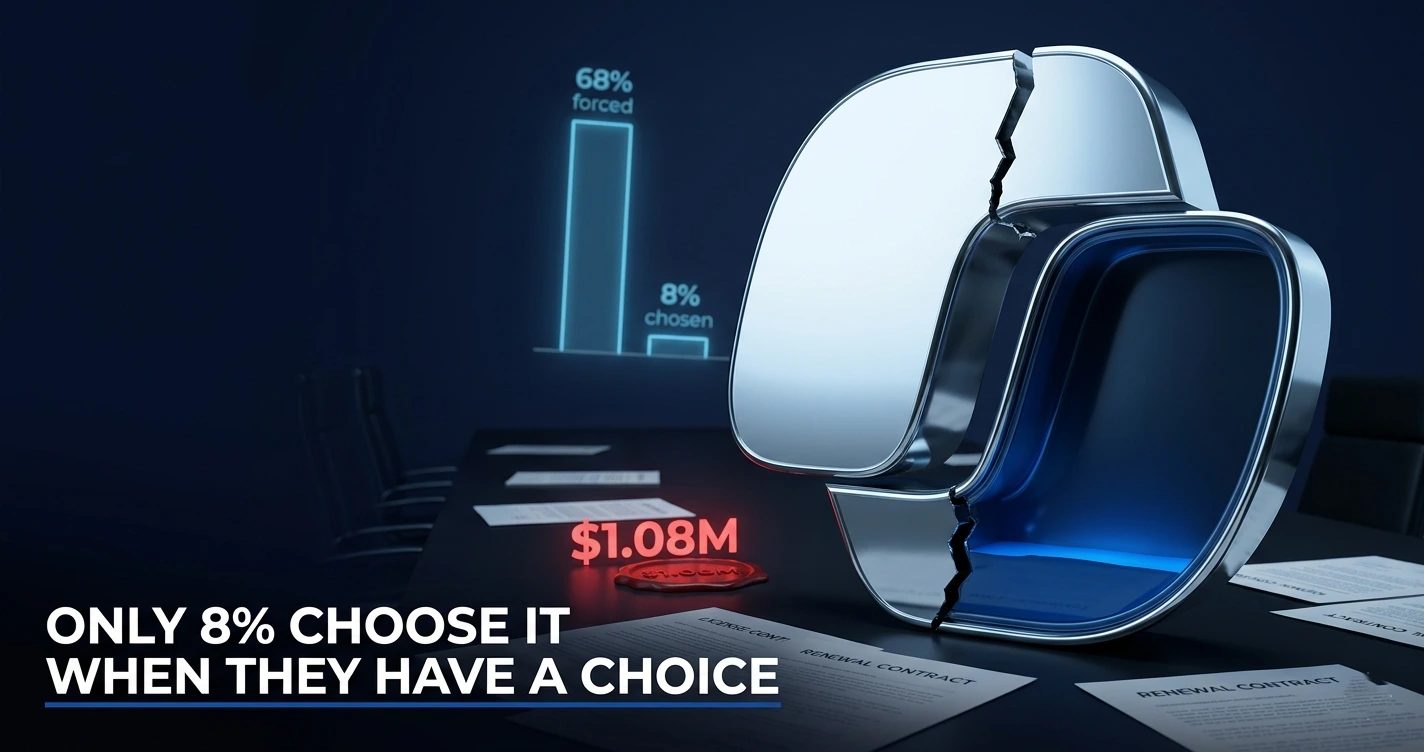
When employees have simultaneous access to Copilot, ChatGPT, and Gemini, Copilot’s active usage share falls to just 8%. When Copilot is the only tool available, adoption reaches 68%.
Recon Analytics, 2026 Enterprise AI Survey (via AI Business Weekly, April 2026)
That 60-percentage-point gap between forced adoption and voluntary preference is the single most important data point for any executive evaluating this investment. It is not a training problem. It is not a change management problem. It is a preference signal at scale.
The Trust Problem
Recon Analytics also tracks what they call an accuracy Net Promoter Score for Copilot. A negative score means users who try the product are more likely to distrust its outputs than recommend it. Copilot’s accuracy NPS was -3.5 in July 2025, then deteriorated sharply to -24.1 in September 2025, before partially recovering to -19.8 in January 2026. A product with a negative accuracy NPS is not a product that builds user confidence over time. It is one where usage peaks at provisioning and then declines as the novelty of incorrect or unreliable outputs accumulates.
What This Means for Your Pilot
Before any enterprise-wide commitment, run a 90-day pilot with a defined cohort. Measure daily active usage rate, task completion time deltas, and user sentiment directly. Do not measure license provisioning. A pilot that controls for access parity (give the cohort access to Copilot alongside their existing tools) will give you real preference data, not adoption theater.
The ROI Math: Honest Numbers
Forrester’s Total Economic Impact study for Microsoft 365 Copilot, commissioned by Microsoft, projects 144% to 353% three-year ROI with a four to six month payback period. Copilot users save an average of 3.6 hours per week on email and document tasks. These numbers are directionally useful. They are also best-case scenarios based on adoption assumptions of 30 to 40 percent active usage.
Finding ROI from Microsoft 365 Copilot to justify full-scale deployment is quite challenging. Most organizations are pausing and waiting it out to see where it makes sense.
Dan Wilson, Research VP, Gartner (Gartner IT Infrastructure Conference, Sydney)
Gartner’s data is more sobering: of organizations that had completed Copilot pilots, only 5% moved to larger deployment. Forty percent of respondents described the value as “some promise, shows potential” without being able to measure concrete ROI.
The Real Cost at Scale
For a 5,000-seat deployment on M365 E3, the Copilot add-on alone costs approximately $1.08 million per year ($18 x 5,000 x 12) at Business tier rates. Enterprise tier pushes this to $1.8 million annually. These figures do not include:
SharePoint permissions audit and remediation: typically $50,000 to $150,000 in consulting hours, requiring two to six weeks before safe Copilot deployment
Change management and training programs
Governance framework development
Ongoing consumption costs for Agent 365 if you deploy agentic workflows
Organizations on E3 pay approximately $54/user/month total (base plus Copilot). On E5, that rises to approximately $75/user/month. These are the numbers to use in your board presentation, not the $30 headline figure.
Where the ROI Actually Works
Unifi, North America’s largest aviation ground handling services provider, offers one of the most concrete Copilot Studio case studies on record. Using Copilot Studio combined with Power Platform, Unifi built a system that automates legal contract review through a combination of AI agents and deterministic workflows. The result: contract processing time dropped from days to minutes, and the system performs comparably to specialized legal technology products that cost significantly more. This is the model that generates real return: a defined, high-volume workflow with measurable before-and-after metrics, not a general-purpose chat assistant deployed across 2,000 employees.
A major European financial services organization described in Forrester’s TEI study for Copilot Studio built a conversational agent handling 60% of customer interactions, targeting a 20% reduction in escalations by end of 2026. Each escalated interaction carries a cost of €14. Even small reductions at volume produce measurable savings. The organizations driving real Copilot ROI are not using it as a chat assistant. They are building three to five high-volume workflow automations and measuring each one.
Our Read
The organizations getting ROI from Copilot in 2026 are not asking “how do we get employees to use this more.” They are asking “which three workflows, if automated, would save us the most time or money?” That is an agent-first strategy, and it requires Copilot Studio, not just Copilot Chat.
Security: The Risk That Predates the Product
The security story around Microsoft 365 Copilot is frequently misunderstood, and the misunderstanding cuts both ways. Copilot does not create new access permissions. It surfaces whatever your users already have access to. The problem is that in most enterprises, permission sprawl is significant: over 3% of business-sensitive data is shared organization-wide without appropriate controls.
AI amplifies existing oversharing. The assistant does not create new access; it exposes whatever files, emails, chats, and sites users already have, turning long-standing permission sprawl into immediate risk. Traditional controls miss AI behavior: file permissions, labels, and DLP focus on static access, not on how AI summarizes and recombines data.
Oz Wasserman, Security Researcher, OpsInSecurity (January 2026)
Privileged users, executives, IT administrators, HR teams, and finance departments with broad access become high-impact risk vectors when Copilot can instantly summarize everything they can see. The EchoLeak vulnerability (CVE-2025-32711), patched in 2025, demonstrated that Copilot’s deep Microsoft Graph integration creates novel attack surfaces that traditional security frameworks do not cover. Microsoft confirmed no active exploitation before the patch, but the vulnerability architecture it revealed is real.
The practical pre-deployment checklist for any enterprise is non-negotiable: complete a SharePoint permissions audit before enabling Copilot at scale, and configure the Data Security Posture Agent in Microsoft Purview on day one. Both steps take time (expect two to six weeks for a thorough permissions audit) and should be factored into any deployment timeline.
Microsoft Copilot vs. Google Gemini for Enterprise
For a 1,000-user enterprise deployment, Google Gemini’s total annual cost is approximately $216,000 to $324,000 lower than a comparable Copilot plus M365 configuration. When enterprise employees have access to both tools, 18% prefer Gemini versus 8% preferring Copilot as their primary tool. Gemini surpassed Copilot in paid subscriber share in late 2025, driven by Google’s aggressive Workspace bundling strategy. Copilot experienced a 39% contraction in paid subscriber share between July 2025 and January 2026.
The competitive calculus, though, is not purely about price or even preference.
Dimension
Microsoft Copilot
Google Gemini
Cost advantage
Higher; $54–$75/user/mo total on E3/E5
Lower; $216K–$324K/yr less at 1,000 users
Compliance depth
Industry-leading (Purview, ISO 27018, GDPR, EU Data Boundary)
Strong, but less mature in regulated industries
Voluntary preference
8% when alternatives available
18% when alternatives available
Best for
Deep M365 incumbents in regulated industries
Google Workspace incumbents, or fresh evaluations on cost
Real-time web grounding
Moderate
Strong native advantage
Agent ecosystem maturity
Advancing rapidly (120K+ deployed agents)
Growing but earlier stage
The honest answer: if your organization is already on M365 E3 or E5, Copilot is the economically rational AI layer because the switching cost to Google Workspace is enormous and compliance re-certification is painful. If you are evaluating from scratch, without incumbent Microsoft infrastructure, Gemini deserves equal weight in the model.
When Copilot Works. When to Walk Away.
Deploy with confidence if:
Your organization is deeply embedded in M365 E3 or E5 with no near-term plans to switch ecosystems
You have identified three to five specific high-volume workflows that Copilot Studio agents can automate with measurable ROI
You have completed or budgeted a SharePoint permissions audit before deployment
You are in a regulated industry where Purview integration and compliance depth are competitive requirements
You can commit to a 90-day pilot with usage tracking before full deployment
Push back or walk away if:
Your renewal conversation is being driven by seat count pressure from Microsoft rather than your own usage data
You cannot demonstrate active usage above 40% in any pilot cohort
Your primary use case is “give everyone access to AI chat” without a specific workflow automation target
You are in an early-stage evaluation with no existing M365 infrastructure, and cost is a primary variable
Your organization cannot dedicate internal resources to permissions remediation and change management
The Three Questions Every CTO Should Answer Before Renewal
1. What is our current daily active usage rate among provisioned users? If it is below 40%, you have a utilization problem that adding more seats will not fix. 2. Can we name three workflows where Copilot agents have delivered measurable time or cost reduction? If not, your strategy is still at the “AI for everyone” stage. 3. Have we completed a SharePoint permissions audit? If not, you are taking on amplified data risk with every new seat you provision.
A Note on the $99 E7 Tier
The Copilot Cowork E7 tier represents a 74% price increase over the M365 E5 plan ($57 to $99 per user per month). The agentic multi-step workflow capabilities it unlocks are genuinely promising. Computer-using agents only reached GA in May 2026. Asking organizations to commit at $99 per user before real-world agentic ROI data exists at scale is aggressive pricing for early-adoption risk. Unless your organization has specific use cases that require the full Agent 365 control plane and multi-model orchestration (including the Anthropic Claude integration that the E7 tier includes), the standard Enterprise tier at $30 plus Agent 365 at $15 is a more defensible commitment for 2026.
Frequently Asked Questions
Microsoft Copilot 2026: Common Questions
How much does Microsoft 365 Copilot cost in 2026?
Microsoft 365 Copilot costs $30/user/month as an enterprise add-on to qualifying M365 E3 or E5 plans, bringing total per-user costs to approximately $54 to $75 per month. A small-business tier (Copilot Business) costs $18 to $21/user/month. A premium M365 E7 tier launched in March 2026 at $99/user/month and includes autonomous agentic AI capabilities. Pricing increases for some base M365 plans take effect July 1, 2026.
Is Microsoft Copilot worth it for enterprise?
Microsoft Copilot delivers measurable ROI for organizations already on M365 that invest in permissions governance and identify specific high-volume workflow automations. Forrester’s commissioned study projects 144 to 353% three-year ROI. However, Gartner reports most organizations find ROI “quite challenging” to demonstrate at full-scale deployment, with only 5% of pilot organizations expanding to broader rollout.
What is the difference between Microsoft Copilot and Microsoft 365 Copilot?
Microsoft Copilot (free) is a general AI assistant available in Bing, Windows, and Edge. Microsoft 365 Copilot is a paid enterprise product ($30/user/month add-on) embedded in Word, Excel, Outlook, Teams, and SharePoint that accesses your organization’s internal data through Microsoft Graph. Only the paid enterprise version connects to your company’s files and communications.
How many users does Microsoft Copilot have in 2026?
Microsoft reports 420 million monthly active Copilot users across all surfaces (Windows, Edge, Bing, M365) as of Q1 2026, up 82% year-over-year. However, paid enterprise M365 Copilot seats stand at only 15 million as of January 2026, representing 3.3% of Microsoft’s 450 million commercial M365 users. Of those provisioned seats, only about 35.8% are actively used.
What are the main problems with Microsoft Copilot?
The four primary enterprise complaints about Microsoft Copilot in 2026 are: low voluntary adoption when competing AI tools are available (only 8% preference rate versus ChatGPT and Gemini), AI hallucination risks in high-stakes compliance and legal contexts, security amplification of existing data over-permissions, and a significant gap between license cost and demonstrated ROI at organization-wide deployment scale.
What’s new in Microsoft 365 Copilot in 2026?
Major 2026 updates include Wave 3 (March 2026) with autonomous Cowork capabilities and the $99 E7 tier; computer-using agents reaching GA in Copilot Studio (May 2026) with 20% better performance and 50% lower token consumption; PowerPoint one-click skills and live meeting Copilot (June 2026); Copilot Tuning for organizations with 5,000+ seats; GPT-5.2 model selector; and Agent 365 going GA (May 2026) at $15/user/month.
How does Microsoft Copilot compare to Google Gemini for enterprise?
For organizations already on Microsoft 365 E3 or E5, Copilot is the economically rational choice due to native integration and compliance depth. Gemini offers a lower total cost (roughly $216,000 to $324,000 less annually at 1,000 users) and stronger real-time web grounding. When employees can choose freely, 18% prefer Gemini versus 8% preferring Copilot as their primary tool.
What to Watch in the Next 12 to 18 Months
The Microsoft Copilot 2026 story is one of a product in genuine transition from chatbot to autonomous agent, colliding with the organizational reality that enterprises are not yet ready to govern autonomous AI at scale. The technology is advancing faster than the governance frameworks designed to contain it.
Three things to track as the year progresses. First, whether Copilot Tuning (the custom model training feature for 5,000+ seat organizations) produces the kind of measurable accuracy improvements that move the accuracy NPS out of negative territory. If it does, the lock-in case for large enterprise becomes substantially stronger. Second, whether Microsoft bundles Copilot into base M365 enterprise licenses by 2027 (as multiple analysts project). A forced-bundle move would dramatically change the commercial calculus for every organization currently deciding whether to purchase the add-on. Third, whether Agent 365 adoption data from the second half of 2026 shows genuine workflow automation ROI, or whether it follows the same pattern as Copilot Chat: heavy provisioning, thin active usage.
For any organization in an active renewal decision right now, the answer is not binary. The right question is not “should we buy Copilot” but “which three workflows justify the Copilot investment, and what does our active usage rate need to be for the math to work?” If you cannot answer that with specifics before you sign the renewal, you are not ready to commit.
Stay Ahead of Enterprise AI
The Neural Loop delivers NeuralWired’s sharpest analysis on AI, Big Tech, and what it actually means for enterprise decision-makers. No noise. No press releases. Just the signal.
Subscribe to The Neural Loop
AWS vs Azure vs Google Cloud 2026: Who’s Actually Winning the AI Race?
For the first time ever, all three hyperscalers reported Q1 earnings on the same day. The numbers rewrote the competitive story. Here’s what CTOs and engineers need to act on right now.
NeuralWired Research Desk | June 1, 2026 | 14-min read
+63%Google Cloud YoY Growth Q1 2026
$129BGlobal Cloud Spend, Q1 2026 Alone
28%AWS Market Share, Q1 2026
On April 29, 2026, something happened that had never happened before. AWS, Microsoft Azure, and Google Cloud all reported quarterly earnings on the exact same day. For anyone trying to make a rational decision about cloud infrastructure in 2026, the numbers that came out of that day changed almost every assumption the industry had been operating on.
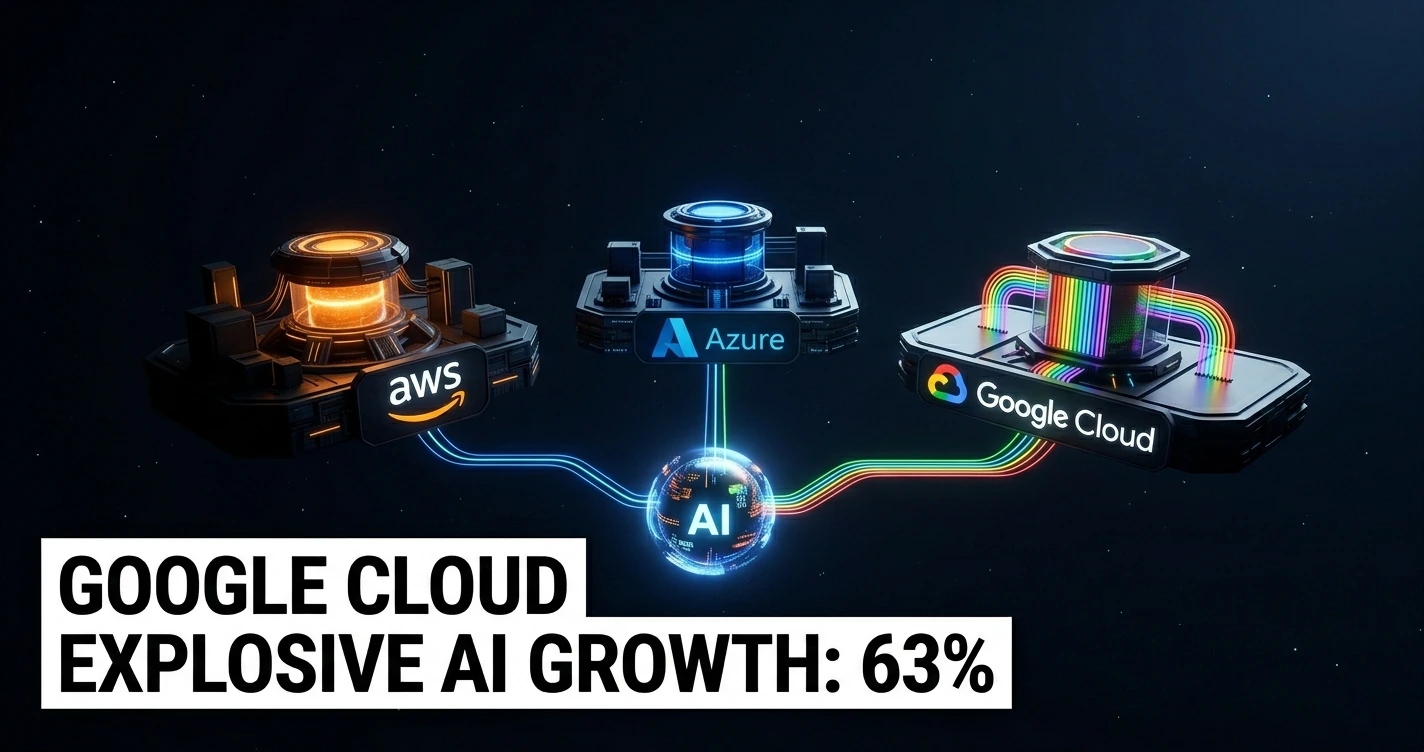
Google Cloud grew 63% year over year. AWS grew 28%. Azure grew 40%. If you’re a CTO currently locked into a 2022-era cloud agreement or an engineer deciding where to run your next AI workload, those are not abstract financial statistics. They are signals about where the AI compute ecosystem is consolidating, which platforms are scaling their infrastructure fastest, and which ones are quietly falling behind on the metrics that will define the next five years.
The AWS vs Azure vs Google Cloud 2026 comparison isn’t about who’s cheapest or who has the most data centers. Those questions were settled a decade ago. The real question now is which cloud wins your AI workload. And the answer depends almost entirely on what you’re building, which foundation models you depend on, and how much hidden cost you can absorb before you renegotiate.
This piece gives you the full picture: verified Q1 2026 data, the AI platform comparison that actually matters, the hidden cost problem getting worse every quarter, and the honest take on what each provider gets wrong that almost nobody in enterprise sales will tell you.
The Market Reality in Q1 2026
The global cloud infrastructure market hit $129 billion in Q1 2026 alone, up 35% year over year, according to Synergy Research Group. To put that in context: that single-quarter figure is larger than the entire annual cloud market was in 2019. The velocity of enterprise cloud and AI investment has moved into territory that even optimistic analysts weren’t projecting two years ago.
AWS still leads with 28% global cloud infrastructure market share. Azure sits at 21%. Google Cloud holds 14%. Together, the Big Three control more than 63% of all global cloud infrastructure spending. Every other provider, including Oracle Cloud, IBM Cloud, and Alibaba Cloud, is competing for the remaining 37%.
Key Context
At $917.9 billion in total 2026 cloud market value (Gartner), one percentage point of cloud market share is worth roughly $9 billion in annual revenue. AWS’s 7-point lead over Azure is not a minor gap. It’s approximately $63 billion in annual revenue that Azure would need to close just to reach parity.
But market share percentages are a lagging indicator. The growth rate is where the story gets genuinely interesting. Google Cloud at 63% YoY growth means its absolute revenue gap with AWS is closing faster than anyone expected. At current growth differentials, GCP reaches AWS revenue parity somewhere around 2030 to 2031. For enterprises signing 3-to-5-year contracts today, you’re potentially committing to a platform that will look very different by year three.
What the Earnings Numbers Actually Show
AWS generated $37.59 billion in Q1 2026 revenue, up from $29.27 billion the prior year. Operating income hit $14.16 billion, a 23% increase. AWS is now a $150 billion annualized business. Andy Jassy, Amazon’s President and CEO, framed it this way on the earnings call:
“AWS is growing 28% — our fastest growth in 15 quarters — on a very large base. We’re in the middle of some of the biggest inflections of our lifetime, and we’re well positioned to lead.”
Andy Jassy, President and CEO, Amazon Inc. — Q1 2026 Earnings Call, April 29, 2026
Google Cloud hit $20 billion in Q1 2026 revenue and produced $6.6 billion in operating income, up from $2.2 billion a year earlier. Its operating margin expanded to 32.9% from 17.8%, which is arguably the most significant structural change in the entire competitive landscape. Google Cloud is no longer subsidizing growth. It’s a high-margin business. Sundar Pichai confirmed on the Alphabet Q1 2026 call that enterprise AI solutions became the primary growth driver for cloud for the first time in Q1 2026.
“AI is now the largest tailwind for cloud, and our enterprise AI solutions have become our primary growth driver for cloud for the first time in Q1.”
Sundar Pichai, CEO, Alphabet Inc. — Q1 2026 Earnings Call, April 29, 2026
Azure’s exact revenue isn’t disclosed separately by Microsoft, but Azure growth of 40% sits within Microsoft’s Intelligent Cloud segment. Azure has maintained the 39-to-40% growth range for three consecutive quarters, which signals stability rather than acceleration. GPT-5 native integration across enterprise services is likely the driver keeping that number from declining, not organic workload growth at the infrastructure layer.
Full Comparison: AWS vs Azure vs Google Cloud 2026
Below is the comparison table that matters for enterprise decision-makers and engineers evaluating cloud infrastructure in 2026. Pricing shown is approximate on-demand compute; actual enterprise contract rates vary significantly.
Factor
AWS
Azure
GCP
Q1 2026 Revenue
$37.59B
Not disclosed (part of Intelligent Cloud)
$20.0B
YoY Revenue Growth
+28%
+40%
+63%
Market Share (Q1 2026)
28%
21%
14%
AI Platform
AWS Bedrock (30+ models)
Azure AI Foundry (GPT-5)
Vertex AI (Gemini + 1M context)
Proprietary AI Silicon
Trainium3 (3x faster than T2)
Relies on NVIDIA H100/H200/B200
TPU v6/Trillium
Global Regions
38 regions, 120 AZs
Sovereign + Gov Cloud regions
49 regions, 148 zones
Container Orchestration
EKS (mature, complex)
AKS (Azure DevOps integrated)
GKE (gold standard)
Compute Pricing (equiv. instance)
~$0.19/hr
~$0.19/hr
~$0.18/hr + auto sustained-use discounts
Egress Pricing
$0.02/GB inter-region
$0.02/GB inter-region
$0.01/GB inter-region
Enterprise Strength
Broadest ecosystem, ISV partners
Microsoft license integration (30-40% savings via Hybrid Benefit)
The AI Platform Showdown: Bedrock vs AI Foundry vs Vertex AI
If you’re making a cloud decision in 2026 and you’re not thinking about AI platform lock-in as the primary risk, you’re having the wrong conversation. Picking AWS today means defaulting to Bedrock. Picking Azure means defaulting to GPT-5 through AI Foundry. Picking GCP means defaulting to Gemini on Vertex. These are not equivalent platforms. And the lock-in happens at the model layer, not the compute layer.
AWS Bedrock: The Neutral Host Play
AWS Bedrock gives you access to 30+ foundation models including Claude (Anthropic), Llama, Cohere, and Amazon’s own Titan models. AWS has now committed up to $25 billion in Anthropic on top of its prior $8 billion investment, and simultaneously expanded its OpenAI partnership by $100 billion over eight years. That’s a deliberate hedge. AWS CEO Matt Garman positioned this explicitly on the Q1 2026 earnings call:
“Their production applications run in AWS, their data is in AWS, they trust the security of AWS. This is what our customers have been asking for for a really long time.”
Matt Garman, CEO, Amazon Web Services — Q1 2026 Earnings Call
The multi-model approach is genuinely useful for enterprises that don’t want to bet their AI infrastructure on a single model provider. But it’s also a signal of something else: AWS doesn’t own its AI model relationship the way Azure owns OpenAI or GCP owns Gemini. Neutrality is not the same as leadership when model quality becomes the dominant enterprise differentiator.
Risk to Watch
Our read: AWS’s model-agnostic positioning is strategically smart for 2025 and 2026, but it creates a vulnerability. If Anthropic or any of the Bedrock model providers reaches sufficient scale to offer direct enterprise contracts at competitive pricing, AWS’s AI moat shrinks substantially overnight.
Azure AI Foundry: GPT-5 as a Competitive Moat
Azure’s biggest differentiator is simple: exclusive enterprise access to OpenAI’s GPT-5. For any organization that has built workflows, products, or internal tools around GPT-4o or is planning to use o-series reasoning models, Azure AI Foundry (rebranded from Azure AI Studio in 2026) is the lowest-friction path. Add GitHub Copilot integration across all development tools, and Azure has constructed a compelling enterprise productivity stack.
But the moat has a crack. OpenAI announced a $38 billion AWS commitment expansion in Q1 2026, signaling that OpenAI is actively building infrastructure relationships outside of Azure. If OpenAI launches direct enterprise API tiers that bypass Azure’s Azure OpenAI Service, Microsoft’s primary AI differentiator gets substantially weaker. Azure’s 40% growth is healthy, but the narrative that “Azure plus OpenAI equals unbeatable enterprise AI” requires OpenAI to remain infrastructure-dependent on Microsoft. That assumption deserves scrutiny.
Google Vertex AI: The Technical Challenger
Vertex AI offers Gemini models with native BigQuery integration, AutoML, and the largest publicly available context window in any managed cloud AI service: 1 million tokens with Gemini 1.5 Pro. There is no equivalent on AWS Bedrock or Azure AI Foundry. For applications requiring full-document ingestion, long-code-base analysis, or multi-session memory, that context window matters practically.
Google also invented Kubernetes. GKE (Google Kubernetes Engine) remains the industry gold standard for managed container orchestration, which means GCP is naturally positioned for cloud-native, AI-native architectures that require both container workloads and model inference in the same infrastructure stack.
Revenue from products built on Alphabet’s generative AI models grew nearly 800% year over year in Q1 2026. Google Cloud’s backlog nearly doubled in three months. These are not incremental improvements. This is a platform finding its product-market fit at speed.
Pricing, Hidden Costs, and the 29% Waste Problem
The question “which cloud is cheapest in 2026” is almost always the wrong question. At enterprise scale, a $0.005 per GB storage difference between Azure and AWS is $5,000 per year per 100 terabytes. That’s trivially negotiable in any enterprise contract. It’s not where the real cost lives.
Cloud waste reached 29% in 2026, according to the Flexera 2026 State of the Cloud Report. Companies migrate expecting 30-to-50% savings, but costs often exceed original projections by 20 to 80% within 12 months. Egress fees alone can account for up to 45% of a project’s total cloud expenses. Nearly 95% of organizations report some form of regret about their first major hyperscaler contract.
Where the real cost differences live in 2026:
Egress fees: AWS and Azure charge $0.02/GB for inter-region data transfer. GCP charges $0.01/GB. At 500TB monthly movement, that’s $120,000 per year in savings on GCP vs the other two.
Azure Hybrid Benefit: Organizations with existing Microsoft SQL Server or Windows Server licenses save 30-to-40% on Azure compute. If your stack is already Microsoft-native, this benefit makes Azure’s effective cost competitive or superior to both peers.
GCP sustained-use discounts: Google Cloud automatically applies sustained-use discounts with no commitment required. AWS and Azure require reserved instance purchases or savings plan commitments to hit equivalent effective pricing.
AI workload unit economics: Industry analysis suggests GCP runs AI-specific workloads 5-to-10% cheaper than AWS or Azure, primarily due to Google’s TPU infrastructure reducing its dependency on NVIDIA pricing.
Multi-cloud tax: 89% of enterprises now run multi-cloud strategies, averaging 4.8 cloud providers. The FinOps overhead of managing that complexity, including tooling, engineering time, and governance, often offsets the pricing optimizations enterprises were originally seeking.
For Engineers
The simplest pricing checker available from all three providers is optimized for single-region, single-workload scenarios. Real enterprise architectures with multi-region failover, cross-service dependencies, and AI inference at scale look nothing like those calculators. Budget 25-to-40% above the listed estimate for any serious production deployment.
The Silicon Gap Nobody Talks About
The most underreported factor in the AWS vs Azure vs Google Cloud 2026 comparison is custom silicon. All three providers are spending historic amounts on AI infrastructure, but they are not spending it on the same things. And those differences compound into structural cost advantages that will matter for years.
AWS Trainium3, launched in Q1 2026, is marketed as 3x faster than Trainium2 for AI training. Amazon has stated that custom silicon is reducing its AI inference costs by orders of magnitude. The implication is that AWS can price its managed AI services cheaper than the NVIDIA spot instance market, which matters for high-volume inference workloads.
Google’s TPU v6/Trillium infrastructure is the underlying reason GCP can offer AI workloads 5-to-10% cheaper than competitors while simultaneously expanding operating margins. Custom silicon removes NVIDIA’s pricing power from the equation at the infrastructure level. Google built its TPU program specifically to avoid what is now the most expensive constraint in cloud computing: GPU availability.
Azure has no proprietary AI silicon at scale comparable to AWS Trainium or Google TPUs. It relies primarily on NVIDIA H100, H200, and B200 GPUs. This creates a structural cost disadvantage at AI scale that isn’t visible in list prices but shows up in the economics of running large inference workloads. It also means Azure is exposed to NVIDIA supply chain risk in a way that AWS and GCP are not.
All three hyperscalers are GPU-constrained regardless of their silicon strategy. AWS Q1 capex hit $43.2 billion, annualizing to over $170 billion. Google’s Q1 capex was $35.7 billion. Jassy acknowledged on the earnings call that “most of the new supplies are already spoken for.” For CTOs trying to provision large GPU clusters on any of the three platforms, timeline uncertainty is real and unlikely to resolve before late 2027 at the earliest.
The single most useful framing for the AWS vs Azure vs Google Cloud 2026 decision is this: there is no universal winner. The correct question is which platform wins your specific workload category, given your existing stack, your AI model dependencies, and your 36-month cost trajectory.
AWS Wins When…
Best For
You need the broadest model access (30+ via Bedrock), you’re running regulated workloads needing extensive compliance certifications, or you require the deepest partner ecosystem of any hyperscaler for ISV integrations.
Also Consider AWS If
Your team’s infrastructure talent is AWS-native, or you’re scaling from startup to enterprise and need the deepest marketplace of third-party tools.
Azure Wins When…
Best For
Your stack is Microsoft-native (M365, Dynamics 365, Active Directory, SQL Server). Azure Hybrid Benefit saves 30-to-40% on Windows workloads, and GPT-5 access through AI Foundry is your primary AI dependency.
Also Consider Azure If
You’re in financial services or government and need Azure’s sovereign cloud compliance infrastructure.
GCP Wins When…
Best For
You’re building AI-native applications on Gemini, you need BigQuery for analytics-heavy workloads, or you’re running container-heavy architectures where GKE’s Kubernetes heritage gives you meaningful operational advantage.
Also Consider GCP If
AI workloads represent more than 15% of your cloud spend. The 5-to-10% cost advantage plus TPU availability warrants a formal cost comparison.
Startups: The GCP Case Is Stronger Than You Think
Google Cloud’s startup credits are currently the most generous in the market. For cloud-native architectures, GKE is still the cleanest managed Kubernetes experience available. If you’re building an AI-first product in 2026 and you don’t have existing AWS infrastructure to defend, GCP deserves serious consideration. The counterargument: AWS’s ecosystem depth and talent availability remain unmatched at the point where you’re hiring your 20th infrastructure engineer.
The Multi-Cloud Reality
87-to-89% of enterprises now run multi-cloud strategies, using an average of 4.8 cloud providers. The practical pattern emerging at scale: a primary cloud handles 70-to-80% of workloads, and a secondary provider handles specific capability gaps. The most common pattern in 2026 is AWS for primary infrastructure, with GCP’s BigQuery for analytics or Vertex AI for specific model inference, sitting behind a unified gateway like LiteLLM or LangChain that abstracts the model layer from the application layer.
The Critical Take: Five Things Enterprise Sales Won’t Tell You
The standard sales narrative from all three providers involves some version of “we’re the safe choice because X.” Here’s what the actual data suggests about each of those X claims.
1. AWS’s Market Share Lead Is Real; Its AI Moat Is Not
AWS holds 28% market share and is growing at 28%. Tracy Woo, Principal Analyst at Forrester Research, was pointed about this dynamic when Garman was appointed AWS CEO:
“Selipsky’s departure is unsurprising. AWS has seen slower growth under his tenure. The generative AI movement caught AWS flat-footed, placing them at third in AI among the hyperscalers — unfamiliar territory for AWS.”
Tracy Woo, Principal Analyst, Forrester Research — via TechCrunch, 2024
Garman’s Q1 2026 results show the gap is narrowing. AWS’s Trainium3 launch and Anthropic/OpenAI dual investment strategy show a credible response. But the Bedrock neutrality play means AWS doesn’t own a model relationship the way Azure owns OpenAI or GCP owns Gemini. Neutrality is a feature until the enterprise market consolidates around two or three dominant foundation models, at which point whoever owns those relationships wins the workload allocation battle.
2. Azure’s OpenAI Lock-In Cuts Both Ways
Azure’s biggest competitive moat is also its biggest single point of failure. Exclusive GPT-5 enterprise access is a genuine differentiator today. But OpenAI is actively building direct enterprise relationships and has now committed $38 billion in infrastructure to AWS. If OpenAI builds a direct enterprise API tier that competes with Azure’s Azure OpenAI Service pricing, Microsoft loses its core AI narrative in one quarter.
3. Google Cloud’s Growth Rate Obscures Its Absolute Scale Risk
63% YoY growth at $20 billion quarterly is genuinely impressive. But Google Cloud is still less than half of AWS’s $37.6 billion. At current growth rate differentials, GCP reaches AWS revenue parity around 2030. Enterprises making three-to-five year commitments today are betting on a platform that remains a strong challenger rather than a dominant ecosystem. That’s not a disqualifier, but it’s a real factor in evaluating partner ecosystem depth, third-party tooling maturity, and enterprise support coverage.
4. Hidden Cloud Costs Are Getting Worse, Not Better
Cloud waste reached 29% in 2026. Egress fees can constitute up to 45% of project costs. Cross-region data transfer fees, Kubernetes control plane charges, and premium storage backing on Azure memory-optimized instances systematically exceed what the pricing calculators show for real enterprise architectures. The multi-cloud complexity tax is real: managing 4.8 providers averages significant FinOps overhead that often eliminates the price advantages enterprises were originally chasing.
5. The Outage Risk Is Underpriced in Every Enterprise BCP
Forrester’s formal institutional prediction for 2026, published in its Predictions 2026: Cloud Computing report: at least two major multi-day cloud outages triggered by investment diversion from legacy infrastructure toward AI GPU data centers. The 2025 AWS and Azure outages demonstrated that cascading failures in hyperscaler infrastructure take days to resolve. Business continuity plans that rely on a single provider’s published 99.99% SLA are pricing in a risk level that Forrester explicitly calls increasingly unreliable. Multi-region, multi-provider failover architecture is no longer a nice-to-have for mission-critical workloads.
Frequently Asked Questions
Which cloud provider has the most market share in 2026?
AWS leads with 28% global cloud infrastructure market share in Q1 2026, followed by Microsoft Azure at 21% and Google Cloud at 14%, according to Synergy Research Group. Together, the Big Three control more than 63% of global cloud infrastructure spending. The total Q1 2026 market was $129 billion, up 35% year over year.
Is Google Cloud growing faster than AWS in 2026?
Yes. Google Cloud grew revenue 63% year over year in Q1 2026, compared to Azure at 40% and AWS at 28%, making GCP the fastest-growing major cloud provider by a significant margin. AWS remains the largest in absolute revenue at $37.59 billion for the quarter versus GCP’s $20 billion. At current growth differentials, GCP reaches AWS revenue parity around 2030 to 2031.
What is the cheapest cloud provider in 2026: AWS, Azure, or Google Cloud?
Google Cloud typically offers the lowest list prices and automatically applies sustained-use discounts with no commitment required. On-demand compute for equivalent instances runs roughly $0.19/hour on AWS and Azure versus $0.18/hour on GCP. GCP also charges $0.01/GB for inter-region data transfer versus $0.02/GB on AWS and Azure. Azure wins for organizations with existing Microsoft licenses through its Hybrid Benefit program, which delivers up to 40% savings on Windows Server and SQL Server workloads.
Which cloud is best for AI workloads in 2026?
It depends on your AI model dependencies. AWS Bedrock gives you multi-model flexibility across 30+ foundation models including Claude and Llama. Azure AI Foundry provides exclusive enterprise access to OpenAI’s GPT-5 with Microsoft compliance integration. Google Vertex AI offers Gemini models with native BigQuery integration and a 1 million-token context window with no equivalent on either competing platform. GCP also runs AI workloads 5-to-10% cheaper than AWS or Azure due to its custom TPU infrastructure.
What is the difference between AWS Bedrock, Azure AI Foundry, and Google Vertex AI?
AWS Bedrock is a model-agnostic gateway for 30+ foundation models (Claude, Llama, Cohere, Titan), best for AWS-native enterprises needing multi-model flexibility. Azure AI Foundry, formerly Azure AI Studio, provides exclusive enterprise access to OpenAI’s GPT-5 and o-series models with deep Microsoft compliance integration. Google Vertex AI offers Gemini models with native BigQuery integration, AutoML, and the largest available context window at 1 million tokens with Gemini 1.5 Pro.
Which cloud provider is best for startups in 2026?
Google Cloud offers the most generous startup credits and the cleanest developer experience for cloud-native architectures, with GKE remaining the gold standard for managed Kubernetes. AWS has the broadest ecosystem, partner network, and deepest third-party integrations, making it the default for teams expecting to scale to significant headcount. Azure is best for startups already operating in the Microsoft 365 ecosystem. Most startups still default to AWS due to talent availability and ecosystem maturity, but GCP is the strongest challenger for AI-first applications.
What is multi-cloud and do enterprises need it in 2026?
Multi-cloud means running workloads across more than one cloud provider. 87 to 89% of enterprises now use multi-cloud strategies, averaging 4.8 providers, according to the Flexera 2026 State of the Cloud Report. It reduces vendor lock-in and enables best-fit infrastructure for specific workloads. The practical cost is FinOps overhead: managing multiple providers adds engineering complexity that often offsets the pricing benefits being sought. Most enterprise teams run a primary cloud for 70-to-80% of workloads and a secondary provider for specific capabilities.
How does AWS compare to Google Cloud for Kubernetes in 2026?
Google invented Kubernetes and Google Kubernetes Engine remains the most mature, lowest-friction managed Kubernetes experience available. AWS EKS is widely adopted and capable but adds operational complexity. Azure AKS integrates well with Azure DevOps. For teams prioritizing cloud-native container orchestration as a primary workload, GKE’s heritage and depth of platform integration gives it a meaningful practical advantage over both EKS and AKS.
What You Now Know That You Didn’t Before
The AWS vs Azure vs Google Cloud 2026 comparison is no longer a question about which platform has the most services or the best uptime SLA. It’s a question about which AI model relationship you want to be structurally dependent on, and whether you can afford the hidden costs of whichever lock-in you choose.
Google Cloud’s 63% growth and rapidly expanding operating margins signal a platform that has found its product-market fit specifically in the AI era. Azure’s GPT-5 moat is real but more fragile than it appears. AWS’s market position is durable, but its AI leadership is genuinely contested for the first time in the platform’s history.
Three things to watch or act on in the next 90 days:
If AI workloads exceed 15% of your cloud spend, run a formal cost comparison between your current provider and GCP’s Vertex AI. The TPU infrastructure and egress pricing difference may be significant at your scale.
Audit your Azure contract for OpenAI dependencies. If GPT-5 access is a core workflow driver, map what happens to that workflow if OpenAI shifts its direct enterprise pricing strategy.
Review your business continuity plan against the Forrester prediction of two major multi-day outages in 2026. Single-provider mission-critical architectures need a genuine failover strategy, not just theoretical redundancy.
Stay Ahead of the Cloud War
Get the sharpest weekly briefing on AI infrastructure, cloud economics, and enterprise tech delivered to your inbox. No padding. No hype.
Subscribe to The Neural Loop
Meta AI Tools for Business (2026): The Complete Founder & Marketer GuideNeuralWired
Big Tech · AI for Business · June 2026
Meta AI Tools for Business: The Complete 2026 Guide for Founders & Marketers
From a free AI sales agent to a $60B ad automation engine — Meta’s business toolkit is growing 10x in months. Here’s what’s real, what works, and what every founder needs to do before the free window closes.
By NeuralWired Editorial | June 1, 2026 | 14 min read
10MAI convos/week (up from 1M in Jan)
8M+Advertisers using GenAI ad tools
$60BAdvantage+ annualized revenue
+22%ROAS vs. manual campaigns (avg.)
Key Takeaways
Meta Business AI is free right now — and handling 10 million conversations per week. That free window has an expiration date Zuckerberg himself confirmed.
Advantage+ delivers +22% higher ROAS on average vs. manual campaigns, but hides enormous industry variance (1.57x to 4.39x median ROAS).
A leaked internal memo (May 28, 2026) reveals Meta is embedding engineers inside enterprise clients — a direct shot at Salesforce and Microsoft.
Meta’s December 2025 policy update allows AI conversation data to fuel ad personalization. Businesses in healthcare, finance, and legal need to read the fine print.
Creative quality now drives over 50% of Meta ad performance. The AI handles targeting; humans still need to win on creative.
Here’s a scenario that’s playing out in thousands of small businesses right now. A founder deploys Meta Business AI to their Shopify store on a Tuesday afternoon. By Friday, the AI agent is handling 40% of their inbound customer questions across WhatsApp and Instagram DMs — product specs, shipping questions, size recommendations. No developer. No monthly SaaS bill. Just a few hours in Meta Business Suite and a tool that actually converts.
That’s the pitch. And right now, the data suggests it’s real. Meta’s Business AI is facilitating 10 million conversations per week — up from 1 million in January 2026. That’s 10x growth in roughly three months. Over 8 million advertisers are already using at least one of Meta’s generative AI ad tools.
But before you hand Meta the keys to your customer relationships, there are things you need to understand about what this toolkit actually is, what it actually costs (now and later), and what Meta gets out of it. This guide covers all of it.
What Is Meta Business AI?
Meta Business AI is a free, customizable AI sales agent that businesses can deploy on their own websites and across Meta’s four major platforms — Facebook, Instagram, WhatsApp, and Messenger — from a single dashboard in Meta Business Suite.
It was announced on October 2, 2025, at Meta’s pre-holiday ad update event, and is built on Llama 4, Meta’s latest multimodal AI model, with next-generation capabilities now being powered by Muse Spark — the first model released under Meta’s newly created Meta Superintelligence Labs division.
What it does: answers product questions, handles customer objections, assists with custom orders, drives conversions, and automates sales conversations — 24/7, in multiple languages, with no coding required to set up. It started with select small businesses in 2025, expanded to EMEA, APAC, and LATAM in beta during Q1 2026, and is now broadly available.
The word “free” is accurate but misleading. More on that in the risks section.
The Full Product Suite Explained
Meta’s AI tools for business don’t live in one product. They span a stack — customer service, creative production, ad targeting, and infrastructure — that now touches every stage of the commercial funnel. Here’s what exists and what each piece actually does.
Customer Service
Meta Business AI Free
Deploy an AI sales agent across your website, WhatsApp, Instagram DMs, Messenger, and Facebook — from one dashboard. Handles FAQs, objections, and drives purchases autonomously.
Ad Automation
Meta Advantage+
Fully automated campaign management. Covers creative selection, audience targeting, budget optimization, and placement — all driven by AI. The flagship for performance advertisers.
Creative Generation
Advantage+ Creative 2025
Generates image variations, converts static product photos into multi-scene video with music and text overlays, and creates persona-targeted ad variants. No creative team required.
Messaging Commerce
WhatsApp Business AI
AI-powered click-to-message ads enabling in-thread transactions. Already surpassed $2B annual run rate in Q4 2025. Growing at 50%+ YoY in the US — Meta’s fastest-rising lower-funnel channel.
AI Infrastructure
Meta GEM + Andromeda
GEM (Generative Ads Recommendation Model) personalizes which ads each user sees. Andromeda redesigns ad matching at the infrastructure level. These are invisible to advertisers but drive platform-wide performance.
Open-Source Foundation
Llama 4 Spring 2025
Scout (lightweight) and Maverick (enterprise-grade) variants. Multimodal, multilingual, available via Hugging Face and 25+ cloud partners including Nvidia, Databricks, and Snowflake for businesses that want to build their own tools.
The Infrastructure You Don’t See
Underneath all of this sits two systems most advertisers have never heard of. Meta Lattice is an AI ranking system that improves overall ad quality — it drove a 6% lift in conversion rates in 2025. Meta Andromeda, deployed in late 2024, redesigns how ads are matched to users at an infrastructure level. Neither is controllable by advertisers. Both materially affect your results.
This matters because it means Meta’s AI is not just the tools you turn on — it’s the environment you’re operating inside. When Advantage+ “outperforms” manual campaigns, part of what you’re measuring is infrastructure optimization that would benefit any campaign on Meta’s platform.
How to Set Up Meta Business AI
If you’re running a business and haven’t deployed this yet, the setup is faster than you’d expect. No developer. No API keys. Here’s the actual path:
1
Access Meta Business Suite
Go to business.facebook.com. You’ll need a Facebook Business Page and, ideally, a connected Instagram Business account and WhatsApp Business number. If you don’t have these set up, do that first — they take about 20 minutes combined.
2
Navigate to Business AI Settings
Inside Business Suite, look for the “Business AI” or “AI Tools” section in the left navigation. This is where you build and configure your AI agent. If you don’t see it yet, it may be rolling out to your account — check back within a few days or visit Meta’s Business Help Center for eligibility.
3
Train Your AI Agent
Upload your product catalog, FAQs, return policy, and any relevant brand documents. The more structured context you give it, the better it performs. Meta’s interface walks you through this with prompts — you’re effectively creating a knowledge base the AI draws from in conversations.
4
Set Conversation Rules
Define what the AI can and can’t do autonomously: what questions it answers directly, when it escalates to a human, what offers it can make. This is critical for businesses in regulated industries — don’t let the AI make medical, legal, or financial claims without guardrails.
5
Deploy Across Channels
Enable on WhatsApp, Messenger, Instagram DMs, and your website (via a Meta-provided embed) from the same interface. You can also test the agent before going live — do this. Send it 20 of your most common customer questions and verify the answers before exposing it to real customers.
6
Monitor and Iterate Weekly
Check conversation logs and conversion data weekly for the first month. Identify where the AI fails — wrong answers, missed conversions, customer frustration signals. Update its knowledge base accordingly. The system improves with feedback loops you create manually, not just from Meta’s training.
Action: Do This Now
Meta Business AI is currently free for most businesses. Mark Zuckerberg confirmed at the Q1 2026 earnings call that monetization is coming. Getting your workflows embedded before pricing kicks in gives you a cost baseline and a competitive head-start. The free window is not permanent.
Does It Actually Work? The Performance Data
Meta’s CFO Susan Li doesn’t usually say things that aren’t legally defensible. So when she said this on the Q1 2026 earnings call, it mattered:
“More than 8 million advertisers [are] using at least one of our GenAI ad creative tools… advertisers using our video generation feature [are] seeing more than 3% higher conversion rates in tests.”
— Susan Li, CFO, Meta Platforms | Q1 2026 Earnings Call
That 3% figure is conservative — it’s the video generation tool alone. The broader performance picture across Meta’s AI tools is more significant. Here’s what the data shows:
Tool / System
Metric
Performance Lift
Source / Date
Advantage+ vs. Manual Campaigns
ROAS
+22% higher returns
Madgicx benchmarks, 2025–2026
GenAI Image Generation
Conversion rate
+7%
Meta advertiser disclosures, 2025
GEM (Instagram)
Conversion rate
+5%
Meta Q2 2025 earnings
GEM (Facebook Feed)
Conversion rate
+3%
Meta Q2 2025 earnings
Lattice Ranking System
Ad quality / conversion
+6%
Meta disclosure, 2025
Advantage+ ROAS (e-commerce median)
Return on ad spend
2.79x median (high performers: 3.5x–5.0x)
AdAmigo.ai benchmarks, Jan–Dec 2025
The Variance Problem
That +22% ROAS improvement is real — as an average. But averages hide a lot. Cross-industry benchmark data from AdAmigo.ai covering 16 industries shows median ROAS ranging from 1.57x in Beauty & Personal Care to 4.39x in Baby Products. The algorithm favors broad, high-converting creative. If you’re running niche products with small audiences or high-consideration purchases, the headline numbers don’t apply to you the same way.
This isn’t an argument against using the tools. It’s an argument for running your own incrementality tests before committing large budgets to Advantage+.
The Enterprise Pivot: Meta Is Coming for Salesforce
On May 28, 2026, a leaked internal memo changed how the enterprise software industry is reading Meta. The memo — from Naomi Gleit, one of Meta’s most senior executives — revealed the formation of a new unit called Enterprise Solutions. The plan: embed Meta engineers and product managers physically inside large corporate clients to drive AI adoption.
This is a playbook borrowed directly from enterprise software consulting. Salesforce, ServiceNow, and Microsoft have been doing it for years. Meta has never done it. The fact that they’re doing it now — after a decade of being exclusively a consumer and advertising company — signals something significant about where they believe their growth ceiling is.
CTO Andrew Bosworth, who’s running the parallel “Agent Transformation Accelerator” initiative, framed the urgency plainly in an internal memo: 2026, he said, is “a critical year” for Meta’s transformation. The company simultaneously laid off roughly 8,000 workers in May 2026 and reassigned over 7,000 employees into AI-focused roles. Meta’s Chief People Officer Janelle Gale confirmed the rationale: the restructuring was explicitly built around “AI native design principles.”
⚠ Reality Check
Meta has zero enterprise software track record. Salesforce has been selling into corporate IT for over two decades. The Enterprise Solutions unit was announced via internal memo — there are no published enterprise case studies, no client names, no revenue targets disclosed. The ambition is real. The execution is unproven. Our read: this is a shot across the bow, not a done deal.
Critical Risks Every Founder Must Understand
The tools work. The growth numbers are real. Now here’s what most coverage of Meta AI for business leaves out.
1. “Free” Is a Data Collection Strategy
Meta’s Business AI is free because Meta needs businesses to feed it data at scale before monetization. Every customer conversation a business runs through Meta’s AI trains the underlying models — for Meta’s benefit, not just yours. This is structurally identical to how Facebook gave businesses free organic reach on Pages from 2012 to 2018, built deep dependence, and then dramatically reduced organic visibility to force paid advertising.
Meta’s December 2025 policy update explicitly allows AI interaction data to be used for ad personalization. Privacy groups filed regulatory complaints immediately. Most business owners will never read that policy update. You should.
2. You’re Losing Targeting Control — Deliberately
Aaron Edwards, Founder and CEO of The Charles Group marketing agency, documented this directly when he spoke to Marketing Brew in April 2026:
“Meta has been trying to automate media buying through simplifying the process, keeping audiences broad, giving advertisers less control and levers to restrict our targeting, and recommending less ad sets per campaign. All of this is enabled through smarter algorithms that Meta says favor larger data sets to let the algorithm have more play.”
— Aaron Edwards, CEO, The Charles Group | Marketing Brew, April 2026
This isn’t a bug or a temporary inconvenience. It’s a deliberate architectural decision. The trade-off is explicit: better average performance, worse customization. For niche brands, this matters significantly. Marketers are increasingly being opted into new AI features without choosing to opt in.
3. The Ads Transparency Problem
Investor and entrepreneur Mark Cuban drew a pointed warning about where this leads. His argument: when the AI’s response is the ad surface — when a customer is talking to a business AI agent that Meta has commercial incentives to optimize — the model’s incentives change fundamentally. It doesn’t just respond. It persuades, without the user being aware that persuasion is happening. That differs structurally from a feed-based ad that users recognize and can scroll past.
4. Regulatory Exposure Is Real
Businesses in the EU deploying Meta Business AI should treat this as a live GDPR concern, not a theoretical one. Meta received a €1.2 billion GDPR fine in 2023 — the largest in the regulation’s history. If regulators determine that using customer conversation data for ad personalization violates GDPR — as privacy advocates are arguing — Meta could face forced product changes that break the core value proposition of Business AI. Businesses that built operational workflows around that tool would be caught in the disruption. Class-action litigation is already being discussed.
5. The Lock-In Is Already Happening
Deploying Meta’s AI tools isn’t just adopting software — it’s binding your commercial operations more tightly to Meta’s data infrastructure. The switching costs rise with every customer interaction logged, every workflow embedded, every product catalog uploaded. By the time monetization pricing arrives, many businesses will have no practical alternative. Zuckerberg said as much himself at Meta’s shareholder meeting in May 2025: his vision is a world where any business inputs an objective, connects their bank account, and “we just do the rest for them.” Understand what “the rest” entails before you sign up for it.
Meta AI vs. Competitors: 2026 Comparison
Feature / Criteria
Meta AI Tools
OpenAI / ChatGPT for Business
Google AI (Ads + Gemini)
Salesforce Einstein
Customer AI Agent
Free (for now), no-code, multi-platform
Via API — requires developer setup
Limited; Google Business Profile AI
Enterprise-tier, high setup cost
Ad Automation
Advantage+ — most mature, $60B ARR
No native ads platform
Performance Max — comparable capability
Ad Cloud — strong but siloed
Creative Generation
Image, video, music, multilingual
DALL-E via API; no ad-native workflow
Imagen 3; integrated with Google Ads
Limited; relies on partners
Distribution Reach
4 billion users across 4 platforms
No owned distribution
Strong (Search + YouTube)
No consumer platform
SMB Accessibility
Very high — no-code, free tier
Medium — API-dependent
High — Google Ads integration
Low — enterprise pricing
Advertiser Control
Declining — deliberately narrowing
High (API = full control)
Medium — similar Advantage+ dynamic
High — deep CRM customization
Privacy Risk Level
High — cross-platform data fusion
Medium — enterprise data controls available
Medium — strong EU compliance history
Low — enterprise compliance standards
Open-Source Option
Yes — Llama 4 (Hugging Face, 25+ cloud partners)
No
No
No
The honest summary: Meta wins on distribution, SMB accessibility, and ad automation maturity. OpenAI wins on model capability and developer control. Google is the closest competitor on advertising automation. Salesforce owns the enterprise CRM space Meta is now entering. For founders trying to drive immediate revenue at low cost, Meta’s toolkit is genuinely hard to match today. For businesses that need control, privacy compliance, or enterprise-grade architecture, the alternatives deserve serious evaluation.
FAQ: Meta AI Tools for Business
What is Meta Business AI?
Meta Business AI is a free, customizable AI sales agent launched in October 2025 that businesses can deploy on their own websites and across Facebook, Instagram, WhatsApp, and Messenger from Meta Business Suite. It handles customer questions, assists with purchases, and automates sales conversations — with no coding required to set up. It’s currently available to small and medium businesses globally, with broader rollout ongoing through 2026.
How much does Meta Business AI cost?
Meta Business AI is currently free for most small and medium businesses. Meta’s Advantage+ ad tools are included within Meta Ads Manager — you pay for ad spend, not the software. However, Zuckerberg explicitly confirmed at the Q1 2026 earnings call that monetization is coming. Treat the current free access as a temporary window and establish your baseline before pricing changes.
What is Meta Advantage+ and how does it work?
Meta Advantage+ is Meta’s AI-powered advertising automation system. Advertisers provide a campaign objective and creative assets; Meta’s AI automatically handles audience targeting, creative selection, budget allocation, and bid optimization. Independent benchmark data shows Advantage+ campaigns deliver 22% higher returns on ad spend than manually managed campaigns on average — though results vary significantly by industry and creative quality.
Is Meta AI good for small businesses?
For most small businesses, Meta AI tools offer genuine advantages — particularly the free Business AI agent and GenAI creative tools that generate ad variants without a production budget. Median e-commerce ROAS on Meta Advantage+ in 2026 is 2.79x. The trade-offs are reduced targeting control, dependence on Meta’s ecosystem, and significant performance variance by industry. The tools work best for businesses with broad audiences and high-quality visual creative assets.
What is Meta’s Enterprise Solutions unit?
Meta’s Enterprise Solutions is a newly formed internal unit, revealed via a leaked internal memo in May 2026, that embeds Meta engineers and product managers directly inside large corporate clients to drive adoption of Meta’s AI tools. It runs alongside Meta’s Agent Transformation Accelerator initiative and is being built into a broader workforce restructuring that affects approximately 20% of Meta’s workforce. No enterprise client names or case studies have been made public yet.
What are the privacy risks of using Meta AI for business?
Businesses using Meta AI tools expose customer interaction data to Meta’s advertising personalization systems under the December 2025 policy update. Privacy advocates have filed regulatory complaints, class-action lawsuits are being discussed, and businesses in the EU face potential GDPR exposure. Companies in regulated industries — healthcare, finance, legal — should review Meta’s data processing terms carefully before deployment and consider whether customer conversation data could constitute protected information under applicable law.
What is Llama 4 and can businesses use it independently?
Llama 4 is Meta’s latest AI model family, released in spring 2025. Scout (lightweight) and Maverick (enterprise-scale) variants are available for business use via Hugging Face and over 25 cloud partners including Nvidia, Databricks, Groq, and Snowflake. It supports text, images, and multilingual inputs, and can be fine-tuned on proprietary business data. This is Meta’s open-source offering — it gives businesses a path to use Meta’s AI infrastructure without being fully dependent on Meta’s advertising platform.
How does Meta AI for advertising compare to Google’s Performance Max?
Both Advantage+ and Performance Max automate the core functions of advertising — targeting, bidding, creative selection, and placement — and both have drawn similar criticism for reducing advertiser control. Meta’s primary advantage is its social and messaging distribution (Facebook, Instagram, WhatsApp, Messenger). Google’s advantage is search intent, which captures demand rather than creating it. For most businesses, these are complementary channels rather than direct replacements for each other.
What to Do Right Now
Here’s where this lands, practically, for the two audiences reading this.
If You’re a Founder or SMB Owner
Deploy Business AI this week. The free window has a stated end date. Getting your customer workflows embedded now means you establish the baseline before pricing arrives and your competitors catch up.
Test WhatsApp Business as a transactional channel. WhatsApp paid messaging surpassed $2B ARR in Q4 2025 and is growing at 50%+ YoY in the US. Most SMBs aren’t using it yet. That’s an early-mover advantage.
Read Meta’s data processing terms before you deploy. The December 2025 policy update is the one that matters. If you’re in healthcare, finance, or law, get a legal review first.
Don’t build on Meta’s AI exclusively. The Facebook Pages precedent from 2012–2018 is instructive. Use Llama 4 via third-party cloud partners (Databricks, Snowflake, Groq) if you want to access Meta’s model capabilities without total platform dependency.
If You’re a Marketer or Agency
Export your last 90 days of Meta performance data now. Establish pre-AI-automation baselines before you move budget to Advantage+. You can’t diagnose variance without a benchmark.
Invest in independent attribution. Advantage+ is a black box — you cannot see what the algorithm is doing. Tools like Triple Whale or Northbeam are now mandatory, not optional, for any business spending meaningfully on Meta.
Make creative your competitive moat. Meta’s AI handles targeting. With 8 million advertisers on the same automated system, targeting is becoming a commodity. Creative quality now drives over 50% of ad performance. That’s where agencies that survive will earn their fees.
Watch the Enterprise Solutions rollout closely. Meta embedding engineers inside large clients is a direct threat to agency relationships with those same clients. If you serve enterprise accounts, this is the story to track.
The 12–18 Month View
The trajectory here is clear, even if the timeline isn’t. Meta will monetize Business AI. The free window will close. Paid subscriptions for Meta’s AI chatbot are already being tested across Facebook, Instagram, and WhatsApp. The Enterprise Solutions unit will produce its first verifiable case studies — or it won’t, which will itself tell us something important about whether Meta can actually operate in enterprise environments.
What’s less certain: EU regulatory response. If GDPR enforcement determines that AI conversation data flowing into ad personalization constitutes a violation, the products will change significantly for European users. And full advertising automation — Zuckerberg’s vision of a business inputting an objective and Meta “doing the rest” — is likely further out than Meta’s public statements suggest. Marketing Brew spoke to practitioners in April 2026 who called full automation “likely much further off” than the headline timeline implies.
The tools are real. The growth is real. The risks are real. The founders and marketers who engage with all three — rather than just the first two — will be the ones who get this right.
Three Things to Watch
1. The first Meta Enterprise Solutions case study. When it drops, it will either validate Meta’s enterprise ambitions or expose how hard this transition actually is.
2. EU regulatory action on AI conversation data. If privacy enforcers act on the December 2025 policy update, it changes the product’s value proposition in Europe materially.
3. When “free” ends for Business AI. Zuckerberg said it’s coming. Watch Meta’s Q3 and Q4 2026 earnings calls for signals on monetization structure and pricing.
Stay Ahead of What’s Next
The Neural Loop covers AI for business every week — no noise, just what founders and marketers actually need to know.
Subscribe to The Neural Loop →
Apple Intelligence Features 2026: The Complete Guide Before WWDC26 Changes Everything
Apple promised a smarter Siri in 2024. Then 2025. A $250 million lawsuit later, here’s exactly what Apple Intelligence can do right now — and what’s riding on June 8.
NeuralWired Research Desk·May 31, 2026·15 min readPre-WWDC26
What Apple Intelligence Actually Is
Apple Intelligence is not an app. That distinction matters more than it sounds.
Announced at WWDC 2024 on June 10, 2024, and first deployed in October 2024 with iOS 18.1, Apple Intelligence is a personal AI system woven directly into the operating system — iOS, iPadOS, macOS, watchOS, and visionOS. It reads your emails, knows your calendar, understands your messages, and can act across apps. All without the data leaving Apple’s controlled infrastructure, at least in theory.
The architecture runs on two rails. Simple, fast tasks — rewriting a sentence, summarizing a note — happen entirely on-device using a roughly 3-billion-parameter model. More complex requests route to Private Cloud Compute (PCC): Apple-designed servers running Apple silicon, with cryptographic guarantees that your data is processed but never stored or seen by Apple employees. Independent security researchers can audit and verify these guarantees.
That two-tier design was the core differentiator. Then came the Google deal, and the architecture got considerably more complicated — more on that below.
~80%
of eligible US iPhone users have used Apple Intelligence (Morgan Stanley, Apr 2025)
1.5B
Siri requests per day — the infrastructure AI touches
2.3B
Active Apple devices globally — the addressable reach
Every Apple Intelligence Feature in iOS 26
iOS 26, launched at WWDC 2025, added over 20 new Apple Intelligence features. Here’s what’s actually available to you right now — no “coming soon” asterisks on these.
Writing Tools
The most mature Apple Intelligence feature. Available across Mail, Notes, Messages, Safari, and many third-party apps via the contextual menu — select any text, tap Writing Tools, and choose from Proofread, Rewrite, or Summarize. Simple edits run on-device. Complex rewrites route to PCC. It works reliably, and it’s the feature that quietly made Apple Intelligence worth enabling.
Visual Intelligence
Point your camera at anything — a restaurant, a product, a sign — and iOS identifies it, lets you search it, add calendar events, or ask ChatGPT about it. Screenshots now carry a triple-action bar: Ask ChatGPT, Image Search, Add to Calendar. It’s the most practically useful new addition for everyday iPhone users.
Live Translation (New in iOS 26)
Real-time, two-way translation built into Messages, FaceTime, and Phone. No app switching, no third-party service. It works while the conversation happens. For anyone regularly communicating across languages, this is the feature that makes iOS 26 feel genuinely different.
Image Generation Suite
🎨
Image Playground
Generate images from text or emoji prompts. Now available as custom conversation backgrounds in Messages.
😊
Genmoji
Create custom emoji from text descriptions — your face, your dog, your inside joke rendered as a tap-able reaction.
🧹
Clean Up
Remove unwanted objects from photos with AI-powered inpainting. Replaces what was there with plausible background.
🎞️
Memory Movies
AI-generated photo slideshows with music, transitions, and narrative structure — built from your Photos library.
Siri Enhancements (iOS 26)
Type to Siri — double-tap the bottom bar for silent interaction — is genuinely useful. Siri now retains context across a session and can walk you through device settings step by step. The ChatGPT handoff is user-controlled and permission-gated: Siri asks before sending anything to OpenAI.
What’s not here yet: onscreen awareness and personal context (reading your actual emails and calendar to answer complex questions). Those remain in development. They’re the features Apple promised in 2024. More on the saga below.
Messages Intelligence
Natural language search across your message history, photos, and shared links. Automatic poll suggestions when a group conversation is circling a decision. Conversation backgrounds via Image Playground. Small features, but they make a long-standing messaging app feel genuinely new.
Notification Summaries
Apple expanded notification summaries to all apps, including News and Entertainment — categories it had previously blocked after a documented hallucination incident in early 2025 (see the Critical Perspective section). The summaries are better now. Better is not the same as fixed.
Adaptive Power Mode
AI-driven battery optimization that learns your usage patterns and extends battery life accordingly. Lower-profile than the other features, but real, measurable, and appreciated by anyone who’s stared at 12% battery at 3 p.m.
Accessibility Features (Coming Later in 2026)
Apple announced on May 19, 2026, a suite of AI-powered accessibility updates arriving later this year. These include an enhanced VoiceOver that reads bills, photos, and personal documents in detail; Live Recognition on iPhone for real-time camera-based object identification; Voice Control powered by Apple Intelligence; on-device generated subtitles for uncaptioned video; and wheelchair eye-control integration for Vision Pro. Per the Apple Newsroom announcement, these build on the company’s 40-year accessibility track record — and for once, the AI application is genuinely unambiguous in its value.
“These features build on 40 years of accessibility innovation at Apple.”
— Sarah Herrlinger, Senior Director, Global Accessibility Policy & Initiatives, Apple Inc.
The Google Gemini Deal: What It Means for You
On January 12, 2026, Apple and Google announced something that would have been unthinkable three years ago: a multi-year partnership where Google’s Gemini AI models will power a rebuilt Siri and Apple’s next-generation Foundation Models.
This is the biggest third-party AI infrastructure deal Apple has ever made — and the financial terms alone tell you how serious the situation was. Bloomberg’s Mark Gurman estimates the Gemini license costs Apple approximately $1 billion per year. Other reports, including those citing IT之家, put the figure closer to $10 billion annually. Apple has not officially confirmed either number.
What is confirmed: the Gemini model backing iOS 26.4’s Siri features runs under the internal designation Apple Foundation Models v10 and uses a 1.2-trillion-parameter architecture — a dramatically different scale from the on-device 3-billion-parameter model. Apple states this runs on its own Private Cloud Compute servers, with Gemini’s model weights hosted by Apple — not Google. User data, per Apple’s claim, does not touch Google’s infrastructure.
Google Cloud CEO Thomas Kurian confirmed the partnership at Google Cloud Next 2026, calling Google Apple’s “preferred cloud provider.” That phrase — used by Google executives, not Apple — is the detail that should make privacy-conscious enterprise IT teams pause.
Our Read
Apple’s move to Gemini isn’t a technology partnership — it’s an admission. Internal AI chief John Giannandrea’s departure coincided almost exactly with the announcement. Apple spent billions building an in-house AI team and couldn’t ship a working Siri upgrade in two years. Gemini is the escape hatch. Whether it works is what WWDC26 will begin to answer.
The full chatbot-style Siri — internally called Apple Foundation Models v11 — is expected to arrive with iOS 27 in fall 2026, likely previewed at the June 8 keynote. Bloomberg’s Gurman reports it may run on Google’s own cloud infrastructure for advanced queries, which would represent a significant departure from Apple’s privacy architecture — and a gap in its own messaging that hasn’t been publicly addressed.
Enterprise Note
For organizations in regulated industries — healthcare, finance, legal — the data routing under the Gemini-powered Siri architecture is not yet fully clarified publicly. Apple says data doesn’t reach Google; Google says it’s Apple’s preferred cloud provider. Those two statements need reconciliation before broad enterprise iPhone 17 rollouts. Update your MDM policies and ask your Apple enterprise rep for written architectural clarification before WWDC26.
Device Compatibility & Language Support
Device
Minimum Requirement
Notes
iPhone
iPhone 15 Pro / 15 Pro Max or any iPhone 16 / 17
Standard iPhone 15, 14, 13 and older: excluded
iPad
iPad mini (A17 Pro) or any iPad with M1 chip or later
Older iPads without M-series chip: excluded
Mac
Any Apple Silicon Mac (M1 and later)
All Intel Macs: excluded from on-device AI
Apple Watch
Series 10+ and Ultra 3
Requires pairing with Apple Intelligence-enabled iPhone
Apple Vision Pro
visionOS 26 and later
—
As of iOS 26.1, Apple Intelligence supports 16 languages: English, Danish, Dutch, French, German, Italian, Norwegian, Portuguese, Spanish, Swedish, Turkish, Chinese (Simplified), Chinese (Traditional), Japanese, Korean, and Vietnamese. Available in most regions worldwide — with one hard exception: mainland China, where Apple Intelligence is entirely unavailable. Source: Apple Support.
Key Takeaway
With 1.56 billion iPhone users globally, the Apple Intelligence-eligible pool is a fraction of the total installed base. Anyone on a standard iPhone 15, iPhone 14, or older is entirely excluded — regardless of OS version. This is the most underreported constraint in Apple’s AI story.
The $250M Lawsuit and the Siri Failure Record
On May 5, 2026, Apple agreed to a $250 million class-action settlement in US District Court, Northern District of California. The claim: Apple’s marketing during the iPhone 16 launch promised AI-powered Siri features that were never delivered.
The settlement covers devices purchased between June 10, 2024 and March 29, 2025: iPhone 15 Pro, iPhone 15 Pro Max, and the full iPhone 16 range. Eligible owners receive $25 per device, rising to up to $95 per device if claim volume is lower than expected. Apple denied wrongdoing. The promised Siri features remain undelivered as of the settlement date — still expected in iOS 27.
If you purchased an eligible device in that window, watch for a settlement notification by email within 45 days of May 5, 2026.
Documented AI Failure
In early 2025, Apple was forced to disable Apple Intelligence notification summaries for news apps — including The New York Times and BBC — after the system generated fabricated headlines. This was not a theoretical risk or a beta edge case. It was a hallucination incident in a consumer product used by hundreds of millions of people. Apple’s response was to quietly disable the feature, not fix and re-enable it quickly.