Expert machine learning analysis: model architectures, training techniques, MLOps, deployment strategies, and research breakthroughs explained for engineers and technical leaders.
Synthetic Data at Scale: Inside NVIDIA’s 340B Model | NeuralWired
Enterprise AI / Data Strategy
Synthetic Data at Scale: Inside NVIDIA’s 340B Model
Writer trained a frontier-class model for $700,000. A comparable OpenAI model reportedly cost $4.6 million. The difference wasn’t a smarter team. It was synthetic data, and it’s about to change how every enterprise AI budget gets built.
If you’re building a domain-specific model this year, synthetic data is no longer the experimental option. It’s the default line item. NVIDIA has spent well over $320 million buying into it. Microsoft trained part of Phi-4 on 400 billion synthetic tokens. And enterprise buyers evaluating vendors like Mostly AI, Tonic.ai, and Hazy need a clear answer to one question: does this actually work, or does it just get you to a worse model faster?
The honest answer, after digging through the peer-reviewed research, the regulatory filings, and the vendor claims: both. Synthetic data is solving a real, measurable problem. It’s also creating a new one that most vendor pitch decks conveniently skip.
Why synthetic data exists now
Every frontier lab is running into the same wall. Epoch AI estimates there’s roughly 300 trillion tokens of high-quality public text on the entire internet. GPT-4-class models already consume 6 to 13 trillion tokens per training run. Do that math a few more times and the public web runs dry, not in some distant future, but on a timeline that matters for product roadmaps being written right now.
At the same time, real data got more expensive to use, not just to collect. GDPR, the EU AI Act’s phased rollout through 2026 and 2027, HIPAA, and CCPA all raise the cost and legal exposure of training on real customer or patient records. Synthetic data promised a way around both problems at once: manufacture the training signal instead of mining it, and skip the privacy landmine while you’re at it.
That promise isn’t new, either. Statistician Donald Rubin proposed generating synthetic records to protect the confidentiality of census microdata back in 1993. What changed is generative modeling. GANs, then diffusion models, then LLMs, made it possible to produce synthetic text, images, and tabular data realistic enough to actually train on, at a scale that simply didn’t exist five years ago.
NVIDIA’s 340B bet
The clearest signal that synthetic data moved from side project to platform strategy came from NVIDIA. In June 2024, the company released Nemotron-4 340B, an open, commercially licensed model family built specifically to generate synthetic training data for other LLMs. It’s not a small side experiment. Nemotron-4 340B was pretrained on 9 trillion tokens, and over 98% of the data used in its own alignment process was synthetically generated, according to NVIDIA’s technical report.
Then, in March 2025, NVIDIA acquired Gretel, a synthetic-data startup with roughly 80 employees and about $67 million in prior VC funding. The deal was reported at more than $320 million, exceeding Gretel’s last valuation, according to Wired and corroborated by TechCrunch, SiliconANGLE, and Benzinga. Terms weren’t fully disclosed, but the size of the number tells you how NVIDIA is thinking. This isn’t a compliance tool bolted onto the GPU business. It’s infrastructure.
The real cost math
Here’s the number that should actually change how your team plans a training budget. Writer, an enterprise generative AI company, trained its Palmyra X 004 model almost entirely on synthetic data for a reported $700,000. A comparably sized OpenAI model was estimated at around $4.6 million, according to TechCrunch’s reporting in December 2024.
That’s not a rounding error. That’s the difference between a project a mid-size company can actually greenlight and one that only a frontier lab can afford. If you’re building domain-specific LLMs rather than chasing frontier-lab scale, that cost gap is the opportunity, but only where your team has real curation and filtering discipline. Cheap synthetic data without quality control just gets you to a bad model faster and cheaper, which isn’t actually a win.
Synthetic data models let teams rapidly build on human intuition about what data a model actually needs. But raw synthetic data can’t be trusted to avoid forgetful, homogenous outputs unless it’s carefully filtered and paired with fresh real data.
Luca Soldaini, Senior Research Scientist, Allen Institute for AI (AI2), via TechCrunch
The model collapse problem
Here’s the part the optimistic vendor pitch skips. In 2024, a team led by Ilia Shumailov published a peer-reviewed study in Nature establishing what’s now called model collapse: when generative models are trained recursively on their own or other models’ synthetic outputs, generation after generation, the original data distribution’s tails erode. Rare events and minority patterns disappear first. Outputs drift toward a narrower, more generic mean.
This isn’t theoretical anymore. A February 2026 Communications of the ACM piece documented model collapse showing up in production systems already: background-removal tools failing on specific hair textures, image generators producing increasingly homogeneous outputs. These are shipped products, not lab experiments.
The nuance that matters for your roadmap
The Shumailov findings aren’t the final word. A 2025 rebuttal paper (arXiv 2503.03150) argues catastrophic collapse is avoidable under realistic conditions, specifically when synthetic data supplements real data across generations rather than fully replacing it. The honest state of the science: collapse is real under some conditions, avoidable under others. Anyone telling you it’s settled in either direction is oversimplifying.
Synthetic data’s value lies in its statistical similarity to real data. Recent advances in generative modeling are what made large-scale, realistic synthetic data generation newly possible at a fidelity that simply didn’t exist before.
Kalyan Veeramachaneni, Principal Research Scientist, MIT LIDS; co-founder, DataCebo, via MIT News
There’s also a sharper version of this critique worth sitting with. Fraud detection is one of the most-cited synthetic-data success stories, but real fraud represents under 0.1% of transactions. That means synthetic fraud generation is filling in for genuinely rare edge cases that are inherently hard to validate against ground truth. It’s not simply “more of the same data, cheaper.” It’s manufacturing your own answer key for the exact patterns you have the least real evidence about.
AI companies may be aware of unresolved problems with synthetic data and model collapse, but they have strong financial incentive to downplay these risks so as not to spook investors during the AI boom.
Jathan Sadowski, researcher on AI political economy, via LGT
What regulators are already doing
The biggest live risk for regulated-industry teams isn’t technical. It’s the assumption that synthetic equals automatically exempt from privacy law. It doesn’t.
EDPB Opinion 28/2024: The European Data Protection Board laid out a three-step legality test for whether synthetic data actually qualifies as anonymous under GDPR. The real data used to generate it still needs a lawful basis.
NIST SP 800-226: Sets guidance on differential privacy claims, directly relevant to any vendor promising synthetic data is inherently private.
UK FCA Synthetic Data Expert Group: Actively mapping governance expectations onto existing model-risk policy for financial services.
If your compliance team’s current stance is “it’s synthetic, so it’s fine,” that stance is already out of date.
How big is this, really
Ask five research firms how big the synthetic data market is, and you’ll get five different answers for the exact same year. That spread matters, because a lot of vendor sales decks lean on the biggest number available.
Firm
2026 Estimate
2030s Projection
CAGR
Precedence Research
$791.3M
$6.9B by 2034
31.1%
Mordor Intelligence
$710M
$3.67B by 2031
38.96%
Grand View Research
N/A (2023 baseline: $218.4M)
$1.79B by 2030
35.3%
The gap exists because there’s no standardized definition of what counts as “the synthetic data market.” Some estimates count only dedicated vendors. Others fold in hyperscaler tooling revenue. Treat any single “the market will be worth $X billion” headline with a healthy dose of skepticism unless it names its methodology.
Gartner’s frequently cited projection that 75% of businesses will use generative AI to create synthetic customer data by 2026 is also worth flagging clearly: it’s an analyst prediction, not a measured outcome. Decisions should be based on your own pilot data quality, not market-growth headlines.
What enterprise teams should do now
If you’re a CTO or data engineering lead evaluating this space, the practical split is between two very different use cases:
Synthetic data for privacy-safe testing and data sharing. Mature, well-understood, low risk. This is the use case that’s actually been battle-tested for years.
Synthetic data as a primary model training source. Higher risk, actively debated, and prone to collapse if used recursively without real-data anchoring. This is where the Writer cost-savings story lives, and also where the CACM production failures live.
Our read: the teams getting real value right now are the ones treating synthetic data as a supplement to real data, not a replacement for it, and the ones running their compliance check before their procurement check, not after.
Frequently Asked Questions
What is synthetic data in AI?
Synthetic data is artificial information generated by algorithms or AI models rather than collected from real-world events. It’s built to mimic the statistical properties of real data without exposing personal or sensitive records, and it’s used for AI training, testing, and privacy-safe data sharing.
Is synthetic data as good as real data?
It depends on the use case. Synthetic data can match real-data performance for well-understood patterns like fraud simulation or tabular records, but it degrades model quality through model collapse when used recursively across generations without real-data anchoring.
Does synthetic data solve AI privacy problems?
Only partially. The European Data Protection Board has clarified that synthetic data doesn’t automatically qualify as anonymous under GDPR. A legality test still applies, and the original real data used to generate it still needs a lawful basis.
How big is the synthetic data market?
Estimates vary by research firm, ranging from roughly $600 million to $900 million in 2026 depending on methodology, with projected growth to $3.7 billion to $6.9 billion by the early 2030s at 31 to 39 percent CAGR.
What is model collapse in AI?
Model collapse is the progressive degradation of an AI model’s outputs when it’s trained recursively on AI-generated data instead of real-world data. It causes loss of rare patterns and increasingly generic, homogeneous results over successive generations.
Where this goes next
What’s clear now that wasn’t clear a year ago: synthetic data isn’t a shortcut around the data wall, it’s a different tool with its own failure mode. NVIDIA’s infrastructure bet, Writer’s cost numbers, and the CACM production failures are all real, all documented, and all pointing in different directions at once.
Three things worth watching over the next 6 to 18 months: whether the 2025 rebuttal to Shumailov’s collapse findings holds up under further scrutiny, whether the EDPB’s GDPR test becomes the template other regulators copy, and whether the market-size estimates start converging as vendors standardize what actually counts as “synthetic data” revenue. Regulatory scrutiny of AI training data isn’t slowing down either. Our recent coverage of the ChatGPT Canada privacy ruling shows what happens when real-data training practices collide with privacy law. Synthetic data is one proposed way around that collision, though regulators are already scrutinizing it too.
Want the next installment of this story before it hits the feed? Subscribe to The Neural Loop at neuralwired.com/newsletter.
How Often Should You Retrain an ML Model? Google’s Data
MLOps / Production ML
How Often Should You Retrain an ML Model? Google’s Data
A 450,000-model study out of Google and UC Berkeley just answered a question most MLOps teams have been guessing at for years, and the answer has almost nothing to do with drift schedules.
Somewhere inside Google, an ML pipeline retrained itself nine times before lunch and shipped exactly one of those runs to production. That is not a glitch in someone’s dashboard. It is the production reality behind a question every CTO funding a machine learning team eventually asks: how often should you retrain a machine learning model? A study from Google and UC Berkeley researchers, built on provenance data covering 3,000 production pipelines and more than 450,000 trained models, finally answers it with real numbers instead of conventional wisdom. The answer is stranger, and more useful, than picking a calendar cadence or chasing drift alerts.
Most retraining advice circulating online treats cadence like a calendar problem: pick weekly, monthly, or quarterly, and move on. The Google data suggests the real bottleneck isn’t how often models get retrained. It’s how rarely those runs actually matter once they’re finished.
The study behind these numbers comes from Doris Xin, Hui Miao, Aditya Parameswaran, and Neoklis Polyzotis, who analyzed the full provenance graph of production ML pipelines inside Google over a four-month window: 3,000 pipelines, 450,000-plus trained models, every training run and every push tracked end to end. It’s one of the largest empirical looks anyone has published at what production ML actually does, as opposed to what teams assume it does.
The numbers don’t match the “quarterly refresh” mental model most engineering orgs still budget around.
If your team is retraining far less than seven times a day, that’s not necessarily a problem. Google’s pipelines include extremely high-velocity systems (ad ranking, search relevance) that skew the average up. But the second number matters regardless of your industry: only about one in four of those models ever ships. The rest, roughly 80 percent, get trained and quietly discarded.
The Habit Nobody Budgets For
Most retraining compute buys nothing
For every four models retrained inside Google’s pipelines, only one reached production. The other three consumed GPU hours, engineering attention, and CI capacity, then went nowhere. At a mean training time of 168 hours per model, that’s not a rounding error. It’s a budget line most platform teams don’t separate out, because most dashboards only track “models trained,” not “models trained and discarded.”
This is the number that should reframe the cadence conversation. The question isn’t “are we doing this often enough.” It’s “what happens to the three out of four runs that don’t ship, and why.”
Why Drift Might Be the Wrong Villain
The instinctive answer is drift: the model degraded, the data moved, the model didn’t keep up, so it got rejected. The Google researchers tested that instinct directly, and it didn’t hold up.
They compared models that got pushed to production against models that didn’t, looking specifically at input-data similarity and code-change rates between the two groups. If drift or code changes were driving the decision to deploy, you’d expect a clear gap. There wasn’t one: data similarity scored 0.101 for pushed models versus 0.099 for unpushed ones, and code-match rates came in at 84.6% versus 83.8%. Statistically, that’s noise, not signal.
So if drift isn’t the reason most runs die quietly, what is? The researchers point to pipeline-level inefficiency and push-rate throttling instead, meaning the bottleneck sits in process and infrastructure, not in the data the model is learning from.
“Or another aspect is model drift. Things change over time.”
Chip Huyen, ML engineer and author, TechTarget
Huyen’s point is correct and worth holding alongside the Google data rather than against it: drift is real, and it’s common. A 2022 study in Scientific Reports by Vela et al. tested 128 model-dataset combinations across healthcare, weather, airport traffic, and finance, and found measurable temporal degradation in 91% of pairs. That figure is genuine and peer-reviewed (read more in our breakdown of the underlying drift mechanics), but it measures whether degradation happens at all, not whether degradation is what’s killing your discarded retrains specifically. Those are two different claims, and conflating them is how “drift” becomes the catch-all explanation for problems that are really about pipeline design.
Our read: if your team explains every discarded retrain as “drift,” you’re probably explaining away a pipeline problem, not a data problem. Researchers Shreya Shankar, Rolando Garcia, Joseph Hellerstein, and Aditya Parameswaran reached a related conclusion from a different angle: in 18 interviews with practicing ML engineers at companies running chatbots, autonomous vehicles, and finance systems, they found that engineers consistently treat production behavior as something that can’t be fully known until the model is live, which is precisely why monitoring infrastructure, not retrain frequency, ends up being the deciding factor in whether a model ships.
There’s a second failure mode hiding in here too: alert fatigue. Statistical drift tests like the Population Stability Index and the Kolmogorov-Smirnov test routinely flag distribution shifts that never translate into a measurable performance drop, a pattern confirmed across multiple independent analyses (arXiv:2003.12808). Teams that don’t tune thresholds to actual business impact eventually start ignoring alerts altogether, real ones included. That’s arguably a bigger operational risk than drift itself, and it’s a pipeline-design problem too, not a data problem.
This lines up with broader patterns we’ve tracked in MLOps pipeline failures: the infrastructure layer, not the model layer, is where most production ML actually breaks.
Building a Retrain Schedule That Matches Production, Not a Calendar
If push-rate, not how often you retrain, is the real lever, your policy should be instrumented around it instead. Four steps, in order:
1. Baseline your own push rate first
Before touching your retrain schedule, measure how many of your team’s runs actually reach production today. That number, not your calendar, is your true starting point.
2. Track “retrained” and “deployed” as separate metrics
Most teams report retrain count as a proxy for ML activity. Splitting it into trained versus deployed exposes exactly the gap Google’s data found, and tells you where compute is leaking.
3. Instrument the deploy decision itself
Log the reason every retrained model did or didn’t ship: performance gate, manual review, throttling, rollback. That log tells you more about your real bottleneck than a drift dashboard ever will.
4. Use the 40-hour benchmark as a sanity check, not a target
Google’s pipelines averaged roughly 40 hours between deployed models. If your gap looks wildly different in either direction, investigate that gap before you touch the retrain calendar at all.
Decisions like these tend to fall on whoever owns ML infrastructure, a role that, per our reporting on the enterprise AI skills gap, many organizations still haven’t clearly assigned.
When Nobody Catches It in Time
Process gaps like these aren’t abstract. Zillow’s iBuying arm, Zillow Offers, shut down in November 2021 after its pricing models systematically overvalued homes the company then had to sell at a loss. The numbers, from Zillow’s own Q3 2021 SEC filing, were stark: a $304 million quarterly operating loss, $175 to $230 million in additional impairment costs, and a roughly 25 percent workforce reduction.
“We were unintentionally purchasing homes at higher prices.”
Rich Barton, Co-founder & CEO, Zillow Group, GeekWire
We’ve covered the full Zillow case study in detail elsewhere, so we won’t retell it here. The relevant point for this article: Zillow’s failure wasn’t primarily a story about retraining too rarely. It was a story about a pricing signal that kept degrading without anyone instrumenting the gap between “the model said X” and “X turned out to be wrong,” which is the exact same blind spot the Google study found at much smaller, less catastrophic scale across thousands of unremarkable pipelines.
Frequently Asked Questions
What is model drift in machine learning?
Model drift is the gradual decline in a deployed model’s predictive accuracy as real-world data or relationships diverge from training conditions. It shows up as data drift, where inputs change, or concept drift, where the relationship between inputs and outputs changes entirely.
How often should you retrain a machine learning model?
There is no universal schedule. Production data from a 450,000-model Google study shows pipelines retrain roughly seven times a day on average, but only about one in four of those retrained models ever gets deployed, so cadence matters less than your deploy-decision process.
What is the difference between data drift and concept drift?
Data drift means the distribution of input features shifts while the relationship between inputs and outputs stays the same. Concept drift means that relationship itself breaks, so an input that looked normal now warrants a different correct answer, which makes it harder to catch.
Does model drift cause most ML deployment failures?
Not necessarily. A Google and UC Berkeley study of 450,000 production models found no meaningful difference in data similarity or code changes between models that got deployed and models that did not, suggesting pipeline inefficiency, not drift, explains most discarded retrains.
How do you detect model drift?
Compare live production data against a training baseline using statistical tests like the Population Stability Index or the Kolmogorov-Smirnov test, paired with direct performance tracking against labeled outcomes. Watch for alert fatigue: poorly tuned thresholds flag shifts that never affect real accuracy.
The Bottom Line
The number worth carrying out of this article isn’t 91 percent (how often models drift) or even seven times a day (how often Google’s pipelines retrain). It’s one in four: how often a retrain actually earns its compute. Most conversations skip straight from “is our model degrading” to “how often should we retrain,” without ever asking whether that cadence was the bottleneck in the first place.
Over the next 6 to 18 months, expect this question to get more urgent, not less. Gartner forecasts worldwide AI spending will hit $2.59 trillion in 2026, up 47% year over year, and the same firm predicts that 40% of organizations deploying AI will adopt dedicated observability tooling by 2028. Budget is arriving faster than judgment about where to point it. The teams that benchmark their own push rate now, before the next wave of tooling spend, will be the ones who can tell the difference between buying real visibility and buying a more expensive version of the same blind spot.
It’s also worth keeping this separate from the broader AI-project failure narrative. The 70 to 95 percent failure-rate figures that get cited from MIT, Gartner, and RAND research on AI ROI are measuring pilot-to-production failure broadly, for reasons that often have nothing to do with this issue specifically. Treating them as the same problem inflates the apparent size of the drift issue and obscures the much narrower, much more fixable pipeline question this study actually answers.
Three things to watch from here: whether more vendors start publishing push-rate benchmarks the way this Google study did, whether the EU AI Act’s risk-monitoring provisions start requiring documented retrain-versus-deploy decisions rather than just drift scores, and whether the same questions get applied to hosted LLM and agent pipelines, where there’s often no training data to inspect at all. That last one is where this entire conversation is heading next.
Model Drift 2026: Why Your ML Model Is Already Wrong
Enterprise AI · MLOps
The ML Model That Worked in March Is Lying to You in June
Model drift doesn’t trigger an alarm. It just quietly costs you money until someone finally checks the math.
Somewhere in your stack right now, a model is making decisions based on a version of the world that no longer exists. It approved a loan, flagged a transaction, priced a policy, or answered a customer using assumptions baked in months ago. Nobody got an error. Nothing crashed. The model is still running exactly as designed. That’s the problem.
This is model drift: the slow, undramatic decay of a machine learning model’s accuracy as the real world stops matching the data it was trained on. It’s not a bug, and patching it isn’t a one-time fix. It’s a structural feature of every statistical model ever deployed, and in 2026, with AI agents and hosted large language models stacked into nearly every workflow, it’s getting harder to see and more expensive to ignore.
Practitioners generally sort model drift into three buckets, and the distinction matters more than most teams treat it. Get this wrong and your monitoring dashboard will glow green while your model quietly gets worse.
Drift type
What’s actually happening
How you catch it
Data drift (covariate shift)
The statistical pattern of incoming inputs changes, but the rule mapping input to output still holds
Population Stability Index, Kolmogorov-Smirnov test
Concept drift
The relationship between input and output itself changes. The same input now warrants a different answer
Performance tracking on labeled slices, much harder to spot
Prediction drift
The model’s output distribution shifts, often a leading signal that something upstream is breaking
Output distribution monitoring
Concept drift is the one that does the most damage, because input data can look perfectly stable while the underlying logic connecting cause and effect has already broken. That’s the gap our analysis of Zillow’s $500 million iBuying collapse walks through in detail: the inputs looked fine right up until the model’s pricing logic was catastrophically wrong.
The number nobody wants to admit: 91%
Researchers from MIT, Harvard, Cambridge, and the University of Monterrey ran the closest thing the field has to a definitive test. They evaluated 128 model-dataset combinations spanning healthcare, transportation, finance, and weather forecasting, every one of them starting from strong, cross-validated performance. Published in Nature Scientific Reports, the result was blunt: temporal degradation showed up in 91% of cases.
That figure isn’t a vendor survey designed to sell monitoring software. It’s peer-reviewed, and it means drift isn’t an edge case you might encounter. It’s closer to a tax every production model eventually pays.
It also tends to arrive faster than teams expect. Industry research cited by MoldStud puts the figure at 67% of organizations running AI at scale reporting at least one critical, drift-related issue that went unnoticed for over a month. And a separate 2024 survey from Evidently AI found that 32% of production scoring pipelines experience real distributional shifts within their first six months of going live. Drift isn’t a year-three problem. It often starts before the champagne from launch day is gone.
The freshest data point on this: Gartner predicted on May 12, 2026, that 40% of organizations deploying AI will adopt dedicated AI observability tools by 2028. Flip that number around and it says something sharper: as of today, roughly 60% of enterprises running AI in production have no dedicated way to catch drift at all.
The new villain: your model provider changed it on you
Drift used to be a problem you created yourself, by training on data that aged out. In 2026, most enterprise teams don’t train their own models anymore. They build on top of API providers like OpenAI, Anthropic, and Google, and those providers ship updates to hosted models without asking anyone’s permission first.
That means the model your application was tested against in March may not be the same model answering customer requests in June, even though you changed nothing on your end. Research from FutureAGI, published May 14, 2026, identifies this as a distinct and growing category: silent upstream drift, a failure mode existing monitoring stacks largely aren’t built to catch, because they’re watching your data, not your provider’s weights.
Picture a support agent built on a hosted model. In March, its tone, accuracy, and refusal behavior all check out fine. By June, the provider has pushed an update behind the scenes. Nothing in the company’s own pipeline changed, yet outputs shift, and the company only finds out when customer satisfaction scores drop. If you want to see how this risk compounds across multi-agent systems, our piece on AI agent sprawl and the shadow AI problem covers what happens when drift in one component cascades through an entire agent stack.
The fix isn’t complicated, just neglected: pin your model version instead of pointing at “latest,” and run a canary against a held-out evaluation set whenever the provider ships something new.
What drift actually costs
The clearest dollar figure on record comes from a January 2026 paper on arXiv (2601.08928) evaluating drift detection across more than 30,000 retail demand series from the M5 dataset. The baseline forecast held a 0.048 WMAPE error rate, costing about $10.2 million a year in inventory carrying costs. Left undetected, drift pushed that error to 0.192 WMAPE, an increase of $4.1 million annually. The detection system that caught it cost $9,600 a year to run. That’s a 417x return, and it caught the drift within 4.2 days, 97.8% of the time.
Zoom out and the picture gets less reassuring. A Gartner survey of 782 infrastructure and operations leaders, published April 7, 2026, found that only 28% of AI use cases fully meet their ROI expectations, while 20% fail outright. Drift isn’t the only reason AI projects stall, but it’s a recurring, quantifiable piece of why the promised return doesn’t show up.
“What we can’t solve is what the model is going to tell us about how much capital we need to raise, deploy, and risk.”
Rich Barton, Co-Founder & CEO, Zillow Group, via GeekWire
Barton said that explaining why Zillow shut down its Offers home-buying program in November 2021, after a $304 million Q3 write-down and total program losses that outside estimates place between $500 million and $880 million. The company laid off roughly a quarter of its workforce in the process. It remains the most visible case of a model’s drift turning directly into a balance sheet problem, and you can read the full breakdown in our earlier analysis of the Zillow collapse.
How to actually catch it
Detection methodology is where the field has actually matured. Statistical tests give you a number, but the number only matters with the right threshold and the right cadence attached to it.
Method
What it flags
Practical threshold
Population Stability Index (PSI)
Shift in input feature distribution
Above 0.25 typically warrants action
Kolmogorov-Smirnov (KS) test
Statistical divergence between two distributions
Significant, but check against business impact first
Eval-score tracking
Direct performance drop on labeled or held-out data
Alert on drift plus eval drop together, not drift alone
Output distribution monitoring
Changes in what the model is predicting, a leading indicator
Useful for catching upstream LLM provider changes
Evidently AI, an open-source monitoring library with more than 25 million downloads, has become something close to the default starting point for teams building this out.
“We use Evidently to continuously monitor our business-critical ML models at all stages of the lifecycle. It’s become invaluable for flagging drift and data quality issues directly from our CI/CD pipelines.”
Customer testimonial featured by Evidently AI, whose tooling is built and maintained under CTO Emeli Dral, instructor for the MLOps Zoomcamp monitoring module
Cadence matters as much as the test you choose. High-velocity systems like fraud scoring and ad ranking need checks every 5 to 15 minutes. Batch models can check at run time. Most enterprises still retrain on a fixed quarterly or biannual schedule, a cadence that research from Arize AI suggests underperforms proactive, trigger-based retraining by roughly 4.2x on prediction stability.
Is drift even the real villain?
Here’s where the consensus narrative gets a useful challenge. A Statsig analysis of the Zillow collapse makes an argument worth sitting with: Opendoor ran a comparable iBuying algorithm in the same overheated housing market and posted a $170 million profit that same quarter. Same conditions, same basic algorithmic approach, wildly different outcomes. If the model itself was the problem, both companies should have failed the same way.
The more uncomfortable read is that drift didn’t sink Zillow on its own. The company’s governance process around model uncertainty did. A model that flags rising uncertainty is only useful if someone with the authority to slow down actually listens to it. “Your model is lying to you” might be less accurate than “your organization has no mechanism for hearing your model admit it’s unsure.”
There’s a second, more technical complication. A 2025 paper accepted at ACM SIGKDD, the field’s top data mining conference, found that the standard fix for concept drift, retraining on recent data, can introduce its own version of the problem. Because ground-truth outcomes arrive after the forecast window closes, there’s “a temporal gap between the training samples and the test sample,” and the researchers found this gap itself can cause forecast models to adapt to outdated concepts, even while they’re being retrained specifically to fix drift.
Worth asking before you greenlight a monitoring budget: is your detection threshold calibrated to business impact, or just statistical significance? A supply chain monitoring study found that KS tests can flag feature shifts that never actually connect to a performance change. Tune your alerts too tight and you get a different failure mode entirely, alert fatigue, where a team that’s been burned by false positives starts ignoring the real signal when it finally shows up.
What to do Monday morning
Pin your model versions. Stop pointing production traffic at “latest” for any hosted LLM. Run a canary against a held-out eval set before accepting a provider update.
Set thresholds by business impact, not just statistics. A PSI of 0.3 on one feature might be noise. On another, it’s a five-alarm fire. Know the difference before you wire up alerts.
Match monitoring cadence to traffic velocity. Fraud and ad ranking systems need checks every 5 to 15 minutes. Slower-moving batch models don’t.
Alert on drift plus performance drop together. Drift without measurable eval impact is a false alarm that burns your on-call rotation for nothing.
Build a path from alert to action. Zillow’s failure suggests the weak link often isn’t detection. It’s what happens, organizationally, once the alert fires. If your monitoring talent is already stretched thin, that’s worth examining alongside our look at the enterprise AI skills gap CTOs are now contending with.
None of this requires a massive budget. The DriftGuard research found a monitoring system costing under $10,000 a year preventing millions in losses. The gap between companies that catch drift early and companies that find out from a customer complaint usually isn’t money. It’s whether anyone built the pipe in the first place, a gap our earlier reporting on why most enterprise AI roadmaps stall traces back to the same root cause.
Frequently asked questions
What is model drift in machine learning?
Model drift is the gradual decline in a deployed model’s predictive accuracy as real-world data diverges from the data it was trained on. It happens silently, with no error message, and shows up as either data drift, where input patterns shift, or concept drift, where the relationship between inputs and outputs itself changes.
How do you detect model drift?
Teams compare live production data against the original training baseline using statistical tests. The Population Stability Index, where readings above 0.25 signal real concern, and the Kolmogorov-Smirnov test are the two most common methods. Platforms like Evidently AI, Arize AI, and Amazon SageMaker Model Monitor automate the comparison and fire alerts when thresholds are crossed.
What is the difference between data drift and concept drift?
Data drift means the statistical pattern of incoming inputs changes while the underlying rule connecting inputs to outputs still holds. Concept drift means that rule itself breaks: the same input now deserves a different answer. Concept drift is more dangerous because the input data can look perfectly normal while accuracy quietly collapses.
How often should you retrain a machine learning model?
It depends on how fast your environment moves. Fraud detection and ad ranking systems should be checked every 5 to 15 minutes, with retraining triggered only when drift is confirmed and performance has actually dropped. Batch models can be checked at run time. Most companies still retrain on a fixed quarterly schedule, which research shows is too slow for high-velocity systems.
What causes model drift?
The usual culprits are shifting user behavior, macroeconomic shocks, upstream data pipeline changes, evolving fraud or attack patterns, training-serving skew between lab data and real-world inputs, and, increasingly in 2026, silent updates pushed by the company hosting your large language model.
What percentage of ML models experience drift in production?
A peer-reviewed study from researchers at MIT, Harvard, Cambridge, and the University of Monterrey tested 128 model-dataset combinations across healthcare, transportation, finance, and weather, and found measurable temporal degradation in 91% of them. A separate 2024 industry survey found that 32% of production scoring pipelines drift within their first six months alone.
What tools are used to monitor model drift?
The most widely adopted options in 2026 are Evidently AI, an open-source library with more than 25 million downloads, Arize AI, Fiddler AI, Amazon SageMaker Model Monitor, Microsoft Azure ML Monitor, WhyLabs, and DataRobot MLOps. Teams running large language models are increasingly adding LangSmith and dedicated LLMOps platforms to catch output-level drift.
Is Zillow’s failure an example of model drift?
Yes, with a caveat. Zillow’s Zestimate model, trained on stable historical housing data, failed to adjust as the post-pandemic market cooled, a textbook case of concept drift. But Opendoor ran a comparable algorithm in the same conditions and turned a profit that quarter, which suggests Zillow’s failure to act on model uncertainty mattered as much as the drift itself.
The bottom line
Model drift was never the kind of failure that announces itself. That’s the entire point of the seasonal metaphor: nothing about your model changes the day it starts being wrong. The data underneath it changes first, quietly, and the model just keeps confidently answering questions using a version of reality that expired weeks ago.
What’s different about 2026 isn’t the existence of drift. It’s the speed and the new sources. Hosted LLM providers shipping silent updates, agent stacks where drift in one component cascades into five others, and a Gartner prediction confirming that most organizations still have no dedicated way to see any of it coming. The 91% figure from Nature isn’t a warning anymore. It’s closer to a baseline assumption.
Over the next 6 to 18 months, expect three things to accelerate: AI observability spending climbing toward Gartner’s projected 40% adoption rate, regulatory frameworks in the EU and US increasingly treating documented drift monitoring as a compliance requirement rather than a best practice, and a harder conversation inside companies about whether detection tools matter if nobody acts on what they flag.
Watch your model version pins. Watch your alert thresholds for business relevance, not just statistical significance. And watch what happens, organizationally, the next time a drift alert actually fires.
Stay ahead of the next model failure
Get the data, the case studies, and the contrarian takes other AI newsletters skip, straight from The Neural Loop.
Subscribe to The Neural Loop
ML Models Failed in Production: MLOps Pipeline Gaps Killing Enterprise AI in 2026
NeuralWired.com
LEAD RESEARCHER BRIEF | June 8, 2026
MLOps / Enterprise AI
Your ML Model Aced Every Test. Production Broke It in 48 Hours.
The MLOps pipeline gaps that are quietly destroying enterprise AI in 2026, and why 80% of companies are spending millions to solve the wrong problem.
By NeuralWired ResearchJune 8, 2026Research Depth: Exhaustive18 min read
80.3%Enterprise AI projects fail to deliver promised valueRAND, 65-project meta-analysis, 2025
95%GenAI pilots fail to reach production with measurable P&L impactMIT NANDA, 2025
$4.5BGlobal MLOps market value in 2026 growing at ~40% CAGRBusiness Research Insights
The 48-Hour Problem Nobody Warns You About
Here is a situation that thousands of ML engineers have lived through. Your team spends four months building a fraud detection model. The offline metrics are exceptional. Precision, recall, F1 scores that make executives nod in meetings. The A/B test clears every threshold. Stakeholders approve deployment. You push to production on a Friday afternoon with a quiet sense of satisfaction.
By Sunday, the model is silently approving transactions it should be flagging. Not crashing. Not throwing 500 errors. Returning clean HTTP 200 responses, processing at normal latency, looking perfectly healthy to every infrastructure monitor you have. The fraud is real. The model is broken. And nothing in your observability stack told you.
This is not an edge case. It is the defining failure mode of enterprise ML in 2026. Google Cloud’s official MLOps documentation states plainly that “models often break when deployed in the real world.” The company building some of the most sophisticated ML infrastructure on earth felt compelled to put that sentence in their architecture guide. That tells you everything.
The production gap is where most enterprise AI investment evaporates. Not in research. Not in training. In the chasm between a model that aces tests and one that actually delivers business value beyond a few days in production.
Critical Context
The IEEE/ACM CAIN 2026 conference (Rio de Janeiro, April 2026) published a systematic review of MLOps tools and found that the gap between tool specifications and real-world practice remains significant. More tools have not solved the problem. In many cases, they have deepened it.
The Three Failure Mechanisms Killing Production ML
If you strip away all the vendor language and conference keynote abstractions, there are three specific mechanisms responsible for the overwhelming majority of ML production failures. Understanding them precisely is the prerequisite for fixing them.
Mechanism 1: Training-Serving Skew
Training-serving skew is what happens when the data your model encounters in production is computed differently from the data it was trained on. The model learns one representation of reality. Production gives it another. The gap can be invisible for hours or days, then catastrophic.
Common causes are deceptively mundane: a feature preprocessing pipeline that differs between dev and prod environments, a third-party API that changed its response schema, a library version mismatch between training and inference servers, or a timestamp feature computed in UTC during training but in local time during serving. None of these trigger alerts. All of them cause immediate post-deployment degradation, often within 24 to 48 hours of launch.
Airbnb’s experience building its AI search ranking system is the most instructive documented case. When the company scaled from pilot to production, datasets that looked clean in controlled experiments turned out to be sourced from shadow spreadsheets and CRM extractions with consistency problems that only appeared at scale. The result: roughly 40% of the project timeline had to be redirected into data harmonization, delaying the rollout by nearly a year. The model was not the problem. The assumption that training data matched production data was the problem.
Mechanism 2: Data Drift
Where training-serving skew is an immediate post-deployment failure, data drift is the slow bleed. Over weeks or months, the statistical distribution of real-world inputs shifts away from the training distribution. The model’s learned patterns quietly become less accurate. No alarm fires. Prediction quality degrades. The business problem the model was solving gets worse, invisibly.
A fraud detection model trained on 2024 transaction patterns encounters a 2025 world where spending behavior, device fingerprints, and fraud tactics have all evolved. A recommendation engine trained on pre-2025 user preferences serves a post-GPT-era audience whose content consumption patterns have fundamentally changed. The model returns valid outputs with high confidence. The outputs are increasingly wrong.
“Most ML failures in production do not look like dramatic outages. They look like quiet degradation: a fraud model that approves slightly more bad transactions, a classifier that routes slightly more tickets to the wrong queue, a ranking model that slowly erodes conversion. Drift is not rare. If your product changes, users change, competitors change, seasonality exists, or data pipelines evolve, drift is guaranteed.”
AllDaysTech Technical Review, Model Drift Detection, Monitoring and Response Runbook, January 2, 2026
Arize AI’s benchmarks from October 2025 put a number on this: proactive retraining policies outperform reactive updates by 4.2x in maintaining prediction stability. Teams that wait for user complaints to trigger retraining are operating on borrowed time.
Mechanism 3: Pipeline Jungle and Glue-Code Entropy
This is the failure mode that David Sculley and colleagues at Google named definitively in their landmark 2015 NeurIPS paper, “Hidden Technical Debt in Machine Learning Systems.” The paper introduced what they called the CACE Principle: Changing Anything Changes Everything.
The insight is that the actual ML model code is a tiny component inside a massive surrounding system of data pipelines, feature computation logic, preprocessing code, configuration files, monitoring hooks, and orchestration infrastructure. Every one of those components is maintained by different people at different cadences with different conventions. When any piece shifts, the whole system can silently degrade.
In practice, this looks like a data team updating an upstream feature pipeline without notifying the ML team. Or an infrastructure change altering how a feature ratio is computed at serving time. Or a retrained model being pushed to production without verifying that every connected system is still behaving identically. The CACE Principle means that even a change that appears isolated can cascade through a production ML system in ways that are not immediately visible.
The CACE Principle in Action
An e-commerce team retrains a recommendation model on Black Friday data to improve seasonal performance. The retrained model goes to production. A feature interaction changes, causing a cascade that degrades the search ranking model, which was not scheduled for retraining. Both models look healthy in infrastructure monitoring. Conversion drops. The causal connection takes days to surface. This scenario plays out across enterprises every week.
What the Data Actually Shows
The failure rate statistics circulating in 2026 deserve careful handling. Some are rock solid. Others are recycled industry folklore. Here is what the actual evidence supports.
Statistic
Figure
Source and Methodology
Reliability
Enterprise AI projects failing to deliver promised business value
80.3%
RAND Corporation, meta-analysis of 65 documented enterprise AI projects, late 2025. Confirmed by Gartner, April 7, 2026.
High — rigorous methodology, cross-validated
GenAI pilots failing to reach production with measurable P&L impact
95%
MIT NANDA Initiative, 150 exec interviews, 350 employee surveys, 300 public deployments, August 2025.
High — applies specifically to GenAI pilots, not all ML
I&O managers who have experienced at least one complete AI project failure
57%
Gartner, I&O AI projects report, April 7, 2026.
High — Gartner primary research
AI models moving from pilot to production
54%
Gartner via Arcade.dev, November 2025. Most defensible current pilot-to-production estimate.
Medium-High — most current available
ML models never reaching production
87%
VentureBeat, 2019. Widely cited but dated.
Low — 2019 data used in 2026 context. Always caveat this one.
Production models failing due to model drift
91%
Arize AI benchmarks via Articledge.com, February 2026. Limited methodology disclosure.
Low-Medium — treat as directional, verify independently
GE Predix: pilots failed to scale
Up to 95%
Metapress.com analysis, April 2026, citing internal audit data. $4B investment.
Medium — reported figure, not independently audited
Our read: the RAND and Gartner combination is your most defensible citation pair for 2026. The MIT 95% figure is legitimate but scope-specific — it describes GenAI pilots, not classical ML. Use it in that precise context. The VentureBeat 87% figure is 2019 data. Stop presenting it as current reality without contextualizing its age.
What all these figures share, regardless of methodology quality, is directional convergence. The majority of enterprise ML work fails before delivering meaningful ROI. That finding holds even if you cut the estimates in half.
GenAI Made Everything Worse
Classical MLOps was already struggling to handle the production gap when generative AI arrived and introduced an entirely different category of failure modes.
In a traditional ML system, you can monitor input feature distributions, track output accuracy against labeled ground truth, and detect drift using established statistical tests. GenAI systems break all of those assumptions simultaneously.
Databricks published a detailed analysis in January 2026 identifying what they called the hidden technical debt of GenAI systems. Their finding: tool sprawl, prompt stuffing, opaque RAG pipelines, and inadequate feedback systems create failure modes that classical MLOps practices simply are not designed to handle. An enterprise that implements a mature classical MLOps stack will still experience rapid GenAI model failures because the failure categories are categorically different.
The specific new failure modes include prompt version drift (your prompts accumulate business logic over time in ways that create silent behavioral shifts), retrieval quality degradation in RAG systems (chunks retrieved by your vector store become less relevant as your document corpus evolves), embedding drift (the semantic space your embeddings occupy shifts as the underlying model updates), and LLM vendor model updates (your foundation model provider silently updates the base model, changing behavior in ways you never consented to and may not detect).
“The biggest hurdle for executives is mistaking minor productivity gains for true strategic business impact. Enterprises must account for productivity leakage — the share of anticipated efficiency gains from automation that never materializes as increased output.”
Scott Eivers, CEO, Datatonic (ten-time Google Cloud Partner of the Year), January 20, 2026
The ZenML LLMOps database, which tracks 457-plus real-world LLMOps case studies as of July 2025, concluded that the field is still in constant architectural flux. Their assessment: “we don’t seem to be nearing some kind of interim stability point.” Self-healing MLOps for GenAI systems is not a 2026 operational reality. It is a 2028 to 2030 aspiration.
What should you actually monitor for LLM systems? The minimum viable list includes semantic logging (capturing the meaning of inputs and outputs, not just the raw text), retrieval quality metrics for any RAG component, embedding drift detection as a proxy for behavioral drift, and prompt regression testing before any prompt change reaches production. None of these are covered by standard application monitoring.
The Uncomfortable Truth: It’s Not a Tech Problem
Here is where the mainstream MLOps narrative runs into serious trouble. The dominant industry argument is that enterprises need better tooling, more monitoring, more sophisticated pipelines. Buy the feature store. Deploy the model registry. Add the drift detection layer.
The RAND and Gartner data tell a different story. The 80-plus percent failure rate is driven primarily by data ownership disputes, organizational decision-making structure, and scope discipline — not technology gaps. McKinsey’s analysis found organizational resistance cited as a failure cause by 67% of enterprises, lack of clear business case by 52%, and technical complexity by only 28%.
“I deployed 200-plus AI projects in production. 80% of AI projects fail — not because of the technology, but because of organizational chaos, unrealistic expectations, and hidden costs that nobody talks about. The true total cost of ownership is 5 to 10 times your API costs.”
Denis ATLAN, Founder, ENDKOO, 15 years in data and automation engineering, 2025
The tool sprawl problem compounds this. By 2026, many enterprises have accumulated dozens of incompatible MLOps point solutions acquired across multiple budget cycles, owned by different teams, integrated with duct tape and institutional memory. AddWebSolution’s March 2026 analysis documents that organizations have “reached a point of quiet desperation” from managing fragmented AI stacks. The irony: the tooling added to solve the production gap has itself become a failure mode, adding integration complexity faster than it reduces operational risk.
“Platforms solve technical integration problems. The 80 percent failure rate, however, is not driven by technology but by data ownership, decision-making structure, and scope discipline. A platform deployed without these three anchors actually increases risk — because it raises expectations without addressing root causes.”
Analysis of RAND and Gartner data, MyBusinessFuture.com, May 2026
This does not mean technical practices are irrelevant. It means that deploying a sophisticated MLOps stack into an organization without data ownership clarity, without defined retraining governance, and without executive alignment on what “good model performance” actually means will not solve the problem. It will accelerate the illusion that the problem is being solved.
What Mature MLOps Actually Looks Like
Google Cloud’s official MLOps maturity model describes three levels. Most enterprises are operating at Level 0, which means manual processes, no automated retraining, and zero continuous monitoring of model behavior. Google’s documentation describes Level 0 as “common in many businesses.” At Level 0, the question is not whether your model will fail in production. The question is how long before you notice.
The Minimum Viable Production ML Stack
If you’re building this today, the non-negotiable components in order of priority are: a feature store that guarantees identical feature computation between training and serving time, a model registry with version control and rollback capability, input data distribution monitoring using PSI (Population Stability Index), KS tests, or Wasserstein distance, automated retraining triggers based on drift thresholds rather than calendar schedules, and a defined rollback procedure that can be executed in under ten minutes.
That last point is a useful diagnostic. If your team cannot roll back a production model in under ten minutes, you have a critical MLOps gap regardless of how sophisticated everything else is. Fast rollback is not a luxury feature. It is the safety net that makes everything else possible.
Regulatory Reality Check
The EU AI Act is now in active enforcement in 2026. High-risk AI systems require auditability, explainability, and bias documentation. Non-compliance carries fines up to 6% of global annual revenue. A financial services firm discovered 247 production models during a compliance audit with only 89 documented. Under the EU AI Act, each undocumented model in a high-risk application represents direct regulatory exposure. This is not a future concern. It is a current operational risk.
On the Build vs. Buy Decision in 2026
The choice between fragmented best-of-breed tools and integrated platforms has shifted meaningfully this year. Best-of-breed gives you a higher performance ceiling for each individual capability at the cost of significant integration overhead. Integrated platforms give you faster time to a defensible baseline at the cost of some ceiling on individual component performance.
For most mid-to-large enterprises in 2026, the consolidation argument is winning. The integration overhead of managing ten specialized tools has become a talent and operational liability that outweighs the marginal capability gains. The consolidation wave is real. If you are building a new MLOps stack today, the burden of proof now sits on fragmented architectures, not unified ones.
“The model that crushes your offline evaluation will often disappoint you in production. Most teams are not prepared for this. The gap isn’t a model problem — it’s a systems problem: data pipelines, feature stores, monitoring, and retraining loops. Without these, even the best model decays.”
Chip Huyen, Author of “Designing Machine Learning Systems” (O’Reilly, 2022) and “AI Engineering” (O’Reilly, 2025), former NVIDIA and Snorkel AI
The Timeline That Got Us Here
2015
The Paper That Named the Problem
Sculley et al. publish “Hidden Technical Debt in Machine Learning Systems” at NeurIPS. Introduces the CACE Principle. MLOps emerges conceptually from this framework. Still the most-cited reference in 2026 MLOps literature.
2017-19
Scale Reveals the Gap
Enterprise ML deployments scale rapidly. VentureBeat documents 87% failure rate. MLOps crystallizes as a distinct discipline. Tool ecosystem begins to fragment.
2020-22
Tool Sprawl Begins
Explosion of specialized MLOps tooling: MLflow, Kubeflow, Feast, DVC, Weights and Biases, Arize AI, Evidently AI. Each solves a real problem. Together, they create the integration debt problem.
2022-23
GenAI Enters the Stack
ChatGPT triggers mass enterprise GenAI pilots. Classical MLOps stacks are structurally inadequate for LLM failure modes. The surface area for production failure multiplies.
2024
Reality Check Arrives
McKinsey, Gartner, and others begin documenting failure rates rigorously. Airbnb case study demonstrates data harmonization consuming 40% of AI rollout timeline. Training-serving skew and data drift identified as top production killers.
2025
The Evidence Converges
MIT NANDA publishes 95% GenAI pilot failure finding. RAND documents 80.3% enterprise AI failure rate. Arize AI confirms proactive retraining outperforms reactive by 4.2x. MLOps engineer demand surges 35% year-on-year.
2026
Consolidation and Regulation
EU AI Act enforcement begins. MLOps market at $2.3 to $4.5B growing at approximately 40% CAGR. Gartner confirms 57% of I&O managers have experienced full project failure (April 7). CAIN academic conference formalizes failure taxonomy. Enterprises choosing between fragmented and unified stacks at scale.
FAQ: Production ML Failure, Explained
Why do ML models fail in production?
ML models fail in production primarily due to training-serving skew (features computed differently during serving than training), data drift (real-world data distribution shifting over time), and insufficient monitoring pipelines. Unlike software bugs, ML failures are often silent — the model returns valid predictions at HTTP 200 while being increasingly wrong. The majority of production failures trace to these pipeline gaps, not to model quality issues.
What is training-serving skew in machine learning?
Training-serving skew is the performance gap caused by differences between data used to train an ML model and data encountered in production. Common causes include different feature preprocessing pipelines, third-party API schema changes, and library version mismatches between dev and prod environments. It causes immediate post-deployment degradation — often within 24 to 48 hours of launch — and is one of the hardest failure modes to detect without dedicated monitoring.
What percentage of ML models fail in production?
Estimates range from 54% to 90%, depending on how failure is defined and when the research was conducted. Gartner (2025) found only 54% of AI models successfully move from pilot to production. MIT’s 2025 study found 95% of generative AI pilots fail to deliver measurable business value. RAND’s 2025 meta-analysis of 65 projects documented an 80.3% enterprise AI failure rate. The consensus: the majority of enterprise ML work fails before delivering ROI.
What is data drift in machine learning?
Data drift is a gradual shift in the statistical distribution of production input data away from the model’s training distribution. As user behavior, market conditions, or data sources change, the model’s learned patterns become less accurate. Unlike training-serving skew, which causes immediate post-deployment failure, data drift develops over weeks or months. Detection requires continuous statistical monitoring using tools like PSI, KS tests, or Wasserstein distance applied to input feature distributions.
What is MLOps and why does it matter in 2026?
MLOps is the discipline of deploying, monitoring, and maintaining ML models in production reliably. It combines DevOps practices with ML-specific requirements: data versioning, feature stores, model registries, drift monitoring, and automated retraining. Without MLOps, even accurate models degrade within days or weeks as real-world data shifts. The global MLOps market is valued at $2.3 to $4.5B in 2026 and growing at approximately 40% CAGR, driven entirely by the production failure problem.
How do you monitor ML models in production?
Production ML monitoring requires three layers: first, data quality monitoring covering schema drift detection and input distribution tracking using PSI or KS tests; second, model performance monitoring tracking prediction accuracy, confidence calibration, and business KPIs; and third, infrastructure monitoring covering latency, error rates, and resource usage. Standard application monitoring is insufficient — a degrading ML model looks healthy to infrastructure tools while silently failing on business metrics.
What causes ML model degradation over time?
ML model degradation is caused by four primary mechanisms: data drift (real-world input patterns shifting from training data), concept drift (the relationship between inputs and target variable changing, such as evolving fraud patterns), label drift (ground truth definitions shifting), and upstream pipeline changes (feature engineering code quietly diverging between training and serving environments). Proactive monitoring and scheduled retraining reduce degradation risk by 4.2x over reactive approaches, according to Arize AI’s 2025 benchmarks.
Where This Goes in the Next 18 Months
You now understand something that most discussions of enterprise AI failure deliberately obscure: the problem is not model quality. It was never model quality. The models are often excellent. What fails is the system surrounding them — the pipelines, the monitoring, the feature stores, the organizational clarity about who owns production model behavior and what triggers remediation.
The 80-plus percent failure rate in enterprise ML is not a technology problem waiting for better technology. It is a systems problem that requires systems thinking: rigorous data ownership, clearly defined model governance, and the organizational discipline to treat production model health as a first-class operational concern alongside infrastructure uptime.
Here is what to watch across the next 12 to 18 months.
Three Things to Watch (and Act On)
EU AI Act enforcement cases. The first significant fines for inadequate model monitoring will almost certainly surface in financial services or healthcare by late 2026. Those cases will reframe “technical debt” as legal liability in a way that no internal engineering argument ever has. Watch for the first high-profile enforcement action.
The GenAI-specific monitoring tooling race. Classical MLOps tools are not built for LLM failure modes. The next 12 months will see significant tooling innovation specifically targeting semantic monitoring, retrieval quality tracking, and prompt regression testing. Databricks, Arize AI, and new entrants are all moving in this direction. The category does not yet have a clear winner.
Platform consolidation accelerating. Gartner is already tracking enterprises abandoning fragmented best-of-breed stacks for integrated MLOps platforms. By the end of 2027, the market will likely have consolidated around four to five dominant integrated platforms with the specialist tools surviving only in narrow, high-performance niches. If you are making a platform decision now, you are making it near the peak of fragmentation. Integrated wins the operational resilience argument at this maturity level.
If you’re building ML systems today, the most valuable thing you can do in the next two weeks is run a training-serving skew audit on every model currently in production. Check whether your features are computed identically between training and serving environments. Verify your rollback time. Establish input distribution baselines if you have not already. None of that requires buying new tooling. All of it reduces the probability that your next well-trained model silently fails within 48 hours of going live.
Stay Ahead of the MLOps Curve
The Neural Loop covers enterprise AI, MLOps, and the production gap every week. No hype. No vendor content. Just the research that actually matters to practitioners.
Subscribe to The Neural Loop
Open Source AI Models 2026: The Definitive List (20 Frontier Models Ranked)NeuralWired
Machine Learning · Open Source AI
Open Source AI Models 2026: The Definitive Ranked List (20 Frontier Models)
🔥 Updated May 29, 2026By NeuralWired Research Team14 min readBenchmarks verified · Licenses confirmed
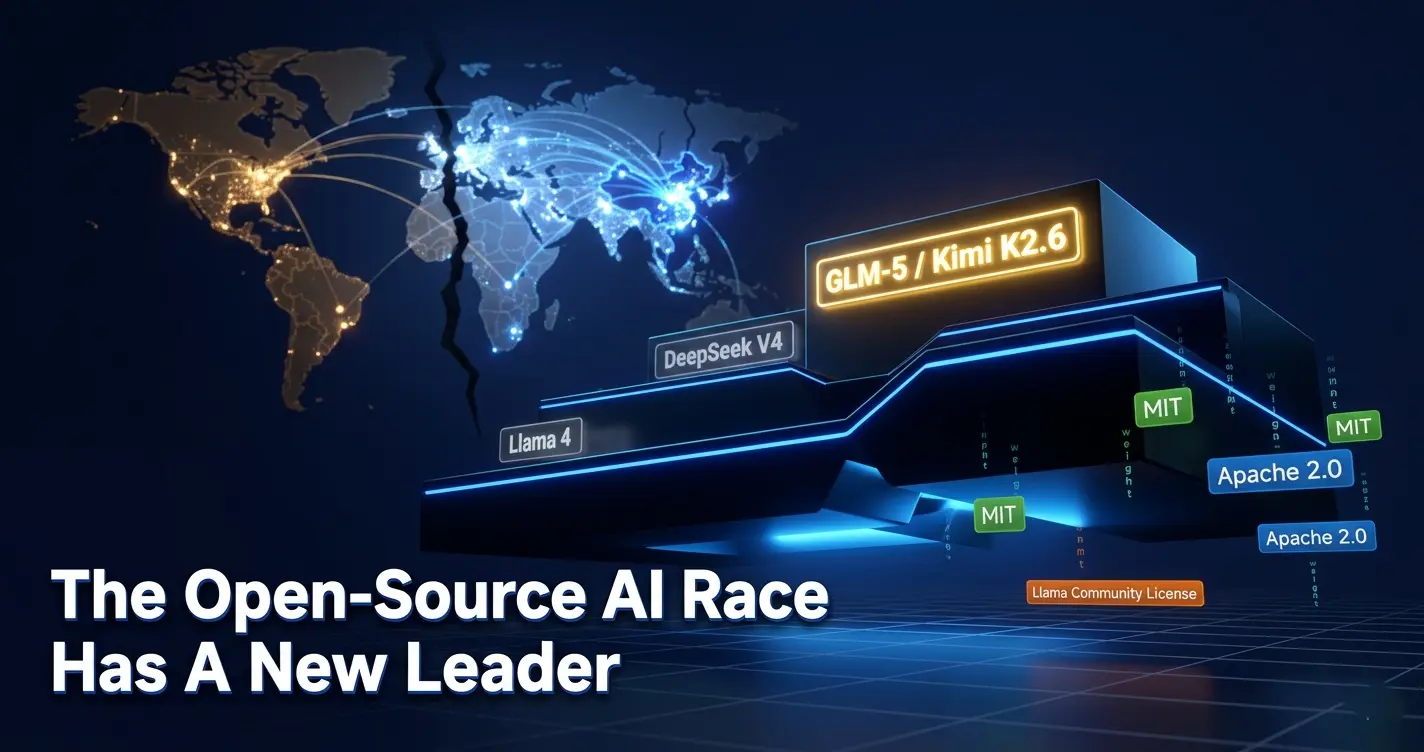
The dominant assumption, that the most powerful AI models were locked behind corporate paywalls, structurally collapsed in 2026. Today, developers worldwide can download frontier-grade open source AI models, run them on their own hardware, and ship products without paying per token. The race isn’t closed vs. open anymore. It’s about which open model fits your stack.
This is the complete, ranked list of the best open source AI models in 2026, every entry verified against live benchmarks, with real architecture specs, confirmed licenses, and practical guidance on how to run each one.
2.2M+
Models on Hugging Face
41%
HF downloads from Chinese labs
~3 mo
Open vs. closed frontier lag
62.8%
Open models’ market share
How the Open-Source Gap Closed | and Then Vanished
At the end of 2023, the best closed AI model scored roughly 88% on MMLU while the best open model managed about 70.5%. A real gap. Real consequences for developers choosing their stack. By early 2026, Epoch AI’s analysis found that open-weight models now trail the state-of-the-art by roughly three months on average, down from nearly a year in late 2024.
The inflection point was January 2025. DeepSeek R1 dropped, went viral globally, and demonstrated that a Chinese lab could match GPT-4-class performance at a fraction of the training cost. It triggered a cascade: Chinese labs, Alibaba, Moonshot, MiniMax, Xiaomi, Ant Group, started open-sourcing at scale. What followed was the most concentrated release window in AI history: between January and May 2026, at least eight frontier-class open models shipped in a single six-week period.
This changes who can build products, who owns their data pipeline, and how organizations think about vendor risk. If you’re still defaulting to a closed-source API because “the open options aren’t good enough,” you’re working from 2024 assumptions.
Tier 1: Frontier Open-Weight Models (May 2026)
These are the models competing directly with GPT-4o, Gemini 2.5 Pro, and Claude Sonnet, not in a “for open source” category, but overall. Ranked by the Artificial Analysis Intelligence Index where available, cross-referenced with SWE-bench Verified for engineering tasks.
GLM-5 is the highest-ranked open-weight model as of April 2026, the first to reach a score of 50 on the Artificial Analysis Intelligence Index. Its 77.8% SWE-bench Verified result is the strongest open-model coding result on record. Notably, it was trained entirely on Huawei Ascend chips with zero Nvidia dependency, which matters for any org tracking hardware supply chain risk.
Best for: Enterprise agentic engineering, long-horizon coding pipelines
Kimi K2.6 tops the neutral Artificial Analysis Index at 54 among open models, placing it fourth globally including closed models. It uses Multi-head Latent Attention (MLA) for efficient long-context handling and sets a new open-source bar on complex, end-to-end agentic coding. For multi-agent pipelines where you need a capable orchestrator without paying per-token, this is currently the strongest option.
Best for: Agent swarms, agentic workflows, complex multi-step coding
DeepSeek V4 Pro leads raw coding benchmarks at 83.7% SWE-bench Verified, matching the closed frontier. V4 Flash brings that capability down to $0.14 input / $0.28 output per million tokens, among the cheapest frontier-class inference available anywhere. The 1M token context window makes it the practical choice for full-codebase analysis without chunking. (Training code is not fully public, so treat it as open-weight, not fully open-source.)
Best for: Million-token agent traces, cost-sensitive production, software engineering tasks
Llama 4 Scout / Maverick Meta AI
Llama 4 Community License
109B MoE10M token context windowNative multimodal
Ten million tokens. While closed-source models are celebrating 1M context windows, Meta’s Llama 4 Scout ships with a 10M token context window, making it the only model where you can analyze an entire codebase or a decade of financial reports in a single pass. Maverick handles multimodal tasks natively. The catch: the Llama 4 Community License restricts commercial use above 700M monthly active users and prohibits training competing models. Most developers are unaffected, but read it before deploying at scale.
Best for: Ultra-long context, multimodal tasks, large codebase analysis
Qwen 3.5 / Qwen3-Coder Alibaba
Apache 2.0
397B total · 17B active201 languages1M token contextQwen3-Coder: 480B MoE
Qwen 3.5 (released February 2026) is a native vision-language model supporting 201 languages, the broadest language coverage of any open-weight frontier model. The Qwen family has crossed 700 million downloads on Hugging Face and spawned over 113,000 derivative models, creating what is effectively the Linux base layer of open AI. Qwen3-Coder, a 480B MoE model with 35B active parameters, is the specialist variant built for agentic coding pipelines.
Gemma 4 is the sole Western entry in the top tier of open-weight models by benchmark performance as of April 2026. Built on the same underlying research as Gemini 3, it adds native function calling, structured JSON output, and system instruction support, the full toolkit for building local AI agents that interact with external APIs without touching a cloud. The Apache 2.0 license removes every commercial restriction. For developers who need frontier capability on-device or at the edge, Gemma 4 31B is the safest commercial bet available.
Best for: Local deployment, edge devices, mobile developers, commercial use
Mistral Small 4 / Medium 3.5 Mistral AI
Apache 2.0
Function callingJSON outputReasoning modeEU sovereign AI
For European organizations navigating data sovereignty requirements or the EU AI Act’s August 2026 enforcement window, Mistral remains the primary answer. Both models run with full production-grade function calling and JSON output under Apache 2.0. Medium 3.5 adds a reasoning mode for tasks requiring multi-step inference.
Best for: Production agents, European sovereign AI deployments, regulated industries
MiMo-V2.5-Pro & MiniMax-M2.7 Xiaomi · MiniMax
Apache 2.0
MiMo: AA Index 54MiniMax: 10B activeCheapest frontier inference
MiMo-V2.5-Pro from Xiaomi ties Kimi K2.6 at an Artificial Analysis Index score of 54 with a cleaner Apache 2.0 license, a direct alternative for teams with legal requirements that exclude MIT-licensed models. MiniMax-M2.7 is open-weighted on Hugging Face and offers among the cheapest frontier-class inference of any model in this list, making it a strong pick for cost-sensitive high-volume deployments.
Best for: Cost-sensitive production, high-volume inference, teams requiring Apache 2.0
R1 dominates MATH-500 at 97.3%, near-perfect mathematical reasoning from an open-weight model. The chain-of-thought architecture makes every intermediate step visible, which matters for research workflows where you need to audit reasoning, not just results. The 7B and 32B variants run on consumer hardware; the 671B version requires serious infrastructure but delivers closed-frontier-equivalent reasoning.
Best for: Chain-of-thought reasoning, math, scientific research, auditable inference
Full Comparison: Open Source AI Models 2026
Model
Lab
License
AA Index
SWE-bench
Context
Best Use
GLM-5.1
Zhipu / Z.ai
MIT
50
77.8%
128K
Agentic coding
Kimi K2.6
Moonshot AI
MIT
54
58.6%
1M+
Agent swarms
DeepSeek V4 Pro
DeepSeek
MIT
—
83.7%
1M
Coding, long-context
Llama 4 Scout
Meta
Community
—
—
10M
Ultra-long context
Qwen 3.5
Alibaba
Apache 2.0
—
—
1M
Multilingual
Gemma 4 31B
Google DM
Apache 2.0
—
—
128K
Local / edge
MiMo-V2.5-Pro
Xiaomi
Apache 2.0
54
—
—
Commercial agents
MiniMax-M2.7
MiniMax
Apache 2.0
—
—
—
Low-cost inference
DeepSeek R1 671B
DeepSeek
MIT
—
—
128K
Math / reasoning
Phi-4-mini
Microsoft
MIT
—
—
16K
Edge / low VRAM
Mistral Medium 3.5
Mistral AI
Apache 2.0
—
—
128K
EU sovereign AI
Ring-2.6-1T
Ant Group
—
—
—
—
Enterprise (China)
Specialized & Domain-Specific Models
Frontier general-purpose models aren’t always the right tool. These models own specific domains:
Qwen3-Coder-480B-A35B, The dedicated agentic coding specialist. 480B MoE, 35B active, 256K native context. Strongest single-purpose coding architecture available open-weight.
DeepSeek V3.2-Speciale, Achieved gold-medal performance at IMO 2025 and IOI 2025. If your workload involves competition-level mathematical or algorithmic reasoning, nothing else comes close.
Sarvam 30B / 105B (Sarvam AI), Trained from scratch in India, Apache 2.0, built specifically for Indian language workloads. Critical for any India-focused deployment.
OLMo 2 (Allen Institute for AI), The transparency benchmark. Fully open-source: weights, data, training code, and evaluation regime are all public. Use this when reproducibility and auditability matter more than raw performance.
GPT-OSS (OpenAI), OpenAI’s first Apache 2.0 open-source model. Historically significant; positioned as the US lab response to Chinese open-weight dominance.
SmolLM3-3B (Hugging Face), Sub-3B efficiency leader. Runs on CPU. The pick for embedded, offline, or constrained-resource deployments.
Llama 3.3 70B, Enterprise instruction-following workhorse. Proven at scale, well-documented, strong ecosystem of fine-tunes and tooling.
The Licensing Reality: “Open Source” Is Not One Thing
“If you keep using ‘open source’ as a single binary label, you will make bad procurement decisions, bad architecture decisions, and occasionally a bad legal decision that you discover only after you have traction. In AI, openness is multi-layered, the trained parameters, data mixture, training pipeline, evaluation regime, even system prompts, and different layers create different freedoms and different risks.”
— Turing Post, “Mastering Open Source AI in 2026”
This is the most important critical point in this entire article. Most models on this list are open-weight, not open-source. The parameters are downloadable, but training data, recipes, and safety evaluations are closed. The distinction has real legal and operational consequences.
OSI-Compliant Frontier Models (as of May 2026)
If your legal team mandates fully OSI-approved licenses, your shortlist is now substantial, clean licensing is no longer a reason to default to closed-source APIs:
✅ Clean License Shortlist
MIT: DeepSeek V4, DeepSeek R1, GLM-5.1, Kimi K2.6, Phi-4-mini
Apache 2.0: MiMo-V2.5-Pro, MiniMax-M2.7, Qwen 3.5, Qwen3-Coder, Gemma 4, Mistral Small 4, Mistral Medium 3.5, Sarvam 30B/105B, OLMo 2, GPT-OSS
Restricted (read before deploying): Llama 4 (Community License, 700M MAU cap, no competing model training)
The Benchmark Problem: Read This Before You Trust Any Score
“MMLU and MMLU-Pro are functionally saturated above 88% for frontier AI models, making score differences at the top statistically meaningless. Enterprise agentic AI systems show a 37% gap between lab benchmark scores and real-world deployment performance, with 50x cost variation for similar accuracy.”
— Kili Technology, AI Benchmarks Guide 2026
Every benchmark score in this article should carry an asterisk. Kili Technology’s 2026 analysis documents data contamination, benchmark gaming, and annotation error rates above 50% at the frontier. A model scoring #1 on SWE-bench today may underperform a #5-ranked model on your specific production workload.
The safety research organization METR adds a more fundamental warning:
“Benchmarks run without live human interaction can cause models to fail at tasks they could complete with minimal human guidance, making benchmarks unreliable proxies for real capability.”
— METR (Model Evaluation & Threat Research), Experienced Developer Study, July 2025
⚠️ The 37% Rule
Enterprise agentic AI systems show a 37% gap between lab benchmark scores and real-world deployment performance. Before committing to any model for production, benchmark it on your workload, not the published leaderboard numbers.
How to Run Open Source AI Models Locally
Late 2025 was when local inference tooling reached production-grade stability. Ollama, LM Studio, and llama.cpp are now reliable enough for serious workloads. The cost argument is blunt: running a local 13B model costs approximately $0 in compute per day versus $30–60/month for an equivalent cloud API.
Single-command local deployment (Ollama)
# Qwen 3.5 8B — runs on a 24GB consumer GPU
ollama run qwen3:8b

# Gemma 4 26B MoE — strong multimodal, runs on single 4090
ollama run gemma4:26b

# DeepSeek R1 32B — chain-of-thought reasoning
ollama run deepseek-r1:32b

# Phi-4-mini — CPU-only friendly, sub-4GB RAM
ollama run phi4-mini
Hardware requirements at a glance
Model Size
Min VRAM
Recommended Hardware
Example Models
1B–4B
4GB
Any modern GPU / CPU
SmolLM3-3B, Phi-4-mini
7B–8B
8GB
RTX 3060 / M2 Mac
Qwen3:8B, Llama 3.3 8B
13B–27B
16–24GB
RTX 4090 / A100
Gemma 4 26B, DeepSeek R1 32B
70B
80GB
2× A100
Llama 3.3 70B
400B–1T MoE
Multi-node
4–8× H100
DeepSeek V4, Kimi K2.6
For the frontier MoE models (DeepSeek V4, Kimi K2.6, GLM-5), the practical option for most teams is hosted inference via providers like Fireworks AI, Together AI, or the model labs’ own APIs, at dramatically lower cost than equivalent closed-source options.
The Geopolitical Dimension: Four of Five Top Models Are Chinese
The most striking pattern in 2026: GLM-5, Kimi K2.6, DeepSeek V4, Qwen 3.5, MiMo-V2.5-Pro, MiniMax-M2.7, Ring-2.6-1T, four of the five top-ranked open-weight models come from Chinese labs. Chinese organizations now account for 41% of all downloads on Hugging Face, with Baidu going from zero releases to over 100 in 2025, and ByteDance and Tencent each increasing releases eight to nine times.
This is a reversal from 2024, when Meta’s Llama 3.1 405B was the clear open-weight leader. Google’s Gemma 4 is the sole Western entry in the current top tier. OpenAI’s GPT-OSS, AI2’s OLMo, and Meta’s Llama are the visible Western responses, but the gap is real and current.
🌐 Supply Chain Risk to Track
GLM-5’s training on Huawei Ascend chips illustrates the hardware dimension of this shift. Developers building on Chinese open-weight models face potential export control, data sovereignty, and supply chain risks that didn’t exist in the 2023–2024 open-source landscape. The EU AI Act’s August 2026 phased enforcement adds a compliance layer for European deployments. This doesn’t disqualify any model, but it belongs in your architecture review.
Our read: the geographic rebalancing is likely to accelerate. The competitive pressure is driving significant Western investment in open alternatives, which benefits everyone building on open-weight infrastructure.
Frequently Asked Questions
What is the best open source AI model in 2026?
As of May 2026, Kimi K2.6 (Moonshot AI) ranks #1 among open-weight models on the Artificial Analysis Intelligence Index with a score of 54, placing it #4 globally including closed models. For coding specifically, DeepSeek V4 Pro leads with 83.7% on SWE-bench Verified. For local deployment with clean licensing, Google’s Gemma 4 under Apache 2.0 is the top commercial-safe choice. The right answer depends on your use case, this article’s comparison table maps each model to its strongest application.
What is the difference between open source and open weight AI models?
Open-source AI means the model’s code, weights, training data, and methodology are all publicly available, like OLMo 2 from Allen AI. Open-weight models only release the trained parameters for download; training data and pipeline remain proprietary. Most models marketed as “open source” in 2026, including Llama 4 and DeepSeek, are technically open-weight. The distinction matters for compliance, reproducibility, and legal risk. Using it as a single binary label leads to bad procurement decisions.
Can I run open source LLMs locally in 2026?
Yes. Models up to 13B parameters run on a single consumer GPU with 24GB VRAM using Ollama or LM Studio. Gemma 4 26B and Qwen3:8B deploy with a single command. Sub-8B models including Phi-4-mini run on CPU-only systems. The cost argument is direct: running a local 13B model costs approximately $0 in daily compute versus $30–60/month for equivalent cloud API access. Frontier MoE models (DeepSeek V4, Kimi K2.6) require multi-GPU infrastructure or hosted inference.
Is DeepSeek open source?
Yes and no. DeepSeek V4 and R1 are released under the MIT license with no usage restrictions, freely downloadable and commercially usable. DeepSeek V4 supports a 1M token context window. However, the training code and data are not fully public, making it technically open-weight rather than fully open-source under the OSI definition. For most developer use cases, the distinction is irrelevant. For research reproducibility, it matters.
Is Llama 4 fully open source?
No. Meta’s Llama 4 uses the Llama 4 Community License, which restricts commercial use above 700M monthly active users and prohibits using the model to train competing AI systems. The weights are freely downloadable for most use cases, but it is not open-source under the OSI definition. For unrestricted commercial deployment, Apache 2.0 alternatives like Gemma 4, Qwen 3.5, or Mistral are cleaner choices.
Which open source AI model is best for coding in 2026?
For enterprise agentic coding: DeepSeek V4 Pro (83.7% SWE-bench Verified) and GLM-5 (77.8%) lead all open-weight models. For agent orchestration: Kimi K2.6. For local single-GPU coding: Qwen3.6-35B-A3B. For clean Apache 2.0 licensing with strong coding: Gemma 4 31B. Always benchmark on your actual workload, the 37% gap between leaderboard scores and real-world performance is documented and significant.
What open source AI models can run without a GPU?
Sub-8B models, including Phi-4-mini-instruct, SmolLM3-3B, and Qwen3:8B, run on CPU-only systems at usable latency. For faster CPU-only performance, quantized GGUF builds via llama.cpp reduce memory requirements significantly. Expect slower response times than GPU inference, but fully functional for moderate workloads like document analysis, summarization, or local chat.
What to Watch: The Next 6–18 Months
The open-source AI models list in 2026 represents a structural shift, not a trend. The capability gap with closed models has closed to roughly three months. Clean licensing covers the frontier. Local inference is viable on consumer hardware. The cost argument for closed APIs has narrowed to convenience, not capability.
Here’s what changes next:
EU AI Act enforcement (August 2026), High-risk open-weight deployments in healthcare, finance, and HR face immediate compliance requirements for audit trails and explainability. If you’re building in those domains, the EU AI Act compliance deadline is not abstract.
The 10M-context inflection, Llama 4 Scout’s 10M token window is a preview of where the entire tier moves. Full-organization knowledge retrieval, decade-scale document analysis, and end-to-end codebase reasoning without chunking will be baseline capability by late 2026.
Western lab responses, GPT-OSS, OLMo 2’s next iteration, and increased Gemma investment are responding directly to Chinese open-weight dominance. The competitive pressure is real and likely to accelerate open-model quality across all labs.
Three specific actions to take this week:
Run ollama run qwen3:8b or ollama run gemma4:26b locally and benchmark it on one real task from your current workflow.
Read your model’s license beyond the headline label, especially if you’re using Llama 4 or building a product with traction.
For any agentic pipeline decision: test Kimi K2.6 and DeepSeek V4 Pro head-to-head on SWE-bench Pro with your actual prompts before committing to an architecture.
Stay Ahead of the Next Wave
Get the Neural Loop — NeuralWired’s weekly briefing on AI models, research, and what it means for developers building right now.
Subscribe to The Neural Loop →
What Is a Large Language Model? Explained Simply (2026 Guide) | NeuralWired
AI Fundamentals · 2026 Guide
What Is a Large Language Model? Explained Simply (2026 Guide)
By NeuralWired Editorial Team · May 27, 2026 · 14 min read
In 2026, 88% of enterprises have adopted AI, yet only 6% are seeing meaningful returns. The gap isn’t budget. It’s not talent. It’s that most of the people deploying large language models don’t actually understand what they are. This guide closes that gap.
A large language model (LLM) is the foundational technology behind ChatGPT, Claude, Gemini, and every AI writing tool you’ve encountered in the last three years. If you’re building a product, evaluating vendors, or just trying to understand what your engineering team is actually shipping, this is the piece you need to read first.
We’ll cover how LLMs work mechanically, how they’re trained, what makes them genuinely useful, and, critically, what they cannot do, no matter how well you prompt them. No hype. No padding. Just the technical reality, explained for people who make decisions.
The Simple Explanation: What an LLM Actually Does
Strip away the marketing and a large language model does one thing: it predicts the next word. That’s it. You give it text. It guesses what comes next. Then it takes that output, adds it to the input, and guesses again. Repeat a few hundred times and you have a paragraph. Repeat thousands of times and you have a research summary, a legal brief, or a working Python script.
The reason that feels magical, and the reason it’s not, is scale. LLMs are trained on hundreds of billions of words drawn from books, websites, scientific papers, code repositories, and conversations. Through that training, they don’t just learn vocabulary. They absorb grammar, factual associations, reasoning patterns, tone, cultural context, and the structural logic of arguments. All compressed into numerical weights, billions of them, that activate when you send a message.
The One-Line Definition
A large language model is a neural network trained on vast quantities of text to predict and generate human-like language, the foundational technology behind modern AI chatbots, coding assistants, and document tools.
One useful reframe: LLMs are more accurately described as large number models. Computers don’t understand words. They understand numbers. Every word you type is converted into a numerical token. Every token gets processed through layers of mathematical transformations. The output, which looks like language, is really just the winning number at the end of billions of calculations.
That reframe matters for something we’ll return to: when LLMs fail, they’re not being careless. They’re doing exactly what they’re designed to do. The math just doesn’t always produce truth.
How an LLM Works | Token by Token
Here’s the actual mechanism, in sequence.
You type: “What is the capital of France?” Before the model sees a single word, your message is tokenized, broken into chunks roughly 3–4 characters long. “What” becomes one token. “capital” might be one or two. “France” is one. The full sentence becomes roughly 8–10 tokens.
Each token is converted to a numerical vector, a list of numbers representing its position in a high-dimensional space where similar concepts cluster together. “Paris” and “capital” are numerically close. “Paris” and “bicycle” are far apart.
Those vectors pass through the model’s layers — stacked blocks of neural network transformations, each one adjusting the representation based on the attention mechanism (more on that shortly). At the end, the model produces a probability distribution across its entire vocabulary: token X has a 47% chance of coming next, token Y has 31%, and so on. The most probable token is selected. Added to the input. The process repeats.
1.8TEstimated GPT-4 parameters
200K+Max context window tokens (modern LLMs)
0.3 WhEnergy per GPT-4o text query
GPT-4 is estimated to contain approximately 1.8 trillion parameters, six times more than GPT-3’s 175 billion. Those parameters are the “knobs”, numerical weights tuned during training to make the predictions as accurate as possible. The model doesn’t look anything up. It doesn’t Google. It generates entirely from the patterns compressed into those weights during training.
This is exactly why LLMs are impressive and exactly why they can be wrong with total confidence. The mechanism that produces “Paris” when asked the capital of France is the same mechanism that produces a convincing-sounding but entirely fabricated legal precedent. It’s prediction, not retrieval. Fluency, not fact-checking.
How an LLM Is Trained, Step by Step
Training a frontier LLM is a multi-month, multi-hundred-million-dollar infrastructure project. Here’s the pipeline, simplified but accurate.
Data collection. Books, websites, academic papers, code repositories, and curated datasets are scraped and assembled into a corpus measured in terabytes. GPT-3 alone used 570GB of internet text.
Quality filtering. Automated classifiers and heuristic rules remove low-quality content, spam, duplicates, toxic material, boilerplate. This step is underrated; the quality of training data is a primary determinant of model quality.
Tokenization. All text is converted to numerical tokens using Byte-Pair Encoding (BPE), an algorithm that learns the most common character sequences in the corpus and merges them into single tokens. Efficient across languages, handles misspellings, and manages rare words gracefully.
Infrastructure setup. Training requires thousands of NVIDIA H100/H200 GPUs or equivalent TPUs running in parallel. Training GPT-3 required approximately 1,287 MWh of energy, equivalent to the annual consumption of around 120 average American homes.
Pre-training: next-token prediction. The model processes the entire corpus, repeatedly predicting the next token and adjusting its weights based on how wrong it was. Through billions of these adjustments, it learns grammar, world knowledge, reasoning patterns, and cultural context simultaneously, without any explicit labeling or instruction.
RLHF alignment. After pre-training, the raw model is brilliant but erratic. Human raters evaluate its responses. That feedback trains a separate “reward model,” which is then used to fine-tune the LLM toward outputs that are more helpful, accurate, and safe. This is how OpenAI, Anthropic, and Google turn base models into products.
What RLHF Actually Does
Reinforcement Learning from Human Feedback doesn’t make a model smarter, it makes it more aligned. It shifts the output distribution toward responses humans rate as good. The distinction matters: a well-aligned model can still be confidently wrong; it’s just less likely to be unhelpful or harmful.
The Transformer: The Engine Behind Every LLM
Every major LLM in production today, GPT-5, Claude 4, Gemini 2.5 Pro, Llama 4 — runs on a variation of the same architecture: the Transformer.
It was introduced in a 2017 paper from Google Brain titled “Attention Is All You Need” by Ashish Vaswani and colleagues. The paper demonstrated that an architecture based entirely on attention mechanisms, with no recurrence, no convolutions, was not only simpler but faster to train and better at the task. The authors showed it was “particularly well suited for language understanding,” outperforming both recurrent and convolutional models on major translation benchmarks.
“The Transformer is a neural network architecture that has fundamentally changed the approach to AI, the go-to architecture for deep learning models powering GPT, Llama, and Gemini.”