NeuralWired’s Technology section covers the developments reshaping how the world builds, deploys, and regulates digital innovation. We report daily on the stories driving global conversation in artificial intelligence, big technology companies, startups and venture funding, cybersecurity, consumer gadgets and devices, and blockchain and cryptocurrency.
Our technology coverage goes beyond product announcements. When a major AI model launches, we explain what it can actually do and where its claims are overstated. When a startup raises a large funding round, we look at whether the business behind it can sustain that valuation. When a cybersecurity breach hits the news, we explain who is affected and what comes next, not just what happened. Each article is built from original research into primary sources, including company statements, technical documentation, regulatory filings, and verified data, and is written by our editorial team rather than generated automatically.
Readers come to this section for daily updates on the technology stories that matter globally, from shifts inside major technology companies to emerging tools changing how people work, communicate, and build. Whether you are a founder, an investor, an engineer, or simply someone trying to understand where technology is heading next, NeuralWired’s Technology coverage is built to keep you informed without wasting your time on hype.
Bitcoin’s $80K Wall: Why 4 Rejections, $3B in ETF Inflows, and 818K BTC in Corporate Vaults Still Haven’t Broken It | NeuralWired
MarketsMay 1, 2026 · 10 min read
Bitcoin’s $80K Wall: Why 4 Rejections, $3B in ETF Inflows, and 818K BTC in Corporate Vaults Still Haven’t Broken It
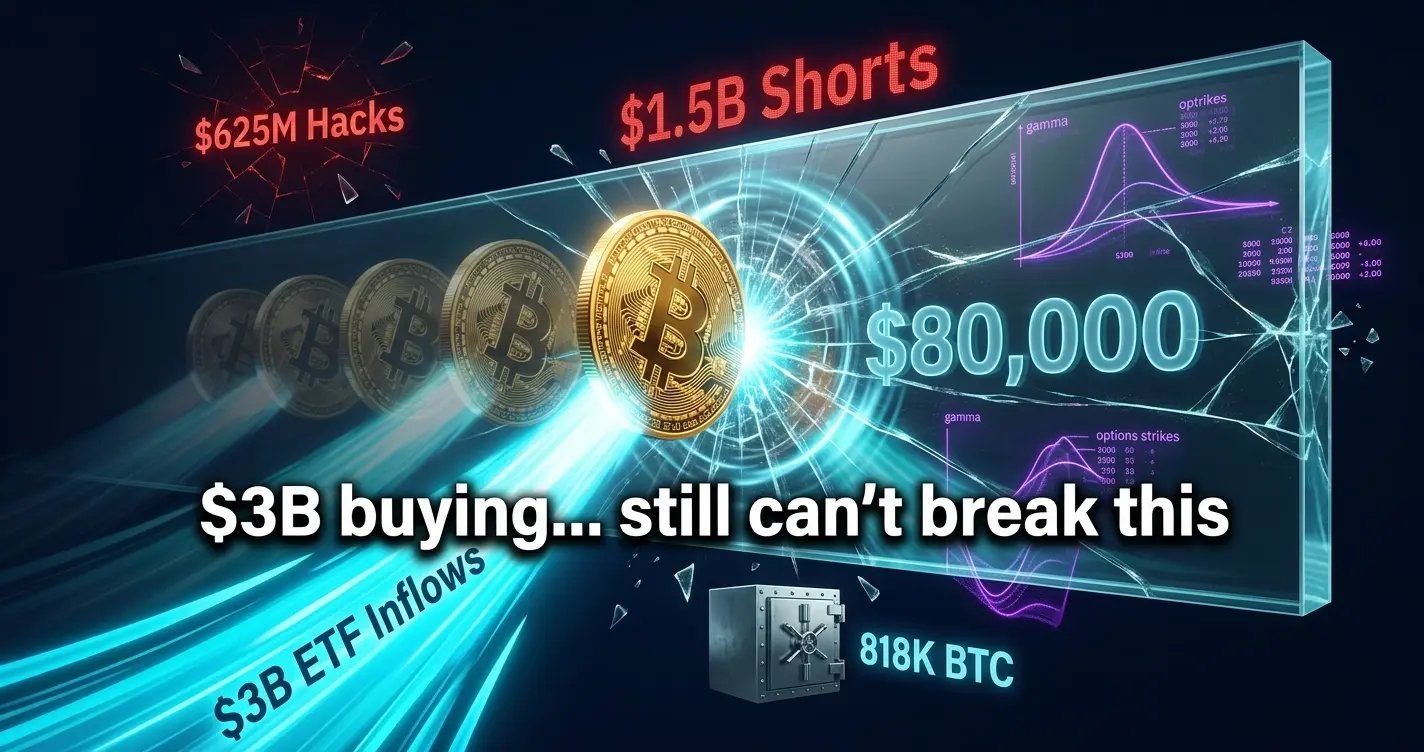
Bitcoin has bounced off $80,000 four times since February. Institutions keep buying, exchange reserves sit at a six-year low, and prediction markets priced a May 1 close above $79,000 at just 22 cents. Something structural is holding the line.
Bitcoin traded between $78,000 and $78,700 on May 1, 2026, inching toward a resistance level that has now repelled four separate breakout attempts since February. The number is round, the psychology is obvious, and the mechanics are anything but simple. Beneath a deceptively flat price chart sits a coiled structure of options exposure, institutional order flow, and on-chain supply compression that makes $80,000 one of the most technically significant price points in this market cycle.
The week ending April 25 saw Bitcoin spot ETFs absorb a net $3.06 billion in fresh capital, the second-largest weekly inflow ever recorded, according to SoSoValue data. BlackRock’s IBIT alone pulled in $1.45 billion across those five trading days, pushing its lifetime net inflows past $41.2 billion. That buying wave didn’t push Bitcoin through $80,000. It got within $523 of the level and then reversed.
That reversal tells you more about what’s really happening than the inflow number does. This is a market where institutional demand is real, supply on exchanges has fallen to a six-year low of 2.3 million BTC, and yet a single price level keeps acting like a ceiling. Here’s why, and what it would actually take to change that.
The $80K Wall: Options, Gamma, and 7,200 BTC in Open Interest
The $80,000 level isn’t just psychologically significant. It carries real mechanical weight in the options market. According to analysis from crypto exchange Bittime, there are approximately 7,200 BTC worth of open interest clustered at or near the $80,000 strike, and the current gamma exposure at that level is positive, meaning options dealers are net short gamma and must sell into rising prices to stay hedged.
“BTC’s resistance level is at $80,000 [and] exceeding this level will trigger extreme volatility.”
On-chain analyst Murphy, cited by Bittime Research, April 27, 2026
What that means in practice: every time Bitcoin approaches $80,000, dealers sell to rebalance their books. The selling isn’t driven by conviction that the price is too high. It’s mechanical. Once price clears that level and moves into the zone above $81,000, however, the gamma flips negative. At that point dealers need to buy into rising prices, which can accelerate a move toward $82,000 and beyond with surprising speed. Bittime’s data puts the negative gamma zone at roughly 4,644 BTC of exposure above $81,000.
What is gamma exposure? Options dealers who sell calls must buy the underlying asset as prices rise to hedge their position. When gamma is positive (near a resistance strike), this hedging pressure works against the breakout. When gamma turns negative above that strike, the hedging pressure reverses and can amplify upward moves dramatically.
The April 24 intra-day high of $79,477 illustrated this exactly. Bitcoin came within half a percentage point of $80,000, touched that options resistance zone, and was sold back within hours. The rejection wasn’t a coincidence. It was the market’s options structure executing exactly as designed.
“Bitcoin must break $80,000 to exit consolidation and confirm a durable bullish regime.”
Bitfinex Research Desk, Bitcoin.com News, April 26, 2026
Bitfinex analysts have been consistent on this point since late April. Break the level with a weekly close above it, and the consolidation that began after Bitcoin’s February peak near $126,000 is structurally over. Fail again, and the range compresses further until something external forces a resolution. There’s also an estimated $1.5 billion in short positions that would be force-liquidated if Bitcoin clears $81,000, adding further fuel to any genuine breakout.
ETF Flows: A Record Week Followed by Three Days of Outflows
The $3.06 billion weekly inflow was genuinely exceptional. To put it in context, Bloomberg ETF analyst Eric Balchunas captured the trajectory well when the products first launched:
“If they can take in $22 billion when it’s raining, imagine when the sun is shining.”
Eric Balchunas, Senior ETF Analyst, Bloomberg, CryptoBriefing, January 5, 2026
That early-2026 optimism played out in April’s inflow numbers. But what the weekly headline obscured was a sharp reversal in the days that followed. After the record week ended April 25, flows turned negative almost immediately.
Date
ETF Flow
Notable
Apr 21-25 (week)
+$3.06B net inflows
Second-highest week on record; IBIT +$1.45B
Apr 27
-$263M outflows
Largest single-day outflow of the post-peak period
Apr 28
-$89.68M outflows
Fidelity FBTC shed 1,959 BTC in one session
Apr 29
-$112M (IBIT alone)
BlackRock’s flagship product posted its own net outflow day
Three consecutive days of outflows after a record inflow week is the kind of data point that gets lost in the narrative. It doesn’t invalidate the structural bull case. But it does confirm that institutional appetite, while real, is not an unlimited conveyor belt of buying pressure. When Bitcoin failed to reward the surge of April 21-25 capital with a breakout, some of that money came back out.
Flow reversal risk: For a sustained move above $80,000, analysts say ETF outflows need to flip back to consistent net positive territory. Three consecutive days of net selling after the second-biggest weekly inflow on record suggests momentum may need a fresh catalyst to reignite.
The early-2026 picture does offer longer-term reassurance. Bitcoin ETFs pulled in $1.2 billion across their first two trading days of 2026. If that pace had been sustained over a full year, total annual inflows would have annualized toward $150 billion. It didn’t sustain at that pace, obviously. But it established a demand floor that keeps showing up during any meaningful dip.
818,334 BTC: Corporate Accumulation as a Structural Floor
Strategy, the software company turned Bitcoin holding vehicle led by Michael Saylor, now holds 818,334 BTC. That’s approximately 4.2% of the total Bitcoin supply that will ever exist, sitting in a single corporate treasury. And the buying hasn’t stopped.
On April 20, Strategy added 34,164 BTC at an average price of $74,395, spending $2.54 billion in a single transaction. One week later, another 3,273 BTC for $255 million. The consistency of this accumulation, even at prices most retail buyers would consider elevated, does two things to the market. It removes coins from circulation. And it sets a psychological floor well below current trading prices.
🏛️
Strategy Holdings
818,334 BTC (~4.2% of total supply). Latest purchases averaged $74,395 per coin across two April transactions totaling $2.8B.
📉
Exchange Reserves
2.3 million BTC on exchanges, the lowest level in six years. Less available supply means larger price swings when demand spikes.
💰
Stablecoin Dry Powder
$317 billion in stablecoins, representing 11.73% of total crypto market cap. Potential buying power sitting on the sidelines.
📊
BTC Dominance
57.89% of the $2.65T total crypto market cap. Institutional preference keeps flowing toward BTC over altcoins.
The structural argument is straightforward: with exchange reserves at a six-year low and a single entity holding 4.2% of supply, the available float that could meet institutional demand is genuinely constrained. That’s the supply side of the equation. The demand side, as represented by ETF inflows, has shown it can generate $3 billion in a single week. When those two forces converge with a macro catalyst, the options market’s gamma structure above $80,000 turns from headwind to tailwind almost instantly.
“The $85,000 to $88,000 zone is not a fantasy number, and it sits right at the confluence of the 200-day simple moving average and the upper boundary of the resistance band.”
Michael van de Poppe, Independent Market Analyst, Phemex Research, April 29, 2026
April’s $625M Hack Storm: The Bearish Signal Nobody’s Talking About
The Drift Protocol exploit on April 1 drained $285 million from the Solana-based derivatives platform in one of the largest single DeFi hacks on record.
The KelpDAO attack on April 18, targeting a cross-chain bridge via LayerZero, extracted $293 million, briefly setting a new single-incident record before month-end tallies put it second behind Drift on impact.
The remaining 26-28 incidents collectively accounted for roughly $47 million, a figure that would dominate headlines in a quieter month but barely registered against April’s two landmark exploits.
Context: DeFiLlama’s confirmation of April 2026 as the most-hacked month by incident count doesn’t mean the DeFi ecosystem is collapsing. But $625 million in 30 days creates measurable headwinds for sentiment, particularly among institutional allocators who must justify exposure to their risk committees. This is a suppressive force on the upside that price charts alone don’t capture.
The timing matters. April’s hack wave coincided almost exactly with the peak ETF inflow week and the $79,477 rejection. Some portion of the selling pressure that knocked Bitcoin back from its high likely reflected DeFi participants moving funds off-chain or rotating to safer assets after major protocol failures. It’s impossible to isolate that effect precisely, but it’s also not credible to ignore it entirely.
The broader context is also troubling. The FBI reported $240 million lost to crypto ATM scams in just the first half of 2025, with total ATM-related fraud losses exceeding $333 million nationally. Tennessee has already passed legislation banning crypto ATMs entirely, effective July 2026, citing the FBI-linked fraud data. That’s a retail access restriction at a moment when institutional channels are expanding rapidly, which creates an asymmetric market structure that skews heavily toward sophisticated players.
Macro and Policy Backdrop: Risk-On, but Fragile
Bitcoin’s correlation with traditional risk assets has been consistent throughout this cycle. When equity futures rise, Bitcoin tends to follow. When the Federal Reserve tilts hawkish, crypto sells off. The current macro environment offers a cautiously supportive backdrop, but “cautious” is doing a lot of work in that sentence.
“Market conditions appear to be realigning with the broader status quo, particularly around Fed expectations. After a brief wobble driven by a hawkish tilt that unsettled risk assets, the market is once again leaning toward accommodation.”
Joel Kruger, Strategist, LMAX Group, Finance Magnates
Kruger’s observation describes the macro mechanism that keeps reasserting itself: whenever the Fed signals even a modest lean toward easier conditions, risk assets including Bitcoin catch a bid. The current setup mirrors that pattern. Bitcoin has recovered 30% from its cycle low of $60,000, and the global crypto market cap sits at $2.65 trillion to $2.7 trillion as of May 1, up more than 2% in 24 hours. That’s not explosive. But it’s directional.
Ethereum traded at $2,280 on May 1, up roughly 1.06% on the day, with an intra-day range of $2,260 to $2,300. Ethereum’s relative underperformance against Bitcoin, whose dominance now stands at 57.89%, reflects a consistent theme of this cycle: institutional capital flows into BTC first, altcoins second. Until Bitcoin establishes a clear new range above $80,000, that capital hierarchy is unlikely to shift.
Market snapshot, May 1, 2026: Bitcoin ~$78,000-$78,700 (+2-3% 24h). Ethereum $2,280 (+1.06%). Global crypto market cap $2.65T-$2.7T. BTC dominance 57.89%. BTC market cap $1.56T. Stablecoin market cap $317B (11.73% of total). Sources: CoinGecko.
The prediction markets offered their own probability assessment on May 1. Robinhood’s Bitcoin price event contracts priced a 5pm EDT close at or above $78,000 at 71 cents, above $78,500 at 43 cents, and above $79,000 at just 22 cents. Sophisticated traders put the probability of challenging the $80,000 resistance zone by end of day at roughly one in five.
3 Scenarios for May: Breakout, Grind, or Reversal
Analyst CF Benchmarks’ Gabe Selby framed the decision point plainly in late April: “$80K could be reached within days, though failure to break $88K may trigger renewed consolidation.” That’s the May range in a single sentence. What determines which scenario plays out?
Scenario
Trigger
Price Target
Key Risk
Breakout
Weekly close above $80K + ETF outflows reverse; $1.5B short squeeze ignites above $81K
$82K-$88K (van de Poppe’s 200-DMA confluence zone)
Gamma flip to negative above $81K creates vol spike; macro shock could kill momentum mid-run
Grind
ETF flows remain mixed; no macro catalyst; range-bound $74K-$80K continues
$76K-$80K through May
Prolonged compression increases the probability of a violent resolution in either direction
Strategy’s average cost basis near $74K provides a structural defense; below that gets ugly
Phemex’s market analysts laid out three specific conditions they say must all be met for a sustained push toward $88,000: ETF inflows need to return to net positive and stay there for at least a week; the macro environment needs to hold its current risk-on posture without a Fed shock; and on-chain data needs to confirm that long-term holders aren’t distributing into strength. Two of those three conditions were borderline as of May 1. The third, on-chain holder behavior, remains constructive.
The short-squeeze element adds a non-linear dimension to any breakout. An estimated $1.5 billion in short positions sit above current prices, clustered most densely between $80,000 and $82,000. A clean break above $80,000 that forces even a portion of those positions to close at a loss doesn’t just add buying pressure. It removes selling pressure simultaneously, which is why breakouts from ranges like this can happen faster than even optimistic forecasts anticipate. The options-driven negative gamma above $81,000 amplifies that further.
Frequently Asked Questions
Why does Bitcoin keep failing to break $80,000?
The $80,000 level carries significant options market resistance, with roughly 7,200 BTC in open interest at that strike. Options dealers must sell into rallies approaching $80,000 to stay hedged, creating mechanical selling pressure that doesn’t reflect fundamental bearishness. Once price clears that level, the dynamic reverses.
How much did Bitcoin ETFs bring in during April 2026?
The week of April 21-25 saw Bitcoin spot ETFs record $3.06 billion in net inflows, the second-highest weekly total ever. However, three consecutive days of net outflows followed: $263 million on April 27, $89.68 million on April 28, and $112 million from BlackRock’s IBIT alone on April 29.
How much Bitcoin does Strategy (formerly MicroStrategy) hold?
As of late April 2026, Strategy holds 818,334 BTC, representing approximately 4.2% of Bitcoin’s total eventual supply. The company added 34,164 BTC at an average of $74,395 on April 20 and 3,273 BTC one week later, spending roughly $2.8 billion across two purchases.
What happened with crypto hacks in April 2026?
April 2026 became the most-hacked month in crypto history by incident count. DeFiLlama confirmed 28 to 30 separate exploits totaling more than $625 million stolen. The Drift Protocol exploit ($285 million) and KelpDAO exploit ($293 million) accounted for 93% of losses.
What is a short squeeze and why does it matter at $80K?
A short squeeze occurs when rising prices force traders who bet against an asset to buy it back to limit losses. Approximately $1.5 billion in short positions are estimated above current Bitcoin prices. If Bitcoin clears $81,000, forced short-covering adds significant upward momentum on top of normal buying pressure.
What price targets are analysts citing for Bitcoin in May 2026?
Independent analyst Michael van de Poppe cites $85,000-$88,000 as a realistic target if Bitcoin breaks $80,000, based on the 200-day moving average and resistance band confluence. CF Benchmarks analyst Gabe Selby noted $80,000 could be reached within days but cautioned that failure to clear $88,000 risks renewed consolidation.
Is Bitcoin’s dominance rising or falling in 2026?
Bitcoin dominance sits at 57.89% of total crypto market cap as of May 1, 2026, with a market cap of $1.56 trillion out of a total $2.65-$2.7 trillion global crypto market. Institutional preference for BTC over altcoins continues to support its dominant share of flows.
What is the Tennessee crypto ATM ban and what does it signal?
Tennessee passed legislation banning crypto ATMs, effective July 2026, citing FBI data linking machines to fraud. The FBI reported $240 million in ATM-related scam losses in the first half of 2025 alone, with total losses exceeding $333 million nationally. Tennessee’s move is an early signal of a broader retail-channel restriction trend as institutional access expands.
What Comes Next
The honest read on Bitcoin’s position at the start of May 2026 is that the bulls have done almost everything right and still can’t close above $80,000. Institutional flows hit a near-record. Corporate treasury buying continued at scale. Exchange supply compressed to multi-year lows. The macro backdrop shifted toward risk-on. And Bitcoin topped out at $79,477 before reversing.
That’s not a failure of the bull case. It’s the bull case colliding with a specific, well-defined structural obstacle. Options market mechanics, not fundamental disagreement about Bitcoin’s value, are the primary force keeping price below $80,000. That’s both reassuring and frustrating: reassuring because the resistance is finite and mechanical rather than sentiment-based, frustrating because it can persist indefinitely until a catalyst with enough force to overwhelm the gamma wall shows up.
The April hack data adds a layer of complexity that most price-focused analysis ignores. Losing $625 million across 30 incidents doesn’t just affect the protocols and users directly hit. It shapes the risk conversation inside institutional treasury and compliance teams evaluating crypto allocations. If April’s security picture carries into May, it limits the marginal institutional buying that could provide the catalyst the price needs.
One other data point is worth keeping in mind: $317 billion in stablecoins sits on the sidelines, representing 11.73% of total crypto market cap. That’s buying power looking for a reason to deploy. If Bitcoin provides that reason, in the form of a clean weekly close above $80,000 with ETF outflows reversing, the chase toward van de Poppe’s $85,000-$88,000 target zone could compress into a matter of days rather than weeks.
Watch For
01Weekly ETF flow data (released each Monday): a return to consistent net positive after three straight outflow days is the clearest leading indicator of renewed institutional conviction heading into mid-May.
02Options expiry dates in May: large monthly expirations reset gamma exposure at key strikes. A post-expiry gamma reset could make $80,000 meaningfully easier to clear as dealer hedging pressure temporarily lifts.
03Federal Reserve communication: any signal of rate flexibility or easing bias is the macro catalyst most likely to trigger the institutional buying wave that overwhelms $80,000’s options resistance in a single session.
04May DeFi security data: if April’s 30-incident hack pace continues into May, it will keep a measurable drag on sentiment at precisely the moment price needs clean momentum to break a three-month ceiling.
Stay ahead of the curve.
More Bitcoin market analysis and crypto intelligence at NeuralWired.
Senators Warren and Wyden Launch 4th Probe Into Tether’s $191B Empire and Its Ties to Commerce Secretary Lutnick
A reported loan from the world’s largest stablecoin issuer to a trust benefiting Howard Lutnick’s children has triggered a fresh congressional investigation — arriving the same week Tether froze $344 million linked to Iran.
Two of Washington’s most aggressive crypto skeptics aren’t done with Tether. On April 29 and 30, 2026, Senators Elizabeth Warren and Ron Wyden sent letters to Commerce Secretary Howard Lutnick and Tether CEO Paolo Ardoino demanding details about a reported loan that allegedly helped Lutnick satisfy his federal divestiture requirements. The letters mark what watchdog journalists are calling the fourth congressional inquiry into the Lutnick-Tether relationship — and they arrive at a politically charged moment.
Just days before the letters landed, the U.S. Treasury Department announced that Tether had frozen $344 million in USDT tied to addresses the government says are connected to the Central Bank of Iran. Treasury Secretary Scott Bessent publicly praised the move. That the same company faces both bipartisan acclaim on sanctions enforcement and a Democratic-led ethics investigation underscores how complicated Tether’s Washington story has become.
Tether now issues more than $191 billion in USDT, representing a 58% share of the entire stablecoin market. It isn’t a niche cryptocurrency project. It’s a financial infrastructure company whose decisions affect markets, sanctions enforcement, and — if the senators’ concerns prove well-founded — the policy agenda of a sitting cabinet official.
The Fourth Probe: What Warren and Wyden Are Asking
The letters Warren and Wyden sent aren’t fishing expeditions. They’re precise. The senators want to know whether Tether provided a loan to a trust set up for Lutnick’s four children, whether that loan facilitated his court-mandated divestiture from Cantor Fitzgerald, and whether Lutnick has maintained any communication with Tether or its executives since his Senate confirmation. They also want documents.
“It is critical that you make decisions because they are in the best interest of the American public, not in the financial interest of your family or Tether.”
Senator Elizabeth Warren, Ranking Member, Senate Banking Committee — Letter to Secretary Howard Lutnick, April 30, 2026
Warren didn’t stop there. She spelled out the conflict of interest in plain terms: if reports of the loan are accurate, she wrote, they “would raise serious questions about the relationship between Secretary Lutnick and Tether, and the influence of Tether on Mr. Lutnick’s policy decisions.” It’s the kind of framing that tends to follow officials into confirmation hearings — or impeachment proceedings.
Wyden, who chairs the Senate Finance Committee, co-signed the letters. This was their third joint action against Lutnick in under a year. In August 2025, the two senators had already demanded that Cantor Fitzgerald disclose tariff-refund agreements it allegedly held. The pattern of escalation is deliberate.
Timeline of investigations: Aug 2025 — Warren and Wyden demand Cantor tariff-refund disclosures. Jan 29, 2025 — Lutnick testifies before the Senate Commerce Committee on Tether involvement. April 29-30, 2026 — Fourth probe launched via letters to Lutnick and Ardoino.
The Commerce Department responded with a familiar line: Lutnick has complied with all applicable ethics rules. That may be legally accurate. It doesn’t answer the underlying question about whether a loan from Tether to a family trust — even an indirect one structured through a blind trust — creates an ongoing financial relationship that shapes policy.
The Loan at the Center of It All
The core allegation traces back to a Bloomberg report from October 2025. According to that reporting, when Lutnick was required to divest his multibillion-dollar stake in Cantor Fitzgerald upon his nomination as Commerce Secretary, a loan from Tether helped facilitate the transaction. The stake was transferred into a trust for Lutnick’s children. Tether, Bloomberg reported, provided the financing that made the structure work.
Neither the loan amount nor its terms have been publicly disclosed. Warren’s letter notes the amount “likely reached millions” based on the scale of the Cantor Fitzgerald valuation. Tether has neither confirmed nor denied the loan’s existence in public statements. Ardoino did not respond to press inquiries before this article’s publication.
“If reports of this loan are accurate, it would raise serious questions about the relationship between Secretary Lutnick and Tether, and the influence of Tether on Mr. Lutnick’s policy decisions.”
Senator Elizabeth Warren — Letter to Commerce Secretary Howard Lutnick, April 29, 2026
The timing matters. Lutnick now sits on the President’s Working Group on Digital Assets. Tether’s U.S.-focused stablecoin product, USAT, launched while Lutnick was already in office. Ardoino attended the White House signing of the GENIUS Act, the stablecoin regulatory framework that Tether had publicly advocated for. Whether any of those outcomes were influenced by the reported financial relationship is exactly what Warren and Wyden want documents to resolve.
Unconfirmed: The loan amount, terms, collateral, and interest rate have not been publicly disclosed. The loan itself has not been independently verified beyond Bloomberg’s original reporting. Tether and the Commerce Department have not confirmed or denied its existence.
How the Divestiture Structure Works
Federal ethics rules require cabinet nominees to divest assets that could create conflicts of interest. Lutnick’s Cantor Fitzgerald stake ran into the billions. A direct sale would have triggered significant tax consequences. Transferring the stake to a trust for his children while securing outside financing — if that’s what happened — is a structure that ethics experts say can technically comply with divestiture requirements while preserving family wealth. It can also preserve relationships, which is precisely the senators’ concern.
$344 Million Frozen: Tether’s Iran Enforcement Action
April 23, 2026 was a busy day for Tether’s compliance team. The company, working alongside U.S. authorities, froze two Tron blockchain addresses holding a combined $344 million in USDT. The Treasury Department said the funds were connected to the Central Bank of Iran and were being used to evade U.S. sanctions.
“We will follow the money that Tehran is desperately attempting to move outside of the country and target all financial lifelines tied to the regime.”
Scott Bessent, U.S. Treasury Secretary — Treasury Department press statement, April 23, 2026
The mechanics of the freeze are worth understanding. Tether’s USDT smart contracts include a blacklist function that allows the company to freeze specific wallet addresses at the protocol level. Once frozen, funds can’t be moved. The two addresses in this case held $213 million and $131 million respectively, both on the TRON network, which carries roughly 42% of all circulating USDT, or about $78 billion.
Three days later, on April 26, OFAC updated its Central Bank of Iran designation to reflect the blockchain activity Tether’s freeze had surfaced. The U.S. government confirmed it had detected, through blockchain analytics, “material connections to the Iranian regime, including verified transactions with Iranian exchanges and a series of transfers routed through intermediary addresses interacting with wallets associated with the Central Bank of Iran.”
🔒
Total Frozen
$344 million in USDT frozen across two Tron addresses linked to Iran sanctions evasion.
🇮🇷
Iran Nexus
OFAC confirmed verified transactions with Iranian exchanges and Central Bank of Iran-linked wallets.
🌐
Enforcement Reach
Tether works with 340-plus law enforcement agencies across 65 countries on financial crime cases.
⛓️
Tron Network
TRON carries 42% of all USDT supply, with $20-30 billion in daily transfer volume.
The enforcement action is Tether’s largest single freeze on record. It’s also politically useful for the company. Demonstrating active cooperation with Treasury on sanctions enforcement while simultaneously facing a Senate ethics probe over Lutnick allows Tether to argue that it’s a compliant, government-aligned operator — not a rogue stablecoin issuer.
Tether’s Reserve Picture in 2026
Critics have spent years questioning whether Tether actually holds the assets backing its USDT supply. The company’s position has shifted considerably since its commercial-paper era. Today, Tether’s published reserve breakdown shows more than $122 billion in U.S. Treasury Bills, roughly 83% of its total reserve base.
Reserve Component
Amount / Share
Notes
U.S. Treasury Bills
$122B+ (83.11%)
Largest single asset class; short-duration government paper
Cash and Cash Equivalents
76.31% of liquid assets
Includes overnight repos and money market instruments
Corporate Bonds
0%
Eliminated entirely after 2022 pivot away from commercial paper
Gold and Bitcoin
Small percentage
Held as supplementary collateral alongside surplus equity
Surplus Equity
Billions (undisclosed)
Retained earnings above 1:1 backing ratio
The pivot away from commercial paper began in 2022, when Tether held roughly $8.4 billion in corporate debt instruments that drew sustained criticism from analysts and regulators. That’s all gone now. The shift to Treasury Bills is significant: short-duration U.S. government paper is the most liquid, most transparent asset class available. If Tether needed to redeem USDT quickly, T-bills are easy to sell.
That said, Tether still publishes attestations rather than full audits. The distinction matters. An attestation confirms that a snapshot of assets matched liabilities at a specific moment. A proper audit examines internal controls, the validity of asset ownership documentation, and whether the accounting reflects economic reality. The company has been promising a full audit for years. None has materialized.
Attestation vs. Audit: Tether publishes quarterly reserve attestations from accounting firms. These are not equivalent to a full financial audit. Former SEC enforcement officials have noted that attestations cannot independently verify asset ownership chains or detect potential undisclosed liabilities.
Despite that gap, USDT’s market position keeps growing. As of May 1, 2026, circulating supply sat at approximately $191.1 billion. The stablecoin’s peg held at $0.99971, essentially unchanged despite the headlines. Bitcoin, trading near $75,600 to $76,000 on the same day, showed muted momentum, its price partly weighted by broader market uncertainty around the investigation’s coverage.
Who Has What at Stake
This story isn’t just about one company and one senator. Multiple institutions are navigating overlapping interests, and the outcome of the probe could reshape U.S. stablecoin regulation.
Investigation produces nothing; political capital spent
U.S. Treasury / OFAC
Sanctions enforcement effectiveness
Tether continues freezing illicit funds as enforcement partner
Conflict of interest narrative undermines Treasury credibility
Crypto Traders and Exchanges
USDT liquidity and peg stability
Probe resolves without affecting market confidence
Peg stress or exchange delistings trigger market disruption
Tether’s position in the stablecoin market isn’t secure by default. Circle’s USDC has gained ground in compliant institutional markets, and TRM Labs data from March 2026 shows USDC holds about 64% of the combined adjusted transaction volume in regulated settings. If U.S. stablecoin legislation passed with provisions that made Tether’s offshore structure noncompliant, the company’s American market access could narrow quickly.
Coinbase CEO Brian Armstrong hinted in early 2026 that exchanges might be required to delist Tether under certain regulatory scenarios. Tether’s response has been to accelerate its compliance portfolio, the Iran freeze, the MOS mining OS open-sourcing, the USAT U.S. stablecoin, to build a track record of cooperation before any binding rules take effect.
Meanwhile, the Bitcoin mining vertical is expanding. Tether Investments has proposed merging Strike, the Bitcoin payments company led by Jack Mallers, with Twenty One Capital and bitcoin miner Elektron Energy. Elektron controls around 50 exahashes per second of mining capacity, roughly 5% of the entire Bitcoin network hashrate. Mallers publicly supported the proposal on April 28, 2026. If completed, Tether would have interests spanning stablecoin issuance, U.S. payments infrastructure, and industrial-scale Bitcoin mining.
“Successful treasury companies need amazing operational businesses.”
Paolo Ardoino, CEO, Tether — CoinMarketCap Academy interview, December 2025
Frequently Asked Questions
What is the Tether loan to Lutnick’s family trust?
Bloomberg reported in October 2025 that Tether provided a loan to a trust set up for Commerce Secretary Howard Lutnick’s four children, which allegedly helped him satisfy his federal divestiture requirement from Cantor Fitzgerald. Neither the loan amount nor its terms have been officially confirmed. Senators Warren and Wyden are demanding documentation.
Why did Tether freeze $344 million in USDT?
On April 23, 2026, Tether froze two Tron blockchain addresses holding $344 million in USDT at the request of U.S. authorities. Treasury and OFAC said the funds were connected to the Central Bank of Iran and were being used to evade U.S. sanctions. OFAC updated its Iran designation on April 26 to reflect the findings.
How big is Tether’s USDT in 2026?
As of May 1, 2026, Tether had approximately $191.1 billion in USDT in circulation, representing about 58% of the total stablecoin market. The overall stablecoin market stands at roughly $316 billion across all issuers.
Is Tether’s USDT fully backed by real assets?
Tether publishes quarterly reserve attestations showing more than $122 billion in U.S. Treasury Bills and additional liquid assets. However, these are attestations, not full financial audits. Critics note that attestations can’t independently verify ownership chains or rule out undisclosed liabilities. No independent audit has been completed.
What is the GENIUS Act and how does it affect Tether?
The GENIUS Act is U.S. stablecoin legislation that Tether has publicly supported. CEO Paolo Ardoino attended the White House signing ceremony. The bill would create a legal framework for stablecoin issuers, potentially legitimizing Tether’s U.S. operations while setting compliance standards it would need to meet.
Can Tether freeze USDT in any wallet?
Yes. Tether’s USDT smart contracts include a blacklist function that allows the company to freeze specific addresses at the protocol level. This capability has been used in law enforcement cooperation cases. Tether says it works with more than 340 agencies across 65 countries. Critics argue this power makes USDT not truly decentralized.
What is Howard Lutnick’s role in crypto policy?
As Commerce Secretary, Howard Lutnick sits on the President’s Working Group on Digital Assets. Before his nomination, he ran Cantor Fitzgerald, which had financial ties to Tether including reported U.S. Treasury custody arrangements. His divestiture structure is now under investigation by the Senate.
What is Twenty One Capital and why does it matter?
Twenty One Capital is a Tether-backed Bitcoin holding company. Tether Investments has proposed merging it with Strike, the Bitcoin payments company, and Elektron Energy, a Bitcoin miner controlling roughly 5% of network hashrate. If completed, it would give Tether interests across stablecoin issuance, U.S. payments, and industrial mining.
What Comes Next
The fourth probe into Tether’s Washington ties is, at its core, about two questions that have never been cleanly answered: Does a financial relationship between a stablecoin issuer and a cabinet official constitute a conflict of interest under federal ethics law? And if it does, who, exactly, enforces that?
Warren and Wyden have the oversight authority to demand documents. They can’t compel criminal charges. Whether the Justice Department or the Office of Government Ethics pursues the matter further depends on what those documents actually show. Lutnick’s team says he complied with all required disclosures. The senators say the disclosures they’ve seen don’t answer their specific questions about the reported loan.
Tether, for its part, isn’t standing still. It’s building compliance infrastructure, cooperating on sanctions enforcement, expanding into Bitcoin mining, and pushing for regulatory frameworks it helped draft. The company’s strategy seems to be making itself too useful, and too deeply embedded in U.S. financial infrastructure, to target aggressively. Whether that strategy holds up against a sustained Senate investigation is a different matter. The documents Warren and Wyden are demanding have deadlines attached. The answers, when they come, will determine whether this is a fourth probe or the beginning of something much larger.
Watch For
01Document response deadlines from Lutnick and Ardoino, the senators set specific timelines in their April 29-30 letters. Non-compliance or redacted responses will escalate pressure significantly.
02GENIUS Act progress in Congress, if the bill moves to a floor vote, expect Warren and Wyden to use the Lutnick-Tether probe as a centerpiece argument for stricter conflict-of-interest provisions in stablecoin law.
03Tether’s proposed merger of Strike, Twenty One Capital, and Elektron Energy, regulatory review of a deal combining Bitcoin payments, mining, and stablecoin interests could draw antitrust and securities scrutiny on top of the existing Senate inquiry.
04USDT peg stability, despite holding firm at $0.99971 on May 1, 2026, any major exchange signaling a review of Tether’s listing status could trigger a stress test of its reserve redemption capacity.
Stay ahead of the curve.
More crypto policy, stablecoin analysis, and blockchain regulation coverage at NeuralWired.
PyTorch Lightning Hit by Supply Chain Attack — Malicious PyPI Versions Steal Credentials | NeuralWired
CybersecurityMay 1, 2026 · 9 min read
PyTorch Lightning Hijacked: 16M Monthly Downloads Exposed to Credential-Stealing Malware
Two versions of the popular AI framework package were quietly poisoned on PyPI, executing a credential harvester the moment any developer imported them. Here’s what got stolen, how it worked, and what you need to do right now.
At some point on the morning of April 30, 2026, someone published two versions of the lightning package on PyPI that should never have gone live. Versions 2.6.2 and 2.6.3 of PyTorch Lightning, a high-level wrapper used by machine learning engineers around the world to train scalable models, carried hidden malware that kicked off the moment a developer ran import lightning. No extra steps. No warnings. Just a background thread quietly draining credentials.
By the time PyPI quarantined the package, the malicious releases had been available for hours. With over 302,000 downloads recorded in a single day and more than 16 million across the past month, the exposure window was not trivial. Any developer who updated Lightning that morning and then ran a training script could have handed over their GitHub tokens, AWS access keys, and more without realizing it.
This wasn’t an opportunistic smash-and-grab. The attack was carefully engineered, obfuscated behind multiple layers, and tied to a broader supply chain campaign that had already hit SAP-related npm packages the day before. The AI and machine learning community, which has built considerable institutional trust in the PyTorch ecosystem, now has a reason to reconsider how it handles package hygiene.
What Happened on April 30
The malicious packages were pushed to PyPI under the lightning project namespace, almost certainly using a compromised PyPI token belonging to the Lightning-AI maintainer account. That’s the most probable entry point, though the full forensic picture hasn’t been publicly confirmed by Lightning-AI at time of writing.
What followed was a rapid sequence of moves that suggested the attacker had a plan well beyond the initial payload. Within hours, a GitHub account identified as pl-ghost pushed and then quickly deleted six short-lived branches across Lightning-AI repositories, including litAI, utilities, and torchmetrics. The branch names were either random 10-character strings or fake Dependabot labels, both designed to blend into the background noise of an active open source project. Fortunately, branch protections and automated workflows on the Lightning-AI repos blocked any of those branches from merging.
Safe version: PyTorch Lightning 2.6.1, released January 30, 2026, is the last confirmed clean release. If you’re running 2.6.2 or 2.6.3, treat your environment as compromised until you’ve completed a full credential rotation.
Community members noticed quickly. A GitHub issue, numbered #21689 on the Lightning-AI repo, described the hidden execution chain in detail. It was closed without explanation. When Socket Research opened a follow-up issue, it was shut down within one minute by the pl-ghost account, which posted a “SILENCE DEVELOPER” meme before closing it. That behavior strongly suggests the project’s GitHub account had already been taken over at that point.
“The issue was closed within one minute by the pl-ghost account, which then posted a ‘SILENCE DEVELOPER’ meme… strongly indicating that the project’s GitHub account appears to be compromised.”
Socket Research Team, Socket.dev — Socket Research Blog, April 30, 2026
The Lightning-AI maintainers eventually acknowledged the situation with a short statement confirming an active investigation, and a subsequent advisory described the affected versions as containing “functionality consistent with a credential harvesting mechanism.” That’s a careful way of saying the packages were designed to steal developer secrets.
Inside the Malware: A Multi-Stage Credential Harvester
The technical sophistication here is worth understanding, because this wasn’t a simple script that grabbed a few environment variables. Socket Research’s full payload teardown reveals a multi-stage attack chain that starts on import and fans out aggressively.
Stage One: The Launcher
The malware hides inside a directory called _runtime/ within the package. A file named start.py triggers silently when the library is imported. Its first job is downloading the Bun JavaScript runtime directly from GitHub. This is an unusual dependency for a Python machine learning library, which is exactly why it works as a hiding mechanism.
Stage Two: The 11 MB Payload
Once Bun is installed, the launcher executes router_runtime.js, an 11-megabyte obfuscated JavaScript file running in a daemon thread. The obfuscation uses string-array rotation combined with AES decryption, consistent with the javascript-obfuscator toolchain. The size and complexity of this file signal that substantial development time went into making it hard to analyze.
🔑
703 process.env References
The payload systematically scans environment variables for any tokens, secrets, or credentials present in the developer’s shell.
🔐
463+ Auth Token References
Targeted scanning for authentication tokens, API keys, and bearer credentials across multiple platforms and services.
📦
336 Repository References
Once credentials are harvested, the payload attempts to poison up to 50 branches per stolen token across reachable repositories.
🪛
npm Worm Component
Local npm .tgz files get infected via postinstall hooks, enabling the malware to spread laterally through package dependencies.
Stage Three: Credential Validation and Exfiltration
The payload doesn’t blindly dump everything it finds. It validates harvested credentials against live APIs before exfiltrating them, confirming that GitHub tokens, npm tokens, and cloud provider keys (AWS, Azure, GCP) are actually active before sending them out. This validation step is a meaningful refinement over simpler stealers; it signals a mature operation focused on quality over volume of data.
Stage Four: Repository Poisoning
With a valid GitHub token, the malware attempts to inject .claude/router_runtime.js and malicious workflow files into up to 50 branches per token. Commits are impersonated using the email claude@users.noreply.github.com, a deliberate choice to blend in with automated commits from legitimate Claude AI tooling. The npm worm component handles local spread, bumping package versions and inserting postinstall hooks into any .tgz files it can reach.
Important dependency: The entire attack chain requires the Bun runtime to be downloadable from GitHub. In environments with strict egress controls or GitHub access restrictions, the payload may not fully execute. That said, any affected version should still be treated as compromised regardless of network configuration.
Detection in 18 Minutes, and the Response That Followed
One of the few things that went right here was speed. Socket’s AI-powered scanner flagged both 2.6.2 and 2.6.3 as potentially malicious just 18 minutes after they were published to PyPI. That’s an impressively short detection window for a supply chain attack, where traditional signature-based tools often lag by hours or days.
“Socket’s AI scanner flagged both versions 2.6.2 and 2.6.3 as potentially malicious eighteen minutes after publication.”
Socket Research Team, Socket.dev — Socket Research Blog, April 30, 2026
PyPI’s own response was also fairly rapid, moving to quarantine the lightning project once the situation was confirmed. Quarantine on PyPI means the affected versions can no longer be installed, though anyone who already pulled them down retains the packages in their local cache.
The maintainer response was more complicated. The GitHub suppression behavior, whether it represents a fully compromised account or something more ambiguous, created a trust problem that a brief advisory statement can’t fully repair. When community members raising legitimate security concerns get silenced by memes within 60 seconds, it damages the project’s credibility in ways that outlast the technical incident itself.
Understanding the Scale of the Risk
PyTorch Lightning isn’t a niche tool. It’s infrastructure for how a meaningful slice of the global AI research and engineering community trains models at scale. The download numbers make that concrete.
Metric
Figure
Why It Matters
Daily Downloads (lightning)
302,431
Reflects how many installs could occur within a single attack window
Weekly Downloads
3,429,724
Shows how quickly compromised versions propagate through CI/CD pipelines
Monthly Downloads
16,201,959
Long-tail exposure risk for teams with infrequent dependency updates
GitHub Stars (pytorch-lightning)
31,100+
Indicator of broad developer adoption and community reliance
Companies using PyTorch
17,196+
Enterprise-scale attack surface across industries
AI research papers using PyTorch
~85%
Academic ML pipelines potentially feeding compromised credentials into research infrastructure
The PyTorch ecosystem is effectively the default substrate for AI research. When something this deeply embedded gets compromised, the blast radius isn’t just individual developers. It extends to corporate training clusters, academic compute environments, and any CI/CD pipeline that automatically pulls the latest compatible version. That last category is particularly dangerous, since many ML projects pin a major version but not a specific patch, meaning an automated update could trigger the malware silently.
It’s also worth noting, as Socket Research flags, that PyPI download statistics include CI mirrors and caching infrastructure. The “real” number of human-initiated installs is lower than 16 million, but that caveat doesn’t meaningfully reduce the risk surface for organizations running automated pipelines.
Connecting the Dots: Mini Shai-Hulud and TeamPCP
This attack didn’t emerge in isolation. The Hacker News assessed the Lightning incident as an extension of the Mini Shai-Hulud campaign, which struck SAP-related npm packages on April 29, just one day earlier. The shared patterns are hard to dismiss: similar obfuscation techniques, the same focus on credential harvesting to enable repository poisoning, and an operational tempo that suggests a coordinated actor moving across ecosystems quickly.
“The campaign is assessed to be an extension of the Mini Shai-Hulud supply chain incident that targeted SAP-related npm packages on Wednesday.”
Ravie Lakshmanan, Editor, The Hacker News — The Hacker News, April 30, 2026
A group calling itself TeamPCP has claimed responsibility via a Tor-accessible site, posting a PGP-signed message that references both LAPSUS$ and a group called CipherForce. Those claims should be treated skeptically. Attribution in supply chain attacks is genuinely difficult, and extortion groups have strong incentives to name-drop well-known threat actors to inflate their perceived credibility. Socket Research itself notes that the Lightning payload lacks specific IOCs tied to Mini Shai-Hulud, suggesting it may be a distinct actor mimicking the same playbook rather than the same crew.
What’s not disputed is the sophistication of the operational security. The use of fake Dependabot branch names, commits impersonating Claude AI tooling, and rapid deletion of evidence branches all point to an attacker who has studied how modern DevOps environments look and knows how to hide in plain sight within them.
IOC note: The specific IOC “SHA1HULUD,” associated with the Mini Shai-Hulud npm campaign, was not found in the Lightning payload. Researchers at Aikido Security and OX Security have documented overlapping infrastructure patterns, but the exact actor relationship remains unconfirmed.
What You Should Do Right Now
If there’s any chance your environment pulled Lightning 2.6.2 or 2.6.3, the response isn’t optional. Here’s the practical order of operations.
Immediately uninstall both affected versions: pip uninstall lightning. Then reinstall the last clean release: pip install lightning==2.6.1.
Rotate every secret in your environment. GitHub personal access tokens, fine-grained tokens, npm tokens, and cloud provider credentials (AWS, Azure, GCP) should all be treated as compromised. Don’t audit first and rotate later; rotate now and audit afterward.
Review your GitHub repository’s branch history for any unexpected branches created around April 30, particularly any with random alphanumeric names or fake Dependabot labels.
Audit your GitHub Actions workflow files for any unauthorized modifications. The malware attempts to insert malicious workflows; check .github/workflows/ carefully across all branches.
Check your local npm cache and any .tgz packages in your project directories. The worm component targets these specifically via postinstall hooks.
If your CI/CD pipeline automatically installs the latest compatible lightning version, add a version pin to 2.6.1 immediately and lock it until Lightning-AI publishes a verified clean release with an explicit security advisory.
Scan your environment with Socket’s security tooling or equivalent software composition analysis (SCA) tools. Look for any .claude/router_runtime.js files that shouldn’t be there.
For teams: If anyone on your team ran a training job or imported Lightning on April 30 before the quarantine, assume shared secrets are at risk. Service accounts with broad repository access should be rotated first. Check your GitHub security log for any unusual OAuth activity or API calls originating from unfamiliar IP addresses.
Frequently Asked Questions
Are PyTorch Lightning versions 2.6.2 and 2.6.3 safe to use?
No. Both versions contain credential-stealing malware that executes automatically when you import the library. PyPI has quarantined these releases, so they can no longer be installed fresh. If you already have either version, uninstall immediately and downgrade to 2.6.1, the last verified clean release.
What credentials were targeted in the PyTorch Lightning supply chain attack?
The payload targeted GitHub tokens, npm tokens, and cloud provider credentials including AWS, Azure, and GCP access keys. It also scanned environment variables broadly, referencing over 700 process.env lookups. Credentials were validated against live APIs before exfiltration, so only active secrets were sent out.
How do I remove the compromised PyTorch Lightning package?
Run pip uninstall lightning, then pip install lightning==2.6.1 to restore the last clean version. After uninstalling, rotate all secrets in your environment, audit your GitHub repository for unexpected branches or workflow changes, and scan local npm files for signs of the worm component.
Does this affect pytorch-lightning as well as the lightning package?
The confirmed malicious versions were published under the lightning PyPI namespace. The pytorch-lightning package name was previously used but the project migrated to lightning. If your requirements file references lightning at version 2.6.2 or 2.6.3, you’re affected. Check both package names in your environment to be safe.
What is the Mini Shai-Hulud campaign?
Mini Shai-Hulud is the name researchers applied to a supply chain attack that compromised SAP-related npm packages on April 29, 2026. The Lightning PyPI incident shares similar obfuscation techniques and credential-harvesting patterns, leading researchers to assess them as potentially related. A group called TeamPCP has claimed responsibility for both, though attribution remains unconfirmed.
How quickly was the PyTorch Lightning malware detected?
Socket’s AI-powered scanner flagged versions 2.6.2 and 2.6.3 as potentially malicious within 18 minutes of publication. This rapid detection is faster than traditional signature-based approaches, though the packages were still available for several hours before PyPI completed quarantine.
Was the Lightning-AI GitHub account compromised?
Evidence strongly suggests it was. The pl-ghost account closed a legitimate community security report within one minute while posting a dismissive meme, then pushed and deleted six suspicious branches across multiple Lightning-AI repositories. Socket Research concluded this behavior is consistent with a compromised maintainer account, not normal project management.
What should ML engineering teams do to prevent similar attacks?
Pin exact package versions in production environments rather than floating on minor versions. Integrate software composition analysis tools like Socket into your CI/CD pipeline to catch malicious packages before they deploy. Regularly audit your dependency tree, enable two-factor authentication on all package registry accounts, and implement least-privilege policies for tokens used in automated pipelines.
What This Means Going Forward
The PyTorch Lightning compromise is a useful case study in how supply chain attacks actually work in practice: not through spectacular zero-days, but through a compromised token, a sophisticated payload, and a brief window before the community noticed. The 18-minute detection by Socket is genuinely impressive. The hours-long exposure window before full quarantine is not.
For ML engineers specifically, this incident highlights a risk profile that the security community has been raising for years. Training infrastructure typically runs with broad cloud permissions and direct access to sensitive model weights, datasets, and API keys. A credential harvester that lands inside a framework as foundational as PyTorch Lightning doesn’t just steal tokens; it can open doors into production model serving environments, data pipelines, and cloud billing accounts. The attack surface for a compromised ML developer is meaningfully wider than for a compromised web developer.
OSS trust is a fragile thing. The speed of the technical response, from Socket’s detection to PyPI’s quarantine, shows the system can work. But the GitHub suppression behavior, whatever its precise explanation, is the kind of thing that makes developers question whether the open source projects they depend on are actually being watched by anyone paying attention. That’s a confidence problem the Lightning-AI team will need to address directly, not just through code patches, but through transparency about how the account was compromised and what access controls have changed since.
The broader lesson isn’t novel, but it’s clearly not yet internalized everywhere: every package in your dependency tree is a potential attack surface. The more foundational the package, the more attractive the target. In an ecosystem where 85% of AI research runs on PyTorch, “foundational” doesn’t get more foundational than this.
Watch For
01Lightning-AI’s official post-incident report — particularly whether they confirm full compromise of the PyPI token and GitHub account, and what token-rotation and account-audit steps have been implemented.
02TeamPCP’s next move. If the attribution holds, a group claiming LAPSUS$ ties that successfully hit both npm and PyPI in 48 hours is likely to attempt more OSS ecosystem targets. Watch for unusual activity in popular ML framework namespaces on PyPI and conda-forge.
03PyPI’s policy response. The incident is a test case for whether package registries will accelerate adoption of mandatory publisher attestations, two-factor requirements for high-download packages, and faster automated quarantine tooling.
04Secondary infections from the npm worm component. Any developer who ran affected Lightning versions alongside active npm projects may have locally infected .tgz files that could propagate the payload if shared or published, even after removing the original package.
Stay ahead of AI security threats.
More on supply chain attacks, model security, and the tools protecting the ML ecosystem at NeuralWired.
Copy Fail (CVE-2026-31431): The 9-Year Linux Kernel Flaw That Gives Any User Root Access | NeuralWired
SecurityApril 30, 2026 · 10 min read
Copy Fail: The 9-Year Linux Kernel Flaw That Hands Any Local User Root Access
CVE-2026-31431 lets any unprivileged user on virtually every major Linux distribution gain full root access using 732 bytes of Python. An AI found it in roughly one hour. Nobody spotted it for nine years.
Three separate kernel changes, written years apart by engineers who had no reason to connect them, quietly assembled a trap inside the Linux cryptographic subsystem. The last piece clicked into place in August 2017. Nobody noticed. Servers got deployed. Containers launched. Cloud providers scaled. And somewhere in the intersection of an IPsec helper module, a zero-copy file transfer mechanism, and a performance shortcut, a fully working privilege escalation waited.
On April 29, 2026, offensive security firm Xint.io published the full technical details of CVE-2026-31431, now publicly named Copy Fail. The flaw carries a CVSS 7.8 severity score, which sounds manageable until you read what it actually does: it gives any local user, no matter how restricted, a reliable path to full root on nearly every Linux system shipped since 2017. No race condition. No per-distro adjustments. No compiled payload. Just Python, and patience.
The discovery itself is almost as striking as the vulnerability. Theori’s Xint Code Research Team, using an AI-assisted analysis pipeline, surfaced Copy Fail as its highest-severity finding roughly an hour after pointing the system at the Linux kernel’s crypto/ subsystem. The same scan, the team noted, found additional high-severity bugs still working through coordinated disclosure.
A Bug Built in Three Acts
Copy Fail isn’t a single coding mistake. It’s the result of three individually reasonable kernel changes, each made years apart, that only become dangerous in combination.
Act One: 2011 – The authencesn Module
The authencesn module arrived in 2011 to handle IPsec ESP Extended Sequence Numbers, defined in RFC 4303. From the start, it used the caller’s destination scatterlist as scratch space to rearrange ESN bytes during decryption. This was entirely harmless: only the kernel’s internal xfrm layer ever called it, and the kernel controlled both ends of the operation.
Act Two: 2015 – The AF_ALG AEAD Socket
In 2015, the AF_ALG interface gained AEAD support, including a splice() path that could deliver pages directly from the page cache into the cryptographic subsystem. authencesn was converted to the new AEAD interface. Still not exploitable: AF_ALG used out-of-place operations, keeping input and output buffers separate.
Act Three: August 2017 – The In-Place Optimization
A performance optimization in algif_aead.c changed how decryption handled memory. For efficiency, the new code copied AAD and ciphertext into an output buffer, but chained the authentication tag pages by reference using sg_chain() and then set req->src = req->dst, creating an in-place operation. Page cache pages delivered via splice() were now sitting inside the writable destination scatterlist. The trap was set.
The core insight: Nobody connected the 2017 in-place optimization to authencesn‘s scratch writes or to splice()‘s page cache delivery mechanism. Each change was reasonable in isolation. The vulnerability lives entirely at their intersection, across a six-year window and three separate subsystems.
How the Exploit Actually Works
The attack chain is deceptively clean. An unprivileged user opens an AF_ALG socket bound to authencesn(hmac(sha256),cbc(aes)) and uses the standard splice() system call to transfer pages from a readable target file into the socket. No special permissions. No kernel modules. Nothing that triggers standard audit rules.
Inside the kernel, the 2017 in-place optimization causes those file pages to end up in the writable destination scatterlist. When authencesn‘s decrypt routine runs, it writes four bytes at an offset past the AEAD tag, directly into what it believes is its own output buffer. Those bytes land in the kernel’s cached copy of the target file.
“An unprivileged local user can write four controlled bytes into the page cache of any readable file on a Linux system, and use that to gain root.”
Xint Code Research Team, Theori — xint.io
The write fails HMAC verification and recvmsg() returns an error. The caller sees a failed decryption. But the four-byte write into the page cache persists. Repeat the process across targeted offsets of a setuid binary, and the kernel’s cached version of that binary contains attacker-controlled code. Call execve() on it, and the kernel loads from the page cache rather than disk.
Stealth note: The corrupted page is never marked dirty for writeback, so the file on disk remains unchanged. Disk-based integrity checks and standard checksums won’t catch the modification. The in-memory version, which is what actually executes, is corrupted system-wide.
The result is a four-property combination that the Xint team describes as nearly unique in their experience:
📦
Portable
Confirmed working on Ubuntu 24.04, Amazon Linux 2023, RHEL 10.1, and SUSE 16 with no per-distro modifications.
🔬
Tiny
The full working proof-of-concept is 732 bytes of standard-library Python. No compiled payload, no external dependencies.
👻
Stealthy
Disk-based integrity checks see nothing. The modification exists only in the page cache, invisible to on-disk forensic tools.
🐳
Cross-Container
Container isolation doesn’t stop it. Part two of Theori’s research series covers a full Kubernetes container escape using the same primitive.
“This vulnerability is unique because it has four properties that almost never appear together: it’s portable, tiny, stealthy, and cross-container. It allows any user account, no matter how low-level, to increase their privilege to full admin access.”
Xint.io Spokesperson, Theori — xint.io
The Scale of Exposure
Linux isn’t just popular on servers. It is, for practical purposes, the substrate on which the cloud runs. The numbers make the exposure concrete.
Platform
Linux Share
Implication
Google Cloud VMs
91.6%
Highest Linux density of any major cloud provider
AWS EC2 Instances
83.5%
Amazon Linux 2023 directly confirmed vulnerable
Microsoft Azure VMs
61.8%
Majority of Azure workloads run affected kernels
Public Cloud Overall
~90%
CNCF estimate across combined AWS/Azure/GCP infrastructure
Production Kubernetes
96.4%
Container escape risk affects nearly all K8s deployments
The affected kernel range compounds the problem. Theori confirmed the exploit works across kernel versions 6.12, 6.17, and 6.18. The vulnerable commit dates to August 2017, meaning any system running a kernel from that point forward and exposing AF_ALG sockets to unprivileged users is potentially affected. That’s essentially every major distribution shipped in the past nine years.
Shared hosting environments face the most acute risk. A single compromised tenant account can traverse to root, from which the entire host is accessible. Multi-tenant SaaS platforms, university computing clusters, and developer PaaS environments all sit in this category.
“732 bytes of Python. Root on every major Linux distribution shipped since 2017. No race conditions. No per-distro offsets. No version checks. 100% success rate.”
Brian Pak, Xint Code Research Team, Theori — xint.io
AI Found It in One Hour
The vulnerability’s discovery story is, in many ways, just as significant as the vulnerability itself. Taeyang Lee, a researcher at Theori, formed an initial hypothesis: the combination of AF_ALG sockets and splice() creates a path where unprivileged userspace can feed page cache pages directly into the crypto subsystem, and that scatterlist page provenance might be an underexplored source of vulnerabilities.
Rather than manually auditing the kernel’s crypto subsystem, the Xint Code Research Team fed that one-line hypothesis into an AI-assisted scanning pipeline pointed at crypto/. About an hour later, Copy Fail came back as the highest-severity finding. The same scan surfaced additional high-severity bugs that are still working through coordinated disclosure.
“About an hour later, Copy Fail came back as the highest-severity finding. The same scan surfaced additional high-severity bugs, still in coordinated disclosure.”
Xint Code Research Team, Theori — xint.io
The implications for the security research field are hard to overstate. Traditional manual kernel audits are expensive, slow, and require deep specialist knowledge. This approach condensed what might have been weeks of expert review into a single hour of autonomous scanning. The economics of vulnerability discovery are shifting, and not symmetrically: defenders don’t automatically get faster just because attackers do.
David Brumley, Chief AI and Science Officer at Bugcrowd, drew a direct line between Copy Fail and earlier high-profile kernel primitives in a post on Bugcrowd’s research blog:
“Copy Fail is the same class of primitive, in a different subsystem. The 2017 in-place optimization in algif_aead allows a page-cache page to end up in the kernel’s writable destination scatterlist for an AEAD operation submitted over an AF_ALG socket. An unprivileged process can then drive splice() into that socket and complete a small, targeted write into the page cache of a file it doesn’t own.”
David Brumley, Chief AI and Science Officer, Bugcrowd — bugcrowd.com
Logic bugs like Copy Fail are particularly hard for humans to spot. Memory corruption flaws produce signals: crashes, sanitizer output, fuzzer hits. A logic bug that writes to the right memory location, through the right interfaces, in a sequence that spans three subsystems and six years of kernel history, produces nothing. It just works.
Patching: Fast Upstream, Slow Everywhere Else
The upstream kernel response was fast. Theori reported the flaw to the Linux kernel security team on March 23, 2026. An initial acknowledgment came the next day. Patches were proposed and reviewed by March 25. The fix landed in the mainline kernel on April 1, 2026, via commit a664bf3d603d, which reverts the 2017 in-place optimization. Upstream patch time: under 10 days from report to commit.
The problem is what happens after that. Enterprise deployments average 60 to 90 days to roll out Linux patches after vendor releases, according to Qualys TruRisk data. Roughly 15 to 25 percent of systems running older LTS kernel branches wait more than 100 days. The gap between “patch exists” and “patch deployed” is where attacks happen.
Stage
Typical Timeline
Status for CVE-2026-31431
Upstream kernel patch
24-48 hours (critical)
Committed April 1, 2026
Distro security advisory
Days to weeks
Debian and SUSE advisories published
Enterprise deployment
60-90 days average
Majority of systems still unpatched
LTS branch backport
Varies widely
15-25% may wait 100+ days
For immediate mitigation before patching is possible, administrators can restrict AF_ALG socket access using seccomp profiles or AppArmor/SELinux policies. The Debian security tracker and SUSE CVE advisory both carry current package status for their respective distributions.
Action required: Check your kernel version against your distribution’s patched release. On systems where live patching isn’t available, restrict AF_ALG socket creation for unprivileged users as an interim control. Container workloads should be treated as high priority given the forthcoming Kubernetes container escape research.
Disclosure Timeline
Copy Fail followed a thorough coordinated disclosure process, giving vendors and distributors time to prepare patches before full public release.