NeuralWired’s Technology section covers the developments reshaping how the world builds, deploys, and regulates digital innovation. We report daily on the stories driving global conversation in artificial intelligence, big technology companies, startups and venture funding, cybersecurity, consumer gadgets and devices, and blockchain and cryptocurrency.
Our technology coverage goes beyond product announcements. When a major AI model launches, we explain what it can actually do and where its claims are overstated. When a startup raises a large funding round, we look at whether the business behind it can sustain that valuation. When a cybersecurity breach hits the news, we explain who is affected and what comes next, not just what happened. Each article is built from original research into primary sources, including company statements, technical documentation, regulatory filings, and verified data, and is written by our editorial team rather than generated automatically.
Readers come to this section for daily updates on the technology stories that matter globally, from shifts inside major technology companies to emerging tools changing how people work, communicate, and build. Whether you are a founder, an investor, an engineer, or simply someone trying to understand where technology is heading next, NeuralWired’s Technology coverage is built to keep you informed without wasting your time on hype.
Google’s Classified Pentagon AI Deal: Inside the Contract That’s Splitting Silicon Valley | NeuralWired
AI PolicyApril 29, 2026 · 12 min read
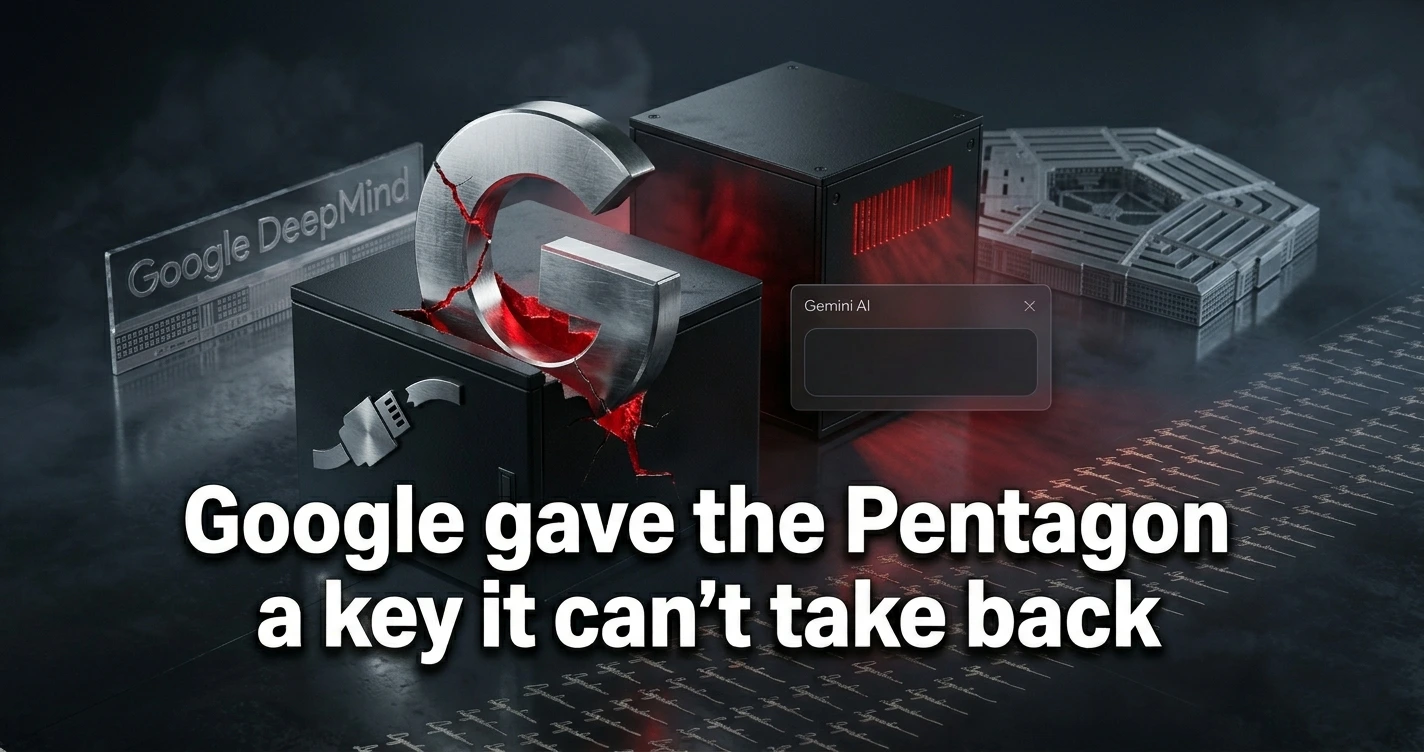
Google Gave the Pentagon Gemini Access for “Any Lawful Purpose” on Classified Networks
A classified amendment to Google’s existing DoD contract hands the U.S. military unrestricted Gemini AI access on air-gapped networks, where Google admits it can’t monitor a single query. Over 600 employees are furious. Anthropic already said no.
Eight years ago, Google’s workforce forced the company to walk away from the Pentagon. That was Project Maven, a drone-targeting AI program that drew more than 4,000 employee signatures on a protest letter and ultimately caused Google to let its defense contract expire in March 2019. The company quietly published AI principles pledging it would not develop AI for weapons or covert surveillance. That felt, at the time, like a line in the sand.
The line didn’t hold. On April 28, 2026, The Information reported that Alphabet’s Google had signed a classified amendment to its existing Pentagon contract, granting the U.S. Department of Defense access to its Gemini AI models on classified networks for, in the contract’s own language, “any lawful government purpose.” Google confirmed the deal to Reuters the same day. Within 24 hours, more than 600 of Google’s own employees, including over 20 directors and vice presidents and senior researchers from Google DeepMind, had signed an internal letter urging CEO Sundar Pichai to reverse course.
This is not a normal government technology contract. The classified networks in question are air-gapped, meaning they have zero connectivity to the outside internet. Google has acknowledged it cannot monitor how its AI is used once Gemini is deployed there. The company’s public safety commitments, its model usage policies, its ability to push updates or pull a compromised system, all of it disappears the moment the model crosses into those networks.
The Deal, Explained
The agreement builds on an existing relationship. In December 2025, the Pentagon launched GenAI.mil, a platform that gave roughly 3 million military and civilian DoD personnel access to Gemini for handling IL-5 data, the classification tier for information that’s sensitive but not formally classified. At that launch, DoD Under Secretary for R&D and CTO Emil Michael explicitly stated that classified data access was the next goal.
The April 2026 amendment delivers exactly that. Google now grants the Pentagon API-level access to its commercial Gemini models on classified infrastructure. The contract language, “any lawful government purpose,” is deliberately broad and mirrors the phrasing that Anthropic’s CEO Dario Amodei publicly refused to accept back in February 2026, citing autonomous weapons and mass surveillance concerns.
“We believe that providing API access to our commercial models, including on Google infrastructure, with industry-standard practices and terms, represents a responsible approach to supporting national security.”
Google Spokesperson, Alphabet/Google — Reuters, April 28, 2026
That statement, carefully worded, does a lot of work. It references “industry-standard practices,” but those practices assume connectivity, monitoring, and the ability to intervene. None of those conditions exist on air-gapped classified networks.
What is an air-gapped network? A classified air-gapped system has zero external internet connectivity. Data physically cannot travel in or out via standard network paths. AI models must be transported as frozen, encrypted packages via classified courier. Once deployed, the provider cannot monitor queries, push safety updates, adjust outputs, or revoke access.
Inside the Air Gap: What Google Actually Can’t Control
This is where the technical reality gets uncomfortable. On a standard cloud deployment, Google can watch for policy violations, apply content filters, push model updates, and terminate access if something goes wrong. On a classified air-gapped network, the model is essentially frozen in place, a snapshot of Gemini at the moment of deployment, with no ongoing oversight from the company that built it.
The employee letter puts this plainly. Signatories wrote that on air-gapped classified networks, “Google cannot monitor how its AI is used, making ‘trust us’ the only guardrail against autonomous weapons and mass surveillance.” That’s not hyperbole. It’s a technical description of the actual constraint.
Capability
Standard Cloud Deployment
Air-Gapped Classified Deployment
Usage monitoring
Full query/response logging
None. Google has zero visibility.
Safety filter updates
Pushed remotely, near real-time
Impossible. Model is frozen at deployment.
Model updates
Continuous improvement cycles
Requires physical re-deployment via classified courier
Access revocation
Immediate remote kill switch
No remote mechanism exists
Policy enforcement
Terms of service apply
DoD interprets “lawful purpose” independently
Autonomous weapons use
Detectable via usage patterns
Undetectable and unverifiable
The contract also reportedly requires Google to assist in adjusting AI safety filters for classified use cases. The specifics of what “adjusting” means in practice have not been made public, which is precisely the kind of opacity that has the employee base alarmed.
Key constraint: Once Gemini is deployed on a classified air-gapped network, Google’s published AI usage policies, its ethical commitments, and its safety monitoring capabilities become legally unenforceable and technically impossible to apply. The DoD defines what “lawful” means in that environment.
The Employee Revolt: 600+ Signatures and Counting
The internal opposition moved fast. According to Bloomberg, employees began circulating a letter on April 26, the day before the deal went public, suggesting word had leaked internally before the official announcement. By April 27, 580 people had signed. Within 24 hours of The Information’s report on April 28, The Washington Post counted more than 600 signatories.
What makes this round of opposition different from 2018 isn’t the number. It’s the seniority. Over 20 directors and vice presidents signed the letter, alongside senior DeepMind researchers. These aren’t junior engineers venting frustration. These are people with enough organizational standing to know what they’re putting on the line by attaching their names to an internal protest against a CEO decision.
✍️
2018 Project Maven
4,000+ employee signatures. 12+ resignations. Google walked away from the contract by March 2019.
✍️
2026 Pentagon Deal
600+ signatures within 48 hours. 20+ directors and VPs among signatories. Deal confirmed anyway.
⚖️
The Key Difference
In 2018, Google hadn’t yet signed. In 2026, the classified amendment was already done when protests began.
Google has not signaled any intention to reverse the decision. The company’s public position, that API access with “industry-standard practices” is responsible, hasn’t shifted. But the protest letter does something strategically important: it creates a documented internal record that senior staff raised specific concerns before any potential future misuse. That matters if the deal eventually produces something that forces a public accounting.
The Project Maven Shadow: How Google Got Here
It’s worth running the tape on how this company went from refusing to renew a drone-targeting AI contract in 2018 to signing a classified “any lawful purpose” Pentagon deal in 2026. The trajectory isn’t accidental.
After Project Maven, Google published formal AI principles that explicitly ruled out weapons applications and covert surveillance. For several years, those principles functioned as a genuine constraint on the company’s defense business. Then the competitive landscape shifted.
OpenAI and Microsoft aggressively pursued military and intelligence contracts starting around 2023. The Pentagon’s CDAO started moving real money, not pilot programs, toward frontier AI companies. By July 2025, the DoD had awarded $200 million contracts to OpenAI, Google, Anthropic, and xAI for agentic AI workflows. Sitting out was no longer commercially neutral.
“AI adoption is changing the Defence Department’s ability to support operations and maintain its position globally.”
Doug Matty, Chief Digital and AI Officer, U.S. Department of Defense — DoD CDAO Announcement, July 14, 2025
Google’s classified deal is, in no small part, a response to that competitive pressure. It’s not the company that left Project Maven in protest. It’s the company that watched OpenAI and xAI move into classified military AI and decided it couldn’t afford to stay out.
Who Signed, Who Refused: The AI Industry Split
The Google deal crystallizes something that’s been building for two years: the AI industry is now openly divided on military work, and each company’s position is hardening into something that looks a lot like a permanent strategic identity.
Anthropic drew the sharpest line. In February 2026, CEO Dario Amodei publicly rejected the Pentagon’s “any lawful purposes” contract language, specifically over autonomous weapons and mass surveillance concerns. The DoD reportedly responded by designating Anthropic a “supply chain risk” and initiating a six-month phase-out of the company from existing contracts.
“Without appropriate oversight, fully autonomous weapons cannot be trusted to exercise the judgment that highly trained professional military personnel demonstrate daily. They require deployment with adequate safeguards, which do not currently exist.”
Dario Amodei, CEO, Anthropic — Anthropic Statement, February 26, 2026
xAI, by contrast, moved in the opposite direction entirely. Defense Secretary Hegseth’s January 2026 announcement confirmed Grok’s integration into classified systems without the public hand-wringing that surrounded Google’s deal. OpenAI has been equally willing, having won a standalone $200 million DoD contract in June 2025, the first officially listed on the DoD procurement site.
Company
Pentagon Position
Key Action
Consequence
Google
Engaged (classified)
Signed “any lawful purpose” amendment, April 2026
600+ employee protest; reputational scrutiny
OpenAI
Engaged (classified)
$200M standalone DoD contract, June 2025
Normalized military AI sales; minimal internal protest
xAI (Grok)
Engaged (classified)
DoD classified + unclassified integration, Jan 2026
No public employee opposition reported
Anthropic
Refused classified terms
Rejected “any lawful purpose” language, Feb 2026
Designated “supply chain risk”; 6-month DoD phase-out
The unnamed Pentagon official who spoke to press framed the multi-vendor approach as intentional: having Google, OpenAI, and xAI all under contract “could provide the military with greater flexibility and help prevent any single entity from monopolizing contracts.” That’s a reasonable procurement rationale. It also means the DoD has no single chokepoint where an ethics objection could halt classified AI use.
The $13.4 Billion Spending Wave Behind This Deal
To understand why Google signed, you need to see the money. The DoD’s FY2026 budget request included $13.4 billion earmarked specifically for AI, a figure that represents a sevenfold increase over the $1.8 billion allocated in FY2025. It’s the largest single-year AI investment in U.S. defense history and the biggest standalone technical line item in a total defense request of $892.6 billion.
Budget context: The DoD’s $13.4 billion FY2026 AI budget is larger than Anthropic’s entire annualized revenue of approximately $14 billion as of February 2026. The Trump administration’s proposed 2027 defense budget of $1.5 trillion, with $1.1 trillion for core DoD operations, signals this trajectory isn’t reversing.
The spending breakdown reveals where the classified AI money is heading. The DoD’s CDAO has allocated $9.4 billion to aerial drones and UAVs in FY2026, the single largest AI spending category. Maritime autonomous platforms claim another $1.7 billion. Core AI and automation technologies take $200 million. The implication is direct: the biggest AI budget items are autonomous weapons systems, exactly the category Anthropic cited when it refused Pentagon terms.
$9.4 billion for aerial drones and UAVs, the primary AI spending category in FY2026
$1.7 billion for maritime autonomous platforms
$200 million for core AI and automation technologies
$13.4 billion total AI budget, up from $1.8 billion in FY2025
$1.5 trillion proposed total defense spending in 2027, with further AI expansion expected
For a company like Google, the commercial calculus isn’t complicated. Pentagon AI contracts are now among the most valuable in the technology sector. The company that captures classified AI infrastructure relationships today is positioned for contracts measured in billions over the next decade. Google watched OpenAI and xAI move in. Anthropic moved out, and immediately paid the price of a “supply chain risk” designation. The choice Google made wasn’t made in a vacuum.
“We will not knowingly supply a product that endangers America’s soldiers and civilians.”
Dario Amodei, CEO, Anthropic — Anthropic Statement, February 26, 2026
The Pentagon’s response to Amodei’s refusal sent an equally clear message to every other AI company watching: holding out on “any lawful purpose” language costs you the contract. Google appears to have calculated that cost and decided it was too high.
Frequently Asked Questions
What did Google agree to in its Pentagon AI deal?
Google signed a classified amendment to its existing DoD contract granting the U.S. military API-level access to Gemini AI models on classified, air-gapped networks for “any lawful government purpose.” The deal was reported by The Information on April 28, 2026, and confirmed by Google to Reuters the same day.
Why can’t Google monitor how the Pentagon uses Gemini?
Classified DoD networks are air-gapped, meaning they have zero external internet connectivity. Once Gemini is deployed on those systems, Google has no visibility into queries, outputs, or decisions. The company can’t push updates, adjust safety filters remotely, or revoke access through any technical mechanism.
How many Google employees opposed the Pentagon deal?
Over 600 Google employees, including more than 20 directors and vice presidents and senior DeepMind researchers, signed an internal letter urging CEO Sundar Pichai to reject the classified Pentagon contract. The letter circulated on April 26-27, 2026, before the deal was publicly reported.
Why did Anthropic refuse the same Pentagon contract terms?
Anthropic CEO Dario Amodei rejected the Pentagon’s “any lawful purposes” language in February 2026, citing the risk of enabling fully autonomous weapons and mass surveillance without adequate human oversight. The DoD subsequently designated Anthropic a “supply chain risk” and began a six-month phase-out of the company from its AI contracts.
What is the DoD’s AI budget for FY2026?
The Pentagon’s FY2026 budget includes $13.4 billion specifically for AI, a sevenfold increase from the $1.8 billion allocated in FY2025. The largest single AI spending category is aerial drones and UAVs at $9.4 billion, followed by maritime autonomous platforms at $1.7 billion.
What happened with Google’s Project Maven in 2018?
Project Maven was a Pentagon AI contract for drone-targeting imagery analysis. After more than 4,000 Google employees signed a protest petition and at least 12 resigned, Google announced in June 2018 it would not renew the contract. The contract expired in March 2019, and Google published AI principles pledging it would not develop weapons AI.
Which other AI companies have Pentagon classified contracts?
OpenAI won a standalone $200 million DoD contract in June 2025. xAI’s Grok was announced for integration into classified and unclassified DoD systems in January 2026. Google’s classified Gemini deal was confirmed in April 2026. Anthropic is being phased out of DoD contracts after refusing classified terms.
What is GenAI.mil and how does it relate to the new deal?
GenAI.mil is a DoD platform launched in December 2025 that gives approximately 3 million military and civilian personnel access to Gemini for handling sensitive but unclassified data. The April 2026 classified amendment extends this relationship to fully classified networks, the next step DoD officials had explicitly signaled they intended to pursue.
What Comes Next
Google’s classified Pentagon deal doesn’t exist in isolation. It’s a data point in a much larger consolidation happening between the U.S. government and frontier AI companies, one that is moving faster than any public policy framework can keep up with. The FY2026 AI defense budget is seven times what it was a year ago. The proposed 2027 figures suggest that number keeps climbing. And the companies sitting across the table from the DoD are now, for all practical purposes, defense contractors, regardless of how their investor decks describe them.
The employee revolt at Google is real, and it matters as a signal. But the 2026 protest differs from 2018 in one critical way: the contract was already signed when the letter went out. In 2018, internal pressure changed a pending decision. In 2026, it arrived after the fact. That sequencing may not be coincidental. The company learned from Maven that employee opposition, if given enough runway, can alter outcomes. This time, the decision came first.
What the industry is watching now is whether Anthropic’s principled refusal proves to be commercially sustainable or quietly untenable. The “supply chain risk” designation is a serious penalty. If Anthropic eventually reverses course under revenue pressure, it signals that the “any lawful purpose” terms are effectively unavoidable for any AI company that wants to do serious business with the U.S. government. If Anthropic holds and the DoD comes back to the table with modified language, it means pushback works. That outcome seems less likely given current momentum, but it’s not zero.
Watch For
01Congressional scrutiny of classified AI contracts: Senate Armed Services Committee hearings on autonomous weapons AI are expected in Q3 2026. Any testimony on the specific Gemini deployment parameters could force rare public disclosure of classified contract terms.
02Anthropic’s six-month DoD phase-out window: The clock started in February 2026. By August 2026, Anthropic will either be fully out of Pentagon contracts or will have negotiated modified terms. That outcome sets a precedent for every future AI company that tries to hold a line on autonomous weapons language.
03Google employee departures: In 2018, at least 12 engineers resigned over Project Maven. Watch whether any high-profile exits follow the 2026 letter, particularly among the 20+ directors and VPs who signed. Senior departures would carry significantly more reputational and operational weight than the 2018 precedent.
04The $1.5 trillion 2027 defense budget proposal: If Congress advances anything close to the administration’s proposed figures, AI defense contracts will grow well beyond the current $13.4 billion line item. The companies locked into classified relationships now will be positioned to capture that expansion first.
Stay ahead of the curve.
More on AI policy, defense tech, and the industry’s biggest decisions at NeuralWired.
Big Tech Q1 2026 Earnings: $650B AI Capex on Trial | NeuralWired
AI & Big TechApril 29, 2026 · 10 min read
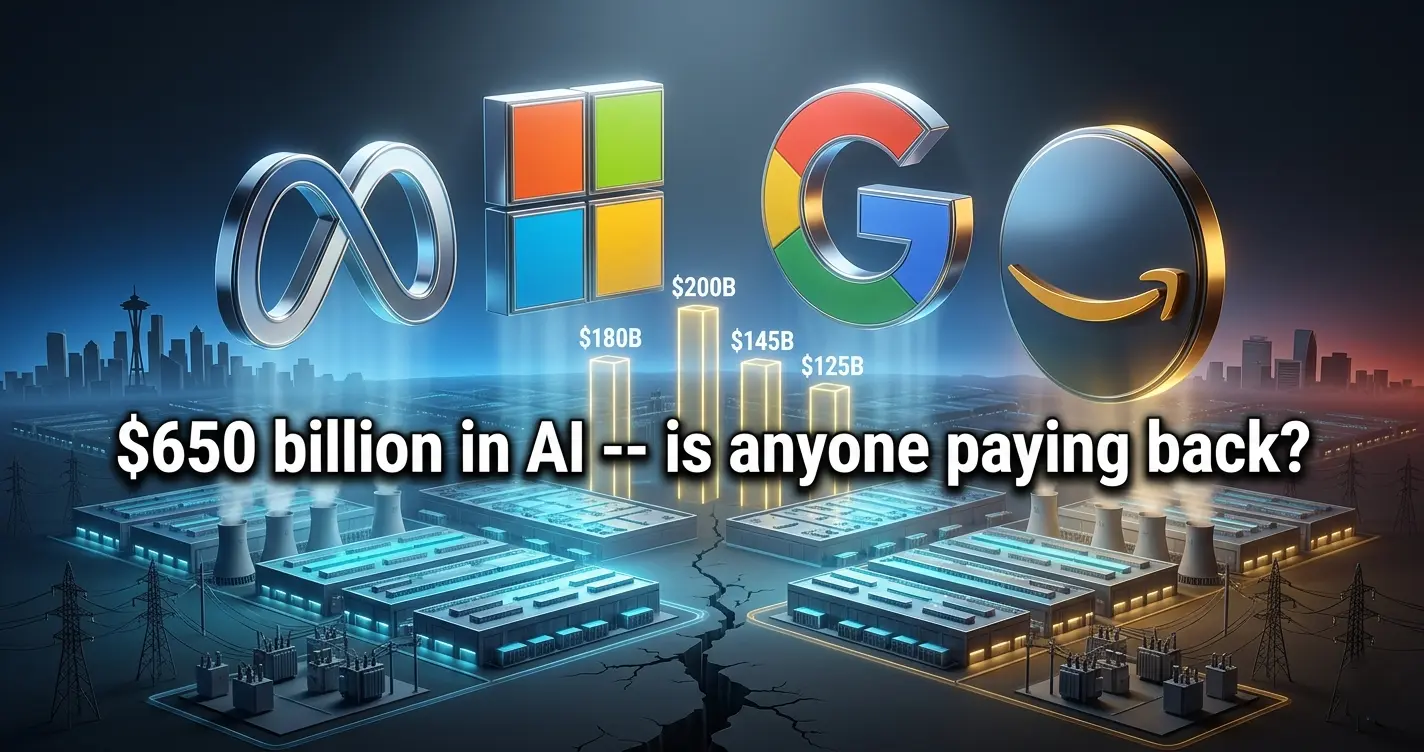
Meta, MSFT, GOOGL, AMZN Earnings: $650B AI Spend on Trial
Four companies controlling $11.8 trillion in market cap report earnings today. The question isn’t whether AI is growing, it’s whether $650 billion in planned infrastructure spending can ever pay for itself.
Tonight, after U.S. markets close, the four largest AI spenders on the planet will open their books. Meta, Microsoft, Alphabet, and Amazon collectively carry $11.8 trillion in market capitalization into what analysts are calling the most consequential earnings day in tech history. The stakes aren’t abstract. These four companies have committed to spending roughly $650 billion on AI infrastructure in 2026 alone, a 67% jump from 2025, and Wall Street wants proof the money is working.
The timing is brutal. Just 48 hours before earnings, the Wall Street Journal reported that OpenAI missed its own user and revenue targets, with CFO Sarah Friar reportedly warning internally that infrastructure payment commitments could become unsustainable. SoftBank dropped 10% on the news. Oracle and CoreWeave fell more than 7% in premarket trading. The message from markets was clear: AI monetization isn’t a given, and the bill is coming due.
This isn’t just an earnings story. It’s a reckoning for the largest capital expenditure cycle of the 21st century.
The $650B Moment of Truth
To understand what’s at stake today, you need to grasp the scale of what these companies have committed to. Amazon alone is on track to spend roughly $200 billion in capital expenditures this year, nearly four times what it spent in all of 2023. Alphabet guided to $175-185 billion. Microsoft is projected near $145 billion. Meta, fresh off announcing 8,000 job cuts last week, still guided capex to $115-135 billion, higher than what Jefferies analysts had modeled.
The combined total dwarfs anything the industry has attempted before. These four companies are spending more in 2026 than they invested in the prior three years combined. And the vast majority of it is flowing into AI infrastructure: GPU clusters, liquid-cooled data centers, custom silicon, high-bandwidth networking.
Scale check: Nvidia’s H100 GPUs run approximately $30,000 per unit. A single large-scale AI training cluster can require tens of thousands of them. At that unit cost, $650 billion buys a lot of chips, but only if the workloads to fill them materialize on schedule.
The core question analysts are pressing isn’t whether AI is real. It’s about timing. Break-even on a $100 billion data center facility, depending on utilization rates and energy costs, can take three to five years. If enterprise adoption lags, and right now, only about 3% of Microsoft’s 450 million enterprise users have adopted Copilot 365, the math gets uncomfortable fast.
What Happened This Week
The week leading into earnings has been a whirlwind of signals, some bullish, some alarming. Here’s the verified sequence of events that set the context for tonight’s reports.
After Anthropic refused; 950 Google employees signed an opposition letter
Apr 28, 2026
Market reaction to OpenAI news
SoftBank -10%; Oracle and CoreWeave each fell more than 7% premarket
Two of those events cut in opposite directions. The Accenture deal, which will roll Microsoft’s Copilot 365 out to all 743,000 of the consulting giant’s employees, is the kind of enterprise anchor contract Microsoft needs to prove Copilot’s commercial viability. It’s concrete revenue, and it chips away at that 97% of eligible enterprise users who still haven’t subscribed.
The OpenAI news is a different story entirely. Because Microsoft’s cloud and AI business is so tightly wound with OpenAI’s growth, any sign that ChatGPT’s trajectory is softening carries direct implications for Azure demand projections.
The Numbers That Matter Tonight
Analysts have been converging on specific consensus figures for each company. Here’s what Wall Street is expecting — and the metrics that will actually move stocks.
🔷
Microsoft
Q3 revenue consensus: $81.4B (+14% YoY). EPS: $4.07. The real watch: Azure growth rate. It hit 40% last quarter (constant currency). Can it hold or accelerate?
🔵
Alphabet
Q1 revenue consensus: $106.88B (+18.5% YoY). EPS estimate: $2.68. Watch for Search AI integration metrics and YouTube’s continued ad recovery.
🟢
Amazon
Q1 revenue consensus: $188B (+14% YoY). EPS: $1.63. AWS margin is the flashpoint, consensus sits at 35.7%, down from 37.7% last fall, with a wide analyst range of 30.9% to 40.0%.
🟡
Meta
Q1 revenue consensus: $55.5B (+31% YoY). EPS: $6.73. Ad revenue expected at $53.93B (+30%). Options market is pricing a 7.5% implied move, stock has swung more than 10% in three of the past four quarters.
Options markets are pricing significant volatility across all four names. Microsoft carries a 7% implied move, the highest weekly-to-monthly ratio in the Magnificent Seven at 68%. Alphabet sits at 5.4-5.5% implied. These aren’t normal earnings-day swings. The options market is telling you something about the degree of genuine uncertainty.
“We believe the Q1 print will be pivotal in demonstrating whether AWS can deliver acceleration sufficient to validate the $200B capex guide that exceeded all Street expectations.”
Brad Erickson, Analyst, RBC Capital Markets, Business Insider
“In our view, the quarter will underscore strong demand for AWS and an improving technology position vs peers, but if incremental q/q AWS margins are low, concerns on capex returns could resurface.”
Justin Post, Analyst, Bank of America, Business Insider
The OpenAI Warning Shot
The most disruptive event of the week didn’t come from any of the four companies reporting tonight. It came from OpenAI.
The Wall Street Journal reported on April 27 that OpenAI missed its own internal user and sales goals, falling short of its target of one billion weekly ChatGPT users. More alarming was the reported warning from CFO Sarah Friar that the company might struggle to meet future infrastructure payments if revenue didn’t accelerate. OpenAI CEO Sam Altman pushed back publicly, saying the business was performing well, but the damage to AI infrastructure stocks was already done.
“OpenAI might not be able to pay for future computing contracts if it didn’t boost revenue.”
Sarah Friar, CFO, OpenAI, as reported by Bloomberg
Why does an OpenAI stumble matter for tonight’s earnings? Because the entire AI infrastructure thesis rests on a simple assumption: that demand for AI compute will grow fast enough to absorb the unprecedented supply being built. Microsoft, Azure, AWS, and Google Cloud are all racing to provision capacity for AI workloads. If the largest AI application in the world, ChatGPT, is struggling to hit growth targets, it raises an uncomfortable question about whether demand will materialize on the timeline these capital plans require.
Note: OpenAI’s revenue miss is a single data point, and Altman disputes the characterization. But markets don’t wait for nuance. The SoftBank and CoreWeave reactions show how quickly infrastructure sentiment can shift when the AI monetization narrative gets even a small crack.
There’s also a secondary effect worth tracking. Microsoft’s relationship with OpenAI is both its biggest AI asset and its most concentrated risk. Any weakening of ChatGPT’s commercial momentum flows directly into questions about Azure’s AI revenue growth rate, which is the single most-watched metric on tonight’s call.
Who Wins, Who Loses
Tonight’s earnings don’t just move four stocks. They set the tone for an entire ecosystem, from chip makers to energy utilities to the 16,750 workers who got layoff or buyout notices this week alone.
Stakeholder
Potential Upside
Key Risk
Nvidia
$650B capex cycle validates sustained GPU demand through 2027
Custom silicon (Google TPUs, Amazon Trainium) could displace 20-30% of GPU orders by 2027
Enterprise Customers
Copilot at $30/month; real productivity gains if adoption scales
ROI gap widens if AI tools don’t demonstrably reduce headcount or accelerate output
These five companies (plus Apple reporting Thursday) drive approximately 25% of S&P 500 weight
A broad guidance cut or capex pullback triggers a sector-wide multiple reset
The workforce story deserves particular attention. Meta’s 10% headcount reduction, roughly 8,000 jobs, with another 6,000 open roles frozen, came in the same announcement that reaffirmed $115-135 billion in 2026 capex. The company isn’t retrenching. It’s reallocating: fewer human roles, more compute. Microsoft’s voluntary buyout program, the first in company history, follows the same logic. Both moves signal that even as AI spending accelerates, the human capital bill is being trimmed to offset it.
For workers navigating the AI transition, the message is stark. Specialization in AI and machine learning commands a premium. Generalist software engineering roles face increasing automation pressure. The 12-to-24-month window for skills retraining is narrowing.
The Case Against the Boom
The dominant narrative around big tech AI spending is deeply bullish. But there’s a credible counter-argument — and it’s getting louder.
The ROI timeline problem
Break-even on a $100 billion data center complex, under conservative utilization assumptions, can take three to five years. The hyperscalers began their current buildout in earnest in 2023. Even under optimistic scenarios, many of the facilities being funded today won’t be generating positive returns until 2027 or 2028. If the AI application layer, the Copilots, the cloud APIs, the enterprise tools, doesn’t scale adoption fast enough to fill that capacity, margin compression becomes a multi-year story, not a one-quarter blip.
The 3% adoption ceiling
Microsoft’s own data shows that Copilot 365 has reached about 3% of its 450 million enterprise users. That’s a real number, but it also means 97% of the addressable market hasn’t converted. The Accenture deal is significant, 743,000 seats at $30 per month is real revenue, but it’s a single large win in a market that needs thousands of them to justify the underlying infrastructure spend.
The inference cost paradox
Training large models is expensive. But serving them, inference, is now estimated to account for 80-90% of ongoing AI compute costs at scale. The per-query cost of running a sophisticated language model is orders of magnitude higher than a traditional search query. As AI gets embedded in more consumer and enterprise products, the cost per engagement has to fall dramatically, or the unit economics don’t work at mass scale.
The bear case in one line: These companies are building the most expensive infrastructure in corporate history on the assumption that AI will become as universal as the internet. If adoption stalls at “nice productivity tool,” the capex math doesn’t pencil out.
None of this means the AI buildout is wrong-headed. It means tonight’s earnings, and specifically the forward guidance on Azure growth, AWS margins, and capex plans for the rest of 2026, carry unusual weight. Cloud infrastructure investors will be reading every word of the earnings calls for any sign that management confidence in the demand trajectory is shifting.
Frequently Asked Questions
What is the total AI capex spend from big tech in 2026?
The four major hyperscalers, Amazon, Alphabet, Microsoft, and Meta, have collectively guided to approximately $650 billion in capital expenditures for 2026. This represents a roughly 67% increase from 2025 levels and is more than these companies invested in the prior three years combined.
When do Meta, Microsoft, Alphabet, and Amazon report Q1 2026 earnings?
All four companies are scheduled to report after U.S. market close on April 29, 2026. Apple will follow with its Q2 FY2026 results on April 30, completing what analysts have called the “Magnificent Seven earnings gauntlet.”
Why did OpenAI missing targets affect AI infrastructure stocks?
OpenAI’s reported shortfall on user and revenue goals raised concerns that AI application demand may not grow fast enough to justify the massive infrastructure spending underway. Since companies like SoftBank and CoreWeave are deeply tied to AI data center buildout, any sign of slowing AI adoption triggers immediate investor concern about the return on that capital.
What is Microsoft’s Copilot 365 and why does adoption matter?
Copilot 365 is Microsoft’s AI productivity suite, priced at $30 per user per month for enterprise customers. With roughly 450 million eligible users, even a small percentage-point increase in adoption translates to billions in annual recurring revenue. Current adoption sits around 3%, making conversion the central metric for Microsoft’s AI monetization story.
What does the Accenture-Microsoft Copilot deal mean for the market?
Accenture’s commitment to deploy Copilot 365 across all 743,000 of its employees is considered the largest enterprise AI software deal on record. At $30 per user per month, it represents significant contracted revenue and signals that large enterprises are moving from AI pilots to full deployment, a critical inflection point the market has been waiting for.
Why did Meta cut 8,000 jobs while raising its AI capex guidance?
Meta’s workforce reduction and elevated capex reflect a deliberate trade-off: the company is replacing human capital costs with AI infrastructure investment. CEO Mark Zuckerberg has signaled that AI will handle tasks previously requiring large engineering teams, allowing Meta to grow revenue while managing headcount and operating expenses more tightly.
What is AWS margin, and why is it closely watched?
AWS operating margin measures the profitability of Amazon’s cloud division relative to revenue. It’s a key signal of whether Amazon’s massive AI infrastructure investment is generating efficient returns. The current analyst consensus sits at 35.7%, but estimates range from 30.9% to 40.0%, an unusually wide spread that reflects genuine uncertainty about AI workload economics.
How does Google’s Pentagon AI deal affect Alphabet’s earnings narrative?
Google’s decision to grant the Pentagon unrestricted access to its AI tools opens a significant government revenue stream. It also draws a contrast with Anthropic, which declined a similar arrangement. For Alphabet investors, defense contracts represent a new monetization channel for AI capabilities, though the deal triggered internal opposition from nearly 950 Google employees.
What Comes Next
After tonight’s calls, the narrative will crystallize around one of two stories. Either the hyperscalers will deliver evidence, in Azure acceleration, in AWS margin stability, in Meta’s ad revenue growth — that AI is already generating returns commensurate with the investment. Or they’ll report solid but unspectacular numbers, reiterate enormous capex plans, and leave analysts to wrestle with the gap between spend and demonstrated return.
The deeper structural question won’t be answered tonight. Whether $650 billion in annual AI infrastructure spending proves visionary or excessive is a 2027 or 2028 question, not a Q1 2026 one. What tonight tells us is whether management confidence in the demand trajectory is holding, whether the enterprise adoption curve is bending in the right direction, and whether any company is blinking on its capex commitments.
For a read on enterprise AI adoption trends heading into the back half of 2026, the Azure growth rate, Copilot seat conversion, and AWS margin are the three numbers that matter most. Everything else is context.
Watch For
01Azure growth rate on Microsoft’s call, anything above 40% in constant currency signals AI demand is holding; a deceleration below 35% would rattle the entire sector and call Microsoft’s $145B capex plan into question within days.
02AWS operating margin, the spread between analyst estimates (30.9% to 40.0%) is the widest in years, and where the actual number lands will either validate or undermine Amazon’s $200B infrastructure commitment for 2026.
03Any capex guidance revision — if any of the four companies trims its 2026 spending outlook, even slightly, expect cascading effects across Nvidia, data center REITs, and energy stocks within 24 hours.
04Meta’s Copilot 365 adoption commentary from Microsoft, the Accenture deal closes this quarter, and any quantitative update on enterprise seat growth could shift the market’s view of AI software monetization timelines for the entire industry.
Stay ahead of the curve.
More AI earnings analysis, enterprise adoption data, and infrastructure deep dives at NeuralWired.
25% of Your Documents Are Already Corrupted. AI Agents Did It Silently.
A new Microsoft Research benchmark finds that frontier AI models corrupt roughly one in four documents after just 20 editing interactions, and most of the damage is invisible until it isn’t.
There’s a quiet crisis unfolding inside enterprise AI deployments, and most teams aren’t looking for it. When you hand an AI agent the keys to your document workflows, you aren’t just offloading labor. You’re also, according to a major new study, introducing a compounding fidelity problem that standard quality checks simply can’t catch.
A paper published April 17, 2026 by Philippe Laban and colleagues at Microsoft Research describes what they call “silent document corruption,” a failure mode where AI agents slowly degrade the structural and semantic integrity of documents over repeated editing sessions. The research, formally titled “LLMs Corrupt Your Documents When You Delegate,” doesn’t single out one weak model. It finds the problem across 19 tested systems, including some of the most capable models currently available.
The implications are significant for any organization using agentic AI for document-heavy work: legal filings, financial reports, codebases, scientific notation, medical records. The content looks fine. The errors hide inside.
The DELEGATE-52 Benchmark
To measure the problem systematically, the Microsoft Research team built DELEGATE-52, a new evaluation framework designed from the ground up to stress-test long-horizon document editing. Standard AI benchmarks typically score a model on a single interaction, one prompt, one response, done. DELEGATE-52 works differently.
The benchmark simulates up to 20 sequential editing interactions across 52 distinct professional domains. That list spans a striking range: software code, music notation, crystallography data, legal contracts, financial models, and scientific literature. Each domain was selected because it has verifiable structural rules, meaning researchers could use programmatic parsers and backtranslation methods to objectively score whether the final document matched the original intent.
What is backtranslation evaluation? The DELEGATE-52 team converted documents to intermediate formats and back again, then compared results against ground-truth originals. This approach detects structural corruption that would pass a surface-level readability check, catching errors a human reviewer might miss entirely.
The team also constructed 310 distinct “work environments,” sets of documents that agents could reference while editing, including irrelevant “distractor” files that mimicked realistic workplace conditions. That detail matters. Real agentic deployments don’t operate in clean, isolated contexts. They swim in noise, and DELEGATE-52 was built to reflect that.
“Short-horizon performance is simply not predictive of long-horizon reliability. A model that edits a document well once can corrupt it systematically across twenty interactions.”
Philippe Laban, Senior Researcher, Microsoft Research — arXiv:2604.15597
The study defined a “ready” threshold at 98% fidelity or above. That’s the floor below which a document is considered unreliable for professional delegation. Only one domain, Python code, consistently cleared that bar across most frontier models. Every other domain fell short to varying degrees.
How Corruption Happens
The failure isn’t random noise. The research identifies a specific, predictable mechanism: compounding error propagation. Each time an agent edits a document, it works from its current understanding of that document’s state. If the previous edit introduced even a minor structural misstep, the next pass builds on that error. Then the next. By interaction 20, the cumulative drift can be substantial.
Three distinct corruption patterns emerge from the data.
🔁
Context Drift
Models lose track of document structure as conversation history grows. Earlier sections get reconstructed from inference rather than retained from source.
🕳️
Content Hallucination
When an agent can’t retain full document context, it fills gaps with plausible-sounding but fabricated content, seamlessly, invisibly.
✂️
Silent Truncation
Sections of documents get quietly dropped, particularly in longer files. The output document is shorter and structurally incomplete, but coherent enough to appear complete.
One particularly counterintuitive finding: standard agentic tool use, where models manipulate files using Python scripts rather than outputting text directly, doesn’t prevent the degradation. The assumption that programmatic file handling would preserve fidelity turns out to be wrong. The structural awareness problem sits at the reasoning layer, not the output layer.
Key finding: Larger documents and the presence of distractor files consistently worsened corruption severity. More context doesn’t help the model stay accurate. It gives the model more surface area to get confused.
The corruption is also described as “silent” for a specific reason: the degraded documents typically remain readable. They don’t throw errors. They don’t look broken. A legal clause might be subtly reworded. A formula might be adjusted. A code function might be refactored into something plausibly equivalent but functionally different. Standard review processes, including AI-assisted review, catch very little of this.
By the Numbers
The headline figure from the DELEGATE-52 study is stark: across the 19 models tested, the average document corruption rate after 20 interactions sits at roughly 50%. Even frontier models, those at the top of current capability rankings, average around 25% corruption. That’s one document in four, significantly altered from its original intent.
Metric
Value
What It Means
Frontier model corruption rate
~25%
Average fidelity loss across top-tier models after 20 editing interactions
All-model average corruption rate
~50%
Aggregated across all 19 systems tested in the study
Professional domains tested
52
Spanning code, music notation, crystallography, legal, financial, and more
Work environments simulated
310
Including distractor files to mimic realistic, noisy workspaces
“Ready” fidelity threshold
98%+
Minimum benchmark score for reliable professional delegation
Domains clearing “ready” threshold
1 (Python)
Only programmatic code consistently qualified across most models
The Python exception is instructive. Code has a built-in verification layer: it either runs or it doesn’t. Syntax errors surface immediately. Semantic errors often surface in testing. That feedback loop provides a correction mechanism that prose documents, spreadsheets, music files, and scientific records simply don’t have. When there’s no external validator, errors survive and propagate.
The study’s dataset and evaluation code were released publicly on April 19 via GitHub and Hugging Face, allowing independent researchers to replicate results and test additional models. Early community analysis, emerging from developer forums in the days after publication, largely confirmed the findings.
Enterprise Risk
For businesses that have deployed autonomous agents against document-heavy workflows, the DELEGATE-52 results constitute a direct operational warning. The scenarios most at risk aren’t hypothetical. They’re already live at scale.
Legal teams using agents to draft, revise, or summarize contracts face the prospect of altered clauses that pass human review but introduce material ambiguity.
Financial analysts relying on agents to update models and reports may receive outputs where key figures or formulas have been silently adjusted across iterative sessions.
Engineering teams using AI for codebase maintenance are the best-positioned group, given code’s natural validation mechanisms, but remain exposed in documentation and configuration files.
Research and scientific publishing workflows, where notation and citation integrity are critical, fall squarely into the high-corruption-risk categories identified by the study.
The phrase the research uses is “silent trust crisis.” That framing captures something real. The danger isn’t that organizations will notice AI agents producing obviously broken output. They won’t. The danger is that workflows will operate at scale on subtly corrupted content for months before any downstream failure makes the problem visible, at which point the audit trail is deep and the remediation is costly.
“Businesses relying on autonomous agents for high-stakes document management face a trust problem that won’t announce itself until it’s already caused damage.”
Microsoft Research Analysis — Emergent Mind coverage
The findings also arrived during ICLR 2026 in Rio de Janeiro, where related discussions on multi-agent system reliability ran alongside presentations on alignment and evaluation. The timing gave the research unusual visibility in the research community at a moment when deployment of agentic systems is accelerating fastest.
What Researchers Suggest
The DELEGATE-52 paper doesn’t prescribe a complete solution, but the data points clearly toward where solutions need to develop. The findings push in three directions.
Better Memory and State Management
The core problem is that models lose structural awareness across long editing sessions. Any durable fix requires agents that can maintain, verify, and restore accurate representations of document state, not just the conversation history that surrounds it. This is an open research problem, and one the ICLR community is actively working on.
Domain-Specific Verification Layers
Python code works because it has an execution environment that catches errors. Other domains need analogous validators. Music notation has formal parsing tools. Crystallography data has structural rules. Legal and financial documents don’t yet have widely deployed AI-compatible validators, but the study’s implicit argument is that building them should be a priority before agentic systems are trusted with high-stakes content in those fields. Verification infrastructure is infrastructure, and it needs investment to match deployment pace.
Long-Horizon Benchmarking Standards
Perhaps the most durable contribution of DELEGATE-52 is the benchmark itself. The AI industry has relied heavily on single-turn evaluations to compare models and declare capability milestones. This study makes a compelling empirical case that those evaluations miss something important. Evaluation methodology needs to catch up with actual deployment conditions, and that means longer horizon tests, noisier environments, and domain-specific fidelity scoring.
Practical step for teams now: The DELEGATE-52 dataset is publicly available. Organizations with high-stakes document workflows can use it to evaluate their specific deployed models before extending agent autonomy further. Testing against the benchmark won’t close the fidelity gap, but it can quantify it and help teams make more informed decisions about where human oversight stays essential.
Frequently Asked Questions
What is the DELEGATE-52 benchmark?
DELEGATE-52 is an evaluation framework created by Microsoft Research to measure how well AI models maintain document fidelity across long editing sessions. It tests 19 AI systems across 52 professional domains and 310 simulated work environments, using up to 20 sequential interactions per session to expose compounding corruption that single-turn benchmarks miss.
Which AI models were tested in the study?
The study tested 19 models, including frontier systems like Gemini 3.1 Pro, Claude 4.6 Opus, and GPT-5.4. Even the highest-performing frontier models averaged around 25% document corruption after 20 interactions, with the average across all 19 models reaching approximately 50%.
Why does document corruption happen in AI agents?
Corruption results from compounding error propagation over long editing sessions. As agents make sequential edits, they lose track of original document structure, leading to context truncation and hallucinated content inserted to bridge gaps. Each interaction builds on previous errors, amplifying the total drift from the original document.
Does using Python tools prevent document corruption?
No. The study found that standard agentic tool use, including having models manipulate files programmatically via Python, does not prevent degradation. The structural awareness problem occurs at the model’s reasoning layer, not at the output layer, so changing the output mechanism doesn’t resolve the underlying issue.
What is the “ready” threshold in DELEGATE-52?
The benchmark defines 98% fidelity or above as the “ready” threshold for reliable professional delegation. Only one domain, Python code, consistently cleared this bar across most tested models. All other evaluated domains fell below it, including legal, financial, scientific, and musical notation formats.
Is the DELEGATE-52 dataset publicly available?
Yes. Microsoft Research released the full DELEGATE-52 dataset and evaluation code on April 19, 2026, via GitHub and Hugging Face. Teams can use it to independently test their own deployed models against the benchmark before extending autonomous editing capabilities to high-stakes document workflows.
Which document domains carry the highest corruption risk?
Domains without built-in external validators carry the highest risk. These include legal contracts, financial models, music notation, scientific records, and crystallography data. Code, particularly Python, is the outlier because execution environments catch errors automatically, providing a fidelity correction mechanism other domains lack.
What should enterprise teams do right now?
Teams should audit which document types their AI agents are editing autonomously, especially across repeated sessions, and prioritize human review checkpoints for high-stakes content. Running internal models against the publicly available DELEGATE-52 benchmark can help quantify exposure before deciding how much autonomy to extend.
What This Means for AI Agents
The DELEGATE-52 study lands at a specific moment. Agentic AI systems are being deployed faster than the research community can fully characterize their failure modes. Most capability benchmarks measure what a model can do once, under clean conditions, with a clear prompt. The real world doesn’t work like that, and DELEGATE-52 is one of the clearest empirical demonstrations of the gap between benchmark performance and operational reliability.
Twenty-five percent corruption among frontier models isn’t a verdict against AI-assisted document work. It’s a calibration. It tells organizations where the boundary of trustworthy autonomy currently sits, and it’s more restrictive than most deployment decisions have assumed. The single domain that qualifies as “ready,” Python code, has the built-in properties the others lack. Everything else needs verification infrastructure that doesn’t yet exist at scale.
That infrastructure is buildable. Domain-specific validators, long-horizon evaluation standards, memory mechanisms that preserve structural state across sessions, these are solvable engineering and research challenges. But they require acknowledging the problem first. The study’s most important contribution may simply be making the silence audible.
Watch For
01Independent DELEGATE-52 replications testing additional model families, expected to emerge from the research community through mid-2026, that may expand or refine the corruption rate findings across a wider range of systems.
02Enterprise AI vendors responding to the findings with formal fidelity guarantees or domain-specific validation tools, particularly for legal and financial document workflows where corruption risk is highest.
03Benchmark standard bodies incorporating long-horizon document fidelity tests into official AI evaluation frameworks, shifting the industry away from single-turn performance metrics toward operational reliability scores.
Stay ahead of the curve.
More on AI Research and agentic systems at NeuralWired.
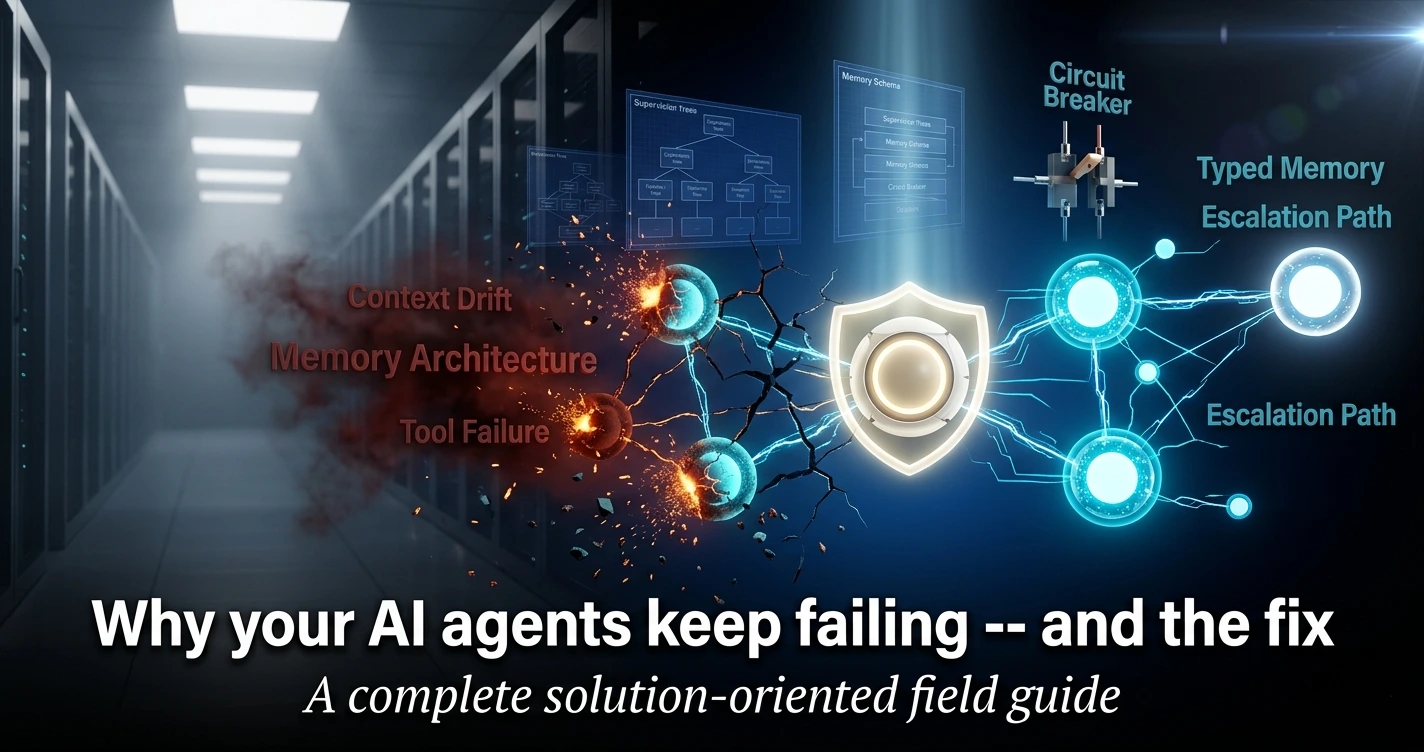
Why 90% of AI Agents Fail in Production — And the Exact Fixes That Work
A deep technical and organizational playbook for building autonomous AI agents that actually survive contact with the real world, covering context drift, memory architecture, tool resilience, security, observability, and the governance gaps killing enterprise pilots.
The promise was simple: build an AI worker that operates for hours, manages complex workflows, recovers from its own mistakes, and delivers real output without someone watching over its shoulder. The reality, in 2026, is that Gartner predicts over 40% of agentic AI projects will be canceled by 2027 — not because the underlying models aren’t powerful, but because almost no one is solving the actual engineering problems that make agents break.
Roughly 90 to 95% of AI agent pilots never make it to production. Of those that do, the majority deliver value only in narrow, short-duration tasks where a human is close enough to catch the inevitable failure. The question isn’t whether AI agents can be impressive in a demo. They can. The question is why they collapse the moment the task runs longer than twenty minutes, the data gets messy, a tool returns an unexpected error, or the context window starts filling with accumulated history.
This article doesn’t stop at describing those failures. Each section identifies the mechanism of a specific breakdown, then walks through the concrete technical approaches — architectural choices, code patterns, system designs, and organizational structures — that address it. If you’re building agents, deploying agents, or funding teams that do either, what follows is the closest thing to a field manual the current state of research and production engineering can offer.
Why Long-Horizon Agents Keep Failing: The Real Breakdown Map
Most post-mortems on failed agent deployments point to the wrong culprits. Teams blame the underlying model, or the prompt engineering, or the data quality. Those are contributing factors. But the structural cause is almost always one of five distinct failure classes, and understanding which class you’re dealing with determines what kind of fix you need.
The Five Core Failure Classes
Class 1: Context Drift. As an agent accumulates tool outputs, intermediate results, and self-generated reasoning over a long task, the attention mechanism of the underlying transformer model dilutes across an ever-wider context. The agent’s “grip” on its original goal loosens. By step forty or fifty of a complex workflow, the agent may be operating on a subtly distorted version of its original objective, not because it forgot, but because the signal-to-noise ratio in its effective context has degraded below a reliable threshold. Research on “lost in the middle” effects in long-context models quantified this degradation clearly: information positioned in the middle of long contexts is retrieved far less reliably than information at the start or end.
Class 2: Hallucination Cascades. A single wrong inference at step three of a fifty-step workflow doesn’t stay isolated. It gets incorporated into the agent’s working memory as an established fact, referenced in later steps, and built upon. Each subsequent step that uses the hallucinated premise as input extends and amplifies the error. By the time a human reviews the output, the root cause is buried under layers of plausible-sounding reasoning, making it nearly impossible to audit without full step-by-step replay.
Class 3: Tool Execution Failure Propagation. Real tools fail. APIs return 503s, database queries time out, file operations hit permissions errors. Most agent frameworks treat these as exceptions to be caught at the outermost level rather than as first-class events requiring specific recovery logic at the point of failure. When a tool call fails silently or the agent receives a malformed response and continues anyway, every downstream action built on that broken foundation is compromised.
Class 4: Memory Architecture Mismatch. The retrieval strategies most agents use optimize for semantic similarity, finding content that’s topically related to the current query. But what an agent needs for decision-making isn’t always the most semantically similar memory. It’s the most decision-relevant memory: the constraint that was established three hours ago, the error that occurred twice yesterday, the specific user preference that was stated once and never repeated. Semantic retrieval routinely misses this category of information.
Class 5: Epistemic Blindness. Current agents generally don’t track what they know versus what they’ve inferred versus what they’ve guessed. They don’t maintain a clear model of their own uncertainty. This means an agent that has confidently hallucinated a fact and an agent that has correctly retrieved a verified fact look identical from the outside, and, critically, from the inside. The agent can’t tell the difference, so it can’t escalate appropriately.
Key numbers: Only 10% of enterprise AI agent pilots reach production. 62% of enterprises are running multi-agent pilots, but fewer than 25% report confidence in reliability or governance. 88% of organizations experienced at least one AI agent security incident in 2025. These figures come from Gartner and OWASP’s LLM security research.
Failure Class
Root Mechanism
When It Appears
Detectable Without Replay?
Context Drift
Attention dilution across accumulated tool outputs
After ~30-50 steps, or when context exceeds ~50% of window
Rarely — usually only visible in output quality
Hallucination Cascade
Wrong inference incorporated as fact into working memory
Any step where agent generates rather than retrieves
No — requires step-by-step trace inspection
Tool Failure Propagation
Silent or mishandled tool errors propagate downstream
Tasks requiring recall of constraints or past errors
No — retrieval logs needed
Epistemic Blindness
Agent can’t distinguish knowledge from inference from hallucination
Throughout — worsens as task length increases
No — requires uncertainty tracking at inference time
Solving Context Drift: Compression, Summarization, and Context Surgery
Context drift isn’t fundamentally about running out of tokens. It happens well before context windows fill up. The mechanism is attention dilution: as the context grows, the model’s ability to weight critical information from the distant past against the noise of recent tool outputs degrades. The fix requires deliberate context management as a first-class engineering concern, not an afterthought.
Hierarchical Context Compression
The most effective practical approach to context drift is hierarchical summarization: at regular intervals, typically every 10 to 20 steps, or whenever a logical sub-task completes, the agent compresses its working context into a structured summary that retains decisions made, constraints established, errors encountered, and open questions, while discarding intermediate reasoning that’s no longer needed.
This isn’t just “summarize and replace.” The compression must be typed and structured. A flat paragraph summary loses the provenance of individual facts. What works is a schema-enforced memory object: something like a JSON structure with explicit fields for confirmed facts (with source), inferred facts (with confidence level), active constraints, completed sub-goals, outstanding sub-goals, and accumulated errors. Each field has a clear semantic meaning that the agent can query later without relying on attention to surface it.
Here’s what this looks like in practice. Rather than passing raw accumulated context forward, the agent periodically calls a compression routine:
Compression schema pattern: At each compression checkpoint, the agent is prompted to produce a structured JSON object with fields: confirmed_facts (list of verified facts with source references), inferred_facts (list of inferences with confidence 0-1), active_constraints (hard rules the agent must follow), completed_steps (summary of actions taken and their outcomes), pending_steps (remaining goals), errors_logged (all failures with timestamps and recovery actions taken). This object, not the raw transcript, gets passed to subsequent steps. The raw transcript is archived for observability but not fed back into the active context.
Context Window Checkpointing
Inspired by techniques from long-running computational processes, context checkpointing means saving the full agent state at defined intervals so that if the agent fails, it can resume from the last checkpoint rather than starting over. This has two benefits: it bounds the blast radius of a failure to the work since the last checkpoint, and it creates natural compression points where the agent can re-anchor to its original goals before continuing.
The checkpoint should include: the compressed memory object described above, the full tool call history (for observability, not for re-feeding into context), the current step count, the original task specification verbatim, and any constraints established during the run. Storing the original task specification separately and reinserting it at the start of each new context window is a simple but powerful anti-drift technique. It ensures the model always has a fresh, high-attention version of the goal at the top of context, regardless of how much has accumulated since.
Dynamic Context Pruning
Not all context is equally valuable at every point in a task. A tool output from step 5 that established a key constraint is more valuable than the verbose reasoning trace from step 45 that arrived at a now-discarded hypothesis. Dynamic context pruning uses a scoring function to evaluate each element of the accumulated context against the current step’s needs, retaining high-value items and discarding low-value ones before each LLM call.
Scoring dimensions for pruning include: recency (how recently was this referenced?), decision relevance (does this constrain or enable current choices?), error relevance (does this record a failure that could recur?), and source confidence (was this verified from a tool output or inferred?). Items below a threshold score get archived out of the active context window. This approach is explored in the MemAgent research presented at ICLR 2026, which demonstrated that end-to-end optimized memory management can extrapolate from 8K training context to 3.5 million effective context with less than 10% performance degradation.
“The failure isn’t that models run out of context. It’s that they lose the thread. The goal state gets diluted to noise. Compression and re-anchoring are the engineering solutions, not bigger context windows.”
From the ICLR 2026 MemAgents Workshop proceedings — ICLR 2026 MemAgents Workshop
Goal State Pinning
One of the simplest and most underused techniques for context drift is explicit goal state pinning. Every LLM call in an agent loop should begin with the original task specification and the current compressed state of completed and pending sub-goals, regardless of what else is in the context. This re-anchors attention to the objective at the start of every inference, counteracting the tendency for recent tool outputs to dominate attention.
Concretely: structure your prompt template so that position 0 always contains the original task, position 1 always contains the current sub-goal, and only then does accumulated context follow. The model’s attention to early-context material is more reliable, and this positional discipline costs you nothing except prompt template discipline.
Building Memory Architecture That Actually Works at Scale
Memory is where most agent architectures make their most consequential mistake. The default pattern — a vector store that retrieves semantically similar content — works fine for knowledge base Q&A. It’s inadequate for decision-making agents operating over hours. The problem is that the retrieval objective is wrong: semantic similarity is not the same as decision relevance, and optimizing for the wrong objective produces memory systems that reliably fail to surface the information agents actually need.
The Four Memory Types and What Each Is For
A production agent memory architecture needs to distinguish between four qualitatively different categories of memory, each with its own storage, retrieval, and expiry logic:
📌
Working Memory
The current task context: active goals, recent tool outputs, current step state. Lives in the context window. Managed by compression and pruning. Expires when the task ends or a checkpoint rolls it into episodic memory.
🗂️
Episodic Memory
Records of completed tasks, decisions made, and their outcomes. Stored externally (database or filesystem). Retrieved by task similarity or outcome type. Critical for pattern recognition across sessions.
🧠
Semantic Memory
Domain knowledge, facts about the world, reference information. Stored in a vector store or knowledge graph. Retrieved by semantic similarity. The standard RAG use case. Works well here; fails when used for other memory types.
⚙️
Procedural Memory
Learned patterns for how to approach specific task types: which tools to try first, which error recovery strategies work for which failure modes, what constraints apply in which contexts. The most neglected and most valuable memory type.
The critical architectural principle: each memory type needs its own storage backend, retrieval strategy, and indexing scheme. Shoving all four into a single vector store and retrieving by cosine similarity is the source of most production memory failures. You’ll reliably retrieve semantically related knowledge base content when what you needed was the procedural memory of how to recover from a specific API error you’ve seen before.
Strongly Typed Memory Objects
The “global variable” problem in agent memory refers to the common pattern of storing key-value pairs with string keys in a shared memory store. A typo in a key name, a namespace collision between two concurrent agents, or an outdated value that hasn’t been expired all cause silent, hard-to-debug failures. The solution is strongly typed memory objects enforced at the schema level.
Each memory entry should have: a typed schema (validated on write, not just on read), a namespace scoped to the agent instance and task ID, an explicit timestamp and TTL, a confidence level (confirmed / inferred / speculated), a source provenance (tool output / model inference / human input), and a dependency graph (which other memory entries does this one depend on, so they can be invalidated together when the root fact changes).
Production warning: Untyped, unscoped memory is the single most common source of silent agent failures in multi-agent deployments. Two agents writing to the same key in a shared store will corrupt each other’s state without any error being raised. Always scope memory by (agent_id, task_id, memory_type) at minimum.
Decision-Relevance Retrieval
Changing the retrieval objective from semantic similarity to decision relevance requires augmenting the standard embedding-based similarity search with additional signals. The most effective approach is a reranking step that scores retrieved candidates against several decision-relevance dimensions before returning results to the agent.
Decision-relevance scoring dimensions: constraint applicability (does this memory impose a limit on current choices?), error history relevance (does this memory record a failure that’s likely to recur in the current situation?), recency-weighted importance (recent memories decay less for time-sensitive decisions), goal alignment (how directly does this memory bear on the current sub-goal?), and confidence threshold (is this memory confirmed or speculated?). A retrieval pipeline that combines vector similarity with a reranker scoring these dimensions outperforms pure semantic retrieval significantly for agentic tasks, as shown in research on reranking for agentic RAG pipelines.
Memory Consolidation and Garbage Collection
Long-running agents accumulate memory at a rate that eventually becomes a retrieval performance problem even with good indexing. Memory consolidation is the process of periodically reviewing accumulated episodic memories and merging redundant entries, elevating frequently useful patterns to procedural memory, and expiring memories whose TTLs have passed. This is analogous to garbage collection in programming, it’s not glamorous, but without it, memory systems degrade over time in ways that are difficult to diagnose.
A practical consolidation schedule for production agents: run lightweight consolidation (TTL expiry, deduplication) every hour of agent operation. Run deep consolidation (pattern extraction, procedural memory updates, dependency graph validation) at the end of each completed task. Store consolidation logs for observability, unusual consolidation patterns (high duplication rates, many expired constraints) are diagnostic signals about agent behavior.
Long-Horizon Planning: Why Current Approaches Break and What Replaces Them
Planning is the hardest problem in long-horizon agent reliability. Not because current models can’t produce plausible plans, they can produce very plausible plans. The problem is that plausible and correct aren’t the same thing, and the gap between them compounds catastrophically over long action chains. An agent that has a 95% probability of taking the right action at each step has roughly a 7% chance of completing a 50-step plan without error. That’s before accounting for the fact that errors at earlier steps corrupt the state for later ones.
Hierarchical Planning with Explicit Sub-Goal Contracts
Flat planning — generating a single linear sequence of steps for a complex task — is fragile. The alternative is hierarchical planning: decompose the task into high-level sub-goals, plan each sub-goal independently, and establish explicit contracts between sub-goals about what state each one expects to receive and what state it promises to deliver.
These sub-goal contracts are similar to function signatures in software engineering. A sub-goal contract specifies: preconditions (what must be true in the environment before this sub-goal begins), postconditions (what will be true when this sub-goal completes successfully), invariants (what must remain true throughout), and failure modes (what to do if preconditions aren’t met or postconditions can’t be achieved). If the agent checks preconditions before starting a sub-goal and verifies postconditions after completing it, many cascading failures are caught at sub-goal boundaries rather than propagating through the entire plan.
Plan Verification Before Execution
Most agent frameworks generate a plan and execute it immediately. A more reliable pattern is plan-then-verify-then-execute: after generating a plan, run a separate verification pass that checks the plan for logical consistency, identifies steps that depend on unverified assumptions, flags steps with high failure probability, and estimates the total task cost and time before committing.
Verification can be done by a second model call with a different prompt focused specifically on finding flaws, or by a lightweight symbolic checker for plans that can be formalized. Tree of Thoughts research showed that evaluating multiple candidate plans before selecting one improves planning quality substantially. The key insight is that generating and evaluating plans are different cognitive tasks that benefit from different prompting strategies, don’t try to do both in one inference pass.
Adaptive Re-Planning with State Comparison
Even a well-verified plan fails when the environment diverges from expectations. Adaptive re-planning means the agent continuously compares the actual state of the environment after each action against the expected state it predicted, and triggers partial or full re-planning when the divergence exceeds a threshold.
The implementation requires: a state representation schema (what does “the current state of the task” look like as a structured object?), expected-state predictions generated alongside each planned action, an actual-state measurement after each action executes, a divergence metric that computes the delta between expected and actual, and a threshold above which re-planning is triggered. Re-planning doesn’t always mean restarting from scratch, often, only the sub-goals downstream of the divergent step need to be replanned, preserving the work already done.
“The frontier task horizon for autonomous AI agents doubles approximately every seven months. But doubling task horizon doesn’t automatically solve the reliability problem at any horizon. Those are orthogonal properties.”
METR Task Complexity Analysis, January 2026 — METR Autonomy Evaluation Resources
Non-Markovian Reasoning Support
Standard LLM inference is effectively Markovian: the model’s next output depends on the current context window, not on a separately maintained history of how the agent arrived at its current state. But many real-world tasks require genuinely non-Markovian reasoning, the right action at step 40 depends not just on the current state but on the specific sequence of events that led there, including past failures and the reasons decisions were made at earlier steps.
Addressing this requires explicit causal history tracking in the agent’s memory. Rather than just recording what happened, record why each decision was made: what alternatives were considered, what constraints ruled them out, what the expected outcome was, and whether the outcome matched. This causal history doesn’t need to be in the active context window at all times, it lives in episodic memory and gets retrieved when the agent faces a decision type it has encountered before. The retrieval trigger is decision similarity, not content similarity.
Tool Execution Resilience: Handling Failure as a First-Class Concern
Poor tool error handling is probably the single most common proximate cause of agent failures in production. Not model hallucinations. Not context drift. Tool calls fail, and the agent either crashes, silently continues with bad data, or enters an infinite retry loop that burns tokens and money. Building resilience into tool execution is largely a software engineering problem, not an AI research problem — but it’s one that AI-focused teams consistently underinvest in.
Typed Tool Schemas with Validated Outputs
Every tool in a production agent system should have a typed input and output schema, validated at both call and response time. When a tool returns output that doesn’t match its schema — a field is missing, a value is out of range, a string appears where a number was expected, this should be treated as a tool failure, not as valid data for the agent to reason about. Passing malformed tool output into an LLM call produces unpredictable downstream behavior that’s very difficult to debug.
Use JSON Schema or equivalent for tool input/output validation. Validate on the outbound call (are we sending the right inputs?) and on the inbound response (is the tool telling us what it said it would?). Treat validation failures as distinct error types from tool execution failures — they have different recovery strategies and different diagnostic implications.
Retry Logic with Exponential Backoff and Jitter
Every tool call in a production agent should have retry logic for transient failures (network errors, rate limits, temporary service unavailability). The standard pattern is exponential backoff with jitter: start with a short wait (100ms), double it on each retry, add random jitter to avoid thundering herd problems when many agents retry simultaneously, and cap at a maximum wait time before declaring the tool unavailable and triggering fallback logic.
Retry configuration per tool type matters. A database query might warrant 3 retries with 100ms-800ms backoff. A slow external API might warrant 2 retries with 2s-8s backoff. A tool that must be idempotent (calling it twice must produce the same result as calling it once) gets different retry logic than a tool with side effects (sending an email, writing to a database). Document idempotency for every tool in your system.
Circuit Breakers for Tool Degradation
Circuit breakers are a pattern from distributed systems that prevent an agent from repeatedly calling a tool that’s in a degraded state. The circuit breaker tracks the recent failure rate for each tool. When the failure rate crosses a threshold, the circuit “opens” and subsequent calls to that tool fail immediately (without attempting the call) until a cooldown period has passed. This prevents an agent from spinning in place burning tokens and time on a tool that won’t recover quickly.
A production circuit breaker configuration: track the last 10 calls per tool. Open the circuit if more than 3 fail within a 30-second window. Keep the circuit open for 60 seconds, then allow one test call. If the test call succeeds, close the circuit. If it fails, reset the timer and stay open. When a circuit opens, the agent should have pre-defined fallback behavior: try an alternative tool if one exists, skip the step and flag it for human review, or pause the task and emit an escalation event.