NeuralWired’s Technology section covers the developments reshaping how the world builds, deploys, and regulates digital innovation. We report daily on the stories driving global conversation in artificial intelligence, big technology companies, startups and venture funding, cybersecurity, consumer gadgets and devices, and blockchain and cryptocurrency.
Our technology coverage goes beyond product announcements. When a major AI model launches, we explain what it can actually do and where its claims are overstated. When a startup raises a large funding round, we look at whether the business behind it can sustain that valuation. When a cybersecurity breach hits the news, we explain who is affected and what comes next, not just what happened. Each article is built from original research into primary sources, including company statements, technical documentation, regulatory filings, and verified data, and is written by our editorial team rather than generated automatically.
Readers come to this section for daily updates on the technology stories that matter globally, from shifts inside major technology companies to emerging tools changing how people work, communicate, and build. Whether you are a founder, an investor, an engineer, or simply someone trying to understand where technology is heading next, NeuralWired’s Technology coverage is built to keep you informed without wasting your time on hype.
Litecoin’s 13-Block Reorg: How a MWEB Zero-Day Rewrote 3 Hours of Chain History | NeuralWired
Blockchain Security·April 26, 2026·Deep Analysis
Litecoin’s MWEB Zero-Day Forced a 13-Block Reorg That Rewrote 3 Hours of History
A privacy layer exploit on April 25 let attackers drain $600,000 from cross-chain protocols before Litecoin Core developers did what proof-of-work blockchains rarely admit they can do: rewrite the chain.
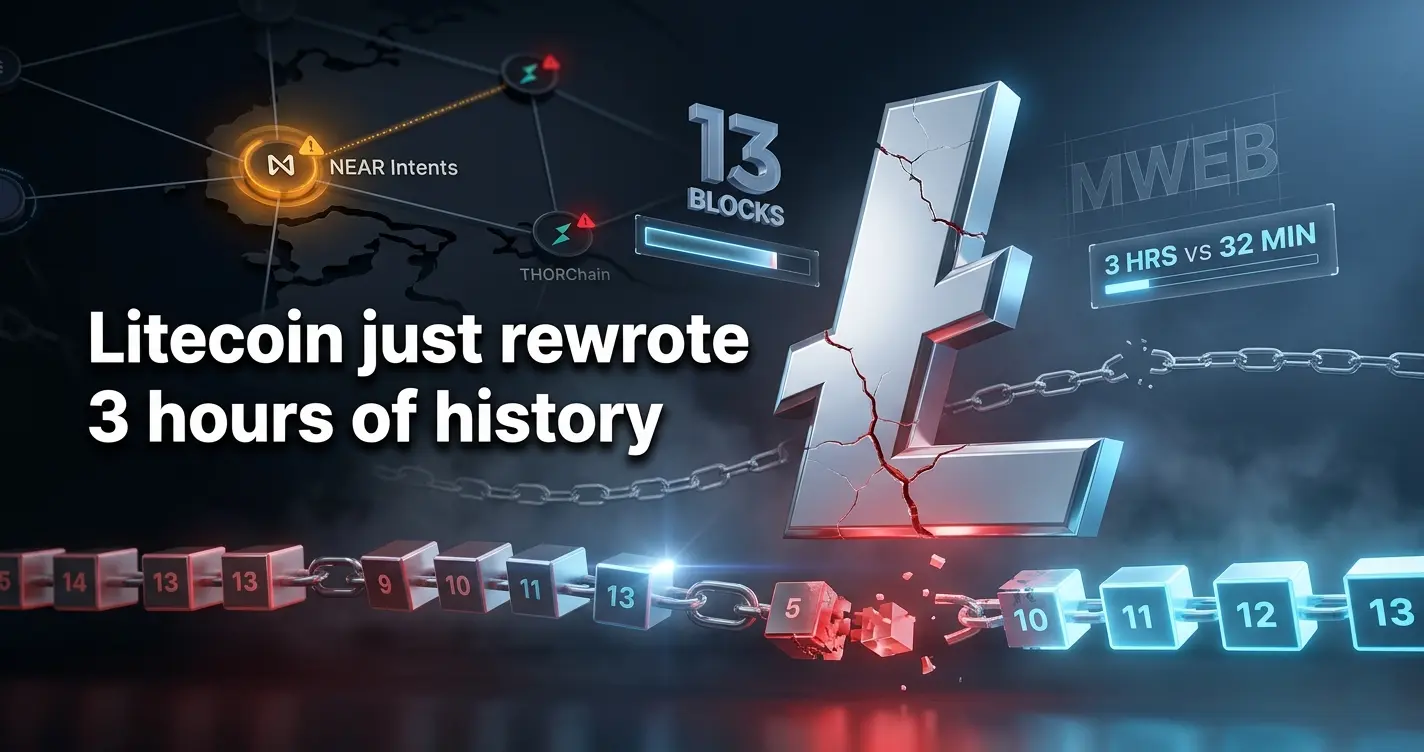
Litecoin just erased three hours of its own history. On April 25, 2026, the Litecoin Foundation confirmed a 13-block chain reorganization triggered by a zero-day vulnerability in its MimbleWimble Extension Block (MWEB) privacy layer. The reorg reversed blocks 3,095,930 through 3,095,943, a stretch that should have taken 32 minutes to produce but instead took more than three hours because a simultaneous denial-of-service attack had hammered major mining pools offline.
The incident is the first major exploit of MWEB since Litecoin activated the privacy upgrade in May 2022. It combined a consensus bug, a coordinated DoS campaign, and fraudulent cross-chain swaps into a single attack sequence that exposed roughly $600,000 in assets on NEAR Intents and caused smaller losses on THORChain. By the evening of April 25, Litecoin Core v0.21.5.4 was out with both fixes applied. The network was declared stable.
But the incident raises questions that a quick patch doesn’t fully answer: about the fragility of opt-in privacy layers, the coordination required to execute a controlled reorg on a live chain, and what it means for “finality” on a proof-of-work network when developers retain the practical ability to roll back history when circumstances demand it.
13Blocks reorganized on Litecoin chain
3 hrsChain history rewritten (normally 32 min)
$600KNEAR Intents exposure from double-spends
~1%LTC price drop after disclosure
What Actually Happened, in Order
The attack began somewhere between midnight and 3:00 AM UTC on April 25. Attackers launched a denial-of-service campaign against major Litecoin mining pools while simultaneously broadcasting invalid MWEB peg-out transactions onto the network. Because a meaningful portion of nodes were running older Litecoin Core versions, those nodes lacked the patched validation logic. They accepted the fraudulent transactions as valid.
This created a chain split. Updated nodes rejected the invalid blocks. Outdated nodes kept building on top of them. The result was a fork in which the “invalid” chain grew for more than three hours, producing 13 blocks at roughly 13.5 minutes per block, about 5.4 times slower than Litecoin’s normal 2.5-minute target. The slowdown itself is a fingerprint of the DoS attack: reduced honest hash power meant fewer miners working on the honest chain, and the invalid chain benefited from the momentary advantage.
Around noon UTC, Aurora Labs CEO Alex Shevchenko flagged the situation publicly. He had spotted what he described as a coordinated attack and had begun tracking the double-spend transactions flowing to cross-chain protocols. At 4:22 PM Eastern (8:22 PM UTC), the Litecoin Foundation posted its official confirmation on X, acknowledging the zero-day bug, the DoS campaign, and the decision to execute a 13-block reorg. Approximately 8 minutes later, Litecoin Core v0.21.5.4 was published.
Official Statement
“All valid operations during this period remain unchanged. The bug has been fully fixed, and the network continues to operate normally.” — Litecoin Foundation, April 25, 2026
The Exploit Mechanics: How MWEB’s Privacy Layer Became an Attack Surface
MWEB is an opt-in privacy layer that uses MimbleWimble cryptography to hide transaction amounts and addresses. Users move LTC from the base chain into extension blocks via a “peg-in” process, transact privately, then exit back to the transparent base chain via “peg-out.” The privacy comes from confidential transactions: amounts are hidden behind cryptographic commitments that nodes verify without seeing the actual values.
The vulnerability lived in the peg-out validation logic. Specifically, a kernel fee overflow error allowed attackers to construct MWEB transactions where input and output commitments summed to zero in a way that appeared valid to unpatched nodes. In practice, this let attackers peg out LTC they hadn’t legitimately pegged in. Invalid coins materialized on the base chain.
The attack had three distinct phases:
Phase
Attack Vector
Effect
Target
1. Disruption
DoS against mining pools
Reduced honest hash power; slowed block production
Updated pool operators
2. Injection
Invalid MWEB peg-out transactions
Fraudulent LTC created on base chain, accepted by unpatched nodes
Non-upgraded node operators
3. Extraction
Cross-chain swaps on DEXes
Fraudulent LTC exchanged for ETH and other assets
NEAR Intents, THORChain
The patch in v0.21.5.4 corrects the input/output accounting, prevents kernel fee overflow during MWEB validation, and instructs miners to exclude MWEB transactions when commitments sum to zero. It also erases block data for mutated blocks to prevent a related miner DoS vector.
Who Got Hit and How Much Was Lost
The clearest loss figure comes from Aurora Labs. Shevchenko publicly stated that NEAR Intents faced exposure of approximately $600,000, identified through on-chain double-spend tracking. His team spotted multiple fraudulent peg-out transactions flowing to cross-chain venues and warned trading platforms in real time.
“We see a lot of double spend transactions.”
Alex Shevchenko, CEO, Aurora Labs
THORChain’s losses came in dramatically lower, reportedly around $500, though exact protocol loss disclosures were still being compiled as of April 26. An independent on-chain analyst using the handle Zacodil flagged the reorg earlier in the day, initially interpreting it as a 51% attack before the MWEB exploit vector was identified.
LTC’s price reaction was notably subdued. The token traded between $56.33 and $56.36 after the incident went public, a drop of roughly 1%. Twenty-four-hour volume on KuCoin sat at $3.75 million, low by historical standards but consistent with muted market panic. The quick resolution, official communication, and same-day patch appears to have contained confidence erosion.
The discrepancy between NEAR Intents’ $600,000 loss and THORChain’s $500 figure warrants attention. It likely reflects different levels of LTC liquidity depth, different MWEB deposit acceptance policies, and the speed at which each protocol’s monitoring systems flagged the anomalous transactions.
The “Zero-Day” Dispute: What the GitHub Commits Actually Show
The Litecoin Foundation called this a zero-day exploit. That framing has been challenged by researchers examining the litecoin-project GitHub commit history.
A zero-day, by definition, is a vulnerability that developers have zero days to respond to because it’s exploited before they’re aware of it. But the consensus vulnerability that enabled the invalid MWEB peg-out was privately patched between March 19 and March 26, 2026, four weeks before the April 25 attack. The code fix existed. What failed was the deployment: not enough node operators had upgraded in the intervening month.
“This isn’t an isolated incident. There have been many of these rollback-and-double-spend attacks against Proof-of-Work-alone blockchains both years ago and recently, including recently against Monero and Grin.”
Zooko Wilcox, Founder, Zcash Foundation
The DoS vulnerability was genuinely patched on the morning of April 25, the same day it was exploited. That one arguably qualifies as a true zero-day. But the consensus bug, the one that enabled the fraudulent peg-outs, had a patch sitting in the repository for a month. The Litecoin Foundation rolled both fixes into v0.21.5.4 and announced them together, which contributed to the unified “zero-day” narrative.
This distinction matters for attribution and for lessons learned. If the consensus bug had been patched but not deployed, the real failure wasn’t in the vulnerability research pipeline. It was in the upgrade coordination pipeline.
Key Distinction
The consensus bug enabling fraudulent peg-outs had a private patch for four weeks before the attack. The DoS bug was patched the same morning it was used. Calling the entire incident a “zero-day” conflates two separate vulnerability timelines.
Reorgs in Historical Context: When Blockchains Rewrite Their Own Rules
The 13-block Litecoin reorg is historically unusual but not unprecedented. In 2013, Bitcoin experienced a 26-block chain fork caused by a database compatibility bug between Bitcoin Core versions 0.7 and 0.8. Developers and miners coordinated to roll back to the older chain. The 2016 Ethereum DAO hard fork was a social consensus decision to override an irreversible theft of approximately $50 million, abandoning “code is law” when the financial stakes demanded it.
Event
Year
Blocks/Scope
Trigger
Outcome
Bitcoin chain fork
2013
26 blocks
Database version incompatibility
Coordinated rollback; chain unified
Ethereum DAO fork
2016
Hard fork (irreversible)
$50M theft via smart contract exploit
ETH/ETC chain split; funds returned
Monero reorg attacks
Recent
Multiple
PoW double-spend campaigns
Ongoing mitigation efforts
Grin attacks
Recent
Multiple
MimbleWimble double-spend exploits
Protocol patches deployed
Litecoin MWEB reorg
2026
13 blocks
MWEB peg-out consensus bug + DoS
Reorg executed; patch deployed
What makes the Litecoin case distinctive is the combination of an optional privacy layer creating divergent node states, and a simultaneous infrastructure attack that bought the attackers time. Zooko Wilcox’s comment about Monero and Grin is worth taking seriously: MimbleWimble-based chains appear to face a recurring pattern of rollback-and-double-spend attacks. Litecoin’s incident is not an outlier. It’s part of a documented category of exploits.
The deeper uncomfortable truth: executing a reorg requires social consensus among miners and developers. That consensus exists. It can be mobilized. And that means proof-of-work “finality” is not the absolute guarantee that its proponents often claim.
Broader Implications for Cross-Chain Protocols and Privacy Layers
For DeFi operators and cross-chain bridge integrators, April 25 delivered a clear message: LTC settlement confirmations need a rethink. Protocols that accepted MWEB peg-outs as final within the 13-block window got hit. Those with deeper confirmation requirements or real-time anomaly detection survived unscathed or with minimal losses.
The incident also exposes a structural tension in opt-in privacy designs. MWEB’s opt-in architecture was praised during its 2022 launch as a way to preserve regulatory compatibility while offering users privacy when they want it. But opt-in means the peg-in/peg-out boundary is where confidential and transparent accounting intersect, and that boundary is exactly where the validation bug lived.
Node upgrade coordination is the unglamorous structural problem this incident clarifies. Privacy protocol integrations on live networks create a window where some nodes operate with new validation rules and others don’t. Any consensus-level bug discovered during that window becomes an exploitable asymmetry. Mandatory upgrade enforcement, via hard forks with firm cutoff dates, may be the only reliable solution, but it comes with its own coordination costs and centralization concerns.
For the broader crypto industry, DeFi losses in 2026 have already exceeded $750 million through mid-April. The Kelp DAO bridge drain on April 19 alone accounted for $292 million. Litecoin’s incident, with $600,000 in confirmed losses, is comparatively small. But it introduces a category of risk that’s harder to price: chain-level state reversion affecting assets that were considered settled.
THORChain and NEAR Intents will both be revisiting their LTC confirmation depth policies. Other cross-chain protocols integrating privacy-enabled chains should treat this incident as a model for pre-exploit security frameworks rather than a post-incident retrospective they file away and forget.
Frequently Asked Questions
A blockchain reorg occurs when nodes on a network switch from one version of the chain’s history to a longer or more valid one. Transactions in the discarded blocks are reversed. In proof-of-work networks, reorgs happen naturally at the single-block level but become incidents when they span multiple blocks and reverse confirmed transactions.
MWEB stands for MimbleWimble Extension Blocks. Activated on Litecoin in May 2022, it’s an opt-in privacy layer that hides transaction amounts and addresses using confidential transaction cryptography. Users can choose to transact privately or use the transparent base chain. The design was intended to add privacy without forcing all users into confidential transactions.
The MWEB peg-out validation had a kernel fee overflow bug. Attackers constructed MWEB transactions where cryptographic commitments summed to zero in a way that bypassed checks on unpatched nodes. This allowed them to exit LTC onto the transparent base chain without having legitimately deposited it, creating coins from nothing that older nodes accepted as valid.
It’s significant, not catastrophic. Most exchanges and protocols consider transactions final after 6 confirmations. A 13-block reorg reverses transactions that many recipients considered irreversibly settled. By contrast, Bitcoin’s 2013 fork involved 26 blocks. The Litecoin Foundation’s quick response and same-day patch limited the financial and reputational damage considerably.
NEAR Intents reported approximately $600,000 in exposure from double-spend transactions. THORChain reported losses of roughly $500. The Litecoin Foundation stated that all valid operations during the affected period remain unchanged, meaning legitimate user transactions were not reversed. The losses fell on cross-chain protocols that accepted the fraudulent peg-outs as genuine LTC.
The Foundation’s statement packaged both vulnerabilities together. The DoS bug was patched the morning of April 25, which qualifies as a genuine zero-day. The consensus bug enabling fake peg-outs had been privately patched in late March, four weeks earlier. Researchers examining GitHub commit history identified this discrepancy. The “zero-day” label accurately describes the DoS component but not the consensus component.
Protocols integrating privacy-enabled L1s should increase confirmation depth requirements for MWEB peg-out transactions, implement real-time anomaly detection for unusual block production times, and establish network health monitoring before processing large LTC swaps. Cross-chain bridges should also consider pausing LTC routes when block times deviate significantly from the 2.5-minute target.
The market reaction, a roughly 1% price drop to around $56, suggests investors don’t see this as existential. The quick resolution and same-day patch demonstrate that Litecoin Core developers can respond under pressure. The more lasting question is whether MWEB’s privacy architecture will face continued scrutiny as a DeFi integration risk, which could suppress LTC adoption in cross-chain use cases.
What Comes Next for Litecoin and the Industry
Litecoin’s MWEB incident is a case study in how layered protocol upgrades create layered attack surfaces. The privacy architecture that MWEB introduced in 2022 was never the conceptual problem. The problem was the inevitable period between patch publication and network-wide deployment, a window during which exploiters knew about the vulnerability and most of the network didn’t. That window lasted four weeks for the consensus bug. That’s four weeks of exposure that a mandatory upgrade mechanism might have eliminated.
The reorg itself will be studied in the context of proof-of-work finality for years. Litecoin’s developers and miners coordinated to roll back 13 blocks of history, which is exactly the kind of social consensus mechanism that proponents of “immutability” argue doesn’t exist, or shouldn’t exist. It does. It was used. It worked. And that cuts in two directions: it’s reassuring that the ecosystem can correct catastrophic errors, and it’s unsettling that the correction mechanism is a distributed social negotiation rather than a deterministic protocol rule.
For cross-chain integrators, the lesson is operational rather than philosophical. Confirmation depth thresholds need to account for the block production rate, not just block count. When Litecoin’s 2.5-minute target extends to 13.5 minutes per block, a 6-confirmation policy that normally delivers 15 minutes of settlement certainty is delivering a very different risk profile. Monitoring block timing should now be part of any protocol’s LTC integration checklist.
Watch for in the Coming Weeks
Mandatory upgrade enforcement proposals from Litecoin Core developers, including potential hard-fork cutoffs for MWEB privacy layer node versions.
Cross-chain protocol policy updates at THORChain, NEAR Intents, and other DEXes integrating LTC, particularly around MWEB peg-out confirmation requirements and anomaly detection thresholds.
Independent security audits of MWEB commissioned by the Litecoin Foundation or third parties, which could surface additional attack vectors in the peg-in/peg-out boundary logic.
Stay current on blockchain security incidents, protocol vulnerabilities, and DeFi risk analysis at NeuralWired.
Follow Blockchain Security Coverage
$344M Iran-Linked Crypto Frozen: How Tether Became a Sanctions Weapon | NeuralWired
Crypto & PolicyApril 25, 202612 min read
$344M Frozen: How Tether Just Became America’s Sharpest Sanctions Weapon
The U.S. Treasury froze $344 million in USDT tied to Iran’s central bank and the IRGC. The method was precise, fast, and unprecedented. Stablecoin issuers are now doing what traditional banks can’t.
NW
NeuralWired Staff
Crypto & Policy Desk
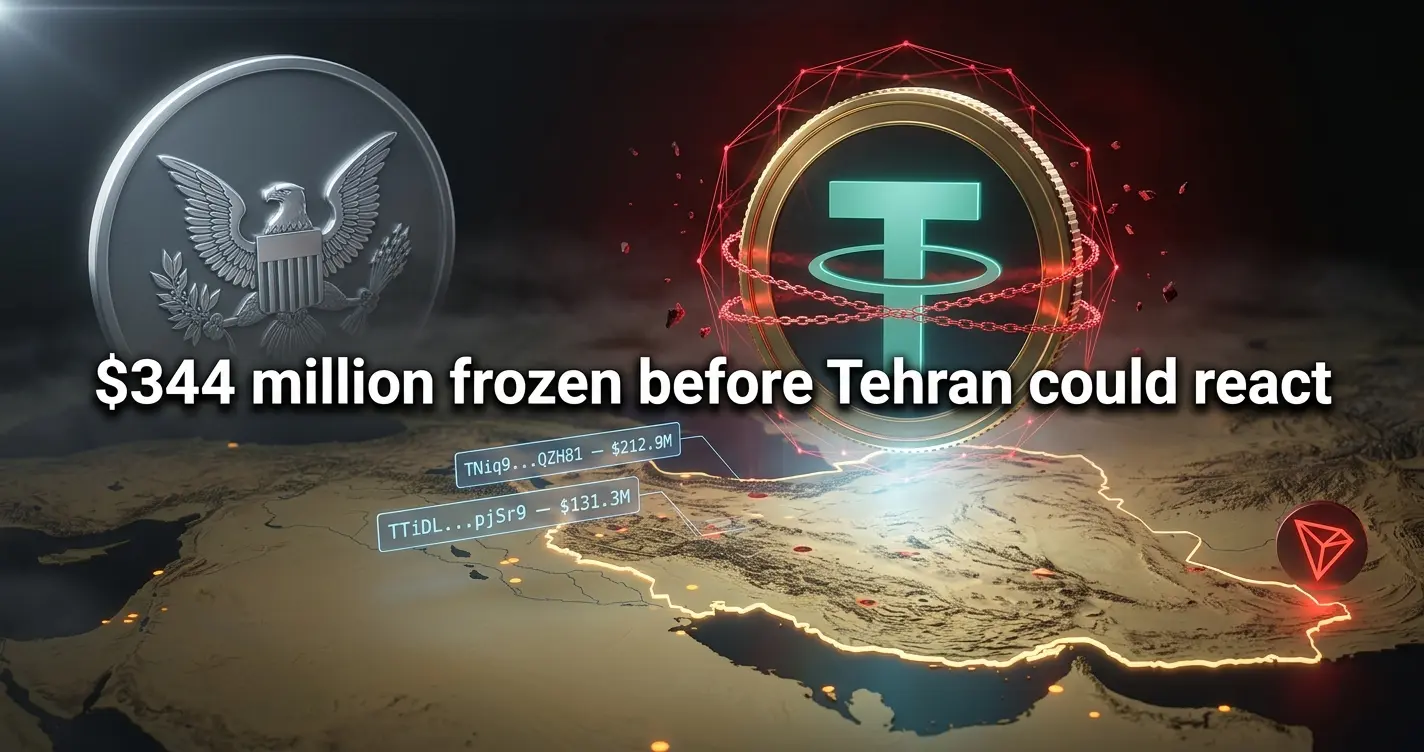
On the afternoon of April 23, 2026, Tether announced it had frozen $344.2 million in USDT across two Tron blockchain addresses, acting in coordination with the U.S. Treasury’s Office of Foreign Assets Control (OFAC). Hours later, Treasury Secretary Scott Bessent confirmed the action on X, framing it as part of “Operation Economic Fury,” a campaign targeting Iran’s financial infrastructure. By the following morning, blockchain analytics firms had mapped the wallets down to individual transaction flows. The entire operation, from designation to freeze, took less than a day.
That speed is the story. In traditional finance, asset freezes mean calls to correspondent banks, legal filings across multiple jurisdictions, and weeks of back-and-forth. With centralized stablecoins, a single function call in a smart contract locks $344 million before anyone on the other side can move a dollar. This is a structural advantage traditional sanctions enforcement has never had.
The action also raises a more uncomfortable question: when a private company based in the British Virgin Islands holds the technical authority to freeze hundreds of millions of dollars on behalf of the U.S. government, what exactly has changed about how financial power works?
$344M
Total USDT frozen in one action
$370M
Total inflows across ~1,000 transactions since 2021
$7.78B
Iran’s 2025 crypto ecosystem value
$4.4B+
Tether’s total all-time frozen assets
Operation Economic Fury: What Actually Happened
The two wallets at the center of this action had been quietly accumulating funds since March 2021. TRM Labs, which provided the blockchain intelligence supporting the designation, traced roughly $370 million in total inflows across approximately 1,000 transactions over that four-year span. The wallets then went largely dormant by 2023, with minimal outbound transfers. One wallet moved less than $16 million out; the other saw over $228 million in inflows with almost no corresponding exits. These weren’t spending wallets. They were vaults.
OFAC tied both addresses to the Central Bank of Iran (CBI) and, through transaction graph analysis, to the Islamic Revolutionary Guard Corps (IRGC). A U.S. official speaking to CNN confirmed the connections, describing “substantial ties to the Iranian regime, including verified transactions through intermediary addresses interacting with CBI-associated wallets.” Blockchain analytics firm PeckShield independently confirmed the wallet breakdown: $212.9 million in the first address (Tron address TNiq9…QZH81) and $131.3 million in the second (TTiDL…pjSr9).
January 2026 had already signaled the escalation was coming. That month, OFAC sanctioned two Iranian cryptocurrency exchanges, Zedcex and Zedxion, marking the first time the U.S. had formally designated Iranian digital asset platforms for IRGC ties. The April action moved from exchange-level designation to sovereign wallet-level targeting. The progression is deliberate.
“Treasury’s OFAC is sanctioning multiple wallets tied to Iran, resulting in the freeze of $344 million in cryptocurrency. We will follow the money that Tehran is desperately attempting to move outside of the country.”
Scott Bessent, U.S. Treasury Secretary
How the Freeze Actually Worked
The technical mechanics here deserve close attention, because they explain both the power and the limits of this approach. USDT on the Tron blockchain isn’t a bearer asset in the way Bitcoin is. It’s a token governed by a smart contract that Tether controls. That contract includes a blacklist() function. When Tether adds an address to that list, the function blocks any outbound transfers from it. The funds don’t disappear. They sit in the wallet, visible to anyone, completely immovable.
The sequence for this action ran roughly as follows: OFAC identified the suspicious wallets through blockchain intelligence, shared the designations with Tether, and Tether executed the blacklist update. From announcement to freeze, this happened within hours. Compare that to the 2022 Tornado Cash sanctions, which took months of legal preparation and still faced court challenges because they targeted a protocol rather than specific addresses.
This isn’t a capability unique to USDT on Tron. Circle’s USDC includes similar administrative controls. But Tether is the dominant stablecoin by circulation at roughly $189 billion, and its willingness to act swiftly has established it as the preferred enforcement partner. The company has now frozen over $4.4 billion in total across 65 countries, working with more than 340 law enforcement agencies on over 2,300 cases.
Tether Enforcement Track Record
Action
Amount
Year
Mechanism
Iran IRGC/CBI wallet freeze
$344.2M
Apr 2026
OFAC Designation
Pig butchering fraud (Iran-linked)
$225M
2025
DOJ / FBI
Pig butchering fraud (Iran-linked)
$61M
2024
DOJ / FBI
Total all-time frozen assets
$4.4B+
2014-2026
Multiple agencies
U.S.-linked frozen assets
$2.1B+
2014-2026
1,200+ U.S. cases
The Scale of Iran’s Crypto Ecosystem
To understand why this freeze matters strategically, you need the full picture of how much Iran relies on crypto. Chainalysis estimated Iran’s 2025 crypto ecosystem at $7.78 billion. TRM Labs, in its broader analysis, puts total Iranian crypto transaction volume in the $8 to $10 billion range for the year when combining retail and state-linked activity. That’s not marginal. It’s a significant portion of how a heavily sanctioned economy moves money.
The IRGC’s role in that ecosystem is dominant and growing. Chainalysis found that IRGC-associated addresses received over $3 billion in 2025, representing roughly half of Iran’s Q4 crypto activity. The IRGC isn’t just tolerating crypto, it’s running a significant portion of Iran’s parallel financial infrastructure through it. Oil revenues, arms transactions, proxy financing: blockchain analytics firms have traced multiple categories of flows through IRGC-linked addresses.
The $344 million freeze represents roughly 4.4% of Iran’s annual crypto volume. Not a knockout blow. But it’s the first time the U.S. has directly targeted what appear to be CBI-associated sovereign wallets, a qualitatively different kind of pressure than going after private exchanges. And the signal to other custodians and issuers globally is unmistakable.
Tether as Sanctions Enforcer: The Structural Shift
But there’s a structural tension here that privacy advocates have been flagging for years. A private company, not a court, not a regulator directly, holds the technical power to freeze funds at the request of a government agency. Tether’s cooperation is voluntary. It acts on what it describes as “credible information” from authorities. There’s no public due process, no appeals mechanism, no notice to wallet holders before the freeze executes. The speed that makes this enforcement tool so effective is the same quality that makes it alarming as a matter of financial rights.
Tom Robinson, co-founder of blockchain analytics firm Elliptic, had predicted exactly this trajectory in his January 2026 policy outlook: “In 2026, policymakers and regulators will focus on preventing cryptoasset-related sanctions evasion with renewed urgency.” The April action validated that forecast three months in.
“The asset freeze is significant, but given the extent of sanctions against Iran, I don’t believe it will substantially hinder Iran’s efforts to continue operating amid the current state of conflict.”
Dr. Alex Tanne, Fellow, Atlantic Council
Limitations and Likely Workarounds
Dr. Alex Tanne of the Atlantic Council offered the most grounded assessment of the action’s actual strategic impact. The freeze is significant, he told CNN, but Iran has endured sanctions for decades and has established mechanisms to adapt. His recommendation for more effective pressure: focus on third-party actors, specifically China, UAE, and Turkey, that facilitate Iran’s access to global markets.
The technical workarounds available to Iran are well-documented. Sanctions evasion through crypto has never relied exclusively on USDT. Bitcoin and Ethereum can’t be frozen by any central party. Monero and other privacy coins offer transactional opacity that blockchain analytics firms can’t easily pierce. Non-U.S. stablecoin issuers, particularly those operating out of jurisdictions outside American reach, have no obligation to comply with OFAC. And the February 2026 analysis from Cambridge’s Centre for Alternative Finance noted that crypto mixers are actively resurging post-2022 sanctions pressure, now operating through compliant-adjacent privacy protocols.
What the dormant wallet strategy also reveals is that Iran understood this vulnerability. Parking funds in USDT rather than moving them suggests either a belief that USDT offered sufficient security (now disproven) or a deliberate long-term storage play that assumed no U.S. action was imminent. Either way, the strategic calculation will shift. Future Iranian state-linked crypto activity will almost certainly avoid centralized stablecoins for large reserve storage.
Key limitations of the freeze mechanism
Works only for centralized stablecoins like USDT and USDC; Bitcoin and Ethereum have no equivalent freeze mechanism.
Requires voluntary cooperation from the issuer; non-U.S. stablecoin providers face no legal obligation to comply with OFAC.
Adversaries can shift to privacy coins like Monero, which offer transactional opacity that current analytics tools struggle to trace.
Self-custody wallets using non-custodial bridges and cross-chain mixers can circumvent address-level blacklisting.
The freeze captures value already stored but can’t stop future flows that avoid designated infrastructure.
What This Means Going Forward
The $344 million freeze is not primarily a story about Iran losing $344 million. Iran’s crypto infrastructure will adapt, as it always has. The larger story is about what the U.S. government has demonstrated it can do with a willing stablecoin issuer and a functional blockchain analytics apparatus: it can freeze sovereign-scale assets, in hours, with precision targeting that leaves no collateral damage to the surrounding network.
That capability has implications well beyond Iran. Any nation-state, sanctioned entity, or large criminal organization currently holding significant USDT balances is now watching this case and reassessing. The assumption that crypto provided geographic and jurisdictional distance from U.S. enforcement has taken a material hit. The public ledger, which crypto advocates once celebrated as a tool for financial transparency and individual freedom, is now also the most detailed transaction record any sanctions enforcement body has ever had access to.
Blockchain traceability as a sanctions multiplier was always the theoretical upside from an enforcement perspective. April 2026 is when that theory became demonstrated practice at scale. The September 2025 Treasury action targeting crypto-linked oil sale networks, combined with the January 2026 exchange designations and now the April wallet freeze, shows a clear escalation cadence. The U.S. is building out an enforcement playbook, and Tether is currently the most important tool in it.
Frequently Asked Questions
What is Operation Economic Fury?
+
Operation Economic Fury is a U.S. Treasury campaign announced by Secretary Scott Bessent in April 2026. It targets Iran’s financial infrastructure through coordinated crypto sanctions, aiming to cut off funding channels linked to the IRGC, Iran’s Central Bank, and affiliated entities operating through digital assets.
How did Tether freeze $344 million in cryptocurrency?
+
Tether’s USDT smart contract on the Tron blockchain includes a blacklist function that can block outbound transfers from specific addresses. Once OFAC shared the designated wallet addresses, Tether added them to this blacklist, preventing any movement of funds. The process takes minutes to execute and doesn’t require court approval.
Can Bitcoin or Ethereum be frozen in the same way?
+
No. Bitcoin and Ethereum are decentralized protocols with no central issuer holding administrative control. Unlike USDT, no single entity can modify their smart contracts to block transfers. This is a fundamental architectural difference between decentralized cryptocurrencies and centralized stablecoins like USDT or USDC.
How much cryptocurrency does Iran use annually?
+
Chainalysis estimated Iran’s 2025 crypto ecosystem at $7.78 billion in on-chain activity. TRM Labs places the broader figure, including state-linked flows, in the $8 to $10 billion range. The IRGC alone accounted for over $3 billion in crypto receipts in 2025, roughly half of Iran’s Q4 2025 digital asset activity.
Will this freeze significantly impact Iran’s financial operations?
+
Experts are divided. Dr. Alex Tanne of the Atlantic Council argues the freeze won’t substantially hinder Iran, given decades of sanctions adaptation. The $344 million represents roughly 4.4% of Iran’s annual crypto volume. The symbolic and deterrent effect may outweigh the immediate financial disruption.
What happens to the frozen funds now?
+
The funds remain in the blacklisted wallets, visible on-chain but completely immovable. They can’t be transferred, swapped, or spent. Whether they are eventually seized, forfeited, or remain frozen indefinitely depends on subsequent legal proceedings between the U.S. government and Tether under existing sanctions law.
What are the broader implications for stablecoin regulation?
+
The action reinforces that centralized stablecoin issuers function as de facto financial intermediaries subject to U.S. sanctions law. As Congress moves toward a federal stablecoin framework in 2026, compliance capabilities, specifically the ability to freeze addresses on government request, will likely become a formal regulatory requirement rather than a voluntary practice.
Could Iran simply switch to privacy coins or other stablecoins to avoid future freezes?
+
Yes. Privacy coins like Monero, non-U.S. stablecoin issuers, and decentralized exchange protocols present significant challenges for U.S. sanctions enforcement. The Cambridge Centre for Alternative Finance noted a resurgence in crypto mixer activity following 2022 sanctions actions, suggesting sanctioned entities are already shifting toward more opaque tools.
Conclusion
What happened on April 23, 2026 was a precision strike, not a financial war. $344 million frozen in hours, traced through a public ledger to a sovereign actor, with surgical accuracy that no correspondent bank network could replicate. The action proved something important: the public blockchain, the same infrastructure marketed as a tool for individual financial freedom, is also the most transparent transaction record a government enforcement body has ever worked with.
The implications extend in two directions. For U.S. sanctions policy, the Tether cooperation model has just been validated at sovereign-reserve scale. Expect more designations, more freezes, and growing pressure on other stablecoin issuers to build equivalent compliance infrastructure. For adversaries of U.S. financial power, whether state-level or criminal, the message is clear: centralized stablecoins are no longer a safe distance from enforcement reach. The migration to decentralized alternatives, privacy protocols, and non-U.S. financial infrastructure will accelerate.
Watch For
Secondary sanctions pressure on Chinese and UAE financial actors that facilitate Iranian crypto flows, as Dr. Tanne suggested this is the higher-impact enforcement lever.
A formal stablecoin compliance framework from Congress that codifies OFAC cooperation requirements for all U.S.-licensed issuers, likely referencing this action as precedent.
Increased adoption of Monero and non-USDT stablecoins by IRGC-linked wallets as the state-linked component of Iran’s crypto ecosystem migrates away from freezable infrastructure.
NeuralWired covers the intersection of technology, policy, and financial infrastructure. For more analysis on crypto regulation and blockchain-based enforcement, follow our dedicated coverage.
More Crypto & Policy Coverage →