In-depth artificial intelligence analysis: AI agents, LLMs, enterprise deployment, governance, and breakthroughs. Research-backed insights for CTOs, founders, and decision-makers.
EU AI Act Article 50 and California SB 942: What Changes Aug 2
Every enterprise compliance lead who filed the EU AI Act under “high risk, delayed to 2027” and moved on to other fires needs to reopen that file today. On August 2, 2026, Article 50 of the EU AI Act becomes enforceable, and California’s AI Transparency Act (SB 942, as amended by AB 853) goes live on the exact same day, a coordination that was not an accident. If your chatbot, image generator, or content tool touches users in either jurisdiction, the disclosure duty starts now, whether or not the underlying system counts as “high risk.”
The headline delay story you have probably already read, that the EU pushed its toughest AI rules back sixteen months, is true but incomplete. It describes the parts of the law that got easier. It says almost nothing about the parts that did not. This piece separates the two, walks through what actually changes in a product team’s daily workflow starting today, and flags a California bill sitting one signature away from rewriting who SB 942 even applies to.
Three things are true at once, and most coverage flattens them into one story. First, the EU AI Act’s transparency rules under Article 50 of Regulation (EU) 2024/1689 take effect on schedule, no delay, no grace period, for the core disclosure duties. Second, the tougher high-risk obligations under Annex III, the ones covering hiring tools, credit scoring, and education systems, were formally pushed to December 2027 when the Council of the EU gave final approval to the Digital Omnibus on June 29, 2026. Third, California’s SB 942 operative date, deliberately set by the state legislature to land on the same calendar day as Brussels, also arrives August 2.
Three deadlines, three different scopes, one date. That is the story worth writing down.
Article 50: the transparency duty that was never delayed
Article 50 requires four things regardless of whether a system is classified as high risk: disclosure when someone is interacting with a chatbot, machine-readable marking of AI-generated or manipulated content, disclosure of emotion-recognition or biometric-categorization tools, and labeling of deepfakes and AI-generated text published on matters of public interest. The Commission finalized its implementation guidelines on July 20, 2026, just thirteen days before enforcement began, after consulting member states, the EU AI Board, and industry.
Penalties sit under the Act’s general regime: up to €15 million or 3 percent of global annual turnover, whichever is higher. Enforcement runs through national market surveillance authorities in each of the 27 member states, with a narrower role for the EU AI Office and the EDPS where EU institutions themselves are providers or deployers.
Content published before August 2 does not need retroactive labeling, though the Commission says retroactive labeling is encouraged. That is the one piece of breathing room in an otherwise live-today obligation.
The nuance most competing coverage will miss
Article 50 is not a flat “zero delay” story. Under the Digital Omnibus amendment, the marking and detection sub-duty in Article 50(2) gets a four-month reprieve, to December 2, 2026, but only for GenAI systems already on the market before August 2. New systems launched from August 2 onward get no grace period at all. Chatbot disclosure and deepfake labeling are live today regardless. Treat this as “delayed on watermarking mechanics, on time on everything else,” not a single yes-or-no answer.
The high-risk delay everyone is talking about
The Digital Omnibus is the first substantive amendment to the AI Act since it entered into force in 2024, and it is the part of the story that has dominated headlines. The Commission proposed it on November 19, 2025. A first round of trilogue negotiations collapsed on April 28, 2026. A provisional political agreement followed in early May, the European Parliament endorsed the package 423 to 57 with 174 abstentions on June 16, and the Council gave final approval on June 29.
The result: standalone high-risk systems under Annex III, covering hiring, credit scoring, education, and law enforcement tools, move from an August 2, 2026 deadline to December 2, 2027, a sixteen-month deferral. AI embedded in regulated products, such as medical devices and toys, under Annex I, moves from August 2, 2027 to August 2, 2028, a twelve-month deferral.
The Omnibus was not purely a rollback. It also added a new Article 5 prohibition, effective December 2, 2026, banning AI systems that generate non-consensual intimate imagery, so-called “nudifier” tools, and CSAM. That ban applies regardless of a system’s risk classification and was not delayed at all.
“Big Tech is probably popping champagne. While European companies that care about safety and did their homework now face regulatory chaos.”
Kim van Sparrentak, Member of the European Parliament, Greens/EFA, quoted via Reuters and IAPP
Van Sparrentak’s framing, given during the failed April trilogue round, is the sharpest on-record pushback: that the delay rewards companies who put off compliance investment while penalizing, relatively speaking, the ones who built ahead of schedule. DigitalEurope’s Director General offers the opposing read.
“The delay shows that the democratic process is working as it should. We now have another opportunity to get the AI Act right and to avoid adding up to 31 billion euros in unnecessary compliance costs.”
Cecilia Bonefeld-Dahl, Director General, DigitalEurope
A third voice sits closer to the legislative process itself. Arba Kokalari, the European Parliament’s EPP co-rapporteur on the file, framed the vote as a mandate for simplification rather than a fight between industry and critics, telling reporters the Council needed to show it was “serious about cutting bureaucracy.” Three MEPs, three different reads of the same 423-57 vote. That is not consensus. It is a compromise everyone can point to as evidence for their own argument.
California’s SB 942: who counts as a “covered provider”
California’s AI Transparency Act started as SB 942, signed by Governor Newsom in September 2024 with a January 1, 2026 operative date. AB 853, signed a year later, pushed that date to August 2, 2026, specifically to align with the EU, and layered in two future obligations: a hosting-platform duty starting January 1, 2027, and a capture-device requirement, meaning cameras and phones, phasing in during 2028.
The threshold that determines who has to comply is narrower than most explainers suggest. A “covered provider” under the statute is a person or entity that creates, codes, or otherwise produces a generative AI system with more than one million monthly visitors or users, publicly accessible in California. It is the system’s own userbase, not a parent company’s total reach, and it applies only to image, video, and audio output. Text generation is excluded entirely. Miss that distinction and you will overstate who the law actually reaches.
Penalties are modest by EU standards: $5,000 per violation, enforced by the state Attorney General, a city attorney, or county counsel. There is no private right of action.
The wrinkle: SB 1000 could rewrite SB 942 this week
Developing, verify before you plan around this
Senate Bill 1000 (Becker), an urgency measure amending SB 942 and AB 853, would delete the one-million-user threshold from the “covered provider” definition entirely, rename the “AI detection tool” a “disclosure verification tool,” and tighten the disclosure standard. As an urgency statute it takes effect immediately on signature, not on a future January 1. As of the most recent legislative tracking, the bill passed the Senate 33-1 with its urgency clause intact, cleared Assembly Privacy and Consumer Protection 15-0, cleared Assembly Appropriations 10-0, and was read a second time and ordered to third reading in the Assembly on July 2, 2026. It has not yet reached the Governor’s desk as of this writing. If Newsom signs it in the days around this deadline, the “applies only above one million users” framing used throughout this piece, and in most other Aug. 2 coverage, becomes obsolete the moment he does. Check the live bill tracker before making compliance decisions based on the current threshold.
Why does a threshold-deletion bill exist at all? Because the one-million-user line, once drafted, produced an obvious gaming incentive: nothing in SB 942 defines whether “monthly visitor” is measured cumulatively or per product, and nothing stops a company from splitting a GenAI feature across multiple smaller properties to stay under the line. Legal trackers who have followed the bill since February describe SB 1000 as regulators fixing a flaw they already see, not an outside critique waiting to be validated.
EU vs. California, side by side
Dimension
EU AI Act, Article 50
California SB 942 / AB 853
Effective date
August 2, 2026 (watermarking sub-duty for legacy systems deferred to Dec 2, 2026)
August 2, 2026
Who it covers
Any provider or deployer of a chatbot, content generator, or emotion-recognition system reaching EU users, regardless of company size
“Covered providers” of GenAI systems with over 1,000,000 monthly CA visitors or users (pending possible removal via SB 1000)
What triggers the duty
Deployment: any customer-facing AI interaction, independent of risk classification
Development: producing the underlying GenAI system, not merely using one
Content types covered
Text, image, audio, video, and biometric/emotion-recognition disclosure
Image, video, and audio only; text is explicitly excluded
Maximum penalty
€15 million or 3% of global annual turnover, whichever is higher
$5,000 per violation, no private right of action
Enforcement body
National market surveillance authorities in each of 27 member states
California Attorney General, city attorneys, county counsel
The gap in penalty structure, up to €15 million on one side and $5,000 per violation on the other, is itself a story about which regulator actually has teeth on day one. California’s number can compound if violations are counted daily, but the ceiling and the enforcement machinery behind it are not remotely comparable.
SynthID and C2PA: the watermark standard nobody legislated
Neither government wrote a technical watermarking standard into law. The market did that first. On May 19, 2026, OpenAI joined the C2PA steering committee, alongside Adobe, Amazon, the BBC, Google, Intel, Meta, Microsoft, and others, and committed to embedding Google DeepMind’s SynthID watermark in every image generated through ChatGPT, the API, and Codex, on top of existing C2PA Content Credentials metadata. The same day, at Google I/O, Google announced native SynthID and C2PA verification coming to Search and Chrome.
The two systems are complementary rather than redundant. C2PA is structured, human-readable metadata, creator, tool, edit history, that can be stripped when a file is resaved or screenshotted. SynthID is an invisible pixel-level signal that tends to survive compression and resizing but only answers a binary question: AI-generated, yes or no. Neither one is legally mandated by Article 50 or SB 942. A company could technically satisfy both laws with a weaker watermarking approach. The “de facto global standard” framing is directionally accurate for the biggest labs and should not be overstated as universal compliance.
C2PA now counts more than 6,000 members and affiliates, and its specification sits at version 2.1.
The critical view: who actually benefits from the delay
Set the two governments’ actions next to each other and an uncomfortable pattern shows up. Regulators in Brussels and Sacramento are both now leaning on a watermarking standard that neither wrote and neither has independently audited. SynthID is Google-developed and Google-controlled. No credentialed source has gone on record framing that as a risk specifically, but the structural question, who checks SynthID’s false-positive and false-negative rate against a legal disclosure duty, remains open.
There is also a readiness gap worth naming plainly. The Commission’s own Article 50 guidelines finalized just thirteen days before enforcement began. The EU’s standards bodies, CEN and CENELEC, missed a fall-2025 deadline to produce harmonized technical standards for the Act. Expect inconsistent enforcement postures across member states in the first weeks. Legal applicability and enforcement readiness are not the same thing, and several legal trackers following this file have said so explicitly.
Frequently asked questions
Does the EU AI Act still apply August 2, 2026?
Yes. Article 50’s transparency rules, chatbot disclosure, AI-content labeling, and deepfake disclosure, take effect on schedule on August 2, 2026, with fines up to €15 million or 3 percent of global turnover. Only the broader high-risk system rules under Annex III were delayed, to December 2, 2027.
What companies does California SB 942 apply to?
SB 942 applies to “covered providers,” entities that create or produce a generative AI system with over 1,000,000 monthly visitors or users publicly accessible in California, not to businesses that merely use GenAI tools. A pending bill, SB 1000, could remove this threshold entirely.
Is the EU AI Act’s high-risk deadline delayed?
Yes. On June 29, 2026, the Council of the EU finalized a sixteen-month delay for standalone high-risk AI systems under Annex III, moving compliance from August 2, 2026 to December 2, 2027, plus a twelve-month delay for AI embedded in regulated products, to August 2, 2028.
How can I check if an image is AI-generated?
Look for C2PA Content Credentials, viewable metadata showing the creation tool and edit history, or run the file through a SynthID detector. OpenAI’s “Verify” tool and Google’s Search and Chrome integration, both live since May 2026, check both signals on supported images.
What is the penalty for violating California’s AI Transparency Act?
SB 942 sets a civil penalty of $5,000 per violation, enforced by the California Attorney General, a city attorney, or county counsel. There is no private right of action.
What to watch next
Here is what changes in a compliance team’s actual workload starting today, and where to look over the next six to eighteen months.
Audit deployer-facing disclosure now. Article 50(1) is a deployer obligation, separate from and broader than SB 942’s developer-only threshold. A low-risk internal chatbot with no disclosure banner is exposed on August 2 even though its risk classification never changed.
Recheck the SB 942 threshold before finalizing any compliance roadmap. If SB 1000 is signed this week or shortly after, the one-million-user line disappears immediately under the bill’s urgency clause.
Track member-state enforcement posture through Q4 2026. With harmonized technical standards still catching up, expect the first real divergence in how “machine-readable mark” gets interpreted country by country.
Two governments picked the same date for very different reasons, and picked incompatible penalty structures to enforce it. The disclosure duty is real today regardless of a company’s risk classification or its position on the Annex III delay. Everything else, the SB 1000 threshold question, the SynthID audit gap, the member-state enforcement gap, is still being written in real time.
Prompt Engineering Is Dead. LangChain’s Data Proves It.
Published July 30, 2026 · NeuralWired Developer Focus
Your agent worked flawlessly in the demo. In production, it forgets a tool call from three steps ago, contradicts a document it retrieved 40 tokens earlier, and burns your API budget re-reading its own context window. You rewrite the prompt. Nothing changes. That’s because the prompt was never the problem.
A new discipline called context engineering has quietly become the line separating engineers who ship reliable AI agents from everyone still fiddling with instruction wording. It’s not a rebrand for the sake of a rebrand. According to LangChain’s June 2026 survey of 1,340 practitioners, 32% of teams cite quality, not cost, as the top barrier keeping agents out of production, and enterprise write-in responses point directly at context management as the root cause. This is the story of how that shift happened, what the data actually shows, and why the skeptics think the industry is getting ahead of itself.
Quick take: Context engineering means designing everything a model sees before it answers, not just how you phrase the question. Anthropic calls it “the natural progression of prompt engineering.” The data says it’s already the top reason enterprise AI agents fail in production.
Track the timeline and the shift happened in about nine days. On June 18, 2025, Shopify CEO Tobi Lütke posted that he preferred the term “context engineering” over prompt engineering, describing it as the art of providing all the context needed for a task to be plausibly solvable by an LLM. A week later, Andrej Karpathy, OpenAI co-founder and former Tesla AI director, quote-tweeted him with a line that has since become the industry’s working definition.
“Context engineering is the delicate art and science of filling the context window with just the right information for the next step.”
The post reached roughly 14,000 likes and 2,600 reposts, which sounds like a vanity metric until you notice how fast the term propagated through actual engineering orgs. Two days later, Simon Willison, creator of Django and Datasette, wrote that the label stuck precisely because prompt engineering had degraded into what he called a pretentious way of describing typing things into a chatbot. His argument wasn’t about branding for its own sake. It was that the old term no longer described what senior practitioners actually spent their time doing.
By September 2025, Anthropic made it official. In “Effective context engineering for AI agents”, published alongside the Claude Sonnet 4.5 release, the company defined the practice as curating the optimal set of tokens available during inference, a materially different job than wordsmithing a single instruction. Gartner picked up the framing too, predicting the discipline would be embedded in 80% of AI tooling by 2028, though that figure lives behind Gartner’s paywall and is worth treating as widely reported rather than independently verified.
The data: why 32% is the number that matters
Twitter endorsements are fun. They’re not evidence. The number that actually justifies the hype arrived in June 2026, when LangChain published its State of Agent Engineering report, a survey of 1,340 professionals fielded between November 18 and December 2, 2025.
The headline figures build a clear picture. Agents are already in production at 57.3% of organizations, up from 51% a year earlier, and at 67% of companies with more than 10,000 employees. But quality, not budget, is what’s stalling the rest: 32% of respondents named quality as the single biggest barrier to production, and write-in answers from large enterprises specifically called out context engineering and context management at scale as the cause. Add the fact that 89% of organizations have some form of agent observability while only 52.4% run offline evaluations, and you get an industry that’s watching its agents fail without yet having the tooling to systematically fix why.
Metric
Figure
Source
Orgs with agents in production
57.3% (67% at 10,000+ employee firms)
LangChain
Cite quality as the top production barrier
32%
LangChain
Run agent observability vs. offline evals
89% vs. 52.4%
LangChain
Extra tokens used by isolated multi-agent context
Up to 15x a standard chat call
Anthropic
That last row is worth sitting with. Anthropic’s own multi-agent research system burns up to 15 times more tokens than a single chat exchange, and the company built it that way on purpose. Isolating context across sub-agents rather than cramming everything into one window is what made the multi-agent approach outperform a single-agent setup. Context engineering isn’t free. It’s a trade-off between cost and reliability, and right now the data says reliability is winning.
Why a bigger context window won’t save you
There’s an obvious objection here. If context is the bottleneck, why not just buy a bigger window? Claude and Gemini both expose 1-million-token context by 2026, up roughly 100x from GPT-4’s 8K limit in March 2023. Shouldn’t that make curation obsolete?
Chroma Research tested that assumption directly. Its Context Rot study ran controlled needle-in-haystack tests across 18 frontier models, including GPT-4.1, Claude 4 Opus and Sonnet, and Gemini 2.5 Pro and Flash. Every single model got measurably less accurate as input length grew, and the degradation started well before any model hit its advertised limit. Position mattered as much as volume: when the relevant fact sat in the middle of a 20-document context, accuracy dropped more than 30 percentage points compared to placing it at the start or end, an effect sharper than earlier “lost in the middle” research had suggested.
Not everyone treats that finding as settled science. AI commentator Cobus Greyling has pointed out that Chroma runs a commercial vector database business with a direct financial stake in RAG staying relevant, which means the incentive to find that raw context length underperforms curated retrieval deserves a second look, not automatic acceptance. It’s a fair caveat. The underlying pattern, that stuffing a window doesn’t guarantee the model uses what’s in it, has also shown up independently in Anthropic’s and LangChain’s engineering writeups, which is a stronger reason to take it seriously than any single study alone.
The four strategies engineers actually use
LangChain’s July 2025 post, “Context Engineering for Agents,” gave the field a shared vocabulary that most production frameworks now build around. Four verbs cover almost everything:
Write: persist information outside the immediate context (scratchpads, memory stores) so it doesn’t have to live in the window at all.
Select: pull only the relevant memory, tool output, or document into context for the current step, instead of everything available.
Compress: summarize or trim what’s already in context before it accumulates into noise.
Isolate: split context across sub-agents or sandboxed steps so one task’s clutter doesn’t pollute another’s reasoning.
Cognition, the company behind the autonomous coding agent Devin, put it bluntly in its own engineering writeup: context engineering is effectively the number one job of engineers building AI agents. Coming from a team shipping a commercial agent rather than a lab publishing a framework, that’s a practitioner’s verdict, not a marketing line.
The skeptics: is this just a rebrand?
Not everyone is convinced this is a new discipline at all. Addy Osmani, an engineering leader at Google who writes widely on AI-assisted development, has said plainly that many experienced developers see context engineering as either rebranded prompt engineering or, worse, buzzword creation dressed up as science. He doesn’t stop there, though. He calls the criticism understandable before making his own case for why the distinction still earns its keep.
“Many experienced developers see ‘context engineering’ as either rebranded prompt engineering or, worse, pseudoscientific buzzword creation.”
There’s a sharper version of the same complaint circulating in developer forums: context engineering is just prompt engineering with a PR budget. It’s a punchy line, and it lands because of a real gap in the data. Unlike “prompt engineer,” which briefly commanded its own job postings and reported six-figure salaries back in 2023, there is still no dedicated “context engineer” job title or salary line-item as of mid-2026. The available compensation data covers the broad “AI Engineer” title, not this specific skill, which means the labor market hasn’t caught up to the discourse yet, if it ever fully does.
Then there’s the naming treadmill itself. Within roughly a year of context engineering becoming consensus vocabulary, a third term started circulating: harness engineering, discussed by OpenAI Codex team member Ryan Lopopolo and analyzed at Martin Fowler’s site around the idea that agents aren’t the hard part, the harness around them is. If that cycle keeps compressing, a senior engineer who masters context engineering this year may be fielding interview questions about harness engineering by next.
What it means for your career
Our read: the technical practice here is real and well evidenced. The professional-identity framing, that this “separates senior engineers from everyone else,” is currently more aspirational than measured labor fact. Both things can be true at once, and knowing the difference is what actually helps you plan a career move.
The market context still favors betting on the skill. AI and ML engineer job postings are up 59% since February 2020 while general software engineering postings are down 49% over the same stretch, according to Indeed Hiring Lab data cited in Pin’s 2026 tech job market report. Median pay for the 823 AI Engineer postings analyzed by Recruiting from Scratch sits at $198,000 in 2026, ranging from $165,000 to $233,000 between the 25th and 75th percentiles. And only about 11.4% of the broader AI and ML candidate pool, across a sample of 1.7 million profiles, carries genuinely current LLM-specific skills. That’s the scarcity context engineering fluency sits inside: not a distinct job title yet, but a real edge within a labor pool that’s still mostly running on 2023-era knowledge.
If you’re building agents right now, the practical move is to stop treating quality failures as a prompting problem by default. Check where information sits in your context before you touch the wording. Then decide, deliberately, whether it needs to be written to memory, selected on demand, compressed, or isolated in its own step. That’s the actual skill under the label, whatever the label ends up being called next year.
FAQ
What is context engineering?
Context engineering is the practice of designing everything a model sees before it responds, including instructions, retrieved documents, memory, and tool outputs, rather than just refining a single prompt’s wording. Anthropic calls it the natural progression of prompt engineering.
What’s the difference between prompt engineering and context engineering?
Prompt engineering focuses on how you phrase instructions. Context engineering focuses on what information the model has access to, including memory, retrieved knowledge, tool outputs, and conversation history, when it generates a response. Most production systems need both.
Is prompt engineering dead?
Not entirely, but its scope narrowed. Phrasing still matters for single-turn tasks, but for agents and production systems, engineers now spend most of their effort managing the broader context window rather than wordsmithing instructions.
Does a bigger context window solve context engineering problems?
No. Chroma Research tested 18 frontier models, including ones with million-token windows, and found accuracy degraded as input length grew, often well before the advertised limit, which means deliberate curation still matters regardless of window size.
Who coined the term context engineering?
The term gained mainstream traction in June 2025, when Shopify CEO Tobi Lütke and researcher Andrej Karpathy both publicly endorsed it on X within a week of each other, with Karpathy’s post reaching roughly 14,000 likes.
Where this goes next
Here’s what changes once you see the pattern: agent failures that looked like prompting bugs are usually context bugs wearing a disguise. The evidence for that is no longer just a viral tweet from mid-2025. It’s a 1,340-person survey, an 18-model degradation study, and a token-cost trade-off Anthropic is willing to pay 15x for.
Over the next 6 to 18 months, watch three things. First, whether “context engineer” ever becomes an actual job title with its own salary data, or stays absorbed into the broader AI Engineer role the way this analysis suggests. Second, whether harness engineering displaces context engineering as the term of art, or turns out to be a subset of it. Third, whether Gartner’s 80% tooling-penetration prediction for 2028 holds up as more vendors ship built-in context management rather than leaving it to hand-rolled agent code.
Multimodal AI Enterprise Adoption 2026: The Default, Not the Feature
Artificial Intelligence
Multimodal AI Now Runs 60% of Enterprise Apps
The question used to be which model sees images best. That question is dead. Here’s what replaced it, and what it costs you if you haven’t noticed yet.
By The NeuralWired Desk · Updated July 2026
Your engineering team probably signed a single-vendor LLM contract sometime in 2024. If that contract still governs how your enterprise buys AI in 2026, you’re already running a text-only pipeline in a multimodal world, and nearly six in ten of your competitors’ applications have already moved past you.
That’s not a scare tactic. It’s the finding from a January 2026 Market.us report on the multi-modal AI platform market: close to 60% of enterprise applications are now built on models that combine two or more data types, text, image, audio, or video, rather than a single one. Multimodal AI enterprise adoption in 2026 isn’t a roadmap item anymore. It’s the baseline procurement teams are already building against.
Three numbers explain the shift, and none of them come from a vendor’s marketing deck.
Market.us puts U.S. enterprise adoption at 47% fully embedded into daily workflows, not pilots, not sandboxes, actual daily use. Gartner’s September 2024 forecast, still the most-cited figure in this space, projected that 40% of generative AI solutions would be multimodal by 2027, up from roughly 1% in 2023. Ten months later, Gartner went further: 80% of enterprise software and applications will be multimodal by 2030, up from less than 10% in 2024, according to analyst Roberta Cozza.
Line those three up and you get one of the steepest adoption curves Gartner has tracked in enterprise software, full stop.
The shift to multimodal enterprise software represents a fundamental transformation in business operations, unlocking previously unattainable use cases across healthcare, finance, and manufacturing.
Roberta Cozza, Senior Director Analyst, Gartner, July 2025
What made this affordable is almost as important as what made it possible. Multimodal inference costs have dropped roughly 280-fold in two years, according to a March 2026 production-cost analysis from BuildMVPFast that tracks Gemini’s pricing history. Features that sat on someone’s “future roadmap” slide in 2023, reading scanned diagrams, triaging video-based support tickets, running voice-first interfaces, are shippable now because the unit economics finally work.
The benchmark that got solved, and the ones that didn’t
Here’s the part most procurement conversations still get wrong: they’re still asking “which model understands images best?” That question stopped mattering in April 2026.
A benchmark analysis published by Digital Applied that month found four frontier multimodal models, GPT-5.5, Gemini 3 Deep Think, Claude Opus 4.7, and Qwen 3.5 Omni, all clearing 80% on MMMU-Pro, the industry’s headline multimodal reasoning test. Two years earlier, that same benchmark showed a 65-78% spread between leading models. The gap closed. The differentiator moved.
What this actually means: Benchmark saturation on MMMU-Pro doesn’t mean multimodal reasoning is solved. It means one heavily-studied test stopped separating the leaders. Real gaps still show up in video temporal reasoning, real-time audio latency, and long-document OCR accuracy, exactly where the models below split apart.
So where does the actual decision happen now? On task-specific sub-benchmarks that most procurement teams aren’t tracking yet.
Capability
Model that leads
Why it matters for enterprise
Video and audio understanding
Gemini 3
Native architecture, not a bolted-on pipeline
Chart reasoning and code-with-vision
GPT-5.5
Best for dashboards, technical documentation, dev workflows
Long-document OCR
Claude Opus 4.7
Strongest for contracts, claims, and compliance archives
Native omnimodal streaming
Qwen 3.5 Omni
Real-time audio-visual, launched March 30, 2026
That last one is a genuine milestone. Alibaba’s release of Qwen 3.5-Omni in late March marked what one industry analysis called the arrival of true “omnimodal” AI: models that treat text, image, audio, and video as one continuous stream rather than separate inputs stitched together after the fact. It landed directly against Gemini 3.1 Pro’s video-first architecture and GPT-5.4’s orchestrated, non-native pipeline, and the contrast made the industry’s remaining single-model contracts look dated almost overnight.
Our read: the smart enterprises aren’t picking a favorite model anymore. They’re building routing layers, sending video to one model, long documents to another, and treating the “best multimodal AI model for enterprise” question as workload-specific rather than vendor-loyal.
The August 2026 compliance clock
None of this happens in a regulatory vacuum. The EU AI Act’s high-risk obligations take effect in August 2026, and multimodal AI used in healthcare diagnostics, credit scoring, insurance claims, or manufacturing safety all fall squarely into the high-risk category. That means conformity assessments and technical documentation, not someday, but before the deadline hits.
If your multimodal deployment touches any of those four sectors, this isn’t a future compliance project. It’s a current one. (NeuralWired covered the automation side of this in our EU AI Act compliance-as-code breakdown, worth a read before your next architecture review.)
Aaron Baughman, IBM Fellow and CTO of AI & Data Science, who leads the company’s applied multimodal work across the US Open, ESPN Fantasy Football, and the Masters, named multimodal AI a defining 2026 trend in an on-record IBM Think interview. He’s bullish on where this goes next.
Multimodal digital workers capable of autonomously interpreting complex cases, including in healthcare, are coming soon, but that doesn’t remove the need for human-in-the-loop oversight.
Aaron Baughman, IBM Fellow & CTO of AI & Data Science, IBM Think, March 2026
Notice what he didn’t say: that oversight becomes optional. In a high-risk regulatory environment, it’s the opposite. Autonomy and human review are scaling up together, not trading off against each other.
The 95% failure rate you need to hear about
Here’s where the multimodal hype cycle needs a hard brake applied to it.
MIT’s Project NANDA published “The GenAI Divide: State of AI in Business 2025” after interviewing 150 executives, surveying 350 employees, and reviewing 300 public AI deployment case studies. The finding that traveled: 95% of enterprise generative AI pilots fail to deliver measurable P&L return.
Important distinction: That 95% figure covers generative AI broadly, not multimodal AI specifically. No credible source has published a multimodal-only failure rate at that scale. Treat this as the enterprise-AI risk environment that multimodal deployments inherit, not proof that multimodal projects fail at the same rate.
Still, the underlying diagnosis is worth sitting with, because it applies just as easily to a multimodal rollout as to a text-only chatbot.
The 95% failure rate reflects the “GenAI Divide,” and the core issue isn’t model quality. It’s an organizational learning gap: generic tools work well for individuals but stall in enterprise settings because they don’t adapt to specific workflows.
Aditya Challapally, Lead Author, MIT Project NANDA, via Fortune / Yahoo Finance
Gartner’s own research backs up the caution. The firm separately forecasts that over 40% of agentic AI projects, many now built on multimodal foundations, will be cancelled by 2027 due to unclear ROI and weak governance. Adoption and success are two different curves. Confusing them is how a good infrastructure story turns into a bad board presentation.
McKinsey’s 2025 State of AI survey found 88% of organizations already use AI in at least one business function, which tells you general AI saturation is nearly complete. Multimodal adoption is the next layer stacked on top of that, not a separate story starting from zero.
What CTOs should actually do this quarter
If you’re the one signing the next AI infrastructure contract, three things matter more than a benchmark leaderboard right now.
Stop buying a single model. Build (or buy) a routing layer that sends workloads to the model that actually wins that sub-benchmark, video to Gemini 3, long-document OCR to Claude Opus 4.7, chart-heavy code work to GPT-5.5, rather than forcing every task through one contract.
Start your EU AI Act paperwork now, not in July. If your deployment touches healthcare, credit, insurance, or manufacturing safety, the conformity assessment process takes longer than the runway left before August 2026.
Budget for integration, not just inference. The MIT NANDA research is blunt about this: the gap between a working model and a working workflow is where most of the 95% failure rate lives. Multimodal capability doesn’t skip that step.
Worldwide AI spending is projected to hit $2.59 trillion in 2026, a 47% jump over 2025, according to Gartner. That capital is chasing exactly this transition. The enterprises that treat model routing and compliance as engineering work, not procurement afterthoughts, are the ones who’ll show up in next year’s adoption numbers instead of next year’s failure statistics.
Frequently asked questions
What is multimodal AI?
Multimodal AI refers to systems that process and generate multiple data types, text, images, audio, and video, within a single unified model rather than separate single-purpose tools. By 2026, frontier models like Gemini 3, GPT-5.5, and Claude Opus 4.7 handle these modalities natively rather than through bolted-together pipelines.
How is multimodal AI different from generative AI?
Generative AI describes any model that creates new content. Multimodal AI describes models that work across more than one data type at once. A generative AI system can be text-only; a multimodal system combines modalities like vision and audio in the same reasoning process, which is why Gartner projects 40% of GenAI solutions will be multimodal by 2027, up from 1% in 2023.
Which AI model is best for enterprise multimodal tasks?
There’s no single best model in 2026. Performance now varies by task: Gemini 3 leads video and audio understanding, GPT-5.5 leads chart reasoning and code-with-vision, and Claude Opus 4.7 leads long-document OCR, per April 2026 benchmark data from Digital Applied. Enterprises increasingly route tasks to different models rather than standardizing on one.
Is multimodal AI worth the investment for enterprises?
Adoption is high, nearly 60% of enterprise applications now use multimodal models, per Market.us, but MIT’s Project NANDA found 95% of broader generative AI pilots fail to show measurable P&L return, largely due to poor workflow integration rather than model limitations. Multimodal capability alone doesn’t guarantee ROI.
What is the multimodal AI market size in 2026?
Estimates vary by research firm. Grand View Research places the multimodal AI market at roughly $1.73 billion in 2024, growing at a 36.8% CAGR toward $10.89 billion by 2030. Other firms report different absolute figures but broadly agree on the mid-30s CAGR range.
Where this goes next
What you now know that you probably didn’t ten minutes ago: multimodal AI enterprise adoption in 2026 has already crossed from experimental to default, model choice has splintered into a routing problem instead of a single vendor decision, and the regulatory clock on high-risk use cases is now measured in weeks, not years.
Over the next 6 to 18 months, watch three things: whether Gartner’s 40%-by-2027 forecast holds up against real adoption data, whether the EU AI Act’s August 2026 enforcement produces the first major conformity penalties, and whether the model-routing pattern described here becomes a standard enterprise architecture pattern or stays a leading-edge tactic.
Specific actions worth taking this quarter: audit whether your current AI contract locks you into one model family, check whether any of your deployments touch EU high-risk categories, and pressure-test your last “successful” AI pilot against the workflow-integration gap MIT’s research keeps surfacing.
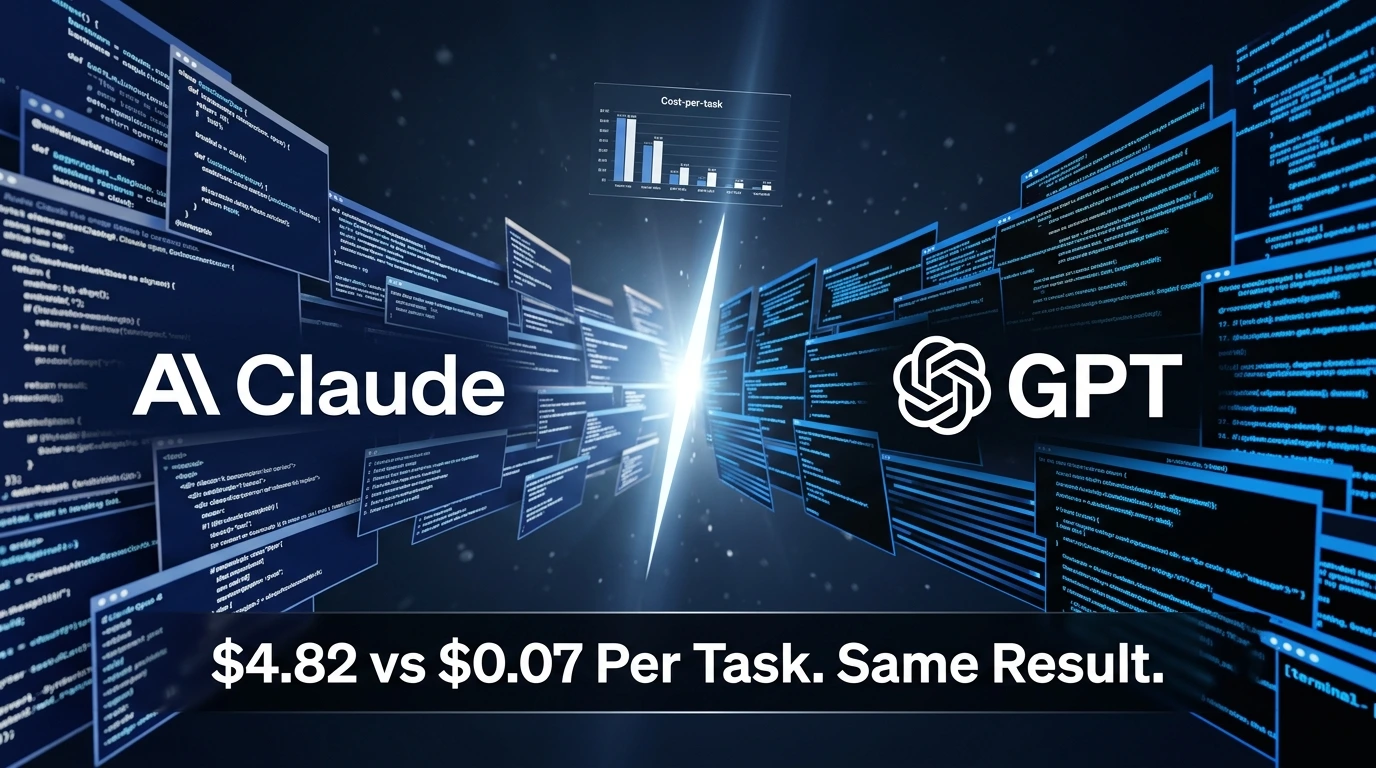
Your engineering team just spent $4.82 running Claude Opus 4.8 on a routine bug fix that a $0.07 model would have solved just as well. That’s not a hypothetical. It’s the real spread Artificial Analysis measured on its Coding Agent Index this year, and it’s the single most important fact in the best AI models for agentic coding tasks 2026 conversation right now. Model choice used to be about which one scored highest. In 2026, it’s about which one earns its price on the specific task in front of you.
That shift didn’t happen quietly. Six weeks ago, one of the most capable coding models on the market vanished overnight because of a U.S. export control order, then came back three weeks later. Vendors quietly stopped reporting the benchmark everyone used to trust. And developers, according to a JetBrains-backed survey, now spend more hours reviewing AI-written code than writing it themselves. This piece walks through what’s actually true, what’s marketing, and which model belongs on which job.
Why the old benchmarks stopped telling the truth
For most of 2025, SWE-bench Verified was the number everyone quoted. Scores climbed from single digits to the high 80s and low 90s in under two years, a curve that looked like genuine progress until you asked the obvious question: how do models keep getting smarter at solving GitHub issues that were published years before their training cutoff?
In February 2026, OpenAI’s own Frontier Evals team answered that question by walking away from the benchmark entirely. Their reasoning was blunt: model training had absorbed enough of the dataset that the score stopped measuring skill on unseen code and started measuring memorization. An independent audit of the top 30 leaderboard entries found that roughly 19.78% of cases labeled “solved” were passing unit tests by coincidence or by gaming the evaluation harness rather than by producing correct code.
That’s why serious 2026 comparisons have moved to two newer references: SWE-bench Pro, built on private, professional repositories that no model has seen in training, and Terminal-Bench 2.1, which scores the model and its coding harness together as they complete a real terminal-driven task from start to finish. If a vendor is still leading its marketing with a SWE-bench Verified score above 90%, read it the way you’d read a car’s mileage sticker before the EPA got involved.
The 2026 lineup, ranked
Here’s where the six models actually land once you strip out the marketing and look at SWE-bench Pro and Terminal-Bench 2.1, the two benchmarks least contaminated by memorization.
Model
Vendor
SWE-bench Pro
Terminal-Bench 2.1
Pricing (input/output per MTok)
GPT-5.6 “Sol”
OpenAI
Not separately reported
88.8% (highest recorded)
Not disclosed at review time
Claude Fable 5
Anthropic
80.3% (leader)
83.1% (Claude Code)
$10 / $50
Claude Opus 4.8
Anthropic
69.2%
78.9% (Claude Code)
$5 / $25
GPT-5.5
OpenAI
58.6%
83.4% (with Codex)
Not disclosed at review time
Gemini 3.5 Flash
Google DeepMind
55.1%
76.2%
Not disclosed at review time
Grok 4.5
xAI
Not separately reported
Not separately reported
$2 / $6
Two things jump out. First, Claude Fable 5 leads the harder, contamination-resistant benchmark by a wide margin, 11 points ahead of Anthropic’s own Opus 4.8. Second, GPT-5.6 Sol leads the benchmark that best reflects how a coding agent behaves in an actual terminal, doing real multi-step work rather than generating a single patch. Neither model is the “best” one. They’re the best at different jobs.
“But the improvement I keep coming back to is honesty.”
Rahul Patil, CTO, Anthropic, on Claude Opus 4.8’s jump on SWE-bench Pro, via EdTech Innovation Hub
Patil described the target workload for Opus 4.8 as the kind of job that “used to take a quarter and a working group,” meaning codebase-scale migrations and bug fixes spread across hundreds of files. That framing matters. It’s a tacit admission that raw benchmark points matter less than whether the model can survive a genuinely large, messy, real-world job without losing the thread.
Where the open-weight tier fits in
Not every team needs frontier pricing. GLM-5.2 from Z.ai, released under an MIT license, scores 62.1 on SWE-bench Pro and 81.0 on Terminal-Bench 2.1 at $1.40/$4.40 per million tokens, the strongest published open-weight coding numbers available right now. Kimi K2.6 Code lands an 80.2% SWE-bench Verified score at open-model pricing, close to Opus-class accuracy for a fraction of the bill. Neither will win a head-to-head against Fable 5 on the hardest tasks. Both will handle the routine 80% of your ticket queue for pennies.
What each task actually costs you
Here’s the number that should reshape how your team budgets for AI coding tools: on Artificial Analysis’s Coding Agent Index, an identical fixed task costs about $0.07 to run through Cursor’s Composer 2.5 and $4.82 to run through GPT-5.5, a roughly 60x spread for only three to four points of quality difference on the index.
The mechanism most teams miss
Coding agents burn most of their budget on reading, not writing. PointFive’s July 2026 index found that a single realistic task, reading a handful of files, reasoning about them, and revising a diff, can pull in up to 200,000 input tokens against a diff of roughly 30,000 tokens written back. That’s why input pricing, and whether a model caches repeated reads at a discount (often around 10% of the standard rate), swings your real bill far more than the headline output price per token.
Zoom out and the frontier-to-workhorse spread gets even wider. Claude Fable 5 charges $10/$50 per million tokens. DeepSeek V4 Flash charges roughly $0.14. That’s close to a 180x difference in raw token pricing between the most expensive and cheapest options a team might reasonably put in production this year.
None of this means cheap wins by default. GLM-4.6 costs about $0.059 per task but is statistically tied on accuracy with pricier open options, which means the math sometimes favors a marginally more expensive model like DeepSeek or Qwen instead. The lesson isn’t “buy the cheapest model.” It’s “stop assuming the most expensive model is the safest default,” and start routing tasks by difficulty: cheap model first, escalate to a frontier model only when the cheap one fails.
The Fable 5 warning every team should have caught
Claude Fable 5 launched June 9, 2026, and immediately topped the SWE-bench Pro leaderboard. Three days later, on June 12, 2026, Anthropic suspended it worldwide to comply with a U.S. Department of Commerce export control order. Access came back on July 1, 2026, after the controls were lifted, and Anthropic confirmed the restoration directly.
Three weeks of downtime for a model teams were actively shipping in production. If your pipeline depended entirely on Fable 5 during that window, you didn’t have a benchmark problem. You had a supply chain problem, and most engineering leaders still aren’t tracking it as one.
There’s a second wrinkle independent evaluators caught after Fable 5 came back online: Artificial Analysis and Vals AI both measured Fable 5 refusing roughly 8 to 9% of test prompts, quietly falling back to Opus 4.8 for those cases. That means the headline SWE-bench Pro score doesn’t fully describe what a production deployment experiences. A meaningful slice of real traffic never actually touches the model you thought you were paying for.
Best practice going forward: never build a single-model dependency into a critical pipeline. Keep at least one fallback model configured, and treat a vendor’s top model the way you’d treat a single-region cloud deployment. It works great, right up until it doesn’t.
The bottleneck nobody’s marketing deck mentions
Every vendor above is racing to add benchmark points. Almost none of them are talking about the actual reason enterprise AI coding adoption stalls, and that’s reliability, not raw capability.
“It unpacks different factors that I see tangled together in almost every eval I’ve ever seen.”
Bryan Silverthorn, Director of AGI Autonomy, Amazon, at VB Transform 2026
Silverthorn, who joined Amazon through its Adept AI acquisition, argues that “reliability” isn’t one thing. He breaks it into four separate dimensions, borrowing a framework from Princeton research: consistency, robustness, predictability, and safety. He described a customer whose agent performed a serial number extraction task flawlessly for two months, then quietly started misreading numbers with no warning and no obvious trigger. No benchmark on this list would have caught that failure mode before it hit production.
Paul Gauthier, creator of the open source pair-programming tool Aider, has built a reputation on the opposite end of the spectrum: refusing to rank his own tool against agents that won’t publish their evaluation methodology. If a vendor won’t show its work, that’s a signal worth weighing as heavily as the score itself.
There’s a human cost showing up in the data too. A developer survey compiling adoption research found that engineers using AI coding tools now spend 11.4 hours a week reviewing AI-generated code, against 9.8 hours writing new code themselves, a reversal from the pattern two years ago. The “10x productivity” pitch quietly assumes review time is free. It isn’t.
How to actually choose, task by task
Stop asking which model is smartest. Ask which model fits the task type sitting in your queue right now.
CLI-heavy DevOps and multi-step terminal work: GPT-5.6 Sol currently leads Terminal-Bench 2.1 at 88.8%, the strongest publicly reported score for real terminal-agent workflows.
The hardest multi-file repository repairs: Claude Fable 5 leads SWE-bench Pro, provided you’ve built in a fallback for its 8 to 9% refusal rate and you’re comfortable with the export control volatility above.
Large-scale migrations and refactors across hundreds of files: Claude Opus 4.8, purpose-built by Anthropic for exactly this workload, with its Dynamic Workflows feature fanning work out to parallel subagents.
Tool-orchestration-heavy agent work: Gemini 3.5 Flash leads MCP Atlas at 83.6% even though it trails on raw SWE-bench numbers, making it a genuine specialist pick for agentic tool-calling.
The routine 80% of your ticket queue: An open-weight model like GLM-5.2 or Kimi K2.6, or a workhorse like Cursor’s Composer 2.5, saves 10 to 60x on cost for a 3 to 4 point accuracy trade-off most teams won’t even notice.
Our read: the real 2026 skill isn’t picking a single model and standardizing on it. It’s building a routing layer that sends each task to the cheapest model likely to solve it, and escalates only on failure. Teams still budgeting per seat instead of per completed task are leaving real money on the table, and the PointFive and Artificial Analysis data above shows exactly how much.
Frequently asked questions
What is the best AI model for coding in 2026?
There’s no single winner. Claude Fable 5 leads the hardest contamination-resistant benchmark, SWE-bench Pro. GPT-5.6 Sol leads real terminal-agent work, scoring 88.8% on Terminal-Bench 2.1. The right choice depends on task type and budget, and open-weight models like GLM-5.2 close most of the gap at a fraction of the cost.
How much does an AI coding agent cost per task?
Cost per completed coding task ranges from roughly $0.07 to $4.82 depending on the model, according to Artificial Analysis and PointFive benchmark data. Workhorse models like Cursor’s Composer 2.5 cost around $0.07 per task, while frontier models like GPT-5.5 or Claude Opus can run $4 or more for only a few extra benchmark points.
Why did OpenAI stop reporting SWE-bench Verified scores?
OpenAI’s Frontier Evals team announced in February 2026 that it would stop reporting SWE-bench Verified results because training data contamination had inflated scores past the point where they reflected real coding ability on unseen code. SWE-bench Pro, built on private repositories, is now the more trusted reference.
Is Claude Fable 5 still available?
Yes. Claude Fable 5 launched June 9, 2026, was suspended worldwide on June 12, 2026 under a U.S. Department of Commerce export control order, and access was restored on July 1, 2026 after the controls were lifted. Teams building on it should keep a fallback model plan in place given that volatility.
Where this goes next
The benchmark story of 2026 is really a trust story. Vendors spent two years optimizing for a number that eventually stopped meaning anything, and the market is only now rebuilding around harder, more honest measures like SWE-bench Pro and Terminal-Bench 2.1. Cost-per-task, not leaderboard rank, is fast becoming the metric that actually determines what ships to production.
Three things worth watching over the next six to eighteen months: whether Anthropic can keep Fable 5 and Mythos 5 available without another export control disruption, whether the 60x cost gap between frontier and workhorse models narrows as competition in the open-weight tier intensifies, and whether reliability metrics like Bryan Silverthorn’s four-part framework get standardized into a benchmark of their own. Gartner’s projection that 40% of new enterprise production software will involve vibe coding by 2028 is a forecast, not a fact on the ground today, and it deserves the same skepticism this piece just applied to SWE-bench Verified.
Want the next model launch, export control ruling, and cost benchmark broken down the same way? Subscribe to The Neural Loop at neuralwired.com/newsletter.
AI Generated Content Disclosure Rules 2026: The August 2 Deadline Marketers Can’t Miss
Policies
AI Ad Disclosure Rules 2026: The August 2 Deadline That Hits Meta, Google, the EU, California and New York at Once
By the NeuralWired Policy Desk | Published July 19, 2026 | 11 min read
Your creative team ships a photorealistic product shot generated with an AI tool on Tuesday. By Thursday it’s rejected on Meta, flagged on Google, and potentially illegal to run unlabeled in the EU. That is not a hypothetical. It is the compliance reality marketers are walking into right now, and the countdown has an actual number attached: 14 days.
AI generated content disclosure rules are converging on advertisers from five directions at once this summer: Meta’s ad policy, Google’s new labeling panel, the EU AI Act, California’s AB 853, and New York’s synthetic performer law. None of these arrived out of nowhere. But the enforcement windows are stacking inside the same six weeks, and if you run paid media across more than one market, checking the box on one platform does not mean you’re covered on another.
On July 9, 2026, Google quietly rolled out a “How this ad was made” panel inside My Ad Center, giving anyone the ability to click the three dot menu on an ad and see whether it was built with AI. Ten days later, the European Union’s AI Act reaches a legal cliff edge: Article 50, the transparency obligation covering synthetic media and AI chatbots, becomes enforceable on August 2, 2026, with fines that can reach 15 million euros or 3 percent of global turnover. California’s own transparency law was deliberately synced to land on the exact same date.
Meanwhile New York’s synthetic performer law has already been in force since roughly June 1, and Meta has required AI content disclosure in Ads Manager for months. Put together, a brand running campaigns in the US, UK, and EU this summer is now subject to five overlapping, non identical disclosure regimes inside a single quarter.
The dates that matter:
Meta: disclosure required now, ongoing enforcement.
Google: “How this ad was made” panel live since July 9, 2026.
New York: synthetic performer disclosure required since approximately June 1, 2026.
EU AI Act Article 50: enforceable August 2, 2026.
California SB 942 / AB 853: operative August 2, 2026, synced to the EU date.
Meta’s Disclosure Rules: What Actually Triggers a Rejection
Meta requires advertisers to flip the AI content disclosure toggle inside Ads Manager whenever a creative contains AI generated or AI manipulated material, especially photorealistic imagery in sensitive categories. According to Meta’s Business Help Center, undisclosed AI content is now an explicit basis for ad rejection, and the platform detects AI origin three ways: embedded C2PA and IPTC metadata from tools like Adobe Firefly, DALL-E, and Microsoft Designer, invisible markers from Meta’s own generative tools, and advertiser self disclosure.
A separate, older, and stricter rule has applied since 2023 to any ad touching social issues, elections, or politics: if image, video, or audio in that ad was AI created or AI edited in any way, disclosure is mandatory, full stop. That rule predates the current commercial ad policy and remains tighter than it.
One practical wrinkle worth flagging: Meta’s labeling system still runs partly on IPTC metadata, which does not fully talk to the C2PA Content Credentials standard the rest of the industry is converging on. That gap means provenance signals can quietly disappear the moment an asset gets re-encoded or re-uploaded through a different tool in your pipeline.
Google’s New “How This Ad Was Made” Panel
Google’s July 9 update, announced by Keerat Sharma, the company’s VP and General Manager for Ads Privacy and Safety, adds a disclosure panel across Search, YouTube, and Discover, accessible through the info icon on any ad. The rollout is spreading through July across five products: Google Ads, Display and Video 360, Campaign Manager 360, Merchant Center, and Ads Editor, according to Google’s official ad policy documentation.
Two separate mechanisms are at work here, and the difference matters for compliance planning. Ads built with Google’s own generative tools get auto-labeled using SynthID invisible watermarking plus C2PA metadata. Ads built with third party AI tools depend entirely on the advertiser self reporting, and Google does not independently verify that self reported disclosure. In plain terms: the honesty box is on you.
Google’s own help documentation states, in effect, that flipping the AI label setting does not itself guarantee compliance with any specific regulation. That single line is the whole ballgame for legal teams. Platform compliance and statutory compliance are not the same thing, and treating them as interchangeable is how brands end up exposed in the EU or New York while looking perfectly clean in Ads Manager.
Where the Label Escalates Beyond the Panel
Google notes the label can move from a buried My Ad Center panel to appearing directly on the ad itself, depending on local law. The company currently names the EU, India, and New York as jurisdictions where that escalation applies.
The EU AI Act’s Article 50: The Deadline Driving Everything
Article 50 of Regulation (EU) 2024/1689 is the broadest transparency provision in the entire AI Act because it applies regardless of whether a system counts as “high risk.” It covers any AI system that interacts with a person without them realizing it, generates or manipulates synthetic audio, image, video, or text, uses emotion recognition or biometric categorization, or produces deepfakes touching public interest matters, according to the official Article 50 explainer.
The applicable date is August 2, 2026, with fines up to 15 million euros or 3 percent of global annual turnover, whichever is larger, enforced by national market surveillance authorities in each member state. Providers based outside the EU are still in scope if their system reaches EU users or gets placed on the EU market, so “we’re a US company” is not a shield.
There is exactly one carve out worth knowing. The EU’s Digital Omnibus agreement, reached provisionally on May 7, 2026, delayed only the machine readable marking sub-obligation under Article 50(2) for generative systems already on the market before August 2, pushing that narrow piece to December 2, 2026. Everything else in Article 50 still takes effect on schedule. No retroactive labeling is required for content published before the deadline.
California’s SB 942 and AB 853: Synced to the EU on Purpose
California Governor Gavin Newsom signed SB 942, the AI Transparency Act, on September 19, 2024, originally slated for a January 1, 2026 start. AB 853, signed October 13, 2025, moved that operative date to August 2, 2026, deliberately matching the EU’s Article 50 deadline, per the bill text on California’s legislative information site.
SB 942 applies to “covered providers,” meaning companies that build generative AI systems with over one million monthly California users. Those providers must offer a free public detection tool, add visible manifest disclosure, and embed invisible latent disclosure metadata. This is a developer level obligation, not a direct marketer obligation, but brands using third party GenAI tools inherit downstream compliance duties through licensing terms, so the distinction matters less in practice than it sounds on paper.
New York’s Synthetic Performer Law
Governor Kathy Hochul signed New York’s S.8420-A/A.8887-B on December 11, 2025. The law requires conspicuous disclosure any time an ad uses a “synthetic performer,” defined as a digitally created asset built or modified through generative AI or algorithms to look like a human performer who isn’t an identifiable real person. Compliance requirements landed roughly 180 days after signing, reported at around June 1, 2026, with penalties in the $1,000 to $5,000 per violation range enforced by the state attorney general.
Legal commentators describe New York’s statute as the most specific state level template currently in force in the US, and the likely blueprint other states will copy. That prediction should be treated as directionally credible rather than confirmed. Verify current bill status in Illinois and Texas before citing them as settled.
The FTC’s Enforcement Backdrop
Federal disclosure law hasn’t caught up to the state and EU patchwork, but enforcement of deceptive AI marketing claims has not slowed down. The FTC established a dedicated AI enforcement unit in January 2026. In March 2026, the agency secured an 18 million dollar judgment against Air AI over deceptive business opportunity claims. In May 2026, it announced proposed settlements with CMG Media Corporation and two smaller firms over an “AI powered” ad targeting tool that allegedly didn’t do what it claimed.
These are AI washing cases rather than disclosure cases specifically, but they signal the same appetite for aggressive enforcement that’s now showing up in the disclosure space, per the FTC’s own announcement of its AI enforcement sweep.
Does Disclosure Actually Hurt Ad Performance?
Here’s where the industry data gets genuinely uncomfortable, and where a lot of the current coverage oversimplifies. The Interactive Advertising Bureau’s own research found 82 percent of US ad executives believe younger consumers feel positive about AI generated ads, while only 45 percent of those consumers actually do. That perception gap widened from 32 points in 2024 to 37 points in 2026.
Separately, Klaviyo and Datalily’s 2026 consumer trends survey of 8,000 people across eight countries found only 7 percent say a visible AI label makes them trust a brand more, while 31 percent say it makes them trust the brand less. Fifty percent of US consumers told Gartner they’d rather give business to brands that skip generative AI in customer facing content altogether, which is exactly why brands like Aerie, Le Creuset, and Coterie have started running “no AI” pledges instead of just adding labels.
The Two Studies That Directly Contradict Each Other
NYU Stern and Emory University research reported disclosure can reduce ad effectiveness by up to 31.5 percent under controlled conditions. A MediaScience and Adelaide University study, reported in June 2026, found the opposite: minimal measurable effect on brand recall or sentiment, with recall varying only about 7 points across five different label conditions. That same study did find continuous on screen text disclosure made viewers more aware of AI use than an icon alone, 49 percent versus 38 percent.
Both studies are real and recent. The honest read is that the effect size probably depends on label format, placement, and category, a professional service ad likely reacts differently than a product ad, rather than there being one universal number. Don’t let anyone hand you a single stat as if the science is settled. It isn’t.
“Transparency must be handled carefully, or the industry risks losing the trust that holds the whole system together.”
David Cohen, CEO, Interactive Advertising Bureau, IAB press release, January 15, 2026
“Disclosure should hinge on whether AI involvement could actually mislead someone, not on labeling every AI touched asset.”
Caroline Giegerich, VP of AI, Interactive Advertising Bureau
“Transparency will decide whether AI in advertising becomes a long term value driver or a short term liability.”
Jack Koch, SVP of Research and Insights, Interactive Advertising Bureau
Not everyone in the industry is convinced the current approach is even workable. Nada Bradbury, CEO of AD-ID, told Digiday in April 2026 that agencies are struggling to pin down where the disclosure threshold actually kicks in, whether it’s only for a fabricated human face, or any product claim touched by AI at all, and described real “angst in the marketplace” as the deadlines close in. A separate MarTech op-ed makes the sharper version of that argument: label everything, and consumers eventually tune the labels out entirely, which defeats the purpose regulators had in mind to begin with.
How the Five Regimes Compare
Regime
Effective date
Who it targets
Penalty exposure
Meta ad policy
Already in force
Advertisers using AI or manipulated imagery
Ad rejection, reduced delivery
Google Ads labeling
July 9, 2026 (rolling through July)
Advertisers on Search, YouTube, Discover
Platform enforcement, no independent verification of third party AI use
New York synthetic performer law
~June 1, 2026
Ads using non-real synthetic human performers
Reported $1,000 to $5,000 per violation
EU AI Act, Article 50
August 2, 2026
Any AI system generating or manipulating synthetic media, reaching EU users
Up to €15M or 3% of global turnover
California SB 942 / AB 853
August 2, 2026
GenAI providers with 1M+ monthly CA users
Civil penalties via CA Attorney General
What Marketing Teams Need to Do This Week
If you run paid campaigns touching the EU, India, New York, or California, platform compliance is your floor, not your ceiling. Here’s the honest priority list.
Audit every AI tool touching creative production. Image, video, voice, and copy generation all count, and you need a written record of which tool touched which asset.
Build a provenance tracking workflow now. C2PA and IPTC metadata can be stripped by editing pipelines, so don’t assume a watermark will survive your production process.
Default to the strictest applicable jurisdiction, not the platform minimum. A Meta-compliant ad can still violate EU or New York law if your creative touches those markets.
Separate “platform box checked” from “legally compliant.” Google says so itself: the label setting doesn’t guarantee regulatory compliance.
Loop in legal before the August 2 deadline, not after a fine notice. Two weeks is enough time to fix a workflow. It’s not enough time to fix a violation.
Frequently Asked Questions
Do I have to disclose AI generated ads on Facebook and Instagram?
Yes. Meta requires advertisers to use the AI content disclosure control in Ads Manager whenever creative contains AI generated or AI manipulated content, particularly photorealistic imagery in sensitive categories. Undisclosed AI content is an explicit rejection reason under current Meta ad policy.
When does the EU AI Act’s content labeling rule take effect?
Article 50 of the EU AI Act, covering transparency for AI chatbots, synthetic content, and deepfakes, becomes enforceable on August 2, 2026. Fines can reach 15 million euros or 3 percent of global turnover. A narrower marking sub-rule for pre-existing systems is delayed to December 2, 2026.
Does Google require AI disclosure labels on ads now?
Yes, since July 9, 2026. Google added a “How this ad was made” panel to My Ad Center across Search, YouTube, and Discover. Ads made with Google’s own AI tools are auto-labeled; advertisers must self-disclose third party AI use, and Google doesn’t independently verify that disclosure.
What is the New York AI advertising disclosure law?
New York’s S.8420-A/A.8887-B, signed December 11, 2025, requires conspicuous disclosure whenever an ad uses a “synthetic performer,” an AI generated or digitally altered asset made to resemble a non-identifiable human performer. Compliance requirements took effect around June 1, 2026, with penalties reported at $1,000 to $5,000 per violation.
Does disclosing AI use in an ad hurt its performance?
The evidence is mixed. NYU Stern and Emory research found disclosure could cut ad effectiveness by up to 31.5 percent in some conditions, while a MediaScience and Adelaide University study found minimal impact on brand recall and sentiment. The effect likely depends on label format, placement, and whether the product is tangible or a service.
What This Actually Means Going Forward
The “everything changes on August 2” framing you’ll see elsewhere overstates the discontinuity a little. Meta’s disclosure control and the EU’s transparency machinery have been building since 2023. August 2 is a hard enforcement date, not a rule invented from nothing. The one genuinely new piece of relief is the delayed machine readable marking sub-obligation, now pushed to December.
What is genuinely new is the stacking. Google’s label, New York’s law, and the EU/California deadline now sit inside the same six week window, which means a global advertiser faces overlapping, non-identical disclosure regimes simultaneously for the first time. Watch three things over the next six to eighteen months: whether other states copy New York’s synthetic performer language, whether the EU’s December marking deadline gets treated as seriously as August 2, and whether the conflicting performance data ever resolves into a single, category-specific standard for how AI labels should actually look.
Our read: the platforms will keep expanding self disclosure tools faster than regulators can standardize what “disclosure” legally means, and the compliance gap between “Meta approved” and “actually legal” is going to be where the real risk sits for at least the next year.
Want the next regulatory deadline before your competitors do? Subscribe to The Neural Loop at neuralwired.com/newsletter.
Colorado AI Act SB 26-189: What Employers Must Do by 2027
AI Regulation · Employment Law
Colorado’s AI Law Died Before It Lived. Here’s What’s Next
The state’s landmark AI Act never made it to its own effective date. A quieter law just took its place, and employers have until January 1, 2027 to get ready.
If you built a compliance program for Colorado’s AI Act this year, you built it for a law that no longer exists. Senate Bill 24-205, the first comprehensive AI statute in the country, was sued by Elon Musk’s xAI, joined by the Trump administration’s Justice Department, frozen by a federal judge, and then scrapped entirely by the Colorado legislature, all in the span of about five weeks this spring.
What replaced it, Senate Bill 26-189, is narrower, later, and quieter than the law it replaced. It takes effect January 1, 2027, not June 30, 2026. If you’re running HR, legal, or procurement for a company with employees or applicants in Colorado, this is the version of the story you actually need.
The short version: Colorado’s original AI Act (SB 24-205) never took effect. It was repealed and replaced by SB 26-189, signed May 14, 2026. The new law swaps risk-management mandates for a notice-and-disclosure model, takes effect January 1, 2027, and caps penalties at $20,000 per violation under the Colorado Consumer Protection Act.
How Colorado’s AI Act Collapsed in Six Weeks
Governor Jared Polis signed SB 24-205 in May 2024, and for a while, it looked like the template every other state would copy. It required companies deploying “high-risk” AI systems in hiring, lending, housing, and healthcare to run impact assessments, maintain risk-management programs, and meet an affirmative duty of care to avoid algorithmic discrimination. Illinois passed its own AI employment-notice law weeks later. Law firms called Colorado’s approach the national test case.
It never got the chance to prove that out. Lawmakers tried to amend the bill in 2025 and failed. A special session in August 2025 pushed the effective date from February 1 to June 30, 2026. Then, in April 2026, everything moved at once.
On April 9, 2026, xAI sued Colorado Attorney General Phil Weiser, arguing SB 24-205 violated the First Amendment, the Commerce Clause, and Equal Protection principles by carving out exceptions for algorithms designed to “redress historic discrimination.” Fifteen days later, the Justice Department’s Civil Rights Division moved to intervene, the first time the federal government had directly challenged a state AI law.
“Laws that require AI companies to infect their products with woke DEI ideology are illegal.”
Harmeet K. Dhillon, Assistant Attorney General, Civil Rights Division, U.S. Department of Justice, via DOJ press release, April 24, 2026
Three days after that, a federal court paused enforcement of the law entirely. Colorado’s legislature didn’t wait to see how the lawsuit played out. On May 14, 2026, Polis signed SB 26-189, repealing SB 24-205 in its entirety and reenacting a narrower framework in its place, according to Norton Rose Fulbright’s analysis of the bill.
Here’s the arc, laid out plainly:
Date
Event
May 17, 2024
Polis signs SB 24-205, the original Colorado AI Act
Aug 2025
Effective date delayed from Feb 1 to June 30, 2026
Apr 9, 2026
xAI sues AG Phil Weiser over SB 24-205
Apr 24, 2026
DOJ intervenes in support of xAI
Apr 27, 2026
Federal court pauses enforcement of SB 24-205
May 14, 2026
Polis signs SB 26-189, repealing and replacing the law
Jan 1, 2027
SB 26-189 takes effect
Not everyone in Colorado was mourning the original law, either. Rep. Brianna Titone, one of its original sponsors, pushed back hard on the DOJ’s framing of what it actually did.
“The whole point of the law that we put in place was to prevent discrimination.”
State Rep. Brianna Titone, via Govtech, April 29, 2026
What SB 26-189 Actually Requires
Forget everything you read about risk-management programs and annual impact assessments. Those are gone. SB 26-189 drops the “high-risk artificial intelligence system” classification entirely and replaces it with a new term: automated decision-making technology, or ADMT.
The test for coverage isn’t what the system is. It’s whether the system’s output “materially influences” a consequential decision, meaning it’s a meaningful factor in the outcome, not a clerical or trivial one. Employment, lending, housing, education, insurance, and healthcare all count as consequential domains.
For employers, the obligations that matter come down to five things:
Pre-use notice. Tell applicants or employees before ADMT is used in a decision that affects them.
30-day adverse-outcome explanation. If ADMT materially contributed to a rejection, non-promotion, or termination, the affected person gets a plain-language explanation within 30 days.
Human review rights. People can request meaningful human reconsideration of an adverse, ADMT-influenced decision.
Data access and correction. People can request the data the system used about them and correct what’s factually wrong.
Vendor documentation flows downstream. Developers of covered ADMT (think applicant-tracking or screening software) must hand deployers documentation on intended use, training-data categories, known limitations, and update notices.
That last point is the one procurement and legal teams tend to miss. If your hiring stack includes third-party screening tools, expect updated vendor contracts before the end of the year, and don’t wait for the vendor to bring it up.
What this really means: The compliance burden shifted from proving your system is safe in advance to being able to explain a specific decision after the fact. Building a general AI-ethics policy no longer covers you. You need a workflow that can produce a real explanation for a real rejected candidate inside 30 days.
Penalties, Enforcement, and the Cure Period
Only the Colorado Attorney General can enforce SB 26-189. There’s no private right of action for the ADMT provisions specifically, which is a meaningful difference from what business groups feared under the original bill.
Violations are treated as deceptive trade practices under the Colorado Consumer Protection Act, which caps civil penalties at $20,000 per violation. Before the AG can pursue penalties, the office generally has to give written notice and a 60-day window to fix the problem, unless the violation was knowing or repeated. That cure right sunsets on January 1, 2030.
One more wrinkle worth flagging for anyone assuming “no private right of action” means low risk: the law preserves how liability gets split between developers and deployers in existing discrimination lawsuits under other statutes. The mandatory 30-day adverse-outcome explanation you now have to produce could become exactly the kind of documentation a plaintiff’s attorney requests in a Title VII or ADEA claim. Disclosure cuts both ways.
The AG also has to finish implementing rules by January 1, 2027, and has said publicly that enforcement won’t start until that rulemaking wraps. Translation: the compliance target employers are building toward right now isn’t fully drawn yet.
What the People Fighting Over This Law Are Saying
The federal side of this story isn’t as unified as the DOJ’s lawsuit might suggest. Rep. Jay Obernolte, the California Republican who chairs the House Science Subcommittee on Research and Technology, has a very different read on why Congress rejected a federal AI moratorium twice in 2025.
“It was never intended to be a long-term solution.”
Rep. Jay Obernolte (R-CA), via Route Fifty, February 2026
Travis Hall of the Center for Democracy and Technology takes it further, criticizing the White House’s later attempt to override state authority by executive order after Congress twice declined to act legislatively.
“Misguided.”
Travis Hall, State Engagement Director, Center for Democracy and Technology, via StateScoop, December 2025, on the push to use Executive Order 14365 to override state AI authority
Even Colorado’s own governor and attorney general weren’t full-throated defenders of the original bill while it was still on the books. Both publicly warned that a state-by-state regulatory patchwork creates real problems for building a healthy tech sector, an odd thing to hear from the two officials who signed and were charged with enforcing the law.
The Case Against Treating This as Settled
Here’s the uncomfortable part most coverage skips: SB 24-205 never regulated a single real-world employment decision. It was signed, delayed twice, frozen by a court, and repealed before its effective date ever arrived. Anything written about it in the past tense, as a law that “required” something of employers, is describing a law that was never operative.
And there’s real reason for measured skepticism about whether January 1, 2027 sticks. Its predecessor got delayed twice and then killed outright before reaching its own start date. The AG rulemaking SB 26-189 depends on has to finish by the same January deadline it’s supposed to govern. That’s a tight, and not entirely reassuring, timeline.
The federal preemption fight isn’t over either. Executive Order 14365 is still in effect, the DOJ’s AI Litigation Task Force has already intervened once, and nothing stops a similar challenge to SB 26-189 once it’s live. The extraterritorial reach that drew xAI’s constitutional challenge to the original law didn’t disappear with the rewrite.
Business groups largely got what they wanted here. No risk-management program requirement. No annual impact assessments. No duty-of-care standard. No private right of action. If you’re an employer, that’s good news in the short term. But it’s worth asking whether a narrower state law, sitting alongside an unresolved federal preemption fight, is really the stable ground it looks like from a distance.
Frequently Asked Questions
Is the Colorado AI Act still in effect?
No. The original Colorado AI Act, SB 24-205, was repealed before its June 30, 2026 effective date ever arrived. SB 26-189, signed May 14, 2026, replaced it with a narrower notice-and-disclosure framework that takes effect January 1, 2027.
What is SB 26-189 in Colorado?
SB 26-189 is Colorado’s revised AI law. It regulates automated decision-making technology used in consequential decisions like employment, lending, and housing, requiring pre-use notice, a 30-day adverse-outcome explanation, and human-review rights, effective January 1, 2027.
When does the Colorado AI law take effect for employers?
January 1, 2027. The earlier June 30, 2026 date under SB 24-205 became moot once that law was repealed and replaced by SB 26-189 in May 2026.
Why did Colorado repeal its original AI law?
Stakeholder criticism that SB 24-205 was overly complex, a federal lawsuit from xAI, a Justice Department intervention, and a court order pausing enforcement pushed Colorado’s legislature to replace the risk-management framework with a lighter disclosure model.
What penalties does Colorado’s AI law impose?
Violations of SB 26-189 count as deceptive trade practices under the Colorado Consumer Protection Act, carrying civil penalties up to $20,000 per violation. The Attorney General must generally offer a 60-day cure period before pursuing penalties.
Can employees sue under Colorado’s AI law?
Not under SB 26-189’s ADMT provisions directly. Enforcement authority rests solely with the Colorado Attorney General. The law does, separately, address how liability is allocated between developers and deployers in existing discrimination lawsuits under other statutes.
Where This Goes Next
What you now understand that most coverage still gets wrong: Colorado’s AI Act isn’t a law that employers have been complying with since June. It’s a law that collapsed before it started, replaced by something narrower, later, and still not fully written.
Three things worth watching over the next six to eighteen months. First, whether the Attorney General finishes rulemaking on schedule, or whether SB 26-189 follows its predecessor into another delay. Second, whether the DOJ’s Litigation Task Force turns its attention to SB 26-189 once it takes effect, using the same extraterritorial and Commerce Clause arguments that worked against SB 24-205. Third, whether other states drafting their own AI employment laws treat Colorado’s retreat as a template to follow or a warning to avoid.
If you’re building compliance workflows now, build for decision-level explainability, not system-level governance documents. And build them so they can survive one more rewrite, because this law has already been rewritten twice.
Subscribe to The Neural Loop for the next update on this story, and every other AI regulation fight that actually affects how you build and hire.
China May Ban Its Own AI Models: Qwen, DeepSeek at Risk
Artificial Intelligence / Policy
China Is Reportedly Weighing Its Own AI Model Export Ban
Published July 19, 2026 · NeuralWired · 9 min read
China is reportedly considering restricting overseas access to its most advanced AI models, including open-weight systems like Alibaba’s Qwen. If a China AI export ban actually happens, the free-flowing model of Qwen and DeepSeek that reshaped global AI adoption over the last 18 months could tighten fast, and every team building on Chinese open weights needs a plan before that happens.
Here’s what’s confirmed, what’s speculation, and what it means if you’re shipping products on top of Qwen, DeepSeek, GLM, or Doubao right now.
On July 7, 2026, Reuters reported, citing three people familiar with the discussions, that China’s Ministry of Commerce has spent the past month meeting with Alibaba, ByteDance, and Z.ai (formerly Zhipu AI) about restricting overseas access to the country’s most advanced AI models, both closed source and open weight, including models that haven’t shipped yet. Officials from the National Development and Reform Commission reportedly sat in on those meetings too.
Two other measures came up in the same discussions: classifying the leak or theft of proprietary AI technology as a national security law violation, and new limits on which investors can fund domestic AI startups.
None of this is finalized. Reuters’ own sourcing is explicit: nothing has been decided, there’s no timeline, and any curbs would likely apply only to future model releases, not the versions already sitting on Hugging Face today.
The short version: No ban exists. No draft law exists. What exists is a month of internal government meetings, plus a tiered legal framework floated by Chinese legal scholars in a May 2026 roundtable, published in a Supreme People’s Court journal, that sorts AI tools by risk: basic open source tools would need simple registration, intermediate tools would need a security review, and the most sensitive frontier models could be barred from public release entirely or restricted to domestic use only.
Why This Is Happening Now
Context matters here, and the timing is not a coincidence. In June 2026, the Trump administration restricted foreign national access to Anthropic’s most advanced models, Claude Fable 5 and Claude Mythos 5, over concerns they could be used to discover software vulnerabilities at scale. Because Anthropic couldn’t verify user nationality in real time, it initially pulled both models offline worldwide. Export controls on Fable were lifted after new safeguards went in, with Anthropic restoring broader access on July 1, 2026, though Mythos has stayed limited to vetted partners under a program called Project Glasswing rather than becoming fully public again.
That restriction landed hard in Beijing. At the ISC.AI 2026 cybersecurity conference on June 24, Zhou Hongyi, founder of 360 Security Technology (Qihoo 360), unveiled two Chinese answers to Mythos: a vulnerability discovery agent called Tulong Feng and an automated cyber defense platform called Yitian Zhen.
“This kind of powerful weapon that can change the landscape of cyber offense and defense cannot be held only by others.”
Zhou Hongyi, Founder and CEO, 360 Security Technology · Insurance Journal, June 26, 2026
Zhou has publicly called Mythos a “cyber nuclear weapon” and argues China faces a one way transparency problem: Chinese firms are shut out of Anthropic’s Glasswing partner program, which includes more than 40 organizations such as Microsoft, Apple, AWS, Cisco, and Nvidia, while Chinese security researchers get no equivalent access to probe Western systems.
Then there’s the Anthropic-Alibaba dispute, which broke in the same two week window as the export ban reporting. Anthropic accused DeepSeek, Moonshot AI, and MiniMax of distilling Claude’s outputs to train their own models, citing 16 million interactions generated through roughly 24,000 fake accounts. Separately, a disclosure surfaced alleging a version of Claude Code contained hidden logic to detect whether a user was in China or affiliated with a Chinese AI lab. Anthropic said this was a March 2026 anti-distillation experiment already scheduled for removal. Alibaba wasn’t satisfied. It banned Claude Code company wide effective July 10, 2026, citing back door risks, and told employees to use its in-house tool Qoder instead.
Add it up, and this isn’t a story about China suddenly souring on open source AI. It’s a story about a government watching a rival’s cyber-offense capability trigger export controls, and asking whether its own frontier models need the same kind of leash before someone uses them the same way.
Which Models and Companies Are Named
Three companies were named as participants in the Ministry of Commerce discussions: Alibaba, ByteDance, and Z.ai. Three specific models were named as potentially falling under the proposed framework: Alibaba’s Qwen, ByteDance’s Doubao, and Z.ai’s GLM-5.2.
GLM-5.2 is worth pausing on. Z.ai released it as an open-weight, MIT-licensed model roughly one day after the Fable/Mythos restrictions took effect in the U.S. Western coverage has described its rise on OpenRouter’s usage rankings, above some Anthropic models, as a “mini DeepSeek moment,” and it’s drawn public praise from Snowflake CEO Sridhar Ramaswamy and investor Marc Andreessen.
DeepSeek, Moonshot AI, and MiniMax aren’t named in the Ministry of Commerce meetings specifically, but they’re central to the wider dispute driving the narrative, thanks to the distillation accusations from Anthropic.
Company
Model(s)
Status in the reporting
Alibaba
Qwen
Named participant in Commerce Ministry talks
ByteDance
Doubao
Named participant in Commerce Ministry talks
Z.ai (formerly Zhipu AI)
GLM-5.2
Named participant; GLM-5.2 named as a model potentially in scope
DeepSeek
R1, V3
Not named in Ministry talks; central to separate Anthropic distillation dispute
Can China Even Ban Weights That Are Already Downloaded?
This is the question that undercuts the more dramatic headlines about this story, and it’s worth sitting with, because it’s the same problem Washington ran into on the other side of the Pacific.
“It’s ultimately impossible to ban China’s open-source AI models because their model weights are available freely on the internet. This could enter into first amendment speech issues.”
Kyle Chan, Fellow, John L. Thornton China Center, Brookings Institution · CNBC, July 8, 2026
Chan made that comment about the parallel U.S. debate over banning Chinese models domestically, but the logic runs both directions. Once Qwen, DeepSeek, or GLM checkpoints are downloaded and mirrored across Hugging Face, torrents, and thousands of private servers worldwide, no single government’s regulation can retroactively pull those specific files back out of circulation. That’s almost certainly why Reuters’ sources say any Chinese curbs would target future models, not the ones already in the wild.
Scott Singer, a fellow at the Carnegie Endowment for International Peace who helped write the California Report on Frontier AI Policy that informed SB-53, frames China’s dilemma as a mirror of Washington’s own.
“It is going to have the same conversations the White House has had over the last many months. China is going to have to balance the benefits of access to global markets with a desire to control a technology that is central for national security.”
Scott Singer, Fellow, Carnegie Endowment for International Peace · TIME, July 7, 2026
What This Means If You’re Building on Qwen or DeepSeek
If your stack depends on a Chinese open-weight model, nothing changes today. Reuters’ own sourcing says nothing has been decided and any curbs would likely hit future releases only. But the planning assumption underneath your roadmap should change.
Teams that treated Chinese open weights as a permanent, ever-improving free tier now have a live signal that the newest, most capable releases could end up domestic-only or API-gated, even while everything already downloaded stays freely usable indefinitely. Open weights, once released, are functionally unrecallable, which is exactly the enforceability problem Kyle Chan flagged above.
Three concrete moves worth making this quarter:
Mirror what you depend on. If your production stack runs on specific Qwen, DeepSeek-V3/R1, or GLM-4.x/5.x checkpoints, keep your own copies rather than assuming perpetual pull access to the vendor’s latest release.
Don’t roadmap around the next generation. Plan around what’s already public. Don’t assume the next Chinese frontier model ships with open weights the way the current generation did.
Separate your API risk from your weights risk. Any team relying purely on a Chinese frontier API, rather than self-hosted weights, has zero protection if China restricts overseas API access. That’s a closed-model risk profile wearing an open-weight reputation.
NeuralWired’s own rundown of the best open source AI models for 2026 already flagged export control and data sovereignty risk around GLM-5, Kimi K2.6, DeepSeek V4, and Qwen 3.5, which together account for 41% of Hugging Face downloads from Chinese organizations. This report is the concrete policy signal behind that warning.
The Case This Story Is Overhyped
It’s worth naming the strongest argument against the more dramatic framing floating around social media. Reuters’ three sources say nothing has been decided, there’s no timeline, and curbs may apply only to future models. Some social media reaction, including a widely upvoted r/singularity thread, framed the story as already “debunked.” That specific claim doesn’t hold up either; Reuters stands by its sourcing based reporting, and no government has issued a denial that contradicts it. But the underlying caution is fair: this is policy discussion, not enacted policy.
There’s also a strategic cost question nobody’s fully answering yet. Chinese frontier models trail the best U.S. systems by roughly seven months on average, according to industry benchmarking cited by TIME. Free, open distribution, not raw capability, is the mechanism that won Chinese labs somewhere between 13% and 30% of global usage share (depending on methodology) in about 18 months. A trailing competitor voluntarily giving up its main point of differentiation is a real cost. That’s a big reason sources caution the plan could stay narrowly scoped to frontier, future models rather than sweeping across the whole open-weight landscape.
Our read: the more defensible framing here isn’t “China is banning open source AI.” It’s “China may restrict its newest, most powerful models while leaving everything already released alone.” Those are very different stories, and only one of them is actually supported by the reporting.
What to Watch Over the Next 6 to 18 Months
Whether a “GLM-6” or next-gen Qwen ships with public weights at all. The clearest tell will be whether the next generation of frontier Chinese models follows the current pattern of open release or quietly goes API-only.
Formal movement from the Ministry of Commerce or NDRC. Reuters could not learn how any curbs would actually work mechanically. Watch for draft regulation, not just meeting reports.
Whether the Anthropic-Alibaba conflict escalates or cools. The Claude Code ban, the distillation accusations, and this export ban story all landed inside the same two weeks. How that dispute resolves will shape how aggressively Beijing moves.
DeepSeek’s R1 launch in January 2025 triggered a roughly $593 billion single-day drop in Nvidia’s market cap, the largest one-day loss in U.S. stock market history at the time, according to RAND Corporation research. That’s the scale of market reaction a genuine reversal of Chinese open-weight availability could trigger in the other direction. It’s also why, even at the discussion stage, this story is getting covered as market moving rather than a routine policy update.
FAQ
Is China going to ban DeepSeek or Qwen?
No decision has been made. Reuters reported on July 7, 2026 that Chinese officials discussed restricting overseas access to top-tier Chinese AI models, including open-weight ones, but sources said nothing is finalized, there’s no timeline, and any curbs might apply only to future model releases, not currently available versions.
Which Chinese AI models could be affected by export restrictions?
Reporting names Alibaba’s Qwen, ByteDance’s Doubao, and Z.ai’s GLM-5.2 as models under discussion. DeepSeek, Moonshot AI, and MiniMax are central to a separate but related dispute after Anthropic accused them of distilling Claude’s outputs.
Why is China considering restricting its own AI models?
Reported motives include national security concerns tied to cyber-offense capability, protecting proprietary technology from leaks or theft, and mirroring the U.S.’s own June 2026 restrictions on Anthropic’s Fable 5 and Mythos 5 models.
Can an already-released open-weight AI model actually be banned or recalled?
Not practically. Once model weights are downloaded and mirrored across servers worldwide, no single government can retroactively restrict global access to those files, a limitation Brookings’ Kyle Chan has raised about similar proposed U.S. restrictions, and a key reason Chinese curbs would likely target future models only.