BlackRock BUIDL Hit $2.5B. Goldman Sachs Is Using Tokenized Treasuries as Collateral. Your Board Is About to Ask Why You Haven’t: The RWA Tokenization Playbook for 2026
Enterprise Blockchain / Capital Markets
BlackRock Did It. Goldman Sachs Did It. Your Board Is About to Ask Why You Haven’t: The RWA Tokenization Playbook for 2026
By NeuralWired EditorialJune 14, 202614 min read
Your CFO is going to walk into the next board meeting with a printout. It will reference BlackRock’s $2.5 billion tokenized Treasury fund. It will mention that Goldman Sachs is now using tokenized U.S. Treasuries as collateral in live derivatives transactions. It will ask, with genuine urgency, what your organization’s position is on RWA tokenization in 2026. You need an answer before that meeting happens.
The tokenized real-world assets market has grown from roughly $85 million in 2020 to over $33 billion by mid-2026. That is a 300-fold increase in six years. The institutions driving this growth are not startups. They are BlackRock, JPMorgan, Goldman Sachs, Franklin Templeton, and BNY Mellon. RWA tokenization has moved from a crypto-native experiment into load-bearing infrastructure at the world’s largest financial firms, and the window for treating it as a “watch and wait” technology is closing.
This is not a “what is tokenization” explainer. You already know what it is. This is the operating playbook for enterprise boards and CFOs who need to understand what the leading institutions have actually built, what the regulatory runway looks like through 2027, and what specific actions make sense right now.
$33B+Tokenized RWA market, mid-2026
$2.5BBlackRock BUIDL AUM
300xMarket growth since 2020
6Asset classes above $1B onchain
The Board Question Has Already Arrived
In March 2024, BlackRock launched the BUIDL fund on Ethereum and crossed $520 million in assets within 40 days. That single product proved institutional demand for tokenized assets existed at scale and wasn’t theoretical. What followed was a cascade of production-grade deployments from the firms that run global capital markets.
By Q1 2026, six categories of tokenized assets had each surpassed $1 billion in on-chain value: private credit, commodities, U.S. Treasuries, corporate bonds, non-U.S. government debt, and institutional alternative funds. Private credit tokenization grew 180% year-over-year, with Centrifuge, Maple Finance, and Goldfinch originating over $3.2 billion in on-chain loans. Tokenized gold spot trading volume hit $90.7 billion in Q1 2026 alone, already surpassing the $84.6 billion traded across all of 2025.
Larry Fink, whose annual chairman’s letters function as boardroom blueprints for institutional investors globally, was unambiguous in his 2025 letter to investors:
“Every stock, every bond, every fund, every asset, can be tokenized. If they are, it will revolutionize investing.”
Larry Fink, Chairman and CEO, BlackRock | BlackRock 2025 Annual Chairman’s Letter
Fink elaborated with a comparison that cuts through the complexity: if SWIFT is the postal service, tokenization is email itself. Assets move directly and instantly, bypassing intermediaries. That framing is how the world’s largest asset manager is explaining this technology to its clients. Your board will hear it. The question is whether you have a substantive response ready.
What BlackRock Actually Built
BUIDL: The Institutional Benchmark
The BlackRock USD Institutional Digital Liquidity Fund, known as BUIDL, is managed through Securitize (in which BlackRock has invested $47 million) and is now live on nine separate blockchain networks. It holds approximately $2.5 billion in assets as of mid-2026 and is built on short-term U.S. Treasury bills. It is, by any measure, the single largest tokenized Treasury product in existence.
What makes BUIDL operationally significant for enterprise treasury teams is not just the yield. In late April 2026, Standard Chartered, BlackRock, and OKX launched a framework allowing qualified investors to use BUIDL as trading collateral. This created what practitioners are calling a “yield stack”: a single asset that simultaneously generates yield, supports collateral requirements, and enables market access. No traditional money market fund does that.
On May 9, 2026, BlackRock filed with the SEC for two additional tokenized fund structures. BlackRock’s own 8-K filing explicitly positions digital assets and tokenization as one of “the largest new growth channels across the industry.” This is not a side project. It is a named strategic growth pillar in a filing that goes to shareholders.
Enterprise Implication
Tokenized money market funds like BUIDL now return 4 to 5% APY with same-day liquidity, operationally comparable to prime brokerage but on-chain. If your idle cash sits in T+2 settlement cycles while institutional peers earn yield on on-chain Treasuries, your CFO has an efficiency gap that needs an explanation.
What Goldman Sachs Is Actually Doing
From Pilot to Production
Mathew McDermott, Goldman Sachs’ Global Head of Digital Assets, described the internal shift at the Digital Asset Summit in London in October 2025 as moving from “if” to “how” regarding tokenization. That framing is precise. Goldman is no longer evaluating whether to participate in tokenized asset markets. It is executing across multiple production systems simultaneously.
On June 4, 2026, Goldman teamed with Apex and Archax to launch a tokenized real estate fund. McDermott stated in connection with the launch:
“Issuing blockchain native fund units on GS DAP enables investment in real estate assets with precision while unlocking more seamless transferability in the future.”
Mathew McDermott, Global Head of Digital Assets, Goldman Sachs | CoinDesk, June 4, 2026
Goldman has also crossed a threshold that should capture every derivatives desk’s attention: the firm is now using tokenized U.S. Treasuries as collateral in live derivatives transactions. It is pursuing 24/7 tokenized Treasury and money market fund trading in the U.S. and is preparing to launch a euro-denominated digital bond alongside its first U.S. fund tokenization. The GS DAP platform is being spun out as a standalone entity with strategic partners, which means Goldman is not just building internal infrastructure. It is building an infrastructure business.
The Dissent Worth Knowing
Sharmin Mossavar-Rahmani, Chief Investment Officer of Goldman Sachs Wealth Management, has stated publicly that she does not view crypto as an investment asset class and had not seen meaningful client demand from Goldman’s wealth clients. She works at the same firm actively building tokenization infrastructure. McDermott acknowledged this directly: “The nice thing is, about an institution of our size, there are differing views.”
This internal tension at Goldman reflects a broader reality at large enterprises. Technology leadership is bullish on tokenized infrastructure. Wealth and investment management leadership is skeptical of crypto as an asset class. These are not the same debate. Boards need to separate them.
Six Asset Categories Now Above $1 Billion
The RWA tokenization conversation used to center almost entirely on Treasuries and stablecoins. That is no longer accurate. Six distinct asset categories have each crossed $1 billion in on-chain value, and the composition of the market reflects a genuine diversification of institutional use cases.
Asset Category
Notable Developments (2025-2026)
Enterprise Relevance
U.S. Treasuries
~45% of total RWA market; BUIDL at $2.5B; JPMorgan MONY at $100M launch
Highest liquidity; direct treasury management application
Private Credit
180% YoY growth; $3.2B+ originated onchain
Lower cost of capital; faster settlement for loan originators
Commodities (Gold)
$90.7B Q1 2026 spot volume; PAXG and XAUT dominant
Commodity treasury diversification with on-chain auditability
Corporate Bonds
Goldman euro-denominated digital bond in development; Citi and HSBC pilots
Reduced issuance cost; fractional distribution
Real Estate
Goldman x Apex x Archax fund (June 2026); Deloitte projects $1T by 2035
Illiquid asset with highest enterprise balance sheet exposure
Institutional Alternatives
MakerDAO holds $2B+ RWA collateral backing DAI
DeFi-native demand for tokenized fund units as collateral
JPMorgan’s Onyx platform has processed over $900 billion in tokenized repo transactions, though most settle on private chains. The firm’s My OnChain Net Yield Fund (MONY) launched in January 2026 with an initial $100 million seed. JPMorgan, alongside BlackRock, Franklin Templeton, Fidelity, State Street, UBS, Goldman Sachs, BNY Mellon, HSBC, and Citi, is actively driving the institutional adoption of tokenized RWAs.
For context on what the 2030 trajectory looks like: BCG and ADDX describe their $16 trillion by 2030 figure as a highly conservative forecast, with a best-case scenario of $68 trillion. McKinsey is more cautious, projecting $2 trillion as the base case. For board-level planning, the McKinsey base case is the appropriate conservative scenario. BCG’s figure should be treated as an opportunity ceiling, not a probability.
The Regulatory Window: GENIUS Act and What Comes Next
The passage of the GENIUS Act in July 2025 established the first U.S. federal regulatory framework for payment stablecoins. It does not directly regulate tokenized securities, but it does formalize the settlement infrastructure that most tokenized RWA products depend on. By creating standardized stablecoin licensing, capital requirements, custody rules, and AML obligations, the GENIUS Act gave institutional treasury teams a compliance surface they could actually evaluate.
The broader digital asset market structure package, anticipated as the Clarity Act, is expected to advance through Congress in 2026 after Senate delays in 2025. SEC and CFTC rulemakings could take up to 18 months, with primary rules likely effective in late 2026 or 2027. The GENIUS Act’s prohibition on interest-bearing stablecoins is already pushing institutional yield-seekers toward tokenized Treasury and money market products, which is one reason why that category dominates at 45% of the total RWA market.
Critical Timeline for Enterprise Legal Teams
GENIUS Act stablecoin licensing, capital, custody, and AML rules have key 2026 compliance deadlines. Your general counsel needs to be in the room before your CTO signs a vendor contract. The legal structure of a tokenized product determines what rights your organization actually holds, and those rights vary considerably across different tokenization architectures.
The regulatory feedback loop is worth understanding. More regulatory clarity attracts more institutional participation, which creates more secondary market liquidity, which draws more regulatory attention and standardization. This cycle is the primary reason RWA tokenization is growing faster than almost every other sector in the digital asset space in 2026. The sector has grown approximately 66% in 2026 alone, per Finextra analysis cited by MEXC Crypto Pulse in May 2026.
The Enterprise Decision Framework
What to Tokenize
Not every asset is a candidate for tokenization. Artem Tolkachev, featured in the DWF Labs 2026 RWA Tokenization Trends Report, made the constraint explicit: if there is no price discovery, it may not be worth tokenizing. Assets without consistent market-based price discovery, such as bespoke private real estate in low-volume markets, collectible cars, or non-standard commodities, do not become liquid just because they are wrapped in a token. The token does not create liquidity if the underlying asset has none.
Assets that work well for tokenization share three characteristics: they have an established price discovery mechanism, they carry significant friction in traditional settlement (long holding periods, high minimum investments, intermediary fees), and they have identifiable institutional buyer pools. U.S. Treasuries, money market instruments, investment-grade bonds, large-scale commercial real estate, and investment-grade private credit all meet this bar.
Which Platform
The tokenization platform vendor landscape has matured beyond the demo stage. Three production-grade options are currently handling institutional volume. Securitize, backed by BlackRock with a $47 million investment, manages BUIDL and has processed billions in tokenized securities. Tokeny, backed by Apex Group, handled the Goldman Sachs real estate fund launch in June 2026. Goldman’s GS DAP platform is being spun out as a standalone entity and is being positioned as infrastructure for third-party issuers, not just Goldman’s own products.
On blockchain infrastructure, Ethereum hosts over 60% of all tokenized RWAs by value. Stellar, Polygon, and Avalanche hold meaningful secondary share. Enterprise-grade permissioned alternatives include Hyperledger Besu, R3 Corda, and JPMorgan’s Quorum, which remain relevant for organizations that cannot expose settlement infrastructure to public chain risk. Selecting the right blockchain infrastructure for enterprise tokenization is a decision that shapes interoperability, compliance, and cost for years.
What Legal Structure
This is the most important technical-legal reality that boards are not yet grasping: the token is not the asset.
In many tokenization implementations, holding a token means holding a beneficial interest in a special purpose vehicle (SPV) that holds the asset, a debt obligation from the issuer secured by the asset, or a contractual right to receive payments derived from the asset. These are legally distinct from direct ownership of the underlying asset. In a bankruptcy scenario, token holders may have significantly different seniority and recourse than the “ownership” framing implies. Your legal team needs to review the specific structure, not just the token standard, before signing.
The Honest Risks Your Board Needs to Hear
The gap between projection and reality is currently around 1,300 times. The actual tokenized RWA market sits at approximately $12 billion excluding stablecoins, against BCG’s $16 trillion projection. Trillion-dollar forecasts assume multiple structural bottlenecks will be resolved simultaneously. Enterprise boards should understand each of those bottlenecks before committing capital or operational resources.
Counterparty Risk Exceeds Smart Contract Risk
The trust or SPV holding the underlying asset must remain solvent, honest, and legally compliant. If the entity managing a tokenized Treasury fund misappropriates assets or fails to maintain proper reserves, token holders could lose principal regardless of what the blockchain ledger shows. Smart contract risk exists but is secondary to this. An enterprise smart contract audit checklist is necessary but not sufficient protection.
Secondary Market Liquidity Has Not Materialized
A 2025 academic analysis published on arXiv found that despite over $25 billion in tokenized RWAs brought on-chain, most continue to exhibit low trading volumes, long holding periods, and limited secondary-market activity. The liquidity benefit that is the central promise of tokenization has not yet appeared in observable trading behavior. For CFOs modeling cost savings from T+2 to T+0 settlement, this is a critical variable. The efficiency gains are real in theory and in production for high-volume products like BUIDL. They are not universal across asset classes or platforms yet.
Cross-Chain Fragmentation Erodes Efficiency Gains
The State of RWA Tokenization 2026 report from RWA.io documents 1 to 3% pricing gaps for identical assets across different chains and 2 to 5% friction when moving capital cross-chain. BUIDL being live on nine blockchain networks is a feature for BlackRock’s institutional clients. For an enterprise treasury team, it means nine reconciliation problems without new infrastructure investment. The question of how Layer 2 scaling solutions reduce these costs is actively evolving, but fragmentation costs must be modeled against advertised savings.
Operational Readiness Gap at Custodians and Administrators
The IA-IMAS report from November 2025 found that many fund administrators, custodians, and distributors remain unable to process tokenized transactions within existing infrastructure. Survey respondents cited insufficient training across legal, compliance, and middle-office teams. If your custodian cannot settle tokenized assets natively, the operational benefits of tokenization disappear at the institutional layer where they matter most.
Specific Scenarios That Could Go Wrong
Regulatory reversal: The Clarity Act stalls or passes with unfavorable provisions. Enterprises that have built tokenized collateral infrastructure face stranded-asset risk if transfer restrictions or tax treatment changes materially.
SPV insolvency: A tokenized fund’s underlying SPV fails. Token holders discover their on-chain position has no bankruptcy seniority and legal recourse is ambiguous across jurisdictions.
Oracle failure: Chainlink-dependent RWA pricing is exploited, causing cascading liquidations across DeFi protocols using tokenized RWAs as collateral. The intersection of RWA infrastructure with DeFi versus traditional banking risk is not well-understood at most enterprise risk committees.
Interoperability stalls: Nine chains for BUIDL becomes an enterprise management problem rather than a feature if standardization across networks does not arrive on the timeline that institutional infrastructure requires.
The 3-Step Action Plan for Enterprises in 2026
The first-mover advantage in RWA tokenization is not the technology itself. It is the regulatory relationships, custody infrastructure, and investor onboarding flows that take 12 to 18 months to build. Organizations that begin scoping now will be operational when the Clarity Act creates additional regulatory certainty in late 2026 or 2027. Those who wait for full regulatory clarity will be entering a market already structured by their competitors.
Jesse Knutson, Head of Operations at BitFinex, captured the timing risk precisely:
“The total market capitalization of tokenized RWAs could swell to several trillion dollars over the next decade, but this growth depends on major issuers moving beyond pilot programs and test environments to full-scale commercial products.”
Jesse Knutson, Head of Operations, BitFinex | BitcoinKE, December 2025
Our read: Knutson is describing the precise moment enterprises are in right now. The window between “pilot” and “full-scale commercial” is where competitive advantage is built or missed.
Step 1: Assess Your Treasury Exposure
Identify where your organization holds idle cash, short-term Treasuries, or money market instruments. Map these against available tokenized alternatives (BUIDL, FOBXX, JPMorgan MONY) to quantify the yield differential and operational comparison. This is not a technology project. It is a treasury management analysis that any CFO can commission within 30 days.
Step 2: Engage Your Custodian on Tokenization Readiness
Ask your primary custodian directly: can they settle tokenized assets natively? What blockchain networks do they support? What is their timeline for full tokenized asset custody capabilities? The answer will determine whether your tokenization strategy is constrained by vendor readiness or market readiness, and those have different solutions.
Step 3: Involve Legal Before Signing Anything
The GENIUS Act compliance clock is running. Have your general counsel review the specific legal structure (not just the marketing materials) of any tokenized product under consideration. Understand the SPV structure, bankruptcy seniority, and jurisdiction of enforcement before any capital commitment. Consider whether zero-knowledge proof compliance architecture is relevant to your KYC and transfer restriction obligations.
FAQ: RWA Tokenization 2026
What is RWA tokenization?
RWA tokenization converts ownership rights of real-world assets, such as U.S. Treasuries, real estate, private credit, or commodities, into digital tokens on a blockchain. Each token represents a legal claim on the underlying asset, enabling fractional ownership, 24/7 trading, and near-instant settlement without traditional intermediaries.
What is BlackRock’s BUIDL fund?
BUIDL (BlackRock USD Institutional Digital Liquidity Fund) is the world’s largest tokenized money market fund, with approximately $2.5 billion in assets under management as of mid-2026. Managed through Securitize and live on nine blockchain networks, it tokenizes short-term U.S. Treasury bills and is increasingly used as on-chain collateral by institutional investors.
How big is the RWA tokenization market in 2026?
The on-chain tokenized RWA market reached approximately $33 billion in mid-2026, up from $5 billion at the start of 2025. Projections for 2030 range from McKinsey’s conservative $2 trillion baseline to BCG’s $16 trillion estimate. For board-level planning, McKinsey’s base case is the appropriate conservative scenario.
Is Goldman Sachs doing RWA tokenization?
Yes. Goldman Sachs is using tokenized U.S. Treasuries as collateral in live derivatives transactions, launched a tokenized real estate fund with Apex and Archax in June 2026, and is spinning out its GS DAP digital asset platform as a standalone entity. Its Global Head of Digital Assets is actively pursuing 24/7 tokenized Treasury trading.
What are the risks of RWA tokenization?
Key risks include counterparty risk (the SPV holding the underlying asset may fail), limited secondary market liquidity despite on-chain availability, cross-chain fragmentation creating 1 to 3% pricing gaps across networks, unclear legal enforceability of token ownership in bankruptcy scenarios, and regulatory frameworks that can change asset classification and transfer restrictions.
What is the GENIUS Act and how does it affect tokenization?
The GENIUS Act, passed in July 2025, established the first U.S. federal regulatory framework for payment stablecoins. It formalizes the settlement infrastructure that most tokenized RWA products depend on, creates standardized compliance requirements, and its prohibition on interest-bearing stablecoins is pushing institutional yield-seekers toward tokenized Treasury and money market products.
What assets can be tokenized?
Assets suitable for tokenization include U.S. and foreign government bonds, money market funds, private credit, real estate, commodities (gold, carbon credits), private equity, and corporate equities. As of 2026, six categories have each crossed $1 billion in on-chain value: private credit, commodities, U.S. Treasuries, corporate bonds, non-U.S. government debt, and institutional alternative funds.
What blockchain is used for RWA tokenization?
Ethereum dominates with over 60% of tokenized RWA value, using ERC-20 and ERC-3643 token standards. Avalanche, Stellar, Polygon, Solana, and BNB Chain hold meaningful secondary share. Enterprise-grade permissioned alternatives include Hyperledger Besu, R3 Corda, and JPMorgan’s Quorum. BlackRock’s BUIDL fund is live on nine separate blockchain networks.
What You Now Know That You Didn’t Before
RWA tokenization in 2026 is not a crypto story. It is a capital markets infrastructure story that has been validated by the world’s largest asset managers operating production systems at scale. The three things that aligned simultaneously to make this the defining 2026 enterprise technology question were regulatory clarity from the GENIUS Act, institutional proof points beyond pilots, and the “yield stack” innovation that made the economic case undeniable.
The gap between where the market is today ($33 billion) and where the most aggressive forecasts point ($16 trillion by 2030) is a multiple of roughly 470 times. That gap is where the risk and the opportunity both live. Not all of it will close on the timeline proponents project. But enough of it will close, fast enough, to make inaction a position your board will need to defend rather than a default.
In the next 6 to 18 months, watch three things: the Clarity Act’s progress through Congress and its final treatment of tokenized securities, whether major custodians (BNY Mellon, State Street, JPMorgan custody) announce native tokenized asset settlement capabilities, and whether secondary market liquidity in non-Treasury RWA categories begins to show up in observable trading volume data. Those three signals will tell you whether the trillion-dollar projections are compressing or extending.
The board question has already arrived. The organizations with an answer ready built that answer 12 months before the question was asked.
Stay Ahead of What’s Moving Markets
The Neural Loop delivers enterprise technology intelligence every week, without the noise. Join senior technology and finance leaders who read it first.
Subscribe to The Neural Loop
Ethereum vs Solana vs Hyperledger: What Enterprise Dev Teams Actually Choose in 2026Enterprise Blockchain
Ethereum Chose Safety. Solana Chose Speed. Enterprise Dev Teams Are Choosing Something Else Entirely.
By NeuralWired EditorialJune 14, 202610 min read
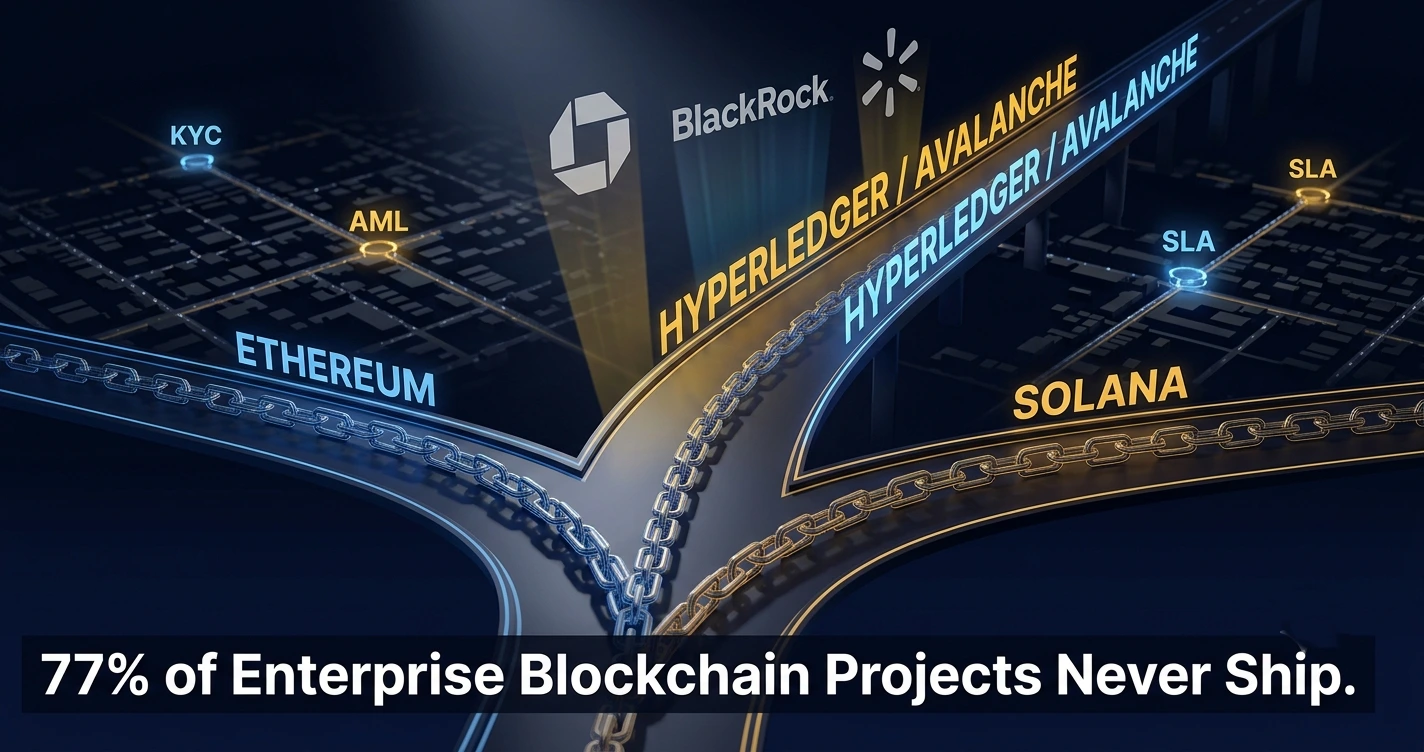
Enterprise development teams have quietly abandoned the Ethereum-versus-Solana debate. While public discourse frames blockchain as a binary between Ethereum’s security and Solana’s speed, the teams actually shipping production infrastructure in 2026 are choosing a third category: purpose-built, permissioned, and subnet-based architectures that offer compliance controls, data privacy, and governance models that neither public chain can deliver. JPMorgan, Walmart, BlackRock, and FIS Global have all deployed on non-Ethereum, non-Solana infrastructure. And the data is damning: 77% of enterprise blockchain projects never make production, with wrong platform selection cited as the primary reason.
In December 2025, JPMorgan arranged a $50 million commercial paper issuance for Galaxy Digital, settled entirely in USDC on Solana. The headline wrote itself: Wall Street has chosen its blockchain. The reality is considerably more complicated.
JPMorgan runs its primary daily tokenized transactions on Onyx, a permissioned blockchain that runs on private infrastructure. It pilots on Avalanche for Project Guardian. It experiments on Solana for settlement. It doesn’t have a single blockchain. It has a portfolio. And so does every other Tier 1 institution making production decisions in 2026.
This is the conversation the Ethereum-versus-Solana debate has been crowding out. The enterprise blockchain platform decision in 2026 is not a coin flip between two public chains. It’s a multi-layer architectural question with a $500,000 to $2 million penalty if you get it wrong, per Deloitte’s 2025 Global Blockchain Survey.
77%of enterprise blockchain PoCs never reach production (Gartner, 2025)
$2Maverage cost to migrate platforms mid-stream (Deloitte, 2025)
589%growth in tokenized RWA market, early 2025 to June 2026 (Binance Research)
Ethereum: The Institutional Trust Play
Ethereum commands approximately 75% market share in decentralized applications and holds roughly 60% of total DeFi total value locked, which stood at $160 billion globally as of early 2025, according to Chainalysis. Its developer ecosystem is the largest in blockchain: 31,869 total active developers as of September 2025, adding over 16,000 new contributors in that year alone, per Electric Capital data cited by the Ethereum Foundation.
BlackRock’s tokenized fund BUIDL launched on Ethereum in March 2024 and surpassed $1 billion by 2025. That was the landmark: the world’s largest asset manager building directly on a public chain at institutional scale. Visa, PayPal, and BlackRock all actively use Ethereum for settlement experiments, stablecoin issuance, and tokenized fund products. Average gas fees dropped roughly 70% since 2022 peaks, landing around $0.05 on mainnet by 2025.
Ethereum’s value proposition for enterprise is not speed. It’s legitimacy. When Vitalik Buterin described his platform’s design philosophy in a January 2026 public debate, he articulated exactly what risk-averse enterprise architects want to hear:
“Ethereum should be designed to eventually be self-sustaining, eventually needing little developer input, prioritizing stability, decentralization, and long-term security over constant protocol upgrades.”
Vitalik Buterin, Co-founder, Ethereum Foundation (January 2026 public debate, MEXC News)
That stability-first philosophy is Ethereum’s biggest enterprise advantage and its biggest enterprise limitation simultaneously. Teams building compliance-heavy applications need platforms that evolve with regulatory requirements. A protocol that explicitly aims for minimal developer input is a feature for conservative institutional investors. It’s a risk for CTOs building on top of it.
The L2 ecosystem partially addresses the scalability gap. Ethereum’s Layer 2 network, including Arbitrum, Optimism, and Polygon zkEVM, provides lower fees and higher throughput while inheriting mainnet security. For enterprise teams with existing Solidity skills, the enterprise CTO guide to Layer 2 scaling is the most important piece of reading before any platform decision. Deploying on an L2 does not require rewriting existing smart contract logic, which is a material consideration when your Solidity development team is already built out.
Solana: Speed with Strings Attached
Solana’s raw performance numbers are genuinely impressive. Theoretical maximum throughput reaches 65,000 TPS, with real-world performance confirmed at 3,400-plus TPS in production conditions and average transaction fees under $0.01 per Landbase’s 2026 data. Solana attracted 7,625 new developers in 2024, the largest share of new blockchain developer talent that year, and grew its developer base 83% year-over-year by 2025.
But Ethereum remains nearly double Solana’s total size: 31,869 developers versus approximately 17,708 on Solana. That gap matters for enterprise hiring. Rust, the language required for Solana program development, carries a steeper learning curve and a narrower available talent pool than Solidity. Every CTO building a Solana-native stack is building a specialized hiring requirement into their technical debt.
Anatoly Yakovenko, Solana’s co-founder and CEO, directly countered Buterin’s stability argument in the same January 2026 debate:
“Stopping blockchain development would eventually lead to its failure. Solana has to constantly develop to be relevant and address the needs of developers and users. Constant updates to the protocol are necessary. They will help address the real-world challenges.”
Anatoly Yakovenko, Co-founder and CEO, Solana Labs (MEXC News, January 18, 2026)
For enterprise decision-makers, this framing introduces a specific governance risk: who controls the roadmap of the infrastructure you’re building on, and can they change it under you? That is not a rhetorical question. It is a board-level risk assessment item.
The reliability picture is more complicated than Solana’s official communications suggest. The Solana Foundation’s June 2025 Network Health Report confirmed the network achieved its longest streak without a major officially confirmed outage: 16-plus consecutive months since the February 6, 2024 incident, which ran for nearly five hours. That’s real progress. But an SEC Crypto Task Force filing from July 2025 put an important qualifier on that achievement:
“The network has had degraded performance as recently as February of this year [2025] as well as during the release of the TRUMP memecoin, where we saw severe network congestion. I believe it is in the best interest of the public to wait for the new validator client, Fire Dancer’s, full release to ensure diversity in validator clients to prevent potential network outages.”
Kimber/Courage, Crypto Education Research (SEC CTF Written Input, July 9, 2025)
Third-party monitoring firm StatusGator detected at least nine distinct disruptions between October 2024 and February 2025 that were never officially acknowledged by the Solana team. From an enterprise SLA perspective, unacknowledged downtime is categorically worse than acknowledged outages. A 16-month streak without a “major officially confirmed outage” is not the same as 16 months of 99.99% uptime, and enterprise contracts require precise language around exactly that distinction.
The Firedancer client from Jump Crypto is expected to significantly improve validator client diversity when it reaches full production, addressing the single-client failure risk. Until that release is battle-tested at institutional scale, Solana’s reliability record carries a genuine asterisk for compliance-critical enterprise deployments. Any enterprise team navigating smart contract security and audit requirements needs to account for this directly in their platform risk assessment.
The Third Path Enterprises Are Actually Taking
Here’s what the Ethereum-versus-Solana narrative systematically ignores: the enterprise blockchain market has had a completely separate ecosystem for over a decade, and it’s the dominant one.
Hyperledger Fabric was launched in 2015 under the Linux Foundation with IBM as a primary contributor. R3 Corda was built in 2016 specifically for regulated financial services. Both were battle-tested in production enterprise environments before Solana’s whitepaper existed. According to Hyperledger Foundation data from 2025, Fabric accounts for roughly 55% of enterprise Hyperledger deployments, with Hyperledger Besu at 35% and growing. Broader market estimates from Autheo (April 2026) place Fabric at 80% of all permissioned enterprise blockchain deployments.
As TechTarget’s enterprise blockchain guide summarized in April 2026:
“For enterprise use, the decision typically comes down to four options: Hyperledger Fabric for consortium networks with complex privacy requirements, R3 Corda for financial services and regulated industries, private Ethereum networks (Besu or Quorum) for teams wanting the largest tooling ecosystem, and Avalanche Subnets for high-performance customizable blockchain instances.”
Enterprise architect consensus, TechTarget Enterprise Guide, April 2026
Hyperledger Fabric: The Supply Chain and Consortium Standard
Walmart mandates that suppliers use IBM Food Trust, built on Hyperledger Fabric, for leafy greens tracking. The result is a reduction in food safety investigation time from weeks to seconds. That’s not a pilot. That’s operational infrastructure for one of the world’s largest retailers, running on a blockchain the crypto press rarely covers. The full context of Walmart’s deployment, including how it compares to TradeLens and what it means for supply chain teams, is covered in Walmart’s Hyperledger Fabric supply chain deployment.
Fabric’s core architectural advantage for enterprise is its private channels model. In a Fabric network, participants are known and credentialed. Data sharing is enforced via private channels, meaning counterparties only see the transactions relevant to them. Governance is enterprise-controlled, not determined by a decentralized validator set that can vote to change protocol rules.
The tradeoffs are real. Fabric requires substantial implementation time, specialized expertise, and persistent infrastructure investment. Its developer ecosystem is significantly smaller than Ethereum’s. The open-source model means enterprise support typically requires IBM or a certified implementation partner, which adds cost. The theoretical 100,000 TPS figure for Fabric-X is a controlled-environment benchmark, not a production-verified number at scale.
R3 Corda: Financial Services and CBDC Infrastructure
R3 Corda holds approximately 30% market share in private ledger deployments, according to Sparkco.ai’s blockchain disruption report. SWIFT chose Corda for its CBDC sandbox specifically because Corda’s transaction privacy model aligns with banking regulatory requirements: transactions are only shared between the parties involved in a given contract, not broadcast to the network.
In May 2025, R3 announced a strategic partnership with the Solana Foundation to bridge permissioned and public blockchain networks. In December 2025, R3 revealed the Corda protocol would launch on Solana in H1 2026 as a yield vault platform for tokenized real-world assets. That bridge architecture is exactly what the hybrid enterprise model demands: private, compliant internal infrastructure connecting to public chain liquidity when needed.
Avalanche Evergreen Subnets: The Enterprise Bridge
For enterprise teams that need EVM compatibility (existing Solidity talent, established tooling) combined with compliance controls (KYC, restricted validator sets, permissioned access), Avalanche Evergreen Subnets are the most architecturally specific answer available in 2026.
Evergreen Subnets are compliance-ready, permissioned blockchain networks built within the Avalanche ecosystem. They support KYC verification, restricted validator sets, and enterprise-grade governance while remaining EVM-compatible and interoperable with the broader Avalanche network. The Avalanche9000 upgrade in January 2025 cut subnet fees by 75%, making institutional subnet deployment economically viable rather than theoretically possible. The Granite upgrade activated in November 2025 introduced dynamic block times and enhanced Interchain Messaging verification for cross-chain security.
The institutional momentum is concrete. BlackRock tokenized $500 million into its BUIDL fund on Avalanche in March 2025 (it also runs on Ethereum). FIS Global, which processes $9 trillion in annual transactions, partnered with Avalanche in November 2025. JPMorgan participated in Avalanche’s Project Guardian pilots. Over 100 testnet institutional chains are already running, with projections of 200 institutional chains by 2026. Active Avalanche addresses grew 242% since January 2026 to approximately 1.6 to 1.7 million addresses.
The honest caveat: those 200 institutional chains are a forward projection, not a realized figure. The AVAX token price dropped roughly 93% from its all-time high, which directly affects subnet economics for validators posting AVAX collateral. Institutional deployments from BlackRock and JPMorgan are live but early-stage relative to their traditional infrastructure scale.
RWA Tokenization: The Forcing Function
The catalyst that turned “enterprise blockchain TBD” into urgent platform decisions is real-world asset tokenization. The tokenized RWA market surged 589% from early 2025 to June 2026, reaching $32 to $37 billion depending on measurement methodology, according to Binance Research’s June 2026 analysis. Boston Consulting Group projects the sector could reach $16 trillion by 2030. Citi’s “Money, Tokens and Games” report estimates $4 to $5 trillion in tokenized securities alone.
BlackRock, Franklin Templeton, and JPMorgan have all launched live tokenized fund products. RWA tokenization was the central theme at Davos 2026, where discussions explicitly defined 2026 as the turning point for institutional digital assets. You can’t keep deferring platform decisions when you’re tokenizing $500 million in assets on a chain you haven’t fully committed to.
RWA tokenization forces a three-part compliance requirement that no single public chain currently satisfies alone:
Compliance: KYC/AML verification, restricted transfer rights, and investor accreditation requirements baked into the token itself.
Privacy: Counterparty confidentiality, meaning not every participant on the network sees your fund’s cap table or transaction history.
Public liquidity: Secondary market trading accessible to institutional investors via public chains or regulated exchanges.
This three-part requirement is precisely why production RWA deployments use hybrid stacks: a permissioned internal chain (Fabric, Corda, or Evergreen Subnet) for compliance and privacy, connected to a public chain (Ethereum mainnet or Avalanche C-Chain) for settlement and liquidity. The enterprise blockchain platform decision in 2026 is not “which chain.” It’s “which combination of chains, and how do they connect.”
Our read: The $16 trillion BCG projection for tokenized RWAs by 2030 assumes regulatory clarity, legal enforceability across jurisdictions, custodial standardization, and cross-chain interoperability. None of those four preconditions is fully resolved. The gap between $37 billion today and $16 trillion in 2030 requires regulatory tailwinds that are far from guaranteed globally. Build for the regulatory environment you have, not the one projected at Davos.
Enterprise Blockchain Platform Comparison 2026
The table below reflects production-verified characteristics, not marketing specifications. Use it as a starting framework, not a final decision matrix. Your compliance requirements, developer talent availability, and interoperability needs will determine the actual selection.
Platform
Type
Real-World TPS
Privacy
EVM Compatible
Best For
Notable Enterprise Users
Ethereum Mainnet
Public L1
~1.5M txn/day
None
Yes (native)
Token issuance, public DeFi, institutional liquidity
BlackRock BUIDL, Visa, PayPal
Ethereum + L2
Public L2
Thousands/sec
Limited
Yes
Scaled dApps, lower-cost enterprise settlement
JPMorgan JPMD network
Solana
Public L1
3,400+ real-world
None
No (Rust/Anchor)
High-frequency apps, payments, DeFi
JPMorgan commercial paper (Dec 2025), Galaxy Digital
The enterprise blockchain market reached $12.77 billion in 2025 and is projected to hit $29.29 billion by 2033, according to Autheo’s April 2026 market report. Separately, IDC projects enterprise blockchain spending could reach $36 billion by 2026. These numbers are real. So is the context that makes them less reassuring than they look.
The 77% Failure Rate Is the Real Story
Gartner’s data showing 77% of enterprise blockchain proofs of concept never reaching production is not a caveat. It’s the headline. Enterprise blockchain has been “about to take off” since 2017. The structural failure rate has remained stubbornly high because most projects fail due to governance complexity, not technical limitations. No blockchain platform solves a bad governance model. The platform comparison table above is irrelevant if your consortium partners can’t agree on who controls the validator set.
The “60% of Fortune 500” Figure Is Misleading
TokenMinds’ 2026 data showing 60% of Fortune 500 companies “active in at least one blockchain project” includes proofs of concept, internal research studies, and vendor evaluations. It does not mean 60% of Fortune 500 companies have production blockchain deployments generating revenue. Conflating exploration with production is how blockchain hype sustains itself through multiple market cycles. The number that matters is how many of those projects cleared the Gartner 77% wall.
TradeLens: The Template Everyone Should Study
Maersk and IBM launched TradeLens on Hyperledger Fabric in 2018. At its peak, it processed 50% of global container shipments. It shut down in 2022. The reason was not a technical failure. It was insufficient adoption beyond the pilot partner network. No platform choice prevents that outcome. The lesson for enterprise architects is that blockchain consortium failures are almost always governance failures dressed up as technology failures.
Migration risk: According to Forrester Research guidance cited by ChainLaunch, expect to spend 40 to 60% of your original development budget and 6 to 12 months on a full platform migration. The only easier path is moving between Hyperledger Besu and Quorum, since both share EVM compatibility. Every other migration is a near-full rebuild. The Deloitte 2025 Global Blockchain Survey puts the average cost at $500,000 to $2 million. Platform selection is not a sprint decision.
Is Ethereum or Solana better for enterprise development?
Neither is a complete enterprise solution on its own. Ethereum offers the largest developer ecosystem and the deepest institutional trust, while Solana provides high throughput at low cost. Most enterprises in 2026, however, choose permissioned alternatives like Hyperledger Fabric or Avalanche Subnets that deliver compliance controls, data privacy, and governance models that public chains cannot provide natively.
What blockchain do enterprises actually use in production?
Hyperledger Fabric powers 40 to 80% of permissioned enterprise blockchain deployments, depending on methodology. R3 Corda dominates regulated financial services. Avalanche Subnets are gaining ground for hybrid compliance-ready deployments. Ethereum is used for public-facing settlement and tokenized asset issuance. Most production enterprise systems use a combination rather than any single platform.
Why do enterprise blockchain projects fail at such high rates?
According to Gartner’s 2025 data, 77% of enterprise blockchain proofs of concept never reach production, with wrong platform selection as the primary cited reason. Governance complexity, unmet compliance requirements, and underestimated migration costs averaging $500,000 to $2 million per the Deloitte 2025 Global Blockchain Survey are the most common compounding failure factors.
Is Solana reliable enough for enterprise use?
Solana has not experienced a major officially confirmed outage since February 2024, achieving 16-plus consecutive months of uptime by mid-2025. However, third-party monitoring by StatusGator detected at least nine unacknowledged disruptions through early 2025. The Firedancer client from Jump Crypto is expected to significantly improve reliability through validator client diversity. Until it reaches full production and battle-testing, single-client risk remains an enterprise SLA concern.
What is the difference between Hyperledger Fabric and Ethereum for enterprise use?
Ethereum is a public blockchain optimized for open participation, liquidity, and composability. Hyperledger Fabric is a permissioned blockchain where participants are known, data privacy is enforced via private channels, and governance is enterprise-controlled. Fabric suits internal consortium networks and regulated data sharing. Ethereum suits public-facing token issuance and settlement requiring open market liquidity.
What is an Avalanche Evergreen Subnet?
Avalanche Evergreen Subnets are compliance-ready, permissioned blockchain networks built within the Avalanche ecosystem. They support KYC verification, restricted validator sets, and enterprise-grade governance while remaining EVM-compatible and interoperable with the broader Avalanche network. BlackRock and JPMorgan have both piloted Avalanche in tokenized asset contexts through Project Guardian.
What blockchain does JPMorgan use?
JPMorgan uses multiple blockchain platforms. Its Onyx platform runs daily tokenized transactions on permissioned blockchain infrastructure. In December 2025, JPMorgan arranged a $50 million commercial paper issuance on Solana, settled in USDC. JPMorgan has also participated in Avalanche’s Project Guardian pilots. This multi-chain approach is standard practice for Tier 1 financial institutions in 2026.
Can Ethereum scale for enterprise applications?
Yes, through Layer 2 solutions. Ethereum’s L2 ecosystem including Arbitrum, Optimism, and Polygon zkEVM provides lower fees and higher throughput while inheriting Ethereum’s security model. Hyperledger Besu, an EVM-compatible enterprise client, enables private Ethereum deployments. Enterprise teams with Solidity expertise can deploy on L2 networks without rewriting existing smart contract logic, which is a significant cost advantage.
The Bottom Line for CTOs
The best blockchain for enterprise development in 2026 is not a single platform. It’s a stack. And the enterprise teams that understood this two years ago are now shipping production infrastructure. The ones that ran a pilot on Ethereum or Solana and expected it to solve their compliance requirements are currently absorbing the $500,000 to $2 million migration bill Deloitte documented.
Here’s what the data actually tells enterprise decision-makers heading into 2026:
If your primary requirement is compliance and data privacy: Hyperledger Fabric or R3 Corda. Accept the smaller developer ecosystem and higher implementation cost as the price of the control you need.
If your team has Solidity skills and you need compliance plus interoperability: Avalanche Evergreen Subnets are architecturally built for this. The FIS Global and BlackRock deployments validate the institutional trajectory.
If you’re tokenizing assets for public markets: Ethereum mainnet or Avalanche C-Chain for liquidity, with a permissioned layer handling the compliance controls.
If you’re experimenting with high-frequency settlement on a public chain: Solana’s performance is real. Its enterprise reliability record warrants contractual caution until Firedancer reaches full production.
The forcing function for the next 6 to 18 months is RWA tokenization. With $32 to $37 billion in tokenized assets already live and BCG projecting $16 trillion by 2030, platform decisions that were deferred through the pilot phase are now consequence-laden. Three things to watch closely: the Firedancer client’s production readiness timeline and its effect on Solana enterprise SLA viability; the Corda-on-Solana launch in H1 2026 and whether it delivers on the permissioned-to-public bridge at institutional scale; and whether Avalanche’s 200 institutional subnet projection materializes as realized deployments or remains a forward target.
The Ethereum-versus-Solana debate was always a retail investor narrative. Enterprise development teams moved past it before most of the crypto press noticed. The question in 2026 is not which public chain wins. It’s whether your architecture is built to handle the moment when regulators, counterparties, and auditors ask you to prove your compliance controls exist at the infrastructure level.
Stay current on enterprise blockchain and digital infrastructure: Subscribe to The Neural Loop at neuralwired.com/newsletter for weekly briefings built for technical decision-makers, not crypto speculators.
Here is an uncomfortable fact for enterprise technology leaders: the EU’s eIDAS 2.0 regulation, which entered into force in May 2024, explicitly encodes zero knowledge proof enterprise privacy technology into the architecture of European Digital Identity Wallets. The European Data Protection Board has cited zero-knowledge proofs by name in its guidance on privacy-enhancing technologies for blockchain. FATF has issued guidance on ZKP-compatible Travel Rule solutions.
Meanwhile, most enterprise engineering teams are still debating whether ZKPs are production-ready.
That gap is institutional. It is embarrassing. And it is closing fast, whether you lead that closure or not.
This article is for CTOs, chief compliance officers, and senior architects in finance, healthcare, and any regulated industry where “we collect the data to verify the data” is still the default architecture. Zero-knowledge proofs don’t just improve that architecture. In several jurisdictions, they are becoming the architecture regulators expect.
What a Zero-Knowledge Proof Actually Is
Strip away the cryptography and the concept is almost comically simple. A zero-knowledge proof lets one party (the prover) convince another party (the verifier) that a statement is true, without revealing anything beyond the fact that it is true.
The classic illustration: you want to prove to a bank that your account balance exceeds $10,000 to qualify for a loan. With traditional verification, you hand over your full bank statement. With a ZKP, you generate a cryptographic proof that says “this balance threshold is met” and the bank cryptographically verifies it. Your actual balance, your transaction history, your account number: none of it crosses the wire.
This is not theoretical cleverness. It is a direct technical implementation of GDPR’s data minimisation principle. You prove what needs to be proven and nothing else leaves your possession.
The concept was formalized in a 1985 paper by Goldwasser, Micali, and Rackoff, who won the Turing Award partly for this work. The journey from that mathematical abstraction to production enterprise systems took about four decades. That journey is now complete.
$1.7BZKP market size in 2025 (Fact.MR)
22.1%CAGR projected through 2036
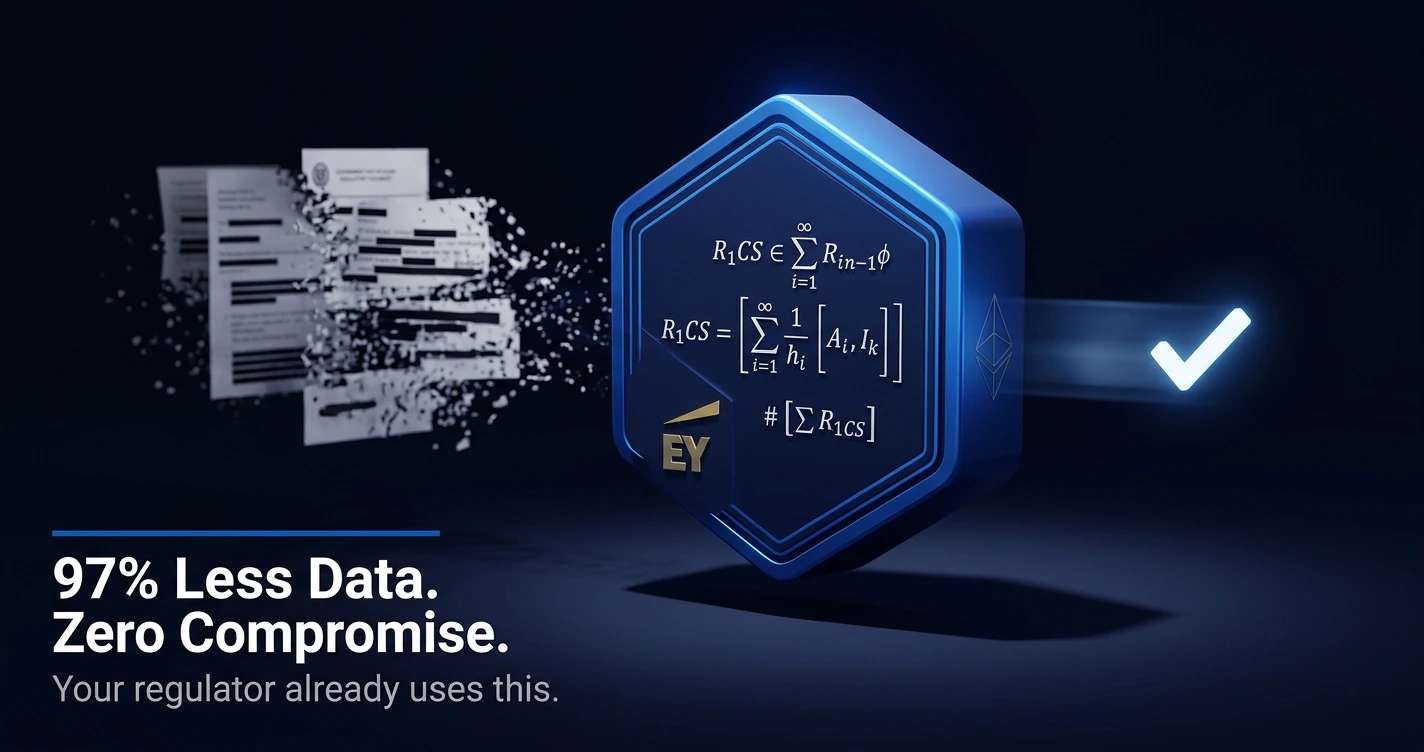
97%Reduction in exposed user data vs. traditional KYC
$28B+TVL locked in ZK-based rollups (2025)
Why Your Regulator Knows More Than Your CTO
This isn’t a provocation. It is a description of how policy adoption timelines work. Regulatory bodies run multi-year consultation processes. By the time a technology appears in binding legislation, it has already survived years of scrutiny from government cryptographers, privacy lawyers, and technical advisors. ZKPs cleared that bar some time ago.
The eIDAS 2.0 Regulation (EU 2024/1183) doesn’t mention ZKPs as a future option. It builds them into the required architecture for the European Digital Identity Wallet, which all EU Member States must deploy by end of 2026. The regulation explicitly requires ZKPs to implement GDPR’s data minimisation principle in digital identity transactions. Every enterprise that wants to interoperate with EU digital identity infrastructure needs to be ZKP-compatible. That deadline is not moving.
The FATF Travel Rule, which requires transmission of originator and beneficiary information for virtual asset transfers, creates a structural collision with GDPR on public blockchains. Put raw PII on an immutable ledger and you immediately violate the right to erasure. ZKP-based identity architectures solve this by allowing financial institutions to prove Travel Rule compliance cryptographically without transmitting or storing personally identifiable information. Research published at the IEEE International Symposium on Privacy Enhancing Technologies in Berlin (June 2025) demonstrates this approach in production financial environments.
In the United States, the January 2026 effective dates for comprehensive privacy laws in Indiana, Kentucky, and Rhode Island, combined with California’s expanded CCPA regulations mandating formal risk assessments and cybersecurity audits, have created immediate compliance pressure for any enterprise processing personal data across state lines.
The regulatory timeline is not waiting for your engineering roadmap. eIDAS 2.0 wallets: end of 2026. New US state privacy laws: already in force. EU privacy coin ban enforcement: July 2027. EDPB binding guidance on blockchain GDPR compliance: expected 2027. Each of these creates architectural requirements that a ZKP-ignorant stack will fail to meet.
The FBI reported that 2024 internet crime losses exceeded USD 16 billion. The FTC received 6.5 million consumer reports related to fraud, identity theft, and privacy violations in the same year. These numbers give regulatory bodies the political mandate to enforce hard. An enterprise deploying ZKP-based verification is eliminating the attack surface entirely: you cannot breach data that was never collected.
zk-SNARK vs. zk-STARK: The Enterprise Decision That Matters
Most introductions to ZKPs spend three paragraphs explaining the mathematics and skip the one question your architecture team actually needs to answer. Here it is plainly: do you need quantum resistance or proof size efficiency?
Property
zk-SNARK
zk-STARK
Proof size
~128 bytes (Groth16)
Larger (kilobytes range)
Trusted setup
Required (security risk)
Not required
Quantum resistance
No (ECC-based)
Yes (hash-based)
Proof generation speed
Fast
Faster in benchmarks
Primary enterprise use
Consumer DeFi, gas-optimized chains
Enterprise, long-term infrastructure
NIST post-quantum alignment
At risk
Aligned
The trusted setup issue with zk-SNARKs is not theoretical. During the ceremony where cryptographic parameters are generated, if any participating party retains the “toxic waste” from the process, they can forge proofs undetected. Multi-party computation ceremonies have been designed to mitigate this (Zcash’s Powers of Tau involved hundreds of participants), but the attack surface exists. zk-STARKs eliminate it entirely by using public randomness and hash functions.
The quantum question matters more than most enterprise architects currently weigh it. NIST finalized its first three post-quantum cryptography standards in August 2024 (FIPS 203, 204, and 205). zk-SNARKs rely on elliptic curve cryptography, which is vulnerable to quantum computers. NIST has set a 2030 deadline for RSA migration, and that timeline has real teeth. If you’re building infrastructure that will run for a decade, the cryptographic primitive underneath it matters. zk-STARKs use hash functions and are considered quantum-resistant under current NIST frameworks.
Our read: for any enterprise deployment being designed in 2026, the default choice should be zk-STARKs unless you have a specific, justified requirement for the smaller proof sizes zk-SNARKs provide. The security trade-off doesn’t favor legacy choices here.
Real Enterprise Use Cases That Are Live Right Now
EY Nightfall_4: Private Transactions on Public Ethereum
Ernst & Young’s Nightfall program is the most important proof point for enterprise ZKP adoption, precisely because EY is not a crypto startup. In April 2025, EY released Nightfall_4, replacing the prior optimistic rollup with a full ZK version on Ethereum mainnet. The architectural significance: near-instant transaction finality without a challenge period, and institutional-grade privacy on a public chain.
“This update to version 4 represents a major update to Nightfall, providing the same privacy and scaling that version 3 enabled, but now with near-instant finality and a simplified architecture. We believe we will see accelerating adoption of this technology in the coming year by enterprise users.”
Paul Brody, Global Blockchain Leader, Ernst & Young. April 2025.
In March 2026, COTI announced it will deploy Nightfall on testnet with mainnet rollout later in 2026, expanding the ZK enterprise privacy infrastructure across Ethereum-compatible networks. As JPMorgan’s pivot toward public Ethereum infrastructure illustrates, the reason institutions are making this move is that ZKPs have made privacy on public chains viable in a way private chains could never deliver interoperability.
“We are really pleased to be working with COTI. Adding the Ethereum Mainnet to the set of networks where Nightfall is available is a huge positive step, and COTI already understands the importance of building infrastructure for privacy for enterprise users.”
Clare Adelgren, Global Interim Blockchain Leader, Ernst & Young. March 2026.
Google Wallet: ZKP Age Verification at Consumer Scale
In July 2025, Google open-sourced its “Longfellow” ZKP library in partnership with Sparkasse, Germany’s network of public savings banks. The library enables privacy-preserving age verification using zero-knowledge proofs. Google had already integrated ZKPs into Google Wallet in May 2025, allowing users to verify age for apps without exposing full identity documents.
When Google open-sources production cryptographic infrastructure and partners with a European banking network to deploy it, the technology has cleared the “research curiosity” threshold. Full stop. The signal to enterprise architects is unambiguous.
ZK-KYC: The Compliance Use Case With the Clearest ROI
The ZK-KYC market is projected to grow from USD 83.6 million in 2025 to USD 903.5 million by 2032, at a 40.5% CAGR. That growth rate reflects how directly ZKP-based KYC solves a real regulatory problem that traditional architectures create.
Empirical research published on SSRN in March 2025 by researcher Nicolin Decker, using Monte Carlo simulations and real financial datasets, produced three numbers that compliance teams should put in front of their CFOs:
ZKP-based KYC verification reduces exposed user data by 97% compared to conventional centralized KYC architectures.
ZKP-based liquidity verification reduces compliance costs by 28% by eliminating redundant data collection, verification overhead, and breach liability exposure.
“ZKP-based KYC verification reduces exposed user data by 97%, while AI-enhanced ZKP fraud detection achieves 96.7% accuracy, significantly outperforming conventional rule-based AML systems.”
Nicolin Decker, “Proof Without Exposure,” SSRN Working Paper 5170329, March 2025.
The 28% compliance cost reduction addresses the most common executive objection before it is raised. ZKP adoption is not a cost center. It is a breach liability reduction program that pays for itself.
zkML: Proving AI Decisions Without Revealing the Model
The emerging frontier is zero-knowledge machine learning. In 2025, Lagrange Labs shipped DeepProve-1, described as the first production zkML system to generate cryptographic proofs over a full LLM inference. This means an AI system can prove that a decision was made correctly by its model without revealing the model weights or the input data. For regulated industries where algorithmic accountability is becoming a compliance requirement (finance, healthcare, insurance), this is not a research curiosity. It is the compliance architecture for AI-driven decisions in the next three years.
What Implementation Actually Costs
Enterprise ZKP conversations stall most often at this question. The honest answer is: less than a data breach, more than your team currently budgets for cryptography work.
A focused single-use-case pilot costs between $50,000 and $150,000 depending on complexity.
Circuit design and implementation requires 2 to 4 months of specialized engineering time.
Ongoing per-proof compute cost runs approximately $0.01 to $0.10 on standard cloud hardware.
ZKP engineers command $150,000 to $250,000 in annual compensation, and the supply is severely constrained.
On the performance question (which was the dominant objection through 2022): GPU- and FPGA-accelerated systems now produce basic ZKPs in milliseconds rather than minutes. That is an orders-of-magnitude improvement. Proof generation time is no longer the bottleneck for identity verification, KYC, or single-transaction compliance workflows. It remains a real constraint for complex computational statements, which is addressed in the critical perspective section below.
Integration note for architects: ZKP integration is additive, not a platform replacement. It can be layered onto existing Hyperledger Fabric or Hyperledger Besu deployments without changing consensus mechanisms. If your team is evaluating Layer 2 scaling for enterprise workloads, ZK-rollups are already the dominant scaling mechanism. The decision may already be made for you.
ZKP-as-a-service platforms (Aleo, Aztec Network, StarkWare) have lowered the entry point substantially. You don’t need to hire a cryptographer who can write R1CS constraints from scratch. You need an architect who understands what ZKPs can and cannot prove, and an integration team that can work with existing proving systems. Higher-level ZKP languages like Noir and Circom have reduced the barrier further, though they have not eliminated it.
The Case Against Moving Fast on ZKPs
Any technology briefing that doesn’t present the strongest counterarguments is advocacy dressed as analysis. Here are the five arguments ZKP proponents consistently underweight.
The Incentive Structure Problem
The most underreported barrier is not technical. It is organizational. Companies that monetize data collection have zero economic incentive to adopt ZKPs. Regulatory pressure has not yet reached the level where the cost of non-compliance exceeds the revenue from data harvesting. As CoinDesk’s November 2025 analysis of AI agent identity put it plainly: “companies that profit from collecting data have little incentive to adopt the technology.” ZKP advocates consistently underestimate this structural resistance. The technology’s elegance does not overcome misaligned incentives.
The Regulatory Gray Zone Is Real
The EDPB’s position that blockchain is not GDPR-exempt creates the compliance problem. It does not certify the ZKP solution. No major jurisdiction has issued explicit, binding guidance that a specific ZKP-based compliance architecture satisfies data protection law. An enterprise that deploys ZKP-based KYC and later faces a regulatory challenge needs to defend the cryptographic architecture in court. That gray zone is real and it will exist until EDPB binding guidance arrives, which most analysts expect in 2027.
Developer Talent Scarcity
Circuit design for ZKPs requires expertise in algebraic constraint systems, finite field arithmetic, and proof system internals. This skill set is genuinely rare. Any enterprise timeline that includes “hire a ZKP engineer next quarter” as a dependency is probably wrong. The talent pipeline is limited and compensation expectations are high. Plan for 6 to 9 months of hiring or upskilling time, not 6 to 9 weeks.
Performance Limits at Complex Scale
Proof generation is fast for simple statements (age verification, KYC status, single transaction compliance). For complex computational statements, the cost rises substantially. Full LLM inference verification via Lagrange Labs DeepProve-1 is described as thousands of times slower than unverified computation. Enterprises should scope ZKP use cases carefully. Not everything should be wrapped in a proof, and the performance profile of complex ZKP statements is not solved by current hardware acceleration.
Cross-Chain Identity Remains Unsolved
Current ZKP-based identity systems work robustly within a single-chain environment. Cross-chain identity verification remains an open challenge in academic and practitioner literature as of 2025. For enterprises operating across multiple blockchain networks (which is the real-world architecture for most large financial institutions), this is a meaningful limitation that current product roadmaps have not resolved.
Hannah Garvey, Senior Privacy Counsel at Binance, put the implementation friction in useful terms in her March 2026 regulatory analysis: “the computational overhead remains significant, and integrating them into existing protocols requires substantial development resources.” That assessment is accurate and the ZKP community’s tendency to wave it away with benchmarks for simple use cases does not serve enterprise decision-makers well.
Frequently Asked Questions
What is a zero-knowledge proof in simple terms?
A zero-knowledge proof is a cryptographic method that lets one party prove a statement is true (such as “I am over 18” or “My balance exceeds $10,000”) without revealing the underlying data itself. The verifier learns only that the statement is true, nothing more. No personal data is transmitted or stored.
What is zero-knowledge proof used for in enterprise?
Enterprises use zero-knowledge proofs for KYC and AML compliance without data exposure, privacy-preserving identity verification, private transactions on public blockchains such as EY’s Nightfall on Ethereum, supply chain confidentiality, and satisfying GDPR data minimisation requirements without redesigning existing data architectures.
Are zero-knowledge proofs GDPR compliant?
Zero-knowledge proofs support GDPR compliance by enabling the data minimisation principle. The European Data Protection Board has cited ZKPs as a privacy-enhancing technology. However, no binding regulatory guidance certifies a specific ZKP architecture as definitively GDPR-compliant. Implementation must be assessed case-by-case until EDPB binding guidance arrives, expected in 2027.
What is the difference between zk-SNARK and zk-STARK?
zk-SNARKs produce very small, fast-to-verify proofs but require a trusted setup ceremony that introduces a potential security vulnerability. zk-STARKs require no trusted setup, use hash-based cryptography making them quantum-resistant, and generate proofs faster in benchmarks, but produce larger proof sizes. Enterprises building long-term infrastructure should favour zk-STARKs given the NIST post-quantum timeline.
How do zero-knowledge proofs work with KYC?
In ZKP-based KYC, a trusted identity provider issues a cryptographic credential to a user. The user then proves specific attributes (such as “I am KYC-verified” or “I am not a sanctioned entity”) to a financial institution using a ZKP, without transmitting their passport, address, or date of birth. The institution receives cryptographic proof of compliance, not personal data. Research demonstrates this reduces exposed user data by 97% compared to traditional KYC architectures.
Is zero-knowledge proof the same as blockchain?
No. Zero-knowledge proofs are a cryptographic primitive, a mathematical technique, that can be used with or without blockchain. They are commonly used in blockchain contexts such as ZK-rollups and private transactions, but enterprises also deploy ZKPs for non-blockchain identity verification, database query privacy, and regulatory compliance reporting.
What are the limitations of zero-knowledge proofs?
Key limitations include high computational cost for complex statements, significant developer talent scarcity with ZKP engineers earning $150,000 to $250,000 annually, trusted setup vulnerability in zk-SNARKs, no binding regulatory certification for ZKP compliance architectures, and unresolved cross-chain identity verification for multi-network enterprise deployments.
What to Watch in the Next 18 Months
Zero knowledge proof enterprise privacy adoption is not a 2030 story. The hard deadlines are now. Here is where the inflection points are.
The EU Digital Identity Wallet deployment mandate expires at end of 2026. Every EU member state must have at least one wallet available. Every enterprise system that wants to interoperate with national digital identity infrastructure needs to be ZKP-compatible before that date. This is the most concrete near-term forcing function for enterprise architects outside the crypto sector.
The EU’s privacy coin and anonymous wallet ban is scheduled for enforcement in July 2027. The EDPB binding guidance on GDPR and blockchain is expected around the same window. Together, these represent a 12-month period where the regulatory gray zone narrows considerably. Enterprises that have run ZKP pilots by then will have architecture validation before the rules crystallize. Those that haven’t will be retrofitting under time pressure.
On the technology side, watch zkVM maturation (Risc0, StarkWare’s Cairo VM, early zkEVMs) closely. These allow developers to write ZKP circuits in Rust or Solidity rather than hand-crafted algebraic constraints. As zkVM tooling matures, the developer talent bottleneck loosens. That is the single lever most likely to accelerate enterprise adoption timelines beyond what current hiring constraints would suggest.
Three specific actions for compliance and architecture teams this quarter: evaluate ZKP-as-a-service providers (Aleo, Aztec Network, StarkWare) for your highest-priority compliance use case; run a cost comparison between your current KYC architecture’s breach liability exposure and a ZKP-based alternative using the 97% data reduction figure as your baseline; and confirm whether your enterprise blockchain stack (Fabric, Besu, or any EVM-compatible chain) already supports ZK-rollup integration via existing vendor roadmaps before building a custom procurement process.
The performance objection is obsolete. The talent objection is real but manageable. The regulatory uncertainty is narrowing on a published timeline. The only enterprise ZKP strategy that is clearly wrong right now is waiting for someone else to go first.
Stay ahead of enterprise cryptography and compliance shifts
The Neural Loop delivers NeuralWired’s most important analysis directly to senior technology leaders every week. No noise. No filler.
Subscribe to The Neural Loop
In April 2026, more than $635 million was stolen from DeFi protocols across 30 separate attacks. It was the single worst month in decentralized finance history. Three weeks later, JPMorgan filed for regulatory approval to launch a tokenized U.S. Treasury fund on Ethereum’s public blockchain.
Same industry. Same month. Completely contradictory signals. That is not confusion. That is the actual state of enterprise DeFi risk in 2026, and it is precisely why your CFO is saying no while your CTO is already running pilots.
This article does not tell you DeFi is safe. It does not tell you traditional banking is risk-free either. What it does is map the two risk profiles side by side, with real numbers from the last six months, so that the conversation in your boardroom can be grounded in something other than fear or hype. The DeFi vs traditional finance risk conversation has graduated from theoretical to urgent. Here is what you actually need to know.
The Risk Frameworks Are Not Comparable. They Are Different Species.
The most common mistake in the DeFi vs banks debate is framing it as a spectrum where one end is “risky” and the other is “safe.” That is the wrong mental model entirely. DeFi and traditional banking carry structurally different types of risk, requiring completely different mitigation strategies. A CTO who maps DeFi risk onto their existing enterprise risk register without modification is setting up their organization for a category error with nine-figure consequences.
Here is what each system’s risk profile actually contains:
Risk Category
Traditional Banking (TradFi)
DeFi
Counterparty Risk
Bank has legal identity, jurisdiction, regulatory oversight. FDIC insures deposits to $250K.
The protocol is the counterparty. No legal personhood. No jurisdiction. No entity to sue.
Operational Risk
Human error, fraud, IT failure backstopped by internal controls and regulators.
Smart contract bugs execute autonomously and irreversibly. Code is law. There is no undo button.
Liquidity Risk
Central bank liquidity facilities exist as backstop. Fed window available in crisis.
50% of liquidity in most DeFi pools is controlled by a small number of large wallets. When they exit, liquidity evaporates in hours, not days.
Systemic Risk
Contagion is real (see 2008, 2023), but government intervention can and does occur.
Contagion is faster and has no backstop mechanism. $13 billion fled DeFi in 48 hours after the April 2026 attacks.
Regulatory Risk
Fully settled legal framework. Compliance costs are high but predictable.
SEC and CFTC full rulemakings still 12 to 18 months away. Enterprise activity today happens in a legal gap.
Smart Contract Risk
Does not exist.
Unique to DeFi. Code vulnerabilities, oracle manipulation, bridge exploits, upgrade governance attacks. Cost $953.2 million in access control flaws alone in 2025.
Notice that DeFi carries one entire risk category that has no TradFi equivalent. Smart contract risk is not a variation of operational risk. It is a distinct class of exposure with no established enterprise insurance framework, no regulatory backstop, and historically a sub-10% recovery rate when things go wrong.
Our read: the enterprise risk conversation should not be “is DeFi safer than banks?” It should be “which DeFi-adjacent products eliminate smart contract and counterparty recourse risk, and which ones don’t?” That is a solvable question. The binary comparison is not.
What DeFi Risk Actually Looks Like in 2026, With Numbers
If you are a CTO who read about DeFi risks in 2022 and filed it under “crypto volatility,” the 2026 picture requires a significant update. The threat profile has changed. The attack sophistication has changed. And the size of institutional assets at risk has changed.
$840M+DeFi losses in first 5 months of 2026 across 50+ confirmed incidents
70%Year-over-year increase in DeFi hack losses vs same window in 2025
52%DeFi protocols that suffered at least one breach in their first year of operation
April 2026 was not a statistical anomaly. It was the acceleration of a trend. DeFi logged 47 incidents in the first four and a half months of 2026, compared to 28 in the same window in 2025. A 68% year-over-year increase in attack frequency, alongside a 70% increase in losses. These are not the numbers of a maturing security posture. They are the numbers of an industry whose attack surface is expanding faster than its defenses.
The nature of who is doing the attacking matters enormously for enterprise risk teams. According to NFT Plazas, the two Lazarus Group attacks in April 2026 alone accounted for 95% of that month’s total losses. Lazarus Group is a North Korean state-sponsored hacking operation. This is not script-kiddie opportunism. This is nation-state adversary risk operating directly against what will soon be enterprise infrastructure. Your enterprise security team has a playbook for ransomware. The playbook for AI-assisted nation-state attacks targeting on-chain treasury positions is still being written.
Critical Risk Signal
In the 48 hours following the April 2026 exploits, more than $8.4 billion fled Aave, and total DeFi TVL shed over $13 billion. The liquidity exit velocity in a DeFi crisis has no equivalent in traditional banking. There is no orderly resolution. There is no 90-day wind-down period. There is a 48-hour drain.
The Smart Contract Attack Taxonomy CTOs Need to Know
Enterprise CTOs who manage IAM frameworks will recognize the access control problem immediately. CoinLaw’s 2025 security analysis found that access control flaws were responsible for $953.2 million in losses, making it the single largest vulnerability category by dollar value. That is not an exotic protocol-level issue. That is a permissions and authentication problem, and it maps directly to enterprise identity and access management frameworks CTOs already own.
Beyond access control, the four attack vectors that matter at enterprise scale are: code logic vulnerabilities in smart contracts (bugs in business logic that allow fund extraction), oracle manipulation (where external data feeds are poisoned to trigger incorrect on-chain state), cross-chain bridge exploits (the most consistently targeted vector in 2026, and a direct risk to any multi-chain treasury strategy), and upgrade governance attacks (where protocol upgrade votes can be manipulated by coordinated token holders).
Professional smart contract audits cost between $25,000 and $150,000 per contract and are non-optional for enterprise-grade deployment. If your procurement team is not already building audit requirements into DeFi vendor evaluations the same way penetration testing appears in software vendor contracts, that gap needs to close before any capital moves on-chain.
What Traditional Banking Risk Actually Looks Like (The Part CFOs Conveniently Forget)
The CFO’s position is not irrational. It is incomplete. Traditional banking is not zero-risk. Its risk is socialized, backstopped by government intervention, and largely invisible to enterprise finance teams because someone else absorbs the tail risk on their behalf. That invisibility is a policy choice, not a feature of inherent safety.
In March 2023, Silicon Valley Bank and Signature Bank failed within 48 hours of each other. The FDIC estimates total losses at approximately $16.7 billion, recovered through a special assessment levied on other banks. The two failed institutions had combined uninsured deposits of $231.1 billion in 2022. The federal government invoked the systemic risk exception specifically because allowing those depositors to absorb losses would have triggered contagion across the broader banking system.
That is the honest version of TradFi risk. It is real, it is large, and it is managed through a socialization mechanism that enterprises benefit from without bearing the cost. The CFO who says “DeFi is too risky” and “banking is safe” is accurately describing their own firm’s risk exposure under the current regulatory framework. But they are not describing the underlying risk of the banking system itself.
“Such actions will only serve to destroy rather than further confidence in our financial and digital asset markets.”
Lynn Turner, Former Chief Accountant, U.S. Securities and Exchange Commission, testifying before the Senate on crypto market structure legislation, January 2026. Source: Thomson Reuters
Turner’s warning matters because it represents the regulatory establishment’s current posture, not a fringe view. When the former SEC Chief Accountant tells the Senate that current crypto legislation could “trigger the next FTX,” that is the signal CFOs are reading as fiduciary cover for inaction. It is not wrong to read it that way. It is also not the complete picture.
The complete picture is that TradFi and DeFi both carry systemic risk. The difference is who absorbs it when things break. In TradFi, taxpayers and other banks absorb it. In DeFi, you do. That is the actual CFO question: not “is DeFi risky” but “are we prepared to self-insure against the tail risk that TradFi offloads onto the public sector?”
How the Biggest Institutions Are Actually Managing This Tension
The institutions with the most sophisticated risk management teams on the planet are not choosing between DeFi and banking. They are building hybrid infrastructure where tokenized real-world assets and on-chain settlement coexist with regulated custody. Understanding what they are actually doing, rather than the headline version, is the most useful intelligence available to enterprise decision-makers right now.
On May 13, 2026, JPMorgan filed for regulatory approval to launch a tokenized U.S. Treasury money-market fund on Ethereum’s public blockchain via its Kinexys platform. This is a direct contradiction of the “DeFi is not enterprise” narrative. The largest bank in the United States is not putting a pilot on a private Ethereum fork. It is filing to put regulated Treasury fund products on public Ethereum. JPMorgan’s move to public Ethereum changes the terms of this debate at the enterprise level.
“Vaults are a layer on top of DeFi that allows institutions, fintechs, exchanges — anyone with users or capital that wants to offer financial products — to package up the best of DeFi.”
John Zettler, Executive, DeFi Vault Infrastructure, MEXC, 2026
BlackRock’s spot Bitcoin ETF (IBIT) reached $75 billion in assets under management by late 2025. Combined spot Bitcoin ETFs exceeded $115 billion. BlackRock, Franklin Templeton, and JPMorgan are all running live tokenized fund products. HSBC announced it will allow clients to move deposits via token around the clock starting in 2026. These are not exploratory pilots. They are production financial products at institutional scale.
The critical distinction is between permissioned and permissionless DeFi. The headline hack losses in April 2026 hit permissionless protocols. The institutional products JPMorgan and BlackRock are building sit inside a permissioned, regulated, audited layer on top of blockchain infrastructure. Think of it as the difference between a public highway and a private toll road built on the same asphalt. The underlying infrastructure is shared. The access controls, oversight, and counterparty framework are completely different.
Enterprise Insight
The practical enterprise path in 2026 is not permissionless DeFi. It is tokenized Treasuries with regulated custodians, permissioned vault infrastructure, and on-chain settlement rails with identifiable counterparties. The risk profile of this path is materially different from the DeFi that captures headlines when it gets exploited.
Enterprise blockchain ROI data shows the market is already pricing this distinction: the enterprise blockchain market was valued at $12.77 billion in 2025 and is projected to reach $29.29 billion by 2033. That growth is not in permissionless DeFi. It is in regulated institutional on-chain infrastructure.
The Regulatory Gap Enterprises Cannot Ignore in 2026
On March 11, 2026, the SEC and CFTC signed a Memorandum of Understanding establishing the first joint coordination framework on crypto asset regulation. Six days later, on March 17, they issued a joint Interpretive Release clarifying how federal securities laws apply to crypto assets. These are genuinely significant developments. They are also explicitly not the end of the regulatory uncertainty period.
According to Latham and Watkins’ U.S. Crypto Policy Tracker, full SEC and CFTC rulemakings under the new framework are expected to take up to 18 months, with primary rules likely effective in late 2026 or 2027. That means any enterprise engaging in DeFi activities today is doing so without settled legal guidance on three critical questions: whether smart contract positions create securities exposure for the enterprise, what compliance obligations attach to using decentralized exchanges for treasury operations, and whether enterprise treasury staff carry personal fiduciary liability for on-chain losses.
The EU’s MiCA (Markets in Crypto-Assets Regulation) took full effect in 2025, bringing AML and KYC requirements, custody rules, and consumer risk disclosures as baseline requirements across EU member states. For European enterprises, or any U.S. enterprise with EU operations, MiCA compliance is already live. The CLARITY Act passed the U.S. House in summer 2025 but stalled in the Senate, leaving the U.S. framework incomplete heading into the second half of 2026.
The gap period matters because it cuts in both directions. An enterprise that engages with tokenized Treasury products today before rules are finalized faces potential reclassification risk if the SEC’s final framework draws lines differently than the current interpretive guidance suggests. But an enterprise that waits for perfect regulatory clarity before starting any evaluation will find itself 18 months behind competitors who are running pilots now inside managed risk boundaries.
5 Questions Every CTO Should Put in Front of Their CFO
The boardroom conversation about enterprise DeFi risks is happening whether the CFO wants it to or not. JPMorgan’s Ethereum filing made “your bank is already on-chain” a factual statement, not a speculative one. These five questions reframe the debate from “should we engage with DeFi” to “what is our actual risk-adjusted position right now.”
Who is the counterparty, and what happens when they fail at 2am?
In permissionless DeFi, the answer is: the protocol is the counterparty, there is no phone number, and historical recovery rates are below 10%. In institutional DeFi products like tokenized Treasuries through Kinexys or BlackRock BUIDL, the answer changes materially. Define which category any proposed product actually falls into before the capital moves.
What does our on-chain insurance cover, and is it sufficient?
On-chain insurance through platforms like Nexus Mutual exists but is nascent, with coverage capacity far below institutional exposure levels. If your enterprise is holding stablecoin-denominated treasury positions, the question of what insurance covers an exploit is not hypothetical. It needs an answer before entry, not after a loss.
Has every smart contract in our stack been professionally audited in the last 12 months?
52% of DeFi protocols suffered at least one breach in their first year due to inadequate auditing. Professional audits cost $25,000 to $150,000 per contract and should be treated like penetration testing requirements in software vendor procurement. If your CTO cannot produce an audit report for every smart contract your enterprise interacts with, that is the first gap to close.
What is our fiduciary defense if we engage in DeFi today and the SEC reclassifies in 2027?
Former SEC Chief Accountant Lynn Turner specifically warned the Senate about retroactive enforcement exposure. If your enterprise is generating yield from DeFi protocols and the SEC’s 2027 rules classify that activity as unregistered securities activity, the legal and compliance exposure lands on the individuals who authorized the strategy. That exposure needs to be in the legal opinion before the pilot launches.
Are we comparing the right things?
The question is not “DeFi vs. banks.” The question is “which specific on-chain products, with which custody arrangements, custodians, and counterparties, fit inside our existing enterprise risk register?” Tokenized U.S. Treasuries held at a regulated custodian are a categorically different risk profile from a yield farming position in a six-month-old lending protocol. Treating them as the same category is the error that produces bad decisions in both directions.
What the Skeptics Get Right (And Where They Overstate It)
The skeptics are correct on the security point. The headline claim from some DeFi advocates that “blue-chip DeFi platforms have reached parity with traditional banking systems in 2026” is directly contradicted by the April 2026 data. You cannot claim enterprise-grade security parity in the same month your sector logged its worst loss total in history.
“DeFi carries layered risks: heavy reliance on crypto collateral for market risk, concentration of liquidity providers creating liquidity risk, and cyber attack exposure.”
Tobias Adrian, Financial Counsellor and Director, Monetary and Capital Markets, International Monetary Fund, BIS Annual Conference. Source: BIS
The IMF’s Tobias Adrian flagged the liquidity concentration problem years before it became a crisis data point: 50% of liquidity in most DeFi pools is controlled by very few wallets. When those wallets exit, they do not trigger a bank run. They trigger something faster and with no central bank intervention mechanism available.
The “code is law” principle is simultaneously DeFi’s core innovation and its greatest enterprise liability. The same feature that eliminates counterparty friction also eliminates fraud recovery infrastructure. When $635 million left DeFi protocols in April 2026, no relationship manager took a call. No SWIFT recall was initiated. No FDIC examiner arrived on Monday morning. The REKT Database shows that of $77.1 billion in total DeFi losses through 2023, only $6.5 billion was ever recovered. That is an 8.4% recovery rate. Traditional banking fraud recovery operates at a fundamentally different order of magnitude.
Where the skeptics overstate their case is in conflating permissionless DeFi risks with the institutional on-chain products that are now live. The cross-chain bridge exploit risks that characterize retail DeFi attacks are a different risk profile from a tokenized Treasury fund with regulated custody, a known issuer, and a legal structure. Applying April 2026’s permissionless DeFi security data to JPMorgan’s Kinexys product is like citing the Mt. Gox hack as evidence that online banking is unsafe. The infrastructure has changed. The risk profile has changed. The regulatory wrapper has changed.
The honest synthesis is this: permissionless DeFi is not enterprise-grade by default in 2026. Permissioned, audited, institutionally-wrapped on-chain finance is a legitimate and actively-developing enterprise risk category. The two are not the same product, and treating them as equivalent produces bad risk analysis in both directions.
Frequently Asked Questions: DeFi vs Banks Risk Comparison 2026
What are the main risks of DeFi compared to traditional banking?
DeFi carries five distinct risk categories absent in traditional banking: smart contract risk (code bugs causing unrecoverable losses), no counterparty recourse (no legal entity to pursue when funds are stolen), regulatory ambiguity (SEC and CFTC full rules still pending as of mid-2026), liquidity concentration risk (a small number of large wallets control most pool liquidity), and full irreversibility of on-chain transactions. Traditional banking carries systemic and counterparty risk, but these are backstopped by FDIC insurance up to $250,000 and central bank liquidity facilities that have no DeFi equivalent.
Is DeFi safer than traditional finance?
No, not at enterprise scale as of 2026. In the first five months of 2026, DeFi suffered over $840 million in losses across more than 50 confirmed incidents, a 70% year-over-year increase. While traditional banking carries real systemic risk (SVB’s failure cost the banking system $16.7 billion), TradFi risk is covered by government insurance and central bank backstops. DeFi losses are uninsured and typically unrecoverable, with historical recovery rates below 10%.
What is the total value locked in DeFi in 2026?
Total DeFi TVL across all chains stood at approximately $130 to $140 billion in early 2026, recovering from a post-FTX low near $50 billion. Ethereum accounts for approximately 68% of this total. The 2025 peak reached $171.9 billion in October before a market downturn. The broader DeFi market capitalization, including governance tokens, was valued at $238.54 billion in 2026 according to Mordor Intelligence, with a projected CAGR of 26.43% through 2031.
Are enterprises actually using DeFi in 2026?
Yes, cautiously. JPMorgan filed to launch a tokenized U.S. Treasury fund on Ethereum in May 2026. BlackRock, Franklin Templeton, and JPMorgan are running live tokenized fund products. 63% of institutional investors express positive interest in tokenized assets. However, institutional participation concentrates in permissioned, regulated on-chain products, including tokenized Treasuries and vault infrastructure, rather than permissionless DeFi. Direct enterprise use of permissionless protocols remains limited due to unresolved regulatory and security exposure.
What smart contract risks should enterprises understand?
Enterprises face four primary smart contract risks: code vulnerabilities including access control flaws (which caused $953.2 million in losses in 2025 alone), oracle manipulation where external data feeds can be exploited to trigger incorrect on-chain state, upgrade governance risk where protocol votes can be manipulated, and cross-chain bridge vulnerabilities, which were the most frequently targeted vector in 2026. Professional audits cost $25,000 to $150,000 per contract and are non-optional for enterprise deployment.
What is the difference between DeFi risk and traditional finance risk?
TradFi risk is intermediated and socialized. When a bank fails, the FDIC insures deposits and regulators can invoke systemic risk exceptions for larger failures. The counterparty has legal identity, jurisdiction, and accountability. DeFi risk is self-retained. Smart contracts execute autonomously, there is no FDIC equivalent, and recoveries from hacks average below 10% historically. The two risk profiles are structurally different, requiring different mitigation strategies rather than a simple comparison of which is more or less risky overall.
Is JPMorgan using DeFi?
JPMorgan is building institutional on-chain infrastructure that interfaces with public blockchain rails. In May 2026, JPMorgan filed to launch a tokenized Treasury fund on Ethereum via its Kinexys platform. JPMorgan also migrated its JPM Coin deposit token to Coinbase’s Base network in late 2025 and runs settlement and collateral management across multiple blockchains. This positions JPMorgan not as a permissionless DeFi participant but as an institutional architect of regulated on-chain finance, a critical distinction for enterprise risk framing.
What Happens Next: 6 to 18 Months Out
The window between now and the expected SEC and CFTC final rulemakings in late 2026 or early 2027 is genuinely consequential. Enterprises that run structured pilots in permissioned on-chain products during this window will have operational experience and internal frameworks ready when regulatory clarity arrives. Enterprises that wait will find themselves starting from zero in a market where JPMorgan, BlackRock, and HSBC already have production infrastructure running.
Three things to watch in the next 18 months: first, whether the GENIUS Act’s stablecoin framework passes the U.S. Senate and establishes collateral requirements that reduce the Terra-style collapse risk for enterprise treasury positions. Second, whether the SEC’s final rules classify DeFi yield activity as unregistered securities activity, which would create retroactive enforcement exposure for any enterprise that moved early without a qualified legal opinion. Third, whether Lazarus Group’s AI-assisted attack methodology begins targeting institutional DeFi products specifically, which would force a full re-evaluation of the “permissioned DeFi is safe” thesis that institutions are currently operating on.
The risk comparison no CFO wants to do is not really a comparison at all. It is an acknowledgment that the boundary between DeFi risk and banking risk is dissolving in real time, and that every enterprise technology leader now needs a framework for navigating on-chain finance that is more sophisticated than “yes” or “no.” JPMorgan’s Ethereum filing made that framework necessary. April 2026’s hack record made it urgent.
Get the Signal, Not the Noise
The Neural Loop delivers enterprise technology intelligence every week. No hype. No padding. Just what your team actually needs to make better decisions.
Subscribe to The Neural Loop
Walmart Cut Food Tracing From 7 Days to 2.2 Seconds. Why Is Your Supply Chain Still Running on Excel? | NeuralWiredBlockchain • Enterprise Technology
Walmart Cut Food Tracing From 7 Days to 2.2 Seconds. Why Is Your Supply Chain Still Running on Excel?
By NeuralWired Research Desk • June 12, 2026 • 14 min read
Quick Answer
Blockchain supply chain management is a distributed ledger technology that creates a tamper-proof, real-time record of every transaction and movement across a supply chain. Walmart used it to reduce food traceability from 7 days to 2.2 seconds. Nestlé projects $47 million in savings over five years. The market hit $5.23 billion in 2026 and is heading to $21.29 billion by 2029. The risk isn’t whether blockchain works. It’s whether your governance model will.
In October 2016, Walmart handed IBM a mango. That’s the simplified version of what actually happened: Walmart partnered with IBM to run a blockchain pilot using Hyperledger Fabric to trace mangoes through its U.S. stores and pork through its Chinese supply chain. The goal was to answer a question that had haunted the food industry for decades: when something goes wrong, how fast can you find the source?
The answer, before blockchain supply chain management, was seven days. That’s how long it took to trace a contaminated item from store shelf back to farm origin. The answer after? 2.2 seconds. Frank Yiannas, then Walmart’s VP of Food Safety, confirmed that number publicly in 2018. It remains the single most cited performance benchmark in enterprise blockchain history.
This article exists at the intersection of those two facts. It’s written for CTOs, VP Supply Chain, and enterprise architects who are done with the hype cycle and want to know what blockchain in supply chain actually delivers, what it costs when it fails, and what you need to get right before you spend the first dollar.
Blockchain supply chain management is the application of distributed ledger technology to record, verify, and share supply chain data across multiple parties in real time. Each transaction, shipment, inspection, or payment is written as a block onto a chain that no single participant can alter retroactively. Every authorized party sees the same version of the data simultaneously.
The core problem it solves isn’t storage. It’s trust. In a traditional supply chain, a manufacturer trusts a distributor’s spreadsheet. A retailer trusts a supplier’s PDF. A regulator trusts a stack of documents that took 7 days to assemble. Blockchain replaces that chain of trust-me-on-this with a chain of cryptographically verified records. The data doesn’t travel by email. It lives on a shared ledger that updates in real time.
Smart contracts extend this further. These are self-executing programs written onto the blockchain that trigger automatically when conditions are met. A shipment clears customs and a payment fires instantly. A temperature threshold is breached in cold chain logistics and a rejection alert goes out without human intervention. In 2025, more than 65,000 smart contracts were executed across logistics and manufacturing use cases, according to the Blockchain Council.
Why this matters right now
In February 2025, U.S. Senators Maria Cantwell, Marsha Blackburn, and Lisa Blunt Rochester introduced S.257, a bipartisan bill requiring the Department of Commerce to analyze U.S. supply chain security using blockchain and AI. Blockchain isn’t waiting for the market to validate it. The regulatory clock has started.
The Proof It Works: Walmart, Nestlé, and the Numbers
The case for blockchain supply chain management isn’t theoretical. It’s documented, named, and sourced. Here’s what the data actually says.
2.2 sec
Time for Walmart to trace a food item from store to farm, after blockchain. Previously: 7 days.
Walmart and IBM Food Trust
The Walmart pilot began with mangoes and pork. By 2018, it had expanded to poultry, berries, yogurt, and leafy greens. Walmart mandated all leafy green suppliers join IBM Food Trust by September 2019. Suppliers who didn’t comply lost the business. IBM Food Trust grew to 188 organizations in its network. The 7-days-to-2.2-seconds traceability result remains uncontested in any published rebuttal.
Nestlé’s $47 Million Projection
Nestlé’s blockchain supply chain deployment projects $47 million in savings over five years, according to case study data compiled by Marketing Scoop. This covers traceability, waste reduction, and supplier audit efficiency. For an enterprise CTO evaluating ROI, this isn’t a pilot curiosity. It’s a named financial case from one of the world’s largest food manufacturers.
The Full ROI Picture
81%
Average drop in trade finance processing time with blockchain
33%
Reduction in operational costs across documented deployments
42%
Lower administrative costs via smart contract automation
82%
Executives reporting positive ROI within two years
These figures come from SQ Magazine’s December 2025 synthesis of 15+ industry studies. They’re not projections from a vendor pitch deck. They’re documented benchmarks from production deployments. If you’re on the fence about whether the economics work, the 82% two-year ROI confidence figure from surveyed executives is the most straightforward answer available.
“Supply chain is no longer a back-office function. It’s central to business, bringing resilience and value in equal measure.”
Simon Bailey, VP Analyst, Supply Chain Practice, Gartner — June 2025
In 2025, trade finance platforms running on blockchain processed $24.7 billion in transaction volumes. The market doesn’t care what your spreadsheet says about the maturity of this technology. It’s processing $24.7 billion and growing.
Maersk TradeLens: What the $21.29B Market Doesn’t Tell You
Every honest article about blockchain supply chain management has to spend time here. Because TradeLens is the most important story in enterprise technology that most CTOs still misread.
In 2014, Maersk started exploring blockchain for global trade. By 2018, TradeLens was live: a permissioned blockchain network jointly built by Maersk (51%) and IBM (49%), headquartered in New York. By 2022, it was tracking 67 million containers, had processed over 3.5 billion shipping events, and had onboarded more than 150 organizations, including CMA CGM and Mediterranean Shipping Company.
It also delivered documented results. TradeLens claimed a 20% reduction in documentation costs and a 40% reduction in shipment time. The traditional shipping baseline it improved on was a 34-day transit timeline, with 14 days wasted solely on customs paperwork, across 30-plus organizations per single shipment.
On November 29, 2022, Maersk shut it down.
“While we successfully developed a viable platform, the need for full global industry collaboration has not been achieved. As a result, TradeLens has not reached the level of commercial viability necessary to continue work and meet the financial expectations as an independent business.”
Rotem Hershko, Head of Business Platforms, Maersk — November 2022, via CoinTelegraph
Read that quote carefully. Hershko doesn’t say the technology failed. He says the collaboration failed. That distinction is everything.
The Academic Autopsy
In March 2025, researchers from HECF Business School published a peer-reviewed analysis in Frontiers in Blockchain applying Ostrom’s commons theory to TradeLens. Their conclusion: the platform failed because of commons governance failure, not technology failure.
The researchers identified the core structural problem: TradeLens was a shared digital commons built on competitive infrastructure. Maersk and IBM owned the network. Competitors were being asked to put their most sensitive logistics data into a platform run by their largest rival. The incentive structure was broken from day one. The technology tracked 67 million containers. The politics killed it.
This is the lesson every enterprise architect needs to internalize before they start any blockchain supply chain project. The governance question isn’t a secondary concern. It’s the primary risk factor. Who owns the network? Who resolves disputes? What happens when a key participant decides their competitive advantage outweighs the network benefit?
The Consortium Trap
You build a blockchain consortium for your sector. A key competitor refuses to join. The network effect never materializes. The investment becomes stranded infrastructure. TradeLens didn’t fail because Maersk built something that didn’t work. It failed because the shipping industry’s competitive dynamics were incompatible with shared ownership. Map your industry’s dynamics before you map your architecture.
For the record: Maersk hasn’t abandoned blockchain. Their Q4 2024 logistics trend map, based on a Statista survey of 500-plus global logistics decision-makers, still tracks blockchain as an active investment area. They’re just being more careful about governance this time.
Market Reality in 2026: Past Pilots, Into Production
The most important number in the blockchain supply chain story right now isn’t a ROI figure. It’s the year-over-year market growth from 2025 to 2026: $3.27 billion to $5.23 billion. That’s a 60% jump in 12 months, and it’s happening because production deployments are now outnumbering pilots.
Metric
Figure
Source
Market size (2026)
$5.23 billion
Blockchain Council, March 2026
Projected market (2029)
$21.29 billion at 59.8% CAGR
The Business Research Company
Cloud-hosted networks (market share)
60.72%
Mordor Intelligence, January 2026
Private blockchain enterprise share
54.22%
Blockchain Council, March 2026
Smart contracts executed (2025)
65,000+ in logistics and manufacturing
Blockchain Council, March 2026
Trade finance volume on blockchain (2025)
$24.7 billion
Blockchain Council, March 2026
Supply chain managers using Excel
67.4%
Adelante SCM Survey, via Supply Chain Dive
The Excel statistic isn’t rhetorical. It’s a real operational risk. Supply chain disruptions cause an average 62% financial loss according to ISM data, and the companies still running manual reconciliation across multiple spreadsheets are the most exposed. The visibility gap isn’t an inconvenience. It’s a liability.
“Remember that five or six years ago, blockchain was going to change the world.”
Mike Dominy, Analyst, Supply Chain Practice, Gartner — December 2024, via TechTarget
Dominy’s comment is worth sitting with. The hype was real. The disappointment was real. But his full statement adds the nuance: “There’s a greater degree of scrutiny by CFOs on digital investments in general and digital supply chain investments, but I don’t see any abandoning yet.” Scrutiny isn’t abandonment. It’s maturity.
Our read: the 2025-to-2026 numbers confirm that blockchain in supply chain has crossed from “are we doing this?” to “how are we doing this?” The CFO scrutiny Dominy describes is now producing better-scoped projects with cleaner ROI cases, not fewer projects.
The Architecture Decision Every CTO Has to Make
Before any blockchain supply chain project starts, one question determines everything else: private, consortium, or hybrid?